Book the Second
Reading edition
The Roaring Blaze
“A fire that is kindled begins with smoke and hissing, while it lays
hold upon the faggots; bursts into a roaring blaze with raging
tongues of flame, devouring all in reach;
The subject of this book has furnished occasion for liars of all ages—reckless liars, venal liars, raving liars, careless liars, clever liars, and futile liars, to perform their functions.
The Lord Innocent P.P. VIII died on the twenty-fifth of July 1492. The Lord Rafaele Galeotti Sansoni-Riarjo, Cardinal-Deacon of San Giorgio in Velum Aureum, Cardinal-Chamberlain of the Holy Roman Church, sent guards to seize and hold the gates of Rome. Caporioni, priors of the fourteen Regions, patrolled the city to deal with seditions and disorders. Patarina, the great bell on Capitol, that only tolls when the Pope is dead, knelled unceasingly.
At this time the Sacred College consisted of seven and twenty cardinals. Four of these were absent in distant sees, and were unable to reach the Eternal City in the nine days at their disposal. They were:—
(α)
The Lord Luis Juan de Mila y Borja, Cardinal-Prior-Presbyter of the Title of Santi Quattro Coronati;
(β)
The Lord Pedro Gonsalvo de Mendoza, Cardinal-Presbyter of the Title of Santa Croce in Gerusalemme;
(γ)
The Lord André Spinay, Cardinal-Presbyter of the Title of San Martino in Monte t.t. Equitii; 82
(δ)
Frère Pierre d’Aubusson, Grand Master of the Knights of Rhodes, Cardinal-Deacon of Sant’ Adriano.
Twenty-one cardinals entered the Conclave. They were:—
(α)
The Lord Rodrigo de Lançol y Borja, Cardinal-Bishop of Porto and Santa Rufina, Dean of the Sacred College, Vicechancellor of the Holy Roman Church, etc.;
(β)
The Lord Giovanni Michele, Cardinal-Bishop of Praeneste, Bishop of Verona;
(γ)
The Lord Oliviero Carafa, Cardinal-Bishop of Sabina, Archbishop of Naples;
(δ)
The Lord Giorgio Costa, Cardinal-Bishop of Albano.
(ε)
The Lord Antoniotto Pallavicini, Cardinal-Presbyter of the Title of Sant’ Anastasia;
(ζ)
The Lord Girolamo Basso della Rovere, Cardinal-Presbyter of the Title of San Crisogono, Bishop of Recanata;
(η)
The Lord Domenico della Rovere, Cardinal-Presbyter of the Title of San Clemente, Archbishop of Taranto;
(θ)
The Lord Giuliano della Rovere, Cardinal-Presbyter of the Title of San Pietro ad Vincula;
(ι)
The Lord Paolo Fregosio, Cardinal-Presbyter of the Title of San Sisto, Archbishop of Genoa;
(κ)
The Lord Giovanni de’ Conti, Cardinal-Presbyter of the Title of San Vitale, Archbishop of Consano;
(λ)
The Lord Giangiacomo Sclafenati, Cardinal-Presbyter of the Title of San Stefano in Monte Celio, Bishop of Parma;
(μ)
The Lord Ardicino della Porta, Cardinal-Presbyter of the Title of San Giovanni e San Paolo, Bishop of Alba;
(ν)
The Lord Lorenzo Cibo, Cardinal-Presbyter of the Title of Santa Cecilia, Archbishop of Benevento;
(ξ)
The Lord Francesco de’ Piccolhuomini, Cardinal-Archdeacon of Sant’ Eustachio, Archbishop of Siena; 83
(ο)
The Lord Rafaele Galeotti Sansoni-Riarjo, Cardinal-Deacon of San Giorgio in Velum Aureum, Cardinal-Chamberlain of the Holy Roman Church;
(π)
The Lord Giovanni Colonna, Cardinal-Deacon of Santa Maria in Aquiro;
(ρ)
The Lord Giambattista Orsini, Cardinal-Deacon of Santa Maria Nuova;
(σ)
The Lord Giovanni de’ Medici, Cardinal-Deacon of Santa Maria in Domnica;
(τ)
The Lord Giovanni Savelli, Cardinal-Deacon of San Niccolo in Carcere Tulliano;
(υ)
The Lord Giambattista Zeno, Cardinal-Deacon of Santa Maria in Portico;
(φ)
The Lord Ascanio Maria Sforza-Visconti, Cardinal-Deacon of San Vito e San Modesto in Macello, Martiri.
At the last moment, before the Conclave finally was immured, there came:—
(χ)
Fra Mafeo Gheraldo, Cardinal-Presbyter of the Title of San Nereo e Sant’ Achilleo, Patriarch of Venice;
(ψ)
The Lord Friderico Sanseverini, Cardinal-Deacon of San Teodoro.
On the sixth of August 1492, this Conclave of twenty-three cardinals listened to the preliminary exhortations of Fra Bernardino Lopez de Caravajal, and the business of election was begun.
Man mercifully has been left unable to foresee the effect which his actions will have upon the future. Many of these cardinals had assisted before at the election of a Pope; it was a routine with which they were acquainted. But by no means could they know what a mark upon the world’s history they would make with this election. Subsequent events, however, have shewn that the seed of tremendous issues here was sown, issues as great as the consolidation of a European kingdom under a sovereign dynasty that endured until 1870. As such, the Conclave of 1492 must 84be regarded as one of the most pregnant that ever have occurred; and its details, as worthy of intent consideration.
There was a faction and a shadow of a faction among the cardinals. The candidate of the first was the Dean and Vicechancellor-Cardinal Rodrigo de Lançol y Borja, nephew of the Lord Calixtus P.P. III. He actively was supported by the very influential cardinals Sforza-Visconti, Colonna, and Riarjo, whose friendship he is said to have cultivated during the reign of the late Pope, by promises of preferment and by gifts. He also is said to have won the alliance of fourteen other cardinals by similar inducements, and so to have placed himself at the head of a faction of eighteen. His supporters were led to believe that his Spanish nationality would make him neutral to the political parties of Italy; and much stress was laid upon the fact that Spain was now the rising power in Europe, with whom the Church would do well to be allied. The standard of morality of the day prevented objections to the character of Cardinal Rodrigo; and it was made clear to all that he was by far the richest cardinal, holding all the most lucrative appointments, which last would have to be vacated, and would be his to give away, in the event of his election.
The candidate of the second faction was Cardinal Giuliano della Rovere, a nephew of the Lord Xystus P.P. IV. He was the life-long disappointed rival, in more senses than one, of Cardinal Rodrigo. His candidature was an attempt on the part of the Christian King Charles VIII of France to set up a Pontiff devoted to French, and not to Spanish, interests; to which end the King’s Majesty deposited two hundred thousand ducats with a Roman bank for the purchase of cardinalitial votes.
There was an independent candidate, Cardinal Lorenzo Cibo, a nephew of the Lord Innocent P.P. VIII, to whom Cardinal Pallavicini was bound by ties of gratitude: but he had no other supporter, and became submerged in the majority.
Of the two contestants, Cardinal Giuliano della Rovere had the poorer chance. His own cousins, Cardinals Girolamo and Domenico della Rovere, would not support him. His personality was universally antipathetic; his opponent’s 85was universally sympathetic. The French money which he had taken, was but as a drop in the ocean compared with the enormous wealth and desperate determination of the Spaniard. Also, there were no votes for sale. Four cardinals—the Lords Oliviero Carafa, Giorgio Costa, Francesco de’ Piccolhuomini, and Giambattista Zeno—announced that they would vote independently and under no influence; while the remnant of the Sacred College, consisting of seventeen cardinals, having been fiercely canvassed by Cardinal Ascanio Maria Sforza-Visconti, representative of the reigning House of Milan and hereditary foe of France, were already in the pocket of the Vicechancellor-Cardinal-Dean.
The third night of the Conclave concluded the preliminary discussions; and at dawn, on the eleventh of August 1492, Cardinal Rodrigo was elected Pope, by the large majority of twenty-two out of twenty-three, consisting of his own vote with those of the Cardinal-Bishops Giovanni Michele, Oliviero Carafa, Giorgio Costa, the Cardinal-Presbyters Antoniotto Pallavicini, Lorenzo Cibo, Mafeo Gheraldo, Girolamo Basso della Rovere, Domenico della Rovere, Paolo Fregosio, Giovanni de’ Conti, Giangiacomo Sclafenati, Ardicino della Porta, the Cardinal-Archdeacon Francesco de’ Piccolhuomini, the Cardinal-Deacons Rafaele Galeotti Sansoni-Riarjo, Giovanni Colonna, Giambattista Orsini, Giovanni de’ Medici, Giovanni Savelli, Friderico Sanseverini, Giambattista Zeno, and Ascanio Maria Sforza-Visconti.
Rome was exciting herself about this election. Four mule loads of silver had been taken from the palace of Cardinal Rodrigo to the house of Cardinal Sforza-Visconti before the immuring of the Conclave, most conceivably to be guarded there more safely. Rome guessed that the Spaniard was so certain of his own election as to be preparing for the pleasant custom, which the citizens used, of pillaging the palace of the cardinal who was elected Pope. Some of the silver perhaps may have passed into Sforza’s possession; but there is no direct evidence to prove the absurd statement of Monsignor Burchard that it was the price of his vote. In the first instance, the security of 86the silver, was most probably the motive for its transference. After the election the Pope would naturally wish to reward his most useful supporter; and no doubt left the silver[22] with Cardinal Sforza-Visconti while bestowing on him other and more proportionate acknowledgments.
In the Conclave, if one can believe reports, there was no less excitement. All the sombre dignity of Spain left Cardinal Rodrigo at the supreme moment of his life. He showed himself as just a human man, successful in the most daring, most immense, of all ambitions, when his quondam colleagues lowered their green or purple canopies to his, as he joyfully cried: “We are Pope and Vicar of Christ!”
The cardinals knelt at His feet, and Cardinal Sforza-Visconti said that undoubtedly the election was the work of God. Then the new Pope recovered at least decorum of speech, replying that He was conscious of His Own weakness, and relied entirely upon Divine Guidance; but His order to Monsignor Burchard, the Caerimonarius, to write His name on little slips of paper, and fling them from a window for the satisfaction of the citizens who swarmed impatiently outside the Vatican; and His haste to retire behind the altar for the purpose of changing His cardinalitial scarlet for the papal habit of white taffetas with cincture, rochet of fair linen, embroidered crimson stola, house-cap, almuce, and shoes of ermine and crimson velvet (of which vestments three sizes are prepared, to suit the stature of any Pope); this order and this haste shew that the Pope’s Holiness was most deeply moved, as any human being well might be.
Outside, Rome rejoiced. Inside, the cardinals asked what name the Pope would choose, suggesting Calixtus as a compliment to His dead Uncle and Creator, Who had brought 87Him first to Rome. But, now, the Pontiff had regained His magnificent composure, and He answered mightily: “We desire the name of the Invincible Alexander.” Cardinal Giovanni de’ Medici, a clever, serious boy of the age of seventeen years, whispered to Cardinal Cibo: “Now we are in the jaws of a ravening wolf, and if we do not flee he will devour us.” But the gigantic Cardinal Sanseverini lifted the Lord Alexander P.P. VI in his strong arms and throned Him on the altar; and the Sacred College paid Him the first adoration, kissing the cross embroidered on His shoe and on the ends of the stola at His knee, and the Ring of the Fisherman on His right forefinger, while Cardinal-Archdeacon Franceso de’ Piccolhuomini and the second Cardinal-Deacon made proclamation to the crowd at the re-opened door of the Conclave:
“I announce to you great joy. We have for a Pope the Vicechancellor-Cardinal-Dean Rodrigo de Lançol y Borja, Who wills to be called Alexander the Sixth.”
[23]And, incontinent, says Monsignor Hans Burchard the vulgar tittle-tattling Caerimonarius, (wilfully misquoting the Vulgate Psalm cxi. 9,) having assumed the papal power, dispersit et dedit pauperibus bona sua, He hath dispersed, He hath given to the poor, his goods. (Authorised Version, Psalm cxii. 9.) To Cardinal Orsini He gave the Vicechancellor’s palace of San Lorenzo in Damaso, the fortalices of Soria and Monticelli, the revenues of the cathedral of Cartagena in Spain, worth five thousand ducats (which He had been administering for Don Cesare (detto Borgia) in accordance with the Breves of the Lords Xystus P.P. IV and Innocent P.P. VIII), and the legation of the Mark of Ancona. To Cardinal Ascanio Maria Sforza-Visconti He gave His new palace on Banchi Vecchi (v. p. 67), the town of Nepi, the revenues of the cathedral of Agria in Hungary, worth ten thousand ducats, and named him, at the age of thirty-seven years, Vicechancellor of the Holy Roman Church. To Cardinal Colonna He gave the Abbacy of Subjaco with all its fortresses and rights of patronage, 88confirming the same to his house for ever. To Cardinal Riarjo He gave the huge palace in Trastevere (now Corsini) vacated by Cardinal Sforza-Visconti, benefices in Spain producing four thousand ducats yearly revenue, and confirmed him in his office of Cardinal-Chamberlain. To Cardinal Savelli He gave the legations of Perugia and Civita Castellana, including twenty towns and a revenue of three thousand ducats; and to other cardinals the remainder of the preferments which He now vacated.
If these gifts were given and taken as the price of votes, then an enormous act of Simony technically was committed, the buying and selling of ecclesiastical power. Afterwards, His enemies continually were charging Him with Simony; but, at the time, no serious accusation was made. Even the four cardinals, who had announced that they did not intend to be bribed, voted for the Lord Alexander P.P. VI. And here it may be noticed, that though Simony, by the Bull of the Lord Julius P.P. II De Simoniaca Electione, is held to invalidate an ecclesiastical election; yet the said Bull was not issued until after the death of the Lord Alexander P.P. VI, and was not retrospective in effect, although the vehement personal hatred of Julius for Alexander, hatred worthy rather of Carthaginian Hannibal than of the Vicar of the Prince of Peace, leaves no doubt whatever of the intention to defile the memory of the preceding Pontiff with an insinuation which never has been made valid. Under these circumstances, it perhaps may be permitted to those irrational persons who habitually usurp the functions of the Eternal Judge, and who already have condemned the Borgia Pontiff, to remember that, if this election was invalidated and annulled by Simony, He never was a Pope at all, and therefore cannot be blamed, attacked, condemned, in a papal capacity. Much satisfaction of a kind may be derived from that reflection. At the same time, though the theory might be allowed for private consumption, as a “pious opinion” distinguished from a “dogma,” it would be highly injudicious to court collision with another Bull—the Bull Execrabilis of the Lord Pius P.P. II—which provides all proclaimed aspersions of the Popes with pains and penalties. But when all has been 89considered, no evidence is forthcoming to prove that a single cardinal sold—sold—his vote to Cardinal Rodrigo buying. None but a purchased or unpurchased cardinal can testify that he sold, or did not sell; and none of these have testified. That the new Pope gave great gifts is not denied. Popes always do. They cannot help Themselves. The Lord Alexander P.P. VI vacated so much preferment, that He had much to give. To give that preferment was one of the duties of His office; and, naturally, He gave it to His friends, and not to His single enemy and envious rival, Cardinal Giuliano della Rovere, who, in revenge, alleged Simony.
The Lord Innocent P.P. VIII died on the twenty-fifth of July 1492. The Lord Alexander P.P. VI began to reign on the eleventh of August. During the seventeen days that intervened, while the city was under the rigid rule of the white-faced Cardinal-Chamberlain Riarjo, a matter of some two hundred and twenty assassinations took place: in such order had the deceased Pope left His capital that more than nine murders were committed every day among a population of a mere five and eighty thousand. The Lord Alexander P.P. VI acted with decision to end this abominable state of lawlessness. An assassin was caught redhanded—there was no difficulty about that—he and his brother were forced to look on while their house was rased to the ground (the worst disgrace possible to a Roman); and then they were ceremoniously hanged among the ruins. A commission was established to decide all quarrels, which, formerly, had been settled by cold steel. Official inspectors of prisons were appointed; arrears of official salaries paid up to date; and a bench of four judges established for dealing with capital crimes. So the first act of this pontificate was the restoration, at least provisionally, of public order. The admiring Romans said that this vigorous administration of justice was due to the direct disposing of the Almighty.
The coronation, on the steps before the Basilica of St. Peter in the Vatican, of the Lord Alexander P.P. VI by the Cardinal-Archdeacon on the twenty-sixth of August was 90a scene of unlimited magnificence, attended by the Orators of the Powers who hailed the Pope with the most laudatory congratulations. Canon Angelo Ambrogini (detto Poliziano), who spoke for Siena, said :—
“Præstans animi magnitudo quae mortales crederes omnes antecellere—Magna quaedam de te, rara, ardua, singularia, incredibilia, inaudita, pollicentur.[24]
The Orator of Lucca said:—
“Quid iste tuus divinus, et maiestate plenus, aspectus?
The Orator of Genoa said:—
“Adeo virtutum gloria et disciplinarum laude, et vitae sanctimonia decoraris, et adeo singularum ac omnium rerum ornamento dotaris, quae talem summam ac venerandam dignitatem praebeant ut valde ab omnibus ambigendum sit, tu ne magis pontificatui, an illa tibi sacratissima et gloriosissima Papatus dignitas offerenda fuerit.
The Venetian Senate rejoiced:—
“propter divinas virtutes ac dotes quibus Ipsum insignitum et ornatum conspiciebamus, videbatur a Divina Providentia talem Pastorem gregi, dominio et sacrosancto Romanae Ecclesiae Vicarium Suum fuisse delectum et praeordinatum.
Manfredi, the Ferrarese Orator at Florence, wrote to his Duchess:—
“Dicesi che sara glorioso pontifice!
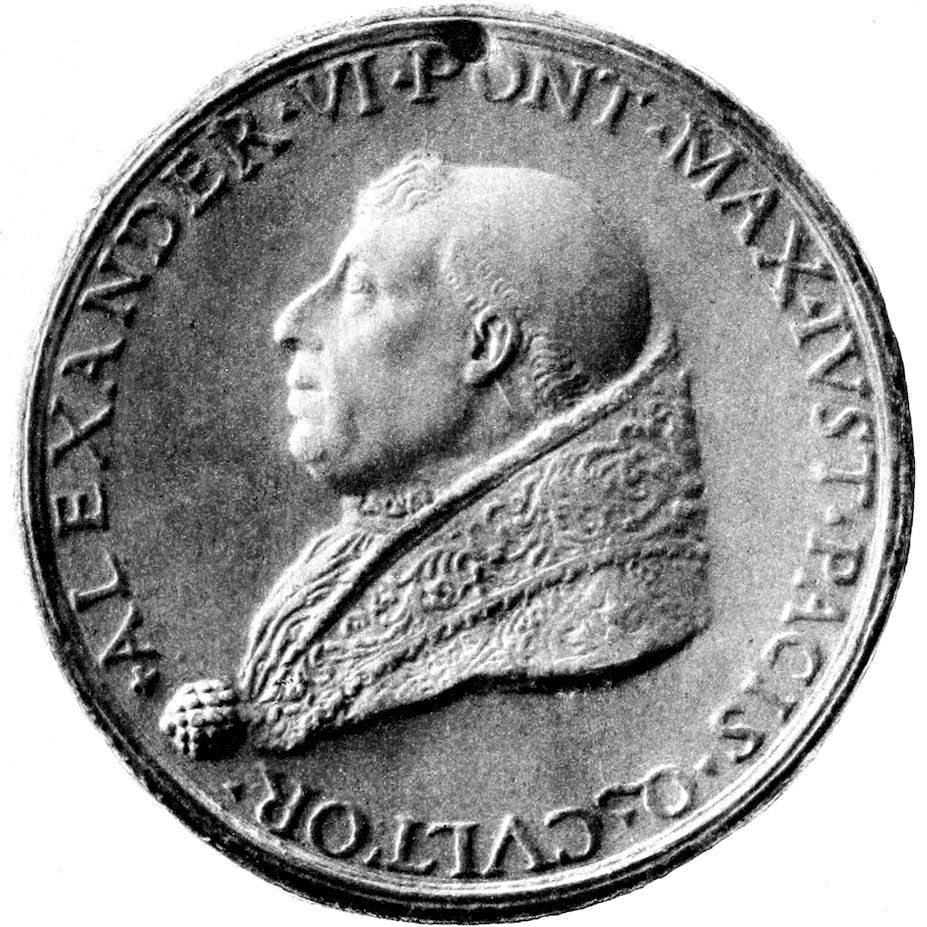
Alexander P.P. VI.
Those words were re-echoed from Milan, from Naples, even from far Germany, “They say that this will be a glorious Pontiff!” All who were permitted to approach Him were enchanted by His magnificent presence and His honeyed tongue; every one praised His talents, His notable mastery of affairs, His active benevolence and beneficence. He was admired because His habits were of the simplest kind, and His magnificence free from prodigal ostentation: though it must be added that the Ferrarese Orator said that people disliked 91dining with the Lord Alexander P.P. VI because His meals consisted of a single dish. But Rome and Italy generally were very proud of Him, because, at sixty-one years of age, He combined the vigour of manhood’s prime with the wisdom of experience of life. If peace could be maintained, while a strong hand guided politics, the auspices were all propitious.
On the thirty-first of August, at the First Consistory, the Lord Alexander P.P. VI named his nephew, Don Juan de Borja y Lançol (Giovanni Borgia, detto Seniore) Cardinal-Presbyter of the Title of Santa Susanna. This Most Worshipful Purpled One was the son of the Pope’s sister, Doña Juana. He had been Apostolic Prothonotary, Corrector of Pontifical Breves, and Archbishop of Monreale, under the Lord Xystus P.P. IV; and powerless Governor of Rome under the Lord Innocent P.P. VIII. He was a great man of business, dexterous and capable with plenary powers, and competent to deal with grave matters. The Lord Alexander P.P. VI, like His August Uncle, lost no time in securing the services of blood relation near to His Own person.
The chorus of flattery was not altogether free from discords. The sinister Cardinal Giuliano della Rovere, every day becoming more and more aggrieved by the success of his abhorred rival, called for a General Council (according to the ridiculous custom of his age) to adjudge the Lord Alexander P.P. VI guilty of Simony. In Florence the eccentric Fra Girolamo Savonarola, a friar of the Religion of St. Dominic, was prophesying evil days. Lorenzo de’ Medici, “that monster of genius,” was dead; and he, literally, had been the Keeper of the Peace. His sons, Don Piero and Don Lorenzo Secondo, brothers to Cardinal Giovanni, were no fit successors to their renowned father. Fra Girolamo really ruled in Florence; and his rule was baneful, because he let his personality over-ride his principles. Starting, a few years before, to convert the sinners of Florence, he had preached naked Christianity. When he had smitten many souls to penitence, his converts (in the manner of converts) leaned upon him. He allowed himself to become a director. From director it naturally was but a step to dictator: and there is the human error of Fra 92Girolamo Savonarola. That is the point from which he went astray. As dictator, he brought not peace but a sword—privilege of not a human man. He ordained what the world calls eccentricities; he became impatient of opinion, of resistance, of control; his penitents were the Salvation Army of the fifteenth century, making singular exhibitions of frenetic benevolence. He had made himself, by perfectly legal means, independent of his local Dominican superiors; the Archbishop of the province had no jurisdiction over him; he was subject only to the General of Dominicans and to the Pope in Rome. He was absolutely sincere; he was a fervent Catholic; of his bonafides there can be no doubt whatever. He had no attraction of manner; his personal aspect was vulgar, terrible, appalling. Yet there must have been some charm in his teaching, for great and holy men left all to follow him; Messer Alessandro Filipepi (detto Botticelli) joined him. And now he claimed to be the prophet of the Most High, prophesying of evils at the door.
Milan menaced the peace of Italy. By the assassination of Duke Galeazzo Maria Sforza-Visconti in 1476, the duchy passed to his infant son Duke Giangaleazzo; whose widowed mother, the Duchess Bona of Savoja, ruled as Regent. Four brothers of her dead husband conspired against her; and in 1479, the eldest, Don Ludovico Maria Sforza-Visconti (detto Il Moro), took possession of her child and deprived her of the regency. Cardinal Ascanio Maria, brother of Il Moro, exerted himself in Rome to obtain confirmation of this heartless deed. Duchess Bona, distracted when she found her young son torn from her arms, knowing his infant life to be the only bar between his uncle Don Ludovico Maria and the throne of Milan, made frantic appeals for the intervention of France. But the Christian King Louis XI died before he could reply to that poor mother: and Don Ludovico Maria, as Regent, thrived, keeping the boy-duke at Pavia in a palace that was, in fact, a prison, in conditions not cruel nor fatal but assuredly not ducal, nor suited to the enjoyment and maintenance of life. In 1489 Duke Giangaleazzo reached the age of twenty 93years; and then it was remembered that his mother; the Duchess Bona, had affianced him in his infancy to Madonna Isabella, daughter of the heir of Naples, Duke Don Alonso de Aragona of Calabria. There appeared to be no reason why Don Ludovico Maria should exacerbate the royal House of Naples by interference with the keeping of this contract; the boy was eager, the girl was marriageable; and the wedding was celebrated with appropriate pomp. The usurping Regent insisted, however, that, as the young Duke was a minor, he should still remain in the condition of a ward; and the newly-wedded children retired to try conjugal life at Pavia. A year later, 1492, a son was born; and then Duke Giangaleazzo, by paternity emboldened into manlihood, became restive against his uncle’s yoke, protesting that he no longer would submit to the treatment of a boy. But Don Ludovico was well aware that long confinement shortens life; and he had kept his nephew a prisoner for ten years. He was not precisely of the stuff of which murderers are made; or a knife-blade delicately pushed between the youngster’s neck and spine long ago would have made the sceptre of Milan his. As Regent he had absolute power; and he was well content to wait. So he took no notice of Duke Giangaleazzo’s remonstrances; and, to pass the time, he practised marriage in his proper person, wedding the lovely Madonna Beatrice d’Este of Ferrara in 1491. (Don Francesco Sforza, son of Don Bosio Sforza and Madonna Cecilia Aldobrandeschi, heiress of Santafiora, the kinsman of Don Ludovico Maria, who arranged this marriage, was the Orator of Milan at the coronation of the Lord Alexander P.P. VI in 1492.) After the nuptials of the usurping Regent, the young Duke Giangaleazzo resigned himself to bear his lot. But his wife was furious, and thought of the interests of her baby son. “In real truth,” cried Madonna Isabella to her feeble spouse, “thou art Duke of Milan, and I thy Duchess. But thou art content to abide in Pavia while that Black, Don Ludovico, ruleth in thy duchy, and seateth Madonna Beatrice near him in my place on thy throne. I will have that girl to know that she is no duchess, and that I, I Isabella, am Duchess of Milan.” And the lady wrote to her father, Don Alonso de Aragona Duke of 94Calabria, who was heir to the crown of the Regno, inciting him to resent the insult put upon her, his daughter, to end the usurpation of Don Ludovico Maria, and to restore Duke Giangaleazzo to his duchy.
Duke Don Alonso was not unwilling. War was imminent between Naples and Milan. Then the Pope died; the Lord Alexander P.P. VI succeeded Him; and, it being an age when the Pope frankly was admitted to be Ruler of the World, Father of princes and of kings, etc., all Italy and Christendom waited to know the new Pope’s pleasure.
This was the first of a series of extremely delicate positions in which the Lord Alexander P.P. VI found Himself involved. On the one hand, the Papacy was at peace with Naples. On the other, the Pope’s Holiness found His brilliant young Vicechancellor-Cardinal Ascanio Maria Sforza-Visconti to be exceedingly valuable; and he was own brother to that Don Ludovico Maria (detto Il Moro) against whom Naples was invoked. Momentous consequences waited on His action.
On the eleventh of December 1492, there arrived in Rome Don Federigo de Aragona, Prince of Altamura, second son of King Don Ferrando I, ostensibly to offer to the Pope’s Holiness the obedience of Naples, with congratulations on His coronation. The royal envoy sumptuously was entertained by Cardinal Giuliano della Rovere, whose chief occupations at this period appear to have been the feeling of the pulses of the Powers, and the search for a potentate willing to be used against the Borgia.
Manifestations of goodwill between Papacy and Regno pleased the Romans. The frontier of Naples was but a day’s ride from Rome; and the Romans liked to feel that beyond that frontier flourished a friend, not lurked a foe. In private audience, however, Don Federigo said that the assistance of the Pope’s Holiness was required in a family affair; and he made it clear that the attitude of Regno to Papacy would be determined by the extent to which the Lord Alexander P.P. VI would go on behalf of Naples.
This was the case in question. King Matthias Corvinus 95of Hungary had married Madonna Beatrice, a bastard of King Don Ferrando I. On the death of King Matthias Corvinus, his childless widow Queen Beatrice had intrigued to get the Hungarian crown settled upon King Wladislaw of Bohemia, who, in return for her Majesty’s services, had promised to marry her. Such a promise of marriage was equivalent to a betrothal, and a betrothal was only less binding than an actual marriage in that it was capable of being dissolved; whereas a marriage was, and is, indissoluble. King Wladislaw of Bohemia had been crowned King of Hungary through the exertions of Queen Beatrice. She, preferring the situation of Queen Regnant to that of Queen Dowager, had performed her part of the contract; and now King Wladislaw had changed his mind, and was about to ask the Pope for a dispensation from the obligation of fulfilling his promise of marriage. This was a grievous insult to the bastard of the King of Naples, whose counterpetition to the Lord Alexander P.P. VI was that no such dispensation should be granted to King Wladislaw, and that he should be compelled to perform his part of the bargain. Nothing was said at this time regarding the affair of the Duchess Isabella of Milan, in which the Regno also was interested. The cases of queens take precedence of those of duchesses.
The Lord Alexander P.P. VI, with the experience of seven and thirty years of curial diplomacy behind Him, required time in which to reflect upon His answer; and would enter into no immediate engagement with the Neapolitan prince. Don Federigo, who imagined that the Regno had but to ask and have, was much aggrieved; and his host, Cardinal Giuliano della Rovere, inflamed him with sardonic sympathy, and eyed the Regno, for a purpose, from that day forward. An uncouth pugnacious schemer was this Most Illustrious Lord Cardinal. As a captain of condottieri he might have captured a kingdom: but as an ecclesiastic he was at all times utterly disedifying. The Lord Alexander P.P. VI seems to have treated him with admirable forbearance, with contemptuous indifference, than which no attitude is more calculated to sting and irritate an angry mediocrity. He had been allowed to proceed in his 96turn to the cardinal-bishopric of Ostia without let or hindrance: he had rank, riches, and power. But he was discontented, jealous, filled with envy, hatred, malice, and all uncharitableness.
It is imperatively important to be able to distinguish between the Office and the Man; and to avoid the excessively vulgar error of confounding the general with the particular. The pontifical acts of Rodrigo, Who is called Alexander P.P. VI, will compare favourably with those of any Supreme Pontiff, from Simon, Who is called Peter P.P., to Gioacchino Vincenzo Rafaele Luigi, Who is called Leo P.P. XIII. His comportment as man, and Italian despot, is another matter. The just necessity of the distinction insistently is laid upon the student of His history.
Man does not yearn to please a person who is playing ugly tricks upon him. The Lord Alexander P.P. VI particularly did not yearn to please the King of Naples. While the envoy of the Regno was displaying his royal father’s petition at the feet of the Father of princes and of kings, the Pope’s Holiness was digesting news of a trick which had been played upon Him by the intrigues of King Don Ferrando I.
Don Franciotto Cibo, bastard of the Lord Innocent P.P. VIII, had been enriched by his Father with the lordships of Cervetri and Anguillara. These were pontifical fiefs, held by feudal tenure from the Pope. Being a silly avaricious weakling, rather frightened of the responsibility of baronage, Don Franciotto Cibo sold the said lordships to Don Virginio Orsini for forty thousand ducats; and went to live at Florence under the protection of his brother-in-law Don Piero de’ Medici. Now Don Virginio Orsini had borrowed those forty thousand ducats from the King of Naples, who was his firm friend, and perfectly qualified to understand the loan to be a super-excellent investment. The lordships of Cervetri and Anguillara lay between the Regno and the territories of the Republic of Florence; and their transference into the hands of Orsini, Naples’ friend, signified the opening of a road from Naples into Tuscany, along which a Neapolitan army easily might travel, should 97King Don Ferrando be pleased to campaign in a northerly direction.
It was Don Ludovico Maria Sforza-Visconti (detto Il Moro), the usurping Regent of Milan, who first saw the serious portent of this move: but, though he communicated his discovery to the Holiness of the Pope, he laboured under a slight misapprehension; for usurpers are the most touchy of mankind, and see an enemy in everything which they do not understand. The northern frontier of Tuscany impinged upon the southern frontier of Milan. Now that the southern frontier of Tuscany was connected, by Cervetri and Anguillara, with the Regno, Don Ludovico Maria suspected an alliance between Don Piero de’ Medici and King Don Ferrando I, between Tuscany and Naples, an alliance which most possibly implied designs detrimental to the duchy of Milan—after all the real Duchess Isabella was Naples’ bastard, thought Don Ludovico Maria, the usurper—; and he envoyed swift couriers to his brother the Vicechancellor-Cardinal in Rome, with instructions to advise the Pope’s Holiness of the imbroglio.
That was the news of which the Lord Alexander P.P. VI chewed the cud at the time when He gave audience to the Prince of Altamura. With His magnificent talent for resolving diplomatic problems into their elements, from which He could discard those that He deemed useless while reserving those possessing salient features, the Pope’s Holiness concluded that the politics of Milan, of Tuscany, of the Regno, and the affairs of their respective rulers, were of secondary importance and altogether negligeable; but that the secret unauthorised transfer of papal fiefs into the hands of dangerous malcontents of the very powerful House of Orsini, required prompt decisive assertion of the rights of the Pontifical Suzerain.
At the beginning of 1493, Cardinal Ascanio Maria Sforza-Visconti was found to be urging the Supreme Pontiff to act against the illegal transfer of Cervetri and Anguillara. Loyalty to his brother, the usurping Regent of Milan, and his duty as Vicechancellor bound to maintain the paramountcy of the Holy Roman Church—these make clear his point of view.
98A clashing of interests between Papacy and Regno was an opportunity which Cardinal Giuliano della Rovere greatly relished. He did not hesitate to take the part of Naples. If he had one enemy whom he hated as perfervidly as he hated the Pope, that enemy was Cardinal Ascanio Maria Sforza-Visconti whose exertions on behalf of his rival had deprived him of the tiara or triregno; and, having sworn that either he or Sforza-Visconti should quit the Sacred College, he avidly seized the present chance of belabouring the cardinal as well as the Pope. He had the support of Orsini, naturally. Colonna, always more Ghibelline than Guelf, was not unwilling to espouse the cause of a man who went about saying that the Pope’s Holiness was plotting to ruin his reputation—his reputation!—and to deprive him of his dignities: and hence arose a very singular and unusual combination.
The Papacy generally has been allied with Colonna or with Orsini. Such was the importance of these houses, that during many hundred years all European treaties and concordats contained their names on one side or the other. But here, for once in their mysterious and interminable feud, these mighty barons of Rome, with all their collateral branches and their myriads of armed retainers, were found united in a common cause. The phenomenon may be explained by the rise of other baronial houses, who were becoming quite as numerous and quite as potent as Colonna or Orsini; and who were equally desirable as allies. The most prominent of these, in 1493, were the Sforza and the Cesarini. The Sforza descended from Don Giovanni Muzio Attendolo (detto Sforza); and included the Sovereign-Duchy of Milan, by the marriage of the great Francesco with the heiress of Duke Giangaleazzo Visconti; the Sovereign-County of Santafiora, by the marriage of Francesco’s brother Bosio with the heiress of Aldobrandeschi; and the Tyrannies of Pesaro, Chotignuola, Imola and Forli. The Sforza blazon the lion rampant with the holy flower of the quince for Santafiora, and the salvage boy couped at the thighs issuant from a serpent statant for Milan. The Cesarini were a Roman house of enormous wealth and distinction, claiming a Cesarian origin. It was 99already allied with the Lord Alexander P.P. VI by the marriage in 1482 of His bastard Madonna Girolama Borgia with Don Giovandrea Cesarini. Its representative, Don Gabriele Cesarini, was the Gonfaloniere of Rome, who fought the Prior of the Caporioni for precedence at the coronation of the Lord Alexander P.P. VI, Who, in person, accorded the first place to Cesarini. Don Giangiorgio Cesarini, the heir, was allied with Sforza by marriage with Madonna Maria Sforza di Guido di Santafiora; and Don Giuliano Cesarini held office in the Apostolic Chamber. It was a house which, during centuries, had been content with secondary rank, while accumulating immense reserves of power, now to be brought into action. These were the two patrician Houses which the Pope’s Holiness found ready to His hand when Colonna leagued with Orsini against His peace. In fact, Sforza and Cesarini were the right and left hands of the Lord Alexander P.P. VI, as Colonna or Orsini were of His predecessors and successors.
Cardinal Giuliano della Rovere, after relieving himself of some treasonable speeches, considered Rome to be unsafe; and fled down Tiber to his bishopric of Ostia, where he fortified himself and advertised for mercenaries.
The word war, to the bloody men of valour of the end of the fifteenth century, signified a game like that of chess. The sole object of war was profit. It was undertaken simply to deprive an enemy of his goods. Prisoners were captured, and held to ransom. Cities and fortresses were reduced by starvation, or by a display of overwhelming force. But bloodshed—and this is noteworthy—was avoided as far as possible; and the game chiefly was played by strategic marches, counter-marches, and manœuvres. It was a business, a profession, “not more hazardous than that of a professional football-player.” The superfluous men of Europe, and the temperamental fighters, served as hired mercenaries under the captains and the princes who could pay their price and afford them a roystering life. Patriotism, the honour of the fatherland, were unknown. Except in the case of England, there was no national army. When a position had been won, a city captured, the conquerors satisfied themselves with the ransoms and the 100richest spoils. If the citizens wished to avoid the inconvenience of a sack, they collected a sum sufficient to pay off the rank and file. Otherwise the mercenaries took the women, and had licence to recoup themselves by pillage. Resistance meant torture and death: but bloodshed was an accident, not an essential of war.
The action of Cardinal Giuliano della Rovere was an invitation to the Lord Alexander P.P. VI to engage in war. He had thrown down the gauntlet. He had made the first move in the game; and his gambit was a very fine one, for the fortress of Ostia dominated Tiber mouth, and enabled him to paralyse Rome by stopping sea-borne supplies.
Like all important characters, the Pope’s Holiness was neurotic; not by any means a coward, but quick to scent danger, susceptible of momentary fright. Early in the spring of 1493 He was going to a picnic, at the villa which the Lord Innocent P.P. VIII had built for pontifical refreshment at La Magliana, outside the walls; and when a cannon saluted His approach He was stricken with a sudden panic, and galloped back to the Vatican amid the frank execrations of His escort disappointed of their dinner.
Here was the situation. The Pope was comfortably embroiled with Cardinal Giuliano della Rovere and his allies of Naples, of Colonna, of Orsini. To some extent His interests tied Him to Sforza and Milan. Tuscany was undecided between the Pope and Naples. The other Powers looked on.
While Don Ludovico Maria Sforza-Visconti was suggesting an alliance between the Pope, the duchy of Milan, and the Republic of Venice, to overawe the Neapolitan Bond, King Don Ferrando was intriguing with a view to discover whether he could make a better bargain with the Sovereign Pontiff than with Colonna + Orsini + della Rovere. This was not treachery. It was merely the Neapolitan method, of which all Italy was fully cognizant. The King’s Majesty sent envoys to Rome, to Milan, and to Tuscany, to try to settle the Cervetri-Anguillara affair by pacific means.
The Lord Alexander P.P. VI was well aware that no confidence could be placed in King Don Ferrando I: but 101by way of giving him a chance He proposed a marriage between His bastard, Don Gioffredo Borgia, now of the age of twelve years, and Madonna Lucrezia, a grand-daughter of the Majesty of Naples. At the same time He gathered troops and fortified the Vatican and the Mola of Hadrian, with the gallery-passage, called Lo Andare, which connects them, enabling Pope and cardinals to run, in time of danger, from the Apostolic Palace to the impregnable fortress tomb by Tiber.
The Republic of Venice flung itself into the arms of Don Ludovico Maria Sforza-Visconti; for the Doge and Senate were dreadfully afraid lest the impassioned appeals of the Duchess Isabella on behalf of her husband, the pathetic Duke Giangaleazzo, should receive the attention of Naples. If the said Duke Giangaleazzo should come to owe his throne to King Don Ferrando I, then Milan would be, to all intents and purposes, a fief of the Regno; and to have Naples lording it in Northern Italy would by no means satisfy Venice, which, on this account, preferred alliance with the usurping Regent, even at the cost of winking at his usurpation of the Regency of Milan. Now Milan and Venice in alliance were a menace to their own neighbours; and, acting on the principle that made those two Powers one, the duchies of Mantua and Ferrara, and the Republic of Siena, hastened to fall into line with them. This concatenation, being superior to anything that Naples could exhibit, also caused the Lord Alexander P.P. VI to arrive at a decision: and, on the twenty-fifth of April 1493, accompanied by an armed cavalcade of Sforza and Cesarini for the ocular instruction of Colonna and Orsini, the Holiness of the Pope proceeded through Rome to the Venetian church of San Marco, on Piazza Venezia, where He ceremonially published the Bull of League between the Papacy, the duchies of Milan, Mantua, and Ferrara, and the Republics of Venice and Siena; after which, the river-port of Rome at Ostia being in His enemies’ hands, He began to fortify the land-port of Rome at Civita Vecchia, by way of giving effect to His warlike proclamation.
At this call of check, Cardinal Giuliano della Rovere howled aloud for a General Council to depose the Lord 102Alexander P.P. VI; and Don Alonso de Aragona, Duke of Calabria, wanted immediately to unite with Don Piero de’ Medici and the Signoria of Florence, and, aided by the Colonna of Paliano and Marino and the Orsini of Gravina and Bracciano, to assault Rome from the outer side, while Colonna + Orsini, who were in the city, engaged in similar diversions. But King Don Ferrando was too sly. He had yet another piece to play. He knew, and none knew better, that the territories of the Holy See during a long course of centuries had been distributed among pontifical relatives and favourites; that, at present, the States of the Church were smaller than an ordinary duchy; and he had heard of the Lord Alexander P.P. VI as a singularly affectionate father, devoted to His children’s interests. Wherefore the Majesty of Naples conceived, and with absolute correctness, that the Pope’s Holiness intended, by hook or by crook, by diplomacy, by marriages, or by war, to recover the possessions of the Papacy, and to use them to promote the fortunes of His family. Secondly, King Don Ferrando I knew France to be Milan’s northern neighbour; and he saw the exceeding possibility of an alliance between the usurping Regent, Don Ludovico Maria Sforza-Visconti, and the Christian King Charles VIII of France; a combination which, with the Papacy, the duchies, and republics, already joined in league, would be absolutely and permanently overwhelming and disintegrating to the very Regno itself. To turn the flank, as it were, to give France occupation in another direction, he resolved on courting an alliance with Spain.
To this end he indited an invective against the Lord Alexander P.P. VI, adopting all the gratuitous insults and lying babble foamed out by the malignant Cardinal-Bishop Giuliano della Rovere. “He leads a life that is abhorred by all, without respect to the seat He holds.” [Compare the speeches of the Orators and contemporary dispatches.] “He cares for nothing save to aggrandise His children by fair means or by foul.” [So far He had done nothing at all, by foul means or by fair, for His children; except to deprive His reputed bastard Don Cesare (detto Borgia) of the revenues of the cathedral of Cartagena, in favour of that very Cardinal Giambattista Orsini who now deserted Him.] 103“From the beginning of His pontificate He has done nothing but disturb the peace.” [This is partly true. The Pope’s Holiness wonderfully had done more than any preceding Pontiff to restore good government and order and security to Rome. But He had behaved, in a certain instance, in a way that was extremely offensive to the Spanish ideal of peace. According to the notions of King Don Ferrando I de Aragona, himself a Spaniard—according to Spanish notions, and the Majesty of Naples was a Spaniard writing to Spaniards—the Lord Alexander P.P. VI was indeed a disturber of the peace. But the facts are these. In 1492, the horrible Spanish Inquisition—that frightful and diabolical atrocity constantly condemned by Rome—under the guidance of the Grand Inquisitor Torquemada, had procured the expulsion of the Jews from Spain. The Spaniards have much of the Moor, a touch of the oriental, the element of the human devil, in their blood. Throughout Christendom the Jews were looked upon with horror, by no means undeserved. Many long years before, England had cast them out; and now they were forced from Spain. The sufferings, with which the fiendish Spaniard visited them, were so fearful as to excite pity even in Papal Italy, whose loathing of Jews was a habit of mind, an article of faith, not an inhuman vice. Messer Giovanni Pico della Mirandola (detto Fenice degli Ingegni) said:—
“The sufferings of the Jews, in which the glory of Divine Justice delights, were so extreme as to fill us Christians with commiseration.
Senarega said:—
“The matter (i.e., the expulsion of the Jews) at first sight seemed praiseworthy as regarding the honour done to our religion; yet it involved some amount of cruelty, if we look upon them (the Jews) not as beasts but as men, the handiwork of God.
Many of this miserable race came to Rome, where, under the expressed order of the Lord Alexander P.P. VI, they were protected, and allowed to share in that security of life and limb which He, at the beginning of His pontificate, had ordained. The Romans did not like these Marañas, as the Moorish Jews were called, any more than they liked, or like, Catalans, or Franks, or Goths, or any other 104foreigners save the English-speaking race; and, following hereditary instinct, there were occasional attempts at persecution, the rigorous stamping out of which, by the justice of the Pope, caused intermittent rioting and disaffection of the citizens who only could look upon the Jews as fair game. That was the only disturbance of the peace with which King Don Ferrando could charge the Holy Father; and it was an act of justice and humanity. But the fifteenth century, in common with the nineteenth (the twentieth is too young yet to be judged), was very wont to give a bad name to the dog that it had failed to hang.]
Any success that might have attended the rabid calumnies of the Majesty of Naples was prevented by an occurrence of the most startling species.
A mariner of Genoa, called Messer Cristoforo Colombi, announced to the Spanish Court, in March 1493, the astounding news of his discovery of a continent. An explorer’s ardour, combined with religious zeal, had made him seek to extend the boundaries of Christendom. He had set out in the hope of finding a few islands. He returned to Europe solemnly asserting that he had found a world. Universal curiosity was awakened, and a fresh expedition planned, with which the intrepid mariner set forth on a second voyage to prove, and to secure, his prize. Meanwhile, Don Hernando and Doña Isabella, the Catholic King and Queen of Spain, thought it would be prudent to bind this new world to their domain by a bond that easily could not be broken. The Pope, as Ruler of the World and Earthly Vicar of Jesus Christ, was held to have authority over all heathen lands, and to His Holiness an envoy went from Spain commissioned to announce the discovery, and to pray Him graciously to confirm it to the Catholic King and Queen.
Precipitevolissimevolmente (no other word describes the act) was issued a Bull, dated “At Rome by St. Peter’s, the year of our Lord’s Incarnation, 1493, the fourth day of the nones of May, and the first year of Our pontificate,” giving to Don Hernando and to Doña Isabella, and to their heirs and successors, all islands and continents, discovered or yet 105to be discovered, in the western ocean, west and south of a line to be drawn from the North Pole to the South Pole, one hundred leagues west of the Açores and Cape Verde Islands. The language of this Bull is exquisitely touching; strong, pregnant, earnest, and majestic, as the Authorised Version of the Epistles of St. Paul. The motive undoubtedly is the motive of an Apostle to convert a world to Christ. The grant is made to the Majesty of Spain, with commands to send honest God-fearing learned and expert men to teach the Christian Faith; and the penalty of excommunication latae sententiae is imposed upon anyone, even royal or imperial, who shall interfere. This supremely beautiful Pontifical Act, the Bull Inter caetera of the Lord Alexander P.P. VI, is given verbatim in Raynaldus, sub anno 1493. So in return for the Borgia, which Spain gave to Italy, Italy and the Borgia gave Messer Cristoforo Colombi and the New World to Spain.
Don Hernando and Doña Isabella, the Catholic King and Queen, were Spaniards. And when that is said all is said; and all the hideous history of the New World under Spanish domination is explained. Those sovereigns bore no goodwill for the Lord Alexander P.P. VI although He was a Spaniard. They, like every other sovereign of Europe, were quite prepared to harass and to flout an unobliging Pope up to the verge of excommunications and interdicts; when they, of course, would cringe and cower like the villainous usurper John Plantagenet: but the quick granting of their petition in this matter of the New World, the immense distinction which the Bull Inter caetera conferred on them and on Spain, turned them, from suitors prepared with impertinence, into the abjectly devoted adherents of the Lord Alexander P.P. VI, at least for the time; and absolutely prevented King Don Ferrando’s application for an anti-pontifical alliance from meeting with success. This, no doubt, is that on which the Pope’s Holiness counted. Very seldom in life does a man so clearly see his duty with the certainty of reward for its prompt performance. And very rarely, in the pontificate of the Lord Alexander P.P. VI, did He deign, so immediately and so unreservedly, to grant a favour. He must have 106perceived, with that marvellous instinct of His, which led Him inevitably to the very roots of matters, that for once the paths of duty and of pleasure coincided. Certainly He unhesitatingly walked therein.
On the twelfth of June the Lord Alexander P.P. VI married His bastard, Madonna Lucrezia Borgia, of the age of fifteen years, to the Tyrant of Pesaro, Don Giovanni Sforza, of the age of twenty-six years, with all the magnificence due to His secular rank as an Italian despot; and thereby set wagging the tongues of those who lamented the decay of ecclesiastical discipline, and who could not distinguish between the dual and contradictory offices which the Pope was expected to reconcile; as well as the pens of professional manufacturers of squibs and lampoons. The wedding-banquet took place at the Vatican, in the presence of the Pope, ten cardinals, and fifteen Roman patricians with their wives. The Holy Father presented to the ladies silver cups filled with sweetmeats, throwing them into their bosoms ad honorem et laudem Omnipotentis Dei et Ecclesiae Romanae, says the golden-mouthed, venomous, untrustworthy historian, Messer Stefano Infessura. In the evening there was dancing, with comedies of the conventional coarse but common type. This event is one of the bases from which disgusting charges have been levelled against the Lord Alexander P.P. VI. It summarily may be stated that those charges consist entirely of the unprintable gossip of enemies or inferiors, and that not one of them satisfactorily can be proved. That the Vicar of Christ should have condescended so far is impossible; that a temporal sovereign should have condescended so far is probable, and, perhaps, regrettable; but the status of the guests, the ten cardinals, and the fifteen Roman patricians with their wives, guarantees the utter respectability of the Despot’s little private party from a contemporary point of view.
In June, also, arrived in Rome Don Diego Lopez de Haro to offer to the Holiness of the Pope the homage and obedience of Spain. These having been accepted, the Orator proceeded to remonstrate with the Pope, in the name 107of the Catholic King and Queen, regarding the asylum extended to the Marañas who were fled from the Spanish Inquisition to Rome. Thousands of these unfortunates were encamped among the tombs on the Appian Way, and had brought the plague with them. Spain execrated the Papal tolerance, and wondered that the Holy Father, as the Head of Christianity, should protect those whom Spain had driven away as being enemies of the Christian Faith. Further, the Spanish Orator said that the Christian King Charles VIII of France was threatening to invade Italy and to take advantage of the quarrels of the Italian Powers; wherefore he urged the necessity of peace, and an agreement among the sovereigns of whom the Pope was chief. By way of showing that concessions would ensure the unanimity of Italy, he set forth a list of ecclesiastical grievances that needed remedies; grievances “which, since the days of the Council of Constance, had been standing complaints against the Papacy, to be urged in all negotiations for other purposes.” (Creighton iv. 199.)
Publicly Don Ludovico Maria Sforza-Visconti harped upon the league between Venice, Milan, and the Papacy. Privately he entered into a secret treaty with the Christian King Charles VIII through Belgioso, Orator of Milan. Being an usurper he trusted not even his allies: preferring to have two strings to his bow, he believed that he could consolidate his position only by disturbing the peace of Italy.
Publicly, from his fortress of Ostia, that psychic epileptic, Cardinal Giuliano della Rovere, continued to shout for a General Council to depose his Rival. The abominable character of this cardinal well may be exposed by stating that he was endeavouring to rend the Church and Christendom with a Fortieth Schism, in order to satiate his personal revenge.
And, like Gallio, the Pope’s Holiness cared for none of these things—for Spain, for Milan, for the contemptible cardinal. He believed in Himself, and in His Own power to rule. At least, He officially had been saluted as Ruler of the World.
108The intrigues and invectives of the King of Naples deservedly having failed, his Majesty made the experiment of a hostile demonstration. His second son, Prince Don Federigo of Altamura appeared with eleven galleys at Ostia on Tiber mouth; and rapturously was hailed by that traitor-cardinal-bishop, with the Colonna and Don Virginio Orsini.
The Lord Alexander P.P. VI was willing to negotiate. Borgian negotiations invariably meant that Borgia would give its opponents something, but not the something that they wanted, and always in such a way that it could not be refused. The Naples + Colonna + Orsini + Cardinal Giuliano della Rovere conspiracy had demanded Cervetri and Anguillara for Orsini (and Naples) and the disgrace of the Vicechancellor-Cardinal Ascanio Maria Sforza-Visconti to satisfy the spleen of him of Ostia. On the twenty-fourth of July the cardinal, the Neapolitan prince, and Don Virginio Orsini came to Rome to hear the pontifical terms, which were:—
(α)
That the Pope’s Holiness would confirm Cervetri and Anguillara to Don Virginio for life; at his death they would revert to the Holy See: but he must pay into the pontifical treasury their price of forty thousand ducats, which he previously had paid to Don Franciotto Cibo:
(β)
That the Pope’s Holiness was willing to forgive and to show favour to Cardinal Giuliano della Rovere: but He refused to disgrace the Vicechancellor-Cardinal Ascanio Maria Sforza-Visconti:
(γ)
That the Pope’s Holiness would consent to ally Himself with the Royal House of Naples by the marriage of His bastard, Don Gioffredo Borgia, to Madonna Sancia, bastard of Don Alonso de Aragona, Duke of Calabria and heir of King Don Ferrando I. This agreement was ratified by betrothal; and Don Gioffredo set out for Naples to see the girl, and to receive her dowry with the title Prince of Squillace. The marriage was postponed for the present, because neither bride nor bridegroom had completed their thirteenth year.
109No sooner was the treaty of peace signed, than the Sieur Perron de Basche, Orator of the Christian King Charles VIII of France, arrived in Rome, armed with instructions to prevent an alliance between Papacy and Regno, and to obtain pontifical confirmation of the election, by the Rouen chapter, of Messire Georges d’Amboise as Archbishop. The Supreme Pontiff, by way of emphasising His independent attitude to France, refused to receive the Orator in audience, annulled the election of Messire Georges d’Amboise, and named one of His Own court to the Archbishopric of Rouen. This was what the twentieth century timidly calls an “unfriendly act”; and the Christian King forthwith began to sympathise with Cardinal Giuliano della Rovere’s recent clamour for a General Council to depose the Lord Alexander P.P. VI, and to meditate thereon day and night.[25]
To strengthen His influence in the Sacred College by adding creatures of His Own, at the Second Consistory of the twentieth of September 1493, the Lord Alexander P.P. VI named twelve new cardinals.
These were:—
(α)
The Lord John Morton, Archbishop of Canterbury, Lord High Chancellor of England, whose virtues have been praised by another English Chancellor, the Blessed Sir Thomas More;—Cardinal-Presbyter of the Title of Santa Anastasia;
(β)
The Lord Giovantonio di Sangiorgio;—Cardinal-Presbyter of the Title of San Nereo e Sant’ Achilleo;
(γ)
Frère Jean Villiers de la Grolaye, Lord Abbot of Saint Denys by Paris;—Cardinal-Presbyter of the Title of Santa Sabina;
(δ)
The Lord Bernardino Lopez de Caravajal, Apostolic Legate to Caesar Friedrich IV, the eloquent 110preacher at the Conclave of 1492;—Cardinal-Presbyter of the Title of San Marcellino e San Pietro:
(ε)
The Lord Raymond Perauld,[26] a Frenchman, Apostolic Nuncio in Germany;—Cardinal-Presbyter of the Title of San Giovanni e San Paolo:
(ζ)
The Lord Cesare (detto Borgia), reputed bastard of the Lord Alexander P.P. VI, and of the age of eighteen years;—Cardinal-Deacon of Santa Maria Nuova:
(η)
The Lord Ippolito d’Este, of the age of fifteen years, a great athlete and fighter from boyhood to youth, and a prince of the Royal House of Ferrara; “tall he was of frame, brawny of sinew, mighty of limb, strengthening his robustitude with exercises, archery, and hurling javelins; grace and charm bloomed on the face of him; his bright eyes beamed with grave tranquillity, worthy of all praise; most royal was his whole aspect; he was an expert swimmer; and with whatsoever weapons he adroitly strove he innured himself to heat and cold and night-long vigils”;—Cardinal-Deacon of Santa Lucia in Silice, alias in Orfea:
(θ)
The Lord Fryderyk Kasimierz Jagelone di Polonia, son of King Kasimierz of Poland, Bishop of Cracow;—Cardinal-Deacon of Santa Lucia in Septisolio, alias in Septizonio:
(ι)
The Lord Giuliano Cesarini (detto Giuniore), Apostolic Prothonotary, Canon of the Vatican Basilica;—Cardinal-Deacon of San Sergio e San Bacco:
(κ)
The Lord Domenico Grimani, Apostolic Prothonotary;—Cardinal-Deacon of San Niccolo inter Imagines: 111
(λ)
The Lord Alessandro Farnese, Apostolic Prothonotary (nicknamed “Cardinal Petticoat,” on account of the Pope’s partiality for his sister, Madonna Giulia Orsini nata Farnese);—Cardinal-Deacon of San Cosma e San Damiano:
(μ)
The Lord Bernardino de’ Lunati, Apostolic Prothonotary, friend of the Cardinal-Vicechancellor;—Cardinal-Deacon of San Ciriaco alle Terme Diocleziane.[27]
The vigour of this deed struck Cardinal Giuliano della Rovere and his friend King Don Ferrando into frantic silence. By a mere act of His Sovereign Will the Holiness of the Pope immensely had increased His Own potentiality. Two of the new creatures were scions of reigning dynasties, whose loyalty thereby was secured. The virtue and eloquence of the English cardinal were as twin towers of strength. The two French creatures were as a sop to France. The minor diaconate conferred on Don Cesare (detto Borgia) gave him a standing, from which the splendour of his youth might do great things. And the other cardinals were proved adherents, who, by being made to owe their promotion to the Lord Alexander P.P. VI, became bound (in so far as human foresight went) to His interests by the bond of gratitude. It was a most paralysing and disheartening stroke for the enemies of the Sovereign Pontiff; and the year 1493 ended amid renewed demands for a General Council from Cardinal Giuliano della Rovere, and renewed invectives from the Majesty of Naples.
On the twenty-fifth of January 1494, King Don Ferrando I died, in the seventieth year of his age and the thirty-fifth of his reign. He was a cautious and experienced politician; and, since the Lord Pius P.P. II, Lorenzo de’ Medici, and the great Duke Francesco Sforza-Visconti, the greatest 112secular statesman of his century. His policy was directed to the preservation of Italy from French invasion, and to the destruction of the Papal States. He was not harsh in his dealings with his subjects: but to his barons and to his opponents he behaved with cruelty and treachery. He liked to have his enemies always near him, either alive in the dungeons of his palace, or dead, and embalmed, and clothed in their habits as they lived. Yet he died regretted; for his heir, the thick-haired, thin-lipped, narrow-eyed, fat-jowled, asymmetrically-featured Don Alonso de Aragona, Duke of Calabria, enjoyed a reputation for violence and brutality the bare idea of which created universal terror.
The game of politics entered on a new phase. The Christian King Charles VIII of France was burning for an opportunity of asserting himself; and had collected an army, ostensibly for a Crusade against the Great Turk, the Sultán Bajazet, really for purposes of French aggrandisement—purposes yet undefined. He was a self-conceited little abortion, this Christian King, of the loosest morals even for a king, of gross semitic type, with a fiery birth-flare round his left eye, and twelve toes on his feet hidden in splayed shoes, which set the fashion in foot-gear for the end of the fifteenth century in Italy; and, like all vain little men, he was anxious to cut a romantic and considerable figure. He announced a claim to the crown of Naples.
This made it necessary for the Lord Alexander P.P. VI to compare the advantages of France as an ally with the Regno; and, in the meantime, that He might lead the Christian King to declare himself with more particularity, the Pope’s Holiness addressed a Brief to him in which the subject of Naples was not named: but which assured him of pontifical favour, and gave him leave to pass through Rome with his army on the way to his contemplated Crusade. There was dissatisfaction in the Sacred College about the matter of the Archbishopric of Rouen; and some of the cardinals were beginning to think that the time was come for turning coats, especially as it was known that the Orator of France had made overtures of friendship on the part of his sovereign to Cardinal Giuliano della Rovere.
113The Supreme Pontiff finally concluded that He would rather have an ally on His frontier, than an ally whose territories were separated from His by the domains of other princes. He decided to leave France out of the question; and to recognize the heir of the late King Don Ferrando I. Accordingly He conveyed this news to Don Alonso de Aragona Duke of Calabria, adding that He would envoy a Legate to Naples to concede investiture and to perform the ceremony of coronation. At the same time, the Pope’s Holiness sent the Golden Rose to the Christian King; and it is hard to know whether this gift symbolized consolation or contempt. If the former, then the gift should have been a sword; for the Sword is the pontifical gift to kings. If the latter, then it was bitterly appropriate, for the Golden Rose is the pontifical gift to queens. Yet only with difficulty one can conceive of the Pope as deliberately setting himself to provoke a reigning sovereign who heads a mobilized army; and the act may have been merely one of those slipshod performances which the greatest geniuses, from time to time, provide to remind mankind of the maxim non semper arcum tendit Apollo. But all the same the Lord Alexander P.P. VI was a very strong man, guilty of hiding none of His human weaknesses.
When the Pope issued His Bull on this matter of the Investiture in Public Consistory, storms ensued. Cardinal Giuliano della Rovere, again diplomatically deprived of his Neapolitan friends, flitted from Rome to Ostia with the pontifical condottieri at his heels. From Ostia, he shipped to Genoa, and made haste to present himself to the pink-eyed Majesty of France. The French Orators in Rome shrieked “We are betrayed” in the consecrated formula; and hurried to safe places. And the fortress of Ostia capitulated to the Pope.
In May, the Lord Giovanni Borgia, Archbishop of Monreale and Cardinal-Priest of the Title of Santa Susanna, received his Brief as Apostolic Ablegate, and went to Naples to crown the new king. The fourteen-year-old Don Gioffredo Borgia accompanied his Most Worshipful cousin; and was married on the coronation-day, the seventh of May.
Madonna Sancia, bastard of King Don Alonso II, who 114confirmed to him the title of Prince of Squillace with a revenue of forty thousand ducats. Also, as an earnest of his gratitude to the Pope, the King of Naples conferred the Principalities of Teano and Tricarico on Don Juan Francisco de Lançol y Borja, eldest surviving bastard of the Lord Alexander P.P. VI (who already had procured for him the Spanish duchy of Gandia;) and enriched Cardinal Cesare (detto Borgia) with Neapolitan benefices. The Papacy and the Regno now were a Dual Alliance.
In Italy of the fifteenth century, men’s minds chiefly were occupied with the accumulation and disposition of matters connected with the intellect and the tastes. The Elect-Emperor Maximilian, who in 1493 succeeded the Pacific Caesar Friedrich IV on the throne of Central Europe (called the Holy Roman Empire) was adding outlying territories to the possessions of his dynasty, the Habsburg House of Austria. Spain was freeing herself, by means of steel and faggot, from her brain, i.e., the Moors and Jews; and in exploiting her New World. England was enjoying peace and a new dynasty, since the close of the War of the Roses in 1485. France had made peace, at a price, with King Henry VII Tudor in 1492; and with Spain, at the cost of her frontier provinces of Cerdogne and Rouissillion, in 1493. Lastly, the Christian King Charles VIII of France had pacified the rage of the Elect-Emperor Maximilian, whom he had robbed of his betrothed the Duchess Anne of Bretagne, by ceding to him the greater part of Burgundy. For the rest, nearly all the kingdoms, duchies, and fiefs of France had fallen into the hands of the vaunting Charles, by conquest, inheritance, lapse or marriage. Finding himself at the head of a great army experienced in the art of war, and with a domain smiling with prosperity, he looked for fresh fields to conquer. The chivalric glamour of the Crusade had by no means faded: it dazzled the pink eye of France: and, at one time, undoubtedly the Christian King intended to march on the Muslim Infidel, now settled in Europe and unmolested. But, with the death of King Don Ferrando I, the fickle Frenchman revived an old claim of the House of Anjou to the crown of Naples, intrigued 115with Cardinal Giuliano della Rovere, and brought his veteran army south to Lyons; where he spent his time in lubricity, until he should have felt the pulses of the Italian Powers with reference to his undertaking. French envoys reported to him that the Papacy was allied with Naples, and Naples with Don Piero de’ Medici of Tuscany; that Don Filiberto the Fair, (the boy-duke of Savoja, married to the Elect-Emperor’s daughter Anne,) with Duke Ercole d’Este of Ferrara, the Marquesses of Monserrat and Saluzzo, and the Republic of Venice, were neutral. The auguries were not propitious for France; but the Christian King, emboldened by the presence, and attentive to the rhodomontades of, Cardinal Giuliano della Rovere, and stupidly believing it possible to reduce a Pope by fear, joined in the duet and cried for a General Council. Indeed, he placed more confidence in the virtue of this threat than in his army; for he definitely threatened the Lord Alexander P.P. VI with deposition and deprivation of the Apostolic dignity, not by force of arms, but by canonical proof of His simoniacal election—unless He would concede to France the crown of Naples. (Corio, Storie di Milano. III 525)
It is very difficult to understand these shouters for a General Council. They were so clever, so logical, in other matters, that it is perfectly impossible for them to have been unaware of the extreme futility of their cry. They could not have been ignorant: then they must have been malignant. Suppose that an assemblage calling itself a General Council had been convened by the Cardinal-Bishop of Ostia and the Majesty of France, and had proved to its own satisfaction that Cardinal Rodrigo de Lançol y Borja had bought, by bribery, the votes of his brother-cardinals, raising himself by these means to the throne of God’s Vicegerent; what end would have been served? There was a moral but no legal prohibition then, as already has been shewn, to prevent a cardinal from buying votes, if he could find cardinals criminal enough to sell. The money-changers were, as now, in possession of the Temple; and the whip of small cords still on the Knees of God.
Suppose that a self-called General Council had decreed the deposition of the Pope on the ground of simony; the 116decrees of a General Council are ineffective until they have been promulgated with the expressed sanction of the Roman Pontiff. Is it probable that the Lord Alexander P.P. VI, that the sanctimonious Cardinal Giuliano della Rovere, that any human man, would sanction the promulgation of the decree that ordained his own deposition? If he did so declare himself to be no Pope, what would be the value of such a declaration? If he were Pope, he would not; if he were not Pope he could not, depose himself. Then what would have been the good, (if the Sokratic method be so far permitted,) of a self-called General Council which only could compile ineffectual decrees?
We are dealing with this matter in its human aspect only. Humanity was master of the mighty then, as now; Morality of the humble and meek. Suppose that a self-called General Council had decreed the deposition of the Pope: what would have happened? This—the Sacred College would have split into two or more factions; let us say two, to keep the argument in reasonable bounds. The Lord Alexander P.P. VI would have headed one faction; the envious Cardinal Giuliano della Rovere the other. Both would have gone into Conclave; the one in Rome, the other in France. The Roman Conclave would have affirmed the Lord Alexander P.P. VI to be the Pontiff-Regnant. The French conclave would have elected Cardinal Giuliano della Rovere, who incontinently would have blossomed forth as Pseudopontiff Julius II. Each would have created cardinals. Each would have administered as much of the Church and Christendom as he could have persuaded to submit to his administration. There would have been a Pontiff in Rome, a pseudopontiff in France. The sheep of Christ’s Flock would have been neglected, while the shepherds exchanged anathemas. It all had happened before—many times before. It would have been the Fortieth Schism. In course of time, death would claim the Pontiff or the pseudopontiff. His party would replace him. In course of time subdivision would take place, a schism in a schism. A section of cardinals would secede from Pontiff, or from pseudopontiff; call themselves the Sacred College in Conclave, and elect a second 117pseudopontiff. Christendom would have been torn asunder. The crime would have been capable of infinite development. All had been seen before, many times before—last, in this identical Fifteenth Century—the century of the Thirty-ninth Schism of the Holy Roman Church, the Thirty-ninth Rending of the Seamless Robe of Christ.
And that was the atrocious turpitude to which Revenge was leading Cardinal Giuliano della Rovere, and Vanity was leading the Christian King Charles VIII, all light-heartedly.
Being now in amity with Colonna and Orsini through the Neapolitan alliance, as well as with Sforza and Cesarini, the Holiness of the Pope proceeded to the Regno for the purpose of concerting a plan of campaign with King Don Alonso II, whom He met at Vicovaro on the fourteenth of July. There it was arranged that the King should hold the Abruzzi provinces with part of the Neapolitan army, while his son, Don Ferrandino de Aragona, with another part should make a swift advance on Milan by way of the Romagna, sending out flying columns to sweep the country free from rebels; and, after expelling the usurping Regent, Don Ludovico Maria Sforza-Visconti, and restoring Duke Giangaleazzo to the throne of Milan, he should force the French to engage in Lombardy. Meanwhile, Don Virginio Orsini with the pontifical condottieri was to protect the Papal States; and Don Federigo de Aragona, brother to King Don Alonso II, was to take the Neapolitan fleet, capture Genoa, and command the northern coast.
No better plan could have been invented for a war of the chess-game species: but in two places it was weak. It would occupy too long in performance; for the French army was on Milan’s frontier which half the length of Italy separated from Naples. It caused the defection of some Sforza: it alienated the Supreme Pontiff from His vicechancellor, His closest friend, for the Neapolitan scheme involved the expulsion from Milan of the brother of Cardinal Ascanio Maria Sforza-Visconti, who thereupon became neutral, Sforza holding by Sforza.
Before the Regno was ready, the French fleet reached Genoa, and the French army crossed the Alps to Milan. 118Admiral Don Federigo de Aragona, finding Genoa in his enemy’s hand, led the Neapolitan galleys to Porto Venere on the Gulf of Spezzia, only to sustain a repulse which caused him to retire to Livorno to repair his fleet. Seeing from which direction he might expect attack, the Christian King garrisoned Genoa with Swiss mercenaries under Duke Louis d’Orleans. On the eighth of September, the Admiral of Naples took Rapallo, a little city six leagues from Genoa, and landed troops. The French commander made an accipitrine swoop from Genoa, cut up the squadrons of Naples, and put Rapallo to sack and pillage for entertaining them. All Italy was amazed, paralyzed with horror, at war conducted on these bloodthirsty lines. The idea of being killed, except perhaps accidentally by being trampled underfoot in a rout, or in a simple personal quarrel, was terrible to people accustomed to battles which were processions, and sieges which were decorative occupations for gentlemen of leisure. Admiral Don Federigo led the remnant of his fleet to Naples without an hour’s delay.
Vicechancellor-Cardinal Ascanio Maria Sforza-Visconti now became aggressive, and successfully detached from the Pope the Houses of Colonna and Savelli; (the last, until their dynasty became extinct, held the office of Hereditary Marshal of the Holy Roman Church.) Colonna and Savelli then collected their retainers and menaced the Eternal City. On the eighteenth of September Don Fabrizio Colonna recaptured Ostia, and held it in the name of its renegade Cardinal-Bishop. French galleys transporting troops anchored in the mouth of Tiber. Crippled Naples dared not to advance on Milan leaving Rome unprotected. Then Madonna Caterina Sforza-Riario, countess and witch, (daughter of the great Francesco, and widow of the infamous Count Girolamo Riario of the Pazzi Conspiracy,) declared for France in her citadel of Imola, and made things worse for Naples and the Papacy by showing them that an enemy was in their midst. In this strait, and having no sovereign friend in Europe save the Majesty of Naples, the Lord Alexander P.P. VI applied to the Great Turk, the Sultán Bajazet. That wily oriental agreed to help, on condition that his brother and rival, the Sultán Djim, long years held 119hostage by the Papacy, should be delivered to his tender mercies. This the Pope’s Holiness refused, not caring to connive at fratricide; and so completed the isolation of Himself and King Don Alonso II.
On the sixth of October, the Supreme Pontiff thundered from the Vatican a demand for the restitution of Ostia, (held by Don Pierfrancesco Colonna (?)) on pain of the Greater Excommunication. He “fills a great place in history because he so blended his spiritual and temporal authority as to apply the resources of the one to the purposes of the other.” (North British Review.) At the same time, having intelligence of a Colonna plot to capture the Sultán Djim on behalf of France, He moved His mysterious ward from the Vatican by way of Lo Andare to the Mola of Hadrian on Tiber; and sent the Lord Francesco de’ Piccolhuomini, Cardinal of Siena, as Apostolic Envoy to the Majesty of France. But the Christian King would not receive him, saying that he was coming to Rome to see the Pope Himself.[28]
The Sultán Djim was a Mystery—the Fifteenth Century equivalent for the Man in the Iron Mask. The brother and rival of the Great Turk, the Sultán Bajazet, who reigned at Constantinople, he was given as a hostage to the Knights of Rhodes at a time when Bajazet wished to win the good graces of the Christian Powers, and to rid himself of a dangerous menace to his throne’s security. The Great Turk offered to pay forty thousand ducats every year, so long as the Sultán Djim was kept away from Byzantium; and he sent also the celebrated emerald, on which is carved an Image of our Divine Redeemer, to the Lord Innocent P.P. VIII. After a long detention, Frère Pierre d’Aubusson, Grand Master of the Knights of Rhodes and Cardinal-Deacon of Sant’ Adriano, transferred this valuable hostage to the Pope for greater security. The Sultán Djim was accorded apartments in the Vatican Palace, and kept a court of his own there in oriental luxury. The crumpled roseleaf of his existence was his constant fear lest his brother should 120envenom him; and envoys from the Great Turk were only allowed to enter his presence when rigorous and ceremonial precautions had been taken;—for example, an envoy bringing a letter from Bajazet was compelled to lick it all over, outside and inside, under Djim’s own eyes, before the last would touch it. The Lord Innocent P.P. VIII, and His successor the Lord Alexander P.P. VI, regarded the Sultán Djim as a precious guarantee for the good conduct of the Great Turk. “As long as Djim is in Our hands, Bajazet continually will be uneasy, and neither raise armies, nor molest the Christians;” wrote the Lord Innocent P.P. VIII. Later, the Great Turk conceived an alarm lest his discontented mamelukes should depose him in favour of his brother; and he proposed to pay a hundred and twenty thousand ducats to the Pope for the restoration of the Sultán Djim: undoubtedly intending to put him out of the way according to the methods observed by oriental potentates in reference to their rivals. But the Lord Innocent P.P. VIII refused to have art or part in crime, though He would have been very glad of the money for His family; and the Sultan Djim continued to remain in Rome. The same policy was pursued by the Lord Alexander P.P. VI, notwithstanding that the Great Turk had ceased to send the yearly forty thousand ducats, thus making his brother the pensioner, as well as the ward, of the Papacy. Then in October 1494, when the Eternal City was about to be the scene of war and tumult, the Pope’s Holiness placed His ward for safety in the Mola of Hadrian, the fortress tomb which also was His own refuge.
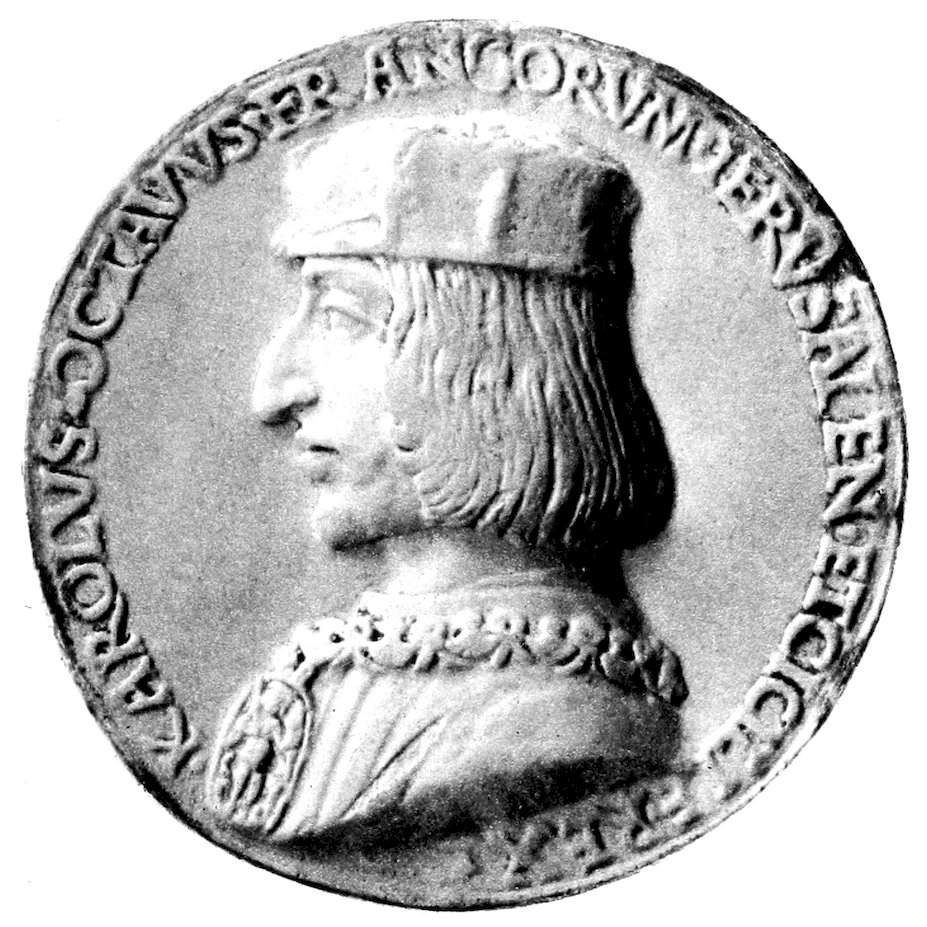
Charles VIII of France
On the same day when Admiral Don Federigo de Aragona fled with the Neapolitan fleet from Rapallo to Naples, the Christian King followed his army across the Alps. Being but a shallow-pated Frenchman, enervated with the most horrible of all diseases, he already was in a quandary: he had no money wherewith to pay his troops; his march for some weeks would lie through friendly territory, and, until he reached the pontifical states, he could find no cities to sack for the appeasing and encouragement of his mercenaries. To meet him, hurried Don Ludovico 121Maria Sforza-Visconti, also in a quandary: he was an usurping regent, with his legitimate sovereign under lock and key; and he was going to meet a legitimate sovereign-regnant. Whether Don Ludovico Maria would complete a little loan, was the question agitating the mind of the Christian King. Whether the Majesty of France would want to champion his Order, to release his brother sovereign and place him on his throne, and to behave severely and unpleasantly to an usurping regent, was the difficulty of Don Ludovico Maria. The two met at Asti. The Christian King at once broached his trouble; and Don Ludovico Maria, with his capacious Sforza brain-pan and his determined Sforza jaw, instantly perceived that he could recommend himself by being useful. He advised France rapidly to advance southward through the Romagna where rich spoils awaited him. And he found the means. Of the man who will lend money at the very moment when it is urgently required, none but the very best opinion can be formed. The Christian King was quite prepared to accept Don Ludovico Maria’s own estimation of himself, now. It was even safe to let him see the pathetic sovereign of Milan in his prison.
After being detained a few weeks by that which Italians call the French disease, because it was introduced into Italy by this Christian King, Charles VIII dawdled on to Pavia; and visited Duke Giangaleazzo Sforza-Visconti. The condition of that luckless prince was scandalous in the extreme. He was of the age of five and twenty years. He had been a prisoner during fifteen years. He was decrepid of body, helpless and dull of mind. His only joy in life was in his Duchess Isabella and in his four-year-old son, for whose protection he piteously entreated the Christian King. France put on a sympathetic aspect—it was perhaps the most gracious moment in the little creature’s life—; the nostrils of his ham-shaped nose wore an air of disgust at Duke Giangaleazzo’s suffering; the glare of his boiled eyes in their congenital flush, and the severe fat line of his mouth, horrified the usurping Regent. Had the money of Don Ludovico Maria been in the coffers of any one just then except the Christian King’s, undoubtedly 122right would have been done by the might of France. But, with promises to return, with excellent intentions to attend to the affairs of Milan when Naples should have been reduced with Milan’s money, the Christian King was persuaded to hasten on to Piacenza.
There, on the twenty-first of October, news came to him that the prince whom he had left in his prison, Duke Giangaleazzo Sforza-Visconti, was dead; and that Don Ludovico Maria had proclaimed himself, and had been accepted as, Duke of Milan. It was also said that the uncle had envenomed the nephew, having observed him to have gained the sympathy of France, and fearing lest that sympathy should restore him to his throne. It may have been so: but there is no evidence whatever on the subject beyond the mere assertion. But it equally might have been the effect of concentrated despair, at seeing deliverance come and pass away, acting on a body, naturally weak, worn by passion and imprisonment, which killed Duke Giangaleazzo Sforza-Visconti of Milan. The Fifteenth Century (and also the first decades of the Sixteenth) was so radically ignorant of the art and science, as well of venoms, as of their practical exhibition, that, unless direct in addition to circumstantial evidence be forthcoming, mere unproved charges based on “on dit,” “aiunt,” “fertur,” or “dicant,” may be disregarded and a natural cause of death assigned.
Florence, capital city of Tuscany and ancient friend of France, was in a critical condition. Lorenzo de’ Medici was just dead. His son, Don Piero had succeeded him. Don Piero’s brother Messer Giovanni, raised to the purple at the age of thirteen years, red-hatted at seventeen, was a Cardinal of Rome. The genius of the great Lorenzo had made him disguise his power. He had married at his own mother’s bidding Madonna Clarice Orsini, a patrician of Rome. His sons, educated by Canon Angelo Ambrogini (detto Poliziano), had grown up intellectual, grand, and gay, with an overweening sense of their own consequence; and, when the sceptre fell into his young inexperienced hands, Don Piero forgot his father’s advice, “Remember that thou art but a citizen of Florence, even as am I;” and he behaved 123autocratically, despotically, independently, to the immense antipathy of the Lily-City.
When the Majesty of France began his interference with Italian politics, Don Piero de’ Medici and Florence, being contracted to the Regno, declined the offer of a French alliance. The Christian King retorted by banishing Florentine merchants from France. This gave occasion for the enemies, (which, in common with all great Houses, Medici had) to blaspheme, muttering of the evils of a tyranny, of the advantages of a republic: and Don Piero’s cousins, Don Giovanni and Don Lorenzino, fled to the Christian King at Piacenza; saying that not Florence, but Don Piero only, was the foe of France.
Fra Girolamo Savonarola, friar of the Religion of St. Dominic, became a prominent and responsible figure in this imbroglio. Ecclesiastically he was a subject of the Dominican Congregation of Lombardy, who was led to desire independence and a pied à terre in Florence. Don Piero de’ Medici, seeing naught amiss, supported his application to Rome for the separation of the Tuscan Dominicans from allegiance to the Lombard Congregation; for, it was urged, the erection of a separate Congregation for Lombardy would add to the dignity of Florence, and would be a slight to Milan. The Lord Alexander P.P. VI, when the case was laid before Him in 1493, was inclined to favour Milan on account of the Vicechancellor-Cardinal who was brother to the usurping Regent: but, on the advice of Cardinal Oliviero Carafa, who officially had examined the matter on its merits, and who reported in favour of Don Piero de’ Medici and the weird friar, the Pope’s Holiness issued the Bull of Separation on the twenty-second of May that same year. Fra Girolamo Savonarola then transferred himself to the new Tuscan Congregation, was elected Prior of San Marco and Vicar-General; and so became the absolute ruler of the Dominicans in Florence, and subject only to the General of the Religion of St. Dominic, and to the Pope, in Rome.
He was a truly pious man, of the hard ascetic type, and very masterful. He used his independence rigorously to reform his Convent of San Marco, with, for a wonder, the 124complete concurrence of his friars; and so he formed a centre of the exclusively religious life. He would make no compromise whatever. He would have God entirely served; and countenanced no paltering with Mammon. He utterly spat upon and defied the World. He burned every pretty worldly thing. Lewd lovely Florence executed a quick change, and followed him in sackcloth and ashes. The alluring melody of Lorenzo de’ Medici’s Canti Carnaleschi was drowned in the chaunting of the Miserere mei Deus and the Seven Penitential Psalms with Litanies; while disciplines and scourges in the public streets fell like flails on youth’s white flesh. Fra Girolamo preached penance in the Advent of 1493. In the Lent of 1494, he preached from the book of Genesis. When he arrived at Noe’s Ark, he dwelled upon it; his subject fascinated him; each plank, each nail, became a symbol: but the moral of his allegory was, “Enter the Ark of Salvation that ye may escape the wrath to come.”
Florence was disturbed by expectation of the French invasion; which, said Fra Girolamo, (mixing his metaphors in the only way that the vulgar really understand) was the Scourge of God for the Purification of the Church. In September, he preached again. Visions came to him; and he preached of them in parables. His success, his ever-growing power, produced in him an effect like inebriation. Not yet having lost his self-control, he was able to see his danger. He made an effort, and ceased to preach. His brain was in a ferment; sleeplessness gnawed the remnant of his physical strength. Again he mounted the pulpit of San Marco, and thundered like a prophet, like a seer, not his own words now, but “Thus saith The Lord.” He claimed εἰσπνοή—Divine Afflatus—Inspiration. Humanly speaking, he had gone out of his mind—was mad.
The excitement of Florence became a frenzy. “Behold,” Fra Girolamo Savonarola tremendously declaimed, “Behold I bring a flood of waters on the earth!” And the French army entered Italy.
Florence was half-dead with terror, terror of the French, terror of the Wrath to Come. She had exasperated the Christian King, was disunited in herself, and she had no 125troops. Yet—she might resist. On her frontier were the strong fortresses of Sarzanella and Pietrasanta. A few resolute patriots might hold the mountain-passes on the road through Lunigiana; and an initial check which ruined French prestige would restore self-confidence to Florence. This was the time of the trial of the stuff of Don Piero de’ Medici; who, being in three minds, failed to stand. First, he sent his brother-in-law, Don Paolo Orsini, to garrison Sarzanella. Secondly, he quavered, because the Florentines appeared sulkily to him. Thirdly, he dallied with the notion of submission to the Christian King. From the fortress of Pietrasanta he whined for a safe-conduct. Arrived in the French camp he collapsed: lying prostrate at the twelve-toed feet of the Majesty of France, he implored pardon for his impertinence in thinking to defend his fatherland; and he offered reparation. He assented to the French demand for the withdrawal of the Tuscan army from the Romagna; for the castles of Sarzana, Sarzanella, Pietrasanta, Pisa, and Livorno, to be held as pledges until Naples should capitulate; for a forced-loan of two hundred thousand ducats; the pledges immediately to be delivered and a treaty signed at Florence. The French had never dreamed that the road should open to them as though by miracle; and by simplest Induction they said that God was on their side.
Florence was dismayed. Don Piero de’ Medici stayed with the French: his brothers were in the vast Medici Palace (now Palazzo Riccardi) at the corner of Via Larga, which Michellozzo built for mighty Cosmo. “It is time to make an end of this government by children and to recover our liberty,” said the grave and sterling Don Piero Capponi; and the Signoria sent out an embassage to undo the mischief. There were five ambassadors, including Fra Girolamo Savonarola whom Florence loved, and Don Piero Capponi whom she admired. They left the city on the sixth of November with plenary powers to modify the disgraceful conditions of surrender. On the seventh, they found the Christian King at Lucca; and followed him to Pisa. He received them very coldly, saying that he would arrange no terms except in Florence. To diseased 126France the degenerate Fra Girolamo forthwith prophesied, “Know thyself for an instrument in the hands of the Lord, Who hath sent thee to heal the woes of Italy and to reform the prostrate Church. But if thou dost not shew thyself just and pitiful, if thou respectest not Florence and her people, if thou forgettest the work for which the Lord hath sent thee, then He will choose another in Thy place, and in His Wrath engulph thee. I speak in the name of the Lord.” (Savonarola’s Compendium Revelationum.)
On the eighth of November, Don Piero de’ Medici reappeared in Florence. The City of Lilies knew that Don Paolo Orsini held the Porta di San Gallo for him, with troops disposed about the district; and suspected that he would summon her citizens and force himself upon them as Dictator. On the ninth, suspicion redoubled, because he went with an imposing retinue to the Palace of the Signoria where the magistrates were in conclave. The door was shut: a voice bade him enter by the postern, but alone. Don Piero de’ Medici turned away. A partisan of Medici in the Signoria followed him, and brought him back. In attempting the little gate, there was some scuffle, some dispute; and the gate was slammed upon him in a gathering crowd which cried “Away—away—and leave the Signoria in peace.” In a storm of hissing where stones were flying Don Piero de’ Medici flashed out his sword,—and—irresolutely—let it fall. His escort closed him in, and hurried him to old Cosmo’s palace, where all of the few Medici were arming. Cardinal Giovanni de’ Medici, not nineteen years of age, risked his sacred person—risked, because a Florentine mob had flung an archbishop in pontificals (Archbishop Salviati of Pisa) at a rope’s end from a window; and bleached with mortal terror the visage of a boy-cardinal (the Lord Rafaele Galeotto Sanzoni-Riario Cardinal-Deacon of San Giorgio in Velum Aureum, aet 16,) not sixteen years before,—his sacred person, because he who suadente diabolo lifts hand against the person of one tonsured ipso facto incurs the Greater Excommunication,—he risked his sacred person among a Florentine mob, endeavouring to rouse them as of old to follow 127Medici with the war-cry “Palle—Palle—Palle.”[29] All was in vain.
The well-worn cry had lost magnetic virtue; and none in Florence now dared to own himself a friend of Medici. Don Piero rushed to the Porta di San Gallo, where Medici had never cried in vain. None answered him. His courage left him there. He infected with fear Don Paolo Orsini and his bands; and all fled to Bologna. At night Cardinal Giovanni and his sixteen-year-old cousin, Messer Giuliano Knight of St John of Jerusalem of Malta, escaped in the frocks of Friars Minor; and from Bologna these three Medici journeyed on to Venice where Italian exiles always found a home: while Florence sacked the Medici Palace, plundered the priceless Medici Library of Manuscripts, and set a price upon the head of Lorenzo’s son Don Piero.
This revolt was the work of Fra Girolamo Savonarola. For sixty years Florence had enjoyed prosperity under Medici. She was the centre of learning, the mediating power of Italy with influence in every state; in fact, as the Lord Boniface P.P. VIII said on receiving the Orators of the Powers in Rome at the Jubilee of 1300, “i fiorentini sono il quinto elemento.” But the Dominican Friar had roused in Her those moral aspirations which Medici had lulled to atrophy; and the contemptible blunders of Don Piero had proved a final exasperation. The newly-formed republic set up Donatello’s statue of Judith with the Head of Holofernes on a pedestal before Palazzo Vecchio, with this inscription for the benefit of budding despots, Exemplum Salutis Publicae Cives Posuere MCCCCXCV. And on the day of the expulsion of the Medici, little Pisa revolted also, and threw off the yoke of Florence.