Book the Third
Reading edition
The Brilliant Light[99]
“A fire that is kindled, begins with smoke and hissing, while it lays hold on the faggots; bursts into a roaring blaze, with raging tongues of flame, devouring all in reach, spangled with sparks that die; settles into the steady genial glare, the brilliant light, that men call fire;”
The Borgia, who have gone before, present no difficulty to the Twentieth Century. When once their formula has been learned, they are found to be men of like passions with ourselves. They were born—they struggled through life with an amazing amount of dignity and success—they died. For a reason which has yet to be explained, the human race has made them serve for hell-myths, for prodigies of turpitude, for symbols wherewith to express ultimate and abysmal crime.
“The slave of his own appetites, in bondage to conventional laws, his spirit emasculated by the indulgences, or corroded by the cares of life, hardly daring to act, to think, or to speak, for himself; man,—gregarious man,—worships the world in which he lives, adopts its maxims, and treads its beaten paths. To rouse him from his lethargy, and to give a new current to his thoughts, heroes appear from time to time on the verge of his horizon; and hero-worship, Pagan or Christian, withdraws 298him for a while from still baser idolatry. To contemplate the motives and the career of such men may teach much that well deserves the knowing: but nothing more clearly than this—that no one can have shrines erected to his memory in the hearts of men of different generations, unless his own heart was an altar, on which the daily sacrifices, of fervent devotion and magnanimous self denial, were offered to the only true Object of human worship.”[100]
The wheel of time makes one unerring revolution; and lo, a saint,—a Borgia Saint.
To write of Saint Francisco de Borja, so that he may be known of men, is more than difficult. Each man knows another, not by his strength but by his weaknesses, not as surpassing but as lacking such and such of the Ideal; for weakness makes men kin. And Saint Francisco de Borja gave no sign of human weakness, little or no sign of human nature, after he had reached his manhood. He has been called “a magnified non-natural man”; and that is the only point of view from which he can be observed. He lived entirely on the supernatural plane: the world, to him, was nothing but an enemy with whom he would have neither art nor part: he was in it, but not of it: his ways were not men’s ways, nor his thoughts men’s thoughts: he rightly cannot be liked, or disliked, hated, or loved, admired, or even judged. He must be taken as he was, comparable to none, the exact antipodes of his strenuous august invincible magnificent ancestors for there are “diversities of gifts,” in opposition to all human ideals, a “magnified non-natural man.” His note is brilliantly personal. He was utterly and absolutely selfishly solicitous about his own salvation. He made that the unique object of his life; and, to that end, he deliberately chose renunciation, hardship, ignominy, utter and extreme. His singular devotion, to the task of living according to his light, is a phenomenon of an intensity beyond the natural, environing him with an aura as of one aloof, as of one alien among men, and, therefore, altogether antipathetic to men.
He was the great-grandson of the Lord Alexander P.P. VI, Whose bastard Don Juan Francisco de Borja, Duke of Gandia in Spain, Prince of Teano and Tricarico, 299Count of Chiaramonte, Lauria, and Cerignola, Constable of Naples, and General of the Pontifical Army, had married Doña Maria de Aragona, a princess of the royal House of Aragon. After the mysterious murder of her husband at Rome in 1497, the Duchess Doña Maria married Don Enriquez de Luna, uncle and Master of the Household to the Viceroy Don Hernando of Castile, and Grand Commander of Leon, who soon left her widowed the second time. She lived at Baeza in Granada, and devoted herself to her two children, Doña Isabella, and Don Juan II de Borja, who succeeded his murdered father as Duke of Gandia and the rest. When her son married, she retired to the monastery of Poor Clares (the Second Order of the Religion of San Francesco d’Assisi) at Gandia, where she took the vows of a nun, and became Suor Maria Gabriella till her death in 1537. Her daughter, Doña Isabella, who was betrothed to the Duke of Segorbe, obtained the necessary dispensations, broke before marriage from her affianced husband; and followed the Duchess of Gandia her beloved mother to the Poor Clares, where she also took the vows as Suor Francisca de Jesus.
Don Juan II married, first, Dona Francisca de Castro y Pinos; secondly, Doña Juana de Aragona, bastard of Archbishop Don Alonso de Aragona of Saragossa nephew of the Catholic King Don Hernando of Spain.[101] Fourteen children were the offspring of these marriages;
Don Francisco, the Saint:
Don Alonso, Abbot of Valdigna:
Don Enrico, Cardinal-Deacon of San Nereo e Sant’ Achilleo:
Doña Luisa, married Don Martino de Aragona y Gurrea, Duke of Villahermosa:
Don Rodrigo, Cardinal-Deacon of San Niccolo in Carcere Tulliano: “while still a youth” (Ciacconi)
Don Pedro Luis, Viceroy of Cataluna:
Don Tommaso, Archbishop of Saragossa, (in succession to Archbishop Don Juan de Aragona bastard of Archbishop Don Alonso,) and Viceroy of Aragon:
Don Felipe, Knight of Montesa and Governor of Oran:
Don Diego, died young:
300Doña Juana, First Abbess of the Royal Monastery of Discalced Carmelites at Madrid. She died in the Odour of Sanctity:
Doña Leonor, married Don Juan de Gurrea:
Doña Magdalena, married Don Hernando de Proxita, Count of Almenara:
Doña Margarita, married Don Fadrique de Portugal y Cordo:
Doña Isabella, followed her grandmother Doña Maria (Suor Maria Gabriella), and her aunt Doña Isabella (Suor Francisca de Jesus) to the Poor Clares of Gandia, of which monastery she became Abbess.
That is a very characteristic family of a Grandee and Hijo de algo (son of something) of Spain. Leaving the heir out of the question, the eight sons divide between them two cardinalates, an archbishopric, an abbacy, two viceroyalties, and a governorship: while, of the six daughters, two enter religion and become abbesses, and four marry grandees and semi-royalty of Spain. It is worth noting too, that shame on account of their origin, or their ancestors’ supposed misbehaviour, has not yet made its appearance. Alonso was the name of many royal bastards of the House of Aragon, as well as of the Lord Calixtus P.P. III. Rodrigo was the name of the Lord Alexander P.P. VI, who also began his public career in the Cardinal-Diaconate of San Niccolo in Carcere Tulliano, and Whose eldest bastard (ob. 1481) was called Pedro Luis. All these names were repeated here in the third and fourth generation; and the eldest son of Don Juan II, bore the second name of his murdered grandfather, Francisco.
The Terrible Pontiff, the Lord Julius P.P. II was reigning in Rome, when Don Francisco de Borja was born in 1510 at the ducal palace of Gandia in Spain.
The Terrible Pontiff was only a terrible memory ten years later, and the Lord Leo P.P. X. was trying hard to “enjoy the Papacy,” in Rome when riots arose in Gandia, the ducal palace was sacked, and Don Juan II, with his family, was forced to flee for life. Don Francisco, then a gracious boy of ten, was sent to his uncle Archbishop Don Juan de Aragona at Saragossa,[102] who supplied him with a house and retinue suited to his condition, and masters who 301taught him music, fencing, and Latin grammar; for he was to be bred as became the heir to the duchy of Gandia, and the future head of the Spanish Branch of the House of Borja.
In January 1522 died the Lord Leo P.P. X; and the Lord Hadrian P.P. VI, a ship-carpenter’s son out of Utrecht in Flanders, was elected Pope, called the Laocoon a pagan idol, walled-up the Belvedere statue-gallery of the Vatican; and died. To Him, in 1523, succeeded Cardinal Giulio de’ Medici, cousin and life-friend of the Lord Leo P.P. X, who ascended Peter’s Throne under the title of the Lord Clement P.P. VII. Great changes were taking place in Europe. By marriage, conquest, inheritance, or lapse, the Holy Roman Empire had passed into the hands of Spain. The Elect-Emperor Carlos V, though he ceremonially had not been crowned with the Iron Crown or the Double Golden Diadem, ruled in Spain, Naples and Southern Italy, Germany, Austria, and part of France. King Henry VIII Tudor, the Defender of the Faith, was becoming a power in England. The Christian King of France was his rival: but the Continent of Europe mainly was the Elect-Emperor’s, and wholly, perhaps, the Roman Pontiffs.
At the age of fourteen years, Don Francisco de Borja went to Tor de Sillas as page of honour to the Infanta Doña Catalina, the Elect-Emperor’s sister, who was about to be married to King Don Juan III of Portugal.
When the marriage took place in 1525, Don Francisco did not accompany his royal mistress to her new kingdom; because his father, who had for him a higher ambition, had commanded his return to Saragossa to study rhetoric and philosophy under his uncle, the Archbishop Don Juan. Here he remained until he passed his seventeenth year; and in 1528 he entered the Court of the Elect-Emperor Carlos V, where his robust physical beauty, his courteous manner, and his brilliant ability, gained for him a notable reception.
Humanly speaking, this acceptance of service under such a potentate is most astonishing in a youth of the gracious piety of Don Francisco. The Elect-Emperor was hot and reeking from the commission of what must have 302seemed to be a perfectly appalling crime—the ghastly Sack of Rome of 1527, the fierce beleaguerment of God’s Vicegerent the Lord Clement P.P. VII in the Mola of Hadrian, carnage, pillage, rape, rapine, sacred monastic enclosures violated, virginity deflowered, nuns and the wives and daughters of Roman citizens gambled for and ravished in the public streets by the Elect-Emperor’s unpaid army of drunken Lutheran Goths and Catholic Catalans. It was to the Court of this monarch that Don Francisco de Borja brought the Gracious flower of his maiden manlihood.
Amid voluptuous surroundings, he found that it was better to marry than to burn; and, in 1529, being then of the age of nineteen years, he led in marriage the Noble Doña Leonor of Portugal. The Elect-Emperor, to mark imperial approval, perhaps, also, from the generous benevolence of a man who himself is about to receive—(he had come to terms with the Lord Clement P.P. VII, and was hoping for the Dual Coronation,)—created Don Francisco Marquess of Lombay.
The relations between Pope and Elect-Emperor were after this fashion. Both were exhausted: both were desirous of peace. Peace, then, was signed, and a perpetual alliance, on the twentieth of June 1527. The Elect-Emperor had gained territory from Venice, and detached Genoa from France; the Pope’s Holiness had promised to invest him with crown of Naples, (which his predecessor the Catholic King Don Hernando of Spain had stolen from the bastard Aragon dynasty in 1501); and formally to crown him as Holy Roman Emperor. The Lord Clement P.P. VII had gained a strong ally, who guaranteed to subdue rebellious Florence for the pontifical nephew Duke Alessandro de’ Medici, to consolidate the alliance by marrying the Bastard Doña Margarita of Austria to the said pontifical nephew; and to procure the restoration of pontifical authority in Emilia, Ravenna, and Cervia. They had been hideous enemies, these two; and the Elect-Emperor had behaved abominably. Even now, he refused to go to Monza or to Sant’ Ambrogio at Milan for the Iron Crown, or to the Lateran Basilica of Rome for the Golden Imperial Diadem, as by precedent he would have been 303compelled to do, had he belonged to the House of Swabia. But he was a Spaniard, arrogant, cruel, unscrupulous, and infamously powerful; and he insolently told the Pope’s Holiness that he had not the habit of running after crowns, for, instead, they came to him.
If the coronation of the Successor of St. Peter be a remarkable function, the coronation according to the Roman Rite of the Successor of Caius Julius Caesar Octavianus Augustus is but one degree less sumptuous. It would be worth the while of any man of the Twentieth Century to exchange lives with William of Hohenzollern, for the sake of the opening which lies before him. In the case of Carlos V, all ceremonies duly were observed. The Lord Clement P.P. VII came to Bologna, a neutral city, for the coronation, and the Elect-Emperor met Him there. On the twenty-second of February 1530, in the Chapel of the Apostolic Palace, the Iron Crown[103] was set upon the imperial head. Two days later, in the Cathedral of San Petronio, curtains were drawn around the imperial canopy forming a pavilion wherein the Elect-Emperor stripped naked for the anointing with holy oil and chrism. He was ordained deacon, vested in the sacred imperial dalmatica, endued with orb and sword and sceptre offered by reigning sovereigns, God’s Vicegerent crowned him with the high closed Double Crown of Empire and heralds proclaimed him
Caesar
Romanorum Imperator Semper Augustus Mundi Totius Dominus Universis Dominis Universis Principibus et Populis Semper Venerandus.
These things having been done, Pope and Emperor appeared in the cathedral porch. There, Caesar Carlos V vested in full imperial insignia, held the Pontiffs stirrup as He mounted, and led His palfrey several paces, as a public act of homage and allegiance to Him By Whose Sanction Kings Do Reign. Then, he mounted his own charger, and 304rode by the Lord Clement P.P. VII’s side through the city of Bologna making knights, as the way is, when the Pontiff left him.
It is probable enough that the Marquess Don Francisco de Borja witnessed, and assisted at, this superb ceremony. He was attached to the personal suite of Caesar Carlos V: but there is another circumstance that implies that, in some way or another, most presumably in the flesh, he was brought into contact with the Pope’s Holiness about this time. It is that a little later, the Supreme Pontiff conferred an extraordinary favour on his illustrious House, consisting of Five Privileges granted to Duke Juan II of Gandia, his heirs and descendants of both sexes, and whomsoever they might marry, in consideration of the signal services rendered to the holy see by the house of Borgia. This unmistakeably distinct statement shews that calumnies and lampoons of Messer Francesco Guicciardini had made no ill impression on the Lord Clement P.P. VII, who actually had met that writer when he was the guest of the bas bleu Madonna Veronica Gambara during the coronation festivities at Bologna. The fable of Borgia iniquity is a plant of later growth. In 1531 the House was considered to have rendered signal services, deserving recognition, for a perpetual memorial. Hence the granting of the Five Privileges which follow here.
I
“To any confessor whom they may select,[104] powers to absolve them from the gravest ecclesiastical censures and penalties: to commute the obligation of fasting to almsgiving: once a year to absolve them in cases usually reserved to the Holy See; or from any oath or vow but those generally excepted.
II
“Special indulgences for the hour of Death, and for visits to a church, or an altar: also, for every mass offered by a scion of the House (he being in priest’s orders), or for any scion of the House, indulgences equal to those which might be gained at the altars of San Sebastiano, San Lorenzo, Santa Pudentiana, and Santa Maria de Panis in Rome.
III
“Permission to use Lacticinia (all food made of milk and eggs) and 305meat,[105] on fast days throughout the year: this permission to extend to guests and servants of the family. Permission to take luncheon at mid-day, and dinner at night. Permission to receive the sacraments within prohibited times.[106] Permission to be buried on any day in the year, Easter alone excepted.
IV
“Priests who are scions of the House of Borgia may anticipate or postpone their recitation of the Breviary Offices without observing the fixed hours, reciting the whole office at once, or dividing it at their pleasure.
V
“To female scions of the House of Borgia, or connections by marriage, liberty once a month to enter the enclosure of nuns,[107] taking with them four others to converse with the nuns, and to eat with them, provided only that they do not remain for the night.” (La heroica vida, etc., del grande San Francisco de Borja, by Cardinal Alvaro Cienfuegos. Madrid, 1717. I. iii. 3, 4.)
The marriage of the Marquess Don Francisco, and the Marchioness Doña Leonor, of Lombay, resulted in the birth of eight children, who were,
Don Carlos, the heir:
Don Juan, Count of Ficalho; Viceroy of Portugal; Ambassador of King Don Felipe III.; Author of Empresas Morales (1581); Married to Doña Lorenza Oñaz de Loyola, heiress of Don Beltrano, Señor de Loyola:
Don Alvaro, Marquess of Alcaguizes; Ambassador of King Don Felipe III to the Holy See:
Don Hernando, Knight of the Order of Calatrava:
Don Alonso, Chamberlain to the Empress Maria:
Doña Isabella, married Don Francisco de Sandoval y Rojas, Marquess of Denia, Count of Lerina: (from this marriage descends the ducal house of Lerina:)
Doña Juana, married Don Juan Enriquez de Almanas, Marquess of Alcanices:
Doña Dorotea, nun at the monastery of Poor Clares in Gandia.
Six years the Marquess Don Francisco spent in the duties of a husband, father, and courtier. In 1536, he accompanied Caesar Carlos V on a futile vainglorious 306expedition into Provence. Harassed by the French commander Montmorency, his vast preparations all nullified, his troops wasted by disease and discredited by disaster, half his army hors de combat by reason of famine and plague, two months of inglorious campaigning sufficed for Caesar Carlos V. The French raised the peasantry against him; his retreat became a rout; and only a shattered fragment of his once-magnificent army reached the gates of Milan. Burning to retrieve his shame in the eyes of Europe, he launched a second vast expedition against Algiers; only to encounter a second ignominious disaster. Such were the Marquess Don Francisco de Borja’s experiences of war.
In 1537, died in the monastery of Poor Clares at Gandia, the Suor Maria Gabriella (Doña Maria de Aragona y Luna) widow of the murdered Duke of Gandia (bastard of the Lord Alexander P.P. VI), and grandmother of the Marquess Don Francisco. The same year, also, death claimed his brother Don Rodrigo, who had enjoyed the Cardinal-Diaconate of San Niccolo in Carcere Tulliano only one year.
In 1539, an event occurred which fundamentally affected the Marquess Don Francisco. He and his wife the Marchioness Doña Leonor, were lord- and lady-in-waiting to Caesar’s wife, the Empress Doña Isabella. While Caesar was at Toledo trying to wring a grant of money from the Cortes of Castile, a sudden illness took the Empress, and she died. The Marquess and Marchioness of Lombay were entrusted with the duty of bringing the imperial corpse for burial to Elvira. There, was performed the ceremony of verification. Before the opened coffin, the Marquess Don Francisco was required to swear before the magistracy, that its contents were the mortal relics of the Empress Isabella. Corruption had set in, completely ravaging the dead: the face was like no human face and totally unrecognizable. The Marquess Don Francisco swore, not from recognition, but from knowledge that the coffin had never left his care. But a permanent impression scathed and branded him. He saw Death the Inevitable, the Horrible. Life at its highest and best, such as he himself enjoyed, offered no equivalent to, no consolation for, the end which none escape. He resolved to qualify for life eternal.
307Perhaps the most prominent note in the Spanish character is singlemindedness. It can pursue a single aim with a concentration of energy, with a fulness and pertinacity of unwavering will which is simply astounding. Is it kind and noble: the kind nobility of Don Quixote de la Mancha exemplifies Spanish ideal. Is it cruel: the ruthless remorseless impersonal cruelty of Torquemada makes worlds to wince. Is it pious: it achieves complete disagreeable detachment of soul from every earthly sentiment, possession, hope, desire. Is it impious: a Spaniard will ravish an abbess of eighty, the corpse of a virginal novice, the statue of Truth. Is it gay: no lark in the sun on the morning of Easter is gayer. Is it gloomy: black moonless night, unstarred, brooding on pools obscure, shadowed by funeral pines, is not more fathomless than the deep depth of gloom veiling sad Spanish eyes. The sight of the dead Empress Isabella drew that veil across the joy of living, for the Marquess Don Francisco. He resolved to abjure the world: he prayed that God would shew the way, and break the bonds that bound him there. He was of the age of nine and twenty years.
When he returned to Toledo, Caesar named him Viceroy of Cataluna and Knight of the Order of Sant’ Jago. Entering with zeal on his new duties, he swept away the brigands who made travelling dangerous and obstructed commerce in his province. He found justice hard to come by; and the judges corrupt and venal. He reformed them all. Hospitals for sick and needy, schools and colleges for the education of the young, sprang up under his viceregal rule. A Sixteenth Century Viceroy was responsible, not to press or parliament or self-styled philanthropists; but to one earthly power alone—the Caesar. So long as his province regularly paid its tribute, and gave no trouble to the imperial exchequer, the Viceroy had absolute freedom. He was a despot in all but name. On this account, a Viceroy who laboured for his people’s welfare was something of a novelty. The piety of the Marquess Don Francisco grew intenser; he changed his habit; going to Holy Communion once a week instead of once a month. He was trying to detach himself from the world—that despotic Viceroy.
308Presently, there came a new kind of religious man, neither monk, nor friar, nor secular priest (to speak strictly), but a priest, one Padre Aretino Aroaz, “of the company of Jesus,” he said; and he preached before the Viceroy at Barcelona. From him, the Marquess Don Francisco heard the marvellous history of the marvellous man, the Señor Don Iñigo Lopez de Recalde, of the House of Loyola; who, born in 1491, the year before the Borgia Lord Alexander P.P. VI began to rule Christendom from Rome, had followed a career of arms; taken a serious incapacitating wound in 1521; become converted; gone on a pilgrimage to Nuestra Señora, the Μητροπάρθενος, of Montserrat, in 1522; lived ten months in an hermitage at Manresa; studied theology in that same city of Barcelona; testified everywhere to his faith in Christ; been imprisoned by the Spanish Inquisition for heresy—six weeks at Alcala, three weeks at Salamanca; studied theology again in Paris from 1528 to 1532; received Holy Order as a priest; founded a Religion of military priest-knights of Christ; gained the sanction and benison of Christ’s Vicar, the Lord Paul P.P. III, for his “Company of Jesus”;[108] and given to the world a book of Spiritual Exercises for the training of the soul in counsels of perfection. All this was of extreme interest and significance to the Marquess Don Francisco. To know more, he entertained a correspondence with this Padre Iñigo de Loyola in Rome.
This same year 1539, the Viceroy’s brother Don Enrico had news that the Lord Paul P.P. III deigned to raise him to the Sacred College, as Cardinal-Deacon of San Nereo e Sant’ Achilleo, the Title of which previously had been held by Cardinal Francisco de Borja, bastard of the Lord Calixtus P.P. III who died excommunicate in 1511. Setting out for Rome to receive the cardinalitial insignia, Don Enrico reached Viterbo, where he suddenly died in September 1540. His epitaph in the Vatican Basilica shews that no shame was known at this date on account of descent from the invincible Lord Alexander P.P. VI.
309“Henricus . Gente . Borgia . natione . Hispanus .
Patria . Valentinus . Alexander . VI. . Pronepos .
Ducis . Gandiae . F . dum . in . maxima . spe . assurgeret .
Immatura . morte . heu . nimium . raptus . est .
Spiritus . in . caelo . corpus . hic . quiescit.”
There were now no cardinals of the House of Borgia.
In 1543, died the Duke Don Juan II. de Borja, father of the Viceroy Marquess of Lombay, who now succeeded to the Duchy of Gandia, the principalities of Teano and Tricarico, the counties of Chiaramonte, Lauria, and Cerignola. Having obtained Caesar’s leave to resign the Viceroyalty of Cataluna, Duke Don Francisco de Borja returned to court, where he was appointed Master of the Household of the Infanta Doña Maria de Portugal. This princess was betrothed to the Infante Don Felipe, son of Caesar Carlos V; and it appeared that worldly ties were not to be untied, but tightened for the Duke of Gandia. But the Portuguese Infanta died before marriage, her household was dispersed; and Duke Don Francisco retired to his duchy, where he began to make plans for a new college for the Company of Jesus (which perfectly had charmed him), and for a new monastery of Dominican nuns in whom his Duchess Doña Leonor was interested.
The year 1546, in a most signal manner marked the Duke of Gandia’s progress along the road of detachment from the world.
The Duchess was sick. The Duke was praying for her recovery. The Figure on the Crucifix spoke to him.
What follows here rests on sworn testimony at the subsequent process of canonization, later to be described; a formal legal process that, from its scope and stringency, demands as much consideration as the Report of a Royal Commission, or, better still, a Decision of the Judicial Committee of the Privy Council, in modern England.
The Figure on the Crucifix spoke: “—oyo una voz sensible, carinosa e distinta, que Christo articulaba desde aquella estatua muerta.”[109]
310It said: “Si tu quieres que te dexe à la Duquesa mas tempo in esta vida, yo lo dexo en tu mano; pero te aviso que à ti no te conviene esto.” If thou askest Me to leave the Duchess longer in this life, I will do so; but I warn thee that this will not be profitable to thee.[110]
The Duke of Gandia repeated this to his confessor. He also told him his reply, which was as follows:
“What is this, O my God? Dost Thou indeed commit to a weak and trembling hand like mine, a Power which belongs to Thy Divine Omnipotence? What art Thou, O my Only Good? And what am I, that Thou should’st desire to do my will; when I was sent into the world for the purpose of doing Thine Alone, and of obeying, not only Every Command, but Every Inspiration of my Rightful Master? What Immeasurable Goodness is This, that, in order to shew favour to a creature, Thou should’st be willing to abrogate Thy Supreme Prerogative as his Creator! Since it is my wish to belong, not to myself, but altogether to Thee, I desire that, not my will, but Thine, should be done. Leave nothing O Lord to the decision of Francisco de Borja. Remember how often his feelings have blinded him and led him astray. Surely I cannot do less in return for Thine Infinite Condescension and Gracious Generosity, than to offer to Thee the lives of my wife and children as well as mine own, and everything, in fact, that I possess in the world. From Thine Hand I have received all: to Thee do I return all: earnestly entreating Thee to dispose of all according to Thy Good Pleasure.”
The Duchess died.
It is unnecessary to engage in a disquisition anent the Speaking Crucifix. It is conceivable that He, Who made the ass of Balaam speak, could also make a statue speak. It already has been said that this history deals with matters which, as far as little human knowledge goes—and that is not far—, are out of the course of nature. The affair most rigorously has been investigated, and admitted, by a competent tribunal, whose verdict must be taken as going as near the path of truth as it is possible for a human tribunal to go. Therefore, the item of the Speaking Crucifix, with other items of supernatural manifestation, will be related as they occur, without attempts to explain them away, or to fit them with an adequate apology. If it be granted that they be possible, they at once become extremely probable. The 311length and elaboration of the Duke of Gandia’s reply are considered, by some, as proving it to have been composed after the event, and with due consideration. This conclusion is quite worthy of notice, because it is open to serious and practical objection. The few men, and the many women, who habitually pray to God and to His saints, who are in direct frank frequent and habitual communication with the other world, will be perfectly well aware of the spontaneous ease with which ideas automatically sort themselves, the formal phrases of the special language automatically flow, from the lips of those whose life is one continual prayer. To these the Duke of Gandia’s utterance presents no difficulty: they recognize a foreign tongue with which they chance to be acquainted. Also, it is quite permissible to understand those words as not having been uttered actually, but as clothing the sentiments of the mind of the Duke of Gandia.
Viewing the affair from a human stand-point, ordinary men will regard Duke Don Francisco’s conduct as abhorrent, as heartless, as utterly brutal. It was. Granting the circumstances, he deliberately sacrificed the life of his wife. But his conduct was purely superhuman, purely supernatural. He was one of the many Roman Catholics of the Sixteenth Century—the Twentieth is less prolific—who really and truly believed In The Life Of The World To Come. His actions prove it. He knew that every man inevitably must submit to the hideous ordeal of surrendering to God’s enemy, Death, as the price of entrance to eternity. He judged that, the sooner this ordeal was over, the better it would be. Therefore, confident in the merits of his Saviour and his wife’s, the chance of translation being offered, he incontinently accepted on her behalf. It was the act of a truly Christian, of a cruelly unworldly man. “He wished to be rid of his wife!”
He did wish. Is it wrong to accept the joy of heaven for one loved, suffering here on earth? “But his wish was selfish!”
His wish was selfish. The Duke of Gandia gained by the death of his wife. He gained liberty to tear the flesh of his gracious body with thongs and scourges. He gained 312liberty to abdicate his duchy, his marquessate, his two principalities, his three counties; to strip himself of every farthing of his enormous wealth; to forsake his home, his children, his palaces, and his power; to starve on foul bread and fouler water; to wear odiously ugly clothes; to do menial service for his natural inferiors; to wheel manure in barrows; worst of all, to herd with vulgar men; to make himself disliked and scorned and hated, literally——: if it be selfish to desire these things, then the Duke of Gandia was a selfish man. “It is impossible to admire him!”
People who say these silly things make the mistake, commit the injustice, are guilty of the absurd inconsistency, of judging the Duke of Gandia by comparing him to their own ideal. He must be regarded as he was; not as he might have been if he had imitated the ideal of some Twentieth Century plumber, haberdasher, or journalist. It is not necessary to admire him. He never courted admiration; nor imitation either. What he did was personal between himself and his God. He acted up to his lights. He obeyed the voice of his conscience. He took for his ideal, that of San Francesco d’Assisi,
Nudus nudum Christum sequens,
He had the right. The affair was his. And his deeds can be related only: for, to use them to teach a lesson or to point a moral would be like a vain beating of the air. Lessons in this department of knowledge are given by no human instructor; and they are given solely to the hearts of willing learners.
The first hindrance was removed.
A few days after the death of the Duchess, Père Pierre Lefevre of the Company of Jesus arrived at Gandia, by previous arrangement, to lay the foundation stone of the college which the Duke was building for the Jesuits. He brought with him the Book of Spiritual Exercises written by the General Padre Iñigo de Loyola. The Duke of Gandia took advantage of his presence to perform these Spiritual Exercises, consisting of prayers, pious meditations, and rigorous and systematic searchings of the heart. Feeling profited by this experience, he wrote to the Lord Paul 313P.P. III, begging Him to pronounce Apostolic Approval of the book. In course of post, (which the Sixteenth Century carried on by means of private couriers,) that is to say in the course of a few months, he received from the Holiness of the Pope a Brief of Recommendation. The Bull of Approval was issued on the thirty-first of July 1548.
This Brief caused him to resolve to join the Company of Jesus; and he wrote his resolution to the General without delay. When the death of his Duchess made him free to renounce the world, he seriously had thought of becoming a Friar Minor. His name Francisco gave him San Francisco d’Assisi, the founder of the Religion of Friars Minor, as his patron-saint: the abject poverty, the singular contempt of the world, the awful austerities of the Franciscans admirably agreed with his habit of mind. He consulted his resident chaplain who himself was a Friar Minor. To this friar, there came a vision of Madonna Mary saying, “Tell the Duke to enter the Company of my Son.” To Duke Don Francisco, also, a statue of Madonna Mary spoke the same words. Hence his final resolution.
Padre Ribadaneira of the Company of Jesus, who, afterwards was his confessor, and who wrote the life of the Duke of Gandia and swore before five tribunals of the truth of every word that he had written, says (xv. 238) that, for the next seven days, Duke Don Francisco was afflicted with an apparition of a sumptuous mitre always floating above his head. He had much fear. He knew that, when a person of his quality relinquished a brilliant secular career, an equally brilliant ecclesiastical one lay open to him. This was the very last thing that he desired. He swore to God that, unless the apparition left him, and he should be allowed to practise poverty during his whole life yet to come, he would refuse to don the clerical habit: for he felt the prospect of dignity to be a danger. Then the apparition left him: How exceedingly natural is this example of unconscious cerebration. It would have been strange indeed if the Duke’s crushed and bruised humanity had not asserted itself in phantasmal apparitions.
The singular reply of the General of the Company of 314Jesus shall be given in full. Its curious worldly care for the worldly welfare of worldly people, its wonderful depth of spirituality for him who is spiritually minded, its complete grip of the subject, its polite piety, its discreet judgment, its personal humility, its impersonal dignity, its authoritative decision, its quaint gravity of form, stamp it as the work of a great and powerful mind. Padre Iñigo de Loyola wrote as follows:
“Most Noble Lord:—
“It gave me great delight to hear of the resolution with which God in His Infinite Goodness has inspired you. Since we, who are on earth, are unable to render Him sufficient thanks for the favour which He has been pleased to show to our humble Company, in calling you to join it, I humbly beseech the angels and the saints who are now enjoying His Presence in heaven to supply our deficiency in this respect. I trust that Divine Providence will cause this decision of yours to be the means of effecting much good, not only in regard to your own soul, but to the souls of many others who may be led to follow your example. As for us who are already members of the Company, we shall strive to serve with increased devotion the Gracious Father, who has given us so skilled a labourer to aid in the work of cultivating the tender vine, which He has been pleased to entrust to my care, although I am in every respect unworthy of the office. In the name of the Lord, I therefore receive you at once as our brother, and shall henceforth regard you as such. Most truly can I promise to feel for you, now, and always, an affection proportioned to the large-hearted generosity with which you desire to enter the House of God, there to serve Him more perfectly.
“With reference to your enquiries as to the time and manner of your entrance into the Company, I have laid the matter before God in prayer. It is my opinion that this change must be made with much caution and deliberation, in order that you may not leave any of your immediate duties unfulfilled; otherwise it may not prove to be A.M.D.G. (Ad Maiorem Dei Gloriam—To The Greater Glory Of God; the motto of the Company of Jhesus.) You had better keep the affair a secret at present; at least as far as it is possible to do, striving meanwhile so to arrange things as to be free as soon as you can, and at liberty to carry out the plan you so ardently desire to execute for the love of our Lord.
“In order to make myself more plainly understood, I may as well say that, as your daughters are of a marriageable age, I think you ought to endeavour to see them suitably settled. It would be well if you were also to choose a suitable wife for your eldest son, the Marquess of Lombay. In regard to your other sons, it would be better not to leave them dependent upon their elder brother: but to assign to each a suitable and sufficient income of his own; allowing them meanwhile 315to pursue their university career. It is reasonably to be hoped that, if they fulfil, as I trust and believe they will, the promise of their youth, the Emperor will extend to them the favour he has always shown to you; and will bestow upon them, when the right time comes, appointments in keeping with their rank. You must also try and push on the various buildings you have begun; for I think it desirable that they should all be completed, before the great change you are contemplating is generally made known.
“Meanwhile, you cannot do better, since you are already a proficient in most branches of human learning, than apply yourself to the study of Theology. It is my wish that you should do this with much care and pains; for I should like you to take a doctor’s degree in the University of Gandia.
“I cannot conclude without inculcating upon you to take every possible precaution in order to prevent this astonishing piece of news from being prematurely divulged. I feel that I need add no more on this head.
“I shall hope to hear frequently from you; and I will try to give you all the advice and assistance you may need. In the meantime, I shall beseech our Lord to grant you all graces and blessings, in ever-increasing abundance.”
That truly is an extraordinary letter. The two men had never met. Only a few letters at long intervals had passed between them; yet there is not the slightest doubt or misunderstanding. The humble priest, readily but not avidly, calmly but not arrogantly accepts the role of mentor to the brilliant duke. He is very glad to get a duke—who will have done with dukedom: but he will allow no looking back when once the hand is put to the plough. The severance must be absolute and irrevocable; and, to this end, Padre Iñigo de Loyola gives an exhibition of plain and practical common sense expressed in terms of courteous and definite command, It is my wish—I think you ought——.
So during the next four years the Duke of Gandia laboured to carry out the orders of his ecclesiastical superior, removing the only hindrances that bound him to the world. His late wife’s sister Doña Juana de Meneses acted as mother to his children. In 1548, he married his heir the Marquess Don Carlos of Lombay, at the age of eighteen years, to Doña Magdalene de Centellas y Cardona, Countess of Oliva. In 1549, he married his daughter Doña Isabella to Don Francisco de Sandoval y Rojas, Marquess 316of Denia and Count of Lerina. He finished the buildings of the Dominican monastery at Gandia, and of the Jesuit College which is richly endowed with houses for poor scholars, and for children of the Maranas or Jews on condition of baptism. He also obtained charters from the Lord Paul P.P. III and from Caesar Carlos V. raising this college to the rank of an university.
At last, in 1550, he left his duchy of Gandia and journeyed toward Rome, escorted by a retinue of thirty servants, and his second son Don Juan de Borgia of the age of seventeen years. He had to pay the penalty of his extraordinary notoriety. On his passage through Ferrara, the reigning Duke (who himself came of Borgia stock) met him with fêtes and processions. At Florence, Duke Cosmo de’ Medici accorded a state-reception. He was going to renounce the world; and the world made a triumphal progress of his going. His desire to slink into the lowest place won him attention verging on adoration. His chagrin was undisguised. He envoyed an avant-courier to ask his superior’s leave to enter Rome by night avoiding publicity. Padre Iñigo de Loyola peremptorily refused: for the Duke of Gandia was too good an object-lesson to be thrown away. His entrance into the Eternal City, whose citizens even in 1550 revered the memory of Borgia, was like that of a king who comes into his kingdom. The Lord Paul P.P. III sent ambassadors to welcome him, and to offer lodging in the Apostolic Palace of the Vatican: but the Duke of Gandia hurried to the Jesuit College; doing obeisance at the feet of the General and Founder of the Company of Jesus. So these two unique personalities first met, whom now men call Saint Ignatius of Loyola, Saint Francis of Borgia.
Padre Iñigo de Loyola immensely admired the Duke of Gandia. This last, whose gracious and brilliant figure caused him to be compared to Apollo and gained for him the nickname The Modern Narcissus, already was known to fame as a ruler and orator born. He was the master of enormous wealth and influence; and his only ambition in life was to strip himself of these and abnegate his will at the command of another. During his sojourn in Rome, he 317lavished his revenues on the foundation of the Roman College. The honourable title of Founder was offered to him by his own General: but he begged to be excused; and the title afterwards was accepted by the Lord Gregory P.P. XIII, Who named the college The Pontifical Gregorian University of Rome. Meanwhile, he sent a courier to Augsburg, where Caesar Carlos V was, with a letter in which he asked his sovereign’s leave to resign all his titles and estates. While he was waiting for the reply, his General obliged him to fulfil all the duties of his ducal rank; whereby he was brought into intimate relations with the Holiness of the Pope and the Curial Cardinals. Even in this august assemblage he won regard. The Pope and the cardinals became so fond of him, that they disliked the notion of allowing so brilliant a man to bury himself in the severe Religion of Padre Iñigo de Loyola. It was a waste of talent, they said; and the Supreme Pontiff proposed instantly to name him cardinal, like his dead brothers Don Rodrigo and Don Enrico.
It did appear to be a waste of talent. But that was a personal account which the Duke of Gandia would have to settle with his Judge. In these specimens of abnormal humanity, interference invariably is fatal, owing to natural forces. It always is the safest and wisest plan, not to hinder, but to help a sane well-meaning man, who is aware of his responsibilities, to do the thing which he wants to do. For human nature is capable of amazing outbreak, violence, and divarication, where it is not free.
After four months in Rome, suddenly, and with no leave-taking, the Duke of Gandia fled to Spain. The prospect of a scarlet hat had become too real, too terrifying. Of course there is not the slightest danger that a man may be made cardinal against his expressed desire. The cardinalate is not an infectious disease like the plague, or scarlet fever; nor is it a sacrament, like baptism, which leaves an ineradicable mark upon the soul. It conceivably is possible that only brutal rudeness and incivility will suffice for its avoidance:—but they will suffice. And it can always be renounced, rare though renunciations be. The Duke of Gandia was a very gracious lord, in full 318possession of all his faculties, utterly uninfluenced; and, no doubt, he wished to avoid an occasion when his conscience would direct him to be ungracious or uncivil to the benevolence of the Holiness of the Pope. In his flight, he first went to the castle of Loyola, where his General had been born, to thank Heaven for the nativity of that marvellous man: then, onward again, a few miles to the little town of Oñata in Guipuscoa, where there was a house of the Company of Jesus. The Lord Paul P.P. III died in Rome this year 1550: and was succeeded by the Lord Julius P.P. III.
The Duke of Gandia received a Brief from Caesar Carlos V, dated the twelfth of February 1551, giving permission, to divest himself of rank and to renounce the world, with very much regret at losing the allegiance of his most brilliant subject, and solely because Caesar felt that to refuse would be opposition to the Divine Will. He made the formal act of renunciation before a notary at Oñate; bestowing his duchy, his principalities, and his counties on his heir, the Marquess Don Carlos of Lombay; distributing his estates and wealth among his children. He laid aside his sword, which, according to the fashion of the courtiers of Caesar Carlos V, he rode cock-horse, (so to speak,) as it hung between his legs. He had his hair cut short, and the tonsure shaved on his head. He changed his ducal robes for the shabby ill-fitting black habit of a Jesuit. On Whit Saturday he was ordained priest; and the Duke of Gandia disappeared in Padre Francisco de Borja. In his after life, he never would allow of any allusion to his former style, except when he chanced to hear of the refusal by the Company of Jesus to admit a would-be but unsuitable novice, when he would say, “Now I thank God from the bottom of my heart for having made me a duke; for assuredly there was nothing else about me which could have induced the superiors to accept me”: an opinion which shews that Padre Francisco’s extremely poor opinion of himself betrayed him into exaggeration—a little human touch which brings him nearer to human understanding.
He said his first mass privately in the chapel of the castle of Loyola, on the first of August 1551, the Festival of St. Peter’s Chains; and gave Holy Communion to his 319second son, Don Juan de Borja, who, having found it hard to leave his father, was losing his young heart to Doña Lorenza Oñaz de Loyola, heiress of the Señor Don Beltrano de Loyola.
Padre Francisco’s second mass was a public function. All the people round about persisted in nicknaming him “Lo Santo Duque,” The Holy Duke. The Lord Julius P.P. III granted a plenary indulgence to all who should assist at this mass, on the usual conditions of confession and communion. To satisfy the multitude the mass was to be said in the city of Vergara: but no church would hold the crowd, and the altar was erected in a field by the hermitage of Santa Ana. It began at nine o’clock in the morning of the fifteenth of November 1551, and continued till three in the afternoon, so overwhelming was the number of communicants. (The ordinary mass lasts half an hour.) The sermon was preached by Padre Francisco in the courtly Castilian dialect: but it is recorded that people of all provinces understood him, even those whose native tongue was Basque. A certain Don Juan de Moschera publicly cursed him; to whom Padre Francisco instantly went, begging pardon for being worth a cursing.
He set up as a hermit in a wooden cell near the Jesuit House at Oñate; and gained fame as a preacher, especially (strange to say) among the learned clergy. Men who take pleasure in approving of others, newcomers, of the same trade, are very rare: but for the clergy to approve of a preacher is rarer. He wrote a manual of Advice to Preachers, which had an unusual vogue. He was very fond of the breviary hymn Vexilla Regis prodeunt, (The Royal Banners forward go;) and repeated with delight of soul the stanza,
“Arbor decora et fulgida,
Ornata regis purpura:
Electo digno stipite,
Tam Sancta Membra tangere.
“O Tree of glory, Tree most fair, ordained those Holy Limbs to bear;
How bright in purple robe It stood, the purple of a Saviour’s Blood.”
(“Hymns Ancient and Modern.”)
He worked miracles. A lady had two splinters of wood; the one was unnotable, the other was a Relique of 320the True Cross: but which was the Relique was not known. Padre Francisco, to decide, broke them both; from one, Blood dropped upon a piece of paper. An Infanta of Spain put him to a similar test: but in this case the relique was said to be a piece of the skin of St. Bartholomew Apostle (he was flayed alive), with another. Padre Francisco tore both skins; and again blood dropped from one on linen. The blood-stained paper and the blood-stained linen, with both reliques, are in the monastery of Poor Clares at Madrid. Multitudes came to see the quondam duke as hermit; they said that they saw a radiant nimbus lighting the pallor of his brow; and to prevent Padre Francisco from becoming puffed up, (an excessively unnecessary precaution, one would think,) his superior at Oñate, Padre Ochiva, set him to hard menial labour, to dig, saw, carry stones, chop wood, light fires, help in the kitchen, and wheel barrows of manure. The General, to whom every detail was reported, sent Padre Francisco to preach in Portugal, where the Company of Jesus was little known; and his mission met with great results. With himself he was most severe. All physical beauty was gone from his once gracious body, macerated in ceaseless austerities. He took the habit of signing his letters Francisco Pecador, “Francis the Sinner”: but his sapient General promptly stopped that practice, saying that Singularity was not the seed of Sanctity. All letters which came to him addressed to The Duke of Gandia, he returned, inscribed Not for me, Francisco S.J.
The Lord Julius P.P. III issued a Brief, offering him a scarlet hat. He sent a firm refusal in reply. It has been said that he feared to accept the cardinalate, lest he should be elected Pope at the next Conclave. The statement is absurd; because
(α)
in theory, the election of the Successor of St. Peter is the work of the Holy Spirit; and ubi Spiritus ibi libertas, where the Spirit is there is liberty: not cardinals alone, but humble priests as well, or newly tonsured clerks, or any Christian male, is eligible:—there is no such absurd thing as a restriction on 321the Right of the Divinity to choose his Vicar; and Padre Francisco, therefore, was as liable in black, as he would have been in scarlet:
(β)
if he had been elected Pope, it was open to him to refuse or to accept the Call.
Some Roman Catholics hold that he could not have refused. But Popes can abdicate, and have abdicated! But would he have refused? Would he have been allowed by the General of the Company of Jesus to refuse? There is no knowing. Such a case has never occurred.
There never has been a Jesuit Pope. It would have been an unique, an unheard of situation,—the Company of Jesus in full power, armed with plenary authority, absolute in all the world, practising unscrupulous, uncompromising Christianity. The conditions of the Millennium would stand in a fair way of being fulfilled—to speak by the Book.—But Padre Francisco de Borja refused the scarlet hat; for he wished for himself complete detachment from the world, and nothing more, here.
Returning from his mission in Portugal to Spain, he evangelized the provinces of Castile and Andalusia. At Alicaza, he healed a cripple girl. At Valladolid, he raised the dead to life. Two teeth being knocked out of the head of a great preacher, his companion, they were replanted by Padre Francisco: and never old age nor decay affected them. The General named him Provincial for Spain and the Indies; and Father and Founder of the Company of Jesus in Spain and Portugal. His preaching converted the rich and worldly Bishop of Plasencia who returned to his religious duties. Padre Francisco introduced the Company of Jesus at Valladolid, Medina, San Lucar, Burgos, Granada, Plasencia, Murcia, Sevilla, Valencia. Did he, in passing through Valencia, find any of the old stock of Don Juan Domingo de Borja who, exactly a century earlier, had given the Lord Calixtus P.P. III to Rome and Christendom?
He was the first to establish the Jesuit Noviciates; and the Noviciate at Simancas was his favourite. Here are his methods of dealing with novices. A certain novice 322of noble birth and breeding, but pious all the same, found it intolerable that he should have to wait upon himself with no menial to truss his points, or brush his clothes, or sweep his floor to serve him. Padre Francisco heard his complaint; and, having there another novice, who in the world had been a valet, he ordered him on his obedience to serve his noble brother. The thing was done; and in a little while, the noble novice sensibly took shame at his own singularity, as might have been expected; and dispensed with further service. Another noble novice found his narrow cell and his hebdomadal shirt altogether insupportable. Padre Francisco promptly furnished him with a large room, and a clean shirt every day; and, presently, he grew to hate his privileges, renounced them, and assimilated himself with the rest. Padre Francisco at least believed what already has been said here, viz., that the wise man does not hinder, but helps the sane well-meaning man who is aware of his responsibilities, to do the thing that he desires to do: for, if that thing be undesirable, the doer quickly will find it out, and so convince himself; while the thing undone, the wish unsatisfied, causes the unconvinced to hanker after, to struggle for, and to revolt. Once when Padre Francisco was visiting the College of Sant’ Andrea of Valladolid, the resources were at an end; and there was neither food nor money in the house. Natheless, he ordered the bell to be rung as usual for supper though the board was bare; and, in the nick of time, there came to the outer door an old grey-headed man with a huge lovely boy, strangers in the city, who brought baskets of meat and bread and fish and eggs and wine, and a purse of money: whom the pious have called St. Andrew and an Angel.
The year 1555 saw three Popes; the Lord Julius P.P. III, Who died and was succeeded by the Lord Marcellus P.P. II, Who died and was succeeded by the Lord Paul P.P. IV.
In 1556, Padre Iñigo de Loyola died; and Padre Francisco instantly began to invoke his departed chief,—Holy Ignatius of Loyola, pray to the Lord our God for me;—while Padre Jago Laynez was elected General of the Company of Jesus.
323In 1558, also died the Holy Roman Emperor Carlos V, who long had given himself to religion. On his death-bed, Imperial Caesar cried for “santo Padre Francisco de Borja” to assist him in his agony. But the Jesuit was unable to arrive except in time to preach the funeral oration. Caesar had shown to the priest the unparalleled respect and honour of naming him executor of his will; an office which the unworldliness of Padre Francisco impelled him to decline. The royal and imperial family, conscious of the κύδος which they would gain by his acceptance, appealed against his decision. The Princess-Regent also invoked the General, who issued a command upon obedience; which Padre Francisco perforce obeyed, carried out the provisions of the will of Caesar Carlos V, taking as little as possible of his own share, to avoid offence. Of course, all he had would go to the funds of his order, his vow of poverty debarring him from personal possessions.
In 1559, he was in Portugal once more, sick of an intermittent fever at Evora. The people of this country, natural enemies of Spain and Spaniards, so loved Padre Francisco that they said he must be a Portuguese. During his sickness, he wiled the weary waiting and cheered his soul by setting music to the anthem Regina caeli laetare (“Rejoice, O Queen of Heaven”), and the hundred and seventy-six verses of Psalm cxviii, Vulgate Version, Beati Immaculati, (Psalm cxix, Authorized Version, “Blessed are the undefiled in the way.”) This year, his sister Dona Juana de Borja y Aragona (Suor Juana de la Cruz,) died In The Odour of Sanctity. She was the first Abbess of the Royal Monastery of Sandalled (Discalced) Carmelites in Madrid. This year 1559, died the Lord Paul P.P. IV and the Lord Pius P.P. IV succeeded Him. In 1560, Padre Francisco calmed the terrified population of Oporto during a total eclipse of the sun, spontaneously preaching an impassioned sermon on the eclipse, of mortal sin, which veils man’s soul from the Sun of Righteousness. Then, again, sickness laid him low; neuralgia, paralysis, ulcers. The vile body was resisting the strain which he made it bear.
Restored to health in 1561, he was summoned to Rome and named Vicar-General of the Company of Jesus. Let 324it never be forgotten that, while the Borgia Pontiffs paved the way for, Padre Francisco de Borja governed the Jesuits throughout the world while the General Padre Jago de Laynez was present at, the Œcumenical of Trent. The connection between the House of Borgia and the Tridentine Decrees is of enormous significance. Here, at last, was the General Council for the Reformation of the Holy Roman Church, summoned and legally constituted by lawful authority. For years, self-seeking malcontents, ecclesiastical and royal, had howled for it. Now, it was come: but the German schism was an accomplished fact. The cry had gone through Christendom that Rome was effete, corrupt, on the verge of decay and dissolution. And lo, She arose in Her strength, and cut away the parasitic ulcers that long had blurred with open wounds Her contours; refurbished spiritual arms long rusted; set Her house in order; and was ready again, like a giant refreshed, for Her interminable affray. The Barque of Peter went into dock. The Garden of Souls was weeded. The Council of Trent reformed the Holy Roman Church: and a Borgia, as General’s deputy, was ruling the Company of Jesus in all the world.
During four years, Padre Francisco was Vicar-General in Rome. He preached often in the Spanish church of San Giuseppe on Via del Monserrato. The Religion of Padre Iñigo de Loyola endured one of its numerous phases of attack. In this world, things being as they are, to such an institution a liability to disesteem is inevitable. Persecutors and calumniators arose; and Padre Francisco showed a talent for successful defence. Having completely crushed himself, he could bring to his cause an amount of irresistible force of which the ordinary man, distracted by the whimsy interests of this and that, is altogether unaware.
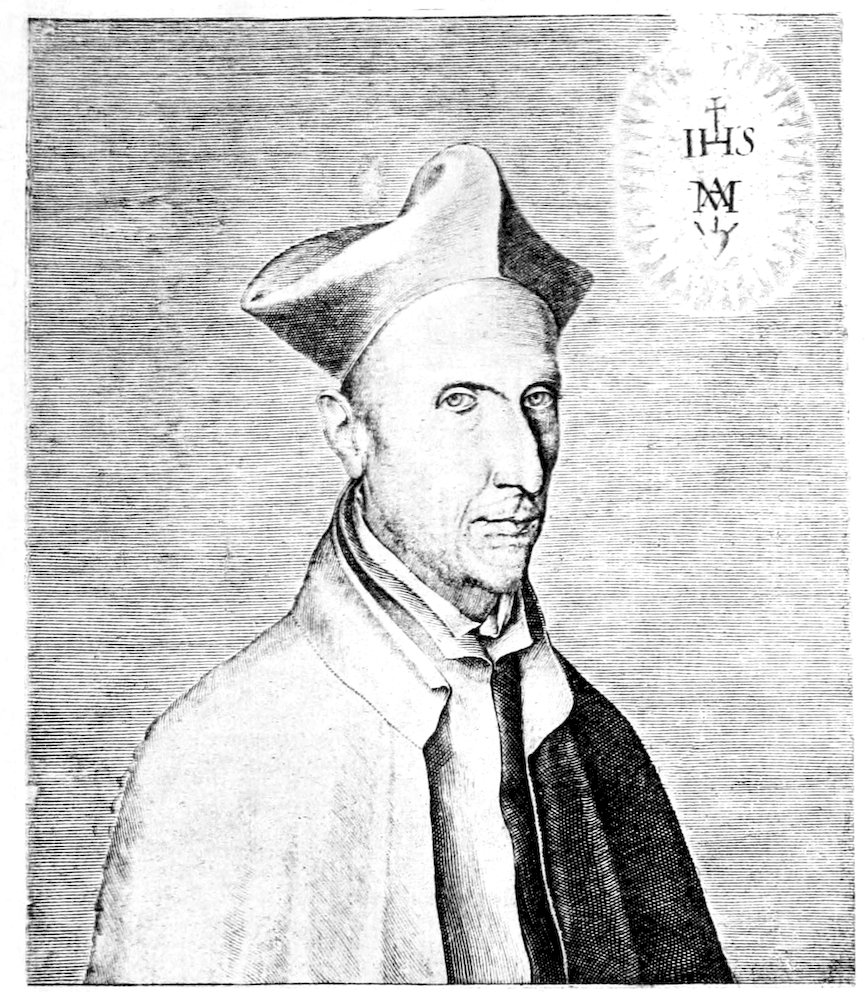
Saint Francis Borgia.
His behaviour, in one of those cases with which the Holy Roman Church occasionally shocks the world, is quite remarkable. His son Don Alvaro de Borja, who was about the age of twenty-seven years, and Ambassador of Spain in Rome, desired to marry Doña Laniparte de Almansa y Borja, daughter of his own sister Doña Juana, and of the age of about fourteen years. Padre Francisco refused to countenance a marriage between his grand-daughter and his 325son, between uncle and niece: refused to ask the Pope’s Holiness for the necessary dispensation. Whereupon, Don Alvaro approached the Lord Pius P.P. IV directly, in his capacity of ambassador, and obtained the dispensation; while the Pope scolded Padre Francisco for his conduct in the matter.
In 1565 Padre Jago Laynez died. Deliberately shutting their ears to his appeals, the Jesuits elected Padre Francisco de Borja Prepositor-General of the Company of Jesus on the second of July. With the single exception of the Roman Pontiff, he now was the most powerful ruler in Christendom, general of an army unrivalled in discipline, utterly reliable, because voluntarily enlisted and morally ruled. Yet he gave no sign of pride or pleasure. He was a perfect Jesuit, humanely sensitive, completely self-distrustful. He said “It is evident that our Lord has condescended to assume the government of this Company since He sees fit to use so deplorably unworthy an instrument.” What words could express more sincerely abject and unworldly humility than those?
Aut pati aut mori was his motto. As General, he relaxed not one of the stern rigorous austerities with which he kept under his body and brought it into subjection. Every passion and appetite of his human nature he deliberately killed. He slept little. He ate little. He had freed himself from every earthly love.
What he might have been!
What he was!
A brilliant and gracious duke, master of territories and boundless wealth, father of a noble family allied with the bluest blood of Spain, honoured by his sovereign, reverenced by his equals, loved by his kin, adored by his dependants.
A sinister shadow of a man, wracked with continual pain, deliberately apart from all his kind, feared, disliked, distrusted, alone, suffering,—alone.
Every day he systematically meditated during five hours on superhuman things. Every morning and every night, he subjected his conscience to rigorous examination, and confessed even every impulse to evil thought. He 326prayed without ceasing. Once, when travelling in Spain with Padre Bustamente, the two slept side by side on the bare floor of a loft, because there was no room for them in the inn. Padre Bustamente, being asthmatic, spat all night long, unknowingly on the face of his companion, who never moved. In the morning light, he was horrified to see what he had done: but Padre Francisco consoled him, saying that in all the world no more suitable place could have been found. He had been very urgent with his sister Doña Juana, Abbess of the Poor Clares at Gandia, that she should persevere in penance and mortification till her life’s end. Has there ever been a case of a consistent Roman Catholic who has committed suicide from religious melancholomania? Rarely; if ever: for the Church, wisely recognising that peculiar temperament, has provided a system where voluntary mortification has its places, its rules, and may be practised by whoever will.
Padre Francisco had the gifts of intuition and of clear-seeing, which generally are found developed respectively in women and brute beasts. He knew when a house was about to fall some time before it fell. He knew, on seeing a courier from his eldest son, that an heir was born to the Duke Don Carlos of Gandia. The courier did not relish this intuition, thinking that he deserved reward for his good news: of which disgust, also, Padre Francisco was aware; and gave reward. The greater the detachment from the world, over worldly things the greater power is gained. People who saw Padre Francisco during his generalship, saw rays of mysterious light playing round his head. The phenomenon of the electric aura now is well-known; and the camera will show it on occasion. Often, in his trances of prayer, he was seen floating above the ground.
In 1566 the Lord Pius P.P. IV died; and, succeeding Him, the Lord Pius P.P. V. stopped his coronation procession at the Jesuit House in Rome, that He might pay His respects to the holy General. In 1569 Padre Francisco again was stricken with fever. Recovering, he made a pilgrimage to the Holy House of Nazareth, which angels carried over the sea from Palestine and set down at Loreto 327by Ancona. In 1571 the Pope’s Holiness sent an embassage to France and Spain and Portugal, to rouse the sovereigns of Christendom against the Muslim Infidel. The ambassadors were the Papal Nephew, the Lord Michele Bonello, son of Madonna Gardina the Pope’s sister, born at Boschi near Alessandria, who at his august Uncle’s first creation in 1566 had been named Cardinal-Presbyter of the Title of Santa Maria sopra Minerva with the cognomen Alessandrino; and Padre Francisco de Borgia, Prepositor-General of the Company of Jesus. The two left Rome in 1571. In Barcelona, they settled a long-standing dispute between the government and the cathedral chapter; for Padre Francisco was ever a peacemaker. In the province of Cataluna, which was not unmindful of him who had been its viceroy, the ambassadors were received with the highest honour.
The record of this journey, through the scenes of his youthful glory, is one of the most pathetic things in human history. This sinister emaciated phantom shabbily robed in thread-bare black, whose thin lips bit perpetual pain; this great and narrow spirit with eyes tardy and grave, furtively, drowsily, reluctantly, regarding earthly things, having seen the heavenly; this mendicant, whose companion was a prince of the church sumptuous in ermine and vermilion,—he was no stranger in Cataluna, where aforetime as marquess, duke, and imperial viceroy he had exercised despotic and sovereign rule. Now he thought no place low enough, foul enough, for his deserts. He was in, but not of, the world.
At Valencia, his children and his grandchildren knelt to kiss his way-worn feet. They prayed him to visit his duchy of Gandia. He refused. He was no longer of the world.
He preached for the last time in the cathedral of Valencia—Valencia the shrine of the House of Borja. Here, a century and a half earlier, Canon Alonso de Borja had been raised to the bishopric. The Bishop of Valencia became cardinal. The Cardinal of Valencia became the strenuous Lord Calixtus P.P. III. From Xativa by Valencia sprang Don Rodrigo de Lançol y Borja, Bishop of Valencia, Cardinal of Valencia, the magnificent invincible 328Lord Alexander P.P. VI. The splendid Don Cesare (detto Borgia) also was Bishop of Valencia and Cardinal, before he renounced the purple for the French duchy of Valentinois. Three huge personalities had borne the name that now was represented by this obscure wan figure whose voice, whose magic pleading fading voice, thrilled in the aisles of Valencia’s fane. Here, in Valencia, the fire was kindled; hence, from Valencia, blazed the all-devouring flame; here, in Valencia, the cresset glowed with steady brilliant light, so shining before men that they might see good works, and glorify the Father which is in heaven. Padre Francisco de Borja preached for the last time in the cathedral of Valencia.
In France, the ambassadors met with no success. That miserable country was in the throes of the Huguenot Rebellion; and the Queen Dowager, Madame Caterina de’ Medici, ruled the maniac King. After travelling through France in the winter, gaining converts and confirming the churches, but failing in the object of their journey, the ambassadors reached Turin; and became guests of the Duke of Savoy. Padre Francisco, utterly worn out with exertion and anxiety, his vital forces being on the verge of exhaustion, fell ill on the second of February, Candlemas Day 1572. The exigencies of courtly etiquette bored him to distraction; and he hurried on. Low Sunday found him in Ferrara. Here, having concluded his ambassadorial duties, the last remains of his strength departed. His nephew, the Duke of Ferrara, gave him a royal escort, and a royal litter, as he was too weak to ride, and sent him onward to Rome. During this last journey, it was noticed that, though he lay still, more like a corpse than a man, his characteristic gesture of command remained with him to the very end.
He attained the Flaminian Gate of Rome on the twenty-eighth of September. All the Company of Jesus were there to receive their dying General. He was carried to the Jesuit House, and the last Sacraments of Unction and Viaticum fortified his soul.
On the Festival of St. Michael Archangel, he lay a-dying. The next day, his speech departed. His last words, the last words of the sometime gracious and brilliant duke, 329the last words of the Jesuit General, were the words of a simple little Christian child, “I long for Jesus!”
He had done with the Latin of the Church. He had gone back to his mother-tongue, “A Jesus quiero.”
On the first of October 1572, he died of a decline, being of the age of two and sixty years.
Instantly, the pious opinion was entertained that Padre Francisco de Borja had died In The Odour of Sanctity.
It was found impossible to undress the corpse. Among others, his brother Don Tommaso de Borja, the Viceroy of Aragon, made an attempt to perform the last duties, but all without success. This same Don Tommaso, who afterwards became Archbishop of Saragossa, wrote a detailed history of this phenomenon which he calls miraculous. Various explanations are given of the sudden and complete rigor mortis, which, however, are mystical, not practical ones. It is said that modesty prevented the disrobing, or that it was intended to hide the scars of long-practised austerities, or that the greatest reverence was due to the body which had been the temple of the Holy Spirit.
His family, and all who in his life had known him, looked upon Padre Francisco de Borja as a saint: as such, they privately venerated his fragrant memory, and invoked the aid of his intercession. No public honours were accorded, for his right to these had not yet been made clear: but it was alleged that these private invocations produced marvellous results. Two shall be named. The physicians attending the Duchess of Uzeda in child-bed found themselves unable to effect delivery owing to congenital malformation. After the invocation of the dead Jesuit, instant safe and painless delivery took place with perfect health to mother and child. Queen Doña Margarita, wife of King Don Felipe III of Spain, endured puerperal fever. The invocation of Padre Francisco brought a cure. Then, and with these credentials, the Company of Jesus formally petitioned the Papal Nuncio in Spain, Monsignor Decio Carafa afterwards Cardinal, to order an enquiry into the virtues and miracles of the Servant of God, their departed General. Five tribunals were found at Valencia, Madrid, 330Barcelona, Saragossa, and Recanati; multitudes of witnesses were examined and cross-examined. Padre Ribadaneira, confessor of the deceased, confirmed on oath his book on the life of Padre Francisco de Borja. From this book, many of the foregoing facts are taken. In 1615, after thirty-seven years’ labour, the proceedings of the five tribunals in writing were sent to Rome, where Spain’s ambassador presented them to the Lord Paul P.P. V with recommending letters from King Don Felipe III, the Grandees and Hidalgos of Spain, archbishops and bishops, cathedral chapters, municipalities, and universities.
The Supreme Pontiff was pleased to refer the matter to the Sacred Congregation of Rites, the Roman tribunal competent to deal with such a case. Before this court, all evidence was verified; and a decree was issued attesting the orthodoxy of the teaching of the Venerable Servant of God, his sanctity of life, and the authenticity of the alleged miracles, satisfactorily to have been proved; and granted permission to proceed to Beatification. The Lord Paul P.P. V confirmed this decree; and named three Apostolic Commissioners to carry on the cause in Spain. The proceedings of a Royal Commission are so well understood, that it merely is necessary to say that the business of an Apostolic Commission is to search for information, to hear and weigh evidence, and to compile a report on a given subject.
Meanwhile, the claims of Spain to possess the remains of her renowned son were recognized; and on the twenty-third of February 1617, the body of the Venerable Francisco de Borja, (except an arm retained at the Gesù in Rome,) was translated to the chapel of the Jesuit House in Madrid.
In 1623, the eight years labours of the Apostolic Commission were concluded; and brought to the usual scrutiny in Rome. Later, the verdict was given to the effect that the sanctity and miracles of the Venerable Francisco de Borja fully had been established; and that, therefore, he was worthy of Beatification: which decision duly was confirmed by the Lord Gregory P.P. XV.
Thirty-one years later, on the thirty-first of August 1654, a decree in accord with this decision was issued by the Sacred Congregation of Rites, and ratified by the 331Lord Urban P.P. VIII[111], Who, on the twenty-fourth of November, published the Bull of Beatification with the Office and Mass in honour of the Blessed Francisco de Borja for the Universal Church.
Another seventeen years of public prayers and legal action passed; and on the eleventh of April 1671, the Lord Clement P.P. XI solemnly canonized Saint Francisco de Borja, adding to the Roman Martyrology, which is the official roll of sanctitude, the three lines, in which the Holy Roman Catholic Church delivers Her authoritative judgment, and of which the following is a literal translation: “Sixth day of the Ides of October. This day, at Rome, is kept the festival of Saint Francisco of Borja, Repositor-General of the Company of Jesus, memorable, having abdicated secular things and refused dignities of the Church, by asperity of life, by the gift of prayer.
In 1680, the reliques of the saint were translated to the gorgeous church in Madrid which the Duke of Lerma built A.M.D.G. To the Greater Glory of God, and of his ancestor St. Francisco de Borja. So, a century after his death, a Borgia was numbered with the Saints.
Rational human judgment may be glad to stand aside before the sober judgment of the Church, so far removed from bias, from ecstatic extravagance, so calmly judicially personal. She has divined all, and is reticent. She has settled his key, She has struck his note, and is sufficient. She has shewn him in an Ideal Content. He “left all”; and for that She honours him: and She has Scriptural Warrant.
“An accomplished courtier, a clever diplomatist, a brilliant and gracious viceroy, a perfect religious.
“A masterful imperious character—in breaking his own will he broke himself.
“A magnified non-natural man.
“Saint Francisco de Borja—Memorable—By asperity of life—By the gift of prayer.
“Memorable.
332
Ashes
“A fire, that is kindled, begins with smoke and hissing, while it lays hold on the faggots; bursts into a roaring blaze, with raging tongues of flame, devouring all in reach, spangled with sparks that die; settles into the steady genial glare, the brilliant light, that men call fire: burns away to slowly-expiring ashes;—
From the birthday to the Life eternal of St. Francisco de Borja, the Spanish Branch of the House in his direct descendants increased and multiplied; intermarried with the grandest names in Spain; and decreased in importance, until its extinction in the penultimate decade of the last century. Four only, of these, need be mentioned here.
Don Gaspard de Borja was a great-grandson of the Saint, and son of Duke Don Francisco de Gandia by his wife Doña Juana de Velasco Tovar. He studied at the Complutensian University, becoming a Laureate in Theology and Dean of the University. He was the first Grandee of Spain to occupy the Chair of Professor and Public Lecturer. At the instance of the Catholic King, he obtained a Canonry at the Metropolitan Cathedral of Toledo; and here he began to nourish the enormous ambition of becoming the third Pope of the House of Borgia.[112]
On the seventeenth of August 1611, he was named Cardinal-Presbyter of the Title of Santa Croce in Gerusalemme, being then a youth; “invenis,” says Ciacconi; twenty-two years of age, says the exact and uniquely well-informed Moroni. On the fifteenth of May 1630, he was 333raised to the Cardinal-Bishopric of Albano, and named Archbishop of Seville. In Rome, he was on the Sacred Congregation of the Holy Office, and ambassador of the Catholic King to the Holy See. In the Kingdom of Naples, he was Viceroy. He bought, (Mr. Henry Harland wittily says that one may buy such things,) the additional title of “Father of the Poor,” by distributing annually in charity ten thousand crowns; and he exchanged his archbishopric of Seville for that of Toledo. In 1641, he held a diocesan synod over which his Vicar-General presided as his proxy, and governed his archdiocese, while he was cultivating his ambition in Rome. He was an unwilling assistant at the two Conclaves, which elected the Lord Gregory P.P. XV and the Lord Urban P.P. VIII. And in November 1645, while England was in the throes of the Great Rebellion, he died at Madrid, after fifty-six years of life, and thirty-four of cardinalate, a disappointed man, and was buried in the metropolitan cathedral of Toledo.
Don Francisco de Borja, great-great-grandson of the Saint, son of Duke Don Carlos de Gandia by his wife Doña Maria Ponce de Leon, was born on the twenty-seventh of March 1659. He was a man of singular and extraordinary piety and learning, Archdeacon of Calatrava and Canon of Toledo. By his proved fidelity he gained the favour of the Catholic King Don Carlos II, who made him Councillor of Aragon. From Rome, he received the bishopric of Calagurita; and (on the fourteenth of November 1699, according to Moroni, or on the twenty-first of June 1700, according to Guarnacci,) the scarlet hat of the cardinalate and the archbishopric of Burgos. He died on the fourth of April 1702, undistinguishable from other ecclesiastics of his rank.
Don Carlos de Borja was brother to the foregoing. Born at Gandia his family’s fief on the thirtieth of April 1653 (Moroni), or 1663 (Guarnacci,) he studied theology at the college of Sant’ Ildefonso, and succeeded his brother as Archdeacon of Calatrava and Canon of Toledo. On the death of Archbishop Don Pedro de Portocarrero, the Lord 334Clement P.P. XI named him Archbishop of Tyre and Trebizond in partibus infidelium; a see held at the present moment by an Englishman who is the ornament of the “Black” drawing-rooms of Rome. From Tyre and Trebizond, Archbishop Don Carlos de Borja rose to the Patriarchate of the Indies, continuing to reside in Spain where he shewed piety and zeal as chaplain and almoner to the Catholic King Don Felipe V. On the thirtieth of September 1720, he was raised to the Sacred College; and in his capacity of cardinal, hurried to Rome for the Conclave of 1721. There, he found already elected and crowned, the Lord Innocent P.P. XIII, who named him Cardinal-Presbyter of the Title of Santa Pudenziana, and placed him on the Sacred Congregations of The Index of Prohibited Books, of Indulgences, of Signaturae Gratiae. He died at the Royal Villa of Sant’ Ildefonso near Madrid on the eighth of August 1733, and honourably was buried there. He has left nothing of his personality, save a physically effete but beautiful gentle generous shadowy visage, in his portrait painted by Procaccini, and engraved by Rossi in Guarnacci II. 357–8.
So the Senior Branch, in the line of the direct descendants of the murdered Duke of Gandia, bastard of the Lord Alexander P.P. VI, withered in sumptuous obscurity; heaping up secular titles and estates by marriage, heaping up ecclesiastical dignity and preferment by the enchantment of the Borja name added to personal merit, until its final extinction only eighteen years ago. The names and titles of the last of the Spanish Borja, here recorded, will shew what that House had accumulated in a bare four hundred years—three principalities, seven duchies, ten marquessates, sixteen counties, and one viscounty, besides knightly orders and decorations.
His name was
Don Mariano Tellez-Giron y Beaufort Spontin Pimentel de Quiñones Fernandes de Velasco y Herrera Diego Lopez de Zuñiga Perez de Guzman Sotomayor Mendoza Maza Ladrón de Lizana Carroz y 335Arborea Borja y Centelles Ponce de Leon Benavides Enriquez Toledo Salm-Salm Hurtado de Mendoza y Orozco Silva Gomez de Sandoval y Rojas Pimentel y Osorio Luna Guzman Mendoza Aragon de la Cerda Enriquez Haro y Guzman.
His titles were
Prince of Squillace[113], Eboli, Melito;
Duke of Osuna, Infantado, Benevente, Plasencia, Béjar, Gandia, Arcos de la Frontera, Medina de Rioseco y Lerma;
Marquess of Tavara, Santillana, Algecilla, Argüesco, Gibraleon, Zahara, Lombay, Peñafiel, Almenara y Cea;
Count of Benevente, Plasencia, Béjar, Gandia, Arcos de la Frontera, Medina de Rioseco y Lerma, Real de Manzanares, La Oliva, Belaleazar, Ureña, Casares, Melgar, Baiten, Mayorga y Fontenar;
Viscount of La Puebla de Alcocer.
He was Ten Times Grandee of Spain of the First Class, Knight of the Orders of Calatrava, of St. John of Jerusalem, of the Golden Fleece, Knight Grand Cross and Collar of the Orders of Carlos V, of St. Hermenegild, of St. Alexandra Newski, of the Christ of Portugal, of the Crown of Bavaria, of the Legion of Honour, etc., etc., etc.,
He died without issue on the second of June 1882.[114]
336