DESCRIPTIVE LIST OF THE EMBELLISHMENTS. (continued 8)
Reading edition
“There are several prospects of this dreadful conflagration, though few of them are worthy of any credit, most having been executed in Holland; and it is probable, indeed, that the best was a small and spirited etching by Wenceslaus Hollar, measuring 7 inches by 2¾, and inserted on the right hand side of ‘A New and Exact Map of Great Britaine. Published by John Overton, at the White Horse, without Newgate. 1667.’ Single sheet. This view is taken from Hollar’s old observatory, the tower of St. Mary Overies Church; and represents the fire spreading furiously Westward, whilst the Bridge appears untouched. This fine little print you will find to be the first illustration in volume ii. of Mr. Crowle’s Pennant in the Print Room of the British Museum; and it is entitled ‘Prospect of the Citty of London, as it appeared in the time of its flames:’ it has frequently sold for 10s. 6d., and sometimes for 15s., even without the plate it belongs to. Hollar’s long view of the City immediately after the conflagration, I have already mentioned; and in that we see with much more certainty the actual damage sustained by our unhappy old edifice, in the Ruins of the Riverside and Bridge after the Fire.
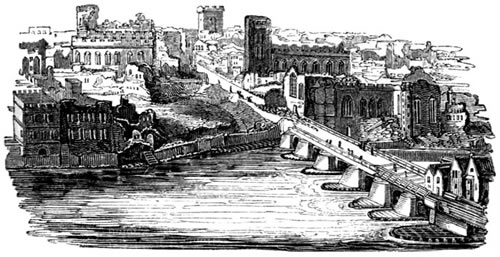
“The alteration appears chiefly to consist in the destruction of that large square building, which terminated the Northern end of the Bridge; and, of course, the entire demolition of the wooden pales and passage, which had been erected after the fire of 1633; but beyond this the flames do not seem to have penetrated. The banks of the River, indeed, presented a more entire picture of ruin. Of the grand Church of St. Magnus nothing remained but some of the walls, and the buildings in front of it were destroyed even to the water’s edge; whilst on the Western side of the Bridge, the Water-works and Tower, numerous houses lining the River, and the ancient edifice of Fishmongers’ Hall, were reduced either to smouldering fragments, scarcely bearing even the forms of what they once had been, or else had not one stone left upon another. ‘The Long Antwerp View of London,’ which has been already so minutely described, furnishes us with a good representation of Fishmongers’ Hall before the Fire of 1666;
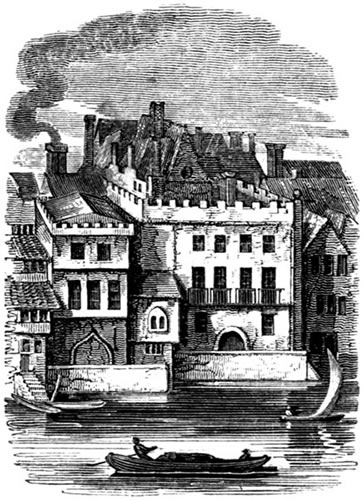
and it appears to have been a plain narrow edifice, castellated and covered with lead on the top, having two principal stories, the lower one of which had a kind of gallery or balcony, an ornament which was very common to buildings in this part of London. The Companies of the Salt-fish and Stock-fish mongers were anciently possessed of so many as six Halls; of which two stood in New Fish-street, now called Fish-street Hill; two more were in Old Fish-street, and two others were erected in Thames-street; in each place one for each Company. These, however, were all united in the year 1536, the 28th of Henry the Eighth; after which they were to have but one Hall, namely, the house given to them by Sir John Cornwall, afterwards created Baron Fanhope, in 1427, the 6th year of Henry VI., which I take to have been the building represented in the print; since Stow, in his ‘Survey,’ volume i., page 499, from whom we derive these few particulars, says that it was in the Parish of St. Michael, Crooked Lane: and adds on the preceding page, that ‘Fishmongers’ Hall, with other fair houses for merchants, standeth about midway between the Bridge foot and Ebgate, or Old Swan-lane.’ Still more brief, however, are the notices, which he furnishes us concerning the Company’s other Halls, which once stood about the same spot. ‘On the West side of this Ward,’—says the old Citizen,—‘at the North end of London Bridge, is a part of Thames-street, which is also of this Ward, to wit, so much as of old time was called Stock-Fishmonger Row,’—a place, you will remember, referred to in that manuscript Survey of Bridge lands which I some time since recited to you—‘of the Stock-fishmongers dwelling there, down West to a Water-gate, of old time called Ebgate, since Ebgate Lane, and now the Old Swan.’ I will not enter into the history of the Fishmongers’ Company, Mr. Barbican, because it does not belong to our present subject, and you may read the chief particulars for yourself, in Stow’s ‘Survey,’ volume i., page 498, and volume ii., page 268; and shall therefore only add a very few particulars concerning the present Hall. According to the splendid plan of Sir Christopher Wren, for adorning the banks of the Thames, it presents to the river, a handsome, though somewhat old-fashioned front of red brick, having the windows ornamented with stone cases. From the wharf on which the Shades’ Tavern is situate, a grand double flight of stone steps leads to the chief apartments; and the door is decorated with Ionic columns supporting an open pediment, containing a shield with the Company’s Arms, all of stone. I shall say nothing, however, of the handsome North front of this building, its spacious court-yard, and its beautiful carved gateway in Thames-street; nor yet of the rich state chambers, their fine paintings of fish, their massive and richly-chased silver branches, their large brazen chandeliers, the interesting relique of Sir William Walworth, nor of the interior of the spacious Hall. I will tell you nothing of either of these, Mr. Geoffrey, since they cannot be observed from London Bridge; but before I entirely quit the Fishmongers, let me observe that Strype, in his Fifth Book of Stow’s ‘Survey,’ has two very singular notices concerning them, which I do not remember to have seen mentioned in any historical account of yonder passage across the Thames. They consist of certain ancient statutes peculiar to this Company, taken from the record called ‘Horn,’ in the Chamber of London; and they state that it should be prohibited that any Fishmonger should ‘buy a fresh fish before Mass at the Chapel upon the Bridge be celebrated:’ which Chapel, it is elsewhere stated, is one of the bounds, beyond which no Fishmonger ought to go to buy fish.
“I have already observed that Hollar’s View of London after the Fire, shews the fine old Church of St. Magnus, which we may consider the North-East boundary of London Bridge, reduced to a pile of ruined walls; having all those costly repairs and beautifyings, which Stow, in his ‘Survey,’ volume i., page 494, records as having taken place from 1623 to 1629, destroyed in the flames. Before I speak, however, of the re-edification of this fane, I shall notice the means employed for that of the Bridge itself, as they are related by the continuators of Stow in his ‘Survey,’ volume i., page 62. Most of the buildings erected upon it, were, as they tell us, totally consumed; excepting the Chapel, and a few edifices standing on the South end, of the time of King John: though this, as I have shewn you, must be erroneous. We may believe, however, from all the circumstances attendant upon the fire, that the stone-work of the Bridge was so battered and weakened, ‘that it cost the Bridge-House £1500. to make good the damage in the piers and arches, before the leaseholders could attempt to rebuild the premises destroyed by the fire.’ Though ‘the stone work,’ continues this passage, ‘was no sooner secured, than a sufficient number of tenants offered; who conditioned with the Bridge-House for building-leases of 61 years, at the rate of 10s. per foot, running, yearly, and to build after such a form and substantial manner as was prescribed.’ This was so rapidly carried into effect, that in five years the North end was all completely finished, with houses four stories high, and a street of 20 feet in breadth between them, measuring from side to side. To make the South end equally perfect, however, and, at the same time, to equalize the rent of the whole, required the invention of some expedient; since the older buildings were already leased to several tenants, with longer and shorter portions of their time yet to elapse, whilst the leases of others were entirely expired. To arrange all these with propriety, the Lord Mayor, Aldermen, and Commonalty, who were appointed for the letting of the Bridge-House lands, with the assistance of Mr. Philip Odde, then Clerk Comptroller of those estates, took the following method. For the first class of tenants, they measured the number of feet in the front of each house; and ascertained the amount of rent, and the time of the lease yet unexpired: whilst a second and third classes were formed of those whose leases were nearly out, or entirely finished. To such as had the longest term to run, a moderate time was added, with an abatement of rent answerable to the cost of re-erecting their buildings, in uniformity with those at the North end. Of the tenants whose leases were nearly expired, and who were unable to build, they were redeemed for valuable considerations; the dilapidated stone-work for the new buildings was then repaired by the City, at an expense of nearly £1000; and in about four or five years the whole edifice was completed.
“We are not, however, now informed of any repair of the Draw-Bridge, although it certainly existed until the great alteration of 1758; but, probably, even long before this time, had ceased to be of any great utility. You may see, in Stow’s historical notices of Queenhithe, (vide his ‘Survey,’ volume i., pages 697-700,) that in the reign of King Henry III. ships and boats laden with corn and fish for sale, were compelled to pass beyond the Bridge to that most ancient wharf and market. In 1463, however, the third year of King Edward IV., the same authority informs us that the market at Queenhithe was ‘hindered by reason of the slackness of drawing up of London Bridge,’ which seems to infer some difficulty in raising it even at that period; fresh ordinances being then made to cause vessels with provisions to proceed up the river. I cannot, however, tell you at what time the Draw-Bridge was made wholly stationary; though it seems not to have been till after the publication of the last ancient edition of Stow’s ‘Survey,’ in 1633, folio, as, in Strype’s excellent new one, of 1720, volume i., book i., page 58, he adds some notices of the arches, in which occurs the following passage. ‘Two of these arches are much larger than the rest, viz. that over which is the Draw-bridge; and the other called the Simile Lock. These were for the use of greater vessels that went through Bridge Westward. The Draw-Bridge formerly was, upon such occasions, taken up; but now-a-days never, but when it wants repairing.’ The additions of Richard Bloome also, on page 56 in the same volume, furnish us with several particulars of these arches, which I shall introduce to you in this place, because they apply, almost equally, both to the Bridge before the Fire, and to the ancient appearance of the present one. ‘There were,’ says he, ‘three vacancies, with stone walls, and iron grates,’—rather rails,—‘over them, on either side, opposite to each other; through which grates, people, as they pass over the Bridge, may take a view of the river both East and West; and also may go aside, more to each side, out of the way of carts and coaches, the passage being but narrow, and not only troublesome but dangerous. These three vacancies are over three of the middle arches, for all the piers are not of a like thickness, nor stand at equal distance one from the other; for under those three vacancies are much wider than the rest, and are called the navigable locks, because vessels of considerable burthen may pass through them. One of these is near unto the second gate, and is called the Rock Lock. The second is under the second vacancy, and is called the Draw-Bridge Lock. And the third is near the Chapel, and is called St. Mary’s Lock. There is a fourth between St. Magnus’ Church and the first vacancy, and is called the King’s Lock, for that the King in his passage through Bridge, in his barge, goes through this lock.’ In Strype’s additions to these particulars, which I have already referred to, he says, ‘The two Arches next London are now stopped up for the use of the Water-mills, but without any prejudice to the current of the Thames. The third arch on the Southwark side is seldom, and very rarely, passed through, because of a rock grown there a little to the East, which is visible at low water. This rock hath been observed this many a year, and is called the Rock Lock. The reparation of these arches, and the striking down piles for securing them, is continual, and men are kept on purpose to take care of it, and to do it. Whereof they have two Master-workmen, viz. a Head-Carpenter,’—whose name in Strype’s time was Wise,—‘and a Head-Mason, whose office it is to look after the Bridge under the Bridge-Masters.’ The common report of the rock growing beneath the water, under one of the Arches of London Bridge, is, however, one of those popular traditions which are generally to be found connected with almost every edifice, engendered partly by ignorance, and partly by the desire mentioned by the Indian in Robinson Crusoe, ‘To make the great wonder look!’ ‘We have been assured,’ says the Rev. John Motley, in ‘Seymour’s Survey of London,’ volume i. page 48, ‘by a person of great veracity as well as curiosity, that a friend of his in the year 1715, when the tide was so kept back that many people walked over the river, went near enough to examine this, and found it to be stones joined together with cement, and iron in some places; and therefore supposed it was part of an arch that had formerly been broken down, and never since removed,’ It has been generally believed, that these ruins were the fragments of the two arches, and the Bridge-gate, which, as I have related to you, fell down in the year 1437: and which, having now lain nearly four centuries, and been increased by the deposits which millions of tides have cast upon them, have become almost as impenetrable as a solid rock, and the arch, therefore, retains its ancient name. Such was London Bridge after it was rebuilt, ‘peopled’—as Evelyn says of the City, but a very few days after the fire,—‘with new shops, noise, and business, not to say vanity.’—‘A Bridge,’ exclaims Richard Bloome, in his continuations to Stow, volume i. page 499, ‘not inferior to any in Europe for its length, breadth, and buildings thereon, being sustained by nineteen great stone arches, secured by piles of timber drove to the bottom of the river, having a Draw-Bridge towards Southwark, as also strong gates; and, by its houses built thereon on both sides, it seemeth rather a street than a Bridge, being now garnished with good timber buildings, which are very well inhabited by sufficient tradesmen, who have very considerable dealings, as being so great a thoroughfare from Southwark into London.’
“Whilst I am mentioning this praise of London Bridge, I may express my wonder that Michael Drayton, in his ‘Poly-Olbion,’ London, 1613, folio, says so little concerning it, whilst John Selden, in his very learned notes to that poem, wholly omits it. As I purpose next to say a few words touching the rebuilding of St. Magnus’ Church, I will close this part of our Bridge history by repeating Drayton’s verses from Song xvii., page 259: where, speaking of the Thames, he says,—
‘Then goes he on along by that more beauteous strand, Expressing both the wealth and brauery of the land; ——So many sumptuous bow’rs, within so little space, The all-beholding sun scarce sees in all his race:— And on by London leads, which like a crescent lies, Whose windowes seem to mock the star-befreckled skies: Besides her rising spyres, so thick themselues that show, As doe the bristling reedes within his banks that growe: There sees his crowded wharfes, and people-pester’d shores, His bosome overspread with shoales of labouring oares; With that most costly Bridge, that doth him most renowne, By which he clearly puts all other Riuers downe.’
“Bloome, the continuator of Stow, to whose labours we are in general little less indebted than we are to those of the old historian himself, gives us but few particulars concerning the rebuilding of St. Magnus’ Church; stating only that it was erected of free-stone, with ‘a tower and steeple of curious workmanship; to which Church,’ he adds, ‘is united the Parish of St. Margaret, New Fish-street, that Church not being rebuilt.’ Newcourt, in his account of the Rectory of St. Magnus, says likewise very little as to its history; though he tells us, that when the Parishes were united, the yearly value of them was made £170, whereas, in 1632, that of St. Magnus amounted only to £83, and that of St. Margaret to £70: and he states also, that part of their Church, before it was rebuilt, was laid into the street, for enlarging the passage. We have, however, a very fair though brief description of the new Church of St. Magnus, in the ‘Memoirs of the Life and Works of Sir Christopher Wren,’ by James Elmes; London, 1823, quarto, pages 357, 490; wherein he states that it was begun in 1676, and that the lofty tower, lanthorn, cupola, and spire, were added in 1705. It is then, as all may see for themselves, an elegant and substantial Church, built of stone and oak timber, covered with lead, and crowned with a handsome lofty steeple, consisting of a tower, a lanthorn containing ten bells, and a cupola surmounted by a well-proportioned spire. The interior, measuring 90 feet in length, 59 in breadth, and 41 in height, is divided into a nave and two aisles, by columns, and an entablature of the Ionic Order; whilst the roof, over the nave, is camerated, and enriched with arches of fret work, executed in stucco. For the monuments, epitaphs, and benefactors of this Church, both ancient and modern, I must refer you to Strype’s Stow, volume i., page 494; and will mention only the gift of the clock by Sir Charles Duncomb, in the year 1700, at the cost of £485. 5s. 4d. The dial of this clock was formerly ornamented with several richly gilded figures, which have since been removed, but a view of the Church, before the archway was opened,—of which we shall speak hereafter,—having also the clock in its original state, will be found in Stow’s ‘Survey,’ at my last reference, and in Maitland’s ‘History of London,’ volume ii., page 1124. Tradition says, that it was erected in consequence of a vow made by the donor, who, in the earlier part of his life, had once to wait a considerable time in a cart upon London Bridge, without being able to learn the hour, when he made a promise, that if he ever became successful in the world, he would give to that Church a public clock, and an hour-glass, that all passengers might see the time of day. There is in ‘The Protestant Mercury,’ of September the 11th, 1700, the following rather curious mention of this clock: ‘On Monday last, the Right Honourable the Lord Mayor, accompanied by the worshipful Aldermen and Sheriffs, went, with the usual formalities, to proclaim Southwark fair; after which they were nobly entertained at the Bridge House, according to an ancient annual custom. In their passing by St. Magnus’ Church, they were presented with the view of that noble and magnificent Dial erected at the West end, at the charge of the generous Sir Charles Duncomb, which equalizing, if not exceeding, all others of that kind, seems to answer the design of the donor.’ This donation is also recorded upon the clock itself; for upon a small metal plate, shaped like a shield, and silvered, screwed to the interior, are engraven the giver’s arms,—a chevron between three talbot’s heads erased,—with the following inscription: ‘The Gift of Sir Charles Duncomb, Knight, Lord Major, and Alderman of this Ward. Langley Bradley fecit, 1709.’ The same liberal Citizen also presented the modern fane of St. Magnus with an organ, of which the ‘Spectator’ of February the 8th, 1712, thus speaks: ‘Whereas Mr. Abraham Jordan, senior and junior, have, with their own hands, joynery excepted, made and erected a very large organ in St. Magnus’ Church, at the foot of London Bridge, consisting of four sets of keys, one of which is adapted to the art of emitting sounds by swelling notes, which never was in any organ before; this instrument will be publicly opened on Sunday next, the performance by Mr. John Robinson. The above-said Abraham Jordan gives notice to all masters and performers, that he will attend every day next week at the said Church, to accommodate all those gentlemen who shall have a curiosity to hear it.’ I will conclude these notices by referring you to Malcolm’s ‘Londinum Redivivum,’ volume iv., pages 30-35, where you will find several other particulars concerning St. Magnus.
“Upon the rebuilding of London, after the Great Fire, it was the proposal of Sir Christopher Wren to form a grand quay, or esplanade, from the foot of London Bridge to the Temple; of which scheme there is the fullest information, from an original manuscript, in Mr. Elmes’s ‘Memoirs,’ pages 270 to 284, Notes. It was proposed that the Quay should be 40 feet in width, between the Thames and the houses on its banks; and, in the year 1670, a petition from the inhabitants of this part of London was presented to the Privy Council, stating that it would be of great detriment to them if such way or wharf should not be carried into effect, from London Bridge to Bridewell Dock, the petitioners having commenced their several houses near the Bridge, as well as the pipes and engines of the Water-House. Of the ancient Water-House at this place, I have already given you some idea; but I may observe, from the authority last cited, that its supplies were constantly defiled by the public drains, and other offensive buildings erected upon this spot. Notwithstanding that the Commissioners of Sewers had ordered their removal, and the King’s Surveyor General had directed that no such contagious places should be constructed here, even so late as 1670 they had been again renewed, polluting both the water and the passage across the Thames. In consequence of the petition, Sir Christopher Wren, assisted by the City Surveyors, inspected the whole line of the intended wharf; and his report was:—That the houses then begun to be built fronting the Thames, which were not a third in number of what the range would contain, were, in general, conformable to the act, as to their being 40 feet distant from the River, and that some of them towards the Bridge were not ungraceful; but that others were unequally low, and, as well as the warehouses, irregularly built; whilst some habitations were constructed only of board. The Quay between the row of houses and the River, which should have been left open for passage, was every where enclosed either with pales or brick walls; and covered with stacks of timber, faggots, and coals. The cranes erected West of the Bridge, he states to be unhandsome, and larger than were required, boarded down to the ground, and having warehouses beneath them. The old towers of Baynard’s Castle, he observes, were also still standing upon the wharf; the walls, wharfings, and landing-stairs, were, for the most part, unrepaired; and, in some places, the Quay was likely to be broken by bridges and docks. Sir Christopher’s report also mentions numerous other obstacles, in consequence of which, their immediate removal was ordered, and the construction of the Quay directed, by an Act of Parliament, in the 22nd of Charles II., 1670, chapter 11, Sections xliv.-xlix.; as well as by a Patent passed in the year following.
“The impediments to this design, however, were never entirely removed; and, in modern times, their number has considerably increased. Of these, Calvert’s Brewery is one of the most prominent, which is supposed to occupy the exact site of the mansion anciently called Cold Harbour; where it now forms the two sides of Champion-lane, formerly called Quay-Wharf-lane, which, with All-hallows and Red-bull lanes, was once open to the river. The last important remains of Sir Christopher’s grand Civic esplanade was shewn in a line of wharf 40 feet in width, and extending from London Bridge to the Steelyard, entitled New Quay; and it may be seen in the plans in Strype’s ‘Stow’s Survey,’ volume i., pages 486, 510; and in Maitland’s ‘History,’ volume ii., pages 790, 1046.
“The Act of Parliament which I have recently cited, also contains a very considerable portion of information relative to the new buildings of London; and from section liii. we learn, that the Water-House at London Bridge was not renewed at the time of its being passed, though in the Act for rebuilding London, passed in 1667, the 19th of Charles II., chapter 3, section xli., it is ordained: ‘that it shall and may be lawful for the Water-House, called Mr. Thomas Morris his Water-House, formerly adjoining to London Bridge, to be rebuilt upon the place it formerly stood, with timber, for the supplying the South side of the City with water, as it for almost an hundred years hath done.’ Most of the ancient engravings of London Bridge, after the Fire, present us with a view of this Water-House, by which it appears that it was a lofty narrow wooden building, standing close to the North West corner of the Bridge. On its Western side, a flight of stairs led down to the river; and its front looked on to the wooden stage which supported the Water-works. Strype, in his ‘Stow’s Survey,’ volume i., page 500, says, that ‘by wheels, iron chains, &c., it drinketh, or rather forceth up water through leaden pipes to the top, where there is a cistern, and from thence descendeth in other leaden pipes to the bottom, and thence, received by other pipes, is conveyed under the pavements of the streets, and so serveth many families in this part of the City with water; who have branches, or small pipes, laid from the main ones unto their houses, to their great convenience, and no small profit to the City.’ In the very amusing ‘Voyages’ of Mons. Aubri De la Motraye, Hague, 1727-32, folio, volume iii., pages 360-362, and plate iv., we have an engraving of the interior mechanism of a public fire-engine erected near this building, with an account of the means employed in it for raising of the water. One of the most picturesque and interesting representations of this modern Water-house at London Bridge,
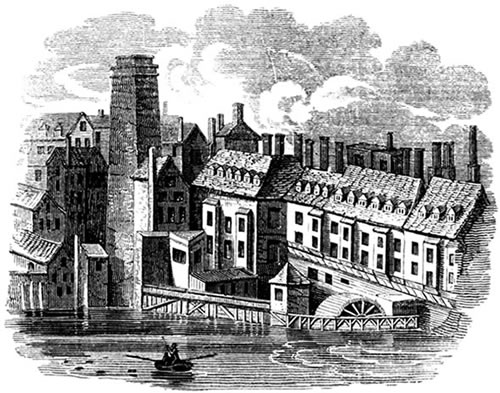
is contained in a series of five views by S. and N. Buck, which forms a sort of panoramic prospect of London, from Westminster to below the Tower; each being taken from a different point of observation. They are dated September the 11th, 1749, and the Bridge as it then appeared, covered with buildings, forms a very prominent feature. I have to add only, that you will find a set of these prints in volume xiii. of Mr. Crowle’s Illustrated Pennant in the British Museum.”
“Well, Master Barnaby,” said I, as well as I was able for yawning, “though you can find no more to say about this Water-House, I must add a few fragments which would otherwise be lost; even as the song says,
‘Mister Speaker, though ’tis late, I must lengthen the debate.’
I have been informed, upon the evidence of a very ancient servant of the present London Bridge, that the water rose in this Tower to the height of 128 feet, through a pipe 12 inches in calibre, often bringing very fine fish up with it; and that from beneath the cistern at the top, issued nine main pipes which supplied all London. As the particular direction of each of these pipes was, of course, entirely different, in the event of a fire, all of them were stopped excepting the one which led immediately through that district; and thus the whole weight of water was thrown towards any place desired. From the same source, I have also received a curious and very particular drawing upon vellum, in colours, representing the North end of London Bridge, the Water-House and works, and the directions of the pipes issuing therefrom, taken from actual measurement, and executed, as I should suppose, before the fire by which they were destroyed, on Sunday, October the 31st, 1779; but this view shall be referred to hereafter. The fire to which I have alluded, brake out in the warehouse of Messrs. Judd and Sanderson, Hop Merchants, at the foot of London Bridge, and having speedily communicated to the Water-works, in less than an hour they were reduced nearly to a level with the river. The wooden Water-Tower having been pitched but a few days before, all the efforts of its engines were, therefore, ineffectual. But enough of water, Mr. Postern: what say you to another draught of sack, and then another spell at the history of London Bridge itself?”
“I like your motion mightily,” replied my companion, “and, once more, here’s your health. In speaking of the Great Fire of London, its consequences, and the new buildings to which it gave birth, I have brought forwards many fragments of our Bridge annals, and anticipated several events, because I wished to draw my information, as much as possible, into one focus. We next pass to the year 1669, though I should not mention to you the short notice of London Bridge by Lorenzo Magalotti, which occurs in ‘The Travels of Cosmo III., Grand Duke of Tuscany, through England, during the reign of King Charles II. 1669,’ London, 1821, quarto; but that it affords something like a proof that the destruction occasioned by the Fire of London was not extensive, so far as it regarded this building, which by that time seems to have been repaired. You will find the passage at page 317, and it runs thus. ‘On the morning of the 27th’—of May,—‘after hearing Mass, his Highness went through the City as far as London Bridge, on which are erected many large buildings, almost half of which escaped the fire there; and those which were consumed have been rebuilt of smaller size, the upper part being used as dwellings, and the lower part as Mercers’ shops, all of which are abundantly filled with goods of various sorts. We crossed the Bridge with some difficulty, owing to the number of carts which are constantly passing and repassing.’ He then proceeds to speak of the Marshalsea, the prisoners of which, he adds, have liberty to take a walk over the Bridge, their promise being first taken that they will not pass the limits, which they very rarely infringe.
“Having mentioned to you, Mr. Geoffrey, several famous Frosts which occurred in the earlier periods of our history, I must not omit to notice that which overspread the Thames from the beginning of December, 1683, until the 5th of February, 1684. ‘It congealed the River Thames,’—says Maitland, in his ‘History,’ volume i., page 484,—‘to that degree, that another City, as it were, was erected thereon; where, by the great number of streets, and shops, with their rich furniture, it represented a great fair, with a variety of carriages, and diversions of all sorts; and, near Whitehall, a whole ox was roasted on the ice.’ Evelyn, however, who was an eye-witness of this scene, furnishes the most extraordinary account of it in his ‘Diary,’ volume i., page 568; where, on January the 24th, 1684, he observes that ‘the frost continuing more and more severe, the Thames before London was still planted with boothes in formal streetes, all sorts of trades and shops furnish’d, and full of commodities, even to a printing-presse, where the people and ladyes tooke a fancy to have their names printed, and the day and yeare set down when printed on the Thames: this humour tooke so universally, that ’twas estimated the printer gain’d £5. a day, for printing a line onely, at sixpence a name, besides what he got by ballads, &c. Coaches plied from Westminster to the Temple, and from several other staires to and fro, as in the streetes; sleds, sliding with skeetes, a bull-baiting, horse and coach races, puppet-plays, and interludes, cookes, tipling, and other lewd places, so that it seem’d to be a bacchanalian triumph, or carnival on the water.’”
“It is singular, Master Postern,” said I, as he finished this extract, “that the author whom you have now quoted, never once mentions that King Charles the Second visited these diversions, and even had his name printed on the ice, with those of several other personages of the Royal Family. The author of some curious verses, entitled, ‘Thamasis’s Advice to the Painter, from her Frigid Zone: or Wonders upon the Water. London: Printed by G. Croom, on the River of Thames,’ 74 lines, small folio half sheet, says,
“‘Then draw the King, who on his Leads doth stay, To see the Throng as on a Lord Mayor’s day, And thus unto his Nobles pleas’d to say; With these Men on this Ice, I’de undertake To cause the Turk all Europe to forsake: An Army of these Men, arm’d and compleat, Would soon the Turk in Christendom defeat.’
“The original of this poem is in the possession of my friend, Mr. William Upcott, of the London Institution, whose invaluable collection of rarities can also boast one of the very papers on which the King and his Royal companions had their names printed! This truly interesting document consists of a quarter sheet of coarse Dutch paper, on which, within a type border, measuring 3¼ inches by 4, are the magnificent names of

CHARLES, KING. JAMES, DUKE. KATHERINE, QUEEN. MARY, DUTCHESS. ANN, PRINCESSE. GEORGE, PRINCE. HANS IN KELDER. —————————————— London: Printed by G. Croom, on the ICE, on the River of Thames, January 31, 1684.



“Here, then, we have King Charles the Second; his brother James, Duke of York, afterwards James the Second; Queen Catherine, Infanta of Portugal; Mary D’Este, sister of Francis, Duke of Modena, James’s Second Duchess; the Princess Anne, second daughter of the Duke of York, afterwards Queen Anne; and her husband, Prince George of Denmark: and the last name, which I think was doubtless a touch of the King’s humour, signifies ‘Jack in the Cellar,’ alluding to the pregnant situation of Anne of Denmark. This most remarkable paper may, with great probability, be considered unique; and not to mention several of a similar nature containing common names, I may notice to you that there is in the same collection another bearing the noble titles of ‘Henry, Earl of Clarendon,’ son of the Chancellor; ‘Flora, Countess of Clarendon,’ and ‘Edward, Lord Cornbury.’ The date of this is February the 2nd, and I will conclude these notices of printing on the ice, by some lines from the poem I have already quoted, which tell its readers
‘——————— to the Print-house go, Where Men the Art of Printing soon do know: Where, for a Teaster, you may have your Name Printed, hereafter for to shew the same; And sure, in former Ages, ne’er was found, A Press to print, where men so oft were dround!’”
“I am very much bounden to you, honest Mr. Geoffrey,” recommenced the Antiquary, as I concluded, “for these most appropriate and interesting illustrations: for although the sports of this frost can hardly be said to form an immediate portion of the history of London Bridge, yet so memorable an event on the Thames well deserves some pains to be bestowed in recording it.
“The principal scene of this Blanket-Fair, indeed,—for so the tents and sports on the Thames were denominated,—was opposite to the Temple stairs, for few, or none, of the festivities approached very near to London Bridge; as we are informed by the many rude, but curious memorials of it, which are yet in existence. One of the most interesting of these is an original and spirited, though unfinished, sketch in pencil, slightly shaded with Indian ink; supposed to have been the production of Thomas Wyck, an artist particularly eminent for his views at this period. In the right hand corner, at the top, the drawing is dated in an ancient hand, ‘Munday, February the 4: 1683-4;’ and it consists of a view down the River from the Temple-stairs to London Bridge, the buildings of which are faintly seen in the back ground. In front appear various groups of figures, and a side prospect of that line of tents which stretched all across the Thames, known during the frost by the name of Temple-street. You will find this drawing in volume viii. of Mr. Crowle’s Illustrated Pennant, in the British Museum, after page 262; and it measures 28 inches by 93⁄8. Gough, in his ‘British Topography,’ volume i., pages 731, 784,* mentions several other publications ‘illustrative of this frost, some of which are also in the same volume of Mr. Crowle’s Pennant, and the principal particulars of them I shall give you briefly in the following list.
“A large copper-plate, 20½ inches by 165⁄8, entitled ‘A Map of the River Thames, merrily call’d Blanket Fair, as it was frozen in the memorable year 1683-4, describing the booths, footpaths, coaches, sledges, bull-baiting, and other remarks upon that famous river.’ Dedicated to Sir Henry Hulse, Knt. and Lord Mayor, by James Moxon, the Engraver.
“A large and coarse engraving on wood, representing the sports, tents, and buildings on the ice, taken from opposite the Temple buildings, which are shewn in the back ground; beneath are 106 lines of very inferior verse, and the title:—‘A true description of Blanket-Fair, upon the River Thames, in the time of the great Frost. In the year of our Lord 1683.’ Broadside sheet, 12¾ inches by 16½.
“‘Wonders on the deep, or the most exact description of the frozen river of Thames; also what was remarkably observed thereon in the last great frost, which began about the middle of December, 1683, and ended the 8th of February following: together with a brief Chronology of all the memorable strong frosts for almost 60 years, and what happened in the Northern kingdoms.’ A wood-cut.
“‘A wonderfull fair, or a fair of wonders; being a new and true illustration and description of the several things acted and done on the river of Thames in the time of the terrible frost, which began about the beginning of Dec. 1683, and continued till Feb. 4, and held on with such violence that men and beasts, coaches and sledges, went common thereon. There was also a street of booths from the Temple to Southwark, where was sold all sorts of goods: likewise bull-baiting, and an ox roasted whole, and many other things, as the map and description do plainly shew.’ Engraved and printed on a sheet, 1684.
“A volume of coarse and worthless narratives, entitled ‘An historical account of the Late Great Frost, in which are discovered, in several Comical Relations, the various Humours, Loves, Cheats, and Intreagues of the Town, as the same were mannaged upon the River of Thames during that season.’ London. 1684. 12mo.
“‘Freezland-Fair, or the Icey Bear Garden. 1682.’
“‘News from the Thames; or the frozen Thames in tears. January 1683-4.’ Half sheet, folio.
“‘A winter wonder, or the Thames frozen over; with remarks on the resort there. 1684.’
“‘A strange and wonderfull relation of many remarkable damages sustained, both at sea and land, by the present unparaleled Frost.’ London. 1684. Half sheet small folio, 2 pages.
“Notwithstanding the admiration with which London Bridge had long been regarded, on account of its appearance as an actual street over the Thames; in 1685 its very confined limits seem to have attracted attention, and to have produced at least somewhat of reformation. There is a tradition extant, though I have not as yet been able to trace it to any printed authority, that the cross over the dome of St. Paul’s having been cast in Southwark, the street of London Bridge was too narrow, and its numerous arches too low, to allow of it being that way brought into the City: and Hatton, in his ‘New View of London,’ volume ii., page 791, shews us that in his time the enlarging of the Bridge was recorded upon the North side of the Nonesuch House, in the following inscription:—
“‘Anno MDCLXXXV., et primo Jacobi II. Regis,
This Street was opened and enlarged from 12, to the width of 20 foot:
Sir James Smith, Knight, Lord Mayor.’
“Even until the time, however, when London Bridge was entirely cleared of its houses, the street over it has always been described as dark, narrow, and dangerous. ‘The houses on each side,’—says Pennant, page 320,—‘overhung, and leaned in a most terrific manner. In most places they hid the arches, and nothing appeared but the rude piers.—I well remember the street on London Bridge, narrow, darksome, and dangerous to passengers, from the multitude of carriages: frequent arches of strong timber crossing the street, from the tops of the houses to keep them together, and from falling into the river. Nothing but use could preserve the repose of the inmates, who soon grew deaf to the noise of falling waters, the clamors of watermen, or the frequent shrieks of drowning wretches. Most of the houses were tenanted by pin or needle-makers, and economical ladies were wont to drive from the St. James’s end of the town, to make cheap purchases.’
“The ‘New and Universal History, Description, and Survey of the Cities of London and Westminster, the Borough of Southwark, and their adjacent parts,’ by Walter Harrison, London, 1776, folio, furnishes some few additional features to this scene: although the work itself is, perhaps, anything but reputable; being chiefly a compilation from Stow and Strype, without much acknowledgment of the originals. Some particulars of London Bridge, however, the compiler himself actually knew, and on page 24, he says,—‘Across the middle of the street there were several lofty arches, extending from one side to the other, the bottom part of each arch terminating at the first story, and the upper part reaching near the top of the buildings. These arches were designed to support the houses on each side the street, and were therefore formed of strong timbers bolted into the houses, which, being covered with lath and plaister, appeared as if built with stone.’ The Rev. J. Motley, in his ‘Seymour’s Survey of London,’ volume i., page 48, also says,—‘On each side, between the houses, are left three vacancies, opposite to each other, two with stone walls, upon which are iron rails, that people passing along may take a view of the river East and West, and may also step out of the way of carts and coaches, the passage being formerly very narrow, and the floors of the houses that lay cross the streets being low, they not only rendered those places dark, but likewise obstructed the free passage of carts, if they were loaded any way high, and coaches, so that they could not pass by one another, which oftentimes occasioned great stops upon the Bridge, and was a great hindrance to passengers.’ As there was no regular foot-way over the Bridge, it was therefore the most usual and safest custom to follow a carriage which might be passing across it. The brief notice of London Bridge in Hoffmann’s ‘Lexicon Universale’ is not worth repeating, but you will find it in volume iii., page 833, column i., character ξ: and though a much better account of it in 1697 appears in Motraye’s ‘Voyages,’ volume i., page 150, it contains nothing new. He calls it ‘one of the strongest buildings which he had seen in this nation.’
“A very melancholy instance of suicide which took place in April, 1689, bears testimony to the power of the torrent at London Bridge at that period; and you will find it recorded in that very interesting work, entitled ‘The Travels and Memoirs of Sir John Reresby, Baronet,’ best edition, with a Preface by Edmund Lodge, Esq., London, 1813, 8vo. page 406.—‘About this time,’—says the Author of this volume,—‘a very sad accident happened, which, for a while, was the discourse of the whole town: Mr. Temple, son to Sir William Temple, who had married a French lady with 20,000 pistoles; a sedate and accomplished young gentleman, who had lately by King William been made Secretary of War; took a pair of oars, and drawing near the Bridge, leapt into the Thames and drowned himself, leaving a note behind him in the boat, to this effect: ‘My folly in undertaking what I could not perform, whereby some misfortunes have befallen the King’s service, is the cause of my putting myself to this sudden end; I wish him success in all his undertakings, and a better servant.’ Pennant, in repeating this anecdote in his ‘Account of London,’ page 323, adds that it took place on the 14th of April; that the unhappy suicide loaded his pockets with stones to destroy all chance of safety; and that his father’s false and profane reflection on the occasion was, ‘that a wise man might dispose of himself, and make his life as short as he pleased!’
“From a very remote period, the City of London has protected the persons and property of its Orphans; and so early as the year 1391 the Orphans’ Fund was possessed of very considerable wealth, since the sum of 2000 marks, or £1333. 6s. 8d., was then borrowed from it to procure corn during a dearth. In the year 1693, the City stood indebted to the same source, as well as to other creditors, in the amount of £747,500, and an Act of Parliament was at length procured, establishing a fund for their re-payment; by which all the City estates, excepting those belonging to the Hospitals, London Bridge, and such places as were liable to its repairs, were charged with raising the annual sum of £8000, clear of all deductions, as a perpetual deposit for paying an interest of 4 per cent. to the said creditors. The act itself is in volume iii. of Owen Ruffhead’s ‘Statutes at Large,’ London, 1770, 4to., the 5th of William and Mary, 1694, chapter x., section 2. In which year also, during the Mayoralty of Sir William Ashurst, the Common Council passed an Act, on Wednesday the 15th of June, that as the ensuing Midsummer day, the time for delivering the Bridge-House accounts, would fall on a Sunday, for ever after, in such a case, they were to be delivered the next day following. An original copy of which Act is in the xxv.th volume of London Tracts in the British Museum, folio.
“I have already mentioned several particulars of the Bridge-House revenues, and the salaries of the Wardens at various periods; and I shall now shew you the ancient estimation of several other offices of the same establishment. In the xxviii.th volume of London Tracts last cited, is a folio sheet, entitled ‘A List of the Rooms and Offices bought and sold in the City of London;’ the total amount of which is £145,586; and there occur in it the following valuations of places belonging to the Bridge. ‘1 Clerk of the Bridge House, £1250.—2 Carpenters of the Bridge-House, £200 each.—1 Mason of the Bridge-House, £200.—1 Plasterer to the Bridge-House, £200.—1 Pavier to the Bridge House, £250.—1 Plummer to the Bridge-House, £250.—2 Porters of the Bridge-House, £100 each.—1 Purveyor of the Bridge House, £200.—1 Shotsman of the Bridge-House, £200.’ The whole of this list is also printed in Motley’s ‘Seymour’s Survey of London,’ volume i., page 261: and at the end of the original is the following note, more particularly fixing the time when these offices were held in such estimation. ‘Whereas, James Whiston, in a late book, intituled ‘England’s Calamities Discovered,’ &c.—London, 1696, quarto,—‘set forth the mischievous consequences of buying and selling places in Cities, States, and Kingdoms: and the discovery of the disease being the first step towards the cure; for that end some persons, well-affected to the government of this City and Kingdom, have taken great pains to find out the number and value of ye places bought and sold within this City; which are to ye best information that can at present be got, as followeth.’—And now, pledge me once more, Mr. Geoffrey Barbican, in a farewell libation to the seventeenth century, for this notice brings us down to the year 1701.”
“Marry, Sir, and I’m heartily glad on’t,” said I, “for I began to be like honest Bunyan’s Pilgrims on ‘the Enchanted Ground,’ and to have much ado to keep my eyes open: but as I now really think there is some little prospect that your tale will have an end, I shall do mine endeavour to be wakeful during the next century and a quarter, which you have yet to lecture upon. And, in the meanwhile, like Peter the Ziegenhirt, in Otmar’s German story, which gave Geoffrey Crayon the idea of Rip Van Winkle, I shall take another draught of the wine-pitcher; and so once again, Mr. Barnaby, here’s to you.”
“My most hearty thanks are your’s,” replied he, “and let me add, for your consolation, that I really have comparatively but little to say in the next century; for a great portion of it was occupied in doubting whether the Bridge would stand, in surveying its buildings, in repairing it, in disputing concerning the erection of a new one, in receiving the reports of architects, and in adopting schemes for its alteration.
“The year 1701 may be considered as the important period, when the Water-works at London Bridge began to advance towards that extent and power at which they afterwards arrived. Peter Moris, the original inventor, had a lease from the City for 500 years, paying 10s. of yearly rent for the use of the Thames water, one arch of the Bridge, and a place on which he might erect his mill. The Citizens soon experiencing the benefit of his invention, granted him, two years after, a similar lease for a second arch, by which his wealth considerably increased; and, with various improvements, the property continued in his family until this time, when the proprietor finding his profits lessened by the works at the New River, it was sold to one Richard Soams, Citizen and Goldsmith, for £36,000. That it might be the more secure, Soams procured from the City, in confirmation of his bargain, another grant for the fourth arch,—the third belonging to a wharfinger,—and a new lease of the unexpired term, at the yearly rent of 20s., and a fine of £300. He then divided the whole property into 300 shares of £500 each, and formed it into a company; all which information you will find in Strype’s ‘Stow’s Survey,’ volume i., page 29; and in Maitland’s ‘History,’ volume i., pages 51, 52. Subsequently, however, a fifth arch was granted by the Court of Common Council, after a long debate, on June the 23rd, 1767; under an express condition that if, at any time, it should be found injurious to the navigation of the river, the City might revoke their grant, upon re-payment of the expenses. A particular description of these works, which I shall speak of hereafter, will be found in the ‘Philosophical Transactions, volume xxxvii. for the years 1731, 1732,’ London, 1733, 4to. No. 417, pages 5-12, written by Henry Beighton, with a plate, of which I possess the original drawing, executed very carefully in pen-and-ink.
“The earliest view of London Bridge in this century, I take to be that very barbarous print by Sutton Nicholls, an Engraver who resided in London, about the year 1710, was much employed by the booksellers, and who executed several of the plates in Strype’s edition of ‘Stow’s Survey.’ His prospect of the Bridge is a large and coarse engraving in two sheets, measuring 35 inches, by 22½, and is divided lengthways into two parts; the upper one entitled ‘The West side of London Bridge,’ on a ribbon, and the lower one the Eastern side, in the same manner. Both of these views are horizontal, and of most execrable drawing, especially with respect to the water and vessels; and the Print seldom produces more than a few shillings, though I should observe that there are two editions of it. One bearing the imprint of ‘Printed for and Sold by I. Smith, in Exeter Exchange in the Strand,’ which is the earliest and best; and another marked ‘Printed for, and Sold by, Tho. Millward and Bis. Dickinson, at Inigo Jones Head, next the Globe Tavern, in Fleet Street;’ which latter is probably still in existence, as impressions of it are by no means rare. Below the views are engraven ‘An Historical Description of the great and admirable Bridge in the City of London over the River of Thames,’ and Howell’s verses, which I have already cited to you. But although its present value is so trifling, it is yet far beyond the original price of it, for in the Harleian MSS., No. 5956, is an impression of the following curious original copper-plate Prospectus for its publication:—
“‘Proposals for Printing a Prospect of London Bridge, Thirty-five Inches Long, and Twenty-three Inches Broad.
‘1st. Every Subscriber paying half a Crown at the time of subscription, shall have a Prospect pasted on Cloath in a Black Frame, paying half a Crown more at the receipt thereof.
‘2dly. Every Subscriber paying one shilling at the time of subscription, shall have one of the Prospects on Paper only, paying one shilling more at the receipt thereof.
‘3dly. He that subscribes, or procures subscriptions, for six framed ones, shall have a seventh in a Frame, Gratis; and he that subscribes, or procures subscriptions, for six in sheets, shall have a seventh in sheets, Gratis.
‘4thly. Any person that desires it, may see a Drawing of the same in the hands of Sutton Nicholls, Ingraver, against the George Inn, in Aldersgate Street, London, where subscriptions are taken in. At the same place is taught the Art of Drawing, by Sight, Measure, or Instrument; also the Art of Writing: Prints and Mapps, Surveys, Ground Plotts, Uprights, and Perspectives, are there Drawn and Coloured at reasonable rates.’ This view of London Bridge is mentioned by Gough, in his ‘British Topography,’ volume i., page 734.
“Although the Thames was again frozen over at intervals in the year 1709, and some persons crossed it on the ice, yet the frost was neither so intense nor so permanent as to cause another fair; though, in the illustrated Pennant in the British Museum, there is an impression of a coarse bill, within a wood-cut border of rural subjects, containing the words ‘Mr. John Heaton, Printed on the Thames at Westminster, Jan. the 7th, 1709. The Art and Mystery of Printing first invented by John Guttemberg, in Harlem, in 1440, and brought into England by John Islip.’ 7 inches by 5¾.
“About the end of November 1715, however, a very severe frost commenced, which continued until the 9th of the following February, when the sports of 1683 were all renewed; but of this I shall mention only the few curious memorials of it to be found in Mr. Crowle’s London collections in the British Museum.
“A copper-plate, 6 inches by 7¼, representing a view of London from the opposite shore, with London Bridge on the right hand, and a line of tents on the left, leading from ‘Temple Stairs.’ In front, another line of tents marked ‘Thames Street,’ and the various sports, &c. before them: below the print are alphabetical references, with the words ‘Printed on the Thames 1716⁄15;’ and above it, ‘Frost Fair on the River Thames.’
“A copper-plate, 16 inches by 20¼, representing London at St. Paul’s, with the tents, &c. and with alphabetical references; ‘Printed and Sold by John Bowles, at the Black Horse, in Cornhill.’ In the right hand corner above, the arms and supporters of the City; and in the left, a cartouche with the words ‘Frost Fayre, being a True Prospect of the Great varietie of Shops and Booths for Tradesmen, with other curiosities and humors, on the Frozen River of Thames, as it appeared before the City of London, in that memorable Frost in ye second year of the Reigne of Our Sovereigne Lord King George, Anno Domini 1716.’
“‘Frost Fair: or a View of the booths on the frozen Thames, in the 2nd Year of King George, 1716.’ A wood-cut.
“‘An exact and lively view of the booths, and all the variety of shows, &c. on the ice, with an alphabetical explanation of the most remarkable figures, 1716.’ A copper plate.
“In the year 1716, a very remarkable phenomenon occurred at London Bridge, when, in consequence of the long drought, the stream of the River Thames was reduced so low, and from the effects of a violent gale of wind, at West-South-West, was blown so dry, that many thousands of people passed it on foot, both above and below the Bridge, and through most of the arches. Strype, in his edition of Stow’s ‘Survey,’ volume i., page 58, states, that he was an eye-witness to this event; and observes that, on September 14th, the channel in the middle of the River was scarcely ten yards wide, and very shallow; the violence of the wind having prevented the tide from coming up for the space of four and twenty hours. Whilst the Thames remained in this state, many interesting observations were made on the construction and foundation of London Bridge; and the ‘Weekly Packet,’ from September the 15th to September the 22d, states, that a silver tankard, a gold ring, a guinea, and several other things which had been lost there, were then taken up.
“The author of ‘Wine and Walnuts,’ in one of his chapters, which relate to this edifice, volume ii., page 112, gives a few notices of a feast held upon it in April, 1722, whilst some repairs were carrying on about the Draw-Bridge: and states, that it being settled that the Bridge should be shut on the Saturday and Sunday, the old street was empty and silent; tables were set out in the highway, where, besides the residents, several of the wealthy tradesmen in the vicinity sat drinking through the afternoon; that they might be enabled to say—adds Malcolm,—who notices the circumstance in his ‘Anecdotes of the Manners and Customs of London during the Eighteenth Century,’ London, 1808, quarto, volume ii., page 233,—‘however crowded the Bridge is, I have drank punch upon it for great part of a day.’ Though I do not find this festivity recorded in any of the public prints, yet in the ‘Daily Courant’ for Friday, April the 13th, 1722, is a notice from the Wardens of London Bridge, that the Draw-Bridge Lock, through which hoys, lighters, and other vessels usually passed, would be boomed up on the following Wednesday, the 18th, for repairing; whilst in the same paper for Friday, April the 20th, a second notice appeared, that on Saturday, the 12th of May, between the hours of 9 and 10 in the evening, the Draw-Bridge itself would be taken up in order to lay down a new one, which was completed by the Thursday following. At the same time, the Rulers of the Company of Watermen issued a notice, that the Stairs at Pepper Alley would be dangerous during the repairs; and that persons were requested to take water higher up the River. It is also stated in the ‘Daily Post’ of Tuesday, May the 15th, that the new Draw-Bridge was to be considerably stronger than the old one, both in wood and iron; and that the former had been laid down in the Whitsun holidays, exactly fifty years previously, on May the 12th, 1672, the work being completed in five days.
“About the end of the seventeenth century, the improvement of the passage over London Bridge seems to have been actively considered, if not executed: for in 1697, the 8th and 9th year of William III., (chapter xxxvii.,) an Act was passed concerning the Streets in London, Westminster, Southwark, &c. ‘and for widening the Street at the South end of London Bridge.’ In section 8 of which, it is stated that ‘the Corporation of London have of late years, with great charge and difficulty, pulled down and new built all the houses upon London Bridge, and caused the street or common passage over the same to be opened and enlarged; which good and public intention is not yet perfected, by reason of certain tenements on or near the South end of the Bridge, which yet continue a great hindrance to commerce by occasioning frequent stops, and endangering the lives of many passengers.’ Commissioners are then appointed to treat with the owners of such houses, as they shall think fit to be pulled down. See the Act itself in Ruffhead’s ‘Statutes at Large,’ volume iii., page 687. Again, in the year 1722, during the Mayoralty of Sir Gerard Conyers, an Act was issued by the Corporation of the City, for preserving the passage of the Bridge free, which you may read at length in Motley’s ‘Seymour’s Survey,’ volume i., page 49: it ordains that there shall be three persons, appointed by the Governors of Christ’s Hospital, the inhabitants of Bridge Ward Within, and the Bridge-Masters, to give daily attendance at each end of the Bridge. Their duty being, to oblige all carriages coming from Southwark, to keep the West side, and others the contrary; and to prevent any cart from standing across the Bridge to load or unload. It was also ordered, that the Toll Collector—whose station was in the present Watch House, at the North-west corner of the Bridge,—should collect the duties without delay; and, in 1723, they were ‘For every cart or waggon with shod wheels, 4d.; For a dray with five barrels, 1d.; For every pipe or butt, 1d.; For a ton of any goods, 2d.; for any thing less than a ton, 1d.;’ which order was directed to be printed and published in the most public places within the City, and upon London Bridge itself. I may merely add, that Maitland tells us in his ‘History,’ volume i., page 48, that in 1725, when it was proposed to erect a Bridge at Westminster, Mr. Henry Garbrand, the Deputy Comptroller of London Bridge, and Mr. Bartholomew Sparruck, the Water Carpenter, measured the River at this building, and found it to be 915 feet 1 inch in breadth; the height of the Bridge, 43 feet, 7 inches; the width of the street, 20 feet; and the depth of the houses on each side, 53 feet, or 73 feet in the whole. One of the last fires which happened on London Bridge, took place on the 8th of September in this year, during the Mayoralty of Sir George Mertins, Knight; and, as Motley tells us in his ‘Seymour’s Survey,’ volume i., page 49, commenced at the house of a brush-maker, near St. Olave’s, Tooley Street, through the carelessness of a servant. It burned down all the houses on that side of the way as far as the Bridge-Gate, with several of the buildings on the other; and ‘Mist’s Weekly Journal,’ of Saturday, September the 11th, describes it in the following words:—‘On Wednesday night, between eleven and twelve o’clock, a fire broke out at a Haberdasher’s of Hats, on the Bridge foot in Southwark, which burnt on both sides of the way with great violence for four or five hours. We hear that about sixty houses are consumed, some upon the first and second arch of the Bridge; and had it not been for the stone gate which stopp’d the fire very much, the rest of the houses on the Bridge had in all likelyhood been down: the Bridge for some time was, by the fall of the timber and rubbish, render’d impassable for coaches, waggons, and carts, which were oblig’d to cross over at Lambeth Ferry. The damage done amounts to many thousands of pounds, but no just computation can yet be made.’ The old Bridge-Gate was so much damaged by this conflagration, that in 1726 it was taken down and re-built, being finished in the year 1728. The New South Gate on London Bridge,
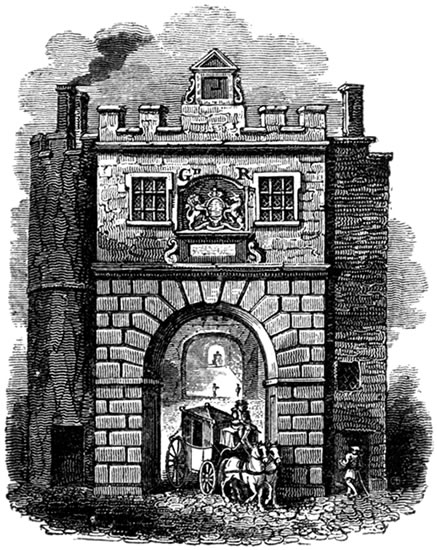
was furnished with two posterns for foot-passengers, and was decorated with the Royal Arms, under which was inscribed, ‘This Gate was widened from eleven to eighteen feet, in the Mayoralty of Sir Edward Becher, Knight, S. P. Q. L.’ The medalet, with a representation of this edifice, I have already mentioned to you, and it may now be stated that it was taken down in the year 1760, with all the other buildings on the Bridge, and the materials sold by auction. At which sale, the fine old sculpture of the Royal Arms was bought, with some other articles, by a Mr. Williams, a stone-mason of Tooley Street; who, being soon after employed to take down the gateway at Axe and Bottle Yard, and to form the present King Street, in the Borough, introduced several of the old Bridge materials in erecting it. The ancient Royal Arms, too, are yet to be seen on the front of a small public house, on the right-hand side of the Western end of the same street, between the numbers 4 and 67; with the inscription ‘G. III. R. 1760., King Street,’ carved around them. Mr. Williams also bought several of the facing stones of the old London Bridge, of which he built a very curious house, the roof being of the same stone, and which, about three years since, was standing in Lock’s Fields, near Prospect Row, Newington, usually known by the name of ‘Williams’s Folly.’ The new Bridge-Gate stood near the corner of Pepper Alley Stairs, and you will find a representation of it in the Frontispiece to the first volume of Maitland’s ‘History.’ I imagine, that upon the removal of the old gate, the custom of erecting the heads of traitors there was discontinued, as I find no subsequent notice of it; and the last heads which, probably, were placed upon its towers, are said to have been those of the Regicides in 1661, as I have shewn from Monconys, though, in the numerous pamphlets of their Trials, &c., I find no account of their being thus disposed. From ‘The Traytors’ Perspective Glass,’ London, 1662, 4to., we learn, however, that the heads of Cromwell and Ireton were set over Westminster Hall; and of the others, it is said, ‘their heads, in several places, are become a spectacle both to angels and men, and a prey to birds of the air.’
In Maitland’s ‘History,’ volume i., page 49, we are furnished with ‘a brief state of the Bridge Account, from Lady-day 1726 to ditto 1727, by the Bridge-Masters, Matthew Snablin and John Web.
‘Charge. £. s. d.
‘By Money in the Bridge-Masters’ hands, at the foot of the last Account 576 9 9
By ditto in the Tenants’ hands in arrears 4271 13 3
By the General Rental this year 3299 0 5
By Fines this Year 493 4 2
By Casual Receipts 267 6 8
The whole charge. £8907 14 3
‘Discharge. £. s. d.
‘To Rents and Quit-Rents 49 12 8
To Taxes and Trophy-Money 209 14 3
To Weekly Bills, Expenses, and Emptions 1648 0 7
To Timber and Boards 430 18 9
To Stones, Chalk, Lime, Terrass, and Bricks 197 6 0
To Iron-work 170 0 0
To Plumber, Glazier, Painter, and Paviour 278 8 0
To Shipwrights’ Work and Cordage 61 5 0
To Benevolence to the Lord Mayor, &c. 145 6 8
To particular Payments by Order of Court 173 7 0
To Fees and Salaries 270 4 0
To Costs at Audit and Lady Fair 296 2 0
To Money due to balance 4977 9 4
£8907 14 3’
On Wednesday, the 26th of December, 1739-40, commenced another Frost, the most severe which had occurred since 1716. The Thames, as we are told by the ‘Gentleman’s Magazine,’ of 1740, volume x., page 35, January 31, floated with rocks and shoals of ice; and when they fixed, represented a snowy field, every where rising in masses and hills of ice and snow. Of this scene, several artists made sketches; whilst tents and printing-presses were erected, and a complete Frost-fair was again held upon the River, over which multitudes walked, though some lost their lives by their rashness. It was in this fair that Doll, the Pippin-woman, whom I before mentioned, lost her life, as Gay relates it in the Second Book of his ‘Trivia,’ verses 375-392; the last line of which seems to be an imitation of that song which we formerly considered, and which was extremely popular even in the time of Gay himself. The passage I particularly allude to is this:
‘Doll every day had walk’d these treacherous roads; Her neck grew warp’d beneath Autumnal loads Of various fruit: she now a basket bore; That head, alas! shall basket bear no more. Each booth she frequent past, in quest of gain, And boys with pleasure heard her thrilling strain. Ah, Doll! all mortals must resign their breath, And industry itself submit to death! The crackling crystal yields; she sinks, she dies, Her head, chopt off, from her lost shoulders flies; Pippins she cried, but death her voice confounds, And pip—pip—pip, along the ice resounds.’
“Mr. J. T. Smith, in his ‘Ancient Topography of London,’ page 24, states that another remarkable character, called ‘Tiddy Doll,’ died in the same place and manner.
“In the treasures of Mr. Crowle’s Illustrated Pennant, are several contemporary memorials of this Fair; which I shall very briefly mention, and give some specimens of the poetry attached to them.
“A coarse copper-plate, entitled ‘The View of Frost Fair,’ 10¼ inches by 12, scene taken from York-buildings Water-Works; twelve verses beneath.
“A copper-plate, 7½ inches by 5, representing an altar-piece with the ten commandments, engraven between the figures of Moses and Aaron; and beneath, on a cartouche, ‘Printed on the Ice on the River of Thames, Janry. 15, 1739.’
“A coarse copper-plate engraving, looking down the River, entitled ‘Frost Fair,’ with eight lines of verse beneath; and above ‘Printed upon the River Thames when Frozen, Janu. the 28, 1739⁄40.’ 9½ inches by 12¼.
“A copper-plate 5 inches by 8¼, representing an ornamental border with a female head, crowned at the top; and below, two designs of the letter-press and rolling press. In the centre in type, ‘Upon the Frost in the year 1739-40;’ six verses, and then ‘Mr. John Cross, aged 6. Printed on the Ice upon the Thames, at Queen-Hithe, January the 29th, 1739-40.’
‘Behold the Liquid Thames now frozen o’er! That lately Ships of mighty Burden bore. Here You may Print your Name, tho’ cannot Write, ’Cause numb’d with Cold: ’Tis done with great Delight. And lay it by; That Ages yet to come May see what Things upon the Ice were done.’
“A copper-plate, representing a view of the Thames at Westminster, with the tents, sports, &c., and alphabetical references, entitled ‘Ice Fair.’ ‘Printed on ye River Thames, now frozen over, Jany 31, 1739-40;’ 7½ inches by 12½.
‘Amidst ye arts yt on ye Thames appear, To tell ye Wonders of this frozen Year, Sculpture claims Prior place, since yt alone Preserves ye Image when ye Prospect’s gone.’
“An altered copy of these verses was printed upon the Thames in the great Frost of 1814; and from an advertisement in the ‘London Daily Post’ of Thursday, January the 31st, 1739-40, we learn that this and the following print were originally sold for 6d. each.
“A Copper-plate printed in red, 9½ inches by 13¼, the view taken opposite St. Paul’s, with tents, sports, &c. in front, sixteen lines of verse beneath, with ‘Frost and Ice Fair, shewing the diversions upon the River Thames, began the 26th of Decemr 1739-40, ended Februry the 17th.’”
“In the beginning of this Frost, the houses on London Bridge appear to have received considerable damage, from the many vessels which broke from their moorings, and lay beating against them; the notice of which, we derive from the two most celebrated newspapers of the time,—the ‘Daily Post,’ and Woodfall’s ‘General Advertiser.’ The latter of these, for Monday, December the 31st, 1739, states that ‘all the watermen above the Bridge have hauled their boats on shore, the Thames being very nigh frozen over:’ and in the same paper, for Wednesday, January 2nd, 1739-40, it is observed, that ‘several vintners in the Strand bought a large Ox in Smithfield on Monday last, which is to be roasted whole on the ice on the River of Thames, if the Frost continues. Mr. Hodgeson, a Butcher in St. James’s Market, claims the privilege of selling, or knocking down, the Beast, as a right inherent in his family, his Father having knocked down the Ox roasted on the River in the great Frost, 1684; as himself did that roasted in 1715, near Hungerford Stairs. The Beast is to be fixt to a stake in the open market, and Mr. Hodgeson comes dress’d in a rich lac’d cambric apron, a silver steel, and a Hat and Feathers, to perform the office.’ After the mention of numerous accidents near London Bridge, the repetition of which would occupy considerable time with but little gratification, the ‘Daily Post,’ of Tuesday, January the 22nd, 1740, thus notices the first breaking-up of this famous frost. ‘Yesterday morning, the inhabitants of the West prospect of the Bridge were presented with a very odd scene, for, on the opening of their windows, there appear’d underneath, on the River, a parcel of booths, shops, and huts, of different forms, and without any inhabitants, which, it seems, by the swell of the waters and the ice separating, had been brought down from above. As no lives were lost, it might be view’d without horror. Here stood a booth with trinkets, there a hut with a dram of old gold; in another place a skittle-frame and pins, and in a fourth ‘the Noble Art and Mystery of Printing, by a servant to one of the greatest trading companies in Europe.’ With much difficulty, last night, they had removed the most valuable effects.’ To conclude my information upon this subject, I have to observe only that the ‘Daily Post’ of Thursday, February the 14th, states that the Sterlings of London Bridge had received so much damage during the frost from the great weight of ice, that their repairs would amount to several thousand pounds.
“The last extract given us by Maitland, in his ‘History’ page 49, from the Bridge-House revenues and accounts, extends from Lady-day 1752 to Lady-day 1753, and consists of the following particulars.”
£ s. d.
“‘In the hands of the Bridge-Masters, at the foot of their last account 2669 9 6
In the hands of the Chamberlain of London, paid to him by Webb’s securities 600 0 0
—————— 3269 9 6
In Tenants’ hands in arrears at Lady-day, 1752 2413 18 9½
In arrear for fines then 70 6 11
Rental General this year, including Quit Rents 3843 8 7
Fines set this year 662 0 0
Whole charge £10259 3 9½
£ s. d.
‘Rents and Quit-Rents paid 52 9 3
Taxes and Trophy-money: sums collected for the accoutrements and maintenance of the Militia 194 11 4½
Expenses 351 17 1½
Emptions of Timber 471 7 6
Stone, Chalk, Terrass 340 4 4
Iron-work 158 18 0
—————— 970 9 10
Mason, Painter, Glazier, Carpenter, &c. 1904 13 9
Shipwrights’ work and Cordage 104 18 0
Benevolence 232 13 4
Particular Payments by Order 1254 7 3¾
Fees and Salaries 287 4 5
Costs at Audit and Lady Fair 160 11 0
£5513 15 4¾
£ s. d.
‘Amount of the preceding Charge 10259 3 9½
Deduct the foregoing expenses 5513 15 4¾
Remainder 4745 8 4¾
Whereof discharged by desperate arrears and remitted 89 0 0
Remaining due to the Bridge-house, at Lady-day, 1753 4656 8 4¾
And thus disposed of.
Arrears of Fines and Quit-rents 2483 15 1¾
Arrears and Fines 70 6 11
In the hands of the Bridge-Masters 1502 5 5
In the hands of the Chamberlain of London 600 0 0
£4656 7 5¾’
“There appears to be some little inaccuracy in this statement by Maitland, since the amounts which he sets down are not the products of the sums when added together; but these I have rectified, though the balance of the whole account does not quite accord with the sums remaining in hand.
“We have at length reached that period, when the extensive alteration, or even re-building, of London Bridge, began to form a matter of grave and active consideration; and in relating the proceedings of these times, there will be no little difficulty in condensing into one consecutive account, all the numerous surveys, reports, plans, proposals, and objections, which were then published. In treating of this part of the subject, however, as it will be best and briefest to do it in order, we will first consider the state of old London Bridge, as it was represented by the various Architects employed to survey it; then give some account of the schemes proposed for its alteration; and lastly, describe that which was adopted, and the means used for carrying it into effect.
“It appears extremely probable, that the contrast presented by the broad and clear road of the new Bridge at Westminster,—which was commenced in September, 1738, and completed in November, 1749,—chiefly contributed to turn the attention of the Corporation of London to the exceeding inconvenience of their own. Though to the building of Westminster Bridge, Maitland, who knew the circumstances, tells us in his ‘History,’ volume ii., page 1349, that there was very considerable opposition; and that the City of London, the Borough of Southwark, the Company of Watermen, and the West-Country Bargemen, all petitioned the Parliament against it. On Friday, February the 22d, 1754, as we learn from the ‘Public Advertiser’ of the day following, the Court of Common Council took into consideration a motion for the construction of a new Bridge between London and Southwark: when, after a debate of nearly four hours, it was withdrawn, and a Committee appointed, consisting, as usual, of the Aldermen, Deputies, and one Common-Councilman from each Ward, to consider of the best means of rendering the old Bridge safe and convenient; who were empowered to draw upon the Chamberlain to the amount of £100, for plans, surveys, &c. The Report of this Committee stated, that the Bridge foundation was still good, and that, by pulling down the houses, and making such repairs as should then be required, the edifice might be rendered equally serviceable with Westminster Bridge; being capable of receiving four carriages abreast, with a good foot way on each side. By pulling down the houses at the corners of the narrow streets leading to the old Bridge, it was also represented that it would be rendered so convenient as to supersede the erection of any new one. To this it was objected, that most of the houses declined considerably out of the perpendicular; and that those on the Eastern side of the Bridge decayed much faster than the opposite ones. In Harrison’s ‘History,’ page 24, this account is partly confirmed; since we are there told that ‘on the outer part of the Bridge, on the East side, the view from the wharfs and quays was exceedingly disagreeable. Nineteen disproportioned arches, with sterlings increased to an amazing size by frequent repairs, supported the street above. These arches were of very different sizes, and several that were low and narrow were placed between others that were broad and lofty. The back part of the houses next the Thames had neither uniformity nor beauty; the line being broken by a great number of closets that projected from the buildings, and hung over the sterlings. This deformity was greatly increased by the houses extending a considerable distance over the sides of the Bridge, and some of them projecting farther over it than the others; by which means, the tops of almost all the arches, except those that were nearest, were concealed from the view of the passengers on the quays, and made the Bridge appear like a multitude of rude piers, with only an arch or two at the end, and the rest, consisting of beams, extending from the tops of flat piers, without any other arches, quite across the river.’
“The best view of London Bridge in this state, is represented in an engraving by Peter Charles Canot, from a picture painted by Samuel Scott, of whom Walpole says, ‘if he were but second to Vandevelde in sea-pieces, he excelled him in variety, and often introduced buildings in his pictures with consummate skill. His views of London Bridge, of the Quay at the Custom-House, &c. were equal to his Marines.’ He died October the 12th, 1772; vide the ‘Anecdotes of Painting,’ page 445. This view is also noticed by Gough in his ‘British Topography,’ volume i., page 735: and Mr. J. T. Smith, in his ‘Ancient Topography,’ page 25, observes, that it was in the possession of Edward Roberts, Esq., Clerk of the Pells, who probably still retains it. It was exhibited, says the author of ‘Wine and Walnuts,’ volume i., page 65, in 1817, at the British Institution; and of the excellent engraving from it there are two editions: the earliest and best is marked, ‘Published according to Act of Parliament, Feby. 25, 1761:’ and the latter may be known by the imprint of ‘Printed for Bowles and Carver, R. H. Laurie, and R. Wilkinson.’ This plate has been more than once copied in a reduced form; but the best, engraved by Warren, appeared in that work by Dr. Pugh, known by the name of ‘Hughson’s History of London,’ London, 1806-9, octavo, volume ii., page 316. Another view of London Bridge with the houses, of considerably less merit, but rather more rarity, was ‘Printed and sold for John Bowles, Print and Map-seller, over against Stocks-Market, 1724.’ It consists of a small square plate, and shews the houses on the Western side of the edifice in bad perspective, with a short historical account beneath it; and it forms plate y of a folio volume, entitled, ‘Several Prospects of the most noted Buildings in and about the City of London.’ There are also some rather large representations of this Bridge, in most of the old two and three-sheet views of London; as in those published by Bowles ‘at the Black Horse in Cornhill,’ about 1732, &c.; and in the series of prints usually called ‘Boydell’s Perspectives,’ is a folio half-sheet plate very much resembling Scott’s, entitled ‘A view of London Bridge taken near St. Olave’s Stairs. Published according to Act of Parliament by J. Boydell, Engraver, at the Globe, near Durham Yard in the Strand. 1731. Price 1s. J. Boydell, delin. et sculp.’ I could mention several others, as in the Title-page to the old ‘London Magazine;’ in Strype’s edition of Stow; in Maitland; Motley’s ‘Seymour’s Survey;’ in Hughson, Lambert, and numerous other works; but for fidelity of feature, and excellence of effect, none of them are in any respect equal to that of Scott, representing London Bridge before the alteration of 1758.
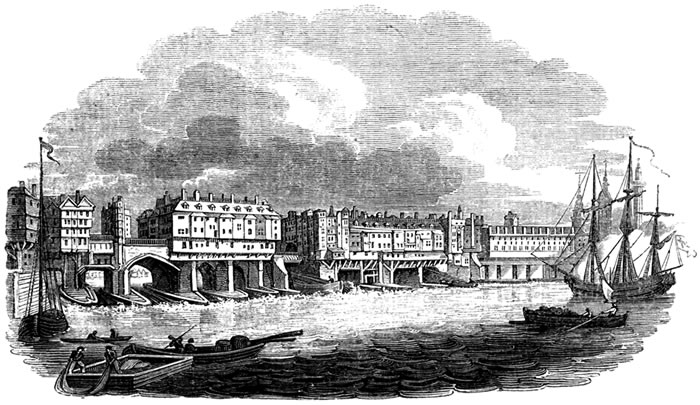
“As at this period the public attention was generally directed towards this edifice, the proprietors of Maitland’s ‘History of London,’ which was then appearing in numbers, issued an Advertisement, in the ‘Public Advertiser’ of Saturday, April the 6th, 1754, stating that ‘Number xv. will be illustrated with two fine Prospects of London Bridge as it may be altered agreeable to drawings presented to Sir Richard Hoare, by Charles Labelye, Esq.; and humbly inscribed to the Lord Mayor, Aldermen, and Common-Council, who now have the state of that Bridge under consideration.—Not one of this Number will be delivered to any but Subscribers, and such as have bought, or shall buy, the former Numbers.’ Like Strype’s edition of Stow, this work was published at 6d. each Number.
“On Thursday, September the 26th, 1754, the Bridge Committee presented their Report to the Court of Common-Council, an original verbatim copy of which is in the xxviiith. volume of ‘London Tracts’ in the British Museum, small folio. This Report stated, that the piles, &c. of old London Bridge having been surveyed by Mr. George Dance, then Clerk of the Works to the City, the foundations were declared good, and, with common repairs, likely to last for ages. That the houses on the Bridge being a public inconvenience, it was recommended that they should be removed, from St. Magnus’ Church to the City Gate, on the East; and from the corner of Thames Street to the Bear Tavern in the Borough, on the West. That Mr. Dance had produced a plan for an alteration of the Bridge, with estimates amounting to £30,000, in which were a carriage-road of 33 feet, with two foot-paths of 6 feet each; but that such expense might be reduced to £27,000, by leaving the houses standing on the South side of the Gate. That the annual rents of the houses to be taken down amounted to about £828: 6s., which would be lost to the Bridge-House estates; whilst the Parishes of St. Magnus and St. Olave would also lose in taxes, rents, and tythes, about the yearly sum of £484: 19s. 10d.; and that the estimate of the houses then out upon lease, with others which must be bought, came to £8940: 11s. 7d.; besides other satisfaction which might be required by the under-tenants.
“The substance of Labelye’s plan for altering this edifice, is given in Maitland’s ‘History,’ volume ii., pages 826-832, together with the result of several other reports made in 1746. His chief objection to old London Bridge was to the sterlings surrounding the piers; which, occupying almost one fourth part in five of the water-way, caused a fall of nearly five feet perpendicular, during the greater part of every tide, thus rendering the passage of vessels through the locks equally difficult and dangerous. He, consequently, proposed casing the piers with four feet of Portland Stone, and to lessen the sterlings so as always to have about 400 feet of water-way, which, being twice as much as the Bridge originally possessed, would reduce the fall to about 15 inches. The expense of this plan, he conceived, would be about £2000 for each pier; two or three of which could be altered in a year, without stopping the passage either over or under the Bridge. He also proposed to adopt the idea of Sir Christopher Wren, in new-modelling the appearance of the building itself, by taking away eleven piers, and forming nine broad-pointed Gothic arches, springing from the lowest low-water mark: these were to be of different dimensions, and the fifth from the South end was to be 90 feet in span. The parapet was to be ornamented with Gothic crocketted recesses surmounting the piers; by a cast-iron ballustrade; or by a dwarf-wall, or even houses; and, according to this plan, there would have been a water-way of 540 feet, and a fall of not more than 9 inches; whilst the amount of time and expense would not be considerably greater than in the former.
“The Reports of Mr. George Dance, Clerk of the City Works, and Bartholomew Sparruck, the Water-Carpenter of London Bridge, in answer to the questions of the Committee, in 1746, also furnish several very curious and interesting particulars concerning the building at that period, and the original is to be found at length in Maitland’s ‘History,’ already cited; and in Nos. II. and III. of Dr. Charles Hutton’s ‘Tracts on Mathematical and Philosophical Subjects,’ London, 1812, volume i., pages 115-122. The Report commences with a table of the depth of water, above, immediately under, and below every arch, beginning at the South end of the Bridge, which is to the following effect.
“‘Name of the Lock. West Side. Under the Arch. East Side.
Feet. Inch. Feet. Inch. Feet. Inch.
Shore Lock 16 — 5 9 8 10
Second Lock from Surrey Shore 14 6 9 — 10 4
Rock Lock 22 3 3 — 14 —
Fourth Lock from Surrey Shore 14 — 7 — 15 7
Fifth Lock from Surrey Shore 18 9 10 3 18 7
Roger Lock 17 7 8 7 15 11
Draw Lock 18 1 8 10 15 11
Nonesuch Lock 25 1 9 2 18 3
Pedlar’s Lock 17 8 5 9 18 6
Gutt Lock 21 2 5 6 17 8
Long Entry Lock 18 11 3 5 12 8
Chapel Lock 17 — 2 4 22 —
St. Mary’s Lock 24 6 8 9 20 —
Little Lock 22 3 9 — 17 4
King’s Lock 23 9 6 9 20 7
Shore Lock 19 9 6 11 21 10
Mill Lock 20 3 4 6 21 10
Mill Lock 19 4 7 9 14 1
Mill Lock 10 10 4 — 13 10
Mill Lock 6 7 6 1 10 10’
“The Report then proceeds to state, that the height of the under bed of the first course of stones is very unequal; some being 2 feet 4 inches; and others varying from 1 foot 3 inches, to 1 foot 11 inches above low-water mark; and from 4 to 6 feet above the level of the sterlings. The rough and unhewn piles were found to be shod with iron, and but little decayed: in some instances, they were separated from the stone-work by planks of oak and elm, from 4 to 6 inches in thickness, which were probably first inserted at some of the numerous repairs; and each of the piers was protected by a stone base, extending about 7 inches beyond them. It was from these reports, that Mr. Labelye drew up his plans, which, together with his remarks on the old Bridge, were presented to the Committee, on Wednesday, the 17th of September, 1746. As this Architect desired that his designs might be examined by some eminent, scientific, and disinterested individuals, several such persons were called in to assist the deliberations of the Committee; though, after many other inquiries and consultations, the discussions terminated in a proposal for building a new Bridge at Blackfriars.
“At a Court of Common Council holden on Thursday, December 18th, 1755, after a very protracted opposition, the Corporation consequently agreed to petition Parliament for leave to bring in a Bill to erect another Bridge over the Thames at Fleet-Ditch, and on Tuesday, January 13th, 1756, the petition was presented and referred to a Committee; another petition being also presented at the same time, praying leave to bring in a Bill for improving and widening the passage over London Bridge, by removing the houses and other obstructions thereon, and for raising money to enable the Trustees to render the same safer and more commodious. This also was referred to a Committee; on Friday, March 12th, 1756, leave was granted to bring in the Bills; and on Thursday, the 27th of May, they both received the Royal assent, when the King closed the Session of Parliament. These Acts are printed in Maitland’s ‘History,’ volume ii., page 1387; though the best authority is Ruffhead’s ‘Statutes at Large,’ volume vii., pages 728-738, 29th of George II., Chapter xl.; and I shall first give a very few particulars of the Act relating to London Bridge, and next shew how the alteration was effected. By this Statute, then, the Corporation was empowered to buy and remove all buildings on, and contiguous to, the Bridge, for enlarging its avenues, improving the passage over, and widening one or more of its arches:—to devise how the same should be executed, and kept in repair:—to erect an uniform ballustrade on each side, with a passage of 31 feet for carriages, &c., and 7 feet for each of the footways:—to have it lighted and watched at the expense of the Bridge-House estates:—to preserve the arches and pipes belonging to the Water-works:—to establish, after the 24th of June, 1756, an additional toll for the payment of the expenses incurred by the alterations:—to keep the Bridge clear of buildings, and of carriages standing upon it for hire, after the houses should be removed; and to make all carriages keep on the Eastern side in going towards Southwark, and on the Western side in coming to London. The Act also provided penalties for destroying the Bridge or any of its works; extensive powers for the Corporation in buying the various property; an equivalent for the tythes, rates, &c., payable to the Rectors of St. Magnus and St. Margaret, and St. Olave; and particular ordinances concerning the tolls.
“Gates and toll-houses were to be erected on, or near, London Bridge; but to continue only until the principal and interest of the borrowed monies should be discharged. The additional tolls were, ‘for every horse drawing any coach, chariot, hearse, berlin, landau, calash, chaise, or chair, over the Bridge, 1d.; for every such carriage itself, 1d.; and for every horse not drawing, passing across the Bridge, ½d.’ Loaded vessels also, passing under the Bridge, were to pay 2d. for every 5 tons burthen; 3d. for ten tons; 6d. for 25 tons, and 1s. for vessels of greater capacity. In the Act for building a Bridge at Blackfriars, 29th of George II.—1756,—Chapter lxxxvi., it is stated, that the taking away of all tolls from that of London, as soon as possible, would be of general advantage, they being then leased out for 21 years at a fine of £2100, and a yearly rent of £735; the redemption of all which was estimated at £36,000. In 1757, the 31st of George II., Chapter xx., an aid of £15,000 was granted by Parliament towards the rebuilding of London Bridge, because the tolls were not only difficult to collect, but were also a considerable hindrance to commerce and navigation: vide the ‘Continuation of Maitland’s History,’ at the end of volume ii., page 19. The powers of the new Act—which also protected the Bridge and its works, by making it felony to destroy them,—commenced from the 21st of April, and the additional tolls of the former one ceased from the 24th of June, 1758. Whilst I am upon the subject, it will probably be as well to include all our notices of the tolls of London Bridge under one head; and therefore I may remark, that in 1767, the 7th of George III., Chapter xxxvii., an Act was passed for the completing of Blackfriars Bridge, making several improvements in the City, and for treating with Mr. Edward Neale, the Lessee of the tolls of London Bridge, for their redemption; to which latter purpose, the sum of £30,000 was appropriated. About the end of September, 1770, the Corporation proceeded to act upon this power, fifteen years and three quarters being then unexpired of the lease; but the lessee having altered his demand, on account of the tolls having increased upwards of £600 per annum since 1766, it was found, that to reimburse the City, it was essential that they should continue both upon London and Blackfriars Bridges for some years longer. Upon petition of the Corporation, therefore, in the 11th of George III., 1771, Chapter xx., an Act was passed for further continuing the tolls on London Bridge until March the 25th, 1782, when the remainder of the lease was to be bought and the tolls finally to cease. All these particulars will be found in the ‘Statutes at Large,’ volumes vii., pages 728-738, 742; viii., page 210; x., pages 306, 307; and xi., pages 154, 155; there is also considerable information upon this subject, to be found in Malcolm’s ‘Londinum Redivivum,’ volume ii., pages 392-396, derived from authentic documents. From these authorities it appears that the amount of the prescriptive tolls of London Bridge, at Midsummer, 1763, produced £1785: 10s. 5d.; in 1764, £1946: 4s. 1d.; in 1765, £1846: 7s. 4d.; in 1766, £1878: 16s. 6d.; and in 1770, £2465: 14s. 3d.; estimating, therefore, the average to be about £1864, and deducting from that sum the Rent, £735; Land Tax, £180: 12s. and the expenses of collecting, £150, the lessee’s clear annual income would be £798: 15s.