DESCRIPTIVE LIST OF THE EMBELLISHMENTS. (continued 11)
Reading edition
“This erection was divided into four principal parts, consisting of a floor and three galleries, the whole being capable of containing 2000 persons; nearly which number was probably present. The floor was laid 45 feet below high-water mark, and measured 95 feet by 36, being formed of four-inch beechen planks, resting upon Piles headed with iron; upon which was a layer of timber two feet thick, and a course of brick-work and stone, each of 2½ feet deep. It was surrounded by three rows of seats, excepting at the entrance at the Eastern end; and on the North side was a chair of state, covered with crimson cloth, having behind it the seats appropriated to the Lord Mayor’s family and private friends. The whole floor was capable of receiving 500 persons, and was entirely covered with red baize, excepting at a rectangular space in the centre, within which appeared a cavity, cut in stone, of 21 inches by 15, and 7 in depth, for the coins, &c., over which the First Stone was suspended by a strong fall and tackle, secured to the upright timbers of the Dam. Above the floor was a gallery, containing three rows of covered seats, sufficient to hold 400 spectators; and over it were two others; the lower one, of two rows for 400; and the upper tier for 300 more. Three other galleries also stretched along the cross beams above; whilst a still more lofty one, at the Western end, was appropriated to the Ward Schools of Bridge, Dowgate, and Candlewick. The general character of the Dam was strength and solidity; the tiers of seats being supported by massive cross-beams, wreathed and decorated with flags and rosettes; along the centre passed another very thick timber, bearing the uprights and their respective supporters; and from the roof several large flags hung heavily downwards. The taste and ingenuity which were exerted in the arrangements, had indeed left nothing to be wished for; whilst the general security was everywhere so palpably apparent, as to dispel the apprehensions even of the most timid. Such was the appearance of the Interior of the Coffer-Dam, and the position of the first stone,
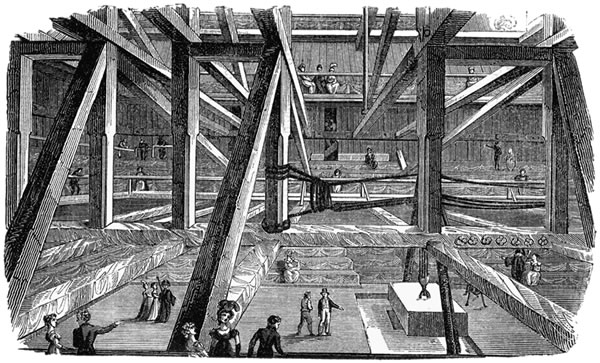
which was of the best hard Aberdeen Granite, weighing 4 tons. Its measurement was, 5 feet 5⁄8 of an inch long, 3 feet 63⁄8 inches broad, and 2 feet 10 inches deep; containing 50 feet 7 inches in cubic measure; and its situation as nearly as possible the centre of the First, or South Pier, on the Southwark side. The Company continued rapidly to arrive until the barriers were closed at 2 o’clock, when most of the seats in the Coffer-Dam were occupied; and where, to lighten as much as possible the interval of waiting, the bands of the Horse-Guards, Red and Blue, and of the Artillery Company, which were stationed in a gallery at the entrance, were employed to furnish frequent entertainment: Refreshments of Tea, Coffee, Champagne, &c., being also liberally supplied by the Committee. About a quarter before three o’clock, the Lady Mayoress, and her family, came to the Dam in the private state-carriage; and at four, a signal-gun announced that the Procession had left the Court-yard of Guildhall, nearly in the following order; passing through Cheapside, Cornhill, and Grace-Church Street, to the Bridge, where it was received by the Committee, and other members of the Common Council; the principal persons being in their own carriages.
A Division of the Artillery Company, with their Field-pieces. Constables. Band of Music. Marshalmen. The Junior City Marshal, Mr. W. W. Cope, on horseback. Nathaniel Saunders, Junr., Esq., the Water-Bailiff, and Mr. Nelson, his Assistant. Barge Masters. City Watermen, bearing Colours. Remainder of the City Watermen. Bridgemasters and Clerk of the Bridge-House. Contractors, William Jolliffe, Esq., and Sir Edward Banks. Model of the Bridge, borne by Labourers. Architect and Engineer, John Rennie, Esq., F.R.S. Members of the New Bridge Committee. Comptroller of the Bridge-House, Robert F. Newman, Esq. Visitors and Members of the Committee of the Royal Society. High Bailiff of the Borough of Southwark, John Holmes, Esq. Under Sheriffs, George Martin, and John S. Tilson, Esqrs. Clerk of the Peace of the City of London, Thomas Shelton, Esq. City Solicitor, William Lewis Newman, Esq. Remembrancer, Timothy Tyrrell, Esq. Secondaries of Giltspur Street and the Poultry Compters. Comptroller of the Chamber, Lewis Bushnan, Esq. Common Pleaders, Wm. Bolland, Esq., George Bernard, Esq. Hon. C. E. Law, and John Mirehouse, Esq. Judges of the Sheriff’s Court. Town Clerk, Henry Woodthorpe, Esq. Common Serjeant, Thomas Denman, Esq., M. P. Deputy Recorder, Mr. Serjeant Arabin. Chamberlain, Richard Clark, Esq. Members of Parliament and other Gentlemen, Visitors. Sir Humphrey Davy, President of the Royal Society. The Sheriffs, Anthony Brown, and John Key, Esqrs., Aldermen. Aldermen below the Chair. The Recorder, Newman Knowlys, Esq. Aldermen past the Chair. Visitors, Privy Councillors. Visitors, Peers. Officers of State. Music and Colours, with the Court of the Lord Mayor’s Company, the Goldsmiths. Marshalmen. The Senior City Marshal, Mr. Neville Brown, on horseback. The Lord Mayor’s Household. The Lord Mayor’s Servants in their State Liveries. The Lord Mayor in his State Carriage, accompanied by His Royal Highness the Duke of York. Carriage of His Royal Highness the Duke of York. The remainder of the Artillery Company, as a guard of honour to the Lord Mayor.
“The streets through which the Procession passed, were all thronged; every window was filled with spectators; and, on arriving at its destination, the River, the Wharfs, the most distant buildings, and even Southwark Bridge, were equally crowded with thousands of impatient gazers. It was not, however, until a quarter before five, that the field-pieces of the Artillery Company, at the old Swan Stairs’ Wharf, announced the cavalcade’s actual approach, when the bands played the famous Yäger Chor of Weber’s ‘Freyschutz.’ The City-Watermen, bearing their richly emblazoned standards, soon afterwards entered the Coffer-Dam, when, after the colours had been very ingeniously passed between the timbers, and grouped around the Stone, it being found that they would materially obstruct the view, they were, with similar difficulty, conveyed back again. The narrow and winding passages of the Dam destroyed much of the stately order of the Procession; but nearly the whole Court of Aldermen, and a large party of the Common-Council, in their scarlet and purple gowns, having appeared on the floor beneath, they were followed by the City Officers; the Lord Mayor, in his robes of state; and His Royal Highness the Duke of York, in a plain blue coat, wearing the Garter round his knee, and the star of the order upon his breast. In the same part of the Procession also came the Earl of Darnley; Lord James Stuart; the Right Hon. C. W. W. Wynn, President of the Board of Controul; Admiral Sir George Cockburn, M. P.; Admiral Sir Isaac Coffin, Bart, M. P.; Sir George Warrender, Bart, M. P.; Sir Peter Laurie; Sir Robert Wilson, M. P.; Thomas Wilson, Esq., M. P.; William Williams, Esq., M. P.; George Holme Sumner, Esq., M. P.; and several other personages of distinction.
“The Lord Mayor and His Royal Highness having arrived at the state chair, amidst the waving of handkerchiefs, and the loudest cheers, and having both of them declined that seat of honour, they remained standing during the whole of the ceremony; which then commenced by the Ward Schools and the visitors singing ‘God save the King,’ verse and chorus, in which the Duke also joined with great enthusiasm. The Lord Mayor then removed towards the Eastern end of the Platform, in the centre of the Coffer-Dam floor, where there was a small stage covered with crimson cloth, attended by four members of the Bridge Committee, bearing the bottle for the coins, an inscription incrustated in glass, the level, and the splendid Silver-Gilt Trowel for Laying the First Stone.
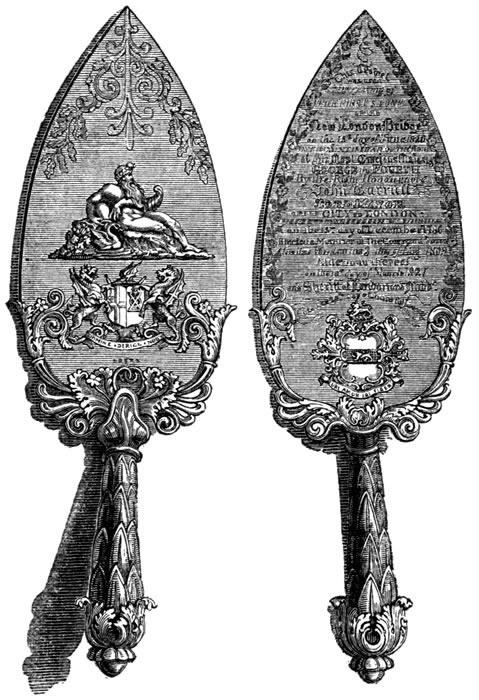
This elegant instrument, which was designed and executed by Messrs. Green, Ward, and Green, of Ludgate Hill, measured 15 inches in its extreme length, and 5 inches at the widest part of the blade; the handle being 5½ inches long, composed of wrought laurel, terminating in very rich acanthus foliage at the end; and its depository, a green Morocco case lined with white satin. The upper side was embossed with a reclining figure of the Thames, with a vase, swan, and cornucopia; beneath which was a shield, charged with the impaled arms of London and Southwark, and surrounded by the supporters, crest, motto, and badges of the City. The other side was perfectly flat, and was decorated with a border of flowers; the armorial ensigns, crest, and motto, of the Lord Mayor; and the following Inscription, engraven in ornamental characters:—
‘THIS TROWEL WAS USED IN THE LAYING OF THE FIRST STONE OF THE NEW LONDON BRIDGE, ON THE 15th DAY OF JUNE, 1825, IN THE SIXTH YEAR OF THE REIGN OF HIS MOST GRACIOUS MAJESTY GEORGE THE FOURTH, BY THE RIGHT HONOURABLE JOHN GARRATT, LORD MAYOR OF THE CITY OF LONDON: WHO WAS BORN IN THE WARD IN WHICH THE BRIDGE IS SITUATED, ON THE 15th DAY OF DECEMBER, 1786; ELECTED A MEMBER OF THE COMMON COUNCIL FOR THAT WARD, ON THE 3rd DAY OF AUGUST, 1809 ALDERMAN THEREOF, ON THE 10th DAY OF MARCH, 1821; AND SHERIFF OF LONDON AND MIDDLESEX, ON THE 24th DAY OF JUNE FOLLOWING.’
“Mr. John Rennie having exhibited to the Lord Mayor and the Duke of York a large and excellent drawing of the elevation of the New Bridge, Richard Clark, Esq., the venerable Chamberlain of London, next produced a white satin purse, containing a series of new coins of the reign, each separately enveloped, which being uncovered, and deposited by the Lord Mayor in an elegant square bottle of cut-glass, were placed in the cavity; four glass cylinders, 7 inches long and 3 in diameter, intended to support the engraved Inscription-plate, being fixed at the corners in plaster-of-Paris. Another member of the Committee then handed to the Lord Mayor a block of solid glass, 7¼ inches broad, 3½ in height, and 1½ in thickness, enclosing these words, in Messrs. Pellats’ and Green’s Ceramie Incrustation:—
‘THE FIRST STONE OF THIS BRIDGE WAS LAID BY THE RIGHT HONBLE JOHN GARRATT, LORD MAYOR OF LONDON, IN JUNE, 1825: AND IN THE 6TH YEAR OF THE REIGN OF KING GEORGE THE 4TH.’
‘PELLATS & GREEN.’
“The Town-clerk, Henry Woodthorpe, Esq., who had recently received the Degree of LL.D., then came forward with the brass Depositum-plate, and read aloud this very fine Inscription, composed, at the request of the Bridge Committee, by the Rev. Edward Coplestone, D.D., Master of Oriel College, Oxford, and late Professor of Poetry in that University; whose ‘Prælectiones Academicæ’ have so excellently illustrated the beauties of the ancient Classic Poets.
‘PONTIS VETVSTI QVVM PROPTER CREBRAS NIMIS INTERIECTAS MOLES IMPEDITO CVRSV FLVMINIS NAVICVLAE ET RATES NON LEVI SAEPE IACTVRA ET VITAE PERICVLO PER ANGVSTAS FAVCES PRAECIPITI AQVARVM IMPETV FERRI SOLERENT CIVITAS LONDINENSIS HIS INCOMMODIS REMEDIVM ADHIBERE VOLENS ET CELEBERRIMI SIMVL IN TERRIS EMPORII VTILITATIBVS CONSVLENS REGNI INSVPER SENATVS AVCTORITATE AC MVNIFICENTIA ADIVTA PONTEM SITV PRORSVS NOVO AMPLIORIBVS SPATIIS CONSTRVENDVM DECREVIT EA SCILICET FORMA AC MAGNITVDINE QVAE REGIAE VRBIS MAIESTATI TANDEM RESPONDERET NEQVE ALIO MAGIS TEMPORE TANTVM OPVS INCHOANDVM DVXIT QVAM CVM PACATO FERME TOTO TERRARVM ORBE IMPERIVM BRITTANICVM FAMA OPIBVS MVLTITVDINE CIVIVM ET CONCORDIA POLLENS PRINCIPE ITEM GAVDERET ARTIVM FAVTORE AC PATRONO CVIVS SVB AVSPICIIS NOVVS INDIES AEDIFICIORVM SPLENDOR VRBI ACCEDERET.
PRIMVM OPERIS LAPIDEM POSVIT IOANNES GARRATT ARMIGER PRAETOR XV DIE IVNII ANNO REGIS GEORGII QVARTI SEXTO A. S. M.D.CCC.XXV.
JOANNE RENNIE S. R. S. ARCHITECTO.’
“The following English translation of this truly elegant composition was also engraven on the reverse of the plate; though not then read.
‘THE FREE COURSE OF THE RIVER BEING OBSTRUCTED BY THE NUMEROUS PIERS OF THE ANCIENT BRIDGE, AND THE PASSAGE OF BOATS AND VESSELS THROUGH ITS NARROW CHANNELS BEING OFTEN ATTENDED WITH DANGER AND LOSS OF LIFE BY REASON OF THE FORCE AND RAPIDITY OF THE CURRENT, THE CITY OF LONDON, DESIROUS OF PROVIDING A REMEDY FOR THIS EVIL, AND AT THE SAME TIME CONSULTING THE CONVENIENCE OF COMMERCE IN THIS VAST EMPORIUM OF ALL NATIONS, UNDER THE SANCTION AND WITH THE LIBERAL AID OF PARLIAMENT, RESOLVED TO ERECT A BRIDGE UPON A FOUNDATION ALTOGETHER NEW, WITH ARCHES OF A WIDER SPAN, AND OF A CHARACTER CORRESPONDING TO THE DIGNITY AND IMPORTANCE OF THIS ROYAL CITY: NOR DOES ANY OTHER TIME SEEM TO BE MORE SUITABLE FOR SUCH AN UNDERTAKING THAN WHEN, IN A PERIOD OF UNIVERSAL PEACE THE BRITISH EMPIRE FLOURISHING IN GLORY, WEALTH, POPULATION, AND DOMESTIC UNION, IS GOVERNED BY A PRINCE, THE PATRON AND ENCOURAGER OF THE ARTS, UNDER WHOSE AUSPICES THE METROPOLIS HAS BEEN DAILY ADVANCING IN ELEGANCE AND SPLENDOUR.
THE FIRST STONE OF THIS WORK WAS LAID BY JOHN GARRATT, ESQUIRE, LORD MAYOR, ON THE 15th DAY OF JUNE, IN THE SIXTH YEAR OF KING GEORGE THE FOURTH, AND IN THE YEAR OF OUR LORD, 1825.
JOHN RENNIE, F.R.S. ARCHITECT.’
“Printed copies of these Inscriptions, with an embossed border, were presented to each person on entering the Dam; as was also another edition of the Latin, engraven on copper, of the same size as the admission-ticket, and having the same view of the New Bridge above it. The brass plate was then placed upon the glass pillars, when Mr. Richard Lambert Jones, Sub-Chairman of the Committee for erecting the edifice, presented the splendid Trowel to the Lord Mayor, with this address: ‘My Lord, I have the honour to inform your Lordship, that the Committee of Management has appointed you, in your character of Lord Mayor of London, to lay the First Stone of the New London Bridge; and that I am directed to present your Lordship with this Trowel, as a means of assistance to your Lordship in accomplishing that object.’ Upon which the Lord Mayor turned towards the Duke of York, and thus addressed His Royal Highness, and the other witnesses of the ceremony.
“‘Though it is not essential for me to speak at any length upon the purpose for which we are this day assembled, since its importance to this great commercial City must be clearly evident; yet I cannot refrain from offering a few observations, feeling, as I do, more than an ordinary interest in the accomplishment of the undertaking, of which the present ceremony is only the primary step. I cannot consider the present a favourable moment for entering into any chronological history of the present venerable Bridge, which is now, from the increased commerce of the country, and the rapid strides made by the Sciences in this Kingdom, found inadequate to its purposes; but would rather advert to the many advantages which must naturally result from the completion of this great national enterprise. Whether there be taken into consideration the rapid, and consequently dangerous, currents arising from the obstruction incidental to the defects of this ancient edifice, which have proved so destructive to human life and property, or its difficult and incommodious approaches and acclivity, it must be matter of sincere congratulation, that we are living in times when the resources of this highly-favoured country are competent to a work of such great public utility. If ever there were a period more suitable than another, for engaging in national improvements, it must be the present; governed as we are by a Sovereign, the munificent and accomplished Patron of the Arts, beneath whose mild and paternal sway, by the blessing of Divine Providence, we now enjoy profound peace; living under a government, by the enlightened policy of which, our trade and manufactures so extensively flourish; and represented by a Parliament, ever ready to foster, by the most liberal grants, any plans for the improvement of the Empire; to which the present undertaking is so deeply indebted for its munificent support. Thus happily situated, it is impossible to hail such advantages with other feelings than those of gratitude and delight; and it is to me a source of unqualified pride and pleasure, that this great undertaking should have occurred in the year when I have been honoured by the office of Chief Magistrate of this great, this greatest, City, not of England only, but of the world; and that this important ceremony should take place in the Ward which I have the honour to represent in the Civic Councils. I cannot conclude without acknowledging how highly complimentary I feel it to the honourable office which I now fill, to meet such an auditory as now surrounds me; in which I see the illustrious Prince, Heir-presumptive to the Throne of this Kingdom; many of His Majesty’s Ministers, and the distinguished Nobles of the land; my active brother-magistrates; my kind fellow-citizens; and, above all, so brilliant an assemblage of that sex, whose radiant smiles, this day, shed a lustre on our meeting. Under such auspices, I rejoice to lay the Foundation-Stone of a structure, which, I trust, will, through all future time, prove an ornament to the Metropolis; reflect credit on the Architect; and redound to the honour of this Corporation: and I offer up a sincere and fervent prayer, that, in executing this great work, there may occur no calamity; that, in completing what is most particularly intended as a preventive of future danger, no mischief may overcloud the universal rejoicings on the undertaking.’
“The very warm applauses which followed this most appropriate address subsided only upon the commencement of the Masonic ceremonies, by a portion of fine mortar being placed around the cavity of the Stone, by several of the Assistants, and spread by the Lord Mayor with his splendid Trowel; after which, precisely at 5 o’clock, the First Stone was gradually lowered into its bed by a brazen block of four sheaves, and the power of a machine called a crab. When it was settled, it was finally secured by several Masons, who cut four sockets close to it on the stone beneath, into which were fitted strong iron clamps, cured with plaster of Paris. The Lord Mayor then struck it with a mallet, and ascertained its accuracy by applying the level to its East, North, West, and South surfaces. The work being thus perfected, the City Sword and Mace were disposed in Saltire upon the stone; successive shouts burst from the numerous spectators; the bands again played the National Anthem of England; and a flag being lowered as a signal on the top of the Dam, the guns of the Artillery Company, and the carronades on Calvert’s Brewery Wharf, fired a concluding salute. The declining Sun, also, contributed to shed a golden glory upon the closing ceremony; for, as the day advanced, its radiance streamed through an opening in the tent-covering above, and, gradually approaching the Stone, shone upon it with a dazzling brilliancy, at the very moment of its being deposited. The whole ceremonial terminated with an universal repetition of ‘God save the King,’ and three series of huzzas, for the Duke of York, Old England, and Mr. Rennie; after which, when the Procession had left the Dam, amidst similar acclamations to those which first greeted it, many of the visitors went down to the floor, to view the Stone more closely, and to boast to posterity that they had stood upon it, or walked over it.
“To conclude the festivities of the day with appropriate Civic hospitality, the Lord Mayor, at his own private expense, gave a most sumptuous banquet to the Corporation, and his noble visitors, at the Mansion House. The dinner and wines included Turtle, Venison, Champagne, Claret, and every other luxury; to which the following card of Invitation, thus commemorated the event:—
‘THE LORD MAYOR REQUESTS THE HONOUR OF
COMPANY TO DINNER AT THE MANSION HOUSE, ON WEDNESDAY THE 15th OF JUNE, AT SIX O’CLOCK PRECISELY, ON THE OCCASION OF LAYING THE FIRST STONE OF THE NEW LONDON BRIDGE.
The favour of an answer is particularly requested by the 6th of June.
Mansion House, May 25th, 1825.’
“A Royal dinner at Carlton Palace, on the same day, deprived him of the presence of the Duke of York, who quitted the Bridge through Southwark, immediately after the ceremony. His Lordship’s guests, however, amounted to a greater number than had ever before dined within the Mansion House, since, in addition to upwards of 360 in the Egyptian Hall, nearly 200 of the Artillery Company dined in the Saloon; the whole edifice being brilliantly illuminated with gas, both within and without, and the entertainment superintended by a Committee of his Lordship’s private friends.
“To mark the very deep public sense of the Lord Mayor’s munificent conduct upon this memorable occasion, at a Court of Common Council held on the following day, Thursday, June 16th, Adam Oldham, Esq., Deputy of the Ward of Farringdon Within, called the attention of the Court to the very splendid manner in which his Lordship had conducted himself towards the Members of the Corporation, at the recent ceremony of Laying the First Stone of the New London Bridge; and suggested that the Court should make some early and suitable acknowledgment of his Lordship’s distinguished liberality. In consequence of which, at a subsequent Court held on July 28th, a motion was made by R. L. Jones, Esq., ‘That a Gold Medal be prepared, with a suitable Inscription, commemorative of the circumstance of Laying the First Stone of a New London Bridge, and presented to the Right Honourable the Lord Mayor in the name of this Court:’ which was unanimously agreed to, and its provision referred to the said Committee.
“This Medal, however, has not yet been presented; and of two others which were prepared, as memorials of this work, one had the die break in the hardening, and the other was struck for private distribution only: as their extreme rarity is, therefore, not to be questioned, I shall give a short account of each of them; at the same time, expressing my surprise, that so important an event has not called forth an host of these classical memorials. The first private Medal was executed by Peter Rouw, and William Wyon, Esquires, Modeller, and Die-sinker, to his Majesty; the obverse containing a Medallion of the Lord Mayor and Lady Mayoress;
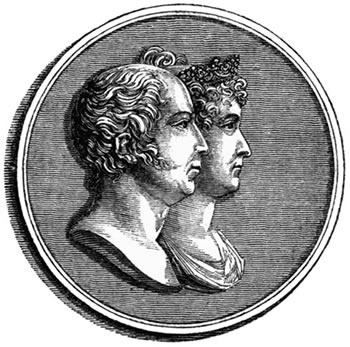
and the reverse being occupied by the following Inscription:—
‘TO COMMEMORATE THE LAYING OF THE FIRST STONE OF LONDON BRIDGE BY THE RIGHT HON. JOHN GARRATT, LORD MAYOR, ON THE 15th OF JUNE 1825, IN THE PRESENCE OF H.R.H. THE DUKE OF YORK, VARIOUS BRANCHES OF THE NOBILITY, AND THE CORPORATION OF THE CITY, AND IN TESTIMONY OF HIS LORDSHIP’S PUBLIC WORTH AND PRIVATE VIRTUES, THIS MEDAL WAS DESIGNED AT THE REQUEST OF HIS FELLOW CITIZENS, BY JOSEPH YORK HATTON.’
“The other Medal had about twenty impressions struck in silver, which were distributed to the Engineers, assistants, &c., on the day of the foundation. These were 2½ inches in diameter, and nearly 1⁄8 of an inch in thickness. The obverse consisted of a fine head of the elder Mr. Rennie, from a former Medal; and the reverse contained a design, by Mr. William Knight, of the New London Bridge Works, consisting of an elevation of the edifice, with representations of the First Stone, Mallet, and Trowel: the Inscription being as follows:—
‘. LONDON . BRIDGE . . THE . FIRST . STONE . OF . THIS . . WORK . WAS . LAID . BY . THE . . RIGHT . HON. . JOHN . GARRATT, . . LORD . MAYOR . OF . LONDON. . . ON . THE . XV . DAY . OF . JUNE, . . MDCCCXXV . AND . IN . THE . SIXTH . . YEAR . OF . THE . REIGN . . OF . GEORGE . IV. . . JOHN . RENNIE . ESQ. . F.R.S. . ENGINEER . . JOLIFFE . & . BANKS . CONTRACTORS.’
“Such are the few remaining reliques of this Ceremony, which have been provided for posterity; for, with the exception of a slight etching of the Western end of the Coffer-Dam, in a Memorandum Book, and an Indian Ink Drawing, by Dighton, of some of the principal persons standing about the First Stone, there is no other representation to record it. There are, indeed, several prospects of the finished Edifice; though of its exact features, it is probable we can form no very correct idea, until we are a few years older; so then let us here take our last View of the New London Bridge;
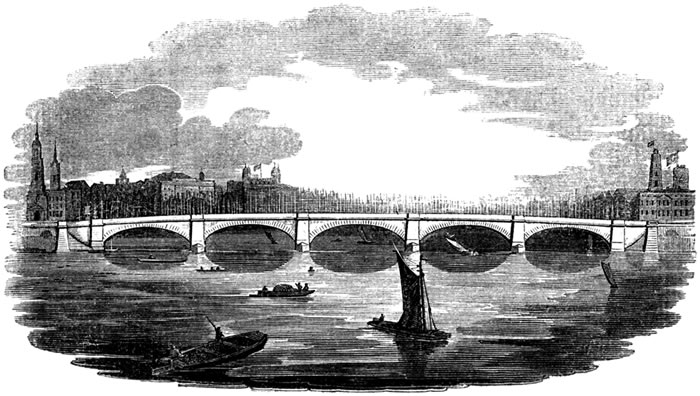
for such are all the particulars and memorials which I can give you concerning this interesting Civic ceremony; and if the Italian of old could give his famous ‘Esto Perpetua!’ to his water-seated Venice, how much rather shall every true-hearted citizen bestow it upon this rising edifice, beneath whose expansive arches,
‘The time shall come, when, free as seas or wind, Unbounded Thames shall flow for all mankind; Earth’s distant ends our glories shall behold, And the new world launch forth to seek the old!’”
I concluded these lines of Pope’s “Windsor Forest” with so much enthusiasm, that I did not immediately remark the silence which followed; but upon looking up to wish my auditor a good night, how greatly was I astonished to find myself alone! with only a few dim lights in the empty coffee-room, and the waiter sleeping in a distant box. Hastily starting from my seat, I inquired what had become of Mr. Postern, when, to my great surprise, he absolutely denied that he had seen him either come in or go out. Since that time, too, I have everywhere, but in vain, sought “the learned Pundit” who had so long conferred with me. I certainly cannot discredit the evidence of my own senses, but, upon reconsidering all the circumstances, it appears to me that I must have seen and conversed with the shade of Peter of Colechurch, the original Architect of London Bridge! Our narrative, however, rests upon more solid foundations; for, as I have verified every authority referred to, these Chronicles are presented to posterity as the collected memorials of that once-famous edifice, which within a few years will exist no longer.”