DESCRIPTIVE LIST OF THE EMBELLISHMENTS. (continued 5)
Reading edition
“The King next passed on to the Conduit in Cornhill, where he was awaited by other Pageants equally sumptuous and interesting; but as these are out of our province, we shall mention them no farther.
“There seems to have gone abroad a singular conception, that the Chapel of St. Thomas on London Bridge did not exist beyond the time of King Henry the Sixth; in the 23rd year of whose reign,—1458,—there were four Chaplains serving in it; though it was originally founded but for two Priests, four Clerks, and their officers, independently of the several chantries, or revenues, left to the establishment, for the singing of daily mass for the souls of its benefactors. The income of the Chapel, however, more than ten years before that period, was considered as worthy of some inquiry on the part of a neighbouring ecclesiastic; for we find, in Newcourt’s ‘Repertorium,’ which I have already cited, volume i., page 396, the following particulars concerning it. ‘In the year 1433,’ says this Author, ‘Sir John Brockle, then Mayor of London, upon a controversie that was then like to arise, between the said Mayor and Commonalty of London, and the Bridge-Masters on the one part, and Richard Morysby, Archdeacon of London, and Rector of St. Magnus Church, on the other, about the oblations and other spiritual profits, which were made in a certain Chapel, called the Chapel of St. Thomas on the Bridge, within the precincts of this parish; there was a composition, or agreement, then made, and confirmed by Robert Fitzhugh, then Bishop of London, whereby (inter alia) it was agreed, that the Chaplains of the Chapel, and their successors, should receive all the profits of the Chapel to the use of the same, and the Bridge, and should pay yearly at Michaelmas the sum of xxd. to the said Church of St. Magnus, and to the Rector of the same, and to his successors for ever.’
“And now that we are speaking of the property appertaining to London Bridge, it will be a fit place to give you some idea whence it was in general derived; I say, in general, because the inquiry into all its sources would be not only difficult, but almost impossible. Stow tells you in his ‘Survey,’ volume i., page 59, that after the erection of buildings upon London Bridge, ‘many charitable men gave lands, tenements, or sums of money, towards the maintenance thereof: all which was sometimes noted, and in a table fair written for posterity remaining in the Chapel, till the same Chapel was turned to a dwelling-house, and then removed to the Bridge-House.’ The honest old Antiquary states, however, that he would willingly have given a copy of this table of benefactors, but that he could not procure a sight of it; for, as he was known to be a notable restorer of decayed and dormant charities, he was occasionally refused admission to such records as would have enabled him to compile a lasting register of all the pious gifts and benefactions in London. He never hesitated to reprove unfaithful Executors, whether Corporations, or private persons, some of which he caused to perform the testaments which they proved; whilst the dishonesty of others he left on record to futurity. It is then not to be wondered at, if he often-times met with a repulse instead of information; ignorance opposed him in one quarter, and interest in another; and he might very well have taken up the significant, though homely complaint of Ames, when he was composing his History of Printing, ‘Some of those persons treats folks, as if they came as spies into their affairs.’ We have, however, some particulars of the Bridge property, as well collected by Stow, as gathered since his time; and, firstly, I must notice to you, that at page 60 of his ‘Survey,’ he states that ‘John Feckenham, Civis et Bracciator,’—Citizen and Brewer, or perhaps, Corn-Meter, ‘by his will, dated May 11th, 1436, bequeathed to the Mayor and Commonalty of the City of London, a Tenement with a Shop and Garden, in the Parish of St. Augustine Pappey,’—that is to say in St. Mary at Axe,—‘between the tenement and lands of the Bridge of the City of London on the East, &c. To have to the Mayor and Commonalty of London, ad usum et sustentationem operis Pontis prædictis in perpetuum,’—for the use and support of the work of the aforesaid Bridge for ever,—‘on condition that the Chaplains of the Chapel of St. Thomas the Martyr, on the Bridge, celebrating, have his soul, and also the souls of the late Lord Richard II., King of England, Edward Boteler, knight, and the Lady Anne his wife, Richard Storme, and Alice his wife, and the soul of Joan, his’—the said Feckenham’s—‘wife, perpetually recommended in their prayers.’ You may see both the original and an authentic copy of this Will, and that which I shall hereafter mention, in the Bishop of London’s Registry in St. Paul’s Cathedral. The Chamber in which they are kept, is entered through the Vestry on the Northern side of the nave; whence a flight of dark winding stairs, lighted only by loop-holes, leads you to a small square room, surrounded by oaken presses containing the original Wills tied up in bundles. The Calendar, or Index to the Register Books, extends from 1418 to 1599; all after that year being kept at the Bishop’s Consistory Court in Great Knight-Ryder Street. It is a small folio volume, having a parchment cover, anciently tied with strings, and is written in a small neat black text upon parchment, though now much soiled by time and the continual dust of the chamber. If ever you visit this Registry, however, I would not have you trust too much to this Calendar; for in referring to the Will which I have now quoted, its volume and page are called ‘Moore, prima pars, folio iiij.;’ though the true reference is ‘3 Moore, folio cccclxij a.’ This volume, Moore, is so called from the first Will entered in it, and it contains registers of Wills from the year 1418 to 1438, beautifully written in a small black text upon parchment, in a very thick square folio.
“Another benefactor to London Bridge mentioned by Stow, was one John Edwards, Citizen and Butcher, who ‘gave by his Will, dated the 8th of November, 1442, to John Hatherle, Mayor of the City of London, and to John Herst and Thomas Cook, Masters of the work of the Bridge of London, for ever, his tenement, with a garden, in the Parish of St. Botolph, Aldgate, situate between the tenement lately John Cornwallys’s on the South, &c., and extending from the King’s Street leading from Aldgate towards the Tower on the West, &c. towards the sustaining and reparation of the said Bridge.’ You will find this Will in the Register called 4 Stacy, now Prowet, folio ciiij b, which extends from 1438 to 1449; though the Calendar marks it as entered at folio xxv. Both of these Wills are in Latin.
“Without, at present, referring to the multitudes of books and records of Bridge property, which must exist in the office of the Comptroller of its Estates, I will give you an abstract of one of these volumes, of which a Manuscript copy is to be found in the Harleian Collection in the British Museum, No. 6016, folio 152. This book is entitled ‘A Repertory by way of Survey, of all the forren landes belonging to London Bridge, to geather with all the quitt rents due to, and other rents due from the same:’ and the industrious mortal who copied it out has added, ‘Borrowed the booke 21°. ffebr. 1653 of Captaine Richard Lee, Clarke of the Bridge-house.’ The Survey is written in corrupt and abbreviated Latin, which, from the expressions which are made use of, would appear like the language of the fifteenth century; and it contains many curious particulars of the names of persons and places, not elsewhere to be found. I purpose, however, giving you only a general statement of the amount of Bridge property in different places, with a few notices and extracts from the more interesting parts; reminding you, that these abstracts have never yet been printed.—In the Parish of St. Andrew the Bishop, London Bridge possessed 20 huts or cabins, occupied by the Brotherhood of Friars Minors, which were valued at £12. 3s. 4d. Then follows an entry of ‘Lands and Meadows belonging to the Bridge of London without the bar of Southwark, at Le Loke, in Hattesham, Camerwelle, Lewesham, and Stratford.’ In Lambeth field without Southwark, or St. George’s bar, 19 acres of land, lying towards Newington and Lambeth, held of the Prior of Bermondsey, for the yearly rent of 14s. 10d. At Le Loke,—that is to say, partly on the site of the New Kent Road, and on part of which was, doubtless, built that row of houses in Blackman Street, now called Bridge-house-Place,—4 acres of arable land, called Longland, and 2½ acres and 1 rood of meadow land, held by the yearly rent of 5s. 10d., payable at the Feast of St. Michael. Also, on the South part of King Street, 2 acres of arable, and 2 acres of meadow land, called Carpenterishawe, held of the Archbishop of Canterbury, at the yearly rent of 6d., payable at the Feast of St. Michael the Archangel. Also near St. Thomas Wateringgs, on the South part of King’s Street, 7 acres of arable, and 2 acres of meadow land, called Fourecrofts, by the yearly rent of 4s. 8d., payable at the Feast of St. Michael, and at Easter; another piece of land lying towards Hattesham,—perhaps Hatcham Manor,—containing 10 acres of arable, and 2½ acres and 1 rood of meadow land, called Tevatree, was held for the same sum. At Le Steerte, near the wall of Bermondsey, one acre of meadow ground, for the rent of 2d. per annum; and at Hattesham, at the entrance of the Marsh, 6 acres of arable land enclosed by a ditch, were held of the heirs of Simon de Kyme, for the rent of one penny per annum. In Lewisham, London Bridge seems to have had large possessions, since they were let out to farm at the immense rent of £3. 4s.; and to the property of the Manor was attached the ancient feudal rights of heriot,—taking of the best beast, when a new tenant came on the estate; wardship,—the holding and enjoying the profits of a tenant’s land, who was a minor; marriage,—claiming assistance from all the tenants once, to furnish a dowry for the Lord’s eldest daughter; Reliefs and Escheats,—the payment of a certain sum on the entry of a new tenant, and the return of forfeited estates. The land itself was divided, and the original rents were as follow.
“‘24 and 11 acres of arable land, called the Greggehouse, 5 acres of wood, in two groves, 42 acres of arable land, and 2 acres of meadow land, held of the Abbot of Gaunt, at the yearly rent of 14s. 9½d.; 22 acres held of the heirs of Lord John de Backwell, Knight, at the yearly rent of 3s.; 10 acres, and 10 acres in the field called Edwinesfelde, held of the Abbot of Stratford, at the yearly rent of 10d.; 2 acres held of the heirs of Lord William Bonquer, Knight, at the yearly rent of 8d.; 1½ acre lying in the road near Depeford Bregge, held of the heirs of William Clekots, at the yearly rent of 1½d.; 3 acres in a croft near Leuesham Street, held of the heirs of Henry Boyding, and William Atteford, at the yearly rent of 2d.; 1½ acre at Rombeigh, for which nothing is paid; 10 acres in the field called Brodefelde, held of the heirs of William de Hinntingfeld, Knight, at the yearly rent of 1s. 8d. Item. There is owing for the said Manor to the heirs of Nicholas de Farndon, the yearly rent of 1d. At Leuesham, a water-mill, with 2 acres of pasture belonging to it, held of divers persons for the rent of 1s. 5d. and half a quarter of corn out of the tolls yearly, and the value of the tenths, from this time forth for ever.’
“The possessions of London Bridge, at Stratford, have been already referred to, but for the sake of perspicuity, I repeat them, and they were as follow:—One water-mill, called ‘Saynesmelle,’ and four acres of meadow land belonging to the same; ‘whereof one acre lies within the close of the said mill, and four roods opposite to it on the East; and they are every where planted round with willows.’ One acre and one rood of meadow land lie near ‘Wyldemersh-bregge,’ and are called ‘Horslese.’ They are held of the heirs of the Lord Richard de Playz, Knight, for the yearly rent of £1. 17s.—Also at Stratford are ten acres of meadow-land held of the same, and for the same rent: whereof four acres are adjoining to the mill-pond called ‘Spileman’s Melle,’ and four acres are lying near to the meadow called ‘Gryggewyche’s Mead,’ and adjoin, in like manner, to the same mill-stream. And one acre lies near the Bridge called ‘Wildenmersshbregge,’ and is enclosed by willows; and three roods of the same meadow lie near ‘Golynant,’ and one acre and one rood of the same meadow are lying in one piece, adjoining to the mill-stream of ‘Saynesmelle.’ At Royeshope, is one acre of meadow land, formerly held by John Breggewrythe, at the yearly rent of 2s. which is held, &c. as aforesaid. Also there are of the same, 1½ rood near Horslese, originally bought by Roger Atte-vyne, and John Sterre, then Keepers of the Bridge, which are held of the heirs of Thomas le Belevere, for the annual rent of 1d. The Vicar of West-Ham also held one acre of meadow, assigned to him for his tythe for the whole meadow; and 13s. 4d. were paid to him yearly, as tythe for the two mills. At Stratford, also, was another water-mill belonging to London Bridge, called ‘Spylemanne’s Melle,’ which was held of the heirs of Lawrance Stede, for the payment of 1d. yearly; which mill being of Sutler’s estate, tythes were paid for it by that estate, and it was therefore free for ever. There were also four acres of meadow and pasture belonging to it. All the foregoing were, at the time of this survey, let out to farm by London Bridge.
“Such were some of its possessions out of the metropolis; and I now proceed to notice that more interesting part of the volume, entitled ‘Quit-rents of London Bridge, issuing from divers tenements of London and Southwark, according as they lie in different Parishes; and, firstly, of its property in the Parish of St. Magnus the Martyr.’
“‘Three shops, with galleries built upon them, now held by Robert Kots and Lawrence Schrouesbury, Glovers, standing at the Bridge stairs towards London, with the houses belonging to London Bridge on the South side. They were formerly belonging to the Fraternity called ‘Le Salue,’ in the Church aforesaid. Two shops with galleries built thereupon, held by Peter Wydynton, Spicer, belonging to the same Fraternity, which are situated by the same stairs, between the way leading down to the common sewer on the South; the tenements belonging to the same Fraternity on the North, the tenements of John Zakesle on the East, and the King’s road on the North; and they owe yearly to the Bridge of London, 3s.’ Another Tenement, held by Henry Ziuele, Mason, paid 5s.: and it was situate between the King’s Road on the East, and the Oyster Gate on the West. Another Tenement paid 5 marks,—£3. 6s. 8d.;—it stood ‘at the corner opposite to St. Magnus’ Church,’ between the King’s Road towards ‘Byllyngesgate’ on the South, and the King’s Road, called ‘Brigge-streete,’ on the West. It belonged to a certain perpetual Chantry in St. Magnus’ Church, for the soul of Thomas le Bener; also belonging to the same Chantry, and standing about the same spot, was a tavern, which paid to the Bridge 2s. 6d. yearly, and the shop of the same paid 1s. 3d. Certain other shops and tenements belonging to Richard, the son of John Horne,—perhaps the eminent Town-Clerk of that name, whom I have already mentioned,—paid £2. of yearly rent; and they were lying near the narrow way called Rederes lane on the East, in the Parishes of St. Magnus and St. Roth’i. A house belonging to the Priory and Convent of St. Mary, in Southwark, paid 1s.: it stood between Oystergate on the East; and the houses belonging to St. Magnus’ Church on the West; and extended from the King’s Road called ‘Stokfissmongeres Rewe,’ on the North, down to the River Thames on the South. Another house in the Bridge Street, standing by that of John Somervyle, the Goldsmith, paid 8s. 9d. to the Bridge; as did also an adjoining shop and house; thus making the whole Bridge Rents in St. Magnus’ Parish amount to £7. 8s. 11d. per annum. I have been the more particular in detailing the property of London Bridge in this part of City, because it in some measure illustrates the ancient state of it; but I shall be much more brief,—and, I dare say, much more to your content,—in speaking of its possessions in the other parishes mentioned in this Manuscript.
“‘In the Parish of St. Botolph, near Byllyngesgate,’ the Bridge owned the following:
“‘One Tenement in the King’s Street leading to ‘Byllyngesgate,’ 16s. One Tenement, a Granary, or Brewery, with two Shops in the same, 12d. Total 17s.
“‘In the Parish of St. Mary atte Hulle.’ One Messuage on ‘Byllyngesgate’ Quay, called the ‘Boleheued,’ 11s. 8d. The Priory and Convent of the Holy Trinity on the Quay called ‘Treyerswarfe,’ 6s. 8d. The house of William Walworth in the narrow way leading to ‘Treyerswarfe,’ 3s. 4d. Total £1. 1s. 8d.
“‘In the Parish of St. Dunstan the Bishop, towards the Tower of London.’ A Tenement called ‘Cokeden-halle,’ standing ‘at the corner of the narrow way called Martelane,’ on the East, and the Tenements belonging to St. Dunstan’s Church on the West, and the King’s Road called ‘le Tourstreete’ on the South, 8s. A Tenement adjoining the same, 7s. A Tenement belonging to John Atte Vyne, son and heir of William Atte Vyne, standing near ‘the narrow way called Mengehouslane,’ 3s. A Tenement belonging to ‘Gyhalle,’ standing between the corner of the narrow way called ‘le Chirchelane,’ Eastward, and the foregoing, 4s. 8d. The House of Andrew the Canon, standing West of the foregoing, 4s. 8d. Tenements of John Pyebaker, belonging to the same Canon, 2s. 6d.; of Alie. Bemehoo, belonging to the same Canon, 2s. 6d.; of John Morton, Clerk, in the corner of the Church-yard of St. Dunstan’s, near the narrow passage leading to the Tower, 4s. 8d.; of Isabella Rotheryng and her sister, standing by the Thames, 2s. Total £1. 19s.
“‘In the Parish of All Saints de Berkyngcherch.’ A Tenement of John Longe, the Fishmonger, standing between the Tenements of London Bridge, on the East, the Tenements of Walter Denny, the Fishmonger, on the West, and ‘le Tourstreete’ on the North, 3s.
“‘In the Parish of St. Andrew Hubert in Estchepe.’ A corner Tenement held by Richard Croydon, standing by the said Church on the North, between the narrow way adjoining, and the King’s way called ‘Seyntandrewys-lane’ on the West, 12s.
“‘In the Parish of St. Margaret in Brigge Streete.’ A Tenement of John Littele, the Fishmonger, standing in ‘le Crokedelane,’ 4s.
“‘In the Parish of St. Leonard, the Abbot, in Estchepe.’ One Tenement in ‘Candelwykstreete,’ held by William Yuory, £1. 6s. 8d. A Shop held by the same, between the Tenements of the Prior and Convent of ‘Cristecherche,’ on the North, and the King’s road, called ‘Grascherchestrete,’ on the East, 8s. Another Tenement, 1s. Another Tenement standing by the corner Tenement of the Hospital of the Blessed Mary without ‘Busshopisgate,’ on the North, and the King’s road, called ‘Estchepe,’ on the East, 2s. A Tenement of the Prioress of St. Helen’s, having ‘Grascherchestrete’ on the West, 13s. 4d. There was also another Tenement of 1s. rent, having Eastcheap on the East. Total £2. 12s.
“‘In the Parish of St. Benedict de Grascherche.’ One Tenement, a Granary, or Brewery, with two Shops, of Benedict de Cornewayle, having the King’s road, called ‘Fancherchestreete’ to the South, 9s. 4d.
“‘In the Parish of All Saints de Grascherche.’ One Tenement with a forge and 4 Shops, standing between the corner Tenement of the Prior and Convent of Ely on the South, and the Tenement belonging to the Brethren of the Cross, called ‘le Cardinaleshat’ on the North, and the King’s road, called ‘Grascherchstrete’ on the West, 40s. A Granary, 5s. Total £2. 5s.
“‘In the Parish of St. Katherine de Cricherch.’ A Granary standing in a corner between the narrow way called Bellezeterslane on the East, and the Tenement of Philip Page on the West, 8s.
“‘In the Parish of St. Mary Attenaxe.’ Ten Shops, with Galleries built upon them, standing in a corner, between the King’s way, which is between London Wall and the aforesaid Shops, and the way that leads from the Church of St. Mary Attenaxe, to the Church of ‘St. Augustine Papheye,’ on the West, 1s.
“‘In the Parish of St. Augustine Papheye.’ The Tenement of Richard Schet, Fuller, standing by the Tenements of London Bridge on the East, and the King’s road under London Wall on the North, and the Garden of the Prior of Cricherch on the South, 12d.
“‘In the Parish of St. Martin Otiswych.’ A Tenement with a large door, and a Shop on both sides of it, standing between the Church-yard on the North, and the King’s road, called ‘Bisshopisgatestreete,’ on the East, 3s.
“In the Parish of St. Michael upon Cornhulle.’ A Tenement with two Shops, having Cornhill upon the South, 8s.
“‘In the Parish of St. Edmund in Lumbardstrete.’ Certain Tenements with Shops, standing between the Tenements of St. Thomas’s Hospital in ‘Sothewarke,’ on the North, and the King’s way, called ‘Berchers-lane,’ on the West. They owe yearly to London Bridge, by the Will of Henry of Gloucester, Goldsmith, 5s.
“‘In the Parish of St. Clement, near Candelwyk-stret.’ A tenement of the Abbot and Convent of Stratford, standing between the Tenement of Thomas Clench, Fishmonger, on the South, the Tenement of the perpetual Chantry of the said Church, which was formerly John de Charteneys, on the North, and the narrow way called ‘Seyntclementslane’ on the West. It owes yearly to London Bridge, by the legacy of Henry of Gloucester, 2s. A Tenement with four Shops, 2s. Three Shops with galleries erected upon them, and a certain place called ‘Wodehagh,’ bounded on the South by Candlewick-street, 4s. Total 8s.
“‘In the Parish of St. Michael in le Crokedelane.’ A Tenement in ‘Stokfisschmongeresrewe,’ belonging to the Chaplain of ‘Kyngeston,’ 5s. An ancient Tenement, having the Tenement of the perpetual Chantry of the said Church, which was formerly John Abel’s, on the West, and the narrow way called ‘Crokedelane’ on the North, 5s. Total 10s.
“‘In the Parish of All Saints the Less.’ A Tenement having the Tenements of St. Bartholomew’s Hospital on the West, and the King’s way called ‘Tamystrete’ on the South, 4s. Certain Tenements standing in the short narrow way of St. Lawrence, between the Tenement of the Master of St. Lawrence’s College on the North, and Thames-street on the South, 10s. The Tenement of the said Master, 6s. Total 20s.
“‘In the Parish of St. Lawrence, near Candelwyk-stret.’ A Tenement belonging to ‘Gyldhalde’ of London, having the College of the said Church on the East; the narrow way which goes from the Church-yard of the same Church to Candlewyck-street, on the West; the said Church-yard on the South; and a Tenement belonging to a perpetual Chantry in the Church of St. Swythin on the North, 19s. 8d.
“‘In the Parish of the Blessed Mary of Abbecherch.’ A Tenement, having the Tenement of the Hospital of St. Katherine, near the Tower, on the North, and the Burial-place of the aforesaid Church on the East, 10s.
“‘In the Parish of St. Swythin the Bishop. A Tenement held by Solomon Faunt, standing between the Church aforesaid on the South; the Tenement of Henry Fyuyan, Draper, on the North, and the King’s way called ‘Swythynislane’ on the East, 2s. 6d. The Tenement of the said Henry Fyuyan, standing by that of John Hende, Draper, 2s. Total 4s. 6d.
“‘In the Parish of St. Mary de Bothhaghe.’ A Tenement held by Lord Thomas de Salesbury, Knight, standing between the Tenement with the Great Gate also belonging to the same, on the East, and Candlewick-street on the South, 12d.
“‘In the Parish of St. Stephen de Walbrok.’ Two Tenements under one edifice, standing by the Tenement of John Norwich, the Goldsmith, on the South, and the King’s way, called Walbrook, on the West, 2s.
“‘In the Parish of St. Mary Woolnoth.’ A corner Tenement, which formerly was Hamon Lumbard’s, having the narrow street, called ‘Seyntswythinislane,’ to the East, and that called ‘Berebyndereslane,’ to the South, 13s. 4d. Another Tenement standing in a corner in ‘Schytelboanelane,’ 2s. Total 15s. 4d.
“‘In the Parish of St. Bartholomew the Less. A Tenement, a Granary, or Brewery,’ having the King’s way called ‘Braddestrete’ on the North, 2s. 6d.
“‘In the Parish of St. Pancras.’ One Cell, called ‘le Brodecelde,’ of which one entrance is by the large open place towards ‘Soperslane’ on the East, and another is toward ‘Chepe,’ at the sign of the Key, on the North, 6s. 8d.
“‘In the Parish of St. Michael at Queen’s bank,’—or Wharf.—‘A Tenement, with its offices, which belongs to the Abbot and Convent of the Monastery of the Blessed Mary of Grace, near the Tower of London: it stands in a corner between the narrow way that leads to the Saltewarf on the East, and the Tenement of the Abbot of Jesus on the West, and it extends from the narrow way, called ‘Ratonneslane,’ on the North, down to the Thames Southward,’ 2s.
“‘In the Parish of St. Martin at Ludgate.’ A Tenement with a forge standing in a corner without Ludgate, having the narrow street, called ‘Little-bayly,’ on the West, and the King’s way, called ‘Fletestrete,’ on the North, 9s.
“‘In the Parish of St. Bridget, the Virgin, in Flet-strete.’ A Tenement, a Granary called ‘le Horsothehop,’ with two Shops, having Fleet-street on the North, and belonging to a certain Chantry in St. Paul’s Church, for celebrating Mass for the Soul of Walter Thorpe, 8s.
“‘In the Parish of St. Alban de Wodestret.’ A Tenement, called ‘le Horsscho,’ 4s. Another Tenement, having the Tenement of the Hospital of the Blessed Mary without ‘Busschopesgate,’ on the South, and the King’s way, called ‘Wodestret,’ on the West, 2s. Total 6s.
“‘In the Parish of the Blessed Mary of Athelmanbery.’ A Tenement standing in a corner between the narrow way called ‘Phylippeslane,’ on the West; that called ‘Paddelane’ on the South, and the Tenements of St. Paul’s Church on the North, 2s.
“‘In the Parish of St. Michael de Bassyngeshawe.’ A Tenement with eight Shops, standing in a corner, towards London Wall, having the King’s way, called ‘Bassyngeshawe,’ on the West, 2s. Two other Tenements, 6s. 6d. Total 8s. 6d.
“‘In the Parish of St. Olave at the Wall.’ A Tenement, formerly belonging to the Prior of the Hospital of the Blessed Mary without Bishopsgate, having the King’s way, called ‘Mugwelle stret,’ to the East, 3s. 6d.
“‘In the Parish of St. Stephen in Colmanstret.’ Certain vacant places, by the legacy of Henry of Gloucester, 2s.
“‘In the Parishes of St. Faith and St. Gregory.’ Certain Shops standing in ‘Paternostrerewe,’ under the Palace of the Bishop of London, newly erected by the venerable Lord Michael de Northborough, formerly Bishop of London, 40s.
“A Tenement in ‘Redecrouchstrete,’ which cannot be found, 4d. Also in ‘Est Smethfeld’ was formerly a Tenement, which is now the common Church-yard, 4d. Another in ‘Blachynglegh,’ 12d. Also in Stratford, a piece of meadow land, formerly held to farm of the Bridge keepers, being the sixth part of a meadow called ‘Ruschope,’ 2s. Also at ‘Sabryschesworth,’ a Tenement, 3d. Total 3s. 11d.
“‘In the Parish of St. Olave of Sothewerk.’ Two Shops of the Hospital of St. Thomas of Sothewark, standing in a corner at the stairs of London Bridge towards Southwark, between the Tenements belonging to the said Bridge on the North, the King’s way of Southwark on the South, and the stairs aforesaid on the East, 8s. A corner Tenement, now belonging to the Church of St. Michael in ‘le Reole, which is called Paternostercherche,’ and standing at the aforesaid stairs, having the King’s way leading to ‘Bermundeseye,’ on the South; the Tenements of the Bridge aforesaid on the North, and the aforesaid stairs on the West, 13s. 4d. Total 21s. 4d.
“‘In the Parish of St. Margaret in Sothewerk.’ One Tenement of the Hospital of St. Thomas of ‘Sothewark,’ having the King’s way of ‘Sothewerk’ on the East, 4s.
“‘In the Parish of St. George in Sothewerk.’ A certain Tenement and Garden called ‘Exuuiwe,’ which the Prior and Convent of the Blessed Mary of Southwark now hold; standing in a corner at the Cross in ‘Kentestreete,’ between the King’s way which leads to Bermondsey on the North, the King’s way called Kent-street on the West, and a garden on the South, 13s. 4d. A Tenement called ‘le Mote,’ having the Tenement of the Hospital of St. Thomas of Southwark on the North, a garden on the South, and Kent-street on the West, 8s. A Tenement standing at ‘Le Loke,’ near the Bridge Tenements, 2s. Total 23s. 4d.’
“Such, Mr. Barbican, were the gifts to London Bridge of Quit-rents, or small sums reserved by various landlords out of their charters and leases, for the support and improvement of this noble edifice. Their whole amount was £30. 0s. 2d. per annum, a splendid revenue, if, as I imagine from several circumstances, this very curious survey was made about the middle of the thirteenth century. Several of these gifts are authenticated by references to the original grants, read and enrolled in the Court of Hustings at Guildhall, at various meetings held during the reign of King Edward I.: whilst another authority, often cited, is called ‘the Red Rental,’ which also makes mention of Godardus, a Chaplain, and his brethren of London Bridge. The light these very brief but curious notices shed upon Parochial history and antiquities, has made me give you a more particular account of them, than might be perfectly agreeable to you; though, as I have not quite finished the volume, I must request you patiently to hear me a little longer speak of the ancient landed property of London Bridge.”
“Oh! go on, Sir, pray go on!” said I, in a tone of mock resignation, “take your own time, Mr. Barnaby; though, to be sure, there seems but little reason why I should say so. I had, indeed, fondly hoped, that when you could no longer plague me with a Patent Roll, I might rest secure from any thing more provoking; but I must certainly own I was a most short-sighted mortal for thinking so, since your genius can never want a weapon to be drowsy with: but, I suppose that you rarely meet with a hearer so quiet, so mild, so undoubting, and so easily satisfied as I have proved: and therefore, suffer I must.”
“I have truly,” said he, in a short dry voice, “seldom met with a companion like you: but, I am sure, you will not think these extracts wearisome, when you remember that so little is known about the possessions of London Bridge; and that the fragments which I have repeated to you are all of the most undoubted authority, as yet unprinted, and almost locked up in a barbarous mixture of abbreviated and corrupt French, Saxon, and Latin. To return then to the Survey,—which, I assure you, I have very nearly concluded,—it next records the Bridge property at ‘Les Stocks,’ somewhat of which, you may remember, I have already spoken: and contains one of the most curious and ancient descriptions of that once-famous market now extant:—thus commences the entry.
“‘Near the Church of the Blessed Mary of Wolcherchehawe, is a certaine Cattle-Fold called les Stocks, ordained for Butchers and Fishmongers, where the same may sell flesh and fish; the rent of which is uncertain, because any greater or smaller value arises from the way in which places in it may be occupied by the Butchers upon Flesh-days, and by the Fishmongers on Fish-days. Upon this Cattle-stall are three mansions, and one slaughter-house, built above it, the principal of which mansions is towards Cornhill, being now held by William Vale, Fishmonger, and it yields to London Bridge, yearly, 30s. Also, on the West side, towards the Conduit, is another mansion, held by John Louekyn, Fishmonger, which pays yearly 20s. Also there is another little mansion in the middle of the house upon the Stocks on the North side, paying 10s. Also on the South part of the Stocks is a slaughter-house, for which rent is not paid. Total 60s. And in the stalls aforesaid, called the Stocks, are places measured for the Fishmongers’ tables, namely four feet and a half and two thumbs breadth in length, and called Poulisset, having legs, the which places are occupied by the Butchers on Flesh-days at the price of 4d. the week. And the same places are occupied by the Fishmongers on Fish-days, at the price of 3d. by the week. Of these places there are 19 on the South part next the Church; 18 on the North; 15, in one row, in the middle of the house on the South; and at the Eastern front of the said house are four places for Fishmongers, three of which are occupied by Butchers on the Flesh-days. In the West front of the said house are two places, occupied as well by Butchers as by Fishmongers; but the certain amount of the rents of these cannot be ascertained, because any of the aforesaid places may be occupied or not, and thus a larger or a smaller sum may appear upon the account-rolls of the gate-keepers of the place aforesaid, in different weeks and years. Without the Stocks, at the West front, are five places for Fishmongers, where, on Fish-days, they sell their fish; and, on Flesh-days, three of them are occupied by the Butchers. There are also 22 places and a half under the walls of the house, appointed for Butchers to sell flesh on Flesh-days; whereof 18 places are under the North wall, and 4 places and a half are under the wall of the Eastern front, of which places the value, when they are occupied, is 4d. per week: but now they are not fully engaged, and therefore no certain sum can be stated.’
“‘Also, it is to be known that the gifts, legacies, and oblations of the Corbell-Chapel, standing on the Bridge, with’—the Pontage from—‘the carts carrying bread for sale crossing over it, and the passage of vessels under it, are uncertain in amount, because they may be greater or less in value, as they appear in the account-rolls of the Keepers of the said Bridge for different years.’
“The Survey concludes with an abstracted list of rents paid by London Bridge for lands and tenements held in various places, both in, and out of, the City; but as I have already given you several particulars of these, and as they do not contain any great additional information, I shall but observe from them that their total amount appears to be £20. 0. 9¼d.; and as we are occasionally informed that the lands were let out to farm, we may conclude that the Bridge-keepers were amply recompensed for the payment of a sum even so great as this. The disbursements of London Bridge were, indeed, always considerable, for Stow observes in his ‘Survey,’ page 59, that the account of William Mariner and Christopher Elliott, Wardens of that edifice, from Michaelmas, in the 22nd year of Henry VII.—1506,—to the Michaelmas ensuing, amounted to £815. 17s. 2½d., all payments and allowances included.
“We must now set sail again on the ocean of English History, as it is connected with London Bridge; and you are to remember that we are yet in the reign of King Henry VI., though we have mentioned a multitude of dates since the commencement of our digression: and the next event in its Chronicles, relates to the destruction of a considerable portion of it in the year 1437. I have already cited to you some of the writings of William of Worcester, and in another work of which he was also the author, entitled ‘Annales Rerum Anglicarum,’ he gives a slight notice of this event, which you will find in the edition printed in Hearne’s ‘Liber Niger,’ volume ii. page 458, taken from an autograph manuscript in the Library of the College of Arms. The best accounts, however, are furnished by Fabyan, on page 433, of his Chronicle, and by Stow in his ‘Annals,’ page 376. From these we learn that on Monday, January the 14th, the Great Stone Gate, and Tower standing upon it, next Southwark, fell suddenly down into the River, with two of the fairest arches of the same Bridge: ‘and yet,’ adds the habitually pious Stow, ‘no man perished in body, which was a great worke of God.’
“In the year 1440, the Annals of London Bridge became again interwoven with the great historical events of the kingdom, which impart such dignity to its own records, inasmuch as the Bridge-Street, by which is meant as well the passage over the Thames as the main street beyond it on each side, was one scene of the public penance of Eleanor Cobham, Duchess of Gloucester, for Witchcraft. The inflexible honesty of the Duke, who was Protector of England during the minority of Henry VI., and presumptive heir to the crown, had created a violent party against him, the heads of which were Cardinal Henry Beaufort, Bishop of Winchester, and William de la Pole, first Duke of Suffolk. With regard to his Sovereign, however, not all the spies, which were placed about Humphrey Plantagenet, Duke of Gloucester, by these powerful and inveterate enemies, could find even a pretence for the slightest charge; though that which they were unable to discover in him, they found in his Duchess, who was then accused of Witchcraft and High Treason: it being asserted that she had frequent conferences with one Sir Roger Bolinbroke, a Priest, who was supposed to be a necromancer, and Margaret Jourdain, a witch, of Eye, near Westminster; assisted and advised by John Hum, a Priest, and Thomas Southwell, Priest, and Canon of St. Stephen’s, Westminster. Shakspeare, in his ‘Second Part of Henry the Sixth,’ Act i. Scenes 2 and 4, and Act ii. Scenes 1 and 4, has recorded several particulars of this circumstance; and makes the Duchess ask some questions concerning the King’s fate; though she was, in reality, charged with having his image made of wax, which, being placed before a slow fire, should cause his strength to decay as the wax melted. The result of the enquiry was, that Jourdain was burned in Smithfield; Southwell died before his execution, in the Tower; Bolingbroke was hanged, drawn, and quartered, at Tyburn; and, on November the 9th, the Duchess was sentenced to perform public penance at three open places in London. On Monday the 13th, therefore, she came by water from Westminster, and, landing at the Temple-bridge, walked, at noon-day, through Fleet-street, bearing a waxen taper of two pounds weight to St. Paul’s, where she offered it at the High Altar. On the Wednesday following she landed at the Old Swan, and passed through Bridge-street and Grace-Church-street to Leadenhall, and at Cree-Church, near Aldgate, made her second offering: and on the ensuing Friday, she was put on shore at Queen-Hythe, whence she proceeded to St. Michael’s Church, Cornhill, and so completed her penance. In each of these processions her head was covered only by a kerchief, her feet were bare; scrolls, containing a narrative of her crime, were affixed to her white dress, and she was received and attended by the Mayor, Sheriffs, and Companies of London.
“The leading features of these events are of course in all the numerous volumes of English History, but for the more particular circumstances I must refer you to Stow’s ‘Annals,’ pages 381, 382; to folio lxiiii. a, of the Chronicle of Edward Hall, an eminent Lawyer who died in 1547, and whose work is entitled ‘The Vnion of the two Noble Houses of Lancastre and Yorke,’ London, 1550, folio; and, finally, to the Harleian Manuscript No. 565, page 96 a. Of which latter most curious work we now take leave, for soon after recording this event it terminates imperfectly; though I may observe, that when speaking of the fate of Roger Bolingbroke, on page 96 b, it adds, concerning him, that the same day on which he was condemned at Guildhall, he ‘was drawe fro ye Tower of London to Tiborn and there hanged, hedyd, and quartered, and his heed set up on London Bridge.’ His quarters were disposed of at Hereford, Oxford, York, and Cambridge.
“In 1444, William de la Pole, whom I have just mentioned, was one of the King’s Ambassadors in France, when, with his usual lofty and impetuous spirit, he suddenly proposed a marriage between Henry VI., and Margaret, daughter of Réné, Duke of Anjou, and titular King of Jerusalem, Sicily, Arragon, Valence, &c. without any instructions from his Sovereign, or even acquainting his fellow-commissioners with his design. Notwithstanding the Duke of Gloucester opposed this union at the Council Board in England, yet the Earl managed his proposal so skilfully, that he procured himself to be created a Duke, and despatched into France to bring over the Queen: and on Thursday, the 22nd of April, 1445, she was consequently married to Henry at Tichfield Abbey, Southwick, in the County of Southampton. It was, probably, in her way from Eltham Palace to Westminster, before her Coronation, that she was greeted by the famous pageants prepared for her on London Bridge, on Friday, the 28th of May; for you will remember that she was crowned at Westminster Abbey, on Sunday, the 30th of the month, by John Stafford, Archbishop of Canterbury. However it might be, she was met at several places by many persons of rank, with numerous attendants having their sleeves embroidered, or decorated in the most costly manner, with badges of beaten goldsmith’s work; and especially by the Duke of Gloucester, who received her with 500 men habited in one livery. At Blackheath, according to custom, the Mayor, Sheriffs, and Aldermen, clothed in scarlet, attended her with the several City companies, all mounted and dressed in blue gowns, having embroidered sleeves and red hoods: and in this manner Queen Margaret and her followers were conducted through Southwark and the City, ‘then beautified,’—says Stow in his ‘Annals,’ page 384, where he relates all these particulars,—‘with pageants of diuers histories, and other showes of welcome, maruellous costly and sumptuous.’ He gives, however, but a very brief statement of them in his printed book; though in his Manuscripts, several of which are extant in the Harleian Collection in the British Museum, there are the very verses spoken to the Queen on the Bridge, composed, as he says, by John Lydgate. The Manuscript I allude to, is one to which I have already made a reference, being No. 542, a small quarto volume written on antique paper, in Stow’s own plain, but minute hand-writing. In this volume, therefore, article 16, on page 101 a, is entitled, ‘The speches in the pagiaunts at ye cominge of Qwene Margaret wyfe to Henry the syxt of that name Kynge of England, the 28th of Maye, 1445, ye 23rd of his reigne.’ The first pageant, which was an allegorical representation of Peace and Plenty, was erected at the foot of London Bridge, and the motto attached to it was ‘Ingredimini et replete Terram,’—Enter ye and replenish the earth,—taken from Genesis ix. according to the Vulgate Latin. The verses addressed to Queen Margaret were as follow:—
‘Most Christian Princesse, by influence of grace, Doughter of Jherusalem, owr plesáunce And joie, welcome as ever Princess was, With hert entier, and hoole affiáunce: Cawser of welthe, ioye, and abundáunce, Youre Citee, yowr people, your subgets all, With hert, with worde, with dede, your highnesse to aváunce, Welcome! Welcome! Welcome! vnto you call.’
“Upon the Bridge itself appeared a pageant representing Noah’s Ark, bearing the words ‘Jam non ultra irascar super terram,’—Henceforth there shall no more be a curse upon the earth,—Genesis viii. 21. and the following verses were delivered before it:—
‘So trustethe your people, with assuráunce Throwghe yowr grace, and highe benignitie.— ’Twixt the Realmes two, England and Fraunce, Pees shall approche, rest and vnité: Mars set asyde with all his crueltyé, Whiche too longe hathe trowbled the Realmes twayne; Bydynge yowr comforte, in this adversité, Most Christian Princesse owr Lady Soverayne. Right as whilom, by God’s myght and grace, Noé this arké dyd forge and ordayne; Wherein he and his might escape and passe The flood of vengeaunce cawsed by trespasse: Conveyed aboute as god list him to gye. By meane of mercy found a restinge place Aftar the flud, vpon this Armonie. Vnto the Dove that browght the braunche of peas,— Resemblinge yowr symplenesse columbyne,— Token and signé that the flood shuld cesse, Conducte by grace and power devyne; Sonne of comfort ’gynneth faire to shine By yowr presence whereto we synge and seyne Welcome of ioye right extendet lyne Moste Christian Princesse, owr Lady Sovereyne.’
“We shall here take our leave of the poet Lydgate, by whose descriptive verses we have illustrated three splendid scenes in the history of London Bridge; and I pray you, if it be but in gratitude for this single circumstance, reject, as malignant and untrue, the character given of him by Ritson, when he calls him a ‘voluminous, prosaick, and drivelling Monk.’ Warton is not only more liberal, but more just, in his estimate, when he says that ‘no poet had greater versatility of talents, and that he moves with equal ease in every mode of composition.’ He admits that he was naturally verbose and diffuse, tedious and languid: but he asserts, also, that he had great excellence in flowery description; that he increased the power of the English language; and that he was the first of our writers whose style is clothed with modern perspicuity. ‘His Muse was of universal access,’ he continues, ‘and he was not only the poet of his monastery, but of the world.’ Alike happy in composing a Masque, a Disguising, a May-game, a Pageant, a Mummery, or a Carol, for Ritson’s list of his poems, amounting to 251, embraces all these, and numerous other subjects.
“The year 1450 was made memorable by the daring insurrection of Jack Cade and the commons of Kent, which arose, partly, out of the popular belief that the Duke of Suffolk had caused the loss of a great portion of France to the English Crown; and, partly, from the pretensions of Richard, Duke of York, to the throne; in consequence of the haughtiness, despotism, and usurpation of Queen Margaret, and William De la Pole, her favourite. After some vain attempts to satisfy the commons concerning the Duke of Suffolk, King Henry banished him from the realm for five years; when after his embarkation his vessel was chased by an English ship called the Nicholas, belonging to the Constable of the Tower, by which it was captured, the Duke seized, and his head struck off on the side of a boat in Dover-roads; after which, it was carelessly cast with the body upon the sands. This murder, however, did not restore quietness to England, for the Duke of York being thus relieved from a powerful enemy, immediately proceeded in his own designs upon the Crown. By his instigation, therefore, one John Cade assumed the name of Sir John Mortimer, of the house of March, who, in reality, had been beheaded in 1425, on a charge of treason. Cade was a native of Ireland, and formerly a servant to Sir Thomas Dacre, Knight, of Sussex; but having cruelly murdered a pregnant woman, he took sanctuary, and forsware the kingdom. With such a character, he began his work of reformation in Kent, in May, 1450; assuming also, as some tell us, the title of John Amendall, and easily drew so many malcontents together, that, in a few days, he was enabled to approach London, and to encamp with his rebel forces upon Blackheath. When Henry marched against him, he retired into a wood near Sevenoaks; where he remained, until the King, supposing his followers dispersed, returned to London, and contented himself with despatching after them a detachment of his army commanded by Sir Humphrey Stafford; which division falling into the ambush, was cut in pieces, and its leader slain. Elated by this success, Cade again marched towards London, whilst Henry and his Court retreated to Kenilworth Castle in Warwickshire; leaving a garrison in the Tower, under command of the Lord Scales. The rebels, however, now became increased by multitudes, which joined them from all parts; and on Wednesday, the 1st of July, Cade arrived in Southwark, where he lodged at the Hart, for, says Alderman Fabyan, in his ‘Chronicle,’ from whom Stow almost verbally copies this story, ‘he might not be suffered to enter the Citie.’ Jack Cade, however, had but too many friends within the gates of London. The Commons of Essex were already in arms, and were mustered in a field at Mile-end; and upon a discussion in the Court of Common-Council on the propriety of admitting the rebels over the Bridge, the loyal-hearted Alderman Robert Horne so incensed the populace, by speaking warmly against the motion, that they were not reduced to order until he was committed to Newgate. About five o’clock then, on the afternoon of Thursday, July 2nd, London stained her Annals by opening the Bridge-gates to Cade, and his rabble rout. As he crossed the Draw-bridge, he cut with his sword the ropes which supported it; and on entering into the City, so beguiled the inhabitants, and even Nicholas Wilford, or Wyfold, the Lord Mayor, that he procured a free communication between his followers and London, though he himself again withdrew to his lodging in Southwark.
“In Shakspeare’s vivid scenes of this rebellion, in his ‘Second Part of King Henry the Sixth,’ Act iv., Scene 4th, a messenger tells King Henry,—
‘Jack Cade hath gotten London Bridge; the Citizens Fly and forsake their houses:’—
and in the next scene a Citizen says, ‘they have won the Bridge, killing all that withstand them.’ In Scene 6th, Cade cries, ‘Go and set London-Bridge on fire;’ and Edmund Malone, in his note upon this passage, tells us, what we certainly cannot find by any other history, that ‘at that time London Bridge was built of wood;’ adding, from Hall, that ‘the houses on London Bridge were, in this rebellion, burnt, and many of the inhabitants perished.’ This note you may see in the Variorum edition of ‘Shakspeare’s Plays,’ by Isaac Reed, London, 1803, 8vo., volume xiii., page 341. London Bridge, however, was not even yet entirely captured, and two robberies which Cade had committed in the City, speedily roused the wealthier inhabitants to a sense of his outrage, and their own danger. Whereupon, ‘what do they,’ as honest John Bunyan says of the Captains in Mansoul, ‘but like so many Samsons shake themselves?’ and send unto the Lord Scales, and the valiant Matthew Gough, at the Tower, for assistance. The latter of these commanders was appointed to aid the City, whilst the former supported him with a frequent discharge of ordnance; and on the night of Sunday, July 5th, Cade being then in Southwark, the City Captains, the Mayor, Aldermen, and Commonalty of London mounted guard upon the Bridge. ‘The rebelles,’ says Hall in his ‘Chronicle,’ folio lxxviii. a, which contains the best version of the story,—‘the rebelles, which neuer soundly slepte, for feare of sodayne chaunces, hearing the Bridge to be kept and manned, ran with greate haste to open the passage, where betwene bothe partes was a ferce and cruell encounter. Matthew Gough, more experte in marciall feates than the other Cheuetaynes of the Citie, perceiuing the Kentishmen better to stand to their tacklyng than his ymagination expected, aduised his company no farther to procede toward Southwarke, till the day appered; to the entent, that the Citizens hearing where the place of the ieopardye rested, might occurre their enemies and releue their frendes and companions. But this counsail came to smal effect: for the multitude of the rebelles drave the Citizens from the stoulpes,’—wooden piles,—‘at the Bridge foote, to the Drawe-bridge, and began to set fyre in diuers houses. Alas! what sorow it was to beholde that miserable chaunce: for some desyringe to eschew the fyre lept on hys enemies weapon, and so died: fearfull women, with chyldren in their armes, amased and appalled lept into the riuer; other, doubtinge how to saue them self betwene fyre, water, and swourd, were in their houses suffocate and smoldered, yet the Captayns nothyng regarding these chaunces, fought on this Draw-Bridg all the nyghte valeauntly, but in conclusion the rebelles gat the Draw-Bridge and drowned many, and slew John Sutton, Alderman, and Robert Heysande, a hardy Citizen, with many other, besyde Matthew Gough, a man of greate wit, much experience in feates of chiualrie, the which in continuall warres had valeauntly serued the King, and his father, in the partes beyond the sea. But it is often sene, that he which many tymes hath vanquyshed his enemies in straunge countreys, and returned agayn as a conqueror, hath of his owne nation afterward been shamfully murdered and brought to confusion. This hard and sore conflict endured on the Bridge till ix. of the clocke in the mornynge in doubtfull chaunce and Fortune’s balaunce: for some tyme the Londoners were bet back to the stulpes at Sainct Magnes Corner; and sodaynly agayne the rebelles were repulsed and dryuen back to the stulpes in Southwarke, so that both partes beynge faynte, wery, and fatygate, agreed to desist from fight, and to leue battayll till the next day, vpon condition that neyther Londoners shoulde passe into Southwarke, nor the Kentish men into London.’ William Rastall, who produced his curious Chronicle, called ‘The Pastimes of People,’ in the year 1529, adds to this account, that ‘the Kentysshemen brent the Brydge;’ see page 265 of the excellent edition of that work, by the Rev. T. F. Dibdin, D. D. &c. London, 1811, quarto.
“During the truce that followed this most valiant defence of London Bridge, and which nearly effaced the deep stain of the Citizens opening their gates to a rebel, a general pardon was procured for Cade and his followers, by John Stafford, Archbishop of Canterbury, Lord High Chancellor. Upon which, some accepted of the King’s grace, and all began, by degrees, to withdraw from Southwark with their spoil, whilst Cade himself was soon after slain by Alexander Iden, Esquire, of Kent, in consequence of a reward being offered for his apprehension. His dead body was brought to London, and his head erected on the Bridge-gate, where he had so recently placed that of one of his greatest victims, Sir James Fynes, Lord Say, Treasurer of England. Concerning these events see also Shakspeare’s ‘Second Part of King Henry the Sixth,’ Act iv., Scenes 7th and 10th; Fabyan’s ‘Chronicle,’ pages 451-453; and Stow’s ‘Annals,’ pages 391, 392.
“I have but little more to subjoin to close the history of this rebellion; but I may add, that in January 1451, twenty-six of the Kentish rebels were tried before the King and his Justices Itinerant, and executed at Dover, and other places in the County; and that on Tuesday, February 23rd, as Henry returned to London, great numbers more met him on Blackheath, dressed in their shirts only, and imploring his clemency on their knees, were all pardoned. Against his entering the City, nine heads of those who had been executed were erected on London Bridge, that of their leader standing in the centre. ‘This,’ says Hall, in closing his account of Cade’s insurrection, ‘is the successe of all rebelles, and this fortune chaunceth ever to traytors: for where men striue against the streame, their bote neuer cometh to his pretensed porte.’
“In June 1461, previously to his Coronation, King Edward IV. crossed London Bridge with some ceremony, on the way from his Palace of Sheen to the Tower; whence it was anciently customary for the English Sovereigns to ride to Westminster in solemn procession the day before they were crowned. We have this information in an article printed by Hearne, and attached to his ‘Thomæ Sprotti Chronica.’ Oxford, 1719, 8vo. It is entitled ‘A remarkable Fragment of an old English Chronicle, or History of the Affairs of King Edward the Fourth, Transcrib’d from an old MS.;’ and on page 288, we find the following particulars. ‘The same xxvith of Juny, the King Edward movid from Sheene towardis London, then being Thursday;’—in reality though it was Friday, as this very extract subsequently shews—‘and upon the way receyvid him the Maire and his brethirn all in scarle, with iiii c commoners well horsid and cladde in grene, and so avauncing theime self passid the Bridge, and thurgh the Cite they rode streigte unto the Toure of London, and restid there all nigt.’ The day following, King Edward made 32 Companions of the Bath. He then proceeded to Westminster, attended by the new Knights habited in the white silk dress of the Order; and on the morrow,—which was St. Peter’s day, and Sunday,—he was crowned at Westminster by Thomas Bourchier, Archbishop of Canterbury.
“The revenues of London Bridge seem greatly to have flourished under the reign of this Sovereign, for in his 5th year, 1465, the Wardens of the same, Peter Alford and Peter Caldecot, paid, on account thereof, the immense sum of £731. 10s. 1½; as you may see in Maitland’s ‘History,’ volume i., page 48, which information he has quoted from Stow’s ‘Survey.’ You, doubtless, remember, that although Edward IV. was, at this period of our history, seated on the English throne, yet that King Henry VI. was only deposed by the partizans of Edward Plantagenet, Earl of March, and son to the late Duke of York, and the Earl of Warwick, in March, 1461. In October 1470, therefore, Henry was again restored to his crown, which he retained with a disturbed sway for seven months only, and in April, 1471, was again imprisoned in the Tower, whence he had been taken to remount the throne. There were, however, not even then wanting some zealous adherents to the declining House of Lancaster, who made several brave, though unavailing efforts on the behalf of King Henry, Margaret of Anjou, and the young Edward, Prince of Wales. Under the sanction of their cause an impudent attack was made upon London in 1471, which forms an important feature in the history of this Bridge; which being mentioned by Stow in his ‘Survey,’ volume i., page 61, is thence copied by all who have written its Annals. The Earl of Warwick had appointed to be Vice-Admiral of the Channel, one Thomas Neville, an illegitimate son to William, Lord Falconbridge, and thence called ‘the Bastard of Falconbridge.’ When he lost this employment, as he was a man alike devoid of morals and of money, he saw, says Rapin, with a very singular expression, ‘no other way to subsist than turning Pirate;’ for which, however, he probably required very little transmutation. As Edward was, at this time, engaged in pursuit of Elizabeth, his Queen, Falconbridge collected some ships, and a number of persons of desperate fortunes, and landing on the coast of Kent, intended no less than to surprise London, and enrich himself with the plunder of the City. He arrived in Southwark in May, giving out that he came to free King Henry from his captivity, and soon becoming possessed of that place, on Tuesday, the 14th, he ordered 3000 of his followers to cross the river in boats, and assault Ald-Gate and Bishops-Gate, whilst he himself attempted to force the Bridge. This he endeavoured to effect by firing it, by which he destroyed sixty houses standing upon it; though the Citizens were so well provided with ordnance, that even if the passage had been entirely open, says an ancient Chronicler, ‘they should have had hard entering that way.’ It is singular, however, that in this account of the number of the houses burned on London Bridge, Stow should be so greatly at variance with the earlier Historians; since they state it to be sixty, whilst, in his ‘Survey,’ he says only that Falconbridge ‘burned the Gate and all the houses to the Draw-Bridge, being at that time thirteen in number.’ It is, perhaps, possible that the old Citizen is in the right; and that the other Annalists include some of those buildings which were destroyed in the suburbs of Southwark.
“One of the bravest defenders of London Bridge was Ralph Joceline, Alderman and Draper, afterwards made a Knight of the Bath, and Lord Mayor, in 1464 and 1476; since he not only manfully resisted Falconbridge and his party, when they attacked the Draw-Bridge, but upon their retiring, as they were at last forced to do, as well from the City as from the Bridge, he sallied forth upon them, and following them along the water-side beyond Ratcliffe, slew and captured very many of them. The Arms of this worthy were Azure, a mullet within a circular wreath Argent and Sable, having four hawk’s bells joined thereto in quadrature, Or. I have given you these particulars from Stow’s ‘Annals,’ page 424; from Holinshed’s ‘Chronicle,’ volume ii., page 690; and from Fabyan’s ‘Chronicle,’ page 590; in which last authority it is added that ‘the Bastarde, with his shipmen, wer chased vnto their shippes lying at Blackewall, and there in the chase many slaine. And the saied Bastarde, the night followyng, stale out his shippes out of the riuer and so departed, and escaped for that tyme.’
“Another record of the destruction of part of London Bridge, marks the year 1481, for page 61 of volume i. of Stow’s ‘Survey,’ informs us, that a house called ‘the Common Stage,’ then fell down into the Thames, and by its fall five men were drowned. What this building really was, you may see in Holinshed’s ‘Chronicle,’ volume ii., page 705, where this fact is quoted from the volume entitled ‘Scala Temporum,’ or, the Ladder of the Times, a contemporary record of remarkable occurrences.
“We are indebted to that singularly curious work, known by the name of ‘Arnold’s Chronicle,’ for an account of the expenses of London Bridge in several of the latter years of the fifteenth century, beginning with 1482, and terminating with 1494. The best edition of this volume is that edited by Francis Douce, Esq., London, 1811, quarto, for the series of modern reprints of ancient English Chronicles, which appeared about that time. The modern title of the book is ‘The Customs of London, otherwise called Arnold’s Chronicle;’ but in its original state it was devoid of a Title-page, the Table of Contents being headed thus: ‘In this booke is conteyned the names of ye Bayliffs, Custos, Mairs, and Sherefs of the Cite of London, from the tyme of King Richard the Furst; and also th’ Artycles of the Chartur and Libarties of the same Cyte; and of the Chartur and Libarties off England, wyth odur dyuers matters good for euery Citezen to vndirstond and knowe; whiche ben shewid in Chaptirs after the fourme of this kalendir following.’ The first edition of ‘Arnold’s Chronicle’ is usually supposed to have been printed by John Doesborowe, at Antwerp, about the year 1502, in small folio; though it is without either date, or name of place, or Printer. It seems that Richard Arnold himself was a Citizen and Haberdasher, who resided in the Parish of St. Magnus, London Bridge, where he flourished in the year 1519. His work is a most singular compilation, for it not only contains all the subjects which I have already named to you, but numerous others which seem to have no sort of connection with it: such, for instance, as forms for legal instruments, ‘the crafte to make a water to haue spottys out of clothe;’—‘the vij ægesse of the worlde fro Adam forewarde;’—‘the crafte of graffyng and plantyng of tryes;’—‘to make a pickell too kepe fresh sturgeon in;’ and the ancient original of Prior’s beautiful ballad of the Nut-brown Maid! But now to shew you its references to London Bridge in particular, I must observe that one of its articles is entitled ‘The lerning for to make a count by ye yerly rentis of London Brygge, Fo. 270;’ nearly all of Arnold’s examples being given from real and public documents: indeed, he was, as Mr. Douce observes of him, ‘a very active, and even a meddling character.’ To that activity and meddling, however, we owe too much extremely valuable information, to visit his sins of officious curiosity with any very severe censure; or to blame him too violently for having compiled his volume of such very singular materials. The first extract from these Account-rolls is for 1482, and is as follows:—
“‘The Yerely stint of the Lyuelod belonging to London Brydge. Fyrst, for all maner ressaitis in ye yere vii. C. li. or therabout;’ namely £700. ‘The Chargis goyng out.
Li. s. d.
‘For wagis and fees of the Officers lxix. vj. viij.
Item, for rewardis of the Officers xxiij. vj. viij.
Item, paid out for quyt rentis xxx. xiiij. vj.
Item, for quyt rentis dekayed ix. iij. viij.
Item, for vacacions xxx. — —
Item, for costis of the Chapell xxxiiij. v. iij.
Item, the expencis vpon the Auditors — xl. —
Somme of this parte C.lxxxxviij. xvj. ix. £198. 16s. 9d.
Rest cler v.C.i. iij. iij. £501. 3s. 3d.’
“As there is not in this account any mention of the particular salaries actually received by the Bridge Keepers, I must refer you for information to a modern copy of some ancient documents, entitled ‘An Account of the Fees or Salaries and Rewards of the Wardens or Keepers of London Bridge, from the 20th year of the reign of King Edward IV. Ann. Dom. 1482, to the present year, 1786, stating the times when their salaries were augmented, and also the Rental, or yearly income of the Bridge-House estate at each particular period.’ Single folio sheet.—‘A. D. 1482. William Galle and Henry Bumsted, Wardens, to the said Wardens because of their office, to either of them, £10. Also for their Clothing, or Livery, to each, £1. Also allowed to the said Wardens, in reward for their attendance and good provision done in their office this year, to either of them as hath been allowed in years past, £10. Total to each of them, £21. Total Income, or Rental of the Bridge-House Estate this Year, £650. 13s. 7½d.’
“I regret, Mr. Barbican, and I am very sure that you do, that our Bridge Annals must, for some few years, be carried on principally by these documents; for I do not, in my limited reading, find any more interesting matter to record in them. Thus much, however, may be said in their defence, that we may certainly learn from them the increasing prosperity of the Bridge, and discover, in the items of their charges, many a curious fragment of the ancient value of money, and the articles contained in them. Having thus then, Mr. Geoffrey, deprecated your wrath against these matters, which certainly are somewhat dull in the recital, I proceed to the accounts of London Bridge for the years 1483-85, as they are given in ‘Arnold’s Chronicle.’
‘The Acompte of Willyam Galle and Hery Bumpsted, Wardeyns of London Bredge, from Mychelmasse Anno xxij. Edw. iiij. into Mychelmasse after, and ij yeres folowynge. The Charge. First the areragis of the last acompte, ij. C. lxvij. li. xiiij. s. ob.’—£267. 14s. 0½. ‘Item, all maner resaytis the same yere, vij. C. xlvi. li. xvi. s. ob. Somma, M. xiiij. li. x. s. i. d.’—£1014. 10s. 1d. ‘Allowans and paymentis the same yere, vij. C. xliiij. li. x. s. ij. d. ob. Rest that is owyng ij. C. lxx. li. xix. s. x. d. ob.—Wherof is dew by Edward Stone and odur, of ther arrearagis in ther tyme, liij. li. vj. s. vj. d. ob. Item, ther is diew by the sayd Wyllyam Galle and Hery Bumpstede, Somma, ij. C. xvij. li. xiij. s. iiij. d.’
‘The acompte the next yere suyng, from Mychelmasse in the first yere of the reign of King Rycharde the iij. vnto Mychelmasse next folowyng, the space of an hole yere. The Charge.
Li. s. d.
‘First the Areragis of the last acompte ij.C.xvij. xiij. iiij.
Item, proper rentis v.C.lxviij. xij. iiij.
Item, foreine rente lix. xi. v. ob.
Item, ferme of the Stockis lix. ix. xi.
Item, quite rente xxxi. xij. vj.
Item, passage of cartis xx. xij. vij.
Item, incrementis of rentis — vj. vj.
Item, casuell ressaitis vi. — —
“‘Somma of all their charge, ix.C.lxiij. li. vii. s. ix. d. ob.
“Allouaunce and Dischargis the same yere. Fyrst, in quyt rentis, xxx. li. xiiij. s. vj. d. To Saint Mary Spytell, wt annuities, l. s. viij. d. Item, decay of quyt rente, ix. li. iij. s. viij. d. ob. Item, allowaunce for store-houses, xxxv. s. iiij. d. Item, in vacacions, xxxiiij. li. xvij. s. iij. d. Item, in decrements, iij. li. vij. s. i. d. Item, allowaunce for money delyuerd to the Mayre, xl. li. Item, for buying of stone, xvij. li. xiij. s. iiij. d. Item, for buying of tymbre, lath, and bord, li. li. xi. s. v. d. Item, for buying of tyle and brik, xiij. li. ix. s. iij. d. Item, for buying of chalke, lime, and sond, xxiiij. li. xi. s. xi. d. Item, for yren werke, xxxij. li. viij. s. iij. d. q. Item, requisites bought, xviij. li. viij. s. iiij. d. Item, in expencis, viij. li. xviij. s. xi. d. Item, costis of cariage, xij. li. xix. s. vj. d. Item, led and sowder, xiij. li. viij. s. Item, for glasyng, xxxvij. s. i. d. Item, costis of the rame, xxxiij. li. vj. s. ix. d. Item, masons wagis, xlviij. li. xviij. s. iiij. d. ob. Item, Carpenters wages, C. xiiij. li. v. s. Item, laborers wages, xxij. li. x. s. ix. d. ob. Item, Costis of the Chapel, xxxiij. li. v. s. iij. d. Item, the wagis of the tylers, xij. li. xij. s. vi. d. Item, for wagis of the dawbir, xij. li. vi. s. Item, for sawiars, xij. li. xv. s. vi. d. Item, for wagis of paviours, xviij. s. viij. d. Item, to the Baker at the Cok, l. s. Item, for fees and wagis of Officers, lxix. li. vi. s. viij. d. Rewardis of Officers, xxiij. li. vi. s. viij. d. Item, expencis vpon the auditours, xlij. s. viij. d. Somme of all the paymentis and allowaunce, vij. C. xx. li. ix. s. iiij. d. qu.:’ or £720. 9s. 4¼d. ‘Reste, CC. xlij. li. xviij. s. vi. d. qu. Wherof is owynge and dieu by Edward Stone, for arereage in his tyme, Somma liiij. li. vi. s. vi. d. Item, by W. Galle and H. Bumpsted, C. lxxxix. li. xi. s. xi. d. ob. qu.’
“The last document of this nature recorded in ‘Arnold’s Chronicle,’ is for the year 1484, and it contains the following particulars.—‘Ther Acompte, Anno ij. Ric. Tercij. The Charge. First, the arreragis of ther last acompte, C. lxxxix. li. xi. s. xi. d. ob. qu. Item, all maner ressaitis, vii. C. xliiij. li. x. s. v. d. qu. Somma of the Charge, ix. C. xxxiiij. li. ij. s. iiij. d. Discharge. Fyrst, allowaunce of paymentis the same yere, vi. C. xxiij. li. iiij. s. x. d. Soo there remayneth the somme CCC. x. li. xvij. s. v. d. ob. Wherof is dieu by Edward Stone and other of their arrerage in their tyme, liij. li. vi. s. vi. d. ob. And soo remayneth clerly dieu by William Gale and Herry Bounsted CC. lvij. li. x. s. xi. d.’ I must not omit to notice, before quitting these particulars of the ancient expenses of London Bridge, that they are to be found also printed in Maitland’s ‘History,’ volume i., pages 48, 49.
“We have frequently, in the course of these fragmenta, mentioned various officers set over the affairs of London Bridge, and some of the instruments which I have quoted, have shewn that several of them were anciently appointed by the King’s Writ or Patent. The principal of these Officers are two Bridge-Masters, having certain fees and profits, yearly elected, or continued, by the Livery at the Common Hall, held upon Midsummer day, after the Sheriffs and Chamberlain. Strype, the continuator of Stow’s ‘Survey,’ whose signature is J. S., states, in volume ii., page 25, that the Bridge-Master is some freeman elected by the City and set over the Bridge-House, ‘to look after the reparations of the Bridge;’ he adds, too, that ‘he hath a liberal salary allowed him; and that the place hath sometimes been a good relief for some honest citizens fallen to decay.’ We are also farther told by the same author, on page 472 of the same work and volume, that at a Court of Common Council, held on Friday, April 15th, 1491, in the 6th year of King Henry VII., it was enacted that at the election of Bridge-Master, the Lord Mayor and Aldermen should annually present four men to the Commonalty, from whom they were to elect two to be Bridge-Masters. This act appears to have been in force until Thursday, April the 15th, 1643, when it was repealed, and the whole election has since remained in the Livery. Of the names and ancient fees of these Bridge-Masters I have already given you some specimens, and shall cite you several others in the future years of our history.
“We must again be indebted to ‘Arnold’s Chronicle’ for a fragment illustrative of the property, persons, and houses, in the Parish of St. Magnus, and on London Bridge, in the year 1494; for on page 224 of that mass of singular information, we find an article entitled ‘The Valew and stynt of the Benefyce of St. Magnus at London Brydge yerly to the Person. The Rekenyng of the same the fyrst day of Decembre, Anno Domini M. CCCC. lxxxxiiij.’ I am not going to give you the long bead-roll of names, rents, and rates which follow; but I shall observe that, at this period, the rents amounted to £434. 12s. 8d., and the offerings paid to the Parson came to £75. 8s. 8½d. The rent of ‘the Shoppis in Brig-strett,’ amounted to £70. 3s. 4d., and their offerings to £12. 3s. 3d.; but the only building that is mentioned as immediately connected with our present subject is ‘the Ymage of our Lady on the Brydge, valet iiij marke,’ or £2. 13s. 4d. You may, perhaps, remember that this very article from ‘Arnold’s Chronicle,’ was afterwards printed in a small volume commonly supposed to have been compiled by the learned Dr. Brian Walton, Bishop of Chester, and Editor of the famous London Polyglot Bible, in 1657. This tract is entitled ‘A Treatise concerning the payment of Tythes and Oblations in London. By B. W., D. D.;’ 1641, 4to., and the original manuscript, written in an ancient hand on folio paper, is, to our delight, yet remaining in the Archiepiscopal Library at Lambeth Palace, No. 273. Whilst I am speaking of this collection, I may observe that it contains another manuscript in which are some few curious particulars concerning the buildings on London Bridge. This is marked No. 272; was written in 1638, on folio paper; and is entitled ‘A Catalogue of inhabitants of the several Parishes in London, with the rent of houses and tythes paid out of them; in order to a new settlement of Tythes.’ The contents of this manuscript set forth not only the names of the dwellers in the various houses, but also ‘a moderate valuacion’ of them, ‘and other things tithable;’ wherein, however, it is added, of St. Magnus, that ‘the Parish would not ioyne.’ This district forms article 48 of the volume, and we find mentioned in it the following buildings ‘on London Bridge.’ ‘One great house, shop, warehouse, cellars, &c. clear value £50., Tithes, £1. 16s.; it hath bin letten for above £8.’—‘One faire house and shop, part of the Little Nonesuch,’ value £40., Tythes, £1. 7s. 6d.; and the same for the other part. ‘One Ale-cellar, Tythes, 3s.’ On the South side of Great Thames Street, the following buildings are mentioned connected with the Bridge: ‘One house, wharf, and Engines to carry water, valued at £500. cleere profitt.’—‘One great house divided into divers tenements, Bridge-House Rents, over them, value £20.’
“In giving you these particulars, I must own that I have considerably anticipated the period to which they belong, but as it is my wish to say something of the history of St. Magnus’ Parish, it could scarcely be more properly introduced than when we were noticing the ancient amount of its tythes, &c. The earliest mention of the Church of St. Magnus is said by Pennant to be in 1433, though Stow speaks of several monuments considerably older; and if you will turn to Newcourt’s ‘Repertorium Ecclesiasticum,’ volume i., page 396, you will find that Hugh Pourt, one of the Sheriffs of London, in 1302, and Margaret his wife, founded a perpetual Chantry in this edifice: and further, that the list of Rectors commences with Robert de Sancto Albano, who resigned his office on the 31st of August, 1323. There was also a Guild, or Fraternity, called ‘Le Salve Regina,’ held in this Church, as Stow shows you in his ‘Survey,’ volume i., page 495, which was flourishing in the 17th year of Edward III.,—1343.—The intent of that convention will best be shewn by an extract from Stow’s translation of the certificate of this species of religious Benefit Society, which is as follows:—‘Be it remembered that Rauf Capeleyn, du Bailiff; William Double, Fishmonger; Roger Lowher, Chancellor; Henry Boseworth, Vintener; Stephen Lucas, Stock-Fishmonger; and other of the better sort of the Parish of St. Magnus, near the Bridge of London, of their great devotion, and to the honour of God and his glorious Mother, our Lady Mary the Virgin, began, and caused to be made a Chantry, to sing an Anthem of our Lady called ‘Salve Regina,’ every evening: and thereupon ordained five burning wax lights at the time of the said anthem, in the honour and reverence of the five principal joys of our Lady aforesaid, and for exciting the people to devotion at such an hour, the more to merit to their souls. And thereupon many other good people of the same Parish, seeing the great honesty of the said service and devotion, proferred to be aiders and parteners to support the said lights and the said anthem to be continually sung; paying to every person every week an halfpenny. And so that hereafter, with the gift that the people shall give to the sustentation of the said light and anthem, there shall be to find a Chaplain singing in the said Church for all the benefactors of the said light and anthem.’
“I do not find that the Patron Saint of this edifice is at all mentioned by Alban Butler; nor are all writers perfectly agreed as to who he actually was; seeing that there were two Saints named Magnus, whose festival day was kept on the 19th of August. One of these was Bishop of Anagnia in Italy, and was martyred in the persecution raised by the Emperors Decius and Valerian, about the middle of the third century after the Birth of Christ. The other St. Magnus; was the person to whom Newcourt supposes this Church was dedicated, though he erroneously calls his feast August the 18th. He is named, by way of distinction, St. Magnus the Martyr of Cæsarea, in Cappadocia, because he suffered at that City, under Alexander the Governor, in the time of the Emperor Aurelian, A. D. 276. Having vainly endeavoured to make him do sacrifice, he caused him to be twice exposed to the flames of a furnace, and thrice to be thrown to wild beasts; but none of these things moving him, he was at length stoned, and when all imagined that he was dead, he suddenly prayed that his soul might have a peaceful exit, and presently gave up the ghost. An extended history of these famous men, you will find in that wonderful work the ‘Acta Sanctorum,’ which I have before quoted, in the third volume for August, pages 701-719: though there is a much longer account of the Swedish St. Magnus, the Abbot, whose festival is September the 6th, and whom I pray you never to mistake for the Martyr of London Bridge. The Rectory of St. Magnus, says the tract which I last quoted from the Lambeth Library, is rated higher in his Majesty’s books than any living in, or about, London, being valued at £69. and 40s. more in pensions, but is without any glebe attached to it. Before I close these spicilegia of the rents, &c. of St. Magnus and London Bridge, I must observe to you that when Arnold is speaking in his ‘Chronicle’ of the fifteenths raised by every Ward in London, he states, at page 48, that the quarter of the Bridge itself, at a fifteenth, amounted to £14. 3s. 4d.; and that the Bridge-street quarter produced £11. 5s. 8d. So much then for a few particulars of the history of this Church and Parish, the North-East boundary of London Bridge, to the Chronicles of which we shall now return, taking them up again with the year 1497.
“It was in this year, you may remember, that the forces of Henry VII., which were proceeding to Scotland, were suddenly recalled to subdue a commotion raised in Cornwall, in consequence of a subsidy voted by Parliament, in 1496. The rebels were headed by one Thomas Flamoke, a Lawyer and a gentleman; and a Blacksmith, or Farrier, of Bodmin, called Michael Joseph; both of them, says Stow, in his ‘Annals,’ page 479, ‘men of stout stomackes.’ Under these leaders, then, they penetrated even to Blackheath, but on their march were so valiantly opposed in Kent, that numbers of the insurgents fled from their company. On Blackheath the Royal troops were already encamped under several valiant commanders, by whom the rebels’ retreat was immediately cut off; and in a short engagement which ensued on June the 22nd, Flamoke and Joseph were both taken prisoners. On the 28th following they were executed at Tyburn; and their quarters were to have been erected in various places in Cornwall, but Hall states, in his ‘Chronicle,’ folio 43 b, that, as it was supposed it would incite the Cornishmen to new insurrections, they were set up in London: and their heads greeted Henry VII. on London Bridge, as he triumphantly returned over it from Blackheath.
“During this same year, London Bridge appears to have been repaired to some extent, although it is probable that the only notice of it may exist in the manuscript records of the Bridge Comptroller. In the ‘Gentleman’s Magazine,’ however, for October 1758, volume xxviii., page 469, is a Letter from Joseph Ames, Secretary to the Society of Antiquaries, and Author of the ‘Typographical Antiquities,’ containing three inscriptions engraven on stone, found in pulling down a part of the edifice. These, it is supposed, were laid in the building at the different times of its repair, specified by their several dates; but though so very ancient, yet the descriptive account states that, ‘they are all as fresh as if new cut;’ they being then in the possession of Mr. Hudson, the Bridge-Master. The oldest inscription is sculptured upon a stone 9¾ inches in height, by 16¾ inches long;
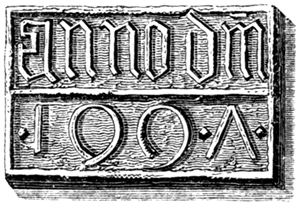
the letters being raised and blacked, and the words, within a border, being ‘Anno Domini,’ with the date of 1497, in small black-letters, and ancient Arabic figures. I shall introduce the other stones to your notice in the years to which they refer; and only now remark, that they are engraven in Plate 1, Numbers I. II. III. page 470, of the work to which I have already referred you, whence they were copied into Gough’s ‘Sepulchral Monuments,’ volume ii., part i., page cclxvi., plate xxv.
“Hitherto, Mr. Geoffrey Barbican, I have quoted you an abundance of authorities which make mention of the history, or appearance, of London Bridge, but notwithstanding my researches I find only a very few ancient representations of it. If, however, you would see an interesting and sweetly-touched portraiture of it about the year 1500, look into that stout roan-coated folio, marked 16 F. ii. xv. in the Royal Library of Manuscripts in the British Museum, and you will be enraptured. The volume professes to treat of ‘Grace entiére sur le gouvernement du Prince,’ and it is written in prose and verse, in the common large black script of the fifteenth century, on vellum, with most noble illuminations, executed in the best style of the best period of the art in England, and by one of the most gifted of the Brethren of St. Luke. The Author of the poems was Charles, Duke of Orleans, father of Louis XII.; and this particular copy of his works seems to have been illuminated for Henry the Eighth, when Prince of Wales; for it not only contains numerous initial letters and borders richly coloured and embossed with gold; but in the frontispiece, on the first page, are his father’s well known badges of the red and white roses; the former of which are supported by the white hound, and red dragon: with glorified white roses in the margin. The poems are divided into several books of various amatory subjects, as ‘Venus et Cupidon,’—‘Epitres d’Abelard et Eloise,’—‘Les Demandes d’Amours;’ and the second division of the volume is adorned with a large and beautiful illumination representing the Duke of Orleans in the Tower, sending despatches to his friends abroad. The Tower, wharf, and river before them, occupy the whole foreground of the painting; and in the back appears the East side of London Bridge, with numerous houses standing upon it, the Chapel of St. Thomas reaching down to the sterlings, and the violent fall of the river through the different arches; whilst, beyond it, rise the spires of several Churches, especially the very high one of old St. Paul’s, and the other buildings of London erected along the banks of the Thames. It is, indeed, hardly possible to give you an adequate idea of the spirit and beauty of this view of London Bridge in the Year 1500,
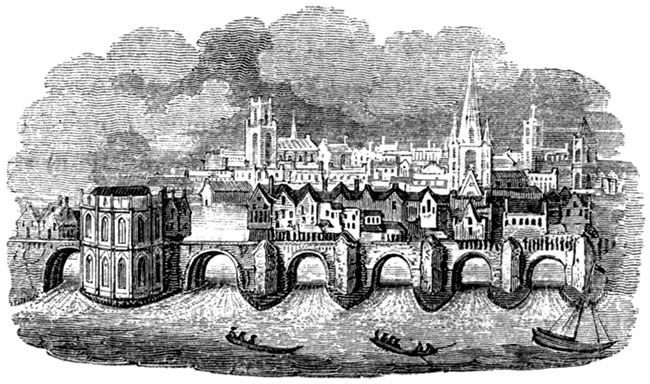
the colouring is so vivid and harmonious: a sky of ultra-marine blue is spread over the whole of the back-ground, against which the distant buildings appear in white, the nearer ones being touched with different shades of brown. You will, however, find a fair copy of this noble painting, engraved by Basire, in Gough’s ‘History of Pleshy,’ which I have already cited, page 193; and the same plate has also been published as an additional illustration to the Rev. T. D. Fosbrooke’s ‘Encyclopædia of Antiquities,’ London, 1825, volume ii., page 923.
“You must, doubtless, recollect that in November 1501, Arthur, Prince of Wales, and son to King Henry VII., was married to Katherine, daughter of Ferdinand V., King of Spain, and that on Friday, the 12th of that month, the young Princess was conveyed from Lambeth, through London, to witness the pageants which had been prepared by the Citizens to do honour to her nuptials. The whole City was full of triumph and splendour; and Stow, in his ‘Annals,’ page 482, says that on London Bridge there was ordained a costly pageant of St. Katherine and St. Ursula, with many virgins. ‘I passe ouer,’ says Hall, in a very brilliant paragraph, folio, liii a, and using that most powerful oratorical figure called Paralepsis, or Omission, which declares that of which it denies saying any thing:—‘I passe ouer,’ says the old Chronicler,—‘the wyse deuises, the prudent speches, the costly woorkes, the conninge portratures practised and set foorth in vij goodly beautifull pageauntes erected and set vp in diuers places of the Cite. I leaue also the goodly ballades, the swete armony, the musicall instrumentes, which sounded with heavenly noyes on every side of the strete. I omit farther the costly apparel both of goldsmythes woorke and embraudery, the riche jewelles, the massy cheynes, the styrrynge horsses, the beautifull bardes and the glytteryng trappers bothe with belles and spangles of golde. I pretermyt also the ryche apparell of the Pryncesse, the straunge fasshion of the Spanishe nacion, the beauty of the Englishe ladyes, the goodly demeanoure of the young damoselles, the amourous countenaunce of the lusty bachelers. I passe ouer also the fyne engrayned clothes, the costly furres of the Citizens standing on skaffoldes, rayled from Gracechurche to Paules. What should I speake of the oderiferous skarlettes, the fyne veluet, the plesaunt furres, the massye chaynes, which the Mayre of London with the Senate, sitting on horseback, at the Litle Condyte in Chepe, ware on their bodyes, and about their neckes. I will not molest you with rehersyng the ryche arras, the costly tapestry, the fyne clothes bothe of golde and syluer, the curious veluettes, the beautiful sattens, nor the pleasaunt sylkes, which did hang in every strete wher she passed, the wyne that ranne continually out of the condytes, the graueling and rayling of the stretes nedeth not to be remembered.’ I have given you the whole of this fine, but certainly extended, extract, that you may derive from it some general idea of the pageantry of this festival, concerning which our Bridge historians are, in general, altogether silent.
“The night of Thursday, November 21st, 1504, was rendered memorable by a dreadful Fire, which commenced at the sign of the Pannier, at the Northern end of London Bridge, where six tenements were consumed, ‘that could not be quenched.’ Fabyan and Holinshed tell us this in their ‘Chronicles,’ page 534 and volume II., page 791; adding, that on the 7th of the following month certain other houses were also destroyed, near St. Botolph’s Church, in Thames Street. It was, probably, when the repairs occasioned by these conflagrations were completed, that another of those sculptured stones which I lately mentioned, was placed at the Bridge. It measures 10 inches in height, by 13¾ inches broad; and, carved in the same characters, and figures, as the former, are the words ‘Anno Domini 1509.’ At the end of the date is an arbitrary mark of a cross charged with a small saltire, which is supposed to have been the old device for Southwark, or the estate of London Bridge: and you know that the Arms used for those places are still Azure, an Annulet, ensigned with a Cross pateé, Or interlaced with a saltire conjoined in base, of the second. I have yet to mention a third sculptured stone, which, it is supposed, records the public benefits conferred by Sir Roger Achiley, Draper, upon the City during his Mayoralty in 1511. This tablet is 11½ inches wide, by 9½ high; and the inscription is ‘Anno’—the City sword—‘Domini. R. 1514 A;’ these letters being the initials of that very eminent Citizen, who was then senior Alderman, representing the Ward of Bridge Within. Such were the other two Ancient stones found at London Bridge in 1758.
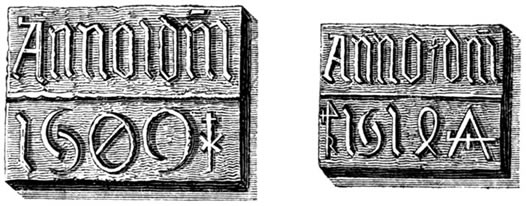
“I have already mentioned to you the situation, and general intent, of the Bridge-House and Yard, and I have now to remark, that they seem, at a very early period, to have been used for the erection of Granaries for the City to preserve Corn, &c. in, during the times of famine and scarcity of provisions. This information we derive from Stow’s ‘Survey,’ volume ii., page 24; where he adds, that there were also certain public ovens built in the same places, for the baking of such bread-corn as was there laid up, for the relief of the poor Citizens at such seasons. These ovens were ten in number, six of them being very large, and the remainder only half the size; and for their erection, Stow observes, that John Throstone, or Thurston, Citizen and Goldsmith, one of the Sheriffs in 1516, gave, by his testament, the sum of £200.
“We have now arrived at the days of King Henry the Eighth, about the period when Pope Alexander the Sixth sent over the celebrated Polydore Vergil to receive the tribute called Peter-pence, of which he was the last Collector in England. As he was already celebrated for his Poems and his books, ‘On the Invention of Things,’ and ‘on Prodigies,’ he met with great encouragement in this country; where he not only received several ecclesiastical preferments, being made Archdeacon of Wells, and Prebendary of St. Paul’s, but in 1521 he was employed by the King to write a History of England, which he performed in most elegant Latin, and which was first printed at Basil, bearing the date of 1533 for 1534. He left England in 1550, and died at his birth-place, Urbino, in Italy, in 1555. The best edition of this work, entitled ‘Polydori Vergilii Urbinatis Historiæ Angliæ,’ which contains a descriptive eulogy on London Bridge, is that of Leyden, 1651, octavo;—though I quote from the Basil folio of 1570,—and if you turn to page 4 of that volume, you will find the passage commencing ‘Is fluvius amœnissimus,’ &c. of which I shall attempt to give you a translation. ‘This most delightful river’—the Thames,—‘rises a little above the road to Winchcomb, whence flowing several ways, it is first increased at Oxford; and the beautiful wonder, having washed the City of London, pours itself into the Gallic Ocean, who welcomes it into the impetuous waves of his seas; from which, twice in the space of twenty-four hours, it flows and returns more than the distance of sixty miles, and is of the greatest national advantage, for, by it, merchandise may easily be returned to the City. In this River there is a stone Bridge, certainly a most wonderful work! for it is erected upon twenty square piers of stone, 60 feet in height, 30 feet in breadth, and distant from each other about 20 feet, united by arches. Upon both sides of the Bridge there are houses erected, so that it might appear not to be a Bridge, but one substantial and uninterrupted street.’ The same author, at page 25 of the same ‘History,’ says farther of London Bridge:—‘This part of the City, which looks Southward, is washed by the River Thames, in which stands the Bridge, as we have said before, leading towards Kent, erected upon 19 arches, and having a series of extensive magnificent houses standing upon both sides of it.’—But I fear you are drowsy, Mr. Barbican; take another draught of the sack, good Master Geoffrey, and then we’ll to it again.”