DESCRIPTIVE LIST OF THE EMBELLISHMENTS. (continued 6)
Reading edition
“Eh!—What!”—said I, starting up and shaking myself, “drowsy, did you say? Oh no! Heaven defend that I should be drowsy, when a gentleman of your inveterate learning and lungs condescends to give me a lecture! I was, indeed, for a moment thinking of the Chinese devotee who vowed never to sleep at all, and so cut off his eyelids: but I never slept, my ancient; I never winked over your homily, though I would fain have you come to your nineteenthly, lastly, and to conclude. However, whilst we live we must drink, and so here’s to your reformation, friend Postern. Now, by St. Thomas of the Bridge!” ejaculated I, as I took up the tankard, “you’re either a wizard, Master Barnaby, or else this tankard hath no bottom; and, truly, it’s the first time I ever saw wine keep hot on a mahogany table.”
“Fancy, Mr. Geoffrey, mere fancy,” replied the placid old man with a shrewd smile; “but even as it is, it will serve as a good prelude to some of the more amusing scenes with which the fragments of Bridge history furnish us in the sixteenth century. Indeed, all I have been able to lay before you are but fragments: cyphers which derive their value by connection, and look considerable only by their number.
“It was then in the year 1526, when Cardinal Wolsey was meditating a marriage between King Henry VIII., and the Duchess of Alençon, that his adversaries had anxiously contrived for him to be despatched on an embassy to France, in order to remove him from about the throne, or, at the least, to weaken his power. On July the 26th, the Cardinal left England, and in that extraordinary and entertaining piece of biography, called ‘Cavendish’s Life of Cardinal Wolsey,’ we have a particular account of the grand procession in which he rode through the City to cross London Bridge, on his road to Dover. The best edition of this work is, past question, that by Samuel Weller Singer, Esq., 1825, octavo, 2 volumes; in the first of which, at page 86, you may see an engraving of the Cardinal’s progress, from a Manuscript in the possession of Francis Douce, Esq., and read the passage I have alluded to in the following words. ‘Then marched he forward out of his own house at Westminster, passing all through London, over London Bridge, having before him of gentlemen a great number, three in a rank, in black velvet livery coats, and the most part of them with great chains of gold about their necks. And all his yeomen, with noblemen’s and gentlemen’s servants following him in French tawny livery coats; having embroidered upon the backs and breasts of the said coats these letters: T. and C., under the Cardinal’s hat. His sumpter mules, which were twenty in number and more, with his carts and other carriages of his train, were passed on before, conducted and guarded with a great number of bows and spears. He rode like a Cardinal, very sumptuously, on a mule trapped with crimson velvet upon velvet, and his stirrups of copper and gilt; and his spare mule following him with like apparel. And before him he had his two great crosses of silver, two great pillars of silver, the Great Seal of England, the Cardinal’s Hat, and a gentleman that carried his valaunce, otherwise called a cloak-bag; which was made altogether of fine scarlet cloth, embroidered over and over with cloth of gold very richly, having in it a cloak of fine scarlet. Thus passed he through London, and all the way of his journey, having his harbingers passing before to provide lodging for his train.’
“As the Account Rolls of the Bridge estates, in 1533, furnish us with a very good conception of its prosperity and revenues at that period, I shall request you to listen to only a very short abstract of the charges as they appear upon a printed document which I have already quoted. ‘1533, Thomas Crull and Robert Draper, Wardens of London Bridge, Salary to each of them, £16. 8s. 4d.—£32. 16s. 8d. Winter’s Livery to each, £1.—£2. Reward to each, £10.—£20. For horse-keeping to each, £2.—£4. Total to each of them, £29. 8s. 4d. Sum of the whole, £58. 16s. 8d. Rental this year, £840. 9s. 3¼d.’
“I have next to speak of an event occurring on London Bridge, in 1536, which is probably better known, and more often related, than most other portions of its history; I allude, as you will guess, to the anecdote of Edward Osborne leaping into the Thames from the window of one of the Bridge Houses, to rescue his master’s daughter. The particulars of this circumstance are given by Stow in his ‘Survey,’ volume ii., page 226, in the list of Lords Mayors of London; when having arrived at the year 1559, and the Mayoralty of Sir William Hewet, a Cloth-worker, he farther speaks of him as follows:—‘This Mayor was a Merchant, possessed of a great estate, of £6000 per Annum; and was said to have had three sons and one daughter,’—Anne,—‘to which daughter this mischance happened, the father then living upon London Bridge. The maid playing with her out of a window over the River Thames, by chance dropped her in, almost beyond expectation of her being saved. A young gentleman, named Osborne, then Apprentice to Sir William, the father, which Osborne was one of the ancestors of the Duke of Leeds, in a direct line, at this calamitous accident leaped in, and saved the child. In memory of which deliverance, and in gratitude, her father afterwards bestowed her on the said Mr. Osborne, with a very great dowry, whereof the late estate of Sir Thomas Fanshaw, in the Parish of Barking, in Essex, was a part, as the late Duke of Leeds told the Reverend Mr. John Hewyt, from whom I have this relation; and together with that estate in Essex, several other lands in the Parishes of Hartehill, and Wales, in Yorkshire; now in the possession of the said most noble family. All this from the old Duke’s mouth to the said Mr. Hewyt. Also that several persons of quality courted the said young lady, and particularly the Earl of Shewsbury; but Sir William was pleased to say ‘Osborne saved her, and Osborne should enjoy her.’ The late Duke of Leeds, and the present family, preserve the picture of the said Sir William, in his habit as Lord Mayor, at Kiveton House in Yorkshire, to this day, valuing it at £300.’ Pennant, in his collection of anecdotes, called ‘Some Account of London,’ which I have already cited, page 322, says, after relating this story, ‘I have seen the picture of Osborne’s master at Kiveton, the seat of the Duke of Leeds, a half-length on board; his dress is a black gown furred, and red vest and sleeves, a gold chain, and a bonnet.’ There is also an engraved portrait of Osborne himself, said to be unique, in a series of wood-cuts in the possession of Sir John St. Aubyn, Bart. They consist of the portraits of forty-three Lord Mayors in the time of Queen Elizabeth, reduced copies of six of which, exclusive, however, of Osborne, one of the most interesting, were, between the years 1794 and 1797, published by Richardson, the print-seller, of Castle-street, and the Strand.
“This gallant action of Osborne has, likewise, been the subject of a graphical record; for there is a small, but rather uncommon, engraving of him leaping from the window, executed for some ephemeral publication, from a drawing by Samuel Wale. As this artist died in 1786, it is of course but little authority as being a representation of the fact, but it is, nevertheless, interesting as giving a portraiture of the dwellings on London Bridge in his time; and with this print I may also mention one designed by the same hand, and engraved by Charles Grignion, of the first Duke of Leeds pointing to a portrait of Hewet’s daughter, and relating to King Charles II. the foregoing anecdote of his ancestor. You will find it in William Guthrie’s ‘Complete History of the Peerage of England,’ having ‘vignettes at the conclusion of the history of each family,’ London, 1742, quarto, volume i., page 246.”
“Before you pass on to any other event, Mr. Postern,” said I, as the old gentleman came to a period, “let me say a word or two of the fortunate hero of this anecdote. Sir Edward Osborne was the son of Richard Osborne, of Ashford, in Kent, a person certainly in a most respectable situation in life, if not immediately of gentilitial dignity. He became Sheriff of London in 1575, and Lord Mayor in 1583-84, the 25th of Queen Elizabeth, when he received the honour of Knighthood at Westminster. ‘He dwelled,’—says a manuscript in the Heralds’ College, to which I have already referred, Pb. No. 22, folio 18 a,—‘in Philpot Lane, in Sir William Hewet’s house, whose da: and heire he married, and was buried’—in 1591,—‘at St. Dennis in fanchurch Streete.’ His Armorial Ensigns, according to the same authority, were Quarterly, 1st and 4th. Quarterly, Ermine and Azure, a Cross Or; for Osborne: 2nd. Argent, 2 bars Gules, on a Canton of the second, a Cross of the first; 3rd. Argent, a Chevron Vert, between three annulets Gules. To these we may add the coat of Hewet on an Escutcheon of Pretence, it being Parted per pale, Argent and Sable, a chevron engrailed between three rams’ heads erased, horned Or; all counterchanged, within a bordure engrailed Gules, bezantée. On the 15th of August, 1675, Sir Thomas Osborne, the great-grandson of Sir Edward, was raised to the Peerage by the titles of Viscount Latimer, and Baron Kiveton, in the County of York, by Patent from King Charles the Second; on the 27th of June, in the year following, he was created Earl of Danby; on April the 20th 1680, he was advanced to the dignity of Marquess of Caermarthen; and he became First Duke of Leeds on May the 4th, 1694. So much then, Mr. Postern, for an historical and genealogical illustration of the anecdote of the gallant apprentice of London Bridge.”
“I regret, Mr. Geoffrey Barbican,” recommenced my visitor, after thanking me for having added the above information to his narrative, “I regret that I have so little to lay before you, touching the state and revenues of the Chapel of St. Thomas on London Bridge, at the time of the Dissolution of Monasteries, &c. by the famous act of the 31st year of King Henry VIII.,—1539,—Chapter the 13th. It does not appear that its revenues yielded any considerable profit to the King’s Augmentation Office; but yet it certainly must have existed even in the form of a religious establishment so late as that King’s reign, because we find it mentioned in several lists of those institutions in London made about that period; though it does not appear in the ‘Valor Ecclesiasticus,’ also made by order of the same Monarch. This celebrated and most authentic historical record, was an ecclesiastical survey of England, made in pursuance of an Act of Parliament passed in the 26th of Henry VIII.,—1534,—chapter iii., section x., for the payment of First Fruits, Pensions, &c. to the King. The survey was, of course, executed by Commissioners, and many of the original returns to their enquiries are yet preserved in the First-Fruits and Tenths’ Office, in the Court of Exchequer: whilst the ‘Valor Ecclesiasticus’ itself has been printed under the direction of the Commissioners of Records, in five volumes folio, London, 1810-1821. The survey for the City of London is contained in the first volume, in which we find London Bridge frequently mentioned as receiving certain reserved rents from the property of other establishments. Thus, on page 388, column ii., in the rents paid to divers persons by St. Bartholomew’s Hospital in West Smithfield, 9s. are set down as being paid ‘to the Master or Keeper of the Bridge of London, out of the corner tenement at the Litill Bayly without Ludgate.’ On page 390, column i., Elsyng Spital is stated to pay 33s. 4d. to the Master of London Bridge, out of the tenements in the Parish of St. Benedict, Grace-Church: and on page 431, column ii., it is recorded that the House of the Carthusians was to pay 9s. 4d. to the House of London Bridge: though the Chapel of St. Thomas is never mentioned in the valuation of St. Magnus’ Rectory, which amounted to £71. 7s. 3½d.
“I have hardly less regret in stating our absolute want of information relating to the Bridge Chapel at the Dissolution, than I have to speak of that concerning the Common Seal belonging to the officers of London Bridge. Stow tells us, as you may remember, in volume ii., page 25, of his ‘Survey,’ that ‘at a Common Council, July 14th, Anno 33, Henry VIII.—1540,—it was ordered, that the Seal of the Bridge-House should be changed; because the image of Thomas Becket, sometime Archbishop of Canterbury, was graven therein; and a new Seal to be made, devised by Mr. Hall, to whom the old Seal was delivered. Note, this was occasioned by a Proclamation, which commanded the names of the Pope, and Thomas of Becket, to be put out of all books and monuments; which is the reason you shall see them so blotted out in all old Chronicles, Legends, Primers, and Service-books, printed before these times.’ Of these erasures, the best account is in Bishop Burnet’s ‘History of the Reformation of the Church of England,’ London, 1681, folio, volume i., book iii., page 294; where it is asserted that such alterations were but slight, and that the old Mass-books were still in use, until the time of Queen Mary, when the castrated volumes were every where brought in, and destroyed; all Parishes being compelled to furnish themselves with new copies of the Church Offices: and Stow, on page 191 of the second volume of his ‘Survey,’ states that in the book marked D of the City Records, the name of St. Thomas was omitted, in pursuance of the King’s edict.
“We have thus come down to the times of that most eminent and laborious Antiquary, John Leland, to whose works I have already made some slight illustrative references; and the volume to which I am now about to request your attention, is one of the most rare, and curious, though not the greatest, of his productions. Let me remind you, however, before I mention the work itself, that Leland was, very probably, born in the Parish of St. Michael le Quern, London, in September, about the year 1506; that he was educated at St. Paul’s School, in both the Universities, and in France; that he made a literary and an antiquarian tour, of amazing minuteness and research, by virtue of a commission from King Henry VIII., in 1533; and that he died in a state of mental derangement, April the 18th, 1552, having lived about five years under its heaviest pressure. The particular volume of his writings to which I would refer you, as containing much original and curious matter concerning London Bridge, is a Latin poem, written in verses of five feet, yet not strictly in pentameters, entitled ‘Kykneion Asma, Cygnea Cantio: A Swan’s Song: the Author, John Leland, the Antiquary.’ Of this book there are two editions; a quarto, printed at London in 1545; and a duodecimo, also published here in 1658: though the poem and commentary were again inserted in the 9th volume of Hearne’s edition of ‘Leland’s Itinerary;’ since, as he states in his Preface thereto, they ‘ought to be looked upon as part of the Itinerary;’ and that they were grown so very rare, that though twice reprinted, they had sold, even so far back as 1712, for forty shillings in auctions. Bishop Nicolson, in his ‘English Historical Library,’ page 3, characterises this work as ‘a poetical piece of flattery, or a panegyric on King Henry; wherein the author brings his Swan down the River of Thames, from Oxford to Greenwich, describing, as she passes along, all the towns, castles, and other places of note within her view. And the ancient names of these, being sometimes different from what the common herd of writers had usually given, therefore, in his commentary on this Poem, he alphabetically explains his terms, and, by the bye, brings in a great deal of the ancient geography of this island.’ The first passage that I shall cite you from this curious volume, is from page 8, verse 213, edition 1658; which commences ‘Mox et nobilium domos virorum;’ but as I have, for the first time, done it into English verse, I will repeat you only my paraphrase, rather than the original Latin, observing that I have strictly adhered to all the actual facts.
‘More plainly now, as o’er the tide With swift, but gentle course we glide; The sight embraces in its ken Those dwellings of illustrious men, Where Thames upon his banks descries The brave, the courteous, and the wise. But, Oh! that sight too well recalls The name of one, whose love was shrined Within his river-seated halls, Less richly furnish’d than his mind! For Wisdom had endow’d his heart With all that gilds mortality; But he was man, and Death’s keen dart Changed so much of him as could die, Into his body’s native earth, To give his soul an heavenly birth. Yet, whilst we muse on Time’s career, And hail his care-worn kindred here, The streaming river bears us on To London’s mighty Babylon: And that vast Bridge, which proudly soars, Where Thames through nineteen arches roars, And many a lofty dome on high It raises towering to the sky. ‘There are, whose truth is void of stain, Who write, in Lion Richard’s reign, That o’er these waves extended stood A ruder fabric framed of wood: But when the swift-consuming flames Destroy’d that bulwark of the Thames, Rebuilt of stone it rose to view, Beneath King John its splendours grew, Whilst London pour’d her wealth around, The mighty edifice to found; The lasting monument to raise To his, to her eternal praise, Till, rearing up its form sublime, It stands the glory of all time! ‘Yet here we may not longer stay But shoot the Bridge and dart away, Though, with resistless fall, the tide Is dashing on the bulwark’s side; And roaring torrents drown my song As o’er the surge I drift along.’
“Such then, Mr. Barbican, is my rapid version of those interesting verses contained in the ‘Cygnea Cantio;’ and we shall next refer to the famous passage in the Commentary upon it, though, in order to be perfectly explicit, I must previously mention some of the circumstances which caused it to be written.
“John Bale, an intimate friend, and most fervent admirer of Leland, admits, in the Preface attached to his ‘New Year’s Gift,’ that he was not quite free from the weakness of boasting and vain-glory. An instance of this is to be found in the Commentary on that part of the ‘Cygnea Cantio,’ where he is speaking of London Bridge; and you will find the passage referred to in a work to which I have been greatly indebted for these notices of Leland and his writings:—‘The Lives of those eminent Antiquaries John Leland, Thomas Hearne, and Anthony à Wood,’ Oxford, 1772, 8vo., volume i., page 47, where it is also stated, that London Bridge was then the subject of much public attention. By far the most curious reference to Leland’s invective, however, is to be seen in an original Letter written from Hearne to Bagford, and preserved in the Harleian Collection of Manuscripts, No. 5910, Part iv. at the end; whence I shall give it you in all its original simplicity.
‘Oxf. 11th July, 1714.
“‘Sir,
’Tis a pretty while since I received another part of your observations about London, together with some fragments and books, and a copy of Leland’s ‘Encomia illustrorum virorum.’ The gentleman who lent this copy is a person for whom I have a great honour, and I desire you would return him my service and thanks, altho’ I have already done this myself in a letter I writ to him. I should be glad to know whether he be Esq., or what other title I may call him by, if I should have occasion to make public mention of his name. I am extremely obliged to you for your care and trouble, and for your readiness to assist me. As for what Leland says about London Bridge, ’tis in the word Pontifices in his Com. upon the ‘Cygnea Cantio.’ Some ignorant persons, and particularly one, had found fault with his making only nineteen arches, in London Bridge, when, as they alleged, there were twenty. Mr. Leland acknowledges there were twenty cataracts, or passages, but observes that one of them was only a sluice, or Draw-Bridge, and that there were only nineteen stone arches. Upon this he takes occasion to animadvert in short upon the aforesaid person, who had been so pert, and promises to take more notice of him afterwards, and at the same time to expose him according to his deserts. He tells us he had survey’d the whole City, and took notes of every thing of consequence in it, and insinuates that he would publish a most full and exact account of its History and Antiquities. ’Twas in this work the remarks of the aforesaid Observator were to be fully considered; but Mr. Leland dying before he could finish either this, or divers other undertakings, his papers came into other hands, and those about London (which were considerable) coming to Mr. Stowe, many of them are published in the Survey of London as Mr. Stowe’s own, and others are entirely lost, or, at least, ’tis not at present known who has the possession of them.’
****
‘For Mr. John Bagford, at the Charter House, London.’
“After this flourish of trumpets, concerning Leland and London Bridge, I proceed to translate for you the very amusing passage itself, premising only that you will find it on page 133, in that edition of the work which I have already cited.—‘Pontifices: Bridge Masters, officers who derive their name from the nature of their employment, namely, the constructing of Bridges, or the keeping of them in order; of whom also are the two Governors charged with the care of London Bridge. These officers have an excellent house in the suburb of Southwark, as well as a storehouse containing every thing belonging to their occupation. Rodolphus à Diceto relates in his History, that Peter of Colechurch, a Priest, laid the foundations of a new Bridge: but though it was at first very inconsiderable, Royal and Civic munificence afterwards brought it to be the edifice which it now appears. Upon this subject, Courteous Reader, I am assailed by a whole herd of blustering smatterers, of whom there is one more insignificant than even the rest; a fellow more notorious for loquacity than eloquence, and prodigiously self-conceited; he, truly, shamelessly asserts me to have mistaken in my enumeration of the Arches of London Bridge. And he being, I warrant you, a critic of rare sagacity, plucks up by the roots, rends, and mangles, all by his own mighty authority, an’t please you, the pretended oversight on my part. But no more at present; for upon another opportunity I am about to overwhelm his intolerable stupidity, and trample down his arrogance: I merely then reply to him, that one eye-witness is of more value than ten hearsays. I am a Citizen of London, nor do I repent me of my country; and I hope also that she may never have any reason to repent her of her son. To thee then, thou vile companion, Geta,’—the name, you may remember, of a very knavish servant in Terence’s ‘Phormio,’—‘to thee I say
To none the City better known can be, All London is a monument to me!
Suppose thou wert to try thy skill at searching into that antiquity which involves this wonder of our City? Perchance thou mayest learn something, unless thou art half-ashamed to learn under my tuition. But why should we not now return to the matter of the Bridge? London Bridge then, as it extends itself from North to South, has twenty cataracts; but of arches, incurvated passages formed of solid stone, there are no more than nineteen. That platform, having the figure of a Bridge, made of level wooden planks, capable of being raised or lowered by machines, that an enemy may not find an open passage, I neither can, nor will, nor ought reasonably to call an arch. And yet thou wert greatly in hope of a mighty triumph over me in this matter; but by these words thus easily do I snatch away from thee thine air-built castles.
For though Antæus thou should’st be, or Polyphemus vast, Or Atlas, on whose shoulders broad the world itself was cast, To hope to triumph o’er me were but labour spent in vain, And thou, I deem, wilt wiser be if e’er we meet again.
‘And now, get thee hence, thou Geta, and fail not to proclaim to all your pot-companions, your notable discovery of twenty arches in London Bridge!’
“I have next, Mr. Barbican, to commend to your notice the account of London Bridge and the Thames, given to us by that most learned man and voluminous writer, Paulus Jovius, Bishop of Nocera, an historian who was born at Como, in Italy, in 1483, and died in 1552. The passage to which I allude, is in his ‘Descriptio Britanniæ, Scotiæ, Hyberniæ, et Orchadum,’ Venice, 1548, small quarto, or octavo, page 12 a, beginning ‘Sed harum et denique omnium et famam Londinum penitus obscurat;’ but I shall here again take the freedom to anticipate time a little, and give you under one year a translation of Paulus Jovius, and Sir Paul Hentzner’s description of the same object; since the former is cited by the latter, and both are excellently well rendered into English in that very curious and rare production of the Strawberry-Hill press, entitled ‘A Journey into England, by Paul Hentzner, in the Year M.D.XC.VIII.,’ printed in 1757, octavo; on page 4 of which the passage thus commences. ‘On the South is a Bridge of stone, 800 feet in length, of wonderful work; it is supported upon 20 piers of square stone, 60 feet high, and 30 broad, joined by arches of about 20 feet diameter. The whole is covered on each side with houses, so disposed as to have the appearance of a continued street, not at all of a Bridge. Upon this is built a tower, on whose top the heads of such as have been executed for high treason are placed upon iron spikes: we counted above thirty. Paulus Jovius, in his description of the most remarkable towns of England, says, ‘All are obscured by London; which, in the estimation of many, is Cæsar’s City of the Trinobantes, the capital of all Britain, famous for the commerce of many nations; its houses are elegantly built, its churches fine, its towers strong, and its riches and abundance surprising. The wealth of the world is wafted to it by the Thames, swelled by the tide, and navigable to merchant ships, through a safe and deep channel for 60 miles, from its mouth to the City. Its banks are every where beautified with fine country seats, woods, and farms; below, is the Royal Palace of Greenwich; above, that of Richmond; and between both, on the West of London, rise the noble buildings of Westminster, most remarkable for the Courts of Justice, the Parliament, and St. Peter’s Church, enriched with the Royal tombs. At the distance of 20 miles from London, is the Castle of Windsor, a most delightful retreat of the Kings of England, as well as famous for several of their tombs, and for the most renowned ceremonial of the Order of the Garter. This river abounds in swans, swimming in flocks; the sight of them, and their noise, are vastly agreeable to the fleets that meet them in their course. It is joined to the City by a Bridge of stone wonderfully built; is never encreased by any rains, rising only with the tide, and is every where spread with nets, for the taking of salmon and shad.’ Thus far Paulus Jovius.’
“I have given you the whole of this passage, because it is curious in itself, most elegantly translated by Lord Orford, and because, in the accounts of ancient London which we derive from the foreigners who have visited it, there is most commonly a delineation of some feature which others have neglected; as I shall have several opportunities of shewing you hereafter. I have only to add at present, that Paul Hentzner was an eminent German Counsellor and traveller, who died in 1623; and whose work, whence I have extracted the foregoing description, is entitled ‘Itinerarium Germaniæ, Galliæ, Angliæ, et Italiæ,’ &c. best edition, Nuremberg, 1629, 4to. It was written during a journey which he made through those countries with the young Count Rhediger, with whom he had been at the University of Strasburg; its elegance of language is particularly remarkable, and the part relating to England is generally considered as the best.
“In the fourth year of the reign of King Edward the Sixth,—1550,—those extensive Letters Patent were granted to Southwark, by which the famous Fair was instituted in that Borough, to be held on the 7th, 8th, and 9th of September. The Patent was dated the 20th of April, and the sum of £647. 2s. 1d. was paid for it to the King, by the Mayor and Corporation of London. At the time of this Fair, anciently called ‘Our Lady Fair in Southwark,’ the Lord Mayor, and Sheriffs, used to ride to St. Magnus’ Church after dinner, at two o’clock in the afternoon; the former being vested with his collar of SS., without his hood, and all dressed in their scarlet gowns, lined, without their cloaks. They were attended by the Sword-Bearer wearing his embroidered cap, and carrying ‘the Pearl Sword;’ and, at the Church, were met by the Aldermen, all of whom, after Evening Prayer, rode over the Bridge in procession, passed through the Fair, and continued either to St. George’s Church, Newington Bridge, or to the stones pointing out the City liberties at St. Thomas of Waterings. They then returned over the Bridge, or to the Bridge-House, where a banquet was provided, when the Aldermen took leave of the Lord Mayor, and, all parties being returned home, the Bridge-Masters gave a supper to the Lord Mayor’s officers. Stow and his continuators are my authorities for these particulars; see volume ii. of his ‘Survey,’ pages 5, 249.
“Our voyage down the stream of history, and of time, has at length conducted us to the reign of Queen Mary, and the year 1554; when her proposed marriage with Philip II., of Spain, alarmed all the nation, lest the Inquisition should be established in England, and the people become the vassals of the Spanish crown. But although the Protestants were the most alarmed at this marriage, when the treaty was made public the complaints and murmurs against it became almost universal; and, finally, produced a conspiracy against Mary, of which it was certainly either the cause, or the pretence. One of the principal leaders of this plot was Sir Thomas Wyat, a gentleman of Kent, who had frequently been Ambassador to Spain, where the cruelty and subtilty of the people had alarmed him for the future fate of his own country. As the insurrection was intended to be general, his sphere of action was to be Kent; whilst Sir Peter Carew excited a rising in Cornwall, and the Duke of Suffolk in Warwickshire, as being the centre of the kingdom. From too hasty preparations, however, and too rapidly assembling his forces, the designs of Carew were discovered before they were entirely perfected; one of his accomplices was arrested; and he saved himself only by deserting the enterprise and escaping to France. This unexpected discovery accelerated all the other measures; for, though it was intended to await the arrival of King Philip, to give a colour to the rebellion, Wyat, notwithstanding he was unprepared, marched his few followers to Maidstone, and gave out that he took up arms to preserve England from being invaded. He had little success on his way to London, but the City Trained-bands being, by a manœuvre, induced to desert to him, he arrived with about 4000 men in Southwark, on Saturday, February the 3rd, 1553-54. The prudence of that excellent man, Sir Thomas White, then Lord Mayor, had, however, already prepared for his coming; added to which, the Queen, who remained in Guildhall, appointed Lord William Howard Lieutenant of the City. The Draw-Bridge at London Bridge was then cut down and thrown into the River; the Bridge gates were shut; ramparts and fortifications were raised around them; ordnance was planted to defend them; and the Mayor and Sheriffs, well armed for the conflict, commanded all persons to shut their shops and windows, and to stand ready harnessed at their doors for any event which might occur. As Wyat found there was no opposition made to him in Southwark, some of his soldiers completely sacked the Bishop of Winchester’s Palace, and destroyed his extensive library; whilst at the Bridge foot he laid two pieces of ordnance, and dug an extensive trench between the Bridge and his forces. In order to gain an entrance to the Bridge, Sir Thomas brake down the wall of a house adjoining the gate, by which he ascended the leads over the gate, and then coming down into the Porter’s lodge, about eleven at night, he found the Porter sleeping, but his wife, with several others, watching over a coal fire. On beholding Wyat, they suddenly started, when he commanded them to be silent, as they loved their lives, and they should have no hurt; and, they timidly yielding to him, he and some others went upon the Bridge to reconnoitre. On the other side of the Draw-Bridge he saw the Lord Admiral, the Lord Mayor, Sir Andrew Judd, and one or two more in consultation, for defence of the Bridge, as we may suppose, by fire or torch light; and after, for some time, carefully observing their deliberations, he returned to his party, unseen and in safety. Having stated to his followers the active measures of the Citizens, they began to consult what course they had better adopt to secure their own success and safety. The advice of some was to return to Greenwich, and crossing the water into Essex, enter London at Aldgate; others, though they were suspected of treachery, were for going back into Kent to meet some friends and supplies; when, at length, it was concluded that they should march along the Thames towards Kingston, and, crossing the Bridge of that place, enter the City on the West.
“On the night previously to their departure, Monday, the 5th of February, as ‘Thomas Menschen, one of the Lieutenant’s men of the Tower,’—says Stow, in his ‘Annals,’ page 619,—‘rowed with a sculler over against the Bishop of Winchester’s Palace, there was a water-man of the Tower stayres, desired the sayd Lieutenant to take him in, who did so, which being espied of Wyatt’s men, seauen of them with harquebusses called to them to land againe, but they would not, whereupon each man discharged their piece, and killed the sayd Waterman, which foorthwith falling downe dead, the sculler with much paine rowed through the Bridge to the Tower wharfe, with the Lieutenant’s man and the dead man in his boat; which thing was no sooner knowne to the Lieutenant, but even the same night, and the next morning, hee bent seauen great pieces of ordnance, cvluerings and demi-canons, full against the foote of the Bridge, and against Southwarke, and the two steeples of Saint Olaues and Saint Mary Oueries, besides all the pieces on the White Tower, one culuering on the Diueling Tower, and three fauconets ouer the Water-gate: which so soone as the inhabitants of Southwarke vnderstood, certaine both men and women came to Wyat in most lamentable wise, saying, ‘Sir, wee are all like to bee vtterly vndone, and destroyed for your sake, our houses shall by and by bee throwne downe vpon our heads, to the vtter spoyle of this borrough, with the shot of the Tower, all ready bent and charged towards vs, for the loue of God therefore take pittie vpon vs:’ at which wordes hee being partly abashed, stayed a while, and then sayd: ‘I pray you my friends bee content a while, and I will soone ease you of this mischiefe, for God forbid that you, or the least here, should be killed, or hurt, in my behalfe.’ And so, in most speedie manner, hee marched away.’
“He next proceeded to Kingston, where he devised the means of crossing the river, though the bridge was destroyed; and on the 7th of February he entered London. His unhappy story is no farther connected with that of London Bridge; and it will therefore be sufficient to observe that he was executed on the 11th of April, on Tower-hill, his quarters being set up in several places, and his head on the gibbet at Hay-hill, near Hyde Park; whence, however, it was soon after stolen and carried away. In addition to Stow’s ‘Annals,’ let me observe that I have also quoted from Holinshed’s ‘Chronicle,’ volume iii., page 1097.
“Although, as I have fully shewn you, London Bridge was, in general, most intimately connected with the principal executions of the times, yet I do not read that it was rendered remarkable, in the days of Queen Mary, by being made the scene of any of the numerous Protestant martyrdoms, which have eternally blotted her short, but sanguinary reign. There is, however, in Fox, a short anecdote connected with our present subject, which I quote the more readily, as it also bears a reference to the Church of St. Magnus. Upon the death of Pope Julius III., in 1555, Stephen Gardiner, Bishop of Winchester and Lord Chancellor, wrote to Bonner, Bishop of London, to command him, in Queen Mary’s name, to order those prayers to be used throughout his diocese, which the Roman Church has appointed during a vacancy in the Papal See. ‘Vpon this commandment,’—says John Fox, in his immortal ‘Acts and Monuments of Martyrs;’ London, 1610, volume iii., page 1417, column 2,—‘on Wednesday in Easter weeke,’—which, in 1555, was the 17th of April,—‘there were hearses set vp, and diriges sung for the said Julius, in diuers places. At which time it chanced a woman to come into Saint Magnus Church, at the Bridge-foot in London, and there seeing an hearse and other preparation, asked what it meant: and other that stood by, said that it was for the Pope, and that she must pray for him. ‘Nay,’ quoth she, ‘that I will not, for he needeth not my prayer: and seeing he could forgiue vs all our sins, I am sure he is cleane himselfe: therefore I neede not to pray for him.’ She was heard speake these words of certaine that stood by: which by and by carried her vnto the cage at London Bridge, and bade her coole her selfe there.’ In some of the editions of Fox there is an engraving representing this circumstance, which shews that the Stocks and Cage stood by one of the archways on the Bridge, and in one of the vacant spaces which looked on to the water.
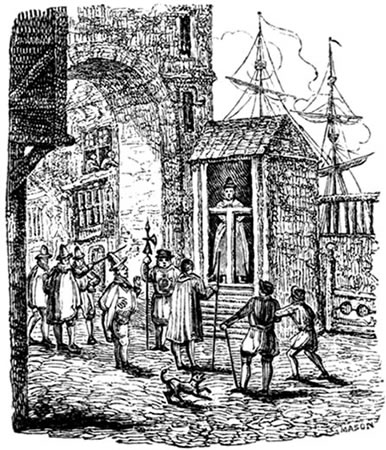
I will but add, that Cages and Stocks were ordered to be set up in every Ward of the City by Sir William Capell, Draper, and Lord Mayor, in 1503.
“I cannot illustrate the year 1556 farther than by an extract from the Account-Rolls of the Bridge-Keepers, taken from the printed document already mentioned; and the general particulars are as follow. ‘1556. Andrew Woodcock and William Maynard, Bridge-Masters, received for this year’s fee, each, £26. 13s. 4d.—£53. 6s. 8d. Horse-keeping, to each, £2.—£4. Livery, each £1.—£2. Total, to each of them, £29. 13s. 4d. Sum of the whole £59. 6s. 8d. Rental, £1069. 11s. 6¼d.’
“The next view which we find representing London Bridge, is supposed to have been taken about this time, or at least before the year 1561, since it shews the Cathedral of St. Paul surmounted by its famous spire, which was then destroyed. The picture, itself, is a prospect of London, taken from St. Catherine’s, below the Tower, over the gate of which are two turrets, since gone, and behind the Tower is a view of Grace Dieu Abbey in the Minories, with the spires and tops of several other Churches and buildings. Mr. Gough, in his ‘British Topography,’ volume i., page 748, esteems this to be the oldest view of London extant; and states that it was a painting in the possession of Mr. John Grove, of Richmond, who had it engraven in Nov. 1754, by J. Wood, and dedicated to the Right Honourable Philip, Lord Hardwicke, Lord Chancellor, &c. This view consists of a whole-sheet folio plate, executed in the line-manner; the Bridge is shewn in the distance, having fifteen arches only, with three separate piles of buildings and towers above: and in the front are several ancient vessels and boats. Though Mr. Gough states that the plate has been mislaid, impressions from it are by no means exceedingly rare, excepting when they are in fine preservation, as to colour and margin; and, it should be remarked, that there is also a quarto copy of it in the second number of a singular, but unfinished work, published by Messrs. Boydell and Co. in 1818, entitled ‘London before the Great Fire.’ This view of London Bridge is, however, much too distant for our purpose; even if its authority were less apocryphal, than it is generally supposed to be.
“The year 1564 was remarkable, inasmuch as it concerned London Bridge, for a severe frost upon the Thames, which began on Thursday, December the 21st, and of which Stow, in his ‘Annals,’ page 658, and Holinshed in his ‘Chronicle,’ volume iii., page 1208, give you some particulars. It is there stated, that the frost continued to such an extremity, that on New-Year’s Eve ‘people went ouer and alongst the Thames on the ise from London Bridge to Westminster. Some plaied at the football as boldlie there, as if it had beene on the drie land: diuerse of the Court being then at Westminster, shot dailie at prickes set vpon the Thames; and the people, both men and women, went on the Thames in greater numbers, than in anie street of the Citie of London. On the third daie of January at night, it began to thaw, and on the fift there was no ise to be seene betweene London Bridge and Lambeth, which sudden thaw caused great floods and high waters, that bare downe bridges and houses, and drowned manie people in England: especiallie in Yorkshire, Owes Bridge was borne awaie with others.’
“Stow relates in his ‘Survey,’ volume i., page 64, that in April, 1577, the Tower which stood at the Northern end of the Draw-Bridge on London Bridge, was become so decayed as to require taking down and removing. A new building was consequently then commenced, and the heads of the traitors which had formerly stood upon it were re-erected on the Tower over the Gate at the Bridge foot, Southwark; which was subsequently known by the name of Traitors’ Gate.
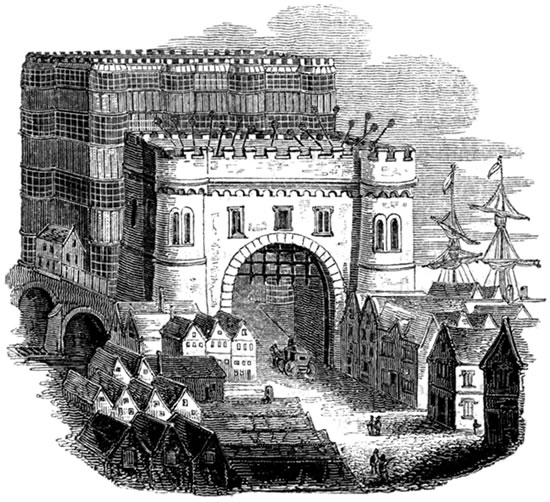
“Whilst I am speaking to you of the removal of these heads to the South end of London Bridge,—though it comes a little out of the order of time,—I must not forget to notice the increase of their number, by those of several persons who were executed for not acknowledging King Henry VIII. as Supreme Head of the Church of England. The Act, by which he was so constituted, was passed in the 27th year of his reign,—1535,—and it ordained that all who refused to take the Oath of the King’s Ecclesiastical Supremacy, and renounce that of the Pope, whether Clergyman or layman, should be considered as guilty of High Treason. The first who suffered under this Act were several of the Carthusian Monks of the Charter-house,—preceded by their Prior, John Houghton, on Tuesday, May the 4th,—whose heads were then set up on the Bridge: but two of the most eminent and remarkable instances, were those of Bishop Fisher, and Sir Thomas More, to which I shall request your attention whilst I give you a few particulars.
“John Fisher, Bishop of Rochester, was executed on St. Alban’s day, Tuesday, the 22nd of June, 1535, about ten in the morning; and his head was to have been erected upon Traitors’ Gate the same night, but that it was delayed to be exhibited to Queen Anne Boleyn. We gather these particulars from that most curious little duodecimo, written by Hall, but attributed to Dr. Thomas Baily, entitled ‘The Life and Death of that renowned John Fisher, Bishop of Rochester,’ London, 1655; in which also, at page 211, there is the following interesting passage concerning London Bridge. ‘The next day after his burying, the head, being parboyled, was pricked upon a pole, and set on high upon London Bridge, among the rest of the holy Carthusians’ heads that suffered death lately before him. And here I cannot omit to declare unto you the miraculous sight of this head, which, after it had stood up the space of fourteen dayes upon the Bridge, could not be perceived to wast nor consume: neither for the weather, which then was very hot, neither for the parboyling in hot water, but grew daily fresher and fresher, so that in his life-time he never looked so well; for his cheeks being beautified with a comely red, the face looked as though it had beholden the people passing by, and would have spoken to them, which many took for a miracle, that Almighty God was pleased to shew above the course of Nature, in this preserving the fresh and lively colour in his face, surpassing the colour he had being alive, whereby was noted to the world the innocence and holinesse of this blessed father, that thus innocently was content to lose his head in defence of his Mother, the Holy Catholique Church of Christ. Wherefore the people coming daily to see this strange sight, the passage over the Bridge was so stopped with their going and coming, that almost neither cart nor horse could passe: and, therefore, at the end of fourteen daies, the executioner was commanded to throw downe the head, in the night time, into the River of Thames, and, in the place thereof, was set the head of the most blessed and constant martyr, Sir Thomas More, his companion, and fellow in all his troubles, who suffered his passion’—on Tuesday,—‘the 6th of July next following,’ about nine o’clock in the morning.
“The circumstances attendant upon the relique of this most eminent man, were but little less singular than the preceding; and Thomas More, his great-grandson, in his very interesting Life of him, printed at London, in octavo, 1726, pages 276, 277, says, ‘his head was putt vpon London Bridge, where as trayters’ heads are sett vpon poles:—and hauing remained some moneths there, being to be cast into the Thames, because roome should be made for diuerse others, who, in plentiful sorte, suffered martyrdome for the same Supremacie, shortly after it was bought by his daughter Margarett, least,—as she stoutly affirmed before the Councell, being called before them for the same matter—it should be foode for fishes; which she buried where she thought fittest. It was very well to be knowen, as well by the liuelie fauour of him, which was not all this while in anie thing almost diminished; as also by reason of one tooth which he wanted whilst he liued: herein it was to be admired, that the hayres of his head being almost gray, before his martyrdome, they seemed now, as it were, readish or yellow.’ The pious daughter of this most celebrated Chancellor, is said to have preserved this relique in a leaden case, and to have ordered its interment, with her own body, in the Roper vault, under a chapel adjoining St. Dunstan’s, Canterbury, where it was seen in the year 1715; and again very recently.
“About the time of removing the black and decaying fragments of these heads, there seem to have been several other alterations and improvements effected upon London Bridge; for Stow tells us that, to replace the Tower which was taken down, ‘a new foundation was drawn, and Sir John Langley, the Lord Mayor, laid the first stone of another building, in presence of the Sheriffs, and Bridge Masters, on Wednesday, the 28th of August, 1577. In September, 1579, the Tower was finished, being a beautiful and chargeable piece of work, and having all its fabric above the Bridge formed of timber.’ This erection, then, formed a second Southwark Gate and Tower.
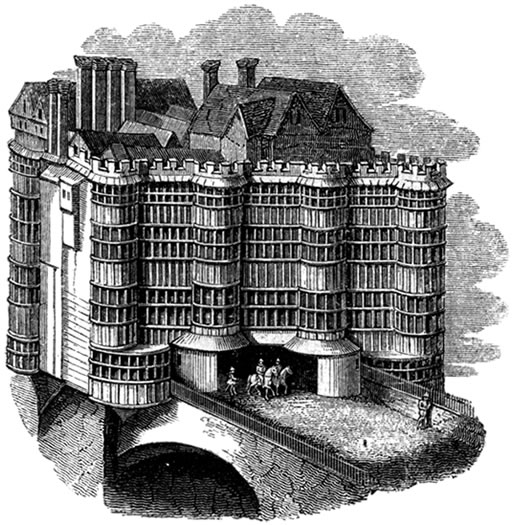
The structure consisted of four circular turrets, connected by curtains, and surmounted by battlements, containing a great number of transom casements; within which, having their roofs and chimneys rising above the Tower, were several small habitations, whilst beneath, was a broad covered passage; the building itself projecting considerably over each side of the Bridge, the width of the carriage-way, at this part, being about 40 feet. Perhaps, however, the most splendid and curious building which adorned London Bridge at this time, was the famous Nonesuch House;
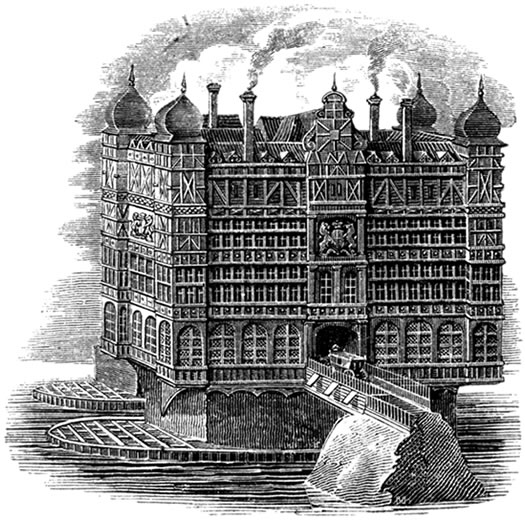
so called, because it was constructed in Holland, entirely of wood, and, being brought over in pieces, was erected in this place with wooden pegs only, not a single nail being used in the whole fabric. It stood at some distance beyond the edifice which I last described to you, nearer the City, at the Northern entrance of the Drawbridge; and its situation is even yet pointed out to you, by the 7th and 8th Arches of London Bridge, from the Southwark end, being still called the Draw Lock, and the Nonesuch Lock. On the London side of the Bridge, the Nonesuch House was partly joined to numerous small wooden dwellings, of about 27 feet in depth, which hung over the parapet on each side, leaving, however, a clear space of 20 feet in the centre; though, over all these, its carved gables, cupolas, and gilded vanes, majestically towered. Two Sun-dials, declining East and West, also crowned the top on the South side; on the former of which was painted the old and appropriate admonition of ‘Time and Tide stay for no man;’ though these ornaments do not appear to have been erected until the year 1681, in the Mayoralty of Sir Patience Ward. This we learn from Edward Hatton’s ‘New View of London,’ volume ii., page 791.
“Like most of those other buildings, this celebrated edifice also overhung the East and West sides of the Bridge; and there presented to the Thames two fronts, of scarcely less magnificence than it exhibited to Southwark and the City; the columns, windows, and carving, being similarly splendid; and, thus, equally curious and interesting, was the Nonesuch House on London Bridge, seen from the water.
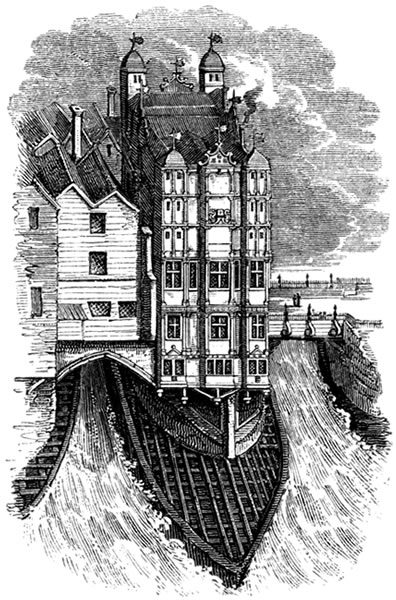
Its Southern front only, however, stood perfectly unconnected with other erections, that being entirely free for about fifty feet before it, and presenting the appearance of a large building projecting beyond the Bridge on either side; having a square tower at each extremity, crowned by short domes, or Kremlin spires, whilst an antiquely-carved gable arose in each centre. The whole of the front, too, was ornamented with a profusion of transom casement windows, with carved wooden galleries before them; and richly sculptured wooden panels and gilded columns were to be found in every part of it. In the centre was an arch, of the width of the Drawbridge, leading over the Bridge; and above it, on the South side, were carved the Arms of St. George, of the City of London, and those of Elizabeth, France and England quarterly, supported by the Lion and Dragon; from which circumstance, only, can we estimate the time when the Nonesuch House was erected.”
“Allow me, however, to observe at this place,” said I, as Mr. Postern pronounced these last words, “that we have another, and a very curious piece of evidence too, for believing that the Nonesuch House on London Bridge was placed there about this very period: inasmuch as that excellent and indefatigable antiquary, Mr. Sharp, of the most ancient City of Coventry, has discovered, in the manuscript accounts of that place, a memorandum which certainly has reference to this very building; and which, as he has favoured me with a copy, I shall repeat to you.—‘1585. Paid to Durram, the paynter, to bye Coulors to paynt the Vawte at the Maior’s palace, in parte of payment of xxx s., to ley the vawte in oyle Colers substancially, the greate posts in jasper Collur, as the newe house on London Bridge ys: all the rayles in stone Coulor, the smale pillors in white leade Coulors, the great pillars in perfect greene Coullor xiij.s. iiij.d.’—‘The Vawte,’—he adds,—‘was a balcony, or colonnade, in front of the Mayor’s Parlour, supported by large pillars, and having a ballustrade of smaller pillars round the flat-leaded roof of it.’ This, Mr. Barnaby, it must be confessed, is very like the features of the Nonesuch House on London Bridge: and it is not at all improbable but what we have here almost the very year of its erection.”
“You are right, worthy Mr. Barbican, you are right,” said the old Historian of the Bridge; “and I would to Heaven, that no Antiquarian discussion ever demanded a heavier concession. But now let us return for a while from the buildings on London Bridge, to the scattered events which illustrate its history; for I purpose again speaking of its appearance when we arrive at the close of this century, and of then mentioning all the ancient prospects of it, whence I have drawn my descriptions of its edifices.
“It was in 1582 that the idea was first formed of erecting Water-works against the Arches of London Bridge; and of adapting the violence of the torrent, as it rushed through its narrow locks, to some purpose of general utility. As a good account of these original works is given in Stow’s ‘Annals,’ page 696, and in Holinshed’s ‘Chronicle,’ volume iii., page 1348, I shall give you the very words, as conveying the best illustration of them. ‘This year,’—says Abraham Fleming, Holinshed’s continuator,—‘Peter Moris, a Dutchman, but a Free-Denizen, having made an engine for that purpose, conueied Thames water in pipes of lead ouer the steeple of St. Magnus Church, at the North end of London Bridge, and so into diuerse men’s houses in Thames Street, New Fish Street, and Grasse-street, vp vnto the North-west corner of Leadenhall,—the highest ground of the Citie of London,—where the waste of the first maine pipe ran first this yeare, one thousand five hundred eightie and two, on Christmasse eeuen; which maine pipe, being since at the charges of the Citie brought vp into a standard there made for that purpose, and diuided there into foure severall spouts, ranne foure waies, plentifullie seruing to the vse of the inhabitants neere adioining, that will fetch the same into their houses, and also clensed the chanels of the streets, North towards Bishopsgate, East towards Aldgate, South towards the Bridge, and West towards the Stocks Market. No doubt a great commoditie to that part of the Citie, and would be farre greater, if the said water were mainteined to run continuallie, or at the least at euerie tide some reasonable quantitie, as at the first it did; but since is much aslaked, thorough whose default I know not, sith the engine is sufficient to conueie water plentifullie: which, being well considered by Bernard Randolph, Esquier, Common Sergeant of the Citie of London, he, being aliue, gaue and deliuered to the Company of Fishmongers, in London, a round sum to be imploied towards conducting the Thames water, for the good seruice of the Commonwealth, in conuenient order.’ It was probably the success of this engine which occasioned another of four pumps, worked by horses, to be erected at Broken-Wharf, near Queenhithe; invented, as Stow observes in his ‘Annals,’ page 769, by Bevis Bulmar, ‘a most ingenious gentleman.’ It was at first intended to convey the Thames water, by leaden pipes, to the whole Western part of London; but after working it for a short time, it was laid aside, on account of its great charge both to the tenants and the proprietors.
“After this I meet with but little to notice in our Bridge Annals, for several years, excepting, that in 1583, Sir Edward Osborne, being then Lord Mayor, is said to have introduced the custom of drinking to the new Sheriffs, although there is a ludicrous instance of such a ceremony in 1487; and that Stow’s ‘Annals’ inform us, at page 698, that on the conclusion of the Irish rebellion, James, Earl of Desmond, a principal leader, ‘secretly wandering without any succour, being taken in his cabine by one of the Irish, his head was cut off and sent into England, where the same,—as the head of an arch-rebell,—was set on London-Bridge on the thirteene of December.’
“It was on December the 4th, 1586, that the Commissioners appointed to try the unfortunate Mary, Queen of Scots, issued their sentence against her from Richmond; which, on the 6th, was openly read in London, by William Sebright, the Town-Clerk. This proclamation, as Stow relates in his ‘Annals,’ page 741, was made with the Serjeants at Arms, and by sound of trumpets, about ten o’clock in the morning, at four places in the City; namely, at the end of Chancery lane; at the Cross in Cheapside; at the corner of Leadenhall; and also at St. Magnus, London Bridge. It was witnessed by several of the Nobility; the Lord Mayor, and Aldermen, in their scarlet dresses; the City Officers; the principal part of the gentry of London, and the most eminent Citizens habited in velvet with gold chains; all mounted on horseback. The tidings which were thus made known, were received by the people with every kind of rejoicing; ‘as manifestly appeared,’—says Stow,—‘by ringing of bells, making of bonfires, and singing of psalmes in euery of the streetes and lanes of the Citie.’
“I do not find, in the preparations for defending London against the Spaniards, in 1588, any orders concerning the guarding of the Bridge; though in the scheme for marshalling the City, then drawn up by Edmund York, and printed in volume ii. of Stow’s ‘Survey,’ page 569, it is observed that the Bridge is to be one of the places watched as a gate of London. This, however, was not the first time that the Citizens had been under military discipline, for Stow relates, in the same volume, page 567, that in September, 1586, when so much danger was anticipated from the conspiracies of the Papists, a series of orders was drawn up for their instruction. In these regulations it was stated, that the gates should be shut every night, and the Portcullises put in order; and that one of the stations of the watch by the water-side, should be by the engine which supplied the City with water, which was at the North-West corner of London Bridge, and almost adjoining to the present site of Fishmongers’ Hall. Both these anticipated dangers, however, passed away without any other effect upon London, than that of evincing the courage of the Citizens; and, after the notable defeat of the Armada, eleven of the captured standards were hung upon London-Bridge, towards Southwark, on Monday, September the 9th, the day of the Fair in that place, to the great rejoicing of all who saw them.
“Besides the before-mentioned engines for supplying the City with water, there were, however, also Corn Mills erected near London Bridge, at a very early period in the sixteenth century: for Stow, in volume i. of his ‘Survey,’ page 42, observes that they were built on the Thames, about the year 1508. These were, however, not the most ancient machines of that nature erected about this place; for in the year 1197, in an exchange of the Manor of Lambethe for the Manor of Darent, made between Hubert Walter, Archbishop of Canterbury, and the Monks of Rochester, there is a notice of a Mill which ‘the aforesaid Monks have without Southwark on the Thames, towards the East, against the Tower of London.’ You may see the original instrument in the third volume of Dugdale’s ‘Monasticon Anglicanum,’ London, ‘In the Savoy,’ 1673, folio, page 4. It was therefore, upon these precedents, for the better supply of the City, in consequence of the dearth and scarcity of corn which had extended for several miles round London, and also on account of the difficulty of grinding meal for the poor, that in March 1588, the Mayor, Aldermen, and Commonalty, petitioned Queen Elizabeth that they might erect four Corn Mills under two roofs on the Thames, near the Bridge, in parts where they could not occasion any injury. On the 1st of April, therefore, a commission was addressed from the Court, at Greenwich, to Mr. Rokesby, Master of St. Katherine’s, Mr. Fanshaw, Master of the Requests, and Mr. Peter Osborn, Remembrancer of the Exchequer, to call before them such persons as should be appointed by the City to manage their cause; some of the principal Officers of the Navy, and certain Masters of the Trinity-House, to consult with them whether the erection of such Mills would be beneficial, or inconvenient; and to consider in what places they should be set up, in order that the Queen might be moved to grant the City’s petition. After this consultation, a certificate, dated May the 16th, was returned by all the parties summoned, and the eight Masters and Overseers of the River, and others of the Assistants of the Company of Watermen, that the erecting of such Mills could not in any way be hurtful to the Thames. But as Stow has left on record the Trinity-House Certificate, I shall give it you in the original form and words.
“‘Whereas it hath pleased the Lords of Her Majesty’s most Honourable Privy Council to direct their letter to the Worshipful Mr. Rookesby, Master of St. Katherine’s, Mr. Fanshaw, Mr. Osborn, Commissioners for the building of certain Mills on the South side of Thames upon the starlings above the Bridge: and the Commissioners above-named, have sent for us, the Master and Assistants of the Trinity-House of Deptford-Strand in Kent, that we should make the survey, whether the erecting of those Mills might be prejudicial, or hurtful, to the said River; We whose names are hereunder written, with others, have taken a view of the said place, and do find, as far as we can judge and foresee, it will not be hurtful, nor prejudicial, to the said River in any way. April 4th, 1588.
John Hawkins. William Holstock.
Richard Gibs, Master. By me, Edw. Wilkinson.
By me, Will. Harris. By me, Peter Hills.’
By me, Tho. Andros.
“In Stow’s same work and volume, page 62, he states, that as soon as these Mills were set up, complaint was made to the Court, which produced the foregoing enquiry; and that it was then ordered, that the water should have free course through the arches of the Bridge, and that the parts of the Mills which stood nearest to the stone-work of the edifice, should still be twelve feet distant from any part of it. The intent of these Mills was to provide a remedy for times of dearth, when the common people paid from 4d. to 6d. the bushel for grinding their corn, and often, for a considerable time, could not get it ground at all; to supply which they were constrained to buy meal at the meal-sellers’ own prices, which they increased at their pleasure.
“We have no very perfect idea left us of the appearance of either the Mills, or the ancient Waterworks erected against London Bridge. Gough, in his ‘British Topography,’ volume i., page 735, states on the authority of Bagford, that in the Pepysian Library, at Cambridge, there is ‘a draught of London Bridge, expressing the Mill at the end;—as also a very old drawing of this Bridge on Fire, on vellum.’”
“Yes, Master Postern,” said I, “he does so; and that same ‘very old drawing,’ is nothing less than a most fair and interesting view of the Western side, as it appeared about the time of Elizabeth, or James I., delicately drawn with a pen, slightly shaded, coloured, and gilded, but all faded by time, and nearly worn out by having been folded in two, from the continual friction of the surfaces. It measures about 24¼ inches, by 43⁄8 inches; and is now contained in the portfolio marked ‘London and Westminster, 1. 246, 247. C.’ As the Bridge is represented with the Northern end in a perfectly entire state, it must have been drawn anterior to the great conflagration which destroyed it in 1632-33; though it was probably to commemorate that event, that some rude and barbarous hand has disfigured it with those numerous streaks of red, which Bagford and Gough supposed to represent flames. From the minute and careful manner in which it is drawn, it may certainly be esteemed as peculiarly authentic; and, therefore, I proceed to notice to you, that it, very probably, contains a representation of the four Mills, which you have already mentioned as being set up near this place. At the Southern end, below the Traitors’ Gate, is a kind of long shed, formed of shingles, or thin boards, erected on three of the sterlings, and covering, as the Citizens proposed, four water wheels, which edifice is, doubtless, intended to represent the Ancient Corn Mills at London Bridge.
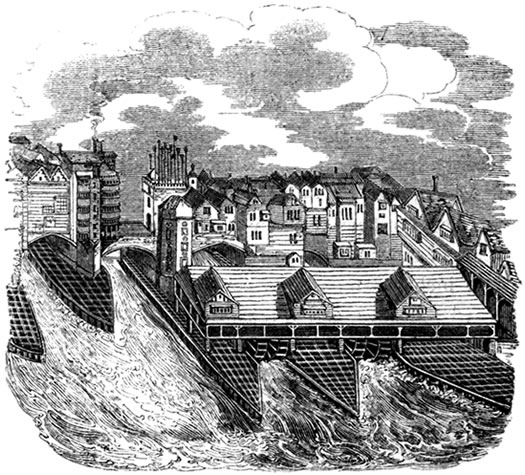
“Now, Mr. Barnaby, as this building stands out so far from the Bridge itself as to leave a considerable space between them, though enclosed on all sides, a sort of water-square open at the top, it appears to me an evident proof that it represents those very Mills. In the roof of the building are three sets of windows; and an open stage, or floor, appears a short distance below it. At the North end, also, of this most interesting prospect, against the first sterling, is a high square building, like a tower, having a low wooden gallery in front of it; and a single water-wheel turning beneath it; which are, most probably, intended for the Waterworks and Tower at London Bridge.
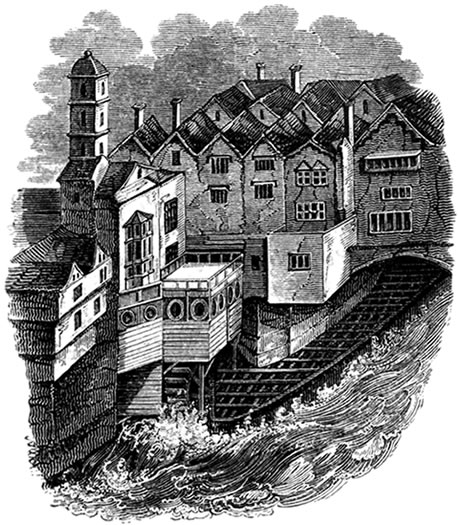
“With regard to the other principal features of the Pepysian view, I shall remark to you only, that the Western side of the Nonesuch House is delineated in the richest and most delicate manner, all its carvings and columns being minutely drawn and touched with gold; whilst a whole grove of heads and quarters raised upon staves stands upon the top of the Traitors’ Gate beyond it; and so much then for a brief description of this ancient prospect of London Bridge.”
“I am much your debtor, most worthy Master Geoffrey,” said Mr. Postern, as I concluded, “I, truly, am greatly your debtor, for these curious notices of a view, at once so rare, so interesting, and so antique: and, touching the Water-house, or Tower, to which you have alluded, although we have not any certain information of the time when it was erected, yet from the circumstance of its appearing with a name in John Norden’s very scarce view of London Bridge, which I shall presently mention, it may be supposed to have been set up in the time of Elizabeth, and was, perhaps, as old as the Water-works themselves. In the first edition of Stow’s ‘Survey,’ by Strype, London, 1720, volume i., book ii., page 174, there is a passage relating to the Water-house, which does not appear either in the original edition of 1598, nor in the last ancient one of 1633; and therefore may be very justly supposed to refer to the wooden building erected after the Great Fire; when it will most properly be noticed.
“I must here again refer to the Account-rolls of the Bridge Keepers, for the memoranda of some past years’ revenues and expenditure, to inform you that in the year 1562 the rental was £1071. 6s. The salaries, and allowance for horsekeeping, to William Draper and Robert Essington, the Wardens, were the same as those paid in 1556; but the liveries were increased to £3. 6s. 8d. each. The whole amount for the year being £64. In 1565,—says the same authority,—the allowance to each Bridge-Master for fees, livery, &c. was £33.: and the rental of the estates amounted to £1168. 8s. 5½d.: while in 1590, the Bridge rental was £1369. 7s. 2d.; and Robert Aske and James Conneld, the Wardens, paid the two Bridge-Masters for their Year’s fee, £50. each, with £3. each for their horses and liveries; making the whole charge £106.
“In the year 1591, a most singular instance of drought occurred in the vicinity of our history, as you may read in Stow’s ‘Annals,’ page 765, where he states, that on ‘Wednesday, the sixth of September, the wind West-and-by-South, as it had beene for the space of two days before, very boysterous, the riuer of Thamis was so voyd of water, by forcing out the fresh and keeping backe the sault, that men in diuers places might goe 200 paces ouer, and then fling a stone to the land. A Collier, on a mare, rode from the North side to the South, and backe againe, on either side of London Bridge, but not without danger of drowning both wayes.’
“The year 1594 was particularly remarkable for a dearth of corn, occasioned, as Stow tells us, it was supposed,—see his ‘Annals,’ page 769,—by the English Merchants having exported it too largely. The summer had been extremely wet; for not only much rain fell in May; but, in the following two months, it commonly rained every day, or night, until the 25th of July, the Feast of St. James, and two days after, without intermission. Notwithstanding these floods a fair harvest followed in August, but the price of grain rose to 5s. for a bushel of Rye, whilst Wheat was sold from 6s. to 8s. the bushel, and increased even still higher. In consequence of this, Sir John Spencer, the Lord Mayor, procured it to be ordered, that the several Companies of the City should presently provide themselves with certain proportions of wheat and rye, to be laid up in the public granaries at the Bridge House. In December, however, the greatest part of their stores was yet wanting, and the Lord Mayor, therefore, issued a new order on the 13th of that month, directing that the whole quantity should be laid up in the Bridge-House before the 8th of the ensuing January; since corn was then being imported into England. At this period, Elizabeth was, most probably, preparing those twenty-six vessels, which she despatched, the following year, to Spanish America, under Sir John Hawkins; since, in his capacity of Treasurer of the Navy, he demanded of the Lord Mayor the Bridge-House, granaries, ovens, &c. for the use of the Queen’s Navy, and baking biscuits for the fleet. Cecil, Lord Burleigh, who was then Lord Treasurer, being a great patron and protector of the City; to him the Lord Mayor addressed a remonstrance against Sir John Hawkins, stating all the foregoing circumstances, that the City would be deprived of its provision, if he lent the granaries; that the Companies would neglect to lay up the corn they were enjoined to do, and that grain must either be bought from the Badgers, or Meal-sellers, or else the Merchants be discouraged from importing any more. He added also, that the ovens in the Bridge-House were required for baking bread for the City poor, at reduced rates; and he concluded by representing that the Queen had not only granaries about Tower Hill, Whitehall, and Westminster, but that Winchester House was also in her possession, in which large quantities of corn might be deposited. This honest and spirited conduct of the Lord Mayor produced, on the part of Admiral Hawkins, the reply ‘that he should hear more to his further dislike,’ as well as some letters from the Privy Council in censure of his proceedings. Upon which he again addressed the Lord Treasurer, entreated his favour and protection, and petitioned that the granaries might still be employed for the use of the City, lest the dearth of corn should yet increase, or the poor of London should be distressed for provision: adding that, as the City was then unprovided, his Lordship would hold him excused from resigning the Bridge House, and submitting himself to his good pleasure. With these answers, Hawkins was probably forced to be content, as we meet with no farther correspondence upon this subject.
“With these particulars, then, terminate our annals of London Bridge for the sixteenth century; but before we pass on to the opening of the following one, let me mention to you the views of this edifice which we possess, illustrative of the period we have now arrived at, and give you a general idea of its appearance, whilst it yet remained in its greatest state of splendour.
“One of the most ancient representations of London Bridge is contained in that painting of the procession of King Edward VI. from the Tower, to his Coronation at Westminster, February the 19th, 1547; the original of which was executed to decorate a part of the Great Dining Room of Cowdray Hall, Sussex, the seat of Viscount Montague, where it was destroyed by fire in 1793. An engraving of this interesting picture was, however, published by the Society of Antiquaries in May, 1797; and the Bridge is there represented at the left hand of the engraving, containing four or five buildings erected on the side, in the centre of which rises a spire, perhaps meant for the Chapel of St. Thomas; and at the Southern end appears the gate. This, however, is but an oblique view, and by no means to be depended upon for its accuracy; though, at the same time, the plate contains numerous other interesting features of antiquity, which render it invaluable to all the admirers of London in the olden times. The next most ancient prints of this edifice are those maps and plans of London which include the Bridge; such as that contained in the ‘Civitates Orbis Terrarum,’ by George Braun and Francis Hohenberg, volume i., Cologne, 1523, folio, signature A:—the famous map of Radulphus Aggas, published about 1588; and some others of less note, of which you have a tolerably accurate account in Richard Gough’s ‘British Topography,’ volume i., pages 743-760. These plans, however, although exceedingly interesting, are, from their great extent, less pleasing than a view, as it regards particulars; for the buildings are sometimes so rudely and minutely sketched, as to convey no perfect idea to the minds of such as desire to contemplate old London in all its original quaintness and antique beauty.
“But, perhaps, the rarest and most curious prospect of London Bridge in the reign of Elizabeth, is that engraven by John Norden, of which an impression rests in Mrs. Sutherland’s sumptuously-illustrated copy of Lord Clarendon’s History of the Rebellion, in 31 volumes imperial folio, comprising 5800 prints and original drawings. Norden, you will recollect, was Surveyor to Henry, Prince of Wales, and died about 1626; and his view of London Bridge was, most probably, published two years before, for, though it is without date, it bears the arms of, and is dedicated to, Sir John Gore, Lord Mayor in 1624. The dedication states, however, that Norden had ‘described it in the time of Queene Elizabeth, but that the plate had bene neare these 20 yeares imbezeled and detained by a person till of late vnknowne.’ The view of the Bridge is taken from the Eastern side, and the edifice is represented horizontally, from South to North; though it is singularly enough stated to be from East to West: it measures 20½ inches by 105⁄8, and is engraved in a border surmounted by the arms and supporters of James I., having its name written upon a scroll. At each end of the print is a naked boy flying; the one bearing a shield with the City Arms, and the other those of the person to whom it is dedicated. With respect to the Bridge itself, it is filled with buildings, in which the Traitors’ Gate with the heads, the Nonesuch House, and the Chapel of St. Thomas, are particularly visible; whilst above the houses, at the North end, is seen the top of ‘The Water Worke.’ From the windows of several of the houses, buckets are being let down by long ropes into the water, which is seen rushing through the arches with great impetuosity, although there is no fall. On the right appears a boat overturned, its oars floating about, one man drowning, and two others being saved by another boat; whilst two or three more vessels, &c. are seen in different parts of the picture. Along the lower part of the water are engraven the words ‘Tame Isis Flvvius vulgo Temms;’ and below the print are the Dedication, and ‘The description of London Bridge,’ in letter-press in three columns, surrounded by a border of metal flowers, and signed John Norden. As this account is, of course, very short, and is chiefly taken from Stow, it gives us but little information; though, perhaps, the concluding paragraphs may not be unworthy of your attention.—‘It were superfluous to relate vnto such as well know, and duely do consider the forme and beauty of this famous Bridge: but to intimate it to the apprehension of strangers, I haue deliniated the same to the eye, how it is adorned with sumptuous buildings, and statelie and beautifull houses on either side, inhabited by wealthy Citizens, and furnished with all manner of trades, comparable in it selfe to a little Citie, whose buildings are so artificially contriued, and so firmely combined, as it seemeth more than an ordinary streete, for it is as one continuall vaute or roofe, except certaine voyde places, reserued from buildings, for the retire of passengers from the danger of carres, carts, and droues of cattell, vsually passing that way. This description representeth vnto the eye the true forme of this famous pyle, as neare as arte—in this kinde of deliniation,—can be demonstrated: the number and forme of euery arch, and all the buildings; their true height, breadth, and distance of euery particular, from the East towards the West: as for the other side it like wise appeareth in my prospectiue description of the Citie; the vaults, sellers, and places in the bowels as it were of the same Bridge,—which are many and admirable,—excepted, which arte cannot discouer to the outward view. The situation, arte, and workmanship, in and about the Bridge, are affirmed by obseruing trauailers in all respects to exceede all the Bridges of the world. And, therefore, I thought it fit to represent it to the view of the world, that it may know, that if one part of this Citie be so famous, how much more the whole: which, for state and Christian gouernment, may well challenge place before any Citie in Christendome. And therefore I present vnto you this simple modell of one of the wonders of the world.’ So concludes the descriptive eulogy of Master Norden. And now, Sir, having mentioned to you the great rarity of this print of London Bridge, and that if another impression of it were to appear, it would probably produce the respectable price of ten, or fifteen guineas; I must add that there has been an excellent fac-simile of it published by Mr. William Scott, of Great May’s Buildings, St. Martin’s Lane, for the more moderate sum of 10s. 6d., which no genuine lover of London, or London Bridge, should hesitate to procure.
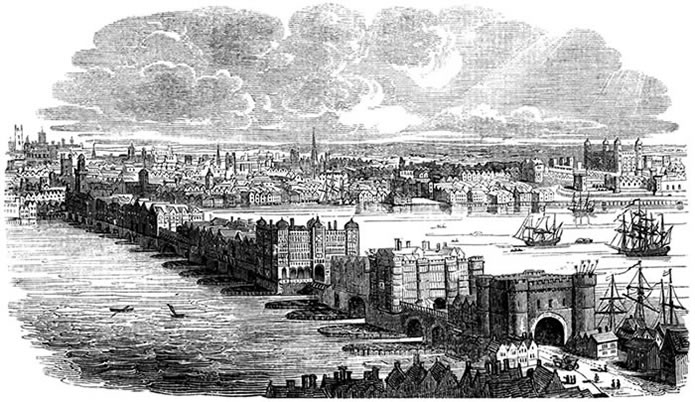
“The last view of this edifice which I shall at present notice to you, is one copied by Thomas Wood, Engraved by J. Pye, and dedicated to Brass Crosby, Esq., Lord Mayor, the Aldermen, and Common Council of the City of London; and it represents the ‘South View of the said City and part of Southwarke, as it appeared about the year 1599.’ I am half inclined to believe, however, that this prospect is made up from Hollar’s View, published in 1657; as it is certainly taken from the same point. The Bridge rises obliquely on the right hand: at the South end of it appears the Southwark Gate, and beyond it is placed the rich tower which I have already described to you; whilst a series of buildings, forming two distinct groups, with spaces between them, finish the picture, which has the old Church of St. Magnus for its Northern boundary. Even at this period, probably, some of the Arches of London Bridge had received those names by which they were so long afterwards known, though they were first inserted in Stow’s ‘Survey,’ by Richard Bloome, one of the last of his Continuators before Strype; but his account of these locks I shall speak of in the next century, and I will now only observe that such were the features of London Bridge in the Year 1599.
“‘Thanks be praised!’ Master Barnaby,” said I, as my indefatigable historian arrived at this period, “‘thanks be praised!’ as the Countryman says in the Play, ‘I thought we would never ha’ got hither, for we’ve had a power of crosses upo’ the road.’ If you do not make the better speed through the next two centuries, mine honest friend, you will scarcely allow me time to conclude your narrative by a brief account of the New Bridge, and the grand ceremonial of its foundation: here’s your health, however, and if contributing to one’s repose, be a praiseworthy action, why, truly, I’m much your debtor, good Mr. Postern.”
“Rest you merry, Sir,” replied he of the sack tankard; “I see that you’re one of the humourists of Old London; and, methinks, you ought to be somewhat grateful to me for furnishing you with occasion to be witty; but, to speak more seriously, I pray you to recollect that I have conducted you through a period of more than six hundred years, and that too in a history of which the materials are to be sought for, and extracted, from a vast multitude of very opposite sources. And even when we have found them, you know, my good Mr. Barbican, that they resemble those grains of gold which the wandering Bohemians recover from the sand; of little or no value till collected into a mass, and even then surprising by their insignificance. Surely, he is to be pitied, who becomes the historian of a subject equally ancient, interesting, hopeless, and unknown.”
“A very good reason,” answered I, “for not becoming one at all, Master Barnaby; Odzooks! do men write your thick folios, only because they know nothing of the matter? But you have no such excuse, for you quote me a dozen authors to tell of one event; and then there’s such ‘fending and proving’ about a handful of years, that where subjects are lacking, ’fore George! you seem to me to create them.”
“Well, Sir, well,” resumed the mild old man, “your wit becomes you; but as we may never meet again, I would fain pour into your bosom all the little knowledge which I possess upon this point; and so we will pass on to the Chronicles of London Bridge in the seventeenth century.
“The inhuman cruelties which Queen Mary, Bishop Bonner, and others of their faith, practised upon the Protestants, may reasonably be supposed to have so embittered their minds, as to have excited in them no slight feelings of revenge, when, in their turn, they came into power. Indeed, it is difficult to imagine any other cause for the severities which they practised, or for the laws which were enacted to authorise them. The principal of these Statutes, you may remember, were five: one in the 27th of Elizabeth, 1585, chapter ii., entitled ‘An Act against Jesuits, Seminary Priests, and other such like disobedient persons;’ and a second passed in her 35th year, 1593, chapter ii., and called ‘An Act for restraining Popish Recusants to some certain place of abode.’ Under King James I., were introduced three others strengthening and confirming the former, the first of which was made in the 1st year of his reign, 1604, chapter iv., being ‘An Act for the due execution of the Statutes against Jesuits, Seminary Priests, Recusants, &c.’: and in his third year, 1606, were passed two others, see chapters iv. and v., namely, ‘An Act for the better discovering and repressing of Popish Recusants;’ and ‘An Act to prevent and avoid dangers which grow by Popish Recusants.’ History, Master Barbican, blushes to record what cruelties were perpetrated under the sanction of those laws; and I should have omitted all notice of them, but that they are so interwoven with several anecdotes of London Bridge. My authority is a work, entitled ‘The Catholic Book of Martyrs, or a true British Martyrology commencing with the Reformation;’ by the Right Rev. Richard Challoner, Bishop of Debora; of which the new edition of 1825 is a singularly curious book. He states from Stow, in volume ii., page 9, that in 1578, February 3rd, John Nelson, a Priest, was executed at Tyburn, for denying the Queen’s supremacy, and that his head was erected on London Bridge; whilst, on page 74, is a similar relation of another Priest named James Fenn; but I proceed to notice a much more remarkable instance. In the year 1605, Father Henry Garnet, the Principal of the English Jesuits, was taken up and imprisoned in the Tower, for being a party concerned in the famous Gunpowder Plot: after many examinations, he acknowledged that Father Greenway, a Jesuit, had communicated it to him under the seal of confession from Catesby, the Chief of the conspirators. Both the Priests were struck with horror at the design, and vainly endeavoured to prevent its execution. Greenway fled beyond the seas, but Father Garnet was taken, condemned, and executed in St. Paul’s Church Yard, on the 3rd of May, the Anniversary of the Invention, or Finding of the Holy Cross by the Empress Helena, the Mother of Constantine. ‘His head,’ says Bishop Challoner, in his ‘Catholic Book of Martyrs,’ volume iii., page ii., ‘was fixed on London Bridge, and it was much remarked, that his countenance, which was always venerable, retained, for above twenty days, the same lively colour which it had during life, which drew all London to the spectacle, and was interpreted as a testimony of his innocence; as was also an image of him wonderfully formed on an ear of straw, on which a drop of his blood had fallen.’ Dr. Challoner gives his authorities for this narrative at its commencement.
“But to pass from these unhappy subjects to the story of London Bridge, and the River Thames, let me next observe that the year 1608 was remarkable for a great frost near this edifice, of which we have a very curious account in Edmond Howe’s ‘Continuation of the Abridgement of Stow’s English Chronicle,’ London, 1611, duodecimo, page 481; from which take the following extract. ‘The 8th of December began a hard frost, and continued vntill the 15th of the same, and then thawed: and the 22nd of December it began againe to freeze violently, so as diuers persons went halfe way ouer the Thames vpon the ice: and the 30th of December, at euery ebbe, many people went quite ouer the Thames in diuers places, and so continued from that day vntill the third of January: the people passed daily betweene London and the Bankside at euery halfe ebbe, for the floud remoued the ice and forced the people daily to tread new paths, except onely betweene Lambeth and the ferry at Westminster, the which, by incessant treading, became very firm and free passage, vntill the great thaw: and from Sunday, the tenth of January, vntill the fifteenth of the same, the frost grew so extreme, as the ice became firme, and remoued not, and then all sorts of men, women, and children, went boldly upon the ice in most parts; some shot at prickes, others bowled and danced, with other variable pastimes; by reason of which concourse of people, there were many that set vp boothes and standings vpon the ice, as fruit-sellers, victuallers, that sold beere and wine, shoomakers, and a barber’s tent, &c.’ He adds, that all these had fires; that the frost killed all the artichokes in the gardens about London; and that the ice lasted until the afternoon of the 2nd of February, when ‘it was quite dissolued and clean gon.’ There is a very rare tract, containing an account of this frost, mentioned by Gough in his ‘British Topography,’ volume i., page 731, which has a wood-cut representation of it, with London Bridge in the distance: and is entitled ‘Cold doings in London, except it be at the Lottery: with newes out of the Country. A familier talk, between a Countryman and a Citizen, touching this terrible Frost, and the Great Lottery, and the effect of them.’ London, 1608, quarto. I may observe that the Lottery was then drawn at St. Paul’s, the prizes were all of plate, the highest being £150, and the price of each ticket was one shilling only. The same year of 1608 was also memorable for two tides flowing at London Bridge, on Sunday, the 19th of February. Edmond Howes records it in his Continuation of Stow’s ‘Annals,’ page 893, and states that ‘when it should haue beene dead low water at London Bridge, quite contrary to course it was then high water; and, presently, it ebbed almost halfe an houre, the quantitie of a foote, and then sodainly it flowed againe almost two foote higher than it did before, and then ebbed againe vntill it came neere the right course, so as the next floud began, in a manner, as it should, and kept his due course in all respects as if there had beene no shifting, nor alteration of tydes. All this happened before twelue of the clocke in the forenoone, the weather being indifferent calme; and the sixt of February, the next yeere following, the Thames againe shifted tydes very strangely.’
“We know not, Mr. Barbican, at what exact period London Bridge was first occupied by shops, but in the Survey of Bridge-lands which I have already repeated to you, it appears very probable that some of the shops in the Bridge Street were actually erected on the Bridge. Houses with distinguishing signs, however, must have been built upon this edifice at a very early period; for the first notice of one, which I can now recollect, is in the fire which brake out at the Pannier, at the North end of the Bridge in 1504; whilst the next is not older than 1619, and occurs in a letter written October the 6th, by George Herbert, the pious author of the ‘Temple,’ and printed at the end of Izaak Walton’s ‘Lives,’ fourth edition, London, 1675, 8vo., page 340. ‘I pray, Sir, therefore,’—says this epistle,—‘cause this inclosed to be carried to his brother’s house,’—Sir Francis Nethersole,—‘of his own name, as I think, at the sign of the Pedlar and his Pack on London Bridge, for there he assigns me.’ Norden, as I have already shewn you, says that this place was ‘furnished with all manner of trades;’ and as this is rather a curious, though an unexplored portion of Bridge story, I shall at once lay before you all the information which I have collected upon it, under the present period of time, since it is infinitely too small to be divided into different years. The principal ancient residences of the London Booksellers were, St. Paul’s Church Yard, Little Britain, Paternoster Row, and London Bridge; and of books published at the latter place let me first exhibit to you some titles, taken from that vast collection, which John Bagford made for a General History of Printing, preserved with the Harleian Manuscripts in the British Museum. The ensuing are from No. 5921, pages 5 b, 6 a, 7 a, and 9 b,
“‘The Merchandises of Popish Priests; or, a Discouery of the Jesuites Trumpery, newly packed in England. Laying open to the world how cunningly they cheate and abuse people with their false, deceitfull, and counterfeit wares. Written in French, by John Chassanion, and truly translated into English. Printed at London, for Henry Gosson, and are to be sold at his Shop on London Bridge. 1629.’ Small quarto. Above the imprint is a rude wood-cut of a corded bale, labelled with the words ‘A Packe of Popish Trinkets,’ and exhibiting a crucifix, rosary, bell, book, taper, a chalice signed with the cross, and an Aspergillum for scattering holy-water.—‘The Wise Merchant, or the Peerless Pearl; set forth in some meditations, delivered in two Sermons upon Matth. xiii. 45, 46. By Thomas Calvert. London. Printed by H. Bell, for Charles Tyns, dwelling at the Three Bibles on London Bridge. 1660.’ octavo.—‘The Seaman’s Kalender: By Henry Phillippes, Philo-Nauticus. London. Printed by W. G., for Benjamin Hurlock, and are to be sold at his shop over-against St. Magnus Church, on London Bridge, near Thames Street. 1672.’ small quarto.—‘England’s Grievances, in times of Popery. London. Printed for Joseph Collyer, and Stephen Foster, and are to be sold at the Angel on London Bridge, a little below the Gate, 1679.’ small quarto.—‘The Saints’ Triumph; or, the Glory of Saints with Jesus Christ. Discoursed in a Divine Ejaculation; by J(ohn) B(unyan). Printed by J. Millet for J. Blare, at the looking Glass on London Bridge. 1688.’ small quarto. A rude, but characteristical wood-cut portrait of Bunyan is indented in the margin of this title-page. We also find one Hugh Astley living ‘at St. Magnus corner,’ in 1607; and, in 1677, R. Northcott kept ‘the Marriner and Anchor upon Fish-street Hill, near London Bridge.’”
“Whilst you are speaking of the Booksellers and Tradesmen who lived on old London Bridge, Mr. Postern,” observed I, as he came to a period, “let me add to your account some other circumstances which, at various times, and from different sources, I have collected illustrative of that subject. The sign of ‘the Three Bibles’ seems to have been a very favourite device upon that edifice, and, most probably, continued so until the houses were removed; for we trace it into the eighteenth century, at which time there were two shops so denominated; and one of them also appears to have been famous for the sale of a Patent Medicine, as you will find from the following particulars communicated to me by Mr. John Thomas Smith, Keeper of the Prints and Drawings in the British Museum. ‘The Mariner’s Jewel; or, a Pocket Companion for the Ingenious. By James Love, Mathematician. The sixth edition, corrected and enlarged. London. Printed for H. and J. Tracy, at the Three Bibles on London Bridge. 1724.’ duodecimo. At the end of the volume bearing this title, is an advertisement of a medicine, called ‘The Balsam of Chili,’ which is succeeded by the following curious note. ‘All persons are desired to beware of a pretended Balsam of Chili, which, for about these seven years last past, hath been sold, and continues to be sold, by Mr. John Stuart, at the Old Three Bibles, as he calls his sign, although mine was the sign of the Three Bibles twenty years before his. This pretended Balsam sold by Mr. Stuart, resembles the true Balsam in colour, and is put up in the same bottles; but has been found to differ exceedingly from the true sort by several persons, who, through the carelessness of the buyers intrusted, have gone to the wrong place. Therefore all persons who send, should give strict order to enquire for the name Tracy; for Mr. Stuart’s being the very same sign, it is an easy matter to mistake. All other pretended Balsams of Chili, sold elsewhere, are shams and impositions; which may not only be ineffectual, but prove of worse consequence. The right sort is to be had of H. Tracy, at the Three Bibles on London Bridge, at 1s. 6d. a bottle, where it hath been sold these forty years.’ There also appear to have been two Booksellers’ shops known by the sign of ‘the Looking Glass on London Bridge;’ for you have already mentioned that ‘the Life and Death of John Overs’ was printed for T. Harris at such a sign, in 1744; and at the very same time, as well as earlier, one T. Hodges was an extensive publisher of popular books, ‘at the Looking Glass on London Bridge over against St. Magnus Church,’ as you will find in the title-pages to a multitude of small volumes of that period. One of the little tracts to which his name appears, is ‘The whole Life and merry exploits of bold Robin Hood, Earl of Huntingdon,’ 1737. duodecimo; and we also read the name of S. Crowder and Company, London Bridge, attached to ‘The Delightful, Princely, and Entertaining History of the Gentle Craft; adorn’d with Pictures suitable to each story.’ 1760. duodecimo. I could easily, Mr. Postern, increase this list of books published on London Bridge, from the advertisements which continually appeared in the columns of ‘The Daily Post,’—‘The Daily Courant,’ and other Newspapers of the early part of the last century, but I rather wish to point out to you the names and signs of some other persons dwelling in the same place; for it seems to have been occupied by a variety of trades. Thus, in 1722, we have John Body, Silversmith, at the White Horse on London Bridge;—Hotham, Bookseller, at the Black Boy; and E. Herne, Milliner, at the Dolphin and Comb. The shop-bills of these tradesmen, however, from whence we generally derive this kind of information, are so exceedingly rare, that after a very careful search through that extensive collection belonging to the late Miss Banks, now preserved in the Print Room of the British Museum, I have found only one! although the Portfolios contain many thousands. But what I there sought for in vain, has been supplied to me from two private sources; for Henry Smedley, Esq., of Whitehall, and Mr. William Upcott, of the London Institution, are in possession of impressions of several, of which they have kindly permitted me to take the following copies.