DESCRIPTIVE LIST OF THE EMBELLISHMENTS. (continued 2)
Reading edition
“‘Henry, King of England, to Ralph, Bishop of Chichester, and all the Officers of Sussex, sendeth greeting. Know ye, &c. I command by my kingly authority, that the manor called Alceston, which my father gave with other lands to the Abbey of Battle, be free and quiet from shires and hundreds, and all other customs of earthly servitude, as my father held the same, most freely and quietly; and namely, from the work of London Bridge, and the work of the Castle at Pevensey: and this I command upon my forfeiture. Witness, William Pont de l’Arche, at Berry.’
“The second year of the succeeding King, however, namely Stephen, saw London Bridge in a state to require the exertions of all England to raise it: for, in 1136, a fire broke out in the dwelling of one Aileward, near London Stone, that consumed Eastward as far as Aldgate; and to the Shrine of St. Erkenwald, in St. Paul’s Cathedral, to the West. On the Southern side of London the Wooden Bridge over the Thames was destroyed, but was soon after repaired, since Stephanides, whose description of London was written between 1170 and 1182, speaks of it as affording a convenient standing place to the spectators of the Citizens’ Water Tournaments. I shall give you the whole passage, because it describes a very curious sport of the twelfth century, which was celebrated in the immediate vicinity of this very spot; and the account is at page 76, beginning ‘In feriis Paschalibus;’ we’ll content ourselves, however, with Dr. Pegge’s translation of it, which runs thus.
“‘At Easter, the diversion is prosecuted on the water; a target is strongly fastened to a trunk or mast, fixed in the middle of the River, and a youngster standing upright in the stern of a boat, made to move as fast as the oars and current can carry it, is to strike the target with his lance; and if in hitting it he break his lance, and keep his place in the boat, he gains his point, and triumphs; but if it happen that the lance be not shivered by the force of the blow, he is of course tumbled into the water, and away goes his vessel without him. However, a couple of boats full of young men is placed, one on each side of the target, so as to be ready to take up the unsuccessful adventurer, the moment he emerges from the stream, and comes fairly to the surface. The Bridge, and the balconies on the banks, are filled with spectators, whose business it is to laugh.’
“Of this singular sport, Joseph Strutt copied in his ‘Sports and Pastimes of the People of England,’ London, 1801, 4to. page 92, plate x. a very curious illumination, contained in a volume of the Royal Manuscripts in the British Museum,—2 B. vii.—which consists of a history of the Old Testament, the Psalter, the Hymns of the Church, and a Calendar; all richly painted in water-colours, and beautified with gold,—‘yellow, glittering, precious gold,’—so highly embossed, as to be ‘sensible to feeling as to sight.’
“That volume brings back old days to my recollection, whenever I behold it; for, in the year 1553, it belonged to Queen Mary of England, and is bound in a truly regal style for her; being in thick boards covered with crimson velvet, richly embroidered with large flowers in coloured silks and gold twist; besides being garnished with gilt brass bosses and clasps, on the latter of which are engraven the Royal devices and supporters. Another, and more pleasing proof of its having been her’s,—inasmuch as it records a good action of a London Citizen concerned with the affairs of this brave river,—is to be found in a Latin note written in a beautiful black text hand, on the reverse of the last leaf of the volume. ‘This Book,’ it states, ‘formerly a gift, was afterwards carried away by a sailor; but that excellent and honest person, Baldwin Smith, Receiver of the Customs of the Port of London, hath restored and given it unto the most illustrious Mary, Queen of England, France, and Ireland, in the month of October, in the year of our Lord, 1553, in the first year of her reign.’ The text of this volume is said to have been written, and the illuminations executed, in the fourteenth century, though, from their style, I cannot help thinking that the period is nearly an hundred years too late; for beneath the pages of the Psalter is a series of most interesting and excellent drawings, in pen-and-ink outlines, very slightly and delicately tinted with colours, which was certainly a far more ancient custom. However that may be, this series consists ‘de omnibus rebus, et quibusdam aliis,’ for there are the representations of animals and birds, field-sports, games, legends, martyrdoms, battles, and fables, of an almost infinite variety; and in the course of them occur the figures of a water-quintain, both as it is described by Fitzstephen, and also of a more warlike character. The first of these was engraved by Strutt in the work which I have before referred to, and gives a very perfect idea of the River Tilting of the Twelfth Century,
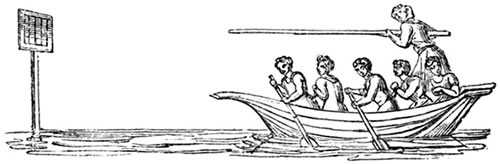
which the illuminator had, no doubt, personally witnessed in his own time. The other, which has also been engraven in the same work, page 113, plate xv. shews two armed knights getting ‘grysly together,’ as the ‘Morte d’Arthur’ calls it, in boats;
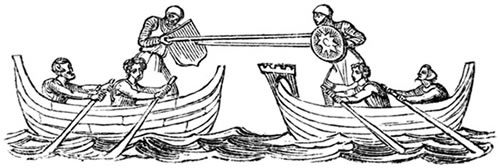
and you will find it under the 60th Psalm, ‘Dominus repulisti nos,’ &c.
“Stow, in his ‘Survey,’ volume i. page 301, mentions a very rude imitation of this kind of jousting on the water at London; when he says, ‘I have seen also in the summer season, upon the River of Thames, some rowed in wherries, with staves in their hands, flat at the fore-end, running one against another, and, for the most part, one or both of them were overthrown and well ducked.’ In Queen Mary’s Manuscript, under the psalm of ‘Misericordiam et judicium cantabo,’ is also a representation of two fiends hurling a Monk from a rude stone Bridge; but as I rather think that did not occur at London, I mention it no farther.
“But now, to return to our subject:—Stow relates the particulars of the great fire of 1135-36, at page 58 of his ‘Survey,’ citing in the margin the ‘Annals of Bermondsey,’ and the ‘Book of Trinity Priory,’ as his authorities. The latter of these is, perhaps, now no more; but in the former you may find the conflagration mentioned at page 13 b, where it is said to have happened in the year 1135, and to have extended to the Church of St. Clement Danes. It was probably in the Register of Trinity Priory, that Stow found a notice that London Bridge was not only repaired, but a new one erected of elm timber, in 1163, by the most excellent Peter of Colechurch, Priest and Chaplain; since I find it in none of the historians with whom I am acquainted. It is, however, much better authenticated that the same pious architect began his labours upon the first stone one in 1176; for, in the ‘Annals of Waverley,’ at page 161, you find the following entry.—‘1176. In this year, the Stone Bridge at London is begun by Peter, the Chaplain of Colechurch.’ Here, therefore, ends the history of the infancy of London Bridge: and a very chargeful infancy it was, for, as old Stow says, ‘it was maintained partly by the proper lands thereof, partly by the liberality of divers persons, and partly by taxations in divers shires, as I have proved, for the space of 215 years,’—And now, Mr. Geoffrey Barbican, your very good health.”
“Sir, my hearty thanks to you,” replied I, rubbing my eyes, “for this Bridge Story is as dull as proving a Peerage, where there’s no reliance, and much doubting:—but how’s this, Master Postern!” continued I, looking into the tankard, “you have drank, and I have drank, and yet the jug is as full as ever, and as hot as it was as first?”
“You’re pleased to be facetious, good Sir,” answered my visitor, “for truly I’m no Saint Richard to work such miracles; but, if you please, we’ll now return to the Bridge again.
“We are here entering upon the golden age of London Bridge, for the new stone building, by Peter of Colechurch, was such an ornament as the Thames had never before witnessed; indeed, in my poor judgment, it very far surpassed that erection, of which I shall hereafter have occasion to speak; and perhaps, for its time, even that which now stretches itself across the flood. The person to whom was entrusted the building of the first stone Bridge at London, was, as I have already told you, named Peter, a Priest and Chaplain of St. Mary Colechurch; an edifice, which, until the Great Fire of London, stood on the North side of the Poultry, at the South end of a turning denominated Conyhoop Lane, from a Poulterer’s shop having the sign of three Conies hanging over it. This Chapel, of which the skilful Peter was Curate, was dedicated to the Blessed Virgin, and was famous as the place where St. Edmund and St. Thomas à Beckett were presented at the baptismal Font; still it must have been something very like having a church on a first floor, for you may remember Stow says, in his ‘Survey,’ volume i. page 552, that it was ‘built upon a vault above ground, so that men are forced to ascend into it by certain steps.’ Of the architectural knowledge of the Curate thereof, I have already shewed you that the Citizens of London had experienced some proofs, since he is said to have rebuilt their last wooden Bridge: and John Leland the Antiquary—whom I shall anon quote more particularly,—observes, in the notes to his famous ‘Song of the Swan,’—a book of which I will also speak hereafter,—that Radulphus de Diceto, Dean of London, who wrote about 1210, states from his own knowledge, that he was a native of this City. The same venerable Antiquary also tells us in his ‘Itinerary,’ edited by Thomas Hearne, Oxford, 1768-69, octavo, volume vii. part I. marginal folio 22, page 12,—that ‘a Mason beinge Master of the Bridge Howse, buildyd à fundamentis the Chapell on London Bridge, à fundamentis propriis impensis;’ or, as we should now say, from bottom to top, at his own costs and charges. The property of Peter of Colechurch, however, would not stand Bridge-building by itself; and therefore the present will be the most fitting place, to give you some account of the other contributors to this great national work.
“Master Leland, in the same place which I last quoted, observes that ‘a Cardinale, and Archepisshope of Cantorbyri, gave 1000 Markes or li. to the erectynge of London Bridge.’ Now, the Cardinal who is here alluded to, was Hugo, Hugocio, or Huguzen di Petraleone, a Roman, Cardinal Deacon of St. Angelo, whom Pope Alexander III. sent, in 1176, to France, Scotland, and England, as his Legate; which you may find stated in Alphonso Ciaconio’s noble book entitled ‘Vitæ et Res Gestæ Pontificum Romanorum, et Sanctæ Romanæ Ecclesiæ Cardinalium,’ Rome, printed with the Vatican types, in 1630, folio, page 578, a work of about 3000 pages in extent; of an enormous size, fairly bound in embossed vellum, and adorned with a prodigious number of copper-plates and wood-cut Armorial Ensigns; by the latter of which we are shewn, that this foreign contributor to the building of London Bridge bore for his arms, Quarterly, Argent and Gules, and over all, in the centre point, a sieve of the first. Whilst the Cardinal resided in England, he took some notice of the dispute which was then going on concerning the Primacy, between the Archbishops of Canterbury and York: when at a meeting held at Westminster, Roger de Ponte, the turbulent possessor of the latter see, arrogantly took his seat at the Cardinal’s right hand. Upon which the domestics of Richard, the mild and amiable Archbishop of Canterbury, took him thence by force, and in the ensuing scuffle he was beaten, and turned out of the assembly, with his episcopal robes sadly rent. Now this Richard was a Benedictine Monk, and Prior of the Monastery of St. Martin’s, Dover; who was elected to the See of Canterbury on the death of Thomas à Beckett, in 1174. ‘He was a man,’ says Bishop Godwin, when writing his memoirs, ‘very liberal, gentle, and passing wise;’ and, what gives him great honour in my sight, he was the very Prelate whom Leland mentions in the passage I quoted, as subscribing so nobly to the foundation of London Bridge. And yet, ’tis strange, that only in his ‘Itinerary,’ and in Stow’s ‘Survey,’ volume i. page 58, is this donation recorded; for even in the best and most splendid edition of Bishop Godwin’s volume, ‘De Præsulibus Angliæ Commentarius,’ by William Richardson, Canon of Lincoln, Cambridge, 1743, folio, page 79, the old Citizen is referred to at note y, as his authority for the fact. I cannot omit now giving you the blazon of this Prelate’s own arms, as they appear in that noble illuminated copy of Archbishop Parker’s work, ‘De Antiquitate et Privilegiis Ecclesiæ Cantuariensis cum Archiepiscopis ejusdem 70,’ Lambeth, 1572, folio, page 123, which is estimated to be fully worth its weight in gold. This truly valuable volume was presented by our late good King George the Third to the British Museum, and formerly belonged to Queen Elizabeth. The arms, however, were Azure, three Mullets in bend, between two Cottises Argent; and whenever you turn to this volume, on which the ancient Art of Illuminating shed its latest rays, I pray you fail not carefully to inspect it: for you will find it a copy of that edition printed at his own palace, by John Day; with many leaves impressed on vellum, and the whole of the book carefully ruled with red-ink lines, the initials coloured and gilded, and all the Armorial Ensigns, with the Frontispiece, excellently well emblazoned. And I pray you also, forget not well to note the binding; since a richer, or more fancifully embroidered covering there are few tomes which can exhibit. The ground of it is green velvet, intended to represent the vert of a park, and it is surrounded by a broad border of pales with a gate, worked in brown silk and gold twist; whilst within are trees, flowers, shrubs, tufts of grass, serpents, hinds, and does, all executed in richly coloured silks, and gold and silver wire. At the back are the Queen’s badges of red and white roses; the edges of the leaves are gilt, and the volume was once secured by ribbons of crimson silk.
“Of this most splendid book I must, indeed, yet add another word, that it may be estimated as it so well deserves. Dr. Ducarel, in his account of that astonishing copy of it which is deposited in the Archiepiscopal Palace at Lambeth, says, ‘It was first printed at Lambeth by John Daye in 1572; and so small a number were then published, that, except this complete copy, there is but one extant in England, known to be so, which is preserved in the Public Library of Cambridge, as I am informed.’ See his Letter of July the 15th, 1758, addressed to Archbishop Secker, which is inserted in the Rev. H. J. Todd’s ‘Catalogue of the Archiepiscopal Manuscripts in Lambeth Palace.’ London, 1812, folio, page 242, Art. 959.
“The life of Archbishop Richard, which this book contains, is nearly the same as that related by Francis Godwin, Bishop of Landaff; and before I leave speaking of this early and Reverend patron of London Bridge, let me endeavour to clear his memory from something like a stain which attaches to it. He received the Archbishop’s Pall, immediately after the death of a man of unconquerable spirit and insurmountable pride, for you will remember that he was successor to Beckett: and, perhaps, it was the strong contrast afforded by his yielding and quiet disposition, which has made some suppose that he did nothing worthy of memory. I am, however, myself rather surprised at the manner of his decease, when it is allowed by all his biographers, that he was a man so charitable, of such benefit to the revenues of the church, and was so liberal both to the poor, the nation, the King, and even the Pontiff himself. The story of his death is related by Gervase of Dover, by Henry Knyghton, the Canon of Leicester, and in the Chronicle of William Thorne, the Monk of St. Augustine’s, Canterbury; but I shall recite it to you from the old English edition of Francis Godwin’s ‘Catalogue of the Bishops of England, from the first planting of the Christian Religion in this Island:’ London, 1615, 4to. page 96. ‘The end of this man,’ says the Prelate, ‘is thus reported, how that being a sleepe at his Mannor of Wrotham, there seemed to come vnto him a certaine terrible personage’—Knyghton and Thorne say ‘the Lord appeared unto his sight,’—‘demaunding of him, who he was; whereunto, when for feare, the Archbishop answered nothing, Thou art he, quoth the other, that hast destroyed the goods of the Church, and I will destroy thee from off the earth: this having said, he vanished away. In the morning betime, the Archbishop got him up, and taking his iourney toward Rochester, related this fearfull vision vnto a friend of his by the way. Hee had no sooner told the tale, but hee was taken suddenly with a great cold and stifenesse in his limmes, so that they had much adoo to get him so farre as Haling, a house belonging to the Bishop of Rochester. There he tooke his bed, and being horribly tormented with the cholike, and other greefes, vntill the next day, the night following, the 16th of February, hee gaue vp the ghost, anno 1183.’
“Though such was his untimely end, yet his being so great a benefactor to the original building of old London Bridge, ought to make his name revered by every true-hearted Citizen of London; and, indeed, Bridge-building has been thought by some to be an act of real piety, witness those rude old verses printed in Leland’s ‘Itinerary,’ volume vii. part I. Marginal folio 64 b, page 79, which were composed on the erecting of the Bridge at Culham, in Oxfordshire, and hung up by Master Richard Fannand, Ironmonger, of Abingdon, in the Hall of St. Helen’s Hospital.
‘Off alle werkys in this worlde that ever were wrought, Holy Chirche is chefe, there children been chersid. For by baptim these barnes to blisse been ybrought, Thorough the grace of God, and fayre refresshed. Another blessid besines is Brigges to make, Where, that the pepul may not passe after greet showers; Dole it is to drawe a deed body out of a lake, That was fulled in a fount stoon, and a felow of oures. King Herry the fifte, in his fourthe yere, He hathe yfounde for his folke a Brige in Berke schyre, For cartis with carriages may goo and come clere, That many Wynters afore were mareed in the myre. And some oute of ther sadels flette to the grounde Went forthe in the water wist no man whare; Fyve wekys after or they were yfounde, Ther kyn and ther knowlech caught them uppe with care.’
“By this then, you see there is much virtue in your Bridge-builder. The names of all the Benefactors to London Bridge, indeed, were fairly painted on a tablet, and hung up in St. Thomas’s Chapel, which stood upon the middle of it; and, doubtless, the donation of King Henry II. would be found there recorded, if that grateful testimonial were yet in existence. The King’s gift, however, is supposed to have been, in fact, the gift of the people, being the produce of a tax upon wool; and hence arose that absurd tradition, which the commonalty invented to make a wonder of the matter, that ‘London Bridge was built upon woolpacks,’ I am, indeed, inclined to think that the measure was not very popular; for the people of England seldom failed to complain of any additional duty placed upon that commodity; and of this you find some reliques in Lord Coke’s Commentary on the 30th Chapter of the ‘Magna Charta’ of King Henry III., contained in his ‘Second Institute,’ pages 58, 59. He is there speaking, you know, of the taking away of evil tolls and customs, and he observes, that some have supposed that there was a tribute due to the King by the Common Law, upon all wools, wool-fells,—that is, the undressed sheep skins,—and leather, to be taken as well of the English as of strangers, known by the name of Antiqua Custuma. This amounted to half a mark, or 6s. 8d. for every sack of wool of 26 stone weight; and a whole mark upon every last of leather. But even this his Lordship also endeavours to prove a recent custom, by a Patent Roll from the Exchequer, of the 3rd of Edward I., A. D. 1274, which states, that the Prelates, Chiefs, and the whole Common Council of the kingdom, had consented to grant this new custom of wool to him, and to his heirs. Now, even the words ‘novam consuetudinem’ may signify only a revival of the ancient tax, for some specific cause; as it might have lain dormant since the days of building London Bridge; thus having reference to a new occasion, and not to the date. But shortly previous to the final confirmation of the Great and Forest Charters, however, in the 25th of Edward I., 1296, the King set a new toll of forty shillings upon every sack of wool, without the consent of his Parliament; which the Commonalty felt to be a very heavy imposition. Against this they petitioned, and in the aforesaid ‘Confirmationes Chartarum,’ Chapter vii. it was provided that such things should be abolished, and not taken, but by common consent and good will; excepting the customs before granted. There appears to me, however, even a still nearer connection between the Duties raised for the building of London Bridge, and the xxiii. Chapter of the ‘Magna Charta’ of King John, for you there find that ‘No City, nor Freeman, shall be distrained to make Bridges or water-banks, but such as have of old been accustomed to do so:’ from which it is evident, that the taxation was general, and that this instrument was to make it particular; though, according to Lord Coke’s exposition, there was nothing gained by it: for, in his ‘Second Institute,’ folio 29, he says, that in the reigns of Richard I. and John, fictitious exactions were made in the names of Bridges, Bulwarks, and the like, but that neither the erection, nor the paying for them, was abolished by this act, since they could not be erected but by the King himself, or by an Act of Parliament.—But Mr. Barbican!—You doze, worthy Sir!”
“Why truly, Mr. Postern,” said I, rubbing my eyes, “Tax-gathering is always dull work; and I verily thought we’d lost sight of the Bridge in the paying for it. You’re as minute with all your authorities, as a Flemish painter that marks every hair on a cat’s back, and I can turn over your old dull authors in my own dusty book-room.”
“I must acknowledge,” said my visitor, “that such details are rather dry; but you very well know, my good friend, as Father Le Long said, ‘Truth is so delightful, that we should consider no labour too great to obtain it:’ and, indeed, I wished to bring before you some circumstances which lie widely scattered, although they, nevertheless, most excellently illustrate the story, and I would do all honour to the memory of the worthy Peter of Colechurch.”
“Really, Sir,” answered I, “if his blessing be worth having, it ought to rest upon your head; for had you been Peter of Colechurch himself, ten times over, you could scarcely have taken more pains with your history: and so,—here’s your health, and his, Mr. Barnaby.”
“My best thanks to you, my honoured friend,” replied Mr. Postern, “and I’ll shortly repay your attention by a piece of a more brilliant description; for having once got the Bridge built, and paid for, we’ll take a look at the picturesque old edifice itself, and at some of the many gorgeous sights and interesting scenes which took place upon it: indeed it shall go hard but what I’ll find you amusement. The building, then, which the never-to-be-forgotten Peter of Colechurch began, took as long to complete as Solomon’s Temple, for thirty and three years were employed in erecting it. Ere that period, however, the charitable Priest who designed it, the learned Architect and wise builder who watched its progress, went the way of all flesh; as we shall find hereafter, in 1205, and not, as Maitland erroneously says, in the third of King John, A. D. 1201, though he also supposes that he might then be worn out by age or fatigue, since in the Patent Rolls of the Tower of London, of that year, M. 2, No. 9, is the following Letter Missive of the King to the Mayor and Citizens of London, recommending a new Architect. For other references you may consult Maitland’s History, page 45; Thomas Hearne’s edition of the ‘Liber Niger Scaccarii,’ London, 1771, octavo, volume i. page *470, where it is printed in the original Latin; and the ‘Calendarium Rotulorum Patentium in Turri Londinensi, Printed by Command,’ London, 1802, folio, page 1, column 1. The Letter is as follows:—
“‘John, by the Grace of God, King of England, &c. to his faithful and beloved the Mayor and Citizens of London, greeting. Considering how the Lord in a short time hath wrought in regard to the Bridges of Xainctes and Rochelle, by the great care and pains of our faithful, learned, and worthy Clerk, Isenbert, Master of the Schools of Xainctes: We therefore, by the advice of our Reverend Father in Christ, Hubert, (Walter) Archbishop of Canterbury, and that of others, have desired, directed, and enjoined him to use his best endeavour in building your Bridge, for your benefit, and that of the public: For we trust in the Lord, that this Bridge, so requisite for you, and all who shall pass the same, will, through his industry, and the divine blessing, soon be finished. Wherefore, without prejudice to our right, or that of the City of London, we will and grant, that the rents and profits of the several houses which the said Master of the Schools shall cause to be erected upon the Bridge aforesaid, be for ever appropriated to repair, maintain, and uphold the same. And seeing that the requisite work of the Bridge cannot be accomplished without your aid, and that of others, we charge, and exhort you, kindly to receive and honour the above-named Isenbert, and those employed by him, who will perform every thing to your advantage and credit, according to his directions, you affording him your joint advice and assistance in the premises. For whatever good office or honour you shall do to him, you ought to esteem the same as done to us. But, should any injury be offered to the said Isenbert, or to the persons employed by him, which we do not believe there will, see that the same be redressed so soon as it comes to your knowledge. Witness myself, at Molinel,’—in the Province of Bourbon, in France,—‘the eighteenth day of April.’ ‘A Letter,’ adds Hearne, on page *471, ‘of the same form, was written to all the King’s faithful subjects constituting the realm of England;’ and the instrument itself is also to be found at length in the original Latin, in Sir Symonds D’Ewes’ extracts from the Records, Harleian MSS. in the British Museum, No. 86, page 1 a.
“It is, however, by no means clear, notwithstanding this Royal Writ, that Isenbert was employed by the Citizens to complete the building of London Bridge; indeed, the Rev. John Entick, in his edition of Maitland’s ‘History of London,’ volume i. page 45, imagines quite otherwise, because he found that King John, in the seventh year of his reign, 1205, three years, as he says, before the Bridge was finished, granted the custody of it to one Friar West, taking it from the Lord Mayor, and obliging the City to apply certain void places within its walls to be built on for its support. Strype also quotes the former instrument as being yet preserved in the ‘Rotuli Clausi,’ or Close Rolls, in the Tower, 7 John, c. 19, for you know it was a private instrument, and therefore sealed up, and directed to the persons whom it specially concerned.
“But now let us see how far this supposition is founded in truth. In the first place, the reference to the Close Rolls is erroneous, for the writ is to be found on the 15th Membrane, there being no such article as c. 19; and, in the next place, there was no such person as Friar West, for the title of Friar was not in use until the fourteenth century, and the person referred to was called Wasce, though the name of West has been copied and re-copied, and the error thus perpetuated ad infinitum. The actual words of the writ are, in English, as follow.
“‘The King to Geoffrey Fitz Peter, &c.’—Chief Justice of England.—‘We will that Brother Wasce, our Almoner, and some other lawful man of London, provided by you and the Mayor of London, be Attorney for the custody of London Bridge. And, therefore, we command you that they give the whole to these men, like as Peter, the Chaplain of Colechurch, possessed the same from them. Witness for the same, the Prior of Stoke, at Marlebridge, the 15th day of September.’ Notwithstanding this instrument, we hear no more of Frater Wasce, nor of Isenbert of Xainctes, but are told by Stow, page 58, without his referring to any other authority, that ‘this work, to wit the Arches, Chapel, and Stone Bridge over the Thames at London, having been thirty-three years in building, was, in the year 1209, finished by the worthy Merchants of London, Serle Mercer, William Almaine, and Benedict Botewrite, principal masters of that work.’
“This new Bridge consisted, then, of a stone platform, erected somewhat westward of the former, 926 feet long, and 40 in width, standing about 60 feet above the level of the water; and containing a Drawbridge, and 19 broad pointed arches, with massive piers varying from 25 to 34 feet in solidity, raised upon strong elm piles, covered by thick planks, bolted together. Such was the first stone London Bridge, commenced by Peter of Colechurch, A. D. 1176.
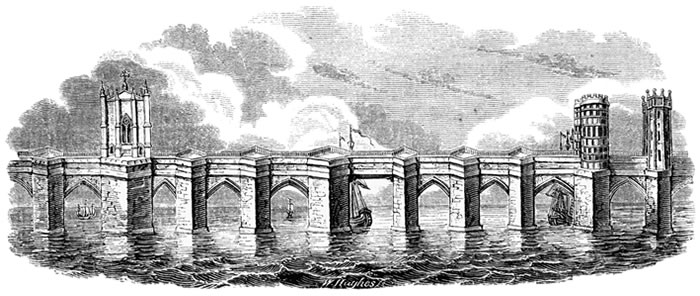
“Deeply as I venerate the memory of the great builder of that Bridge, which continued for so many centuries the wonder of Europe, yet I must not omit to notice to you, that many persons have grievously condemned his labours; the principal objections to which are summed up in the ‘Londinium Redivivum,’ of Mr. James Peller Malcolm, London, 1802-1807, 4to. volume ii. page 386, where he thus heavily censures that erection. ‘Whatever were the pretensions of Peter of Colechurch to eminence as an Ecclesiastical Architect, I think any person who views Vertue’s print of London Bridge, as it stood in 1209, will allow that he was a very bad Civil Engineer. He seems to have delighted in the number of his piers, which amounted to nineteen; and he was so ignorant of the true principles by which he should have been governed, that the centre was swelled into a Chapel, reducing the adjoining arches to half the diameter of the remainder. Indeed, it is wonderful that those piers maintained their situation, when we reflect how the torrent now rushes through, hurling heavy laden barges along as if they were feathers on the stream, when every practicable remedy to enlarge them has been applied.’
“An Architect of nearly an hundred years since, however, has considered these objections with somewhat more of mathematical proof; and what is better, even whilst he admits their full force, he still venerates the memory, and dares to applaud the public spirit, of the blessed Peter of Colechurch. You will readily guess that I allude to Master Nicholas Hawksmoor’s ‘Short Historical Account of London Bridge, with a proposition for a New Stone Bridge at Westminster,’ a quarto pamphlet of 47 pages, and 5 folding Copper-plates, originally published in the year 1736, for two shillings. The Author observes, at page 9, that the whole breadth of the River from North to South is nearly 900 feet, and that in his time there were eighteen solid piers of different dimensions, varying from 34 to 25 feet in thickness. According to this disposition, he argues, ‘the greatest water way is when the tide is above the sterlings, which is 450 feet, and, considering the impediments, it is not half the width of the River for the water to pass; but when the tide is fallen below the sterlings, the water-way is reduced to 194 feet,—which is during the greatest part of the flux and reflux of the tide,—and the river of 900 feet broad, is forced through a channel of 194 feet, which is not a quarter of the whole.’ We can at last, however, hardly judge of the Bridge of Peter of Colechurch with any degree of fairness, for that great benefactor of London died before he completed his Pontificate, as I may jocularly call it; and the author whom I last quoted, very candidly observes of him, that he, perhaps, ‘did not intend to add those immense Sterlings that have so much obstructed the River’s passage betwixt the Stone piers,’ and which, after all, are the great cause of the evil: for, says the same person, at page 13, when answering the common objection to altering London Bridge, on account of the expense attending it, ‘I have heard some masters of Hoys and Lighters say, that a Tonnage would willingly be paid for such a conveniency and security of their goods and vessels; and, as I have heard, an offer was made to pay Tonnage, if the Drawbridge had been opened, when the City last repaired it, to avoid the losses they suffered frequently by the Sterlings.’ ‘It is very probable,’ continues the same authority, ‘that the Sterlings were made afterwards, to keep the foundation of the piers from being undermined;—or, perhaps, these Sterlings might be increased after some damages that befell the piers, by the great quantity of ice which might be stopt by the narrowness of the arches; and those that intended to make the legs more secure, used such means as rendered them the less so, by the violent rapidity which they gave to the River so restrained,’ In addition to this, he also attempts an apology even for that very part of Peter’s Bridge, which has been the most condemned; having, perhaps, designed, says Mr. Hawksmoor, ‘by the narrowness of his arches, to restrain the ebbing of the tide, the better to preserve the navigation of the River above the Bridge, though it would not have any great effect if the Sterlings were taken away,’ considering ‘that if the River had its free course, it would ebb away so fast, that there would be scarce any navigation above the Bridge, a little time after high-water.’ This pamphlet also contains a defence of the Great Pier, which so violently excited the censure of Malcolm, who thought a Church on a Bridge was thrown away; for at page 12, he states that it might be intended ‘firstly to be a steadying of the whole machine, instead of making an angle, as it is in the famous Bridge at Prague, and in some of the Bridges in France; so that this fortress was placed in the middle of the Bridge, to stem the violence of the floods, ice, and all other accidents that might be forced against it. Secondly,—that if by any accident of the ice or flood, or undermining any of the legs,’—he means the piers, but Hawksmoor frequently uses this very ungraceful epithet,—‘some of the arches might fall, as five did, Anno 1282, yet, by the help of this great buttress,—though this damage was done on one side,—the arches on the other side stood firm, so that there was less expense, and greater encouragement to make the repair. The third reason was, that he had an opportunity to shew his piety, having a situation for erecting a Chapel, which was done, and his body deposited in it.’
“At the great repair of London Bridge, which took place between 1757 and 1770, several additional arguments were brought forward against the original edifice; of which Mr. Robert Mylne, in his Answers to the Select Committee of the House of Commons, for improving the Port of London, dated May the 15th, and October the 30th, 1801, printed in the Fourth Report of that Committee, states the following particulars. ‘The houses,’ says he, ‘being then taken down, and the sides of the Bridge being dismantled, the internal masses of its great bulk were found little better than rubbish, and of bad mason-work, &c. without active exertion, or even inert resistance. The original Piles, under the original stone-work of a very narrow Bridge, between the two modern sides and extreme parts, by cutting into the sides of the piers, and by one old being opened up, and totally removed, have been found composed of Sapling Oak and some Elm, carelessly worked, neither round nor square, but much decayed.’
“And now, worthy Mr. Barbican, having told you some of the objections to, and apologies for, the Bridge of the venerable Peter of Colechurch, before we ascend to the parapet, to examine the buildings which stood upon it, let me observe to you, that there are engraved Ground-plans of this Bridge, in George Vertue’s prints, which I shall mention more particularly hereafter, and also in Hawksmoor’s tract from which I have so largely quoted.”
Here let me for a moment interrupt the narrative of Mr. Postern, by stating that on the next page the Reader has a reduced copy of the interesting plan last mentioned, to which are subjoined Hawksmoor’s own measurements, and some additional particulars, also taken from Vertue; on the accuracy of every part of which, we have the best authority for placing the most complete reliance.
Ground plan of the first stone Bridge At London: commenced A. D. 1176, and completed A. D. 1209.
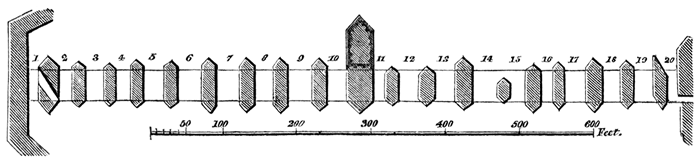
DIMENSIONS AND REFERENCES. COMMENCING AT THE CITY, OR NORTH END.
Feet. Inches.
Breadth of First Arch 10 —
—————— Pier 30 —
———— Second Arch 15 —
——————— Pier 18 —
Length of Second Pier 47 6
Breadth of Third Arch 25 —
—————— Pier 17 —
Length of Third Pier 41 6
Breadth of Fourth Arch 21 —
——————— Pier 18 —
Length of Fourth Pier 47 6
Breadth of Fifth Arch 27 —
—————— Pier 21 —
Length of Fifth Pier 47 6
Breadth of Sixth Arch 29 6
—————— Pier 21 —
Length of Sixth Pier 54 —
Breadth of Seventh Arch 29 6
——————— Pier 21 —
Length of Seventh Pier 54 —
Breadth of Eighth Arch 26 —
—————— Pier 21 —
Length of Eighth Pier 54 —
Breadth of Ninth Arch 32 9
—————— Pier 21 —
Length of Ninth Pier 54 —
Breadth of Tenth Arch 25 6
———— Centre Pier 36 —
Length of Centre Pier 95 —
Extreme Length of ditto 125 —
Vertue makes the extreme length of this Pier but 115 feet only.
Feet. Inches.
Breadth of Chapel on the Centre Pier 20 —
Length of ditto 60 —
Exterior height from the Water about 110 —
Breadth of Eleventh Arch 16 —
——————— Pier 21 —
Length of Eleventh Pier 37 —
Breadth of Twelfth Arch 24 6
——————— Pier 21 —
Length of Twelfth Pier 38 —
Breadth of Thirteenth Arch 25 8
———————— Pier 27 —
Length of Thirteenth Pier 50 —
Breadth of Drawbridge, or Fourteenth Arch 29 4
Vertue makes this space 30 feet broad.
Feet. Inches.
Breadth of Fourteenth Pier 17 —
Length of Fourteenth Pier 26 —
Breadth of Fifteenth Arch 22 10
——————— Pier 26 —
Length of Fifteenth Pier 47 7
Breadth of Sixteenth Arch 21 10
———————— Pier 15 —
Length of Sixteenth Pier 46 —
Breadth of Seventeenth Arch 29 4
————————— Pier 25 —
Length of Seventeenth Pier 46 —
Breadth of Eighteenth Arch 24 —
———————— Pier 17 —
Length of Eighteenth Pier 46 —
Breadth of Nineteenth Arch 27 —
———————— Pier 17 —
Length of Nineteenth Pier, North Side 49 —
Breadth of Twentieth Arch 15 —
The Piers and Arches were both measured from the squares of the latter, the triangular ends being left un-noticed, excepting in the instance of the Great Pier. The length of the whole Bridge was 926 feet; its height, 60; and the breadth of the Street over it, 40 feet.
“Let us now then, my good Sir,” continued Mr. Postern, “ascend to the Platform or Street of the old London Bridge, erected by Peter of Colechurch, and look at the buildings which stood upon it; the most celebrated of which was the famous Chapel dedicated to St. Thomas à Becket, the Martyr of Canterbury, whence it was familiarly called St. Thomas of the Bridge. This was erected upon the Tenth, or Great Pier, which measured 35 feet in breadth, and 115 from point to point; whilst the edifice itself was 60 feet in length, by 20 feet broad, and stood over the parapet on the Eastern side of the Bridge, leaving a pathway on the West, about a quarter of the breadth of the Pier, in front of the Chapel. The face of the building itself was forty feet in height, having a plain gable, surmounted by a cross of about six feet more; whilst four buttresses, crowned by crocketted spires, divided the Western end into three parts. The wide centre contained a rich pointed-arch window, of one mullion, with a quatrefoil in the top; and the two sides were occupied by the entrances to the Chapel from the Bridge-Street, each being ascended by three steps. Such was the general appearance of the West Front of the Chapel on London Bridge.
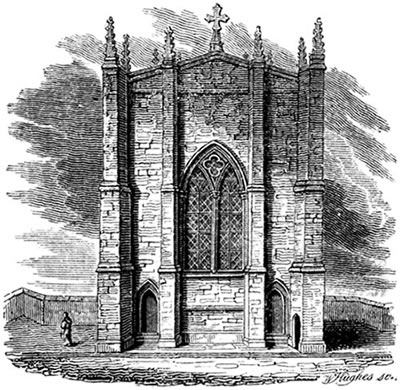
“The interior of this edifice consisted of two stories, both consecrated to sacred purposes, and greatly resembling each other in their appearance. The Upper Chapel was lofty, being supported by fourteen groups of elegant clustered columns, and lighted by eight pointed-arch windows divided by stone mullions into a double range of arches, surmounted by a lozenge. Beneath each of the windows were three arched recesses, separated by small pillars; and the roof itself was also originally formed of lofty pointed arches; though, when this magnificent fane was transformed into a warehouse, a wooden ceiling, with stout beams crossing each other in squares, was erected, which cut off the arches where they sprang from the pillars, and divided into two parts the Interior of the Upper Chapel of St. Thomas.
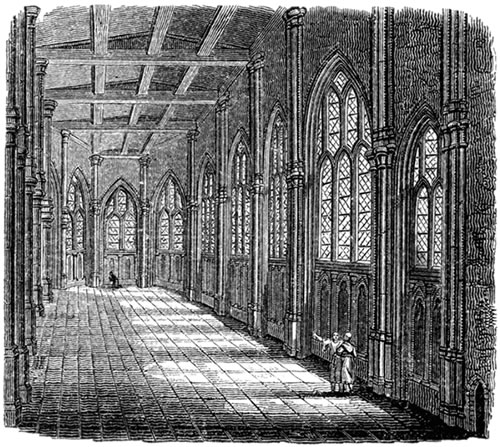
The Eastern extremity of this building formed a semi-hexagon, having a smaller window in each of its divisions, with richly carved arches under them, corresponding with the series already mentioned on the side: and the architectural lightness and elegance of the whole, meriting the highest encomium. Beneath this principal edifice, was a short descending passage, having, on the left hand, a stone basin cut in a recess in the wall, for containing Holy Water, and leading, through the solid masonry of the Pier, into the Lower Chapel of St. Thomas, which was constructed in the Bridge itself.
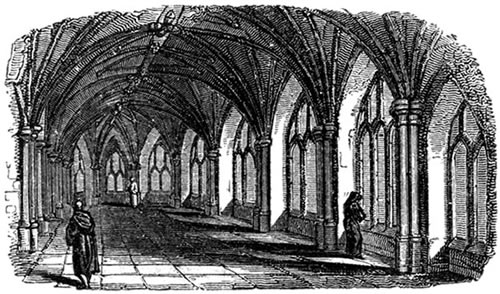
“This Crypt was entered both from the upper apartment and the street, as well as by a flight of stone stairs winding round a pillar, which led into it from the nearest Pier: whilst in the front of this latter entrance, the Sterling formed a platform at low water, which thus rendered it accessible from the River. The Lower Chapel, which—even decorated as that was, in my estimation, very far exceeded the upper one in architectural beauty,—was about 20 feet in height, and its roof supported by clustered columns, similar to those I have already described; from each of which sprang seven ribs, the centre, and the two adjoining it in every division, being bound by fillets with roses on the intersections; whilst the great horizontal ribs had clusters of regal and ecclesiastical masks, producing an effect little to be expected in such a structure, in such a situation; though I may trust to your correct taste, my good Mr. Barbican, for duly appreciating it. There was also a rich Series of Windows in the Lower Chapel,
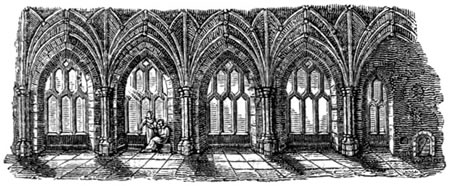
which looked on to the water, similar in character to, though much smaller than, those above: whilst the floor was beautifully paved with black and white marble; for in this place did the pious Architect propose to rest his bones. His monument, remarkable only for its plainness, was formed, according to Maitland’s ‘History,’ page 46, under the Chapel staircase, in the middle of the building; and it measured seven feet and an half, by four in breadth. There was, indeed, neither brass plate, nor inscription, nor carving found about the sepulchre, when Mr. Yaldwin, the inhabitant of the Chapel in 1737, then a dwelling, and warehouse, discovered the remains of a body in repairing the staircase; though, from the ‘Annals of Waverley,’ page 168, we know that the reliques of Peter were certainly entombed in this place. ‘In 1205,’—runs the passage,—‘died Peter the Chaplain of Colechurch, who began the Stone Bridge at London, and he is sepultured in the Chapel upon the Bridge.’ By this entry then, we are assured that he lay there; and as for an epitaph, was not the whole edifice an everlasting catafalco to his memory, which should speak for all times? How finely, indeed, might we apply to him that inscription, which the son of Sir Christopher Wren composed for his father’s burial-place in St. Paul’s,—‘He lived, not for himself, but for the public! Reader, if you seek his monument, look around you!’
“And now, before we enter upon an examination of the bed of the Thames at London Bridge, and consider whether the River were turned, as Stow thinks, to admit of its erection, let me cite you some ancient authorities concerning St. Thomas’s Chapel. The first of these shall be the ‘Itinerary of Symon Fitz Simeon, and Hugo the Illuminator,’ both of whom were Irish Monks, of the Order of Friars Minors, who visited London on their pilgrimage to Palestine, in 1322. ‘This flux and reflux,’—say they, at pages 4, 5,—‘continues to the sea from the famous River named Thames, upon the which is a Bridge, filled with inhabitants and wealth; and in the midst of them is a Church dedicated to the blessed Thomas, Archbishop and Martyr, which is well served continually.’ About the year 1418, also, William Botoner, a Monk of Worcester, of the Parish of St. James in Bristol, who then travelled from that City to St. Michael’s Mount in Cornwall, in his ‘Itinerarium,’ pages 301, 302, thus spake of London Bridge and the Chapel. ‘The length of the Chapel of St. Thomas the Martyr, upon London Bridge, is about twenty yards; having an under Chancel in the vault, with a choir, but the length of the nave of the said Chapel contains fourteen yards. The width of the middle steps is one yard. The length of the Bridge on the South, from the posts to the first gate newly founded by Henry the Cardinal, unto the two posts erected near the Church of St. Magnus, consists of five hundred of my steps. Item: there are five great windows on one side,’—of the Chapel,—‘each of which contains three panes:’ or rather divisions. Of these Itineraries I will observe nothing farther, than that they were published from the original Manuscripts in Corpus Christi College, Cambridge, by James Nasmith, the Editor of Tanner’s ‘Notitia Monastica;’ in 1778, octavo; under the title of ‘Itineraria Symonis Simeonis, et Willielmi de Worcestre.’
“Of this Chapel, and also of the first Stone Bridge, there are two large folio engravings, taken and published, by George Vertue, in 1744-48, which, after his decease, were, with many of his other plates of Antiquities, presented by his widow to the Antiquarian Society in 1775. The first engraving measures 18¼ inches by 20 inches and 3⁄8, and contains ‘A View of the West Front of the Chappel of St. Thomas, on London Bridge; also the Inside View from West to East of the said Chappel, as it was first built An°. 1209:’—and also ‘London Bridge as it was first built, An°. 1209:’—a Ground plan, and some measurements of the same, and a short Historical account of the structure, drawn up by Sir Joseph Ayloffe, Bart. Vice-President of the Society of Antiquaries. The publication line states, that it was ‘drawn, engrav’d, and publish’d by G. Vertue, in Brownlow-Street, Drury-Lane, 1748.’ A second edition was printed by the Society, in 1777.
“The other plate contains ‘The Inside Perspective View of the Under Chappel of St. Thomas within London Bridge, from the West to the East end,’ and beneath it: the ‘Inside South View of the Under Chappel from East to West, representing the manner and form of this rare piece of Ancient Architecture, thus drawn and transmitted to posterity, by G. V., Antiquary, 1744. Published and sold by G. Vertue, in Brownlow-Street, Drury-Lane, 1747’ This plate, which measures 18¼ inches by 20, contains a few additional historical notes, by Sir Joseph Ayloffe; and a reduced copy of the lower View was engraved in the 23d volume of the ‘Gentleman’s Magazine,’ for October, 1753, page 520. I must observe, also, that, in the large interior View on that plate of Vertue last-mentioned, there are introduced the portraits of the learned Samuel Gale, and the eccentric Dr. Ducarel. The former, by whose patronage and assistance Vertue produced these prints, is standing on the left hand, holding a plan of the Chapel, and listening to an outlandish-looking man, designed for Peter of Colechurch; whilst the latter Antiquary is employed in measuring. You find this information given from Gale’s own lips, in that monument of labour, the ‘Literary Anecdotes of the Eighteenth Century,’ by John Nichols, volume iv. London, 1812, 8vo. page 552, and volume vi. part I. page 402. I shall close this notice of these most ancient views of London Bridge, by observing to you, that there is a view and a ground-plan of it, with measurements, engraved by Toms, on the second plate in Hawksmoor’s work, already cited.
“Let me remark to you, however, Mr. Barbican, as touching the Chapel which I have thus described to you, that the custom of erecting Religious Houses on Bridges, is certainly of great antiquity. A notable instance of this kind was on the Bridge at Droitwich, where the road passed through the Chapel and separated the congregation from the reading-desk and pulpit. Another famous Bridge Chapel is also to be found erected over the River Calder, at Wakefield, in the West Riding of Yorkshire; of which, a folding view, by W. Lodge, is inserted in the ‘Ducatus Leodiensis’ of Ralph Thoresby, London, 1715, folio, sometimes placed at page 164. This beautiful fane, you know, was built by King Edward IV. in memory of his father, Richard, Duke of York, who was killed in the battle fought near Wakefield, on December the 31st, 1460. The Bridge Chapel, however, though extremely rich in its architecture, was not so singular as our’s at London, since it was not built in the pier, and descending even to the water’s edge, but upon the pier, and the platform of the Bridge itself. Somewhat like our shrine of St. Thomas, however, as it belonged to the poor of the town, it was, about 1779, converted into a dwelling-house, and let at a small annual rent to a retail dealer in old clothes! as that industrious Antiquary, Richard Gough, tells us, in his ‘British Topography,’ London, 1780, 4to. volume ii. page 437, note, r. ‘To what base uses may we not return, Horatio!’ The edifice which had been erected for Monks to chaunt forth their Requiescats in solemn procession; the shrine which had been endowed for the sweet repose of a warrior’s soul; the—”
“I’ll tell you what, Mr. Barnaby Postern,” said I, starting up, “you’ll contribute to my sweet repose, unless you leave wandering in Yorkshire, and return again to London Bridge: what have we to do with a bead-roll of all the Bridge Chapels that are scattered through England? I desire to know but of one; for, by its having existed, we are sure that there might have been some sort of custom for their erection; and, as old Chaucer saith,
‘Experience, though none auctoritye Were in this world, is quite enough for me.’”
“True, Sir, true,” said the mild old Antiquary; “you have once more brought me back to my starting-post; for I own that I am too apt, when discoursing upon one subject, to branch out into others which seem to illustrate, or are in any degree connected with it. You will, however, I dare say, allow me to remark, that Plutarch denies the derivation of the word Pontifex from the old Roman custom of sacrificing on Bridges, which might, nevertheless, be the origin of Chapels being built upon them. He mentions this in his Life of Numa Pompilius, in his ‘Vitæ Parallelæ,’ best edition, by Augustine Bryan, and M. du Soul, London, 1729-24, 4to. volume i. page 142. The Greek passage begins, ‘Νουμᾷ δὲ και τὴν των αρχιερεων,’ &c., and the Latin, ‘Jam etiam sacerdotum;’ but I shall give you the excellent modern English version of Dr. Langhorne, in his very popular translation of the old Classic, from the edition of Mr. Archdeacon Wrangham, London, 1813, 8vo. volume i. pages 181, 182: ‘To Numa,’ says the passage, ‘is attributed the institution of that high order of priests, called Pontifices; over which, he is said to have presided himself. Some say, they were called Pontifices, as employed in the service of those powerful gods that govern the world; for potens, in the Roman language, signifies powerful. Others, that they were ordered by their law-giver to perform such offices as were in their power, and standing excused when there was some great impediment. But most writers assign a ridiculous reason for the term, as if they were called Pontifices, from their offering sacrifices upon the Bridge, which the Latins call Pontem; such kinds of ceremonies, it seems, being looked upon as the most sacred, and of the highest antiquity. These Priests, too, are said to have been commissioned to keep the Bridges in repair, as one of the most indispensable parts of their sacred office.’ Plutarchus, the author of this, you remember, died about A. D. 140; and the period of which he wrote, was about 630 years before the birth of Christ. That giant of learning, also, John Jacob Hoffmann, denies that the word Pontifex had any thing to do with a Bridge; as you may see discussed at considerable length, in his ‘Lexicon Universale,’ Leyden, 1698, folio, volume iii. page 836, column 2, where he says, it is compounded of posse and facere, that is to say, such persons as are able to do the thing, or sacrifice: but as the article is equally long, erudite, and curious, I refer you to the original.
“And now we come to speak of Stow’s singular hypothesis, that the River Thames was turned in its current, during the erection of the first Stone Bridge at London. He states this in his ‘Survey,’ volume i. page 58, where he also says, that the course of the stream was carried through ‘a trench cast for that purpose; beginning, as it is supposed, East about Rotherhithe, and ending in the West about Patricksey, now termed Battersey.’ Strype, the last, and, perhaps, the best Editor of our old Metropolitan Historian, on the page above cited, seems inclined to support this idea; for he says, ‘It is much controverted whether the River Thames was turned, when the Bridge over it was built, and whether the River was more subject to overflow its banks anciently than at present; and from all that hath been seen and written upon the turning of the River, it seems very evident to me, that it was turned while the Bridge was building, and that it is more subject to overflow its banks now, than it was formerly; for the channel of the River must have been deeper than it is now, or the Palace of Westminster would never have been built where the Hall and the rest of its remains are now situated. Is it to be supposed that any Prince would have built a Palace, where the lower rooms were liable to be overflowed at a spring-tide, as we see the Hall has been several times of late years, and the lawyers brought out on porters’ backs? The reason whereof is, that the sands have raised the channel, and, consequently, the tides must rise higher in proportion, than they did formerly; and unless some care is taken to cleanse the River, the buildings on the same level with the floor of Westminster-Hall, will not be habitable much longer, as the sand and ouse are still daily increasing, and choking up the bed of the River.’ Nicholas Hawksmoor, also, on page 8 of his work, which I have already quoted, says, that ‘many skilful persons have thought that the River Thames was not turned, but that the flowing of the tides was then different, and that the water did not rise so high at the Bridge; for the Thames might heretofore overflow the marshes near the sea, and have a greater spreading; which being now restrained by the bank, called the wall of the Thames, into narrower limits, and the water which comes from the sea into the mouth of the Thames during the flood, not being received by the marshes, must come up into the country, and so swell the tide higher at London than it usually did. The celebrated Sir Christopher Wren was of opinion, that when the foundation of London Bridge was laid, the course of the River was not turned, but that every pier was set upon piles of wood, which were drove as far as might be under low-water mark, on which were laid planks of timber, and upon them the foundation of the stone piers: the heads of the said piles have been seen at a very low ebb, and may be so still when some of the chalk or stone is removed to mend the Sterlings.’
“Maitland, and his Editor Entick, are also both opposed to the idea that the River was turned during the erection of London Bridge, as they evince on page 46 of their ‘History;’ where they ground their objections to it on the following arguments. Firstly, it is supposed that the vestiges of Knute’s Canal—which, as we have seen, took the same course as Stow supposes the River to have taken,—might have deceived him; a reason also adopted by Hawksmoor, in the place I last cited. Secondly, the charge of such an immense work is next objected to; as the cost of the ground intended for the trench, the embankment of it, and the damming off the River itself, must have amounted to at least treble the sum which would otherwise have been required to erect the Bridge. The total silence of those Historians who mention the construction of London Bridge, upon the subject of so great a work as the turning of the River, is next insisted upon: and, finally, the length of time which the building occupied,—thirty-three years,—is adduced as alone sufficient to overthrow the whole hypothesis. ‘For,’ adds the author, ‘had the people concerned in erecting it, had dry ground to have built upon, it might have been finished in a tenth part of the time, and in a much more durable manner.’ Maitland then proceeds to state, that, in 1730, he surveyed the Bridge, in company with Mr. Bartholomew Sparruck, the Water-Carpenter of the same; and that he observed in many places,—where the stones were washed from the sterlings,—the mighty frames of piles whereon the stone piers or pillars were founded; the exterior parts of which, consisted of huge piles driven as closely together as art could effect. ‘On the tops of these,’ he continues, ‘are laid long planks, or beams of timber, of the thickness of ten inches, strongly bolted; whereon is placed the base of the stone pier, nine feet above the bed of the River, and three below the sterlings; and on the outside of this wooden foundation,—and for its preservation,—are drove the piles called the sterlings.’ He then goes on to observe, that Mr. Sparruck informed him, that he and the Bridge-Mason had frequently taken out of the lowermost layers of stones in the piers, several of the original stones, which were laid in pitch instead of mortar; and that from this circumstance they imagined, that all the outside stones of the piers, as high as the sterlings, were originally bedded in the same material, to prevent the water from damaging the work. This labour was, he thinks, continued at every ebb tide, until the piers were raised above high-water mark; and hence he argues, that if the Thames had been turned, there would not have been any occasion for the use of pitch, and that Plaster of Paris was not then in use in this country. These are the principal heads of the dispute concerning the turning of the River: to which I only add my own settled conviction, that the course of the Thames was not altered.”
“But pray, my worthy friend,” said I, as he concluded, “what other buildings stood upon the Bridge built by Peter of Colechurch, besides the Chapel of St. Thomas?”
“That is a point,” replied he, “upon which Antiquaries are very far from being decided: for whilst some assert, with Sir Joseph Ayloffe in his account of the Bridge attached to Vertue’s prints, that, at first, there were no houses upon it, and that it was only plainly coped with stone until 1395,—late in the reign of Richard II.,—others argue that it was built upon to some extent two centuries before, and, indeed, there is proof of this being the case in the reign of King Edward I., as I shall shew you anon. Stow, in his ‘Survey,’ volume i. page 22, says that the Bridge Gate, which was erected at the Southwark end, was one of the four first and principal gates of the City, and stood there long before the Conquest, when there was only a Bridge of timber, being the seventh and last mentioned by Fitz-Stephen. Maitland, at page 30 of his first volume, when he comes to speak of the same erection, denies not only the truth, but even the probability of Stow’s assertions; and, indeed, Stephanides himself says only at page 24, ‘On the West,’—that is of London,—‘are two Castles well fortified; and the City wall is both high and thick with seven double gates, and many towers on the North side, placed at proper distances. London once had its walls and towers in like manner on the South, but that vast River, the Thames, which abounds with fish, enjoys the benefit of tides, and washes the City on this side, hath, in a long tract of time, totally subverted and carried away the walls in this part.’ The Latin of this passage commences at ‘Ab Occidente duo Castella munitissima,’ &c. Maitland then goes on to argue, that Fitz-Stephen could have no regard to a gate on the South, there being no wall remaining; ‘whereas,’ says he, ‘on the contrary, it is manifest that his seven gates were in the continued wall on the land side.’
“It is probable, however, that, at a very early period after its erection, towers were reared upon London Bridge, for there was one standing at each end; but of these I shall speak more largely under future years: remarking only, that it is by no means impossible for a Watch-tower and gate to have stood upon the Bridge, even from its very first erection, seeing that it was, as it were, a new key to the City. A sort of Barbican, Mr. Geoffrey, such as you derive your name from; for you remember the essential importance which such buildings were of, and how Bagford speaks of them in his Letter to Hearne, which I have already quoted, page lxii. ‘Here,’ says he, ‘they kept Cohorts of Souldiers in continual service’—for your Barbican Tower was of Roman invention,—‘to watch in the night; that if any sudden fire should happen, they might be in a readiness to extinguish it, as also to give notice if an enemy were gathering or marching towards the City to surprise them. In short, it was a Watch-tower by day; and at night, they lighted some combustible material on the top thereof, to give directions to the weary traveller repairing to the City, either with provision or on some other occasion.’
“But to pass from probabilities to certainties, let us now, having got the Bridge fairly built of stone, consider the many events and changes which it hath experienced, from its infancy in the thirteenth Century, to its old age in the nineteenth: and so, my excellent auditor, Here begin the Books of the Chronicles of London Bridge.
“That sorrowful exclamation, ‘No sooner born than dead!’ may well, at the period at which we are now arrived, be uttered over this scarcely completed edifice; for in the night of the 10th of July, 1212, within four years after its being finished, a dreadful conflagration took place upon it. Stow, at page 60 of his ‘Survey,’ cites the Book of Dunmow, William de Packington, and William of Coventry, as his authorities for that excellent account of it which I shall presently repeat to you. Let me, however, first observe, that Packington was Secretary and Treasurer to Edward the Black Prince, in Gascoigne, about 1380. For William of Coventry, I conceive that we should read Walter of Coventry; because the former, who wrote about 1360, is celebrated in page 148 of Bishop Nicolson’s ‘Historical Libraries,’ already cited, as the Author of a work ‘concerning the coming of the Carmelites into England.’ Walter, on the contrary, at page 61, is mentioned as having compiled three books of Chronicles, about the year 1217, which yet remain in Manuscript in Bennet College, Cambridge. The ‘Chronicle of Dunmow,’ which is the other authority quoted by Stow, is now to be found only in a small quarto volume in the Harleian Library of Manuscripts, No. 530, article ii. page 2 a. It consists of a miscellaneous collection of notes, in the hand writings of Stow, Camden, and perhaps Sir Henry Savile; transcribed upon old, stained, and worn-out, paper. The notice of this great fire is very brief, and, with the heading of the extracts, runs thus: ‘Collectanea ex Chronico de Dunmowe.’—‘1213. London was burned and the Brydge also, and many peryshed by violence of the fyre.’ Stow’s own account, however, is the most interesting extant, and is as follows. ‘The Borough of Southwark,’ says he, ‘upon the South side of the River of Thames, as also the Church of our Lady of the Canons there,’—that is to say the Church of St. Mary Overies, which changed its name upon being re-founded, in 1106, for Canons Regular, by William de Pont de l’Arche, and William D’Auncy, Norman knights,—these ‘being on fire, and an exceeding great multitude of people passing the Bridge, either to extinguish and quench it, or else to gaze and behold it; suddenly the North part, by blowing of the South wind was also set on fire; and the people which were even now passing the Bridge, perceiving the same, would have returned, but were stopped by the fire: and it came to pass, that as they stayed or protracted the time, the other end of the Bridge also, namely, the South end was fired; so that the people, thronging themselves between the two fires, did nothing else but expect present death. Then there came to aid them many ships and vessels, into which the multitude so unadvisedly rushed, that the ships being thereby drowned, they all perished. It was said, that through the fire and shipwreck, there were destroyed above three thousand persons, whose bodies were found in part or half burned, besides those that were wholly burned to ashes, and could not be found.’
“Such is Stow’s account of this melancholy event, which is best confirmed by the ‘Annals of Waverley,’ page 173; but they state also, that under this year, ‘1212, London, about the Bridge, was great part burned, together with the Priory of Southwark.’ Now, if we might credit the ‘Historiæ Angliæ’ of that wily, but elegant Italian, Polydore Vergil, we might be sure, that even at this period, London Bridge was built upon: ‘Ipso illo anno,’ says he, at page 276 of his book, setting out, however, with an erroneous date, ‘In that same year’—1211,—‘all the buildings that were erected upon London Bridge, were, even upon both sides, destroyed by fire: the which is esteemed a place of wonder.’ Polydore Vergil, you know, was an Historian of the reign of King Henry VIII. so we shall refer to him hereafter; and his work, now cited, was written at that Monarch’s request, so late as about the year 1521. It is esteemed chiefly for its elegant diction; and the best edition of it is considered to be that printed at Leyden, in 1651, octavo; though the foregoing reference is to the last impression of the Basil folio, A. D. 1570.
“There does not appear, however, to have been any very effectual or speedy order taken for the restoration of London Bridge; for in the ‘Rotuli Clausi,’ or the Close Rolls, of the 15th Year of King John, 1213, Membrane the 3rd, is the following entry. ‘It is commanded to the Mayor and Sheriffs of London, that the halfpence which are now taken of foreign Merchants, shall be given to the work of London Bridge. Witness Myself at the Tower of London, on the 18th day of December, in the 15th year of our reign.’—You will find the Latin of this printed in the second impression of Thomas Hearne’s edition of the ‘Liber Niger Scaccarii,’ London, 1771, 8vo. volume i. page *471; and the original record may be seen in the Tower of London, written in so small, delicate, and abbreviated a character, that it hardly makes two lines on the narrow parchment roll. And now that we are speaking of the repairs of London Bridge, I should observe, that they are closely connected with the history of the Bridge-House and Yard in Tooley Street, Southwark; since Stow tells you in his ‘Survey,’ volume ii. page 24, that they were so called and appointed, as being ‘a storehouse for stone, timber, or whatsoever pertaineth to the buildings or repairing of London Bridge.’ He adds too, that this House ‘seemeth to have taken beginning with the first foundation of the Bridge either of stone or timber;’ and that it is ‘a large plot of ground on the bank of the River Thames, containing divers large buildings for the stowage’ of materials for the repairs of London Bridge. Of events which particularly concern this place, I shall, however, speak more fully in their proper order of time.
“In the year 1235, you will recollect that Isabel, third daughter of King John, by his third Queen, Isabella of Angoulême, was sent with great splendour into Germany, to marry the Emperor Frederick II. She was attended by William Brewer, Bishop of Exeter, and a Privy Councillor to King Henry III., and also by the Archbishop of Cologne, the Imperial proxy, who had pronounced her Empress. Upon this occasion, according to the customs of the ancient Norman Law and the Feudal System, the King received an aid to furnish her dowry, of two marks out of every Knight’s Fee;—that is to say, as it is usually accepted, £1. 6s. 8d. from every person who possessed an estate of £20. per annum, which was granted by the Common Council of the kingdom. This rather uncommon aid, you find certified in Thomas Madox’s ‘History and Antiquities of the Exchequer of the Kings of England,’ London, 1711, folio, page 412; and in the voluminous collections of that eminent Antiquary, now preserved with Sir Hans Sloane’s Manuscripts in the British Museum, No. 4563, page 181 b, is the following very curious document, which connects this circumstance with the history of London Bridge. ‘To be remembered concerning the payments of Purprestures’—fines for enclosing and damaging of Land—‘and of Escheats’—accidental returns of estates to their principal owners,—‘It is commanded to the Sheriffs, that they get all the arrears of all the above rents, and the issues of all Purprestures and Escheats; excepting the rents of London Bridge, and the remainder of the amerciaments belonging to the Circuit of W. of York,’—most probably Walter Grey, then Archbishop of York, and Lord Chancellor,—‘as well in the County of Middlesex as at the Tower, and all the deficiencies (of the aid) for marrying the King’s sister, and for the passing over this sea into Gascony.’ In the Exchequer Rolls of the 32nd of Henry III., A. D. 1247, 12 a.
“Towards the latter end of the year 1248, King Henry vainly endeavoured to collect from his Barons, a sum sufficient to enable him to recover certain provinces in France; upon which, he offered a portion of his plate and jewels for sale to the Citizens of London, by whom they were bought. The King, displeased at finding they readily procured money for such a purpose, and yet pleaded poverty whenever he solicited a supply, resolved upon retaliation; and, to that end, kept his Christmas in the City, forced the inhabitants to present him with divers costly New Year’s gifts, and established a Market at Westminster, to last for fifteen days, beginning on the 13th of October, during which time all other fairs were suspended, and, in London itself, all commerce was prohibited. I think too, that we may trace the effects of Henry’s anger yet farther; for, in the Patent Roll of the 34th year of his reign, 1249, Membrane the 5th, is the following writ.
“‘Of taking the City of London into the hands of our Lord the King. The King, &c. to his faithful W. de Haverhull, his Treasurer; Peter Blund, Constable of the Tower of London; and Ernald Gerandin, his Chamberlain: Greeting. We command that without delay, you take into your hands our City of London, with the County of Middlesex, and London Bridge in like manner: so that the issues of the same be answered for to us at our Exchequer at our pleasure. And all the aforesaid shall be in safe custody, until the receipt of another mandate from us. In testimony of which thing, etcætera, Witness the King at Merton, on the 20th day of May.’ The original of this is of course in the Tower.
“In the same National depository of invaluable records, Mr. Geoffrey, there is, in the Patent Rolls of the 37th of Henry III.—1252,—Membrane the 4th, an entry entitled ‘A Protection for the Brethren of London Bridge, concerning the charitable gifts collected for the reparation of the said Bridge.’ This, like the foregoing instrument, has not, as I can remember, ever been printed; and, translated into English, it is as follows. ‘The King to the Archbishops, &c. Greeting. Know ye that we engage for the protection and defence of our Brethren of London Bridge, and their men, lands, goods, rents, and all their possessions. And therefore we command, that they, the Brethren, and their men, lands, goods, rents, and all possessions, in their hands, ye should hold protected and defended. Nor shall any bring upon them, or permit to be brought upon them, any injury, molestation, damage, or grievance. And if it be that any thing hath been forfeited by them, amendment shall be made without delay. And we also desire of you, that when the aforesaid Brethren, or their Messengers, shall come to you for your alms for their support, or for that of the aforesaid Bridge, ye shall courteously receive them, and cause them to be so received in all your Churches, Towns, and Courts; and that ye will bestow upon them of your goods according to your charity and the sight of our precept, the alms which they desire. So that in reward thereof ye may be worthy of all the blessings of mercy, and our special thanks shall be due unto you. In testimony of which thing, &c. Witness the King at Portsmouth, the fifteenth day of July.’
“Really,” said I to Mr. Postern, as he concluded the last Charter, “your memory, Mr. Barnaby, is little less than miraculous! Why, it must be like a chain cable, to hold together the contents of all these musty Patent Rolls, with their endless repetitions. I myself am called by my intimates, ‘Memory Barbican,’ and I can recollect events and stories indifferently well; but you! you remind me of the Wandering Jew, who has lived eighteen hundred years, and never forgot any thing in his life!”
“Ah! my good Sir,” answered the Historian of London Bridge, “if my memory were equal to your praise of it, it were, indeed, worth boasting of; but in my broken narrative I can shew you but here and there an isolated fact, whilst to the greater part of the story, we are obliged to say with Master Shallow, ‘Barren! Barren! Beggars all! Beggars all!’”
“Take a draught out of the fragment of Master Shallow’s fat friend here,” returned I, pointing to the Sack Tankard, “and set out afresh, my old kinsman; but pray let us have the spur on the other leg now, and give us a little History to lighten our Law; with which request,—Here’s my service to you!” Mr. Postern bowed as I drank, and after having followed my example, thus continued.
“You must doubtless remember, my good Sir, that during those unhappy Baronial wars which lasted nearly the whole of the extended reign of Henry III. it was supposed that Queen Eleanor of Provence opposed the Sovereign’s agreeing to the Barons’ demands; and that in revenge for this, how very uncivilly the Citizens treated her at London Bridge. Matthew of Westminster tells the story under the year 1263, in his ‘Flores Historiarum.’ London, 1570, folio, Part ii. page 315; and he, as you will recollect, was a Benedictine Monk of Westminster, who flourished, as Bishop Nicholson supposes in his ‘Historical Libraries,’ page 66, about the year 1307, when his history ends. The event to which I allude was, that as the Queen was going by water to Windsor, just as her barge was preparing to shoot the Bridge, the populace intercepted her progress, attacked her with vehement exclamations and reproaches, and endeavoured to sink her vessel, and deprive her of life by casting heavy stones and mud into her boat. Upon this, she was compelled to return to the Tower, where the King had garrisoned himself, as the City had declared for the Barons, whence she was removed to the Bishop of London’s Palace, at St. Paul’s. It was in the latter end of the same year, that Simon de Montfort, the sturdy Earl of Leicester, and the Baronial leader, marched his forces through the County of Surrey towards London, in the hope that his friends, Thomas Fitz-Richard, then Lord Mayor, Thomas de Pynlesdon, Matthew Bukerel, and Michael Tony, with whom was connected an immense multitude of the common rabble, would open the Bridge Gates to him. When the King, however, became acquainted with the Earl’s design, he left the Tower, and encamped with his troops about Southwark, to oppose his passage. As the Earl of Leicester relied more upon the assistance of the Citizens, than on the valour of his own soldiers, he vigorously attacked the King’s troops, expecting that the Londoners would favour his entrance. Henry, however, had still several adherents in the City; and, indeed, Thomas Wikes, in his ‘Chronicon,’ page 58, as it is printed in volume ii. of Gale’s ‘Scriptores,’ already cited, tells us that the Baronial party in London was composed of the meanest and most worthless, whom the wisest and eldest endeavoured to controul. During the fight, therefore, some of the Royalists, and especially one John Gisors, a Norman, perceiving that the City was in motion to assist De Montfort, locked up the Bridge Gates, and threw the keys into the Thames. So prompt an action had nearly proved fatal to the Earl of Leicester, who had approached the Bridge with only a few soldiers, lest his designs should be discovered; but at length the Gates were broken open, the Citizens rushed out in multitudes to his rescue; King Henry was obliged to retreat, and De Montfort entered the City. By this event we are informed that there certainly did exist a Bridge Gate in the year 1264; and the historians by whom the fact is related, are Matthew of Westminster, whose ‘Flowers of Histories’ I have already quoted, of which book, see page 317; and the ‘Chronicon’ of Thomas Wikes, a Canon Regular of Osney, near Oxford, which concludes with the year 1304.
“It would seem almost certain that, at this period, the keeping of London Bridge, with all its emoluments, was in the possession of the Brethren of St. Thomas of the Bridge; and the idea is somewhat supported by the Protection to which I referred you but a short time since. There is, however, in the Patent Rolls preserved in the Tower of London, of the 50th of Henry III.—1265,—Membrane the 43rd, the following instrument.
“‘For the Hospital of St. Catherine, concerning the Custody of London Bridge, with all the rents thereof for the space of five years.
‘The King to the Brethren and Chaplains ministring in the Chapel of St. Thomas upon London Bridge, the other inhabitants upon the same Bridge; and to all others to whom these letters shall come, Greeting: Know ye, that we commit unto the Master and Brethren of the Hospital of Saint Catherine near to our Tower of London, the Custody of the aforesaid Bridge with all its appurtenances, as well the rents and tenements thereof, as of others which belong to the aforesaid Bridge, within and without the City: to have and to hold by the said Master and Brethren for the space of five years. Yet so that out of the aforesaid rents, tenements, and other goods of the aforesaid Bridge, the repair and support of the Bridge is to be looked for, and to be done, from henceforth from that place as it shall be able, and as it hath been accustomed. And therefore we command you, that to the said Master and Brethren, as well as to the keepers of the aforesaid Bridge, all things belonging to that custody be applied, permitted, and paid, until the term aforesaid. Witness the King at Westminster, on the sixteenth day of November.’ The Latin of this writ you find printed in Hearne’s ‘Liber Niger,’ which I have before quoted, volume i. page *471; and it affords us certain proof of the early existence of dwellings on London Bridge.
“I will but remark in passing onwards, that Madox, in his ‘History of the Exchequer,’ already cited, page 534, quotes a Roll to shew that in the 52nd year of King Henry III.—1267,—Walter Harvey, and William de Durham, Bailiffs of the City of London, accounted to the Crown for the sum of £7. 0s. 2½d. being the amount of the Custom of Fish brought to London Bridge Street, and other Customs also taken there. The term for which the Hospital of St. Catherine was to enjoy the custody of London Bridge, wanted, however, more than a whole twelvemonth of its completion, when a new Patent was issued by Henry III. in 1269, the 54th year of his reign, granting it to his Queen Eleanor of Provence. It is entitled, ‘The King gives to Eleanor, Queen of England, the custody of London Bridge, with the liberties;’ and you will find it the third article on the 4th Membrane, in the Patent Roll for the above year: the Latin is printed by Hearne in the place which I last cited, page *472, and the writ in English is as follows:”
“‘The King to all etcætera, Greeting. Seeing that some time since we would have granted to our most dear Consort Eleanor, Queen of England, the Custody of our Bridge at London, with the liberties and all other things belonging to that Bridge, to have for a certain term: We, therefore, do grant to the same Queen, out of our abundant grace and will, the custody of the Bridge aforesaid, with the liberties and all other things belonging to that Bridge, to be considered from the Feast of All Saints,’—1st of November—‘about to arrive; and from the same Feast of All Saints, until the full end of the six years next approaching, and following. In testimony of which thing, etcætera, Witness the King, at Woodstock, on the 10th day of September.’”
“And pray, Mr. Barnaby Postern,” said I, in a drowsy kind of voice, for I was almost tired at sitting so long silent, “did the Queen enjoy the whole of her term, or was the custody of London Bridge again otherwise disposed of?”
“You bring me, worthy Mr. Geoffrey,” answered he, “by your very seasonable question, to speak of a matter in which the Citizens of London obtained a great triumph on behalf of their Bridge. It is somewhat singular, that Stow, at page 60 of his ‘Survey,’ volume i. has very hastily, and, in my poor mind, very imperfectly, related this matter; whilst Maitland, on page 48 of his ‘History,’ volume i. has told it still less circumstantially. I shall therefore, my good friend, take the freedom to put the proceedings between the Queen and the Citizens in somewhat more particular a form, illustrating them by the very records from whence we derive our information; for to these let me say, that neither of the authors whom I have mentioned give you any reference. Previously to commencing, however, I must entreat you to bear with me, Mr. Barbican, if my proofs cited from the ancient Rolls of the Kingdom be dull and formal; and to remember that they are often the only fragmenta we possess of past events. Tracing of local history is like endeavouring to follow the course of a dried-up river: a rude channel here and there presents itself; some mouldering ruin, once the abutment of an ancient Bridge, or——”
“Mr. Postern,” said I, taking up the Tankard, and interrupting him, “once more, here’s your health, and I wish you safe out of your wilderness: keep to one thing at a time, man, leave your dried-up river, and ‘turn again Barnaby,’ to the dispute between Queen Eleanor of Provence, and the Citizens of London, concerning yonder Bridge.”
“In good time,” continued my visitor, “you have brought me back again. And now, I would first request you to remember, that King Henry III. died at London, on the 16th of November, 1272; Prince Edward his son then being in the Crusade in Palestine; whence, however, he returned to England in July, or August, 1274. Now, almost the whole of the reign of Henry III. had been disturbed by the truculent Barons contending with him for the final settlement of Magna Charta; and these Civil Wars had very naturally produced numerous abuses with respect to the Estates of England, such as the Nobility assuming almost regal rights, imposing heavy tolls, and the officers of the Crown using divers exactions under colour of the law. Such was the state of English affairs at the return of King Edward I., and it was one of the first acts of his reign—as the ‘Annals of Waverley’ tell us on page 235,—to enquire into the state of the revenues, privileges, and lands of the Crown; as well as to examine into the conduct of the sheriffs and officers, who had at once defrauded the Sovereign and oppressed his subjects. For this purpose, as the next circuit of the Justices Itinerant was not expected for six years then to come,—as they generally travelled it but once in seven,—the King issued his Letters Patent under the Great Seal, dated from the Tower of London, on the 11th of October, 1274, appointing Commissioners for each County in England, to make this important inquisition. They were instructed to summon Juries to enquire on oath the answers to thirty-five Articles, examining into the King’s rights, royalties, and prerogatives, and into the extent of all frauds and abuses; the most full and ample instructions being given them for their conduct. The returns and answers to these enquiries constitute that interesting body of Records denominated the ‘Hundred Rolls,’ which are preserved in the Wakefield Tower, in the Tower of London: though, before we make any references to these, let me remark, that you will find their history, nature, and extent, fully described in the ‘Reports from the Select Committee, appointed to enquire into the State of the Public Records,’ 1801, folio, pages 54, 57-62; and ‘Rotuli Hundredorum Tempore Henrici III. et Edwardi I. in Turri Londinensi, et in Curiâ receptæ Scaccarii Westmonasteriensi, asservati.’ London, 1812-18, 2 volumes, folio. The original Patent Commissions, and Articles of Enquiry, are also still preserved in the Patent Rolls in the Tower, of the 2nd of Edward I., Membrane the 5th: by which we are informed, that Bartholomew de Bryaunton, and James de Saint Victoire, were appointed Inquisitors for the Counties of Kent, Surrey, Sussex, and Middlesex, and for the City of London: and that their enquiries for the latter place commenced in the 3rd year of King Edward I., 1274-75. On the first Membrane of the Roll for London it is stated, that twelve Jurors of Basinghall, or as it is often called Bassishaw Ward, gave the following evidence concerning London Bridge, for the original Latin of which see the ‘Rotuli Hundredorum,’ which I have already quoted, volume i. page 403, column 1.
“‘When they enquired concerning the Rents of the Citizens and Burgesses, &c.—They said that the custody of London Bridge, which is wont to belong only to the City, is alienated by the Lady Queen, Mother of Edward our King; and the Keepers of the said Bridge appointed by the same Lady Queen, expend but little in the amending and sustaining of the said Bridge. Whence danger may easily arise, very much to the damage of the King and of the City.’ This is the second Inquisition quoted by Stow, on page 60. On the third Membrane of this same Roll, containing the inquisition made in the Ward of William de Hadestok, or Tower Ward, the Jurors said that ‘the Lady Queen Eleanor, Mother of our Lord the King, is now possessed of the Bridge of London, who keeps it badly, and that it was belonging to the City of London:’ and also that the custody had been alienated ‘from the Battle of Evesham,’ August the 4th, 1265, as I have already shewn you, until the time of the inquisition. See page 405, column 1, of the ‘Hundred Rolls’ before cited.
“The Jurors of the Ward of Fori, or Fore-street, page 406, column 2 of the same book, and Membrane 4 of the original Roll, ‘said that London Bridge had been for a long time in the hands of the City and Citizens of London, and that such had been always accustomed by general consent, to be made keepers of the common Bridge of our Lord the King, and of his City, and of all passers over it; and now,’ they continued, ‘the aforesaid Bridge is in the hands of the Lady the Queen, and they know not by what warrant. They said also, that the same Bridge is greatly and perilously decayed through defect of keeping, which is to the great peril of our Lord the King and his City, and all passing over it.’ The evidence of the Jurors of the Ward of Walter le Poter, was to the same effect: and you will find it on Membrane 5 of the Roll, and on page 408, column 2, of the printed copy. A similar reply was also returned from the Ward of Peter Aunger, see Membrane 6, and page 410, column 1: from Coleman Street Ward, Membrane 7, page 412, column 1: and from the Ward of John de Blakethorne, Membrane 9, page 414, column 2; where, however, it is added, that ‘the Bridge of London, which was formerly in the custody of the whole Commonalty to be repaired and re-edified, is now under that of Brother Stephen de Foleborn for the Queen Mother.’
“The verdict of the twelve Jurors of the Ward of John Horn, also testifies the Queen’s possession of London Bridge, see Membrane 11, and page 416, column 2: but from Queenhithe Ward, or that of Simon de Hadestok, Membrane 13, and page 419, column 1, we learn that the Jurors ‘said that the Lord King Henry took the Bridge of London into his own hands, presently after the Battle of Evesham, and delivered it into the hands of the Lady the Queen, Mother of the Lord the King, who hath it now; and that to the great detriment of the Bridge, and the prejudice of all the people; it is also now nearly in a falling state, through defect of support.’ On Membrane 14, and page 420, column 1, the Jurors of the Ward of John de Northampton,—which is, by the way, the first Inquisition, so vaguely referred to by Stow, at page 60 of his ‘Survey,’—depose to the same effect; as do those of the Ward of Thomas de Basing, Membrane 15, and page 421, column 1; the latter adding only, that when the Bridge was held by the City, it was delivered to two honest Citizens to keep, saving the rents of their custody. The only information we gain from the Jurors of the Ward of Dowgate, Membrane 16, and page 422, column 2, is, that Brother Stephen, Bishop of Waterford, was custodier for Queen Eleanor, whilst their evidence on the Bridge dilapidations is quite as full as that of the other Wards.
“Such were the chief answers to the inquisitions concerning London Bridge, in the reign of King Edward I.; I say the chief, for there are yet several others, which, for the most part, are but abridged repetitions of those already cited. Indeed, they are recorded upon a different Roll, which is kept in the Chapter House, at West-Minster; and you may see their contents in the printed copies of the ‘Hundred Rolls’ to which I have so often referred you, volume i. pages 425-432.”
“Well, Master Postern,” said I, when my narrator came to this breathing place, “and how did King Edward and his Commissioners act upon this evidence against Queen Eleanor of Provence? Were they not of the mind of Dogberry as it regarded the answers of the Citizens; ‘’Fore God! they are both in a tale,’ seeing that nearly all of them swore alike?”