DESCRIPTIVE LIST OF THE EMBELLISHMENTS. (continued 7)
Reading edition
“1. A copper-plate shop-bill, card size, having the figure of a Roebuck enclosed in a rich architectural square frame, surmounted by a shield of arms, 3 roebucks statant regardant, probably a copy from the sign of the house. On the lower parts of the frame are the date ‘1714,’ and the initials ‘W. O.;’ beneath which is ‘William Osborne, Leather seller, at the Roe-buck upon London Bridge.’
“2. A copper-plate shop-bill, 5 inches by 3½, having, within a rich cartouche frame, a pair of embroidered small-clothes and a glove; beneath is written ‘Walter Watkins, Breeches Maker, Leather Seller, and Glover, at the Sign of the Breeches and Glove, on London Bridge, Facing Tooley Street, Sells all sorts Leather Breeches, Leather, and Gloves, Wholesale and Retail, at reasonable rates.’
“3. The copper-plate head of a bill, ‘London 17.., Bought of Churcher and Christie, Leather Sellers and Breeches Makers, at the Lamb and Breeches, London Bridge.’
“4. Copper-plate shop-bill, 53⁄8 inches by 3¾, with the device of a Crown and Anchor, in a square cartouche frame; below which appears ‘James Brooke, Stationer, at ye Anchor and Crown, near the Square, on London Bridge, sells all sorts of Books for Accounts, Stampt Paper, and Parchm.nts, variety of Paper Hangings for Rooms, and all sorts of Stationary Wares, Wholesale and Retail, at reasonable rates.’
“5. A small copper-plate Tobacco-paper, with a coarse and rude engraving of a Negro smoking, and holding a roll of tobacco; above his head a crown, two ships in full sail behind, and the sun issuing from the right hand corner above. In the fore-ground are four smaller Negroes planting and packing tobacco, and beneath is written ‘Iohn Winkley, Tobacconist, near ye Bridge, In the Burrough Southwark, London.’
“6. An elegant ornamental copper-plate shop-bill, 55⁄8 inches by 42⁄8, with an allegorical design of two figures representing Genius and Prudence, with books and articles of stationery below; and between them, a circle, with the words, ‘John Benskin, Stationer, at ye Bible and Star on ye Bridge, London.’
“7. A copper-plate shop-bill, 6 inches by 3½, with a rich cartouche shield, enclosing three tufts of hair curled and tied; beneath is written ‘John Allan, at the Locks of Hair on London Bridge. Sells all sorts of Hair Curled or Uncurled, Bags, Roses, Cauls, Ribbons, Weaving, Sewing Silk, Cards and Blocks. With all goods made use of by Peruke Makers at the Lowest Prices.’
“One of the most eminent and well-known tradesmen on London Bridge, however, was William Herbert, the Print-seller, and Editor of Joseph Ames’s ‘Typographical Antiquities;’ who, upon his return from India, having probably acquired a considerable knowledge of the relative situations of the coasts, countries, and rivers, which he had seen and surveyed abroad, thought himself qualified to undertake the occupation of an Engraver, and Publisher, of Maps and Charts. With this view he took a house upon London Bridge, and continued in it, until the houses were taken down in 1757-58; when he removed to Leadenhall Street, and thence to Goulston Square, White-Chapel. The very first night which Mr. Herbert spent in his house on London Bridge, there was a dreadful fire in some part of the metropolis, on the banks of the Thames; which, with several succeeding ones, suggested to him the plan of a floating fire-engine. He proposed it to Captain Hill, of the Royal Exchange Assurance, who told him that ‘there must be a fire every now and then for the benefit of the insurance:’ Herbert, however, published his proposal in the Gazetteer, and it was soon after adopted. You will find these anecdotes originally printed in the ‘Gentleman’s Magazine,’ for 1795, volume lxv., part i., page 262; supposed to have been written by Mr. Gough; whence they were incorporated into the Memoirs of Herbert, attached to the Rev. Dr. Dibdin’s edition of the ‘Typographical Antiquities,’ volume i., London, 1810, quarto, page 76. The pretty copper-plate shop-bill of Master Herbert is yet preserved in a most beautiful state, in the vast collection of the late Miss Banks, to which I have already alluded, volume iii., class, Print-sellers. It bears the date of 1749, and represents a country view, surrounded by columns, vases, temples, statues, &c. On the left are two figures, one in the full dress of the time, and the other in a morning dress, exhibiting a portrait to him. Round the whole print is a rich ancient frame, ornamented with flowers, laurel branches, busts, books, instruments, scrolls, and a globe standing in the centre beneath. At the top is an eagle supporting a large robe, or piece of drapery, which hangs half way down, and on which the following words are inscribed in ornamental writing. ‘Great variety of English Maps and Prints, plain and colour’d. Also French, and other Foreign Prints, chiefly collected from the works of the most celebrated artists. Sold by William Herbert, at the Golden Globe, under the Piazzas on London Bridge. N. B. Prints neatly framed and glazed for Exportation, Rooms and Staircases fitted up in the modern or Indian taste.’
“Another source whence we derive much of our information concerning the old shopkeepers of London, and, of course, those of London Bridge, is to be found in that species of unauthorised coin commonly known by the name of Tradesmen’s Tokens. For many centuries, you remember, gold and silver money only was regularly current in this kingdom; for, though the earliest inhabitants of Britain probably used copper, there was none coined of an authorised mintage, until the time of Charles II. The silver pence, and even halfpence, which were previously current, were of so minute a size, that, as an eminent author on this subject observes, ‘a dozen of them might be in a man’s pocket, and yet not be discovered without a good magnifying glass;’ and, consequently, they were not adapted to any very extensive circulation. To remedy this, and to provide change for the increase of retail trade, these Tokens were originally issued; being pieces of coin of a low value, to pass between Grocers, Bakers, Vintners, &c., by which the lower classes might have smaller quantities of goods, than they would otherwise be obliged to procure. These Tokens were first issued about the latter end of the reign of Henry VII., or the beginning of the following one, when they were made of lead, tin, latten, and even of leather. In the time of Elizabeth their numbers increased; and, though the silver farthings, coined by James I., and Charles I., for a while supplied the want of small coins, yet, in the Civil Wars, the private Tokens multiplied to a great excess, and every petty tradesman had his pledges for a halfpenny payable in silver, or its value in goods, to bearer upon demand, at his shop: upon the credit of which it therefore depended, whether they should circulate through one or two streets, a whole town, or to some little distance in the country round. The London Gazettes for July the 25th, 1672, and February the 23rd, 1673, contained advertisements against these Tokens, and of the issuing of the first national copper coinage, referring to ‘the Farthing Office in Fen-Church Street,’ as the place of exchange. Previously, however, to the issue of a lawful coinage in 1797, the debased state of the copper money gave rise to another general striking of Provincial and Tradesmen’s Tokens, which was commenced by the famous Anglesey Penny in 1784. Such, then, is a general view of the nature and history of these coins, and we now proceed to notice those which record for us some particulars of London Bridge.
“The general impresses of these Tokens consisted of the names, residences, initials, and signs of their owners, by whom they were issued and paid; and the quantity used in London was so great, that Sir Robert Cotton supposed, about 1612, that there were 3000 persons who cast leaden Tokens to the amount of £5. annually, upon the average; of which they had not one tenth remaining at the year’s end. Notwithstanding this immense quantity, we meet with but few relating to London Bridge; and yet, by the experience and kindness of Edward Hawkins, Esq., Assistant Keeper of the Coins and Medals of the British Museum, and of Mr. M. Young, the well-known Dealer in those articles, I am furnished with a list, and drawings, of most of those which are known to be extant, and of which I shall now give you a description.
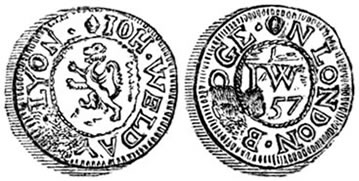
“1. A Brass Token,—Farthing size: Obverse, a Lion rampant, Legend,—‘Joh. Welday. at. ye Lyon,’—Reverse,—‘on London Bridge. I.W. 1657.’
“2. A Brass, or base copper Token,—Farthing size: Obverse, a Sugar Loaf, Legend,—‘Edw. Muns at the Sugar’—Reverse,—‘Loaf on London Bridge. 1668. His Halfepenny.’
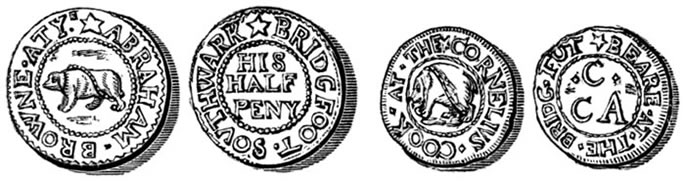
“3. A Copper Token,—Farthing size: Obverse, a Bear passant, chained, Legend,—‘Abraham Browne. at. ye’—Reverse,—‘Bridg foot. Sovthwark. His Half peny.’
“4. A Brass, or base Copper Token,—Farthing size: Obverse, a Dog, Legend,—‘Joseph Brocket,’—Reverse,—‘Bridgfoot Southwark. B.IM.’
“5. A Copper Token,—Farthing size: Obverse, a Bear passant, chained, Legend,—‘Cornelivs. Cook. at. the’—Reverse,—‘Beare. at. the. Bridg. fot. C.CA.’
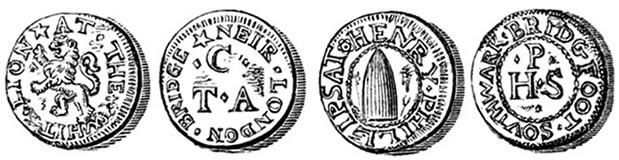
“6. A Brass Token,—Farthing size: Obverse, a Lion rampant, Legend,—‘At. the. Whit. Lyon,’—Reverse,—‘Neir London Bridge. C.T.A.’
“7. A Copper Token,—Farthing size: Obverse, a Sugar loaf, Legend,—‘Henry. Phillips, at.’—Reverse,—‘Bridg. Foot. Sovthwark. P.H.S.’
“Such, then, are some specimens of the Tradesmen’s Tokens current on London Bridge; and though they are sufficiently rude in their workmanship, and base in their metal, yet with some collectors, they are of a far greater degree of rarity, and of value too, than the handsomest modern silver coin you could present them with. You will observe, however, that I have noticed those Tokens only, on which the Bridge is actually mentioned; but an extensive list of such as were issued in Southwark, will be found in Messrs. Manning’s and Bray’s ‘History of Surrey,’ already referred to, volume iii., Appendix, pages cxi-cxv. Let me add too, that my authorities for these historical notices of coins, have been ‘An Essay on Medals,’ by John Pinkerton, London, 1789, octavo, volume i.; and ‘Annals of the Coinage of Britain,’ by the Rev. Rogers Ruding, London, 1819, octavo, volume iii., pages 127, 319, 324, volume iv., page 61. I must not, however, conclude these particulars of the numismatic reliques of London Bridge, without observing to you that there are some Medalets also extant, commemorative of its buildings. Of these coins we find a list in James Conder’s elegant volumes, entitled ‘An Arrangement of Provincial Coins, Tokens, and Medalets, issued in Great Britain, Ireland, and the Colonies, within the last twenty years, from the farthing to the penny size.’ Ipswich, 1798, octavo. Medalets, you know, Mr. Postern, are of that description of coins which were struck by the Romans, and used for scattering to the people upon solemn occasions: and those of which I am now speaking are of the class distinguished by bearing the representation of public buildings. In volume i., pages 72 and 73, of Mr. Conder’s work, are mentioned the following Medalets of London Bridge, of the penny size, executed by P. Kempson.
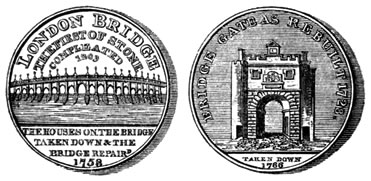
No. 40. A Bronzed or Copper Medalet: Obverse, a view of a Bridge, Legend,—‘London Bridge the first of stone, compleated 1209.’ Legend on the Exergue,—‘The houses on the Bridge taken down, and the Bridge repair’d, 1758.’—Reverse, a figure of Britannia with spear and shield, seated on a rock, holding an olive-branch;—Legend, indented on a raised circle round the field, ‘British Penny Token.’ On the Exergue a cypher ‘P.K.—MDCCXCVII.’ Legend on the edge,—‘I promise to pay on demand the Bearer one Penny.’
No. 47. A Bronzed or Copper Medalet: Obverse, an ancient gateway,—Legend,—‘Bridge Gate as rebuilt 1728.’—Legend on the Exergue, ‘Taken down, 1766.’ Reverse, an upright figure of Justice. Legend and date on the rim as before.
There were also two Medalets of the halfpenny size, executed by P. Skidmore, of Coppice Row, Clerkenwell, which are likewise mentioned by Conder, in volume i., pages 103, 106.
No. 267. A Bronzed or Copper Medalet: Obverse, a view of a church,—Legend,—‘St. Magnus London Bridge. 1676.’—Reverse, a cypher, ‘P.S.Co.,’ in a circle, Legend,—‘Dedicated to collectors of Medals and Coins.’
No. 300. A Bronzed or Copper Medalet: Obverse, an ancient gateway,—Legend,—‘Bridge Gate, Bt. 1728:’ within the Archway the name of ‘Jacobs.’—Reverse, as before.
“I am inclined to think, Mr. Barnaby Postern, that there have been several traditional mistakes perpetuated, as to persons supposed to have dwelt upon London Bridge; for, upon investigating the subject, I can find no authority to support my recording them as inhabitants of that part of London. The author of an exceedingly amusing work, entitled ‘Wine and Walnuts,’ London, 1823, octavo, in which are contained many witty scenes and curious conversations of eminent characters in the last century, has entitled the seventh chapter of his second volume ‘Old London Bridge; with portraits of some of its inhabitants.’ In this article, on page 81, we are told that ‘Master John Bunyan, one of your heaven-born geniuses, resided, for some time, upon London Bridge;’ though I cannot discover any such circumstance in either of the lives of that good man now extant, though he certainly preached, for some time, at a Chapel in Southwark. Perhaps, however, this assertion may be explained by the following passage from the Preface affixed to the Index attached to the first volume of ‘The Labours of that eminent servant of Christ Mr. John Bunyan,’ London, 1692, folio. It is there stated, that in 1688 ‘he published six books, being the time of K. James 2d’s. liberty of conscience, and was seized with a sweating distemper, of which, after his some weeks going about, proved his death, at his very loving friend’s Mr. Strudwick’s, a Grocer,’—at the sign of the Star,—‘at Holborn Bridge, London, on August 31st.’ It is also recorded on the same page of ‘Wine and Walnuts,’ that ‘Master Abel, the great importer of wines, was another of the marvels of old London Bridge; he set up a sign, Thank God I am Abel, quoth the wag, and had, in front of his house, the sign of a bell.’ As I have also heard the same particulars repeated elsewhere, it is possible that there may be some traditionary authority for them; but upon carefully reading over the very rare tracts relating to Mr. Alderman Abel, preserved in the British Museum, I find nothing concerning his residence on London Bridge, and I should rather imagine, from their statements, that he lived at his Ticket, or Patent Office, situate in Aldermary Church-Yard. The same chapter, however, contains some authentic notices of Artists who really did live upon this venerable edifice. Of these, one of the most eminent was Hans Holbein, the great painter of the Court of Henry VIII.; but though we can hardly suppose that he inhabited the Nonesuch House, yet his actual residence here is certified by Lord Orford, in his ‘Anecdotes of Painting,’ vide his ‘Works,’ edit. London, 1798-1822, quarto, volume iii., page 72, note. ‘The father of the Lord Treasurer Oxford’—says the noble author in that place,—‘passing over London Bridge, was caught in a shower; and stepping into a goldsmith’s shop for shelter, he found there a picture of Holbein,—who had lived in that house,—and his family. He offered the goldsmith £100. for it, who consented to let him have it, but desired first to shew it to some persons. Immediately after, happened the fire of London, and the picture was destroyed.’ Another famous Artist of London Bridge, who is mentioned in both the works which I last cited, was Peter Monamy; so excellent a painter of marine subjects, as to be considered but little inferior to Vandevelde himself. Lord Orford says of him, at page 421, that he ‘received his first rudiments of drawing from a sign and house-painter on London Bridge;’—and that ‘the shallow waves, that rolled under his window, taught young Monamy what his master could not teach him, and fitted him to paint the turbulence of the ocean.’ This artist died at Westminster in 1749. We are also informed, by Edward Edwards, in his ‘Continuation of Walpole’s Anecdotes of Painting,’ London, 1808, quarto, page 214, that Dominic Serres, the Marine Painter, who died in 1793, also once kept a shop upon London Bridge. To these celebrated men, the author of ‘Wine and Walnuts’ adds Jack Laguerre, the Engraver, ‘a great humourist, wit, singer, player, caricaturist, mimic, and a good scene-painter,’ son to that Louis, who painted stair-cases and saloons, where, as Pope says, ‘sprawl the saints of Verrio and Laguerre.’ His residence, according to our lively author, who states that he received his information from ‘old Dr. Monsey and others,’ was on the first floor of the dwelling of a waggish bookseller, and author of all-work, named Crispin Tucker; the owner of half-a-shop on the East side, under the Southern gate. The artist’s studio was, chiefly, in a bow-windowed back room, which projected over the Thames, and trembled at every half-ebb tide; in which Hogarth had resided in his early life, when he engraved for old John Bowles, of the Black Horse in Cornhill. It resembled, we are told, on page 135 of the work and volume which I have already quoted, one of the alchemist’s laboratories from the pencil of the elder Teniers. It was ‘a complete smoke-stained confusionary, with a German-stove, crucibles, pipkins, nests of drawers, with rings of twine to pull them out; here a box of asphaltum, there glass-stoppered bottles, varnishes, dabbers, gravers, etching-tools, walls of wax, obsolete copper-plates, many engraved on both sides, caricatures, and poetry scribbled over the walls; a pallet hung up as an heir-loom, the colours dry upon it, hard as stone; an easel; all the multifarious arcanalia of engraving, and, lastly, a Printing-press!’ This curious picture is also from the information of Dr. Monsey, but I cannot produce you any other authority for its truth; and I shall likewise, therefore, leave you to read, and judge for yourself, the amusing account of Dean Swift’s and Pope’s visits and conversations with Crispin Tucker, of London Bridge, in chapters viii. and ix. of the work I have referred to.
“It was, however, not only the ordinary buildings in the Bridge-street, which were formerly occupied as shops and warehouses, but even the Chapel of St. Thomas, which, in its later years, was called Chapel-House, and the Nonesuch-House, were used for similar purposes before they were taken down. Mr. John Nichols, in his ‘Literary Anecdotes,’ tells us, volume vi., part i., page 402, note, on the authority of Dr. Ducarel, that ‘the house over the Chapel belonged to Mr. Baldwin, Haberdasher, who was born there; and when, at seventy-one, he was ordered to go to Chislehurst for a change of air, he could not sleep in the country, for want of the noise,’—the roaring and rushing of the tide beneath the Bridge,—‘he had been always used to hear.’ My good friend, Mr. J. T. Smith, too, in his very interesting volume of the ‘Ancient Topography of London,’ which you have already quoted, page 26, has also the following observations concerning the modern use of this Chapel. ‘By the Morning Advertiser,’ says he, ‘for April 26th, 1798, it appears that Aldermen Gill and Wright had been in partnership upwards of fifty years; and that their shop stood on the centre of London Bridge, and their warehouse for paper was directly under it, which was a Chapel for divine service, in one of the old arches; and, long within legal memory, the service was performed every sabbath and Saint’s day. Although the floor was always, at high-water mark, from ten to twelve feet under the surface; yet such was the excellency of the materials and the masonry, that not the least damp, or leak, ever happened, and the paper was kept as safe and dry as it would have been in a garret.’ In that ‘Survey of the Cities of London and Westminster,’ printed in 1734, and purporting to have been compiled by Robert Seymour, Esq., but which was in reality the production of the Rev. John Motley, the famous collector of Joe Miller’s Jests, it is stated in volume i., book i., page 48, that at that time one side of the Nonesuch House was inhabited by Mr. Bray, a Stationer, and the other by Mr. West, a Dry-Salter. So much then, Mr. Barnaby, for the few anecdotes which I have been able to collect of the dwellings and inhabitants of old London Bridge.”
“And a very fair Memorial too, Master Geoffrey,” answered the Antiquary, “especially when we consider the extreme difficulty of procuring such information as this is: but, to carry on our history, I must now enter upon a less amusing subject; the summary of the Bridge Accounts for the years 1624 and 1625, taken from the printed sheet which I have so often cited. ‘1624. To John Langley, and Richard Foxe, Bridge-Masters, half a year’s fee at our Lady-day, £50: and for the other half year augmented by order of the Court of Aldermen, £66. 8s. 4d., and for their Liveries, &c. £6. Total £122. 8s. 4d. Rental £2054. 4s. 2d.—1625. To the said Bridge-Masters, £133. 6s. 8d. Liveries, &c. £6. Total to each of them, £69. 3s. 4d. Rental, £2054. 4s. 2d.’ These notices of the prosperity of this edifice, conduct us down to the time when so much of its glory was lost in devastating flames and mouldering ruins.
“The year 1632-33 must be ever memorable in the history of London Bridge: for scarcely in the awful conflagration which consumed almost the whole City, did our brave old edifice suffer so severely. And now, Mr. Barbican, you must forgive me if I be a little prolix in describing that desolating fire, since it not only destroyed more than a third part of the Bridge Houses, but, at one time, its ravages were feared even in the City itself. I shall commence my account then by reminding you that Richard Bloome, one of Stow’s continuators, on page 61 of his ‘Survey,’ thus speaks of the calamity. ‘On the 13th day of February, between eleven and twelve at night, there happened in the house of one Briggs, a Needle-maker near St. Magnus Church, at the North end of the Bridge, by the carelessness of a Maid-Servant setting a tub of hot sea-coal ashes under a pair of stairs, a sad and lamentable fire, which consumed all the buildings before eight of the clock the next morning, from the North end of the Bridge to the first vacancy on both sides, containing forty-two houses; water then being very scarce, the Thames being almost frozen over. Beneath, in the vaults and cellars, the fire remained glowing and burning a whole week after.’
“There are not wanting several general views of London taken before this fire, by which we are made acquainted with those extensive piles of dwellings it destroyed; several of which I have already mentioned to you. Another also, which is most excellent and rare, is that entitled in Latin, ‘London the most flourishing City of Britain, and the most celebrated emporium of the whole world.’ It was engraven by John Visscher in 1616, and published in Holland, ‘by Jud. Hondius at the sign of the Watchful Dog;’ a four sheet print measuring 7 feet 1½ inch by 1 foot 4¾ inches, with an English description beneath it. ‘A Capital View,’ adds Gough, in his ‘British Topography,’ already cited, volume i., page 749, ‘the plates destroyed in Holland about twenty years ago. T. Davies sold the only impression of it to the King for ten guineas.’ There is, likewise, a variation of this view, without a date, having eight Latin verses at either corner, with the name of ‘Ludovicus Hondius Lusitt.’ It is, says Mr. J. T. Smith, in his ‘Ancient Topography of London,’ page 25, ‘extremely well executed, and exhibits a wind-mill standing in the Strand, very near where the New Church is now erected; and another above the Water-works at Queenhithe.’ He considers it as earlier than the productions of Hollar, from the circumstance that the Palace of Whitehall appears in its original state, before the Banquetting House and York and Somerset Water-gates were erected by Inigo Jones. It is also shewn to be a view of the time of King James I., by a royal procession being introduced on the water, in which the royal barge is surmounted by the thistle. London Bridge forms a very large and important feature in this engraving, and I have been informed, that the edifice alone was copied in quarto, for the work entitled ‘London before the Great Fire;’ but as that publication stopped with the second number, it was never exhibited for sale.
Of the very curious print by Visscher, however,—and I must not forget to observe that a fine impression of it is in the possession of John Dent, Esq.—there was also an imitation of the same size, but somewhat inferior, called, from the place where it was engraven, ‘the Venetian copy of Visscher’s View.’ It is, like its prototype, entitled in Latin, ‘London the most flourishing City in Britain,’ &c. to which is added, ‘Printed in Venice, by Nicolo Misserini, 1629, Franco Valegio fecit:’ it also contains a Latin dedication, and a description in Italian. There is an impression, probably, of this latter print, preserved in volume xiii. of the famous illustrated Pennant’s London, bequeathed by the late Charles Crowle, Esq. to the British Museum; but all the inscriptions have been cruelly cut away, and the print itself doubled in numerous folds to make it fit to the size of the volume! This engraving, however, bears the name of Rombout Vanden Hoege, and shews us, with great minuteness, on rather a large scale, the Group of Buildings on London Bridge, burned down in 1632-33,
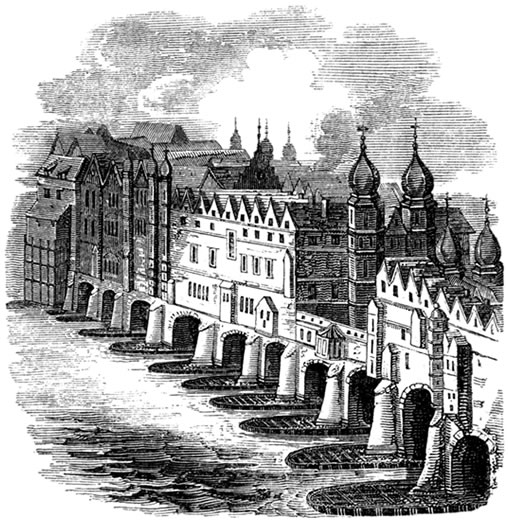
which extended to the first opening, and which, from the very appearance which they present, must have contained a considerable number of inhabitants; but of the fire itself, and of all the distressing events attending it, I am about to give you a very particular and interesting account, from the pen of an eye-witness of the conflagration. This narrative is contained in a coarse paper Manuscript volume, of a small quarto size, written in the print-hand of the 17th century, with some lines of faded red ink and chalk interspersed. The volume contains 517 pages in all, and is entitled ‘A Record of the Mercies of God; or, a Thankefull Remembrance;’ it being a collection, or journal, of remarkable providences and reflections, made by one Nehemiah Wallington, a Puritan Citizen and Turner, who lived in Little East-cheap, and who was evidently a friend of Burton and Bastwick, he having been several times examined concerning them before the Court of Star-Chamber. In this most singular record then, at pages 479-488, is an article entitled ‘Of the great fire vpon the Bridge;’ preceded by Mottoes from Psalms lxvi. 5; lxxi. 17; cxi. 2; Isaiah xlv. 7; and Amos iii. 6; which runs in the following terms.
“‘1633. It is the bounden dutie of vs all that haue beene the beholders of the wonderfull workes of the Lord our God, his mercyes and iudgements shewed heretofore; and now of late of a fearefull fire, wee should not forgett itt ourselues, and we should declare it to all others, euen to ye generations to come.—On the xi. day of February, (being Monday, 1633) began, by God’s iust hand, a fearefull fire in the house of one Mr. Iohn Brigges, neere tenn of the clocke att night, it burnt down his house and the next house, with all the goods that were in them; and, as I heere, that Briggs, his wife, and childe, escaped with their liues very hardly, hauing nothing on their bodies but their shurt and smoke: and the fire burnt so fearcely, that itt could not be quenched till it had burnt downe all the houses on both sides of the way, from S. Magnes Church to the first open place. And allthough there was water enough very neere, yet they could not safely come at it, but all the conduittes neere were opened, and the pipes that carried watter through the streets were cutt open, and the watter swept down with broomes with helpe enough; but it was the will of God it should not preuaile. And the hand of God was the more seene in this, in as much as no meanes would prosper. For the 3 Engines, which are such excellent things, that nothing that euer was deuised could do so much good, yet none of these did prosper, for they were all broken, and the tide was verie low that they could get no watter; and the pipes that were cutt yeilded but littel watter. Some ladders were broke to the hurt of many, for some had their legges broke, some had their armes, and some their ribbes broken, and many lost their liues. This fire burnt fiercely all night, and part of the next day (for my man was there about twelue a cloke, and he said he did see the fardest house on fire) till all was burnt and pulled downe to the ground. Yet the timber, and wood, and coales in the sellers, could not be quenched all that weeke, till the Tuesday following, in the afternoone, the xix of February, for I was there then my selfe, and had a liue cole of fire in my hand, and burnt my finger with it. Notwithstanding there were as many night and day as could labour one by another to carry away timber, and brickes, and tiles, and rubbish cast downe into the liters. So that on Wensday the Bridge was cleared that passengers might goe ouer.’
“‘At the begining of this fire, as I lay in my bed and heard ye sweeping of the channels and crying for water, water, I arose about one of the cloke, and looked downe Fish-street-hill, and did behold such a fearfull and dreadfull fire vaunting it selfe ouer the tops of houses, like a Captaine florishing and displaying his banner; and seeing so much meanes and so little good, it did make me thinke of that fire which the Lord threateneth against Ierusalem, for the breach of his Sabbath day. He saith thus: ‘But if ye will not here me to sanctifie the Sabbath day, and to beare no burden, nor to goe through ye gates of Ierusalem in the Sabbath day, then will I kindle a fire in ye gates there, and it shall deuoure the palaces of Ierusalem, and it shall not be quenched.’ Iere. xvii. 27.
“‘I did heere that on the other side of ye Bridge, the Bruers brought abundance of watter in vessells on their draies, which did, with the blissing of God, much good; and this mircie of God I thought on, that there was but littel wind; for had ye wind bin as high as it was a weeke before, I thinke it would have indangered ye most part of the Citie; for in Thames Street there is much pitch, tarre, rosen, and oyle, in their houses: Therefore, as God remembers mercy in iustice, let us remember thankefullnes in sorrow. ‘Therefore will I praise the Lord with my whole heart, and I will speake of all thy marvellous workes;’ ‘for it is of the Lord’s mercy that wee are not consumed,’ Lament. iii., 22. The Names, and Trades, and number of the Houses burnt vpon the Bridg, heere you may see vnder nethe.—
“‘1. Mr. William Vyner,—Haberdasher of smal Wares. 2. Mr. Iohn Broome,—Hosier. 3. Mr. Arther Lee,—Haberdasher of smal Wares. 4. Mris. Iohane Broome,—Hosier. 5. Mr. Ralph Panne,—Shewmaker. 6. Mr. Abraham Marten,—Haberdasher of Hattes. 7. Mr. Ieremiah Champney,—Hosier. 8. Mr. John Terrill,—Silke man. 9. Mr. Ellis Midmore,—Milliner. 10. Mr. Francis Finch,—Hosier. 11. Mr. Andrewe Bouth,—Haberdasher of small Wares. 12. Mr. Samuel Petty,—Glouer. 13. Mr. Valentin Beale,—Mercer. 14. Mris. —— Chambers, Senior. 15. Mr. Ieremiah Chamley,—Silke man. 16. The Blew Bore,—empti. 17. Mr. Iohn Gouer,—Stiller of Strong Waters. 18. Mr. Iohn Wilding, Iunior,—Girdler. 19. Mr. Daniel Conney,—Silke man. 20. Mr. Stephen Beale,—Lyning Draper. 21. Mris. Iane Langham,—Mercer. 22. Mr. Iames Dunkin, Wolling Draper. 23. Mr. Matthew Harding,—Salter. 24. Mr. Abraham Chambers,—Haberdasher of smal Wares. 25. and 26.—Mr. Lyne Daniel,—Haberdasher of Hattes, a double house. 27. Mris. —— Brookes,—Glouer. 28. Mr. —— Couerley,—Hosier. 29. Mr. Iohn Dransfielde,—Grocer. 30. Mr. Newman, emptie. 31. Mr. Edward Warnett, and 32. Mr. Samuel Wood, partoners,—Haberdashers of Small Wares. 33. Mr. Iohn Greene,—Haberdasher of Hattes. 34. Mr. Heugh Powel,—Haberdasher of Hattes. 35. Mr. Samuel Armitage,—Haberdasher of Small Wares. 36. Mr. Iohn Sherley,—Haberdasher of Small Wares. 37. Mr. John Lawrymore,—Grocer. 38. Mr. Timothy Drake,—Woolling Draper. 39. Mr. Iohn Brigges,—Needle-maker.’—at whose house the fire commenced,—‘40. Mr. Richard Shelbuery,—Scriuener. 41. Mr. Edward Greene,—Hosier. 42. Mr. —— Hazard,—the Curate, and 43. Mr. —— Hewlett,—the Clarke,—at S. Magnus Cloyster.’
“This narrative has, however, already appeared in print in the ‘Gentleman’s Magazine’ for November, 1824, pages 387, 388; the extract having been furnished by the possessor of the volume, Mr. William Upcott, of the London Institution.
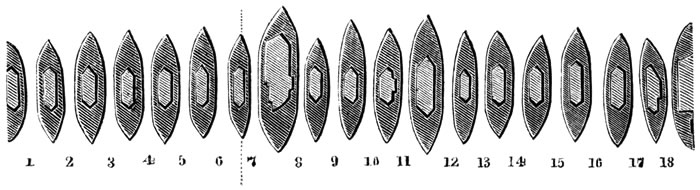
“Of the ground-plot of London Bridge, after the damage done by this fire, there is yet extant a very curious survey, preserved under the care of Mr. Smith, in the British Museum. It consists of an unpublished drawing on parchment, measuring four feet five inches in length, by ten inches in breadth: and it, perhaps, belonged to Sir Hans Sloane, as it is kept with some other fragmenta of his property. In this drawing, the piers are represented in a tint of yellow, placed upon sterlings of Indian ink; and it was executed, as I suppose, soon after this fatal conflagration, since there is a note written in an ancient hand attached to the seventh pier from the City end, stating that ‘the Fire burnt to the prickt line,’ which is drawn from it; and which accords with all the subsequent views taken of the platform, and houses on the Bridge.
“I am next to speak,” continued my unwearied Historian, “of the manner in which this terrible destruction of London Bridge was repaired: and concerning this we are informed by Richard Bloome, a Continuator of Stow, who tells us in his ‘Survey,’ volume i., page 61, that after the fire, ‘this North end of the Bridge lay unbuilt for many years, only deal boards were set up on both sides, to prevent people’s falling into the Thames, many of which deals were, by high winds, oft blown down, which made it very dangerous in the nights, although there were lanthorns and candles hung upon all the cross beams that held the pales together.’ We have two views of London Bridge, in which the Northern end of it appears in this state, but in each of them the temporary erection is quite of a different nature; and it is somewhat singular that the writer whom I last cited, should positively speak as follows, concerning the early restoration of the destroyed houses, when there seems no real authority to support his assertions. ‘For about the year 1645,’—says he,—‘the North end of this part last burned, began to be rebuilt; and in the year 1646 was finished: the building was of timber, very substantial and beautiful, for the houses were three stories high, besides the cellars, which were within and between the piers. And over the houses were stately platforms leaded, with rails and ballusters about them, very commodious and pleasant for walking, and enjoying so fine a prospect up and down the River; and some had pretty little gardens with arbours. This half being finished, the other half was intended to be rebuilt answerable to this, which would have been a great glory to the Bridge and honour to the City, the street, or passage, being twenty feet broad; whereas the other part, at the South end, was not above fourteen, and, in some places, but twelve.’
“Now, notwithstanding this particular description of these new buildings, neither of the engravings which I have alluded to have any indications of them; although one of them was published in 1647, and the other in 1666. The first of these represents the North end of London Bridge, from St. Magnus’ Church to the houses beyond the first opening, as occupied by a covered passage formed of planks, leaving recesses standing out from the main erection, which was supported by buttresses of wood fastened to platforms on the outside of the Bridge.
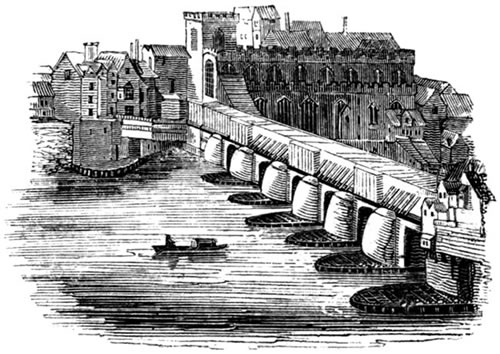
“We derive this view of the dilapidations of London Bridge from a very rare and magnificent print, well known to collectors and antiquaries, by the name of the ‘Long Antwerp view of London;’ for which, Mr. Geoffrey Barbican, if you ever meet with it, you may consider twenty guineas as a very moderate price. This famous engraving is an etching by the matchless Wenceslaus Hollar; it is in seven sheets, measuring two yards and an half in length, by 17½ inches in height: it bears a dedication to Queen Henrietta Maria, and William Prince of Orange, with a copy of Latin verses written by Edward Benlowes, Esq.; and, though it was sold in London, the following publication line appears on one side written in Latin:—‘Sold at Amsterdam by Cornelius Danckers, in Calf Street, at the sign of the Image of Gratitude, in the year 1647.’ The e is, by the way, a pretty fair, but smaller copy of this view of London and Westminster in two sheets, in a series of prints commonly called ‘Boydell’s Perspectives,’ measuring 37½ inches, by 10¼ inches, signed ‘R. Benning, del. et sculp.,’ and entitled ‘A View of London as it was in the year 1647.’ The publication line is, ‘Sold by J. Boydell, Engraver, at the Unicorn in Cheapside, London, 1756.’ You will find both the original, and the copy, in the xiii.th and xiv.th volumes of Mr. Crowle’s Illustrated Pennant, which I have already cited to you, and the view takes in from above the Parliament House at Westminster to beyond St. Catherine’s; but the Bridge is the keimelion of the plate, for that noble edifice is represented with all its buildings, from St. Magnus’ Church, down to the Southwark Tower, the size of 10 inches in length, with the principal buildings about two inches square. The other view to which I have alluded, was also etched by Hollar, upon two sheets measuring 27 inches by 4¼: and it consists of two prospects, one over the other, on the same plate, the upper one representing, ‘London from St. Mary Overies Steeple in Southwark, in its flourishing condition before the Fire;’ and the lower one entitled, ‘Another prospect of the said City, taken from the same place, as it appeareth now after the said calamity and destruction by Fire.’ Copies of these interesting etchings are, however, neither dear nor uncommon; though, if you would have so fine an impression as that in the Print Room of the British Museum, you will scarcely procure it under three Guineas. In the upper of these prospects, the Northern end of London Bridge is shewn to be a passage fenced by wooden palings without any houses, excepting one building, which occupies the whole width of the Bridge; having a gate in it surmounted by the King’s Arms, and standing immediately before the old Church of St. Magnus.
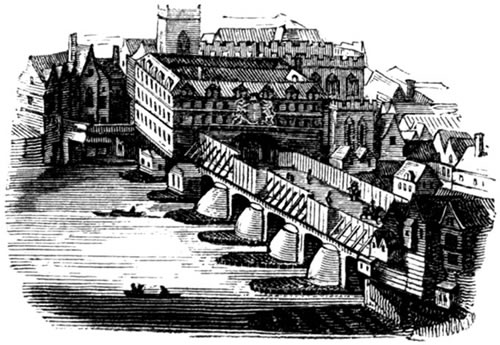
“Independently of these views, we have another very strong evidence that this part was not built upon even in the year 1665, contained in that most interesting and curious work, the ‘Memoirs and Diary of Samuel Pepys, Esq., F.R.S. and Secretary to the Admiralty in the reigns of Charles II. and James II.’ Edited by Richard, Lord Braybrooke, London, 1825, 4to. volume 1., page 388: where, under the date of January 24th, 1665-66, that observant journalist has the following entry. ‘My Lord,’—Edward Montague, Earl of Sandwich,—‘and I, the weather being a little fairer, went by water to Deptford; and the wind being again very furious, so as we durst not go by water, walked to London round the Bridge, no boat being able to stirre; and, Lord! what a dirty walk we had, and so strong the wind, that in the fields we many times could not carry our bodies against it, but were driven backwards. It was dangerous to walk the streets, the bricks and tiles falling from the houses, that the whole streets were covered with them; and whole chimneys, nay, whole houses, in two or three places, blowed down. But above all, the pales on London Bridge, on both sides, were blown away;’—almost the very words, you observe, which I have quoted you from Richard Bloome,—‘so that we were forced to stoop very low, for fear of blowing off the Bridge. We could see no boats in the Thames afloat, but what were broke loose, and carried through the Bridge, it being ebbing water. And the greatest sight of all was, among other parcels of ships driven here and there in clusters together, one was quite overset, and lay with her masts all along in the water, and her keel above water.’ The desolation, and wintry chillness of this picture, is enough to make one shiver even in the Dog-days.”
When the worthy old Chronicler had arrived at the conclusion of this narrative, as usual I took up the story, and began thus:—“This, Mr. Barnaby Postern, was indeed a fatal destruction, and one would imagine that it was no such happy event as to cause a jesting ballad to be made to commemorate it; but yet, though in the following verses there are some discordant circumstances, and even the date is at variance with that which you have already given, there can be little doubt but that they relate to the Fire of which you have now spoken. You will find them printed at the end of a very rare, but, at the same time, a very worthless publication, entitled ‘The Loves of Hero and Leander, a mock Poem: Together with choice Poems and rare pieces of drollery, got by heart, and often repeated by divers witty Gentlemen and Ladies that use to walke in the New Exchange, and at their recreations in Hide Park.’ London, 1653, 12mo., pages 44-48. There is also another edition of 1682; but I pray you to remember, that many of the fescennine rhymes, some of which would have done honour to Hudibras, and many of the witty points of this song, are, in that latter copy, most vilely perverted; I shall give it you, therefore, as it stands in the former impression.
‘Some Christian people all give ear Unto the grief of us: Caused by the death of three children dear. The which it happen’d thus. And eke there befel an accident, By fault of a Carpenter’s son, Who to saw chips his sharp ax-e-lent Woe worth the time may Lon—— May London say: Woe worth the Carpenter! And all such block-head fools; Would he were hanged up like a sarpent here For meddling with edge tools. For into the chips there fell a spark, Which put out in such flames, That it was known into South-wark Which lies beyond the Thames. For Loe! the Bridge was wondrous high With water underneath: O’er which as many fishes fly As birds therein do breathe. And yet the fire consumed the Brigg, Not far from place of landing; And though the building was full big, It fell down,—not with standing. And eke into the water fell So many pewter dishes, That a man might have taken up very well Both boil’d and roasted fishes! And thus the Bridge of London Town, For building that was sumptuous, Was all by fire half burnt down, For being too contumptious! Thus you have all but half my song, Pray list to what comes ater; For now I have cool’d you with the fire,— I’ll warm you with the water! I’ll tell you what the River’s name’s Where these children did slide—a, It was fair London’s swiftest Thames Which keeps both Time and Tide—a. All on the tenth of January, To the wonder of much people; ’Twas frozen o’er that well ’twould bear Almost a country steeple! Three children sliding thereabout, Upon a place too thin; That so at last it did fall out, That they did all fall in. A great Lord there was that laid with the King, And with the King great wager makes; But when he saw that he could not win He sigh’d,—and would have drawn stakes. He said it would bear a man for to slide, And laid a hundred pound; The King said it would break, and so it did, For three children there were drown’d. Of which, one’s head was from his should— ers stricken,—whose name was John; Who then cried out as loud as he could ‘Oh Lon-a! Lon-a! Lon-don!’ ‘Oh! tut—tut—turn from thy sinful race!’ Thus did his speech decay; I wonder that in such a case He had no more to say. And thus being drown’d, Alack! Alack! The water ran down their throats, And stopp’d their breath three hours by the clock, Before they could get any boats! Ye parents all that children have, And ye that have none yet, Preserve your children from the grave, And teach them at home to sit. For had these at a sermon been, Or else upon dry ground, Why then I never would have been seen, If that they had been drown’d! Even as a huntsman ties his dogs, For fear they should go fro him; So tye your children with severity’s clogs, Untie ’em—and you’ll undo ’em. God bless our noble Parliament, And rid them from all fears; God bless all the Commons of this land, And God bless—some of the Peers!’
“And now, Sir, I shall, by your favour, say a few words with respect to the tune to which these verses were formerly sung; which I am the better enabled to do by the researches of a gentleman, to whom, in several other particulars of our history, I have been considerably indebted. By his information, I shall first inform you, that the foregoing Song exists in its original state, in the Pepysian Collection of Ballads preserved in Magdalen College, Cambridge, volume ii., page 146; where it is called ‘The Lamentation of a bad market, or the drownding of three children on the Thames. To the tune of the Ladies’ Fall. Printed for F. Coles, T. Vere, J. Wright, and J. Clarke.’ Now the old verses, entitled ‘A Lamentable Ballad of the Lady’s Fall,’ you will find, with some account of it prefixed, in Bishop Percy’s ‘Reliques of Ancient English Poetry,’ volume iii., book ii., article x., page 137, fourth edition, London, 1794, octavo; or, indeed, you may consult any edition but the last. From the Editor’s notice of this latter poem, we learn that it was sung to the tune of the verses called ‘The Shepherd’s Slumber;’ better known by the first three words of the commencing stanza.
‘In pescod time, when hound to horne Gives eare till buck be kill’d; And little lads with pipes of corne, Sate keeping beasts a-field.’
“I have not, Mr. Barnaby, found the musical notation of this song, though I am almost inclined to think it was sung to the very common tune of ‘Flying Fame,’ so familiar to every body under the name of ‘Chevy Chace;’ for in volume iv., page 1, of Tom D’Urfey’s collection of Songs called ‘Wit and Mirth,’ London, 1719, 12mo., you may see this very ballad on London Bridge, entitled ‘Three children sliding on the Thames. Tune, Chevy chace.’ Listen then, my good Sir, whilst, with my very unmelodious voice, I attempt to give you some idea of it;—the music I have alluded to, runs thus:—
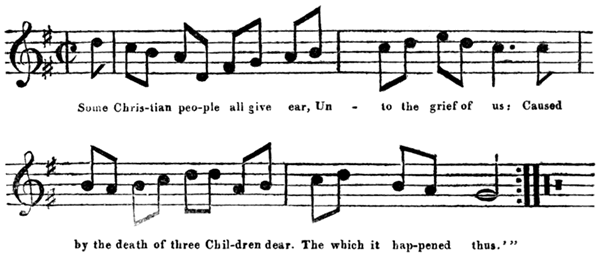
[Listen to MIDI]
‘Some Chris-tian peo-ple all give ear, Un-to the grief of us: Caused by the death of three Chil-dren dear. The which it hap-pened thus.’”
“Thank ye, thank ye, honest Master Geoffrey Barbican,” said my visitor, as I concluded; “my thanks to you, both for your music and poetry; for I verily think as you do, that the verses which you have repeated relate to this conflagration of 1633, although there was the difference of a month between the actual fact, and your rhyming record of it. It appears to me, too, as if I recognized in the 16th stanza,—where the last words of the drowning victim are uttered by his head in broken accents,—the original of Gay’s description of the death of Doll, the Pippin-woman, contained in the 2nd book of his ‘Trivia,’ since she died in much the same place and manner.
“The rental of the Bridge House was, doubtless considerably lessened by this destructive fire; but in the printed document of the Bridge-Masters’ Accounts, there is not any notice of the amount of rents for some years after it. In 1636, however, we are informed that the salaries, horsekeeping, and liveries, of John Potter, and David Bourne, the Wardens, amounted to £71. 3s. 4d. each; and in the following year the rental is stated to have been only £1836. 7s. 6d., whilst the fees, &c. of John Hawes and Noadiah Rawlins amounted to £72. In that Manuscript treatise on the payment of Tythes, which I have mentioned to you as being in the Archiepiscopal Library at Lambeth, Cornelius Burgess, the then Rector of St. Magnus, observes that ‘the best third part of the Parish was consumed by the late fire on London Bridge: yet no part of the annual charges lying on the Parsonage is abated. And it is yet capable of a large improvement, by reason that a good part of it being Citty land, provisions have been accordingly made to keepe downe the tithes generally throughout the Parish to vnreasonable low proportions, some very few houses excepted.’ According to Newcourt, in his ‘Repertorium Ecclesiasticum,’ volume i., page 396, these tythes before this conflagration amounted to £109. for 90 houses, of which about 40 houses were destroyed; though, in the Manuscript valuation of 1638, they are reduced to £81. 12s. 8d.
“The destruction of London Bridge, however, was not allowed to pass without a more appropriate memorial than the song which you have repeated; for in the parochial records of the Church adjoining, it is stated, that Susanna Chambers by her will, dated the 28th day of December, 1640, left ‘unto the Parson of the Parish Church of St. Magnus, on, or near, London Bridge, or unto such other Preacher of God’s word as my said son Richard Chambers, his heirs, administrators, and assignees shall yearly appoint, the yearly sum of twenty shillings of lawful English money, for a Sermon to be preached on the 12th day of February, in every year, within the said Parish Church of St. Magnus, London Bridge, or any other near thereunto, in commemoration of God’s merciful preservation of the said Church of St. Magnus from ruin in the late and terrible fire of London Bridge; and also the sum of seventeen shillings and sixpence to the poor of that Parish of St. Magnus; and two shillings and sixpence to the clerk and sexton.’ This gift is mentioned by most of the London Historians; and I would observe to you that I am informed, with regard to the present state of this bequest, that the money for the Sermon, the Clerk, and the Sexton, has not been claimed within the memory of the oldest inhabitant of the Parish: but that the poor have, ever since, duly received their legacy. Whilst I am speaking of St. Magnus’ Church, I may also remark, that in consequence of the dissolution of the Fraternity belonging to it, which I have before mentioned, there has been a perpetuity of £21. 6s. 8d. paid by the Exchequer ever since the time of Queen Mary.
“In the 43rd volume of that most extraordinary collection of Tracts, which the late excellent King George III. presented to the British Museum, there is a pamphlet of four leaves commemorating a remarkable flow of the Thames at London Bridge, the title to which is given by Gough in his ‘British Topography,’ volume i., page 731: and it bears the same proportion to its contents, as the show-cloth of a travelling menagerie does to the actual exhibition. ‘A Strange Wonder, or the Citie’s Amazement. Being a Relation occasioned by a wonderfull and vnusuall accident, that happened in the River of Thames, Friday, Feb. 4, 1641. There flowing Two Tydes at London Bridge, within the space of an houre and a halfe, the last comming with such violence and hideous noyse, that it not onely affrighted, but even astonished above 500 watermen that stood beholding it on both sides the Thames. Which latter Tyde rose sixe foote higher then the former Tyde had done, to the great admiration of all men.’ London, 1641. Small quarto. This tract is subsequently named ‘True Newes from Heaven,’ and the author takes occasion, from the event which he records, to lament the vices and confusion of his time. The fact itself occupies but a small portion of his text; and he relates it thus.—‘Fryday, Februarie 4, 1641, it was high water at one of the clocke at noone, a time—by reason so accommodated for all imployments by water or land,—very fit to afford witnesse of a strange and notorious accident. After it was full high water, and that it flowed its full due time as all Almanacks set downe; and water-men, the vnquestionable prognosticators in that affaire, with confidence mainetaine it stood a quiet still dead water, a full houre and halfe, without moving or returning any way never so litle: Yea, the water-men flung in stickes to the streame, as near as they could guesse, which lay in the water as vpon the earth, without moving this way or that. Dishes likewise, and wodden buckets, they set a swimming, but it proved a stilling, for move they would not any way by force of stream or water; so that it seemed the water was indeed asleepe or dead, or had changed or borrowed the stability of the earth. The water-men not content with this evidence, would needs make the vtmost of the tryall, that they might report with the more boldnesse the truth of the matter: and with more credible confidence they tooke their boates and lanched into the streame or very channell: but the boates that lay hailed up on the shore moved as much, except when they used their oares; nay,—a thing worthy the admiration of all men,—they rowed under the very arches, tooke up their oares and slept there, or, at least, lay still an houre very neare, their boates not so much as moved through any way, either upward or downeward: the water seeming as plaine, quiet, even, and stable as a pavement under the arch, where, if any where in the Thames, there must be moving by reason of the narrownesse of the place. In this posture stood the water a whole houre and halfe, or rather above, by the testimony of above five hundred water-men, on either side the Thames, whom not to believe in this case were stupiditie, not discretion. At last, when all men expected its ebb, being filled with amazement that it stood so long as hath been delivered, behold a greater wonder, a new Tyde comes in! A new Tyde with a witnesse, you might easily take notice of him; so lowde he roared, that the noise was guessed to be about Greenwich when it was heard so, not onely clearly, but fearfully to the Bridge; and up he comes tumbling, roaring, and foaming in that furious manner, that it was horror unto all that beheld it. And as it gave sufficient notice to the eare of its comming, so it left sufficient satisfaction to the eye that it was now come; having raised the water foure foote higher then the first Tyde had done, foure foote by rule! as by evident measure did appear, and presently ebbed in as hasty, confused, unaccustomed manner. See here, Reader! a wonder, that—all things considered,—the oldest man never saw or heard of the like.’
“Lord Clarendon, in his ‘History of the Rebellion,’ volume i., part ii., book iv. page 521, Oxford, 1819, 8vo., states that when John Hampden and the four other members of Parliament were accused of High Treason, and were, by their own party, brought back in triumph from the City, January the 11th, 1641-42, ‘from London-Bridge to Westminster, the Thames was guarded with above a hundred lighters and longboats, laden with small pieces of ordnance, and dressed up with waistclothes and streamers, as ready for fight,’ These forces, together with the City Trained-bands under Major General Skippon, were not less to honour, than to defend, the return of the accused Members. The same noble Historian tells us farther, in the same volume and part, book v. page 661, that about the end of March in the same year, the Justices, and principal gentlemen of the County of Kent, prepared a Petition to the two Houses of Parliament, that the Militia might not be otherwise exercised in that County than according to Law, and that the Common Prayer Book might still be observed. This was construed by the Parliament into a commotion in Kent; the Earl of Bristol and Judge Mallet were committed to the Tower only for having seen it; and strong guards were placed at London Bridge, where the petitioners approaching the City were disarmed, and forced to return, and only a very few permitted to proceed with the petition to Westminster.
“That it was the unhappy custom, even late in the seventeenth century, to erect heads over the South Gate on London Bridge, we have, Alas! too many proofs; though, indeed, it seems to have been only the case with such as were considered traitors, as were those unfortunate Romish Priests executed under the Statutes of Elizabeth and James I. When Bishop Challoner is speaking, in his work already cited, volume iii., page 112, of the death of Bartholomew Roe, a Priest of the Order of St. Benedict, in January, 1642, he states that, on the morning of his execution, he exhorted the Catholics who were present at his Mass in the prison, and desired them ‘that as often as in passing through the City, they should see that hand of his fixed on one of the Gates, or in crossing the water, should see his head on London Bridge, they would remember those lessons which he had preached to them, of the importance of holding fast the Catholic faith, and of leading a Christian and holy life.’ In October, 1642, the head of Thomas Bullaker, a Priest of the Order of St. Francis, was also set up on London Bridge. See Bishop Challoner, page 132, in the same volume: and another unhappy instance of a similar execution is to be found in Dr. Challoner’s life of Henry Heath, a Father of the Order of St. Francis, contained on pages 141, 143, of the same volume of his work. Having left Douay and landed in England, this Priest travelled to the metropolis in the greatest poverty. ‘At London he arrives wearied, as well he might, having travelled barefoot forty miles that day, and it being the Winter season. It is now time to take up his quarters, and give some little rest and refreshment to the body. But how shall this be done, for money he has none, nor acquaintance? however, he ventures to call at the Star Inn, near London Bridge, but the people of the house finding that he had no money, turned him out of doors at eight o’clock in a cold winter night.’ In this distress, he laid down to rest at a Citizen’s door, where the owner of the house had him seized for a shoplifter, and, when examined by the watch, some writings in defence of the Romish faith being found in his cap, he owned himself to be a Priest. He was then tried and convicted upon the Statute of Elizabeth, and was executed on April the 17th, 1643, at Tyburn, and his head erected upon London Bridge.
“On the 7th of March, 1642, the two Houses of Parliament ordered that the City of London should be fortified, for its better security and safety; and on the day following the order was printed, in small quarto, a copy of which is in the King’s Collection of Tracts in the British Museum, volume 97; and of which, if I repeat you a portion of the title, you will receive all the information contained in the pamphlet itself. ‘An Ordinance and Declaration of the Lords and Commons assembled in Parliament, that the Lord Mayor and Citizens of the City of London, for the better securing and safetie thereof, shall have full power and authority, according to their discretion, to trench, stop, and fortifie all high-waies leading into the said City, as well within the Liberties, as without, as they shall see cause. And for the better effecting thereof, shall impose upon all the inhabitants within the same, upon every house worth £5. a year, six pence, and every house of greater rent, after the rate of two pence in the pound.’ Another copy of this ordinance was printed in April, 1643, and is to be found in volume 104 of the same collection. Maitland, in his ‘History,’ volume i., pages 368, 369, also mentions an act of Common Council passed for the same purpose, February the 23rd, 1642-43: and gives a plan of the fortifications erected round the City. It was enacted, says he, that ‘all the passages and ways leading to the City should be shut up, excepting those entering at Charing Cross, St. Giles’s in the Fields, St. John’s Street, Shoreditch, and Whitechapel; and that the exterior ends of the said streets should be fortified with breast-works and turnpikes, musket-proof; and all the sheds and buildings contiguous to London-Wall without, be taken down; and that the City Wall, with its bulwarks, be not only repaired and mounted with artillery, but, likewise, that divers new works be added to the same at places most exposed.’ When this act had been confirmed by the above ordinances of Parliament, the fortifications were commenced and carried on with considerable rapidity; men, women, and children, were employed upon the works; and, in a short time, an earthern rampart, with redoubts, horn-works, batteries, forts, and bulwarks, was erected round the Cities of London and Westminster, and the Borough of Southwark. We have no particular account, however, of the manner in which London Bridge was fortified at this period; and the great events which took place in the history of the Civil Wars seem to have swallowed up every circumstance connected with this edifice. We learn, indeed, that in the year 1647, the Parliamentary Army entered the City, whilst the Corporation was engaged in an irresolute debate as to the measures to be adopted for its defence: when frequent conciliatory messages passed between the chief Officers and London; and, the less to alarm the Metropolis, the soldiers were quartered at some distance from it. ‘However, in this calm,’—says Lord Clarendon, who relates these circumstances in his ‘History,’ volume iii., part i., book x., page 104,—‘they sent over Colonel Rainsborough with a brigade of horse, and foot, and cannon, at Hampton Court, to possess Southwark, and those works which secured that end of London Bridge; which he did with so little noise, that in one night’s march he found himself master, without any opposition, not only of the Borough of Southwark, but of all the works and forts which were to defend it; the soldiers within shaking hands with those without, and refusing to obey their officers which were to command them: so that the City, without knowing that any such thing was in agitation, found in the morning that all that avenue to the Town was possessed by the enemy; whom they were providing to resist on the other side, being as confident of this that they had lost, as of any gate in the City.’
“Bulstrode Whitelock, in his ‘Memorials of the English Affairs,’ London, 1732, folio, page 263, enables us to add to this account, that on Colonel Rainsborough’s advance to Southwark, he found the Bridge gates shut, the Portcullis lowered, and a guard within; but upon placing a counter-guard with two pieces of ordnance, against the gate, in a short time the great fort was surrendered; about two in the morning of Monday, the 2nd of August, 1647.
“A curious invention, which, very probably, was never carried into execution, was, in the year 1643, connected with the history of London Bridge; being the scheme of an unsuccessful engineer named Captain John Bulmer. You may see an original copy of his ‘Propositions in the Office of Assurance, London, for the Blowing up of a Boat and a man over London Bridge,’ in the King’s Collection of Tracts in the British Museum, Miscellaneous Pieces, volume 3*, folio, article 88. In this statement, which consists of a broadside of one page, he thus commences. ‘In the name of God, Amen, John Bulmer, of London, Esquire: Master and Surveiour Generall of the King’s Maiestie’s Mines Royall, and Engines for Water-workes, propoundeth—by God’s assistance,—that he, the said John Bulmer, shall and will, at and in a flowing water, set out a Boat or Vessell with an Engine, floating with a man or a boy in and aboard the said Boat, in the River of Thames, over against the Tower-wharfe, or lower. Which said Boat, with the said man or boy in or aboard her, shall the same tide, before low-water againe, by art of the said John Bulmer, and helpe of the said engine, be advanced and elevated so high, as that the same shall passe and be delivered over London Bridge, together with the said man or boy in and aboard her, and floate againe in the said River of Thames, on the other side of the said Bridge, in safety.’ He then proceeds to covenant for himself, his heirs, &c., to perform this within the space of one month, after he shall have intimated at the Assurance Office that he is about to put it in practice. This announcement was to be made ‘so soone as the undertakers wagering against him six for one,’ should have deposited in the Office such a sum as he should consider sufficient to ‘countervaile his charges of contriving the said Boat and Engine.’ Captain Bulmer was also to deposit his proportion of the money, and the whole, being subscribed and signed, was to remain in the office, until he had either performed his contract, when he was to receive it; or till his failure, when it was to be re-delivered to the subscribers. This curious paper is dated November the 6th, and concludes with the following promise: ‘And all those that will bring in their monies into the Office, shall be there assured of their losse or gaine, according to the conditions above mentioned.’ I imagine, however, that this scheme met with but little or no encouragement, because I find a new edition of it, dated March the 20th, 1647, printed in small folio, and inserted in the King’s Tracts marked ‘Single Sheets,’ volume 5, article 130. It varies, however, somewhat from the foregoing, and states that ‘the blowing up of a Gun from under the water by the breath of a man’s mouth, shall occasion the raising of such Boate or vessell; which said gun shall then forthwith after be discharged by fire given thereunto, and presently sinke againe: after the sinking whereof, another gunne shall be raised by such meanes as aforesaid, which shall be discharged also, forthwith upon the floating of the said Boate or Vessell on the other side of the sayd Bridge.’ He no longer mentions his terms to be ‘six for one,’ but states that his performance shall take place within a month after the amount of his expenses shall be subscribed by ‘persons pleasing to afford assistance and furtherance to arts and mysteries of this nature.’ He adds too, that security will be given at the office, and that his reason for desiring these deposits is, ‘for that losse of time in collection of the same after performance, would hinder him from prosecution of businesse of greater consequence, and tending to the publique good. He was, however, I doubt not, still unsuccessful; for his time was not only one of national poverty, arising from the Civil Wars, but it was also one of projectors as forward and as promising as himself: whilst the people, in general, seemed but little disposed to encourage any new scheme, however wonderful, and to be of the mind of Goldsmith’s Scrivener, when he said, ‘For my part, I believe all the money is gone to the Devil, or beyond the seas, and he who has a little is a fool if he don’t keep it to himself.’ The Captain, notwithstanding, seems to have made another effort in November, 1649, in the form of a small folio sheet, entitled ‘A note of such Arts and Mysteries as an English Gentleman, a Souldier, and a Traveller, is able, by God’s assistance, to perform; he having means to perfect the same;’ of which there is also a copy in the King’s Tracts, marked ‘Single Sheets,’ volume 8, Article 90. It consists of five propositions concerning Mines, Warlike Engines, Draining and raising water, and Machines for recovering goods from the sea: which secrets he states himself to have discovered ‘with much study, travell, and expenses of many thousands of pounds;’ and that now ‘being old and out of employment, he is willing to shew his art in these things to any which are desirous to learn, upon assurance of such reward as they shall agree upon.’ To this is added a certificate of his ability to perform several of his projects, from Emanuel College, Cambridge, dated 1646; and the paper concludes by a copy of most lamentable verses vindicating himself from his detractors.
“In February, 1644-45, the head of Henry Morse, a Priest of the Society of Jesus, was set up on London Bridge. See Bishop Challoner’s ‘Martyrology,’ volume iii., page 164.
“The manuscript Survey of Bridge Lands which I have already mentioned, bears a memorandum that it was lent in 1653; and it commences with a regulation, which, from its language and orthography, appears to have been made much before that period, relating to an officer called the Sheuteman, who was, probably, an overseer of the Bridge works, and watched the cataracts or falls in the arches. The article is entitled ‘An Order taken and made for the Sheuteman, by us Symond Ryse, and William Campion, Wardens of London Bridge;’ and in substance it is nearly as follows. ‘For as much as diuerse and sundry nights the Sheuteman hath occasyon to ryse in the night-seison to come to his boots, (boats) to see the tydes as they fall erly or late for the occupations of the Bridgehouse, so that the Porter muste open him the gate at vn due tymes of the night, contrary to the ordinances made for the same; whiche is not onely to his greate payne and daunger, but also to the great perell and daunger that myght fall to the house; for, when the gates be opened at ded tymes of the night, it is to be doutyd that some lewed persons myght entre in after them, and not onely robbe thys house, but also putt in daungre of their liues so many as be within. For Remedye whereof, we, the said Wardene, have ordeyned and appoynted a lodging to be made att the ende of the Crane Howse, within the Bridge-howse Yarde, with a chemnye in the same lodging, and sufficient for two or three persons to lye in yt; to the entente that the Sheuteman, with such persons as of consequence he moste have with him for causes requysyte for the tydes, may lye there drye, and tarye theyre tydes when theye fall in the nyght, very erly or late, hauing business to do for the howse; and also when they come from theyre labour weete, or att vn due tymes of the nyght, to goo home to theire houses, may tarye there, and make them fyre to drye them and keepe them warme, of such chyppes as ys hughed of the timber in the yerd, and none other, and nott to keepe any hospitalitie, or dwelling there at ony tyme, but att such tyme and tymes afore rehersed. And according to the old vse and custome, that when the Sheuteman by daye tyme be not occupyed with the boats about the affairs of the Bridge workes, that then he is to doe all such workes within the Bridge-house yerde and in all other places as other laborers doeth, and so he is to receyue his wages, or els not. And this ordinance to be alwayes kept.’
“In the year 1657, James Howel published his volume entitled ‘Londinopolis; an Historicall Discourse, or Perlustration of the City of London,’ to which he attached some Latin verses in praise of London Bridge, on the leaf immediately following the title-page. They are entitled in Latin, ‘Concerning London Bridge, and the stupendous site and structure thereof, in imitation of those celebrated six verses of the Poet Sannazarius, on the City of Venice, commencing ‘Viderat Hadriacis.’ This beautiful hexastichon is to be found in that old and fair edition of his Latin Poems printed at the Aldine Press, Venice, 1535, 8vo., in the first book of Epigrams, page 38 b, and it is entitled ‘On the Wonders of the City of Venice.’ Now, that you may have some slight idea of the original of Howel’s rhymes, before I recite them, perhaps you will permit me to repeat to you an English paraphrase of Sannazario’s own verses, fairly composed in the Sonnet stanza, but not possessing the elegant conciseness of the Latin?”
“Pray, go on, Sir,” answered I, with a good deal of satirical ceremony in my voice; “Pray go on, Mr. Barnaby; it’s long since I have had any choice as to what you shall put in, or what you shall leave out, of your discourse; and, therefore, let’s have the Sonnet, such as it is: you know the proverb,—in for a penny, in for a pound.”
“A facetious gentleman, truly,” was the Antiquary’s reply; “but let me observe for your consolation, Master Geoffrey, that we are now rapidly passing through the history of the Bridge, and that on later events I shall frequently have but little information to impart. However, to return to the matter in hand,—this is the Sonnet.
“As Neptune saw, reclined upon his waves, In the fair Adriatic Venice stand A City, o’er its waters to command, And placed in rule o’er all its billowy caves! He cried, in wonder at the pile it laves,— Thy Tarpeian arches Jove himself hath plann’d, And thy vast walls were wrought by Mars’s hand. Hail, City! which the main in triumph braves! Though some esteem the Tiber’s royal pile The glory of the deep Pelagian sea; Venice, look round on mainland and on isle, There is not one so mighty and so free! ‘They are of men,’ thou say’st with lofty smile, But God alone hath rear’d and planted thee!
“This is truly somewhat ‘in Ercles’ vein,’” continued the old gentleman, as he finished the Sonnet; “but I think you will agree with me that it is completely ‘out-heroded’ by Howel’s imitation of it; as, indeed, his Latinity is vastly inferior to Sannazario’s. I really cannot imagine, how some have supposed that Howel’s Latin verses were written by the Italian; but this grievous mistake has been made, in consequence, perhaps, of the words ‘ad instar,’—after the manner of,—being overlooked. The original poem you may read and criticise at your leisure, but his well-known English translation runs thus.
“‘When Neptune from his billows London spyde, Brought proudly hither by a high spring-tyde; As through a floating wood he steer’d along, And dancing castles cluster’d in a throng;— When he beheld a mighty Bridge give law Unto his surges, and their fury awe;— When such a shelf of cataracts did roar, As if the Thames with Nile had changed her shore;— When he such massy walls, such tow’rs did eye, Such posts, such irons, upon his back to lye;— When such vast arches he observed, that might Nineteen Rialtos make, for depth and height;— When the Cerulean God these things survay’d, He shook his trident, and astonished said, Let the whole Earth now all her wonders count, This Bridge of wonders is the paramount!’
“I cannot imagine, Mr. Barbican, why the ‘Londinopolis,’ in which these verses are printed, should ever be quoted in preference to Stow’s ‘Survey,’ from which it is little more than a transcript, as Howel himself acknowledges in his Advertisement. I should mention, however, that it contains two fine prints, for which it is, perhaps, chiefly desirable: one consisting of a very spirited whole-length portrait of the author, resting against a tree, and executed in that singular style for which Claude Mellan was so famous; and the other an interesting half-sheet etching by Hollar, of London, before the Great Fire. With these embellishments, and its own popularity, the volume sells for about £1. 11s. 6d.; but a fine impression of the latter engraving alone will produce the sum of 10s. 6d. From this work, then, at page 22, we learn that the destruction occasioned by the ‘most raging dismal fire’ of 1633, was not wholly repaired at the time of its publication; for, after stating that it consumed a third part of the buildings on the Bridge, it is added, ‘by the commendable care of the City, there are other goodly structures rais’d up in some of their rooms, of a stronger, and more stately way of building; and pity it is, that the work were not compleated, there being no object,—after the Church of St. Paul,—that can conduce more to the glory and ornament of this renowned City.’ Yet, notwithstanding this Author’s praises of ‘the Bridge of the World,’ as he calls it, on page 20, he makes us acquainted with what may be considered as an ancient satire upon it; since he says, ‘If London Bridge had fewer eyes, it would see far better.’ The arches of this edifice, and the dangerous passage through them, have also given rise to another quaint saying, which is recorded in the Rev. J. Ray’s ‘Compleat Collection of English Proverbs,’ London, 1737, octavo, pages 13 and 251, and which is, ‘London Bridge was made for wise men to go over, and fools to go under.’
“On Tuesday, the 29th of May, 1660, King Charles the Second entered London in triumph, after having been magnificently entertained in St. George’s Fields. About three in the afternoon he arrived in Southwark, and thence proceeded over the Bridge into the City, attended by all the glory of London, and the military forces of the kingdom. Lord Clarendon, who makes this ‘fair return of banished Majesty’ the concluding scene of his noble History, gives us but little information as to the King’s reception at London Bridge, though we learn from him that ‘the crowd was so great, that the King rode in a crowd from the Bridge to Whitehall; all the Companies of the City standing in order on both sides, and giving loud thanks to God for his Majesty’s presence. ‘All the streets’—says White Kennet, Bishop of Peterborough, in his ‘Historical Register of English Affairs,’ London, 1744, folio, page 163,—‘were richly adorned with tapestry, from London Bridge to Whitehall;’ and beyond Temple-bar, were lined with the Trained bands, and a troop of the late King’s Officers, headed by the loyal Sir John Stawell. The procession, which was chiefly an equestrian one, was begun by Major-General Brown, and 300 Citizens in cloth of silver doublets; who were followed by 1200 more all in velvet, with footmen and liveries in purple. Alderman Robinson then led other parties habited in buff coats with sleeves of silver tissue, and green silk scarfs; some in blue liveries with silver lace; and footmen and trumpeters in sea-green, grey, and silver liveries. Eighty of the Sheriffs’ followers attended in red cloaks lined with silver, holding half-pikes; and 600 of the City Companies rode in black velvet coats and gold chains, with their respective servitors in cassocks and ribbands. Drums, trumpets, streamers, and the Life-guards, in satin, scarlet, and silver, followed; then came the City Marshal, with 8 footmen in French green, trimmed with crimson and white; whilst the City Waits and Officers, the Sheriffs, the Aldermen, and their attendants, blazed in red, and cloths of gold and silver in the next rank. Heralds and Maces, in their splendid habits, preceded Sir Thomas Allen, the Lord Mayor; who, to gratify the City, was permitted to carry the Sword of London immediately before the King, which had not been done in any former public entry, excepting when Charles I. returned from Scotland in 1641, and even then the Sword of State had the precedence.
“I have next to mention a very rare and curious pamphlet, never yet cited in the history of London Bridge, of a Vision seen upon that edifice in March, 1661. It is contained in Article 6, No. 867, of that invaluable collection of Tracts which the late King presented to the British Museum. Like most of the wonderful pamphlets of the seventeenth century, its title is truly astounding, but the book itself is only a small quarto of four leaves; of which, as all that now concerns us is contained in three pages, I shall give you the whole, and first for the magnificent Title-page.
“‘Strange News from the West, being a true and perfect account of several Miraculous Sights seen in the Air Westward, on Thursday last, being the 21 day of this present March, by divers persons of credit standing on London Bridge between 7 and 8 of the clock at night. Two great Armies marching forth of two clouds, and encountring each other; but, after a sharp dispute, they suddenly vanished. Also, some remarkable Sights that were seen to issue forth of a cloud that seemed like a mountain, in the shapes of a Bull, a Bear, a Lyon, and an Elephant with a Castle on his back, and the manner how they all vanished. London, Printed for J. Jones, 1661.’ Such is the entry into this exhibition of wonders; the tract itself commences thus.
“‘An exact relation of severall strange wonders, that were seen on Thursday last, by several persons then on London Bridge, appearing in the West of England.—Apparent hath been many signs and wonders made to us here in England, whereby the incredulous have been convinc’d of their obstinacy. It being a great question, and doubtfull now with the generality of people, whether those things lately published which appeared in foreign parts were feasible or no, they have since been verified by other credible persons from those parts, to the great satisfaction of some hundreds: therefore I shall forbear mentioning them, and give you an exact account of what hath lately been visible to divers persons now resident in the City of London, which was as followeth, viz.
“‘Upon the 21 day of March, about, or between 7 and 8 of the clock at night, divers persons living in the City—as they came over London Bridge,—discovered several clouds in strange shapes, at which they suddenly made a stand, to see what might be the event of so miraculous a change in the motion of the Heavens. The first cloud seemed to turn into the form or shape of a Cathedral, with a Tower advancing from the middle of it upwards, which continued for a small space and then vanished away. Another turned into a tree, spreading itself like an oak,—as near as could be judged,—which, in a short space, vanished. Between these two was, as it were, standing, a great mountain, which continued in the same form near a quarter of an hour; after which, the mountain still remaining, there appeared several strange shapes one after another, issuing out of the said mountain, about the middle of the right side thereof: the first seemed to be formed like a Crokedile, with his mouth wide open; this continued a very short space, and, by degrees, was transformed into the form of a furious Bull; and, not long after, it was changed into the form of a Lyon; but it continued so a short time, and was altered into a Bear, and, soon after, into a Hog, or Boar, as near as those could guess who were spectators. After all these shapes had appeared, the mountain seemed to be divided and altered into the form of two monstrous beasts, fastened together by the hinder parts, drawing one apart from the other: that which appeared on the left hand, resembled an Elephant with a castle upon his back; that upon the right hand, we could not so well determine, but it seemed to us like a Lyon or some such like beast.
“‘The Castle on the back of the Elephant vanished, the Elephant himself loosing his shape; and, where the Castle stood, there rose up a small number of men, as we judged, about some four or six: these were in continual motion. The other beast, which was beheld on the right hand, seemed to be altered into the form of an Horse, with a rider on his back, and, after a small proportion of time, the whole vanished, falling downward. Then arose another great cloud, and in small time it formed it selfe into the likenesse of the head of a great Whale, the mouth of which stood wide open. After this, at some distance on the right hand, appeared a cloud, which became like unto a head, or cap, with a horn, or ear, on each side thereof, which was of very considerable length. Between these two rose a few men, who moved up and down with a swift motion; and immediately after they all vanished except one man, who still continued moving up and down with much state and majesty. In the mean time arose near adjacent unto this head, or cap, another cloud, out of which cloud issued forth an Army, or great body of men; and upon the left hand, arose another Army, each of which marched one towards the other; about this time the single man vanished away,—and the two Armies seemed to approach very near each other, and encounter, maintaining a combat one against the other, and, after a short contest, all vanished. During all this time there seemed, to our best apprehension, a flame of fire along the Strand, towards the City of London.’ Such is the notice of these ‘strange sights,’ as they are truly called; but, though I do not cite them, the remaining two pages of the pamphlet are filled with an account of some much stranger seen in Hamburgh, in the preceding February: and now that I have finished, Mr. Barbican, pray what do you think of it?”
“What do I think of it?” returned I: “Why, as Captain Ironside says in the Play, ‘that it’s a lie, to be sure!’ You very well know, Mr. Postern, that a great part of the seventeenth century was quite an age for seeing wonders in the air: for they were continually being exhibited to all sorts and conditions of men; whilst, ever and anon, came forth a pamphlet full of marvel and trumpery, detailing the last revelation, occasionally ornamented ‘with a type of the vision curiously engraven on copper.’ You may remember how the Author of ‘The History of the Great Plague,’ tells you that he was in some danger from a crowd in St. Giles’s, because he could not discern an Angel in the air holding a drawn sword in his hand. Believe me, good Mr. Barnaby, such visions are extremely rare; and, when they do appear, they come not in the uncertain forms of that which you have now referred to. Minds of more weakness than piety gave a ready faith to them, and in convulsed or sorrowful times, were often hearing voices which spake not, and seeing signs which were never visible: willing to deceive, or be deceived, they saw, like Polonius, clouds ‘backed like an ousel,’ or, ‘very like a whale;’
‘So hypochondriac fancies represent Ships, Armies, Battles, in the firmament; Till steadier eyes the exhalations solve, And all to its first matter, clouds, resolve!’”
“Truly, Mr. Barbican,” answered the Antiquary, as I concluded, “truly, Sir, I should never have divined that you had any dislike to dull reflections, had you not yourself assured me so; but now if you will pledge me in another draught of sack, I’ll furnish you with a new scene of London Bridge, from the pencil of an eminent foreigner, as it appeared in May, 1663. This is selected from the very amusing ‘Voyages de Mons. de Monconys,’ and the best edition of his book is that bearing the imprint of Paris, though it was in reality published at Lyons, in 1695, duodecimo. In the second volume of this work, and on page 14 of the part relating to England, he thus speaks of London Bridge. ‘After having passed this place,’—that is Greenwich, which the Author calls Grenuche,—‘we soon came to London, of which the length is truly incredible; but more than two thirds of the River sides are occupied by warehouses and very small buildings of wood, even upon the Bridge, at the foot of which, on the City side, is a large edifice erected wholly of wood, without any iron, which seems to be of hewn stone it is so regularly built. At the other extremity of the Bridge, above the towers of a castle, are many of the heads of the murderers of King Charles.’ On page 21, M. Monconys is speaking of the ‘bots’—boats,—which formerly plied on the Thames to carry persons to the City, or Westminster, by way of avoiding the rude English coaches, and the ruder paved streets of London: ‘They never,’ says he, ‘go below the Bridge; although there is not any place to which they cannot be had, but it is considered dangerous for these small boats to go under the Bridge when the tide is running up, for the water has then an extreme rapidity, even greater than when it is returning, and the two currents are united.’ On page 121, in mentioning his visit to the Tower, he states that neither in going nor returning did his boat pass under the Bridge; for the tide being running up, there was a fall of more than two feet. The passengers left the boat, crossed to the other side of the Bridge, and then re-entered it: whilst the watermen, he adds, had no difficulty in descending the fall, but a great deal in mounting up it again.
“It has been reported, that during the awful time when London was being devastated by the terrible Plague of 1665, the inhabitants of the Bridge were free from its ravages; which is attributed to the ceaseless rushing of the river beneath it. I have not yet discovered, however, the least foundation for such a tradition in any of the numerous publications which appeared concerning the pestilence; and, indeed, the only place in which I find this edifice at all mentioned, is in that terrible volume attributed to Daniel Defoe, and called ‘A Journal of the Plague Year, by a Citizen who continued all the while in London;’ London, 1722, octavo, where, on page 255, when speaking of the fires made in the streets for clearing the air after the pestilence, he says, ‘I do not remember whether any was at the City gates, but one at the Bridge foot there was, just by St. Magnus’ Church.’
“I cannot imagine, Mr. Geoffrey Barbican, that in the fearful conflagration of London, which occurred between the night of Saturday and the morning of Sunday, the 2nd of September, 1666, the Bridge suffered in any proportion to the rest of the City; for I have already shewn you, from Strype’s Stow’s ‘Survey,’ that some of the original houses of King John’s time, were subsequently standing at the Southwark end. I attribute this preservation to the vacancy opposed to the flames at the North end of the Bridge; but as the fire forms so memorable an epoch in the history of London, I shall bring before you some evidence concerning its actual effect upon this building. ‘’Twas at still midnight,’ says one of the most particular accounts of it extant, ‘when all was wrapt in a peaceful silence, and every eye shut up in quiet slumber, that this dreadfull fire brake forth, whose hidden flames at first obscurely crept within close limits; but quickly scorning to be so confined, in a bright blaze brake openly upon us. And now the voice of fire in every street—with horrid emphasis,—is echoed forth: these dreadfull screems disturb our midnight quiet, and raise affrighted people from their beds, who, scarce awake, all seems to be a dream. Each one appears but as a moving statue, as once Lot’s wife, viewing her flaming Sodom, transformed into a pillar: a powerfull wind aided these raging flames, which, like a growing foe, increaseth still.’ Such is the commencement of a broadside, entitled ‘A Short Description of the fatal and dreadfull Burning of London; divided into every day and night’s progression. Composed by Samuel Wiseman;’ but yet this most particular sheet relates nothing concerning the Bridge. We have, however, some little information in a narrative written by Thomas Vincent,—a non-conformist Minister, who was ejected from the living of St. Mary Magdalen, in Milk-street;—and called ‘God’s terrible Judgements in the City, by Plague and Fire.’ Now, says the Author, it ‘rusheth down the hill towards the Bridge; crosseth Thames-street, invadeth St. Magnus’ Church at the Bridge-foot; and, though that Church were so great, yet it was not a sufficient barricado against this Conqueror; but, having scaled and taken this fort, it shooteth flames with so much the greater advantage into all places round about; and a great building of houses upon the Bridge is quickly thrown to the ground: then the conqueror, being stayed in his course at the Bridge, marcheth back to the City again, and runs along with great noise and violence through Thames-street, Westward.’ The minute and pathetic narrative of the accomplished John Evelyn, adds nothing to these particulars; for he says only in his ‘Diary,’ edit. 1818, volume i., page 375, on September the 7th, upon the destruction of certain houses erected about the Tower, if they had ‘taken fire and attacked the White Tower, where the magazine of powder lay, they would undoubtedly not only have beaten and destroyed all ye Bridge, but sunke and torne the vessells in ye River.’ The report of Samuel Pepys, in his ‘Diary,’ already quoted, does not give us much additional information; though he tells us in volume i., page 445, that on the morning of the 2nd, he went on the Tower battlements, whence he saw ‘the houses at that end of the Bridge all on fire; and an infinite great fire on this and the other side the end of the Bridge, which, with other people, did trouble me for poor little Michell and our Sarah on the Bridge.’ He subsequently adds that the fire increased on both sides the North end of London Bridge, but there is nothing said farther concerning its attack upon the edifice itself.