DESCRIPTIVE LIST OF THE EMBELLISHMENTS. (continued 3)
Reading edition
“I cannot, now,” answered Mr. Postern, “call to mind any historical proof that the custody of London Bridge was immediately restored to the Mayor and Citizens, though Maitland states, at page 48 of his ‘History,’ but without quoting any authority, that the Citizens did not cease to prosecute their suit by Quo Warranto, until they regained their ancient rights and privileges. Now the fact is, it is by no means certain that there was any such suit ever commenced as it concerned the Bridge; for the inquisition was first commanded by the King, and the Citizens had only to answer concerning the ancient possession and present state of their property, part of which they stated had been alienated by the King to the Queen Mother, adding also, ‘et nesciunt quo Warranto,’ they knew not by what warrant, or right. This, probably, was the phrase which led Maitland astray; added to which, he cites at page 104 the Quo Warranto Bag of the 3rd year of Edward I. No. 4, in the Exchequer, containing the complaints of the Citizens concerning levies unjustly made.
“It was, however, not the City of London only that presented and complained of alterations in the Bridge customs; for in Messrs. Manning and Bray’s ‘History and Antiquities of Surrey,’ London, 1804-14, folio, volume iii. page 548, there is the following entry. ‘At an Assize at Guildford, in Surrey, in the Octave of St. Michael,’—that is to say within the eight days succeeding the 29th of September,—‘in the 7th of Edward I. 1278—79, before John de Reygate and other Justices Itinerant. There came twelve for the Burgesses of Southwark. They present that a certain part of London Bridge, about the great gate of the Bridge, with the houses and buildings standing on that part, used to belong to the Burgh of the King, of Southwark, where the King used to have of rents of Assize,’—namely, fixed rents which could never be increased,—‘yearly 11s. 4d.; and of the customs of things there sold, 16s. and one halfpenny, till fourteen years ago, in the time of King Henry III., when the Mayor and City of London appropriated it to the City:—the King to be consulted. Also they present that the Keeper of London Bridge holds a messuage which formerly belonged to Reginald de Colemille, who then held the same in Chief,’ immediately from the King, ‘by the rent of one penny farthing: and that Milo le Mareschall holds in Chief of the King two messuages which were formerly the property of Godefride de Marberer, and Henry le Mareschall, and pays yearly two pence halfpenny.’ The ‘Assize Pleadings,’ or Rolls, containing these particulars, were written in consequence of inquisitions into the damages and alienations of the King’s property, during the reign of King Henry III., as I have already remarked with regard to the Hundred Rolls: the original pleadings are preserved in the Tower of London, and in the Court of the Receipt of the Exchequer, in the Chapter House at Westminster. Such were the ancient rents of the houses on London Bridge; to which I may add, that a Fruiterer’s Shop, two yards and a half and one thumb in length, and three yards and two thumbs in depth, was let on a lease from the Bridge-master, at a rental of twelve pence.
“We well know, Mr. Barbican, that in the olden time, Bridges were applied to many purposes which now seem altogether foreign to such edifices. The celebrated Du Cange, you will recollect, in his ‘Glossarium ad Scriptores Mediæ et Infimæ Latinitatis,’ Paris, 1733-36, folio, volume ii. page 67, tells us, that Philip the Fair, King of France, ordained in 1304, that the public Exchange, or Bankers’ Money Table for Paris, should be held upon the Great Bridge there, between the Church of St. Leufred and the Great Arch, as it was anciently accustomed to be. You may remember, also, that Bridges were once considered as Funeral Monuments, for Olaus Wormius, in his ‘Monumentum Danicorum,’ Hafnia, 1643, folio, page 523, when speaking of the Island of Foesoe, observes, that there was erected a Bridge at the costs of two or three persons, as well to preserve their own names to posterity, as to commemorate that of Jotheimnt who converted them to Christianity. He adds also, that the word Bru, which is unquestionably the most ancient etymon of the term Bridge, signifies that coronal of stone with which the large burial-places, or tumuli, in fields, were encircled. With what great propriety then, did the blessed Peter of Colechurch confide his fame to, and rest his most excellent bones, in London Bridge!
“Such, then, being the purposes to which Bridges were once appropriated, we are not to wonder that a Market formerly existed upon that of London; although the circumstance is marked only by the order for its removal, which we find mentioned by Maitland in his ‘History,’ volume i. page 104, in the following terms. ‘In the fifth year of this King’s reign,’ that is to say Edward I. 1276,—‘it was ordained, that there should not be kept a Market on London Bridge, nor in any other place, except those appointed for that purpose: also that no person should go out of the City to Southwark to buy cattle, or any wares which might be bought in the City, under the penalty of the forfeiture of the thing bought. This is the first Ordinance of the Common Council we find on record, concerning the regulation and appointment of Markets in this City.’ The margin of Maitland’s work states that he derived this information from the book entitled ‘Liber Albus,’ preserved in the Record Chamber of the City of London, folio, 130 a. Now this same White Book, which I imagine to have been so called from its having once had a cover of cream-coloured calf, was a most curious and elaborate work, compiled, as it is supposed by Strype, by one J. Carpenter, who was Town Clerk in the reign of Henry V., and a great benefactor to the City. It is dated November 5th, 1419, in the Mayoralty of Master Richard Whyttington, and the 7th year of the Reign of Henry V. and ‘it contains laudable customs not written, wont to be observed in the City, and other notable things worthy of remembrance here and there scatteringly, not in any order written.’ Some of these memoranda, as the Latin Prologue to the volume sets forth, are short indexes to the contents of other City Books, Rolls, and Charters, which are cited by their names, or marks; and in the 4th Book, folio 70 a, there is a reference to another record marked A, page cxxx., concerning the market on London Bridge, which was probably the occasion of Maitland’s marginal note, as the ‘Liber Albus Transcriptum,’ itself, has not in any part of it a page numbered 130. The volume then, in which this very ancient order of the Common Council is really contained, is a small folio of a moderate thickness, cased in boards, covered with white leather, having a coating of rough calf over it. The outside is garnished with bosses and clasps, now black with age; and in the centre, a metal border holds down a piece of parchment, on which is written in Latin the title of the volume, in a clear black letter, guarded by a plate of horn: informing us that it was begun in the 4th year of the reign of Edward I. 1275, and finished in his 22nd year, 1293. The leaves are of parchment, with the contents written in a small Court-hand in Latin; and on folio 130 a, is this entry. ‘Also that no Market place shall be kept upon London Bridge, nor in any other place excepting the appointed stations.’ On the preceding folio, namely 129 b, there is also this farther order concerning the Bridge: ‘Item, that no regraters,’—that is to say those who both bought and sold in the same market or fair,—‘shall come from below London Bridge, for the buying and preparing of bread in the City; because the Bakers of Southwark are not permitted by the statutes of our City, to come from without the City.’ Before I quit these venerable records of London, I must observe to you that they contain an almost infinite number of very curious memoranda concerning London Bridge, which would occupy no trivial time, either to collect or relate; since in the same ‘Liber Albus’ are numerous references to such particulars, see ‘for a taste now,’ as Touchstone saith, the articles entitled ‘Of the Customs of the Bridge, Part I. folio xii. a;’—‘of the Fees’—of Fish,—‘of the Bridge Bailiff, folio xii. b;’—‘concerning the keeping, rent, and course, of the water under the wall,’—Wall-brook;—‘of the cleansing of Fleet-ditch, and of the Bridge of London, and the roads about London,’ book iv. page 16 a; ‘That the Quays and house of St. Botolph be built and repaired by the keepers of the Bridge, volume E. folio cxxv.;’ and ‘Writ for the keepers of the Bridge against the Parson of Wolchurchaw, concerning the stalls on the same. Volume G. folio clviii.’ Such are a few of the very many historical notices relating to London Bridge, preserved in the Civic Records; ‘Books,’ says Strype, in the interesting Preface to his first edition of Stow’s Survey, London, 1720, never afterwards reprinted,—‘Books, that contain such a treasure, as, notwithstanding what Mr. Stow, as well as others, have extracted thence, and published, many other things in vast variety still remain there unprinted,’ and, we may almost add, unknown. Alas! my good Sir, can we wonder at the paucity of historical narrative, when we reflect how often its very sources are undiscovered? Too many of our topographers, ‘content to dwell in decencies for ever!’ flatter each other, and copy each other’s errors; but how seldom do we see one, who, diving deeply into the broad stream of Antiquarian lore, brings up——”
“Mr. Postern,” said I, with some warmth, “this is actually intolerable; there is really nothing but what serves you for a Jack o’lanthorn to go astray by. Whether it be a book, or a bit of musty morality, which has nothing at all to do with the matter, away go you over hedges and ditches, and through a thousand thickets and sloughs, rather than keep the straight road; and dragging me along with you, over the boots in mire. I think, on the whole, indeed, that my estate is gracious that you have not all the Bridge Records at command, for then should I be overwhelmed, and you be ten times more wearisome. Come back then, my good Sir; do pray come back again, and finish the reign of Edward I., as it was connected with the history of London Bridge.”
“I own,” answered Mr. Postern, in his usual undisturbed manner, “that your patience is somewhat tried by these details; but ever remember, Mr. Barbican, I pray you, that our ancient Charters, with all their barbarisms and tautology, our old Latin Chronicles, with all their monkish fables and rudeness, our brief Patent Rolls, with all their dryness and seeming want of interest,—ever remember that these are the sure foundations on which all History is built. Simple truth was, in general, the only aim of the first Chroniclers, to which later ages have added grace of style, vividness of description, and interest of narrative, to adorn their antique fidelity and plainness.
“But to proceed.—We are not made acquainted, Sir, with any particulars of the repairs which followed these inquisitions concerning London Bridge; but in the 9th year of King Edward I.—1280,—there was the following Patent issued for its support: the original of which is preserved with the other Patent Rolls in the Wakefield Tower, in the Tower of London, 9th Edward I. Membrane 25-27; a copy of the Latin is printed in Hearne’s ‘Liber Niger,’ which I have already quoted, volume i. page *472; and English translations are to be found in Stow’s ‘Survey,’ volume i. page 59; and Maitland’s ‘History,’ volume i. page 47. The words of the Patent were these.
“‘Concerning the Relief and Reparation of the Bridge of London.
‘The King to all his Bailiffs, and his faithful subjects, to whom, &c.—these presents shall come,—Greeting. It hath been lately represented unto us, and it grieves us to see, that the Bridge of London is in so ruinous a condition; to the repair of which unless some speedy remedy be put, not only the sudden fall of the Bridge, but also the destruction of innumerable people dwelling upon it, may suddenly be feared.’—I pray you to take notice of this expression, my good Sir, because it is an undeniable proof of the very early occupation of the platform of London Bridge by residences.—‘And that the work,’ continues the Patent, ‘which may now be helped by some before it fall, may, for want of a supply, come to the expense of a damage not to be repaired; Wherefore we, who are bound to take care of, and, by all gentle means, to provide for both the public and private good, and with affection specially to embrace those whom we perceive to be in want of our assistance, and to receive them under our Royal protection; We command and require you, that when the keepers of the said costly work of the Bridge aforesaid, or their messengers, who are under our especial protection and license, shall come to you to collect everywhere throughout our realm aids for the said work from pious devotion, you do admit them friendly through the contemplation of God, in respect of Charity, and for evidence of devotion in this behalf: not bringing on them, nor permitting to be brought upon them, injuries, molestations, damage, impediment, or grievance: and if any damage be done them, that ye make them amends without delay. And when ye shall be required by the aforesaid keepers, or their messengers, to help in the reparation of the aforesaid Bridge, ye will cheerfully contribute somewhat of your goods thereto, according to your abilities. And let each of you endeavour to outrun the other in such memorable works of Charity, for which ye must have merit with God, and shall gain thanks of us. In testimony of which thing, Witness the King, at Walsingham, on the eighth day of January.
“‘And it is also commanded to the Archbishops, Bishops, Abbots, Priors, Rectors, and to all other Ministers of the Holy Mother Church, to whom these presents shall come, that when they, the keepers of the costly work of the Bridge aforesaid, or their messengers, who are under our especial protection and license, shall come to you to gather supplies for the said work, everywhere throughout your Dioceses, Rectories, or other jurisdictions whatsoever, from the pious and devout, you do admit them from the contemplation of God, the regard of Charity, and for evidence of devotion in this matter. Admitting them to excite the people by their pious persuasions, and charitably to invoke the assistance of their alms for the repair of the Bridge aforesaid. Not bringing upon them,’—and so forth to the end, as before.
“And, because, says Stow, when he has finished this instrument, ‘because these voluntary alms and charitable benevolences were not like to bring in the whole charge of the business, therefore the next year, viz. the 10th of Edward I., Anno 1281, the same King issued out other Letters Patents for taking Customs of all commodities for the same in London, and that for a certain term of years.’ These grants are also in the Tower, and the first occurs in the Patent Roll of the 10th of Edward I. Membrane the 18th; for you must remember that the earliest articles are the highest in number on the Roll, which counts from bottom to top, though the printed Calendar, or Index, reverses this order. The Latin text of King Edward’s Patent is in Hearne, as before, page *474, and the translation of it is as follows.
“‘Concerning the Reparation of London Bridge.
‘The King to his Mayor of London, Greeting: Because of the sudden ruin of the Bridge of London, we command you to associate with you two or three of the more discreet and worthier Citizens of the City aforesaid, to take, until our Parliament after Easter next approaching, in supply of the reparation of the Bridge aforesaid, the Customs hereafter written; namely, of every man crossing the water of Thames, or going over the aforesaid Bridge of London upon either side, one Farthing; both unto Southwark, and from Southwark unto London, by reason of the deficiency of repair of the Bridge aforesaid: Of every Horseman so crossing the same, one penny; and for every pack carried on a horse, so crossing over the same, one halfpenny. But we command, in the mean time, that not any thing be taken on the same on this occasion, excepting for the supply of the repairs of the Bridge aforesaid. In testimony of which, &c. Witness the King, at Cirencester, the Fourth day of February.’
“Before the appearance of the new Patent confirming the foregoing, there was, however, issued that grant to which I have already shewn you that Maitland has a reference; and which is to be found recorded on the Roll of the same year as the preceding, Membrane the 11th. Stow also refers to it; and Hearne, on page *475, prints it in the original Latin; in English it ran thus.
“‘That the Mayor and Commonalty of London have power to rent three waste portions of land in divers places in London for the support of London Bridge.—The King to all to whom these presents shall come. Whereas by the testimony of our beloved and faithful Ralph de Hengham, and William de Brumpton, and of others worthy of credit, we have been informed, that it is not to our damage, nor to the hurt of our City of London, if we grant unto our beloved Henry le Waleys, the Mayor, and the Commonalty of the same City, that those vacant places adjoining the wall of the Church of Wolchurch, on the Northern side of the Parish of Wolchurch; and that the other waste places adjoining the wall of the Churchyard of the Church of St. Paul, on the Eastern side, between the Gate of St. Augustine, and the Street of West-Cheap: of which places one half lieth in the Parish of St. Augustine, and the other half in the Parish of St. Michael, at the Corn-Market; and that the other empty places adjoining the wall of the aforesaid Burial-place of the Church of St. Paul, on the Northern side, between the great gate of the said Burial-place, over against the aforesaid Church of St. Michael; also the other gate in the same wall towards the West, over against the narrow way of Ivy lane, that they may build thereon, and rent them for the support of the Bridge at London. We grant for us, and for our heirs, to the aforesaid Henry, and the Commonalty, that the places aforesaid may be built upon and rented for the benefit of them, and of the same City, as they shall see greater cause to expedite them: and they, the said buildings and rents, are to be held of them and of their heirs for ever, for the support of the aforesaid Bridge, without occasion or impediment, of us and of our heirs, our Justices and our Bailiffs whomsoever. In testimony of which thing, Witness the King, at Hartlebury, the 24th day of May.’
“And now I am to remind you, Mr. Barbican, that the Parish Church of St. Mary Woolchurch stood, until after the Fire of London, on that spot of ground once occupied by the Stock’s Market, and now by the Mansion-House; and a part of those waste places, which adjoined to St. Paul’s Church Yard, was situate on the Eastern side of that street which we at present term Old ’Change, because of the Royal Exchange for the receipt of coined bullion, which was once kept there. The Street of West-Cheap, mentioned in the foregoing grant, was our modern Cheapside; and St. Austin’s Gate stood on the Northern side of Watling-street, forming the South-East end of Old ’Change. Stow tells us, in volume i. of his ‘Survey,’ page 637, that in consequence of the preceding license of Edward I. Henry Walleis built one row of houses on the Eastern side of Old ’Change, the profits of which belonged to London Bridge. The other portion of those vacant pieces of ground lay in the Parish of St. Michael ad Bladum, as the Latin original hath it, which is to say St. Michael at the Corn, or, corruptly speaking, St. Michael Quern, because there was formerly a Corn-Market on the site of it; and its famous Church, which was never rebuilt after the fire, stood, as Stow tells you, page 684, where Newgate Street and Pater Noster Row, ‘like two rivulets joining into one, fall into Cheapside.’ These vacant spaces, therefore, that were given to London Bridge were in Pater Noster Row; the houses in which, says Stow, page 664, ‘from the first North gate of St. Paul’s Church Yard, unto the next gate, were first built without the wall of the Church Yard, by Henry Walleis, Mayor, in the Year 1282. The rents of those houses go to the maintenance of London Bridge.’ This estate, as the deed informs us, lay over against, or to the South of, the Venella, that is to say the narrow Street or Way, which, even in 1281, was called Ivy Lane.
“This year was, indeed, prolific in Royal Grants, for the benefit of London Bridge; for, in support of that gift of Customs to be taken upon it, which I have already recited, King Edward also issued the following instrument which stands on the Patent Rolls of the 10th of his reign, Membrane the 9th: You will find a copy of the Latin in Hearne, page *476; and translations of it are in Stow, volume i. page 59, and in Maitland, volume i. page 47.
“‘Concerning the Customs taken for the Repair of London Bridge.
‘The King to his Mayor of London. When lately, by reason of the sudden ruin of London Bridge, we commanded you, that associating with you two or three of the more discreet and loyal Citizens of the aforesaid City, ye should take, until our Parliament after Easter next past, in supply of the reparation of the Bridge aforesaid, a certain Custom, as in those Letters Patents which we have caused to be made from that time to you, is more fully contained. We, being willing that the taking of the said Customs be continued longer, command you, that from the Feast of St. Margaret the Virgin, next coming,’—namely, the 20th of July,—‘unto the end of the Three Years next following completed, ye take the underwritten Custom of the aforesaid Bridge. That is to say, of every man on foot, bringing merchandise or other saleable goods, and crossing the Bridge aforesaid, and betaking himself to other parts, one Farthing: of every Horseman, crossing that Bridge, and betaking himself to other parts with merchandise or other saleable things, as aforesaid, one Penny: of every Pack carried on a horse, and passing over that Bridge, one Halfpenny. Nor will we, in the mean time, that any thing be there taken on this occasion, but for the supply of the reparation of the said Bridge. But the aforesaid term of Three Years being completed, let the above-mentioned Custom cease and become void. In testimony of which thing, &c. for the aforesaid term of Three Years, this may last. Witness the King, at Chester, the Sixth day of July.’
“It is, however, worthy of remark, Mr. Geoffrey, before I pass downwards to another Year, that both Stow, at page 60, and Maitland, page 47, speak of this as the first Grant of Customs to London Bridge, and allude to that which I before rehearsed, as the second; when the months in which they were issued, are no less distant than February and July, independent of the direct reference which this latter deed has to the commencement and terms of the former. The mistake has probably arisen from the peculiarity of numbering the skins on the Patent Roll, counting from the lowest end of it, which I have already mentioned to you, since the first instrument is on the eighteenth Membrane, and the latter on the ninth.
“My next notice of London Bridge is of a nature far less happy than are these Patents for its support, for the Christmas of 1281 proved a most fatal season to it; since Stow, in his ‘Annals,’ edited by Edmund Howes, London, 1631, folio, page 201, tells us, though without mentioning his authority, that ‘from this Christmas till the Purification of Our Lady, there was such a frost and snow, as no man living could remember the like; where-through, five arches of London Bridge, and all Rochester Bridge, were borne downe, and carried away with the streame; and the like hapned to many bridges in England. And not long after, men passed over the Thames betweene Westminster and Lambeth, and likewise over the River of Medway betweene Stroude and Rochester, dry-shod. Fishes in ponds, and birds in woods, died for want of food.’ It would appear as if this devastation had not been very quickly repaired, for, when added to the former ruinous state of the Bridge, the complete demolition of more than a fourth part of it, made it not only a very lamentable, but almost hopeless undertaking. Then, too, the very recent repetitions of grants for its repair and support, rendered the same course nearly impracticable, though old Stow tells us, in his ‘Survey,’ volume i. page 61, that ‘in the year 1289, the Bridge was so sore decayed for want of reparations, that men were afraid to pass thereon; and a subsidy was granted towards the amendment thereof. Sir John Britain being Custos of London, Anno 1289, a great collection, or gathering, was made of all Archbishops, Bishops, and other ecclesiastical persons, for the reparations of London Bridge.’ Of the writs for such collections I have, perhaps, already given you sufficient specimens.
“Several years now passed, unmarked in our Bridge Annals but by the renewal of those various tolls, of which, but a short time since, I related to you the particulars; which circumstances not only too fatally prove into how lamentable a state of decay our venerated edifice had then fallen; but what is infinitely worse, those repeated Royal grants and tolls as plainly indicate the dearth of that public spirit, which had erst lived in the glorious Peter of Colechurch. I will but observe then, that Stow, at page 60 of his ‘Survey,’ and Maitland, who probably merely copied him, at page 47 of his ‘History,’ both record the fact, that in the 27th and 30th Years of King Edward I., namely in 1298 and 1301, the same tolls and customs were continued for the repair of London Bridge. You will find the former of these grants entered on the Patent Roll for the proper year, in the Tower, under the title of ‘Pontage for London,’ Membrane 29; but as the instrument is of some considerable length, I shall prefer giving you a similar shorter one hereafter, being the last Pontage Patent issued by that King.
“And now, Mr. Barbican, we come to speak of a new matter connected with London Bridge, and a singularly curious one it is, inasmuch as it shews the great antiquity and power of the Bridge Master; but for the better illustration of it, have patience with me, I pray you, for a few moments, whilst I recall to your memory a point of legal history to which it is collaterally related. In the times of our Saxon ancestors, you may recollect one superior Court of Judicature, called the Wittenagemote, or General Council of Wise Men, was sufficient for the whole Kingdom. When William I., however, came to be Sovereign, he contrived to separate from it the Ecclesiastical and Judicial authority, by establishing a new and permanent Court in his own Palace, called in history by the various names of Curia Regis, the King’s Court, and Aula Regia, or Aula Regis, the King’s Hall. This was divided into several different departments, the principal of which were composed of the King’s great Officers of State, who were resident in his Palace. Thus, the Lord Marshal generally presided in affairs relating to honour and arms, and the military and national laws; the Lord Chancellor kept the King’s Seal, and had cognizance of all instruments to which it was attached; the Lord Treasurer was the chief authority in all matters concerning the Revenue; and certain persons well acquainted with the Laws, called the King’s Justices, assisted by the Greater Barons of Parliament, formed a Court of Appeal in difficult cases, over which presided the Chief Justiciary of all England. For a considerable time this universal Court was bound to follow the King’s household in all its progresses and expeditions, to the great delay of equity, and the extreme trouble of the people; so that in the articles of petition, which preceded the ‘Magna Charta’ of King John, Section 8, it was solicited that Common Pleas, or causes, should no longer follow the King’s Court, but be held in some certain and permanent place. This article was one to which John consented more readily than to any other in his Great Charter, as the power of the Chief Justiciary being already very considerable, he readily confirmed it by Chapter xvii. of his grant. This officer’s place, however, was even then but little altered, as he remained in Westminster Hall, where the Curia Regis had originally sat; and in the same building a Court of Common Pleas was established, for the determination of all causes concerning land, and injuries between subject and subject. The other departments of the Aula Regia, naturally beginning to decline, soon after this separation, King Edward I. then new modelled the whole judicial polity of England, by dividing it into other Courts.
“Now, Sir, my intention in bringing to your memory these historical memoranda, is, to remind you that abstracts of written proceedings of these Courts, sometimes called the Placita Rolls, or Rolls of Pleas, are yet preserved, recorded in Law Latin in a current Court-Hand full of contractions, some being in the Tower of London, and others in the Chapter House at Westminster. These Rolls contain pleadings as well made in the ancient Curia Regis, as in the Courts subsequently erected; though, those of the reigns of the First and Second Edwards are chiefly of pleas in the King’s Bench, which is the last fragment of the King’s Hall, because it may be removed with the Sovereign’s person, wherever he goes; and, although he be not actually present, yet he is still supposed to be so, since the style of the court is yet ‘coram ipso Rege,’ before the King himself. Now, a collection of abstracts from the Placita Rolls of the various Courts, having been made, and the contents being thus of a very miscellaneous character as to their original time and place, it has been printed by order of the Commissioners of Records under the title of ‘Placitorum Abbreviatio,’ or Abstracts of the Pleadings preserved in the Chapter House at Westminster, London, 1811, folio.
“In this volume then, on page 316, column 2, we find it stated, that during Easter Term, in the sixth of the reign of King Edward II.,—that is to say 1312,—there were pleadings before the King, at Westminster, concerning the property of the Master of London Bridge, in certain Mills on the River Lee in Essex; but as these pleadings refer to an Inquisition originally made in the time of Edward I., the present will be the most proper period to describe and translate them. Stow mentions the circumstance, when speaking of the office of Bridge-Master, in his ‘Survey,’ volume ii. page 25, in the following terms. ‘The Keeper of the Bridge House had, in ancient times, an interest in certain Mills upon the River Lee, near Stratford; and the Master of St. Thomas of Acres,’—now Mercers’ Chapel, in Cheapside,—‘had a title to other mills there. For, as it appears by an old Inquisition, taken in the time of King Edward the First, there was a Calcetum—i. e. a chalk causeway—on the North, near Stratford, which was made by Queen Maud, through which there were three trenches made for three courses of water to run, for the use of several mills, partly belonging to the Master of St. Thomas, and partly to the Bridge Master: over which were three wooden bridges made by the said Masters. This is manifest by an extract out of an ancient Inquisition taken at Stratford at Bow, before Roger Brabanzon and others, in Anno xxxiio.’—we shall presently find that this ought to have been xxxio.—‘Regis Edwardi filii Regis Henrici, &c.—the purport of which is, that there were three mills made upon this chalk causeway Northward; one a Fuller’s Mill, and the site of another mill belonging to the Master of St. Thomas of Acre: and two other Mills, called Sayen’s Mill, and Spileman’s Mill; the one a Water Mill, and the other a Fuller’s Mill, both held by the Keeper of London Bridge. From which mills came three courses of water in three trenches, made cross the chalk causeway by the said Master and Keeper. Beyond which trenches were made three wooden bridges in that said causeway by the said Master and Keeper, which greatly wanted repair.’ Now, Sir, I have already shewn you that in Easter Term, in 1312, these pleadings of 1302-3 were renewed against the Bridge Keeper, and the Master of St. Thomas of Acres, by John de Norton, the King’s Attorney General, who charged them to repair the Bridges, according to the said presentment. The pleadings of 1312 are recorded on Roll 95; and as the form in which they are written is full of curious historical matter, I shall give you a translation of the instrument at length.
“‘Middlesex and Essex. Our Lord Edward, the King’s Father, in the 31st year of his reign,’—namely, 1302, in which you see, this record, on authority we cannot doubt, differs from Stow,—‘commanded Roger de Brabanzon, William de Beresford, Roger de Hegham, and Stephen de Gravesend, that they should enquire who ought to repair the Bridges and Chalk Causeway in the King’s Street between Stratford atte Bowe, and Hamme Stratford; and concerning the deficiencies of support, and repairs of the same, which, from that Inquisition taken by a jury, namely, by twelve for the County of Essex, and by twelve others for the County of Middlesex,’ standeth thus:—‘They said that the Ferry over the water of Luye, or Lee, at Stratford atte Bowe, was anciently accustomed to be in that place called Oldeforde, which is one league distant from the place of both Bridges and the Causeway, that now are near together; at which Ferry, many crossing over from various places have been plunged in the water and in danger. And when, afterwards, such great danger came to be made known to the Lady Matilda, then Queen of England, Consort of our Lord Henry the First, King of England, she, moved by her piety, commanded it to be examined how both the Bridges and the Causeway could be made better, and more convenient, for the utility and easement of the country, and the passengers over them. The which was done by the said Queen, who also caused two Bridges to be built; namely, the Bridge over the water of Lee at the upper end of the town of Stratford atte Bowe,’—which you remember Stow says, in his ‘Survey,’ volume i. page 58, in the margin, and elsewhere, was ‘the first arched Bridge in England, and gave name to the Town, for that it was shaped like a Bow:’—‘and another Bridge over another trench of the same water towards Essex, which is called Channelesbrigge. And also one Chalk Causeway between the said Bridges, so that all passengers going over it, may well and securely cross the same. And, forasmuch as the said Queen desired, that the reparation and support of the aforesaid Bridges and Chalk Causeway should from that time be imposed, so, out of her charity, she bought those lands, rents, meadows, and one water-mill, which is called Wiggemulne, and assigned and commanded them to be for the repair and support of the Bridges, and the Chalk Causeway aforesaid. And because she believed that their repair and support would be better done by religious men, if they were thenceforward laid upon them, than by secular persons, lest that such secular persons themselves, or their heirs, should, in the course of years, be wanting, to preserve them: nor was there then any Religious House near to the aforesaid Bridges and Chalk Causeway, but the Abbey of Berkinggs, the Abbey of Stratford not yet being founded; so that the aforesaid lands, rents, meadows, and mill, with their appurtenances, were then given to the Abbess of Berkinggs and her house: so that she and her successors, &c. should for ever sustain and repair the said Bridges. But afterwards, Gilbert de Mauntfichet founded the Abbey of Stratford, &c.’—that is to say about 1135,—‘And a certain Abbot of the same house bought the lands, &c. from the aforesaid Abbess, because they were near his Abbey, and lying, in situation, commodiously for his house, that is to say, however, undertaking, for himself and his successors, &c. the repair of the Bridges, and Chalk Causeway aforesaid, for the Abbess herself, &c. and farther giving to the same four marks of silver,’—£2. 3s. 4d.—‘by the Year, &c. And so they were found, by the same Inquisition,’—cited at the beginning of this instrument,—‘to be decayed, and who ought to repair the said Bridges and Chalk Causeway? Upon which Inquisition, our Lord the King caused his writ to issue, &c.; and upon this precept it is shewn that the Abbot aforesaid, the Master of the House of the Blessed Thomas of Acre, and the Keeper of London Bridge, made their appearance to answer why the Bridges were not repaired, &c. When the Jurors came, therefore, between the King and the Abbots, they said that the said Abbot was not held to repair, excepting the Bridge called Channelesbrigge, and that none of his predecessors have, at any time, repaired the said Bridges and Chalk Causeway, and that not any of the lands or tenements held by him have been accustomed to make reparations, or support them:—therefore the Abbot was dismissed without a day. But another of the Jurors has found that it is the said Abbess who ought to repair the Bridges. And at length,’—that is to say in 1315,—‘an agreement was made between the said Abbot and Abbess, in the presence of the Earl of Hereford and Essex, and Chancellor of England; also Chief Justice, Chief Baron, and Escheater of our Lord the King on this side Trent, and it was enrolled that the said Abbot obliges himself, and his successors, to repair for ever: for which the said Abbess gives to the said Abbot two hundred pounds, yet saving to her the annual four marks.’ See the Pleadings before the King at Westminster, in Easter Term, 6 Edward II., Roll 95.
“After this very long, though curious document, I have nothing farther to observe on the connection of the Bridge Master of London, and his Mill and Bridge on the River Lee, than that, although he at first traversed, as the Lawyers say, or denied his right to repair them, yet, in 1315, the original claim was confirmed against his denial, as is asserted by Stow, in his ‘Survey,’ volume ii. page 25.”
“Methinks, Mr. Barnaby Postern,” said I, “that before you entirely quit the connection of the Lee River and London Bridge, it would not be irrelevant to speak somewhat of that Cantiuncula, that little song, or, as I may properly call it, that Lallus, for it is truly a nurse’s song, in which they are both united.”
“You say well, Sir,” answered my visitor; “and seeing that I have already spoken somewhat at length, ‘shall I,’ as Izaak Walton says, ‘have nothing from you, that seem to have both a good memory, and a cheerful spirit?’ Come, then, my honoured kinsman, do you relate what hath been written and collected concerning that same Cantiuncula; nor deem that any fragmenta, touching the history of London Bridge, can be uninteresting; wherefore, doubt not but your narrative will be to me like that which Adam made to Raphael:—
‘Nor are thy lips ungraceful, Sire of men, Nor tongue ineloquent.— But thy relation now; for I attend, Pleased with thy words no less than thou with mine.’”
“After the deep reading and extensive knowledge,” returned I, “which you, Mr. Postern, have displayed in your discourse, it is unfortunate for me to have to speak upon a subject, where I am no less perplexed by the paucity of materials, than by my own ignorance of many which may be in existence. For you must know, my fellow-antiquary, that searching out the origin and history of a ballad, is like endeavouring to ascertain the source and flight of December’s snow; since it often comes we know not whence, is looked upon and noticed for awhile, is corrupted, or melts away, we know not how, and thus dies unrecorded, excepting in the oral tradition or memory of some village crones, who yet discourse of it. However, Sir, to proceed methodically, I will first give you the words of this very popular song; then the customs and history connected with it; and, lastly, the musical notation to which it is most commonly sung.
“One of the most elegant copies of this ballad you will find in the late Joseph Ritson’s rare and curious volume, entitled, ‘Gammer Gurton’s Garland: or the Nursery Parnassus. A choice collection of pretty Songs, and Verses, for the amusement of all little good children who can neither read nor run.’ London, 1810. 8vo. Part i., page 4; where it is called ‘The celebrated song of London Bridge is broken down;’ and is as follows:
‘London Bridge is broken down, Dance o’er my Lady Lee; London Bridge is broken down, With a gay lady. How shall we build it up again, Dance o’er my Lady Lee; How shall we build it up again? With a gay lady. Silver and gold will be stolen away, Dance o’er my Lady Lee; Silver and gold will be stolen away, With a gay lady. Build it up with iron and steel, Dance o’er my Lady Lee; Build it up with iron and steel, With a gay lady. Iron and steel will bend and bow, Dance o’er my Lady Lee; Iron and steel will bend and bow, With a gay lady. Build it up with wood and clay, Dance o’er my Lady Lee; Build it up with wood and clay, With a gay lady. Wood and clay will wash away, Dance o’er my Lady Lee; Wood and clay will wash away, With a gay lady. Build it up with stone so strong, Dance o’er my Lady Lee; Huzza! ’twill last for ages long, With a gay lady.’
“In that treasury of singular fragments, the ‘Gentleman’s Magazine,’ for September, 1823, volume xciii., page 232, there is another copy of this ballad, with some variations, inserted in a Letter, signed M. Green, in which there are the following stanzas, wanting in Ritson’s, and coming in immediately after the third verse, ‘Silver and gold will be stolen away;’ though it must be observed, that the propositions for building the Bridge with iron and steel, and wood and stone, have, in this copy also, already been made and objected to.
‘Then we must set a man to watch, Dance o’er my Lady Lea; Then we must set a man to watch, With a gay La-dee. Suppose the man should fall asleep, Dance o’er my Lady Lea; Suppose the man should fall asleep, With a gay La-dee. Then we must put a pipe in his mouth, Dance o’er my Lady Lea; Then we must put a pipe in his mouth, With a gay La-dee. Suppose the pipe should fall and break, Dance o’er my Lady Lea; Suppose the pipe should fall and break, With a gay La-dee. Then we must set a dog to watch, Dance o’er my Lady Lea; Then we must set a dog to watch, With a gay La-dee. Suppose the dog should run away, Dance o’er my Lady Lea; Suppose the dog should run away, With a gay La-dee. Then we must chain him to a post, Dance o’er my Lady Lea; Then we must chain him to a post, With a gay La-dee.’
“I pray you, do not fail to observe in these verses, how singularly and happily the burthen of the song often falls in with the subject of the new line: though I am half inclined to think, that the whole ballad has been formed by many fresh additions, in a long series of years, and is, perhaps, almost interminable when received in all its different versions. Mr. Green, in his letter which I last quoted, remarks that, the stanzas I have repeated to you are ‘the introductory lines of an old ballad, which, more than seventy years previous, he had heard plaintively warbled by a lady, who was born in the reign of Charles the Second, and who lived till nearly that of George the Second.’ Another Correspondent to the same Magazine, whose contribution, signed D, is inserted in the same volume, December, page 507, observes, that the ballad concerning London Bridge formed, in his remembrance, part of a Christmas Carol, and commenced thus:
‘Dame, get up and bake your pies, On Christmas day in the morning:’
‘The requisition,’ he continues, ‘goes on to the Dame to prepare for the feast, and her answer is
‘London Bridge is broken down, On Christmas day in the morning.’
‘The inference always was, that until the Bridge was rebuilt, some stop would be put to the Dame’s Christmas operations; but why the falling of a part of London Bridge should form part of a Christmas Carol at Newcastle-upon-Tyne, I am at a loss to know.’ This connection has, doubtless, long since been gathered into the ‘wallet which Time carries at his back, wherein he puts alms for oblivion;’ though we may remark, that the history and features of the old Bridge of that famous town had a very close resemblance to that of London; as you may find upon reading the Rev. John Brand’s ‘History and Antiquities of the Town and County of the Town of Newcastle-upon-Tyne.’ London, 1789. 4to. volume i., pages 31-53. The chief points of resemblance between these two Bridges, were, that both were founded in the hidden years of remote antiquity; that in each instance wooden Bridges preceded the stone ones; that to each was attached a Chapel dedicated to St. Thomas; that continual dilapidations and Patents for repair characterised each; that both formed a street of houses, having towers, gates, and drawbridges; and, finally, that in 1771, a violent flood reduced the Bridge of Tyne to the same hapless state as erst marked that of London, when ruinated by the terrible fire of 1757. Such, Mr. Postern, are the words, and such are the very few historical notices that I am able to give you, of a song, of which there is, perhaps, not a single dweller in the Bills of Mortality, who has not heard somewhat; and yet not one of whom can tell you more concerning it, than that they have heard it sung ‘many years ago,’ as the gossiping phrase is. If one might hazard a conjecture concerning it, I should refer its composition to some very ancient date, when London Bridge lying in ruins, the office of Bridge Master was vacant; and his power over the River Lee—for it is doubtless that River which is celebrated in the chorus to this song,—was for a while at an end. But this, although the words and melody of the verses be extremely simple, is all uncertain; and thus, my good Sir, do general traditions float down the stream of Time, without any fixed date; for none regard them as of value enough to record, whilst they are yet known in all their primitive truth. Oh! how many an interesting portion of History has been thus lost! How many a——”
“I am glad,” interrupted my visitor at this part of my apostrophe, “to find that I am not the only Antiquary who is apt to be led away from narrative to rhetoric; and who is sometimes induced to declaim when he set out to describe. But you were speaking of the melody to this song, Mr. Barbican; now I would fain hear it, if it live in your memory.”
“Give me a draught of sack,” said I, taking up the tankard, “and you shall hear it, as well as my feeble voice, now ‘turning again to childish treble,’ Mr. Postern, hath the skill to chaunt it. But look for nothing fine, Mr. Barnaby: here are none of Von Weber’s notes; and, indeed, I know of nothing which so well characterises it, as that fine description of a popular ballad in Twelfth Night:—
‘Mark it, Cesario, it is old and plain; The Spinsters, and the Knitters in the sun, And the free maids that weave their thread with bones, Do use to chaunt it——’”
“Come, my good Sir,” replied Mr. Postern, “no more words on’t, but sing, I pray you.”
“Then listen,” answered I, clearing my throat to reach the treble C, with which the melody commences; “but you must sing a part of it, as it stands in this paper, Master Barnaby, for it begins with the chorus; and so here follows the ancient Music to the Song and Dance of London Bridge is broken down.”
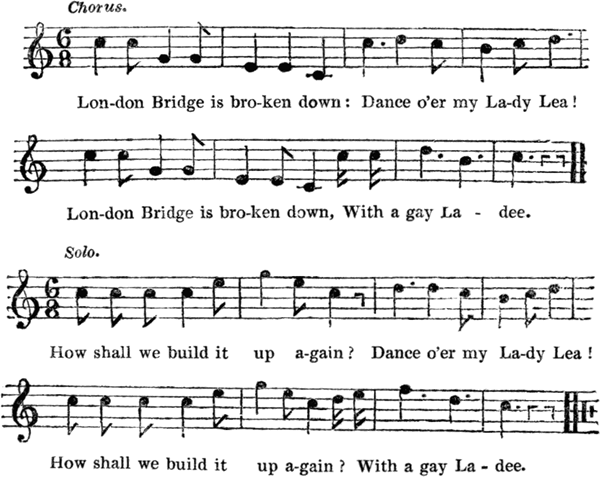
[Listen to MIDI]
Chorus.
Lon-don Bridge is bro-ken down: Dance o’er my La-dy Lea! Lon-don Bridge is bro-ken down, With a gay La-dee.
Solo.
How shall we build it up a-gain? Dance o’er my La-dy Lea! How shall we build it up a-gain? With a gay La-dee.
“A choice piece of simple melody, indeed,” said Mr. Postern, as I finished the last strain of the solo, “and, certainly, from its extreme plainness, not unlikely to be of some considerable antiquity; but you called it also a dance, Mr. Barbican; pray was it ever adapted to the feet, as well as to the tongue?”
“You shall hear, Sir,” returned I, “for I learn from a Manuscript communication, from a Mr. J. Evans, of Bristol, which has been most kindly placed in my hands by the venerable proprietor of the ‘Gentleman’s Magazine,’ and which enclosed the notes of the tune we have now concluded; that ‘about forty years ago, one moonlight night, in a street in Bristol, his attention was attracted by a dance and chorus of boys and girls, to which the words of this ballad gave measure. The breaking down of the Bridge was announced as the dancers moved round in a circle, hand in hand; and the question, ‘How shall we build it up again?’ was chaunted by the leader, whilst the rest stood still.’ The same correspondent also farther observes, that it is possible some musical critics may trace in these notes sundry fragments that have sailed down the stream of Time, beginning with ‘Nancy Dawson,’ and ‘A frog he would a wooing go;’ though the Lament of London Bridge is certainly far, very far, anterior to the latter. I cannot, however, imagine, that the air of our ballad has more than a very distant consanguinity with either; for the melody of Nancy Dawson is generally supposed not to be more than sixty years old, about which time its heroine flourished; and the metre of that worthless song is perfectly different, each verse having eight lines instead of four. Now, when Isaac Bickerstaff produced his Opera of ‘Love in a Village,’ he composed his 14th air, in the last Scene of the first Act, to that very tune; for there the Housemaid commences the Finale, and thus it runs:
‘I pray ye, gentles, list to me, I’m young, and strong, and clean, you see, I’ll not turn tail to any she, For work, that’s in the county: Of all your house the charge I’ll take, I wash, I scrub, I brew, I bake, And more can do than here I’ll speak, Depending on your bounty.’
“Thus, you observe, my good Sir, that the verse has no resemblance at all; and the only similitude of the music lies in a very few notes in the second and third bars of the first and fourth lines. The Adventures of the Frog who went a courting is certainly much more like the ballad of London Bridge; but, in addition to its variations in the latter part, it is quite a modern composition, and, therefore, cannot illustrate the antiquity of that other song, of which it is itself merely a musical parody.”
“My hearty thanks are due to you, Mr. Geoffrey Barbican,” began Mr. Postern, as I concluded; “I have to thank you very heartily for the agreeable manner in which you have contrived to carry on the history of London Bridge, whilst I have breathed from continuing my duller detail: and now, let me observe, that having brought you down to the 31st year of the reign of Edward I., 1302, I shall give you a translation of what was, perhaps, his last and fullest Charter to London Bridge, in the form of a Patent of Pontage, or Bridge Tax, granted in 1305, the 34th year of his sovereignty; which is curious, inasmuch as it enumerates so many of the articles of commerce in that day. The original is, of course, in the Tower, in the Patent Rolls for that year, membrane 25, entitled ‘Pontage for London;’ and the Latin you may see in Hearne’s ‘Liber Niger,’ already cited, volume i., page *478: the English, no very easy matter to discover, is as follows.
“‘The King to his beloved the Mayor and Sheriffs, and to his other Citizens of London,—Greeting. Know ye, that in aid of repairing and sustaining the Bridge of London, we grant that from the day of making these presents, until the complete end of the three years next following, the underwritten customs shall, for that purpose, be taken of saleable goods over the Bridge aforesaid, and of those which cross under the same, that is to say:—of every poise, or weight of cheese,’—namely, 256 pounds,—‘fat of tallow, and butter for sale, one penny. Of every poise of lead, for sale, one farthing. Of every hundred of wax for sale, two pence. Of every hundred of almonds and rice for sale, one penny. Of every hundred of barley corn for sale, one penny. Of every hundred of pepper and ginger, cotewell and cinnamon, Brazil-wood, frankincense, quicksilver, vermillion and verdigrease for sale, two pence. Of every hundred of cinior, alum, sugar, liquorice, syro-montanian aniseed, pion, and orpiment for sale, one penny. Of every hundred of sulphur, orchel, ink, resin, copperas, and calamine stone for sale, one farthing. Of every great frail of figs and raisins for sale, one halfpenny; and of every smaller frail, one farthing. Of every pound of dates, musk nuts, mace, the drug cubebs, saffron, and cotton for sale, one farthing. Of every store butt of ginger for sale, one penny. Of every hundred weight of copper, brass, and tin, for sale, one halfpenny. Of every hundred weight of glass for sale, one farthing. Of every thousand of the best Gris, or grey squirrel skins dressed,’—the famous Vaire fur you remember,—‘for sale, twelve pence. Of every thousand of red skins dressed, for sale, six pence. Of every thousand bark-skins for sale, four pence. Of every hundred of rabbits for sale, one halfpenny. For every timbria’—an ancient Norman law phrase, signifying a certain number of precious skins,—‘of wolves’ skins for sale, one halfpenny. For every timbria of coats for sale, one halfpenny. For every twelfth gennet-skin for sale, one halfpenny. For every hundredth sheep-skin of wool for sale, one penny. Of every hundredth lamb-skin and goat-skin for sale, one halfpenny. Of every twelfth alicum,’—a kind of vest with sleeves,—‘for sale, one penny. Of every twelfth Basane,’—this old Norman word, you know, meant either a purse, or shoe, or any thing made of tanned leather,—‘for sale, one halfpenny. Of every quarter of woad,’—the famous blue dye,—‘for sale, one halfpenny. Of every dole,’—a Saxon word signifying a part or portion,—‘of honey for sale, six pence. Of every dole of wine, six pence. Of every dole of corn, crossing over the Bridge, the same going into countries beyond the sea, one penny. Of every bowl of salt for sale, one penny. Of every mill-stone for grinding, for sale, two-pence. Of every twelfth hand-mill for sale, one penny. Of every smith’s mill for sale,’—perhaps a forge or a grindstone,—‘one farthing. Of every dole of ashes and of fish for sale, one halfpenny. Of every hundredth board of oak, coming from parts beyond the seas for sale, one halfpenny. Of every hundred of fir boards, coming from parts beyond the seas for sale, two pence. Of every twenty sheafs of wooden staves and arrow heads, for sale, one halfpenny. Of a quarter of a hundred of pountandemir for sale, one penny. For all horses laden with serge, stuff, grey cloth and dyed cloth for sale, one penny. Of every hundred ells of linen cloth, coming from parts beyond the seas, for sale, one penny. Of every twelfth poplorum,’—mantle or carpet,—‘for sale, one halfpenny. Of every silk or gold cloth, for sale, one halfpenny. Of all satins and cloths worked with gold, two pence. Of every twelfth piece of fustian for sale, one penny. Of every piece of sendal,’—thin Cyprus silk,—‘embroidered, for sale, one farthing; and of every other two sendals for sale, one farthing. Of every pound of woven cloth coming from parts beyond the seas, six pence. Of every hundred pounds weight of Bateria,’—beaten work of metal,—‘namely, of basins, platters, drinking pots, and cups, for sale, one penny. Of all Flanders cloth bound, and embroidered, for sale, two pence. Of every Estanford,’—a species of cloth made at Stanfort,—‘for sale, from the same parts, one penny. Of every twelfth pair of nether-stocks, for sale, coming from the same parts, one halfpenny. Of every hood for sale, one penny. Of every piece of Borrell,’—coarse cloth,—‘coming from Normandy, or elsewhere, one halfpenny. Of every twelfth Monk’s cloth, black or white, one penny. Of every trussell cloth,’—perhaps a horse-cloth—‘for sale, the same coming from parts beyond the seas, eighteen pence. Of all English dyed cloth and russet for sale, excepting scarlet, crossing the Bridge for the selling of the same, two pence. Of all scarlets for sale, six pence. Of all thin, or summer cloth, for sale, coming from Stamford or Northampton, or from other places in England, crossing the same, one penny. Of every twelfth chalonum,’—which is to say, a carpet or hangings,—‘set for sale, one penny. Of every pound of other merchandise for sale, crossing the same, and not expressed above, four pence. Of every ship-load of sea-coal for sale, six pence. Of every ship-load of turf for sale, two pence. Of every scitata of underwood for sale, two pence. Of every small boat-load of underwood for sale, one penny. Of every scitata of hay for sale, two pence. Of every quarter of corn for sale crossing the same, one farthing. For two quarters of white corn, barley, mixed corn, pease, and beans, for sale, one farthing. For a quarter of a seme,’—a horse load, or eight bushels—‘of oats for sale, one penny. For two quarters of groats, and brewers’ grains for sale, one farthing. For every horse for sale, of the price of forty shillings and more, one penny. For every horse for sale, of a price less than forty shillings, one halfpenny. For every ox and cow for sale, one halfpenny. For six swine for sale, one halfpenny. For ten sheep for sale, one halfpenny. For five bacon hogs for sale, one halfpenny; and for ten pervis for sale, one halfpenny. Of every small boat which works in London for hire, and crosses by the same, one penny. Of every cart freighted with fish for sale, crossing the same, one penny. For the hull of every great ship freighted with goods for sale, excepting these present, crossing by the same, two pence. For the hull of every smaller ship freighted with the same goods, excepting these present, one penny. For every little boat loaden, one halfpenny. For every twelfth salted salmon for sale, one penny. For twenty-five milnell for sale, one halfpenny. For one hundred salted haddocks for sale, one halfpenny. For one hundred salted mackerel for sale, one farthing. For every thousand of salted herrings for sale, one farthing. For every twelfth salted lamprey for sale, one penny. Of every thousand salted eels for sale, one halfpenny. Of every hundred pounds of large fish for sale, one penny. Of every hundred pieces of sturgeon for sale, two pence. For every hundred of stockfish, one farthing. For every horse-load of onions for sale, one farthing. For every horse-load of garlick for sale, one farthing. And of every kind of merchandise not here mentioned, of the price of twenty shillings, one penny. And, therefore, we command you, that the said customs be taken, until the aforesaid term of three years be completed; but at that term, the aforesaid customs shall cease, and be altogether taken away. In which, &c. for their lasting the term aforesaid, Witness the King, at Winchester, the seventh day of May. By writ of Privy Seal.’
“Such, Mr. Geoffrey Barbican, is a tolerably exact translation of this long and very curious Patent of Pontage for London Bridge; but a perfect rendering of it into English is a matter attended with more than usual difficulty; since it is composed of so many barbarous Anglo-Norman nouns, with Latin terminations attached to them; of quaint legal phrases, of which Fortescue and Rastall must be the interpreters; and of numerous articles of which both the names and the nature are to us almost utterly unintelligible. However, Sir, I here give it you to the best of my poor skill; and in doing so, let me add to it the apologetical words of your namesake and fellow citizen, the amiable old Chaucer;—‘Now pray I to them all that hearken this treatise, or rede, that if there be any thing that liketh them, that thereof they thank Him, of whom proceedeth all wit and goodness. And if there be any thing that displease them, I pray them also that they arrette it to the default of mine unknonnyng, and not to my will, that would fain have said better if I had knowing.’”
“Doubtless, Mr. Postern,” answered I, “my civilities are at the least due to you, for the labour you bestow upon me; but yet I must be so plain as to tell you, that your Pontage Patent reminded me mightily of a Table of Tolls at a Turnpike-Gate, whereon we read ‘For every horse, mare, gelding, or mule, laden or unladen, not drawing, two pence,’ So again, and again, I say, let me have stories, man! I want stories! ‘for,’ as Oliver Goldsmith said of old to the Ghost of Dame Quickly, ‘if you have nothing but tedious remarks to communicate, seek some other hearer, I am determined to hearken only to stories.’”
“Be of a sweet temper, however you may be disappointed, Mr. Geoffrey,” replied the old Gentleman; “if I possessed the wit either of honest Oliver, or the Ghost of Mistress Quickly, you should, indeed, be entertained; but, seeing that we lack humour, we must make it up in the real, though somewhat dull, formula of past days. This time, I have, however, a romantic scene for you in petto, and even now we have arrived at a point of the history of London Bridge, which, when skilfully managed, with a little fiction, has drawn tears from many an eye, and awakened an interest in many a heart: I mean the capture and death of the brave and unfortunate Sir William Wallace.
‘Joy, joy in London now! He goes, the rebel Wallace goes to death; At length the traitor meets a traitor’s doom. Joy, joy in London now!’
“It was after the return of the fourth expedition of King Edward I. into Scotland, about the beginning of August, 1305, that London Bridge was defaced, by the placing upon it the trophies of his vengeance. Matthew of Westminster, in his ‘Flowers of Histories,’ which I have already cited to you, tells the sorrowful story of Sir William Wallace’s execution, in his Second Book, page 451; beginning at ‘Hic vir Belial,’—for he treats the Scottish hero with but little reverence,—and in plain English thus runs the narrative. ‘This man of Belial, after innumerable crimes, was at last taken by the King’s officers, and, by his command, was brought up to be judged by himself, attended by the Nobles of the kingdom of England, on the Vigil of St. Bartholomew’s day,’—the 23rd of August,—‘where he was condemned to a most cruel, yet most worthy death. Firstly, he was drawn at the tail of a horse through the fields of London, to a very lofty gibbet, erected for him, upon which he was hung with a halter; afterwards, he was taken down half dead, embowelled, and his intestines burned by fire; lastly, his head was cut off, and set upon a pole on London Bridge, whilst the trunk was cut into four quarters. His body, thus divided, was sent into four parts of Scotland. Behold! such was the unpitied end of this man, whom want of pity brought to such a death!’
“The head of the gallant but ill-fated Wallace was not, however, the only ghastly spectacle upon London Bridge; for the Catalogue of the Harleian Manuscripts, under the Number 2253, has the following notice at article 25:—‘A long Ballad against the Scots, many of whom are here mentioned by name, as also many of the English, besides the King and Prince. But, particularly of William Walleys, taken at the Battle of Dunbar, A. D. 1305, and of Simon Frisell,—or Fraser,—taken at the Battle of Kyrkenclyf, A. D. 1306, both of whom were punished as traitors to our King Edward I. and their heads set among others of their countrymen upon London Bridge.’ The passage which immediately concerns our purpose, you will find at folio 61 a, and, in its own rude dialect, thus it runs:—
“‘With feters and with gyues ichot he wos to drowe, Ffrom the tour of Londone that monie myght knowe, Jn a curtel of burel aselkethe wyse Thurh Cheepe; And a gerland on hys heued of the newe guyse: Monimon of Engelond—for to se Symond Thideward con lepe. Tho he com to galewes, furst he wos an honge, Al qc. beheued, thah him thohte longe; Seththe he was yopened, is boweles ybrend, The heued to londone brugge wos send To shonde; So ich ever mote the—sum while wende he Ther lutel to stonde. He rideth thourth the site as J tell may, With gomen and with solas that wos here play, To londone brugge hee nome the way; Moni was the wyues chil’ that ther on loketh a day, And seide alas! That he was ibore—and so villiche forlore So feir mon as he wos! Now stont the heued above the tubrugge, Fast bi Waleis soth for to sugge.’
“Now, Mr. Geoffrey Barbican, as these barbarous rhymes are but just intelligible, even to an Antiquary, by a very careful reading and consideration, you will, I dare say, excuse me, if I give you a paraphrase of them in modern prose; which would be expressed somewhat in this manner.—With fetters and with leg-irons I wot that he was drawn from the Tower of London that many might know it; dressed in a short coat of coarse cloth, through Cheapside, having on his head a garland of the last fashion; and many Englishmen, to see Simon Frisel, began to run thither. Then was he brought to the gibbet, and first being hung, he was also beheaded, which he thought it long ere he endured it. After, he was opened, and his bowels burned; but his head was sent to London Bridge, to affright beholders: so ever might I thrive, as that once he little thought to stand there. He rides through the City, as I may well tell you, with game and gladness around him, which was the rejoicing of his enemies, and he took the way to London Bridge. Many were the wives’ children that looked upon him, and said, Alas, that he was born! and so vilely forsaken, so terrible a man as he was! Now the head stands above the Town bridge, close to that of Wallace, truly to say.
“Such is this ballad account of the matter; and, in quitting my notice of the manuscript that contains it, I have but to say that, it is written on old discoloured parchment, in a square gothic text, the ink of which is turned brown by time, with many contractions, and much vile spelling; and that its other contents are all exceedingly curious and valuable; and, as the ‘Harleian Catalogue,’ volume i., at page 585, tells us, they are ‘partly in old French, partly in Latin, and partly in English, partly in verse, and partly in prose.’ You will find, however, the whole of this long Poem printed in the late Joseph Ritson’s interesting volume, entitled, ‘Ancient Songs from the time of King Henry the Third to the Revolution,’ London, 1790, 8vo., pages 5-18. Maitland himself also relates the fate of Sir William Wallace, at page 109 of his ‘History,’ verifying his narrative by references to several of the Cloisteral Historians; nor does there, I believe, exist any earlier notice of the Tower on London Bridge having been used for the terrific purpose of exhibiting the heads of such as were executed for High Treason, which procured for it the name of Traitors’ Gate. You will remember I have already proved that edifices were standing upon London Bridge at a very early period; and, were it required, here is an additional proof of it, not to be disputed. Stow, when he is speaking of the Towers upon the Bridge, in his ‘Survey,’ volume i., pages 61 and 64, gives us not a word concerning their age, so of that I must treat hereafter, when we come down to the years in which they were repaired, or rebuilt; and I will, therefore, here remark only, that the heads were at this time erected on a Tower at the North end, and that they were not removed to the Southern extremity, where they so long remained, until about the year 1579.
“I am for your sake, my good friend, truly sorry that my next notice of London Bridge must be another Patent Roll, of the 14th year of King Edward II.,—1320,—Part the First, Membrane the 19th; but, it shews, at any rate, the state of the edifice in that year: and you will find it referred to in Stow’s ‘Survey,’ volume i., page 60; in Maitland’s ‘History,’ volume i., page 47; in the original Latin in Hearne’s ‘Liber Niger,’ volume i., page *477; and in English it ran as follows.
“‘Concerning the subsidies of the Messengers for the work of the Bridge of London, complaining to be admitted.
“‘The King to the Archbishops, Bishops, Abbots, Priors, Rectors, and all other Ministers of the Holy Mother Church, to whom these presents shall come,—Greeting. Seeing that, even now, so many evils,—not only in the loss of goods, but that innumerable bodies of men are in peril through the ruin of the Bridge at London,—are likely soon to come to pass, if that they should not be taken away: we, being willing to provide against this kind of dangers, and to take care of the public and private interests, do desire you, when the keepers of the costly work of the Bridge aforesaid, or their messengers, whom we undertake specially to protect and defend, shall come to collect every where throughout your Dioceses, Rectories, or any other of your jurisdictions, aids for the said work from the pious and the devout, you do, in friendship, admit them, from the contemplation of God, the regard of charity, and for evidence of devotion in this matter: admitting them to excite the people by their pious persuasions, and charitably to invoke the assistance of their alms for the reparation of the Bridge aforesaid. Not bringing upon them, nor permitting to be brought upon them, any injuries, molestations, damage, impediment, or grievance. And if any thing shall have been forfeited by them, amends shall be made without delay. In testimonial of which, &c. Witness the King, at Langele, the Thirteenth day of August.’
“A much more curious instrument than this, however, is recorded on the Patent Rolls of the 17th Year of Edward II.,—1323,—Part the Second, Membrane 9; inasmuch as it particularises several parts of the Bridge property in the ancient Stocks Market, of which we should now be without the knowledge, if it had not been for the careful enumeration of them which is here contained. You will see, that this confirmatory instrument has particular reference to one which I have already rehearsed to you, and that it is of that kind, commonly called an Inspeximus, from the Latin word used in their commencement, meaning, ‘we have seen,’ because the words of the original Charter are there repeated. This Patent is entitled ‘For the Keepers of the Bridge of London;’ the original Latin may be seen on page *482 of Hearne’s ‘Liber Niger,’ volume i.; and the English of it runs in the following terms.
“‘The King to all to whom, &c. Greeting. We have seen a Charter belonging to the Mayor, Aldermen, and Commonalty of the City of London, written in these words.—‘To all the faithful in Christ to whom these present letters shall come, Hamo de Chiggewell, Mayor, the Aldermen, and the whole Commonalty of the City of London, Greeting:’ Know ye that as the Lord Edward, formerly King of England, of famous memory, father of our Lord the King that now is, in the tenth year of his reign, granted for himself and his heirs, to Henry le Waleys, then Mayor, and the Commonalty of the City aforesaid, that those places contiguous to the wall of the burial-place of the Church of Wolchurch, on the North part of the Parish of the same Church, should be built upon and rented for the support of the Bridge of London, according as they should see to be expedient for their commodity, and that of this great City; and that the said places, so built upon and rented, should be held by themselves, and their heirs, for the support of the Bridge aforesaid, for ever, even as in the aforesaid letters is fully contained. And the before-mentioned Henry, the Mayor, and the Commonalty of the City aforesaid, for the common profit of their City, have built and constructed that house upon the places aforesaid, and have called it the Stokkes, and they have ordained the same for the Butchers and Fishmongers selling therein, as in a place situated nearly in the midst of the City; and the rents from the stalls are assigned for the increasing and support of the aforesaid Bridge. For the Stalls of the Butchers, and of the Fishmongers, may not be permitted, excepting, namely, in the broad way of Bridge Street, of East Cheap, and in the way of Old Fish Street, and the Butcher Row on the West, in the Parish of St. Nicholas; even as it was anciently accustomed to be, according to the ordinance and disposal of the aforesaid Henry, and the then Common Council of the City aforesaid, as in this part we have seen fully to be preserved: at which time the Butchers and Fishmongers sold their flesh and fish in the same, and in none other of the contiguous places and neighbourhoods, excepting the streets before mentioned, and the rents of the said stalls were carried to the keepers of the said Bridge, who, for a time, returned them in aid of the support of the said Bridge. But we, the aforesaid Mayor and Aldermen, lately receiving the complaint of John Sterre and Roger Atte-Wynne, Keepers of the Bridge aforesaid, that the Butchers and Fishmongers of the City aforesaid, who ought to stand to sell their flesh and fish in the place aforesaid, have accustomed themselves to diminish the rents of the aforesaid, contriving another stall for selling their flesh and fish, at the top of King Street, and in other contiguous places and neighbourhoods without the house aforesaid, that such persons for stalls existing within the house aforesaid, pay nothing, against the ordinance in this article formerly provided; and by their own authority they have prepared, and have sold their flesh and fish; by which the rents aforesaid, on which, in great part, the maintenance of the aforesaid Bridge exists, will be immensely reduced. Upon which the said keepers supplicate us for their remedy, to be by us applied. And we having considered this, whether that such kinds of sales may any longer be tolerated in the Bridge aforesaid, and in the aforesaid City, as, to all crossing by that Bridge, peril and damage may manifestly happen: and also this, that our Lord the King, by his writ, hath given it in command, that those things which in the premises are least according to custom, and against the aforesaid ordinance, should be attempted to be corrected and amended, and in their original state rebuilt,—we should build. And being willing to provide against such kinds of damages and perils, and to be obedient in all things to the commands of our Lord aforesaid, we have caused to be called before us the Butchers and Fishmongers aforesaid, and also those that have sold their flesh and fish in other contiguous places and neighbourhoods, without the house aforesaid, against the aforesaid ordinance; and in the discourse which we have held, there was nothing which they have said in this matter, nor have known to be said, by which the said ordinance ought to be invalidated, but they have petitioned that the ordinance and agreement formerly made in this article, might be observed. We therefore looked at the ordinance for this kind of sales, and the ancient customs, and saw the agreement of the aforesaid Henry le Waleys, then Mayor, concerning this kind of sales, made and ordained by the consent of the whole Commonalty; and by our general consent, and that of the whole Commonalty aforesaid, we have agreed, and granted, that the aforesaid ancient ordinances and agreements concerning this kind of sales, be, for the future, firmly and permanently established: so that if any shall have offended, or have spoken against the aforesaid ancient ordinances and customs, they shall, firstly, lose the thing exposed for sale; and, secondly, they shall lose the liberty of the aforesaid City, according to the laws and customs of the same City, as hath been anciently accustomed to be done. And because it is useful that we revolve excellent things which are departed, and ancient things lying obscured to lead into light, that by the same the memory of perishable matters may be recalled to sense, and offenders themselves be made to abstain from evil actions on account of their perpetual memory, for the strengthening of these presents we have caused to be attached to them the Common Seal of our City aforesaid, under the custody of the aforesaid keepers, and of the succeeding keepers, who, for the time, have been, and are for ever to be preserved. Given in Guildhall, London, before the Mayor, Aldermen, and Commonalty aforesaid, on Saturday next after the Feast of Saint Valentine,’—February the 14th,—‘in the seventeenth Year of the reign of King Edward the son of King Edward.—We have also granted and confirmed the ordinances, agreements, contracts, and grants aforesaid, and all other things contained in the aforesaid writing, having established and acknowledged them for us and our heirs, so much as in us lies, as the aforesaid writing may fairly witness. In testimony of which, &c. Witness the King, at the Tower of London, the 16th day of June. For a fine of ten marks:’—that is to say the sum of £6. 13s. 4d.
“Before entering upon the tumultuous reign of Richard II. I must observe to you, Mr. Barbican, that in the Patent Roll for the 42nd of Edward III.—1368,—Membrane 21, there is a sort of memorandum of a transfer of a piece of ground from the Friars Minors for the support of London Bridge, the title of which is couched in the following terms: ‘The Guardians of the Friars Minors of London remit for ever to the Mayor, &c. of London, one portion of land on the Southern side of the Church within Newgate, in London, for the support of the Bridge at London, they giving for the same, to the Abbot of Westminster, the sum of four shillings, the which is contained in divers covenants: the King hath confirmed it.’
“Well!” said I to Mr. Postern, on his conclusion of these Patents, “this succession of your dull and never-ending Charters would weary the patience of the most phlegmatic Dutch Lawyer that ever studied at Leyden. Come there any more of them, my honest friend? or may we yet look out for land, after so long tossing in the wide sea of the Tower Records?”
“Tranquillise your perturbed feelings, my good Sir,” replied Mr. Barnaby, “for we are now drawing very rapidly towards that time, when we can give only mere facts, and descriptive scenes of history, unsupported by any of those curious and unquestionable proofs which these evidences furnish. Not but that there are, doubtless, yet many scores of most interesting papers and Charters concerning this Bridge, preserved in the Close Rolls, the ‘Rotuli Chartarum,’ the Patent Rolls, and the vast body of the Records of this kingdom: but life is too short, and the search would be too long, to discover them all; though I would, for your sake, that I knew them better, and could delight your ears with their recital.”
“God forbid! Mr. Postern,” ejaculated I, “that you should bestow all your tediousness upon me! for truly, from that which you have recited, I have some conception of what the whole must be; and I would rather entreat you now to pass on to some of those same ‘facts, and descriptive scenes of history,’ which you seem to undervalue so much, because they do not drag a wearisome Patent Roll after them. Therefore once more, Master Barnaby, I say, give me a tale.”
“Well,” returned he, “as we have now arrived at rather an eventful period, perhaps you will begin to be more gratified; and here let me remark that the gate of London Bridge being so advantageous, as well as so immediate, an entrance into the very heart of the City, was too often the favourite passage by which the rebels of ancient days marched into the bowels of our hapless land. I have already given you one instance of this, in speaking of the Baronial Wars of the days of King Henry III.; and now, when we have arrived at the Year 1381, the 5th of Richard II., we find another melancholy instance of it in the insurrection of Wat Tyler. Stow notices this but very slightly in his ‘Survey,’ volume i., page 61; though in his ‘Annals,’ to which he there refers, page 283, he gives a much more full account of their proceedings on London Bridge, taken chiefly from the ‘Chronicle’ of Thomas Walsingham, a native of Norfolk, and a Monk of St. Albans Abbey, who lived in the time of Henry VI., and died in 1440; his history commencing at the end of the reign of King Henry III. His principal work, entitled ‘Chronica Thomæ Walsingham, quondam Monachi Sancti Albani,’ will be found in William Camden’s ‘Anglica, Normannica, Hibernica, Cambrica, a Veteribus Scripta,’ Frankfurt, 1603, Folio; where, on page 249 you will find his account of it; but, however, we’ll take the English one of old Stow, from the page which I have already cited.
“‘On which day,’ says he, meaning Thursday, the Feast of Corpus Christi,—or June the 13th,—‘also in the morning, the Commons of Kent brake downe the stew-houses neare to London Bridge, at that time in the hands of the frowes of Flanders, who had farmed them of the Mayor of London. After which, they went to London Bridge, in hope to have entred the Citty; but the Maior,’—the famous Sir William Walworth, you remember,—‘comming thither before, fortified the place, caused the Bridge to be drawne vp, and fastened a great chaine of yron a crosse, to restraine their entry. Then the Commons of Surrey, who were risen with other, cried to the Wardens of the Bridge to let it downe, whereby they mought passe, or else they would destroy them all, whereby they were constrained for feare to let it down, and give them entry, at which time the religious present,’—perhaps he means the Brethren of the Bridge,—‘were earnest in procession and prayer for peace.’
As this fragment of History brought to my recollection a point of Heraldical enquiry, which I had long considered, I here interrupted my visitor, in the following words.
“I cannot, Mr. Barnaby Postern, turn from the days of that most notorious rebel, Wat Tyler, without briefly noticing the dispute concerning the Armorial Ensigns of our goodly City, which claim to have had an honourable augmentation arising from the gallantry of the Lord Mayor of that period. If rhyme might pass for reason and argument, we should then be assured of the origin of the City’s Dagger, from the evidence afforded by those verses, which are inscribed beneath Walworth’s effigy in the Fishmongers’ Hall, above us; and which run—
‘Brave Walworth, Knight, Lord Mayor, yet slew Rebellious Tyler in his alarmes; The King therefore did give in lieu The dagger to the City’s Arms. In the fourth Year of Richard II., Anno Domini, 1381.’
“This, however, can stand for nothing, and the arguments for, and against, the popular reason for the introduction of the weapon, are best learned from the ancient English Chronicles and Historians of London. The principal Authors who assert that King Richard added the Dagger to commemorate the loyal valour of Walworth, are Richard Grafton, in his ‘Chronicle at large, and meere History of the Affayres of Englande, and Kinges of the same,’ London, 1569, folio, page 340; in the Margin: Raphael Holinshed, in his ‘Chronicles of England, Scotland, and Ireland,’ London, 1586, volume ii., page 436: John Speed, in his ‘Theatre of the Empire of Great Britaine,’ London, 1611, folio, volume ii., page 596; and Sir Richard Baker, in his ‘Chronicle of the Kings of England,’ London, 1733, folio, page 140.
“Such are the assertors of this very common legend; and the evidence against it, is given, firstly by old Stow, in his ‘Survey,’ volume i., page 506, at that part of it where he is treating of Walworth’s Monument, in the Church of St. Michael, Crooked Lane. He there states, you know, that, in the fourth Year of King Richard II.,—1380,—it was determined, in a Court of the Aldermen and Common Council of the City, that the old seal of the Mayoralty of London should be destroyed, and a new one, engraven with greater skill, then be provided. The device upon the new seal consisted of the effigies of the Saints Peter and Paul, with the Blessed Virgin above them, supported between two Angels, under as many tabernacles. Beneath the feet of the Saints were the Armorial Ensigns of the City, supported by two Lions, and two Serjeants at Arms. Now, Stow’s deductions from this fact are, firstly, that as the Mayor is not called by any title of Knighthood in this Seal, it was made before he received that dignity, and, therefore, before his gallant action in Smithfield, or, the augmentation could have been made to the City Arms. Secondly, he argues, that the Arms were the same in the old seal as in the new, and that, consequently, the weapon was not the dagger of Walworth, but the sword of St. Paul; for when the turbulent Robert Fitz-Walter was Banner-bearer to the City of London, his standard was red, charged with the image of St. Paul in gold, holding a sword, which, together with the head, hands, and feet of the effigy, was silver. These particulars you will also find in Stow’s ‘Survey,’ volume i., page 65; and such is the attempt of this worthy historian to prove the weapon to have been the sword of St. Paul’s Martyrdom, at Aquæ Salviæ, on the 29th of June, A. D. 66. Now, since that holy Martyr is oftentimes called, by the more ancient writers, ‘the titularie patron of London,’ and since her chiefest metropolitan fane was, so early as 610, dedicated to his ever-fragrant memory, there is nothing impossible, or even unlikely, in all this: and that it should have been so, certainly arises from the circumstance that ‘Paul preached in the Islande of Britaine, which cannot be doubted; seeing both Sophronius, Patriarche of Jerusalem, and Theodoret, an ancient Doctor of the Chvrche, doe affirme and approve the same, saying that Fishers, Publicans, and the Tent-maker,’—St. Paul, see Acts xviii. 3,—‘which brought the evangelical light unto all nations, revealed the same unto the Britaines.’
“The only authority adduced by Stow for the support of his novel hypothesis concerning the Dagger of London, is a Manuscript preserved in the City Chamber, and called ‘Liber Dunthorne,’ from William Dunthorne, the name of its author. It is, in form, a large folio volume, written in a very fair, small, black law text, on vellum; and its contents are ancient Civic Laws, commencing with the series of the City Charters, in the first of which, granted by William I., the initial W contains an illumination of the effigy of St. Paul, as already described. I will add only, that this venerable register is bound in wood, covered with rough calf leather, and garnished with brass bosses and clasps, now black with age; whilst on the cover, under a plate of horn, surrounded by a metal frame, is a piece of parchment bearing the name ‘Dvnthorne.’
“Notwithstanding, however, that the effigy of the most glorious Apostle St. Paul might be advanced into the banner of London, I think it still probable that the ancient Civic Armorial Ensigns were a White Shield bearing a Red Cross, having the first quarter either uncharged, or charged, as a distinction from the multitudes of places and persons which adopted the same insignia. For you may observe, that the Cross was anciently and commonly used by all Christians as their badge; some Heralds deriving its introduction from the Emperor Constantine the Great, and others from so holy a person as Joseph, the Son of Joseph of Arimathea; who, being the first preacher of Christianity in Britain, when dying, drew with his own blood a red cross on a white banner, and promised victory to its followers, whilst they continued in the Christian faith. There is also much mystical meaning in this plain, yet noble ensign; for ‘the white shielde,’ says a very ancient and interesting author, ‘betokeneth purenes of life, and the crosse, the bludd that Christ shed for us, his especialle people of Englande.’—‘King Arthur,’ too, says John Bossewell, in his very rare and curious ‘Workes of Armorie,’ London, 1597, small 4to., Part 2., page 22 a, ‘that mightie Conquerour and worthie, had so great affection and loue to this signe, that he left his Armes which he bare before, and assumpted, or tooke to his Armes, as proper to his desire, a Crosse siluer, in a field vert; and on the first quarter thereof, was figured an Image of our Lady, with her Sonne in her armes. And bearing that signe, he did many marueiles in Armes, as in his books of Acts and valiant Conquests are remembred. Thus,’ adds he, ‘in olde time it may be perceiued what Princes thought of the Crosse.’ Now, without believing this origin to its utmost extent, we may nevertheless learn thereby, of how great antiquity is the bearing of that most honourable Ordinary; ‘whose godly observation,’ says John Guillim, in his ‘Display of Heraldry,’ best edition, by James Coats, London, 1724, folio, page 51, ‘was in great use in the primitive Church; though, in later times, it hath been dishonourably entertained by two kinds of fantastics; the one, who so superstitiously doat on it that they adore it like their God; the other, who so unchristianly detest it, that they slander the most godly and ancient use thereof in our first initiating unto Christ, as if it were some devilish idol. But the true soldiers of such a captain, need not to be ashamed to bear his ensign.’
“There is also yet another historical reason given why the Red Cross of St. George should be so often adopted in England; for it is related, that when Robert, Duke of Normandy, the son of our King William I., was prosecuting his victories against the Turks, and laying siege to the famous City of Antioch, A. D. 1098, it was almost relieved by a considerable army of Saracens. In this difficulty there appeared the beatific vision of St. Demetrius, St. Mercurius, and St. George, coming down from the mountains of Syria; the latter being clothed entirely in white, and bearing a Red Cross on his banner, and, at the head of an innumerable reinforcement; which miraculous interference not only reanimated the Christians, but also caused the infidels to fly, and the Crusaders to possess themselves of the City. This legend is related by Matthew Paris, a Monk of St. Albans, in the 13th century, in his ‘Historia Major,’ Paris, 1644, folio, page 29: and it consequently made St. George to become exceedingly famous at that time; and to be esteemed a patron, not of the English only, but of Christianity itself.
“So much, Mr. Barnaby, for the use of the Cross in our City Arms; and as to the distinction borne in the first quarter, there are some who hold the belief that the Roman letter L once occupied the place of the sword. This story appears to have originated with a Mr. William Smith, a Merchant of London, who was created Rouge Dragon Pursuivant of Arms, on October the 22nd, 1597. As he had travelled much on the Continent, and ‘was honest, of a quiet conversation, and well-languaged,’ the Officers of the Heralds’ College solicited to have him joined to their society; and it was from the reminiscences of his former travels, that he was enabled to state the following particulars concerning the original distinction attached to the City Arms, wherein he opposes the hypothesis of Stow. ‘The Auncient Armes of the Cittie of London, as they stand in (the uppermost North Window of) our Lady Church at Andwerp, in which Church windowes stand the effigies of King Edward the Third, and all his children; with most of the Armes of the Corporate Townes of England at that tyme; and this standeth first, and hath an ould Roman L in the first quarter, which John Stowe tooke in an ould seale which he had seene, for a sword, afferminge thereby that it was the Sworde of St. Paule, patron of the saide Cittie: whereby he constantly affermed that they had aunciently soe borne it, and that it was no reward giuen by King Richard the Second, as our Chronicles reporte, for the seruice done in Smythfieeld against Watt Tyler ye Rebell, by William Wallworth, Maior of London, whoe slewe the sayd Tyler with his dagger; in memory whereof, say they, the dagger was added to the Cittie’s Armes.’ This passage you will find in two ancient Manuscript copies of Heraldical Collections for London, in the Harleian Library, No. 1464, page 1; and No. 1349, page 2 b; attended by sketches of the ancient and modern bearings, drawn in pen and ink, technically called Tricks of Arms. This same story, told in the very same words, with two rude sketches of the Arms in the margin, is also to be found in one of Philpott’s Manuscripts, in the Library at the Heralds’ College, marked P b. No. 22, page 10 a; where it is written on paper, in an ancient running hand about the year 1602; and, what is extremely singular, there does not appear to be any other entry of the City Arms in the books of that Office.