Volume 1 / Part 3 — CHAP. VIII
Reading edition
EXTINCTION OF THE "GREAT DYNASTY."
B.C. 104.From the death of Dutugaimunu to the exhaustion of the superior dynasty on the death of Malta-Sen, A.D. 301, there are few demonstrations of pious munificence to signalise the policy of the intervening sovereigns. The king whom, next to Devenipiatissa and Dutugaimunu, the Buddhist historians rejoice to exalt as one of the champions of the faith, was Walagam-bahu I.[1], whose reign, though marked by vicissitudes, was productive of lasting benefit to the national faith. Walagam-bahu ascended the throne B.C. 104., but was almost immediately forced to abdicate by an incursion of the Malabars; who, concerting a simultaneous landing at several parts of the island, combined their movements so successfully that they seized on Anarajapoora, and drove the king into concealment in the mountains near Adam's Peak; and whilst one portion of the invaders returned laden with plunder to the Dekkan, their companions remained behind and held undisputed possession of the northern parts of Ceylon for nearly fifteen years.
B.C. 104.In this and the frequent incursions which followed, the Malabar leaders were attracted by the wealth of the country to the north of the Mahawelli-ganga; the southern portion of the island being either too wild and unproductive to present a temptation to conquest, or too steep and inaccessible to afford facilities for invasion. Besides, the highlanders who inhabit the lofty ranges that lie around Adam's Peak; (a district known as Malaya, "the region of mountains and torrents,")[1] then and at all times exhibited their superiority over the lowlanders in vigour, courage, and endurance. Hence the petty kingdoms of Maya and Rohuna afforded on every occasion a refuge to the royal family when driven from the northern capital, and furnished a force to assist in their return and restoration. Walagam-bahu, after many years' concealment there, was at last enabled to resume the offensive, and succeeded in driving out the infidels, and recovering possession of the sacred city, an event which he commemorated in the usual manner by the erection of dagobas, tanks, and wiharas.
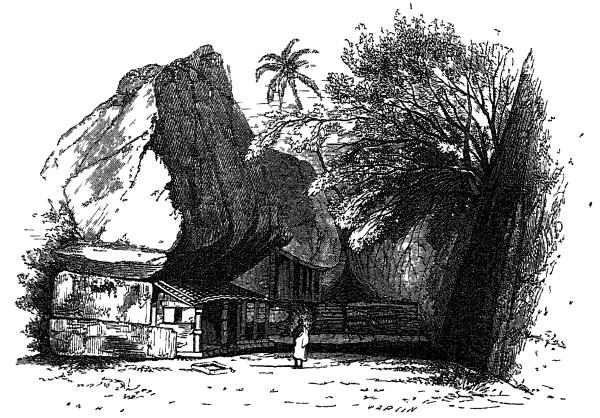
THE ALU WIHARA NEAR MATELLE.
But the achievement by which most of all he entitled himself to the gratitude of the Singhalese annalists, was the reduction to writing of the doctrines and discourses of Buddha, which had been orally delivered by Mahindo, and previously preserved by tradition alone. These sacred volumes, which may be termed the Buddhist B.C. 89.Scriptures, contain the Pittakataya, and its commentaries the Atthakatha, and were compiled by a company of priests in a cave to the north of Matelle, known as the Aloo-wihara.[1] This, and other caverns in which the king had sought concealment during his adversity, he caused to be converted into rock temples after his restoration to power. Amongst the rest, Dambool, which is the most remarkable of the cave temples of Ceylon from its vastness, its elaborate ornaments, and the romantic beauty of its situation and the scenery surrounding it.
B.C. 62.The history of the Buddhist religion in Ceylon is not, however, a tale of uniform prosperity. The first of its domestic enemies was Naga, the grandson of the pious Walagam-bahu, whom the native, historians stigmatise by the prefix of "chora" or the "marauder." His story is thus briefly but emphatically told in the Mahawanso: "During the reign of his father Mahachula, Chora Naga wandered through the island leading the life of a robber; returning on the demise of the king he assumed the monarchy; and in the places which had denied him an asylum during his B.C. 50.marauding career, he impiously destroyed the wiharas.[1] After a reign of twelve years he was poisoned by his queen Anula, and regenerated in the Lokantariko hell."[2]
B.C. 47.His son, King Kuda Tissa, was also poisoned by his mother, in order to clear her own way to the throne. The Singhalese annals thus exhibit the unusual incident of a queen enrolled amongst the monarchs of the great dynasty—a precedent which was followed in after times; Queen Siwalli having reigned in the succeeding century, A.D. 37, Queen Lila-wati, in A.D. 1197, and Queen Kalyana-wati in A.D. 1202. From the excessive vileness of her character, the first of these Singhalese women who attained to the honours of sovereignty is denounced in the Mahawanso as "the infamous Anula." In the enormity of her crimes and debauchery she was the Messalina of Ceylon;—she raised to the throne a porter of the palace with whom she cohabited, descending herself to the subordinate rank of Queen Consort, and poisoned him to promote a carpenter in his stead. A carrier of firewood, a Brahman, and numerous other paramours followed in rapid succession, and shared a similar fate, till the kingdom was at last relieved from the opprobrium by a son of Prince Tissa, who put the murderess to death, and restored the royal line in his own person. His successors for more than two centuriesB.C. 41. were a race of pious fainéants, undistinguished by any qualities, and remembered only by their fanatical subserviency to the priesthood.
Buddhism, relieved from the fury of impiety, was next imperilled by the danger of schism. Even before the funeral obsequies of Buddha, schism had displayed itself in Maghadha, and two centuries had not elapsed from his death till it had manifested itself on no less than seventeen occasions, and in each instance it was with difficulty checked by councils in which the priesthood settled the faith in relation to the points which gave rise to dispute; but not before the actual occurrence of secessions from the orthodox church.[1] The earliest differences were on questions of discipline amongst the colleges and fraternities at Anarajapoora; but in the reign of Wairatissa, A.D. 209.A.D. 209, a formidable controversy arose, impugning the doctrines of Buddhism, and threatening for a time to rend in sunder the sacred unity of the church.[2]
A.D. 209.Buddhism, although, tolerant of heresy, has ever been vehement in its persecution of schism. Boldly confident in its own superiority, it bears without impatience the glaring errors of open antagonists, and seems to exult in the contiguity of competing systems as if deriving strength by comparison. In this respect it exhibits a similarity to the religion of Brahma, which regards with composure shades of doctrinal difference, and only rises into jealous energy in support of the distinctions of caste, an infringement of which might endanger the supremacy of the priesthood.[1] To the assaults of open opponents the Buddhist displays the calmest indifference, convinced that in its undiminished strength, his faith is firm and inexpugnable; his vigilance is only excited by the alarm of internal dissent, and all his passions are aroused to stifle the symptoms of schism.[2]
A.D. 209.This characteristic of the "religion of the Vanquisher" is in strict conformity, not alone with the spirit of his doctrine, but also with the letter of the law laid down for the guidance of his disciples. Two of the singular rock-inscriptions of India deciphered by Prinsep, inculcate the duty of leaving the profession of different faiths unmolested; on the ground, that "all aim at moral restraint and purity of life, although all cannot be equally successful in attaining to it." The sentiments embodied in one of the edicts[1] of King Asoca are very striking: "A man must honour his own faith, without blaming that of his neighbour, and thus will but little that is wrong occur. There are even circumstances under which the faith of others should be honoured, and in acting thus a man increases his own faith and weakens that of others. He who acts differently, diminishes his own faith and injures that of another. Whoever he may be who honours his own faith and blames that of others out of devotion to his own, and says, 'let us make our faith conspicuous,' that man merely injures the faith he holds. Concord alone is to be desired."
A.D. 209.The obligation, to maintain the religion of Buddha was as binding as the command to abstain from assailing that of its rivals, and hence the kings who had treated the snake-worshippers with kindness, who had made a state provision for maintaining "offerings to demons," and built dwellings at the capital to accommodate the "ministers of foreign religions," rose in fierce indignation against the preaching of a firm believer in Buddha, who ventured to put an independent interpretation on points of faith. They burned the books of the Wytulians, as the new sect were called, and frustrated their irreligious attempt.[1] The first effort at repression was ineffectual. It was made by the King Wairatissa, A.D. 209; A.D. 248.but within forty years the schismatic tendency returned, the persecution was renewed, and the apostate priests, after being branded on the back were ignominiously transported to the opposite coast of India.[2]
The new sect had, however, established an interest in high places; and Sangha-mitta, one of the exiled priests, returning from banishment on the death of the king, so ingratiated himself with his successor, that he was entrusted with the education of the king's sons. One of the latter, Maha-Sen, succeeded to the throne, A.D. 275.A.D. 275, and, openly professing his adoption of the Wytulian tenets, dispossessed the popular priesthood, and overthrew the Brazen Palace. With the materials of the great wihara, he constructed at the sacred Bo-tree a building as a receptacle for relics, and a temple in which the statue of Buddha was to be worshipped according to the rites of the reformed religion.[1]
A.D. 275.So bold an innovation roused the passions of the nation; the people prepared for revolt, and a conflict was imminent, when the schismatic Sangha-mitta was suddenly assassinated, and the king, convinced of his errors, addressed himself with energy to restore the buildings he had destroyed, and to redress the mischiefs chiefs caused by his apostacy. He demolished the dewales of the Hindus, in order to use their sites for Buddhist wiharas; he erected nunneries, constructed the Jaytawanarama (a dagoba at Anarajapoora), formed the great tank of Mineri by drawing a dam across the Kara-ganga and that of Kandelay or Dantalawa, and consecrated the 20,000 fields which it irrigated to the Dennanaka Wihare.[1] "He repaired numerous dilapidated temples throughout the island, made offerings of a thousand robes to a thousand priests, formed sixteen tanks to extend cultivation—there is no defining the extent of his charity"—and having performed during his existence acts both of piety and impity, the Mahawanso cautiously adds, "his destiny after death was according to his merits."[2]
A.D. 302.With King Maha-Sen end the glories of the "superior dynasty" of Ceylon. The "sovereigns of the Suluwanse, who followed," says the Rajavali, "were no longer of the unmixed blood, but the offspring of parents, only one of whom was descended from the sun, and the other from the bringer of the Bo-tree or the sacred tooth; on that account, because the God Sakkraia had ceased to watch over Ceylon, because piety had disappeared, and the city of Anarajapoora was in ruins, and because the fertility of the land was diminished, the kings who succeeded Maha-Sen were no longer reverenced as of old."[1]
A.D. 302.The prosperity of Ceylon, though it may not have attained its acme, was sound and auspicious in the beginning of the fourth century, when the solar line became extinct. Pihiti, the northern portion of the island, was that which most engaged the solicitude of the crown, from its containing the ancient capital, whence it obtained its designation of the Raja-ratta or country of the kings. Here the labour bestowed on irrigation had made the food of the population abundant, and the sums expended on the adornment of the city, the multitude of its sacred structures, the splendour of its buildings, and the beauty of its lakes and gardens, rendered it no inappropriate representative of the wealth and fertility of the kingdom.
Anarajapoora had from time immemorial been a venerated locality in the eyes of the Buddhists; it had been honoured by the visit of Buddha in person, and it was already a place of importance when Wijayo effected his landing in the fifth century before the Christian era. It became the capital a century after, and the King Pandukabhaya, who formed the ornamental lake which adjoined it, and planted gardens and parks for public festivities, built gates and four suburbs to the city; set apart ground for a public cemetery, and erected a gilded hall of audience, and a palace for his own residence.
The Mahawanso describes with particularity the offices of the Naggaraguttiko, who was the chief of the city guard, and the organisation of the low caste Chandalas, who were entrusted with the cleansing of the capital and the removal of the dead for interment. For these and for the royal huntsmen villages were constructed in the environs, mingled with which were dwellings for the subjugated native tribes, and temples for the worship of foreign devotees.[1]
Seventy years later, when Mahindo arrived in Ceylon, the details of his reception disclose the increased magnificence of the capital, the richness of the royal parks, and the extent of the state establishments; and describe the chariots in which the king drove to Mihintala to welcome his exalted guest.[1]
A.D. 302.Yet these were but preliminary to the grander constructions which gave the city its lasting renown; stupendous dagobas raised by successive monarchs, each eager to surpass the conceptions of his predecessors; temples in which were deposited statues of gold adorned with gems and native pearls; the decorated terraces of the Bo-tree, and the Brazen Palace, with its thousand chambers and its richly embellished halls. The city was enclosed by a rampart upwards of twenty feet in height[1], which was afterwards replaced by a wall[2]; and, so late as the fourth century, the Chinese traveller Fa Hian describes the condition of the place in terms which fully corroborate the accounts of the Mahawanso. It was crowded, he says, with nobles, magistrates, and foreign merchants; the houses were handsome, and the public buildings richly adorned. The streets and highways were broad and level, and halls for preaching and reading bana were erected in all the thoroughfares. He was assured that the island contained not less than from fifty to sixty thousand ecclesiastics, who all ate in common; and of whom from five to six thousand were supported by the bounty of the king.
The sacred tooth of Buddha was publicly exposed on sacred days in the capital with gorgeous ceremonies, which he recounts, and thence carried in procession to "the mountains without fear;" the road to which was perfumed and decked with flowers for the occasion; and the festival was concluded by a dramatic representation of events in the life of Buddha, illustrated by scenery and costumes, with figures of elephants and stags, so delicately coloured as to be undistinguishable from nature.[1]