Volume 1 / Part 3 — CHAPTER I.
Reading edition
SOURCES OF SINGHALESE HISTORY.—THE MAHAWANSO AND OTHER NATIVE ANNALS.
It was long affirmed by Europeans that the Singhalese annals, like those of the Hindus, were devoid of interest or value as historical material; that, as religious disquisitions, they were the ravings of fanaticism, and that myths and romances had been reduced to the semblance of national chronicles. Such was the opinion of the Portuguese writers DE BARROS and DE COUTO; and VALENTYN, who, about the year 1725, published his great work on the Dutch possessions in India, states his conviction that no reliance can be placed on such of the Singhalese books as profess to record the ancient condition of the country. These he held to be even of less authority than the traditions of the same events which had descended from father to son. On the information of learned Singhalese, drawn apparently from the Rajavali, he inserted an account of the native sovereigns, from the earliest times to the arrival of the Portuguese; but, wearied by the monotonous inanity of the story, he omitted every reign between the fifth and fifteenth centuries of the Christian era.[1]
A writer, who, under the signature of PHILALETHES, published, in 1816, A History of Ceylon from the earliest period, adopted the dictum of Valentyn, and contented himself with still further condensing the "account," which the latter had given "of the ancient Emperors and Kings" of the island. Dr. DAVY compiled that portion of his excellent narrative which has reference to the early history of Kandy, chiefly from the recitals of the most intelligent natives, borrowed, as in the case of the informants of Valentyn, from the perusal of the popular legends; and he and every other author unacquainted with the native language, who wrote on Ceylon previous to 1833, assumed without inquiry the nonexistence of historic data.[1]
It was not till about the year 1826 that the discovery was made and communicated to Europe, that whilst the history of India was only to be conjectured from myths and elaborated from the dates on copper grants, or fading inscriptions on rocks and columns[1], Ceylon was in possession of continuous written chronicles, rich in authentic facts, and not only presenting a connected history of the island itself, but also yielding valuable materials for elucidating that of India. At the moment when Prinsep was deciphering the mysterious Buddhist inscriptions, which are scattered over Hindustan and Western India, and when Csoma de Körös was unrolling the Buddhist records of Thibet, and Hodgson those of Nepaul, a fellow labourer of kindred genius was successfully exploring the Pali manuscripts of Ceylon, and developing results not less remarkable nor less conducive to the illustration of the early history of Southern Asia. Mr. Turnour, a civil officer of the Ceylon service[2], was then administering " /> the government of the district of Saffragam, and being resident at Ratnapoora near the foot of Adam's Peak, he was enabled to pursue his studies under the guidance of Gallé, a learned priest, through whose instrumentality he obtained from the Wihara, at Mulgiri-galla, near Tangalle (a temple founded about 130 years before the Christian era), some rare and important manuscripts, the perusal of which gave an impulse and direction to the investigations which occupied the rest of his life.
It is necessary to premise, that the most renowned of the Singhalese books is the Mahawanso, a metrical chronicle, containing a dynastic history of the island for twenty-three centuries from B.C. 543 to A.D. 1758. But being written in Pali verse its existence in modern times was only known to the priests, and owing to the obscurity of its diction it had ceased to be studied by even the learned amongst them.
To relieve the obscurity of their writings, and supply the omissions, occasioned by the fetters of rhythm and the necessity of permutations and elisions, required to accommodate their phraseology to the obligations of verse; the Pali authors of antiquity were accustomed to accompany their metrical compositions with a tika or running commentary, which contained a literal version of the mystical text, and supplied illustrations of its more abstruse passages. Such a tika on the Mahawanso was generally known to have been written; but so utter was the neglect into which both it and the original text had been permitted to fall, that Turnour till 1826 had never met with an individual who had critically read the one, or more than casually heard of the existence of the other.[1] At length, amongst the books which, were procured for him by the high, priest of Saffragam, was one which proved to be this neglected commentary on the mystic and otherwise unintelligible Mahawanso; and by the assistance of this precious document he undertook, with confidence, a translation into English of the long lost chronicle, and thus vindicated the claim of Ceylon to the possession of an authentic and unrivalled record of its national history.
The title "Mahawanso," which means literally the "Genealogy of the Great," properly belongs only to the first section of the work, extending from B.C. 543 to A.D. 301,[1] and containing the history of the early kings, from Wijayo to Maha Sen, with whom the Singhalese consider the "Great Dynasty" to end. The author of this portion was Mahanamo, uncle of the king Dhatu Sena, in whose reign it was compiled, between the years A.D. 459 and 477, from annals in the vernacular language then existing at Anarajapoora.[2]
The sovereigns who succeeded Maha Sen are distinguished as the "Sulu-wanse," the "lower race," and the story of their line occupies the continuation of this extraordinary chronicle, the second portion of which was written by order of the illustrious king Prakrama Bahu, about the year A.D. 1266, and the narrative was carried on, under subsequent sovereigns, down to the year A.D. 1758, the latest chapters having been compiled by command of the King of Kandy, Kirti-Sri, partly from Singhalese works brought back to the island from Siam (whither they had been carried at former periods by priests dispatched upon missions), and partly from native histories, which had escaped the general destruction of such records in the reign of Raja Singha I., an apostate from Buddhism, who, about the year A.D. 1590, during the period when the Portuguese were in occupation of the low country, exterminated the priests of Buddha, and transferred the care of the shrine on Adam's Peak to Hindu Fakirs.
But the Mahawanso, although the most authentic, and probably the most ancient, is by no means the only existing Singhalese chronicle. Between the 14th and 18th centuries several historians recorded passing events; and as these corroborate and supplement the narrative of the greater work, they present an uninterrupted Historical Record of the highest authenticity, comprising the events of nearly twenty-four centuries.[1]
From the data furnished by these, and from corroborative sources,[1] Turnour, in addition to many elaborate contributions drawn from the recesses of Pali learning in elucidation of the chronology of India, was enabled to prepare an Epitome of the History of Ceylon, in which he has exhibited the succession and genealogy of one hundred and sixty-five kings, who filled the throne during 2341 years, extending from the invasion of the island from Bengal, by Wijayo, in the year B.C. 543 to its conquest by the British in 1798. In this work, after infinite labour, he has succeeded in condensing the events of each reign, commemorating the founders of the chief cities, and noting the erection of the great temples and Buddhist monuments, and the construction of some of those gigantic reservoirs and works for irrigation, which, though in ruins, arrest the traveller in astonishment at their stupendous dimensions. He thus effectually demonstrated the misconceptions of those who previously believed the literature of Ceylon to be destitute of historic materials.[2]
Besides evidence of a less definite character, there is one remarkable coincidence which affords grounds for confidence in the faithfulness of the purely historic portion of the Singhalese chronicles; due allowance being made for that exaggeration of style which is apparently inseparable from oriental recital. The circumstance alluded to is the mention in the Mahawanso of the Chandragupta[1], so often alluded to by the Sanskrit writers, who, as Sir William Jones was the first to discover, is identical with Sandracottus or Sandracoptus, the King of the Prasii, to whose court, on the banks of the Ganges, Megasthenes was accredited as an ambassador from Seleucus Nicator, about 323 years before Christ. Along with a multitude of facts relating to Ceylon, the Mahawanso contains a chronologically connected history of Buddhism in India from B.C. 590 to B.C. 307, a period signalized in classical story by the Indian expedition of Alexander the Great, and by the Embassy of Megasthenes to Palibothra,—events which in their results form the great link connecting the histories of the West and East, but which have been omitted or perverted in the scanty and perplexed annals of the Hindus, because they tended to the exaltation of Buddhism, a religion loathed by the Brahmans.
The Prasii, or people of Megadha, occupy a prominent place in the history of Ceylon, inasmuch as Gotama Buddha, the great founder of the faith of its people, was a prince of that country, and Mahindo, who finally established the Buddhist religion amongst them, was the great-grandson of Chandagutto, a prince whose name thus recorded in the Mahawanso[1] (notwithstanding a chronological discrepancy of about sixty years), may with little difficulty be identified with the "Chandragupta" of the Hindu Purána, and the "Sandracottus" of Megasthenes.
This is one out of the many coincidences which demonstrate the authenticity of the ancient annals of Ceylon; and from sources so venerable, and materials so abundant, I propose to select a few of the leading events, sufficient to illustrate the origin, and explain the influence of institutions and customs which exist at the present day in Ceylon, and which, from time immemorial, have characterised the inhabitants of the island.
NOTE (A.)
ANCIENT MAP OF CEYLON.
So far as I am aware, no map has ever been produced, exhibiting the comparative geography of Ceylon, and placing its modern names in juxtaposition with their Sanskrit and Pali.
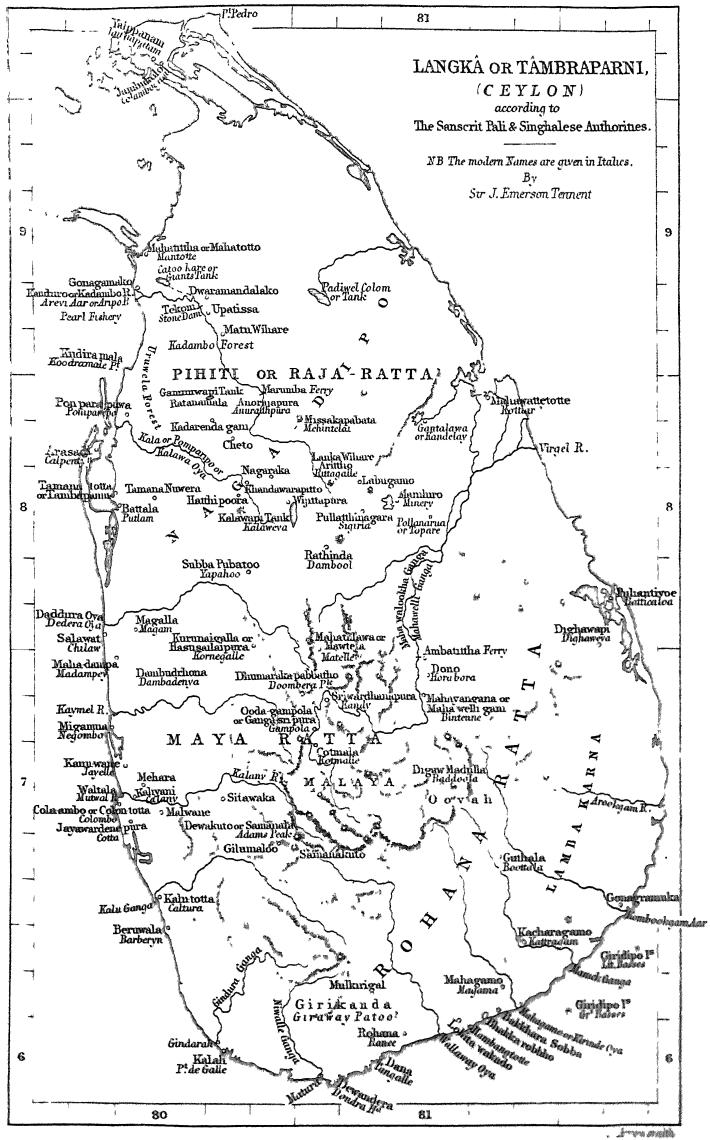
LANGKÂ OR TÂMBRAPARNI. (CEYLON) according to The Sanscrit Pali & Singhalese Authorities. NB The modern Names are given in Italics. By Sir J. Emerson Tennet
NOTE (B.)
NATIVE SOVEREIGNS OF CEYLON.
N.B. The names of subordinate or cotemporary Princes are printed in Italics.
Names and Relationship of each succeeding Sovereign. Capital. Accession
B.C.
1. Wejaya, founder of the Wejayan dynasty Tamananeuera 543
2. Upatissa 1st, minister—regent Upatissaneuera 505
3. Panduwása, paternal nephew of Wejaya ditto 504
Ráma Rámagona
Rohuna Rohuna
Diggaina Diggámadulla
Urawelli Mahawelligama
Anurádha Anurádhapoora
Wijitta Wijittapoora
these six are brothers-in-law
4. Abhaya, son of Paduwása, dethroned Upatissaneuera 474
Interregnum 454
5. Pandukábhaya, maternal grandson of Panduwása Anurádhapoora 437
6. Mutasiwa, paternal grandson ditto 367
7. Devenipiatissa, second son ditto 307
Mahanága, brother Mágama
Yatálatissa, son Kellania
Gotábhaya, son Mágama
Kellani-tissa, not specified Kellania
Káwan-tissa, son of Gotábhaya Mágama
8. Uttiya, fourth son of Mutasiwa Anurádhapoora 267
9. Mahasiwa, fifth son of Mutasiwa ditto 257
10. Suratissa, sixth son of Mutasiwa put to death ditto 247
11. Séna and Guttika, foreign usurpers—put to death ditto 237
12. Aséla, ninth son of Mutasiwa—deposed ditto 215
13. Elála, foreign usurper—killed in battle ditto 205
14. Dutugaimunu, son of Káwantissa ditto 161
15. Saidaitissa, brother ditto 137
16. Tuhl or Thullathanaka, younger son—deposed ditto 119
17. Laiminitissa 1st or Lajjitissa, elder brother ditto 119
18. Kalunna or Khallátanága, brother—put to death ditto 109
19. Walagambáhu 1st or Wattagamini, brother—deposed ditto 104
20. Five foreign usurpers—successively deposed and put to death
Pulahattha ditto 103
Báyiha ditto 100
Panayamárá ditto 98
Peliyamárá ditto 91
Dáthiya ditto 90
21. Walagambáhu 1st, reconquered the kingdom ditto 88
22. Mahadailitissa or Mahachula, son ditto 76
23. Chora Nága, son—put to death ditto 62
24. Kudá Tissa, son—poisoned by his wife ditto 50
25. Anulá, widow ditto 47
26. Makalantissa or Kallakanni Tissa, second son of Kudátissa ditto 41
27. Bátiyatissa 1st or Bátikábhaya, son ditto 19
A.D.
28. Maha Dailiya Mána or Dáthika, brother Anurádhapoora 9
29. Addagaimunu or Amanda Gámini, son—put to death ditto 21
30. Kinibirridaila or Kanijáni Tissa, brother ditto 30
31. Kudá Abhá or Chulábhaya, son ditto 33
32. Singhawallí or Síwalli, sister—put to death ditto 34
Interregnum 35
33. Elluná or Ha Nága, maternal nephew of Addagaimunu ditto 38
34. Sanda Muhuna or Chanda Mukha Siwa, son ditto 44
35. Yasa Silo or Yatálakatissa, brother—put to death ditto 52
36. Subha, usurper—put to death ditto 60
37. Wahapp or Wasahba, descendant of Laiminitissa ditto 66
38. Waknais or Wanka Násica, son ditto 110
39. Gajábáhu 1st or Gámini, son ditto 113
40. Mahalumáná or Mallaka Nága, maternal cousin ditto 125
41. Bátiya Tissa 2nd or Bhátika Tissa, son ditto 131
42. Chula Tissa or Kanittbatissa, brother ditto 155
43. Kuhuna or Chudda Nága, son—murdered ditto 173
44. Kudanáma or Kuda Nága, nephew—deposed ditto 183
45. Kuda Siriná or Siri Nága 1st, brother-in-law ditto 184
46. Waiwahairatissa or Wairatissa, son—murdered ditto 209
47. Abhá Sen or Abhá Tissa, brother ditto 231
48. Siri Nága 2nd, son ditto 239
49. Weja Indu or Wejaya 2nd, son—put to death ditto 241
50. Sangatissa 1st, descendant of Laiminitissa—poisoned ditto 242
51. Dahama Sirisanga Bo or Sirisanga Bodhi 1st, do do.—deposed ditto 245
52. Golu Abhá, Gothábhaya or Megha warna Abhay, do. do. ditto 248
53. Makalan Detu Tissa 1st, son ditto 261
54. Maha Sen, brother ditto 275
55. Kitsiri Maiwan 1st or Kirtisri Megha warna, son ditto 302
56. Detu Tissa 2nd, brother ditto 330
57. Bujas or Budha Dása, son ditto 339
58. Upatissa 2nd, son ditto 368
59. Maha Náma, brother ditto 410
60. Senghot or Sotthi Sena, son—poisoned ditto 432
61. Laimini Tissa 2nd or Chatagáhaka, descendant of Laiminitissa ditto 432
62. Mitta Sena or Karalsora, not specified—put to death ditto 433
63. Pándu} ditto 434
Párinda Kuda} ditto 439
Khudda Párinda} 24.9. Foreign usurpers ditto 455
Dátthiya} ditto 455
Pitthiya} ditto 458
64. Dásenkelleya or Dhátu Séna, descendant of the original royal family—put to death ditto 459
65. Sígiri Kasumbu or Kásyapa 1st, son—committed suicide Sigiri Galla Neuera 477
66. Mugallána 1st, brother Anurádhapoora 495
68. Kirti Séna, son-murdered ditto 522
69. Maidi Síwu or Síwaka, maternal uncle-murdered ditto 531
70. Laimini Upátissa 3rd, brother-in-law ditto 531
71. Ambaherra Salamaiwan or Silákála, son-in-law ditto 534
72. Dápulu 1st or Dátthápa Bhodhi, second son—committed suicide ditto 547
73. Dalamagalan or Mugallána 2nd, elder brother ditto 547
74. Kuda Kitsiri Maiwan 1st or Kirtisri Meg-hawarna, son-put to death ditto 567
75. Senewi or Maha Nága, descendant of the Okáka branch ditto 586
76. Aggrabodhi 1st or Akbo, maternal nephew ditto 589
77. Aggrabodhi 2nd or Sula Akbo, son-in-law ditto 623
78. Sanghatissa, brother-decapitated ditto 633
79. Buna Mugalan or Laimini Bunáya, usurper-put to death ditto 633
80. Abhasiggáhaka or Asiggáhaka, maternal grandson ditto 639
81. Siri Sangabo 2nd, son-deposed ditto 648
82. Kaluna Detutissa or Laimina Katuriya, descendant of Laiminitissa-committed suicide Dewuneura or Dondera 648
Siri Sangabo 2nd, restored, and again deposed Anurádhapoora 649
83. Dalupiatissa 1st or Dhatthopatissa, Laimini branch-killed in battle ditto 665
84. Paisulu Kasumbu or Kásyapa 2nd, brother of Sirisangabo ditto 677
85. Dapulu 2nd, Okáka branch-deposed ditto 686
86. Dalupiatissa 2nd or Hattha-Datthopatissa, son of Dalupiatissa 1st ditto 693
87. Paisulu Siri Sanga Bo 3rd or Aggrabodhi, brother ditto 702
88. Walpitti Wasidata or Dantanáma, Okáka branch ditto 718
89. Hununaru Riandalu or Hatthadátha, original royal family-decapitated ditto 720
90. Máhalaipánu or Mánawamma, do. do. ditto 720
91. Kásiyappa 3rd o Kasumbu, son ditto 726
92. Aggrabodhi 3rd or Akbo, nephew Pollonnarrua 729
93. Aggrabodhi 4th or Kudá Akbo, son ditto 769
94. Mahindu 1st or Salamaiwan, original royal family ditto 775
95. Dappula 2nd, son ditto 795
96. Mahindu 2nd or Dharmika-Sîlámaiga, son ditto 800
97. Aggrabodhi 5th or Akbo, brother ditto 804
98. Dappula 3rd or Kudá Dappula, son ditto 815
99. Aggrabodhi 6th, cousin ditto 831
100. Mitwella Sen or Silámaiga, son ditto 838
101. Kásiyappa 4th or Máganyin Séna or Mihindu, grandson ditto 858
102. Udaya 1st, brother ditto 891
103. Udaya 2nd, son Pollonnarrua 926
104. Kásiyappa 5th, nephew and son-in-law ditto 937
105. Kásiyappa 6th, son-in-law ditto 954
106. Dappula 4th, son ditto 964
107. Dappula 5th, not specified ditto 964
108. Udaya 3rd, brother ditto 974
109 Séna 2nd, not specified ditto 977
110. Udaya 4th, not specified ditto 986
111. Séna 3rd, not specified ditto 994
112. Mihindu 3rd, not specified ditto 997
113. Sèna 4th, son—minor ditto 1013
114. Mihindu 4th, brother—carried captive to India during the Sollean conquest Anurádhapoora 1023
Interregnum Sollean viceroyalty Pollonnarrua 1059
Maha Lai or Maha Lála Kirti Rohuna
Wikrama Pándi Kalutotta
Jagat Pándi or Jagati Pála Rohuna
Prákrama Pándi or Prákhrama Báhu ditto
Lokaiswara Kácharagama
Subordinate native kings during the Sollean vice-royalty. (5 above)
115. Wejayabáhu 1st or Sirisangabo 4th, grandson of Mihindu 4th Pollonnarrua 1071
116. Jayabáhu 1st, brother ditto 1126
117. Wikramabáhu 1st ditto 1127
Mánábarana Rohuna 1127
118. Gajábáhu 2nd Pollonnarrua 1127
Siriwallaba or Kitsiri Maiwan Rohuna 1127
A disputed succession (4 above)
119. Prákrama Báhu 1st, son of Mánábárana Pollonuarrua 1153
120. Wejayabáhu 2nd, nephew—murdered ditto 1186
121. Mihindu 5th or Kitsen Kisdas, usurper—put to death ditto 1187
122. Kirti Nissanga, a prince of Kálinga ditto 1187
Wírabáhu, son—put to death ditto 1196
123. Wikramabáhu 2nd, brother of Kirti Nissanga—put to death ditto 1196
124. Chondakanga, nephew—deposed ditto 1196
125. Lálawátí, widow of Prákramabáhu—deposed ditto 1197
126. Sáhasamallawa, Okáka branch—deposed ditto 1200
127. Kalyánawati, sister of Kirti Nissanga ditto 1202
128. Dharmásóka, not specified—a minor ditto 1208
129. Nayaanga or Nikanga, minister—put to death ditto 1209
Lílawatí, restored, and again deposed ditto 1209
130. Lokaiswera 1st, usurper—deposed ditto 1210
Lílawatí, again restored, and deposed a third time ditto 1211
131. Pandi Prákrama Báhu 2nd, usurper—deposed ditto 1211
132. Mágha, foreign usurper ditto 1214
133. Wejayabáhu 3rd, descendant of Sirisangabo 1st Dambadenia 1235
134. Kalikála Sahitya Sargwajnya or Pandita Prakrama Báhu 3rd, son ditto 1266
135. Bosat Wejaya Báhu 4th, son Pollonnarrua 1301
Bhuwaneka Báhu Yapahu or Subbapabatto
136. Bhuwaneka Báhu 1st, brother ditto 1303
137. Prákrama Báhu 3rd, son of Bosat Wejayabáhu Pollonnarrua 1314
138. Bhuwaneka Báhu 2nd, son of Bhuwaneka Báhu Kurunaigalla or Hastisailapoora 1319
139. Pandita Prákrama Báhu 4th, not specified ditto
140. Wanny Bhuwaneka Báhu 3rd, not specified ditto
141. Wejaya Báhu 5th, not specified ditto
142. Bhuwaneka Báhu 4th, not specified Gampola or Gangásiripoora 1347
143. Prákrama Báhu 5th, not specified ditto 1361
144. Wikram Báhu 3rd, cousin Partly at Kandy or Sengadagalla Neuera 1371
145. Bhuwaneka Báhu 5th, not specified Gampola or Gangásiripoora 1378
146. Wejaya Báhu 5th, or Wíra Báhu, not specified ditto 1398
147. Sri Prákrama Bahu 6th, not specified Kotta or Jayawardanapoora 1410
148. Jayabáhu 2nd, maternal grandson—put to death ditto 1462
149. Bhuwaneka Báhu 6th, not specified ditto 1464
150. Pandita Prákrama Báhu 7th, adopted son ditto 1471
151. Wíra Prákrama Báhu 8th, brother of Bhuwaneka Báhu 6th ditto 1485
152. Dharma Prákrama Báhu 9th, son ditto 1505
153. Wejaya Báhu 7th, brother—murdered ditto 1527
Jayawíra Bandára Gampola
154. Bhuwaneka Báhu 7th, son Kotta 1534
Máyádunnai Setawacca
Raygam Bandára Raygam
Jayawíra Bandára Kandy
155. Don Juan Dharmapála Kotta 1542
A Malabar Yapahu
Portuguese Colombo
Wídiye Rája Pailainda Neuera
Rája Singha Aiwissáwelle
Idirimáné Suriya Seven Korles
Wikrama Báhu descendant of Sirisangabo 1st Kandy
156. Rája Singha 1st, son of Máyádunnai Setawacca 1581
Jaya Suriya Setawacca
Wídiye Rája's queen ditto
157. Wimala Dharma, original royal family Khandy 1592
158. Senáraana or Senarat, brother ditto 1604
159. Rája-singha 2nd, son ditto 1637
Kumára-singa, brother Ouvah
Wejaya Pála, brother Matelle
160. Wimala Dharma Suriya 2nd, son of Rájasingha Khandy 1687
161. Sriwíra Prákrama Narendrasingha or Kundasála ditto 1707
162. Sriwejaya Rája Singha or Hanguranketta, brother-in-law ditto 1739
163. Kirtisri Rája Singha, brother-in-law ditto 1747
164. Rajádhi Rája Singha, brother ditto 1781
165. Sri Wikrema Rája Singha, son of the late king's wife's sister, deposed by the English in 1815, and died in captivity in 1832 ditto 1798
NOTE.—The Singhalese vowels a, e, i, o, u are to be pronounced as in French or Italian.