Volume 1 / Part 5 — CHAPTER I.
Reading edition
CEYLON AS KNOWN TO THE GREEKS AND ROMANS.
Although mysterious rumours of the wealth and wonders of India had reached the Western nations in the heroic ages, and although travellers at a later period returning from Persia and the East had spread romantic reports of its vastness and magnificence, it is doubtful whether Ceylon had been heard of in Europe[1] even by name till the companions of Alexander the Great, returning from his Indian expedition, brought back accounts of what they had been told of its elephants and ivory, its tortoises and marine monsters.[2]
So vague and uncertain was the information thus obtained, that STRABO, writing upwards of two centuries later, manifests irresolution in stating that Taprobane was an island[1]; and POMPONIUS MELA, who wrote early in the first century of the Christian era, quotes as probable the conjecture of HIPPARCHUS, that it was not in reality an island, but the commencement of a south-eastern continent[2]; an opinion which PLINY records as an error that had prevailed previous to his own time, but which he had been enabled to correct by the information received from the ambassador who had been sent from Ceylon to the Emperor Claudius.[3]
In the treatise De Mundo, which is ascribed to ARISTOTLE[1], Taprobane is mentioned incidentally as of less size than Britain; and this is probably the earliest historical notice of Ceylon that has come down to us[2] as the memoirs of Alexander's Indian officers, on whose authority Aristotle (if he be the author of the treatise "De Mundo") must have written, survive only in fragments, preserved by the later historians and geographers.
From their compilations, however, it appears that the information concerning Ceylon collected by the Macedonian explorers of India, was both meagre and erroneous. ONESICRITUS, as he is quoted by Strabo and Pliny, propagated exaggerated statements as to the dimensions of the island[1] and the number of herbivorous cetacea[2] found in its seas; the elephants he described as far surpassing those of continental India both in courage and in size.[3]
MEGASTHENES, twenty years after the death of Alexander the Great, was accredited as an ambassador from Seleucus Nicator to the court of Sandracottus, or Chandra-Gupta, the King of the Prasii, from whose country Ceylon had been colonised two centuries before by the expedition under Wijayo.[1] It was, perhaps, from the latter circumstance and the communication subsequently maintained between the insular colony and the mother country, that Megasthenes, who never visited any part of India south of the Ganges, and who was, probably, the first European who ever beheld that renowned river[1], was nevertheless enabled to collect many particulars relative to the interior of Ceylon. He described it as being divided by a river (the Mahawelli-ganga?) into two sections, one infested by wild beasts and elephants, the other producing gold and gems, and inhabited by a people whom he called Palæogoni[2], a hellenized form of Pali-Putra, "the sons of the Pali," the first Prasian colonists.
Such was the scanty knowledge regarding India communicated to Europe by those who had followed the footsteps of conquest into that remote region; and although eighteen centuries elapsed from the death of Alexander the Great before another European power sought to establish its dominion in the East, a new passion had been early implanted, the cultivation of which was in the highest degree favourable to the acquisition and diffusion of geographical knowledge. In an age before the birth of history[1], the adventurous Phoenicians, issuing from the Red Sea, in their ships, had reached the shores of India, and centuries afterwards their experienced seamen piloted the fleets of Solomon in search of the luxuries of the East.[2]
Egypt, under the Ptolemies, became the seat of that opulent trade which it had been the aim of Alexander the Great to divert to it from Syria. Berenice was built on the Red Sea, as an emporium for the ships engaged in Indian voyages, and Alexandria excelled Tyre in the magnitude and success of her mercantile operations.
The conquest of Egypt by Augustus, so far from checking, served to communicate a fresh impulse to the intercourse with India, whence all that was costly and rare was collected in wanton profusion, to minister to the luxury of Rome. A bold discovery of the same period imparted an entirely new character to the navigation of the Indian Ocean. The previous impediment to trade had been the necessity of carrying it on in small vessels, that crept cautiously along the windings of the shore, the crews being too ignorant and too timid to face the dangers of the open sea. But the courage of an individual at length solved the difficulty, and dissipated the alarm. Hippalus, a seaman in the reign of Claudius, observing the steady prevalence of the monsoons[1], which blew over the Indian Ocean alternately from east to west, dared to trust himself to their influence, and departing from the coast of Arabia, he stretched fearlessly across the unknown deep, and was carried by the winds to Muziris, a port on the coast of Malabar, the modern Mangalore.
An exploit so adventurous and so triumphant, rendered Hippalus the Columbus of his age, and his countrymen, to perpetuate his renown, called the winds which he had mastered by his name.[1] His discovery gave a new direction to navigation, it altered the dimensions and build of the ships frequenting those seas [2], and imparted so great an impulse to trade, that within a very brief period it became a subject of apprehension at Rome, lest the empire should be drained of its specie to maintain the commerce with India. Silver to the value of nearly a million and a half sterling, being annually required to pay for the spices, gems, pearls, and silks, imported through Egypt.[3] An extensive acquaintance was now acquired with the sea-coast of India, and the great work of Pliny, compiled less than fifty years after the discovery of Hippalus, serves to attest the additional knowledge regarding Ceylon which had been collected during the interval.
Pliny, writing in the first century, puts aside the fabulous tales previously circulated concerning the island[1]; he gives due credit to the truer accounts of Onesicritus and Megasthenes, and refers to the later works of ERATOSTHENES and ARTEMIDORUS[2] the geographers, as to its position, its dimensions, its cities, its natural productions, and as to the ignorance of navigation exhibited by its inhabitants. All this, he says, was recorded by former writers, but it had fallen to his lot to collect information from natives of Ceylon who had visited Rome during his own time under singular circumstances. A ship had been despatched to the coast of Arabia to collect the Red Sea revenues, but having been caught by the monsoon it was carried to Hippuros, the modern Kudra-mali, in the north-west of Ceylon, near the pearl banks of Manaar. Here the officer in command was courteously received by the king, who, struck with admiration of the Romans and eager to form an alliance with them, despatched an embassy to Italy, consisting of a Raja and suite of three persons.[3]
The Singhalese king of whom this is recorded was probably Chanda-Mukha-Siwa, who ascended the throne A.D. 44, and was deposed and assassinated by his brother A.D. 52. He signalised his reign by the construction of one of those gigantic tanks which still form the wonders of the island.[1] From his envoys Pliny learned that Ceylon then contained five hundred towns (or more properly villages), of which the chief was Palæsimunda, the residence of the sovereign, with a population of two hundred thousand souls.
They spoke of a lake called Megisba, of vast magnitude, and giving rise to two rivers, one flowing by the capital and the other northwards, towards the continent of India, which was most likely an exaggerated account of some of the great tanks, possibly that of Tissaweva, in the vicinity of Anarajapoora. They described the coral which abounds in the Gulf of Manaar; and spoke of marble, with colours like the shell of the tortoise; of pearls and precious stones; of the luxuriance of the soil, the profusion of all fruits except that of the vine, the natural wealth of the inhabitants, the mildness of the government, the absence of vexatious laws, the happiness of the people, and the duration of life, which was prolonged to more than one hundred years. They spoke of a commerce with China, but it was evidently overland, by way of India and Tartary, the country of the Seres being visible, they said, beyond the Himalaya mountains.[1] The ambassadors described the mode of trading among their own countrymen precisely as it is practised by the Veddahs in Ceylon at the present day[2]; the parties to the barter being concealed from each other, the one depositing the articles to be exchanged in a given place, and the other, if they agree to the terms, removing them unseen, and leaving behind what they give in return.
It is impossible to read this narrative of Pliny without being struck with its fidelity to truth in many particulars; and even one passage, to which exception has been taken as an imposture of the Singhalese envoys, when they manifested surprise at the quarters in which the sun rose and set in Italy, has been referred[3] to the peculiar system of the Hindus, in whose maps north and south are left and right; but it may be explained by the fact of the sun passing overhead in Ceylon, in his transit to the northern solstice; instead of hanging about the south, as in Italy, after acquiring some elevation above the horizon.
The rapid progress of navigation and discovery in the Indian seas, within the interval of sixty or seventy years which elapsed between the death of Pliny and the compilation of the great work of Ptolemy is in no instance more strikingly exhibited than on comparing the information concerning Taprobane, which is given by the latter in his "System of Geography,"[1] with the meagre knowledge of the island possessed by all his predecessors. From his position at Alexandria and his opportunites of intercourse with mariners returning from their distant voyages, he enjoyed unusual facilities for ascertaining facts and distances, and in proof of his singular diligence he was enabled to lay down in his map of Ceylon the position of eight promontories upon its coast, the mouths of five principal rivers, four bays, and harbours; and in the interior he had ascertained that there were thirteen provincial divisions, and nineteen towns, besides two emporiums on the coast; five great estuaries which he terms lakes[2], two bays, and two chains of mountains, one of them surrounding Adam's Peak, which he designates as Maloea—the name by which the hills that environ it are known in the Mahawanso. He mentions the recent change of the name to Salike (which Lassen conjectures to be a seaman's corruption of the real name Sihala[3]); and he notices, in passing, the fact that the natives wore their hair then as they do at the present day, in such length and profusion as to give them an appearance of effeminacy, "[Greek: mallois gynaikeiois eis hapan anadedemenos]."[4]
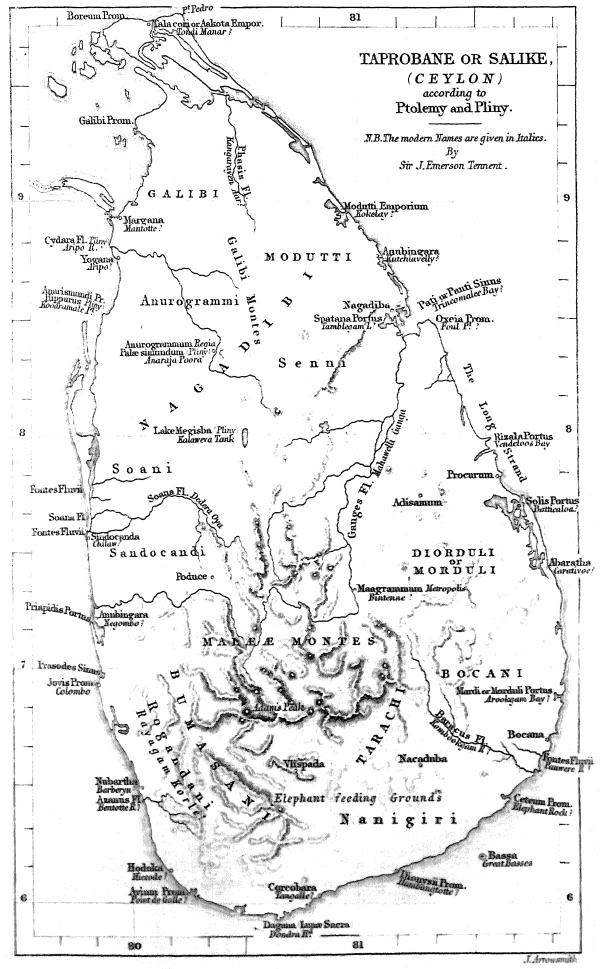
CEYLON, ACCORDING TO PTOLEMY AND PLINY
The extent and accuracy of Ptolemy's information is so surprising, that it has given rise to surmises as to the sources whence it could possibly have been derived.[1] But the conjecture that he was indebted to ancient Phoenician or Tyrian authorities whom he has failed to acknowledge, is sufficiently met by the consideration that these were equally accessible to his predecessors. The abundance of his materials, especially those relating to the sea-borde of India and Ceylon, is sufficient to show that he was mainly indebted for his facts to the adventurous merchants of Egypt and Arabia, and to works which, like the Periplus of the Erythroean Sea (erroneously ascribed to ARRIAN the historian, but written by a merchant probably of the same name), were drawn up by practical navigators to serve as sailing directions for seamen resorting to the Indian Ocean.[2]
So ample was the description of Ceylon afforded by Ptolemy, that for a very long period his successors, AGATHEMERUS, MARCIANUS of Heraclea, and other geographers, were severally contented to use the facts originally collected by him.[1] And it was not till the reign of Justinian, in the sixth century, that COSMAS INDICO-PLEUSTES, by publishing the narrative of Sopater, added very considerably to the previous knowledge of the island.
As Cosmos is the last Greek writer who treats of Taprobane[1], it may be interesting, before passing to his account of the island, to advert to what has been recorded by the Singhalese chroniclers themselves, as to its actual condition at the period when Cosmas described it, and thus to verify his narrative by the test of historical evidence. It has been shown in another chapter that between the first and the sixth centuries, Ceylon had undergone all the miseries of frequent invasions: that in the vicissitudes of time the great dynasty of Wijayo had expired, and the throne had fallen into the hands of an effeminate and powerless race, utterly unable to contend with the energetic Malabars, who acquired an established footing in the northern parts of the island. The south, too wild and uncultivated to attract these restless plunderers, and too rugged and inaccessible to be overrun by them, was divided into a number of petty principalities, whose kings did homage to the paramount sovereign north of the Mahawelli-ganga. Buddhism was the national religion, but toleration was shown to all others,—to the worship of the Brahmans as well as to the barbarous superstition of the aboriginal tribes. At the same time, the productive wealth of the island had been developed to an extraordinary extent by the care of successive kings, and by innumerable works for irrigation and agriculture provided by their policy. Anarajapoora, the capital, had expanded into extraordinary dimensions, it was adorned with buildings and monuments, surpassing in magnitude those of any city in India, and had already attracted pilgrims and travellers from China and the uttermost countries of the East.
With the increasing commercial intercourse between the West and the East, Ceylon, from its central position, half way between Arabia and China, had during the same period risen into signal importance as a great emporium for foreign trade. The transfer of the seat of empire from Rome to Constantinople served to revive the over-land traffic with India; and the Persians for the first time[1] vied with the Arabs and the merchants of Egypt, and sought to divert the Oriental trade from the Red Sea and Alexandria to the Euphrates and the Tigris.
Already, between the first and fifth centuries, the course of that trade had undergone a considerable change. In its infancy, and so long as the navigation was confined to coasting adventures, the fleets of the Ptolemies sailed no further than to the ports of Arabia Felx[1], where they were met by Arabian vessels returning from the west coast of India, bringing thence the productions of China, shipped at the emporiums of Malabar. After the discovery of the monsoons, and the accomplishment of bolder voyages, the great entrepôt of commerce was removed farther south; first, from Muziris, the modern Mangalore, to Nelkynda, now Neliseram, and afterwards to Calicut and Coulam, or Quilon. In like manner the Chinese, who, whilst the navigation of the Arabs and Persians was in its infancy, had extended their voyages not only to Malabar but to the Persian Gulf, gradually contracted them as their correspondents ventured further south. HAMZA says, that in the fifth century the Euphrates was navigable as high as Hira, within a few miles of Babylon[2]; and MASSOUDI, in his Meadows of Gold, states that at that time the Chinese ships ascended the river and anchored in front of the houses there.[3] At a later period, their utmost limit was Syraf, in Farsistan[4]; they afterwards halted first at Muziris, next at Calicut[5], then at Coulam, now Quilon[6]; and eventually, in the fourth and fifth centuries, the Chinese vessels appear rarely to have sailed further west than Ceylon. Thither they came with their silks and other commodities, those destined for Europe being chiefly paid for in silver[7], and those intended for barter in India were trans-shipped into smaller craft, adapted to the Indian seas, by which they were distributed at the various ports east and west of Cape Comorin.[8]
COSMAS was a merchant of Egypt in the reign of Justinian, who, from the extent of his travels, acquired the title of "Indico-pleustes." Retiring to the cloister, he devoted the remnant of his life to the preparation of a work in defence of the cosmography of the Pentateuch from the errors of the Ptolemaic astronomy.[1] He died in the year 550, before his task was completed, and one of the last portions on which he was employed was an account of Taprobane, taken down from the reports of Sopater, a Greek trader whom he had met at Adule in Ethiopia, when on his return from Ceylon.
Sopater, in the course of business as a merchant, sailed from Adule in the same ship with a Persian bound for Ceylon, and on his arrival he and his fellow-traveller were presented by the officers of the port to the king, who was probably Kumara Das, the friend and patron of the poet Kalidas.[1] The king received them with courtesy, and Cosmas recounts how in the course of the interview Sopater succeeded in convincing the Singhalese monarch of the greater power of Rome as compared with that of Persia, by exhibiting the large and highly finished gold coin of the Roman Emperor in contrast with the small and inelegant silver money of the Shah. This story would, however, appear to be traditional, as Pliny relates a somewhat similar anecdote of the ambassadors from Ceylon in the reign of Claudius, and of the profound respect excited in their minds by the sight of the Roman denarii.
As Sopater was the first traveller who described Ceylon from personal knowledge, I shall give his account of the island in the words of Cosmas, which have not before been presented in an English translation. "It is," he says, "a great island of the ocean lying in the Indian Sea, called Sielendib by the Indians, but Taprobane by the Greeks. The stone, the hyacinth, is found in it; it lies beyond the pepper country.[1] Around it there are a multitude of exceedingly small islets[2], all containing fresh water and coco-nut palms[3]; these (islands) lie as close as possible together. The great island itself, according to the accounts of its inhabitants, is 300 gaudia[4], or 900 miles long, and as many in breadth. There are two kings ruling at opposite ends of the island[5], one of whom possesses the hyacinth[6], and the other the district, in which are the port and emporium[7], for the emporium in that place is the greatest in those parts."
"The island has also a community of Christians[1], chiefly resident Persians, with a presbyter ordained in Persia, a deacon, and a complete ecclesiastical ritual.[2]
"The natives and their kings are of different races.[1] The temples are numerous, and in one in particular, situated on an eminence[2], is the great hyacinth, as large as a pine-cone, the colour of fire, and flashing from a distance, especially when catching the beams of the sun—a matchless sight.
"As its position is central, the island is the resort of ships from all parts of India, Persia, and Ethiopia, and, in like manner, many are despatched from it. From the inner[1] countries; I mean China, and other emporiums, it receives silk[2], aloes, cloves, clove-wood, chandana[3], and whatever else they produce. These it again transmits to the outer ports[4],—I mean to Male[5], whence the pepper comes; to Calliana[6], where there is brass and sesamine-wood, and materials for dress (for it is also a place of great trade), and to Sindon[7], where they get musk, castor, and androstachum[8], to Persia, the Homeritic coasts[9], and Adule. Receiving in return the exports of those emporiums, Taprobane exchanges them in the inner ports (to the east of Cape Comorin) sending her own produce along with them to each.
"Sielediba, or Taprobane, lies seaward about five days' sail from the mainland.[1] Then further on the continent is Marallo, which furnishes cochlea[2]; then comes Kaber, which exports 'alabandanum;'[3] and next is the clove country, then China, which exports silk; beyond which there is no other land, for the ocean encircles it on the east. Sielediba being thus placed in the middle as it were of India, and possessing the hyacinth, receives goods from all nations, and again distributes them, thus becoming a great emporium."
This description of the Indian trade by Cosmas is singularly corroborative of the account that had previously been given by the author of the Periplus; and as the Singhalese have at all times been remarkable for their aversion to the sea, the country-craft[1], thus mentioned by both authorities as engaged in voyages between Ceylon and the countries east and west of Cape Cornorin, must have been manned in part by Malabars, but chiefly by the Arabs and Persians, who, previous to the time of Cosmas, had been induced to settle in large numbers in Ceylon[2], attracted by the activity of its commerce, and the extensive employment for shipping afforded by its transit trade.
Amongst the objects, the introduction of which was eagerly encouraged in Ceylon, Cosmas particularises horses from Persia; the traders in which were exempted from the payment of customs. The most remarkable exports were elephants, which from their size and sagacity were found to be superior to those of India for purposes of war. Hence the renown accorded to Ceylon, as pre-eminently the birthplace of the Asiatic race of elephants.
[Greek: "Mêtera Taprobanên Asiêgeneôn elephantôn."] DIONYSIUS PERIEGETES, v. 593.
Cosmas observes upon the smallness of their tusks compared with those of Africa, and mentions the strange fact, that ivory was then exported from Ethiopia to India, as well as to Persia and the countries of Europe. He makes other allusions to Ceylon, but the passages extracted above, present the bulk of his information concerning the island.[1]
NOTE (A).
Knowledge of Ceylon possessed by the Phoenicians.
In the previous chapter, p. 526, &c., allusion has been made to the possible resort of the Phoenicians to Ceylon in the course of their voyages to India, but I have not thought it expedient to embody in the text any notice of the description of the island which is given in the Phoenician History of SANCHONIATHON, published by Wagenfeld, at Bremen, in 1837, under the title of "Sanchuniathonis Historiarum Phoeniciæ Libri Novem Groece Versos a Philone Byblio, edidit Latinaque Versione donavit F. WAGENFELD."
Sanchoniathon is alleged to have lived before the Trojan war; and in Asiatic chronology he is said to have been a contemporary of Semiramis. The Phoenician original perished; but its contents were preserved in the Greek translation of Philo, a native of Byblus, a frontier town of Phoenicia, who wrote in the first century after Christ, and till the alleged discovery of the MS. from which Wagenfeld professed to publish, the only portion of Philo's version known to exist consisted of fragments preserved by Eusebius and Porphyry. Wagenfeld's statement was, that the MS. in his possession had been obtained from the Portuguese monastery of St. Maria de Merinhao (the existence of which there is reason to doubt), and the portion which he first ventured to print appeared with a preface by Grotefend. Its genuineness was instantly impugned; a learned and protracted controversy arose; and though Wagenfeld eventually published the whole of the Greek MS., with a Latin version by himself, he was never prevailed upon to exhibit the original parchments, alleging that he had been compelled to restore them to the convent. The assailants of Wagenfeld accuse him of wilful deception; but the probability is that the document which he translated is one of those inventions of the Middle Ages, in which history and geography were strangely confounded with imagination and romance; and that it is an attempt to restore the lost books of Philo Byblius, as Philo himself is more than suspected to have invented the history which he professed to have translated from Sanchoniathon. (See ERSCH and GRÜBER'S Encyclopædia, 1847; MÖVER'S Phoenician History, vol. i. p. 117.)
In books vii. and viii, Sanchoniathon gives an account of an island in the Indian seas explored by Tyrian navigators, the description of which is evidently copied from the early Greek writers who had visited Taprobane, and the name which is assigned to it, "the Island of Rachius", is borrowed from Pliny. The period of their visit is fixed by Sanchoniathon shortly after the conquest of Cittium, in Cyprus, by the Phoenicians; an event which occurred when Hiram reigned at Tyre, and Solomon at Jerusalem. The narrative is given as follows (book vii. ch. v. p. 150): "So Bartophas died the next day, having exercised imperial authority for six years." (Ch. v.) "And on his death they chose Joramus, the son of Bartophas, king, whom the Tyrians styled Hierbas, and who reigned fifty-seven years. He having collected seventy-nine long ships, sent an expedition against Cittium." ... (Ch. vi.) "At this time, Obdalius, king of the island of Mylite, sent all his forces to assist the Tyrians at Cittium; and when it came to the knowledge of the barbarians who inhabited Tenga, that the island was denuded of men and ships, they invaded it under the command of Plusiacon, the son-in-law of Obdalius, and having slain him and many of his people, they plundered the country, and gave the city to the flames." (Ch. vii.) "And Joramus directed all the eparchs in the cities and islands to make out and send to Tyre descriptions of the inhabitants, their ships, their arms, their horses, their scythe-bearing chariots, and their property of all kinds; and he ordered them to send to distant countries persons competent to draw up narratives of the same kind, and to record them all in a book. In this manner he obtained accurate geographical descriptions of all the regions to the east and the west, both islands and inland parts. But the Æthiopians[1] represented to the king that to the south there were great and renowned countries, densely populated, and rich in precious things, gold and silver, pearls, gems, ebony, pepper, elephants, monkeys, parrots, peacocks, and innumerable other things; and that there was a peninsula so far to the east that the inhabitants could see the sun rising out of the sea." (Ch. viii.) "Joramus then sent messengers to Natambalus, the king of the Babylonians, who were to say to him, 'I have heard that the countries of the Æthiopians are numerous, and abounding in inhabitants; they are easy of access from Babylon, but very difficult from Tyre. If, therefore, I should determine to explore them, and you will let my subjects have suitable ships, you shall have in return a hundred purple cloaks.' Natambalus was willing to do so; but the Æthiopian merchants, who resorted to Babylon, vowed that they would take their departure if he should assist Joramus to sail to Æthiopia." (Chap. ix.) "Subsequently Joramus addressed himself to Irenius of Judea, and undertook that if he would let the Tyrians have a harbour on the sea towards Æthiopia, he would assist him in the building of a palace, in which he was then engaged; and bind himself to supply him with materials of cedar and fir, and squared stones. Irenius assenting, made over to Joramus the city and harbour of Ilotha. There were a great many date trees there, but as their timber was not suitable for constructing vessels, Joramus despatched eight thousand camels to Ilotha, loaded with materials for ship-building, and ordered the shipwrights to build ten ships, and he appointed Cedarus and Jaminus and Cotilus, commanders.... They sailed from Ilotha; but furious tempests prevented them from passing the straits.[2] And while they were wind-bound, they remained five months in a certain island, and having sowed wheat on the low ground, they reaped an abundant crop. After this they sailed towards the rising sun, and leaving the land of the Arabians they fell in with Babylonian ships returning from Æthiopia.[3] And on the following day they arrived at the country of the Æthiopians, which they perceived sandy and devoid of water on the coast, but mountainous inland. They then sailed eastward along the shore for ten days. There an immense region extends to the south, and the Æthiopians dwell in numerous populous and well-circumstanced cities, and navigate the sea. Their ships are not suited for war, and have no sails. And having sailed thirty-six days to the southward, the Tyrians arrived at the island of Rachius ([Greek: Rhachiou nêson])."
(Ch. 9.) "The roadstead was in front of a level strand, bordered with lofty trees, and coming on to blow at night, they were in the utmost danger till sunrise: but running then to the south, they came in sight of a safe harbour[1]; and saw many populous towns inland. On landing, they were surrounded by the villagers, and the governor of the place entertained them hospitably for seven days; pending the return of a messenger whom he had despatched to the principal king, to ask his instructions relative to the Tyrians who had anchored in the harbour. The messenger having returned on the seventh day, the governor sent for the Tyrians the following morning, and informed them that they must go with him to the king, who was then residing at Rochapatta, a large and prosperous city in the centre of the island. In front marched several spearmen, sent by the king as a guard of honour to the strangers; who with the clash of their spears scared away the elephants which were numerous and dangerous because it was their rutting time. The Tyrians marched in the centre, and Cedarus, Cotilus, and Jaminus were carried in palanquins. The villagers as they passed along offered them presents, and the governor brought up the rear, where he rode on an elephant, surrounded by his body guard. In this order of march, they on the third day came to a ford; in the passage over which, one of the travellers was devoured by crocodiles which swarm in the rivers. Having proceeded thus for several days, they at length descried the city of Rochapatta, environed by lofty mountains. And when it was known that they had arrived (for the rumour of their approach had preceded them) the inhabitants rushed from the city in a body to see the Tyrians; some riding on elephants, some on asses, some in palanquins, but the greater part on foot. And the commander having conducted them into a spacious and splendid palace, caused the gates to be closed, that the crowd might not make their way in; and led the Tyrians to the King Rachius, who was seated on a beautiful couch. Presents were then interchanged.
"To the Tyrians, who brought horses and purple robes, and seats of cedar, the King gave in return, pearls, gold, 2000 elephants' teeth, and much unequalled cinnamon ([Greek: kinnamô pollô te kai diapheronti]); and he entertained them as guests for thirty days." (Ch. xi.) "Some of the Tyrians perished in the island, one indeed by sickness, but the others smitten by the gods. One man, picking up some pellets of sheep's dung, drew lines on the sand, and challenged another who happened to be looking on, to play a game with them. The challenger held the sheep's dung, but the other, who could not find any dung of camels (for there are no camels in that island), took cow-dung, of which there was a great quantity, and rolling up little balls of it, placed them on the lines. But a priest who was present warned them to desist, because cow-dung is sacred among them, but they only laughed. So the priest passed on, and they continued their game, but shortly after, both fell down and expired, to the consternation of the bystanders. One of those who died was a native of Jerusalem." (Ch. xii.) "The sea encircles this great island of Rachius on every side, except that to the north and west there is an isthmus which affords a passage to the opposite coast. Baaut constructed this place by heaping up mud, and her footprint is still to be seen in the mountain ([Greek: ês kai ichnos estin en tois orois]).
"And the great king traced his descent from her race. The island is six days' journey in breadth, and twelve days' journey in length. It is populous and delightful. Its natural productions are magnificent, and the sea furnishes fish of the finest flavour, and in the greatest abundance, to the inhabitants of the coast. Wild beasts are numerous in the mountains, of which elephants are the largest of all. There is also the most fragrant of cassia ([Greek: kasia de hê arômatikôtatê]).
"They find stones containing gold in the rivers, and pearls on the sea-shore. Four kings govern the island, all subordinate to the paramount sovereign, to whom they pay as tribute, cassia, ivory, gems, and pearls; for the king has gold in the greatest abundance. The first of these kings reigns in the south, where there are herds of elephants, of which great numbers are captured of surprising size. In this region the shore is inhospitable, and destitute of inhabitants, but the city, in which the governor resides, lies inland, and is said to be large and flourishing. The second king governs the western regions which produce cinnamon ([Greek: tôn pros esperan tetrammenôn tôn kinnamômophorôn]); and it was there the Tyrian ships cast anchor. The third rules the region towards the north, which produces pearls. He has made a great rampart on the isthmus to control the passage of the barbarians from the opposite coast; for they used to make incursions in great numbers, and destroyed all the houses, temples, and plantations they could reach, and slew such men as were near, or could not flee to the mountains. The fourth king governs the region to the east, producing the richest gems in surprising profusion; the ruby, the sapphire, and diamond. All these, being the brothers of the great king in Rochapatta, are appointed to rule over these places, and he who is the eldest of the brothers has the supreme power, and is called the chief and mighty ruler. He has a thousand black elephants, and five light-coloured ones. The black are abundant, but the fair-coloured are rare, and found nowhere except in this island, and the black ones do homage to them. Having captured such a one, they bring him to the king in Rochapatta, whose peculiar prerogative it is to ride on a white elephant, this being unlawful for his subjects. There are many fierce crocodiles in the rivers, and they are killed by crowds of men who rush with shouts into the water, armed with sharp stakes. And ten days after they arrived in Rochapatta, many Tyrians joined Rachius in hunting crocodiles." (Ch. xii.) "When the ships returned to Tyre, Joramus gave orders to erect a pillar at the temple of Melicarthus, and to engrave on it an account of all that had taken place. This pillar was thrown down in the earthquake of last year, but it was not broken, so that the narrative can even now be seen."
BOOK VIII.
(Ch. i) "This is the voyage which Joramus, the king of the Tyrians ordered Joramus, the priest of Melicarthus, to recount and to engrave on a pillar in the temple of Melicarthus, and Sydyk, the scribe, having four copies, was directed to send them to the Sidonians, the Byblians, the Aradians, and the Berythians. The other copies can nowhere be found, and the pillar lies shattered in the ruins of the temple, but the copy of the Byblians is still left in the Temple of Baaltis, and its words are to this effect."
(Ch. ii.) "Hierbas, the son of Bartophas, and king of the Tyrians, thus addressed Joramus, the priest of Madynus, at the time when figs were first ripe: 'Taking a book and pen, describe all the cities and islands and colonies and the countries of the barbarians, and the forces of them all, and their ships of war and of burthen, and their scythe-armed chariots. For when our ships of war, sailing to the island of Rachius, reached the remotest parts eastward that we knew, the extremities of all lands, and the nations that inhabited them, we discovered things unknown to our ancestors. For our ancestors, sailing only to the islands and the region extending to the west, knew nothing of the countries which we have explored to the east: you will therefore write all these things for the information of posterity.' When having prostrated myself before the king, on his saying these things, and having returned to my own house I wrote as follows:—
(Ch. xvi) ... "To the eastward dwell the Babylonians and Medians and Æthiopians. The city of the Babylonians is flourishing and populous; Media produces white horses; Æthiopia is barren and arid near the sea, and mountainous in the interior. And further to the east is the peninsula of Rachius, whither the ships of Hierbas sailed."
On this narrative of Sanchoniathon it is only necessary to remark that the allusion in ch. ix. to the assistance rendered by the Tyrians to Irenius of Judea, when building his palace, in supplying him with timber and squared stones, is almost literally copied from the passage In the Old Testament (1 Kings, ix. 11), where Hiram is stated to have furnished to Solomon "cedar trees and fir trees," for the building of the Temple.
The cession by Irenius of the city and harbour of Ilotha refers to the resort of the Tyrians to Ezion Greber, or Eloth, in the Ælanitic Gulf of the Red Sea, Ib. v. 26, whence they piloted the ships of Solomon, which once in every three years returned with cargoes of gold from Ophir. (Ib. v. 28.)
As to the incidents and observations recorded by the Phoenician travellers during their journey to the interior of Ceylon,—the kings by which it was governed, the natural productions of the various regions, the footprint on Adam's Peak, the incursions of the Malabars, the ascendency of their religion, the absence of camels, the abundance of elephants, and the cultivation of cinnamon,—all these are so palpably imitated from the accounts of Cosmas Indico-pleustes, and the voyages of Arabian mariners, that it is almost unnecessary to point to the parallel passages from which they are taken.