Volume 1 / Part 4 — CHAP. V.
Reading edition
WORKING IN METALS.
METALS. Iron.—Working in metals was early understood in Ceylon. Abundance of iron ore can be extracted from the mountains round Adam's Peak; the black oxide is found on the eastern shore in the state of iron-sand; and both are smelted with comparative ease by the natives. Iron tools were in use for the dressing of stones; and in the third century before Christ, the enclosed city of Wijittapoora was secured by an "iron gate." [1]
Steel.—The manufacture of arms involved the use of steel, the method of tempering which was derived from the Hindus, by whom the wootz was prepared, of which, the genuine blades of Damascus are shown to have been made, the beauty of their figuring being dependent on its peculiar crystallisation. Ezekiel enumerates amongst the Indian imports of Tyre "bright iron, calamus and cassia."[1]
Copper.—Copper was equally in demand, but, like silver and gold, it is nowhere alluded to as a production of the island. In ancient, as in modern, times, therefore, the numerous articles formed from this metal were probably imported from India. The renowned Brazen. Palace of Anarajapoora was so named from the quantity of copper used in its construction. Bujas Raja, A.D. 359, covered a building at Attanagalla with "tiles made of copper, and gilt with gold,"[1] and "two boats built of brass," were placed near the Bo-Tree at the capital "to hold food for the priests."[2] Before the Christian era, armour for elephants[3], and vessels of large dimensions, cauldrons[4], and baths[5], were formed of copper. The same material was used for the lamps, goblets[6], kettles, and cooking utensils of the monasteries and wiharas.
Bells.—Bells were hung in the palaces[1], and bell-metal is amongst the gifts to the temples recorded on the rock at Pollanarrua, A.D. 1187.[2]
Bronze.—Bronze was cast into figures of Buddha[1], and the Mahawanso, describing the reign of Dhatu-Sena, A.D. 459, makes mention of "sixteen bronze statues of virgins having the power of locomotion."[2]
Lead.—Lead was used during the wars of Dutugaimunu and Elala, and poured molten over the attacking elephants during the siege of Wijittapoora.[1] As lead is not a native product of Ceylon, it must have been brought thither from Ava or Malwa.
Gold and Silver.—Ceylon, like the continent of India, produces no silver and gold, save in the scantiest quantities.[1] The historical books, in recording the splendour of the temples and their riches, and the wealth lavished by the kings upon the priesthood, describe in perpetually recurring terms, the multitude of ornaments and vessels made of silver and gold. In early times the most precious of these were received as gifts from the princes of India, and in the second century before Christ the Mahawanso records the arrival of ships in the south of the island, "laden with golden utensils." The import of these might possibly have been a relic of the early trade with the Phoenicians, whom Homer, in a passage quoted by Strabo (l. xvi. c. 2. s. 24.), describes as making these cups, and carrying across the sea for sale in the great emporiums visited by these ships.[2] A variety of articles of silver are spoken of at very early periods. Dutugaimunu, when building the great dagoba, caused the circle of its base to be described by "a pair of compasses made of silver, and pointed with gold;"[3] parasols, vases, caranduas and numerous other regal or religious paraphernalia, were made from this precious material. Gold was applied in every possible form and combination to the decoration and furnishing of the edifices of Buddhism;—"trees of gold with roots of coral,"[4] flowers formed of gems with stems of silver[5], fringes of bullion mixed with pearls; umbrellas, shields, chains, and jewelled statuettes[6], are described with enthusiasm by the annalists of the national worship.
The abundance of precious stones naturally led to their being extensively mounted in jewelry, and in addition to those found in Ceylon, diamonds[1] and lapis lazuli [2] (which must have been brought thither from India and Persia) are classed with the sapphire and the topaz, which are natives of the island.
The same passion existed then, as now, for covering the person with ornaments; gold, silver, and gems were fashioned into rings for the ears, the nose, the fingers, and toes, into plates for the forehead, and chains for the neck, into armlets, and bracelets, and anklets, and into decorations of every possible form, not only for the women, but for men, and, above all, for the children of both sexes. The poor, unable to indulge in the luxury of precious metals, found substitutes in shells and glass; and the extravagance of the taste was defended on the ground that their brilliancy served to avert the malignity of "the evil eye" from the wearer to the jewel.
Gilding.—Gilding was likewise understood by the Singhalese in all its departments, both as applied to the baser metals and to other substances—wood-work was gilded for preaching places[1] as was also copper for roofing, cement for decorating walls, and stone for statuary and carving.[2]
Coin.—Although the Singhalese through their sacred writings had a knowledge of coined money, and of its existence in India from a period little subsequent to the death of Gotama Buddha[1]; and although their annalists give the names of particular coins in circulation[2], at various times, no Singhalese money has yet been discovered of a date antecedent to the eleventh century. The Chinese in the fifteenth century spoke with admiration of the gold pieces struck by the kings of Ceylon, which they found in circulation on their frequent visits to the emporium at Galle[3]; but of these only a few very rare examples have been preserved, one of which bears the effigy and name of Lokaiswaira[4], who usurped the throne during a period of anarchy about A.D. 1070. Numbers of small copper coins of the eleventh and twelfth centuries have from time to time been dug up both in the interior and on the coast of the island[5]. A quantity of these which were found in 1848 by Lieutenant Evatt, when in command of a pioneer corps near the village of Ambogamoa, were submitted to Mr. Vaux of the British Museum, and prove to belong to the reign of Wijayo Bahu, A.D. 1071, Prakrama I., A.D. 1153, the Queen Lilawatte, A.D. 1197, King Sahasamallawa, A.D. 1200, Darmasoka, A.D. 1208, and Bhuwaneka Bahu, A.D. 1303. These coins have one and all the same device on the obverse,—a rude standing figure of the Raja holding the trisula in his left hand, and a flower in the right. His dress is a flowing robe, the folds of which are indicated rather than imitated by the artist; and on the reverse the same figure is seated, the name in Nagari characters being placed beside the face[6].
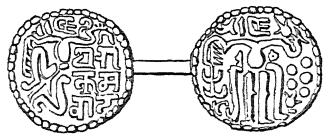
Coin showing the Trisula.
The Kandyans, by whom these coins are frequently found, give the copper pieces the name of Dambedenia challies, and tradition, with perfect correctness, assigns them to the twelfth and thirteenth centuries, when the kings of that period are believed to have had a mint at Dambedenia.
A quantity of coins similar in every respect to those dug up in Ceylon have been found at Dipaldinia or Amarawati, on the continent of India, near the mouth of the Kistna; a circumstance which might be accounted for by the frequent intercourse between Ceylon and the coast, but which is possibly referable to the fact recorded in the Mahawanso that Prakrama I., after his successful expedition against the King of Pandya, caused money to be coined in his own name before retiring to Ceylon.[1]
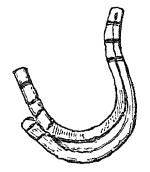
HOOK MONEY.
Hook-money.—No ancient silver coin has yet been found, but specimens are frequently brought to light of the ridis, pieces of twisted silver wire, which from their being sometimes bent with a considerable curve have been called "Fish-hook money." These are occasionally impressed with a legend, and for a time the belief obtained that they were a variety of ring-money peculiar to Ceylon.[1] Of late this error has been corrected; the letters where they occur have been shown to be not Singhalese or Sanskrit, but Persian, and the tokens themselves have been proved to belong to Laristan on the Persian Gulf, from the chief emporium of which, Gambroon, they were brought to Ceylon in the course of Indian commerce; chiefly by the Portuguese, who are stated by VAN CARDAEN to have introduced them in great quantities into Cochin and the ports of Malabar.[2] There they were circulated so freely that an edict of Prakrama enumerates the ridi amongst the coins in which the taxes were assessed on land.[3]
In India they are called larins, and money in imitation of them, struck by the princes of Bijapur and by Sivaji, the founder of the Mahrattas, was in circulation in the Dekkan as late as the seventeenth century.[1]