Volume 1 / Part 3 — CHAP. III
Reading edition
THE CONQUEST OF CEYLON BY WIJAYO, B.C. 543, AND THE ESTABLISHMENT OF BUDDHISM, B.C. 307.
B.C. 543.The sacred historians of Ceylon affect to believe in the assertion of some mysterious connection between the landing of Wijayo, and the conversion of Ceylon to Buddhism, one hundred and fifty years afterwards; and imply that the first event was but a pre-ordained precursor of the second.[1] The Singhalese narrative, however, admits that Wijayo was but a "lawless adventurer," who being expelled from his own country, was refused a settlement on the coast of India before he attempted Ceylon, which had previously attracted the attention of other adventurers. This story is in no way inconsistent with that told by the Chinese Buddhists, who visited the island in the fifth and seventh centuries. FA HIAN states, that even before the advent of Buddha, Ceylon was the resort of merchants, who repaired there to exchange their commodities for gems, which the "demons" and "serpents," who never appeared in person, deposited on the shore, with a specified value attached to each, and in lieu of them the strangers substituted certain indicated articles, and took their departure.[2]
B.C. 543.HIOUEN-THSANG, at a later period, disposes of the fables of Wijayo's descent from a lion[1], and of his divine mission to Ceylon, by intimating, that, according to certain authorities, he was the son of a merchant (meaning a sea-faring trader), who, having appeased the enmity of the Yakkhos, succeeded by his discretion in eventually making himself their king.[2]
Whatever may have been his first intentions, his subsequent policy was rather that of an agriculturist than an apostle. Finding the country rich and fertile, he invited merchants to bring their families, and take possession of it.[1] He dispersed his followers to form settlements over the island, and having given to his kingdom his patrimonial name of Sihala[2], he addressed himself to render his dominions "habitable for men."[3] He treated the subjugated race of Yakkhos with a despotic disdain, referable less to pride of caste than to contempt for the rude habits of the native tribes. He repudiated the Yakkho princess whom he had married, because her unequal rank rendered her unfit to remain the consort of a king[4]; and though she had borne him children, he drove her out before his second marriage with the daughter of an Indian sovereign, on the ground that the latter would be too timid to bear the presence of a being so inferior.[5]
B.C. 504.Leaving no issue to inherit the throne, he was succeeded by his nephew[1], who selected a relation of Gotama Buddha for his queen; and her brothers having dispersed themselves over the island, increased the number of petty kingdoms, which they were permitted to form in various districts[2], a policy which was freely encouraged by all the early kings, and which, though it served to accelerate colonisation and to extend the knowledge of agriculture, led in after years to dissensions, civil war, and disaster. It was at this period that Ceylon was resolved into the three geographical divisions, which, down to a very late period, are habitually referred to by the native historians. All to the north of the Mahawelli-ganga was comprised in the denomination Pihiti, or the Raja-ratta, from its containing the ancient capital and the residence of royalty; south of this was Rohano or Rahuna, bounded on the east and south by the sea, and by the Mahawelli-ganga and Kalu-ganga, on the north and west; a portion of this division near Tangalle still retains the name of Roona.[3] The third was the Maya-ratta, which lay between the mountains, the two great rivers and the sea, having the Dedera-oya to the north, and the Kalu-ganga as its southern limit.
B.C. 504.The patriarchal village system, which from time immemorial has been one of the characteristics of the Dekkan, and which still prevails throughout Ceylon in a modified form, was one of the first institutions organised by the successors of Wijayo. "They fixed the boundaries of every village throughout Lanka;"[1] they "caused the whole island to be divided into fields and gardens;"[2] and so uniformly were the rites of these rural municipalities respected in after times, that one of the Singhalese monarchs, on learning that merit attached to alms given from the fruit of the donor's own exertions, undertook to sow a field of rice, and "from the portion derived by him as the cultivator's share," to bestow an offering on a "thero."[3]
From the necessity of providing food for their followers, the earliest attention of the Bengal conquerors was directed to the introduction and extension of agriculture. A passage in the Mahawanso would seem to imply, that previous to the landing of Wijayo, rice was imported for consumption[1], and upwards of two centuries later the same authority specifies "one hundred and sixty loads of hill-paddi,"[2] among the presents which were sent to the island from Bengal.
B.C. 504.In a low and level country like the north of Ceylon, where the chief subsistence of the people is rice, a grain which can only be successfully cultivated under water, the first requisites of society are reservoirs and canals. The Buddhist historians extol the father of Wijayo for his judgment and skill "in forming villages in situations favourable for irrigation;"[1] his own attention was fully engrossed with the cares attendant on the consolidation of his newly acquired power; but the earliest public work undertaken by his successor Panduwasa, B.C. 504, was a tank, which he caused to be formed in the vicinity of his new capital Anarajapoora, the Anurogrammum of Ptolemy, originally a village founded by one of the followers of Wijayo.[2]
B.C. 307.The continual recurrence of records of similar constructions amongst the civil exploits of nearly every succeeding sovereign, together with the prodigious number formed, alike attests the unimproved condition of Ceylon, prior to the arrival of the Bengal invaders, and the indolence or ignorance of the original inhabitants, as contrasted with the energy and skill of their first conquerors.
B.C. 307.Upwards of two hundred years were spent in initiatory measures for the organisation of the new state. Colonists from the continent of India were encouraged by the facilities held out to settlers, and carriage roads were formed in the vicinity of the towns.[1] Village communities were duly organised, gardens were planted, flowers and fruit-bearing trees introduced,[2] and the production of food secured by the construction of canals,[3] and public works for irrigation. Moreover, the kings and petty princes attested the interest which they felt in the promotion of agriculture, by giving personal attention to the formation of tanks and to the labours of cultivation.[4]
B.C. 307.Meantime, the effects of Gotama's early visits had been obliterated, and the sacred trees which he planted were dead; and although the bulk of the settlers had come from countries where Buddhism was the dominant faith, no measures appear to have been taken by the immigrants to revive or extend it throughout Ceylon. Wijayo was, in all probability, a Brahman, but so indifferent to his own faith, that his first alliance in Ceylon was with a demon worshipper.[1] His immediate successors were so eager to encourage immigration, that they treated all religions with a perfect equality of royal favour. Yakkho temples were not only respected, but "annual demon offerings were provided" for them; halls were built for the worshippers of Brahma, and residences were provided at the public cost, for "five hundred persons of various foreign religious faiths;"[2] but no mention is made in the Mahawanso of a single edifice having been then raised for the worshippers of Buddha, whether resident in the island, or arriving amongst the colonists from India.
It was not till the year B.C. 307, in the reign of Tissa, that the preacher Mahindo ventured to visit Ceylon, under the auspices of the king, whom he succeeded in inducing to abstain from Brahmanical rites, and to profess faith in the doctrines of Buddha. From the prominent part thus taken by Tissa in establishing the national faith of Ceylon, the sacred writers honour his name with the prefix of Déwánan-pia, or "beloved of the saints."
B.C. 307.The Mahawanso exhausts the vocabulary of ecstacy in describing the advent of Mahindo, a prince of Magadha, and a lineal descendant of Chandragutto. It records the visions by which he was divinely directed to "depart on his mission for the conversion of Lanka;" it describes his aërial flight, and his descent on Ambatthalo, the loftiest peak of Mihintala, the mountain which, rising suddenly from the plain, overlooks the sacred city of Anarajapoora. The story proceeds to explain, how the king, who was hunting the elk, was miraculously allured by the fleeing game to approach the spot where Mahindo was seated[1]; and how the latter forthwith propounded the Divine doctrine "to the ruler of the land; who, at the conclusion of his discourse, together with his forty thousand followers, obtained the salvation of the faith."[2]
Then follows the approach of Mahindo to the capital; the conversion of the queen and her attendants, and the reception of Buddhism by the nation, under the preaching of its great Apostle, who "thus became the luminary which shed the light of religion over the land." He and his sister Sanghamitta thenceforth devoted their lives to the organisation of Buddhist communities throughout Ceylon, and died in the odour of sanctity, in the reign of King Uttiya, B.C. 267.
B.C. 289.But the grand achievement which consummated the establishment of the national faith, was the arrival from Magadha of a branch of the sacred Bo-tree. Every ancient race has had its sacred tree; the Chaldeans, the Hebrews[1], the Greeks, the Romans and the Druids, had each their groves, their elms and their oaks, under which to worship. Like them, the Brahmans have their Kalpa tree in Paradise, and the Banyan in the vicinity of their temples; and the Buddhists, in conformity with immemorial practice, selected as their sacred tree the Pippul, which is closely allied to the Banyan, yet sufficiently distinguished from it, to serve as the emblem of a new and peculiar worship.[2] It was whilst reclining under the shade of this tree in Uruwela, that Gotama received Buddhahood; hence its adoption as an object of reverence by his followers, and in all probability its adoration preceded the use of images and temples in Ceylon.[3]
B.C. 289.In order that his kingdom might possess a sacred tree of the supremest sanctity, king Tissa solicited a branch of the identical tree under which Gotama reclined, from Asoca, who then reigned in Magadha. The difficulty of severing a portion without the sacrilegious offence of "lopping it with any weapon," was overcome by the miracle of the branch detaching itself spontaneously, and descending with its roots into the fragrant earth prepared for it in a golden vase, in which it was transported by sea to Ceylon[1], and planted by king Tissa in the spot at Anarajapoora, where, after the lapse of more than 2000 years, it still continues to flourish and to receive the profound veneration of all Buddhist nations.[2]
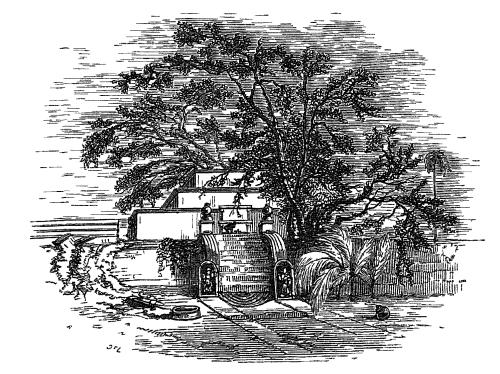
THE BO TREE AT ANARAJAPOORA