Volume 7 — T (continued 3)
Reading edition
A further opportunity offered itself to be present at the funeral of an elderly woman on the open downs not far from Paikāra, in connection with which certain details possess some interest. The corpse was, at the time of our arrival, laid out on a rude bier within an improvised arbour covered with leaves and open at each end, and tended by some of the female relatives. At some little distance, a conclave of Toda men, who rose of one accord to greet us, was squatting in a circle, among whom were many venerable white-turbaned elders of the tribe, protected from the scorching sun by palm-leaf umbrellas. Amid much joking, and speech-making by the veterans, it was decided that, as the eldest son of the deceased woman was dead, leaving a widow, this daughter-in-law should be united to the second son, and that they should live together as man and wife. On the announcement of the decision, the bridegroom-elect saluted the principal Todas present by placing his head on their feet, which were sometimes concealed within the ample folds of the putkūli. At the funeral of a married woman, three ceremonies must, I was told, be performed, if possible, by a daughter or daughter-in-law, viz.:—
(1) Tying a leafy branch of the tiviri shrub (Atylosia Candolleana) in the putkūli of the corpse;
(2) Tying balls of thread and cowry shells on the arm of the corpse, just above the elbow;
(3) Setting fire to the funeral pyre, which was, on the present occasion, done by lighting a rag fed with ghī with a match.
The buffalo capture took place amid the usual excitement, and with freedom from accident; and, later in the day, the stalwart buffalo catchers turned up at the travellers’ bungalow for a pourboire in return, as they said, for treating us to a good fight. The beasts selected for sacrifice were a full-grown cow and a young calf. As they were dragged near to the corpse, now removed from the arbour, butter was smeared over the horns, and a bell tied round the neck. The bell was subsequently removed by Kotas, in whose custody, it was said, it was to remain till the next day funeral. The death-blow, or rather series of blows, having been delivered with the butt end of an axe, the feet of the corpse were placed at the mouth of the buffalo. In the case of a male corpse, the right hand is made to clasp the horns. [It is recorded by Dr. Rivers that, at the funeral of a male, men dance after the buffalo is killed. In the dancing a tall pole, called tadri or tadrsi, decorated with cowry shells, is used.] The customary mourning in couples concluded, the corpse, clad in four cloths, was carried on the stretcher to a clear space in the neighbouring shola, and placed by the side of the funeral pyre, which had been rapidly piled up. The innermost cloth was black in colour, and similar to that worn by a palol. Next to it came a putkūli decorated with blue and red embroidery, outside which again was a plain white cloth covered over by a red cotton cloth of European manufacture. Seated by the side of the pyre, near to which I was courteously invited to take a seat on the stump of a rhododendron, was an elderly relative of the dead woman, who, while watching the ceremonial, was placidly engaged in the manufacture of a holly walking-stick with the aid of a glass scraper. The proceedings were watched on behalf of Government by a forest guard, and a police constable who, with marked affectation, held his handkerchief to his nose throughout the ceremonial. The corpse was decorated with brass rings, and within the putkūli were stowed jaggery, a scroll of paper adorned with cowry shells, snuff and tobacco, cocoanuts, biscuits, various kinds of grain, ghī, honey, and a tin-framed looking-glass. A long purse, containing a silver Japanese yen and an Arcot rupee of the East India Company, was tied up in the putkūli close to the feet. These preliminaries concluded, the corpse was hoisted up, and swung three times over the now burning pyre, above which a mimic bier, made of slender twigs, was held. The body was then stripped of its jewelry, and a lock of hair cut off by the daughter-in-law for preservation, together with a fragment of the skull. I was told that, when the corpse is swung over the pyre, the dead person goes to amnodr (the world of the dead). In this connection, Dr. Rivers writes that “it would seem as if this ceremony of swinging the body over the fire was directly connected with the removal of the objects of value. The swinging over the fire would be symbolic of its destruction by fire; and this symbolic burning has the great advantage that the objects of value are not consumed, and are available for use another time. This is probably the real explanation of the ceremony, but it is not the explanation given by the Todas themselves. They say that long ago, about 400 years, a man supposed to be dead was put on the funeral pyre, and, revived by the heat, he was found to be alive, and was able to walk away from the funeral place. In consequence of this, the rule was made that the body should always be swung three times over the fire before it is finally placed thereon.” [Colonel Marshall narrates the story that a Toda who had revived from what was thought his death-bed, has been observed parading about, very proud and distinguished looking, wearing the finery with which he had been bedecked for his own funeral, and which he would be permitted to carry till he really departed this life.] As soon as the pyre was fairly ablaze, the mourners, with the exception of some of the female relatives, left the shōla, and the men, congregating on the summit of a neighbouring hill, invoked their god. Four men, seized, apparently in imitation of the Kota Dēvādi, with divine frenzy, began to shiver and gesticulate wildly, while running blindly to and fro with closed eyes and shaking fists. They then began to talk in Malayālam, and offer an explanation of an extraordinary phenomenon, which had appeared in the form of a gigantic figure, which disappeared as suddenly as it appeared. At the annual ceremony of walking through fire (hot ashes) in that year, two factions arose owing to some dissension, and two sets of ashes were used. This seems to have annoyed the gods, and those concerned were threatened with speedy ruin. But the whole story was very vague. The possession by some Todas of a smattering of Malayālam is explained by the fact that, when grazing their buffaloes on the northern and western slopes of the Nīlgiris, they come in contact with Malayālam-speaking people from the neighbouring Malabar district.
Several examples of laments relating to the virtues and life of the deceased, which are sung or recited in the course of the funeral ceremonies, are given by Dr. Rivers. On the occasion of the reproduction of a lament in my phonograph, two young women were seen to be crying bitterly. The selection of the particular lament was unfortunate, as it had been sung at their father’s funeral. The reproduction of the recitation of a dead person’s sins at a Badaga funeral quickly restored them to a state of cheerfulness.
The following petition to the Collector of the Nilgiris on the subject of buffalo sacrifice may be quoted as a sign of the times, when the Todas employ petition-writers to express their grievances:—
“According to our religious custom for the long period, we are bringing forward of our killing buffaloes without any irregular way. But, in last year, when the late Collector came to see the said place, by that he ordered to the Todas first not to keep the buffaloes without feeding in the kraal, and second he ordered to kill each for every day, and to clear away the buffaloes, and not to keep the buffaloes without food. We did our work according to his orders, and this excellent order was an ample one. Now this ——, a chief of the Todas, son of ——, a deceased Toda, the above man joined with the moniagar of —— village, joined together, and, dealing with bribes, now they arose against us, and doing this great troubles on us, and also, by this great trouble, one day Mr. —— came for shooting snapes (snipe) by that side. By chance one grazing buffalo came to him, push him by his horns very forcely, and wounded him on his leg. By the help of another gentleman who came with him he escaped, or he would have die at the moment. Now the said moniagar and —— joined together, want to finish the funeral to his late father on the 18th instant. For this purpose they are going to shut the buffaloes without food in the kraal on the 18th instant at 10 o’clock. They are going to kill the buffaloes on the 19th instant at 4 o’clock in the evening. But this is a great sin against god. But we beg your honour this way. That is, let them leave the buffaloes in the grazing place, and ask them to catch and kill them at the same moment. And also your honour cannot ordered them to keep them in the kraal without food. And, if they will desire to kill the buffaloes in this way, these buffaloes will come on us, and also on the other peoples one who, coming to see funs on those day, will kill them all by his anxious. And so we the Todas begs your honour to enquire them before the 18th, the said funeral ceremony commencing, and not to grant the above orders to them.”
A Whit Monday at Paikāra was given up to an exhibition of sports and games, whereof the most exciting and interesting was a burlesque representation of a Toda funeral by boys and girls. A Toda, who was fond of his little joke, applied the term pacchai kēdu (green funeral) to the corpses of the flies entrapped by a viscous catch’em-alive-oh on the bungalow table. To the mock funeral rites arrived a party of youths, as from a distant mand, and crying out U, hah, in shrill mimicry of their elders. The lad who was to play the leading part of sacrificial buffalo, stripping off his putkūli, disappeared from sight over the brow of a low hillock. Above this eminence his bent and uplifted upper extremities shortly appeared as representatives of the buffalo horns. At sight thereof, there was a wild rush of small boys to catch him, and a mimic struggle took place, while the buffalo was dragged, amid good-tempered scuffling, kicks, and shouting, to the spot where the corpse should have been. This spot was, in the absence of a pseudo-dead body or stage dummy, indicated by a group of little girls, who had sat chatting together till the boy-beast arrived, when they touched foreheads, and went, with due solemnity, through the orthodox observance of mourning in couples. The buffalo was slain by a smart tap on the back of the head with a cloth, which did duty for an axe. As soon as the convulsive movements and twitchings of the death struggle were over, the buffalo, without waiting for an encore, retired behind the hillock once more, in order that the rough and tumble fight, which was evidently the chief charm of the game, might be repeated. The buffalo boy later on came in second in a flat race, and he was last seen protecting us from a mischievous-looking member of his herd, which was grazing on the main-road. Toda buffaloes, it may be noted, are not at all popular with members of the Ootacamund Hunt, as both horses and riders from time to time receive injuries from their horns, when they come in collision.
At the Muttanād mand, we were treated to a further exhibition of games. In one of these, called narthpimi, a flat slab of stone is supported horizontally on two other slabs fixed perpendicularly in the ground so as to form a narrow tunnel, through which a man can just manage to wriggle his body with difficulty. Two men take part in the game, one stationing himself at a distance of about thirty yards, the other about sixty yards from the tunnel. The front man, throwing off his mantle, runs as hard as he can to the tunnel, pursued by the ‘scratch’ man, whose object is to touch the other man’s feet before he has squeezed himself through the tunnel. Another sport, which we witnessed, consists of trial of strength with a heavy globular stone, the object being to raise it up to the shoulder; but a strong, well-built-man—he who was entrusted with slaying the funeral buffalo—failed to raise it higher than the pit of the stomach, though straining his muscles in the attempt. A splendidly made veteran assured me that, when young and lusty, he was able to accomplish the feat, and spoke sadly of degeneration in the physique of the younger members of the tribe.
Mr. Breeks mentions that the Todas play a game resembling puss-in-the-corner, called kāriālapimi, which was not included in the programme of sports got up for our benefit. Dr. Rivers writes that “the Todas, and especially the children, often play with mimic representations of objects from practical life. Near the villages I have seen small artificial buffalo-pens and fireplaces made by the children in sport.” I have, on several occasions, come across young children playing with long and short pieces of twigs representing buffaloes and their calves, and going solemnly through the various incidents in the daily life of these animals. Todas, both old and young, may constantly be seen twisting flexible twigs into representations of buffaloes’ heads and horns.
Of Toda songs, the following have been collected:—
Sunshine is increasing. Mist is fast gathering. Rain may come. Thunder roars. Clouds are gathering.
Rain is pouring. Wind and rain have combined.
Oh, powerful god, may everything prosper!
May charity increase!
May the buffaloes become pregnant!
See that the buffaloes have calves.
See that the barren women have children.
Go and tell this to the god of the land.
Keygamor, Eygamor (names of buffaloes).
Evening is approaching. The buffaloes are coming.
The calves also have returned.
The buffaloes are saluted.
The dairy-man beats the calves with his stick.
Milk has been offered to the bell.
It is growing dark.
This is a buffalo with beautiful horns.
A buffalo stupidly given away by the Badaga.
A buffalo brought to the Kāndal mand.
Innerovya (name of buffalo).
Like this buffalo there is no other.
Parkūr (name of a Toda).
Like him there is no man.
The sun is shining. The wind is blowing.
Rain is coming. The trees are in flower.
Tears are falling. The nose is burning.
He is coming, holding up his umbrella.
He is coming, wearing a good body-cloth.
He is coming, wearing a good under-cloth.
He (the palol) is coming, wearing a black cloth.
He is coming, holding his walking-stick of palai wood.
I have a god. What is to become of me?
I am inclined to cry, my heart being heavy.
Oh, my child! Do not cry. It is still crying.
Thuree. Thuree. See. Be quiet.
A robust bull buffalo. Ach! Ach!
A big buffalo not intended for killing. Ach! Ach!
Is leading the cow buffalo. Ah! Ah!
Two or three men are driving it. Ah! Ah!
Song in honour of the arrival of the Maharāni-Regent of Mysore at Ootacamund.
All we Todas go to her house, and dance before her.
She gives us fifteen rupees.
She comes near our women, and talks to them.
She gives cloths to us.
Next day we take milk, eight bottles in the morning, four in the evening.
Month by month she pays us for our milk.
She goes back to Mysore, and, when she goes, we stand in a row before her.
She gives us presents; cloths and three rupees.
The women cut their hair, and stand before her.
Marriage Song.
Boys and girls are singing.
Much money are they spending.
To the girl her father is giving five buffaloes.
The husband tells his wife that she must curl her hair.
If her hair is curled, all the people will rejoice.
The buffalo is slain, and now we must all dance.
Why are not more people here? More should come.
My buffalo is big, very big.
Go quickly and catch it.
The Todas are all there. They are standing in a row.
Who will run, and catch the buffalo first?
To him will a present of five rupees be given.
I will go and catch it first.
The Todas are all fighting.
The Todas are all feasting.
People give them rice.
The buffalo is coming. Two men run to catch it by the neck.
Ten men collect the buffaloes. They pen them in a kraal.
At one o’clock we take our food.
The buffalo is running, and I hit it on the back with a stick.
It swerves aside, but I drive it back to the path.
Night comes, and we all dance.
Next morning at ten o’clock we bring out the buffalo, and slay it.
At four in the morning we wrap rice and grain in a white cloth, and burn it.
At eleven we cut the hair of the boys and girls.
At four in the morning the priest goes to the temple (dairy).
He lights the lamp.
At eight he milks his buffaloes.
He puts on no cloth.
He places butter and ghī before the god.
Then he grazes his buffaloes, and eats his food.
Then he puts on his cloth.
At three in the afternoon he goes again to the temple.
He kindles a fire, and lights the lamp.
He puts milk in a chatty, and churns it into butter with a cane.
He mixes water with the butter-milk, and gives it to the women to drink.
He alone may sleep in the temple.
At four in the morning he lets out the buffaloes to graze.
At seven he milks them.
The woman’s house is down the hill.
The priest must not go in unto the woman.
He may not marry.
When he is twenty, he may not enter the temple.
Another is made priest in his stead.
The religious institutions of the Todas, including the elaborate dairy ritual, and their religion, are described in full detail by Dr. Rivers. The Todas have been to some extent influenced by Hinduism, and some visit the temples at Nanjengōd in Mysore, Karamadai in the Coimbatore district, and other shrines, whereat they worship, present votive offerings, and pray for offspring, etc. Writing in 1872, Mr. Breeks remarked that “about Ootacamund, a few Todas have latterly begun to imitate the religious practices of their native neighbours. Occasionally children’s foreheads are marked with the Siva spot, and my particular friend Kinniaven, after an absence of some days, returned with a shaven head from a visit to the temple of Siva at Nanjengudi.” A man who came to my laboratory had his hair hanging down in long tails reaching below his shoulders. He had, he said, let it grow long because his wife, though married five years, had borne no child. A child had, however, recently been born, and, as soon as the second funeral of a relation had been performed, he was going to sacrifice his locks as a thank-offering at the Nanjengōd temple. The following extracts from my notes will serve to illustrate the practice of marking (in some instances apparently for beauty’s sake) and shaving as carried out at the present day.
(1) Man, aged 28. Has just performed a ceremony at the ti mand. White curved line painted across forehead, and dots below outer ends thereof, on glabella, and outside orbits. Smeared with white across chest, over outer side of upper arms and left nipple, across knuckles and lower end of left ulna, and on lobes of ears.
(2) Man, aged 21. Painted on forehead as above. Smeared over chest and upper eye lids.
(3) Man, aged 35. White spot painted on forehead.
(4) Man, aged 30. Hair of head and beard cut short owing to death of grandfather.
(5) Boy, aged 12. Shock head of hair, cut very short all over owing to death of grandfather.
(6) Girl, aged 8. Hair shaved on top, back and sides of head, and in median strip from vertex to forehead.
(7) Boy, aged 6. White spot painted between eyebrows. Hair shaved on top and sides of head, and in median strip from vertex to forehead. Hair brought forward in fringe over forehead on either side of median strip, and hanging down back of neck.
(8) Male child, aged 18 months. White spot painted between eyebrows. Shaved on top and sides of head.
Todupuzha Vellāla.—For the following note, I am indebted to Mr. N. Subramani Aiyar. Besides the Nanchinād Vellālas, there are, in Travancore, two sections of the Vellāla caste, inhabiting the mountainous Todupuzha tāluk. These are the Tenkanchi and Kumbakōnam Vellālas. The former are known by the popular name of Anjuttilkar, or the five hundred, and the latter are designated Munnutilkar, or the three hundred, in reference to the number of families which originally settled in the taluk. Like the Nanchinād Vellālas, they take the title of Pillai, and, in special cases, the honorific prefix Kanakku.
The Tenkanchi Vellālas appear to have dwelt originally in the Tenkāsi taluk of the Tinnevelly district, and to have emigrated, as the legend goes, on account of the demand of a Vaduka ruler for the hand of a member of their community in marriage. The Vadakkumkur Rājas were ruling over Todupuzha at the time of their migration, and afforded them a safe asylum. The Kumbakōnam Vellālas believe that they emigrated to Travancore about the commencement of the Malabar era from Kumbakōnam in the Tanjore district. Both divisions speak Malayālam, but there are clear indications in their speech that their mother-tongue was once Tamil, and they always use that language in their ceremonial writings. The Anjuttilkar women have adopted the dress and ornaments of the Nāyars. Both sections wear the tuft of hair in front, but the Munnutilkar women do not tie the hair on the left side like the Nāyars and Anjuttilkars, but behind like the Pāndi Vellālas. Nor do the Anjuttilkar women wear a white dress like the Tenkanchis, but a coloured cloth, sixteen cubits in length, in orthodox Tamil fashion. Again, while the Tenkanchi women largely resort to the todu and other Nāyar ornaments, the Kumbakōnam women are more conservative, and wear only the pampadam and melidu, though they sometimes wear jewels, such as the nāgapata tāli for the neck. Both sections are Saivites, in the sense that they abstain from flesh and fish.
Their principal occupation is agriculture. They worship the two mountain deities Bhadrakāli and Durgā. In the Kirikkot muri of the Karikkod property there is a temple dedicated to Siva or Unnamalanathar, with a large amount of property attached to it. This belongs to the Tenkanchi Vellālas, and a Malayālam Brāhman performs the priestly functions. The Kumbakōnam Vellālas have their own temples, such as the Ankalamma koil, Annamala matam, Vīrabhadran koil, etc., and worship, besides the principal gods of the Hindu pantheon, such minor deities as Vīrabhadran, Karuppan, Bhairavan, Māriamman, and Muttaramman. The priests of both sections are East Coast Brāhmans, who live in the Todupuzha tāluk. As their profession is regarded by other Brāhmans as degrading, they, especially in the case of the Kumbakōnam Vellālas, perform their duties stealthily. The headman of the Kumbakōnam section lives in the Periyakulam tāluk of the Madura district, and, by his order, an image of Siva is worshipped at their homes.
Divorce is not permitted on any ground, and, in ancient days, widow remarriage was forbidden. There is a legend that a woman of this caste, who was a friend of the daughter of a certain Vadakkumkur Rājah, was so aggrieved at the news of her newly married husband’s death that, at her intercession, the Rājah issued a proclamation permitting the remarriage of widows. If no husband has been found for a girl before she reaches puberty, certain propitiatory rites have to be performed, at which one of her female relations represents her. On the fourth day of the marriage ceremony, the bride and bridegroom, before they bathe, rub each other’s bodies with oil, and, going to a large caldron containing water, throw a gold and silver ring into it, and pick them out three times. Inheritance of both sections is from father to son (makkathāyam). A sambandham alliance does not confer any rite of inheritance.
The names of both sections are such as are unknown among Nāyars, e.g., Sivalingam, Arunāchalam, Chidambaram, Arumukham. The Tenkanchis are considered to be higher in the social scale than the Kumbakōnam section, as they observe only twelve days’ death pollution, whereas the latter are under pollution for sixteen days. The Tenkanchis may enter the temple, and, like Nāyars, stand on the left side of the inner shrine, whereas the Kumbakōnam Vellālas may proceed only as far as the balikkalpura, or out-house of the temple, and not enter the nalambalam. Again, butter-milk is freely received by Brāhmans from the Tenkanchis, but not from members of the Kumbakōnam section. While Pāndi Vellālas will not receive food from the Tenkanchis, or give their daughters in marriage to them, the latter will not intermarry with the Nānchinād Vellālas.
Though Chaudēsvari is the patron god of the Togatas, they also worship Poleramma, Ellamma, Kotamma, and other minor deities.
The original occupation of the Togatas is said to have been dyeing, but, at the present day, owing to the depression in the hand-loom weaving industry, a large number have taken to cultivation.
Like many other Telugu castes, they have exogamous septs, of which the following are examples:—
Pātha, old. Kambhapu, pillar. Nīli, indigo. Madaka, plough. Bana, pot. Jīlakara, cummin seed. Annam, food. Mékala, goat. Gōpalam, alms. Sāmanthi, Chrysanthemum indicum. Gurram, horse. Perumāl, a god. Bandāri, treasurer? Gudditi.
Pūjāris (priests) for temple worship are always elected from the Perumāl sept, and caste messengers from the Bandāri sept, if they are represented in a settlement. Torches are generally carried, at processions, by men of the Gudditi sept. Members of the Gurram sept are not allowed to ride on horseback.
The panchāyat (village council) system is in vogue, but, in some places, a headman is selected, as occasion requires. In their marriage and funeral ceremonies, the Togatas closely follow the Telugu standard Purānic form of ceremonial. The dead are buried in a recumbent posture. On the last day of the death rites, the Sātāni gives arrack (liquor) to the Togatas, as to the Padma Sālēs, in lieu of holy water (thirtham).
Tohala.—Recorded, in the Madras Census Report, 1901, as a small class of Oriya hill cultivators and petty traders in the Ganjam Agency.
Tolagari.—Recorded, in the Madras Census Report, 1901, as a sub-caste of Mutrācha. In the North Arcot Manual the Tolagaris are described as a small cultivating caste, who were formerly hunters, like the Pālayakkārans.
Tolar (Wolf).—An exogamous sept of Halēpaik. The equivalent Tolana occurs as a sept of Mogēr.
(a) Boots and shoes of country make and English pattern.
(b) Harness making.
(c) Native shoes (ceruppu). These are of the special pattern peculiar to Malabar, and are largely used by all classes of the Hindu and Māppilla communities. The Arabs who visit this coast once a year purchase a considerable number to take back with them. The price of a pair varies from Rs. 1–8–0 to Rs. 5. Those with ornamental gold lace work cost from Rs. 10 to Rs. 50. These shoes are generally used by well-to-do Māppillas. White of egg is used to give a creaking sound to the shoes. This work is mainly done by Thōlperunkollans and Māppillas, and the latter show more skill in finish and ornamental work.
(d) Knife sheaths. Almost every Nāyar, Tiyan and Māppilla carries a knife about a foot in length, and there is a demand for leather sheaths. These are made by Pānans as well as by Thōlperunkollans and Māppillas.
(e) Leather baskets are also made, and are largely used as receptacles for carrying pepper, paddy (rice), and other grain.
(f) Winnowing fans are made of leather, and are used in pepper and paddy yards, etc.
(g) Muttu ceruppu (clogs) are leather shoes with wooden soles. These are largely used during the rainy season.”
Tollakkādan (one with a big hole in the lobes of his ears).—Taken, at the census, 1901, as a sub-caste of Shānān, as those returning the name, who are vendors of husked rice in Madras, used the Shānān title Nādān. The equivalent Tollakādu was returned as a sub-division of Konga Vellāla.
Tōl Mēstri.—A sub-division of Semmān.
Tondamān.—It is stated, in the Madras Census Report, 1901, that the Tondamāns are “also called Sunnāmbukkāran (q.v.), a Tamil caste of lime (chunam) burners found only in the Tinnevelly district. They are said to be a branch of the Kallans who migrated to Tinnevelly from Pudukkōttai, or the Tondamān’s country. Its members are now drummers and pipers as well as lime-burners. Brāhmans are their purōhits, but they are not allowed to go into Hindu temples. They will eat in the houses of Maravans. Their title is Sōlagan.” It is noted, in the same report, that the Semmān caste “has two sub-divisions, Tondamān and Tōl-mēstri, and men of the former take wives from the latter, but men of the latter may not marry girls of the former.” Tondamān is the family name of the Rāja of Pudukkōttai, a Native State surrounded by the British districts of Tanjore, Madura, and Trichinopoly. The Rāja is the head of the Kallan caste. Copper coins, called amman kāsu, are current only within the State, and their greatest distribution is during Navarātri or Dusserah, when they are issued to the people with a dole of rice every day during the nine days of the festival. They bear on one side the word “Vijaya,” meaning victory, or more probably having reference to our faithful ally Vijaya Ragunātha Tondamān, in whose reign they were first struck, it is said in 1761, after the surrender of Pondicherry to the British.
Tondamandalam.—The name of a sub-division of Vellāla, derived from Tondanādu, the ancient Pallava country.
Toppa Tāli.—A name applied to certain Vāniyans in the North Arcot district, owing to the peculiar tāli (marriage badge) which married women wear.
Torai.—A title of various Oriya castes.
Toreya.—The Toreyas are a Canarese class, living chiefly in the Tamil districts of Coimbatore and Salem. They are said to have been originally fishermen and palanquin bearers, and the name is derived from turai, a river ghāt. Most of them are now cultivators, especially of the betel vine (Piper betle). Those whom I examined at Coimbatore were earning their living as betel and sugar-cane cultivators, vendors of tobacco, bakers, cloth merchants, contractors, petty traders, and police constables.
By the Coimbatore Toreyas, the following endogamous divisions were returned:—
Elai, leaf. Betel cultivators.
Chunam, lime. Lime burners.
Gāzul, glass bangle. The Toreya caste is said to have originated from the bangles of Machyagandhi or Gandhavati, the daughter of a fisherman on the Jumna. She was married to king Shantanu of Hastinapūr, who was one of the ancestors of the heroes of the Mahābhārata.
Many exogamous septs exist among the Toreyas, of which the following are examples:—
Belli, silver. May not wear silver toe-rings.
Nāga, snake. The members of the sept, at times of marriage, worship ant-hills, which are the home of snakes.
Alwar or Garuda.
Chinnam, gold.
Kansugaje, small bronze bells, tied to the legs when dancing.
Urukathi, a kind of knife.
Vajjira, diamond.
Vasishta, a Hindu saint.
Mogila, clouds.
Onne (Pterocarpus Marsupium). Do not mark their foreheads with the juice from the trunk of this tree.
Kuzhal, the flute played by shepherd boys and snake charmers. If the sound thereof is heard during a meal, what remains of the food should be thrown away.
Rākshasa, a giant. Do not celebrate the Dīpāvali festival in honour of the victory over, and death of, a rākshasa.
Erumai, buffalo.
The headman of the caste is called Ejaman, who has under him an officer entitled Dalavayi. The caste messenger bears the name of Kondikar. These three offices are hereditary. The Ejaman presides at council meetings which are held at the temple of the caste. The eldest member of each family is entitled to a seat on the council. Those who come late to a meeting thereof prostrate themselves before the assembly. Witnesses before the council have to take an oath, which is administered by the Kondikar. He makes the witness stand within a circle drawn on the ground, and makes him repeat the formula “Before God and the elders assembled, with the sky above and the earth beneath, I will state only the truth.” The Kondikar then takes up a pinch of earth, and puts it on the head of the witness. For merely threatening to beat a person with shoes, the offender has to feed twenty-five castemen. If he takes the shoes in his hands he must feed fifty, and, if he actually resorts to beating with them, he has to feed a hundred men. In addition, the culprit has to pay a small fine, and both parties have to be purified at the temple. A similar punishment is enforced for beating, or threatening to beat with a broom. For adultery the guilty person is excommunicated, and is admitted back into the caste only after the death of one of the parties concerned. He then has to feed a large number of castemen, or pay a money fine, and, prostrating himself before the assembly, he is beaten with a tamarind switch. He further makes obeisance to the Ejaman, and washes his feet. The Ejaman then purifies him by a small piece of burning camphor in his mouth.
When a married girl reaches puberty, she is taken to her father’s house, and her husband constructs a hut with branches of Ficus glomerata. On the last day of her confinement therein, the hut is pulled down, and the girl sets fire to it. The house is purified, and the female relations go to the houses of the Ejaman and caste people, and invite them to be present at a ceremonial. A small quantity of turmeric paste is stuck on the doors of the houses of all who are invited. The relations and members of the caste carry betel, and other articles, on trays in procession through the streets. The girl is seated on a plank, and the trays are placed in front of her. Rice flour, fruits, betel, etc., are tied in her cloth, and she is taken into the house. In the case of an unmarried girl, the hut is built by her maternal uncle.
Marriage is always celebrated at the house of the bridegroom, as there is a legend that a Rājah belonging to the Toreya caste had a son, who was taken to the house of his bride elect, and there murdered. The bridegroom’s father and relations go to the house of the bride, and make presents of money, cloths, ornaments, etc. They also have to make obeisance to, and feed five married women sumptuously. Pandals (booths) are constructed at the houses of both the bride and bridegroom. Five married women go, on behalf of each of the contracting parties, to their houses, and pound rice there. On the second day, five such women fetch water from a tank, and bathe the bride and bridegroom respectively. The ten women then go to the potter’s house, and bring five decorated pots. Three of these are taken to a tank, and filled with water. On the following day, the bridegroom and his sister take the two remaining pots to the tank, and fill them with water. The five pots are placed in the pandal, and represent the household gods. The relations of the bridegroom take twelve kinds of ornaments, a new cloth, flowers, etc., to the house of the Ejaman, and go with him to the bride’s house. She is then bathed, and decked with finery. A Brāhman does pūja (worship) and ties on her forehead a mandaikettu or bashingham (chaplet) made of gold leaf or tinsel. She is then carried in procession to the house of the bridegroom. Meanwhile, the Brāhman ties a mandaikettu on the forehead of the bridegroom, who puts on the sacred thread, and sits within the pandal, holding a katar (dagger) in his hand, and closed in by a screen. The bride goes thrice round this screen, and the Brāhman does pūja and gives advice (upadēsam) to the couple. The screen is then lowered slightly, and the bride and bridegroom garland each other. The bride’s parents place a few gingelly (Sesamum) seeds in the hand of the bridegroom, and pour water thereon, saying that their daughter belongs to him, and telling him to take care of her. The tāli, after being blessed by those assembled, is given by the Brāhman to the bridegroom, who ties it on the bride’s neck. The screen is then removed, and the couple sit side by side. The sacred fire is lighted, their hands are linked together, and the ends of their cloths tied together. They then leave the pandal, and, placing their feet on a grindstone, look at the pole-star (Arundati). Entering the pandal once more, they sit therein, and the elders bless them by throwing rice coloured with turmeric over their heads. On the fourth day, they again sit within the pandal, and cooked rice, coloured white, red, yellow, green, and black, on five trays, and nine lighted wicks on a tray are waved before them. Five married men and women, holding a string, stand round them in a circle, within which is the bride’s brother with a twig of pīpal (Ficus religiosa). The bridegroom places his hands together, and small rice cakes are placed on the head, shoulders, bend of the elbows and knees, and between the fingers of the couple. They are then bathed, and, taking betel in their hands, bow to the four corners of the earth. The bridegroom makes a nāmam (Vaishnavite sect mark), or places vibhūti (sacred ashes) on the twelve posts of the pandal, and the bride places a little cooked rice and water before each post, to which camphor is burnt, and pūja done. They then start for the bride’s house, but the bride’s sister meets them at the entrance thereto, and will not allow them to go in until she has extracted a promise that their child shall marry hers. The bride proceeds to a tank, sowing some paddy (rice) on the way thither, and brings back a pot of water, with which she washes her husband’s hands and feet. Husband and wife then feed each other with a small quantity of rice and milk. Their hands are then cleaned, and the bride’s brother puts a gold ring on the finger of the bridegroom. A tray with betel leaves and areca nuts is brought, and the bridegroom ties three handfuls thereof in his cloth. The newly married couple then worship at the temple. On the fifth day, they carry the earthen pots to a river, and, on their return, five married women are worshipped and fed. Five men have to come forward as sureties for the good behaviour of the couple, and declare before those assembled that they will hold themselves responsible for it. In the evening the pair go to the bride’s house, and rub oil over each other’s head before bathing in turmeric water. On the following day they repair to the house of the bridegroom.
The corpse of a dead Toreya is placed in a pandal constructed of cocoanut leaves and stems of the milk-hedge (Euphorbia Tirucalli). Sect marks are placed on the foreheads of the corpse and the widow. The son of the deceased dons the sacred thread. The funeral ceremonies resemble, in many particulars, those of the Oddēs. A mound is piled up over the grave. A Paraiyan places a small twig of the arka plant (Calotropis gigantea) in three corners of the grave, leaving out the north-east corner, and the son puts a small coin on each twig. As he goes round the grave with a water-pot and fire-brand, his maternal uncle, who stands at the head of the grave, makes holes in the pot. On the third, fifth, seventh, or ninth day, the widow, dressed in new cloths, and bedecked with ornaments and flowers, is taken to the burial-ground, with offerings of milk, ghī (clarified butter), tender cocoanut, sandal, camphor, etc. Five small stones, smeared with turmeric and lime, are set up at the head of the grave, and worshipped. The widow goes thrice round the grave, and seats herself near the head thereof. Her brother holds up her arms, and one of her husband’s male relations breaks her bangles. She breaks, and throws her tāli on the grave, with the flowers which adorn her. Her ornaments are removed, and she is covered with a cloth, and taken to a river, where she is rubbed with cow-dung and bathed. The son and other relatives go to the temple with butter and other articles. A Brāhman does pūja, and shuts the doors of the temple. The son, with his back to the temple, throws a little butter on the doors, which are then opened by the Brāhman. This is done thrice. On the seventh day, pollution is removed by sprinkling holy water, and the caste people are fed. A widow remains in seclusion (gōsha) for three months. Srādh (memorial ceremony) is performed.
The Toreyas worship both Siva and Vishnu, but consider Ayodhya Rāman as their special deity, and sacrifice sheep and fowls to Koriamma.
Toreya.—A sub-division of the Badagas of the Nīlgiris.
Tōta (garden).—Recorded as a sub-division of cultivating Balijas, and an exogamous sept of Bōya, Chenchu, Vāda Balija (or Mila), Mutrācha and Bonthuk Savara. The equivalent Tōta occurs as an exogamous sept of Kāpu and Yānādi. Tōta Dēvaru, or garden god, is the name of an exogamous sept of the Tigala gardeners and cultivators.
Tōtakūra (Amarantus gangeticus).—An exogamous sept of Kamma.
Toththala or Tottadi.—A sub-division of Velama.
Odiya Tōti is a Tamil synonym for Oriya Haddis employed as scavengers in municipalities in the Tamil country.
Tottiyan.—In the Census Report, 1901, Mr. W. Francis writes that the Tottiyans are “Telugu cultivators. The Tottiyans or Kambalattāns of the Tanjore district are, however, said to be vagrants, and to live by pig-breeding, snake-charming, and begging. So are the sub-division called Kāttu Tottiyans in Tinnevelly. The headman among the Tinnevelly Tottiyans is called the Mandai Periadanakkāran or Sērvaikāran. Their marriages are not celebrated in their houses, but in pandals (booths) of green leaves erected for the purpose on the village common. However wealthy the couple may be, the only grain which they may eat at the wedding festivities is either cumbu (Pennisetum typhoideum) or horse-gram (Dolichos biflorus). The patron deities of the caste are Jakkamma and Bommakka, two women who committed sati. The morality of their women is loose. The custom of marrying boys to their paternal aunt’s or maternal uncle’s daughter, however old she may be, also obtains, and in such cases the bridegroom’s father is said to take upon himself the duty of begetting children to his own son. Divorce is easy, and remarriage is freely allowed. They offer rice and arrack (alcoholic liquor) to their ancestors. The Kāttu Tottiyans will eat jackals, rats, and the leavings of other people. Tottiya women will not eat in the houses of Brāhmans, but no explanation of this is forthcoming. The men wear silver anklets on both legs, and also a bracelet upon one of the upper arms, both of which practices are uncommon, while the women wear bangles only on the left arm, instead of on both as usual. Some of the Zamindars in Madura belong to this caste. The caste title is Nāyakkan.” At the census, 1901, Kudulukkāran was returned as a sub-caste of the Tottiyans in Madura and Tinnevelly. The Urumikkāran, meaning those who play on the drum called urumi, are said to be Tottiyans in Madura and Paraiyans elsewhere.
The Tottiyans are most numerous in the Madura and Tinnevelly districts, and include two grades in the social scale. Of these, one consists of those who are engaged in cultivation, and petty Zamindars. The other is made up of those who wander about begging, and doing menial work. Between the two classes there is neither interdining nor intermarriage. In districts other than Madura and Tinnevelly, the name Tottiyan is applied by Tamil-speaking castes to the Jōgis, who are beggars and pig breeders, and, like the Tottiyans, speak Telugu. The following legend is current, to account for the division of the Tottiyans into two sections. They once gave a girl in marriage to a Muhammadan ruler, and all the Tottiyans followed him. A large number went to sleep on one side of a river, while the rest crossed, and went away. The latter are represented today by the respectable section, and the begging class is descended from the former. To this day the Muhammadans and Tottiyans of the Trichinopoly district are said to address each other as if they were relations, and to be on terms of unusual intimacy.
In the Madura district, the Tottiyans are apparently divided into three endogamous sections, viz., Vēkkili, Thokala, and Yerrakolla, of which the last is considered inferior to the other two. Other names for the Vēkkili section are Kambalattar, or Rāja Kambalattar. In some places, e.g., in Tinnevelly, there seem to be six divisions, Thokala, Chilla or Silla, Kolla, Narasilla, Kānthikolla and Pāla. Of these, Pāla may intermarry with Chilla, but the other four are endogamous. As examples of exogamous septs occurring among the Yerrakollas may be noted Chīkala (broom), and Udama (lizard, Varanus), of which the latter also occurs as an exogamous sept of the Kāpus.
In the neighbourhood of Nellakota in the Madura district, the Yerrakollas have a group of seven septs called Rēvala, Gollavīrappa, Kambli-nayudi, Karadi (bear), Uduma, Chīla, and Gelipithi. Intermarriage between these is forbidden, as they are all considered as blood-relations, and they must marry into a group of seven other septs called Gundagala, Būsala, Manni, Sukka, Alivīrappa, Sikka, and Mādha. The names of these septs are remembered by a system of mnemonics.
In a note on the Tottiyans of the Trichinopoly district, Mr. F. R. Hemingway writes as follows. “Three endogamous sub-divisions exist in the caste, namely, the Erra (red) Gollas or Pedda Inti (big family), the Nalla (black) Gollas or Chinna Inti (small family), and the Vālus, who are also called Kudukuduppai Tottiyans. The Vālus are said to be a restless class of beggars and sorcerers. The red Gollas are, as a rule, fairer than the blacks (whence perhaps the names). The women of the former wear white cloths, while those of the latter do not. Again, they tie their hair in different ways, and their ornaments differ a good deal. The red women carry no emblem of marriage at all, while the black women wear the pottu. The reds allow their widows to remarry, but the blacks do not. Both sections have exogamous sections, called Kambalams—the reds fourteen, and the blacks nine. The reds are divided, for purposes of caste discipline, into nine nādus and the blacks into fourteen mandais. Each village is under a headman called the Ūr-Nāyakan, and each nādu or mandai under a Pattakāran. The former decide petty disputes, and the latter the more serious cases. The Pattakāran is treated with great deference. He is always saluted with clasped hands, ought never to look on a corpse, and is said to be allowed to consort with any married woman of the caste.”
The Tottiyans are supposed to be one of the nine Kambalam (blanket) castes, which, according to one version, are made up of Kāppiliyans, Anappans, Tottiyans, Kurubas, Kummaras, Parivārams, Urumikkārans, Mangalas, and Chakkiliyans. According to another version, the nine castes are Kāppiliyan, Anappan, Tottiyan, Kolla Tottiyan, Kuruba, Kummara, Mēdara, Oddē, and Chakkiliyan. At tribal council-meetings, representatives of each of the nine Kambalams should be present. But, for the nine castes, some have substituted nine septs. The Vekkiliyans seem to have three headmen, called Mettu Nāyakan, Kodia Nāyakan, and Kambli Nāyakan, of whom the first mentioned is the most important, and acts as priest on various ceremonial occasions, such as puberty and marriage rites, and the worship of Jakkamma and Bommakka. The Kambli Nāyakan attends to the purification of peccant or erring members of the community, in connection with which the head of a sheep or goat is taken into the house by the Kambli Nāyakan. It is noted, in the Gazetteer of the Madura district, that “persons charged with offences are invited to prove their innocence by undergoing ordeals. These are now harmless enough, such as attempting to cook rice in a pot which has not been fired, but Turnbull says that he saw the boiling oil ordeal in 1813 in Pudukkōttai territory. Perhaps the most serious caste offence is adultery with a man of another community. Turnbull says that women convicted of this used to be sentenced to be killed by Chakkiliyans, but nowadays rigid excommunication is the penalty.”
The Kambalam caste is so called because, at caste council meetings, a kambli (blanket) is spread, on which is placed a kalasam (brass vessel) filled with water, and containing margosa (Melia Azadirachta) leaves, and decorated with flowers. Its mouth is closed by mango leaves and a cocoanut.
A correspondent writes to me that “the Zamindars in the western parts of Madura, and parts of Tinnevelly, are known as Kambala Palayapat. If a man belongs to a Zamindar’s family, he is said to be of the Rāja Kambala caste. The marriage ceremony is carried out in two temporary huts erected outside the village, one for the bridegroom, the other for the bride. The tāli is tied round the bride’s neck by an elderly female or male belonging to the family. If the marriage is contracted with a woman of an inferior class, the bridegroom’s hut is not made use of, and he does not personally take part in the ceremony. A dagger (kattar), or rude sword, is sent to represent him, and the tāli is tied in the presence thereof.”
In a zamindari suit, details of which are published in the Madras Law Reports, Vol. XVII, 1894, the Judge found that the plaintiff’s mother was married to the plaintiff’s father in the dagger form; that a dagger is used by the Saptūr Zamindars, who are called Kattari Kamaya, in the case of inequality in the caste or social position of the bride; that, though the customary rites of the Kambala caste were also performed, yet the use of the dagger was an essential addition; and that, though she was of a different and inferior caste to that of the plaintiff’s father, yet that did not invalidate the marriage. The defendant’s argument was that the dagger was used to represent the Zamindar bridegroom as he did not attend in person, and that, by his non-attendance, there could have been no joining of hands, or other essential for constituting a valid marriage. The plaintiff argued that the nuptial rites were duly performed, the Zamindar being present; that the dagger was there merely as an ornament; and that it was customary for people of the Zamindar’s caste to have a dagger paraded on the occasion of marriages. The Judge found that the dagger was there for the purpose of indicating that the two ladies, whom the Zamindar married, were of an inferior caste and rank.
It is recorded, in the Gazetteer of the Madura district, that, when a Tottiyan girl attains maturity, “she is kept in a separate hut, which is watched by a Chakkiliyan. Marriage is either infant or adult. A man has the usual claim to his paternal aunt’s daughter, and so rigorously is this rule followed that boys of tender years are frequently married to grown women. These latter are allowed to consort with their husband’s near relations, and the boy is held to be the father of any children which may be born. Weddings last three days, and involve very numerous ceremonies. They take place in a special pandal erected in the village, on either side of which are smaller pandals for the bride and bridegroom. Two uncommon rites are the slaughtering of a red ram without blemish, and marking the foreheads of the couple with its blood, and the pursuit by the bridegroom, with a bow and arrow, of a man who pretends to flee, but is at length captured and bound. The ram is first sprinkled with water, and, if it shivers, this, as usual, is held to be a good omen. The bride-price is seven kalams of kumbu (Pennisetum typhoideum), and the couple may eat only this grain and horse-gram until the wedding is over. A bottu (marriage badge) is tied round the bride’s neck by the bridegroom’s sister.”
Concerning the marriage ceremonies of the Yerrakollas, I gather that, on the betrothal day, kumbu must be cooked. Food is given to seven people belonging to seven different septs. They are then presented with betel leaves and areca nuts and four annas tied in a cloth, and the approaching marriage is announced. On the wedding day, the bride and bridegroom are seated on planks on the marriage dais, and milk is sprinkled over them by people of their own sex. A few hours later, the bridegroom takes his seat in the pandal, whither the bride is brought in the arms of her maternal uncle. She sits by the side of the bridegroom, and the Mettu Nāyakan links together the little fingers of the contracting couple, and tells them to exchange rings. This is the binding portion of the ceremony, and no bottu is tied round the bride’s neck. At a marriage among the Vekkiliyans, two huts are constructed in an open space outside the village, in front of which a pandal is erected, supported by twelve posts, and roofed with leafy twigs of the pongu tree and Mimusops hexandra. On the following day, the bride and bridegroom are conducted to the huts, the bride being sometimes carried in the arms of her maternal uncle. They worship the ancestral heroes, who are represented by new cloths folded, and placed on a tray. The bridegroom’s sister ties the bottu on the bride’s neck inside her hut, in front of which kumbu grain is scattered. Betel and a fanam (coin) are placed in the bride’s lap. On the third day the bridegroom is dressed up, and, mounting a horse, goes, accompanied by the marriage pots, three times round the huts. He then enters the bride’s hut, and she is carried in the arms of the cousins of the bridegroom thrice round the huts. The contracting couple then sit on planks, and the cousins, by order of the Mettu Nāyakan, link their little fingers together. They then enter the bridegroom’s hut, and a mock ploughing ceremony is performed. Coming out from the hut, they take up a child, and carry it three times round the huts. This is, it is said, done because, in former days, the Tottiyan bride and bridegroom had to remain in the marriage huts till a child was born, because the Mettu Nāyakan was so busy that he had no time to complete the marriage ceremony until nearly a year had elapsed.
At a wedding among the nomad Tottiyans, a fowl is killed near the marriage (aravēni) pots, and with its blood a mark is made on the foreheads of the bride and bridegroom on their entry into the booths. The Vekkiliyans sacrifice a goat or sheep instead of a fowl, and the more advanced among them substitute the breaking of a cocoanut for the animal sacrifice.
In connection with marriage, Mr. Hemingway writes that “the Tottiyans very commonly marry a young boy to a grown woman, and, as among the Konga Vellālas, the boy’s father takes the duties of a husband upon himself until the boy is grown up. Married women are allowed to bestow their favours upon their husbands’ relations, and it is said to be an understood thing that a man should not enter his dwelling, if he sees another’s slippers placed outside as a sign that the owner of them is with the mistress of the house. Intercourse with men of another caste is, however, punished by expulsion, and widows and unmarried girls who go astray are severely dealt with. Formerly, it is said, they were killed.”
At a Tottiyan funeral, fire is carried to the burning-ground by a Chakkiliyan, and the pyre is lighted, not by the sons, but by the sammandhis (relations by marriage).
The Tottiyans of the Madura district observe the worship of ancestors, who are represented by a number of stones set up somewhere within the village boundaries. Such places are called mālē. According to Mr. Hemingway, when a member of the caste dies, some of the bones are buried in this shed, along with a coin, and a stone is planted on the spot. The stones are arranged in an irregular circle. The circles of the Yerrakollas are exceedingly simple, and recall to mind those of the Nāyādis of Malabar, but without the tree. The stones are set up in an open space close to the burning-ground. When a death occurs, a stone is erected among the ashes of the deceased on the last day of the funeral ceremonies (karmāndhiram), and worshipped. It is immediately transferred to the ancestral circle. The mālē of the Vekkiliyan section of the Tottiyans consists of a massive central wooden pillar, carved with male and female human figures, set up in a cavity in a round boulder, and covered over by a conical canopy supported on pillars. When this canopy is set in motion, the central pillar appears to be shaking. This illusion, it is claimed, is due to the power of the ancestral gods. All round the central pillar, which is about ten feet high, a number of stones of different sizes are set up. The central pillar represents Jakkamma and other remote ancestors. The surrounding stones are the representatives of those who have died in recent times. Like the Yerrakollas, the Vekkiliyans erect a stone on the karmāndhiram day at the spot where the body was cremated, but, instead of transferring it at once to the ancestral circle, they wait till the day of periodical mālē worship, which, being an expensive ceremonial, may take place only once in twelve years. If the interval is long, the number of stones representing those who have died meanwhile may be very large. News of the approaching mālē worship is sent to the neighbouring villages, and, on the appointed day, people of all castes pour in, bringing with them several hundred bulls. The hosts supply their guests with fodder, pots, and a liberal allowance of sugar-cane. Refusal to bestow sugar-cane freely would involve failure of the object of the ceremonial. After the completion of the worship, the bulls are let loose, and the animal which reaches the mālē first is decorated, and held in reverence. Its owner is presented with cloths, money, etc. The ceremony may be compared with that of selecting the king bull among the Kāppiliyans.
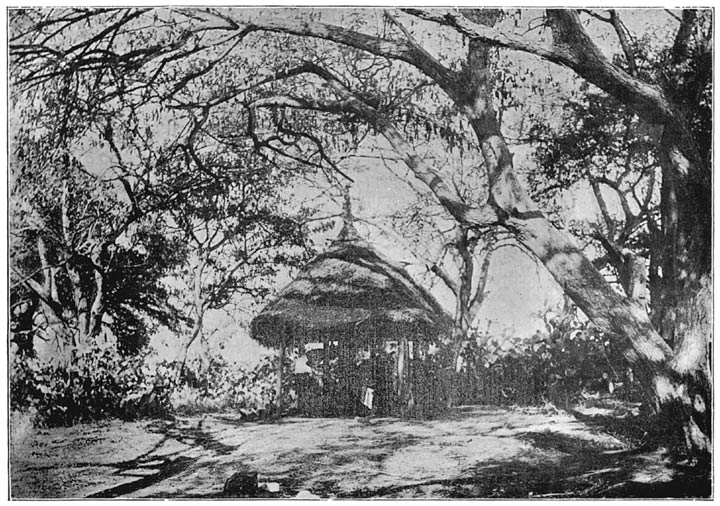
Tottiyan Mālē.
“The Tottiyans,” Mr. Hemingway writes, “do not recognise the superiority of Brāhmans, or employ them as priests at marriages or funerals. They are deeply devoted to their own caste deities. Some of these are Bommaka and Mallamma (the spirits of women who committed sati long ago), Vīrakāran or Vīramāti (a bridegroom who was killed in a fight with a tiger), Pattālamma (who helped them in their flight from the north), and Mālai Tambirān, the god of ancestors. Muttalamma and Jakkamma are also found. Mālai Tambirān is worshipped in the mālē. The Tottiyans are known for their uncanny devotion to sorcery and witchcraft. All of them are supposed to possess unholy powers, especially the Nalla Gollas, and they are much dreaded by their neighbours. They do not allow any stranger to enter their villages with shoes on, or on horseback, or holding up an umbrella, lest their god should be offended. It is generally believed that, if any one breaks this rule, he will be visited with illness or some other punishment.”
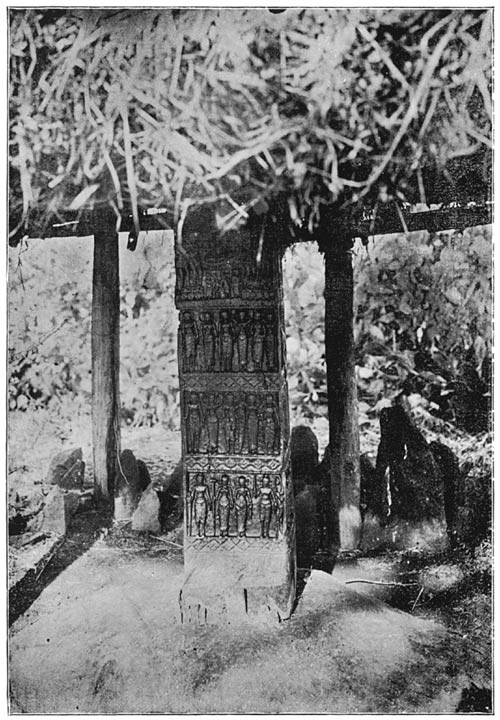
Tottiyan Mālē.
The Tottiyans have attached to them a class of beggars called Pichiga vādu, concerning whose origin the following legend is narrated. There were, once upon a time, seven brothers and a sister belonging to the Irrivāru exogamous sept. The brothers went on a pilgrimage to Benares, leaving their sister behind. One day, while she was bathing, a sacred bull (Nandi) left its sperm on her cloth, and she conceived. Her condition was noticed by her brothers on their return, and, suspecting her of immorality, they were about to excommunicate her. But they discovered some cows in calf as the result of parthenogenesis, and six of the brothers were satisfied as to the girl’s innocence. The seventh, however, required further proof. After the child was born, it was tied to a branch of a dead chilla tree (Strychnos potatorum), which at once burst into leaf and flower. The doubting brother became a cripple, and his descendants are called Pichiga vāru, and those of the baby Chilla vāru.
Traivarnika (third caste men).—Recorded, in the Madras Census Report, 1901, as a section of Kōmatis (who claim to be Vaisyas, or members of the third caste of Manu), who follow the details of Brāhmanical customs more scrupulously than the others. They are described, in the Vizagapatam Manual, as followers of the Rāmānuja faith, who deal chiefly in gold and silver, and ornaments made thereof.
Triputa (Ipomæa Turpethum, Indian jalap).—A sept of Vīramushti.
Like other Telugu castes, the Tsākalas have exogamous septs or intipēru, among which chīmala (ant) is of common occurrence. Members of the gummadi sept do not cultivate, or eat the fruit of Cucurbita maxima (gummadi), and those of the magili pula gōtra avoid the fruit of Pandanus fascicularis. In like manner, sword beans (Canavalia ensiformis) may not be eaten by those who belong to the thamballa gōtra.
Among the sub-divisions of the caste are Reddi Bhūmi (Reddi earth), Murikināti, Pākanāti (eastern country), Dēsa, and Golkonda. Of these, some are also sub-divisions of other Telugu classes, as follows:—
Dēsa or Dēsūr Balija—Kāpu.
Murikināti or Murikinādu—Kamsala, Mangala, Māla and Rāzu.
Pākanāti—Balija, Golla, Kamsala, Kāpu, and Māla.
Reddi Bhūmi—Māla, Mangala.
At the census, 1891, Odde was recorded as a sub-division of the Tsākalas, and it is noted in the Vizagapatam Manual (1869) that the Vadde or Odde Cakali wash clothes, and carry torches in that district. The name Odde Tsākala refers to Oriya-speaking washermen. Telugus call the Oriya country Ōdra or Odde dēsam and Oriyas Ōdra or Odde Vāndlu.
Like the Tamil Vannāns, the Tsākalas prepare for various castes torches for processional or other ceremonial occasions, and the face cloth, and paddy piled up at the head of a corpse, are their perquisite. The Reddi Bhūmi and other sub-divisions wash the clothes of all classes, except Mālas and Mādigās, while the Dēsa and Golkonda sub-divisions will wash for both Mālas and Mādigās, provided that the clothes are steeped in water, and not handed to them, but left therein, to be taken by the washerman. Every village has its families of washermen, who, in return for their services, receive an allowance of grain once a year, and may have land allotted to them. Whenever a goat or fowl has to be sacrificed to a deity, it is the privilege of the Tsākala to cut off the head, or wring the neck of the animal. When Kāpu women go on a visit to a distant village, they are accompanied by a Tsākala. At a Kāpu wedding, a small party of Kāpus, taking with them some food and gingelly (Sesamum) oil, proceed in procession to the house of a Tsākala, in order to obtain from him a framework made of bamboo or sticks, over which cotton threads (dhornam) are wound, and the Ganga idol, which is kept in his custody. The food is presented to him, and some rice poured into his cloth. Receiving these things, he says that he cannot find the dhornam and idol without a torch-light, and demands gingelly oil. This is given to him, and the Kāpus return with the Tsākala carrying the dhornam and idol to the marriage house. The Tsākala is asked to tie the dhornam to the pandal (marriage booth) or roof of the house, and he demands some paddy (unhusked rice) which is heaped up on the ground. Standing thereon, he ties the dhornam. At a Panta Kāpu wedding, the Ganga idol, together with a goat and kāvadi (bamboo pole), with baskets of rice, cakes, betel leaves and areca nuts, is carried in procession to a pond or temple. The washerman, dressed up as a woman, heads the procession, and keeps on dancing and singing till the destination is reached. At the conclusion of the ceremonial, he takes charge of the idol, and goes his way. Among the Panta Reddis of the Tamil country, the idol is taken in procession by the washerman, who goes to every Reddi house, and receives a present of money. At a wedding among the Īdigas (Telugu toddy-drawers), the brother of the bride is fantastically dressed, with margosa (Melia Azadirachta) leaves in his turban, and carries a bow and arrow. This kodangi (buffoon) is conducted in procession to the temple by a few married women, and made to walk over cloths spread on the ground by the village washerman. The cloth worn by a Kāpu girl at the time of her first menstrual ceremony is the perquisite of the washerwoman.
The tribal deity of the Tsākalas is Madivālayya, in whose honour a feast, called Mailar or Mailar Pandaga, is held in January immediately after the Pongal festival. Small models of pots, slabs of stone such as are used for beating the wet clothes on, and other articles used in their work, are made in rice and flour paste. After they have been worshipped, fruits, cooked vegetables, etc., are offered, and a sheep or goat is sacrificed. Some of its blood is mixed with the food, of which a little is sprinkled over the pots, stones, etc., used during washing operations. If this ceremonial was not observed, it is believed that the clothes, when boiling in the water pot, would catch fire, and be ruined. The festival, which is not observed by the Dēsa and Golkonda Tsākalas, lasts for five or seven days, and is a time of holiday.
At the first menstrual ceremony, the maternal uncle of the girl has to erect a hut made of seven different kinds of sticks, of which one must be from a Strychnos Nux-vomica tree. The details of the marriage ceremony are very similar to those of the Balijas and Kammas. The distribution of pān-supāri, and the tying of the dhornam to the pandal must be carried out by an assistant headman called Gatamdar. On the last day, a goat or sheep is sacrificed to the marriage pots. Liberal potations of toddy are given to those who attend the wedding.
The Tsākalas have a caste beggar called Mailāri, or Patam, because he carries a brass plate (patam) with the figure of a deity engraved on it. He is said to be a Lingāyat.
Tsalla or Challa (butter-milk).—An exogamous sept of Māla.
Tsanda or Chanda (tax or subscription).—An exogamous sept of Kamma and Mēdara.
In connection with weighing ceremonies, it may be noted that, at Mulki in South Canara, there is a temple of Venkatēswara, which is maintained by Konkani Brāhmans. A Konkani Brāhman, who is attached to the temple, becomes inspired almost daily between 10 and 11 A.M. immediately after pūja (worship), and people consult him. Some time ago, a rich merchant (a Baniya from Gujarat) consulted the inspired man (Darsana) as to what steps should be taken to enable his wife to be safely delivered. The Darsana told him to take a vow that he would present to the god of the temple silver, sugar-candy, and date fruits, equal in weight to that of his wife. This he did, and his wife was delivered of a male child. The cost of the ceremonial is said to have been five thousand rupees.
Tulabīna.—The Tulabīnas are a class of cotton-cleaners, who are scattered over the Ganjam district, and said to be more numerous in Cuttack. It is suggested that the name is derived from tula, the beam of a balance, and bīna (or vīna) a stringed musical instrument. The apparatus used by them in cleaning cotton, which bears a fanciful resemblance to a vīna, is suspended by a rope so that it is properly balanced, and the gut-string thereof struck with a dumb-bell shaped implement, to set it vibrating.
Tulasi (Ocimum sanctum, sacred basil).—A sub-division of Velama, and gōtra of Kōmati. The tulsi plant is planted in Hindu houses and worshipped by women, and the wood is made into beads for rosaries.
Tulukkar (Turks).—A Tamil name sometimes applied to Muhammadans.
Tuluva.—Tulu, Tuluva, or Tuluvan occurs as the name of a sub-division of the Tamil Vellālas, and of the Agasas, Billavas, Gaudas, Kumbāras, and other classes in South Canara. The equivalent Tulumar is recorded as a sub-caste of Māvilan, which speaks Tulu.
Tunnaran (tailor).—An occupational sub-division of Nāyar.
Tupākala.—Tupākala or Tupāki (gun) has been recorded as an exogamous sept of Balija, Kavarai, and Yānādi.
Turaka.—Recorded as a sept of Kuruba. It is further a Telugu name sometimes applied to Muhammadans. There is also a thief class, known as Bhattu Turaka. (See Bhatrāzu.)
Turuvalar.—Recorded in the Salem Manual as a caste name, by which some of the Vēdans call themselves. “The Turuvalar are distinguished as the Kattukudugirajāti, a name derived from a custom among them which authorizes informal temporary matrimonial arrangements.”