Volume 7 — V (continued 2)
Reading edition
The Vāriyars are described, in the Gazetteer of Malabar, as “a caste whose traditional duty is to sweep the temple precincts (vāruga). At the present day, some members of the caste are important land-owners or petty chieftains, occupying a very high social position. They generally follow the marumakkatāyam principle, but they have also a form of marriage called Kudivekkal similar to the Brahman Sarvasvadhānam, by which the wife is adopted as a member of the family into which she marries, and her children also belong to it. The Vāriyar’s names and ceremonies indicate Sivaite proclivities, just as those of the Pishārodi are tinged with Vishnavism. The Vāriyar’s house is called a Vāriyam, and his woman-folk Varassiars. This class is perhaps the most progressive among the Ambalavāsis, some of its members having received a Western education and entered the learned professions.”
Varugu Bhatta.—A mendicant class, which begs from Perikes.
Varuna.—Some Pattanavan fishermen have adopted the name of Varunakula Vellāla or Varunakula Mudali after Varuna the god of the waters.
Vasa (new).—A sub-division of Kurubas, who are said to weave only white blankets.
Vasishta.—A Brāhmanical gōtra adopted by Khatris and Toreyas. Vasishta, one of the seven great Rishis, was the son of Mitra and Varuna, whose quarrels with Viswamitra are narrated in the Rāmayana.
Vastra.—One division of the Koragas is called Vastra, meaning cloths such as are used as a shroud for a corpse, which were given to them as an act of charity, the wearing of new cloths by them being prohibited. Vastrala (cloth) further occurs as an exogamous sept of the Karna Sālē and Dēvānga weavers.
Vattē (camel).—A gōtra of Kurni.
Vātti.—Vātti or Vāttikurup has been recorded at times of census as a sub-division of Nāyar, and a synonym of Kāvutiyan and Tōlkollan. Vātti is said to mean one who prays for happiness.
Vayani.—The Vayanis, Vayinis, Vaguniyans, or Pavinis, are a section of Mādigas, the members of which play on a single-stringed mandoline, and go about from village to village, singing the praises of the village goddesses. Each Vayani has his recognised beat. He plays a prominent part in the celebration of the annual festival of the village goddess, and receives a sacred thread (kappu), which is usually tied to his mandoline, before the commencement of the festival. He regards himself as superior in social position to ordinary Mādigas, with whom he will not marry. The name Vayani is said to be a corruption of varnane, meaning to describe. In some localities, e.g., the Chingleput district, the Vayani enjoys mirāsi rights in connection with land.
Vēdan.—The Vēdans are described by Mr. H. A. Stuart, in the North Arcot Manual, as having been “formerly hunters and soldiers, and it is this caste which furnished a considerable and valuable contingent to the early Hindu kings, and later to the armies of Hyder and Tippoo. They are supposed by some to be the remnants of the earliest inhabitants of the peninsula, and identical with the Veddahs of Ceylon. They are also called Vālmīkulu, which means those who live on the products of ant-hills (vālmīkum).” It is noted, in the Census Report, 1891, that the two castes Bēdar (or Bōya) and Vēdan were, “through a misapprehension of instructions, treated as identical in the tabulation papers. The two words are, no doubt, etymologically identical, the one being Canarese and the other Tamil, but the castes are quite distinct.” It may be noted that the name Vālmīka or Vālmīki is assumed by the Bōyas, who claim descent from Vālmīki, the author of the Rāmayana, who did penance for so long in one spot that a white-ant hill grew up round him.
The following story in connection with bears and Vēdans is worthy of being placed on record. The bears are said to collect ripe wood-apples (Feronia elephantum) during the season, and store them in the forest. After a small quantity has been collected, they remove the rind of the fruits, and heap together all the pulp. They then bring honey and petals of sweet-smelling flowers, put them on the heap of pulp, and thresh them with their feet and with sticks in their hands. When the whole has become a consistent mass, they feed on it. The Vēdan, who knows the season, is said to drive off the bears by shooting at them, and rob them of their feast, which is sold as karadi panchamritham, or bear delicacy made of five ingredients.
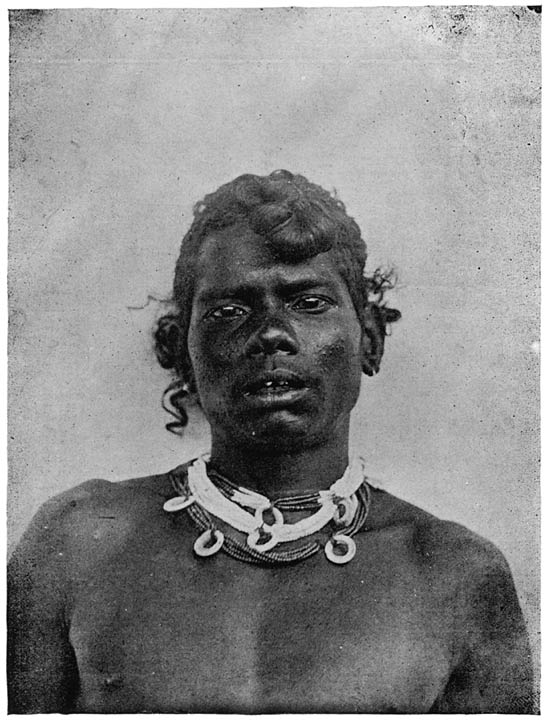
Mala Vēdan with filed teeth.
The more important measurements of twenty-five Mala Vēdans examined by myself were—
Max. Min. Average.
Stature (cm.) 163.8 140.8 154.2
Cephalic index 80.9 68.8 73.4
Nasal index 102.6 71.1 85.0
The figures show that, like other primitive jungle tribes in Southern India, the Mala Vēdans are short of stature, dolichocephalic, and platyrhine.
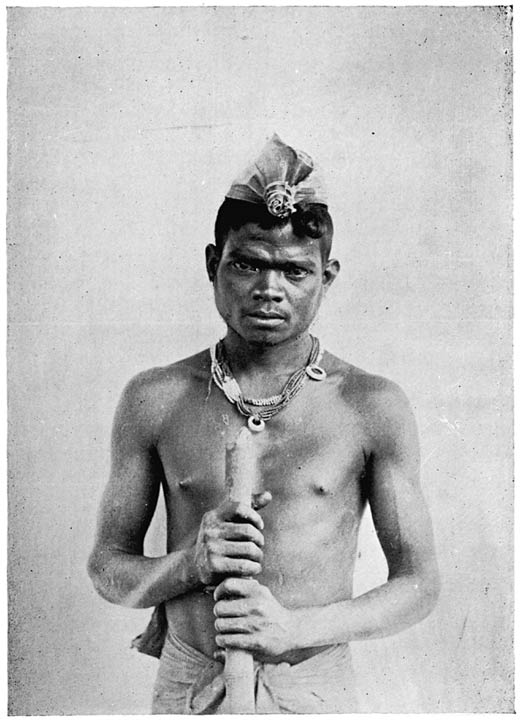
Mala Vēdan.
Vēdunollu.—A gōtra of Gānigas, members of which may not cut Nyctanthes Arbor-tristis. The flowers thereof are much used in Hindu worship, as the plant is supposed to have been brought from heaven by Krishna for his wife Satyābhāma.
Vēginādu.—A sub-division of Kōmatis, who belong to the Vēgi or Vengi country, the former name of part of the modern Kistna district. The Vēgina Kōmatis are said to have entered the fire-pits with the caste goddess Kanyakamma.
Vekkāli Puli (cruel-legged tiger).—An exogamous section of Kallan.
Vēl (lance).—A sub-division of Malayālam Paraiyans, and an exogamous sept or sub-division of Kānikars in Travancore. Vēlanmar (spearmen) occurs as a name for the hill tribes of Travancore.
Velakkattalavan.—Velakkattalavan or Vilakkattalavan is stated in the Travancore Census Report, 1901, to indicate chieftains among barbers, and to be the name for members of families, from which persons are selected to shave kings or nobles. In the Madras Census Report, 1891, Velakkattalavan is said to be “the name in South Malabar of the caste that shaves Nāyars and higher castes. The same man is called in North Malabar Valinchiyan, Nāvidan, or Nāsiyan. In dress and habits the caste resembles Nāyars, and they call themselves Nāyars in the south. Many returned their main caste as Nāyar. The females of this caste frequently act as midwives to Nāyars. In North Malabar, the Valinchiyan and Nāsiyan follow the Nāyar system of inheritance, whereas the Nāvidan has inheritance in the male line; but, even amongst the latter, tāli-kettu and sambandham are performed separately by different bridegrooms. In South Malabar the caste generally follows descent in the male line, but in some places the other system is also found.” Sūdra Kāvutiyan is recorded, in the Madras Census Report, 1901, as a synonym of Velakkatalavan.
The most important sub-divisions returned by the Velamas at the census, 1891, were Kāpu, Koppala, Padma, Ponnēti, and Yānādi. “It is,” the Census Superintendent writes, “curious to find the Yānādi sub-division so strongly represented, for there is at the present day a wide gulf between Velamas and Yānādis” (a Telugu forest tribe). In the Vizagapatam Manual, a class of cultivators called Yānādulu is referred to; and, in the Madras Census Report, 1901, it is recorded that entries under the name Yānāti “were clubbed with Yānādi; but it has since been reported that, in Bissam-Acuttack tāluk of the Vizagapatam Agency, there is a separate caste called Yānāti or Yēnēti Dora which is distinct from Yānādi.” It would appear that, as in the south, the Velamas call themselves Telugu Vellālas, so in the north they call themselves Yānātis.
For the following note on the Velamas who have settled in the Vizagapatam district, I am indebted to Mr. C. Hayavadana Rao. The following sub-divisions of the caste may be noted:—
(2) Kamma Velama found chiefly in the Kistna district, from which some families are said to have emigrated in company with the early Rājas of Vizianāgram. They are met with almost solely in the town of Vizianāgram. The remarriage of widows is permitted, but females are gōsha. The title is Nāyudu.
(3) Koppala, or Toththala, who do not shave their heads, but tie the hair in a knot (koppu) on the top of the head. They are divided into sections, e.g., Nāga (cobra), Sankha (chank shell, Turbinella rapa), Tulasi (Ocimum sanctum), and Tābēlu (tortoise). These have no significance so far as marriage is concerned. They are further divided into exogamous septs, or intipērulu, of which the following are examples:—Nalla (black), Doddi (court-yard, cattle-pen or sheep-fold), Reddi (synonym of Kāpu). The custom of mēnarikam, by which a man marries his maternal uncle’s daughter, is observed. A Brāhman officiates at marriages. Widows are permitted to remarry seven times, and, by an unusual custom, an elder brother is allowed to marry the widow of his younger brother. Women wear on the right wrist a solid silver bangle called ghatti kadiyam, and on the left wrist two bangles called sandēlu, between which are black glass bangles, which are broken when a woman becomes a widow. The titles of members of this sub-division are Anna, Ayya, and, when they become prosperous, Nāyudu.
There is, a correspondent informs me, a regular gradation in the social scale among the Velamas, Kammas, and Kāpus, as follows:—
Velama Dora = Velama Esquire.
Kamma Vāru = Mr. Kamma.
Kāpu.
A complaint was once made on the ground that, in a pattah (title-deed), a man was called Kamma, and not Kamma Vāru.
Vēlampan (rope-dancer).—Possibly a name for the Koravas of Malabar, who perform feats on the tight-rope.
Vēlan.—As a diminutive form of Vellāla, Vēlan occurs as a title assumed by some Kusavans. Vēlan is also recorded as a title of Paraiyans in Travancore. (See Pānan.)
The Vēlans, like the Pānans, are a caste of devil-dancers, sorcerers and quack doctors, and are, in the northern parts of the State, called Perumannāns or Mannāns (washermen). My informant, a Perumannān at Trichūr, told me that their castemen south of the Karuvannūr bridge, about ten miles south of Trichūr, are called Vēlans, and that they neither interdine nor intermarry, because they give māttu (a washed cloth) to carpenters to free them from pollution. The Mannāns, who give the māttu to Izhuvans, do not give it to Kammālans (artisan classes), who are superior to them in social status. The Vēlans at Ernakulam, Cochin, and other places, are said to belong to eight illams. A similar division into illams exists among the Perumannāns of the Trichūr tāluk. The Perumannāns of the Chittūr tāluk have no knowledge of this illam division existing among them.
The following story was given regarding the origin of the Vēlans and Mannāns. Once upon a time, when Paramēswara and his wife Parvati were amusing themselves, the latter chanced to make an elephant with earth, which was accidentally trodden on by the former, whence arose a man who stood bowing before them. He was called the Mannān because he came out of man (earth), and to him was assigned his present occupation. This tradition is referred to in the songs which are sung on the fourth day of a girl’s first menses, when she takes a ceremonial bath to free her from pollution.
The Vēlans are found all over the southern parts of the State, as their brethren are in the northern parts. They live in thatched huts in cocoanut gardens, while the Mannāns occupy similar dwellings in small compounds either of their own, or of some landlord whose tenant they may be.
When a girl attains puberty, she is at once bathed, and located in a room in the hut. Her period of seclusion is four days. On the morning of the fourth day, she is seated in a pandal (booth) put up in front of the hut, and made to hold in her hand a leafy vessel filled with rice, a few annas and a lighted wick, when a few of the castemen sing songs connected with puberty till so late as one or two o’clock, when the girl is bathed. After this, the castemen and women who are invited are feasted along with the girl, who is neatly dressed and adorned in her best. Again the girl takes her seat in the pandal and the tunes begin, and are continued till seven or eight o’clock next morning, when the ceremony comes to an end. The songsters are remunerated with three paras of paddy (unhusked rice), twenty-eight cocoanuts, thirteen annas and four pies, and two pieces of cloth. The songs are in some families postponed till the sixteenth day, or to the day of the girl’s marriage. Very poor people dispense with them altogether. The following is a translation of one of the songs.
One day a girl and her friends were playing merrily on the banks of a river, when one of them noticed some blood on her dress. They took her home, and her parents believed it to have been caused by some wound, but on enquiry knew that their daughter was in her menses. The daughter asked her mother as to what she did with the cloth she wore during her menses, when she was told that she bathed and came home, leaving it on a branch of a mango tree. On further enquiry, she knew that the goddess Ganga purified herself by a bath, leaving her cloth in the river; that the goddess earth buried it in earth; and that Panchali returned home after a bath, leaving her dress on a branch of a banyan tree. Unwilling to lose her dress, the girl went to the god Paramēswara, and implored his aid to get somebody to have her cloth washed. When muttering a mantram (prayer), he sprinkled some water, a few drops of which went up and became stars, and from a few more, which fell on the leaves of a banyan tree, there came out a man, to whom was assigned the task of washing the cloths of the women in their courses, wearing which alone the women are purified by a bath.
When a young man of the Vēlan caste has attained the marriageable age, his father and maternal uncle select a suitable girl as a wife, after a proper examination and agreement of their horoscopes. The preliminaries are arranged in the hut of the girl, and a portion of the bride’s price, fifteen fanams, is paid. The auspicious day for the wedding is fixed, and the number of guests that should attend it is determined. The wedding is celebrated at the girl’s hut, in front of which a shed is put up. The ceremony generally takes place at night. A few hours before it, the bridegroom and his party arrive at the bride’s hut, where they are welcomed, and seated on mats spread on the floor in the pandal (shed). At the auspicious hour, when the relatives on both sides and the castemen are assembled, the bridegroom’s enangan (relation by marriage) hands over a metal plate containing the wedding suit, the bride’s price, and a few packets of betel leaves and nuts to the bride’s enangan, who takes everything except the cloth to be given to the bride’s mother, and returns the plate to the same man. The bridegroom’s sister dresses the bride in the new cloth, and takes her to the pandal, to seat her along with the bridegroom, and to serve one or two spoonfuls of milk and a few pieces of plantain fruit, when the bride is formally declared to be the wife of the young man and a member of his family. The guests assembled are treated to a feast, after which they are served with betel leaves, nuts, and tobacco. The rest of the night is spent in merry songs and dancing. The songs refer to the marriage of Sīta, the wife of Rāma, of Subhadra, wife of Arjuna, and of Panchali, wife of the Pāndavas. Next morning, the bride’s party is treated to rice kanji (gruel) at eight o’clock, and to a sumptuous meal at twelve o’clock, after which they repair to the bridegroom’s hut, accompanied by the bride, her parents and relations, all of whom receive a welcome. The formalities are gone through here also, and the bride’s party is feasted. On the fourth morning, the newly married couple bathe and dress themselves neatly, to worship the deity at the local temple. After dinner they go to the bride’s hut, where they spend a week or two, after which the bridegroom returns to his hut with his wife. It is now that the bride receives a few ornaments, a metal dish for taking meals, a lamp, and a few metal utensils, which vary according to the circumstances of her parents. Henceforward, the husband and wife live with the parents of the former in their family.
Among the Mannāns of the northern parts of the State, the following marriage customs are found to prevail. The bridegroom’s father, his maternal uncle, enangan, and the third or middle man, conjointly select the girl after due examination and agreement of horoscopes. The preliminaries are arranged as before, and the day for the wedding is determined. At the auspicious moment on the wedding day, when the relatives on both sides and the castemen are assembled at the shed in front of the bride’s hut, the bridegroom’s father takes up a metal plate containing the wedding dress, the bride’s price (twelve fanams), and a few bundles of betel leaves, nuts and tobacco, and repeats a formula, of which the substance runs thus. “A lighted lamp is placed in the shed. Four mats are spread round it in the direction of east, west, north and south. A metal plate, containing rice, flowers and betel leaves, is placed in front of the lamp, and the elderly members of the caste and the relatives on both sides are assembled. According to the traditional custom of the caste, the young man’s father, maternal uncle, enangan, and the middle man conjointly selected the girl after satisfying themselves with due agreement of horoscopes, and ascertaining the illams and kriyams on both sides. They have negotiated for the girl, and settled the day on which the marriage is to take place. In token of this, they have taken meals in the bride’s family. The claims of the girl for two pieces of cloth for the Ōnam festival, two fanams or nine annas for Thiruwatira (a festival in Dhanu, i.e., December-January), and Vishu, are satisfied, and she is by the young man taken to the village festival. They have now come for the celebration of the wedding. There have been times when he has heard of 101 fanams as the price of the bride, and has seen 51 fanams as the price of the same, but it is now 21 fanams. It thus varies, and may be increased or diminished according to the will, pleasure, and means of the parties. With four fanams as the price of the bride and eight fanams for ornaments, and with the bundles of betel leaves, nuts, and the wedding dress in a metal plate, may I, ye elderly members, give it to the girl’s parents?” “Shall I,” answers the girl’s father, “accept it?” Receiving it, he gives it to his brother-in-law, who gives it to the enangan, and he takes everything in it except the wedding suit, which he hands over to the bridegroom’s enangan, who gives it to the bridegroom’s sister, to have the bride dressed in it. The other portions of the ceremony are the same as those described above. In Palghat and the Chittūr tāluk, the following declaration is made. “According to the customary traditions of the caste, when a young man of one locality comes to tame a girl of another locality, and takes her as his wife, ye elderly members assembled here, may these four bundles of betel leaves, four measures of rice, two pieces of cloth, and ten fanams be given to the bride’s parents?” “Shall these be accepted?” says the bride’s enangan. When the bride accompanies the bridegroom to his hut, the following formal statement is made. “Thrash thou mayst, but not with a stick. Thou mayst not accuse her of bad conduct. Thou mayst not cut off her ears, breasts, nose and tufts of hair. Thou mayst not take her to a tank (to bathe), or to a temple (for swearing). Thou mayst keep and protect her as long as thou wantest. When thou dost not want her, give her maintenance, and take back the children, for they are thine own.”
Polygamy is not prohibited, but is rarely practiced by the Vēlans and Mannāns. They are very poor, and find it difficult to support their wives and children born in a single married life. Want of children, bodily defect or incurable disease, or want of additional hands for work, may sometimes induce them to take more than one wife. Polyandry does not prevail among the Vēlans, but is common among the Mannāns of the northern parts of the State. A Vēlan woman who loses her husband may marry another of her caste, if she likes, a year after her husband’s death. The formalities of the wedding consist in the husband giving two pieces of cloth to the woman who wishes to enter into wedlock with him. After this she forfeits all claim on the property of her former husband. Among the Mannāns, a widow may marry any one of her brothers-in-law. A woman committing adultery with a member of her own caste is well thrashed. One who disposes of herself to a member of a lower caste is sent out of caste. She may then become a Christian or Muhammadan convert. If an unmarried young woman becomes pregnant, and this is known to her castemen, they convene a meeting, and find out the secret lover, whom they compel to take her as his wife. Very often they are both fined, and the fine is spent on toddy. Both among the Vēlans and Mannāns, divorce is easy. A man who does not like his wife has only to take her to her original home and give charge of her to her parents, informing them of the circumstances which have induced him to adopt such a course. A woman who does not like her husband may relinquish him, and join her parents. In both cases, the woman is at liberty to marry again.
When a woman is pregnant, the ceremony of pulikuti (drinking of tamarind juice) is performed for her during the ninth month at the hut of her husband. The juice is extracted from tamarind (Tamarindus indica), kotapuli (Garcinia Cambogia), nerinjampuli (Hibiscus surattensis) and the leaves of ambazhampuli (Spondias mangifera). A large branch of ambazhampuli is stuck in the ground in the central courtyard, near which the pregnant woman is seated. The husband gives her three small spoonfuls, and then seven times with her cherutāli (neck ornament) dipped in the juice. Among the washermen, the woman’s brother gives it three times to her. Should her sister-in-law give it in a small vessel, she has a claim to two pieces of cloth. After this, a quarter measure of gingelly (Sesamum) oil is poured upon her head, to be rubbed all over her body, and she bathes, using Acacia Intsia as soap. Those of her relatives and the castemen who are invited are sumptuously fed. Some of them crack jokes by asking the pregnant woman to promise her baby son or daughter to theirs when grown up. All bless her for a safe delivery and healthy child.
A woman who is about to become a mother is lodged in a separate room for her delivery, attended by her mother and one or two grown-up women, who act as midwives. The period of pollution is fifteen days. For the first three days the woman is given a dose of dried ginger mixed with palmyra (Borassus flabellifer) jaggery (crude sugar), and for the next three days a mixture of garlic and jaggery. Her diet during the first three days is rice kanji with scrapings of cocoanut, which are believed to help the formation of the mother’s milk. For the next three days, the juice of kotapuli (Garcinia Cambogia), cumin seeds, and kotal urikki (Achyranthes aspera), and of the leaves of muringa (Moringa pterygosperma) is given, after which, for a few more days, a dose of the flesh of fowl mixed with mustard, cumin seeds and uluva (Trigonella fœnum-græcum) boiled in gingelly oil is taken. She bathes in water boiled with medicinal herbs on the fourth, seventh, ninth, eleventh, and sixteenth days. On the morning of the sixteenth day, her enangathi (enangan’s wife) cleans her room with water mixed with cow-dung, and sweeps the compound. Wearing a māttu (washed cloth) brought by a washerman, she bathes to be freed from pollution. She may now enter the hut, and mingle with the rest of the family.
Among Vēlans and Mannāns, the sons inherit the property of their fathers, but they are very poor, and have little or nothing to inherit.
Vēlans and Mannāns practice magic and sorcery. All diseases that flesh is heir to are, in the opinion of these people, caused by malignant demons, and they profess to cure, with the aid of their mantrams and amulets, people suffering from maladies. The muttering of the following mantram, and throwing of bhasmam (holy ashes), in propitiation of the small-pox demon is believed to effect a cure.
(1) Ōm, Oh! thou, Pallyamma, mother with tusk-like teeth, that in demoniacal form appearest on the burning ground called omkara, with burning piles flaming around, with one breast on one of thy shoulders, and playing with the other as with a ball, with thy tongue stretched out and wound round thy head, with grass, beans, and pepper in thy left hand, with gingelly seeds and chama grains in thy right hand, that scatterest and sowest broadcast the seeds of small-pox; Oh! let the seeds that thou hast sown, and those that thou hast not sown, dry up inside, and get charred outside. Be thou as if intoxicated with joy! Protect thou, protect thou!
(2) Malign influence of birds on children.
Oh! thou round-eyed, short Karinkali with big ears, born from the third incessantly burning eye of Siva, come, come and be in possession.
If this mantram be muttered sixteen times, and bhasmam thrown over the body of a child, the operator breathing violently the while, a cure will be effected. If the mantram be muttered in a vessel of water the same number of times, and the child bathed in it, the cure will be equally effective.
(3) To cure fits and fever.
Oh! thou swine-faced mother, thou catchest hold of my enemy, coming charging me, by the neck with thy tusks thrust into his body; draggest him on the ground, and standest slowly chewing and eating, thrusting thy tusks, rubbing again, and wearing down his body, chewing once more and again; thou, mother that controllest 41,448 demons presiding over all kinds of maladies, seventy-two Bhiravans, eighteen kinds of epileptic fits (korka), twelve kinds of muyalis and all other kinds of illness, as also Kandakaranans (demons with bell-shaped ears), be under my possession so long as I serve thee.
This mantram should be repeated sixteen times, with bhasmam thrown on the body of the patient.
(4) Oh! Bhadrakali, thou hast drunk the full cup. Oh! thou that holdest the sword of royalty in thy right hand, and that half sittest on a high seat. Place under control, as I am piously uttering the mantrams to serve thee, all demons, namely Yakshi, Gandharvan, Poomalagandharvan, Chutali, Nīrali, Nīlankari, Chuzali, and many others who cause all kinds of illness that flesh is heir to. Oh! holy mother, Bhadrakali, I vow by my preceptor.
(5) For devil driving.
Oh! thou, Karinkutti (black dwarf) of Vedapuram in Vellanad, that pluckest the fruits of the right hand branch of the strychnine tree (Strychnos Nux-vomica), and keepest toddy in its shell, drinking the blood of the black domestic fowl, drumming and keeping time on the rind of the fruit, filling and blowing thy pipe or horn through the nose. Oh! thou primeval black dwarf, so long as I utter the proper mantrams, I beg thee to cause such demons as would not dance to dance, and others to jump and drive them out. Oh! thou, Karinkutti, come, come, and enable me to succeed in my attempts.
(6) Oh! thou goddess with face. Oh! thou with face like that of a bear, and thou, a hunter. I utter thy mantrams and meditate upon thee, and therefore request thee to tread upon my enemies, burst open their bodies to drink their blood, and yawn to take complete rest; drive out such demons as cause convulsions of the body both from within and without, and all kinds of fever. Scatter them as dust. I swear by thee and my preceptor. Swahah.
(7) For the evil eye.
Salutations to thee, Oh! God. Even as the moon wanes in its brightness at the sight of the sun, even as the bird chakora (Eraya) disappears at the sight of the moon; even as the great Vasuki (king of serpents) vanishes at the sight of chakora; even as the poison vanishes from his head; so may the potency of his evil eye with thy aid vanish.
(8) To cause delay in the occurrence of menses.
Salutation to thee, Oh! Mars (the son of the goddess Earth).
If this mantram is muttered on a thread dyed yellow with turmeric, and if the thread be placed on both the palms joined together, and if the number of days to which the occurrence of the menses should be delayed be thought of, the postponement will be procured by wearing it either round the neck or the loins. The thread with a ring attached to it, and worn round the neck is equally effective.
(9) To prevent cows from giving milk.
Ōm, Koss, dry up the liquid, kindly present me with thy gracious aspect. Oh! thou with the great sword in thy hands, the great trident, dry up the cow’s udder even as a tiger, I swear by thee and my preceptor.
(10) To cause cows to give milk.
Even as the swelling on the holy feet of Mahādēva due to the bite of a crocodile has subsided and gone down, so go down. I swear by my preceptor.
(11) To remove a thorn from the sole of the foot.
When Paramēswara and Parvathi started on their hunting expedition, a thorn entered the foot of her lady-ship. It was doubted whether it was the thorn of a bamboo, an ant, or a strychnine tree. Even so may this poison cease to hurt, Oh! Lord. I swear by my preceptor.
(12) To effect metamorphosis.
Take the head of a dog and burn it, and plant on it vellakutti plant. Burn camphor and frankincense, and adore it. Then pluck the root. Mix it with the milk of a dog and the bones of a cat. A mark made with the mixture on the forehead will enable any person to assume the figure of any animal he thinks of.
(13) Before a stick of the Malankara plant, worship with a lighted wick and incense. Then chant the Sakti mantram 101 times, and mutter the mantram to give life at the bottom. Watch carefully which way the stick inclines. Proceed to the south of the stick, and pluck the whiskers of a live tiger, and make with them a ball of the veerali silk, string it with silk, and enclose it within the ear. Stand on the palms of the hand to attain the disguise of a tiger, and, with the stick in hand, think of a cat, white bull, or other animal. Then you will, in the eyes of others, appear as such.
(14) Take the nest of a crow from a margosa tree, and bury it at the cremation ground. Then throw it into the house of your enemy. The house will soon take fire.
(15) Take the ashes of the burial-ground on which an ass has been rolling on a Saturday or Sunday, and put it in the house of your enemy. The members of the family will soon quit the house, or a severe illness will attack them.
The Vēlans and Mannāns are animists, and worship demoniacal gods, such as Chandan, Mundian, Kandakaranan, Karinkutti, and Chāthan. All of them are separately represented by stones located underneath a tree in the corners of their compounds. Offerings of sheep, fowls, plantain fruits, cocoanuts, parched rice and beaten rice, are made to them on the tenth of Dhanu (last week in December), on a Tuesday in Makaram (January-February), and on Kumbham Bharani (second asterism in March-April). They also adore the goddess Bhagavathi and the spirits of their departed ancestors, who are believed to exercise their influence in their families for good or evil. Sometimes, when they go to Cranganore to worship the goddess there, they visit the senior male members of the local Nāyar, Kammālan and Izhuvan families to take leave of them, when they are given a few annas with which they purchase fowls, etc., to be given as offerings to the local goddess. Wooden or metal images, representing the spirits of their ancestors, are located in a room of their huts, and worshipped with offerings on New Moon and Sankranti nights.
The Vēlans and Mannāns either burn or bury the dead. The son is the chief mourner who performs the funeral rites, and the nephews and brothers take part in them. Their priests are known as Kurup, and they preside at the ceremonies. Death pollution lasts for sixteen days, and on the morning of the sixteenth day the hut of the dead person is well swept and cleansed by sprinkling water mixed with cowdung. The members of the family, dressed in the māttu (a washed cloth worn before bathing) brought by the washerman, bathe to be free from pollution. The castemen, including their friends and relations, are invited and feasted. A similar funeral feast is also held at the end of the year.
The chief occupation of the Vēlans and Mannāns is the giving of māttu to Brāhmans, Kshatriyas, Anthalarajātis, Nāyars, Kammālans and Izhuvans, for wearing before going to bathe on the day on which they are freed from pollution. A girl or woman in her courses on the morning of the fourth day, a woman in confinement on the fifth, ninth, eleventh and sixteenth days, and all the members of a family under death pollution on the sixteenth day, have to use it. They bathe wearing the washed cloth, and return it as soon as the bath is over. It may either belong to the washerman, or have been previously given to him by the members of the family. He gets an anna or a measure of paddy for his service to a woman in her menses, and a para of paddy or six annas for birth and death pollutions. The Vēlans give the māttu to all the castes above mentioned, while the Mannāns refuse to give it to the Kammālans, and thereby profess themselves to be superior in status to them. They wash clothes to dress the idols in some of the high caste temples. Their washing consists in first plunging the dirty cloths in water mixed with cowdung, and beating them on a stone by the side of a tank (pond), canal or river, and again immersing them in water mixed with wood ashes or charamannu, after which they are exposed to steam for a few hours, and again beaten on the stone, slightly moistening in water now and then, until they are quite clean. They are then dried in the sun, and again moistened with a solution of starch and indigo, when they are exposed to the air to dry. When dry, they are folded, and beaten with a heavy club, so as to be like those ironed. The Vēlans of the Cranganore, Cochin, and Kanayannūr tāluks, climb cocoanut trees to pluck cocoanuts, and get about eight to ten annas for every hundred trees they go up. They make umbrellas. Some among them practice magic and sorcery, and some are quack doctors, who treat sickly children. Some are now engaged in agricultural operations, while a few make beds, pillows, and coats. There are also a few of them in every village who are songsters, and whose services are availed of on certain ceremonial occasions, namely, on the bathing day of a girl in her first menses, on the wedding night, and when religious ceremonies are performed, and sacrifices offered to their gods. Some are experts in drum-beating, and are invited by low caste people of the rural parts. The Mannāns also follow the same occupations.
The Vēlans and Mannāns eat at the hands of all castes above them, namely, Brāhmans, Kshatriyas, Nāyars, and Izhuvans. The former take food from Kammālans, while the latter abstain from so doing. They do not eat the food prepared by Kaniyans, Pānans, Vilkurups, or other castes of equal or inferior status. They have to stand at a distance of twenty-four feet from Brāhmans. They have their own barbers, and are their own washermen. They stand far away from the outer wall of the temples of high castes. They are not allowed to take water from the wells of high caste Sūdras, nor are they allowed to live in their midst.
The following note on the Vēlans of Travancore has been furnished by Mr. N. Subramani Iyer.
The word Vēlan has been derived from vel a spear, and also from vela work. The usual title of the Vēlans is Panikkan. They are believed to be divided into four classes, viz., Bharata Vēlan, Vaha Vēlan, Pana Vēlan, and Manna Vēlan. While the last of these sections, in addition to their traditional occupation, are washermen and climbers of areca palm trees, the Pana Vēlans take sawing as a supplementary employment. Some of the members of the first and second classes are also physicians. This classification is gradually going out of vogue.
The Vēlans are said traditionally to have been descended from Siva, who, on one occasion, is believed to have removed the evil effects of the sorcery of demons upon Vishnu by means of exorcism. As this kind of injury began to increase among men, a man and woman were created by this deity, to prevent its dire consequences. In the Kēralolpatti, this caste is mentioned as Velakkuruppu. But at present the Puranadis, who are the barbers and priests of this class, are known by this name. A Puranadi means one who stands outside, and is not admitted as of equal rank with the Vēlans proper. The Puranadis are not washermen. Commensal relations exist only between the male members of the Vēlans and Puranitis (Puranadi females).
The Vēlans perform a number of useful services in the body politic of Malabar. In the Kēralolpatti their duty is said to be the nursing of women in their confinement. In the Kērala-Visesha-Mahatmya, exorcism, climbing of trees, and washing clothes, are mentioned as their occupations. There are various kinds of exorcism, the chief being Vēlan Tullal and Vēlan Pravarti. The former is a kind of masque performed by the Vēlans for warding off the effects of the evil eye, and preventing the injurious influences of demons and spirits. Atavi is a peculiar female divinity worshipped by the caste, by whose help these feats are believed to be performed in the main. She, and a host of minor gods and goddesses, are represented by them, and a dance commences. After it is over, all the characters receive presents. Vēlan Pravarti, or Otuka, may either last for eleven days, or may be finished on a minor scale within three days, and in emergent cases even in one day. A Puranadi acts as buffoon, and serves the purpose of a domestic servant on the occasion. This is called Pallipana when performed in temples, Pallipperu when in palaces, and Vēlan Pravarti or Satru-eduppu in the case of ordinary people. This is also done with a view to prevent the effect of the evil eye. On the first day, a person representing the enchanted man or woman is placed in a temporary shed built for the purpose, and lights are waved before him. On the third day, a pit is dug, and a cock sacrificed. On the fourth day, the Pattata Bali, or human sacrifice, takes place. A person is thrown into a pit which is covered with a plank of wood, upon which sacrifices are offered. The buried person soon resuscitates himself, and, advancing as if possessed, explains the cause of the disease or calamity. On the eighth day, figures of snakes, in gold or silver, are enclosed in small copper vessels, and milk and fruit are offered to them. On the ninth day, the Vēlans worship the lords of the eight directions, with Brahma or the creator in the midst of them. On the tenth day, there is much festivity and amusement, and the Mahābhārata is sung in a condensed form. The chief of the Vēlans becomes possessed, and prays that, as the Pāndavas emerged safely from the sorcery of the Kauravas, the person affected by the calamity may escape unhurt. On the last day, animals are sacrificed at the four corners of the compound surrounding the house. No special rite is performed on the first day, but the Ituvanabali, Kuzhibali, Pattatabali, Kitangubali, Patalabali, Sarakutabali, Pithabali, Azhibali, Digbali, and Kumpubali, are respectively observed during the remaining ten days. The Pana, of which rite the breaking of cocoanuts is the most important item, completes this long ceremony. It was once supposed that the Bharata Vēlans exorcised spirits in the homes of high caste Hindus, the same work being done among the middle classes by the Vaha Vēlans, and among the low by the Manna Vēlans. This rule does not hold good at the present day. The Vēlans are also engaged in the event of bad crops.
Besides standing thirty-two feet apart from Hindu temples, and worshipping the divinities therein, the Vēlans erect small sanctuaries for Siva within their own compounds, called Kuriyala. They worship this deity in preference to others, and offer tender cocoanuts, fried rice, sugar, and plantain fruits to him on the Uttradam day in the month of August.
Velanāti (foreign).—A sub-division of Kāpus, and other Telugu castes, and of Telugu Brāhmans.
Velanga (wood apple: Feronia elephantum).—An exogamous sept of Mūka Dora.
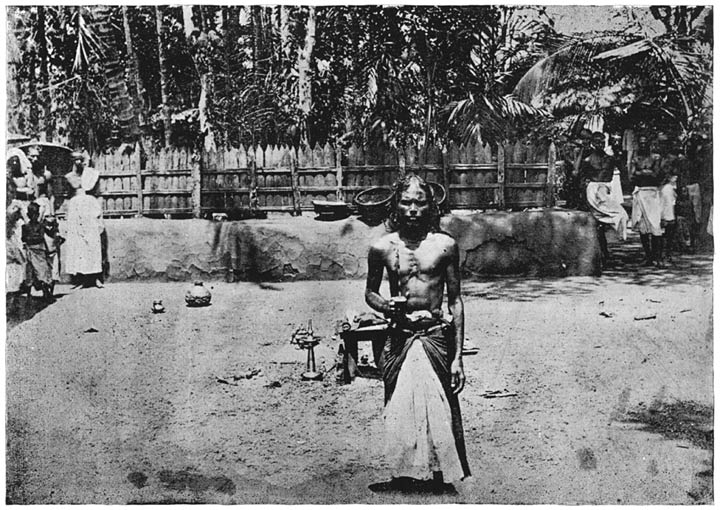
Velichchapād.
Veliyam.—Recorded, in the Travancore Census Report, 1901, as a title of Nāyars. In the same report Veliyattu is described as synonymous with Pulikkappanikkan, a sub-division of Nāyar.
Vellaikāran (white man).—A Tamil name for European.
At the time of the census, 1871, some Vellālas claimed that they had been seriously injured in reputation, and handled with great injustice, in being classed as Sūdras by the Municipal Commissioners of Madras in the classification of Hindus under the four great divisions of Brāhmans, Kshatriyas, Vaisyas, and Sūdras. In their petition it was stated that “we shall first proceed to show that the Vellālas do come exactly within the most authoritative definition given of Vysias, and then point out that they do not come within the like definition of Sūdras. First then to the definition of Vysia, Manu, the paramount authority upon these matters, says in paragraph 90 of his Institutes:—‘To keep herds of cattle, to bestow largesses, to sacrifice, to read the scripture, to carry on trade, to lend at interest, and to cultivate land, are prescribed or permitted to a Vysia.’” In the course of the petition, the Vellālas observed that “it is impossible to imagine that the Vellālas, a race of agriculturists and traders, should have had to render menial service to the three higher classes; for the very idea of service is, as it needs must be, revolting to the Vellāla, whose profession teaches him perfect independence, and dependence, if it be, upon the sovereign alone for the protection of his proper interests. Hence a Vellāla cannot be of the Sūdra or servile class. Besides, that the Vellālas are recognised as a respectable body of the community will also appear from the following. There was a ceremony called tulabhāram (weighing in scales) observed by the ancient kings of, at some part of their lives, distributing in charity to the most deserving gold and silver equal to the weight of their persons; and tradition alleges that, when the kings of Tanjore performed this ceremony, the right to weigh the king’s person was accorded to the Vellālan Chettis. This shows that the Vellālas have been recognised as a respectable body of mercantile men in charge of weights and measures (Manu 30, chap. 9). So also, in the Halasya Purānam of Madura, it is said that, when the King Somasundara Pandien, who was supposed to be the very incarnation of Siva, had to be crowned, there arose a contention as to who was to put the crown on his head. After much discussion, it was agreed that one of the Vellālas, who formed the strength of the community (note the fact that Manu says that Vysia came from the thighs of the Supreme Deity, which, as an allegory, is interpreted to mean the strength of the State) should be appointed to perform that part of the ceremony. Also, in Kamban’s Rāmayana, written 1,000 and odd years ago, it is said that the priest Vasista handed the crown to a Vellāla, who placed it upon great Rama’s head.”
Cart-driver. Bricklayer. Cooly. Varnisher. Painter. Watchman. Cultivator. Gardener. Compositor. Railway fireman. Peon. Student.
The account of the divisions and sub-divisions of the Vellālas recorded above may be supplemented from various sources:—
3. Kāraikkāt or Kārkātta. The name is said to mean Vellālas who saved or protected the clouds, or waiters for rain. Their original profession is said to have been rain-making. Their mythological origin is as follows.
Kondaikatti literally means one who ties his hair in a knob on the top of his head, but the name is sometimes derived from kondai, a crown, in connection with the following legend. A quarrel arose between the Kōmatis and Vellālas, as to which of them should be considered Vaisyas. They appeared before the king, who, being unable to decide the point at issue, gave each party five thousand rupees, and told them to return after trading for five years. The Vellālas spent one-fifth of the sum which they received in cultivating land, while the Kōmatis spent the whole sum in trading. At the end of the allotted time, the Vellālas had a bumper crop of sugar-cane, and all the canes contained pearls. The Kōmatis showed only a small profit. The king was so pleased with the Vellālas, that he bestowed on them the right to crown kings.
5. Kumbakōnam. Vellālas, who migrated from Kumbakōnam in the Tanjore district to Travancore.
6. Kummidichatti. Recorded, in the Manual of the North Arcot district, as a sub-division, regarded as low in position, which carried the pot (chatti) of fire at Vellāla funerals. It is said that, in default of Kummidichattis, ordinary Vellālas now have to carry their own fire at funerals.
7. Nangudi or Savalai Pillaimar. (See Nangudi.)
8. Tendisai (southern country). They are found in the Coimbatore district, and it has been suggested that they are only a branch of the Konga Vellālas.
9. Tenkānchi. Vellālas, who migrated from Tenkāsi in the Tinnevelly district to Travancore. (See Todupuzha Vellāla.)
The following legendary account of the Tondamandalam Vellālas is given in the Baramahal Records. “During the reign of a certain Rāja of Chōladēsa, a kingdom supposed to have comprised the present provinces south of the river Kāvēri, the countries between the Kistna and Kāvēri were quite a wilderness, in which many families of the Kurbavar caste or shepherds resided here and there in villages surrounded by mud walls. On a time, the Rāja came forth into the wilds to take the diversion of hunting, and, in traversing the woods, he came to a place in the vicinity of the present town of Conjeeveram in the Kingdom of Arcot, where he met with a Naga Kanya or celestial nymph, fell in love with her, and asked her to yield to his embraces. She replied, ‘If I consent to your proposal, and bear you a son, will you make him your successor in the kingdom?’ He rejoined ‘I will,’ and she asked him who should witness his promise. He answered ‘the earth and sky,’ but she said that two witnesses were not sufficient, and that there must be a third. There happened to be a tree called adhonda near them, and the Rāja replied ‘Let the fruit of this adhonda tree be the third witness.’ When she was satisfied respecting the witnesses, she granted the Rāja his desires, and, after he had remained with her a short time, he took his leave, and returned to his metropolis, and, in a little while, abdicated his throne in favour of his eldest son, who managed the affairs of the kingdom. To return to the Naga Kanya, she conceived and brought forth a son, who remained with her three or four years, and then visited the different Rishis or hermits who resided in the forest, and learnt from them to use the sword, the bow and arrow, and the art of war, and obtained from them a knowledge of the whole circle of sciences. By this time he had attained the age of sixteen years, and, coming to his mother, he requested her to tell him who was his father. She answered ‘Thy father is the Chōla Rāja.’ He replied ‘I will go to him, but who is to bear witness to the truth of your assertion?’ She rejoined ‘The earth, sky, and the fruit of the adhonda tree are witness to what I have told you.’ The son plucked one of the berries of the adhonda tree, hung it by a string to his neck, took his sword and other weapons, and set out for his father’s capital. He one day took an opportunity of accompanying some of the nobles to the darbar, and called out to the old Rāja ‘Behold your son.’ The Rāja replied ‘I know nothing of thee;’ upon which the young man repeated everything which his mother had told him, but it had no effect on the Rāja. When the son found that his father was determined not to acknowledge him he challenged him to single combat, but the Rāja, not thinking it proper to accept a challenge from a rash youth, demanded if he had any witnesses to prove his claim. He answered ‘The earth and sky, and the fruit of the adhonda tree, which I wear suspended from my neck, are witnesses to the truth of my assertion.’ This circumstance brought the old occurrence to the Rāja’s recollection, and he owned his son, and told him that, as he had already abdicated the throne, he trusted he would not insist upon the fulfilling of the promise which had been made to his mother, but consent to live in a private station under the dominion of his elder half-brother. The young man nobly replied ‘I with pleasure waive the performance of your promise, but point out to me your enemy, and assist me with some troops, and I will conquer a kingdom for myself.’ The Rāja gave him an army, and directed him to subdue the Kurubavāru or shepherds, to clear the woods, and to form himself a kingdom between the rivers Kistna and Kāvēri. He accordingly advanced into the wilderness, and, without meeting much opposition, soon subjected the Kurubavāru, who, knowing nothing of cultivation or sinking of tanks or watering the country from the rivers, and the conqueror wishing to introduce agriculture among them, he was obliged to repair to his father, and make known his difficulties. The Rāja was much pleased with the enterprising spirit of his son, conferred on him the title of Adhonda Chakra, wrote and permitted him to take with him such of the Vellāla caste as chose to emigrate. The young Rāja held out great encouragement, and got a number of adventurers of that caste to accompany him back, to whom he gave large grants of waste land, and told them to pitch upon such spots of ground as met with their approbation, and they fixed upon the forts, districts, and villages belonging to the Kurubavāru caste, which consisted of twenty-four forts, eighty-one districts, and one thousand and nine hundred villages. This country was formerly named Dandaka Aranya. Dandaka is the name of a famous Rakshasa or Giant, who is mentioned in the Rāmāyana, and Aranya signifies a wilderness. It was also called Dhuntra Nādu, or the middle country, and the new Rāja named it Dhanda Mandalam, or country of the tree dhonda, alluding to the fruit of the adhonda or dhonda tree, which bore testimony to his descent. The emigrants of the Vellāla caste surnamed themselves Dhonda Mandala Vellāla vāru, and are now corruptly called Tondamandala Vellāla vāru.”
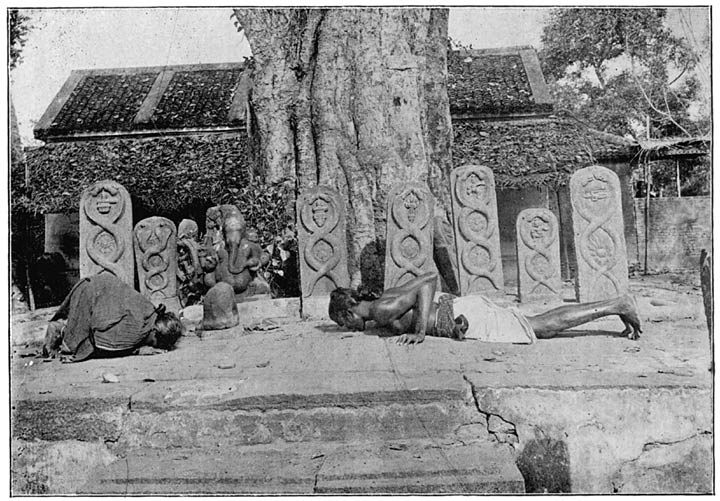
Vellālas worshipping lingam, snake-stones and Ganēsa.
In connection with the sub-divisions of the Vellālas, Mr. Hemingway, in a note on the Vellālas of the Trichinopoly district, gives some still further information. “The Kondaikattis are so-called from the peculiar way in which they used to wear their hair—a custom no longer observed. They are split into two sections, called Mēlnādu and Kīlnādu (westerns and easterns). The Dakshināttāns (south country men) are immigrants from Tinnevelly. The members of the Kāraikkāttar sub-division in the Udaiyarpālaiyam tāluk are rather looked down on by other Vellālans as being a mixed race, and are also somewhat contemptuously called Yeruttu-māttu (pack-bullocks), because, in their professional calling, they formerly used pack-bullocks. They have a curious custom by which a girl’s maternal uncle ties a tāli (marriage badge) round her neck when she is seven or eight years old. The Panjukkāra Chettis live in the Udaiyarpālaiyam tāluk. The name is an occupational one, and denotes cotton-men, but they are not at the present day connected with the cotton trade. The Sōlapūram (or Chōlapūram) Chettis are apparently called after the village of that name in the Kumbakonam tāluk of Tanjore. The Sōlias (or Chōlias) are numerous and ubiquitous. They are generally regarded as of doubtful descent, since parvenus, who wish to be considered Vellālans, usually claim to belong to this sub-division. The more respectable Pandārams, the Thambirans who own temples and matams, and the Oduvar or Ādi Saivāl, belong to the Sōzhia section. The Uttunāttu sub-division is local in origin. Its head-quarters is the country round Uttatūr. The members thereof are the special devotees of the Siva of that place. The Arunāttus (six nādus) are also called Mottai (shaved) Vellālans, apparently because they always shave their moustache, and wear only a very small kudumi (hair-knot). Some of their customs are unlike those of the rest of the caste. They have exogamous septs, their widows always dress in white and wear no ornaments (a rule not universally observed in any other sub-division), they never marry their sister’s daughter, and their wives wear the tāli (marriage badge), like the Panta Reddis, on a golden thread. Of their six nādus, three of which are supposed to have been located on each side of the Aiyār river, only two are now recognised. These are the Sērkudi nādu in Nāmakkal tāluk and the Omandūr nādu of Musiri. The Yēlūr (seven villages) Vellālas are very few and far between. There is a small colony of Tuluvas, engaged in dyeing, at Illuppūr. The Malaikandas are only found near the Ratnagiri hill in the Kulittalai tāluk. They take their name from the fact that they are required to look at the Ratnagiri hill when they get up in the morning. They are devotees of the god there. The Kāniyālans (landowners) are scarce, but widely distributed, since the man who carries the pot of blood, when animals are sacrificed at festivals to the village goddesses, must belong to this sub-division. The Kodikkal Vellālans are so-called from their occupation of betel cultivation, which they still pursue largely.”
The Konga Vellālas differ so strikingly from the rest in many of their customs that a separate account of them is given. (See Konga Vellāla.)
It is noted by Mr. Hemingway that some Vellālas “observe a curious custom (derived from Brāhmans) with regard to marriage, which is not unknown among other communities. A man marrying a second wife after the death of his first has to marry a plantain tree, and cut it down before tying the tāli, and, in the case of a third marriage, a man has to tie a tāli first to the erukkan (arka: Calotropis gigantea) plant. The idea is that second and fourth wives do not prosper, and the tree and the plant are accordingly made to take their places.”
A peculiar ceremony, called Sevvai (Tuesday) Pillayar, is performed by some Vellāla women. It is also called Avvai Nonbu, because the Tamil poetess observed it. The ceremony takes place twice in the year, on a Tuesday in the months of Thai (February-March) and Audi (August-September). It is held at midnight, and no males, even babies in arms, may be present at it, or eat the cakes which are offered. A certain number of women club together, and provide the necessary rice, which is measured on the back of the hand, or in a measure similar to those used by Madras milk-sellers, in which the bottom is fixed high up in the cylinder. At the house where the ceremony is to be performed the rice is pounded into flour, and mixed with leaves of Pongamia glabra and margosa (Melia Azadirachta). The mixture is then made into cakes, some flat, and some conical, to represent Pillayar (Ganēsa). Flowers, fruits, betel, turmeric, combs, kunkumam (red powder), and other articles required in connection with the Pillayar worship, are also taken to the room in which the rites are performed. Of these it has been impossible to gather an account, as the women refused to describe them, lest ruin should fall on their families. Some say that, during the ceremony, the women are stark-naked.
Of proverbs relating to the Vellālas, the following may be cited:—
Agriculture is no agriculture, unless it is performed by the Vellālas.
The Vellāla ruined himself by gaudy dress; the courtesan ruined herself by coquetry and affectation.
Of all the sections of the Sūdras, the Vellāla is foremost; and, of all the thefts committed in the world, those of the Kallans are most notorious.
Though you may face an evil star, never oppose a Vellāla.
Though apparently the Vellāla will not ruin you, the palm leaf, on which he writes about you, will certainly ruin you for ever.
In the Madras Census Report, 1891, Vellāla is recorded as a caste of Jains. In this connection, it is noted by Mr. Hemingway that the Naināns or Nāyinārs (q.v.) and the Kāraikkāttans of the Udaiyarpālaiyam tāluk are thought to be descended from Jains who were converted to the Hindu faith.
Vellān Chetti.—A name, denoting Vellāla merchant, taken by some Vellālas.
Velli (silver).—See Belli.
Velnāti.—A sub-division of Kāpu, named after the old Velnādu division of the Telugu country.
Veloma.—Defined as “one of the two classes of Sūdras, viz., Anuloma and Veloma. The term Veloma is applied to those born of a lower caste male and higher caste female.”
Veluttēdan.—The Veluttēdan is defined in the Madras Census Report, 1891, as “the washerman of the Nāyars and higher castes in Malabar. He calls himself a Nāyar, and, in many cases, was returned as of that main caste, but these have been separated in abstraction. The caste is called Vannattān in North Malabar. The Veluttēdans follow the marumakkatāyam law of inheritance in the north, and makkatāyam in the south. They have tāli-kettu and sambandham separately. Their dress and habits are the same as those of Nāyars.” In the Madras Census Report, 1901, Bannata is given as a Canarese synonym for the caste name. In the Travancore and Cochin Census Reports, 1901, Veluttētan and Veluthēdan are given respectively as an occupational title and sub-division of Nāyars.
For the following note on the Veluttēdans of Travancore, I am indebted to Mr. N. Subramani Aiyar. The name is believed to signify a place where clothes are bleached. In the early Settlement Records the designation recorded is Ayavu, in all probability an old synonym for washing. The South Travancore Veluttēdans are said to be divided into two endogamous septs, Paravūr and Attingal, with four exogamous septs in each; but these distinctions may be said to have now lost their vigour and force. There is a current tradition that once upon a time a Brāhman was washing cloths for a friend, and was on that account thrown out of caste by Parasurāma. The occupation of the Veluttēdans is washing cloths for all high-caste Hindus down to the Sūdras, in which profession, for neatness and purity at any rate, if not for promptitude, they stand above the Vannāns and Chayakkārans of the east coast, both of whom have now entered the field in competition with them, and, at least in the most civilised parts of the State, not entirely without success. In no case do the castemen receive cloths from classes lower in social rank than the Sūdras, and this is pointed to with pride as one of the causes which keep them in their present elevated scale. It need hardly be said that, in their traditional occupation, the Veluttēdans are largely and materially assisted by their females, the Veluttēdathis. They do not live in a group together, but are conveniently scattered about, so as to avoid competition one with another. Their main profession is, in many cases, supplemented by agriculture. There are absolutely no educated men among them, and, as long as machine-laundries are not introduced into the country, they have no reason to abandon the profession of their forefathers in pursuit of alien ones. In the matter of food and drink, as also in their dress and ornaments, they resemble the Nāyars. Clothes, it may be mentioned, are never bought by Veluttēdans, as they are always in possession, though temporarily, of other peoples’ apparel. Tattooing prevails only in South Travancore. They cannot enter Brāhmanical shrines, but are permitted to stand outside the talakkal or stone-paved walk round the inner sanctuary, by which the image is taken in daily procession. Besides standing here and worshipping the higher Hindu deities, they also engage in the propitiation of the minor village deities. There are two headmen in each village, who punish social delinquents, and preside over caste ceremonials. On the twenty-eighth day after the birth of a child, the name-giving ceremony is performed, and a thread is tied round the infant’s neck. Those who can afford it celebrate the first food-giving. The tāli-tying and sambandham ceremonies are performed separately, just like Nāyars. The former is known as muhurtham or auspicious occasion. The marriage badge is called unta minnu or puliyilla minnu. The details of the marriage ceremony do not differ from those of the Nāyars. The ayani unu, bhūtakkalam, appam poli, and avaltitti are all important items, and, at least in South Travancore, seldom failed to be gone through. In poor families the mother, without any formal ceremonial, ties the tāli of the girl before she is twelve years old, after an oblation of cooked food to the rising sun. This is called Bhagavan tāli, or god’s marriage ornament. Freedom of divorce and remarriage exist. The pulikuti (tamarind) is an indispensable ceremonial, to be gone through by a pregnant woman. Inheritance devolves in the female line (marumakkattāyam). The clothes washed by Veluttēdans are used by Nambūtiri Brāhmans, without previous washing as on the east coast, for all religious purposes; and clothes polluted by a member of a low caste are purified by the Veluttēdan sprinkling ashes and water over them.
Vēmu (margosa or nīm: Melia Azadirachta).—An exogamous sept of Mūka Dora.
Vēngai Puli (cruel-handed tiger).—An exogamous section of Kallan.
Veralu Ichē Kāpulu or Vēlu Ichē Kāpulu (those who dedicate their fingers).—See Morasu.
Vēshya (Sansk: Bēshya).—A name denoting prostitute, applied to dancing-girls.
Vētagiri.—A Tamil class found in the Chingleput district. The members thereof are employed in hunting, cultivation, and the manufacture of wild date baskets. Their title is Nāyakan.
Vettaikāran (hunter).—An occupational name of Bōyas, Irulas, and Koravas, returned at times of census.
Vettile (betel vine: Piper Betle).—A kothu or tree of Kondaiyamkotti Maravans.
The duties of the Vettiyān are multifarious. He it is who goes round the rice fields, and diverts the water-courses to the various fields, according to the rights of the ryots (agriculturists). The Vettiyān beats the drum for public notices and ceremonies. As a servant of Government, he has to carry the revenue which has been collected to the treasury. He is sometimes entrusted with large sums of money, and has never been known to abscond with it. It is said that the Village Munsiff will trust the Vettiyān, but not the Taliāri, who is never sent alone with money. The Vettiyān is in charge of the burial ground, and those who repair thither have to pay him for his services. He is also the grave-digger, and officiates when a Paraiyan corpse is burnt or buried. Hence the Tamil proverb against meddling in what ought to be left to some one else:—“Let the Vettiyān and corpse struggle together.” At a Paraiyan funeral, the Vettiyān, in some places, carries the pot of fire to the grave. To bring down rain, some of the lower classes, instead of addressing their prayers to the rain-god Varuna, try to induce a spirit or dēvata named Kodumpāvi (wicked one) to send her paramour Sukra to the affected area. The belief seems to be that Sukra goes away to his concubine for about six months, and, if he does not return, drought ensues. The ceremony consists in making a huge figure of Kodumpāvi in clay, which is placed on a cart, and dragged through the streets for seven to ten days. On the last day, the final death ceremonies of the figure are celebrated. It is disfigured, especially in those parts which are usually concealed. Vettiyāns, who have been shaved, accompany the figure, and perform the funeral ceremonies. This procedure is believed to put Kodumpāvi to shame, and to get her to induce Sukra to return and stay the drought.
At Paraiyan marriages certain pots are worshipped, and it is, in some places, the Vettiyān who says “The sun, the moon, the pots, and the owner of the girl have come to the marriage booth. So make haste, and fill the pots with water.”
The office of the Vettiyān village official is hereditary, and the holder of it is entitled to some respect among his brethren, and to certain emoluments in kind, e.g., grain at the harvest season. There is a proverb that “whatever may be the wealth of the lord who comes to rule over him, his duty of supplying him with a bundle of grass is not to cease.” This relates to the demands which were, and perhaps are still, made on him in rural parts of the country. In some places, lands, called Vettiyān Māniyam, are given rent-free to Vettiyāns.
The Vettiyāns belong to the right-hand section during disputes between the right and left hand factions.
Vēttuvan.—The Tamil Vēttuvans are described, in the Madras Census Report, 1901, as “an agricultural and hunting caste, found mainly in Salem, Coimbatore, and Madura. The name means ‘a hunter.’ They are probably of the same stock as the Vēdans, though the exact connection is not clear, but they now consider themselves superior to that caste, and are even taking to calling themselves Vēttuva Vellālas. Tradition says that the Konga kings invited Vēttuvans from the Chōla and Pāndya countries to assist them against the Kēralas. Another story says that the caste helped the Chōla king Aditya Varma to conquer the Kongu country during the latter part of the ninth century. In paragraph 538 of the Census Report, 1891, reference is made to the belief that the Vēdans are identical with the Veddahs of Ceylon. In connection with this supposition, it is reported that the Vēttuvans worship a goddess called Kandi-Amman, which may possibly mean ‘the goddess of Kandy’ (in Ceylon). Of the endogamous sections into which the caste is divided, the most numerically important are Venganchi, Kilangu (root), Pasari, Viragu (firewood), Pannādai (sheath of the cocoanut leaf), and Villi (bow). They have their own barbers, who seem also to form a separate sub-division, and are called Vēttuva Ambattans or Nāvidans, both of which words mean barber. They are said to refuse to serve any one lower than a Konga Vellāla. Nominally they are Hindus, but they are said to worship the seven Kannimars, or aboriginal goddesses, to whom the Irulas also pay homage. They eat meat and drink alcohol, though some of those who are endeavouring to increase their social repute are taking to vegetarianism. Widow marriage is forbidden. They either burn or bury the dead, but no ceremonies are performed for deceased ancestors. Their customs are thus a curious mixture of those followed by high castes and low ones. Their ordinary title is Kavandan.”
Of the Malayālam Vēttuvans, who live in Malabar and the southern portion of the South Canara district, it is recorded, in the Madras Census Report, 1901, that they are “agricultural serfs, shikāris (hunters), and collectors of forest produce, who live in the Malabar jungles. They have two endogamous sub-divisions, called Kodi and Peringala. The former keep their hair long, and their women wear a cloth. The latter have top-knots, and their women dress in leaves, which they wear only round their waists, and renew daily. The latter are an unclean set of people, who live in rude bamboo and reed huts, and will eat anything down to carrion. Yet they consider themselves superior to Cherumans and Pulaiyans, and are careful not to be polluted by them. This same name is also borne by a class of masons and salt-workers in the low country in Malabar.”
On the occasion of a recent visit of the Governor of Madras to South Canara, a party of Vēttuvans was paraded before him. One of the men was wearing an aluminium coronation medal, and, on being asked by the Collector who had given it to him, he folded his arms obsequiously, and replied ‘My Tamburan’ (landlord).
In a recent note on the leaf-wearing Vēttuvans, it is stated that “they believe that the sun travels, after it has set, through a hole in the bowels of the earth, and emerges at morning in the east. The way they calculate time is interesting. A Vēttuvan says that his children were born when his master sowed paddy (rice) on such and such hills. They are a very truthful lot, of good moral character, the chastity of their womankind being held very sacred.”
“The Vettuvans are also called Vettuva Pulayas. They are pure agricultural labourers, taking part in every kind of work connected with agriculture, such as ploughing, sowing, weeding, transplanting, pumping water, and reaping. They are more day labourers. The males get two edangazhis of paddy (hardly worth 2 annas), and the females an edangazhi and a half. In times of scarcity, they find it difficult to support themselves.
“When an unmarried woman becomes pregnant, her parents, as soon as they become aware of the fact, inform their local headman (Kanakkan or Kuruppan), who convenes a meeting of the elderly members of the community for the purpose of summoning the secret lover, and prosecuting the necessary enquiries. In the event of the confession of the charge, he is asked to marry her. The matter does not end there. They go to the local Thandan, and relate to him the incident, who thereupon gives him water in a vessel (kindi vellam). The woman is asked to drink this as well as some cow-dunged water, and is then made to let flow a few drops of blood from the body. After this he says ‘dhosham thirnu’ (free from guilt). Should, however, the lover be unwilling to marry her, he is thrashed and placed under a ban. If they are related to each other, they are both turned out of caste. The woman who is freed from guilt can marry again. The Thandan gets as his perquisite four annas out of the fine imposed, four packets of betel leaf, eight areca nuts, and three tobacco leaves. Their headman also has a share of the fine, etc. The balance which then remains is spent on toddy, and beaten rice for those assembled.
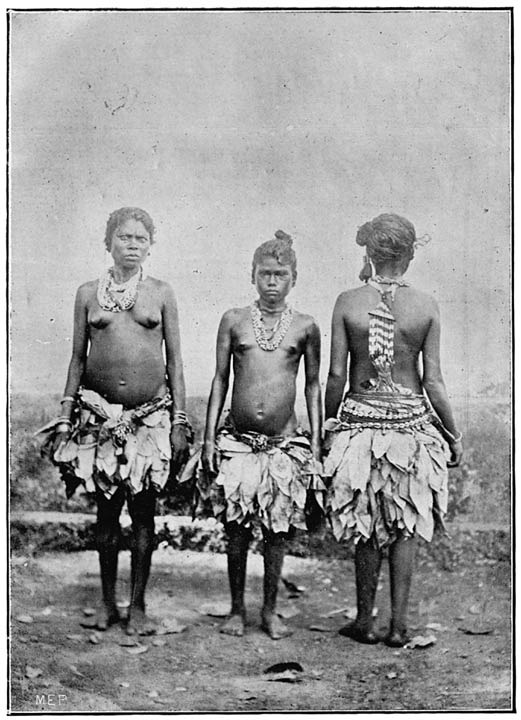
Vēttuvans.
“The Vettuvans profess the lower forms of Hinduism. Their chief gods are Chevva, Chathan, Karinkutti, Parakutti, Kappiri and Kandakaranan, and also Namburi Thamburan. They give regular offerings to them, lest the gods should become angry, and cause serious calamities to the members of their families. Images of gods are made of bell-metal, and worshipped in their huts. The deceased ancestors are also worshipped as gods, to whom are given a different kind of offerings. Toddy is an indispensable item in their offerings to them. In Ooragam and its neighbourhood, when I took my notes on the Vettuvans, I was told that there was no tree-tapping, and that toddy brought to them for sale was largely adulterated with water, and very costly. Their gods were very angry, for they were not satisfied with it. They caused fever, deafness, blindness, and other disorders. They worship Kāli also. Kumbhom Bharani is an important festival to them. On the morning of this day, tunes are played in honour of the goddess. There are special songs called Thottampattu. Sacrifices are offered to the deity very early. A pūja (worship) is also performed for the sword, anklets, and bells worn round the loins, all placed in front of the deity, and songs are again sung. One of them turns a Velichchapād (oracle), who speaks as if by inspiration. Wearing the above ornaments, they go to a temple, in front of which they empty out on a mat a few paras of paddy, and again play and sing.
“The funeral ceremonies of the Vettuvans are somewhat elaborate. When a member of the caste breathes his last, his relations, friends, and other castemen of the kara (settlement) are all informed of the event. They attend, and take part in the obsequies. The dead body is bathed, and dressed in a piece of new cloth. Some gold, rubbed on a stone in water, is poured into his mouth by his sons and daughters. Karuvanguka, or Gurutvam Vanguka, is an important ceremony performed by his sons and daughters. It consists in taking sixteen small bits of plantain leaves, with some rice on each, and placing them on the forehead, neck, chest, loins, thighs, hands, legs, feet, etc., washing the last two, and collecting the water, which is taken in by the members junior to him in the family. After this, the dead body is placed on the bier, which is carried by four persons to the grave. The nearest relatives of the family, four in number, called Bhedakars, with a mundu (cloth) tied round their heads, walk in front of the procession. The grave is dug, and a new cloth is spread, and the corpse laid on it. It is filled in with layers of earth and stones, to prevent dogs and jackals from disturbing the dead body. All those who have accompanied the chief mourner bathe, and return home. The members of the family fast for the night. The eldest son, who is the chief mourner, bathes in the early morning, and offers the pinda bali (offering of rice) to the spirit of the departed for fifteen days. On the seventh day, the chief mourner, and the Enangan, go to the graveyard, and level the slightly raised part of the grave. A piece of stone, kept near the foot, is taken, and placed on a leaf. Some toddy, arrack (alcoholic liquor) and water of the tender cocoanut, are poured over it as offerings. By some magic, the spirit is supposed to be living in it. It is brought home, and placed in a cocoanut shell containing oil mixed with turmeric, and kept outside the hut until the pollution is over. The pollution lasts for fifteen days, and on the night of the fifteenth day they fast. On the morning of the sixteenth day, all the castemen of the kara who are invited bring with them rice, curry-stuffs, and toddy. Rubbing themselves with oil, they all go to bathe, after which the Enangan sprinkles cowdunged water, to show that they are freed from pollution. The stone is also purified by a dip in water, and then brought home. Those who have assembled are fed, and then depart. The chief mourner, who has to perform the diksha, does not shave for a year, bathes in the early morning, and offers the bali before going to work. This he continues for a year, at the end of which he gets himself shaved, and celebrates a feast called masam in honour of the departed. The stone, representing the deceased, is placed on a seat in a conspicuous part of the hut. An image of wood or copper sometimes takes its place. It is thenceforward worshipped, and believed to watch over the welfare of the family. Regular offerings are given to it on Karkadagom and Thulam Sankranthi, Ōnam, Vishu, and the festival day of the local temple.
“The castes below the Vettuvans are Pulayan, Nayādi, and Ullatan. They consider themselves superior to Pulayas, and are careful not to be polluted by them. A Vettuvan who is polluted by a Nayādi or Ulladan fasts for seven days, subsisting on water, tender cocoanuts, and toddy. On the eighth day he bathes, and takes his regular meals. As the Vettuvans are Chandalars, any distance less than sixty-four feet will pollute the higher castes. They stand at a distance of twenty-four feet from Kammālar. Nayādis and Ullatans stand far from them. Owing to their disabilities and low wages, many turn either Christians or Muhammadans, and work for wages of two and a half to three annas a day.”
Vibhāka Gunta.—Recorded in the Madras Census Report as “a low class of wandering beggars; clubbed with Māla.” Some Mālas in the Vizagapatam district possess gunta mānyams, or petty fields, and supplement their income by begging.
Vignēsvara.—A synonym for the elephant god Ganēsa, which occurs as a gōtra of Nagarālu. The equivalent Vināyaka is a gōtra of Mēdara.
Vilkurup.—The Vilkuruppu or Vilkollakuruppu are the priests and barbers of the Malayālam Kammālans, and also makers of umbrellas and bows (vil) and arrows. In former times they supplied the latter articles for the Malabar Infantry. Malabar and Travancore are, par excellence, the home of the palm-leaf umbrella, which still holds its own against umbrellas of European manufacture, which were, in 1904–1905, imported into India to the value of Rs. 18,95,064. A native policeman, protecting himself from the sun with a long-handled palm umbrella, is a common object in towns and villages on the west coast.
Villasan (bowmen).—A synonym of Malayalām Kammālans, who formerly had to supply bows and arrows for the Travancore army.
Villi.—Villi (bow) or Villiyan (bowmen) has been recorded as a synonym of the Irulas of Chingleput. Villi also occurs as a sub-division of Vēttuvan, a hunting caste of the Tamil country.
Villu Vēdan (huntsmen using bows).—A synonym of Eravallar.
Vīlyakāra.—Recorded, in the Madras Census Report, 1901, as “a sub-caste of Sērvēgāra or Kōtēgāra.” Vīlyakāra, Vālēkāra and Olēkārā are names indicating the occupation of a servant under Government or a private individual.
Vinka (white-ant: Termites).—An exogamous sept of Jātapu.
Vipravinōdi.—In a note on the Vipravinōdis, Mr. C. Hayavadana Rao writes that they are said to be the descendants of a Brāhman by a Lingāyat woman. They are Lingāyats, and are called Vipravinōdi because they perform acrobatic feats before Vipras, or Brāhmans. They generally travel about the country with their wives and children. One of their favourite feats is throwing up three stone or wooden balls in the air, and catching them, or rolling them over various parts of the body. When they perform before a mixed audience, they call themselves Naravidya vāru, which is said to be an abbreviated form of Narulu Mechchē Vidyalu Chēsē vāru, or those who perform feats which men praise. The dead are buried in a sitting posture.
Vīrabhadra.—A synonym of the Tamil washermen (Vannān), whose patron deity is Vīrabhadra, from whom they claim descent.
Viragu (firewood).—A sub-division of Vēttuvan.
Virakudiyān.—A synonym of Panisavans, who are engaged in blowing the conch shell on ceremonial occasions.
Vīrala (heroes).—An exogamous sept of Golla and Kāpu.
Vīra Māgāli (a god).—An exogamous section of Kallan.
Vīramushti.—For the following account of the Vīramushtis in the Vizagapatam district, I am indebted to Mr. C. Hayavadana Rao.
They are Lingāyats, but do not, as a rule, wear the lingam, as it is the custom to postpone initiation until death, when the linga is tied on the corpse by a Jangam before it is buried. Those who are initiated during life wear the linga suspended from the neck. The Vīramushtis seem to have several sub-divisions, e.g., Nāga Mallika (Rhinacanthus communis), the roots of which are believed to cure snake-bite, Puccha Kaya (Citrullus Colocynthis), Triputa (Ipomœa Turpethum), and Ramadosa (Cucumis Melo).
Girls are married before or after puberty. The mēnarikam custom, according to which a man should marry his maternal uncle’s daughter, is observed. A vōli (bride-price) of sixteen rupees, or half a tola of gold, in the form of jewelry, is given to the bride.
The Vīramushtis are professional acrobats and mendicants, and are attached to the Dēvāngas and Kōmatis. The following legends are current to account for their connection with these castes. In days gone by, there was, in a big town, a great Lingāyat mutt (monastery) named Basavanna Mandiram, presided over by a Jangam priest named Basavanna. The mutt contained three hundred crores of Lingāyat priests, and great wealth was stored in it. This the Vīrāmushtis guarded against thieves. A Telaga, Chikayya by name, who was a professional thief, determined to plunder the mutt, in order to satisfy his mistress. One night, when the Vīramushtis were fast asleep, he entered the mutt, but, when he saw a number of Jangams engaged in devout worship, he abandoned his project, and determined to turn Lingāyat. Accordingly, at day-break, he advanced to the place where the head of the mutt was seated, made known to him who he was, and informed him of his resolution. Opinions were divided as to the fitness of receiving such an applicant, but it was finally decided that, if a man repented, he was a fit person to be received into the Lingāyat fold, as the linga recognises no caste. The linga was accordingly tied on his neck. From that time Chikayya became a new man and a true Jangam, and went from place to place visiting sacred shrines. One day he happened to be at a place where lived a merchant prince, who never dined except in the company of a Jangam. On the suggestion of his wife Nīlakuntaladēvi, an invitation to dine was sent to Chikayya, who accepted it. After dinner, the merchant went out on business, and Nīlakuntaladēvi, noticing what a beautiful man Chikayya was, fell in love with him. He, however, rejected her advances, and ran away, leaving his knapsack behind him. Nīlakuntaladēvi cut off her golden necklace, and, having placed it in the knapsack, ran after Chikayya, and threw it at him, asking him to accept it. She then inflicted several cuts on herself, and, as soon as her husband returned home, complained that the Jangam had stolen her necklace, and attempted to ravish her. Information was sent to Basayya, the head of the mutt, and a council meeting summoned, at which it was decided that Chikayya should have his head cut off. The order to carry out this act was given to the Vīramushtis, who went in search of him, and at last found him beneath the shade of a tree overhanging the bank of a river, engaged in worshipping his linga, which was in his hand. On searching the knapsack, they found the necklace, and proceeded to cut off Chikayya’s head, which went several hundred feet up into the air, and travelled towards the mutt, whither the headless trunk followed on foot. On their return to the mutt, the Vīramushtis found that the three hundred crores of priests had been miraculously beheaded, and the place was a vast pool of blood. As soon, however, as the head and body of Chikayya approached, they became re-united, and Siva, appearing on the scene, translated him to kylās (heaven). At the same time, he restored the priests to life, and inflicted the following four curses on the Vīramushtis:—(1) they were not to build or use houses, and are consequently found living under trees outside villages; (2) they were not to sleep on a cot; (3) they were not to use the wild broom-stick; (4) they were not to set up permanent ovens for cooking purposes, but to make impromptu stoves out of three stones. Taking compassion on them, the Dēvāngas promised to give the Vīramushtis a small sum of money annually, and to contribute towards their marriage expenses.
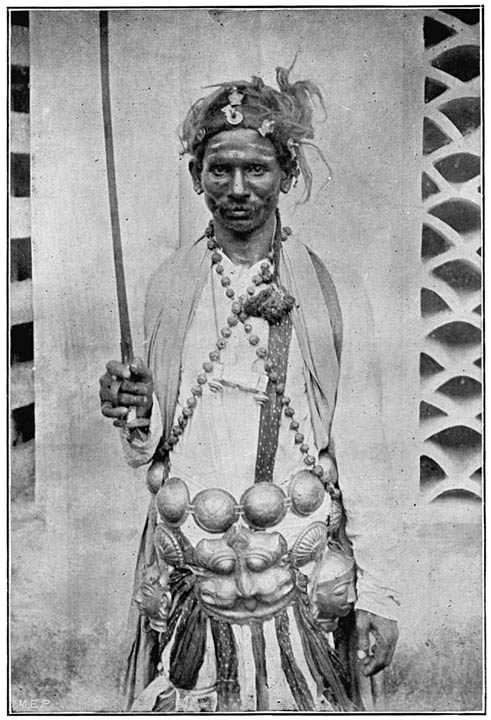
Viramushti.
The Vīramushtis are said to have become attached to the Kōmatis subsequent to the above incident. The story goes that some Kōmatis asked them to delay for three and half hours the march of Vishnuvardhāna Rāja, who was advancing with a view to marrying the daughter of one of them, named Vasavakanya (now deified into Kanyakamma). This the Vīramushtis did by entertaining the Rāja with their acrobatic feats. Meanwhile, the Kōmatis made a number of fire-pits, and put an end to themselves. Vishnuvardhāna arrived too late, and had his head cut off. The Vīramushtis prayed to Vasavakanya, inasmuch as they had lost both the Rāja, who promised them a grant of land in return for their performance, and herself, who had promised to give a lump of gold to each gōtra. The Kōmatis replied in a body that each family of their caste would in future give the Vīramushtis an annual present of money, and help in defraying the expenses of their marriages.
In accordance with the above legends, the Vīramushtis usually beg only from Dēvāngas and Kōmatis. When they approach a village, they generally halt under a tree, and, early in the morning, dress up as acrobats, and appear with daggers, sticks, etc., crying Good luck! Good luck! They caper about as they advance, and, when they reach a Dēvānga or Kōmati house, perform their acrobatic feats, and wind up with a eulogium of the caste. Money and food are then doled out to them.
Whenever a Dēvānga, Lingayat Kōmati, or other Lingāyat wants to make a hero (vīra) of a deceased member of his family, he sends for a Vīramushti (or hero-maker), and has a slab planted, with a recognised ceremonial, at the spot where he is buried.
In a further note on the Vīramushtis I am informed that they correspond to the Vīrabhadra Kāyakams of the Canarese Lingayats, like whom they dress up, and adorn themselves with small lingams, the figure of Vīrabhadra, a sword, a plate bearing a star, and heads of Asuras (demons). Every important Saivite temple has one or two Vīramushtis attached to it, and they are supposed to be servants of the god Siva. One of their chief duties is to guard the idol during processions, and on other occasions. If, during a car procession, the car will not move, the Vīramushtis cut themselves with their swords until it is set in motion. There is a Tamil proverb that the Siva Brāhman (temple priest) eats well, whereas the Vīramushti hurts himself with the sword, and suffers much. The custom is said to be dying out.
The principal occupation of the Vīramushtis is begging from Bēri Chettis, Dēvāngas, Kōmatis, and washermen. In former days, they are said to have performed a ceremony called pāvadam. When an orthodox Lingāyat was insulted, he would swallow his lingam, and lie flat on the ground in front of the house of the offender, who had to collect some Lingāyats, who would send for a Vīramushti. He had to arrive accompanied by a pregnant Vīramushti woman, pūjāris (priests) of Draupadi, Pachaiamman and Pothurāja temples, a Sembadava pūjāri, Pambaikārans, Udukkaikārans, and some individuals belonging to the nearest Lingayat mutt. Arrived at the house, the pregnant woman would sit down in front of the person lying on the ground. With his sword the Vīramushti man then made cuts in his scalp and chest, and sprinkled the recumbent man with the blood. He would then rise, and the lingam would come out of his mouth. Besides feeding the people, the offender was expected to pay money as pāvadam to the Vīramushtis and mutts.
Some Vīramushtis style themselves Vastād, or athletes, in reference to their professional occupation.
Vīrānattān.—The name denotes those who play on a drum called vīrānam. It is recorded, in the Madras Census Report, 1901, that the Vīrānattāns “were originally temple servants, but now do miscellaneous day labour. Their females are prostitutes. Their titles are Mēstri and Mudali.”
Vīranollu.—Vīranollu and Viththanollu are gōtras of Gānigas, who may not cut the wood-apple (Feronia elephantum).
Vīrasaiva.—A synonym for Lingāyat. Some Lingāyats claim to be Vīrasaiva Brāhmans.
Visālākshiamma.—Recorded, in the Manual of the North Arcot district, as a sub-division of Vāniyan. Visālākshiamma is the goddess of Benares, who is said to be the sister of Minākshi of Madura and Kāmākshi of Conjeeveram. Visālākshi means literally one with beautiful eyes, and is a name of Parvati, who is described as possessing large and beautiful eyes.
Viswakarma.—Viswakarma and Viswa Brāhman are synonyms for Kammālan, the members of which class claim descent from the five faces of Viswakarma, the architect of the gods.
Vitugula-vāndlu.—A fanciful name, meaning hunters or gallants, adopted by Bōyas.
Vodāri.—See Odāri.
Vodda.—See Oddē.
Vōdo.—A small caste of Oriya basket-makers and cultivators in the Vizagapatam agency.
Vōjali.—See Ojali.
Vokkiliyan (cultivator).—A sub-division of Kāppiliyan, and Tamil form of Vakkaliga. (See Okkiliyan.)
Vudupulavallu.—An occupational name for Balijas, Velamas, etc., who paint chintzes.
Vyādha (forest men).—A synonym of Myāsa Bēdars.
Vyāpāri.—A trading section of Nāyar.
Vyāsa (the name of a sage or rishi).—A sub-division of Balija.