Volume 7 — T (continued 2)
Reading edition
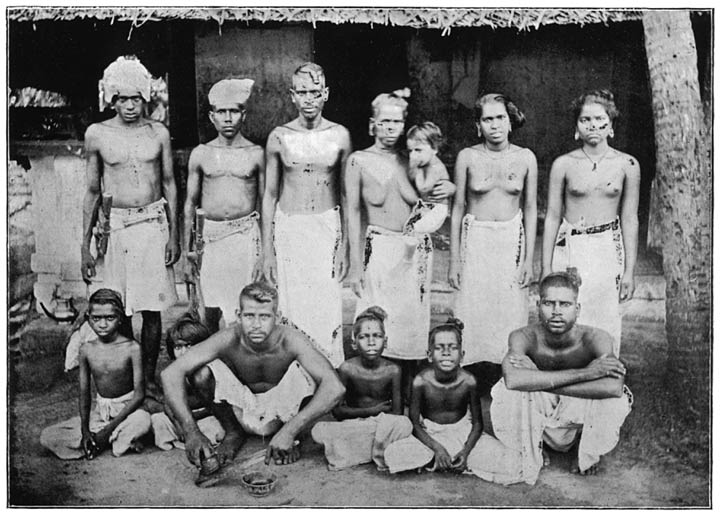
Tiyans.
It will not be worth while to attempt a description of the marriage ceremony of the Tiyans of North Malabar, because there is none, or next to none. There the Tiyans and all classes, including even the Muhammadan Māppillas, follow the rule of marumakkatāyam, or inheritance through females from uncle to nephew. The children have no right to their father’s property. Either party may annul the marital union at will, without awarding any compensation; and, as its infraction is easy and simple, so is its institution. Nor is there any rigid inquiry as to the antecedents of either party. It is an affair of mutual arrangement, attended with little formality. Proceeding to the girl’s house, accompanied by a few friends, the intending husband takes with him a couple of cloths, one for the girl, and the other for her mother. In parts of North Malabar, the Tiyan women wear an ornament called chittu (ring) in a hole bored in the top of the helix of each ear. The holes are bored in childhood, but the chittu is not worn until the girl forms a marital union with a man. The chittus are made on the spot at the time, in the marriage pandal erected for the occasion, the girl’s uncle providing the gold. They are never removed during life, except in cases of dire distress. “To sell chittu” is equivalent to having become a pauper. It is supposed that, in olden days, the marriage ceremonies lasted over seven days, and were subsequently reduced to seven meals, or three and a half days, and then to one day. Now the bridegroom remains the first night at the bride’s house, and then takes her to his home. Before they leave, a cocoanut, the outer husk of which has been removed, is placed on a stool of pala wood, and one of the bridegroom’s party must smash it with his fist. Some of the more orthodox in North Malabar observe the formality of examining horoscopes, and a ceremony equivalent to the conjee-drinking ceremony which has been described, called achāra kaliāna, and the payment of kanam in the shape of forty-one fanams, instead of forty-two as in South Malabar. In connection with fanams it may be noted that the old gold fanam is reckoned as worth four annas, whereas five silver or velli fanams make a rupee. Everywhere in rural Malabar, calculations are made in terms of velli fanams thus:—
10 pice (1/12 of an anna) = 1 velli.
5 vellis = 1 rupee.
Bazaar men, and those who sell their small stock at the weekly markets all about the country, arrange their prices in vellis.
When the death of a Tiyan is expected, all the relations draw near, and await the fateful moment. The person who is about to die is laid on the floor of the middle room, for it is inauspicious to die on a cot. We will suppose that the dying man is a parent and a landlord. Each of the sons and daughters gives him a little conjee water, just before he passes away. At the moment of death, all the women bawl out in lamentations, giving the alarm of death. The Cheruman serfs in the fields join in the chorus, and yell out an unintelligible formula of their own. Absent relations are all formally invited. From the houses of the son’s wife and daughter’s husband are sent quantities of jāk fruits, unripe plantains, and cocoanuts, as death gifts. One half of the husks of the cocoanuts is removed, and the other half left on the shell. After the cremation or burial, these articles are distributed among those present by the Tandān, who receives an extra share for his trouble. When life is extinct, the body is placed with the head to the south, and the thumbs and big toes are tied together. It is then taken out into the yard, washed, bathed in oil, dressed in a new cloth, and brought back to the middle room. A cocoanut is cut in two, and the two halves, with a lighted wick on each, are placed at the head and foot. The house-owner spreads a cotton cloth over the corpse, and all the relations, and friends, do the same. Any one who wishes to place a silk cloth on the corpse may do so, but he must cover it with a cotton cloth. The body is then removed for burial or cremation, and placed near the grave or funeral pyre. It is the rural rule that elderly persons and karnavans of tarwads are cremated, and others buried. The barber, whose function it is to perform the purificatory rites, now removes, and retains as his perquisite, all the cloths, except the last three covering the corpse. As it is being borne away to the place of burial or cremation, water mixed with cow-dung is sprinkled behind it in the yard. The eldest son, who succeeds to the property and is responsible for the funeral ceremonies, then tears crosswise a piece of the cloth which has been placed over the corpse by the people of the house, and ties it round his forehead. He holds one end of the cloth while the barber holds the other, and tears off the piece. The barber then cuts three holes in the remainder of this cloth covering the body, over the mouth, navel, and pubes. A little water and rice are poured over a gold fanam through the slit over the mouth. All who observe the death pollution, i.e., sons, grandsons, nephews, younger brothers and cousins, offer water and rice in the same manner, and walk three times round the grave or pyre. The barber then breaks a pot of water over the grave. No other ceremonial is observed on this day, on which, and during the night, rice must not be eaten. If the body has been cremated, a watch is kept at the burning ground for five days by Pānans, who beat drums all night to scare away the evil spirits which haunt such spots. Early on the second day, all who are under pollution are shaved. The operation is attended with some ceremonial, and, before it is commenced, a lighted lamp, a measure of rice and paddy on a plantain leaf must be at hand. The paddy and rice are a perquisite of the barber. Those who have been shaved bathe, and then follows the crow-feeding ceremony. Rice is boiled in a bell-metal vessel over a hearth prepared with three young cocoanuts. The eldest son, who tore the cloth of succession from the corpse, makes the rice into two little balls, places them on a plantain leaf, and offers them to the spirit of the departed by pouring libations of water on them over a blade of karuka grass. Men and women who are under pollution then do the same. The rice balls are eaten by crows. This little ceremony is performed daily until the eleventh or thirteenth day, when the period of death pollution comes to an end. If the eleventh day happens to fall on a Tuesday or Friday, or on any inauspicious day, the period is extended to the thirteenth day. When the period of death pollution is partly in one month, and partly in another, another death in the house within the year is expected. Preceding the sanchayanam, which occupies the fifth day, there is the lamp-watching on the previous night. In the south-east corner of the middle room, a little paddy is heaped up, and on it is placed a bell-metal plate with an iron lamp having five or seven lighted wicks on it. Under the lamp is a little cow-dung, and close to it is a bunch of cocoanut flowers. The lamp must be kept burning until it is extinguished on the following day. In the case of the death of a male, his niece watches the lamp, and in that of a female her daughter, lying near it on a grass mat. The sanchayanam is the first stage in the removal of death pollution, and, until it is over, all who come to the house suffer from pollution, and cannot enter their own house or partake of any food without bathing previously. When the body has been cremated, the fragments of calcined bones are collected from the ashes, and carried in procession to the sea, or, if this is far away, into a river. The members of the family under pollution then rub their bodies all over with oil, and the barber sprinkles a mixture of cow’s milk over their heads, using a blade of karuka grass as a spout. They then bathe, and the eldest son alone observe māttu. The crow-feeding ceremony follows, and, when this is over, the three cocoanuts which were used as a hearth are thrown away. A large bell-metal vessel filled with water is now placed in the front yard before the door of the house. The barber carries the still burning lamp from the middle room, and sets it on the ground near the pot of water. The women who are under pollution come from the middle room, each carrying a lighted wick, walk thrice round the pot, and throw the wicks into the water. The woman who has watched the lamp puts four annas into the pot, and the others deposit a few pies therein. The eldest son now lights a wick from the iron lamp which is about to be extinguished, and with it lights a lamp in the middle room. The barber then dips the iron lamp in the water, and picks out the money as his perquisite. The water is poured on the roots of a cocoanut tree. The bell-metal vessel becomes the property of the woman who watched the lamp, but she cannot take it away until she leaves the house after the pula-kuli ceremony. When the lamp has been extinguished, a woman, hired for the occasion, is seated on a cocoanut leaf in the front yard. The Tandān pours oil on her head three times, and she receives a little betel and two annas. She rises, and leaves the place without turning back, taking the pollution with her. Betel is then distributed. Those who provided the death gifts on the day of the death must on this day bring with them a bag of rice, and about four rupees in money. They have also to give eight annas to the barber. A folded handkerchief is first presented to the barber, who formally returns it, and receives instead of it the eight annas. Before the people disperse, the day of the pula-kuli is settled. Pula-kuli, or washing away the pollution, is the final ceremony for putting off the unpleasant consequences of a death in a family. First of all, the members thereof rub themselves all over with oil, and are sprinkled by the barber with cow’s milk and gingelly oil. They then bathe. The barber outlines the figure of a man or woman, according to the sex of the deceased, with rice flour and turmeric powder, the head to the south, in the middle room of the house. The figure is covered with two plantain leaves, on each of which a little rice and paddy are heaped. Over all is spread a new cloth, with a basket containing three measures of paddy upon it. The eldest son (the heir) sits facing the south, and with a nāzhi measures out the paddy, which he casts to the south, east, and west—not the north. He repeats the performance, using the fingers of the left hand closed so as to form a cup as a measure. Then, closing the first and fourth fingers firmly with the thumb, using the left hand, he measures some paddy in the same manner with the two extended fingers. Rice is treated in the same way. A nāzhi of paddy, with a lighted wick over it, is then placed in a basket. The eldest son takes the nāzhi in his left hand, passes it behind his body, and, receiving it with his right hand, replaces it in the basket. The wick is extinguished by sprinkling it with water three times. At the head of the figure on the floor is placed a clean cloth—the washerman’s māttu. It is folded, and within the folds are three nāzhis of rice. On the top of it a cocoanut is placed. In the four corners a piece of charcoal, a little salt, a few chillies, and a gold fanam are tied. The eldest son, who is always the protagonist in all the ceremonies after death, lifts the cloth with all its contents, places it on his head, and touches with it his forehead, ears, each side and loins, knees and toes. He does this three times. The plantain leaves are then removed from the figure. A little turmeric powder is taken from the outline, and rubbed on the forehead of the eldest son. He then bows thrice to the figure, crossing his legs and arms so that the right hand holds the left ear, and the left the right ear, and touches the ground with the elbow-joints. It is no joke to do this. All this time, the eldest son wears round his forehead the strip torn from the cloth which covered the corpse. There is nothing more to be done in the middle room for the present, and the eldest son goes out into the yard, and cooks the rice for the final feed to the crows. Three nāzhis of this rice must be pounded and prepared for cooking by the woman who watched the lamp on the fourth night after death. Having cooked the rice, the eldest son brings it into the middle room, and mixes it with some unrefined sugar, plantains and pappadams, making two balls, one large and one small. Each of these he places on a plantain leaf. Then some pūja is done to them, and offerings of rice are made over a gold fanam. The balls are given to the crows in the yard, or, in some cases, taken to the sea or a river, and cast into the water. When this course is adopted, various articles must be kept ready ere the return of the party. These comprise a new pot containing water, a branch of areca blossoms, mango leaves, a kindi containing a gold fanam or gold ring, a little salt and rice, each tied up in a piece of cloth, and a few chillies. The mouth of the pot is covered with a plantain leaf, and secured. There are also two stools, made of pala and mango wood. The eldest son sits on one of these, and places his feet on the other, so that he does not touch the ground. The water in the pot is sprinkled with mango leaves by the barber to the north, south, east and west, and on the head of the son. The remainder of the water is then poured over his head. The barber then sprinkles him with cocoanut water, this time using areca blossoms, and makes him sip a little thereof. The barber makes a hole in the plantain leaf, and picks out the contents. The eldest son bathes, and after the bath there is a presentation of gifts. The barber, sitting in the verandah beside the son, first gives to each person under pollution a little salt and raw rice, which they eat. He then gives them a little betel leaf and a small piece of areca nut, and receives in return a quarter of an anna. The eldest son chews the betel which he has received, and spits into a spittoon held by the barber, whose property it becomes. Then to the barber, who has been presented with a new mat to sit on and new cloth to wear before he seats himself in the verandah, are given an ear-ring such as is worn by Tiyan women, a silk cloth, a white cotton cloth, and a few annas. If the deceased has been cremated he is given six fanams, and, if buried, five fanams as the fee for his priestly offices. On an occasion of this kind, several barbers, male and female, turn up in the hope of receiving presents. All who help during the various stages of the ceremonial are treated in much the same way, but the senior barber alone receives the officiating fee. It is odd that the barbers of the four surrounding villages are entitled to receive gifts of new cloths and money. Those under death pollution are forbidden to eat fish or flesh, chew betel, or partake of jaggery. The restriction is removed on the pula-kuli day. The last act for their removal is as follows. The barber is required to eat some jaggery, and drink some conjee. After this, the eldest son, the Tandān, and a neighbour, sit on a mat spread in the middle of the house, and formally partake of conjee and jaggery. The pula-kuli is then over.
It is a sacred duty to a deceased person who was one of importance, for example the head of a family, to have a silver image of him made, and arrange for it being deposited in some temple, where it will receive its share of pūja (worship), and offerings of food and water. The new-moon day of the months Karkitakam (July-August), Tulam (October-November), and Kumbham (February-March) is generally selected for doing this. The temples at Tirunelli in Wynād and Tirunavayi, which are among the oldest in Malabar, were generally the resting-places of these images, but now some of the well-to-do deposit them much further afield, even at Benares and Rāmēsvaram. A silver image is presented to the local Siva temple, where, for a consideration, pūja is done every new-moon day. On each of these days, mantrams are supposed to be repeated a thousand times. When the image has been the object of these mantrams sixteen thousand times, it is supposed to have become eligible for final deposit in a temple. It is this image which rests in the temple at Tirunavayi, or elsewhere.
An annual srādh ceremony is performed for the sake of the spirit of the deceased, at which crows are fed in the manner already described, and relations are fed. On the night of this day, some sweetmeats or cakes, such as the deceased was fond of during life, are offered to the spirit. A lamp is placed on a stool, and lighted in the middle room of the house, with a kindi of water and a young cocoanut near it. The cakes or sweetmeats are placed in front of the stool. Children sprinkle rice over it, and the door is shut for a quarter of an hour. The individual who feeds the crows should partake of only one meal, without fish or flesh, on the previous day. Another ceremony, which is necessary for the repose of the dead, is called badha-velichatu-variethal, or bringing out the spirit. It cannot be performed until at least a year after death, for during that period the spirit is in a sort of purgatory. After that, it may be invoked, and it will answer questions. The ceremony resembles the nelikala pregnancy ceremony. The performers are Pānans or washermen. Some little girls are seated in front of a booth in the yard. The celebrant of the rite sings, invoking the spirit of the deceased. Late at night, one of the girls becomes possessed by the spirit, and, it is said, talks and acts just like the deceased, calling the children, relations and friends by name, talking of the past, and giving commands for the future conduct of the living members of the family. After this, the spirit is severed from earthly trammels, and attains heavenly bliss.
The wood used for the purpose of cremation is that of a mango tree, which must be cut down after the death. A little sandalwood and cuscus (grass) roots are sometimes added to the pyre. In these days, when the important and interesting features of ceremonial are fast disappearing, it is not surprising that dried cakes of cow-dung are superseding the mango wood.
Among other ceremonies, there is one called kutti pūja, which is performed when a newly built house is taken charge of. Vastu Purusha is the name of the supreme being which, lying on its back with its head to the north-east and legs to the south-west, supports the earth. Or rather the earth is but a small portion of this vast body. Forests are its tiny hairs, oceans its blood-vessels, and the wind its breath. In this body are fifty-three deities, who are liable to disturbance when the surface of the earth is dug, when trees are felled, foundations laid, and a house built. These angry beings must be propitiated, or there will be untimely deaths, poverty, and sickness among the inmates. The ceremony is performed in the following manner. A square with fifty-three columns is made with rice flour in the middle room of the house, and each column is filled with yellow, red, and black powder. A plantain leaf is placed over it, and a few measures of paddy are set on the top of the leaf. On this is placed another leaf, with various kinds of grain, plantains, cocoanuts, and jaggery on it. The carpenter, who is the architect and builder of the house, then performs pūja with flowers, incense and lights, and the troublesome imp-spirit Gulikan is propitiated with toddy and arrack, and a fowl which is decapitated for him. Then all the workmen—carpenters, masons, and coolies—walk thrice round the house, breaking cocoanuts on the walls and doors, and howling in order to drive away all evil spirits which may by chance be lurking about the place. After this, they are all fed until they cry out “We are satisfied, and want no more.” They are given cloths and other presents, and the chief feature of the ceremony takes place. This is the formal handing over of the house by the carpenter. He hands it over to a third person, and never directly to the owner. It is not always easy to find a third person who is willing to undertake the responsibility, and who is at the same time suitable for the Gulikan who is dispossessed of the house, and pursues him henceforth, following him who first receives charge of the house. He should be a man who brings luck, cheerful and contented, having a family, and not labouring under any disorder or sickness of body. There is, or was a few years ago, an old Nāyar living not far from Calicut, who was much sought after to fulfil the functions of third person on these occasions, and all the houses he received prospered. The third person is generally a poor man, who is bribed with presents of cloths, money and rice, to undertake the job. He wears one of the new cloths during the ceremony. When the carpenter’s ceremonies have been completed, this man is taken to the middle room of the house, and made to stand facing the door, with each foot on a plantain leaf. Pieces of the thatch are tied to the four corners of his cloth. He shuts the door, opens it, and shuts it again. The carpenter calls from without, asking him whether he has taken charge of the house. He replies evasively “Have the carpenters and workmen received all their wages? If they have, I take charge of the house.” The carpenter does not answer the question, for, if he did so, the mischief would be transferred to him through the house-owner. So he says “I did not ask you about my wages. Have you taken charge of the house?” The man inside answers as before, adding “otherwise not.” The carpenter again says “I did not ask you about my wages. Answer me straight. Have you, or have you not taken charge of the house?” The man inside replies “I have taken charge of the house,” and opens the door. Taking in his hands the plantain leaves on which he stood, he runs away as fast as he can without looking back. This he must not do on any account. The people pelt him with plantains, and hoot at him as he runs, and water mingled with cow-dung is sprinkled in his path. After all this, cow’s milk is boiled with a little rice in the house, of which every one partakes, and the owner assumes charge of his house.
In the pre-British days, a few of the well-to-do families of Tiyans lived in houses of the kind called nalapura (four houses), having an open quadrangle in the centre. But, for the most part, the Tiyans—slaves of the Nāyars and Nambūtiris—lived in a one-roomed thatched hut. Nowadays, the kala pura usually consists of two rooms, east and west.
Toddy-drawing, and every thing connected with the manufacture and sale of arrack (country liquor) and unrefined sugar, form the orthodox occupation of the Tiyan. But members of the community are to be found in all classes of society, and in practically all professions and walks of life. It is interesting to find that the head of a Tiyan family in North Malabar bears the title Cherayi Panikar, conferred on the family in the old days by a former Zamorin. A title of this kind was given only to one specially proficient in arms. Even in those days there were Tiyan physicians, bone-setters, astrologers, diviners, and sorcerers.
It is easy to identify the toddy-tapper by the indurated skin of the palms, fingers, inner side of the forearms, and the instep. The business of toddy-tapping involves expert climbing, while carrying a considerable paraphernalia, with no adventitious aid other than can be got out of a soft grummet of coir to keep the feet near together, while the hands, with the arms extended, grasp the palm tree. The profession is rarely adopted before the age of eighteen, but I have seen a man who said he began when he was twelve years old. It is very hard work. A tapper can work about fifteen trees, each of which he has to climb three times a day. In the northern districts of the Madras Presidency, among the Telugu population, the toddy-drawers use a ladder about eight or nine feet in length, which is placed against the tree, to avoid climbing a third or a fourth of it. While in the act of climbing up or down, they make use of a wide band, which is passed round the body at the small of the back, and round the tree. This band is easily fastened with a toggle and eye. The back is protected by a piece of thick soft leather. It gives great assistance in climbing, which it makes easy. All over the southernmost portion of the peninsula, among the Shānāns and Tiyans, the ladder and waist-band are unknown. They climb up and down with their hands and arms, using only the grummet on the feet. The Tiyan toddy-tapper’s equipment consists of a short-handled hatchet, about seven inches square, of thin iron, sheathed in a wooden case, and fastened to a waist-belt composed of several strings of coir yarn, to which is hung a small pot of gummy substance obtained by bruising the leaves of the aichil plant. A vessel holding a couple of gallons, made out of the spathe of the areca palm, is used for bringing down the toddy. Tucked into the waist-belt is a bone loaded with lead at either end, which is used for tapping the palm to bring out the juice. A man once refused to sell at any price one of these bones—the femur of a sāmbar (Cervus unicolor), which had such virtue that, according to its owner, it would fetch palm juice out of any tree. The garb of the tapper at work consists of a short cloth round the loins, and (always during the rains, and often at other times) a head-covering somewhat pointed in shape, made of the leaves of the cocoanut palm placed together as in a clinker-built boat, or of a rounded shape, made out of the spathe of the areca palm. The toddy-tapper should go through the show of reverence by touching the cocoanut tree with the right hand, and then applying his hand to the forehead, every time he prepares to climb a tree.
In connection with toddy-drawing, the following note occurs in the Gazetteer of Malabar. “The tapper and the toddy shopkeeper are generally partners, the former renting the trees, paying the tree-tax, and selling the toddy at fixed prices to the latter. Sometimes the shopkeeper pays both rent and tax, and the tapper is his servant paid by the bottle. The trees are rented half yearly, and the rent varies between Re. 1 and Re. 1–8–0 per tree. They are fit for tapping as soon as they come into bearing, but four years later and in the succeeding decade are most productive. They are seldom tapped for more than six months in the year, and the process, though it shortens the life of the tree, improves the yield of nuts in the rest of the year. The tapper’s outfit is neither costly nor elaborate. A knife in a wooden case, a bone weighted with lead (the leg bone of a sambhur for choice), a few pots, and two small rings of rope with which to climb complete the tale. Operations begin when the spathe is still enclosed by its sheath. Once a day the spathe is gently bruised on either side with the bone, and on the third and following days a thin slice is cut off the end twice a day. On the fifteenth day drawing begins, and the bruising ceases. Sheath and spathe are swathed for the greater part of their length in a thick covering of leaves or fibre; the ends are still cut off twice or three times a day, but, after each operation, are smeared with a paste made of leaves and water with the object, it is said, of keeping the sap from oozing through the wound and rotting the spathe. The leaves used for this purpose are those of the éechal or vetti tree, which are said to be one and the same (Aporosa Lindleyana); but in British Cochin, where the tree does not grow, backwater mud is utilised. Round the space between the end of the sheath and the thick covering of leaves a single leaf is bound, and through this the sap bleeds into a pot fastened below. The pot is emptied once a day in the morning. The yield of sap varies with the quality of the tree and the season of the year. In the hot months the trees give on an average about a bottle a day, in the monsoon and succeeding months as much as three bottles. In the gardens along the backwaters, south of Chēttuvāyi, Messrs. Parry & Co. consider that in a good year they should get a daily average of three bottles or half a gallon of toddy per tree. A bottle of toddy sells for three or four pies.”
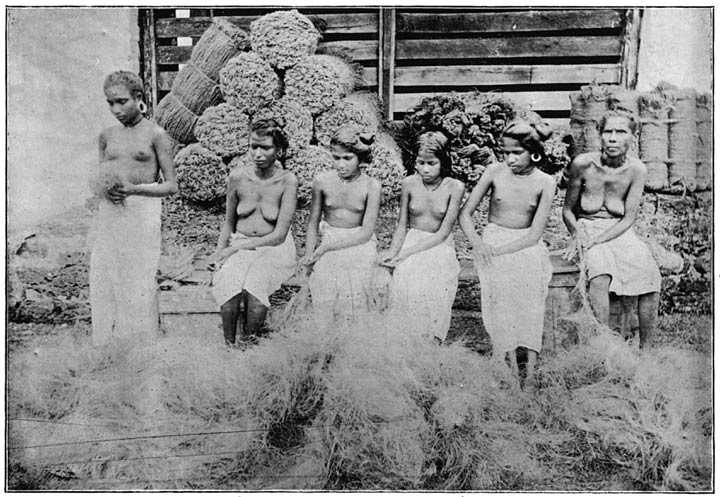
Tiya females at a coir factory.
In connection with the coir industry, it is noted, in the Gazetteer of Malabar, that “the husks of the cocoanuts are buried in pits as near as possible to the waterline of rivers, backwaters and creeks, and are left to soak for six months, a year, or even eighteen months—the longer the better. The colour of the yarn, and thereby the quality, depends very much on the water in which the husks are steeped. It should be running water, and, if possible, fresh water. If the water be salt, the yarn may at first be almost white, but in a damp climate it soon becomes discoloured and blotchy. As soon as the husks are taken out of the pits, the fibre is beaten out with short sticks by Tiyattis (Tiyan females) and women of the Vēttuvan caste. It is dried in the sun for twelve hours, and is then ready for sale to native merchants at Calicut and Cochin, who in their turn deal with the European firms. The fibre is twisted into yarn by Tiyattis and other women, and in that form the greater part of the coir made in Malabar is exported from Cochin to all parts of the world, but chiefly to the United Kingdom and Germany.”
It has been said that “in North Malabar the preparation of coir is a regular cottage industry of the most typical kind. Throughout the year, wherever one goes, one hears the noise of the women hammering out the fibre, and sees them taking, in the evening, that part of it which they have rolled into yarn to the nearest little wayside shop, to be exchanged for salt, chillies, paddy, etc. But, in the north of the district, nothing of the kind goes on, and the coir is commonly used as fuel.”
It has been already stated that marumakkatāyam, or inheritance through nephews, is the invariable rule in North Malabar, being followed even by the Muhammadan Māppillas. In South Malabar, where the Tiyans do not observe marumakkatāyam, the property devolves through the sons. All sons share alike. Daughters have no share. The practice of polyandry, which still exists in Malabar among the Tiyans (and other classes), and which was probably once general, tends to prevent dispersion of the family property. Although theoretically all sons share the property of their father, it is the eldest son who succeeds to possession and management of the tarwad property. The others are entitled to maintenance only, so long as they remain in the same tarwad house. It is the same among the Izhuvans.
Beef, as in the case of all Hindus, is forbidden as an article of diet. The staple food is rice with fish curry. The common beverage is conjee, but this is being supplanted by tea, coffee, lemonade, and soda-water.
A loin-cloth, which should not reach to the knees, with a Madras handkerchief on the shoulders, is the orthodox dress of the males, and a double loin-cloth that of females. Women were not allowed to wear anything above the waist, except when under death pollution. Any colour might be worn, but white and blue are most common. A ring, composed of hollow gold beads, called mani-kathila, is the proper ornament for a Tiyan woman’s ear. Twenty or thirty, with a pendant in the middle, might be worn. Gold or silver bracelets could be worn. Hollow silver bracelets were worn by girls until the birth of their first child. But times have changed, and nowadays Tiyan women wear the ornaments which, strictly speaking, appertain to Nāyar and Brāhman women. Their mode of tying the hair, and even their dress, which is inclined to follow the fashion of the Christians, has changed. In olden days, a Tiyan woman could wear an ornament appropriate for a Nāyar on a special occasion, but only with the permission of the Nāyar landlord, obtained through the Tandān, on payment of a fee.
In North Malabar a good round oath is upon Perumāl Iswaran, the God of the shrine at Kōtiyūr. In South Malabar it is common to swear by Kodungallūr Bhagavati, or by Guruvayūr Appan, local deities.
In connection with the religion of the Tiyans, I may commence with an old tradition, which is no doubt from a Brāhmanic source. Once upon a time there were seven heavenly damsels, who used to bathe every day before dawn in a lake situated in a forest. Siva found this out, and appeared as a fire on the bank, at which the girls warmed themselves. Having thus lured them, the God made all of them mothers. Seven beautiful boys were born, and Siva presented them to Parvati, who treated them as if they were her own sons. They were taken to mount Kailāsa, and employed in preparing toddy for the mysterious and wonderful Sakti worship. Daily they brought the toddy at the moment when it was required for the golden pot. Parvati embraced the boys all at once, and they became one. On a certain day, this boy sent the sacred toddy in charge of a Brāhman, who became curious to know the virtues of the mysterious liquid. As he rested on a river bank thinking about it, he drank a little, and filled the vessel up with water. Then he reached Kailāsa too late for the daily worship. Siva was angry, and ordered the Saunika boy (Parvati’s name for him) to be brought before him. But the boy had been told what had happened, and cut off the head of the Brāhman, who had confessed to him. Seeing the boy coming along carrying a Brāhman’s head, Siva was astonished, and commanded him to approach nearer. The boy explained that it was not a heinous crime to cut off the head of one who had prevented the Sakti worship. Siva said that the killing of a Brāhman was the worst of crimes, and put the perpetrator out of caste. He would not listen to the boy, who replied that whoever prevented Sakti worship was a Chandāla, and condemned him. The boy asked for death at Siva’s hands. The request pleased the God, who forgave him. The boy had to remain out of caste, but was initiated into the mysteries of Sakti worship as the surest means of salvation, and to him was given the exclusive privilege of performing Sakti worship with liquor. He was commanded to follow, and imitate the Brāhmans in everything, except in the matter of repeating the sacred mantrams. By tantrams (signs with the hands) he eventually obtained the merit of making pūja with mantrams. He was the first Tiyan.
It is pretty safe to say that all the ideas of the Tiyans connected with pure Hinduism—the Hinduism of the Vēdas—and of tradition, of which we see very little in Southern India, and which in Malabar is more perverted in confused ideas than perhaps elsewhere, those relating to re-birth, karma, pilgrimages to Benares and distant temples are borrowed from the Brāhmans. In the ceremonies which have been described, notably in those connected with marriage and death, we have seen the expression of many Hindu ideas. Not so is all that relates to offerings to the dead. That is the common property of all the children of men.
A main feature in the religion of the Tiyan is that it is largely connected with Sakti worship. Some Brāhmans indulge therein, but they are unable, like the Tiyans, to use arrack in connection with it, and are obliged to use, instead of this requisite, milk or honey. Siva, not exactly a Vēdic entity, and Sakti, are supposed to be the two primordial and eternal principles in nature. Sakti is, perhaps, more properly the vital energy, and Sakti worship the worship of the life principle in nature. We are not considering the abstract meaning of the term Sakti; nor are we now thinking of the Siva of Monier Williams or Max Müller. We are in Malabar, where the Hinduism of the Vēdas is in almost hopeless confusion, and mingled with animism and nearly every other kind of primitive religious idea. It is not therefore at all an easy task to represent in words anything like a rational conception of what the religion of the Tiyan really is. The poor and ignorant follow, in a blind ignorant way, Hinduism as they know it and feel it. Their Hinduism is very largely imbued with the lower cult, which, with a tinge of Hinduism, varied in extent here and there, is really the religion of the people at large all over Southern India. The Tiyans have a large share of it. To the actions of evil and other spirits are attributable most, if not all of the ills and joys of life. The higher Hinduism is far above them. Nevertheless, we find among them the worship of the obscure and mysterious Sakti, which, unfortunately, is practiced in secret. Nobody seems to be in the least proud of having anything to do with it. In fact, they are rather ashamed to say anything about it. Those who, so to speak, go in for it are obliged to undergo preliminary purificatory ceremonies, before the great mystery can be communicated to them. The mantram, which is whispered by the guru (religious preceptor) in the ear of the devotee is said to be “Brahma aham, Vishnu aham, Bhairavu aham” (I am Brahma, I am Vishnu, I am Bhairavan). It is believed that each individual is a spark of the divinity. Having in him the potentiality of the Supreme Being, he can develop, and attain godhood. There is no distinction of caste in Sakti worship. The devotees may belong to the highest or to the lowest castes, though I doubt very much whether the Nambūtiri Brāhmans indulge in it. The novices, of whatever caste, eat and drink together during the period of pūja. Men and women participate in the secret rites. A solemn oath is taken that the mystery of Sakti will not be revealed, except with the permission of the guru, or on the death-bed. The spirit of the goddess (for Sakti is thought of as the female principle) must be withdrawn from the body of the Sakti worshipper when he is at the point of death. A lamp is lighted beside him. A few leaves of the tulsi plant (Ocimum sanctum), a little rice, and a lighted wick are given to the dying man. Holding these things, he makes three passes over his body from head to foot, and, as it were, transfers the spirit to the next man, at the same time communicating his wishes about continuing the worship, and so on. When a man dies before this separation or transfer has been accomplished, a Brāhman must be called in, who, with a silver image representing the deceased, makes symbolic transference of the Sakti spirit. It must be done somehow, or the soul of the deceased cannot attain salvation. It is said that, like many other things in this land, Sakti worship has undergone degeneration, that such lofty ideas and feelings as may have once pervaded it have more or less disappeared, and that the residue is not very edifying. Be this as it may, in every tara there is a Bhagavati temple for Tiyans, where Tiyans officiate as priests. The Komaram (oracle) of the Bhagavati temple is clothed in red, and embellished with red sandal paste mixed with turmeric. Bhagavati is always associated with various jungle spirits or gods, whose Komarams always wear black. There is no daily worship in Tiyan temples, with the exception of a few in the neighbourhood of Cannanore. But there is an annual celebration of pūja during the mannalam (forty day) period, commencing on the first of the month Vrischikam (15th November). Lamps are lighted, and worship is begun on this day, and continued for forty days. At its conclusion, the jungle gods retire to the jungle until the next year. A death in the family of a Komaram involves, I believe, some postponement of the rites. The period is supposed to be first part of the functional activity of the earth, which ends somewhere about the 21st of June. It is during this period that Sakti worship is carried on.
The temple of Subramania at Palni in the Madura district is a favourite objective for Tiyan pilgrims. The subject of pilgrimages to this temple has been touched on in my note on the Nāyars (see Nāyar). The Bhagavati temple at Kodungallūr in Cochin territory on the coast is another favourite place of pilgrimage among the Tiyans. All classes of people, with the exception of Brāhmans, undertake this pilgrimage. Everyone under a vow, proceeding to the festival, which takes place in February or March, carries with him a cock, which is beheaded at the shrine. Under the Perumāls, pilgrimage to Kodungallūr was somewhat compulsory. This temple was a fruitful source of revenue to the State, for not only the Tiyans, but the fisherman and artisan castes had their own temple in every tara in the land, and the Mūppan—the Komaram—of each temple was under an obligation to contribute yearly gifts to the temple at Kodungallūr. Rent for the temple lands was set at a nominal figure—a mere pepper-corn rent as acknowledgment of sovereign right. Rent might not be paid in times of trouble, but the gifts eked out of superstition were unfailing. It is not surprising, therefore, that learning and advancement among the inferior castes did not receive much encouragement from the rulers of those days.
The temple of Kotiyūr in North Malabar is also a shrine to which Tiyans make pilgrimage. Indeed, it may be said that they follow Hinduism generally in rather a low form, and that Sakti worship is perhaps more peculiarly theirs than others’, owing to their being able to use arrack, a product of the palm, and therefore of their own particular métier. The highest merit in Sakti can be reached only through arrack. The Sakti goddess, Bhagavati, the Tiyans look upon as their own guardian spirit.
As instancing the mixture and confusion of religious ideas in Malabar, it may be mentioned that Māppillas have been known to indulge in Sakti worship, and Tiyans to have made vows, and given offerings at Māppilla mosques and Christian churches. Vows to the well-known mosque at Mambram are made by people of almost every caste. It is not uncommon to present the first fruit of a jāk tree, or the milk of a cow when it brings forth its first calf, to the local Tangal or Māppilla priest.
In many, perhaps in most Tiyan houses, offerings are made annually to a bygone personage named Kunnath Nāyar, and to his friend and disciple Kunhi Rāyan, a Māppilla. It is probable that they excelled in witchcraft and magic, but, according to the story, the Nāyar worshipped the kite until he obtained command and control over all the snakes in the land. The offerings are made in order to prevent accidents from snakes. The snake god will also give children to the family, and promote domestic prosperity. Men without offspring worship him. Leprosy and the death of a child are believed to be the consequence of killing a snake. There are Māppilla devotees of Kunnath Nāyar and Kunhi Rāyan, who exhibit snakes in a box, and collect alms. There is a snake mosque near Manarghāt, at the foot of the Nīlgiri hills, which has its annual festival. The alms are collected ostensibly for this mosque.
Gold valam-piri (a sort of string worn over the right shoulder);
Silver edam-piri (a similar sort of string worn on the left shoulder);
Gold netti-pattam (to be tied on the forehead);
Gold bracelet;
Gold ornament for the hair.
1. To make ceilings for their houses.
2. To make upstairs houses to live in.
3. To put up single staircases, consisting of one pole, in which notches are cut, or pegs are stuck alternately, for the feet.
4. To have a gate-house.
5. To perform the tāli-tying ceremonies of their girls in a booth having four posts or supports; to place within it, on a stool, a looking-glass with a handle, and the Rāmayana; and to place a silk cloth on the girl’s head.
6. To do arpu at the conclusion of the tāli-tying ceremony (Vel! Arpu! is yelled out by the boys).
7. To cook rice in copper vessels on occasions of marriage and other ceremonies, and to serve sugar and pappadams at their feasts.
8. To hold the umbrella and taza (a sort of umbrella), which are carried in front of processions.
9. To clap hands, and dance.
10. To keep milch-cows for their own use.
Permission was further granted for the Kammālans to wear the following ornaments.
1. Netti-pattam, worn on the forehead during the tāli-tying ceremony.
2. Ananthovi, a ear ornament named after Anandan, the endless, the serpent on which Vishnu reposes. The serpent is sometimes represented with its tail in its mouth, forming a circle, an endless figure. Ananthovi is the central pendant of the ear-ring worn by Tiyan women among their kathila (ordinary gold ear-rings). It resembles a serpent in form. It is worn by men of the Tiyan and artisan castes on special occasions.
3. Waist zone or girdle.
4. Bracelets.
5. Anklet with two knobs, formed of two pieces screwed together.
6. Puli-mothiram, or tiger’s claws mounted in gold, worn by children.
7. Podippu, a knot of cotton-thread at the end of the string on which coins are hung as ornaments.
8. Kalanchi, a gold knob above the podippu, which represents a flower.
9. Necklace.
10. Edakam and madkam-tāli, neck ornaments, in one of which are set twenty-one stones.
11. Cotton thread above the gold thread on the neck.
The Perumāl conferred like privileges upon the family (Tiruvarankath) of the Pānan who brought back the Kammālans. He wore all his ornaments, and made his obeisance to the Perumāl. He had, however, taken off his gold cap. The Perumāl said “What you have removed, let it be removed.” So he lost the privilege of wearing a gold cap. The Perumāl blessed the Kammālans, and they returned to their villages. They made a separate house for the Izhuva boy and the Variar girl, and maintained them. The Izhuva boy, who was the first Tiyan to come to Malabar, brought with him the cocoanut, and retained the right to cultivate and use it. To this day, the people of the serf castes—Cherumans, Kanakans, and the like—use the word Varian when addressing Tiyans, in reference to their descent from the Variar girl.
The orthodox number of classes of Kammālans is five. But the artisans do not admit the workers in leather as of their guild, and say there are only four classes. According to them, the fifth class was composed of the copper-smiths, who did not return to Malabar with the others, but remained in Izhuva land. Nevertheless, they always speak of themselves as the Aiyen kudi or five-house Kammālans.
There is a variant of the legend of the exodus, told by the Āsāris (carpenters), which is worth narrating. Their version of the story is repeated among themselves, and not by the Pānan, at every marriage and tāli-tying ceremony. They identify the village of the Perumāl’s washerman as Kanipayyūr. This is the name of a Nambūtiri’s illam in the Ponāni tāluk of Malabar. The Nambūtiri is, it may be mentioned, considered to be the highest extant authority in architecture. Disputed points relating to this subject are referred to him, and his decision is final, and accepted by all carpenters and house-builders. The washerman’s stone is said to have been lying flat in the water. The girl Ayyesvari was also of Kanipayyūr, and was carried off as in the former story. But there was no request for an armed guard to rescue her. The Perumāl was, instead, asked to make the washerman marry her, and thus avoid disgrace. He consented to do so, and all the 7,764 families of the five classes of Kammālans assembled for the wedding. An immense booth, supported on granite pillars, was erected. The washerman and his party were fed sumptuously. But the booth had been so constructed that it could be made to collapse instantaneously. So the Kammālans went quietly outside, and, at a given signal, the booth collapsed, and crushed to death the washerman and his friends. After this, the Kammālans fled, and remained one year, eight months and eleven days in the Izhuva country. Negotiations were carried on through the Izhuva king, and the Kammālans returned under his guarantee that their demands would be complied with. The Izhuva king sent his own men and the Nasrāni to the capital of the Perumāl. The story of the exodus and the return was inscribed on granite stone with solemn rites, and in the presence of witnesses. This was buried at the northern gate of the Tiruvanchakulam temple on Friday, the eighth of the month of Kanni. It was resolved that, in any case of doubt, the stone should be unearthed. And it was only after all this had been done that the Izhuva king’s envoy returned to him. Then the Kammālans came back to Malabar. According to the carpenters, the copper-smiths did not return. They say that eighteen families of Āsāris remained behind. Some of these returned long afterwards, but they were not allowed to rejoin the caste. They are known as Puzhi Tachan, or sand carpenters, and Patinettanmar, or the eighteen people. There are four families of this class now living at or near Parpangadi. They are carpenters, but the Āsāris treat them as outcastes.
There is yet another variant of the story of the exodus, which is obviously of recent manufacture, for a Pattar Brāhman is brought in, and gives cunning advice. We know that the Pattars are comparatively new comers in Malabar.
In 1906, the foundation stone of a Tiya temple at Tellicherry was laid with great ceremony. In the following year, a very successful Industrial Exhibition was held at Cannanore under the auspices of the Sri Narayan Dharma Paripalana Yogam. Still more recently, it was resolved to collect subscriptions for the establishment of a hostel for the use of Tiya youths who come from other places to Tellicherry for educational purposes.
Tiyōro.—The Tiyōros are described, in the Madras Census Report, 1901, as “Oriya fishermen, who also make lotus-leaf platters. They have four endogamous sections, viz., Torai, Ghodai, Artia, and Kulodondia.” It has been suggested that the caste name is a corruption of the Sanskrit tivara, a hunter. (See Risley, Tribes and Castes of Bengal, Tiyar.)
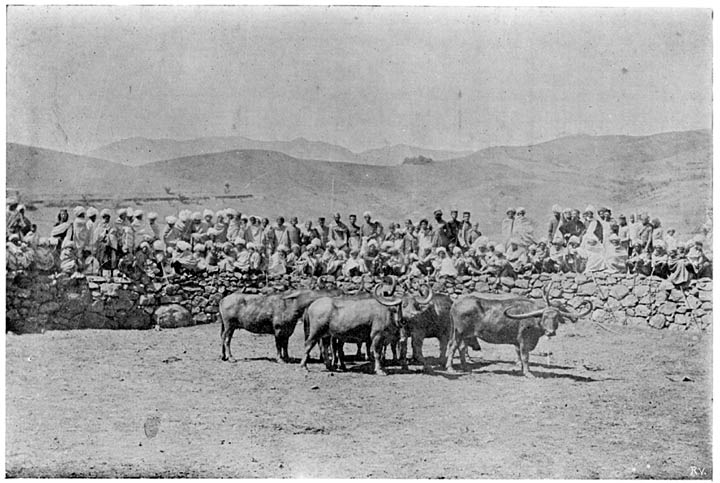
Toda buffaloes in kraal.
The Todas lead for the most part a simple pastoral life. But I have met with more than one man who had served, or who was still serving Government in the modest capacity of a forest guard, and I have heard of others who had been employed, not with conspicuous success, on planters’ estates. The Todas consider it beneath their dignity to cultivate land. A former Collector of the Nīlgiris granted them some acres of land for the cultivation of potatoes, but they leased the land to the Badagas, and the privilege was cancelled. In connection with the Todas’ objection to work, it is recorded that when, on one occasion, a mistake about the ownership of some buffaloes committed an old Toda to jail, it was found impossible to induce him to work with the convicts, and the authorities, unwilling to resort to hard remedies, were compelled to save appearances by making him an overseer. The daily life of a Toda woman has been summed up as lounging about the mad or mand (Toda settlement), buttering and curling her hair, and cooking. The women have been described as free from the ungracious and menial-like timidity of the generality of the sex in the plains. When Europeans (who are greeted as swāmi or god) come to a mand, the women crawl out of their huts, and chant a monotonous song, all the time clamouring for tips (inām). Even the children are so trained that they clamour for money till it is forthcoming. As a rule, the Todas have no objection to Europeans entering into their huts, but on more than one occasion I have been politely asked to take my boots off before crawling in on the stomach, so as not to desecrate the dwelling-place. Writing in 1868, Dr. J. Shortt makes a sweeping statement that “most of the women have been debauched by Europeans, who, it is sad to observe, have introduced diseases to which these innocent tribes were once strangers, and which are slowly but no less surely sapping their once hardy and vigorous constitutions. The effects of intemperance and disease (syphilis) combined are becoming more and more apparent in the shaken and decrepit appearance which at the present day these tribes possess.” Fact it undoubtedly is, and proved both by hospital and naked-eye evidence, that syphilis has been introduced among the Todas by contact with the outside world, and they attribute the stunted growth of some members of the rising generation, as compared with the splendid physique of the lusty veterans, to the results thereof. It is an oft-repeated statement that the women show an absence of any sense of decency in exposing their naked persons in the presence of strangers. In connection with the question of the morality of the Toda women, Dr. Rivers writes that “the low sexual morality of the Todas is not limited in its scope to the relations within the Toda community. Conflicting views are held by those who know the Nilgiri hills as to the relations of the Todas with the other inhabitants, and especially with the train of natives which the European immigration to the hills has brought in its wake. The general opinion on the hills is that, in this respect, the morality of the Todas is as low as it well could be, but it is a question whether this opinion is not too much based on the behaviour of the inhabitants of one or two villages [e.g., the one commonly known as School or Sylk’s mand] near the European settlements, and I think it is probable that the larger part of the Todas remain more uncontaminated than is generally supposed.”
I came across one Toda who, with several other members of the tribe, was selected on account of fine physique for exhibition at Barnum’s show in Europe, America and Australia some years ago, and still retained a smattering of English, talking fondly of ‘Shumbu’ (the elephant Jumbo). For some time after his return to his hill abode, a tall white hat was the admiration of his fellow tribesmen. To this man finger-prints came as no novelty, since his impressions were recorded both in England and America.
The typical Toda man is above medium height, well proportioned and stalwart, with leptorhine nose, regular features, and perfect teeth. The nose is, as noted by Dr. Rivers, sometimes distinctly rounded in profile. An attempt has been made to connect the Todas with the lost tribes; and, amid a crowd of them collected together at a funeral, there is no difficulty in picking out individuals, whose features would find for them a ready place as actors on the Ober Ammergau stage, either in leading or subordinate parts. The principal characteristic, which at once distinguishes the Toda from the other tribes of the Nīlgiris, is the development of the pilous (hairy) system. The following is a typical case, extracted from my notes. Beard luxuriant, hair of head parted in middle, and hanging in curls over forehead and back of neck. Hair thickly developed on chest and abdomen, with median strip of dense hairs on the latter. Hair thick over upper and lower ends of shoulder-blades, thinner over rest of back; well developed on extensor surface of upper arms, and both surfaces of forearms; very thick on extensor surfaces of the latter. Hair abundant on both surfaces of legs; thickest on outer side of thighs and round knee-cap. Dense beard-like mass of hair beneath gluteal region (buttocks). Superciliary brow ridges very prominent. Eyebrows united across middle line by thick tuft of hairs. A dense growth of long straight hairs directed outwards on helix of both ears, bearing a striking resemblance to the hairy development on the helix of the South Indian bonnet monkey (Macacus sinicus). The profuse hairy development is by some Todas attributed to their drinking “too much milk.”
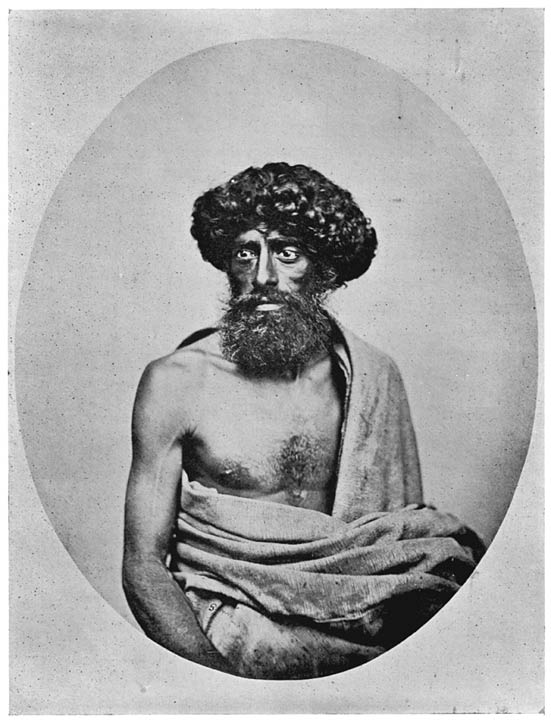
Toda.
Nearly all the men have one or more raised cicatrices, forming nodulous growths (keloids) on the right shoulder.These scars are produced by burning the skin with red-hot sticks of Litsæa Wightiana (the sacred fire-stick). The Todas believe that the branding enables them to milk the buffaloes with perfect ease, or as Dr. Rivers puts it, that it cures the pain caused by the fatigue of milking. “The marks,” he says, “are made when a boy is about twelve years old, at which age he begins to milk the buffaloes.” About the fifth month of a woman’s first pregnancy, on the new-moon day, she goes through a ceremony, in which she brands herself, or is branded by another woman, by means of a rag rolled up, dipped in oil and lighted, with a dot on the carpo-metacarpal joint of each thumb and on each wrist.
The women are lighter in colour than the men, and the colour of the body has been aptly described as of a café-au-lait tint. The skin of the female children and young adults is often of a warm copper hue. Some of the young women, with their raven-black hair dressed in glossy ringlets, and bright glistening eyes, are distinctly good-looking, but both good looks and complexion are short-lived, and the women speedily degenerate into uncomely hags. As in Maori land, so in Toda land, one finds a race of superb men coupled to hideous women, and, with the exception of the young girls, the fair sex is the male sex. Both men and women cover their bodies with a white mantle with blue and red lines, called putkūli, which is purchased in the Ootacamund bazar, and is sometimes decorated with embroidery worked by the Toda women. The odour of the person of the Todas, caused by the rancid butter which they apply to the mantle as a preservative reagent, or with which they anoint their bodies, is quite characteristic. With a view to testing his sense of smell, long after our return from Paikara, I blindfolded a friend who had accompanied me thither, and presented before his nose a cloth, which he at once recognised as having something to do with the Todas.
In former times, a Badaga could be at once picked out from the other tribes of the Nīlgiri plateau by his wearing a turban. At the present day, some Toda elders and important members of the community (e.g., monegars or headmen) have adopted this form of head-gear. The men who were engaged as guides by Dr. Rivers and myself donned the turban in honour of their appointment.
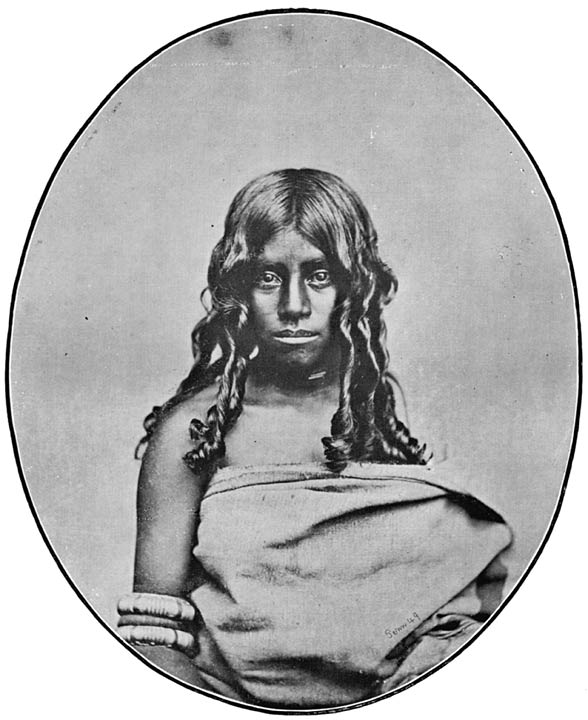
Toda woman.
1. Aged 22. Has one child. Tattooed with three dots on back of left hand. Wears silver necklet ornamented with Arcot two-anna pieces; thread and silver armlets ornamented with cowry (Cypræa moneta) shells on right upper arm; thread armlet ornamented with cowries on left forearm; brass ring on left ring finger; silver rings on right middle and ring fingers. Lobes of ears pierced. Ear-rings removed owing to grandmother’s death.
2. Aged 28. Tattooed with a single dot on chin; rings and dots on chest, outer side of upper arms, back of left hand, below calves, above ankles, and across dorsum of feet. Wears thread armlet ornamented with young cowries on right forearm; thread armlet and two heavy ornamental brass armlets on left upper arm; ornamental brass bangle and glass bead bracelet on left wrist; brass ring on left little finger; two steel rings on left ring finger; bead necklet ornamented with cowries.
3. Aged 35. Tattooed like the preceding, with the addition of an elaborate device of rings and dots on the back.
4. Aged 35. Linen bound round elbow joint, to prevent chafing of heavy brass armlets. Cicatrices of sores in front of elbow joint, produced by armlets.
5. Aged 23. Has one child. Tattooed only below calves, and above ankles.
The following are the more important physical measurements of the Toda men, whom I have examined:—
Av. Max. Min.
CM. CM. CM.
Stature 169.8 186.8 157.6
Cephalic length 19.4 20.4 18.2
Do. breadth 14.2 15.2 13.3
Do. index 73.3 81.3 68.7
Nasal height 4.7 4.9 4.6
Do. breadth 3.6 3.8 3.4
Do. index 74.9 79.9 70.
Allowing that the cephalic index is a good criterion of racial or tribal purity, the following analysis of the Toda indices is very striking:—
A thing of exceeding joy to the Todas was my Salter’s hand-dynamometer, the fame of which spread from mand to mand, and which was circulated among the crowd at funerals. Great was the disgust of the assembled males, on a certain day, when the record of hand-grip for the morning (73 lbs.) was carried off by a big-boned female, who became the unlovely heroine of the moment. The largest English feminine hand-grip, recorded in my laboratory note-book, is only 66 lbs. One Toda man, of fine physique, not satisfied with his grip of 98 lbs., went into training, and fed himself up for a few days. Thus prepared, he returned to accomplish 103 lbs., the result of more skilful manipulation of the machine rather than of a liberal dietary of butter-milk.
The routine Toda dietary is said to be made up of the following articles, to which must be added strong drinks purchased at the toddy shops:—
(a) Rice boiled in whey.
(b) Rice and jaggery (crude sugar) boiled in water.
(c) Broth or curry made of vegetables purchased in the bazar, wild vegetables and pot-herbs, which, together with ground orchids, the Todas may often be seen rooting up with a sharp-pointed digging-stick on the hill-sides. The Todas scornfully deny the use of aphrodisiacs, but both men and women admit that they take sālep misri boiled in milk, to make them strong. Sālep misri is made from the tubers (testicles de chiens) of various species of Eulophia and Habenaria belonging to the natural order Orchideæ.
The indigenous edible plants and pot-herbs include the following:—
(1) Cnicus Wallichii (thistle).—The roots and flower-stalks are stripped of their bark, and made into soup or curry.
(2) Girardinia heterophylla (Nīlgiri nettle).—The tender leafy shoots of vigorously growing plants are gathered, crushed by beating with a stick to destroy the stinging hairs, and made into soup or curry. The fibre of this plant, which is cultivated near the mands, is used for stitching the putkuli, with steel needles purchased in the bazar in lieu of the more primitive form. In the preparation of the fibre, the bark is thrown into a pot of boiling water, to which ashes have been added. After a few hours’ boiling, the bark is taken out and the fibre extracted.
(3) Tender shoots of bamboos eaten in the form of curry.
(4) Alternanthera sessilis. Pot-herbs.

Stellaria media.
Amarantus spinosus.
Amarantus polygonoides.
The following list of plants, of which the fruits are eaten by the Todas, has been brought together by Mr. K. Rangachari:—
Eugenia Arnottiana.—The dark purple juice of the fruit of this tree is used by Toda women for painting beauty spots on their faces.
Rubus ellipticus. Wild raspberry.

Rubus molucanus.
Rubus lasiocarpus.
Fragaria nilgerrensis, wild strawberry.
Elæagnus latifolia. Said by Dr. Mason to make excellent tarts and jellies.
Gaultheria fragrantissima.
Rhodomyrtus tomentosa, hill gooseberry.
Loranthus neelgherrensis. Parasitic on trees.

Loranthus loniceroides.
Elæocarpus oblongus.
Elæocarpus Munronii.
Berberis aristata. Barberry.
Berberis nepalensis.
Solanum nigrum.
Vaccinium Leschenaultii.
Vaccinium nilgherrense.
Toddalia aculeata.
Ceropegia pusilla.
To which may be added mushrooms.
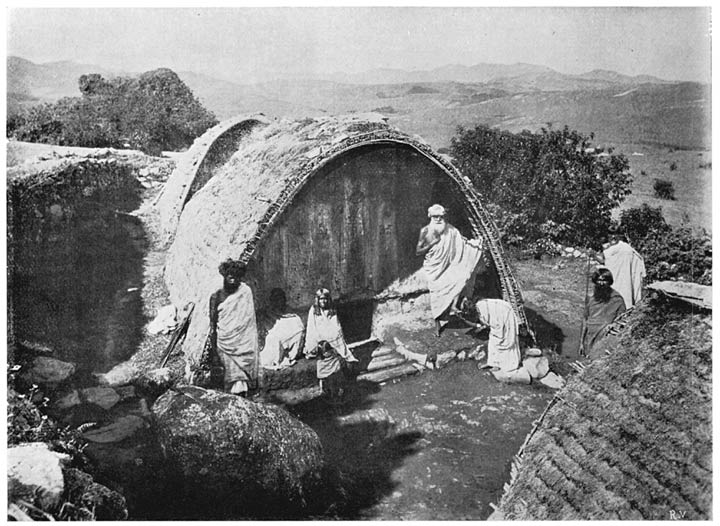
Toda hut.
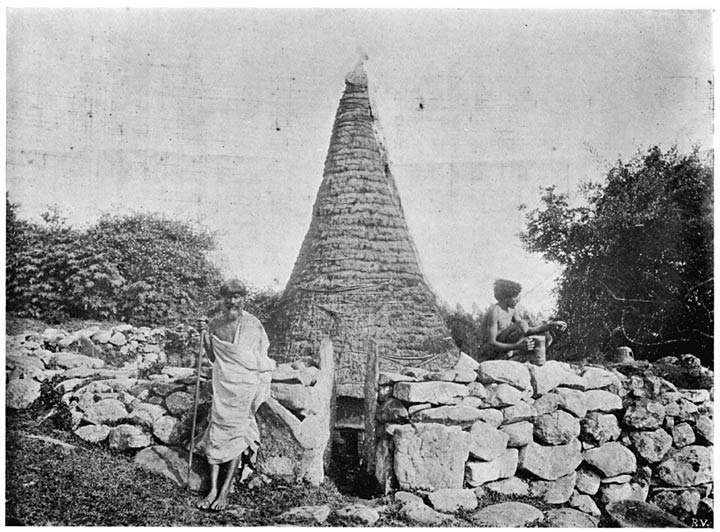
"Toda cathedral."
Two forms of Toda dairy have so far been noticed. But there remains a third kind, called the ti mand, concerning which Dr. Rivers writes as follows. “The ti is the name of an institution, which comprises a herd of buffaloes, with a number of dairies and grazing districts, tended by a dairy-man priest called palol, with an assistant called kaltmokh. Each dairy, with its accompanying buildings and pasturage, is called a ti mad, or ti village. The buffaloes belonging to a ti are of two kinds, distinguished as persiner and punir. The former are the sacred buffaloes, and the elaborate ceremonial of the ti dairy is concerned with their milk. The punir correspond in some respects to the putiir of the ordinary village dairy, and their milk and its products are largely for the personal use and profit of the palol, and are not treated with any special ceremony. During the whole time he holds office, the palol may not visit his home or any other ordinary village, though he may visit another ti village. Any business with the outside world is done either through the kaltmokh, or with people who come to visit him at the ti. If the palol has to cross a river, he may not pass by a bridge, but must use a ford, and it appears that he may only use certain fords. The palol must be celibate, and, if married, he must leave his wife, who is in most cases also the wife of his brother or brothers.” I visited the ti mand near Paikāra by appointment, and, on arrival near the mand, found the two palols, well-built men aged about thirty and fifty, clad in black cloths, and two kaltmokhs, youths aged about eight and ten, naked save for a loin-cloth, seated on the ground, awaiting our arrival. As a mark of respect to the palols, the three Todas who accompanied me arranged their putkūlis so that the right arm was laid bare, and one of them, who was wearing a turban, removed it. A long palaver ensued in consequence of the palols demanding ten rupees to cover the expenses of the purificatory ceremonies, which, they maintained, would be necessary if I desecrated the mand by photographing it. Eventually, however, under promise of a far smaller sum, the dwelling-hut was photographed, with palols, kaltmokhs, and a domestic cat seated in front of it.
In connection with the palol being forbidden to cross a river by a bridge, it may be noted that the river which flows past the Paikāra bungalow is regarded as sacred by the Todas, and, for fear of mishap from arousing the wrath of the river god, a pregnant Toda woman will not venture to cross it. The Todas will not use the river water for any purpose, and they do not touch it unless they have to ford it. They then walk through it, and, on reaching the opposite bank, bow their heads. Even when they walk over the Paikāra bridge, they take their hand out of the putkūli as a mark of respect. Concerning the origin of the Paikāra river, a grotesque legend was narrated to us. Many years ago, the story goes, two Todas, uncle and nephew, went out to gather honey. After walking for a few miles they separated, and proceeded in different directions. The uncle was unsuccessful in the search, but the more fortunate nephew secured two kandis (bamboo measures) of honey. This, with a view to keeping it all for himself, he secreted in a crevice among the rocks, with the exception of a very small quantity, which he made his uncle believe was the entire product of his search. On the following day, the nephew went alone to the spot where the honey was hidden, and found, to his disappointment, that the honey was leaking through the bottom of the bamboo measures, which were transformed into two snakes. Terrified at the sight thereof, he ran away, but the snakes pursued him (may be they were hamadryads, which have the reputation of pursuing human beings). After running a few minutes, he espied a hare (Lepus nigricollis) running across his course, and, by a skilful manœuvre, threw his body-cloth over it. Mistaking it for a man, the snakes followed in pursuit of the hare, which, being very fleet of foot, managed to reach the sun, which became obscured by the hoods of the reptiles. This fully accounts for the solar eclipse. The honey, which leaked out of the vessels, became converted into the Paikāra river.
In connection with the migrations of the herds of buffaloes, Dr. Rivers writes as follows. “At certain seasons of the year, it is customary that the buffaloes both of the village and the ti should migrate from one place to another. Sometimes the village buffaloes are accompanied by all the inhabitants of the village; sometimes the buffaloes are only accompanied by their dairy-man and one or more male assistants. There are two chief reasons for these movements of the buffaloes, of which the most urgent is the necessity for new grazing-places.... The other chief reason for the migrations is that certain villages and dairies, formerly important and still sacred, are visited for ceremonial purposes, or out of respect to ancient custom.” For the following note on a buffalo migration which he came across, I am indebted to Mr. H. C. Wilson. “During the annual migration of buffaloes to the Kundahs, and when they were approaching the bridle-path leading from Avalanchē to Sispāra, I witnessed an interesting custom. The Toda family had come to a halt on the far side of the path; the females seated themselves on the grass, and awaited the passing of the sacred herd. This herd, which had travelled by a recognised route across country, has to cross the bridle-path some two or three hundred yards above the Avalanchē-Sispāra sign-post. Both the ordinary and sacred herd were on the move together. The former passed up the Sispāra path, while the latter crossed in a line, and proceeded slightly down the hill, eventually crossing the stream and up through the shōlas over the steep hills on the opposite side of the valley. As soon as the sacred herd had crossed the bridle-path, the Toda men, having put down all their household utensils, went to where the women and girls were sitting, and carried them, one by one, over the place where the buffaloes had passed, depositing them on the path above. One of the men told me that the females are not allowed to walk over the track covered by the sacred herd, and have to be carried whenever it is necessary to cross it. This herd has a recognised tract when migrating, and is led by the old buffaloes, who appear to know the exact way.”
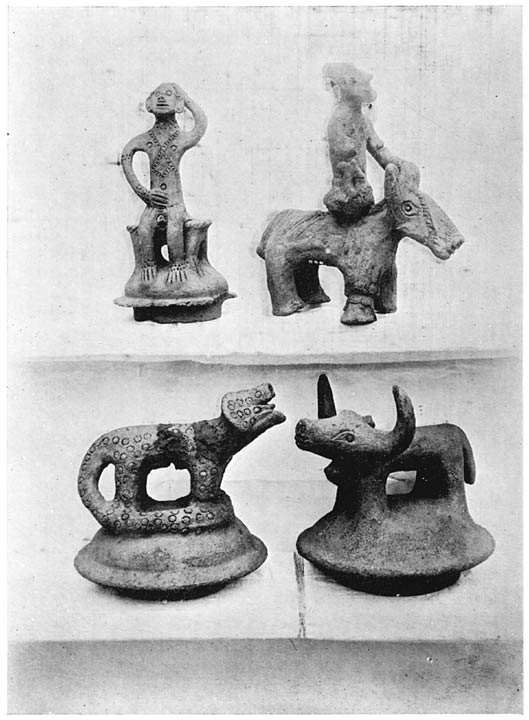
Figures from Nilgiri Cairns.
The tenure under which lands are held by the Todas is summed up as follows by Mr. R. S. Benson in his report on the revenue settlement of the Nilgiris, 1885. “The earliest settlers, and notably Mr. Sullivan, strongly advocated the claim of the Todas to the absolute proprietary right to the plateau [as lords of the soil]; but another school, led by Mr. Lushington, has strongly combated these views, and apparently regarded the Todas as merely occupiers under the ryotwari system in force generally in the Presidency. From the earliest times the Todas have received from the cultivating Badagas an offering or tribute, called gudu or basket of grain, partly in compensation for the land taken up by the latter for cultivation, and so rendered unfit for grazing purposes, but chiefly as an offering to secure the favour, or avert the displeasure of the Todas, who, like the Kurumbas (q.v.), are believed by the Badagas to have necromantic powers over their health and that of their herds. The European settlers also bought land in Ootacamund from them, and to this day the Government pays them the sum of Rs. 150 per mensem, as compensation for interference with the enjoyment of their pastoral rights in and about Ootacamund. Their position was, however, always a matter of dispute, until it was finally laid down in the despatch of the Court of Directors, dated 21st January, 1843. It was then decided that the Todas possessed nothing more than a prescriptive right to enjoy the privilege of pasturing their herds, on payment of a small tax, on the State lands. The Court desired that they should be secured from interference by settlers in the enjoyment of their mands, and of their spots appropriated to religious rites. Accordingly pattas were issued, granting to each mand three bullahs (11.46 acres) of land. In 1863 Mr. Grant obtained permission to make a fresh allotment of nine bullahs (34.38 acres) to each mand on the express condition that the land should be used for pasturage only, and that no right to sell the land or the wood on it should be thereby conveyed. It may be added that the so-called Toda lands are now regarded as the inalienable common property of the Toda community, and unauthorised alienation is checked by the imposition of a penal rate of assessment (G.O., 18th April 1882). Up to the date of this order, however, alienations by sale or lease were of frequent occurrence. It remains to be seen whether the present orders and subordinate staff will be more adequate than those that went before to check the practices referred to.” With the view of protecting the Toda lands, Government took up the management of these lands in 1893, and framed rules, under the Forest Act, for their management, the rights of the Todas over them being in no way affected by the rules of which the following is an abstract:—
1. No person shall fell, girdle, mark, lop, uproot, or burn, or strip off the bark or leaves from, or otherwise damage any tree growing on the said lands, or remove the timber, or collect the natural produce of such trees or lands, or quarry or collect stone, lime, gravel, earth or manure upon such lands, or break up such lands for cultivation, or erect buildings of any description, or cattle kraals; and no person or persons, other than the Todas named in the patta concerned, shall graze cattle, sheep, or goats upon such lands, unless he is authorised so to do by the Collector of Nilgiris, or some person empowered by him.
2. The Collector may select any of the said lands to be placed under special fire protection.
3. No person shall hunt, beat for game, or shoot in such lands without a license from the Collector.
4. No person shall at any time set nets, traps, or snares for game on such lands.
5. All Todas in the Nilgiri district shall, in respect of their own patta lands, be exempt from the operation of the above rules, and shall be at liberty to graze their own buffaloes, to remove fuel and grass for their domestic requirements, and to collect honey or wax upon such lands. They shall likewise be entitled to, and shall receive free permits for building or repairing their mands and temples.
6. The Collector shall have power to issue annual permits for the cultivation of grass land only in Toda pattas by Todas themselves, free of charge, or otherwise as Government may, from time to time, direct; but no Toda shall be at liberty to permit any person, except a Toda, to cultivate, or assist in the cultivation of such lands.
In 1905, the Todas petitioned Government against the prohibition by the local Forest authorities of the burning of grass on the downs, issued on the ground of danger to the shōlas (wooded ravines or groves). This yearly burning of the grass was claimed by the Todas to improve it, and they maintained that their cattle were deteriorating for want of good fodder. Government ruled that the grass on the plateau has been burnt by the inhabitants at pleasure for many years without any appreciable damage to forest growth, and the practice should not be disturbed.
Concerning the social organisation of the Todas, Mr. Breeks states that they are “divided into two classes, which cannot intermarry, viz., Dêvalyâl and Tarserzhâl. The first class consists of Peiki class, corresponding in some respects to Brāhmans; the second of the four remaining classes the Pekkan, Kuttan, Kenna, and Todi. A Peiki woman may not go to the village of the Tarserzhâl, although the women of the latter may visit Peikis.” The class names given by Mr. Breeks were readily recognised by the Todas whom I interviewed, but they gave Tērthāl (comprising superior Peikis) and Tārthāl as the names of the divisions. They told me that, when a Tērthāl woman visits her friends at a Tārthāl mand, she is not allowed to enter the mand, but must stop at a distance from it. Todas as a rule cook their rice in butter-milk, but, when a Tērthāl woman pays a visit to Tarthāl mand, rice is cooked for her in water. When a Tarthāl woman visits at a Tērthāl mand, she is permitted to enter into the mand, and food is cooked for her in buttermilk. The restrictions which are imposed on Tērthāl women are said to be due to the fact that on one occasion a Tērthāl woman, on a visit at a Tarthāl mand, folded up a cloth, and placed it under her putkūli as if it was a baby. When food was served, she asked for some for the child, and on receiving it, exhibited the cloth. The Tarthāls, not appreciating the mild joke, accordingly agreed to degrade all Tērthāl women. According to Dr. Rivers, “the fundamental feature of the social organisation is the division of the community into two perfectly distinct groups, the Tartharol and the Teivaliol [=Dêvalyâl of Breeks]. There is a certain amount of specialisation of function, certain grades of the priesthood being filled only by members of the Teivaliol. The Tartharol and Teivaliol are two endogamous divisions of the Toda people. Each of these primary divisions is sub-divided into a number of secondary divisions [clans]. These are exogamous. Each class possesses a group of villages, and takes its name from the chief of these villages, Etudmad. The Tartharol are divided into twelve clans, the Teivaliol into six clans or madol.”
When a girl has reached the age of puberty, she goes through an initiatory ceremony, in which a Toda man of strong physique takes part. One of these splendid specimens of human muscularity was introduced to me on the occasion of a phonograph recital at the Paikāra bungalow.
Concerning the system of polyandry as carried out by the Todas, Dr. Rivers writes as follows. “The Todas have long been noted as a polyandrous people, and the institution of polyandry is still in full working order among them. When the girl becomes the wife of a boy, it is usually understood that she becomes also the wife of his brothers. In nearly every case at the present time, and in recent generations, the husbands of a woman are own brothers. In a few cases, though not brothers, they are of the same clan. Very rarely do they belong to different clans. One of the most interesting features of Toda polyandry is the method by which it is arranged who shall be regarded as the father of a child. For all social and legal purposes, the father of a child is the man who performs a certain ceremony about the seventh month of pregnancy, in which an imitation bow and arrow are given to the woman. When the husbands are own brothers, the eldest brother usually gives the bow and arrow, and is the father of the child, though, so long as the brothers live together, the other brothers are also regarded as fathers. It is in the cases in which the husbands are not own brothers that the ceremony becomes of real social importance. In these cases, it is arranged that one of the husbands shall give the bow and arrow, and this man is the father, not only of the child born shortly afterwards, but also of all succeeding children, till another husband performs the essential ceremony. Fatherhood is determined so essentially by this ceremony that a man who has been dead for several years is regarded as the father of any children born by his widow, if no other man has given the bow and arrow. There is no doubt that, in former times, the polyandry of the Todas was associated with female infanticide, and it is probable that the latter custom still exists to some extent, though strenuously denied. There is reason to believe that women are now more plentiful than formerly, though they are still in a distinct minority. Any increase, however, in the number of women does not appear to have led to any great diminution of polyandrous marriages, but polyandry is often combined with polygyny. Two or more brothers may have two or more wives in common. In such marriages, however, it seems to be a growing custom that one brother should give the bow and arrow to one wife, and another brother to another wife.”
A few years ago (1902), the Todas, in a petition to Government, prayed for special legislation to legalise their marriages on the lines of the Malabar Marriage Act. The Government was of opinion that legislation was unnecessary, and that it was open to such of the Todas as were willing to sign the declaration prescribed by section 10 of the Marriage Act III of 1872 to contract legal marriages under the provision of that Act. The Treasury Deputy Collector of the Nīlgiris was appointed Registrar of Toda marriages. No marriage has been registered up to the present time.
Toda and phonograph.
(1) Among the Todas, males predominate greatly over females.
(2) This preponderance is doubtless due to the practice of female infanticide, which is probably still to some extent prevalent.
(3) The numerical preponderance of the males has been steadily sinking during recent years, owing probably to the check which foreign intercourse has imposed upon female infanticide.
In connection with the death ceremonies of the Todas, Dr. Rivers notes that “soon after death the body is burnt, and the general name for the ceremony on this occasion is etvainolkedr, the first day funeral. After an interval, which may vary greatly in length, a second ceremony is performed, connected with certain relics of the deceased which have been preserved from the first occasion. The Toda name for this second funeral ceremony is marvainolkedr, the second day funeral, or ‘again which day funeral.’ The funeral ceremonies are open to all, and visitors are often invited by the Todas. In consequence, the funeral rites are better known, and have been more frequently described than any other features of Toda ceremonial. Like nearly every institution of the Todas, however, they have become known to Europeans under their Badaga names. The first funeral is called by the Badagas hase kedu, the fresh or green funeral, and the term ‘green funeral’ has not only become the generally recognised name among the European inhabitants of the Nilgiri hills, but has been widely adopted in anthropological literature. The second funeral is called by the Badagas bara kedu, the ‘dry funeral,’ and this term also has been generally adopted.” The various forms of the funeral ceremonies are discussed in detail by Dr. Rivers, and it must suffice to describe those at which we have been present as eye-witnesses.
I had the opportunity of witnessing the second funeral of a woman who had died from smallpox two months previously. On arrival at a mand on the open downs about five miles from Ootacamund, we were conducted by a Toda guide to the margin of a dense shola, where we found two groups seated apart, consisting of (a) women, girls, and brown-haired female babies, round a camp fire; (b) men, boys, and male babies, carried, with marked signs of paternal affection, by their fathers. In a few minutes a murmuring sound commenced in the centre of the female group. Working themselves up to the necessary pitch, some of the women (near relatives of the deceased) commenced to cry freely, and the wailing and lachrymation gradually spread round the circle, until all, except little girls and babies who were too young to be affected, were weeping and mourning, some for fashion, others from genuine grief. In carrying out the orthodox form of mourning, the women first had a good cry to themselves, and then, as their emotions became more intense, went round the circle, selecting partners with whom to share companionship in grief. Gradually the group resolved itself into couplets of mourners, each pair with their heads in contact, and giving expression to their emotions in unison. Before separating to select a new partner, each couple saluted by bowing the head, and raising thereto the feet of the other, covered by the putkūli. [I have seen women rapidly recover from the outward manifestations of grief, and clamour for money.] From time to time the company of mourners was reinforced by late arrivals from distant mands, and, as each detachment, now of men and now of women, came in view across the open downs, one could not fail to be reminded of the gathering of the clans on some Highland moor. The resemblance was heightened by the distant sound as of pipers, produced by the Kota band (with two police constables in attendance), composed of four Kotas, who made a weird noise with drums and flutes as they drew near the scene of action. The band, on arrival, took up a position close to the mourning women. As each detachment arrived, the women, recognising their relatives, came forward and saluted them in the manner customary among Todas by falling at their feet, and placing first the right and then the left foot on their head. Shortly after the arrival of the band, signals were exchanged, by waving of putkūlis, between the assembled throng and a small detachment of men some distance off. A general move was made, and an impromptu procession formed, with men in front, band in the middle, and women bringing up the rear. A halt was made opposite a narrow gap leading into the shola; men and women sat apart as before; and the band walked round, discoursing unsweet music. A party of girls went off to bring fire from the spot just vacated for use in the coming ceremonial, but recourse was finally had to a box of matches lent by one of our party. At this stage we noticed a woman go up to the eldest son of the deceased, who was seated apart from the other men, and would not be comforted in spite of her efforts to console him. On receipt of a summons from within the shola, the assembled Toda men and ourselves swarmed into it by a narrow track leading to a small clear space round a big tree, from a hole cut at the base of which an elderly Toda produced a piece of the skull of the dead woman, wrapped round with long tresses of her hair. It now became the men’s turn to exhibit active signs of grief, and all of one accord commenced to weep and mourn. Amid the scene of lamentation, the hair was slowly unwrapt from off the skull, and burned in an iron ladle, from which a smell as of incense arose. A bamboo pot of ghī was produced, with which the skull was reverently anointed, and placed in a cloth spread on the ground. To this relic of the deceased the throng of men, amid a scene of wild excitement, made obeisance by kneeling down before it, and touching it with their foreheads. The females were not permitted to witness this stage of the proceedings, with the exception of one or two near relatives of the departed one, who supported themselves sobbing against the tree. The ceremonial concluded, the fragment of skull, wrapt in the cloth, was carried into the open, where, as men and boys had previously done, women and girls made obeisance to it. A procession was then again formed, and marched on until a place was reached, where were two stone-walled kraals, large and small. Around the former the men, and within the latter the women, took up their position, the men engaging in chit-chat, and the women in mourning, which after a time ceased, and they too engaged in conversation. A party of men, carrying the skull, still in the cloth, set out for a neighbouring shola, where a kēdu of several other dead Todas was being celebrated; and a long pause ensued, broken eventually by the arrival of the other funeral party, the men advancing in several lines, with arms linked, and crying out U, hah! U, hah, hah! in regular time. This party brought with it pieces of the skulls of a woman and two men, which were placed, wrapt in cloths, on the ground, saluted, and mourned over by the assembled multitude. At this stage a small party of Kotas arrived, and took up their position on a neighbouring hill, waiting, vulture-like, for the carcase of the buffalo which was shortly to be slain. Several young men now went off across the hill in search of buffaloes, and speedily re-appeared, driving five buffaloes before them with sticks. As soon as the beasts approached a swampy marsh at the foot of the hill on which the expectant crowd of men was gathered together, two young men of athletic build, throwing off their putkūlis, made a rush down the hill, and tried to seize one of the buffaloes by the horns, with the result that one of them was promptly thrown. The buffalo escaping, one of the remaining four was quickly caught by the horns, and, with arms interlocked, the men brought it down on its knees, amid a general scuffle. In spite of marked objection and strenuous resistance on the part of the animal—a barren cow—it was, by means of sticks freely applied, slowly dragged up the hill, preceded by the Kota band, and with a Toda youth pulling at its tail. Arrived at the open space between the kraals, the buffalo, by this time thoroughly exasperated, and with blood pouring from its nostrils, had a cloth put on its back, and was despatched by a blow on the poll with an axe deftly wielded by a young and muscular man. On this occasion no one was badly hurt by the sacrificial cow, though one man was seen washing his legs in the swamp after the preliminary struggle with the beast. But Colonel Ross-King narrates how he saw a man receive a dangerous wound in the neck from a thrust of the horn, which ripped open a wide gash from the collar-bone to the ear. With the death of the buffalo, the last scene, which terminated the strange rites, commenced; men, women, and children pressing forward and jostling one another in their eagerness to salute the dead beast by placing their hands between its horns, and weeping and mourning in pairs; the facial expression of grief being mimicked when tears refused to flow spontaneously.
The ceremonial connected with the final burning of the relics and burial of the ashes at the stone circle (azaram) are described in detail by Dr. Rivers.
A few days after the ceremony just described, I was invited to be present at the funeral of a young girl who had died of smallpox five days previously. I proceeded accordingly to the scene of the recent ceremony, and there, in company with a small gathering of Todas from the neighbouring mands, awaited the arrival of the funeral cortége, the approach of which was announced by the advancing strains of Kota music. Slowly the procession came over the brow of the hill; the corpse, covered by a cloth, on a rude ladder-like bier, borne on the shoulders of four men, followed by two Kota musicians; the mother carried hidden within a sack; relatives and men carrying bags of rice and jaggery, and bundles of wood of the kiaz tree (Eugenia Arnottiana) for the funeral pyre. Arrived opposite a small hut, which had been specially built for the ceremonial, the corpse was removed from the bier, laid on the ground, face upwards, outside the hut, and saluted by men, women, and children, with the same manifestations of grief as on the previous occasion. Soon the men moved away to a short distance, and engaged in quiet conversation, leaving the females to continue mourning round the corpse, interrupted from time to time by the arrival of detachments from distant mands, whose first duty was to salute the dead body. Meanwhile a near female relative of the dead child was busily engaged inside the hut, collecting together in a basket small measures of rice, jaggery, sago, honey-comb, and the girl’s simple toys, which were subsequently to be burned with the corpse. The mourning ceasing after a time, the corpse was placed inside the hut, and followed by the near relatives, who there continued to weep over it. A detachment of men and boys, who had set out in search of the buffaloes which were to be sacrificed, now returned driving before them three cows, which escaped from their pursuers to rejoin the main herd. A long pause ensued, and, after a very prolonged drive, three more cows were guided into a marshy swamp, where one of them was caught by the horns, and dragged reluctantly, but with little show of fight, to the strains of Kota drum and flute, in front of the hut, where it was promptly despatched by a blow on the poll. The corpse was now brought from within the hut, and placed, face upwards, with its feet resting on the forehead of the buffalo, whose neck was decorated with a silver chain, such as is worn by Todas round the loins, as no bell was available, and the horns were smeared with butter. Then followed frantic manifestations of grief, amid which the unhappy mother fainted. Mourning over, the corpse was made to go through a form of ceremony, resembling that which is performed during pregnancy with the first child. A small boy, three years old, was selected from among the relatives of the dead girl, and taken by his father in search of a certain grass (Andropogon Schœnanthus) and a twig of a shrub (Sophora glauca), which were brought to the spot where the corpse was lying. The mother of the dead child then withdrew one of its hands from the putkūli, and the boy placed the grass and twig in the hand, and limes, plantains, rice, jaggery, honey-comb, and butter in the pocket of the putkūli, which was then stitched with needle and thread in a circular pattern. The boy’s father then took off his son’s putkūli, and replaced it so as to cover him from head to foot. Thus covered, the boy remained outside the hut till the morning of the morrow, watched through the night by near relatives of himself and his dead bride. [On the occasion of the funeral of an unmarried lad, a girl is in like manner selected, covered with her putkūli from head to foot, and a metal vessel filled with jaggery, rice, etc., to be subsequently burnt on the funeral pyre, placed for a short time within the folds of the putkūli. Thus covered, the girl remains till next morning, watched through the dreary hours of the night by relatives. The same ceremony is performed over the corpse of a married woman who has not borne children, the husband acting as such for the last time, in the vain hope that the woman may produce issue in heaven.] The corpse was borne away to the burning-ground within the shola, and, after removal of some of the hair by the mother of the newly wedded boy, burned, with face upwards, amid the music of the Kota band, the groans of the assembled crowd squatting on the ground, and the genuine grief of the nearest relatives. The burning concluded, a portion of the skull was removed from the ashes, and handed over to the recently made mother-in-law of the dead girl, and wrapped up with the hair in the bark of the tūd tree (Meliosma pungens). A second buffalo, which, properly speaking, should have been slain before the corpse was burnt, was then sacrificed, and rice and jaggery were distributed among the crowd, which dispersed, leaving behind the youthful widower and his custodians, who, after daybreak, partook of a meal of rice, and returned to their mands; the boy’s mother taking with her the skull and hair to her mand, where it would remain until the celebration of the second funeral. No attention is paid to the ashes after cremation, and they are left to be scattered by the winds.