Volume 7 — T
Reading edition
Tābēlu (tortoise).—A sept of Aiyarakulu, and section of Gāzula Kāpu and Koppala Velama.
Taccha Kurup.—Barbers who shave Malabar Kammālans.
Tacchan.—The name of the carpenter sub-division of Kammālans, and further returned, at the census, 1891, as an occupational sub-division by some Paraiyans. Taccha Karaiyān has been recorded as a name for some members of the Karaiyān fishing caste. The Tacchasāstram, or science of carpentry, prescribes in minute details the rules of construction.
Tacchanādan Mūppan.—Recorded, in the Madras Census Reports, 1891 and 1901, as a sub-division of Kuricchans, and of Kurumbas of the Nīlgiris.
Tādan.—See Dāsari.
Tagara.—A section of Poroja.
Takru.—A class of Muhammadan pilots and sailors in the Laccadive islands. (See Māppilla.)
Talaivan (a chief).—A title of the Maravans. Jādi or Jāti Talaivan is the name of the hereditary chief of the Paravas of Tinnevelly, who, at times of pearl fisheries, receives a fixed share of the ‘oysters.’
Talamala.—A sub-division of Kānikar.
Talayāri.—The Talayāri (talai, head) or chief watchman, or Uddāri (saviour of the village), is a kind of undepartmental village policeman, who is generally known as the Talāri. Among other duties, he has to follow on the track of stolen cattle, to act as a guard over persons confined in the village choultry (lock-up), to attend upon the head of the village during the trial of petty cases, to serve processes, and distrain goods. In big villages there are two or three Talayāris, in which case one is a Paraiyan, who officiates in the Paraiya quarter. In parts of the Telugu country, the Mutrāchas, who are the village watchmen, are known as Talārivallu, or watchman people, and, in like manner, the Bēdars are called Talārivāndlu in the Kurnool and Bellary districts.
It is noted, in the Gazetteer of the Tanjore district (1906), that “from the earliest years of the British occupation of the country, fees were paid to the talaiyāri or village watchman. He was probably survival of a state of society in which kāvalgars did not exist, and his duties were, it seems, to look after the villagers’ fields and threshing floors. At any rate, he continued in existence even after the abolition of the kāval system (see Maravan), and was declared by the early Police Regulation (XI of 1816) to be part of the regular police establishment. Practically he did little real police duty, and in 1860, when the mufassal police was reorganised, all claims to the services of the talaiyāri as a servant of the State were formally abandoned, the Inspector-General of Police having reported that any attempt to utilise the talaiyāri body would be fruitless and unpopular. Talaiyāris still continue to be employed and paid by the ryots (cultivators) as the private guardians of their crops and harvested grain. Recently, however, the district was brought into line with the rest of the Presidency by the creation of a new force of talaiyāris, who now perform the police duties assigned to such persons elsewhere. They are provided with lathis (sticks) and badges, and are a useful auxiliary to the police.”
The marriage badge, as it occurs in Southern India, is, broadly speaking, of two types. The one in use among the Tamil castes is oblong in shape, with a single or double indentation at the base, and rounded at the top. The corresponding bottu or sathamanam of the Telugu and Canarese castes is a flat or cup-shaped disc. The tāli in use among various Malayālam castes at the tāli-kettu ceremony is a long cylinder.
Tambala.—The Tambalas are summed up, in the Madras Census Report, 1901, as “Telugu-speaking temple priests. Their social position differs in different localities. They are regarded as Brahmans in Godāvari, Kistna and Nellore, and as Sūdras in the other Telugu districts.” It is noted, in the Census Report, that the Tambalas are described by C. P. Brown as a class of beggars, who worship Siva, and who beat drums; secular priests, etc. These men are generally Sūdras, but wear the sacred thread. “It is said that, during his peregrinations in the north, Sankarāchārya appointed Tamil Brāhmans to perform temple services in all the Saiva shrines. Hence the Telugu people, in the midst of whom the Tamilians lived, called them the Tambalas (Tamils). They are not now, however, regarded as Brāhmans, whatever their original position may have been. They will eat only with Brāhmans. Most of them are Saivites, and a few are Lingayats. The Smarta Brāhmans officiate as their priests at birth, marriage, and death ceremonies. They do not eat animal food, and all their religious rites are more or less like those of Brāhmans. Their usual titles are Aiya and Appa.”
Tambān.—One of the divisions of Kshatriyas in Travancore. (See Tirumalpād.)
Tambi (younger brother).—A term of affection in the Tamil country, used especially when a younger person is being addressed. It is also recorded as an honorific title of Nāyars in Travancore, and a suffix to the names of Nāyar sons of Travancore sovereigns.
Tambirān.—The name for Pandāram managers of temples, e.g., at Tiruvādudurai in Tanjore and Mailam in South Arcot.
Tamburān.—For the following note on the Rājahs or Tamburāns, I am indebted to the Travancore Census Report, 1901. “They form an endogamous community of Kshatriyas, and live as seven families in Travancore. They are distinguished by the localities in which they reside, viz., Mavelikkara, Ennaikkāt, Kartikapalli, Mariappalli, Tiruvalla, Prāikkara, and Aranmula. They are all related by blood, the connection between some of them being very close. Like the Kōiltampurāns, all the members of their community observe birth and death pollution with reference to each other. Their original home is Kōlattunāt in North Malabar, and their immigration into Travancore, where the reigning family is of the Kōlattunāt stock, was contemporaneous, in the main, with the invasion of Malabar by Tippu Sultan. The first family that came into the country from Kōlattunāt was the Putuppalli Kōvilakam in the 5th century M.E. (Malabar era). The Travancore royal family then stood in need of adoption. The then Rājah arranged through a Koiltampurān of Tattārikkōvilakam to bring from Kōlattunāt two princesses for adoption, as his negotiations with the then Kōlattiri were fruitless. The Puttuppali Kōvilakam members thus settled themselves at Kartikapalli, the last of whom died in 1030 M.E. The next family that migrated was Cheriyakōvilakam, between 920 and 930 M.E. They also came for adoption. But their right was disputed by another house, Pallikkōvilakam. They then settled themselves at Aranmula. The third series of migrations were during the invasion of Malabar by Tippu in 964 M.E. All the Rājahs living there at the time came over to Travancore, of whom, however, many returned home after a time.
The Rājahs, like the Kōiltampurāns, belong to the Yajurvēda section of Dvijas, but follow the sūtra laid down by Baudhāyana. Their gōtra is that of Bhargava, i.e., Parasurāma, indicating in a manner that these are Kshatriyas who were accepted by Parasurāma, the uncompromising Brahmin of the Hindu Purānas. They have all the Brahminical Samskāras, only the Brahmin priest does most of them on their behalf. Chaulam, or tuft ceremony, is performed along with Upanāyanam. The Samāvartanam, or termination of the pupil stage, is celebrated on the fourth day of the thread investiture. Instruction in arms is then given to the Kshatriya boy, and is supposed to be kept up until the requisite skill has been obtained. The tāli-tying (mangalya dhāranam or pallikkettu of a Rāja lady) is done by a Kōiltampurān, who thereafter lives with her as her married husband. The Kanyakādānam, or giving away of the bride, is performed by the priest who attends also to the other Sāstraic rites. The males take Sūdra consorts. If the first husband leaves by death or otherwise, another Kōiltampurān may be accepted. This is not called marriage, but kūttirikkuka (living together).
At Srādhas (memorial services), the Kartā, or performer of the ceremony, throws a flower as a mark of spiritual homage at the feet of the Brahmins who are invited to represent the manes, and greets them in the conventional form (namaskāra). The priest does the other ceremonies. After the invited Brahmins have been duly entertained, oblations of cooked rice are offered to the ancestors by the Kartā himself.
They are to repeat the Gāyatri ten times at each Sandhya prayer, together with the Panchākshara and the Ashtākshara mantras.
Their caste government is in the hands of the Nambūtiri Vaidikas. Their family priests belong to the class of Malayāla Pōttis, known as Tiruveli Pōttis.
Besides the ordinary names prevalent among Kōiltampurāns, names such as Martānda Varma, Āditya Varma, and Udaya Varma are also met with. Pet names, such as Kungāru, Kungappan, Kungōman, Kungunni, Unni and Ampu are common. In the Travancore Royal House, the first female member always takes the name of Lakshmi and the second that of Parvati.
Tāmoli.—A few members of this North India caste of betel-leaf sellers have been returned at times of census. I am unable to discover in what district they occur. Tāmbuli or Tāmuli is recorded as a caste of betel-leaf sellers in Bengal, and Tāmboli as a caste carrying on a similar occupation in the Bombay Presidency.
Tānamanādu.—A sub-division of Valaiyan.
Tanda.—The word literally refers to a settlement or encampment of the Lambādis, by some of whom it is, at times of census, returned as a tribal synonym.
Tandan.—It is recorded, in the Madras Census Report, 1891, that “in Walluvanād and Pālghat (in Malabar) Tandan is a distinct caste. The ceremonies observed by Tandans are, in general outline, the same as those of the southern Tiyyans, but the two do not intermarry, each claiming superiority over the other. There is a custom which prohibits the Tandan females of Walluvanād from crossing a channel which separates that tāluk from Mankara on the Pālghat side.” The Tandans of Malabar are described by Mr. F. Fawcett as a people allied to the Izhuvans, who observe the custom of fraternal polyandry, which the Izhuvans abhor.
For the following note on the Tandans of Travancore, I am indebted to Mr. N. Subramani Aiyar.
The castemen are known as Urālis to the south of Varkallay, and Tandans to the north of it. In some places to the east of Kottarakaray, they were popularly termed Mutalpattukar, or those who receive the first perquisite for assistance rendered to carpenters. In the days when there were no saws, the rough instruments of the Tandan served their purpose. Hence some members of the caste were called Tacchan (carpenter). Tandan is derived from the Sanskrit dandanam or punishment, as, in ancient times, men of this caste were employed to carry out the punishments that were inflicted by the authorities upon offenders. For the execution of such punishments, the Tandans were provided with swords, choppers and knives. As they were also told off to guard the villages (ūr) of which they happened to be inhabitants, they acquired the title of Urāli. In some places, Tandans are also called Vēlans. Males and females have respectively the title Mūppan and Mūppatti, meaning an elder. In addressing members of higher castes, the Tandans call themselves Kuzhiyan, or dwellers in pits.
The Tandans are said to have once belonged to the same caste as the Izhuvans, but to have fallen away from that position. They must, in times gone by, have joined the military service of the various States in Malabar. They were, in some places, given rent-free lands, called Urāli parambu, in return for the duties they were expected to perform. With the return of peaceful times, their occupation changed, and the climbing of palm trees, to extract the juice thereof, became their most important calling. They are also largely engaged in the manufacture of ropes. Many families still receive the mutalpattu, or allowance from the carpenters.
The Tandans are divided into four endogamous sections, called Ilanji, Puvar, Irunelli, and Pilakkuti.
The ornaments of the women are, besides the minnu, wreaths of red and red and black beads. Nowadays the gold gnāttu of the Nāyars is also worn. Tattooing is popular. Even males have a crescent and a dot tattooed on the forehead, the corresponding mark in females being a line from the nasal pit upwards. Among the devices tattooed on the arms are the conch shell, lotus, snake, discus, etc. In their food and drink the Tandans resemble the Iluvans.
The priests of the Tandans are called Tanda Kuruppus, and they are also the caste barbers. The chief deity of the Tandans is Bhadrakāli, at whose shrines at Mandaikkad, Cranganore, and Sarkkaray, offerings are regularly made. At the last place, a Tandan is the priest. The chief days for the worship of this deity are Bharani asterism in March and Pattāmudayam in April. November is a particularly religious month, and the day on which the Kartikay star falls is exclusively devoted to worship. The first Sunday in January is another religious occasion, and on that day cooked food is offered to the rising sun. This is called Pogala. Maruta, or the spirit of smallpox, receives special worship. If a member of the caste dies of this disease, a small shed is erected in his memory either at his home or near the local Bhadrakāli shrine, and offerings of sweetmeats and toddy are made to him on the 28th of Makaram (January-February). Chitragupta, the accountant of Yama, the god of death, is worshipped on the full-moon day in April-May. Ancestor worship is performed on the new-moon day in July.
A girl’s tāli-tying ceremony, which is called kazhuttukettu, takes place when she is between seven and twelve years old. The bridegroom is a relative called Machchampi. The Kuruppu receives a money present of 2½ fanams for every tāli tied in his presence. Though more than one girl may go through the ceremony in the same pandal (booth), each should have a separate bridegroom. The relations between the bride and bridegroom are dissolved by the father of the former paying the latter sixteen rāsi fanams. The daughter of a man’s paternal aunt or maternal uncle may be claimed as murappen or lawful bride. The sambandham, or actual marriage, takes place after a girl has reached puberty. A family is regarded as out-caste, if she has not previously gone through the tāli-tying ceremony.
Only the eldest member of a family is cremated, the rest being buried. Death pollution lasts for ten days. The anniversary of a death is celebrated at the sea-shore, where cooked food, mixed with gingelly (Sesamum) is offered to the departed, and thrown into the sea.
Tandān.—The Tandān is the hereditary headman of a Tiyan tara (village), and is a Tiyan by caste. He is appointed by the senior Rāni of the Zamorin’s family, or by some local Rāja in territories outside the jurisdiction of the Zamorin. The Tandān is the principal person in the decision of caste disputes. He is expected to assist at the tāli-tying, puberty, marriage and pregnancy ceremonies of members of the caste. His formal permission is required before the carpenter can cut down the areca palm, with which the shed in which the tāli is tied is constructed. In cases of divorce, his functions are important. When a new house is built, a house-warming ceremony takes place, at which the Tandān officiates. Fowls are sacrificed, and the right leg is the Tandān’s perquisite. He is a man of importance, not only in many affairs within his own caste, but also in those of other castes. Thus, when a Nāyar dies, it is the Tandān’s duty to get the body burnt. He controls the washerman and barber of the tara, and can withdraw their services when they are most needed. He officiates, moreover, at marriages of the artisan classes.
Tangalān.—A sub-division of Paraiyan. The word indicates one who may not stand near, in reference to their belonging to the polluting classes.
Tangēdu.—Tangēdu or Tangēdla (Cassia auriculata) has been recorded as an exogamous sept of Kāpu and Padma Sālē. The bark of this shrub is one of the most valuable Indian tanning agents, and is, like myrabolams (Terminalia fruits), used in the manufacture of indigenous dyes.
Tantuvāyan (thread-wearer).—An occupational name used by various weaving castes.
Tapodhanlu.—The name, meaning those who believe in self-mortification as wealth, adopted by some Telugu mendicants.
Tārakan.—See Mūttan.
Tāssan.—A Malayālam synonym for the Telugu Dāsari.
Tattān.—The goldsmith section of the Tamil and Malayālam Kammālans.
Teivaliol.—The name, recorded by Dr. W. H. R. Rivers,5 of a division of the Todas.
In a note on the Telagas and Vantaris (strong men), it is suggested that they should be classed with the Kāpus, of which caste they are an offshoot for the following reasons:—”(1) Members of the three classes admit that this is so; (2) a collation of the intipērulu or septs shows that the same names recur among the three classes; (3) all three interdine, and intermarriage between them is not rare. A poor Telaga or Vantari often gives his daughter in marriage to a rich Kāpu. The Telagas and Vantaris are highly Brāhmanised, and will have a Brāhman for their guru, and get themselves branded at his hands. A Kāpu is generally content with a Sātāni or Jangam. Though they do not differ in their marriage and funeral rites from the Kāpus, they usually marry their girls before puberty, and widow remarriage and divorce are disallowed. A Kāpu is invariably a cultivator; a Vantari was in olden days a sepoy, and, as such, owned inām (rent-free) lands. Even now he has a prejudice against ploughing jirāyati (ordinarily assessed) lands, which a Kāpu has no objection to do. Similarly, a Telaga takes pride in taking service under a Zamindar, but, unlike the Vantari, he will plough any land. Kāpu women will fetch their own water, and carry meals to the fields for their fathers and husbands. The women of the other classes affect the gōsha system, and the men carry their own food, and fetch water for domestic purposes, or, if well-to-do, employ Kāpus for these services. It may be added that rich Kāpus often exhibit a tendency to pass as Telagas.”
Tēlikula.—The Tēlikulas are summed up, in the Madras Census Report, 1901, as “a Telugu oil-presser caste, which should not be confused with Tellakula, a synonym for Tsākala, or with Telli, a caste of Oriya oil-pressers.” Telikula is a synonym for the Gāniga or Gāndla caste of oil-pressers, derived from the oil (gingelly: Sesamum indicum), whereas the names Gāniga and Gāndla refer to the oil-mill. In the Northern Circars, the name Tēlikula is used in preference to Gāniga or Gāndla, and the oil-pressers in that part of the country are known as Tēlikula-vāndlu. The Tēlikulas are Onteddu, i.e., use a single bullock for working the oil-mill, whereas, among the Gānigas, there are both Onteddu and Rendeddu sections, which employ one and two bullocks respectively.
Telli.—The Tellis are the oil-pressers of the Oriya country, whose caste name is derived from telo, oil. They are apparently divided into three endogamous sections, named Holodia, Bolodia, and Khadi. The original occupation of the Holodias is said to have been the cultivation and sale of turmeric. They may not carry turmeric and other articles for sale on the back of bullocks, and consequently use carts as a medium of transport thereof. And it is further contrary to their caste rules even to assist in loading or unloading packs carried by bullocks. The Bolodias receive their name from the fact that they carry produce in the form of oil-seeds, etc., on pack bullocks, bolodo being Oriya for bullock. The Khadis are mainly engaged in expressing various oils in oil-mills, and this occupation is also carried on by some members of the other sections. All Tellis seem to belong to one gōtra, called Karthikēswara. The caste title is Sāhu. In social position the Tellis, unlike the Tamil Vāniyans (oil-pressers), are on a par with the agricultural castes, and are one of the panchapātako, or five castes from which individuals are selected to decide serious issues which arise among the Badhōyis. The headman of the Tellis is called Bēhara, and he is assisted by a Bhollobaya, and in some places apparently by another officer called Pento.
It is considered by the Tellis as a breach of caste rules to sail in a boat or ship. If a cow dies with a rope round its neck, or on the spot where it is tethered, the family which owned it is under pollution until purification has been effected by means of a pilgrimage, or by bathing in a sacred river. The Holodias will not rear male calves at their houses, and do not castrate their bulls. Male calves are disposed of by sale as speedily as possible. Those Holodias who are illiterate make the mark (nisāni) of a ball of turmeric paste as a substitute for their autograph on documents. In like manner, the nisānis of the Bolodias and Khadis respectively are the leather belt of a bullock and curved pole of the oil-mill. Among nisānis used by other Oriya castes, the following may be noted:—
Korono (writer caste), style.
Rāvulo (temple servants), trident.
Bāvuri (basket-makers and earth-diggers), sickle.
Dhōba (washermen) fork used for collecting firewood.
Brāhman, ring of dharba grass, such as is worn on ceremonial occasions.
In their marriage ceremonies, the Tellis observe the standard Oriya type, with a few variations. On the day before the wedding, two young married women carry two new pots painted white on their heads. To support the pots thereon, a single cloth, with the two ends rolled up to form a head-pad, must be used. The two women, accompanied by another married woman carrying a new winnowing basket, and mokkuto (forehead chaplet), proceed, to the accompaniment of the music of a chank shell and pipes, to a temple, whereat they worship. On their way home, the two girls, according to the custom of other Oriyas castes, go to seven houses, at each of which water is poured into their pots. During the marriage ceremony, after the ends of the cloths of the bride and bridegroom have been tied together, they exchange myrabolams (Terminalia fruits) and areca nuts. Until the close of the ceremonies, they may not plunge into a tank (pond) or river, and, in bathing, may not wet the head.
Most of the Tellis are Paramarthos, and follow the Chaitanya form of Vaishnavism, but some are Smartas, and all worship Tākurānis (village deities).
Telugu.—Telugu or Telaga is used as a linguistic term indicating a person who speaks that language. It has, at recent times of census, been returned as a sub-division of various classes, e.g., Agasa, Balija, Banajiga, Bēdar, Bestha, Dēvānga, Holeya, Kumbāra, Rāchewar, Tsākala, and Uppara. Further, Telugu Vellāla appears as a synonym of Velama, and Telugu Chetti as a synonym of Saluppan.
Tēn (honey).—Tēn or Jēn has been recorded as a sub-division or exogamous sept of jungle Kurumbas and Holeyas. Some Irulas style themselves Tēn Padaiyāchi or Tēn Vanniyan, Padaiyāchi and Vanniyan being a title and synonym of the Pallis.
Tendisai (southern country).—Recorded as a division of Vellālas in the Madura and Coimbatore districts.
Tenē (millet: Setaria italica).—An exogamous sept of Holeya.
Tengina (cocoanut palm).—The name of a section of Halēpaiks, who tap the cocoanut for extracting toddy.
Tennam.—Tennam (cocoanut) or Tennanjānār (cocoanut tappers) is recorded as the occupational name of Shānān. Tenkāyala (cocoanut) occurs as an exogamous sept of Yānādi, and the equivalent Tennang as a tree or kothu of Kondaiyamkōtti Maravans.
Tennilainādu.—A territorial sub-division of Kallan.
Terkattiyar (southerner).—A term applied to Kallan, Maravan, Agamudaiyan, and other immigrants into the Tanjore district. At Mayāvaram, for example, it is applied to Kallans, Agamudaiyans, and Valaiyans.
Tertal.—A division of Toda.
Teruvān.—A synonym of the Malabar Chāliyans, who are so called because, unlike most of the west coast castes, they live in streets (teru).
Tēvadiyāl (servant of god).—The Tamil name for Dēva-dāsis. Tēvan (god) occurs as a title of Maravans.
Thādla.—Thādla or Thālla, meaning rope, is an exogamous sept of Dēvānga and Karna Sālē.
Thākur.—About a hundred members of this caste are returned, in the Madras Census Report, 1901, as belonging to a Bombay caste of genealogists and cultivators. It is recorded, in the Bombay Gazetteer, that “inferior in rank to Marāthas, the Thākurs are idle and of unclean habits. Though some of them till and twist woollen threads for blankets, they live chiefly by begging and ballad singing. At times they perform plays representing events mentioned in the Purāns and Rāmayan, and showing wooden puppets moved by strings.”
Thalakōkala (female cloths).—An exogamous sept of Dēvānga.
Thālam (palmyra palm).—An exogamous sept or illam of Kānikar.
Thāmballa (sword bean: Canavalia ensiformis).—An exogamous sept of Tsākalas, members of which will not eat the bean.
Thambūri.—A class of people in Mysore, who are Muhammadans, dress like Lambādis, but do not intermarry with them. (See Lambādi.)
The following legend is current regarding the origin of the Thanda Pulayans. In the south, the Pulayans are divided into the eastern and western sections. The former were the slaves of Duryodhana, and the latter were attached to the Pāndus. These formed the two rival parties in the war of the Mahābaratha, and the defeat of Duryodhana was the cause of their degradation.
The Thanda Pulayans appear to have been the slaves of the soil till 1854, when they were emancipated. Even now, their condition has not undergone much material improvement. Though they are left more to themselves, they still work for farmers or landlords for a daily wage of paddy (unhusked rice). If they run away, they are brought back, and punished. There is a custom that, when a farmer or landlord wants a few Pulayans to work in the fields, he obtains their services on payment of fifteen to twenty rupees to them, or to their master. When a Pulayan’s services are thus obtained, he works for his new master for two edangalis of paddy a day. They can obtain their liberation on the return of the purchase-money, which they can never hope to earn. Having no property which they can claim as their own, and conscious perhaps that their lot will be the same wherever they go, they remain cheerful and contented, drudging on from day to day, and have no inclination to emigrate to places where they can get higher wages. The Cherumars of Palghāt, on the contrary, enjoy more freedom. Many go to the Wynād, and some to the Kolar gold-fields, where they receive a good money-wage. The Thanda Pulayans work, as has been said, for some landlord, who allows them small bits of land. The trees thereon belong to the master, but they are allowed to enjoy their produce during their residence there. When not required by the master, they can work where they like. They have to work for him for six months, and sometimes throughout the year. They have little to do after the crop has been garnered. They work in the rice-fields, pumping water, erecting bunds (mud embankments), weeding, transplanting, and reaping. Men, women, and children may be seen working together. After a day’s hard work, in the sun or rain, they receive their wages, which they take to the nearest shop, called mattupitica (exchange shop), where they receive salt, chillies, etc., in exchange for a portion of the paddy, of which the remainder is cooked. The master’s field must be guarded at night against the encroachment of cattle, and the depredations of thieves and wild beasts. They keep awake by shouting aloud, singing in a dull monotone, or beating a drum. Given a drink of toddy, the Pulayans will work for any length of time. It is not uncommon to see them thrashed for slight offences. If a man is thrashed with a thanda garment, he is so much disgraced in the eyes of his fellow men, that he is not admitted into their society. Some improve their condition by becoming converts to Christianity. Others believe that the spirits of the departed would be displeased, if they became Christians.
The Thanda Pulayan community is divided into exogamous illams, and marriage between members of the same illam is forbidden. Their habitations are called matams, which are miserable huts, supported on wooden posts, sometimes in the middle of a paddy field, with walls of reeds, bamboo mats or mud, and thatched with grass or cocoanut leaves. A few earthen pots, bamboo vessels, and cocoanut shells constitute their property. They are denied admission to the markets, and must stand at a distance to make their purchases or sales.
Pulayan girls are married either before or after attaining puberty, but there is special ceremony, which is performed for every girl during her seventh or eighth year. This is called thanda kalyānam, or thanda marriage. It consists in having the girl dressed at an auspicious hour in the leafy garment by a woman, generally a relative, or, in her absence, by one selected for the purpose. The relations and friends are entertained at a feast of curry and rice, fish from the backwater, and toddy. Prior to this ceremony, the girl is destitute of clothing, except for a strip of areca bark.
At the marriage ceremony, the tāli (marriage badge) is made of a piece of a conch shell (Turbinella rapa), which is tied on the bride’s neck at an auspicious hour. She is taken before her landlord, who gives her some paddy, and all the cocoanuts on the tree, beneath which she happens to kneel. When the time has come for her to be taken to the hut of the bridegroom, one of her uncles, taking her by the hand, gives her into the charge of one of her husband’s uncles. On the third morning, her paternal and maternal uncles visit her at the hut of the bridegroom, by whom they are entertained. They then return, with the bride and bridegroom, to the home of the former, where the newly-married couple stay for three days. To ascertain whether a marriage will be a happy one, a conch shell is spun round. If it falls to the north, it predicts good fortune; if to the east or west, the omens are favourable; if to the south, very unfavourable.
The Thanda Pulayans follow the makkathāyam law of inheritance (from father to son). They have their tribal assemblies, the members of which meet together on important occasions, as when a woman is charged with adultery, or when there is a theft case among them. All the members are more or less of equal status, and no superior is recognised. They swear by the sun, raising their hands, and saying “By the sun I did not.” Other oaths are “May my eyes perish” or “May my head be cut off by lightning.”
Every kind of sickness is attributed to the influence of some demon, with whom a magician can communicate, and discover a means of liberation. The magician, when called in professionally, lights a fire, and seats himself beside it. He then sings, mutters some mantrams (prayers), and makes a discordant noise on his iron plate (kokkara). The man or woman, who is possessed by the demon, begins to make unconscious movements, and is made to speak the truth. The demon, receiving offerings of fowls, sheep, etc., sets him or her free. A form of ceremonial, called urasikotukkuka, is sometimes performed. At a place far distant from the hut, a leaf, on which the blood of a fowl has been made to fall, is spread on the ground. On a smaller leaf, chunam (lime) and turmeric are placed. The person who first sets eyes on these becomes possessed by the demon, and sets free the individual who was previously under its influence. In the event of sickness, the sorcerer is invited to the hut. He arrives in the evening, and is entertained with food, toddy, and betel. He then takes a tender cocoanut, flower of the areca palm, and some powdered rice, which he covers over with a palm leaf. The sick person is placed in front thereof, and a circle is drawn round him. Outside the circle, an iron stylus is stuck in the ground. The demon is supposed to be confined within the circle, and makes the patient cry out “I am in pai (influence of the ghost) and he is beating me,” etc. With the promise of a fowl or sheep, or offerings thereof on the spot, the demon is persuaded to take its departure. Sometimes, when the sorcerer visits a house of sickness, a rice-pan containing three betel leaves, areca nuts, paddy, tulsi (Ocimum sanctum), sacred ashes, conch and cowry (Cypræa moneta) shells, is placed in the yard. The sorcerer sits in front of the pan, and begins to worship the demon, holding the shells in his hands, and turning to the four points of the compass. He then observes the omens, and, taking his iron plate, strikes it, while he chants the names of terrible demons, Mullva, Karinkāli, Aiyinar, and Villi, and utters incantations. This is varied by dancing, to the music of the iron plate, sometimes from evening till noon on the following day. The sick person works himself up into the belief that he has committed some great sin, and proceeds to make confession, when a small money fine is inflicted, which is spent on toddy for those who are assembled. The Thanda Pulayans practice maranakriyas, or sacrifices to certain demons, to help them in bringing about the death of an enemy or other person. Sometimes affliction is supposed to be brought about by the enmity of those who have got incantations written on a palm leaf, and buried in the ground near a house by the side of a well. A sorcerer is called in to counteract the evil charm, which he digs up, and destroys.
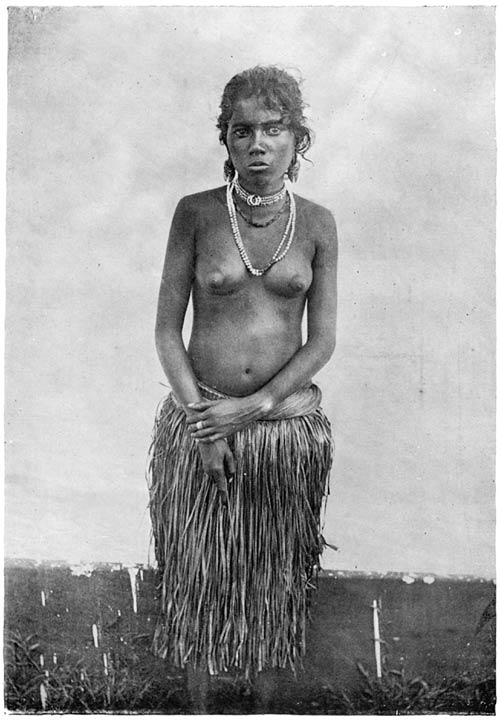
Thanda Palayan.
When a member of the tribe has died an unnatural death, a man, with a fowl and sword in his hands, places another man in a pit which has been dug, and walks thrice round it with a torch. After an hour or two, the man is taken out of the pit, and goes to a distance, where certain ceremonies are performed.
The Thanda Pulayans worship the gods of Brāhmanical temples at a distance of nearly a quarter of a mile. A stone is set up in the ground, on which they place tender cocoanuts and a few puttans (Cochin coins). A temple servant takes these to the priest, who sends in return some sandal paste, holy water, and flowers. They worship, as has been already hinted, demons, and also the spirits of their ancestors, by which small brass figures of males and females representing the pretas (ghosts) are supposed to be possessed. They worship, among others, Kandakarnan, Kodunkāli, Bhairavan, and Arukola pretas, who are lodged in small huts, and represented by stones. In the month of May, they celebrate a festival, which lasts for several days. Chrysanthemum and thumba (apparently Leucas aspera) flowers are used in the performance of worship, and paddy, beaten rice, tender cocoanuts, toddy, etc., are offered up. There is a good deal of singing, drum-beating and devil-dancing by men and women, who on this occasion indulge liberally in toddy. The Pāndavas, whom they call Anju Thamburakkal, are favourite deities. They devise various plans for warding off the evil influence of demons. Some, for example, wear rolls of palm leaf, with incantations written on them, round their necks. Others hang baskets in the rice fields, containing peace offerings to the gods, and pray for the protection of the crop. Wherever there is a dense forest, Mātan and Kāli are supposed to dwell, and are worshipped. From the end of November to April, which is the slack season, the Thanda Pulayans go about dancing from hut to hut, and collecting money to purchase fowls, etc., for offerings. Club-dancing is their favourite amusement, and is often indulged in at night by the light of a blazing fire. The dancers, club in hand, go round in concentric circles, keeping time to the songs which they sing, striking each other’s clubs, now bending to ward off a blow on the legs, or rising to protect the head.
The Thanda Pulayans will not eat with the Ullādans or Parayans, but stand at a distance of ninety feet from Brāhmans and other high-caste people. They are short of stature and dark-skinned. Like the Cherumans, the women adorn their ears, necks, arms and fingers with masses of cheap jewellery.
Thappata (drum).—An exogamous sept of Oddē.
Thāthan (a Vaishnavite mendicant).—The equivalent of the Telugu Dāsari.
Thātichettu (palmyra palm).—An exogamous sept of Karna Sālē and Oddē.
Thāvadadāri.—The name of a section of the Valluvans (priests of the Paraiyans), who wear a necklace of tulsi beads (thāvadam, necklace, dhāri, wearer). The tulsi or basil (Ocimum sanctum) is a very sacred plant with Hindus, and bead necklaces or rosaries are made from its woody stem.
Thēlu (scorpion).—Thēlu and Thēla are recorded as exogamous septs of Padma Sālē and Mādiga. The Canarese equivalent Chēlu occurs as a sept of Kuruba.
Thenige Būvva.—A sub-division of Mādigas, who offer food (buvva) to the god in a dish or tray (thenige) at marriages.
Thikka (simpleton).—A sub-division of Kuruba.
Thippa (rubbish heap).—An exogamous sept of Karna Sālē.
Thogaru (bitter).—An exogamous sept of Mūsu Kamma.
Thōka (tail).—An exogamous sept of Yerukala.
Thonda (Cephalendra indica).—An exogamous sept of Mūsu Kamma, and gōtra of Janappans, members of which abstain from using the fruit or leaves of the thonda plant.
Thumma (bābūl: Acacia arabica).—An exogamous sept of Māla and Padma Sālē. The bark, pods, and leaves of the bābūl tree are used by tanners in the preparation of hides and skins, or as a dye.
Thūmu (iron measure for measuring grain).—An exogamous sept of Mutrācha.
Thupa (ghī, clarified butter).—An exogamous sept of Kuruba.
Thūrpu (eastern).—A sub-division of Yerukala and Yānādi.
Thūta (hole).—An exogamous sept of Dēvānga.
Tigala.—Tigala is summed up, in the Madras Census Report, 1901, as “a Canarese synonym for the Tamil Palli; applied also by the Canarese people to any Tamil Sūdras of the lower castes.” In parts of the Mysore country, the Tamil language is called Tigalu, and the Canarese Mādhva Brāhmans speak of Tamil Smarta Brāhmans as Tigalaru.
Some of the Tigalas, who have settled in Mysore, have forgotten their mother-tongue, and speak only Canarese, while others, e.g., those who live round about Bangalore, still speak Tamil. In their type of cranium they occupy a position intermediate between the dolichocephalic Pallis and the sub-brachy cephalic Canarese classes.
The difference in the type of cranium of the Tigalas and Tamil Pallis is clearly brought by the following tabular statements of their cephalic indices:—
a. Tigala—
68 ◆
69
70
71 ◆
72 ◆◆◆◆◆
73 ◆◆◆◆
74 ◆
75 ◆
76 ◆◆◆◆◆
77 ◆◆◆◆
78 ◆◆◆◆◆
79 ◆◆◆
80 ◆◆◆
81 ◆◆◆◆
82 ◆
83
84 ◆◆
b. Palli—
64 ◆
65
66
67 ◆◆
68 ◆
69 ◆
70 ◆
71 ◆◆◆◆
72 ◆◆◆◆◆
73 ◆◆◆◆◆◆◆
74 ◆◆◆◆
75 ◆◆◆◆◆◆◆◆
76 ◆
77 ◆
78 ◆
79 ◆◆
80 ◆
The Tigalas are kitchen and market gardeners, and cultivate the betel vine. They apparently have three divisions, called Ulli (garlic or onions), Elē (leaf), and Arava (Tamil). Among the Ulli Tigalas, several sub-divisions, and septs or budas named after deities or prominent members of the caste, exist, e.g.:—
I. Lakkamma— Tōta dēvaru (garden god). Dodda dēvaru (big or chief god). Dodda Narasayya. Dodda Nanjappa.
II. Ellammā— Narasayya. Muddanna.
III. Sidde dēvaru.
The Tigalas have a headman, whose office is hereditary, and who is assisted by a caste servant called Mudrē. Council meetings are usually held at a fixed spot, called gōni mara kattē or mudrē gōni mara kattē, because those summoned by the Mudrē assemble beneath a gōni (Ficus mysorensis) tree, round which a stone platform is erected. The tree and platform being sacred, no one may go there on wearing shoes or sandals. The members of council sit on a woollen blanket spread before the tree.
Tigala occurs further as the name of a sub-division of Holeya.
Tikkē (gem).—A gōtra of Kurni.
Ti (fire) Kollan.—A sub-division of Kollan.
Tinda (polluting).—A sub-division of Kanisan. Tinda Kuruppu, meaning a teacher who cannot approach, is a synonym of the Kāvutiyan barber caste.
Tiperum (tī, fire).—A sub-division of Kollan blacksmiths.
Tiragati Gantlavallu (wandering bell hunters).—Stated, in the Manual of the Vizagapatam district, to repair hand-mills, catch antelopes, and sell the skins thereof. In hunting, they use lights and bells.
Tirlasetti (the name of a Balija Chetti).—An exogamous sept of Yānādi.
For the following note on Tampāns and Tirumalpāds, I am indebted to the Travancore Census Report, 1901. “The Tampāns and Tirumalpāts come under the category of Malabar Kshatriyas.The word Tampān is a contraction of Tampurān, and at one time denoted a ruling people. When they were divested of that authority by the Ilayetattu Svarūpam, they are said to have fallen from the status of Tampurāns to Tampāns. Their chief seat is the Vaikam tāluk. The Tirumalpāts do not seem to have ruled at all. The word Tirumulpātu indicates those that wait before kings. There is an old Sanskrit verse, which describes eight classes of Kshatriyas as occupying Kērala from very early times, namely (1) Bhūpāla or Mahā Rāja, such as those of Travancore and Cochin, (2) Rājaka or Rājas, such as those of Mavelikara and Kotungallūr, (3) Kōsi or Kōiltampurān, (4) Puravān or Tampān, (5) Srīpurōgama or Tirumulpāt, (6) Bhandāri or Pantārattil, (7) Audvāhika or Tirumalpāt, (8) Chēta or Sāmanta. From this list it may be seen that two classes of Tirumulpāts are mentioned, namely, Srīpurōgamas who are the waiters at the Rāja’s palace, and the Audvāhikas who perform Udvāha or wedding ceremony for certain castes. Both these, however, are identical people, though varying in their traditional occupations. The chief seats of the Tirumulpāts are Shertallay and Tiruvalla.”
The Tampāns and Tirumulpāts are, for all purposes of castes, identical with other Malabar Kshatriyas. Every Tampān in Travancore is related to every other Tampān, and all are included within one circle of death and birth pollution. Their manners and customs, too, are exactly like those of other Kshatriyas. They are invested with the sacred thread at the sixteenth year of age, and recite the Gāyatri (hymn) ten times thrice a day. The Nambūtiri is the family priest, and (death) pollution lasts for eleven days. The Kettukālyanam, or tāli-tying ceremony, may be performed between the seventh and the fourteenth year of age. The tāli is tied by the Āryappattar, while the Nampūtiris recite the Vēdic hymns. Their consorts are usually Nampūtiris, and sometimes East Coast Brāhmans. Like all the Malabar Kshatriyas, they follow the marumakkathāyam system of inheritance (through the female line). Tampāns and Tirumulpāts are often the personal attendants of the Travancore Maharājas, whom they serve with characteristic fidelity and devotion.The Tirumulpāts further perform the tāli-tying ceremony of the Nāyar aristocracy.
The names of the Tirumulpāts and Tampāns are the same as those of other classes of Kshatriyas. The title Varma is uniformly added to their names. A few families among these, who once had ruling authority, have the titular suffix Bhandārattil, which is corrupted into Pantārattil. The Tampāns call themselves in documents Kōviladhikārikal, as they once had authority in kōvils or palaces.
Tirumān (holy deer).—An exogamous section of Kallan.
Tirumudi (holy knot).—Recorded, in the Madras Census Report, 1901, as “bricklayers, whose women are usually prostitutes; found chiefly in Salem and Coimbatore. They are either Vēttuvans or Kaikōlans. Kaikōlan women, when they are dedicated to the temple, are supposed to be united in wedlock with the deity.
Tiruvalluvan.—A sub-division of Valluvan. Tiruvalluvar, the author of the Kurāl, is said to have belonged to the Valluva caste.
Tiru-vilakku-nagarattar (dwellers in the city of holy lamps).—A name assumed by Vāniyans (oil-pressers).
Tiyadi.—A synonym of the Tiyāttunni section of Ambalavāsis (see Unni).
Tiyan.—The Tiyans, and Izhuvans or Iluvans, are the Malayālam toddy-drawing castes of Malabar, Cochin, and Travancore. The following note, except where otherwise indicated, is taken from an account of the Tiyans of Malabar by Mr. F. Fawcett.
The Tiyans are always styled Izhuvan in documents concerning land, in which the Zamorin, or some Brāhman or Nāyar grandee, appears as landlord. The Tiyans look down on the Izhuvans, and repudiate the relationship. Yet they cannot but submit to be called Izhuvan in their documents, for their Nāyar or Brāhman landlord will not let them have the land to cultivate, unless they do so. It is a custom of the country for a man of a superior caste to pretend complete ignorance of the caste of an individual lower in the social scale. Thus, in the Wynād, where there are several jungle tribes, one is accustomed to hear a man of superior caste pretending that he does not know a Paniyan from a Kurumba, and deliberately miscalling one or the other, saying “This Paniyan,” when he knows perfectly well that he is a Kurumba. It is quite possible, therefore, that, though Tiyans are written down as Izhuvans, the two were not supposed to be identical. State regulations keep the Izhuvans of Cochin and Travancore in a position of marked social inferiority, and in Malabar they are altogether unlettered and uncultured. On the other hand, the Tiyans of Malabar provide Magistrates, Sub-Judges, and other officials to serve His Majesty’s Government. It may be noted that, in 1907, a Tiya lady matriculate was entertained as a clerk in the Tellicherry post-office.
A divagation must be made, to bring the reader to a comprehension of the custom surrounding māttu, a word signifying change, i.e., change of cloth, which is of sufficient importance to demand explanation. When a man or woman is outcasted, the washerwoman (or man) and the barber of the community (and no other is available) are prohibited from performing their important parts in the ceremonies connected with birth, death, and menstruation. A person who is in a condition of impurity is under the same conditions; he or she is temporarily outcasted. This applies to Nambūtiris and Nāyars, as well as to the Tiyans. Now the washerwoman is invariably of the Tiyan caste. There are Mannāns, whose hereditary occupation is washing clothes for Nambūtiris and Nāyars, but, for the most part, the washerwoman who washes for the Nāyar lady is of the Tiyan caste. A woman is under pollution after giving birth to a child, after the death of a member of her tarvad, and during menstruation. And the pollution must be removed at the end of the prescribed period, or she remains an outcaste—a very serious thing for her. The impurity is removed by receiving a clean cloth from the washerwoman, and giving in exchange her own cloth to be washed. This is māttu, and, be it noted, the cloth which gives māttu is one belonging to the washerwoman, not to the person to be purified. The washerwoman gives her own cloth to effect the purification. Theoretically, the Tiyan has the power to give or withhold māttu, and thus keep any one out of caste in a state of impurity; but it is a privilege which is seldom if ever exercised. Yet it is one which he admittedly holds, and is thus in a position to exercise considerable control over the Nambūtiri and Nāyar communities. It is odd that it is not a soiled cloth washed and returned to the person which gives purification, but one of the washerwoman’s own cloths. So the māttu may have a deeper meaning than lies in mere change of cloth, dressing in a clean one, and giving the soiled one to a person of inferior caste to wash. This māttu is second in importance to no custom. It must be done on the last day of pollution after birth and death ceremonies, and menstruation, or the person concerned remains outcasted. It is noteworthy that the Izhuvans know nothing of māttu.
An Izhuvan will eat rice cooked by a Tiyan, but a Tiyan will not eat rice cooked by an Izhuvan—a circumstance pointing to the inferiority of the Izhuvan. A Nāyar, as well as a Tiyan, will partake of almost any form of food or drink, which is prepared even by a Māppilla (Malabar Muhammadan), who is deemed inferior to both. But the line is drawn at rice, which must be prepared by one of equal caste or class, or by a superior. An Izhuvan, partaking of rice at a Tiyan’s house, must eat it in a verandah; he cannot do so in the house, as that would be defilement to the Tiyan. Not only must the Izhuvan eat the rice in the verandah, but he must wash the plates, and clean up the place where he has eaten. Again, an Izhuvan could have no objection to drinking from a Tiyan’s well. Further, there is practically no mixture in the distribution of Tiyans and Izhuvans. Where there are Izhuvans there are no Tiyans, and vice versâ. [In a photograph of a group of Izhuvan females of Palghat eating their meal, which was sent to me, they are all in a kneeling posture, with the buttocks supported on the heels. They are said to assume the same attitude when engaged in grinding and winnowing grain, and other occupations, with a resultant thickening of the skin over the knees.]
Differences, which might well come under the heading marriage, may be considered here, for the purpose of comparison between the Tiyans and Izhuvans. During the preliminaries to the marriage ceremony among the Tiyans, the date of the marriage having been fixed in the presence of the representatives of the bride and bridegroom, the following formula is repeated by the Tandān or headman of the bride’s party. Translated as accurately as possible, it runs thus. “The tara and changati of both sides having met and consulted; the astrologer having fixed an auspicious day after examining the star and porutham; permission having been obtained from the tara, the relations, the illam and kulam, the father, uncle, and the brothers, and from the eight and four (twelve illams) and the six and four (ten kiriyams); the conji and adayalam ceremonies and the four tazhus having been performed, let me perform the kanjikudi ceremony for the marriage of ... the son of ... with ... daughter of ... in the presence of muperium.” This formula, with slight variations here and there, is repeated at every Tiyan marriage in South Malabar. It is a solemn declaration, giving validity to the union, although, in the way that custom and ritual survive long after their original significance has been forgotten, the meaning of many of the terms used is altogether unknown. What, for instance, is the meaning of muperium? No one can tell. But a few of the terms are explainable.
Tara. The tara was the smallest unit in the ancient government system, which, for want of a better term, we may style feudal. It was not exactly a village, for the people lived apart. Each tara had its Nāyar chieftain, and also its Tiyan chief or Tandān, its astrologer, its washerman, its goldsmith, and other useful people, each serving the community for the sake of small advantages. Each tara was its own world.
Changati (friend). The friends of both parties which negotiated the marriage.
Porutham (agreement). Examination of the horoscopes of the boy and girl makes it possible to ascertain whether there is agreement between the two, and the union will be propitious.
Illam. Here intended to mean the father’s family.
Kulam. The name, derived from kula a branch, here denotes the mother’s family.
Twelve illams, ten kiriyams. The word illam, now used exclusively for the residence of a Nambūtiri, is supposed to have been used in days of old for the house of a person of any caste. And this supposition is said to find support in the way that a Tiyan coming from the south is often greeted in South Canara. Thus, a Malabar Tiyan, travelling to the celebrated temple at Gokarnam in South Canara, is at once asked “What is your illam and kiriyam?” He has heard these terms used in the foregoing formula during his own or another’s marriage ceremony, but attached no meaning to them. To the man of South Canara they have genuine meaning. One should be able to answer the question satisfactorily, and thus give a proper account of himself. If he cannot, he gets neither food nor water from the South Canara Tiyan. This also holds good, to some extent, in the case of a southern Tiyan visiting the northern parts of the Cherakal tāluk of Malabar.
The ten illams of South Malabar are as follows:—
Tala Kodan.
Nellika (Phyllanthus Emblica).
Paraka or Varaka.
Ala.
Ten Kudi or Tenan Kudi.
Padayan Kudi.
Kannan.
Varakat.
Kytat inferior.

Puzhampayi or Bavu
The illams of North Malabar are said to be—
Nellika.
Pullanhi.
Vangeri.
Koyikkalan.
Padayam Kudi.
Tenan Kudi.
Manan Kudi.
Vilakkan Kudi.
Marriage is strictly forbidden between two persons belonging to the same illam. The bride and bridegroom must belong to different illams. In fact, the illams are exogamous. Members of some of the illams were allowed certain privileges and dignities. Thus, the men of the Varakat illam (Varaka Tiyans) were in the old days permitted to travel in a mancheel (a hammock-cot slung on a pole). They were allowed this privilege of higher caste people, which was prohibited to the Tiyans of other illams. But, should one of them, when travelling in a mancheel, happen to see a Rājah or a Nāyar, he was obliged to hang one of his legs out of it in token of submission. The Varaka Tiyans were further allowed to wear gold jewels on the neck, to don silken cloths, to fasten a sword round the waist, and to carry a shield. The sword was made of thin pliable steel, and worn round the waist like a belt, the point being fastened to the hilt through a small hole near the point. A man, intending to damage another, might make an apparently friendly call on him, his body loosely covered with a cloth, and to all appearances unarmed. In less than a second, he could unfasten the sword round his waist, and cut the other down. The well-known Mannanar belonged to the Varakat illam. Those who know Malabar will recall to mind the benevolent but strange institution which he initiated. He provided a comfortable home for Nambūtiri women who were thrown out of caste, and thus in the ordinary course of events doomed to every misery and degradation to be found in life. On being outcasted, the funeral ceremonies of Nambūtiri women were performed by her own people, and she became dead to them. She went to the Mannanar, and her birth ceremonies were performed, so that she might begin life anew in a state of purity. If, on arrival, she entered by the left door, she was his wife, if by the front door, his sister. It is said that, when their chief, Mannanar of the Aramana, is destitute of heirs, the Tiyans of Kolattanād go in procession to the Kurumattūr Nambūtiri (the chief of the Peringallūr Brāhmans) and demand a Brāhman virgin to be adopted as sister of Mannanar, who follows the marumakkatāyam rule of succession. This demand, it is said, used to be granted by the Nambūtiris assembling at a meeting, and selecting a maiden to be given to the Tiyans.
Kiriyam is said to be a corrupt form of the Sanskrit word griham (house), but this seems rather fanciful. There are said to have been about two kiriyams for each village. The names of only three are known to me, viz., Karumana, Kaita, and Kampathi. There is a village called Karumana, near the temple of Lakshmipuram in South Canara. Karumana is applied as a term to signify a Tiyan during the ordinary devil-dancing in temples, when an oracular utterance is delivered. The oracle always addresses the Tiyan as “my Karumana,” not as “my Tiyan.” The only other use of the word is in Karumana acharam (the customs of the Tiyans).
Other outward and visible differences between Tiyan and Izhuvan marriages are these. The South Malabar Tiyan bridegroom, dressed as if for a wrestling match, with his cloth tied tight about his loins, carries a sword and shield, and is escorted by two companions similarly equipped, dancing their way along. The Izhuvan does not carry a sword under any circumstances. The chief feature of his wedding ceremony is a singing match. This, called the vatil-tura-pāttu, or open the door song, assumes the form of a contest between the parties of the bridegroom and bride. The story of Krishna and his wife Rukmini is supposed to be alluded to. We have seen it all under slightly different colour at Conjeeveram. Krishna asks Rukmini to open the door, and admit him. She refuses, thinking he has been gallivanting with some other lady. He beseeches; she refuses. He explains, and at length she yields. The song is more or less extempore, and each side must be ready with an immediate answer. The side which is reduced to the extremity of having no answer is beaten and under ignominy.
I pass on to the subject of personal adornment of the Tiyans:—
(a) North Malabar, Males—
1. A horizontal dab made with white ashes on either side of the forehead and chest, and on the outside of each shoulder.
2. Two gold ear-rings (kadakkan) in each ear. A silver chain hanging from the sheath of his knife, and fastened with a boss. Two tambak (copper, brass and silver) rings on the ring finger of the left hand.
3. A gold kadakkan in each ear, and an iron ring on the ring finger of the left hand.
4. A thorn in each ear (another was similarly ornamented). Not married.
5. A gold ear-ring in each ear. An iron ring on the little finger of the left hand. Two silver rings, in which is set a piece of hair from an elephant’s tail, on the little finger of the right hand.
A few individuals wore brass rings, and some had ear-rings, in which a red stone was set. Amulets were worn by some in little cylindrical cases on a string, to protect the wearer against enemies, the evil eye, or devils. One man wore a silver girdle, to which an amulet in a case was fastened, underneath his cloth, so that it was not in view to the public. One individual only is noted as having been tattooed, with a circular mark just above his glabella. The arms of a good many, and the abdomen of a few, bore cicatrices from branding, apparently for the purpose of making them strong and relieving pains.
(b) South Malabar, Males.
In the country parts, the waist cloth is always worn above the knee. About a third of the individuals examined wore ear-rings. The ears of all were pierced. Those who were without ear-rings had no scruples about wearing them, but were too poor to buy them.
1. Blue spot tattooed over the glabella.
2. Silver amulet-case, containing fifteen gold fanams, at the waist. He said that he kept the coins in the receptacle for security, but I think it was for good luck.
3. Ear-ring (kadakkan) in each ear. A copper amulet-case, containing a yantram to keep off devils, at the waist.
4. Four silver amulet-cases, containing yantrams on a copper sheet for curing some ailment, at the waist.
5. Two gold kadakkans in each ear. A white spot over the glabella.
(c) North Malabar, Females.
In olden days, the women used to wear coloured and striped cloths round the waist, and hanging to the knees. The breast was not covered. The body above the waist was not allowed to be covered, except during the period of death pollution. Nowadays, white is generally the colour to be seen, and the body is seldom covered above the waist—never one may say, except (and then only sometimes) in the towns. The Izhuvan women in Malabar always wear blue cloths: just one cloth rolled tightly round the waist, and hanging to the knees. Of late, they have taken to wearing also a blue cloth drawn tight over the breast.
Ornaments. The thōdu, which is now sometimes worn by Tiyan women, is not a Tiyan ornament. The ear-rings, called kathila and ananthod, are the Tiyan ornaments, and look like strings of gold beads with pendants. Discs of white metal or lead are used to stretch and keep open the dilated lobes of the ears, in which gold ornaments are worn when necessary or possible. Venetian sequins, real or imitation, known in Malabar as amāda, are largely used for neck ornaments. There is a Malabar proverb that one need not look for an insect’s burrow in amāda, meaning that you cannot find anything vile in a worthy person.
Turning now to the subject of marriage. In the ordinary course of things, a marriage would not be made between a Tiyan girl of South Malabar and a Tiyan man of North Malabar, for the reason that the children of such a marriage would inherit no property from the family of either parent. The husband would have no share in the property of his family, which devolves through the women; nor would the wife have any share in that of her family, which is passed on through the men. So there would be nothing for the children. But, on the other hand, marriage between a girl of the north and a man of the south is a different thing. The children would inherit from both parents. As a rule, Tiyans of the north marry in the north, and those of the south in the south.
It was generally admitted that it was formerly the custom among the Tiyans in South Malabar for several brothers—in fact all of them—to share one wife. Two existing instances of this custom were recorded.
The arrangement of a marriage, and the ceremonial which will now be described, though pertaining strictly to the Calicut tāluk of South Malabar, are sufficiently representative of a Tiyan marriage anywhere. There is, however, this difference, that, in North Malabar, where inheritance through females obtains, and the wife invariably resides in her own tarwad or family home, there is never any stipulation concerning a girl’s dowry. In South Malabar, where inheritance is through the males, and where the wife lives in her husband’s house, the dowry in money, jewels, or furniture, is as a rule settled beforehand, and must be handed over on the wedding day. In the Calicut tāluk, we find an exception to this general rule of South Malabar, where the subject of the dowry is not usually mentioned. In North Malabar, gifts of jewels are made in proportion as the bride’s people are wealthy and generous. What is given is in the way of a gift, and forms no feature in the marital agreement.
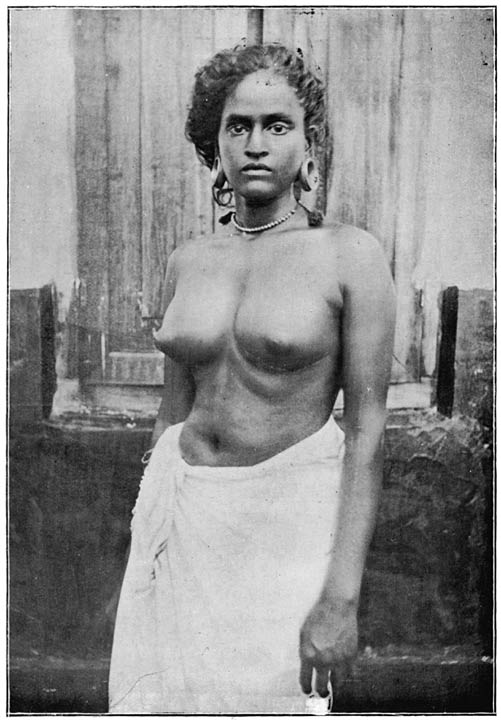
Tiya woman.
The first step to be taken in connection with marriage is examination of the horoscopes of the boy and girl, in order to ascertain whether their union will be one of happiness or the reverse. While this is being done by the Panikkar (Malabar astrologer), the following persons should be present:—
(a) On the part of the bridegroom—
1. Tandān, or chief of the tara.
2. Father, or other elder in the family.
3. Uncle, i.e., the mother’s brother. In Malabar the word uncle means maternal uncle.
4. Sisters’ husbands.
5. Four or more friends or companions.
6. Any number of relations and friends.
(b) On the part of the bride—
1. Tandān of her tara.
2. Father,or other guardian.
3. Uncle.
4. Four or more friends.
5. The astrologer of her tara.
6. Friends and relations.
The ceremony must be performed at the house of the girl’s family. Her father’s consent is necessary, but his presence is not essential at this or the two subsequent ceremonies in connection with the marriage. The Tandān, it may be noted, is the caste governmental head in all matters affecting his own caste and the artisans. He is a Tiyan, and his office, which is authorised by the local Rājah, or rather by his senior Rāni, is hereditary. In exceptional cases, however, the hereditary right may be interrupted by the Rāni appointing some one else. The Tandān of the tara is required to assist at every ceremony connected with marriage, at the ceremony when a girl attains puberty, at that of tying the tāli, and at the fifth and seventh months of pregnancy. His formal permission is required before the carpenter can cut down the areca palm, with which the little shed in which the tāli is tied is constructed. In cases of divorce, his functions are important. When a new house is built, there must be a house-warming ceremony, at which the Tandān officiates. Fowls are sacrificed, and the right leg is the Tandān’s perquisite. He is a man of importance, not only in many affairs within his own caste, but also in those of other castes. Thus, when a Nāyar dies, it is the Tandān’s duty to get the body burnt. He controls the washerman and barber of the tara, and can withdraw their services when they are most needed. He officiates, moreover, at marriages of the artisan class—carpenters, braziers, goldsmiths and blacksmiths.
A group of taras forms what is called a dēsam, the koyma or “sovereignty” of which is represented by a Nāyar tarwad. It is through the head or Karnavan (really the chieftain) of this tarwad that the Tandān approaches the Rāja in matters of appeal, and the like. The Tandān is to some extent under his guidance and control, but he must provide the Tandān with a body-guard of two Nāyars on occasions of marriages. In the old days, it may be mentioned, the Tandāns of the taras within the rule of the Zamorin were always appointed by his senior Rāni. The term Tandān must not be confounded with the Tandars, a people of the Palghāt tāluk, who appear to be allied to the Izhuvans. These Tandars observe the custom of paternal polyandry, while the Izhuvans abhor it.
(a) On the part of the boy—
1. Father, his brother, or some one representing him.
2. Husbands of all married sisters.
3. Uncle.
4. Tandān of his tara.
5. Neighbours and friends.
(b) On the part of the girl—
1. Uncle.
2. Relations of married sisters.
3. Relations of married brothers.
4. Tandān of her tara.
5. Astrologer of her tara.
6. Relations and friends.
The horoscopes are again formally examined by the astrologer, who announces that their agreement augurs a happy wedded life. The boy’s uncle pays him two fanams. The girl’s uncle takes the two horoscopes, which have just been tied together, from the astrologer, and hands them to the Tandān of the girl’s tara, who passes them on to the Tandān of the boy’s tara. They are handed by him to the boy’s uncle. The astrologer then writes on a palmyra leaf a note for each party to the marriage, stating the auspicious day and hour for the final ceremony, the hour at which the bride should leave her house, and the hour for her arrival at the house of the bridegroom. The following programme is then gone through. In the verandah, facing east, before the front door, is spread an ordinary sleeping mat, over it a grass mat, and over that a plain white cloth which has been washed and is not a new one. On the floor close by, the following articles are placed:—
A lamp, having an odd number of cotton wicks, which is kept lighted whatever the hour of day it may be;
A measure, called nāzhi, made of jak tree (Artocarpus integrifolia) wood, filled to overflowing with rice, and placed on a flat bell-metal plate (talika);
A plain white cloth, washed but not new, neatly folded, and placed on the metal plate to the right (south) of the rice;
A small bell-metal vessel (kindi), having no handle, filled with water.
The lamp is placed on the south side of the mat, the plate next to it (to the north), and the kindi at a little distance to the left (the north). The people who sit on the mat always face the east. The mat having been spread, the various articles just mentioned are brought from the central room of the house by three women, who set them in their places. The Tandān’s wife carries the lamp, the eldest woman of the house the bell-metal plate, and some other woman the kindi. The Tandān of the boy’s tara, the boy’s sister’s husband, and a friend then sit on the mat covered with a cloth. If the boy has two brothers-in-law, both sit on the mat, to the exclusion of the friend. The senior woman of the house then hands three plates of rice conjee to the Tandān of the girl’s tara, who places them in front of the three persons seated on the mat. To the right of each plate, a little jaggery (unrefined sugar) is placed on a piece of plantain leaf. Each of those seated takes about a spoonful of conjee in his right hand. The Tandān repeats the formula, which has already been given, and asks “May the conjee be drunk”? He answers his question by drinking some of the conjee, and eating a little jaggery. All three then partake of the conjee and jaggery, after which they rise from the mat, and the plates and mat are removed. The place is cleaned, and the mats are again put down, while betel is distributed. The two Tandāns then sit on the mat. The girl’s Tandān picks up a bundle of about twenty-five betel leaves, and gives half to the boy’s Tandān. The Tandāns exchange betel leaves, each giving the other four. The boy’s Tandān then folds four fanams (one rupee) in four betel leaves, which he hands to the girl’s Tandān, saying “May the conjee ceremony be performed”? The Tandāns again exchange betel leaves as before, and distribute them to all the castemen present, beginning with the uncles of the boy and girl. The proceedings in the verandah are now over. The next part of the ceremony takes place in the middle room of the house, where the mats, lamp, and other articles are arranged as before. The two Tandāns sit on the mat with the boy on the right and the girl on the left, facing east. The boy’s uncle stands in front of the Tandāns, facing west, and the girl’s uncle behind them, facing east. The boy’s father gives to the boy’s uncle two new plain white cloths, with twenty-one fanams (Rs. 5–4) placed on them. When presenting them, he says “Let the Adayalam be performed” three times, and the girl’s uncle says thrice “Let me receive the Adayalam.” The Tandāns again exchange betel leaves, and distribute them among the castemen. Then follows a feast, and more betel. The date of the wedding has now to be fixed. They congregate in the middle room once more, and the Tandāns sit on the mat. The girl’s Tandān shares a bundle of betel leaves with the boy’s Tandān, who, taking therefrom four leaves, places two rupees on them, and gives them to the girl’s Tandān. The boy’s party supplies this money, which is a perquisite of the Tandān. When handing over the leaves and the coins, the boy’s Tandan says “On ... (naming a date) ... and ... (the bride and bridegroom), and friends, and four women will come. Then you must give us the girl, and you must prepare the food for that day.” The other Tandān replies “If you bring six cloths and forty-two fanams (Rs. 10–8) as kanam, and two fanams for the muchenan (the girl’s father’s sister’s son), the girl will be sent to you.” The cloths should be of a kind called enna kacha, each four cubits in length, but they are not now procurable. Kanam is a term used in land tenures, for which there is no precise equivalent in English. It is a kind of mortgage paid by a tenant to a landlord. The former is liable to eviction by the latter, when he obtains better terms for his land from another tenant—a condition of modern growth breeding much mischief and bad blood. But, when a tenant is evicted, he is entitled, according to law, to the value of certain improvements on the land, including eight annas for each tree which he has planted. The kanam is paid by the boy’s sister or sisters. His Tandān addresses his brother-in-law or brothers-in-law in the words “On ... (mentioning a date), you must come early in the day, with Rs. 10–8 as kanam,” and gives him or them four betel leaves. Those assembled then disperse. The boy’s people may not go to the girl’s house before the day appointed for the marriage.
The next item in connection with a marriage is the issue of invitations to the wedding. The senior women of the boy’s house, and the Tandān, invite a few friends to assemble at the house of the bridegroom. The mat, lamp, and other articles are placed in the middle room. The bridegroom (manavālan) sits on the mat, with a friend on either side of him. He has previously bathed, and horizontal daubs of sandal paste have been placed on his forehead, breast, and arms. He wears a new cloth, which has not been washed. His Tandān has adorned him with a gold bracelet on his right wrist, a knife with a gold or silver handle at the waist, and a gold or silver waist-belt or girdle over the loin-cloth. The bracelet must have an ornamental pattern, as plain bracelets are not worn by men. The girdle is in the form of a chain. Besides these things, he must wear ear-rings, and he should have rings on his fingers. His sister who pays the kanam dresses in the same style, but her cloths may be of silk, white without a pattern in the border, and she wears gold bracelets on both wrists. All enjoy a good meal, and then set out, and visit first the house of the Tandān. He and his wife walk in front, followed by the boy’s elder sisters, if he has any. Then comes the bridegroom with a friend before and behind him, with a few women bringing up the rear. At the Tandān’s house there is another meal, and then three, five, or seven houses are visited, and invitation to the wedding given in person. The proceedings for the day are then over, and, after three days, the brother-in-law, uncle, and all others receive invitations.
It is a prevalent custom throughout Southern India that a girl’s father’s sister’s son has the first right to her hand in marriage. This obtains not only among the Dravidian peoples, but also among Brāhmans. The Malayālam word for son-in-law (marumakan) means nephew. If a stranger should marry a girl, he also is called nephew. But the unmarried nephew, having the first admitted right to the girl, must be paid eight annas, or two fanams, before he will allow her to be taken away. The argument is said to be as follows. A sister pays forty-two fanams as kanam for her brother’s wife. When the product, i.e., a daughter, is transferred to a stranger, the son claims compensation on his mother’s investment at the same rate as that at which a cocoanut tree is valued—eight annas. At all events, the nephew has the first right to a girl, and must be compensated before she can be taken away by another.
At the bridegroom’s house, the party is received by the wife of the Tandān and the lady of the house. Following the bride should come her parents and other relations, two Nāyars representing the chieftain, and the Tandān of his tara. The formalities with mats and rice are gone through as before. Rice is sprinkled over the heads, the Tandān receives the swords, and all sit in the shed. The ayini rice ceremony is repeated for the bride by the bridegroom’s mother and sisters. The happy pair then proceed to the inner room of the house, where sweetmeats are served to them. Then is observed, as a rule, the asaram or gift ceremony. Relations are expected to give 101 fanams (Rs. 25–4), but the poorest of them are allowed to reduce the gift to 21 fanams (Rs. 5–4), and the others give according to their means. These gifts are supposed to be repaid with interest. The Tandān sees that a regular account of all the gifts is made out, and handed over to the bridegroom, and receives eight annas for his trouble. The accountant who prepares the accounts, and the person who tests the genuineness of the coins, each receives a bundle of betel leaves, four areca nuts, and two tobacco leaves. Betel leaves, areca nuts, and tobacco, are also given to each giver of gifts. After this, there is the vatil or house ceremony. Two large bundles of betel leaves are prepared, each of which contains a thousand or fifteen hundred leaves, and with them are placed forty or fifty tobacco leaves, and seventy to a hundred areca nuts. The bride’s Tandān pays two or four rupees as vatil kanam to the Tandān of the bridegroom, who hands the money to the bridegroom’s father. The bridegroom then places one bundle of betel leaves, with half the tobacco and areca nuts, before the bride’s father, and the other before her mother, and they are distributed by the Tandān of the girl’s tara and his wife among the men and women who are present. Sweetmeats are then distributed, and the marriage ceremony is concluded. A formal visit must be made subsequently by the women of the bride’s house to the bridegroom’s, and is returned by the bride and bridegroom. The first visit is paid by a party consisting of the bride’s mother, her uncle’s and brother’s wives, the wife of the Tandān, and other relations. They are expected to bring with them plenty of sweetmeats and bread for general distribution. When the return visit is made by the bride and bridegroom, the sister of the latter, and other relations and friends, should accompany them, and they should take with them a lot of betel leaves, areca nuts, tobacco, and sweetmeats. This exchange of visits does not, however, complete those which are de rigueur. For, at the next Ōnam and Vishu festivals, the newly married couple should visit the house of the bride’s family. Ōnam is the beginning of the first harvest, and Vishu the agricultural new year. On these occasions, the bridegroom takes with him the inevitable betel leaves, and presents a new cloth to the parents of the bride and every one else in the house. When the annual Tiruvathira festival takes place between the betrothal and marriage ceremonies, the bridegroom is expected to send to the temple, through his Tandān and one of his own relations, a quantity of ripe and unripe plantains.
The ceremonies which have been described differ considerably from those of the Tiyans of North Malabar, where the marumakkatāyam law of inheritance obtains. These are very simple affairs.
In the Calicut tāluk, a man can marry only one wife at a time. But, when a wife is barren, a leper, or suffering from incurable disease, her husband may, with her formal permission, marry another wife. A bride may be of any age. Where there is no stipulation as to dowry, it is a point of honour to give the girl as many jewels as the bridegroom can afford. Widows may remarry.
Divorce is admissible, when the grounds for it are sufficient. And, when we find that incompatibility of temper is among these, it is safe to say that it is fairly easy of accomplishment. No specific reason need, in fact, be assigned. When it is the man who wishes to get rid of his wife, he must pay her all her expenses towards the marriage, as assessed by persons of the caste who fill the rôle of mediators. He has to give up jewels received from his wife’s family, and must, in some cases, pay the discarded wife something on account of her loss of virginity—a circumstance, which might make it difficult for her to obtain another husband. If the wife wishes to get rid of her husband, she must pay up all his expenses towards the marriage. The party found to be in the wrong must pay a fee of five to twenty rupees to the Tandān and all present, the relations excepted. The amount is distributed then and there. The procedure to be adopted in effecting divorce is as follows. The Tandāns of both sides, uncles and relations, and sometimes the fathers, assemble at the house of the wife, the Tandān, or one of the relations. To the left of a burning lamp are placed two small wooden stools. On one of these are laid a small towel with four fanams (one rupee) tied up in a corner of it, and another towel with a little rice and four fanams tied up in it. Close by is the other stool, on which the wife’s uncle stretches a single thread taken from his own cloth. The husband carries this stool to the gate, and says three times to the wife’s brother, father, or uncle—“Your sister’s (daughter’s or niece’s) matrimonial connection is severed.” He then blows away the thread, throws the stool down, and departs for ever. This little ceremony cannot be performed at the husband’s house, as it would involve perpetual banishment from his own house. The coins in the cloths go to the Tandāns. It is the uncle who gives these cloths, because it was he who received the two cloths at the conjee ceremony. A marriage cannot be dissolved unless both parties agree.
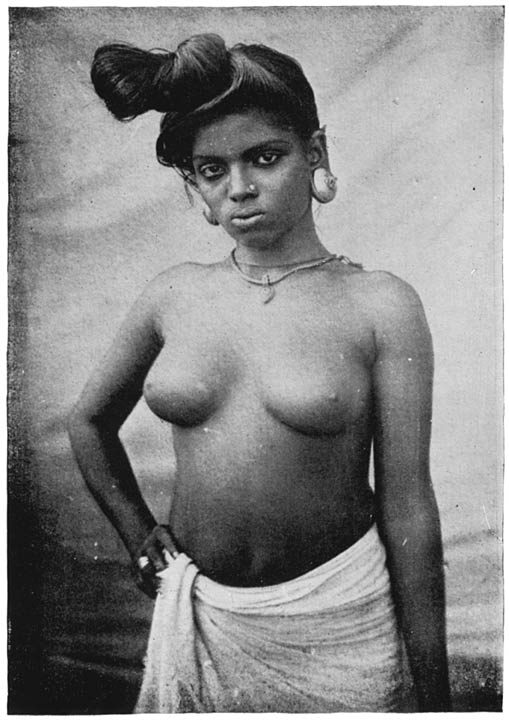
Tiya woman.
The young wife’s child is born at her father’s house, where she is under the care of her mother. When the child is born, the brother of the newly made mother goes out into the yard, and strikes the ground three times with the stem of a dry cocoanut palm leaf. If the child is a boy, he emits a long drawn out ku-u-u-u in high falsetto as he does so. It is then the duty of the brother and the midwife to go and inform the father of the event. The midwife receives from him her fee, and a present of a cloth, and other presents from his sisters. If the child is a boy, the brother receives a cloth, and, if a girl, a cloth and a bell-metal plate.
The event of the birth of a child carries with it, as in the case of death, pollution to every one in the house. This is partially removed by ceremonies on the third day, and wholly by further ceremonies on the ninth or eleventh day, whichever happens to be the more auspicious—a Tuesday for example. Any one coming to the house before the first ceremonies have taken place must bathe and wash his or her cloth to remove the pollution. Any one visiting the house after the first, but before the second ceremony, need not bathe, but cannot eat any food in the house. The men of the household can get no rice at home until after the second ceremony has been performed, and they are consequently compelled to board elsewhere for the time being. A washerwoman carries out the purification rites, assisted by a barber woman. First of all, the floors of all the rooms are smeared with cow-dung. All clothes in use are given to the washerwoman. The women rub their bodies all over with oil, and the washerwoman brings māttu for them. The barber woman sprinkles a mixture of cow’s milk and karuka grass leaves over the women, who then go to a pool and bathe. When the milk is about to be sprinkled, the usual lamp, rice on a metal plate, and kindi of water are produced. The barber woman takes the rice and one fanam, and receives also some cocoanut and gingelly (Sesamum) oil. Much the same things are given to the washerwoman. The second ceremony is just like the first, but, even after its completion, the women of the house cannot touch any cooking-vessels until after the fifteenth day. The ceremony of touching the cooking pots, as at the time of the first menstrual period, is then performed. These three purificatory ceremonies must be performed after every birth.
On the twenty-seventh or fortieth day after the birth of a child, the mother and the infant are taken back to the husband’s house, and cow’s milk is for the first time given to the child. This event, which has all the solemnity of a regular function, takes place in the middle room, where the lamp, mat and other articles have been arranged. The child’s paternal grandfather, father’s elder brother, or other senior man administers the milk, which has been boiled. A gold bracelet is dipped in it, and the drops of milk are made to fall into the child’s mouth. As this is being done, the celebrant whispers in the child’s right ear the name which will be formally given to it in the sixth month. The eldest son is always named after the paternal grandfather, and the second after the father. In like manner, the eldest girl is named after its own mother. Relations and friends take this opportunity to make presents of bracelets and other articles to the infant. A feast is then held. After the ceremony is over, the parents of the child’s mother have to send about half a bag of rice flour mixed with jaggery to her husband’s house.
For the first six months of its life, a child’s food consists of nature’s fount and cow’s milk. It is then, before the sixth month is over, given boiled rice for the first time. The ceremony takes place either in the middle room of its father’s house, or at a temple. The child’s grandfather, or the eldest male member of the family, sits on a mat, and takes the child in his lap. With a gold ring he applies honey three times to its mouth, and then gives it a little rice three times. Female relations who are present follow his example, giving the child first honey, and then rice. Several women, with the lighted lamp and other articles, carry the child into the yard, to show it the sky. They go round a cocoanut tree, and stand before the front door, facing west. An elder among the women of the house stands at the front door, calls out the name of the child three times, and asks it to come inside. The relations give little presents of ornaments, and there is a feast.
It will be observed that even a child’s life is not entirely free from ceremonial. When it has grown up, it undergoes more of it, and, when it has lived its course on earth, is the subject of still more ceremonial long after it is dead. All these affairs involve some expenditure, but the one which literally runs away with money is marriage. The others are not extravagances, nor are they as costly as might be implied from the continual feasting of a large number of people. We must not think of these feasts as of a banquet at the Carlton, but as simple affairs, at which simple people are content with simple though pleasing fare.
When a child is provided by nature with teeth, it is the subject of a little ceremony, during which it is expected to disclose its natural propensities. The usual mat and other articles are arranged, and there are in addition a large flat bell-metal plate containing a rice cake, a knife, a palmyra leaf grantham (book), a cocoanut, and a gold ornament. The child is let loose, and allowed to pick out anything from the plate. If it takes the cake, it will be greedy; if the knife, brave; if the book, learned; if the cocoanut, a landlord; and, if the gold ornament, rich.
A child’s head is shaved in the third or fifth year. The barber, who performs the operation, is allowed to take away the rice which, with the lamp, is at hand. He also receives a fanam and a new cloth. The people of the child’s mother bring rice cakes.
The last day of the Dasara festival in the fifth year of a child’s life is that on which instruction in the alphabet begins. A teacher, who has been selected with care, or a lucky person holds the child’s right hand, and makes it trace the fifty-one letters of the Malayālam alphabet on raw rice spread on a plate. The fore-finger, which is the one used in offering water to the souls of the dead and in other parts of the death ceremonies, must not be used for tracing the letters, but is placed above the middle finger, merely to steady it. For the same reason, a doctor, when making up a pill, will not use the fore-finger. When, later on, the child goes to the village school, the fifty-one letters are written one by one on its tongue with a gold style, if one is available. As each letter is formed, the child has to repeat the sound of it.
The lobes of both a child’s ears are bored with a golden pin or a thorn. The helix of the ear is not bored for the purpose of inserting ornaments in it, but is sometimes bored as a remedy for disease, e.g., hernia. Everywhere else in Southern India, it is common for people of almost every class to have the helix of the left ear bored.
The description which has just been given is that of the ceremony which is performed, if the girl has not been affianced. If a husband has been arranged for her, it is he who ties the tāli, and his sister takes the place of the uncle’s wife. Otherwise the ceremony is the same, with this difference, however, that, when the husband ties the tāli, there can be no divorce, and the girl cannot remarry in the event of his death.
In North, as in South Malabar, the tāli-tying ceremony is always performed before puberty, and occupies four days. This is the orthodox procedure. The girl wears a cloth provided by the washerwoman. She is taken from the middle room of the house to the yard, and there seated on a plank of pala wood. Placed in front of her are a small measure of rice and paddy, a washed white cloth, and a small bell-metal vessel (kindi) on a bell-metal plate. The barber pours cocoanut water on her head, on which a silver and copper coin have been placed. One of her relations then pours water from a vessel containing some raw rice over her head, using two halves of a cocoanut as a spout. The girl is then taken back to the middle room, where she remains for three days. There is a feast in the evening. On the fourth day, a pandal is erected in the front yard, and decorated. The girl is taken to bathe at a neighbouring pool, preceded by women carrying a lamp, a kindi of water, and other things which have been already described. During her absence, the barber performs pūja to Ganapathi in the pandal. After bathing, she cuts a cocoanut in half, and returns in procession, with a silk canopy over her head, amid music and singing, and enters the middle room of the house. The barber woman ties a gold ornament (netti pattam) on her forehead, which she marks with sandal paste, and blackens her eyes with eye-salve. The uncle’s wife, preceded by women bearing a lamp and other articles, carries the mana, covered with cloth, from the middle room to the pandal. She walks three times round the pandal, and places the mana on a grass mat, over which has been spread some paddy and some rice where the girl will put her foot. The women who have carried the lamp, etc., return to the room, and escort the girl to the pandal. She walks thrice round it, and takes her seat on the mana. The barber hands her a little rice, which she throws on the lighted lamp, and articles which have been used in the pūja to Ganapathi, and on the post supporting the south-west corner of the pandal. This post should be of pala wood, or have a twig of that tree tied to it. More rice is handed to the girl, and she throws it to the cardinal points of the compass, to the earth, and to the sky. A small earthen pot containing rice, a cocoanut, betel, and areca nuts, is placed near the girl. Into this a variety of articles, each tied up separately in a piece of plantain leaf, are placed. These consist of a gold coin, a silver coin, salt, rice, paddy, turmeric, charcoal, and pieces of an old cadjan leaf from the thatch of the house. The mouth of the pot is then covered over with a plantain leaf tied with string. The girl sprinkles rice three times over the pot, makes a hole in the leaf, and picks out one of the articles, which is examined as an augur of her destiny. Betel leaves and areca nuts are then passed twice round her head, and thrown away. She next twists off a cocoanut from a bunch hanging at a corner of the pandal. Then follows the presentation of cloths called mantra-kodi. These must be new, and of a particular kind. Each of her relations throws one of these cloths over the girl’s head. Half of them (perhaps ten or twelve) go to the barber, who, at this point, pours cocoanut water from the leaf of a banyan tree on her head, on which a silver and copper coin have been placed. The astrologer is then asked whether it is time to tie the tāli, and replies three times in the affirmative. The barber woman hands the tāli strung on a thread to the girl’s uncle’s wife, who ties it round the girl’s neck. The barber woman then pours water on the girl’s hands. Three times the water is flung upwards, and then to the east, west, south, and north. A cotton wick, steeped in oil, is then twisted round a piece of bamboo, and stuck on a young cocoanut. The girl is asked if she sees the sun, looks at the lighted wick, and says that she does. She is then taken to a cocoanut tree, preceded by the lamp, etc. She walks three times round the tree, and pours water over the root. The ceremony is now concluded, and the girl is marched back to the middle room.
A variation of the tāli-tying ceremony, as performed in Chavakad on the coast between Calicut and Cochin, may be briefly described, because it possesses some interesting features. It is always done by the intended husband, or some one representing him. Seven days prior to the beginning of the ceremony, the carpenter of the tara, with the permission of the Tandān (here called Avakāsi), cuts down an areca palm, and fixes part of it as the south-east post of the booth, at which the tāli will be tied. On the sixth day, the girl is formally installed in the middle room of the house. The carpenter brings a mana of pala wood, the cost of which is paid by the father, and does pūja to it. The bridegroom’s party arrive. A lamp is lighted in the booth, which is at this time partly, but not entirely, made ready. Near the lamp are placed a measure of paddy, half a measure (nāzhi) of rice, a looking-glass, a kindi of water, and a wooden cheppu (a rude vessel with a sliding cover). The wives of the Tandān and uncle, together with some other women, bring the girl, and seat her on the mana. The uncle’s wife parts her hair, and places a gold fanam on her crown. The Tandān’s wife then pours a little oil on it over a leaf of the jāk tree three times. The other women do the same. The girl is then taken to a pool, and bathed. Before her return, the mana should be placed ready for her in the middle room of the house. In the evening there is a feast. On the day but one following, the tāli is tied. The last post of the booth is put up, and it is completed and decorated on the tāli-tying day. A lamp, looking-glass, and other things are put in it. A grass mat is spread on the floor, and a kambli (blanket) and a whitewashed cloth are placed over it. On either side of it is placed a pillow. The bridegroom and his party wait in an adjoining house, for they must not appear on the scene until the psychological moment arrives. The Tandān of the bridegroom’s tara, with a few friends, comes first, and hands over two cloths and ten rupees eight annas to the bride’s Tandān. The girl is dressed in one of these cloths, and led to the booth, the bridegroom’s sister holding her by the hand. She sits on the mana, which has been brought, and placed on the cloth, by her uncle. The bridegroom comes in procession, carried on his uncle’s shoulders. The girl is still a child, and he is only a few years her senior. His uncle puts him down on the right side of the girl, after walking thrice round the booth. The girl’s uncle’s wife sits close to her, on the other side, on the mana. Her father asks the astrologer three times if it is the proper time to tie the tāli, and is answered thrice in the affirmative. Then the boy bridegroom ties the tāli on the girl’s neck. The boy and girl sing out a chorus in praise of Ganapathi, and end up with three loud shouts and hurrahs. Then the boy seats himself on the ground, outside the pillow. The girl is taken inside the house, and, after a general feast, is brought back, and seated on the mana, and rice and flowers are sprinkled. No money is paid to the uncle’s son, as at Calicut. The boy bridegroom pays eight annas to his sister for leading the bride by the hand. When the marriage has been done by proxy, the boy bridegroom is selected from a tarwad into which the girl might marry. He stays at the girl’s house for three days, and, on the fourth day, the boy and girl are taken to a temple. A formal divorce is effected, and the boy is taken away.