Volume 4 — K (Continued)
Reading edition
Kōri (blanket).—An exogamous sept of Kuruba.
Kōriannayya (fowl sept).—An exogamous sept of Bant.
The heads of the Ganjam villages are, Mr. S. P. Rice informs us, “called Korono, the doer, and Karji, the manager. The Korono, who is really only the accountant, but who, by reason of his higher education, is generally the ultimate authority in the village, appropriates to himself the title Potonaiko, as his caste distinction. The word signifies the Naik or head of the town.” It has been noted that “in the Telugu districts, the Karnam is usually a Brāhman. Being in some respects the most intelligent, and the most unpopular man in the village, he is both feared and hated. Murders of accountants, though infrequent, are not unknown.” Of proverbs relating to Karnams, the following may be quoted:—
Even if a thousand pagodas are levied from a village, not even a cash will be levied from the Karnam (a pagoda is a gold, and a cash a copper coin).
The Karnam is the cause of the Kāpu’s (cultivator caste) death.
The hungry Karnam looks into his old accounts (to worry his creditors).
The co-operation of the Karnam is as necessary as the axles to the wheels of a cart.
One Karnam to one village.
A quiet Karnam is as little cared for as a tame elephant.
If a Karnam trusts another, his end is near.
If an enemy is his neighbour; if another Karnam is his superior; if the Kāpu bears complaints against him, a Karnam cannot live on.
The Koronos are divided into various sections, e.g., Sishta or Srishti, Vaisya, Majjula, and Matihansa, some of which wear the sacred thread. The Vaisyas are not allowed to marry their girls after puberty, whereas the others may marry them before or after this event. A woman of the Bhōndari caste is employed on the occasion of marriage and other ceremonies, to perform certain duties, for which her services are indispensable.
Korra (millet: Setaria italica).—An exogamous sept of Gūdala.
Korti.—An occupational name, derived from korto, a saw, of woodsawyers in Ganjam.
Kōsalya.—A sub-division of Māli, named after Kōsala, the modern Oudh.
Kōshti.—Kōshti or Kōshta is the name of a weaving and cultivating caste of Chota Nagpur, a few members of which have settled in the Madras Presidency (see Risley, Tribes and Castes of Bengal). Kōshta is also the name by which the Khatris of Conjeeveram call the Patnūlkāran silk weavers.
The Kotas speak a mixture of Tamil and Kanarese, and speak Tamil without the foreign accent which is noticeable in the case of the Badagas and Todas. According to orthodox Kota views, a settlement should consist of three streets or kēris, in one of which the Terkāran or Dēvādi, and in the other two the Munthakannāns or Pūjāris live. At Kotagiri the three streets are named Kīlkēri, Nadukēri, and Mēlkēri, or lower, central, and upper street. People belonging to the same kēri may not intermarry, as they are supposed to belong to the same family, and intermarriage would be distasteful. The following examples of marriage between members of different kēris are recorded in my notes:—
Husband. Wife.
Kīlkēri. Nadukēri.
Kīlkēri. Mēlkēri.
Nadukēri. Mēlkēri.
Mēlkēri. Nādukēri.
Nadukēri. First wife Kīlkēri, second wife Mēlkēri.
The Kota settlement at Shōlūr is divided into four kēris, viz.:—amrēri, kikēri, korakēri, and akkēri, or near street, lower street, other street, and that street, which resolve themselves into two exogamous groups. Of these, amrēri and kikēri constitute one group, and korakēri and akkēri the other.
Though all classes look down on the Kotas, all are agreed that they are excellent artisans, whose services as smiths, rope and umbrella makers, etc., are indispensable to the other hill tribes. The strong, durable ropes, made out of buffalo hide, are much sought after by Badagas for fastening their cattle. The Kotas at Gudalūr have the reputation of being excellent thatchers. The Todas claim that the Kotas are a class of artisans specially brought up from the plains to work for them. Each Toda, Badaga, Irula, and Kurumba settlement has its Muttu Kotas, who work for the inhabitants thereof, and supply them with sundry articles, called muttu, in return for the carcasses of buffaloes and cattle, ney (clarified butter), grain, plantain, etc. The Kotas eat the flesh of the animals which they receive, and sell the horns to Labbai (Muhammadan) merchants from the plains. Chakkiliyans (leather-workers) from the plains collect the bones, and purchase the hides, which are roughly cured by the Kotas with chunam (lime) and āvaram (Cassia auriculata) bark, and pegged out on the ground to dry.
The Kota blacksmiths make hatches, bill-hooks, knives, and other implements for the various hill tribes, especially the Badagas, and also for European planters. Within the memory of men still living, they used to work with iron ore brought up from the low country, but now depend on scrap iron, which they purchase locally in the bazar. The most flourishing smithy in the Kotagiri village is made of bricks of local manufacture, roofed with zinc sheets, and fitted with anvil pincers, etc., of European manufacture.
As agriculturists the Kotas are said to be quite on a par with the Badagas, and they raise on the land adjacent to their villages crops of potatoes, bearded wheat (akki or rice ganji), barley (beer ganji), kīrai (Amarantus), sāmai (Panicum miliare), korali (Setaria italica), mustard, onions, etc.
At the revenue settlement, 1885, the Kotas were treated in the same way as the Badagas and other tribes of the Nīlgiris, except the Todas, and the lands in their occupation were assigned to them at rates varying from ten to twenty annas per acre. The bhurty or shifting system of cultivation, under which the Kotas held their lands, was formally, but nominally, abolished in 1862–64; but it was practically and finally done away with at the revenue settlement of the Nīlgiri plateau. The Kota lands are now held on puttas under the ordinary ryotwari tenure.
In former days, opium of good quality was cultivated by the Badagas, from whom the Kotas got poppy-heads, which their herbalists used for medicinal purposes. At the present time, the Kotas purchase opium in the bazar, and use it as an intoxicant.
The Kota women have none of the fearlessness and friendliness of the Todas, and, on the approach of a European to their domain, bolt out of sight, like frighted rabbits in a warren, and hide within the inmost recesses of their huts. As a rule they are clad in filthily dirty clothes, all tattered and torn, and frequently not reaching as low as the knees. In addition to domestic duties, the women have to do work in the fields, fetch water and collect firewood, with loads of which, supported on the head by a pad of bracken fern (Pteris aquilina) leaves, and bill-hook slung on the shoulder, old and young women, girls and boys, may continually be seen returning to the Kotagiri village. The women also make baskets, and rude earthen pots from a black clay found in swamps on a potter’s wheel. This consists of a disc made of dry mud, with an iron spike, by means of which it is made to revolve in a socket in a stone fixed in the space in front of the houses, which also acts as a threshing-floor. The earthenware vessels used by the Todas for cooking purposes, and those used in dairy work, except those of the inner room of the ti (sacred dairy), are said by Dr. Rivers to be made by the Kotas.
The Kota priesthood is represented by two classes, Munthakannān or Pūjāri, and Terkāran or Dēvādi, of whom the former rank higher than the latter. There may be more than two Terkārans in a village, but the Munthakannāns never exceed this number, and they should belong to different kēris. These representatives of the priesthood must not be widowers, and, if they lose their wives while holding office, their appointment lapses. They may eat the flesh of buffaloes, but not drink their milk. Cow’s flesh, but not its milk, is tabu. The Kotas may not milk cows, or, under ordinary conditions, drink the milk thereof in their own village, but are permitted to do so if it is given to them by a Pūjāri, or in a village other than their own. The duties of the Munthakannān include milking the cows of the village, service to the god, and participation in the seed-sowing and reaping ceremonial. They must use fire obtained by friction, and should keep a fire constantly burning in a broken pot. In like manner, the Terkārans must not use matches, but take fire from the house of the Munthakannān. The members of the priesthood are not allowed to work for others, but may do so on their own account in the fields or at the forge. They should avoid pollution, and may not attend a Toda or Badaga funeral, or approach the seclusion hut set apart for Kota women. When a vacancy in the office of Munthakannān occurs, the Kotas of the village gather together, and seek the guidance of the Terkāran, who becomes inspired by the deity, and announces the name of the successor. The selected individual has to be fed at the expense of the community for three months, during which time he may not speak to his wife or other woman direct, but only through the medium of a boy, who acts as his assistant. Further, during this period of probation, he may not sleep on a mat or use a blanket, but must lie on the ground or on a plank, and use a dhupati (coarse cloth) as a covering. At the time of the annual temple festival, neither the Munthakannāns nor the Terkārans may live or hold communion with their wives for fear of pollution, and they have to cook their food themselves.
The seed-sowing ceremony is celebrated in the month of Kumbam (February-March) on a Tuesday or Friday. For eight days the Pūjāri abstains from meat and lives on vegetable dietary, and may not communicate directly with his wife, a boy acting as spokesman. On the Sunday before the ceremony, a number of cows are penned in a kraal, and milked by the Pūjāri. The milk is preserved, and, if the omens are favourable, is said not to turn sour. If it does, this is attributed to the Pūjāri being under pollution from some cause or other. On the day of the ceremony, the Pūjāri bathes in a stream, and proceeds, accompanied by a boy, to a field or the forest. After worshipping the gods, he makes a small seed-pan in the ground, and sows therein a small quantity of rāgi (Elusine Coracana). Meanwhile, the Kotas of the village go to the temple, and clean it. Thither the Pūjāri and the boy proceed, and the deity is worshipped with offerings of cocoanuts, betel, flowers, etc. Sometimes the Terkāran becomes inspired, and gives expression to oracular utterances. From the temple all go to the house of the Pūjāri, who gives them a small quantity of milk and food. Three months later, on an auspicious day, the reaping of the crop is commenced with a very similar form of ceremonial.
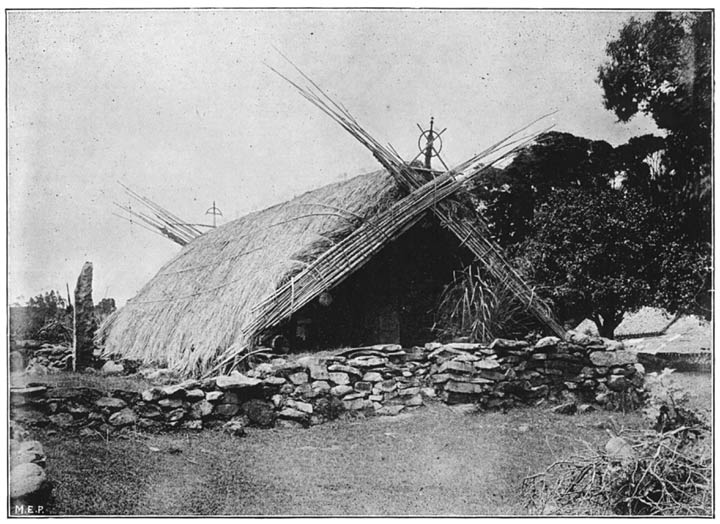
Kota temple.
In addition to Kāmatarāya and Mangkāli, the Kotas at Gūdalūr, which is near the Malabar frontier, worship Vettakaraswāmi, Adiral and Udiral, and observe the Malabar Ōnam festival. The Kotas worship further Māgāli, to whose influence outbreaks of cholera are attributed, and Māriamma, who is held responsible for smallpox. When cholera breaks out among the Kota community, special sacrifices are performed with a view to propitiating the wrath of the goddess. Māgāli is represented by an upright stone in a rude temple at a little distance from Kotagiri, where an annual ceremony takes place, at which some man becomes possessed, and announces to the people that Māgāli has come. The Pūjāri offers up plantains and cocoanuts, and sacrifices a sheep and fowls. My informant was, or pretended to be ignorant of the following legend recorded by Breeks as to the origin of the worship of the smallpox goddess. “A virulent disease carried off a number of Kotas of Peranganoda, and the village was abandoned by the survivors. A Badaga named Munda Jogi, who was bringing his tools to the Kotagiri to be sharpened, saw near a tree something in the form of a tiger, which spoke to him, and told him to summon the run-away Kotas. He obeyed, whereupon the tiger form addressed the Kotas in an unknown tongue, and vanished. For some time, the purport of this communication remained a mystery. At last, however, a Kota came forward to interpret, and declared that the god ordered the Kotas to return to the village on pain of a recurrence of the pestilence. The command was obeyed, and a Swāmi house (shrine) was built on the spot where the form appeared to the Badaga (who doubtless felt keenly the inconvenience of having no Kotas at hand to sharpen his tools).” The Kotas are not allowed to approach Toda or Badaga temples.
First day. A fire is kindled by one of the priests in the temple, and carried to the Nadukēri section of the village, where it is kept burning throughout the festival. Around the fire men, women, adolescent boys and girls, dance to the weird music of the Kota band, whose instruments consist of clarionet, drum, tambourine, brass horn and flute (buguri).
Second day Dance at night.

Third day
Fourth day
Fifth day
Sixth day. The villagers go to the jungle and collect bamboos and rattans, with which to re-roof the temple. Dance at night.
The seventh day is busily spent in re-roofing and decorating the temples, and it is said to be essential that the work should be concluded before nightfall. Dance at night.
Eighth day. In the morning the Kotas go to Badaga villages, and cadge for presents of grain and ghī (clarified butter), which they subsequently cook, place in front of the temple as an offering to the god, and, after the priests have eaten, partake of, seated round the temple.
Ninth day. Kotas, Todas, Badagas, Kurumbas, Irulas, and ‘Hindus’ come to the Kota village, where an elaborate nautch is performed, in which men are the principal actors, dressed up in gaudy attire consisting of skirt, petticoat, trousers, turban and scarves, and freely decorated with jewelry, which is either their own property, or borrowed from Badagas for the occasion. Women merely dressed in clean cloths also take part in a dance called kumi, which consists of a walk round to time beaten with the hands. I was present at a private performance of the male nautch, which was as dreary as such entertainments usually are, but it lacked the go which is doubtless put into it when it is performed under natural conditions away from the restraining influence of the European. The nautch is apparently repeated daily until the conclusion of the festival.
Eleventh and twelfth days. A burlesque representation of a Toda funeral is given, at which the part of the sacrificial buffaloes is played by men with buffalo horns fixed on the head, and body covered with a black cloth.
At the close of the festival, the Kota priests and leading members of the community go out hunting with bows and arrows, leaving the village at 1 A.M., and returning at 3 A.M. They are said to have formerly shot ‘bison’ (Bos gaurus) at this nocturnal expedition, but what takes place at the present day is said to be unknown to the villagers, who are forbidden to leave their houses during the absence of the hunting party. On their return to the village, a fire is lighted by friction. Into the fire a piece of iron is put by one of the priests, made red hot with the assistance of the bellows, and hammered. The priests then offer up a parting prayer to the god, and the festival is at an end.
“During my stay at Kotagiri the Kotas were celebrating the big festival in honour of their chief god. The feast lasted over twelve days, during which homage was offered to the god every evening, and a dance performed round a fire kept burning near the temple throughout the feast. On the last evening but one, females, as well as males, took part in the dance. As darkness set in, the shrill music, which penetrated to my hotel, attracted me to the Kota village. At the end of the street, which adjoins the back of the temple, a big fire was kept up by continually putting on large long bundles of brushwood. On one side of the fire, close to the flames, stood the musicians with their musical instruments, two hand-drums, a tambourine, beaten by blows on the back, a brass cymbal beaten with a stick, and two pipes resembling oboes. Over and over again the same monotonous tune was repeated by the two latter in quick four-eight time to the accompaniment of the other instruments. On my arrival, about forty male Kotas, young and old, were dancing round the fire, describing a semicircle, first to one side, then the other, raising the hands, bending the knees, and executing fantastic steps with the feet. The entire circle moved thus slowly forwards, one or the other from time to time giving vent to a shout that sounded like Hau! and, at the conclusion of the dance, there was a general shout all round. Around the circle, partly on the piles of stone near the temple, were seated a number of Kotas of both sexes. A number of Badagas of good position, who had been specially invited to the feast, sat round a small fire on a raised place, which abuts on the back wall of the temple. The dance over, the circle of dancers broke up. The drummers held their instruments, rendered damp and lax by the moist evening breeze, so close to the flames that I thought they would get burnt. Soon the music began again to a new tune; first the oboes, and then, as soon as they had got into the proper swing, the other instruments. The melody was not the same as before, but its two movements were repeated without intercession or change. In this dance females, as well as males, took part, grouped in a semicircle, while the men completed the circle. The men danced boisterously and irregularly. Moving slowly forwards with the entire circle, each dancer turned right round from right to left and from left to right, so that, after every turn, they were facing the fire. The women danced with more precision and more artistically than the men. When they set out on the dance, they first bowed themselves before the fire, and then made left and right half turns with artistic regular steps. Their countenances expressed a mixture of pleasure and embarrassment. None of the dancers wore any special costume, but the women, who were nearly all old and ugly, had, for the most part, a quantity of ornaments in the ears and nose and on the neck, arms and legs. In the third dance, played once more in four-eight times, only females took part. It was the most artistic of all, and the slow movements had evidently been well rehearsed beforehand. The various figures consisted of stepping radially to and fro, turning, stepping forwards and backwards, etc., with measured seriousness and solemn dignity. It was for the women, who, at other times, get very little enjoyment, the most important and happiest day in the whole year.”
In connection with Kota ceremonials, Dr. Rivers notes that “once a year there is a definite ceremony, in which the Todas go to the Kota village with which they are connected, taking an offering of clarified butter, and receiving in return an offering of grain from the Kotas. I only obtained an account of this ceremony as performed between the people of Kars and the Kota village of Tizgudr, and I do not know whether the details would be the same in other cases. In the Kars ceremony, the Todas go on the appointed day to the Kota village, headed by a man carrying the clarified butter. Outside the village they are met by two Kota priests whom the Todas call teupuli, who bring with them a dairy vessel of the kind the Todas call mu, which is filled with patm grain. Other Kotas follow with music. All stand outside the village, and one of the Kotas puts ten measures (kwa) of patm into the pocket of the cloak of the leading Toda, and the teupuli give the mu filled with the same grain. The teupuli then go to their temple and return, each bringing a mu, and the clarified butter brought by the Todas is divided into two equal parts, and half is poured into each mu. The leading Toda then takes some of the butter, and rubs it on the heads of the two Kota priests, who prostrate themselves, one at each foot of the Toda, and the Toda prays as follows:—
May it be well; Kotas two, may it be well; fields flourish may; rain may; buffalo milk may; disease go may.
“The Todas then give the two mu containing the clarified butter to the Kota priests, and he and his companions return home. This ceremony is obviously one in which the Todas are believed to promote the prosperity of the Kotas, their crops, and their buffaloes.
“In another ceremonial relation between Todas and Kotas, the kwòdrdoni ti (sacred dairy) is especially concerned. The chief annual ceremony of the Kotas is held about January in honour of the Kota god Kambataraya. In order that this ceremony may take place, it is essential that there should be a palol (dairy man) at the kwòdrdoni ti, and at the present time it is only occupied every year shortly before and during the ceremony. The palol gives clarified butter to the Kotas, which should be made from the milk of the arsaiir, the buffaloes of the ti. Some Kotas of Kotagiri whom I interviewed claimed that these buffaloes belonged to them, and that something was done by the palol at the kwòdrdoni ti in connection with the Kambataraya ceremony, but they could not, or would not, tell me what it was.”
In making fire by friction (nejkōl), the Kotas employ three forms of apparatus:—(1) a vertical stick, and horizontal stick with sockets and grooves, both made of twigs of Rhodomyrtus tomentosus; (2) a small piece of the root of Salix tetrasperma is spliced into a stick, which is rotated in a socket in a piece of the root of the same tree; (3) a small piece of the root of this tree, made tapering at each end with a knife or fragment of bottle glass, is firmly fixed in the wooden handle of a drill. A shallow cavity and groove are made in a block of the same wood, and a few crystalline particles from the ground are dropped into the cavity. The block is placed on several layers of cotton cloth, on which chips of wood, broken up small by crushing them in the palm of the hand, are piled up round the block in the vicinity of the grove. The handle is, by means of a half cocoanut shell, pressed firmly down, and twisted between the palms, or rotated by means of a cord. The incandescent particles, falling on to the chips, ignite them.
In a report by Lieutenant Evans, written in 1820, it is stated that “the marriages of this caste (the Kothewars) remind one of what is called bundling in Wales. The bride and bridegroom being together for the night, in the morning the bride is questioned by her relatives whether she is pleased with her husband-elect. If she answers in the affirmative, it is a marriage; if not, the bridegroom is immediately discharged, and the lady does not suffer in reputation if she thus discards half a dozen suitors.” The recital of this account, translated into Tamil, raised a smile on the face of my Kota informant, who volunteered the following information relating to the betrothal and marriage ceremonies at the present day. Girls as a rule marry when they are from twelve to sixteen years old, between which years they reach the age of puberty. A wife is selected for a lad by his parents, subject to the consent of the girl’s parents; or, if a lad has no near relatives, the selection is made for him by the villagers. Betrothal takes place when the girl is a child (eight to ten). The boy goes, accompanied by his father and mother, to the house where the girl lives, prostrates himself at the feet of her parents, and, if he is accepted, presents his future father-in-law with a four-anna piece, which is understood to represent a larger sum, and seals the contract. According to Breeks, the boy also makes a present of a birianhana of gold, and the betrothal ceremony is called balimeddeni (bali, bracelet, meddeni, I have made). Both betrothal and marriage ceremonies take place on Tuesday, Wednesday, or Friday, which are regarded as auspicious days. The ceremonial in connection with marriage is of a very simple nature. The bridegroom, accompanied by his relatives, attends a feast at the house of the bride, and the wedding day is fixed. On the appointed day the bridegroom pays a dowry, ranging from ten to fifty rupees, to the bride’s father, and takes the girl to his house, where the wedding guests, who have accompanied them, are feasted. The Kotas as a rule have only one wife, and polyandry is unknown among them. But polygamy is sometimes practiced. My informant, for example, had two wives, of whom the first had only presented him with a daughter, and, as he was anxious to have a son, he had taken to himself a second wife. If a woman bears no children, her husband may marry a second, or even a third wife; and, if they can get on together without fighting, all the wives may live under the same roof.
Divorce may, I was told, be obtained for incompatibility of temper, drunkenness, or immorality; and a man can get rid of his wife ‘if she is of no use to him’, i.e., if she does not feed him well, or assist him in the cultivation of his land. Divorce is decided by a panchāyat (council) of representative villagers, and judgment given, after the evidence has been taken, by an elder of the community. Cases of theft, assault, or other mild offence, are also settled by a panchāyat, and, in the event of a case arising which cannot be settled by the members of council representing a single village, delegates from all the Kota villages meet together. If then a decision cannot be arrived at, recourse is had to the district court, of which the Kotas steer clear if possible. At a big panchāyat the headman (Pittakar) of the Kotas gives the decision, referring, if necessary, to some ‘sensible member’ of the council for a second opinion.
When a married woman is known to be pregnant with her first child, her husband allows the hair on the head and face to grow long, and leaves the finger nails uncut. On the birth of the child, he is under pollution until he sees the next crescent moon, and should cook his own food and remain at home. At the time of delivery a woman is removed to a hut (a permanent structure), which is divided into two rooms called dodda (big) telullu and eda (the other) telullu, which serve as a lying-in chamber and as a retreat for women at their menstrual periods. The dodda telullu is exclusively used for confinements. Menstruating women may occupy either room, if the dodda telullu is not occupied for the former purpose. They remain in seclusion for three days, and then pass another day in the raised verandah of the house, or two days if the husband is a Pūjāri. A woman, after her first confinement, lives for three months in the dodda telullu, and, on subsequent occasions, until the appearance of the crescent moon. She is attended during her confinement and stay in the hut by an elderly Kota woman. The actual confinement takes place outside the hut, and, after the child is born, the woman is bathed, and taken inside. Her husband brings five leafy twigs of five different thorny plants, and places them separately in a row in front of the telullu. With each twig a stick of Dodonæa viscosa, set alight with fire made by friction, must be placed. The woman, carrying the baby, has to enter the hut by walking backwards between the thorny twigs.
A common name for females at Kotagiri is Mādi, one of the synonyms of the goddess Kālikai, and, at that village, the first male child is always called Komuttan (Kāmatarāya). At Shōlūr and Gudalūr this name is scrupulously avoided, as the name of the god should not be taken by mortal man. As examples of nicknames, the following may be cited.
Small mouth. Head. Slit nose. Burnt-legged. Monkey. Dung or rubbish. Deaf. Tobacco. Hunchback. Crooked-bodied. Long-striding. Dwarf. Opium eater. Irritable. Bad-eyed. Curly-haired. Cat-eyed. Left-handed. Stone. Stammerer. Short. Knee. Chank-blower. Chinaman.
The nickname Chinaman was due to the resemblance of a Kota to the Chinese, of whom a small colony has squatted on the slopes of the hills between Naduvatam and Gudalūr.
A few days after my arrival at Kotagiri, the dismal sound of mourning, to the weird strains of the Kota band, announced that death reigned in the Kota village. The dead man was a venerable carpenter, of high position in the community. Soon after daybreak, a detachment of villagers hastened to convey the tidings of the death to the Kotas of the neighbouring villages, who arrived on the scene later in the day in Indian file, men in front and women in the rear. As they drew near the place of mourning, they all, of one accord, commenced the orthodox manifestations of grief, and were met by a deputation of villagers accompanied by the band. Meanwhile a red flag, tied to the top of a bamboo pole, was hoisted as a signal of death in the village, and a party had gone off to a glade, some two miles distant, to obtain wood for the construction of the funeral car (tēru). The car, when completed, was an elaborate structure, about eighteen feet in height, made of wood and bamboo, in four tiers, each with a canopy of turkey red and yellow cloth, and an upper canopy of white cloth trimmed with red, surmounted by a black umbrella of European manufacture, decorated with red ribbands. The car was profusely adorned with red flags and long white streamers, and with young plantain trees at the base. Tied to the car were a calabash and a bell. During the construction of the car the corpse remained within the house of the deceased man, outside which the villagers continued mourning to the dirge-like music of the band, which plays so prominent a part at the death ceremonies of both Todas and Kotas. On the completion of the car, late in the afternoon, it was deposited in front of the house. The corpse, dressed up in a coloured turban and gaudy coat, with a garland of flowers round the neck, and two rupees, a half-rupee, and sovereign gummed on to the forehead, was brought from within the house, lying face upwards on a cot, and placed beneath the lowest canopy of the car. Near the head were placed iron implements and a bag of rice, at the feet a bag of tobacco, and beneath the cot baskets of grain, rice, cakes, etc. The corpse was covered with cloths offered to it as presents, and before it those Kotas who were younger than the dead man prostrated themselves, while those who were older touched the head of the corpse and bowed to it. Around the car the male members of the community executed a wild step-dance, keeping time with the music in the execution of various fantastic movements of the arms and legs. During the long hours of the night mourning was kept up to the almost incessant music of the band, and the early morn discovered many of the villagers in an advanced stage of intoxication. Throughout the morning, dancing round the car was continued by men, sober and inebriated, with brief intervals of rest, and a young buffalo was slaughtered as a matter of routine form, with no special ceremonial, in a pen outside the village, by blows on the back and neck administered with the keen edge of an adze. Towards midday presents of rice from the relatives of the dead man arrived on the back of a pony, which was paraded round the car. From a vessel containing rice and rice water, water was crammed into the mouths of the near relatives, some of the water poured over their heads, and the remainder offered to the corpse. At intervals a musket, charged with gunpowder, which proved later on a dangerous weapon in the hands of an intoxicated Kota, was let off, and the bell on the car rung. About 2 P.M., the time announced for the funeral, the cot bearing the corpse, from the forehead of which the coins had been removed, was carried to a spot outside the village called the thāvāchivadam, followed by the widow and a throng of Kotas of both sexes, young and old. The cot was then set down, and, seated at some distance from it, the women continued to mourn until the funeral procession was out of sight, those who could not cry spontaneously mimicking the expression of woe by contortion of the grief muscles. The most poignant sorrow was displayed by a man in a state of extreme intoxication, who sat apart by himself, howling and sobbing, and wound up by creating considerable disturbance at the burning-ground. Three young bulls were brought from the village, and led round the corpse. Of these, two were permitted to escape for the time being, while a vain attempt, which would have excited the derision of the expert Toda buffalo-catchers, was made by three men, hanging on to the head and tail, to steer the third bull up to the head of the corpse. The animal, however, proving refractory, it was deemed discreet to put an end to its existence by a blow on the poll with the butt-end of an adze, at some distance from the corpse, which was carried up to it, and made to salute the dead beast’s head with the right hand, in feeble imitation of the impressive Toda ceremonial. The carcase of the bull was saluted by a few of the Kota men, and subsequently carried off by Pariahs. Supported by females, the exhausted widow of the dead man was dragged up to the corpse, and, lying back beside it, had to submit to the ordeal of removal of all her jewellery, the heavy brass bangle being hammered off the wrist, supported on a wooden roller, by oft-repeated blows with mallet and chisel delivered by a village blacksmith assisted by a besotten individual noted as a consumer of twelve grains of opium daily. The ornaments, as removed, were collected in a basket, to be worn again by the widow after several months. This revolting ceremony concluded, and a last salutation given by the widow to her dead husband, arches of bamboo were attached to the cot, which was covered over with a coloured table-cloth hiding the corpse from sight. A procession was then formed, composed of the corpse on the cot, preceded by the car and musicians, and followed by male Kotas and Badagas, Kota women carrying the baskets of grain, cakes, etc., a vessel containing fire, and burning camphor. Quickly the procession marched to the burning-ground beyond the bazar, situated in a valley by the side of a stream running through a glade in a dense undergrowth of bracken fern and trailing passion-flower. On arrival at the selected spot, a number of agile Kotas swarmed up the sides of the car, and stripped it of its adornments including the umbrella, and a free fight for the possession of the cloths and flags ensued. The denuded car was then placed over the corpse, which, deprived of all valuable ornaments and still lying on the cot, had been meanwhile placed, amid a noisy scene of brawling, on the rapidly constructed funeral pyre. Around the car faggots of wood, supplied in lieu of wreaths by different families in the dead man’s village as a tribute of respect, were piled up, and the pyre was lighted with torches kindled at a fire which was burning on the ground close by. As soon as the pyre was in a blaze, tobacco, cigars, cloths, and grain were distributed among those present, and the funeral party dispersed, leaving a few men behind in charge of the burning corpse, and peace reigned once more in the Kota village. A few days later, the funeral of an elderly woman took place with a very similar ceremonial. But, suspended from the handle of the umbrella on the top of the car, was a rag doll, which in appearance resembled an Aunt Sally. I was told that, on the day following the funeral, the smouldering ashes are extinguished with water, and the ashes, collected together, and buried in a pit, the situation of which is marked by a heap of stones. A piece of the skull, wrapped in bracken fronds, is placed between two fragments of an earthen pot, and deposited in the crevice of a rock or in a chink in a stone wall.
The Kotas celebrate annually a second funeral ceremony in imitation of the Todas. For eight days before the day appointed for its observance, a dance takes place in front of the houses of those Kotas whose memorial rites are to be celebrated, and three days before they are performed invitations are issued to the different Kota villages. On a Sunday night, fire is lighted by friction, and the time is spent in dancing. On the following day, the relatives of the departed who have to perform the ceremony purify the open space in front of their houses with cow-dung. They bring three basketfuls of paddy (unhusked rice), which are saluted and set down on the cleansed space. The Pūjāri and the rest of the community, in like manner, salute the paddy, which is taken inside the house. On the Monday, cots corresponding in number to that of the deceased whose dry funeral is being held, are taken to the thāvachivadam, and the fragments of skulls are laid thereon. Buffaloes (one or more for each skull) are killed, and a cow is brought near the cots, and, after a piece of skull has been placed on its horns, sacrificed. A dance takes place around the cots, which are removed to the burning-ground, and set on fire. The Kotas spend the night near the thāvachivadam. On the following day a feast is held, and they return to their homes towards evening, those who have performed the ceremony breaking a small pot full of water in front of their houses.
Like the Todas, the Kotas indulge in trials of strength with heavy spherical stones, which they raise, or attempt to raise, from the ground to the shoulders, and in a game resembling tip-cat. In another game, sides are chosen, of about ten on each side. One side takes shots with a ball made of cloth at a brick propped up against a wall, near which the other side stands. Each man is allowed three shots at the brick. If it is hit and falls over, one of the ‘out-side’ picks up the ball, and throws it at the other side, who run away, and try to avoid being hit. If the ball touches one of them, the side is put out, and the other side goes in. A game, called hulikotē, which bears a resemblance to the English child’s game of fox and geese, is played on a stone chiselled with lines, which forms a rude game-board. In one form of the game, two tigers and twenty-five bulls, and in another three tigers and fifteen bulls engage, and the object is for the tigers to take, or, as the Kotas express it, kill all the bulls. In a further game, called kotē, a labyrinthiform pattern, or maze, is chiselled on a stone, to get to the centre of which is the problem.
The following notes are taken from my case-book:—
Man—Blacksmith and carpenter. Silver bangle on right wrist; two silver rings on right little finger; silver ring on each first toe. Gold ear-rings. Langūti (cloth) tied to silver chain round loins.
Man—Light blue eyes, inherited from his mother. His children have eyes of the same colour. Lobes of ears pendulous from heavy gold ear-rings set with pearls. Another man with light blue eyes was noticed by me.
Man—Branded with cicatrix of a burn made with a burning cloth across lower end of back of forearm. This is a distinguishing mark of the Kotas, and is made on boys when they are more than eight years old.
Woman—Divorced for being a confirmed opium-eater, and living with her father.
Woman—Dirty cotton cloth, with blue and red stripes, covering body and reaching below the knees.
Woman—Two glass bead necklets, and bead necklet ornamented with silver rings. Four brass rings, and one steel ring on left forearm. Two massive brass bangles, weighing two pounds each, and separated by cloth ring, on right wrist. Brass bangle with brass and steel pendants, and shell bangle on left wrist. Two steel rings, and one copper ring on right ring-finger; brass rings on left first, ring, and little fingers. Two brass rings on first toe of each foot. Tattooed lines uniting eyebrows. Tattooed on outer side of both upper arms with rings, dots, and lines; rows of dots on back of right forearm; circle on back of each wrist; rows of dots on left ankle. As with the Todas, the tattooed devices are far less elaborate than those of the women in the plains.
Woman—Glass necklet ornamented with cowry shells, and charm pendant from it, consisting of a fragment of the root of some tree rolled up in a ball of cloth. She put it on when her baby was quite young, to protect it against devils. The baby had a similar charm round its neck.
In the course of his investigation of the Todas, Dr. Rivers found that of 320 males 41 or 12.8 per cent. and of 183 females only two or 1.1 per cent. were typical examples of red-green colour-blindness. The percentage in the males is quite remarkable. The result of examination of Badaga and Kota males by myself with Holmgren’s wools was that red-green colour-blindness was found to be present in 6 out of 246 Badagas, or 2·5 per cent. and there was no suspicion of such colour-blindness in 121 Kotas.
Kōtēgara or Kōtēyava.—See Sērvēgāra.
Kōti (monkey).—The name for Koravas, who travel about the country exhibiting monkeys.
Kotippattan.—The Kotippattans are described, in the Travancore Census Report, 1901, as “a class of Tamil Brāhmans, who, at a very early age in Malabar history, were declared by society to have lost the original Brāhmanical status. The offence was, it is said, their having taken to the cultivation of the betel-vine as their chief occupation. The ordinances of caste had prescribed other duties for the Brāhmans, and it is not unlikely that Sankarāchārya, to whose curse the present position of the Kotippattan is traced, disapproved of the change. In general appearance as regards thread, position of hair-tuft, and dress of men as well as women, and in ceremonials, the Kotippattans cannot be easily distinguished from the Brāhman class. Sad instances have occurred of Brāhman girls having been decoyed into matrimonial alliances with Kotippattans. They form a small community, and the state of social isolation into which they have been thrown has greatly checked their increase, as in the case of many other Malabar castes. Their priests are at present Tamil Brāhmans. They do not study the Vēdas, and the Gāyatri hymn is recited with the first syllable known as the pranavam. In the matter of funeral ceremonies, a Kotippattan is treated as a person excommunicated. The cremation is a mere mechanical process, unaccompanied by any mantras (sacred formulæ) or by any rites, anantarasamskāra (deferred funeral rites) being done after the lapse of ten days. They have their annual srāddhas, but no offerings of water (tarpanam) on the new-moon day. Their household deity is Sāsta. Their inheritance is from father to son. Their household language is Malayālam. Their chief seat is Vāmanapuram, twenty miles from Trivandrum.”
Kotlu (cow-shed).—An exogamous sept of Yānādi.
Kōttaipaththu.—A sub-division of Agamudaiyans, who believe that they are the same as the Kōttai (fort) Vellālas of Tinnevelly.
It is said that, during the days of oppression at the hands of Muhammadan and Poligar rulers, the Kōttai Vellālas had to pay considerable sums of money to secure immunity from molestation. The Kōttai Pillai, or headman of the community, is reported to possess the grants made from time to time by the rulers of the country, guaranteeing them the enjoyment of their customs and privileges. The fort, in which the Kōttai Vellālas live, is kept in good preservation by Government. There are four entrances, of which one is kept closed, because, it is said, on one occasion, a child who went out by it to witness the procession of a god was killed. Brāhmans who are attached to the fort, male members of various castes who work for the inmates thereof, and Pallans may freely enter it. But, if any one wishes to speak to a man living in the fort, the Paraiyan gatekeeper announces the presence of the visitor. Females of all castes may go into the fort, and into the houses within it.
On marriage and other festive occasions, it is customary for the Kōttai Vellālas to give raw rations to those invited, instead of, as among other castes, a dinner. The Kottans eat and drink at the expense of their masters, and dance.
Kōttai Vellāla women wear ordinary jewels up to middle life, when they replace them by a jewel called nāgapadam, which is a gold plate with the representation of a five-headed cobra. This is said to be worn in memory of the occasion when a Pāndyan king, named Thennavarāyan, overlooking the claims of his legitimate son, gave the kingdom to an illegitimate son. The fort Vellālas living at Sezhuvaimānagaram refused to place the crown on the bastard’s head. They were consequently persecuted, and had to leave the country. They decided to throw themselves into a fire-pit, and so meet their death in a body. But, just as they were about to do so, they were prevented by a huge five-headed cobra. Hearing of this marvellous occurrence, the Pāndyan king who was ruling in Tinnevelly invited them to settle at Srīvaiguntam. The fort Vellālas claim that one of the Pāndyan kings gave them extensive lands on the bank of the Vaigai river when they lived at Sezhuvaimānagaram. They claim further that the ministers and treasurers of the Pāndyan kings were selected from among them.
The dead are usually cremated. The corpses are borne by Kottans, who carry out various details in connection with the death ceremonies. The corpses of women are placed in a bag, which is carefully sewn up.
I am informed that, owing to the scarcity of females, men are at the present day obliged to recruit wives from outside.
The Kōttaipaththu Agamudaiyans believe that they are the same as the Kōttai Vellālas.
Kottakunda (new pot).—An exogamous sept of Mēdara.
Kottan.—An occupational name, meaning bricklayer, returned, at times of census, by some Pallis in Coimbatore. Some Pallis are also employed as bricklayers in the City of Madras. Kottan is also recorded as a title of Katasan.
Kottha.—A sub-division of Kurubas, the members of which tie a woollen thread round the wrist at marriages.
Kottiya Paiko.—A sub-division of Rōna.
Kovē (ant-hill).—An exogamous sept of Gangadikāra Vakkaliga.
Kōvila (Indian cuckoo, Eudynamis honorata).—A gōtra of Mēdara.
Kōvilar (temple people).—The name adopted by a section of Pallis or Vanniyans, who wear the sacred thread, and have temples of their own, in which they worship. Kōil Adiyān (temple servant) has been returned by some Balijas at times of census. Kōvilammamar or Kōilpat, denoting ladies of, or those who live in palaces, is a title of some Sāmanta ladies. Kōvilagam is the usual term for the house of a Rāja or Tirumalpād, and Kōilpantāla is recorded, from Travancore, as a synonym for Kōil Tamburān. The Nāttukōttai Chettis have exogamous septs, or kōils, named after temples, e.g., Māthur kōil.
Kōya.—The land and boat-owning class of Muhammadans in the Laccadive islands. The name is said to be a corrupt form of Khōja, meaning a man of distinction. Māppillas use Kōya as a suffix to their names, e.g., Hassan Kōya, Mahomed Kōya (see Māppilla).
Kōyappan.—Kōyappan or Kōyavappan are corrupt forms of Kusavan (Malabar potters).
It is recorded by the Rev. J. Cain that “until the tālukās were handed over to British rule, the Bhadrāchallam Zamindar always kept up a troop of Rohillās, who received very little pay for their services, and lived chiefly by looting the country around. In attendance upon them were one hundred Kois, and one hundred Mādigas. Twenty-five Koi villages form a samutū, and, in the Bhadrāchallam tālukā, there are ten samutūs. In the territory on the opposite side of the river, which also belonged to the Ashwa Rau family, there were ten samutūs. Each samutū was bound in turn to furnish for a month a hundred Kois to carry burdens, fetch supplies, etc., for the above-mentioned Rohillās. During the month thus employed they had to provide their own batta (subsistence money). The petty Zamindars of Albaka, Cherla, Nagar, Bejji and Chintalanada, likewise had their forces of Nāyaks and Kois, and were continually robbing and plundering. All was grist which came to their mill, even the clothes of the poor Koi women, who were frequently stripped, and then regarded as objects of ridicule. The Kois have frequently told me that they could never lie down to rest without feeling that before morning their slumbers might be rudely disturbed, their houses burnt, and their property all carried off. As a rule, they hid their grain in caves and holes of large trees.” It is recorded, in the Vizagapatam Manual, that, in 1857, the headman of Koratūru, a village on the Godāvari river, was anxious to obtain a certain rich widow in marriage for his son. Hearing, however, that she had become the concubine of a village Munsiff or Magistrate of Buttayagūdem, he attempted, with a large body of his Koi followers, to carry her off by force. Failing in the immediate object of his raid, he plundered the village, and retreated with a quantity of booty and cattle.
Those Koyis, the Rev. J. Cain writes, who live in the plains “have a tradition that, about two hundred years ago, they were driven from the plateau in the Bustar country by famine and disputes, and this relationship is also acknowledged by the Gutta Kois, i.e., the hill Kois, who live in the highlands of Bustar. These call the Kois who live near the Godāvari Gommu Kois and Mayalotīlu. The word Gommu is used to denote the banks and neighbourhood of the Godāvari. Thus, for instance, all the villages on the banks of the Godāvari are called Gommu ūllu. Mayalotīlu means rascal. The Gutta Kois say the lowland Kois formerly dwelt on the plateau, but on one occasion some of them started out on a journey to see a Zamindar in the plains, promising to return before very long. They did not fulfil their promise, but settled in the plains, and gradually persuaded others to join them, and at times have secretly visited the plateau on marauding expeditions.... The Kois regard themselves as being divided into five classes, Perumbōyudu, Madogutta, Perēgatta, Mātamuppayo, and Vidogutta.” The Rev. J. Cain states further that “the lowland Kois say that they are divided into five tribes, but they do not know the first of these. The only names they can give are Pāredugatta, Mundegutta, Peramboyina, and Wikaloru, and these tribes are again sub-divided into many families. The members of the different tribes may intermarry, but not members of the same tribe.”
It is noted by the Rev. J. Cain that at Gangōlu, a village about three miles from Dummagudem, “live several families who call themselves Bāsava Gollavandlu, but on enquiry I found that they are really Kois, whose grandfathers had a quarrel with some of their neighbours, and separated themselves from their old friends. Some of the present members of the families are anxious to be re-admitted to the society and privileges of the neighbouring Kois. The word Bāsava is commonly said to be derived from bhāsha, a language, and the Gollas of that class are said to have been so called in consequence of their speaking a different language from the rest of the Gollas. A small but well-known family, the Matta people, are all said to have been originally Erra Gollas, but six generations ago they were received into the Koi people. Another well-known family, the Kāka people, have the following tradition of their arrival in the Koi districts. Seven men of the Are Kāpulu caste of Hindus once set out on a journey from the neighbourhood of Warangal. Their way led through dense jungle, and for a very long time they could find no village, where they and their horses could obtain food and shelter. At length they espied a small hut belonging to a poor widow, and, riding up to it, they entered into conversation with her, when they learned that the whole country was being devastated by a nilghai (blue bull: Boselaphus tragocamelus), which defied all attempts to capture it. In despair, the king of the country, who was a Koi of the Ēmu family, had promised his youngest daughter in marriage to any man who would rid the country of the pest. Before very long, the youngest of the Kāpus was out wandering in the neighbouring jungle, and had an encounter with the formidable beast, which ran at him very fiercely, and attempted to knock him down. The young man raised a small brass pot, which he was carrying, and struck the animal so forcible a blow on the head that it fell dead on the spot. He then cut off its tail, nose, and one ear, and carried them away as trophies of his victory; and, having hidden his ring in the mutilated head of the animal, he buried the body in a potter’s pit close to the scene of the encounter. He and his elder brothers then resumed their journey, but they had not gone far before they received news from the widow that the potter, hearing of the death of the animal, had gone to the king with the tidings, and asserted that he himself was the victor, and was therefore entitled to the promised reward. The king, however, declined to comply with his request, unless he produced satisfactory evidence of the truth of the story. The real victor, hearing all this, bent his steps to the king’s court and asserted his claim, showing his trophies in proof of his statements, and requesting the king to send and dig up the carcase of the animal, and see whether the ring was there or not. The king did so, and, finding everything as the claimant had asserted, he bestowed his daughter on him, and assigned to the newly married couple suitable quarters in his own house. Before very long, the next elder brother of the bridegroom came to pay him a visit, riding in a kachadala, i.e., a small cart on solid wooden wheels. He found all the city in great trouble in consequence of the ravages of a crow with an iron beak, with which it attacked young children, and pecked out their brains. The king, deeply grieved at his subjects’ distress, had it proclaimed far and wide that the slayer of this crow should receive in reward the hand of his youngest remaining daughter. The young man had with him a new bamboo bow, and so he fitted an arrow to the string, and let fly at the crow. His aim was so good that the crow fell dead at once, but the force of the blow was so great that one of the wings was driven as far south as the present village of Rekapalli (wing village), its back fell down on the spot now occupied by Nadampalli (loin or back village), its legs at Kālsāram (leg village), and its head at Tirusapuram (head village), whilst the remainder fell into the cart, and was carried into the presence of the king. The king was delighted to see such clear proofs of the young man’s bravery, and immediately had the marriage celebrated, and gave the new son-in-law half the town. He then made an agreement with his sons-in-law and their friends, according to which they were in future to give him as many marriageable girls as could be enclosed and tied up by seven lengths of ropes used for tying up cattle, and he was to bestow upon them as many as could be tied up by three lengths. In other words, he was to receive seventy children, and to give thirty, but this promise has never been fulfilled. The victor received the name of Kāka (crow), and his descendants are called the Kāka people.”
The Koyis of the Godāvari district are described in the Manual as being “a simple-minded people. They look poor and untidy. The jungles in which they reside are very unhealthy, and the Kois seem almost to a man to suffer from chronic fever. They lead an unsophisticated, savage life, and have few ideas, and no knowledge beyond the daily events of their own little villages; but this withdrawal from civilised existence is favourable to the growth of those virtues which are peculiar to a savage life. Like the Khonds, they are noted for truthfulness, and are quite an example in this respect to the civilised and more cultivated inhabitants of the plains. They call themselves Koitors, the latter part of which appellation has been very easily and naturally changed by the Telugu people, and by the Kois who come most closely into contact with them, into Dorala, which means lords; and they are always honoured by this title in the Godāvari district. [The Rev. J. Cain expresses doubts as to the title Dora being a corruption of tor, and points out that it is a common title in the Telugu country. Some Koyis on the Bastar plateau call themselves Bhūmi Rāzulu, or kings of the earth.] The villages are small, but very picturesque. They are built in groups of five or six houses, in some places even a smaller number, and there are very rarely so many as ten or fifteen. A clearing is made in the jungle, and a few acres for cultivation are left vacant round the houses. In clearing away the wood, every tree is removed except the ippa (Bassia latifolia) and tamarind trees, which are of the greatest service to the people on account of their fruit and shade. The Kois do not remain long in the same place. They are a restless race. Four years suffice to exhaust the soil in one locality, and they do not take the trouble to plough deeper, but migrate to another spot, where they make a fresh clearing, and erect a new village. Their huts are generally covered with melons and gourds, the flowing tendrils of which give them a very graceful appearance, but the surrounding jungle makes them damp and unhealthy. When the cultivation season is over, and the time of harvest draws on, the whole of the village turns out by families, and lives on the small wooden scaffoldings erected in the fields, for the purpose of scaring away the wild animals and birds, which come to feed on the ripening grain. Deer and wild pigs come by night to steal it, and herds of goats by day. Tigers and cheetas (leopards) often resort to the fields of Indian corn, and conceal themselves among the lofty plants. Poorer kinds of grain are also grown, such as millet and maize, out of which the people make a kind of porridge, called java. They likewise grow a little cotton, from which they make some coarse cloth, and tobacco. The ippa tree is much prized. The Koyis eat the flowers of this tree, which are round and fleshy. They eat them either dried in the sun, or fried with a little oil. Oil both for lights and for cooking is obtained from the nut, from which also an intoxicating spirit is extracted.” I gather that the Koyis further use the oil for anointing the hair, whereas, in Kurnool, the forest officers barter with the Chenchus for the fruits, which they will part with, as they do not require them for the toilette or other purpose.
The cultivation of the Koyis has been described as “of the simplest, most unprofitable kind. A piece of jungle is selected, and all the trees, except the fruit-bearing ones, are cut down and burned, the ashes being used for manure. Then, without removing the stumps or further clearing, the land is scratched along the top, and the seed sown. For three or four years the natural fertility of the soil yields them a crop, but then, when the undergrowth begins to appear and the soil to be impoverished, being too lazy to plough and clean it properly or to give it manure, they abandon it, and the land again becomes scrub jungle.”
It is noted by Mr. Hemingway that the houses of the Koyis “are made of bamboo, with a thatch of grass or palmyra. They are very restless, and families change frequently from one village to another. Before morning, they consult the omens, to see whether the change will be auspicious or not. Sometimes the hatching of a clutch of eggs provides the answer, or four grains of four kinds of seed, representing the prosperity of men, cattle, sheep, and land, are put on a heap of ashes under a man’s bed. Any movement among them during the night is a bad omen. The Koyas proper are chiefly engaged in agriculture. Their character is a curious medley. They excite admiration by their truthfulness and simplicity; contempt by their drunkenness, listlessness, and want of thrift; amusement by their stupidity and their combination of timidity and self-importance; and disgust by their uncanny superstitions and thinly veiled blood-thirstiness. Their truthfulness is proverbial, though it is said to be less characteristic than of yore, and they never break their word. Their drunkenness is largely due to the commonness of the ippa tree (Bassia latifolia), from the flowers of which strong spirit is distilled, and is most noticeable when this is blossoming. Their laziness is notorious, and their stupidity is attested by numerous stories. One, vouched for by the Rev. J. Cain, relates how some of them, being despatched with a basket of fruit and a note describing its contents, and being warned that the note would betray any pilfering, first buried the note so that it could not see, then abstracted some of the fruit, afterwards disinterred the note and delivered it and the basket, and were quite at a loss, when charged with the theft, to know how the note could have learnt about it. They are terribly victimised by traders and money-lenders from the low country, who take advantage of their stupidity to cheat them in every conceivable way. Their timidity has on occasions driven them to seek refuge in the jungle on the appearance of a Hindu in clean clothes, but, on the other hand, they insist upon, and receive a considerable measure of respect from lowlanders whom they encounter. They are perfectly aware that their title Dora means lord, and they insist upon being given it. They tolerate the address ‘uncle’ (māmā) from their neighbours of other castes, but they are greatly insulted if called Koyas. When so addressed, they have sometimes replied ‘Whose throat have I cut?’ playing on the word koya, which means to slice, or cut the throat. When driven to extremes, they are capable of much courage. Blood feuds have only recently become uncommon in British territory, and in 1876 flourished greatly in the Bastar State.”
Concerning the marriage custom of the Koyis the Rev. J. Cain writes that “the Koyis generally marry when of fair age, but infant marriage is unknown. The maternal uncle of a girl has always the right to dispose of her hand, which he frequently bestows upon one of his own sons. If the would-be bridegroom is comparatively wealthy, he can easily secure a bride by a peaceable arrangement with her parents; but, if too poor to do this, he consults with his parents and friends, and, having fixed upon a suitable young girl, he sends his father and friends to take counsel with the headman of the village where his future partner resides. A judicious and liberal bestowal of a few rupees and arak (liquor) obtain the consent of the guardian of the village to the proposed marriage. This done, the party watch for a favourable opportunity to carry off the bride, which is sure to occur when she comes outside her village to fetch water or wood, or, it may be, when her parents and friends are away, and she is left alone in the house. The bridegroom generally anxiously awaits the return home of his friends with their captive, and the ceremony is proceeded with that evening, due notice having been sent to the bereaved parents. Some of the Koyis are polygamists, and it not unfrequently happens that a widow is chosen and carried off, it may be a day or two after the death of her husband, whilst she is still grieving on account of her loss. The bride and bridegroom are not always married in the same way. The more simple ceremony is that of causing the woman to bend her head down, and then, having made the man lean over her, the friends pour water on his head, and, when the water has run off his head to that of the woman, they are regarded as man and wife. The water is generally poured out of a bottle-gourd. (These gourds are used by the Koyis as bottles, in which they carry drinking water when on a journey. Very few Koyis stir far from their homes without one of these filled with water.) Generally, on this all-important occasion, the two are brought together, and, having promised to be faithful to each other, drink some milk. Some rice is then placed before them, and, having again renewed their promises, they eat the rice. They then go outside the house, and march round a low heap of earth which has been thrown up under a small pandal (booth) erected for the occasion, singing a simple love song as they proceed. Afterwards they pay their respects to the elders present, and beg for their blessing, which is generally bestowed in the form of ‘May you be happy! may you not fight and quarrel!’ etc. This over, all present fall to the task of devouring the quantity of provisions provided for the occasion, and, having well eaten and drunk, the ceremony is concluded. If the happy couple and their friends are comparatively wealthy, the festivities last several days. Dancing and singing are kept up every evening, and, when the fun waxes fast and furious, the mother-in-law takes up her new son-in-law on her shoulders, and his mother her new daughter-in-law, and dance round as vigorously as age and strength permit. If the mothers-in-law are not able, it is the duty of the respective maternal aunts to perform this ludicrous office. When the bridegroom is a fine strapping young man, this is a duty rather than a pleasure. Some do not object to run away with the wife of another man, and, in former years, a husband has been known to have been murdered for the sake of his wife. Even at present, more disputes arise from bride-stealing than from any other cause, especially as up to the present time (1876) the Government officials have not been able to stop this practice. In the case of a man running away with another man’s wife, the samatu dora (headman), on its being reported to him, goes to the village where the culprit lives, assembles the headman, and calls the offender before him. He then fines the man twelve rupees, and orders him to give another twelve to the husband of the woman whom he has stolen, and then demands two rupees’ worth of liquor, a goat, and grain for a feast. On these being brought, the night is spent in feasting and drinking, and the fault is forgiven. In cases of breach of the seventh commandment, the offender is often placed between two logs of wood, upon which as many men sit as can be accommodated, and press it down as long as they can without endangering the unfortunate man’s life. In all the Koi villages there is a large house, where the young unmarried men have to sleep, and another which the young unmarried girls have to occupy at night.”
In a note on marriage among the Koyis of Vizagapatam, Mr. C. Hayavadana Rao writes that the parents and other relations of the bridegroom go to the bride’s home with a present (vōli) of three or four head-loads of fermented liquor made from rāgi (Eleusine Coracana) seeds, a pair of new cloths for the girl’s father and mother, and a pig. A feast is held, and, on the following day, the bride is conducted to the home of the bridegroom. The marriage ceremony is then conducted on lines similar to those already described.
In connection with birth ceremonies, the Rev. J. Cain writes that “the Koi women are very hardy, and careless about themselves. After the birth of a child, they do not indulge in the luxury of a cot, but, according to their usual custom, continue to lie upon the ground, bathe in cold water, and eat their accustomed food. Directly the child is born, it is placed upon a cot, and the mother resumes her ordinary work of fetching water, wood, leaves, etc., cooking for the family, and so on. On the seventh day the child is well washed, and all the neighbours and near relatives assemble together to name the child. Having placed the child on a cot, they put a leaf of the mohwa tree (Bassia) in the child’s hand, and pronounce some name which they think suitable. If the child closes its hand over the leaf, it is regarded as a sign that the child acquiesces, but, if the child rejects the leaf or cries, they take it as a sign that they must choose another name, and so they throw away the leaf, and substitute another leaf and another name, until the child shows its approbation. If the name chosen is that of any person present, the owner of that name generally expresses his appreciation of the honour thus conferred by placing a small coin in the hand of the child, otherwise the father is bound to do so. This ceremony is followed by a night of dancing and singing, and the next day the father gives a feast to his neighbours and friends, or, if too poor for that, treats the male friends to liquor. Most Kois now name their children without all the elaborate ceremonial mentioned above.”
“The bodies of children,” the Rev. J. Cain writes, “and of young men and young women are buried. If a child dies within a month of its birth, it is usually buried close to the house, so that the rain dropping from the eaves may fall upon the grave, and thereby cause the parents to be blessed with another child in due course of time. With the exception of the above mentioned, corpses are usually burnt. A cow or bullock is slain, and the tail cut off and put in the dead person’s hand, after the cot on which the corpse is carried has been placed upon the funeral pile. If a pūjāri, or Koi priest, is present, he not unfrequently claims a cloth or two belonging to the dead person. The cot is then removed, and the body burnt. Mr. Vanstavern reports having seen part of the liver of the slain animal placed in the mouth of the corpse. The friends of the deceased retire, and proceed to feast upon the animal slain for the occasion. Three days afterwards they generally return, bringing contributions of chōlam (grain), and, having slain one or more animals, have a second feast. In some parts, immediately after the corpse is consumed, the ashes are wetted, rolled into balls, and deposited in a hole about two feet deep, dug on the roadside just outside their village. Over the hole is placed a slab of stone, and at the head an upright stone, and, whenever friends pass by these monuments, they endeavour to place a few leaves of tobacco on the slabs, remarking at the same time how fond the deceased were of tobacco in their lifetime. The hill Kois have erected very large slabs in days gone by, and it is not uncommon to see rows of ten to fifteen outside the villages close to well-frequented roads, but at present they seldom take the trouble to put up any monuments. In the Malkanagiri tāluk, the Kois every now and then erect these stones, and, when encamped in a village, we were struck by the height of one, from the top of which was suspended an ox tail. On enquiry we found that it was the tomb of the late headman, who had been enterprising enough to build some large bunds (embankments), and thus improve his rice fields. Success attended his efforts, and five crops rewarded him. But, alas, envious persons plotted his downfall, he became ill, and called in the diviner, who soon discovered the cause of the fatal illness in the shape of balls of mud, which had been surreptitiously introduced into his stomach by some demoness at the instigation of some foes. Three days after the funeral feast, a second one is frequently held, and, if means are forthcoming, another on the seventh and fifteenth days. The nights are always spent in dancing to the beating of the tom-tom or drum. All believe that these feasts are necessary for the repose of the spirits of the deceased, and that, if these are not thus duly honoured, they will wander about the jungle in the form of pisāchas (devils) ready to avenge their friends’ neglect of their comfort by bringing evil upon their children or cattle. If they are not satisfied as to the cause of the death of any of their friends, they continue to meet at intervals for a whole year, offer the sacrificial feasts, and inquire of the diviner whether he thinks that the spirit of the deceased has been able to associate with spirits or its predeceased friends, and, when they obtain an answer in the affirmative, then and then only do they discontinue these feasts.”
In connection with death ceremonies, Mr. Hemingway notes that “when a Koya dies, a cow or bullock is slaughtered, and the tail is cut off, and put in the dead man’s hand. The liver is said to be sometimes put in his mouth. His widow’s tāli (marriage badge) is always placed there, and, when a married woman dies, her tāli is put in her mouth. The pyre of a man is lighted by his nephew, and of a woman by her son. No pollution is observed by those attending the funeral. The beef of the slain animal provides a feast, and the whole party returns home and makes merry. On the eighth day, a pot of water is placed in the dead man’s house for him to drink, and is watched by his nephew. Next morning another cow is slaughtered, and the tail and a ball of cooked rice are offered to the soul at the burning ground.”
Concerning the death ceremonies in the Vizagapatam district, Mr. C. Hayavadana Rao writes that the corpses of young children are buried far away from the home of their parents. It is customary, among the more prosperous families, to put a few rupees into the mouth of a corpse before the funeral pyre is lighted. The money is made to represent the value of the animal sacrificed in the Godāvari district. Death pollution is not observed, but on the eighth day the relations kill a fowl, and burn it at the spot where the body was cremated. The ashes of a dead person are carried to a spot set apart close to the highway. Water is poured over them, and they are made into small balls. A hole, two or three feet deep, is dug, into which the balls, a few of the pots belonging to the deceased, and some money are put. They are covered over with a stone slab, at one end of which an upright slab is set up. A cow is killed, and its tail cut off, and tied to the upright slab, to appease the ghost of the dead person. The remainder of the animal is carried off, and used for a feast. Ghāsias are notorious for opening up these Koyi sepulchres, and stealing the money buried in them.
Mr. H. Tyler informs me that he came across the burning funeral pyre of a Koyi girl, who had died of syphilis. Across a neighbouring path leading to the Koyi village, were a basket fish-trap containing grass, and on each side thorny twigs, which were intended to catch the malign spirit of the dead girl, and prevent it from entering the village. The twigs and trap, containing the captured spirit, were to be burnt by the Koyis on the following day.
It is noted by Mr. Hemingway that “people who are neither good enough for heaven, nor bad enough for hell, are born again in their former family. Children with hare-lip, moles, etc., are often identified as re-incarnations of deceased relations. Tattooing is common. It is, for various reasons, considered very important for the soul in the next world that the body should have been adequately tattooed.”
Writing further concerning the religion of the Koyis, the Rev. J. Cain adds that “one Sunday afternoon, some Kois came to us from a village nine miles away, and begged for medicine for a man, whose right cheek, they said, had been torn away by a tiger, just as if it had been cut out by a knife. A few days afterwards we heard a story, which was far more credible. The people of the village were very anxious for good crops, and resolved to return to the practice of offering a stranger passing by to the goddess Māmili, and so two of them were on the look-out for a victim. They soon saw one, and began to pursue him, but he, a Koi, knowing the former evil repute of the village, suspected their design and fled, and at last took refuge up a manchan. They began to ascend too, when he took out of his belt a knife, and struck at his assailants, and cut away his right cheek. This caused the two assailants to retreat, and the man escaped. As human sacrifices are now illegal, a langur monkey is frequently substituted, and called for occasion Ekuromma Potu, i.e., a male with small breasts. This name is given in the hope of persuading the goddess that she is receiving a human sacrifice. Mutyalamma is the goddess, who is supposed to preside over small-pox and cholera. When the villages have determined to appease this dread goddess, they erect a pandal (booth) outside their village under a nīm (Melia Azadirachta) tree, search all round for the soft earth of a white-ant heap, and proceed at once to mould this earth into the form of an image of a woman, tie a cloth or two round her, hang a few peacock’s feathers around her neck, and place her under the pandal on a three-legged stool, which has been made of the wood of Cochlospermum Gossypium (silk-cotton tree) for the occasion. They then bring forward a chicken and try to persuade it to eat some of the grains they have thrown down before the image, requesting the goddess to inform them whether she will leave their village or not. If the chicken picks up some of the grains, they regard it as a most favourable omen, but, if not, their hearts are immediately filled with dread of the continued anger of the goddess. They then bring forward two sheep or goats, and then present to them a dish of toddy, and, if the toddy is drunk by the animals, they are quite assured of the speedy departure of the plague which is devastating their village. The sheep are then tied up till the next morning. In the meantime a sorcerer is brought to the front, and they enquire of him the determination of the goddess. After this they return to the village, and they all drink well, and the night is spent in dancing, in which the women join. The next morning the pandal and its inmate are removed to a site still farther away from the village, after which the fowl is killed over the image, on which some drops of blood are allowed to fall. The sheep then have garlands hung round their necks, and their heads are adorned with turmeric, and pots of cold water are poured over them. The deity is at the same time again asked whether she intends to leave them alone, and, if she is disposed to be favourable towards them, she replies by causing the sheep to shiver. The animals are immediately killed, the left ear and left leg being cut off and placed in the mouth, and the head cut off and left as an offering before the image. The rest of the sacrifice is then carried away, to be cooked and enjoyed by all the worshippers before they reach home, as their wives are not allowed to partake of the sacrificial feast.
“Another goddess or demoness, of which many stand in dread, is called a Pida, and her they propitiate in the month of December. All the men of the village gather together and collect from each house a handful of chōlam, which they give to the wife of the pūjāri, directing her to make bread with it for her husband. After he has partaken of it, they bring pots of warm water and pour it over his head, and then all in the village spend some time in dancing. A chatty (pot) is brought after a time, in which are placed leaves of the Diospyros Embryopteris, and two young men carry it between them, suspended from a pole cut from the same tree, all around the village. The pūjāri, carrying a cock, accompanies them, and also the rest of the men of the village, each one carrying a staff cut from the above mentioned tree, with which he strikes the eaves of each house passed in their perambulations. When they have been all around the village, they all march off some little distance, and tie up the stick on which the pot is suspended to two neighbouring trees, and place their staves close by. The pūjāri sets to work to kill the cock, and they all beg the demoness, whom they suppose to have entered the pot, not to come to their village again. The pūjāri then cooks and eats the cock with food which has been supplied him, and the other worshippers also satisfy the cravings of hunger with food they have brought with them. On no account do they return home until after dark, lest the demoness should see the road to their village, and follow in their wake. Very frequently on these occasions, votive offerings, promised long before, are sacrificed and eaten by the pūjāri. It is not at all uncommon for a Koi to promise the Pida a seven-horned male (i.e., a cock) as a bribe to be let alone, a two-horned male (i.e., a goat) being set apart by more wealthy or more fervent suppliants.
“The Kois acknowledge that they worship the dēvatalu or the dayyamulu (demons of the mountains). The Korra Rāzu is supposed to be the deity who has supreme control over tigers, and a friend of mine once saw a small temple devoted to his worship a few miles from the large village of Gollapalli, Bastar, but it did not seem to be held in very great respect. There is no Koi temple in any village near Dummagudem, and the Kois are seldom, if ever, to be found near a Hindu temple. Some time ago there was a small mud temple to the goddesses Sarlammā and Kommalammā at Pedda Nallapalli, and the head Koi of the village was the pūjāri, but he became a Christian, and the temple fell into ruins, and soon melted away. A few families have added to their own faith the worship of Siva, and many of them are proud of the appellation of Linga Kois.” “In times of drought,” Mr. Hemingway writes, “a festival to Bhīma, which lasts five days, is held. When rain appears, the Koyis sacrifice a cow or pig to their patron. Dancing plays an important part at all these feasts, and also at marriages. The men put on head-dresses of straw, into which buffalo horns are stuck, and accompany themselves with a kind of chant.”
“There is,” the Rev. J. Cain writes, “generally one vēlpu for each gens, and in a certain village there is the chief vēlpu for the whole tribe of Kois. When any of the inferior vēlpus are carried about, contributions in kind or cash are collected by its guardians almost exclusively from the members of the gens to which the vēlpu belongs. When the superior vēlpu is taken to any village, all the inferior vēlpus are brought, and, with the exception of two, are planted some little distance in front of their lord. There are two, however, which are regarded as lieutenants of the paramount power, and these are planted one on each side of their superior. As it was expressed to me, the chief vēlpu is like the Rāja of Bastar, these two are like his ministers of state, and the rest are like the petty zamindars (land-owners) under him. The largest share of the offerings goes to the chief, the two supporters then claim a fair amount, and the remainder is equally divided amongst those of the third rank.... Ancestral worship prevails among the Kois, especially on the occasions when the vēlpu of the family is carried round. The vēlpu is a large three-cornered red cloth, with a number of figures of various ancestors roughly cut out of different coloured cloth, white, green, blue, or yellow, and stitched to the main cloth. Whenever any important male member of the family dies, a new figure is added to commemorate his services. It is usually kept in the custody of the leading man of the family, and taken round by him to all members of that family once a year, when each member is bound to give an offering to the vēlpu. No one belonging to a different family takes any part in the ceremonies. On the occasion of its being carried round, it is fixed to a long bamboo ornamented at the top with the hair from the tail of a yak, and with loudly sounding brass bells. On arriving at a village where there are a sufficient number of Kois of the particular family to make it worth while to stay, the priest in charge of the vēlpu and his attendant Dōli give due notice of their arrival, and, having planted the vēlpu in the ground, the night is spent by all the members of the family to which the vēlpu belongs in dancing and making merry to the sound of the drum, which is beaten by the Dōli only. The priest in charge has to fast all night, and keep himself ceremonially pure. In the morning they all proceed to the nearest stream or tank (pond), with the vēlpu in front carried by the priest, and there bathe, and also enjoy the fun of sprinkling each other with water to their hearts’ content. This done, they come up out of the water, plant the vēlpu on the bank, and send for the bullock to be sacrificed. When this is brought, its legs are tied together, and it is then thrown on the ground, and the priest (or, if he is weak, a strong younger man) has to kill it at one blow. It is then cut up, and, after the attendant priest has received his share, it is divided amongst the attendant crowd, who spend the rest of the day in feasting and drinking. As a rule, no act of obeisance or worship is even paid to the vēlpu, unless the offering of money to the custodian be regarded as such. Sometimes a woman very desirous of having a child brings a cock, throws it down before the vēlpu and makes obeisance to it, but this is not a very common custom. The Dōlivandlu or Dōlollu always attend the vēlpu, and are present at all the marriage feasts, when they recite old stories, and sing national songs. They are not Kois, but really a section of the Māla caste, although they will not mix with the rest of the Mālas of their own family, excepting when on the Bastar plateau among the hill Kois. The Kois have very amusing stories as to how the hair from the tail of the yak is obtained. They say that the yak is a hairy animal which lives in a country far away, but that its great peculiarity is that it has only one leg, and that this leg has no joints in it. Being a very swift animal, it is impossible to capture it in any ordinary way, but, as it rests at night by leaning against one particular tree, the hunters carefully mark this tree, and some time during the day cut the trunk through as far as advisable, and watch the result. When night comes on, the animal returns to its resting place, leans against the tree, which is no longer able to give support to the yak, and both fall to the ground. The hunters immediately rush in, and seize their prey. A friend has supplied me with the following reference in ‘De Bello Gallico.’ They (the hunters) either undermine all the trees in that place at the roots, or cut them so far as to leave the external appearance of a standing tree. Then the elk, which has no knots or joints, comes, leans, as usual, and down comes tree, elk and all.”
Concerning the vēlpus, Mr. Hemingway writes that “they consist of small pieces of metal, generally iron and less than a foot in length, which are kept in a hollow bamboo deposited in some wild and unfrequented spot. They are guarded with great secrecy by those in charge of them, and are only shown to the principal worshippers on the rare occasions when they are taken out to be adored. The Koyas are very reticent about them. Mr. Cain says that there is one supreme vēlpu, which is recognised as the highest by the whole Koya tribe, and kept hidden in the depths of Bastar. There are also vēlpus for each gatta, and for each family. The former are considered superior to the latter, and are less frequently brought out of their retreats. One of them called Lakkāla (or Lakka) Rāmu, which belongs either to the Āro or Perambōya gatta, is considered more potent than the others. It is ornamented with eyes of gold and silver, and is kept in a cave near Sitānagaram in the Bhadrāchalam taluk. The others are deposited in different places in the Bastar state. They all have names of their own, but are also known by the generic term Ādama Rāzu. Both the gatta and family vēlpus are worshipped only by members of the sept or family to which they appertain. They are taken round the country at intervals, to receive the reverence and gifts of their adherents. The former are brought out once in every three or four years, especially during widespread sickness, failure of crops, or cattle disease. An animal (generally a young bullock) is stabbed under the left shoulder, the blood is sprinkled over the deity, and the animal is next killed, and its liver is cut out and offered to the deity. A feast, which sometimes lasts for two days, takes place, and the vēlpu is then put back in its hiding-place.
“At present,” the Rev. J. Cain writes, “the Kois around here (Dummagudem) have very few festivals, except one at the harvest of the zonna (Sorghum vulgare). Formerly they had one not only for every grain crop, but one when the ippa flowers were ready to be gathered, another when the pumpkins were ripe, at the first tapping of the palm tree for toddy, etc. Now, at the time the zonna crop is ripe and ready to be cut, they take a fowl into the field, kill it, and sprinkle its blood on any ordinary stone put up for the occasion, after which they are at liberty to partake of the new crop. In many villages they would refuse to eat with any Koi who has neglected this ceremony, to which they give the name Kottalu, which word is evidently derived from the Telugu word kotta (new). Rice-straw cords are hung on trees, to show that the feast has been observed.” In some places, Mr. Hemingway tells us, the victim is a sheep, and the first fruits are offered to the local gods, and to the ancestors. Another singular feast occurs soon after the chōlam (zonna) crop has been harvested. Early on the morning of that day, all the men of each village have to turn out into the forest to hunt, and woe betide the unlucky individual who does not bring home some game, be it only a bird or a mouse. All the women rush after him with cow-dung, mud or dirt, and pelt him out of their village, and he does not appear again in that village until the next morning. The hunter who has been most successful then parades the village with his game, and receives presents of paddy (rice) from every house. Mr. Vanstavern, whilst boring for coal at Beddadanolu, was visited by all the Koi women of the village, dressed up in their lords’ clothes, and they told him that they had that morning driven their husbands to the forest, to bring home game of some kind or other. This quaint festival is said by Mr. Hemingway to be called Bhūdēvi Pandaga, or the festival of the earth goddess. When the samalu crop is ripe, the Kois summon the pūjāri on a previously appointed day, and collect from every house in the village a fowl and a handful of grain. The pūjāri has to fast all that night, and bathe early the next morning. After bathing, he kills the fowls gathered the previous evening in the names of the favourite gods, and fastens an ear of samalu to each house, and then a feast follows. In the evening they cook some of the new grain, and kill fresh fowls, which have not to be curried but roasted, and the heart, liver, and lights of which are set apart as the especial food of their ancestral spirits, and eaten by every member of each household in their name. The bean feast is an important one, as, until it is held, no one is allowed to gather any beans. On the second day before the feast, the village pūjāri must eat only bread. The day before, he must fast the whole twenty-four hours, and, on the day of the feast, he must eat only rice cooked in milk, with the bird offered in sacrifice. All the men of the village accompany the pūjāri to a neighbouring tree, which must be a Terminalia tomentosa, and set up a stone, which they thus dedicate to the goddess Kodalamma. Every one is bound to bring for the pūjāri a good hen and a seer of rice, and for himself a cock and half a seer of rice. The pūjāri also demands from them two annas as his sacrificing fee. Each worshipper then brings his cock to the pūjāri, who holds it over grains of rice which have been sprinkled before the goddess, and, if the bird pecks at the rice, good luck is ensured for the coming year, whilst, if perchance the bird pecks three times, the offerer of that particular cock can scarcely contain himself for joy. If the bird declines to touch the grains, then ill-luck is sure to visit the owner’s house during the ensuing year.