Volume 4 — K (Continued) (continued 3)
Reading edition
Exogamous septs.
Agni, fire. Alige, drum. Andara, booth. Ānē, elephant. Arashina or Arisana, turmeric. Ārathi, wave offering. Ari, ebony. Ariya, noble. Āvu, snake. Bandi, cart. Banni (Prosopis spicigera). Basalē (Basella rubra). Batlu, cup. Belata (Feronia elephantum). Belli, silver. Bēlu (Ægle Marmelos). Bendē (Hibiscus esculentus). Benisē, flint. Bēvu or Bēvina (Melia Azadirachta). Bīnu, roll of woollen thread. Bola, bangle. Chandra, moon. Chēlu, scorpion. Chilla (Strychnos potatorum). Chinna or Sinnata, gold. Dēva, a tree. Emmē, buffalo. Gāli, devil. Gauda, headman. Gulimi, pick-axe. Hālu, milk. Hatti, hut. Honnungara, gold ring. Ibābire, tortoise. Irula, darkness. Iruvu, black ant. Jelakuppa, a fish. Jīrige, cummin. Jīvala, an insect. Kalle, bengal gram. Kanchu, bell-metal. Kavada, coloured border of a cloth. Kombu, stick. Kori, blanket. Mānā, measure. Malli, jasmine. Menusu, pepper. Minchu, metal toe-ring. Mīse, moustache. Mugga, loom. Muttu, pearl. Nāli, bamboo tube. Nāyi, dog. Othu, goat. Putta, ant-hill; snake hole. Ratna, precious stones. Sāmanti or Sāvanti (Chrysanthemum). Sāmē (millet: Panicum miliare). Samudra, ocean. Sankhu, conch-shell. Sarige, lace. Sūrya, sun. Thuppa, clarified butter. Turaka, Muhammadan. Ungara, ring. Uppiri, earth-salt.
The titles of members of the caste are Gauda or Heggade, and the more prosperous go by the name of Kaudikiaru, a corruption of Gaudikiaru. Many, at the present day, have adopted the title Nāyakkan. Some are called Gorava Vāndlu.
According to Mr. Stuart, “each community of Kurubas, residing in a group of villages, has a headman or Gaudu. He acts the part of pūjari or priest in all their ceremonies, presides over their tribal meetings, and settles disputes. He is paid four annas, or, as they call it, one rūka per house per annum. He is a strict vegetarian, and will not eat with other Kurubas.” The headman or guru of the caste in Bellary goes by the name of Rēvana Siddēswara, and he wears the lingam, and follows the Lingāyat creed. Sometimes he dines with his people, and, on these occasions, new cooking pots must be used. He exercises the power of inflicting fines, excommunicating those who have had illicit intercourse with Bōyas, Muhammadans, and others, etc. The Kurubas in Bellary and Anantapūr are said to pay three pies to their guru for every blanket which they sell. The name of the tribal headman at Ālur is Kattaiyintivādu, i.e., shed with a pial or raised verandah in front of it. Among both Kurubas and Bēdars, a special building, built by public subscription, and called the katta-illu or chāvadi, is set apart for council meetings, at which tribal affairs are discussed and decided.
When a girl reaches puberty, she is kept in a corner of the house for eight days. On the ninth day she bathes, and food is taken to her by an old woman of the house. Kuruba women are invited to be present in the evening. The girl, covered with a blanket, is seated on a raised place. Those assembled throw rice over her feet, knees, shoulders, and head, and into her lap. Coloured turmeric and lime water is then waved three or five times round her, and rāvikes (body-cloths) are presented to her.
The following account of the marriage ceremonial was recorded in Western Bellary. When a marriage has been settled between the parents of the young people, visits are exchanged by the two families. On a fixed day, the contracting couple sit on a blanket at the bride’s house, and five women throw rice over five parts of the body as at the menstrual ceremony. Betel leaves and areca-nuts are placed before them, of which the first portion is set apart for the god Bīrappa, the second for the Gauda, another for the house god, and so on up to the tenth. A general distribution then takes place The ceremony, which is called sākshi vilya or witness betel-leaf, is brought to a conclusion by waving in front of the couple a brass vessel, over the mouth of which five betel leaves and a ball of ashes are placed. They then prostrate themselves before the guru. For the marriage ceremony, the services of the guru, a Jangam, or a Brāhman priest, are called into requisition. Early on the wedding morning, the bridal couple are anointed and washed. A space, called the irāni square, is marked out by placing at the four corners a pot filled with water. Round each pot a cotton thread is wound five times. Similar thread is also tied to the milk-post of the marriage pandal (booth), which is made of pīpal (Ficus religiosa) wood. Within the square a pestle, painted with red and white stripes, is placed, on which the bride and bridegroom, with two young girls, seat themselves. Rice is thrown over them, and they are anointed and washed. To each a new cloth is given, in which they dress themselves, and the wrist-thread (kankanam) is tied on all four. Presents are given by relations, and ārathi (red water) is waved round them. The bridegroom is decorated with a bāshingam (chaplet of flowers), and taken on a bull to a Hanumān shrine along with his best man. Cocoanuts, camphor, and betel are given to the priest as an offering to the god. According to another account, both bride and bridegroom go to the shrine, where a matron ties on their foreheads chaplets of flowers, pearls, etc. At the marriage house a dais has been erected close to the milk-post, and covered with a blanket, on which a mill-stone and basket filled with cholum (Andropogon Sorghum) are placed. The bridegroom, standing with a foot on the stone and the bride with a foot on the basket, the gold tāli, after it has been touched by five married women, is tied round the bride’s neck by the officiating priest, while those assembled throw rice over the happy pair, and bless them. According to another version, a bed-sheet is interposed as a screen, so that the bride and bridegroom cannot see each other. On the three following days, the newly-married couple sit on the blanket, and rice is thrown over them. In Western Bellary, the bridegroom, on the third day, carries the bride on his waist to Hanumān temple, where married women throw rice over them. On the fifth morning, they are once more anointed and washed within the irāni square, and, towards evening, the bride’s father hands her over to her husband, saying “She was till this time a member of my sept and house. Now I hand her over to your sept and house.” On the night of the sixth day, a ceremony called booma idothu (food placing) is performed. A large metal vessel (gangālam) is filled with rice, ghī (clarified butter), curds, and sugar. Round this some of the relations of the bride and bridegroom sit, and finish off the food. The number of those, who partake thereof must be an odd one, and they must eat the food as quickly as possible. If anything goes wrong with them, while eating or afterwards, it is regarded as an omen of impending misfortune. Some even consider it as an indication of the bad character of the bride.
Concerning the marriage ceremony of the Kurubas of North Arcot, Mr. Stuart writes as follows. “As a preliminary to the marriage, the bridegroom’s father observes certain marks or curls on the head of the proposed bride. Some of these are believed to forebode prosperity, and others only misery to the family, into which the girl enters. They are, therefore, very cautious in selecting only such girls as possess curls (suli) of good fortune. This curious custom, obtaining among this primitive tribe, is observed by others only in the case of the purchase of cows, bulls, and horses. One of the good curls is the bāshingam found on the forehead; and the bad ones are the pēyanākallu at the back of the head, and the edirsuli near the right temple. But widowers seeking for wives are not generally particular in this respect. [As bad curls are supposed to cause the death of the man who is their possessor, she is, I am informed, married to a widower.] The marriage is celebrated in the bridegroom’s house, and, if the bride belongs to a different village, she is escorted to that of the bridegroom, and is made to wait in a particular spot outside it, selected for the occasion. On the first day of the marriage, pūrna kumbam, a small decorated vessel containing milk or ghī, with a two-anna piece and a cocoanut placed on the betel leaf spread over the mouth of it, is taken by the bridegroom’s relations to meet the bride’s party. Therethe distribution of pān supāri takes place, and both parties return to the village. Meanwhile, the marriage booth is erected, and twelve twigs of nāval (Eugenia Jambolana) are tied to the twelve pillars, the central or milk post, under which the bridal pair sit, being smeared with turmeric, and a yellow thread being tied thereto. At an auspicious hour of the third day, the couple are made to sit in the booth, the bridegroom facing the east, and the bride facing west. On a blanket spread near the kumbam, 2½ measures of rice, a tāli or bottu, one cocoanut, betel leaf and camphor are placed. The Gaudu places a ball of vibhūti (sacred ashes) thereon, breaks a cocoanut, and worships the kumbam, while camphor is burnt. The Gaudu next takes the tāli, blesses it, and gives it to the bridegroom, who ties it round the bride’s neck. The Gaudu then, throwing rice on the heads of the pair, recites a song, in which the names of various people are mentioned, and concluding ‘Oh! happy girl; Oh! prosperous girl; Basava has come; remove your veil.’ The girl then removes her veil, and the men and women assembled throw rice on the heads of the bridal pair. The ends of their garments are then tied together, and two girls and three boys are made to eat out of the plates placed before the married couple. A feast to all their relations completes the ceremony. The Gaudu receives 2½ measures of rice, five handfuls of nuts and betel leaf, and twelve saffrons (pieces of turmeric) as his fee. Even though the girl has attained puberty, the nuptial ceremony is not coincident with the wedding, but is celebrated a few months later.” In like manner, among the Kammas, Gangimakkulu, and other classes, consummation does not take place until three months after the marriage ceremony, as it is considered unlucky to have three heads of a family in a household during the first year of marriage. By the delay, the birth of a child should take place only in the second year, so that, during the first year, there will be only two heads, husband and wife. At a marriage among the Kurubas of the Madura district, a chicken is waved in front of the contracting couple, to avert the evil eye. The maternal uncle’s consent to a marriage is necessary, and, at the wedding, he leads the bride to the pandal. A Kuruba may, I am informed, marry two sisters, either on the death of one of them, or if his first wife has no issue, or suffers from an incurable disease. Some twenty years ago, when an unmarried Kuruba girl was taken to a temple, to be initiated as a Basavi (dedicated prostitute), the caste men prosecuted the father as a protest against the practice.
In the North Arcot district, according to Mr. Stuart, “the mother and child remain in a separate hut for the first ten days after delivery. On the eleventh day, all the Kuruba females of the village bring each a pot of hot water, and bathe the mother and child. Betel and nuts are distributed, and all the people of the village eat in the mother’s house. On the next market-day, her husband, with some of his male friends, goes to a neighbouring market, and consults with a Korava or Yerukala what name is to be given to the child, and the name he mentions is then given to it.” In a case which came before the police in the Bellary district in 1907, a woman complained that her infant child had been taken away, and concealed in the house of another woman, who was pregnant. The explanation of the abduction was that there is a belief that, if a pregnant woman keeps a baby in her bed, she will have no difficulty at the time of delivery.
Remarriage of widows is permitted. The ceremony is performed in a temple or dark room, and the tāli is tied by a widow, a woman dedicated to the deity, or a Dāsayya (mendicant) of their own caste. According to another account, a widow is not allowed to wear a tāli, but is presented with a cloth. Hence widow marriage is called Sirē Udiki. Children of widows are married into families in which no widow remarriage has taken place, and are treated like ordinary members of the community.
In Western Bellary I gathered that the dead are buried, those who have been married with the face upwards, others with the face downwards. The grave is dug north and south, and the head is placed to the south. Earth is thrown into the grave by relations before it is filled in. A mound is raised over it, and three stones are set up, over the head, navel, and feet. The eldest son of the deceased places on his left shoulder a pot filled with water, in the bottom of which three small holes are made, through which the water escapes. Proceeding from the spot beneath which the head rests, he walks round the grave, and then drops the pot so that it falls on the mound, and goes home without looking back. This ceremony is a very important one with both Kurubas and Bēdars. In the absence of a direct heir, he who carries the pot claims the property of the deceased, and is considered to be the inheritor thereof. For the propitiation of ancestors, cooked rice and sweetmeats, with a new turban and cloth or petticoat, according to the sex of the deceased, are offered up. Ancestors who died childless, unless they left property, do not receive homage. It is noted, in the Bellary Gazetteer, that “an unusual rite is in some cases observed after deaths, a pot of water being worshipped in the house on the eleventh day after the funeral, and taken the next morning and emptied in some lonely place. The ceremony is named the calling back of the dead, but its real significance is not clear.”
Of the death ceremonies in the North Arcot district, Mr. Stuart writes that “the son, or, in his absence, a near relative goes round the grave three times, carrying a pot of water, in which he makes a hole at each round. On the third round he throws down the pot, and returns home straight, without turning his face towards the direction of the grave. For three days, the four carriers of the bier are not admitted into their houses, but they are fed at the cost of the deceased’s heir. On the the third day, cooked rice, a fowl and water are taken to the burial-ground, and placed near the grave, to be eaten by the spirit of the dead. The son, and all his relations, return home, beating on their mouths. Pollution is observed for ten days, and, on the eleventh day, sheep and fowls are killed, and a grand feast is given to the Kurumbas of the village. Before the feast commences, a leaf containing food is placed in a corner of the house, and worshipped. This is removed on the next morning, and placed over the roof, to be eaten by crows. If the deceased be a male, the glass bangles worn by his wife on her right arm are broken on the same day.”
The Kurubas are ancestor worshippers, and many of them have in their possession golden discs called hithāradha tāli, with the figures of one or more human beings stamped on them. The discs are made by Akasāles (goldsmiths), who stamp them from steel dies. They are either kept in the house, or worn round the neck by women. If the deceased was a celebrity in the community, a large plate is substituted for a disc.
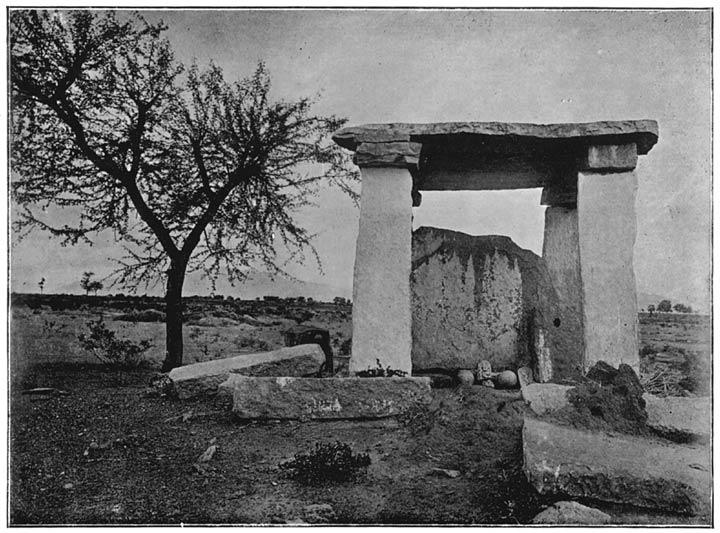
Kuruba Biradēvaru temple.
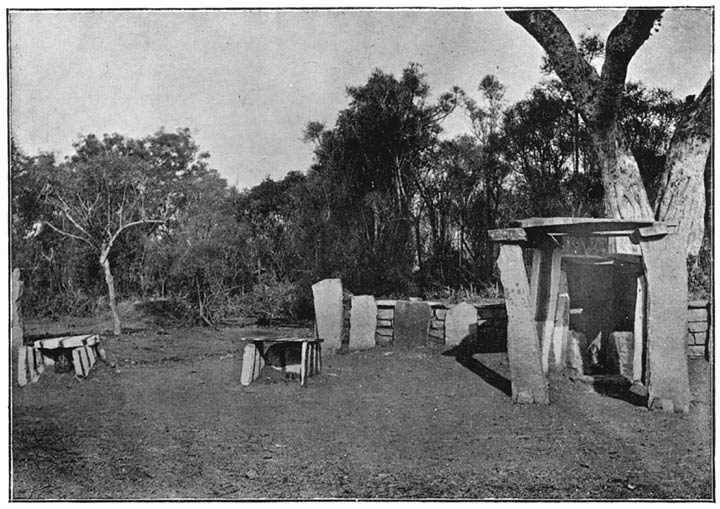
Kuruba dolmen-like graves.
Kuruhina Setti Vīraisaivar.—A synonym of Kurni. Kuruhina means literally a sign, mark, or token. Kuruvina Banajiga occurs as a synonym of Bilimagga.
Kurukkal.—See Gurukkal (Brāhman).
Kurukula Vamsam.—The name, derived from Kuru, the ancestor of the Kauravas, assumed by some Pattanavans.
Kurumba or Kuruman.—As bearing on the disputed question of the connection between the Kurumbas who dwell in the jungle, and the Kurubas (shepherds and weavers) who live in the plains and open country, I may quote the evidence of various witnesses:—
Madras Census Report, 1891.—“The Kurumbas or Kurrubas are the modern representatives of the ancient Kurumbas or Pallavas, who were once so powerful throughout Southern India, but very little trace of their greatness now remains. In the seventh century, the power of the Pallava kings seems to have been at its zenith; but, shortly after this, the Kongu, Chōla, and Chālūkya chiefs succeeded in winning several victories over them. The final overthrow of the Kurumba sovereignty was effected by the Chōla king Adondai about the seventh or eighth century A.D., and the Kurumbas were scattered far and wide. Many fled to the hills, and in the Nīlgiris and the Wynād, in Coorg and Mysore, representatives of this ancient race are now found as wild and uncivilised tribes. Elsewhere the Kurumbas are more advanced, and are usually shepherds, and weavers of coarse woollen blankets.”
“Kuruman.—This caste is found in the Nīlgiris and the Wynād, with a slight sprinkling in the Nilambūr and Attapādi hills in Malabar. Their principal occupations are wood-cutting, and the collection of forest produce. The name is merely another form of Kurumban, but, as they differ from the ordinary Kurumbas, it seemed better to show them separately. I think, however, that they were originally identical with the shepherd Kurumbans, and their present separation is merely the result of their isolation in the fastnesses of the Western Ghāts, to which their ancestors fled, or gradually retreated after the downfall of the Kurumba dynasty. The name Kurumbranād, a sub-division of Malabar, still bears testimony to their once powerful position.”
Madras Census Report, 1901—”Kuruba; Kurumban.—These two have always been treated as the same caste. Mr. Thurston (Madras Mus. Bull. II, i) thinks they are distinct. I have no new information, which will clearly decide the matter, but the fact seems to be that Kurumban is the Tamil form of the Telugu or Canarese Kuruba, and that the two terms are applied to the same caste according to the language in which it is referred to. There was no confusion in the abstraction offices between the two names, and it will be seen that Kuruba is returned where Canarese and Telugu are spoken, and Kurumban where the vernacular is Tamil. There are two sharply defined bodies of Kurumbans—those who live on the Nīlgiri plateau, speak the Kurumba dialect, and are wild junglemen; and those who live on the plains, speak Canarese, and are civilised.”
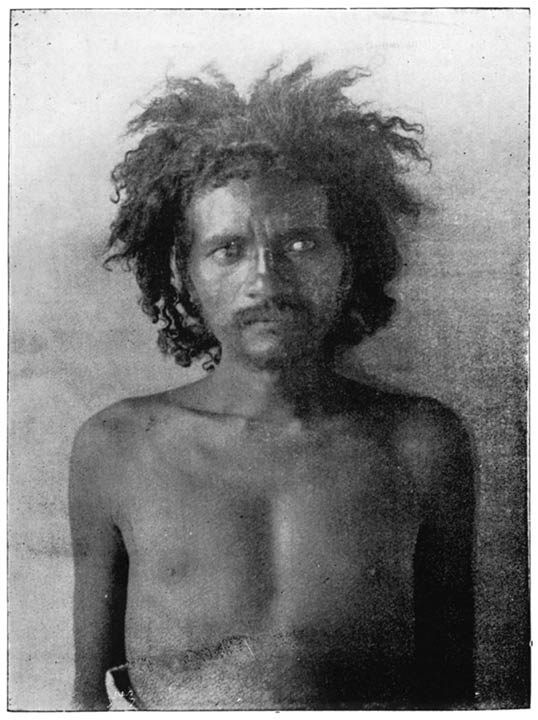
Kurumba.
Mysore Census Report, 1891—Kādu Kuruba or Kurumba.—“The tribal name of Kuruba has been traced to the primeval occupation of the race, viz., the tending of sheep, perhaps when pre-historic man rose to the pastoral stage. The Uru or civilised Kurubas, who are genuine tillers of the soil, and who are dotted over the country in populous and thriving communities, and many of whom have, under the present ‘Pax Britannica,’ further developed into enterprising tradesmen and withal lettered Government officials, are the very antipodes of the Kādu or wild Kurubas or Kurumbas. The latter, like the Iruligās and Sōligās, are the denizens of the backwoods of the country, and have been correctly classed under the aboriginal population. The Tamilised name of Kurumba is applied to certain clans dwelling on the heights of the Nīlgiris, who are doubtless the offshoots of the aboriginal Kādu Kuruba stock found in Mysore.”
W. R. King. Aboriginal Tribes of the Nilgiri Hills—”Kurumbas.—This tribe is of another race from the shepherd Kurumbas. The Nīlgiri tribe have neither cattle nor sheep, and in language, dress, and customs, have no affinity whatever with their namesakes.”
The above extracts will suffice for the purpose of showing that the distinction between the jungle Kurumbas and the more civilised Kurubas, and their relationship towards each other, call for a ‘permanent settlement.’ And I may briefly place on record the results of anthropometric observations on the jungle Kurumbas of the Nīlgiris, and the domesticated Kurubas of Mysore and the Bellary district, whose stature and nasal index (two factors of primary importance) are compared with those of the jungle Paniyans of Malabar and Kādirs of the Ānaimalai mountains—
Stature. Nasal index.
Average. Average. Maximum.
cm.
Kurubas, Bellary 162.7 74.9 92
Kurubas, Mysore 163.9 73.2 86
Kurumbas, Nilgiris 157.5 88.8 111
Paniyans 157.4 95.1 108
Kādirs 151.7 89 115
A glance at the above table at once shows that there is a closer affinity between the three dark-skinned, short, platyrhine jungle tribes, than between the jungle Kurumbas and the lighter-skinned, taller, and more leptorhine Kurubas.
The domesticated Kurubas are dealt with separately, and, in the remarks which follow, I am dealing solely with the jungle Kurumbas.
For the following note on the Kādu Kurumbas I am indebted to the Mysore Census Report, 1891. “There are two clans among them, viz., Bettada and Jēnu. The former worship the forest deities Nārāli and Māstamma; eat flesh and “drink liquor, a favourite beverage being prepared from rāgi (Eleusine Coracana) flour. Some of their habits and customs are worth mentioning, as indicating their plane of civilization. They have two forms of marriage. One is similar to the elaborate ceremony among the Vakkaligas, while the other is the simple one of a formal exchange of betel leaves and areca nuts, which concludes the nuptials. The Kādu Kurubas can only eat meals prepared by members of the higher castes. During their periodical illnesses, the females live outside the limits of the Hādi (group of rude huts) for three days. And, in cases of childbirth, none but the wet nurse or other attendant enters the room of the confined woman for ten days. In cases of sickness, no medical treatment is resorted to; on the other hand, exorcisms, charms, incantations, and animal sacrifices are more generally in vogue. The male’s dress consists of either a bit of cloth to cover their nudity, or a piece of coarse cloth tied round the waist, and reaching to the knees. They wear ornaments of gold, silver, or brass. They are their own barbers, and use broken glass for razors. The females wear coarse cloth four yards long, and have their foreheads tattooed in dots of two or three horizontal lines, and wear ear-rings, glass bangles, and necklaces of black beads. Strangers are not allowed to enter their hādis or hamlets with shoes or slippers on. In case of death, children are buried, whilst adults are burned. On the occurrence of any untoward event, the whole site is abandoned, and a new hādi set up in the vicinity. The Kādu Kurubas are very active, and capable of enduring great fatigue. It is said that they are revengeful, but, if treated kindly, they will do willing service. The Jēnu Kurubas live in small detached huts in the interior of thick jungles, far away from inhabited places. Their habits are no less wild. The male dress consists of either a woollen kambli or coarse cloth, and a skull cap. The female’s sādi is white coarse cloth, their wonted ornaments being a pair of brass ear-rings, strings of black beads tied round the neck, and glass bangles on the wrist. These people do not allow to outcasts and Musalmans access to their premises, or permit shoes being brought into their houses or streets. They eat flesh, and take meals from Vakkaligas, Lingāyats, and other superior castes. They subsist on wild bamboo seed, edible roots, etc., found in the jungle, often mixed with honey. They are said not unfrequently to make a dessert out of bees in preference to milk, ghī (clarified butter), etc. They are engaged chiefly in felling timber in the forests, and other similar rude pursuits, but they never own or cultivate land for themselves, or keep live-stock of their own. They are very expert in tracking wild animals, and very skilfully elude accidental pursuits thereby. Their children, more than two years old, move about freely in the jungle. They are said to be hospitable to travellers visiting their place at any unusual hour. They are Saivites, and Jangams are their gurus. The ceremonial pollution on account of death lasts for ten days, as with the Brāhmans. Children are buried, while adults, male or female, are cremated. A curious trait of this primitive race is that the unmarried females of the village or hādi generally sleep in a hut or chāvadi set apart for them, whilst the adult bachelors and children have a separate building, both under the eye of the head tribesman. The hut for the latter is called pundugār chāvadi, meaning literally the abode of vagabonds.” The Jēnu Kurumbas are said to eat, and the Betta Kurumbas to abstain from eating the flesh of the ‘bison’ (Bos gaurus).
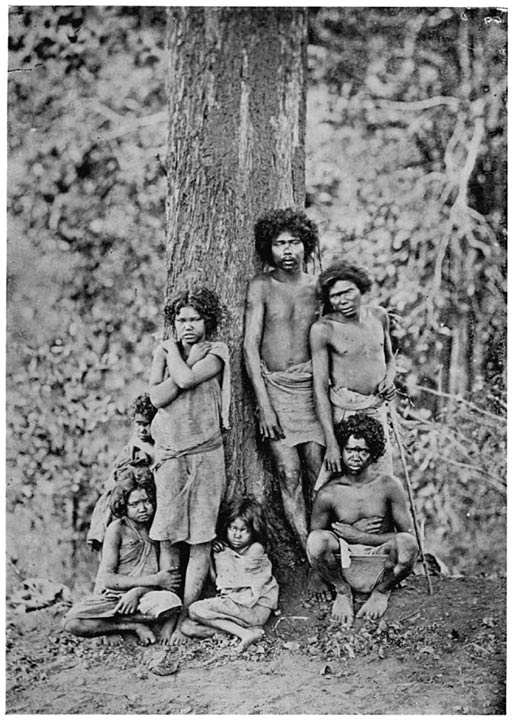
Kurumbas.
In a note on the Jēnu and Betta Kurumbas of Mysore, Mr. M. Venkatanarnappa writes as follows. “The Betta are better clothed and fed than the Jēn Kurumbas. Their occupation is kumri (burning and shifting) cultivation. Their women are clever at basket-making. They can be distinguished by the method of dress which their women have adopted, and the way in which the men wear their hair. A Betta woman covers her body below the shoulders by tying a long cloth round the arm-pits, leaving shoulders and arms bare, whereas a Jēn woman in good circumstances dresses up like the village females, and, if poor, ties a piece of cloth round her loins, and wears another to partially conceal the upper part of her body. Among males, a Betta Kurumba leaves his hair uncut, and gathers it from fore and aft into a knot tied on the crown of the head. A Jēn Kurumba shaves like the ryots, leaving a tuft behind, or clips or crops it, with a curly or bushy growth to protect the head from heat and cold. The Betta and Jēn Kurumbas never intermarry.” The Betta Kurumbas are, I am told, excellent elephant mahauts (drivers), and very useful at keddah (elephant-catching) operations.
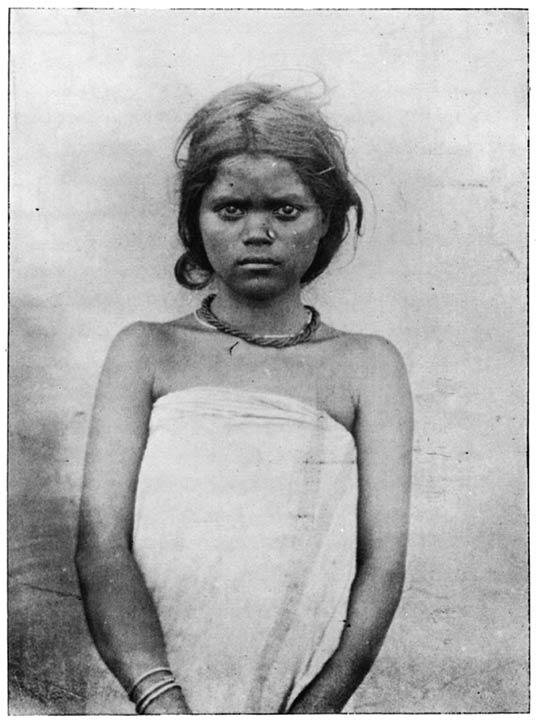
Kurumba.
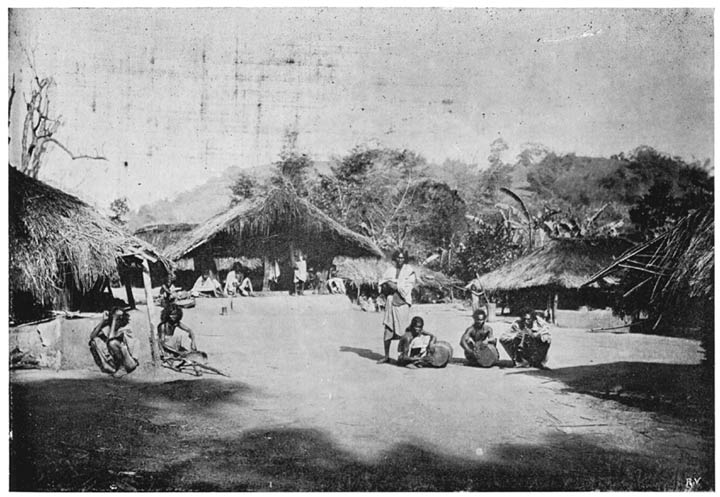
Kurumba village.
Of the Kurumbas who are found in the Wynād, Calicut, and Ernād tāluks of Malabar, the following account is given in the Gazetteer of that district. “They are sub-divided into Mullu (bamboo) Kurumbans, Jēn or Tēn (honey) Kurumbans, also called Kādu or Shōla Nāyakkans (or Jēnu Koyyo Shōla Nāyakas, i.e., honey-cutting lords of the woods), and Ūrali or Bēt Kurumbans; of which the first-named class, who consider themselves superior to the others, are cultivators and hunters; the second wood-cutters and collectors of honey; and the third make baskets and implements of agriculture. The Mullu and Tēn Kurumbans have headmen with titles of Mūppan and Mudali respectively conferred by their janmis (landlords). The Kurumbans, like many of the other hill-tribes, use bows and arrows, with which they are expert. The caste deity of the Tēn Kurumbans is called Masti. It is perhaps worth remarking that the Ūrali Kurumbans of the Wynaad differ from the other two classes in having no headmen, observing a shorter period of pollution after a birth than any other Malabar tribe and none at all after a death, and in not worshipping any of the Malabar animistic deities.”
The chief sub-divisions of the Kurumbas on the Nīlgiris, and in the Wynād, are said, in the Madras Census Report, 1891, to be “Mullu (thorn), Betta or Vetta (hill), Ūrāli (Ūr, a village), Tēn (honey), and Tac’chanādan Mūppan (carpenter headman). Of these, the first and last speak Malayālam, and wear a lock in front of their head in the Malabar fashion. The rest speak Canarese. Ūrāli Kurumbas work in metals.”
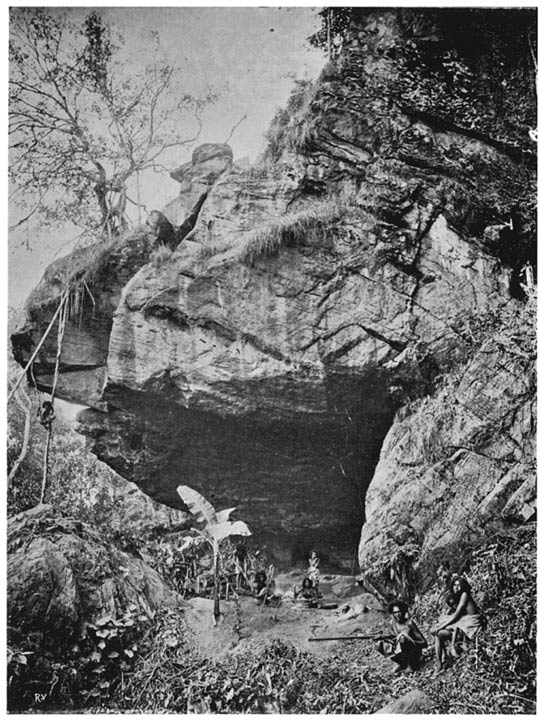
Kurumba cave.
I am informed that, among the Kurumbas of the Nīlgiris, it is the custom for several brothers to take one wife in common (adelphogamy), and that they do not object to their women being open to others also. There is said to be no marriage rite. A man and woman will mate together, and live as husband and wife. And, if it happens that, in a family, there has been a succession of such wives for one or two generations, it becomes an event, and is celebrated as such. The pair sit together, and pour water over each other from pots. They then put on new cloths, and a feast is partaken of. Among the Shōla Nāyakkars, a feature of the marriage ceremony is said to be for the bride to roll a cheroot of tobacco leaves, which both parties must smoke in turn.
It is noted, in the Gazetteer of the Nīlgiris, that the Kurumbas “trade largely on the extraordinary dread of their supposed magical powers which possesses the Todas and the Badagas—the latter especially. Stories are told of how they can summon wild elephants at will, and reduce rocks to powder merely by scattering mystic herbs upon them.”
Fortified by a liberal allowance of alcohol and tobacco, the Kurumbas, armed with bamboo torches, will follow up at night the tracks of a wounded ‘bison’ (Bos gaurus), and bring back the head and meat to camp. A European sportsman recounts that he has often seen his Kurumba shikāri (tracker) stop, and, with the one word “honey,” point to the top of an adjacent tree. “How do you know?” he asked, “Oh! I saw a bee” was the answer given with the greatest nonchalance. On one occasion he found himself close to a swarm of bees. The Kurumba, seeing him hesitate, thrust his stick clean through the swarm, and, with the bare remark “No honey,” marched on. The District Forest Officer, when out shooting, had an easy shot at a stag, and missed it. “There,” said the Kurumba, pointing to a distant tree, “is your bullet.” His trained sense of hearing no doubt enabled him to locate the sound of the bullet striking the tree, and his eyes, following the sound, instantly detected the slight blaze made by the bullet on the bark. The visual acuity of a number of tribes and castes inhabiting the mountains, jungles, and plains, has been determined by Dr. W. H. R. Rivers and myself, by means of the Cohn letter E method. And, though the jungle man, who has to search for his food and mark the tracks or traces of wild beasts, undoubtedly possesses a specially trained keenness of vision for the exigencies of his primitive life, our figures show that, as regards ordinary visual acuity, he has no advantage over the more highly civilised classes.
“The Kurumbas of the Mysore forests,” Mr. Theobald writes, “make fire by friction. They follow the same method as the Todas, as described by Mr. Thurston, but never use the powdered charcoal in the cavity of the horizontal piece of wood which is held down by their feet, or by a companion. The fine brown powder, formed during the rotation of the longer vertical piece, gives sufficient tinder, which soon ignites, and is then placed on a small piece of cotton rag, rolled loosely, and gently blown until it is ignited. The vertical stick is held between the palms, and has a reciprocal motion, by the palms being moved in opposite directions, at the same time using a strong downward pressure, which naturally brings the palms to the bottom, when they are at once raised to their original position, and the operation continued till the naturally formed tinder ignites.”
In his report on Forest Administration in Coorg, 1902–1903, Mr. C. D’A. McCarthy writes as follows concerning the Kurumbas, who work for the Forest department. “We experienced in connection with the Kurumbas one of those apparent aberrations of sense and intellect, the occurrence of which amongst this peculiar race was foreshadowed in the last report. The Chief Commissioner is aware that, in the interests of the Kurubas themselves, we substitute for a single cash payment distributions to the same value of food-grains, clothes and cash, in equal proportions of each. Now, seventy years ago, before the annexation of Coorg, the Kurubas and similar castes were prædial slaves of the dominant Coorgs, receiving no other remuneration for service than food and clothing. In fact, this institution, nothing less than real slavery, was not entirely broken up until the great demand for local labour created by the opening up of the country for coffee cultivation so late as 1860–1870, so that the existing generation are still cognisant of the old state of affairs. Last year, during the distribution of rewards for the successful protection of the reserves that season from fire, it seems that the idea was put into the heads of these people that our system of remuneration, which includes the distribution of food and clothing, was an attempt to create again at their expense a system of, as it were, forest slavery; with the result that for a time nothing would induce many of them to accept any form of remuneration for the work already performed, much less to undertake the same duties for the approaching season. It was some time, and after no little trouble, that the wherefore of this strange conduct was discovered, and the suspicions aroused put at rest.” In his report, 1904–1905, Mr. McCarthy states that “the local system of fire protection, consisting of the utilisation of the Kuruba jungle population for the clearing of fire lines and patrolling, and the payment of rewards according to results, may now be said to be completely established in Coorg. The Kurubas appear to have gained complete confidence in the working of the system, and, provided the superior officers personally see to the payment of the rewards, are evidently quite satisfied that the deductions for failures are just and fair.”
The Kurumbas are said to have been very useful in the mining operations during the short life of the Wynād gold-mines. A few years ago, I received the skulls of two Kurumbas, who went after a porcupine into a deserted tunnel on the Glenrock Gold-mining Company’s land in the Wynād. The roof fell in on them, and they were buried alive.
—— Indice nasal. Indice céphalique. Taille.
54 Panyer 84 74 154
28 Kouroumbas 81 75 157
12 Naiker 80 76.9 157
Concerning Nāyakas or Naikers and Kurumbas, Mr. F. W. F. Fletcher writes to me as follows from Nellakotta, Nīlgiris. “It may be that in some parts of Wynaad there are people known indifferently as Kurumbas and Shola Nāyakas; but I have no hesitation in saying that the Nāyakas in my employ are entirely distinct from the Kurumbas. The two classes do not intermarry; they do not live together; they will not eat together. Even their prejudices with regard to food are different, for a Kurumba will eat bison flesh, and a Nāyaka will not. The latter stoutly maintains that he is entirely distinct from, and far superior to, the Kurumba, and would be grievously offended if he were classed as a Kurumba. The religious ceremonies of the two tribes are also different. The Nāyakas have separate temples, and worship separate gods. The chief Kurumba temple in this part of the country is close to Pandalur, and here, especially at the Bishu feast, the Kurumbas gather in numbers. My Nāyakas do not recognise this temple, but have their place of worship in the heart of the jungle, where they make their pūja (worship) under the direction of their own priest. The Nāyakas will not attend the funeral of a Kurumba; nor will they invite Kurumbas to the funeral of one of their own tribe. There is a marked variation in their modes of life. The Kurumba of this part lives in comparatively open country, in the belt of deciduous forest lying between the ghāts proper and the foot of the Nīlgiri plateau. Here he has been brought into contact with European Planters, and is, comparatively speaking, civilised. The Nāyaka has his habitat in the dense jungle of the ghāts, and is essentially a forest nomad, living on honey, jungle fruits, and the tuberous roots of certain jungle creepers. By constant association with myself, my Nāyaka men have lost the fear of the white man, which they entertained when I first came into the district; but even now, if I visit the village of a colony who reside in the primæval forest, the women and children will hide themselves in the jungle at sight of me. The superstitions of the two tribes are different. Some Nāyakas are credited with the power of changing themselves at will into a tiger, and of wreaking vengeance on their enemies in that guise. And the Kurumba holds the Nāyaka in as much awe as other castes hold the Kurumba. Lower down, on the flat below the ghāts I am opening a rubber estate, and here I have another Nāyaka colony, who differ in many respects from their congeners above, although the two colonies are within five miles as the crow flies. The low-country Nāyaka does his hair in a knot on one side of his head, Malayālam fashion, and his speech is a patois of Malayālam. The Nāyaka on the hills above has a mop of curly hair, and speaks a dialect of his own quite distinct from the Kurumba language, though both are derived from Kanarese. But that the low-country people are merely a sept of the Nāyaka tribe is evident from the fact that intermarriage is common amongst the two colonies, and that they meet at the same temple for their annual pūja. The priest of the hill colony is the pūjāri for both divisions of the Nāyakas, and the arbiter in all their disputes.”
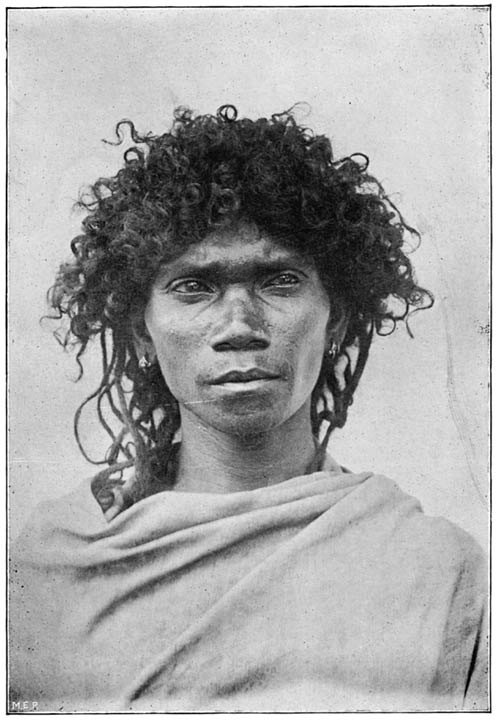
Kurumba (Shōla Naiker).
Kurumo.—The Kurumos are a caste of Oriya agriculturists, found mainly in the Russellkonda tāluk of Ganjam. They are called Kurumo by Oriyas, and Kudumo by Telugus. There is a tradition that their name is derived from Srikurmam in the Vizagapatam district, where they officiated as priests in the Siva temple, and whence they were driven northward. The Kurumos say that, at the present day, some members of the caste are priests at Saivite temples in Ganjam, bear the title Rāvulo, and wear the sacred thread. It is noted in the Madras Census Report, 1901, that “some of them wear the sacred thread, and follow Chaitanya, and Oriya Brāhmans will accept drinking-water at their hands. They will eat in Brāhmans’ houses, and will accept drinking-water from Gaudos, Bhondāris, and Rāvulos.” Bhondāris wash the feet of Kurumos on ceremonial occasions, and, in return for their services, receive twice the number of cakes given to other guests at feasts.
In addition to the Kurumos proper, there is a section called Kūji Kurumo, which is regarded as lower in the social status. The caste titles are Bissoyi, Bēhara, Dudi, Majhi, Nāyako, Podhāno, Rāvulo, Ravuto, Sēnāpati, and Udhdhandra. Those who bear the title Dudi are priests at the temples of the village deities. The title Udhdhandra was conferred by a zamindar, and is at present borne by a number of families, intermarriage among members of which is forbidden. Every village has a headman entitled Adhikari, who is under the control of a chief headman called Bēhara. Both these appointments are hereditary.
Among other deities, the Kurumos worship various Tākurānis (village deities), such as Bōdo Rāvulo, Bāgha Dēvi, Kumbēswari, and Sathabhavuni. In some places, there are certain marriage restrictions based on the house-gods. For example, a family whose house-god is Bōdo Rāvulo may not intermarry with another family which worships the same deity. Every family of Kurumos apparently keeps the house-god within the house, and it is worshipped on all important occasions. The god is usually represented by five areca nuts, which are kept in a box. These nuts must be filled with pieces of gold, silver, iron, copper, and lead, which are introduced through a hole drilled in the base of the nut, which is plugged with silver.
Infant marriage is the rule, and, if a girl does not secure a husband before she reaches maturity, she has to go through the mock-marriage rite, called dharma bibha, with her grandfather or other elder. On the evening of the day previous to that of the real marriage, called gondo sona, the paternal aunt of the bridegroom goes to a tank (pond), carrying thither a brass vessel. This is placed on the tank bund (embankment), and worshipped. Some cowry (Cypræa arabica) shells are then thrown into the tank, and the vessel is filled with water, and taken to the house. At the entrance thereto, a Sullokhondia Gaudo stands, holding a vessel of water, from which a little water is poured into the vessel brought from the tank. The bride’s aunt then goes to three or five houses of members of her own caste, and receives water therefrom in her vessel, which is placed near the house-gods, and eventually kept on the marriage dais throughout the wedding ceremonies. Over the marriage dais (bēdi) at the bridegroom’s house, four brass vessels, and four clay lamps fed with ghī (clarified butter), are placed at the four corners. Round the four posts thereof seven turns of thread are made by a Brāhman purōhit. The bridegroom, wearing mokkuto (forehead chaplet) and sacred thread, after going seven times round the dais, breaks the thread, and takes his seat thereon. After Zizyphus Jujuba leaves and rice have been thrown over him, he is taken in procession to a temple. On his return home, he is met by five or seven young girls and women at the entrance to the house, and Zizyphus leaves are again thrown over him. A Bhondāri woman sprinkles water from mango leaves over him, and he proceeds in a palanquin to the home of the bride. At the marriage ceremony, the bride throws rice on the head of the bridegroom over a screen which is interposed between them. After their hands have been tied together, a grinding-stone and roller are placed between them, and they face each other while their fingers are linked together above the stone. On the seventh day, the newly married couple worship seven posts at the bride’s house. The various articles used in connection with the marriage ceremonies, except one pot, are thrown into a tank. On his return thence, the bridegroom breaks the pot, after he has been sprinkled with the water contained in it by a Bhondāri. At times of marriage, and on other auspicious occasions, the Kurumos, when they receive their guests, must take hold of their sticks or umbrellas, and it is regarded as an insult if this is not done.
On the fifth and eighth days after the birth of a child, a new cloth is spread on the floor, on which the infant is placed, with a book (bāgavatham) close to its head, and an iron rod, such as is used by Oriya castes for branding the skin of the abdomen of newly-born babies, at its side. The relations and friends assemble to take part in the ceremonial, and a Brāhman purōhit reads a purānam. Betel leaves and areca nuts are then distributed. On the twenty-first day, the ceremonial is repeated, and the purōhit is asked to name the child. He ascertains the constellation under which it was born, and announces that a name commencing with a certain letter should be given to it.
Like other Oriya castes, the Kurumos are particular with regard to the observation of various vratams (fasts). One, called sudasa vratam, is observed on a Thursday falling on the tenth day after new moon in the month of Karthika (November-December). The most elderly matron of the house does pūja (worship), and a purānam is read. Seven cubits of a thread dyed with turmeric are measured on the forearm of a girl seven years old, and cut off. The deity is worshipped, and seven knots are made in the piece of thread, which is tied on to the left upper arm of the matron. This vratam is generally observed by Oriya castes.
Kuruvikkāran.—The Kuruvikkārans are a class of Marāthi-speaking bird-catchers and beggars, who hunt jackals, make bags out of the skin, and eat the flesh thereof. By Telugu people they are called Nakkalavāndlu (jackal people), and by Tamilians Kuruvikkāran (bird-catchers). They are also called Jāngal Jāti and Kāttu Mahrāti. Among themselves they are known as Vagiri or Vagirivala. They are further known as Yeddu Marigē Vētagāndlu, or hunters who hide behind a bullock. In decoying birds, they conceal themselves behind a bullock, and imitate the cries of birds in a most perfect manner. They are said to be called in Hindustani Paradhi and Mīr Shikāri.
The Kuruvikkārans are nomadic, and keep pack-bullocks, which convey their huts and domestic utensils from place to place. Some earn their living by collecting firewood, and others by acting as watchmen in fields and gardens. Women and children go about the streets begging, and singing songs, which are very popular, and imitated by Hindu women. They further earn a livelihood by hawking needles and glass beads, which they may be seen in the evening purchasing from Kayalans (Muhammadan merchants) in the Madras bazar.
Some Kuruvikkārans carry suspended from their turban or body-cloth a small whistle, with which they imitate the song of birds, and attract them. Young boys often have with them a bundle of small sticks strung together, and with a horse-hair noose attached to them. The sticks are driven into the ground, and grain is strewn around to entice birds, which get caught in the noose.
The women wear a petticoat and an ill-fitting bodice. Among other classes “Wearing the bodice like a Kuruvikkāran woman” is used as a taunt. The petticoat may never be taken off till it is tattered and torn, and replaced by a new one; and, when a woman bathes, she has to do so with the garment on. Anything which has come in contact with the petticoat, or rice husked with a woman’s feet, is polluted, and may not be used by men. Women adorn themselves with necklaces of beads and cowry shells, or sometimes, like the Lambādis, wear shell bracelets. Both men and women stain their teeth with a preparation of myrabolams, Acacia arabica pods, and sulphates of copper and iron. Females may not blacken their teeth, or wear a necklace of black beads before marriage.
A young married woman, wherever she may be during the daytime, must rejoin her husband at night. If she fails to do so, she has to go through the ordeal of grasping a red-hot iron bar or sickle, and carrying it sixteen paces without dropping it. Another form of ordeal is dipping the hands in a pot containing boiling cowdung water, and picking out therefrom a quarter-anna piece. If the woman is innocent, she is able to husk a small quantity of paddy (rice) by rubbing it between her hands immediately after the immersion in the liquid. If a man has to submit to trial by ordeal, seven arka (Calotropis gigantea) leaves are tied to his palm, and a piece of red-hot iron placed thereon. His innocence is established if he is able to carry it while he takes seven long strides.
The Kuruvikkārans have exogamous septs, of which Rānaratōd seems to be an important one, taking a high place in the social scale. Males usually add the title Sing as a suffix to their names.
Marriage is always between adults, and the celebration, including the betrothal ceremony, extends over five days, during which meat is avoided, and the bride keeps her face concealed by throwing her cloth over it. Sometimes she continues to thus veil herself for a short time after marriage. On the first day, after the exchange of betel, the father of the bride says “Are you ready to receive my daughter as your daughter-in-law into your house? I am giving her to your son. Take care of her. Do not beat her when she is ill. If she cannot carry water, you should help her. If you beat her, or ill-treat her in any way, she will come back to us.” The future father-in-law having promised that the girl will be kindly treated, the bridegroom says “I am true, and have not touched any other woman. I have not smiled at any girl whom I have seen. Your daughter should not smile at any man whom she sees. If she does so, I shall drive her back to your house.” In the course of the marriage ceremonies, the bride is taken to the home of her mother-in-law, to whom she makes a present of a new cloth. The Nyavya (headman) hands a string of black beads to the mother-in-law, who ties it round the bride’s neck, while the assembled women sing. At a marriage of the first daughter of a member of the Rānaratōd sept, a Brāhman purōhit is invited to be present, and give his blessing, as it is believed that a Gujarāti Brāhman was originally employed for the marriage celebration.
The principal tribal deity of the Kuruvikkārans is Kāli or Durga, and each sept possesses a small plate with a figure of the goddess engraved on it, which is usually kept in the custody of the headman. It is, however, frequently pledged, and money-lenders give considerable sums on the security of the idol, as the Kuruvikkārans would on no account fail to redeem it. When the time for the annual festival of the goddess draws nigh, the headman or an elder piles up Vigna Catiang seeds in five small heaps. He then decides in his mind whether there is an odd or even number of seeds in the majority of heaps. If, when the seeds are counted, the result agrees with his forecast, it is taken as a sign of the approval of the goddess, and arrangements are made for the festival. Otherwise it is abandoned for the year. On the day of the festival, nine goats and a buffalo are sacrificed. While some cakes are being cooked in oil, a member of the tribe prays that the goddess will descend on him, and, taking some of the cakes out of the boiling liquid, with his palm rubs the oil on his head. He is then questioned by those assembled, to whom he gives oracular replies, after sucking the blood from the cut throat of a goat. It is noted in the North Arcot Manual that the Vagirivalas assemble two or three times in the year at Varadāreddipalli for worship. The objects of this are three saktis called Mahan Kāli, Chāmundi, and Mahammāyi, represented by small silver figures, which are mortgaged to a Reddi of the village, and lent by him during the few days of the festival.
Kūsa.—A sub-division of Holeyas in South Canara, who also call themselves Uppāra. Some of them say that they are the same as Uppāras of Mysore, whose hereditary occupation was the manufacture of salt from salt-earth (ku, earth). Kūsa further occurs as a synonym of the Otattu, or tile-making section of the Nāyars, and Kūsa Mārān as a class of potters in Travancore. Kūsa is also an exogamous sept of the Bōyas.
“Oh! potter chief ... what toil hath befallen thee!
The descendant of the Cora kings....
Hath gained the world of gods. And so
’Tis thine to shape an urn so vast
That it shall cover the remains of such an one.”
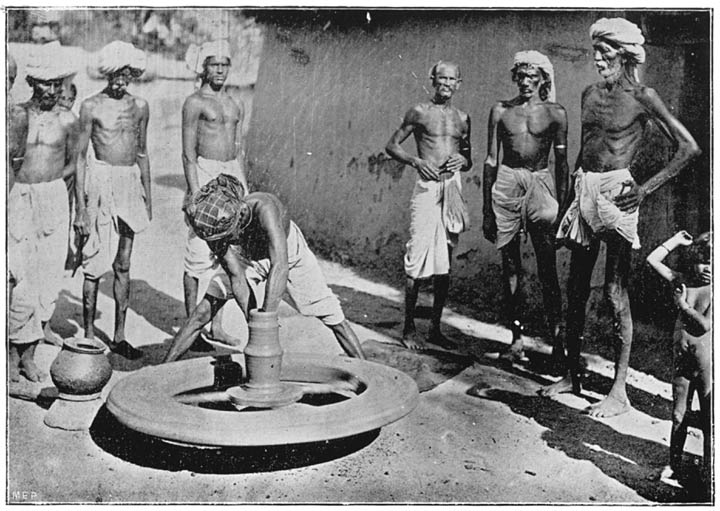
Kusavans.
When travelling in India, Dr. Jagor noticed that the potters of Salem communicated to their ware a kind of polish, exactly like that seen on some of the specimens of antique pottery found in cromlechs. It was ascertained that the Salem potters use a seed for producing the polish, which was determined by Surgeon-General G. Bidie to be the seed of Gyrocarpus Jacquini, which is also used for making rosaries and necklaces. Another method employed for producing a polish is to rub the surface of the baked vessel with the mucilaginous juice of tuthi (Abutilon indicum), and then fire the vessel again.
It is stated, in the Coimbatore Manual, that “the potter never begins his day’s work at the wheel without forming into a lingam and saluting the revolving lump of clay, which, with the wheel, bears a strong resemblance to the usual sculptured conjunction” (of lingam and yōni). An old potter woman, whom I examined on this point, explained that the lump represents Ganēsa. In like manner, the pan coolies at the salt factories never scrape salt from the pans without first making a Pillayar (Ganēsa) of a small heap of salt, on the top of which the salt is sometimes piled up.
For the following note on a ceremony, in which the potters take part, I am indebted to an essay submitted in connection with the M.A. degree of the Madras University. “Brāhmans of Vēdic times ate dogs, horses, bulls, and goats. The fondness for mutton even in a raw state finds its modern counterpart in the bloody hecatombs that disfigure some of their annual sacrifices. In these ceremonies called Pasubandha, Agnishtoma, Vajapeya, Garudachayana, etc., a goat is tied to a post, and, after the usual mantrams (prayers) and the service of frankincense, etc., is ablutioned in water mixed with turmeric and taken to the slaughter-room. And the method of slaughtering is most appalling. Two men appointed for the purpose, invariably men belonging to the pot-making community, rush into the apartment. One catches hold of the fore-quarter of the animal and keeps it from struggling, while the other squeezes the scrotum with so much violence that the animal succumbs in a few minutes, after writhing in the most painful fashion. The man in charge of the fore-quarter puts a handful of salt into the animal’s mouth, and holds it tight, lest the animal should bleat, and make the ceremony unsanctimonious. The carcase is now brought to the mailing shed, where, with crude knives and untrained hands, the Brāhmans peel off the skin most savagely. Then they cut open the chest, and it is a common sight to see these Brāhmans, uninitiated in the art of butchery, getting their hands severely poked or lacerated by the cut sharp ends of the ribs. Then portions of flesh are cut off from various portions of the carcase, such as the buccal region, the cardiac region, the scapular region, the renal, the scrotal, the gluteal and gastroenemial regions. The amount of flesh thus chopped comes to not less than three big potfuls, and they are cooked in water over the slow fire of a primitively constructed oven. No salt is put to season the meat, but the Brāhmans bolt it without any condiment in an awful fashion.”
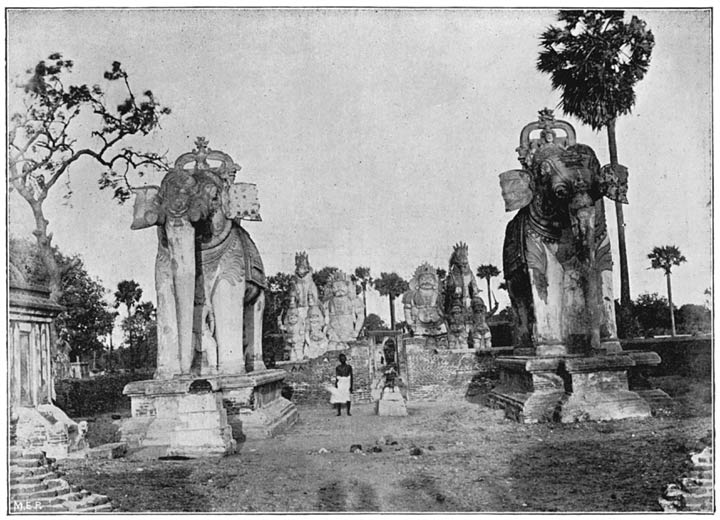
Aiyanar temple.
The services of the potter are required in connection with the marriage ceremonial of many castes. At some Brāhman marriages, for example, the tāli is tied on the bride’s neck in the presence of 33 crores (330 millions) of gods, who are represented by a number of variously coloured pots, large and small. At a Lingāyat wedding, new pots are brought with much shouting, and deposited in the room in which the household god is kept. An enclosure is made round the bride and bridegroom with cotton thread passed round four pots placed at the four corners of the marriage pandal. Among the Patnūlkārans, on the occasion of a wedding, a number of small pots are set up in a room, and worshipped daily throughout the marriage ceremonies. The ceremonial of breaking a pot containing water at the graveside prevails among many classes, e.g., Oddēs, Toreyas, and Paraiyans.
At the time of the Aruvaththimūvar festival, or festival of the sixty-three saints, at Mylapore in the city of Madras, crowds may be seen returning homeward after attending it, each carrying a new pot (chatty), which they purchase so as not to go home empty-handed. At the festival of Tiruvottiyūr, stalks of Amarantus gangeticus are in like manner purchased.
It is noted, in the Gazetteer of the Madura district, that “a Kusavan can claim the hand of his paternal aunt’s daughter. Marriage occurs before puberty. The tāli is tied by the bridegroom’s sister, and the usual bride-price is paid. The ceremonies last three days. One of them consists in the bridegroom’s sister sowing seeds in a pot, and, on the last day of the wedding, the seedlings which have sprouted are taken with music to a river or tank (pond), and thrown into it. When the bride attains maturity, a ceremony is conducted by the caste priest, and consummation follows on the next auspicious day.”
For the notes of the following case I am indebted to Captain F. F. Elwes, I.M.S. A bricklayer, about a month and a half or two months prior to admission into hospital, fell from a height, and injured his left arm. He went to a potter, who placed the arm and forearm in a splint, the former in a line with the latter, i.e., fully extended. He kept the splint on for about a month and, when it was removed, found that he was unable to bend the arm at the elbow-joint. When he was examined at the hospital, practically no movement, either active or passive, could be obtained at the elbow-joint. The lower end of the humerus could be felt to be decidedly thickened both anteriorly and posteriorly. There had apparently been a fracture of the lower end of the humerus. Röntgen ray photographs showed an immense mass of callus extending over the anterior surface of the elbow-joint from about two and a half inches above the lower end of the humerus to about an inch below the elbow-joint. There was also some callus on the posterior surface of the lower end of the humerus.
In the Madura district, the Kusavans have Vēlan as a title.
Kutikkar.—A name for Dāsis in Travancore.
Kutraki (wild goat).—An exogamous sept of Jātapu.
Kūttādi.—Described, in the Census Report, 1901, as an occupational name, meaning a rope-dancer, applied to Dommaras, Paraiyans, or Koravas. Ārya Kūttādi is a Tamil synonym for Marātha (Ārē) Dommaras. Kūttādi also occurs as the name of a class of mendicants attached to Kaikōlans.
Kūttan.—A division of Toda.
Kūttina.—Recorded, in the Travancore Census Report, 1901, as a sub-division of Nāyar.
Kuttiya.—A sub-division of Kond.
Kuzhal.—The name of the flute used by shepherds and snake-charmers. It occurs as an exogamous sept of Toreyas, the members of which must not hear the sound of this musical instrument when at meals.
Kūzhappara.—Recorded, in the Travancore Census Report, 1901, as a sub-division of Nāyar.
Kuzhiyan.—A synonym derived from kuzhi a pit, for Thanda Pulayans, in reference to the legend that they were found emerging in a state of nudity from a pit.