Volume 4 — M (continued 3)
Reading edition
Mangalakkal.—This and Manigrāmam are recorded, in the Travancore Census Report, 1901, as sub-divisions of Nāyar.
Mānikala (a measure).—An exogamous sept of Yānādi.
Mānikattāl.—A synonym of Dēva-dāsi applied to dancing-girls in the Tamil country.
Maniyakkāran.—Maniyakkāran or Maniyagāran, meaning an overseer, occurs as a title or synonym of Parivāram and Sembadavan. As a name of a sub-division of the Idaiyan shepherds, the word is said to be derived from mani, a bell, such as is tied round the necks of cattle, sheep, and goats. Maniyakkāran has been corrupted into monegar, the title of the headman of a village in the Tamil country.
Manjaputtūr.—A sub-division of Chettis, who are said to have emigrated to the Madura district from Cuddalore (Manjakuppam).
Mānla (trees).—An exogamous sept of Chenchu.
Mannādi.—A title of Kunnavans of the Palni hills, often given as the caste name. Also a title of Pallans and Mūttāns.
Mannādiyar.—A trading sub-division of Nāyar.
Mannān (Washerman caste).—See Vannān and Vēlan.
Mannēdora (lord of the hills).—A title assumed by Konda Doras. Mannē Sultan is a title of the Mahārāja of Travancore and the Rāja of Vizianagram. The Konda Doras also style themselves Mannēlu, or those of the hills.
Mannu (earth).—A sub-division of Oddēs, who are earth-workers. Manti, which has also been returned by them at times of census, has a similar significance (earthen). Man Udaiyan occurs as a synonym of Kusavan, and Manal (sand) as an exogamous sept of Kāppiliyan. Man Kavarai is recorded in the Salem Manual as the name of a class of salt makers from salt-earth.
Mantalāyi.—Recorded, in the Travancore Census Report, 1901, as a sub-division of Nāyar.
The cephalic index of the Māppillas is lower than that of the other Muhammadan classes in South India which I have examined, and this may probably be explained by their admixture with dolichocephalic Dravidians. The figures are as follows:—
Number examined. Cephalic index.
Māppilla 40 72.8
Sheik Muhammadan 40 75.6
Saiyad Muhammadan 40 75.6
Daira Muhammadan 50 75.6
Pathān Muhammadan 40 76.2
The cephalic indices, as recorded by Mr. Gray, were:—
Number examined. Cephalic index.
Tamils 6 75.4
Moplas 6 77.5
Hyderabad Contingent 6 75
Maharattas 7 79
The number of individuals examined is, however, too small for the purpose of generalisation.
In the Census Report, 1891, it is noted that some Māppillas have returned “Putiya Islām,” meaning new converts to Islām. These are mostly converts from the Mukkuvan or fisherman caste, and this process of conversion is still going on. Most of the fishermen of Tanūr, where there is an important fish-curing yard, are Mukkuvan converts. They are sleek and well-nourished, and, to judge from the swarm of children who followed me during my inspection of the yard, eminently fertile. One of them, indeed, was polygynous to the extent of seven wives, each of whom had presented him with seven sons, not to mention a large consignment of daughters. On the east coast the occurrence of twins is attributed by the fishermen to the stimulating properties of fish diet. In Malabar, great virtue is attributed to the sardine or nalla mathi (good fish, Clupea longiceps), as an article of dietary.
Mr. A. R. Loftus-Tottenham informs me that “it is quite common now for Māppillas to invoke Mambram Tangal when in difficulties. I have heard a little Māppilla, who was frightened at my appearance, and ran away across a field, calling out ‘Mambram Tangal, Mambram Tangal.’ The Tangal, who had to be induced to leave Malabar, went off to Constantinople, and gained great influence with the Sultan.”
In connection with Māppilla superstition, Mr. Tottenham writes as follows. “A beggar died (probably of starvation) by the roadside in Walluvanād tāluk. When alive, no one worried about him. But, after he died, it was said that celestial voices had been heard uttering the call to prayer at the spot. The Māppillas decided that he was a very holy man, whom they had not fed during his life, and who should be canonised after death. A little tomb was erected, and a light may be seen burning there at night. Small banners are deposited by the faithful, who go in numbers to the place, and there is, I think, a money-box to receive their contributions.” Mr. Tottenham writes further that “the holy place at Malappuram is the tomb of the Sāyyids (saints or martyrs) who were killed in a battle by a local military chieftain. These Sāyyids are invoked. At Kondotti there is a very pretentious, and rather picturesque tomb—a square building of gneiss surmounted by a cupola—to one of the Tangals. Near it is a small tank full of more or less tame fish. It is one of the sights of the place to see them fed. At the great festival called neercha (vow), the Māppillas go in procession, headed by banners, elephants (if they possess them), and music, and carrying offerings to the head-quarters (Malappuram and Kondotti are the principal ones) of some Tangal, where they deposit the banners, I think at the tomb of the local saint, and present the offerings to the Tangal. At Malappuram, an enormous crowd of ten to twenty thousand assembles, and there is a great tamāsha (popular excitement). You will sometimes see a man with his hair uncut, i.e., he does not cut it till he has fulfilled the vow.”
It is recorded, in the Annual Report of the Basel Medical Mission, Calicut, 1907, that “cholera and smallpox were raging terribly in the months of August and September. It is regrettable that the people, during such epidemics, do not resort to hospital medicines, but ascribe them to the devil’s scourge. Especially the ignorant and superstitious Moplahs believe that cholera is due to demoniac possession, and can only be cured by exorcism. An account of how this is done may be interesting. A Thangal (Moplah priest) is brought in procession, with much shouting and drumming, to the house to drive out the cholera devil. The Thangal enters the house, where three cholera patients are lying; two of these already in a collapsed condition. The wonder-working priest refuses to do anything with these advanced cases, as they seem to be hopeless. The other patient, who is in the early stage of the disease, is addressed as follows. ‘Who are you?’—‘I am the cholera devil’. ‘Where do you come from?’—‘From such and such a place’. ‘Will you clear out at once or not?’—‘No, I won’t’. ‘Why?’—‘Because I want something to quench my thirst’. ‘You want blood?’—‘Yes’. Then the Thangal asks his followers and relatives to give him what he asks. A young bull is brought into the room and killed on the spot, and the patient is made to drink the warm blood. Then the Thangal commands him to leave the place at once. The patient, weak and exhausted, gathers up all his strength, and runs out of the house, aided by a cane which is freely applied to his back. He runs as far as he can, and drops exhausted on the road. Then he is carried back, and, marvellous to say, he makes a good recovery.”
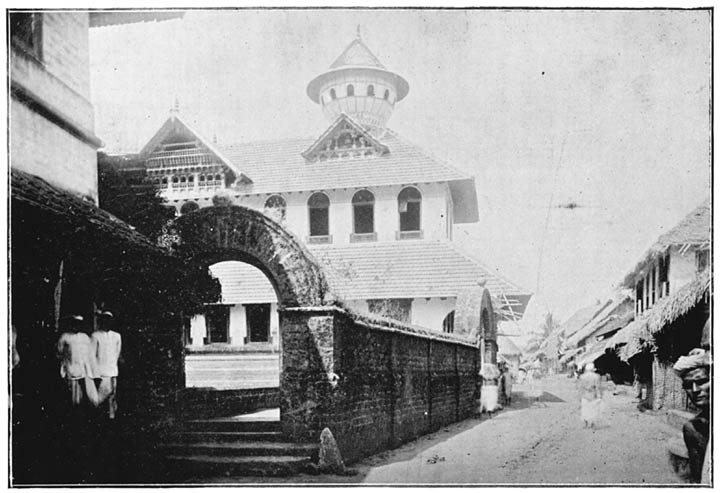
Māppilla mosque.
In 1859, Act No. XX for the suppression of outrages in the district of Malabar was passed.
In 1884, Government appointed Mr. Logan, the Head Magistrate of Malabar, to enquire into the general question of the tenure of land and tenant right, and the question of sites for mosques and burial-grounds in the district. Mr. Logan expressed his opinion that the Māppilla outrages were designed “to counteract the overwhelming influence, when backed by the British courts, of the janmis in the exercise of the novel powers of ouster, and of rent-raising conferred upon them. A janmi who, through the courts, evicted, whether fraudulently or otherwise, a substantial tenant, was deemed to have merited death, and it was considered a religious virtue, not a fault, to have killed such a man, and to have afterwards died in arms, fighting against an infidel Government.” Mr. MacGregor, formerly Collector of Malabar, had, some years before, expressed himself as “perfectly satisfied that the Māppilla outrages are agrarian. Fanaticism is merely the instrument, through which the terrorism of the landed classes is aimed at.”
In 1884 an outbreak occurred near Malappuram, and it was decided by Government to disarm the tāluks of Ernād, Calicut, and Walluvanād. Notwithstanding the excited state of the Māppillas at the time, the delicate operation was successfully carried out by the district officers, and 17,295 arms, including 7,503 fire-arms of various kinds, were collected. In the following year, the disarming of the Ponnāni tāluk was accomplished. Of these confiscated arms, the Madras Museum possesses a small collection, selected from a mass of them which were hoarded in the Collector’s office, and were about to be buried in the deep sea.
The fanatical outbreaks of recent times have been exclusively limited to the Ernād and Walluvanād tāluks. There are quartered at the present time at Malappuram in the Ernād tāluk a special Assistant Collector, a company of British troops, and a special native police force. In 1905, Government threw open 220 scholarships, on the results of the second and third standard examinations, to Māppilla pupils of promise in the two tāluks mentioned above, to enable them to prosecute their studies for the next higher standard in a recognised school connected with the Madras Educational Department. Twenty scholarships were further offered to Māppillas in the special class attached to the Government School of Commerce, Calicut, where instruction in commercial arithmetic, book-keeping, commercial practice, etc., is imparted in the Malayālam language. In 1904, a Māppilla Sanskrit school was founded at Puttūr, some of the pupils at which belong to the families of hereditary physicians, who were formerly good Sanskrit scholars.
At a Loyalty meeting of Māppillas held at Ponnāni in 1908 under the auspices of the Mannath-ul-Islam Sabha, the President spoke as follows. “When the Moplahs are ranged on the side of order, the peace of the country is assured. But the Moplah is viewed with suspicion by the Government. He has got a bad name as a disturber of the peace. He is liable to fits, and no one knows when he may run amock. From this public platform I can assure the Government as well as the public that the proper remedy has at last been applied, and the Moplah fits have ceased, never to return. What the remedy was, and who discovered it, must be briefly explained. Every Moplah outbreak was connected with the relapse of a convert. In the heat of a family quarrel, in a moment of despair, a Hindu thought to revenge himself upon his family by becoming a convert to Islam. In a few days, repentance followed, and he went back to his relatives. An ignorant Mullah made this a text for a sermon. A still more ignorant villager found in it an opportunity to obtain admission into the highest Paradise. An outbreak results. The apostate’s throat is cut. The Moplah is shot. Deportation and Punitive Police follow. The only rational way to put a final stop to this chronic malady was discovered by a Hindu gentleman. The hasty conversions must be stopped. Those who seek conversion must be given plenty of time to consider the irrevocable nature of the step they were going to take. The Mullahs must be properly instructed. Their interpretation of the Koran was wrong. There is absolutely nothing in our scriptures to justify murders of this kind, or opposition to the ruling power. The ignorant people had to be taught. There was no place in Paradise for murderers and cut-throats. Their place was lower down. Three things had to be done. Conversion had to be regulated; the Mullahs had to be instructed; the ignorance of the people had to be removed. Ponani is the religious head-quarters of the Moplahs of the West Coast, including Malabar, South Canara, and the Native States of Cochin and Travancore. The Jarathingal Thangal at Ponani is the High Priest of all the Moplahs; the Mahadoom Thangal of Ponani is the highest authority in all religious matters. It is he that sanctifies the Musaliars. The Mannath-ul-Islam Sabha at Ponani was started under the auspices of the Jarathingal Thangal and the Mahadoom Thangal. Two schools were opened for the education of new converts, one for boys and the other for girls. Strict enquiries were made as to the state of mind and antecedents of all who seek conversion. They are kept under observation long enough, and are admitted only on the distinct understanding that it is a deliberate voluntary act, and they have to make up their minds to remain. Some six thousand converts have passed through our schools since the Sabha was started. The Musaliars are never sanctified until they are thoroughly grounded in the correct principles of our religion, and an assurance is obtained from them that they will never preach rebellion. No Musaliar will break a promise given to the Thangal. The loyalty of the Musaliars and Mullahs is thus assured. Where there is no Musaliar to bless them, there is no Moplah to die as a martyr. The Mullahs are also taught to explain to all villagers that our scriptures condemn opposition to the ruling power, and that loyalty to the Sovereign is a religious duty. We are also trying to spread education among the ignorant villagers. In order further to enlist the sympathies of the people, extensive charities have been organised. Sixteen branches of the Sabha have been opened all over South Malabar and the States of Travancore and Cochin. A very large number of domestic quarrels—divorce cases, partition cases, etc.—have been settled by arbitration through these branch associations. It is an immense power for good.”
The Māppillas have been summed up, as regards their occupations, as being traders on the coast, and cultivators in the interior, in both of which callings they are very successful and prosperous. “In the realm of industry,” it has been said, “the Moplah occupies a position, which undoubtedly does him credit. Poverty is confined almost exclusively to certain wild, yet picturesque tracts in the east of Malabar, where the race constitutes the preponderating element of the population, and the field and farm furnish the only means of support to the people. And it is just in those areas that one may see at their best the grit, laboriousness, and enterprise of the Moplah. He reclaims dense forest patches, and turns them into cultivated plots under the most unfavourable conditions, and, in the course of a few years, by hard toil and perseverance, he transforms into profitable homesteads regions that were erstwhile virgin forest or scrubby jungle. Or he lays himself out to reclaim and plant up marshy lands lying alongside rivers and lagoons, and insures them from destruction by throwing up rough but serviceable dykes and dams. In these tracts he is also sometimes a timber merchant, and gets on famously by taking out permits to fell large trees, which he rafts down the rivers to the coast. The great bulk of the Moplahs in these wild regions belong purely to the labouring classes, and it is among these classes that the pinch of poverty is most keenly felt, particularly in the dull monsoon days, when all industry has to be suspended. In the towns and coast ports, the Moplahs are largely represented in most branches of industry and toil. A good many of them are merchants, and get on exceedingly well, being bolder and more speculative than the Hindus of the district. The bulk of petty traders and shop-keepers in Malabar are also Moplahs, and, in these callings, they may be found at great distances from home, in Rangoon, Ceylon, the Straits and elsewhere, and generally prospering. Almost everywhere in their own district they go near monopolising the grocery, hardware, haberdashery, and such other trades; and as petty bazar men they drive a profitable business on the good old principle of small profits and quick returns. No native hawker caters more readily to Mr. Thomas Atkins (the British soldier) than the Moplah, and, in the military stations in Malabar, ‘Poker’ (a Moplah name) waxes fat and grows rich by undertaking to supply Tommy with tea, coffee, lemonade, tobacco, oilman stores, and other little luxuries.”
The Māppillas take an active share in the fish-curing operations along the west coast, and the Mukkuvans, who are the hereditary fishermen of Malabar, are inclined to be jealous of them. A veteran Mukkuvan, at the time of my inspection of the Badagara fish-curing yard in 1900, put the real grievance of his brethren in a nutshell. In old days, he stated, they used salt-earth for curing fishes. When the fish-curing yards were started, and Government salt was issued, the Mukkuvans thought that they were going to be heavily taxed. They did not understand exactly what was going to happen, and were suspicious. The result was that they would have nothing to do with the curing-yards. The use of salt-earth was stopped on the establishment of Government salt, and some of the fishermen were convicted for illegal use thereof. They thought that, if they held out, they would be allowed to use salt-earth as formerly. Meanwhile, the Māppillas, being more wide-awake than the Mukkuvans, took advantage of the opportunity (in 1884), and erected yards, whereof they are still in possession. A deputation of Mukkuvans waited on me. Their main grievance was that they are hereditary fishermen, and formerly the Māppillas were only the purchasers of fish. A few years ago, the Māppillas started as fishermen on their own account, with small boats and thattuvala (tapping nets), in using which the nets, with strips of cocoanut leaves tied on to the ropes, are spread, and the sides of the boats beaten with sticks and staves, to drive the fish into the net. The noise made extends to a great distance, and consequently the shoals go out to sea, too far for the fishermen to follow in pursuit. In a petition, which was submitted to me by the Mukkuvan fish-curers at Badagara, they asked to have the site of the yard changed, as they feared that their women would be ‘unchastised’ at the hands of the Māppillas.
“Small isolated attempts,” Major Holland-Pryor writes, “to recruit Māppillas were made by various regiments quartered in Malabar some years ago, but without success. This was probably owing to the fact that the trial was made on too small a scale, and that the system of mixed companies interfered with their clannish propensities. The district officers also predicted certain failure, on the ground that Māppillas would not serve away from their own country. Their predictions, however, have proved to be false, and men now come forward in fair numbers for enlistment.” In 1896, the experiment of recruiting Māppillas for the 25th Madras Infantry was started, and the responsible task of working up the raw material was entrusted to Colonel Burton, with whose permission I took measurements of his youthful warriors. As was inevitable in a community recruited by converts from various classes, the sepoys afforded an interesting study in varied colouration, stature and nasal configuration. One very dark-skinned and platyrhine individual, indeed, had a nasal index of 92. Later on, the sanction of the Secretary of State was obtained for the adoption of a scheme for converting the 17th and 25th regiments of the Madras Infantry into Māppilla corps, which were subsequently named the 77th and 78th Moplah Rifles. “These regiments,” Major Holland-Pryor continues, “at present draw their men principally from Ernād and Valuvanād. Labourers from these parts are much sought after by planters and agents from the Kolar gold-fields, on account of their hardiness and fine physique. Some, however, prefer to enlist. The men are generally smaller than the Coast Māppillas, and do not show much trace of Arab blood, but they are hardy and courageous, and, with their superior stamina, make excellent fighting material.” In 1905 the 78th Moplah Rifles were transferred to Dēra Ismail Khān in the Punjāb, and took part in the military manœuvres before H.R.H. the Prince of Wales at Rawalpindi. It has been observed that “the Moplahs, in dark green and scarlet, the only regiment in India which wears the tarbush, are notable examples of the policy of taming the pugnacious races by making soldiers of them, which began with the enlistment of the Highlanders in the Black Watch, and continued to the disciplining of the Kachins in Burma. In the general overhauling of the Indian Army, the fighting value of the Moplahs has come into question, and the 78th Regiment is now at Dēra Ismail Khān being measured against the crack regiments of the north.” In 1907, the colours of the 17th Madras Infantry, which was formed at Fort St. George in 1777, and had had its name changed to 77th Moplah Rifles, were, on the regiment being mustered out, deposited in St. Mark’s Church, Bangalore.
The dress of the Māppillas is thus described in the Gazetteer of Malabar. “The ordinary dress of the men is a mundu or cloth, generally white with a purple border, but sometimes orange or green, or plain white. It is tied on the left (Hindus tie it on the right), and kept in position by a nūl or waist string, to which are attached one or more elassus (small cylinders) of gold, silver, or baser metal, containing texts from the Korān or magic yantrams. A small knife is usually worn at the waist. Persons of importance wear in addition a long flowing garment of fine cotton (a kind of burnoos), and over this again may be worn a short waistcoat like jacket, though this is uncommon in South Malabar, and (in the case of Tangals, etc.) a cloak of some rich coloured silk. The European shirt and short coat are also coming into fashion in the towns. A small cap of white or white and black is very commonly worn, and round this an ordinary turban, or some bright coloured scarf may be tied. Māppillas shave their heads clean. Beards are frequently worn, especially by old people and Tangals. Hajis, or men who have made their pilgrimage to Mecca, and other holy men, often dye the beard red. Women wear a mundu of some coloured cloth (dark blue is most usual), and a white loose bodice more or less embroidered, and a veil or scarf on the head. In the case of the wealthy, the mundu may be of silk of some light colour. Women of the higher classes are kept secluded, and hide their faces when they go abroad. The lower classes are not particular in this respect. Men wear no jewellery, except the elassus already mentioned, and in some cases rings on the fingers, but these should not be of pure gold. Women’s jewellery is of considerable variety, and is sometimes very costly. It takes the form of necklaces, ear-rings, zones, bracelets, and anklets. As among Tiyans and Mukkuvans, a great number of ear-rings are worn. The rim of the ear is bored into as many as ten or a dozen holes, in addition to the one in the lobe. Nose-rings are not worn.
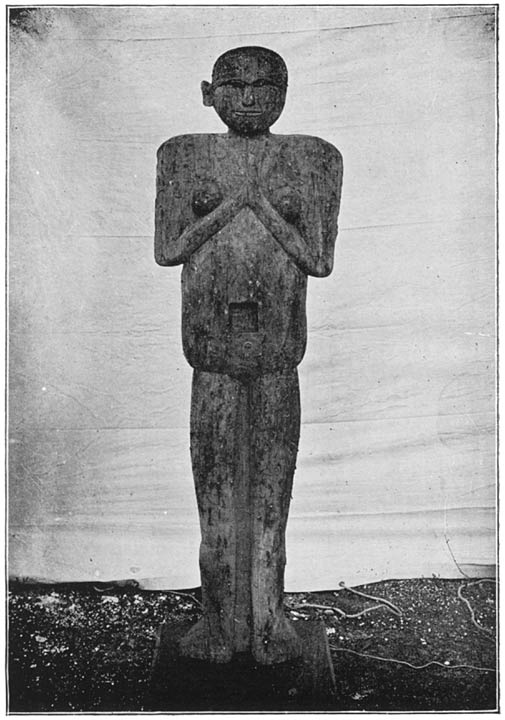
Sorcery figure, Malabar.
I have in my possession five charm cylinders, which were worn round the waist by a notorious Māppilla dacoit, who was shot by the police, and whom his co-religionists tried to turn into a saint. It is noted, in the Gazetteer of Malabar, that, though magic is condemned by the Korān, the Māppilla is very superstitious, and witchcraft is not by any means unknown. Many Tangals pretend to cure diseases by writing selections from the Korān on a plate with ink or on a coating of ashes, and then giving the ink or ashes mixed with water to the patient to swallow. They also dispense scrolls for elassus, and small flags inscribed with sacred verses, which are set up to avert pestilence or misfortune. The Māppilla jins and shaitāns correspond to the Hindu demons, and are propitiated in much the same way. One of their methods of witchcraft is to make a wooden figure to represent the enemy, drive nails into all the vital parts, and throw it into sea, after curses in due form. A belief in love philtres and talismans is very common, and precautions against the evil eye are universal.
In 1903, a life-size nude female human figure, with feet everted and turned backwards, carved out of the wood of Alstonia scholaris, was washed ashore at Calicut. Long nails had been driven in all over the head, body and limbs, and a large square hole cut out above the navel. Inscriptions in Arabic characters were scrawled over it. By a coincidence, the corpse of a man was washed ashore close to the figure. Quite recently, another interesting example of sympathetic magic, in the shape of a wooden representation of a human being, was washed ashore at Calicut. The figure is eleven inches in height. The arms are bent on the chest, and the palms of the hands are placed together as in the act of saluting. A square cavity, closed by a wooden lid, has been cut out of the middle of the abdomen, and contains apparently tobacco, ganja (Indian hemp), and hair. An iron bar has been driven from the back of the head through the body, and terminates in the abdominal cavity. A sharp cutting instrument has been driven into the chest and back in twelve places.
It is recorded in the Gazetteer of Malabar that “in North Malabar, Māppillas as a rule follow the marumakkathāyam system of inheritance, though it is opposed to the precepts of the Korān; but a man’s self-acquisitions usually descend to his wife and family in accordance with the Muhammadan law of property. The combination of the two systems of law often leads to great complications. In the south, the makkatāyam system is usually followed, but it is remarkable that succession to religious stānams, such as that of the Valiya Tangal of Ponnāni, usually goes according to the marumakkathāyam system. There seems to be a growing discontent with the marumakkathāyam system; but, on the other hand, there is no doubt that the minute sub-division of property between a man’s heirs, which the Korān prescribes, tends to foster poverty, especially amongst petty cultivators, such as those of Ernād and Walavanād.”
“When a man dies, his body is undressed, and arranged so that the legs point to Mecca. The two big toes are tied together, and the hands crossed on the chest, the right over the left; the arms are also tied with a cloth. Mullas are called in to read the Korān over the corpse, and this has to be continued until it is removed to the cemetery. When the relatives have arrived, the body is washed and laid on the floor on mats, over which a cloth has been spread. Cotton wool is placed in the ears, and between the lips, the fingers, and the toes, and the body is shrouded in white cloths. It is then placed on a bier which is brought from the mosque, and borne thither. At the mosque the bier is placed near the western wall; the mourners arrange themselves in lines, and offer prayers (niskāram) standing. The bier is then taken to the grave, which is dug north and south; the body is lowered, the winding sheets loosened, and the body turned so as to lie on its right side facing Mecca. A handful of earth is placed below the right cheek. The grave is then covered with laterite stones, over which each of the mourners throws a handful of earth, reciting the Kalima and passages from the Korān. Laterite stones are placed at the head and foot of the grave, and some mailānji (henna: Lawsonia alba) is planted at the side. A Mulla then seats himself at the head of the grave, and reads certain passages of the Korān, intended to instruct the dead man how to answer the questions about his faith, which it is supposed that the angels are then asking him. The funeral concludes with distribution of money and rice to the poor. For three days, a week, or forty days, according to the circumstances of the deceased, Mullas should read the Korān over the grave without ceasing day and night. The Korān must also be read at home for at least three days. On the third day, a visit is made to the tomb, after which a maulad is performed, the Mullas are paid, alms are distributed, and a feast is given to the relations, including the deceased’s relations by marriage, who should come to his house that day. A similar ceremony is performed on the fortieth day, which concludes the mourning; and by the rich on anniversaries. Widows should keep secluded in their own houses for three months and ten days, without seeing any of the male sex. After that period, they are at liberty to remarry.”
In his inspection report of the Laccadives, 1902, Mr. G. H. B. Jackson notes that “the caste barrier, on the island of Androth, between the Koya and the Malumi class and the Melacheris is as rigid as ever. It divides capital from labour, and has given the upper classes much of the appearance of an effete aristocracy.” In a more recent inspection report (1905), Mr. C. W. E. Cotton writes as follows. “Muhammadans, owing to their inordinate love of dress, are apt to give an exaggerated impression of wealth, but I should think that, despite the laziness of all but the Melacheris, the majority of the inhabitants (of Androth) are well-to-do, and, in this respect, compare very favourably with those of the other islands. The Qazi and several other Karnavars, who have a smattering of the Korān, go to the mainland, and, in centres of superstition, earn considerable sums by their profession of extreme learning and piety. The long satin coats (a canary yellow is the fashionable tint) procured in Bombay or Mangalore are evidence of the financial success of their pilgrimages. It is perhaps fortunate that the Koyas have discovered this additional source of income, for, though they continue to own nearly all the cargo-carrying odams (boats), their position as jenmis (landlords) has been seriously jeopardised owing to the repudiation of their obligations as Kudians by many of the enterprising Melacheri community. The Melacheris are now alive to the fact that, as their tenure is not evidenced by documents and rests upon oral assertions, they have a very reasonable chance of freeing themselves of their overlords altogether. The Mukhyastars are quite a representative lot. Sheikindevittil Muthu Koya is a fine specimen of the sea-faring Moplah, and the Qazi, twenty-fourth in descent from Mumby Moolyaka, the Arab who converted the islanders to Islam, struck me as a man of very considerable attainments. In his report on the dispensary at Androth (1905), Mr. K. Ibrahim Khān, hospital assistant, states that “the quacks are said to be clever enough to treat cases both by their drugs and by their charms. They actually prevent other poor classes seeking medical and surgical treatment in the dispensary, and mislead them by their cunning words. Most of the quacks come to the dispensary, and take medicines such as santonine powders, quinine pills, purgatives, etc. They make use of these for their own cases, and thus earn their livelihood. The quacks are among the Koya class. The Koyas are jenmis, and the Malims and Melacheris are their tenants. The latter, being low classes, always believe them, and depend upon their landlords, who are also their physicians, to treat them when they fall sick. The islanders, as a rule, have no faith in English medical treatment. The rich folks who can afford it go to Malabar for native treatment; only the poorer classes, who have neither means to pay the quacks here nor to go to Malabar, attend the dispensary with half inclination.”
Marakāllu.—Marakāllu or Marakādu, meaning fishermen, has been recorded as a sub-division of Pallis engaged as fishermen in the Telugu country. The equivalent of Mukku Marakkālēru is a title or synonym of Mōger and Marakkān of Mukkuvan. Marakkāyar is a title of Labbai boatmen.
Printed by The Superintendent, Government Press, Madras.