Volume 4 — M (continued 2)
Reading edition
“The above ceremony is that performed by the Namdaris or Vishnuvites, who are not afraid of pollution, but who must do all things according to a prescribed ritual. We will now consider the ceremonies of the Mondis or Saivites, who think little of ceremony, but much of defilement. These take the dying person outside, and, as soon as it is realised that the end is near, all arrangements are made as to who is to cook, carry the corpse, etc. Before the breath has left the body, some go to the bazaar to purchase a new cloth. The women smear themselves with turmeric as at a wedding, and put a circular red mark (bottu) on the forehead, whilst the men smear ashes on their foreheads. As soon as the food is cooked, the dead body is washed, and placed upon a bier. Most of the Vishnuvites do not use a bier. The corpse is carried to the grave, accompanied with fire and water as in the Vishnuvite ceremony. Shortly before the grave-yard is reached, a halt is made. The cloth which has been placed over the face is torn, and a cooking pot is broken, after which the body is taken to the grave, and buried without covering, lying prone on the face. After the earth has been filled in, the son of the deceased takes an earthen water-pot full of water, and bores a hole in it, so that the water may escape. He then makes three circuits of the grave, allowing the water to flow on the ground. After each circuit, he makes a fresh hole in the pot. He then goes away without looking back on the grave. When the funeral party, which consists only of men, reaches the house, they find that some of the old women have made a heap of cow-dung, at the top of which is a little hollow filled with water. Those who have returned from the grave dip their great toes in this water, and then linger on the threshold to worship the lamp which is inside. After this, the lamp is taken, and thrown outside the village, and, on their return, they bathe in hot water. The Saivites perform the first ceremony for the dead on the third day, and they have neither Nambi nor priest, but perform the whole ceremony themselves. Like the Vishnuvites, they thoroughly cleanse and plaster the house. There is no animal sacrifice, but food is prepared with vegetables. A tray is plaited from the twigs of the tamarind tree (Tamarindus indica), and in this is placed a leaf plate containing food, frankincense, betel, etc. This food offering is carried to the grave along with fire and water at about eight o’clock in the morning. The man who carries the food must wear only a torn cloth, and yet with this he must manage to cover his head. On reaching the grave, they worship. The tray is left at the head of the grave, and the people retire a short distance, and there wait until a crow or a kite comes, and takes food from the tray. The more quickly this occurs, the greater the merit obtained by the deceased. They never go away until either the one or the other of these birds comes. They afterwards proceed to the well, and bathe fully. On the twelfth day, another ceremony is performed. In the morning, all those taking part in the ceremony proceed to some place outside the village where they shave, and put on clean clothes which have come direct to that place from the washerman. They then go to some temple, and there obtain a little holy water, with which they afterwards sprinkle themselves, the widow, and the house of the deceased. The widow is then arrayed in all her clothes and jewels, and is taken weeping to the ‘widow’s harbour.’ There a stone image is set up, and worshipped. Then the woman’s jewels are taken off, and her bracelets broken. Sweet food is cooked and partaken of, all bathe, and return to their homes. After this ceremony, poor people will stay in their houses for three days, and rich people for a much longer period. For several years, on the anniversary of the death, some little ceremony is usually performed.”
In connection with Māla Dāsaris, to whom reference has already been made, Mr. Nicholson writes as follows. “There is a considerable number of individuals who obtained their living through religious mendicancy. They are known as Dāsaris. There is usually a Nambi or Dāsari for every three or four villages. Some few Dāsaris have inām (rent-free) lands, but the majority live on the charity of the people. They do not ask alms, but sing hymns in honour of Chennudu or Pedda Muni. They also officiate as a sort of priest, and their services are requisitioned at the time of death, marriage, hair-cutting, and the creation of Basavis and Dāsaris. The Dāsari who officiates at a wedding ceremony cannot act in a case of death. There is, in the west Telugu country, a class called Vārapu Dāsari, who act as pujāris for the Sūdras, and in all places the Dāsari receives certain emoluments from Sūdras for singing at weddings and funerals. They receive alms from all classes. Occasionally disturbances take place on account of the Saivites objecting to the Dāsaris coming into their streets, and it is at such times as these that pavādamu is said to take place. It is firmly believed that, if a Dāsari is offended, he will revenge himself in smaller offences by piercing his cheeks or side, for a serious offence by killing himself, generally by severing the head from the body. If one kills himself in this way, the news is said to be immediately and miraculously communicated to every Dāsari and Nambi in the country. They all come to the place where the body lies. Until their arrival, this has been kept covered with a new cloth, and water is constantly sprinkled over it, to keep the wounds from drying up. When the Gurus, Dāsaris, and others are collected, they show their magic power by frying fish, which come to life again on being placed in water, and by cutting limes in two and making them join together, while the remainder sing hymns to Chennudu, and call on the name of Govinda. The Gurus then dig a hole, and in it light the sacred fire of sandal-wood, which must be kindled by the friction of two pieces of wood. All assemble before this sacred fire, and join in singing or reciting the Dandakamu, after which the Dāsaris dance a dance called the request dance. A lotus flower is simulated by arranging betel leaves in a small chembu (metal vessel), and this is placed in a plate along with the severed head. The tray is then carried three times round the corpse by the wife of the deceased if he was married; if not, by his mother; and, if he had no kin, by a Basavi. The head is then taken by the Guru, and fixed properly to the trunk, the junction being plentifully daubed with sacred earth (tirumani). A new cloth is then spread over the corpse, and a network of flowers over all. The Dāsaris again walk round the corpse, calling on Tembaru Manara, repeating at the same time a mantram. Then Kurumayya, the caste Guru, strokes the corpse from head to foot three times with his staff, after which he places his foot on the head of the corpse, and calls on the body to rise. The ability of the Dāsaris to perform this marvel is implicitly believed in. Some I have asked have seen it attempted, but on one occasion it failed because the wife was unwell (under menstrual pollution). On another occasion, the ceremony was not carried out with fitting reverence, and failed in consequence.
“The chief people among the Dāsaris are Guru, Annalayya, Godugulayya (umbrella men), and Tuttulayya (horn-blowers). The Dāsaris have got certain badges of office, which are supposed to have been given by Chennudu on the conquest of Vijayanagar. [According to tradition, between the 8th and 11th centuries A.D. there was great rivalry between the Saivite and Vishnuvite sects, and it is supposed that Kurumayya, fighting on the side of the Vishnuvites, by the aid of the god Chennudu was able to suppress and overcome the followers of Siva. He thus became the Guru of the Mālas.] The Dāsari’s insignia consist of an iron staff, copper pot, tiger skin, antelope skin, etc. Besides these, some of the chief Dāsaris are said to possess copper inscriptions given to them by the kings of Vijayanagar, but these they refuse to allow any one to see.”
Concerning the practice of making Basavis (dedicated prostitutes), Mr. Nicholson writes as follows. “The origin of the Basavis is said to be thus. In former times, the Asādhis had the duty and privilege of dancing and singing before the God, but this office was always performed by a male. On one occasion, there was no male to take up the duties, and, as there was no prospect of further children, one of the daughters was appointed to the work, so that the livelihood would not be lost. Then no one came forward to marry the girl, and she found it impossible to live a good life. The fact, however, that she was a servant of the God kept her from disgrace, and from that time it has been customary to dedicate these girls to the God’s service. Nowadays, the girl goes through a ceremony with a knife, which is placed in front of the God, and, as at ordinary weddings, there are all the various ceremonies performed, and feasts eaten. If at the time of the wedding, any man wishes to have a sort of proprietary right, he may obtain the same by paying a sort of dowry. The elders of the village must give their consent to the dedication, and usually signify this by eating out of the same plate as the bride. In the west Telugu country, parents who have good looking daughters, no matter what their class, give them as Basavis. But, in the east Telugu country, only the Asādhi, Beinēni, and Pambala people do so. A Basavi can never be widowed, and people say they are consecrated to the God. Consequently, their life, though a life of sin, is not considered so by the Gods. Yet by a strange inconsistency, men consorting with Basavis are immediately branded as loose men. The first few years of a Basavi’s life are full of profit, and it is probably for this reason that parents are willing thus to sacrifice their daughters. Afterwards, when the charms of youth are passed, the Basavi resorts to begging, or, with two or three more, obtains a precarious livelihood by music and dancing. Their children have a share in the maternal father’s property.
“The above account of a Basavi’s dedication applies to the Asādhis or singing beggars. The following is a more detailed description of the ceremony as performed by the Dāsaris. The girl to be dedicated is dressed in a white ravike and cloth, after which she is conducted to the priest who is to officiate. He burns the signs of a chank and chakram on the girl’s shoulders, presenting to her at the same time holy water. After this, the priest receives the guruvu kanika, which consists not only of five rupees, but also five seers of rice, five cocoanuts, five garlics, and a quarter of a seer of betel nuts. The person giving the girl away now receives permission from the people and Guruvu, and attaches the marriage symbol to the girl’s neck. Before the tāli is tied, the girl is made to sit on a blanket, upon which has been drawn the ‘throne,’ with her hands which clasp the Garuda stambha tied together with a wreath of flowers. Before the hands are unbound, in place of the usual dowry of about twenty rupees, five duddu (copper coins) are given into the hand of the priest. All assembled now worship the beggar’s staff, and, on proceeding to the place of lodging, food is given to the Dāsaris. Usually the ceremonies are performed before the village shrine, but, at times of festival, they are performed before the God, in honour of whom the festival is being held. On returning to the village, the girl is obliged, for five consecutive Saturdays, to go round the village accompanied by a Dāsari, to whose food and comfort she has to attend. This is, no doubt, a public announcement of the profession the girl has had put upon her. When puberty is arrived at, a feast is given, and thenceforward the girl is her own mistress.”
The Mālas worship a variety of deities, including Gurappa, Subbarayadu, Gunnathadu, Sunkalamma, Poleramma, Gangamma, and Gontiyālamma. In connection with the worship of the goddess Gontiyālamma, Mr. F. R. Hemingway writes, in a note on the Mālas of the Godāvari district, that “the special caste deity is Gontiyālamma, the mother of the five Pandava brethren. They say that Bhīma threatened to kill his mother, who took refuge under an avirēni pot (painted pot used at weddings) in a Māla’s house. For this she was solemnly cursed by her sons, who said that she should remain a Māla woman for ever. In commemoration of this story, a handful of growing paddy (rice) is pulled up every year at the Dasara festival, and, eight days later, the earth adhering to its roots is mixed with turmeric and milk, made into an image of the goddess, and hidden under the avirēni pot. For the next six months this image is worshipped every Sunday by all the villagers in turn, and, on the Sivarātri night, it is taken round the village, accompanied by all the Mālas bearing pots of rice and other food carried in a kāvadi, and is finally thrown with much ceremony into a river or tank (pond or lake). This rite is supposed to mean that the goddess is the daughter of the caste, that she has lived with them six months, and that they are now sending her back with suitable gifts (the rice, etc.) to her husband. A common form of religious vow among Mālas is to promise to send a cloth and a cow with the goddess on the last day of the rite, the gifts being afterwards presented to a married daughter.” It is noted by Mr. Hemingway that both Mālas and Mādigas hold a feast in honour of their ancestors at Pongal—an uncommon rite.
Mala Arayan.—The Mala Arayans are described, in the Travancore Census Report, 1901, as “a class of hill tribes, who are a little more civilized than the Mannāns, and have fixed abodes on the slopes of high mountain ranges. Their villages are fine-looking, with trees and palms all round. They are superior in appearance to most other hill tribes, but are generally short in stature. Some of the Arayans are rich, and own large plots of cultivated grounds. They seldom work for hire, or carry loads. A curious custom with them is that every man in the family has his own room separate from the rest, which only he and his wife are permitted to enter. They are very good hunters and have a partiality for monkey flesh. As wizards they stand very high, and all the low-country people cherish a peculiar dread for them. Makkathāyam is the prevailing form of inheritance (from father to son), but among a few families marumakkathāyam (inheritance through the female line) obtains as an exception. Their language is a corrupt form of Malayālam. Their marriage ceremony is simple. The bridegroom and bride sit and eat on the same plantain leaf, after which the tāli (marriage badge) is tied. The bride then seizes any ornament or cooking vessel in the house, saying that it is her father’s. The bridegroom snatches it from her, and the marriage rite is concluded. Birth pollution is of considerable importance. It lasts for a whole month for the father, and for seven days for the mother. The Arayans bury their dead. Drinking is a very common failing.”
“The objects of Arayan worship are the spirits of their ancestors, or certain local demons supposed to reside in rocks or peaks, and having influence only over particular villages or families. The religious services rendered to these are intended to deprecate anger rather than to seek benefits; but in no case is lust to be gratified, or wickedness practiced, as pleasing to these deities. One of their ancestors is represented by a brass image about three inches in height, the back of the head hollow, the hands holding a club and a gun. This represents a demonized man of wicked character, who lived about a century ago. He is said to have beaten his wife to death with a club; wherefore the people joined to break his skull, and he became a malignant demon. Another image carried an umbrella and staff, and had a milder countenance—this was a good demon. One such image is kept in each family, in which the spirit is supposed actually to reside. They were also put into the little square chambers described above. The Rev. W. J. Richards, of Cottayam, has favoured me with the following history, which throws much light upon this curious superstition. ‘Tālanāni was a priest or oracle-revealer of the hunting deity, Ayappan, whose chief shrine is in Savarimala, a hill among the Travancore ghāts. The duty of Tālanāni was to deck himself out in his sword, bangles, beads, etc., and, highly frenzied with excitement and strong drink, dance in a horrid convulsive fashion before his idols, and reveal in unearthly shrieks what the god had decreed on any particular matter. He belonged to the Hill Arayan village of Eruma-pāra (the rock of the she-buffalo), some eight miles from Mēlkāvu, and was most devoted to his idolatry, and rather remarkable in his peculiar way of showing his zeal. When the pilgrims from his village used to go to Savarimala—a pilgrimage which is always, for fear of the tigers and other wild beasts, performed in companies of forty or fifty—our hero would give out that he was not going, and yet, when they reached the shrine of their devotions, there before them was the sorcerer, so that he was both famous among his fellows and favoured of the gods. Now, while things were in this way, Tālanāni was killed by the neighbouring Chōgans during one of his drunken bouts, and the murderers, burying his body in the depths of the jungle, thought that their crime would never be found out; but the tigers—Ayappan’s dogs—in respect to so true a friend of their master, scratched open the grave, and removing the corpse, laid it on the ground. The wild elephants found the body, and reverently took it where friends might discover it, and, a plague of small-pox having attacked the Chōgans, another oracle declared it was sent by Sāstāvu (the Travancore hill boundary god, called also Chāttan or Sāttan) in anger at the crime that had been committed; and that the evil would not abate until the murderers made an image of the dead priest, and worshipped it. This they did, placing it in a grave, and in a little temple no bigger than a small dog kennel. The image itself is about four inches high, of bronze. The heir of Tālanāni became priest and beneficiary of the new shrine, which was rich in offerings of arrack, parched rice, and meat vowed by the Arayans when they sallied out on hunting expeditions. All the descendants of Tālanāni are Christians, the result of the Rev. Henry Baker’s work. The last heir who was in possession of the idol, sword, bangle, beads, and wand of the sorcerer, handed them over to the Rev. W. J. Richards in 1881.’
“Lamps to the memory of their ancestors were kept burning in little huts, and at stones used to represent the spirits of their ancestors. At one spot, where the genii were supposed to reside, there was a fragment of granite well oiled, and surrounded by a great number of extinguished torches. A most fearful demon was said to reside in a hollow tree, which had been worshipped by thousands of families. They did not know the precise hole in which the symbol was to be found; when discovered, it looked like the hilt of an old sword. One deity was said by the priest of a certain hill to have placed three curious looking rocks as resting-places for himself on his journey to the peak. Cocoanuts are offered to famous demons, residing in certain hills. It has been observed that, in cases of sickness, sometimes Arayans will make offerings to a Hindu god, and that they attend the great feasts occasionally; but in no case do they believe that they are under any obligation to do so, their own spirits being considered fully equal to the Hindu gods. Each village has its priest, who, when required, calls on the ‘hill’ (mala), which means the demon resident there, or the prētham, ghost. If he gets the afflatus, he acts in the usual way, yelling and screaming out the answers sought. The devil-dancer wears the kudumi, and has a belt, bangles, and other implements; and invokes the demons in case of sickness.
“They have some sacred groves, where they will not fire a gun, or speak above a breath; they have certain signs also to be observed when fixing on land for cultivation or the site of a house, but no other elaborate religious rites. In choosing a piece of ground for cultivation, before cutting the jungle they take five strips of bark of equal length, and knot all the ends together, holding them in the left hand by the middle. If all, when tied, form a perfect circle, the omen is lucky, and the position in which the cord falls on the ground is carefully noted by the bystanders.”
Mala Nāyakkan.—A name returned by Tamil Malaiyālis at times of census.
Mala Vēdan.—See Vēdan.
Malai-kanda.—A sub-division of Vellāla.
Malaimān.—See Udaiyān.
Malaiyadi (foot of the hills).—A sub-division of Konga Vellāla.
Malakkar.—It is recorded, in the Gazetteer of Malabar, that “the Malakkars, also called Malamūttanmar and Malapanikkar, are a comparatively superior tribe of jungle cultivators and hunters found in the Calicut and Ernād hills. They follow the marumakkathāyam system (of inheritance in the female line), and observe pollution for twelve days. They call their huts illams, and, if they leave them to go down to the plains, must bathe before returning. They consider themselves polluted by all castes below Nāyars. The name Mūttan is properly a title, meaning elder, confirmed on their headman by their janmis (landlords). Their chief god is Maladēvan. They are good forest watchers and elephant catchers.”
Malāra (a bundle of glass bangles, as carried about for sale).—An exogamous sept of Gauda.
The Malasars are described, in the Madras Census Report, 1901, as “a forest tribe living by hill cultivation and day labour. They are good at game-tracking, and very handy with their axes, with the help of which they will construct a bamboo house for the wandering sportsman in a few hours. They reside in hamlets known as pathis, each of which has a headman, called Vendari, who exercises the usual authority, with the assistance of a panchāyat (council). One of the punishments inflicted by panchāyats is to make the culprit carry a heavy load of sand for some distance, and then stand with it on his head and beg for forgiveness. They worship Kāli and Māriamman, the small-pox goddess, but their special deity is Manakadātta, to whom they sacrifice fowls and sheep in the Māsi. A man of the tribe acts as priest on these occasions, and keeps the heads of the offerings as his perquisite. An unusual item in their wedding ceremonies is the tying of an iron ring to the bridegroom’s wrist. They will eat and drink almost anything, except vermin and cobras. The Kādans regard themselves as superior to the Malasars.” It is noted, in the Manual of the Coimbatore district, that “the Malasars live at a much lower elevation than the Kādars. They are found almost down on the plains, and along the slopes near the foot of the hills. They are somewhat sturdier in general build, but have not the characteristic features of regular hillmen. They are not to be depended on in any way, but will desert en masse on the smallest excuse. They commit dacoities whenever they see an opportunity, and, in fact, even to this day, the roads near the foot of the hills are rarely traversed by low-country natives except in small bands, from fear of the Malasars. On the other hand, the Malasars are useful as being excellent axemen; and as baggage coolies they can hardly be dispensed with. They carry for the most part on their heads like low-country coolies, but unlike the Kādars and Puliyars, who, when they can be induced to carry at all, carry loads on their backs.”
There may be said to be three grades of Malasars, viz., the Malai (hill) Malasars, who live on the hills (e.g., at Mount Stuart on Ānaimalais), and the Malasars who live on the slopes and the plains. It is said that Kādirs and Eravalars are admitted into the Malasar caste. The Kādirs abstain from eating the flesh of the ‘bison’ and cow, whereas the Malasars will eat the carrion of these animals. The settlements of the Malasars are called padhis or pathis, and their streets sālais. These are Tamil names, denoting villages and rows. The padhis are named after the owners of the land on which they are built, e.g., Sircar (Government) padhi, Karuppa Goundan padhi. On the hills, the dwelling huts are made of bamboo matting thatched with grass and teak leaves, whereas on the plains the walls are made of mud, and are roofed with grass and bamboo. Like the Yānādis and Chenchus, the Malasars seem to have an objection to well-built houses, and a Malasar forester prefers his own rude hut to Government quarters.
Some Malasars work as coolies, while others are employed as agricultural labourers, or in collecting honey. A landlord keeps under him a number of Malasars, to whom he gives land free of rent, on which they raise their food-crops. In return, they are expected to work in the fields, and do other services for their landlord (Mannādi), who exercises absolute control over them. Sometimes, if a landholder has a grievance against another, it is not difficult to induce his Malasars to damage the crops of his enemy. The operations connected with the catching and taming of wild elephants are carried out by Malasars. They are proverbially lazy, and will take a week’s wages in advance, and spend a good portion thereof on drink on the same day. With the remainder provisions are purchased, and they may only put in three or four days’ work in the week. Like other hill tribes, they dig up yams when food is scarce.
Marriage is generally adult, though infant marriage is not prohibited. The Malasars of the plains perform the marriage ceremonies at the home of the bride. Monday is considered an auspicious day for their celebration. On the previous day, the contracting couple stand on a pestle, and are anointed, and bathe. Two balls of cooked rice, coloured red and black, are placed in a tray, and lighted wicks are stuck into them. The flames from the two wicks should be of the same height, or the omens would be considered unfavourable. The lights are waved in front of the bride and bridegroom, to ward off the evil eye. After bathing, the couple are seated on a dais within the marriage pandal (booth), and the bridegroom ties the tāli (marriage badge) on the neck of the bride, and their hands are joined by the Mūppan (headman). The tāli consists of a brass disc, tied to a string dyed with turmeric. The couple eat from the same leaf or plate, and the ceremony is at an end.
The Malai Malasars bring the bride to the home of the bridegroom for the marriage ceremonies. The bridegroom goes on a Wednesday to the bride’s house and takes her to his home on the following day. A pandal, made of Sorghum and bamboo stems, is erected. Towards evening, the tāli is tied, and the fingers of the contracting couple are linked together (kaidharam). They eat together from the same plate. The bridegroom should feed his relations and friends at his own house, as well as at that of the bride. He generally presents his mother-in-law with a female cloth, with an eight anna bit tied in the skirt thereof.
Ancestor worship is important among the Malayans. Before commencing their ceremonies, cooked rice and the flesh of the fowl are offered to the ancestors on seven leaves. On the occasion of a marriage, a little of the food is eaten by the bridegroom on a Wednesday, before he proceeds to the home of the bride.
When a girl reaches maturity, she occupies a separate hut for seven days. On the seventh day, she bathes and goes to the dwelling hut. A measure and a lamp are placed before the hut, and the girl has to go over them with her right foot foremost. She then steps backwards, and again goes over them before entering the hut.
The dead are usually buried, face upward. If the dead person was an elder, his personal effects, such as pillows, walking-stick, and clothes, are buried with him, or his corpse is cremated. Sometimes, the dead are buried in a sitting posture, in a niche excavated on one side of the grave. In the case of the Malasars of the plains, the widow chews betel leaf and areca nuts, and spits the betel over the eyes and neck of the corpse. On the third day after death, cooked rice and meat are offered to the soul of the deceased on seven arka (Calotropis gigantea) leaves. The male members of the family then eat from the same leaf.
The Malasars who live in the plains consider the Ficus glomerata tree sacred, and worship it once a year. At least one branch thereof should be used in the construction of the marriage pandal, and the menstrual hut should be made of it. The Malasars of the plains also avoid the use of the Pongamia glabra tree for any purpose. The hill Malasars worship, among other deities, Ponnālamman (Māriamma), Pullarappachi (Ganēsa), and Kāliamman. To Ponnālamman, pigs and buffaloes are sacrificed once a year. The deity worshipped by the Malasars of the plains is Māriāyi (Māriamma), at whose festival a stake is fixed in the ground, and eventually shaken by the Malasars, and removed by Paraiyans. The Malasar women of the plains wear glass bangles only on the left wrist. If a woman puts such bangles on both wrists, the Paraiyans are said to break them, and report the matter to the Mūppan, who is expected to fine the woman. As Paraiyan women, like the Malasars, only wear glass bangles on one wrist, they take the wearing of bangles on both wrists by Malasar women, who are only their equals, as an insult.
Malavarāyan.—A title of Ambalakkāran.
Malayāli.—The Malayālis or Malaiālis, whom I examined in the Salem district, dwell on the summits and slopes of the Shevaroy hills, and earn their living by cultivating grain, and working on coffee estates. Suspicious and superstitious to a degree, they openly expressed their fear that I was the dreaded settlement officer, and had come to take possession of their lands in the name of the Government, and transport them to the Andaman islands (the Indian penal settlement). When I was engaged in the innocent occupation of photographing a village, the camera was mistaken for a surveying instrument, and a protest raised. Many of them, while willing to part with their ornaments of the baser metals, were loth to sell or let me see their gold and silver jewelry, from fear lest I should use it officially as evidence of their too prosperous condition. One man told me to my face that he would rather have his throat cut than submit to my measuring operations, and fled precipitately. The women stolidly refused to entrust themselves in my hands. Nor would they bring their children (unwashed specimens of brown humanity) to me, lest they should fall sick under the influence of my evil eye.
In the account which follows I am largely indebted to Mr. H. LeFanu’s admirable, and at times amusing, Manual of the Salem district.
The word Malaiāli denotes inhabitant of the hills (malai = hill or mountain). The Malaiālis have not, however, like the Todas of the Nilgiris, any claim to be considered as an ancient hill tribe, but are a Tamil-speaking people, who migrated from the plains to the hills in comparatively recent times. As a shrewd, but unscientific observer put it concisely to me, they are Tamils of the plains with the addition of a kambli or blanket; which kambli is a luxury denied to the females, but does duty for males, young and old, in the triple capacity of great coat, waterproof, and blanket. According to tradition, the Malaiālis originally belonged to the Vellāla caste of cultivators, and emigrated from the sacred city of Kānchipuram (Conjeeveram) to the hills about ten generations ago, when Muhammadan rule was dominant in Southern India. When they left Kānchi, they took with them, according to their story, three brothers, of whom the eldest came to the Shevaroy hills, the second to the Kollaimalais, and the youngest to the Pachaimalais (green hills). The Malaiālis of the Shevaroys are called the Peria (big) Malaiālis, those of the Kollaimalais the Chinna (little) Malaiālis. According to another version “the Malaiāli deity Karirāman, finding himself uncomfortable at Kānchi, took up a new abode. Three of his followers, named Periyanan, Naduvanan, and Chinnanan (the eldest, the middle-man, and the youngest) started with their families to follow him from Kānchi, and came to the Salem district, where they took different routes, Periyanan going to the Shevaroys, Naduvanan to the Pachaimalais and Anjūr hills, and Chinnanan to Manjavādi.”
A further version of the legendary origin of the Malaiālis of the Trichinopoly district is given by Mr. F. R. Hemingway, who writes as follows. “Their traditions are embodied in a collection of songs (nāttukattu). The story goes that they are descended from a priest of Conjeeveram, who was the brother of the king, and, having quarrelled with the latter, left the place, and entered this country with his three sons and daughters. The country was then ruled by Vēdans and Vellālans, who resisted the new-comers. But ‘the conch-shell blew and the quoit cut,’ and the invaders won the day. They then spread themselves about the hills, the eldest son (Periyanan), whose name was Sadaya Kavundan, selecting the Shevaroys in Salem, the second son (Naduvanan, the middle brother) the Pachaimalais, and the youngest (Chinnanan) the Kollaimalais. They married women of the country, Periyanan taking a Kaikōlan, Naduvanan a Vēdan, and Chinnanan a ‘Dēva Indra’ Pallan. They gave their sister in marriage to a Tottiyan stranger, in exchange for some food supplied by him after their battle with the men of the country. Some curious customs survive, which are pointed to in support of this story. Thus, the women of the Pachaimalai Malaiyālis put aside a portion of each meal in honour of their Vēdan ancestors before serving their husbands, and, at their marriages, they wear a comb, which is said to have been a characteristic ornament of the Vēdans. Bridegrooms place a sword and an arrow in the marriage booth, to typify the hunting habits of the Vēdans, and their own conquest of the country. The Malaiyālis of the Kollaimalais are addressed by Pallan women as brother-in-law (macchān), though the Malaiyālis do not relish this. It is also said that Tottiyan men regard Malaiyālis as their brothers-in-law, and always treat them kindly, and that the Tottiyan women regard the Malaiyālis as their brothers, but treat them very coldly, in remembrance of their having sold their sister ‘for a mess of pottage.’”
The Malaiālis of the Shevaroys call themselves Kānchimandalam. Many, at the last census, returned themselves as Vellāla and Kārālan. Malakkāran and Mala Nāyakkan are also used as synonyms for Malaiāli. All have Goundan as their second name, which is universally used in hailing them. The first name is sometimes derived from a Hindu god, and my notes record Mr. Green, Mr. Black, Mr. Little, Mr. Short, Mr. Large, and Mr. Big nose.
Subscribing vaguely to the Hindu religion, the Malaiālis, who believe that their progenitors wore the sacred thread, give a nominal allegiance to both Siva and Vishnu, as well as to a number of minor deities, and believe in the efficacy of a thread to ward off sickness and attacks by devils or evil spirits. “In the year 1852,” Mr. LeFanu writes, “a searching enquiry into the traditions, customs, and origin of these Malaiālis was made. They then stated that smearing the face with ashes indicates the religion of Siva, and putting nāmam that of Vishnu, but that there is no difference between the two religions; that, though Sivarātri sacred to Siva, and Srirāmanavami and Gōkulāshtami sacred to Vishnu, appear outwardly to denote a difference, there is really none. Though they observe the Saturdays of the month Peratāsi sacred to Vishnu, still worship is performed without reference to Vishnu or Siva. They have, indeed, certain observances, which would seem to point to a division into Vaishnavas and Saivas, the existence of which they deny; as for instance, some, out of respect to Siva, abstain from sexual intercourse on Sundays and Mondays; and others, for the sake of Vishnu, do the same on Fridays and Saturdays. So, too, offerings are made to Vishnu on Fridays and Saturdays, and to Siva on Sundays and Mondays; but they denied the existence of sects among them.”
In April 1896, I paid a visit to the picturesquely situated village of Kiliūr, not far distant from the town of Yercaud, on the occasion of a religious festival. The villagers were discovered, early in the morning, painting pseudo-sect-marks on their foreheads with blue and pink coal-tar dyes, with the assistance of hand looking-glasses of European manufacture purchased at the weekly market, and decorating their turbans and ears with the leafy stems of Artemisia austriaca, var. orientalis, and hedge-roses. The scene of the ceremonial was in a neighbouring sacred grove of lofty forest trees, wherein were two hut temples, of which one contained images of the goddess Draupadi and eight minor deities, the other images of Perumāl and his wife. All the gods and goddesses were represented by human figures of brass and clay. Two processional cars were gaily decorated with plantain leaves and flags, some made in Germany. As the villagers arrived, they prostrated themselves before the temples, and whiled away the time, till the serious business of the day began, in gossiping with their friends, and partaking of light refreshment purchased from the fruit and sweetmeat sellers, who were doing a brisk trade. At 10 A.M. the proceedings were enlivened by a band of music, which played at intervals throughout the performance, and the gods were decorated with flowers and jewelry. An hour later, pūja was done to the stone image of the god Vignēswara, within a small shrine built of slabs of rock. Before this idol cooked rice was offered, and camphor burnt. The plantain stems, with leaves, were tied to a tree in the vicinity of the temples, and cooked rice and cocoanuts placed beneath the tree. A man holding a sword, issued forth, and, in unison with the collected assemblage, screamed out “Gōvinda, Gōvinda” (the name of their god). The plantain stems were next removed from the tree, carried in procession with musical honours, and placed before the threshold of one of the temples. Then some men appeared on the scene to the cry of “Gōvinda,” bearing in one hand a light, and ringing a bell held in the other. Holy water was sprinkled over the plantain stems, and pūja done to the god Perumāl by offering sāmai (grain) and burning camphor. Outside one of the temples a cloth was spread on the ground, and the images of Draupadi and other deities placed therein. From the other temple Perumāl and his wife were brought forth in state, and placed on two cars. A yellow powder was distributed among the crowd, and smeared over the face. A cocoanut was broken, and camphor burnt before Perumāl. Then all the gods, followed by the spectators, were carried in procession round the grove, and a man, becoming inspired and seized with a fine religious frenzy, waved a sword wildly around him, but with due respect for his own bodily safety, and pointed it in a threatening manner at the crowd. Asked, as an oracle, whether the omens were propitious to the village, he gave vent to the oracular (and true) response that for three years there would be a scarcity of rain, and that there would be famine in the land, and consequent suffering. This performance concluded, a bamboo pole was erected, bearing a pulley at the top, with which cocoanuts and plantains were connected by a string. By means of this string, the fruits were alternately raised and lowered, and men, armed with sticks, tried to hit them, while turmeric water was dashed in their faces just as they were on the point of striking. The fruits, being at last successfully hit, were received as a prize by the winner. The gods were then taken back to their temple, and three men, overcome by a mock convulsive seizure, were brought to their senses by stripes on the back administered with a rope by the pūjari (officiating priest). A sheep being produced, mantrams (prayers) were recited over it. The pūjāri, going to a pool close by, bathed, and smeared turmeric powder over his face. A pretence was made to cut the sheep’s throat, and blood drawn with a knife. The pūjāri, after sucking the blood, returned to the pool, and indulged in a ceremonial ablution, while the unhappy sheep was escorted to the village, and eventually eaten at a banquet by the villagers and their guests.
To Mr. W. Mahon Daly, I am indebted for the following account of a Malaiāli bull dance, at which he was present as an eye-witness. “It is the custom on the Shevaroy hills, as well as the plains, to have a bull dance after the Pongal festival, and I had the pleasure of witnessing one in a Malaiāli village. It was held in an open enclosure called the manthay, adjoining the village. It faces the Māriamma shrine, and is the place of resort on festive occasions. The village councils, marriages, and other ceremonies are held here. On our arrival, we were courteously invited to sit under a wide spreading fig-tree. The bull dance would literally mean a bull dancing, but I give the translation of the Tamil ‘yerothu-attum,’ the word attum meaning dance. This is a sport which is much in vogue among the Malaiālis, and is celebrated with much éclat immediately after Pongal, this being the principal festival observed by them. No doubt they have received the custom from those in the plains. A shooting excursion follows as the next sport, and, if they be so fortunate as to hunt down a wild boar or deer, or any big game, a second bull dance is got up. We were just in time to see the tamāsha (spectacle). The manthay was becoming crowded, a regular influx of spectators, mostly women arrayed in their best cloths, coming in from the neighbouring villages. These were marshalled in a circle round the manthay, all standing. I was told that they were not invited, but that it was customary for them to pour in of their own accord when any sports or ceremonial took place in a village; and the inhabitants of the particular village were prepared to expect a large company, whom they fed on such occasions. After the company had collected, drums were beaten, and the long brass bugles were blown; and, just at this juncture, we saw an elderly Malaiāli bring from his hut a coil of rope made of leather, and hand it over to the pūjāri or priest in charge of the temple. The latter placed it in front of the shrine, worshipped it thrice, some of the villagers following suit, and, after offering incense, delivered it to a few respectable village men, who in turn made it over to a lot of Malaiāli men, whose business it was to attach it to the bulls. This rope the oldest inhabitant of the village had the right to keep. The bulls had been previously selected, and penned alongside of the manthay, from which they were brought one by one, and tied with the rope, leaving an equal length on either side. The rope being fixed on, the bull was brought to the manthay, held on both sides by any number who were willing, or as many as the rope would permit. More than fifteen on either side held on to a bull, which was far too many, for the animal had not the slightest chance of making a dart or plunge at the man in front, who was trying to provoke it by using a long bamboo with a skin attached to the end. When the bull was timid, and avoided his persecutors, he was hissed and hooted by those behind, and, if these modes of provocation failed to rouse his anger, he was simply dragged to and fro by main force, and let loose when his strength was almost exhausted. A dozen or more bulls are taken up and down the manthay, and the tamāsha is over. When the manthay happens to have a slope, the Malaiālis have very little control over the bull, and, in some instances, I have seen them actually dragged headlong to the ground at the expense of a few damaged heads. The spectators, and all the estate coolies who were present, were fed that night, and slept in the village. If a death occurs in the village a few days before the festival, I am told that the dance is postponed for a week. This certainly, as far as I know, is not the custom in the plains.”
The man of highest rank is the guru, who is invited to settle disputes in villages, to which he comes, on pony-back or on foot, with an umbrella over him, and accompanied by music. The office of guru is hereditary, and, when he dies, his son succeeds him, unless he is a minor, in which case the brother of the deceased man steps into his shoes. If, in sweeping the hut, the broom touches any one, or when a Malaiāli has been kicked by a European or released from prison, he must be received back into his caste. For this purpose he goes to the guru, who takes him to the temple, where a screen is put up between the guru and the applicant for restoration of caste privileges. Holy water is dedicated to the swāmi(god), by the guru, and a portion thereof drunk by the man, who prostrates himself before the guru, and subsequently gives a feast of pork, mutton, and other delicacies. The Malaiālis, it may be noted, will eat sheep, pigs, fowls, various birds, and black monkeys.
Each village on the Shevaroys has its own headman, an honorary appointment, carrying with it the privilege of an extra share of the good things, when a feast is being held. A Kangāni is appointed to do duty under the headman, and receives annually from every hut two ballams of grain. When disputes occur, e.g., between two brothers regarding a woman or partition of property, the headman summons a panchāyat (village council), which has the power to inflict fines in money, sheep, etc., according to the gravity of the offence. For every group of ten villages there is a Pattakāran (head of a division), who is expected to attend on the occasion of marriages and car festivals. A bridegroom has to give him eight days before his marriage a rupee, a packet of betel leaves, and half a measure of nuts. Serving under the Pattakāran is the Maniakāran, whose duty it is to give notice of a marriage to the ten villages, and to summon the villagers thereto.
In April 1898, on receipt of news of a wedding at a distant village, I proceeded thither through coffee estates rich with white flowers bursting into flower under the grateful influence of a thunderstorm. En route, a view was obtained of the Golden Horn, an overhanging rock with a drop of a thousand feet, down which the Malaiālis swing themselves in search for honey. On the track through the jungle a rock, known from the fancied resemblance of the holes produced by weathering to hoof-marks as the kudre panji (horse’s footprints), was passed. Concerning this rock, the legend runs that a horse jumped on to it at one leap from the top of the Shēvarāyan hill, and at the next leap reached the plains at the foot of the hills. The village, which was the scene of the festivities, was, like other Malaiāli villages, made up of detached bee-hive huts of bamboo, thatched with palm-leaves and grass, and containing a central room surrounded by a verandah—the home of pigs, goats, and fowls. Other huts, of similar bee-hive shape, but smaller, were used as storehouses for the grain collected at the harvest-season. These grain-stores have no entrance, and the thatched roof has to be removed, to take out the grain for use. Tiled roofs, such as are common in the Badaga villages on the Nīlgiris, are forbidden, as their use would be an innovation, which would excite the anger of the Malaiāli gods. The Malaiālis have religious scruples against planing or smoothing with an adze the trees which they fell. The area of lands used to be ascertained by guesswork, not measurement, and much opposition was made to an attempt to introduce chain measurements, the Malaiālis expressing themselves willing to pay any rent imposed, if their lands were not measured. Huts built on piles contain the flocks, which, during the day, are herded in pens which are removable, and, by moving the pens, the villagers manage to get the different parts of their fields manured. Round the village a low wall usually runs, and, close by, are the coffee, tobacco, and other cultivated crops. Outside the village, beneath a lofty tree, was a small stone shrine, capped with a stone slab, wherein were stacked a number of neolithic celts, which the Malaiālis reverence as thunderbolts from heaven. I was introduced to the youthful and anxious bridegroom, clad in his wedding finery, who stripped before the assembled crowd, in order that I might record his jewelry and garments. On the first day, the bridegroom, accompanied by his relations, takes the modest dowry of grain and money (usually five rupees) to the bride’s village, and arranges for the performance of the nalangu ceremony on the following day. If the bride and bridegroom belong to the same village, this ceremony is performed by the pair seated on a cot. Otherwise it is performed by each separately. The elders of the village take a few drops of castor-oil, and rub it into the heads of the bride and bridegroom; afterwards washing the oil off with punac (Bassia oil-cake) and alum water. One of the elders then dips betel-leaves and arugum-pillu (Cynodon Dactylon) in milk, and with them describes a circle round the heads of the young couple, who do obeisance by bowing their heads. The proceedings wind up with a feast of pork and other luxuries. On the following day, the ceremony of tying the tāli (marriage emblem) round the bride’s neck is performed. The bride, escorted by her party, comes to the bridegroom’s village, and remains outside it, while the bridegroom brings a light, a new mat, and three bundles of betel leaves and half a measure of areca nuts, which are distributed among the crowd. The happy pair then enter the village, accompanied by music. Beneath a pandal (booth) there is a stone representing the god, marked with the nāmam, and decorated with burning lamps and painted earthen pots. Before this stone the bride and bridegroom seat themselves in the presence of the guru, who is seated on a raised dais. Flowers are distributed among the wedding guests, and the tāli, made of gold, is tied round the bride’s neck. This done, the feet of both bride and bridegroom are washed with alum water, and presents of small coin received. The contracting parties then walk three times round the stone, before which they prostrate themselves, and receive the blessing of the assembled elders. The ceremony concluded, they go round the village, riding on the same pony. The proceedings again terminate with a feast. I gather that the bride lives apart from her husband for eleven or fifteen days, during which time he is permitted to visit her at meal times, with the object, as my interpreter expressed it, of “finding out if the bride loves her husband or not. If she does not love him, she is advised by the guru and headman to do so, because there are many cases in which the girls, after marriage, if they are matured, go away with other Malaiālis. If this matter comes to the notice of the guru, she says that she does not like to live with him. After enquiry, the husband is permitted to marry another girl.”
A curious custom prevailing among the Malaiālis, which illustrates the Hindu love of offspring, is thus referred to by Mr. Le Fanu. “The sons, when mere children, are married to mature females, and the father-in-law of the bride assumes the performance of the procreative function, thus assuming for himself and his son a descendant to take them out of Put. When the putative father comes of age, and, in their turn, his wife’s male offspring are married, he performs for them the same office which his father did for him. Thus, not only is the religious idea involved in the words Putra and Kumāran carried out, but also the premature strain on the generative faculties, which this tradition entails, is avoided. The accommodation is reciprocal, and there is something on physiological grounds to recommend it.” Putra means literally one who saves from Put, a hell into which those who have not produced a son fall. Hindus believe that a son can, by the performance of certain rites, save the souls of his ancestors from this place of torture. Hence the anxiety of every Hindu to get married, and beget male offspring. Kumāran is the second stage in the life of an individual, which is divided into infancy, childhood, manhood, and old age. Writing to me recently, a Native official assures me that “the custom of linking a boy in marriage to a mature female, though still existing, has, with the advance of the times, undergone a slight yet decent change. The father-in-law of the bride has relieved himself of the awkward predicament into which the custom drove him, and now leaves the performance of the procreative function to others accepted by the bride.”
Widow remarriage among the Peria Malaiālis is, I am informed, forbidden, though widows are permitted to contract irregular alliances. But, writing concerning the Malaiālis of the Dharmapuri tāluk of the Salem district, Mr. Le Fanu states that “it is almost imperative on a widow to marry again. Even at eighty years of age, a widow is not exempted from this rule, which nothing but the most persistent obstinacy on her part can evade. It is said that, in case a widow be not remarried at once, the Pattakār sends for her to his own house, to avoid which the women consent to re-enter the state of bondage.” Of the marriage customs of the Malaiālis of the Javādi hills the same author writes that “these hills are inhabited by Malaiālis, who style themselves Vellālars and Pachai Vellālars, the latter being distinguished by the fact that their females are not allowed to tattoo themselves, or tie their hair in the knot called ‘kondai.’ The two classes do not intermarry. In their marriage ceremonies they dispense with the service of a Brāhman. Monday is the day chosen for the commencement of the ceremony, and the tāli is tied on the following Friday, the only essential being that the Monday and Friday concerned must not follow new-moon days. They are indifferent about choosing a ‘lakkinam’ (muhūrtham or auspicious day) for the commencement of the marriage, or for tying the tāli. Widows are allowed to remarry. When a virgin or a widow has to be married, the selection of a husband is not left to the woman concerned, or to her parents. It is the duty of the Ūrgoundan to inquire what marriageable women there may be in the village, and then to summon the Pāttan, or headman of the caste, to the spot. The latter, on his arrival, convenes a panchāyat of the residents, and, with their assistance, selects a bridegroom. The parents of the happy couple then fix the wedding day, and the ceremony is performed accordingly. The marriage of a virgin is called ‘kaliānam’ or ‘marriage proper’; that of a widow being styled ‘kattigiradu’ or ‘tying’ (cf. Anglice noose, nuptial knot). Adultery is regarded with different degrees of disfavour according to the social position of the co-respondents. If a married woman, virgin or widow, commits adultery with a man of another caste, or if a male Vellālan commits adultery with a woman of another caste, the penalty is expulsion from caste. Where, however, the paramour belongs to the Vellāla caste, a caste panchāyat is held, and the woman is fined Rs. 3–8–9, and the man Rs. 7. After the imposition of the fine, Brāhman supremacy is recognised, the guru having the privilege of administering the tirtam, or holy water, to the culprits for their purification. For the performance of this rite his fee varies from 4 annas to 12 rupees. The tirtam may either be administered by the guru in person, or may be sent by him to the Nāttān for the purpose. The fine imposed on the offenders is payable by their relatives, however distant; and, if there be no relatives, then the offenders are transported from their village to a distant place. Where the adulteress is a married woman, she is permitted to return to her husband, taking any issue she may have had by her paramour. In special cases a widow is permitted to marry her deceased husband’s brother. Should a widow remarry, her issue by her former husband belong to his relatives, and are not transferable to the second husband. The same rule holds good in successive remarriages. Where there may be no relatives of the deceased husband forthcoming to take charge of the children, the duty of caring for them devolves on the Ūrgoundan, who is bound to receive and protect them. The Vellalars generally bury their dead, except in cases where a woman quick with child, or a man afflicted with leprosy has died, the bodies in these cases being burnt. No ceremony is performed at child-birth; but the little stranger receives a name on the fifteenth day. When a girl attains puberty, she is relegated to a hut outside the village, where her food is brought to her, and she is forbidden to leave the hut either day or night. The same menstrual and death customs are observed by the Peria Malaiālis, who bury their dead in the equivalent of a cemetery, and mark the site by a mound of earth and stones. At the time of the funeral, guns are discharged by a firing party, and, at the grave, handfuls of earth are, as at a Christian burial service, thrown over the corpse.”
If a woman among the Malaiālis of the Javādi hills commits adultery, the young men of the tribe are said to be let loose on her, to work their wicked way, after which she is put in a pit filled with cow-dung and other filth. An old man naively remarked that adultery was very rare.
“The North Arcot Malaiālis,” Mr. Stuart writes, “occupy eighteen nādus or districts. The Nāttān (headman) of Kanamalai nādu is called the Periya (big) Nādan, and is the headman of the caste. He has the power to nominate Nāttāns for other nādus, to call caste panchāyats, to preside over any such meetings, and to impose fines, and excommunicate any Malaiāli. He can inflict corporal punishment, such as whipping with a tamarind switch, on those persons who violate their tribal customs. This power is sometimes delegated by him to the other Nāttāns. Of the fines collected, the Periya Nāttān takes two shares, and the rest is distributed equally among the Ūrāns (village heads). The village precincts are considered sacred, and even Brāhmans are desired to walk barefoot along their alleys. They are both Saivites and Vaishnavites, and worship Kāli and Perumāl, wearing the nāmam and sacred ashes alike. Their worship is somewhat peculiar, and kept more or less a mystery. Its chief object is Kāli, in whose honour they celebrate a feast once a year, lasting for fifteen days. During this time no people of the plains venture near them, believing that no intruder will ever leave the spot alive. Even the Malaiāli women are studiously debarred from witnessing the rites, and those who take part in them are not permitted to speak to a woman, even should she be his wife. The ceremonies take place in the open air, at a particular spot on the hills, where the goddess is to be adored in the shape of a stone called Vellandiswāmi. The nature of the rites it is difficult to learn. In the village they worship, also excluding women, small images of Venkatēswara of Tirupati, which are carefully concealed in caskets, and not allowed to be seen by people of other castes. A few bundles of tobacco are buried with the dead. When any one falls ill, the Malaiālis do not administer medicine, but send for a pūjāri, and ask him which god or goddess the patient had offended. The assessment paid to Government by them is a fixed charge for each plough or hoe possessed, without reference to the extent of land cultivated. They collect jungle produce, particularly the glandular hairs of the fruits of a certain flower (Mallotus philippinensis), which is used by the Rangāris for dyeing silk a rich orange, and the roots of a plant called shenalinsedi, supposed to possess wonderful medicinal virtues, curing, among other things, snake-bite.” The Malaiālis of the Javādi hills in the North Arcot district also earn a living by felling bamboos and sandal trees.
The Malaiālis snare with nets, and shoot big game—deer, tigers, leopards, bears, and pigs—with guns of European manufacture. Mr. Le Fanu narrates that, during the Pongal feast, all the Malaiālis of the Kalrāyans go hunting, or, as they term it, for parvēttai. Should the Pālaiagar fail to bring something down, usage requires that the pūjāri should deprive him of his kudumi or top-knot. He generally begs himself off the personal degradation, and a servant undergoes the operation in his stead. A few years ago, a party of Malaiālis of the Shevaroys went out shooting with blunderbusses and other quaint weapons, and bagged a leopard, which they carried on a frame-work, with jaws wide open and tail erect, round Yercaud, preceded by tom-toms, and with men dancing around.
The Malaiāli men on the Shevaroys wear a turban and brown kumbli (blanket), which does duty as great coat, mackintosh, and umbrella. A bag contains their supply of betel and tobacco, and they carry a bill-hook and gourd water-vessel, and a coffee walking-stick. As ornaments they wear bangles, rings on the fingers and toes, and in the nose and ears. The women are tattooed by Korava women who come round on circuit, on the forehead, outside the orbits, cheeks, arms, and hands. Golden ornaments adorn their ears and nose, and they also wear armlets, toe-rings, and bangles, which are sometimes supplemented by a tooth-pick and ear-scoop pendent from a string round the neck. For dress, a sāri made of florid imported cotton fabric is worn. I have seen women smoking cheroots, made from tobacco locally cultivated, wrapped up in a leaf of Gmelina arborea. Tattooing is said to be forbidden among the Malaiālis of the Javādi hills in North Arcot.
Concerning the Malaiālis of the Trichinopoly district, Mr. F. R. Hemingway writes as follows. “As far as this district is concerned, they are inhabitants of the Pachaimalais and Kollaimalais. The Malaiālis of the two ranges will not intermarry, but have no objection to dining together. For purposes of the caste discipline, the villages of both sub-divisions are grouped into nādus. Each nādu contains some twenty or thirty villages. Each village has a headman called on the Pachaimalais Mūppan, and on the Kollaimalais Ur-Kavundan or Kutti-Māniyam. Again, on the Pachaimalais, every five or ten villages make up a sittambalam, over which is a Kavundan, and each nādu is ruled by a Periya Kavundan. In the Kollaimalais there are no sittambalams, but the nādu there is also presided over by a Periya Kavundan, who is sometimes called a Sādi Kavundan. Again, on the Kollaimalais, the first four nādus are grouped into one pattam under the Pattakāran of Valappūr, and the other three into another under the Pattakāran of Sakkiratti. The nādu headmen on the Pachaimalais also do duty as Pattakārans. All these appointments are hereditary. The permission of the Pattakāran has to be obtained before a marriage can take place, but, on the Kollaimalais, he deputes this power to the Sādi Kavundan. The Pattakārans of both ranges have recognised privileges, such as the right to ride on horseback, and use umbrellas, which are denied to the common folk.
“The Malaiyālis recognise the sanctity of the large Vishnu temple at Srīrangam, and of the Siva temple at Anaplēsvaran Kovil on the Kollaimalais. To the festival of the latter in Adi (July-August) the Malaiyālis of all three divisions flock. In every village is a temple or image of Perumāl. Kali is also commonly worshipped, but the Malaiyālis do not connect her with Siva. Almost every village further contains temples to Māriyayi, the goddess of cholera, and to the village goddess Pidāri. On the Kollaimalais, Kāli is also looked upon as a village goddess, but she has no attendant Karuppans, nor is she worshipped by shedding blood. Pidāri is often called Manu Pidāri on the Pachaimalais, and is represented by a heap of mud. At midnight, a sheep and some cooked rice are taken to this, a man cleaning the pathway to the temple by dragging a bunch of leaves. The sheep is killed, and its lungs are inflated and placed on the heap. On the Kollaimalais two other goddesses, Nāchi and Kongalayi, are commonly worshipped. At the worship of the former, perfect silence must be observed, and women are not allowed to be in the village at the time. It is supposed that, if anyone speaks during the ceremony, he will be stung by bees or other insects. The goddess has no image, but is supposed to appear from the surface of the ground, and to glitter like the comb of a cock. Kongalayi has an image, and her worship is accompanied by music. All these goddesses are worshipped every year before the ground is cultivated. The Malaiyālis, like the people of the plains, worship Pattavans. But, on the Kollaimalais, instead of thinking that these are people who have died a violent death, they say they are virtuous men and good sportsmen, who have lived to a ripe old age. The test of the apotheosis of such a one is that his castemen should have a successful day’s sport on some day that they have set aside in his honour. They sometimes offer regular sacrifices to the Pattavans, but more usually offer the head of any game they shoot. Sometimes a man will dream of some evil spirit turning Pattavan, and then he is taken to a Strychnos Nux-vomica tree, and his hair nailed to the trunk and cut. This is supposed to free the caste from further molestation. The same practice is observed on the Pachaimalais, if the ghost appears in a dream accompanied by a Panchama. On the Kollaimalais, holy bulls, dedicated to the Srīrangam temple, are taken round with drums on their backs by men with feathers stuck in their hair, and alms are collected. When these animals die, they are buried, and an alari tree is planted over the grave. This practice is, however, confined to Vaishnavites, and to a few families. Saivites set free bulls called poli yerudu in honour of the Anaplēsvaram god. These bulls are of good class, and, like the tamatams, are honoured at their death.
“The Malaiyāli houses are built of tattis (mats) of split bamboo, and roofed with jungle grass. The use of tiles or bricks is believed to excite the anger of the gods. The Kollaimalai houses seem always to have a loft inside, approached by a ladder. The eaves project greatly, so as almost to touch the ground. In the pial (platform at the entrance) a hole is made to pen fowls in. On the tops of the houses, tufts of jungle grass and rags are placed, to keep off owls, the ill-omened kōttan birds. The villages are surrounded with a fence, to keep the village pigs from destroying the crops outside. The Pachaimalai women wear the kusavam fold in their cloth on the right side, but do not cover the breasts. The Kollaimalai women do not wear any kusavam, but carefully cover their breasts, especially when at work outside the village site, for fear of displeasing the gods. The Pachaimalai people tattoo, but this custom is anathema on the Kollaimalais, where the Malaiyālis will not allow a tattooed person into their houses for fear of offending their gods.
“All the Malaiyālis are keen sportsmen, and complain that sport is spoilt by the forest rules. The Kollaimalai people have a great beat on the first of Ani (June-July), and another on the day of the first sowing of the year. The date of the latter is settled by the headman of each village, and he alone is allowed to sow seeds on that day, everyone else being debarred on pain of punishment from doing any manner of work, and going out to hunt instead. On the Kollaimalais, bull-baiting is practiced at the time of the Māriyayi festival in Māsi (February-March). A number of bulls are taken in front of the goddess, one after the other, and, while some of the crowd hold the animals with ropes, a man in front, and another behind, urge it on to unavailing efforts to get free. When one bull is tired out, another is brought up to take its place.
“The Malaiyālis have a good many superstitions of their own, which are apparently different from those of the plains. If they want rain, they pelt each other with balls of cow-dung, an image of Pillaiyar (Ganēsa) is buried in a manure pit, and a pig is killed with a kind of spear. When the rain comes, the Pillaiyar is dug up. If a man suffers from hemicrania, he sets free a red cock in honour of the sun on a Tuesday. A man who grinds his teeth in his sleep may be broken off the habit by eating some of the food offered to the village goddess, brought by stealth from her altar. People suffering from small-pox are taken down to the plains, and left in some village. Cholera patients are abandoned, and left to die. Lepers are driven out without the slightest mercy, to shift for themselves.
“With regard to marriage, the Malaiyālis of the Trichinopoly district recognise the desirability of a boy’s marrying his maternal aunt’s daughter. This sometimes results in a young boy marrying a grown-up woman, but the Malaiyālis in this district declare that the boy’s father does not then take over the duties of a husband. On the Kollaimalais, a wife may leave her husband for a paramour within the caste, but her husband has a right to the children of such intercourse, and they generally go to him in the end. You may ask a man, without giving offence, if he has lent his wife to anyone. Both sections practice polygamy. A betrothal on the Pachaimalais is effected by the boy’s taking an oil bath, followed by a bath in hot water at the bride’s house, and watching whether there is any ill omen during the process. On the Kollaimalais, the matter is settled by a simple interview. On both hill ranges, the wedding ceremonies last only one day, and on the Pachaimalais a Thursday is generally selected. The marriage on the latter range consists in all the relatives present dropping castor-oil on to the heads of the pair with a wisp of grass, and then pronouncing a blessing on them. The terms of the blessing are the same as those used by the Konga Vellālas. The bridegroom ties the tāli. On the Kollaimalais, the girl is formally invited to come and be married by the other party’s taking her a sheep and some rice. On the appointed day, offerings of a cock and a hen are made to the gods in the houses of both. The girl then comes to the other house, and she and the bridegroom are garlanded by the leading persons present. The bridegroom ties the tāli, and the couple are then made to walk seven steps, and are blessed. The garlands are then thrown into a well, and, if they float together, it is an omen that the two will love each other.
“Both sections bury their dead. On the Kollaimalais, a gun is fired when the corpse is taken out for burial, and tobacco, cigars, betel and nut, etc., are buried with the body.
“Two curious customs in connection with labour are recognised on both ranges. If a man has a press of work, he can compel the whole village to come and help him, by the simple method of inviting them all to a feast. He need not pay them for their services. A different custom is that, when there is threshing to be done, any labourer of the caste who offers himself has to be taken, whether there is work for him or not, and paid as if he had done a good day’s work. This is a very hard rule in times of scarcity, and it is said that sometimes the employer will have not only to pay out the whole of the harvest, but will also have to get something extra from home to satisfy the labourers.”
Malayāli.—A territorial name, denoting an inhabitant of the Malayālam country. It is noted, in the Mysore Census Report, 1901, that this name came in very handy to class several of the Malabar tribes, who have immigrated to the province, and whose names were unfamiliar to census officials. There is, in the city of Madras, a Malayāli club for inhabitants of the Malayālam country, who are there employed in Government services, as lawyers, or in other vocations. I read that, in 1906, the Malabar Ōnam festival was celebrated at the Victoria Public Hall under the auspices of this club, and a dramatised version of the Malayālam novel Indulekha was performed.
Malayan.—Concerning the Malayans, Mr. A. R. Loftus-Tottenham writes as follows. “The Malayans are a makkathāyam caste, observing twelve days’ pollution, found in North Malabar. Their name, signifying hill-men, points to their having been at one time a jungle tribe, but they have by no means the dark complexion and debased physiognomy characteristic of the classes which still occupy that position. They are divided into nine exogamous illams, five of which have the names Kōtukudi, Velupā, Chēni, Palānkudi, and Kalliath. The men do not shave their heads, but allow the hair to grow long, and either part it in the middle, or tie it into a knot behind, like the castes of the east coast, or tie it in a knot in front in the genuine Malayāli fashion. The principal occupation of the caste is exorcism, which they perform by various methods.
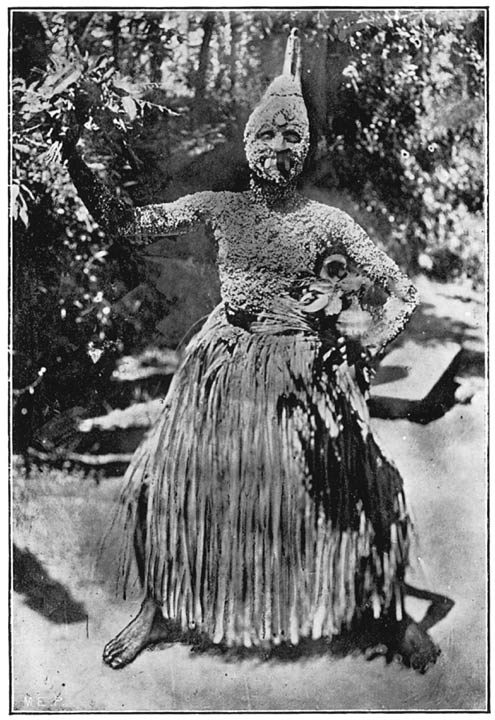
Malayan devil-dancer.
“If any one is considered to be possessed by demons, it is usual, after consulting the astrologer in order to ascertain what murti (form, i.e., demon) is causing the trouble, to call in the Malayan, who performs a ceremony known as tīyattam, in which they wear masks, and, so disguised, sing, dance, tom-tom, and play on a rude and strident pipe. Another ceremony, known as ucchavēli, has several forms, all of which seem to be either survivals, or at least imitations of human sacrifice. One of these consists of a mock living burial of the principal performer, who is placed in a pit, which is covered with planks, on the top of which a sacrifice is performed, with a fire kindled with jack wood (Artocarpus integrifolia) and a plant called erinna. In another variety, the Malayan cuts his left forearm, and smears his face with the blood thus drawn. Malayans also take part with Peruvannāns (big barbers) in various ceremonies at Badrakāli and other temples, in which the performer impersonates, in suitable costume, some of the minor deities or demons, fowls are sacrificed, and a Velicchapād pronounces oracular statements.”
As the profession of exorcists does not keep the Malayans fully occupied, they go about begging during the harvest season, in various disguises, of which that of a hobby-horse is a very common one. They further add to their income by singing songs, at which they are very expert. Like the Nalkes and Paravas of South Canara, the Malayans exorcise various kinds of devils, with appropriate disguises. For Nenaveli (bloody sacrifice), the performer smears the upper part of his body and face with a paste made of rice-flour reddened with turmeric powder and chunam (lime) to indicate a bloody sacrifice. Before the paste dries, parched paddy (unhusked rice) grains, representing small-pox pustules, are sprinkled over it. Strips of young cocoanut leaves, strung together so as to form a petticoat, are tied round the waist, a ball of sacred ashes (vibhūthi) is fixed on the tip of the nose, and two strips of palmyra palm leaf are stuck in the mouth to represent fangs. If it is thought that a human sacrifice is necessary to propitiate the devil, the man representing Nenaveli puts round his neck a kind of framework made of plantain leaf sheaths; and, after he has danced with it on, it is removed, and placed on the ground in front of him. A number of lighted wicks are stuck in the middle of the framework, which is sprinkled with the blood of a fowl, and then beaten and crushed. Sometimes this is not regarded as sufficient, and the performer is made to lie down in a pit, which is covered over by a plank, and a fire kindled. A Malayan, who acted the part of Nenaveli before me at Tellicherry, danced and gesticulated wildly, while a small boy, concealed behind him, sang songs in praise of the demon whom he represented, to the accompaniment of a drum. At the end of the performance, he feigned extreme exhaustion, and laid on the ground in a state of apparent collapse, while he was drenched with water brought in pots from a neighbouring well.
The disguise of Uchchaveli is also assumed for the propitiation of the demon, when a human sacrifice is considered necessary. The Malayan who is to take the part puts on a cap made of strips of cocoanut leaf, and strips of the same leaves tied to a bent bamboo stick round his waist. His face and chest are daubed with yellow paint, and designs are drawn thereon in red or black. Strings are tied tightly round the left arm near the elbow and wrist, and the swollen area is pierced with a knife. The blood spouts out, and the performer waves the arm, so that his face is covered with the blood. A fowl is waved before him, and decapitated. He puts the neck in his mouth, and sucks the blood.
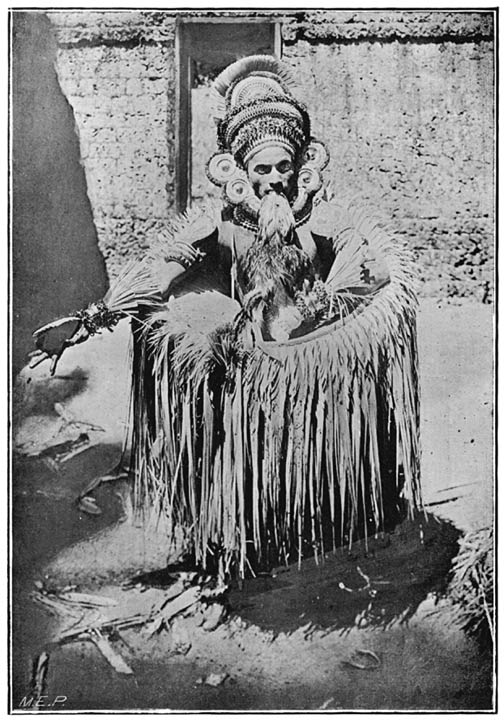
Malayan devil-dancer with fowl in mouth.
The disguises are generally assumed at night. The exorcism consists in drawing complicated designs of squares, circles, and triangles, on the ground with white, black, and yellow flour. While the man who has assumed the disguise dances about to the accompaniment of drums, songs are sung by Malayan men and women.
Malayan.—A division of Panikkans in the Tamil country, whose exogamous septs are known by the Malayālam name illam (house).
Maldivi.—A territorial name, meaning a native of the Maldive islands, returned by twenty-two persons in Tanjore at the Census, 1901.
Malē Kudiya.—A synonym of Kudiya, denoting those who live in the hills.
Malēru.—It is noted, in the Mysore Census Report, 1901, that “in some temples of the Malnād there exists a set of females, who, though not belonging to the Natuva class, are yet temple servants like them, and are known by the name of Malēru. Any woman who eats the sacrificial rice strewn on the balipītam (sacrificial altar) at once loses caste, and becomes a public woman, or Malēru.” The children of Malērus by Brāhmans are termed Golakas. Any Malēru woman cohabiting with one of a lower caste than her own is degraded into a Gaudi. In the Madras Census Report, 1901, Mālē or Mālēra is returned as a sub-caste of Stānika. They are said, however, not to be equal to Stānikas. They are attached to temples, and their ranks are swelled by outcaste Brāhman and Konkani women.
Maleyava.—Recorded, in the Madras Census Report, 1901, as a small Canarese-speaking caste of beggars. In the South Canara Manual, it is stated that they are “classed as mendicants, as there is a small body of Malayālam gypsies of that name. But there may have been some confusion with Malava and Malē Kudiya.”
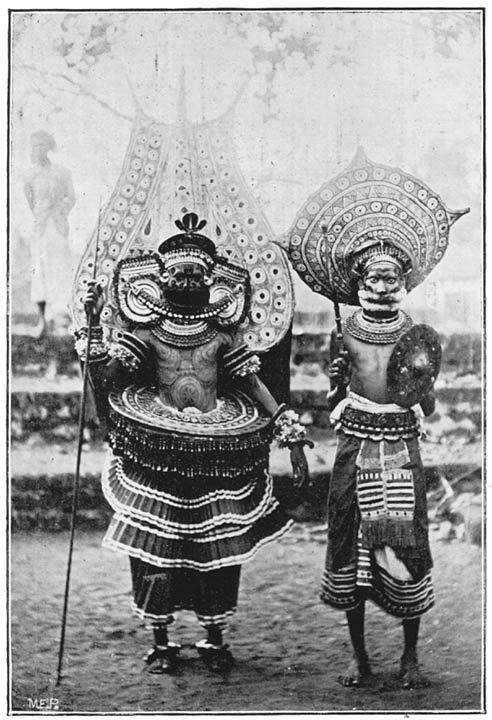
Malayan devil-dancers.
For the following note, I am indebted to Mr. C. Hayavadana Rao. The Mālis say that their ancestors lived originally at Kāsi (Benares), whence they emigrated to serve under the Rāja of Jeypore. They are divided into the following sub-divisions:—Bodo, Pondra, Kosalya, Pannara, Sonkuva, and Dongrudiya. The name Pondra is said to be derived from podoro, a dry field. I am informed that, if a Pondra is so prosperous as to possess a garden which requires the employment of a picottah, he is bound to entertain as many men of his caste as choose to go to his house. A man without a picottah may refuse to receive such visits. A picottah is the old-fashioned form of a machine still used for raising water, and consists of a long lever or yard pivotted on an upright post, weighted on the short arm, and bearing a line and bucket on the long arm.
Among the Bodo Mālis, a man can claim his paternal aunt’s daughter in marriage, which takes place before the girl reaches puberty. A jholla tonka (bride-price) of forty rupees is paid, and the girl is conducted to the house of the bridegroom, in front of which a pandal (booth) has been erected, with nine pots, one above the other, placed at the four corners and in the centre. In the middle of the pandal a mattress is spread, and to the pandal a cloth, with a myrabolam (Terminalia fruit), rice, and money tied up in it, is attached. The contracting couple sit together, and a sacred thread is given to the bridegroom by the officiating priest. The bride is presented with necklaces, nose-screws, and other ornaments by the bridegroom’s party. They then repair to the bridegroom’s house. The ceremonies are repeated during the next three days, and on the fifth day the pair are bathed with turmeric water, and repair to a stream, in which they bathe. On their return home, the bridegroom is presented with some cheap jewelry.
Among the Pondra Mālis, if a girl is not provided with a husband before she reaches puberty, a mock marriage is performed. A pandal (booth) is erected in front of her house, and she enters it, carrying a fan in her right hand, and sits on a mattress. A pot, containing water and mango leaves, is set in front of her, and the females throw turmeric-rice over her. They then mix turmeric powder with castor-oil, and pour it over her from mango leaves. She next goes to the village stream, and bathes. A caste feast follows after this ceremonial has been performed. The girl is permitted to marry in the ordinary way. A Bodo Māli girl, who does not secure a husband before she reaches puberty, is said to be turned out of the caste.
In the regular marriage ceremony among the Pondra Mālis, the bridegroom, accompanied by his party, proceeds to the bride’s village, where they stay in a house other than that of the bride. They send five rupees, a new cloth for the bride’s mother, rice, and other things necessary for a meal, as jholla tonka (present) to the bride’s house. Pandals, made of four poles, are erected in front of the houses of the bride and bridegroom. Towards evening, the bridegroom proceeds to the house of the bride, and the couple are blessed by the assembled relations within the pandal. On the following day, the bridegroom conducts the bride to her pandal. They take their seat therein, separated by a screen, with the ends of their cloths tied together. Ornaments, called maguta, corresponding to the bāshinga, are tied on their foreheads. At the auspicious moment fixed by the presiding Dēsāri, the bride stretches out her right hand, and the bridegroom places his thereon. On it some rice and myrabolam fruit are laid, and tied up with rolls of cotton thread by the Dēsāri. On the third day, the couple repair to a stream, and bathe. They then bury the magutas. After a feast, the bride accompanies the bridegroom to his village, but, if she has not reached puberty, returns to her parents.
Widow remarriage is permitted, and a younger brother usually marries the widow of his elder brother.
The dead are burnt, and death pollution lasts for ten days, during which those who are polluted refrain from their usual employment. On the ninth day, a hole is dug in the house of the deceased, and a lamp placed in it. The son, or some other close relative, eats a meal by the side of the hole, and, when it is finished, places the platter and the remains of the food in the hole, and buries them with the lamp. On the tenth day, an Oriya Brāhman purifies the house by raising the sacred fire (hōmam). He is, in return for his services, presented with the utensils of the deceased, half a rupee, rice, and other things.
Māli further occurs as the name of an exogamous sept of Holeya. (See also Rāvulo.)
Maliah (hill).—A sub-division of Savaras who inhabit the hill-country.
Malighai Chetti.—A synonym of Acharapākam Chettis. In the city of Madras, the Malighai Chettis cannot, like other Bēri Chettis, vote or receive votes at elections or meetings of the Kandasāmi temple.
Mālik.—A sect of Muhammadans, who are the followers of the Imām Abu ’Abdi ’llāh Mālik ibn Anas, the founder of one of the four orthodox sects of Sunnis, who was born at Madināh, A.H. 94 (A.D. 716).
Malle.—Malle, Malli, Mallela, or Mallige, meaning jasmine, has been recorded as an exogamous sept of Bestha, Holeya, Kamma, Korava, Kurni, Kuruba, Mādiga, Māla, Oddē, and Tsākala. The Tsākalas, I am informed, will not use jasmine flowers, or go near the plant. In like manner, Besthas of the Malle gōtra may not touch it.
Mālumi.—A class of Muhammadan pilots and sailors in the Laccadive islands. (See Māppilla.)
Māmidla (mango).—An exogamous sept of Padma Sālē.
Mānā (a measure).—An exogamous sept of Kuruba.
Manavālan (bridegroom).—A sub-division of Nāyar.
Manayammamar.—The name for Mūssad females. Mana means a Brāhman’s house.
Mancha.—Recorded, in the Madras Census Report, 1901, as a Musalman tribe in the Laccadive islands.
Manchāla (cots).—An exogamous sept of Oddē. The equivalent mancham occurs as a sept of Panta Reddis, the members of which avoid sleeping on cots.
Manchi (good).—An exogamous sept of Padma Sālē and Yānādi.
Mandādan Chetti.—There are at Gudalūr near the boundary between the Nīlgiri district and Malabar, and in the Wynād, two classes called respectively Mandādan Chettis and Wynād Chettis (q.v.).
The following account of the Mandādan Chettis is given in the Gazetteer of the Nīlgiris. “They speak a corrupt Canarese, follow the makkatāyam law of inheritance (from father to son), and seem always to have been natives of the Wynaad. Mandādan is supposed to be a corruption of Mahāvalinādu, the traditional name still applied to the country between Nellakōttai and Tippakādu, in which these Chettis principally reside. These Chettis recognise as many as eight different headmen, who each have names and a definite order of precedence, the latter being accurately marked by the varying lengths of the periods of pollution observed when they die. They are supposed to be the descendants in the nearest direct line of the original ancestors of the caste, and they are shown special respect on public occasions, and settle domestic and caste disputes. Marriages take place after puberty, and are arranged through go-betweens called Madhyastas. When matters have been set in train, the contracting parties meet, and the boy’s parents measure out a certain quantity of paddy (unhusked rice), and present it to the bride’s people, while the Madhyastas formally solicit the approval to the match of all the nearest relatives. The bride is bathed and dressed in a new cloth, and the couple are then seated under a pandal (booth). The priest of the Nambalakōd temple comes with flowers, blesses the tāli, and hands it to the bridegroom, who ties it round the bride’s neck. Sometimes the young man is made to work for the girl as Jacob did for Rachael, serving her father for a period (generally of from one to four years), the length of which is settled by a panchāyat (council). In such cases, the father-in-law pays the expenses of the wedding, and sets up the young couple with a house and some land. Married women are not prohibited from conferring favours on their husbands’ brothers, but adultery outside the caste is severely dealt with. Adoption seems to be unknown. A widow may remarry. If she weds her deceased husband’s brother, the only ceremony is a dinner, after which the happy pair are formally seated on the same mat; but, if she marries any one else, a pandal and tāli are provided. Divorce is allowed to both parties, and divorcées may remarry. In their cases, however, the wedding rites are much curtailed. The dead are usually burnt, but those who have been killed by accidents or epidemics are buried. When any one is at death’s door, he or she is made to swallow a little water from a vessel in which some rice and a gold coin have been placed. The body is bathed and dressed in a new cloth, sometimes music is played and a gun fired, and in all cases the deceased’s family walk three times round the pyre before it is fired by the chief mourner. When the period of pollution is over, holy water is fetched from the Nambalakōd temple, and sprinkled all about the house. These Chettis are Saivites, and worship Bētarāyasvāmi of Nambalakōd, the Airu Billi of the Kurumbas, and one or two other minor gods, and certain deified ancestors. These minor gods have no regular shrines, but huts provided with platforms for them to sit upon, in which lamps are lit in the evenings, are built for them in the fields and jungles. Chetti women are often handsome. In the house they wear only a waist-cloth, but they put on an upper cloth when they venture abroad. They distend the lobes of their ears, and for the first few years after marriage wear in them circular gold ornaments somewhat resembling those affected by the Nāyar ladies. After that period they substitute a strip of rolled-up palm leaf. They have an odd custom of wearing a big chignon made up of plaits of their own hair cut off at intervals in their girlhood.”
Mandādi.—A title of Golla.
Mandai.—An exogamous section of Kallan named after Mandai Karuppan, the god of the village common (Mandai).
Mandha.—Mandha or Mandhala, meaning a village common, or herd of cattle collected thereon, has been recorded as an exogamous sept of Bēdar, Karna Sālē, and Mādiga.
Māndi (cow).—A sept of Poroja.
Māndiri.—A sub-division of Dōmb.
The Mandula is a very imposing person, as he sits in a conspicuous place, surrounded by paper packets piled up all round him. His method of advertising his medicines is to take the packets one by one, and, after opening them and folding them up, to make a fresh pile. As he does so, he may be heard repeating very rapidly, in a sing-song tone, “Medicine for rheumatism,” etc. Mandulas are sometimes to be seen close to the Moore Market in the city of Madras, with their heaps of packets containing powders of various colours.
For the following note on the Mangalas, I am indebted to Mr. C. Hayavadana Rao. The caste is divided into two endogamous divisions, Telaga and Kāpu, the ancestors of which were half brothers, by different mothers. They will eat together, but will not intermarry, as they regard themselves as cousins. The primary occupation of the caste is shaving the heads of people belonging to the non-polluting castes, and, for a small consideration, razors are lent to Mādigas and Mālas. A Mangala, in the Vizagapatam district, carries no pollution with him, when he is not actually engaged in his professional duties, and may often be found as storekeeper in Hindu households, and occupying the same position as the Bhondāri, or Oriya barber, does in the Oriya country. Unlike the Tamil Ambattan, the Mangala has no objection to shaving Europeans. He is one of the village officials, whose duties are to render assistance to travellers, and massage their limbs, and, in many villages, he is rewarded for his services with a grant of land. He is further the village musician, and an expert at playing on the flute. Boys are taught the art of shaving when they are about eight years old. An old chatty (earthen pot) is turned upside down, and smeared with damp earth. When this is dry, the lad has to scrape it off under the direction of an experienced barber.
Mangala Pūjāri.—The title of the caste priest of the Mogērs.
Māngalyam.—A sub-division of Mārāns, who, at the tāli-kettu ceremony of the Nāyars, carry the ashtamāngalyam or eight auspicious things. These are rice, paddy (unhusked rice), tender leaves of the cocoanut, a mimic arrow, a metal looking-glass, a well-washed cloth, burning fire, and a small round wooden box called cheppu. Māngalyam occurs as the name for Mārāns in old Travancore records.