Volume 4 — M
Reading edition
Machi.—Recorded as a synonym of Myāsa Bēdar.
Madaka (plough).—An exogamous sept of Togata.
Mādāri (pride or arrogance).—A Tamil name for Chakkiliyan.
Maddi.—Maddi or Madderu, indicating those who use the root of the Indian mulberry (maddi: Morinda citrifolia) as a dye, has been recorded as a sub-division of Besthas and Kabbēras.
Maddila (drum).—Maddila or Maddili has been recorded as an exogamous sept of Kāpu and Māla.
Madhavē (marriage).—An exogamous sept of Badagas of the Nīlgiri hills.
Madhurāpuria.—A name frequently given by members of the Bhatta sub-division of Gaudo.
Madhya.—Madhya or Madhaya is a sub-division of Bottada and Sondi.
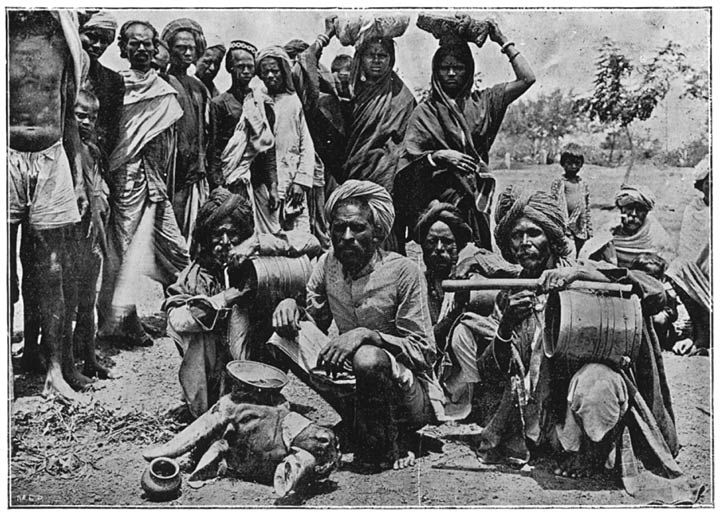
Mādiga.—The Mādigas are the great leather-working caste of the Telugu country, and correspond to the Chakkiliyans of the Tamil area. They were first studied by me at Hospet in the Bellary district, and at once formed a strong opposition party, in the belief that I was going to select and carry off the strong men, lest they should become kings, and upset the British Rāj. So frightened were they, that they went in a body to live in the Muhammadan quarter of the town.
At the Hospet weekly market I witnessed a mendicant youth lying naked in a thorny bed of bābūl (Acacia arabica) stems. A loathsome spectacle was afforded by a shrivelled old woman with mouth distended by a mass of mud the size of a cricket-ball, both eyes bunged up with mud, and beating her bare breasts with her hands. The market was infested by religious mendicants, some from Benares and Rāmēsvaram, others from across the Hyderabad frontier, who cadged persistently for tobacco leaves, an onion or brinjal (Solanum Melongena), a few chillies, a handful of grain, or a pinch of salt, and helped to deplete the slender stock of the market-sellers. One holy man from Sholapūr was profusely decorated with beads, ashes, brass snakes, and deities. Holding out for four pies worth of betel leaves, while the stall-keeper only offered one pie worth, he, after making a circle in the ground with his staff round his sandals thickly studded with blunt nails, stood thereon, and abused the vendor in language which was not nice. A Native Magistrate thereon summoned a constable, who, hastily donning his official belt, took the holy man in custody for an offence under the Act.
A conspicuous feature of Hospet are the block-wheel carts with wooden wheels, solid or made of several pieces, with no spokes. Dragged by sturdy buffaloes, they are excellent for carrying timber or other loads on rough roads or hill-tracks, where ordinary carts cannot travel. During the breezy and showery season of the south-west monsoon, kite-flying is the joy of the Hospet youths, the kites being decorated with devices of scorpions and Hindu gods, among which a representation of Hanumān, one of the genii loci, soared highest every evening.
It is fairly easy to distinguish a Mādiga from a Bēdar, but difficult to put the distinction in words. The Mādigas have more prominent cheek-bones, a more vinous eye, and are more unkempt. The Bēdar, it is said, gets drunk on arrack (alcohol obtained by distillation), whereas the Mādiga contents himself with the cheaper toddy (fermented palm juice). The Bēdars resort freely to the Mādiga quarters (Mādiga kēri), situated on the outskirts of the town, and fenced in by milk-hedge (Euphorbia Tirucalli) bushes. My Brāhman assistant, hunting in the Mādiga quarters for subjects for measurement, unfortunately asked some Bēdars if they were Mādigas. To which, resenting the mistake, one of them replied “We call you the Mādiga,” and the Brāhman stood crushed.
The Hospet Mādigas had their hair cropped short, moustache, and trimmed beard. They wore the customary threads or charm cylinders to ward off devils, and steel tweezers for removing the thorns of the bābūl, which is largely used as a fence for the fields of chōlam and sugar. One man had suspended round his neck, as a hereditary talisman, a big silver Venkatarāmana bottu with the nāmam in the centre on an altar, and the chank and chakram stamped on it.
As bearing on the social status of the Mālas and Mādigas, which is a subject of dispute between the two classes, it may be noted that all the billets in cotton factories which require any skill, such as engine-drivers, valve-men, moulders, turners, etc., are held by Mālas. The Mādigas are generally only three-anna wage men, and do such work as turning a winch, moving bales, and other trivial jobs. At a factory, whereat I stayed, at Adōni, there were three wells, viz.:—for Mālas, for Mādigas, and for the rest of the workers, except Brāhmans. And the well-water for the Mālas was better than that for the Mādigas. A Mādiga chindu, or sword-dance, was prohibited in 1859 and 1874. But a petition, referring to its obscene nature, and its being the cause of frequent collision between the Mālas and Mādigas, was submitted to the Collector of Kurnool in 1887, by a missionary. The dance was performed at festivals, held annually or triennially, in honour of the village goddess, and during the time of threshing corn, building a new house, or the opening of a newly-dug well. The dance, accompanied by a song containing grossly indecent reflections against the Mālas, was also performed, under the excitement of strong drinks, in the presence of the goddess, on the occasion of marriages. One verse ran as follows: “I shall cut with my saw the Mālas of the four houses at Nandyāl, and, having caused them to be cut up, shall remove their skins, and fix them to drums.”
The system of making Basavis (see Deva-dāsi), which prevails among the Mādigas of the Ceded districts, is apparently not in vogue among those of the Telugu country, where, however, there are, in some places, a class of prostitutes called Mātangi, Mātamma, or Mātha, who are held in much respect. In connection with the Basavi system, it is recorded, in the Madras Law Report, 1892, that “upon the whole, the evidence seems to be to establish that, among the Mādigas, there is a widespread custom of performing in the temple at Uchangidurgam, a marriage ceremony, the result of which is that the girl is married without possibility of widowhood or divorce; that she is at liberty to have intercourse with men at pleasure; that her children are heirs to her father, and keep up his family; and that Basavis’ nieces, being made Basavis, become their heirs. The Basavis seem in some cases to become prostitutes, but the language used by the witnesses generally points only to free intercourse with men, and not necessarily to receipt of payment for use of their bodies. In fact, they acquire the right of intercourse with men, without more discredit than accrues to the men of their caste for intercourse with women who are not their wives.”
(a) Sapthamāthas (seven mothers).
(b) A curious temple, in which are found the idols of Jamadhagni Bagawān—the father of Parasurāma and the local rishi—his wife Renuka Dēvi, and the Surabi.
(c) Opposite to this temple is the curious shrine, not very much bigger than a railway pointsman’s box, dedicated to Māthangi. In this temple are found no less than five idols arranged in the following order:—(1) a three-headed snake; (2) another three-headed snake; (3) a female body, with the palms joined reverentially in the worshipping posture in front, with the lower half of the body snaky in form, and with a canopy of snaky hoods above; (4) Māthangi proper—a female figure of about 15 inches in height, made of stone—with a short skirt, below which the feet are visible, but no upper garment, and wearing a garland round the neck. The right hand holds a snake-headed stick, while the left has an adlika, a kind of sieve; (5) another similar figure, but without even the skirt.
“We shall now proceed to enquire who this Māthangi was, and how she came to be worshipped there. Jamadhagni Maharishi, known also as Bagawān on account of his godly power and virtues, married Renuka, the daughter of Renu, and had five sons by her, the youngest of whom was the famous Parasurāma, an incarnation of Vishnu. ‘Once upon a time,’ says the Bhagavatapurāna, ‘Renuka having gone to the Ganga, saw the king of the Ghandarvas wearing garlands of lotus, to play with the Apsaras. Having gone to the river to fetch water, she, whose heart was somewhat attracted by Chitaratha (the king of the Gandharvas) who was playing, forgot the time of Yajna (sacrifice). Coming to feel the delay, and afraid of the curse of the Muni, she returned to the hermitage, and placed the pitcher before the Muni, and remained standing with folded palms. The Muni (Jamadhagni), coming to know of the unchasteness of his wife, got enraged, and said ‘O my sons! kill this sinner.’ Although thus directed, they did not do so. The said (Parasu) Rāma, who was well aware of the power of the Muni in respect of meditations and asceticism, killed, being directed by his father, his mother along with his brothers. The son of Satyavati (Jamadhagni) was pleased, and requested Rāma to pray for any favour. Rāma desired the reanimation of those killed, and their forgetfulness of the fact of their having been killed. Immediately did they get up, as though after a deep sleep. Rāma, who was conscious of the powers of his father in regard to asceticism, took the life of his dear ones.’
“The version locally prevalent is somewhat different. Jamadhagni Bagawān’s hermitage was near this Kona, and he was worshipping the god Surabeswara, and doing tapas (penance) there. One day, his wife Renuka Dēvi went, very early in the morning, to the river Gundlacama to bathe, and fetch water for her husband’s sacrificial rites. She was accompanied, as was her wont on such occasions, by a female slave of the chuckler (leather-worker) caste, as a sort of bodyguard and attendant. While she was bathing, the great warrior Karthaviriyarjuna with a thousand arms happened to fly across the sky on some business of his own, and Renuka saw his form reflected in the water, and was pleased with it in her mind. It must be mentioned that she never used to take any vessel with her to fetch water, for her chastity was such that she had power to roll water into a pot-like shape, as if it were wax, and thus bring it home. On this day, however, she failed to effect this, try what she might, and she was obliged to return home empty-handed. In the meanwhile, the sage, her husband, finding that his wife did not return as usual, learnt through his ‘wisdom sight’ what had happened, and ordered his son Parasurāma to slay his sinful mother. Parasurāma went towards the river accordingly, and, seeing his mother returning, aimed an arrow at her, which severed her head from her body, and also similarly severed, with its unspent force, the head of the chuckler woman who was coming immediately behind his mother. Parasurāma returned to his father without even noticing this accident, and when his father, pleased with his prompt obedience, offered him any boon, he prayed for the re-animation of his mother. Jamadhagni then gave him some holy water out of his vessel, and told him to put together the dismembered parts, and sprinkle some water over them. Parasurāma went off in great delight and haste, and, as it was still dark and early in the morning, he wrongly put his mother’s head on the chuckler woman’s trunk, and sprinkled water on them. Then, seeing another head and another body lying close by, he thought that they belonged to the female slave whom he had unwittingly killed, and he put them also together, and re-animated them. He was extremely vexed when he found out the mistakes he had committed, but, as there was no rectifying them without another double murder, he produced the two women before his father, and begged to be forgiven. The sage finally accepted the person with his late consort’s head as his wife, and granted to the other woman the status of an inferior deity, in response to her prayers, and owing to her having his wife’s body. This was the origin of Māthangi.
“There are some permanent inām (rent-free) lands belonging to this shrine, and there is always a Mādiga ‘vestal virgin’ known as Māthangi, who is the high priestess, or rather the embodied representative of the Brahman-chuckler goddess, and who enjoys the fruits of the inams. Māthangi is prohibited from marrying, and, when a Māthangi dies, her successor is chosen in the following manner. All the chuckler girls of the village, between the ages of eight and ten, who have not attained puberty, are assembled before the shrine, and the invoking hymns are chanted amid a flourish of trumpets, drums, and other accessories. The girl who becomes possessed—on whom the goddess descends—is the chosen vessel, and she is invested with the insignia of her office, a round sieve, a bunch of margosa (Melia Azadirachta) leaves, a snake-headed bamboo stick, a piece of cotton thread rope with some cowries (Cypræa moneta shells) strung on it, and a small vessel of kunkuma (coloured aniline powder). A vow of lifelong celibacy is also administered to her. Curiously enough, this shrine is venerated by all castes, from the Brāhman downwards. We were informed that, at the time of worship, the chuckler priestess dances about in wild frenzy, and she is given toddy to drink, which she not infrequently spits on her devotees, and even Brāhmans regard this as auspicious, and not in the least polluting. We had the pleasure of witnessing a ‘possessed dance’ by the reigning Māthangi, with her drummer in attendance. She is a chuckler woman, about thirty years of age, and, but for the insignia of her office, not in any way differing from the rest of her class. Though unmarried she had several children, but this was apparently no disqualification. We were standing before the shrine of the seven mothers when the drummer invoked the goddess by chanting a Telugu hymn, keeping time on his drum. The meaning of the hymn was to this effect, as far as we could make out:—
Sathya Surabesa Kona! Gowthama’s Kamadhenu! the headless trunk in Sathya Surabesa Kona! your father Giri Rāzu Kamadēva Jamadhagni Mamuni beheaded the trunk; silently Jamadhagni cut off the arms; did you, the headless trunk in Kamadhenuvanam, the headless trunk of Jamadhagni, your father’s golden sword, did you ask to be born a virgin in the snake pit?
“While chanting the above, the drummer was dancing round and round the woman, and beating wildly on his drum. The woman began to tremble all over, and soon it was visible that the goddess had descended on her. Then the drummer, wilder and more frantic than ever, began to praise the goddess in these words:—
Are you wearing bells to your ankles, O mother? Are you wearing cowries, O mother? Dancing and singing, O mother! We pray to thee, O mother! Possessed and falling on the ground, I implore thee, O mother! O mother, who went to Delhi and Oruganti with a sieve in the right-hand, with a wand in the left; with bells tinkling at her ankles, the mother went to Oruganti town, the mother went away.
“During this chant, the woman vies with the drummer, and dances fiercely round and round, always facing him. Then comes the appeasing chant, which the drummer drawls out in a quivering and solemn tone, and without dancing about:—
By the feet of the thirty-three crores, by the feet of the sixty crores, by the feet of the Dēvas, peace !
“The woman then stands with closed eyes, panting for breath, and quite exhausted.
“On ordinary days, the Māthangi goes about the villages, collecting the offerings of her devotees, and, we take it, she is never in much want. There are also local Māthangis in other villages, but they are all said to be subordinate to the Tudimilla woman, who is the high Pontiff of the institution. We were informed that there was an old palmyra-leaf manuscript in existence, describing the institution and the ceremonies (mostly tantric and phallic) in detail.”
Among the Mādigas of Tumkur in Mysore, the Mātangis must apparently belong to one of two septs, Belliyoru or Malloru.
The Mādiga Āsādis, who are males, have to go through an initiation ceremony very similar to that of the Mātangi. But a necklet of pebbles is substituted for the bottu, and the Vakkaliga priest touches the novice’s shoulders with flowers, turmeric powder, and kunkumam. The Āsādis are musicians who sing songs and recite stories about Ellammā. They play on a musical instrument called chaudike, which is a combination of a drum and stringed instrument. The Mātangis and Āsādis, both being dedicated to Ellammā, are eminently qualified to remove pollution for many castes who are Ellammā Vokkalu or followers of Ellammā. A lotus device, or figures of Pothu Rāja and Mātangi, are drawn on the ground, after it has been cleansed with cow-dung. The Mātangi, with her insignia, sits in the centre of the device, and the Āsādis, sitting close by, sing the praises of Ellammā to the accompaniment of the chaudike. The Mātangis and Āsādi then drink toddy, and go about the house, wherein the former sprinkle toddy with the margosa twig. Sometimes they pour some of the toddy into their mouths, and spit it out all over the house. The pot, in which the toddy is placed, is, in some places, called pallakki (palanquin).
The Āsādis’ version of the story of Ellammā is as follows. She is the goddess for all, and is present in the tongues of all except dumb people, because they have to pronounce the syllable elli (where) whenever they ask a question containing the word where. She is a mysterious being, who often exhibits herself in the form of light or flames. She is the cause of universe, and the one Sakthi in existence thereon. She is supposed to be the daughter of Girirāja Mūni and Javanikadēvi, and the wife of Jamadhagni Rishi. Her son is Parasurāma, carrying a plough. The town where she lives has three names, Jambupuri, Isampuri, and Vijayanagara, has eighty-seven gates, and is fortified by seven walls. She is believed to have for her dress all kinds of snakes. Several groves of margosa trees are said to flourish in her vicinity. She is worshipped under many names, and has become Lakshmi, Gauramma, and Saraswati in Brāhman houses, or Akkumari in Vakkaliga houses. To the Īdigas she is Gatabaghya Lakshmi, to the Kurubas Ganga Mari, to the Oddes Peddamma and Chinnamma, and so on. She is said to have proceeded on a certain day to the town of Oragallu, accompanied by Jana Mātangi. On the way thither, the soles of Mātangi’s feet blistered, and she sat down with Ellammā beneath a margosa tree. After resting a short time Mātangi asked Ellammā’s permission to go to a neighbouring Īdiga (Telugu toddy-drawer), and get some toddy to drink. Ellammā objected, as the Īdiga Gauda was a Lingāyat, and Mātangi would be compelled to wear the lingam. When Mātangi persisted, Ellammā transformed herself into an ant-hill, and Mātangi, in the guise of a young woman, went to the Īdiga Gauda with her cane (Jogi kolu) and basket, and asked for toddy. The Gauda became angry, and, tying her to a date-palm (Phœnix sylvestris), beat her, and gave her cane and basket to his groom. Mātangi was further ill-treated by the Gauda and his wives, but escaped, and went to the Gauda’s brother, who treated her kindly, and offered her toddy, of which he had sixty loads on bullocks. All this he poured into the shell of a margosa fruit which Mātangi held in her hand, and yet it was not filled. Eventually the toddy extracted from a few palms was brought, and the shell became full. So pleased was Mātangi with the Īdiga’s treatment of her, that she blessed him, and instructed him to leave three date-palms untapped as Basavi trees in every grove. She then returned to Ellammā, and it was resolved to afflict the Gauda who had treated her badly with all kinds of diseases. Still disguised as a young woman, she went to him with sweet-smelling powders, which he purchased for a large sum of money. But, when he used them, he became afflicted with manifold diseases, including small-pox, measles, cancer, asthma, gout, rheumatism, abscesses, and bed-sores. Mātangi then appeared before him as an old fortune-teller woman, whom the Īdiga consulted, and doing as he was told by her, was cured. Subsequently, learning that all his misfortunes were due to his want of respect to Mātangi, he became one of Ellammā’s Vokkalu.
There are Telugu proverbs to the effect that “under the magili system of cultivation, even a Mādiga will grow good crops,” and “not even a Mādiga will sow before Malapunnama.”
In some places bones are collected by the Mādigas for the Labbais (Muhammadans), by whom they are exported to Bombay.
The god of the temple at Tirupati appears annually to four persons in different directions, east, west, north and south, and informs them that he requires a shoe from each of them. They whitewash their houses, worship the god, and spread rice-flour thickly on the floor of a room, which is locked for the night. Next morning the mark of a huge foot is found on the floor, and for this a shoe has to be made to fit. When ready, it is taken in procession through the streets of the village, and conveyed to Tirupati, where it is presented at the temple. Though the makers of the shoes have worked in ignorance of each other’s work, the shoes brought from the north and south, and those from the east and west, are believed to match, and make a pair. Though the worship of these shoes is chiefly meant for the Pariahs, who are prohibited from ascending the Tirupati hill, as a matter of fact all, without distinction of caste, worship them. The shoes are placed in front of the image of the god near the foot of the hill, and are said to gradually wear out by the end of the year.
In an exceedingly interesting account of the festival of the village goddess Ūramma, at Kudligi in the Bellary district, Mr. F. Fawcett writes as follows. “The Mādiga Basivis (dedicated prostitutes) are given alms, and join in the procession. A quantity of rice and rāgi flour is poured into a basket, over which one of the village servants cuts the throat of a small black ram. The carcase is laid on the bloody flour, and the whole covered with old cloths, and placed on the head of a Mādiga, who stands for some time in front of the goddess. The goddess is then carried a few yards, the Mādiga walking in front, while a hole is dug close to her, and the basket of bloody flour and the ram’s carcase are buried. After some dancing by the Mādiga Basivis to the music of the tom-tom, the Mādigas bring five new pots, and worship them. A buffalo, devoted to the goddess after the last festival, is then driven or dragged through the village with shouting and tom-toming, walked round the temple, and beheaded by the Mādiga in front of the goddess. The head is placed in front of her with the right foreleg in the mouth, and a lamp, lighted eight days previously, is placed on top. All then start in procession round the village, a Mādiga, naked but for a few margosa (Melia Azadirachta) leaves, and held by two others, leading the way. Behind him are all the other Mādigas, carrying six hundred seers of chōlum (Sorghum: millet), which they scatter; and, following them, all the other villagers. It is daybreak, and the Mādiga who led the way, the pūjari (priest), and the women who followed him, who have been fasting for more than twenty-four hours, now eat. The Mādiga is fed. This Mādiga is said to be in mortal terror while leading the procession, for the spirit or influence of the goddess comes over him. He swoons before the procession is completed. At noon the people collect again at Ūramma’s temple, where a purchased buffalo is sacrificed. The head is placed in front of the goddess as before, and removed at once for food. Then those of the lower Sūdra castes, and Mādigas who are under vows, come dressed in margosa leaves, with lamps on their heads, and sacrifice buffaloes, sheep and goats to the goddess.” A further account of the festival of the village goddess Udisalamma, at Bandri in the Bellary district, is given by Mr. Fawcett. “A Mādiga,” he writes, “naked but for a few leaves round his waist, leads the procession, and, following him, are Mādigas with baskets. Fear of the goddess comes on the Mādiga. He swoons, and is carried to the temple, and flung on the ground in front of the goddess. After a while he is revived, bathed, and given new clothing. This man is one of a family, in which this curious office is hereditary. He must be the son of a married woman, not of a Basivi, and he must not be married. He fasts from the beginning of the festival till he has done what is required of him. A young ram—the sacrifice sheep—is taken up by one of the Pōturāzus, as if it were a child, its hind legs at either side of his waist and its forelegs over his shoulders, and he bites its throat open and shows his bloody mouth to the people. He throws it down, and the Mādigas remove it.”
Buffalo Sacrifice. Head with foot in the mouth.
In some localities, during epidemics of small-pox or cholera, the Mādigas celebrate a festival in honour of Māriamma, for the expenses of which a general subscription is raised, to which all castes contribute. A booth is erected in a grove, or beneath a margosa or Strychnos Nux-vomica tree, within which a decorated pot (karagam) is placed on a platform. The pot is usually filled with water, and its mouth closed by a cocoanut. In front of the pot a screen is set up, and covered with a white cloth, on which rice, plantains, and cakes are placed, with a mass of flour, in which a cavity is scooped out to hold a lighted wick fed with ghī (clarified butter), or gingelly oil. A goat is sacrificed, and its head, with a flour-light on it, placed close to the pot. The food, which has been offered to the goddess, is distributed, On the last day of the festival, the pot is carried in procession through the village, and goats are sacrificed at the four cardinal points of the compass. The pot is deposited at a spot where three roads meet, and a goat, pumpkins, limes, flowers, etc., are offered to it. Everything,except the pot, is left on the spot.
The Mādigas sometimes call themselves Jāmbavas, and claim to be descended from Jāmbu or Adi Jāmbuvadu, who is perhaps the Jāmbuvan of the Rāmayana. Some Mādigas, called Sindhuvallu, go about acting scenes from the Mahābaratha and Rāmayana, or the story of Ankalamma. They also assert that they fell to their present low position as the result of a curse, and tell the following story. Kāmadhenu, the sacred cow of the Purānas, was yielding plenty of milk, which the Dēvas alone used. Vellamānu, a Mādiga boy, was anxious to taste the milk, but was advised by Adi Jāmbuvadu to abstain from it. He, however, secured some by stealth, and thought that the flesh would be sweeter still. Learning this, Kāmadhenu died. The Dēvas cut its carcase into four parts, of which they gave one to Adi Jāmbuvadu. But they wanted the cow brought back to life, and each brought his share of it for the purpose of reconstruction. But Vellamānu had cut a bit of the flesh, boiled it, and breathed on it, so that, when the animal was recalled to life, its chin sank, as the flesh thereof had been defiled. This led to the sinking of the Mādigas in the social scale. The following variant of this legend is given in the Mysore Census Report, 1891. “At a remote period, Jāmbava Rishi, a sage, was one day questioned by Isvara (Siva) why the former was habitually late at the Divine Court. The rishi replied that he had personally to attend to the wants of his children every day, which consequently made his attendance late: whereupon Isvara, pitying the children, gave the rishi a cow (Kāmadhenu), which instantaneously supplied their every want. Once upon a time, while Jāmbava was absent at Isvara’s Court, another rishi, named Sānkya, visited Jāmbava’s hermitage, where he was hospitably entertained by his son Yugamuni. While taking his meals, the cream that had been served was so savoury that the guest tried to induce Jāmbava’s son Yugamuni, to kill the cow and eat her flesh; and, in spite of the latter’s refusal, Sānkya killed the animal, and prevailed upon the others to partake of the meat. On his return from Isvara’s Court, Jāmbava found the inmates of his hermitage eating the sacred cow’s beef; and took both Sānkya and Yugamuni over to Isvara’s Court for judgment. Instead of entering, the two offenders remained outside, Sānkya rishi standing on the right side and Yugamuni on the left of the doorway. Isvara seems to have cursed them to become Chandalas or outcasts. Hence, Sānkya’s descendants are, from his having stood on the right side, designated right-hand caste or Holayas; whilst those who sprang from Yugamuni and his wife Mātangi are called left-hand caste or Mādigas.” The occupation of the latter is said also to be founded on the belief that, by making shoes for people, the sin their ancestors had committed by cow-killing would be expiated. This mode of vicariously atoning for deliberate sin has passed into a facetious proverb, ‘So and so has killed the cow in order to make shoes from the skin,’ indicating the utter worthlessness and insufficiency of the reparation.
The following are some of the more important endogamous sub-divisions among the Mādigas:—
Gampa dhompti, basket offering.
Ginna or thēl dhompti, tray or cup offering.
Bhūmi dhompti, earth offering.
Chātla dhompti, winnowing basket offering.
Sibbi dhompti, brass vessel offering.
Chadarapa dhompti, square space on the ground offering.
These sub-divisions are based on the way in which the members thereof offer food, etc., to their gods during marriages, e.g., a Gampa dhompti places it in a basket, a Bhūmi dhompti on the floor. Each sub-division possesses many exogamous septs, of which the following are examples:—
Belli, silver. Chinthala, tamarind. Chātla, winnowing basket. Dārāla, thread. Emme, buffalo. Gavala, cowry shells. Golkonda, a town. Jālam, slowness. Kambha, post. Kappala, frog. Kālahasti, a town. Kaththe, donkey. Kaththi, knife. Kudumala, cake. Kuncham, tassel. Midathala, locust. Mallela, or malli, jasmine. Nannūru, four hundred. Pothula, buffalo. Pasula, cow. Rāgi, Eleusine Coracana. Sīkili, broom. Thēla, scorpion.
There seems to be some connection between the Mādigas, the Mutrāchas, and Gollas. For, at times of marriage, the Mādiga sets aside one thambūlam (betel leaf and areca nut) for the Mutrācha, and, in some places, extends the honour to the Golla also. At the marriage ceremonies of the Pūni Gollas, an elaborate and costly form of Ganga worship is performed, in connection with which it is the Mādiga musicians, called Mādiga Pambala vandlu, who draw the designs in colour-powders on the floor.
The Mādigas observe the panchāyat or tribal council system for the adjustment of disputes, and settlement of various questions at issue among members of the community. The headman is called Pedda (big) Mādiga, whose office is hereditary; and he is assisted by two elected officers called Dharmakartha and Kulambantrothu.
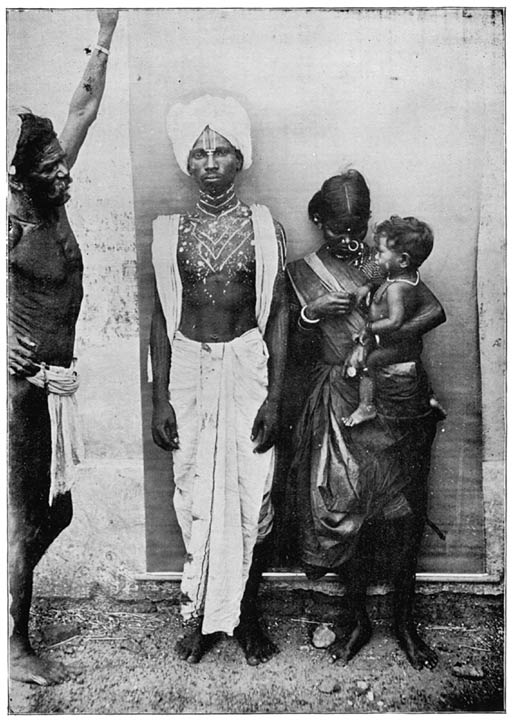
Mādiga bridal pair.
The Mādiga marriages are said to be conducted with much brawling and noise, owing to the quantity of liquor consumed on such occasions. Among the Mādigas, as among the Kammas, Gangimakkulu, and Mālas, marriage is said not to be consummated until three months after its celebration. This is apparently because it is considered unlucky to have three heads of a household within a year of marriage. By the delay, the birth of the child should take place only in the second year, so that, during the first year, there will be only two heads, husband and wife.
At the first menstrual period a girl is under pollution for ten days, when she bathes. Betel leaves and nuts, and a rupee are placed in front of the Pedda Mādiga, who takes a portion thereof for himself, and distributes what remains among those who have assembled. Sometimes, just before the return of the girl to the house, a sheep is killed in front of the door, and a mark made on her face with the blood.
Like many castes, the Mādigas have beggar classes attached to their community, who are called Dakkali and Māstiga. The Dakkalis may not enter the Mādiga settlement. They sing songs in praise of the Mādigas, who willingly remunerate them, as their curses are believed to be very effective. The Māstigas may enter the settlement, but not the huts. It is said to be a good omen to a Lingāyat, if he sees a Mādiga coming in front.
Gōsangi is often used as a synonym for Mādiga. Another synonym is Puravābatta, which is said to mean people older than the world by six months. At the Madras census, 1901, Chakara, Chundi, and Pavini or Vayani were returned as sub-castes, and Māyikkan was taken as the Malabar equivalent for Mādiga.
Madivāla.—See Agasa.
Mādukkāran.—See Gangeddu.
Madurai.—The name of a sub-division of Shānān, apparently meaning sweet liquor, and not the town of Madura.
Magadha Kani.—Recorded, at times of census, as a sub-division of Bhatrāzu.
Maggam.—Maggam, Magga, and Maggada, meaning loom, have been recorded as exogamous septs of Kurubas, Mālas, and Holeyas, some of whom are weavers.
Māghadulu.—A sub-division of Bhatrāzu, named after one Māghade, who is said to have been herald at the marriage of Siva.
Magili (Pandanus fascicularis).—A gōtra of Tsākalas and Panta Reddis, by whom the products of the tree may not be touched. The Panta Reddi women of this gōtra will not, like those of other castes, use the flower-bracts for the purpose of adorning themselves. There is a belief, in Southern India, that the fragrant male inflorescence harbours a tiny snake, which is more deadly than the cobra, and that incautious smelling thereof may lead to death.
Māgura.—Recorded, in the Madras Census Report, 1901, as a small caste of Oriya leaf-plate makers and shikāris (huntsmen). The name is said to be derived from māgora, meaning one who traces foot-paths and tracks.
Mahādev.—A synonym of Daira Muhammadan.
Mahankudo.—A title of Gaudo and Gudiya. The headman of the latter caste goes by this name.
Mahanti.—Mahanti is, in the Madras Census Report, 1901, defined as “a caste akin to the Koronos or Karnams (writers and accountants). The name is sometimes taken by persons excommunicated from other castes.” The word means great, or prestige. According to a note submitted to me, the Mahantis gradually became Karnams, with the title of Patnaik, but there is no intermarriage between them and the higher classes of Karnams. The Mahantis of Orissa are said to still maintain their respectability, whereas in Ganjam they have as a class degenerated, so much so that the term Mahanti is now held up to ridicule.
Mahāpātro.—Said to be a title sold by the caste council to Khōduras. Also a title of Badhōyis, and other Oriya castes.
Maharāna.—A title of Badhōyi.
Mahēswara (Siva).—A synonym of Jangams (priests of the Lingāyats). The Jangams of the Sīlavants, for example, are known by this name.
The Mailāris are stated, in the Madras Census Report, 1901, to be also called Bāla Jangam. Mailāri (washerman) is also an exogamous sept of the Mālas.
Majji.—Recorded as a title of Bagatas, Doluvas, and Kurumos, and as a sept of Nagarālus. In the Madras Census Report, 1901, it is described as a title given to the head peons of Bissōyis in the Māliahs.
Majjiga (butter-milk).—An exogamous sept of Bōya.
Majjula.—A sub-division of Korono.
Majjulu.—Recorded, in the Madras Census Report, 1901, as “cultivators in Vizagapatam, and shikāris (hunters) and fishermen in Ganjam. They have two endogamous divisions, the Majjulus and the Rācha Majjulus, the members of the latter of which wear the sacred thread, and will not eat with the former. In their customs they closely resemble the Kāpus, of which caste they are perhaps a sub-division. For their ceremonies they employ Oriya Brāhmans, and Telugu Nambis. Widow marriage is allowed. They burn their dead, and are said to perform srāddhas (memorial services). They worship all the village gods and goddesses, and eat meat. They have no titles.”
Mākado (monkey).—An exogamous sept of Bottada.
Makkathāyam.—The name, in the Malayālam country, for the law of inheritance from father to son. The Canarese equivalent thereof is makkalsanthānam.
The Mālas will not take water from the same well as the Mādigas, whom they despise for eating carrion, though they eat beef themselves.
Both Mālas and Tamil Paraiyans belong to the right-hand section. In the Bellary district the Mālas are considered to be the servants of the Banajigas (traders), for whom they do certain services, and act as caste messengers (chalavāthi) on the occasion of marriages and funerals. At marriages, six Mālas selected from certain families, lead the procession, carrying flags, etc., and sit in the pial (verandah) of the marriage house. At funerals, a Māla carries the brass ladle bearing the insignia of the right-hand section, which is the emblem of the authority of the Dēsai or headman of the section.
The Mālas have their own dancing girls (Basavis), barbers, and musicians (Bainēdus), Dāsaris or priests, and beggars and bards called Māstigas and Pambalas (drum people), who earn their living by reciting stories of Ankamma, etc., during the funeral ceremonies of some Telugu castes, acting as musicians at marriages and festivals to the deities, begging, and telling fortunes. Other beggars are called Nityula (Nitiyadāsu, immortal). In some places, Tsākalas (washerman caste) will wash for the Mālas, but the clothes must be steeped in water, and left till the Tsākala comes for them. The Mālas will not eat food prepared or touched by Kamsalas, Mēdaras, Mādigas, Bēri Chettis, Bōyas, or Bhatrāzus. The condition of the Mālas has, in recent times, been ameliorated by their reception into mission schools.
In a case, which came before the High Court of Madras on appeal a few years ago, a Māla, who was a convert to Christianity, was sentenced to confinement in the stocks for using abusive language. The Judge, in summing up, stated that “the test seems to be not what is the offender’s creed, whether Muhammadan, Christian, or Hindu, but what is his caste. If he belongs to one of the lower castes, a change of creed would not of itself, in my judgment, make any difference, provided he continues to belong to the caste. If he continues to accept the rules of the caste in social and moral matters, acknowledges the authority of the headmen, takes part in caste meetings and ceremonies, and, in fact, generally continues to belong to the castes, then, in my judgment, he would be within the purview of the regulation. If, on the other hand, he adopts the moral standards of Christianity instead of those in his caste, if he accepts the authority of his pastors and teachers in place of that of the headman of the caste, if he no longer takes part in the distinctive meetings and ceremonies of the caste ... then he can no longer be said to belong to one of the lower castes of the people, and his punishment by confinement in the stocks is no longer legal.”
Between the Mālas and Mādigas there is no love lost, and the latter never allow the former, on the occasion of a festival, to go in palanquins or ride on horseback. Quite recently, in the Nellore district, a horse was being led at the head of a Mādiga marriage procession, and the Mālas followed, to see whether the bridegroom would mount it. To the disgust of the Mādigas, the young man refused to get on it, from fear lest he should fall off.
The Mālas will not touch leather shoes, and, if they are slippered with them, a fine is inflicted, and the money spent on drink.
The following detailed account of the Peddamma or Sunkulamma jātra (festival) in the Kurnool district, is given in the Manual. “This is a ceremony strictly local, in which the entire community of a village takes part, and which all outsiders are excluded from participating in. It is performed whenever a series of crops successively fail or cattle die in large numbers of murrain, and is peculiarly adapted, by the horrible nature of the attendant rites and the midnight hour chosen for the exhibition of its most ghastly scenes, to impress the minds of an ignorant people with a belief in its efficacy. When the celebration of the jātra is resolved on, a dark Tuesday night is selected for it, and subscriptions are collected and deposited with the Reddi (headman) or some respectable man in the village. Messengers are sent off to give intimation of the day fixed for the jātra to the Bynēnivādu, Bhutabaligādu, and Poturāju, three of the principal actors in the ceremony. At the same time a buffalo is purchased, and, after having its horns painted with saffron (turmeric) and adorned with margosa leaves, is taken round the village in procession with tom-toms beating, and specially devoted to the sacrifice of the goddess Peddamma or Sunkulamma on the morning of the Tuesday on which the ceremony is to take place. The village potter and carpenter are sent for, and ordered to have ready by that evening two images of the goddess, one of clay and the other of juvi wood, and a new cloth and a quantity of rice and dholl (peas: Cajanus indicus) are given to each of them. When the images are made, they are dressed with the new cloths, and the rice and dholl are cooked and offered as naivēdyam to the images. In some villages only one image, of clay, is made. Meanwhile the villagers are busy erecting a pandal (booth) in front of the village chāvidi (caste meeting-house), underneath which a small temple is erected of cholam straw. The Bynēnivādu takes a handful of earth, and places it inside this little temple, and the village washerman builds a small pyal (dais) with it, and decorates it with rati (streaks of different coloured powders). New pots are distributed by the potter to the villagers, who, according to their respective capabilities, have a large or small quantity of rice cooked in them, to be offered as kumbham at the proper time. After dark, when these preparations are over, the entire village community, including the twelve classes of village servants, turn out in a body, and, preceded by the Bynēnivādu and Asādivandlu, proceed in procession with music playing to the house of the village potter. There the image of the goddess is duly worshipped, and a quantity of raw rice is tied round it with a cloth. A ram is sacrificed on the spot, and several limes are cut and thrown away. Borne on the shoulders of the potter, the image is then taken through the streets of the village, Bynēnivādu and Asādivandlu dancing and capering all the way, and the streets being drenched with the blood of several rams sacrificed at every turning of the road, and strewed with hundreds of limes cut and thrown away. The image is then finally deposited in the temple of straw already referred to, and another sheep is sacrificed as soon as this is done. The wooden image, made by the carpenter, is also brought in with the same formalities, and placed by the side of the image of clay. A pot of toddy is similarly brought in from the house of the Īdigavādu (toddy-drawer), and set before the images. Now the dēvarapōtu, or buffalo specially devoted to the sacrifice of the goddess, is led in from the Reddi’s house in procession, together with a sheep and a large pot of cooked rice. The rice in the pot is emptied in front of the images and formed into a heap, which is called the kumbham, and to it are added the contents of many new pots, which the villagers have ready filled with cooked rice. The sheep is then sacrificed, and its blood shed on the heap. Next comes the turn of the dēvarapōtu, the blood of which also, after it has been killed, is poured over the rice heap. This is followed by the slaughter of many more buffaloes and sheep by individuals of the community, who might have taken vows to offer sacrifices to the goddess on this occasion. While the carnage is going on, a strict watch is kept on all sides, to see that no outsider enters the village, or steals away any portion of the blood of the slaughtered animals, as it is believed that all the benefit which the villagers hope to reap from the performance of the jātra will be lost to them if an outsider should succeed in taking away a little of the blood to his village. The sacrifice being over, the head and leg of one of the slaughtered buffaloes are severed from its body, and placed before the goddess with the leg inserted into the mouth of the head. Over this head is placed a lighted lamp, which is fed with oil and buffalo’s fat. Now starts a fresh procession to go round the village streets. A portion of the kumbham or blood-stained rice heaped up before the image is gathered into two or three baskets, and carried with the procession by washermen or Mādigas. The Bhutabaligādu now steps forward in a state of perfect nudity, with his body clean shaven from top to toe, and smeared all over with gore, and, taking up handfuls of rice (called poli) from the baskets, scatters them broadcast over the streets. As the procession passes on, bhutams or supernatural beings are supposed to become visible at short distances to the carriers of the rice baskets, who pretend to fall into trances, and, complaining of thirst, call for more blood to quench it. Every time this happens, a fresh sheep is sacrificed, and sometimes limes are cut and thrown in their way. The main streets being thus sprinkled over with poli or blood-stained rice, the lanes or gulleys are attended to by the washermen of the village, who give them their share of the poli. By this time generally the day dawns, and the goddess is brought back to her straw temple, where she again receives offerings of cooked rice from all classes of people in the village, Brāhmins downwards. All the while, the Asādivandlu keep singing and dancing before the goddess. As the day advances, a pig is half buried at the entrance of the village, and all the village cattle are driven over it. The cattle are sprinkled over with poli as they pass over the pig. The Poturāju then bathes and purifies himself, and goes to the temple of Lingamayya or Siva with tom-toms and music, and sacrifices a sheep there. The jātra ends with another grand procession, in which the images of the goddess, borne on the heads of the village potter and carpenter, are carried to the outskirts of the village, where they are left. As the villagers return home, they pull to pieces the straw temple constructed in front of the chāvidi, and each man takes home a straw, which he preserves as a sacred relic. From the day the ceremony is commenced in the village till its close, no man would go to a neighbouring village, or, if he does on pressing business, he would return to sleep in his own village. It is believed that the performance of this jātra will ensure prosperity and health to the villagers and their cattle.
“The origin of this Sunkulamma jātra is based on the following legend, which is sung by the Bynēni and Asādivandlu when they dance before the images. Sunkulamma was the only daughter of a learned Brāhmin pandit, who occasionally took pupils, and instructed them in the Hindu shastras gratuitously. One day, a handsome youth of sixteen years came to the pandit, and, announcing himself as the son of a Brāhmin of Benares come in quest of knowledge, requested that he might be enlisted as a pupil of the pandit. The pandit, not doubting the statement of the youth that he was a Brāhmin, took him as a pupil, and lodged him in his own house. The lad soon displayed marks of intelligence, and, by close application to his studies, made such rapid progress that he became the principal favourite of his master, who was so much pleased with him that, at the close of his studies, he married him to his daughter Sunkulamma. The unknown youth stayed with his father-in-law till he became father of some children, when he requested permission to return to his native place with his wife and children, which was granted, and he accordingly started on his homeward journey. On the way he met a party of Māla people, who, recognising him at once as a man of their own caste and a relation, accosted him, and began to talk to him familiarly. Finding it impossible to conceal the truth from his wife any longer, the husband of Sunkulamma confessed to her that he was a Mala by caste, and, being moved by a strong desire to learn the Hindu shastras, which he was forbidden to read, he disguised himself as a Brāhmin youth, and introduced himself to her father and compassed his object; and, as what had been done in respect to her could not be undone, the best thing she could do was to stay with him with her children. Sunkulamma, however, was not to be so persuaded. Indignant at the treachery practiced on her and her parent, she spurned both her husband and children, and returning to her village, sent for her parent, whose house she would not pollute by going in, and asked him what he would do with a pot denied by the touch of a dog. The father replied that he would commit it to the flames to purify it. Taking the hint, she caused a funeral pile to be erected, and committed suicide by throwing herself into the flames. But, before doing so, she cursed the treacherous Māla who bad polluted her that he might become a buffalo, and his children turn into sheep, and vowed she would revive as an evil spirit, and have him and his children sacrificed to her, and get his leg put into his mouth, and a light placed on his head fed with his own fat.”
The following additional information in connection with the jātra may be recorded. In some places, on a Tuesday fifteen days before the festival, some Mālas go in procession through the main streets of the village without any noise or music. This is called mūgi chātu (dumb announcement). On the following Tuesday, the Mālas go through the streets, beating tom-toms, and proclaiming the forthcoming ceremony. This is called chātu (announcement). In some villages, metal idols are used. The image is usually in the custody of a Tsākala (washerman). On the jātra day, he brings it fully decorated, and sets it up on the Gangamma mitta (Gangamma’s dais). In some places, this is a permanent structure, and in others put up for the jātra at a fixed spot. Āsādis, Pambalas, and Bainēdus, and Mādiga Kommula vāndlu (horn-blowers) dance and sing until the goddess is lifted up from the dais, when a number of burning torches are collected together, and some resinous material is thrown into the flames. At the same time, a cock is killed, and waved in front of the goddess by the Tsākala. A mark is made with the blood on the forehead of the idol, which is removed to a hut constructed by Mālas with twigs of margosa (Melia Azadirachta), Eugenia Jambolana and Vitex Negundo. In some villages, when the goddess is brought in procession to the outskirts of the village, a stick is thrown down in front of her. The Āsādis then sing songs, firstly of a most obscene character, and afterwards in praise of the goddess.
It is noted, in the Madras Census Report, 1891, that the chief object of worship by the Balijas is Gauri, their caste deity. “It is said that the Mālas are the hereditary custodians of the idol of Gauri and her jewels, which the Balijas get from them whenever they want to worship her. The following story is told to account for this. The Kāpus and the Balijas, molested by the Muhammadan invaders on the north of the river Pennār, migrated to the south when the Pennār was in full flood. Being unable to cross the river, they invoked their deity to make a passage for them, for which it demanded the sacrifice of a first-born child. While they stood at a loss what to do, the Mālas, who followed them, boldly offered one of their children to the goddess. Immediately the river divided before them, and the Kāpus and the Balijas crossed it, and were saved from the tyranny of the Muhammadans. Ever since that time, the Mālas have been respected by the Kāpus and Balijas, and the latter even deposited the images of Gauri, the bull and Ganēsa, which they worshipped in the house of a Māla. I am credibly informed that the practice of leaving these images in the custody of Mālas is even now observed in some parts of Cuddapah district and elsewhere.”
An expert Māla medicine-man has been known to prescribe for a Brāhman tahsildar (revenue officer), though the consultation was conducted at a most respectful distance on the part of the honoured physician.
Māla weavers are known as Netpanivandlu (Nethapani, weaving work). According to the Census Report, 1891, the sub-divisions of the Mālas, which are numerically strongest, are Arava, Kanta, Murikinādu, Pākanāti, and Reddi Bhūmi. To these may be added Sarindla, Sāvu, Sāindla, and Dāindla. Concerning some of these divisions, the following legend is current. A Māla married eighteen wives, one from each kulam or tribal division. The god Poleramma, objecting to the sacrifice of sheep and goats, wanted him to offer up a woman and child in substitution for the animals, and the Māla broke the news to his wives, one of whom eloped with a Reddi, and gave origin to the Reddi Bhūmis (bhūmi, earth). Another ran away, and gave rise to the Pākanātis (eastern country). A third hid herself, and escaped by hiding. Hence her descendants are called Dāindla vāndlu, concerning whom there is a proverb “Dagipoyina vāndlu Dāindla vāndlu” or “Those who escaped by hiding are Dāindlas.” One of the wives, who fled to the forest, found her way out by clearing the jungle, and her descendants are called Sarindla (straight). The wife who consented to be sacrificed with her child was restored to life by Poleramma, and gave rise to the Sāvu (death) or Sāindla (belonging to a death house) section. The Dāindlas are said to be Tamil Paraiyans, who settled down in the Telugu country, and adopted the manners and customs of the Mālas. Some call themselves Arava (Tamil) Mālas. They are employed as servants in European houses, horse-keepers, etc.
In connection with the origin of the Mālas, the Rev. S. Nicholson writes as follows. “Originally the Mālas belonged to the kudi paita section of the community, i.e., their women wore the cloth over the right shoulder, but now there are both right and left paita sections, and this must be taken as the principal division. The right-hand (right paita) section is again divided into (a) Reddi Bhūmalavaru, (b) Pōkunātivaru. The left-hand (left paita) section are Murikinātivaru. The following legend professes to account for the existence of the three divisions. When Vīrabahuvu went to the rescue of Harischandra, he promised Kāli that, if she granted him success, he would sacrifice to her his wives, of whom he had three. Accordingly, after his conquest of Vishvamithrudu, he returned, and called his wives that he might take them to the temple in order to fulfil his vow. The wives got some inkling of what was in store for them, and one of them took refuge in the house of a Reddi Bhūmala, another ran away to the eastern country (Pōkunāti), while the third, though recently confined, and still in her dirty (muriki) cloth, determined to abide by the wish of her lord. She was, therefore, sacrificed to Kāli, but the goddess, seeing her devotion, restored her to life, and promised to remain for ever her helper. The reason given for the change in the method of wearing the cloth is that, after the incident described above took place, the women of the Murikināti section, in order to express their disapproval of the two unfaithful wives, began to wear their cloths on the opposite, viz., the left, shoulder. In marriages, however, whatever the paita of the bride, she must wear the cloth over the right shoulder.
“The Reddi Bhūmalu and Pōkunātivāru say that the reason they wear the cloth over the right shoulder is that they are descendants of the gods. According to a legend, the goddess Parvati, whilst on a journey with her lord Paramēshvarudu, discarded one of her unclean (maila) cloths, from which was born a little boy. This boy was engaged as a cattle-herd in the house of Paramēshvarudu. Parvati received strict injunctions from her lord that she should on no account allow the little Māla to taste cream. One day, however, the boy discovered some cream which had been scraped from the inside of the pot sticking to a wall. He tasted it, and found it good. Indeed, so good was it that he came to the conclusion that the udder from which it came must be even better still. So one day, in order to test his theory, he killed the cow. Then came Paramēshvarudu in great anger, and asked him what he had done, and, to his credit be it said, the boy told the truth. Then Paramēshvarudu cursed the lad and all his descendants, and said that from henceforth cattle should be the meat of the Mālas—the unclean.”
The Mālas have, in their various sub-divisions, many exogamous septs, of which the following are examples:—
(a) Reddi Bhūmi.
Avuka, marsh. Bandi, cart. Bommala, dolls. Bejjam, holes. Dakku, fear. Dhidla, platform or back-door. Dhōma, gnat or mosquito. Gēra, street. Kaila, measuring grain in threshing-floor. Kātika, collyrium. Naththalu, snails. Paida, money or gold. Pilli, cat. Rāyi, stone. Samūdrala, ocean. Sīlam, good conduct. Thanda, bottom of a ship.
(b) Pōkunāti.
Allam, ginger. Dara, stream of water. Gādi, cart. Gōne, sack. Gurram, horse. Maggam, loom. Mailāri, washerman. Parvatha, mountain. Pindi, flour-powder. Pasala, cow. Thummala, sneezing.
(c) Sarindla.
Boori, a kind of cake. Ballem, spear. Bomidi, a fish. Challa, butter milk. Chinthala, tamarind. Duddu, money. Gāli, wind. Karna, ear. Kāki, crow. Mudi, knot. Maddili, drum. Malle, jasmine. Putta, ant-hill. Pamula, snake. Pidigi, handful. Semmati, hammer. Uyyala, see-saw.
(d) Dāindla.
Dāsari, priest. Doddi, court or backyard. Gonji, Glycosmis pentaphylla. Kommala, horn. Marri, Ficus bengalensis. Pala, milk. Powāku, tobacco. Thumma, Acacia arabica.
Concerning the home of the Mālas, Mr. Nicholson writes that “the houses (with mud or stone walls, roofed with thatch or palmyra palm leaves) are almost invariably placed quite apart from the village proper. Gradually, as the caste system and fear of defilement become less, so gradually the distance of their houses from the village is becoming less. In the Ceded Districts, where from early times every village was surrounded by a wall and moat, the aloofness of the houses is very apparent. Gradually, however, the walls are decaying, and the moats are being filled, and the physical separation of the outcaste classes is becoming less apparent.”
Mr. Nicholson writes further that “according to their own traditions, as told still by the old people and the religious mendicants, in former times the Mālas were a tribe of free lances, who, ‘like the tiger, slept during the day, and worked at night.’ They were evidently the paid mercenaries of the Poligars (feudal chiefs), and carried out raids and committed robberies for the lord under whose protection they were. That this tradition has some foundation may be gathered from the fact that many of the house-names of the Mālas refer to weapons of war, e.g., spear, drum, etc. If reports are true, the old instinct is not quite dead, and even to-day a cattle-stealing expedition comes not amiss to some. The Mālas belong to the subjugated race, and have been made into the servants of the community. Very probably, in former days, their services had to be rendered for nothing, but later certain inām (rent-free) lands were granted, the produce of which was counted as remuneration for service rendered. Originally, these lands were held quite free of taxation, but, since the advent of the British Rāj, the village servants have all been paid a certain sum per month, and, whilst still allowed the enjoyment of their inām lands, they have now been assessed, and half the actual tax has to be paid to Government. The services rendered by the Mālas are temple service, jātra or festival service, and village service. The village service consists of sweeping, scavenging, carrying burdens, and grave-digging, the last having been their perquisite for long ages. According to them, the right was granted to them by King Harischandra himself. The burial-grounds are supposed to belong to the Mālas, and the site of a grave must be paid for, the price varying according to the position and wealth of the deceased, but I hear that, in our part of the country, the price does not often exceed two pence. Though the Brāhmans do not bury, yet they must pay a fee of one rupee for the privilege of burning, besides the fee for carrying the body to the ghāt. There is very little respect shown by the Mālas at the burning-ghāt, and the fuel is thrown on with jokes and laughter. The Mālas dig graves for all castes which bury, except Muhammadans, Oddēs, and Mādigas. Not only on the day of burial, but afterwards on the two occasions of the ceremonies for the dead, the grave-diggers must be given food and drink. The Mālas are also used as death messengers to relatives by all the Sūdra castes. When on this work, the messenger must not on any account go to the houses of his relatives though they live in the village to which he has been sent.
“The chief occupations of the Mālas are weaving, and working as farm labourers for Sūdras; a few cultivate their own land. Though formerly their inām lands were extensive, they have been, in the majority of cases, mortgaged away. The Mālas of the western part of the Telugu country are of a superior type to those of the east, and they have largely retained their lands, and, in some cases, are well-to-do cultivators. In the east, weaving is the staple industry, and it is still carried on with the most primitive instruments. In one corner of a room stands the loom, with a hole in the mud floor to receive the treadles, and a little window in the wall, level with the floor, lights the web. The loom itself is slung from the rafters, and the whole can be folded up and put away in a corner. As a rule, weaving lasts for eight months of the year, the remainder of the year being occupied in reaping and stacking crops, etc. Each weaver has his own customers, and very often one family of Mālas will have weaved for one family of Sūdras for generations. Before starting to weave, the weaver worships his loom, and rubs his shuttle on his nose, which is supposed to make it smooth. Those who cannot weave subsist by day labour. As a rule, they stick to one master, and are engaged in cultivation all the year round. Many, having borrowed money from some Sūdra, are bound to work for him for a mere pittance, and that in grain, not cash.”
The following detailed account of the ceremonies in connection with marriage, many of which are copied from the higher Telugu castes, is given by Mr. Nicholson. “Chinna Tāmbūlam (little betel) is the name given to the earliest arrangements for a future wedding. The parents of the boy about to be married enquire of a Brāhman to which quarter they should go in search of a bride. He, after receiving his pay, consults the boy’s horoscope, and then tells them that in a certain quarter there is loss, in another quarter there is death, but that in another quarter there is gain or good. If in the quarter which the Brāhman has intimated as good there are relations, so much the better; the bride will be sought amongst them. If not, the parents of the youth, along with an elder of the caste, set out in search of a bride amongst new people. On reaching the village, they do not make their object known, but let it appear that they are on ordinary business. Having discovered a house in which there is a marriageable girl, after the ordinary salutations, they, in a round-about way, make enquiries as to whether the warasa or marriage line is right or not. If it is all right, and if at that particular time the girl’s people are in a prosperous condition, the object of the search is made known. If, on the other hand, the girl’s people are in distress or grief, the young man’s party go away without making their intention known. Everything being satisfactory, betel nut and leaves are offered, and, if the girl’s people are willing to contract, they accept it; if not, and they refuse, the search has to be resumed. We will take it for granted that the betel is accepted. The girl’s parents then say ‘If it is God’s will, so let it be; return in eight or nine days, and we will give you our answer.’ If, within that time, there should be death or trouble of any sort in either of the houses, all arrangements are abandoned. If, when going to pay the second visit, on the journey any of the party should drop on the way either staff or bundle of food, it is regarded as a bad omen, and further progress is stopped for that day. After reaching the house of the prospective bride on the second occasion, the party wait outside. Should the parents of the girl bring out water for them to drink and to wash their faces, it is a sign that matters may be proceeded with. Betel is again distributed. In the evening, the four parents and the elders talk matters over, and, if all is so far satisfactory, they promise to come to the house of the future bridegroom on a certain date. The boy’s parents, after again distributing betel, this time to every house of the caste, take their departure. When the party of the bride arrive at the boy’s village, they are treated to toddy and a good feed, after which they give their final promise. Then, having made arrangements for the Pedda Tāmbūlam (big betel), they take their departure. This ends the first part of the negotiations. Chinna Tāmbūlam is not binding. The second part of the negociations, which is called Pedda Tāmbūlam, takes place at the home of the future bride. Before departing for the ceremony, the party of the bridegroom, which must be an odd number but not seven, and some of the elders of the village, take part in a feast. The members of the party put on their religious marks, daub their necks and faces with sandal paste and akshinthulu (coloured rice), and are sent off with the good wishes of the villagers. After the party has gone some few miles, it is customary for them to fortify themselves with toddy, and to distribute betel. The father of the groom takes with him as a present for the bride a bodice, fried dal (pea: Cajanus indicus), cocoanut, rice, jaggery, turmeric, dates, ghī, etc. On arrival at the house, the party wait outside, until water is brought for their faces and feet. After the stains of travel have been washed off, the presents are given, and the whole assembly proceeds to the toddy shop. On their return, the Chalavādhi (caste servant) tells them to which households betel must be presented, after which the real business commences. The party of the bridegroom, the people of the bride, the elders of the caste, and one person from each house in the caste quarter, are present. A blanket is spread on the floor, and grains of rice are arranged on it according to a certain pattern. This is the bridal throne. After bathing, the girl is arrayed in an old cloth, and seated on a weaver’s beam placed upon the blanket, with her face towards the east. Before seating herself, however, she must worship towards the setting sun. In her open hands betel is placed, along with the dowry (usually about sixteen rupees) brought by her future father-in-law. As the bride sits thus upon the throne, the respective parents question one another, the bride’s parents as to the groom, what work he does, what jewels he will give, etc. Whatever other jewels are given or not, the groom is supposed to give a necklace of silver and beads, and a gold nose jewel. As these things are being talked over, some one winds 101 strands of thread, without twisting it, into a circle about the size of a necklace, and then ties on it a peculiar knot. After smearing with turmeric, it is given into the hands of the girl’s maternal uncle, who, while holding his hands full of betel, asks first the girl’s parents, and then the whole community if there is any objection to the match. If all agree, he must then worship the bridal throne, and, without letting any of the betel in his hands fall, place the necklace round the bride’s neck. Should any of the betel fall, it is looked upon as a very bad omen, and the man is fined. After this part of the performance is over, and after teasing the bride, the uncle raises her to her feet, and, taking from her hands the dowry, etc., sends her off. After distributing betel to every one in the village, even unborn babies being counted, the ceremony ends, and, after the usual feast has been partaken of, the people all depart to their various homes.
“There are slight differences in the ceremonies described above according to the district and sect of the people. In the eastern Telugu country, during the marriage ceremonies, there is a sort of bridesmaid, who accompanies the bride on the day of the wedding. In the western country, largely under the influence of the Canarese, the bridesmaid is scarcely distinguishable from the real bride, but she is not, as at home, an unmarried girl, but must be a mature woman following the functions of a married life. There is another slight difference between the two sections concerning the Bhūmala ceremony. The Vaishnavites, after the arranged people have partaken of the feast, distribute the remainder of the food; the Saivites, on the other hand, if any food is left, bury it somewhere inside the house.
“Mālas may be married many times, and indeed it is not considered respectable to remain a widower. A widower is unable to make arrangements for the marriage of others, to take part in any of the ceremonies connected therewith, except in the capacity of a spectator. It is not the correct thing for a man to have two wives at one time unless the first one is barren, or unless there is other good cause. A woman must on no account marry again. She need not, according to Telugu morals, be ashamed of living, after she is widowed, with another man as his concubine, but, at the very mention of marriage, she covers her face with shame. If such people become Christians, it is a most difficult thing to overcome their prejudice, and persuade them to become legally man and wife. Almost the only way to do so is by refusing to marry their children. In the Canarese country, there is a kind of half marriage (chīra kattinchinaru, they have tied her cloth), which may be attained by widows. It is not reckoned as a proper marriage, nor is the woman considered a concubine. The ceremony for this is not performed at the great length of an ordinary marriage, but it must receive the sanction of the elders. In spite of their sanction, the man must pay a fine imposed by the caste guru. The woman is permitted to wear the tāli or marriage token, but not bangles or other jewels usually worn by a married woman. The children are part inheritors, and are not entirely without rights, as the children of concubines are. A man’s second wife must wear two tālis—that of the first wife as well as her own.”
The following variants of the Pedda Tāmbūlam ceremony, which is performed during the marriage rites, may be noted. As soon as all are assembled in the front yard of the bride’s house, a blanket is spread on the floor, and covered with a cloth. About ten seers of cholam (millet: Sorghum) are heaped up, and a brass vessel (kalasam) is placed thereon. By its side, a lamp is kept burning. A Dāsari, or a Māla priest, stands on one side of it, and a married woman on the other. The names of the gods are mentioned, one after the other, and the woman throws two betel leaves and a nut on the kalasam for each name uttered. The bride is then brought from within the house, and the leaves and nuts are tied up in a cloth. This, with the kalasam, is put in the bride’s cloth, and she is led inside. In some places, the ceremony is more elaborate. For the betrothal ceremony some leading men of the village, and the headmen of the bride and bridegroom’s villages, are required to be present. The Chalavati (caste servant) hands over a bag containing betel leaves, areca nuts, pieces of turmeric, and Rs. 4–6, to the headman of the bride’s village. All these articles are displayed on a new bamboo sieve, or on the lid of a bamboo box. The two headmen discuss the proposed match, and exchange betel and nut thrice. After this, the bride-elect (chinnapāpa) is brought from the house, and seated on a plank or on a cloth roller (dhone). Three handfuls of betel leaves and areca nuts are placed in her lap. Her maternal uncle then puts on her neck a string of unwoven unbleached cotton thread dyed with turmeric. The bride’s headman asks the assembly if he may proceed with the thonuku ceremony. With their permission, he takes from a sieve betel leaves, nuts, and a cocoanut with his right hand, using only the thumb, first, and ring fingers. While doing this, he is expected to stand on one leg, and to take up the various things, without letting even a single leaf or nut fall. In some places, the headman has the privilege of doing this seated near the sieve. In other places, he is said to hold a knife in his hand, with a blade passed below the middle finger, and over the first ring finger.
In connection with birth ceremonies, Mr. Nicholson writes as follows. “During labour, a sickle and some nīm (Melia Azadirachta) leaves are always kept upon the cot, to ward off evil spirits, which will not approach iron. Difficulty during labour is considered to be the effect of kharma, and the method employed for easing it is simple. Some mother, who has had an ‘easy time,’ is called in, and presents the labouring woman with betel, etc. Should this not be effective, a line of persons is drawn up from the well to the house, and water is passed from hand to hand until it reaches the ‘easy time’ woman, who gives the water to the sufferer. This last resort is only sought in extreme cases, but, when it is appealed to, even the caste people will join in the line and help. After the placenta has come away, the child is placed on a winnowing basket, which has been previously filled with grain, and covered with a cloth. The umbilical cord is cut, and the child is washed, and branded with a hot needle in all places, over twenty in all, which are considered vital. When the umbilical cord is cut, some coin is placed over the navel for luck. This, with the grain in the basket, is the midwife’s perquisite. Should the child present with the cord round its neck, a cocoanut is immediately offered. If the child survives, a cock is offered to the gods on the day the mother takes her first bath. The placenta is put in a pot, in which are nīm leaves, and the whole is buried in some convenient place, generally in the backyard. The reason for this is said to be that, unless the afterbirth was buried, dogs or other animals might carry it off, and ever after the child would be of a wandering disposition. The first bath of the mother takes place on the third, fifth, seventh, or ninth day after delivery. Every house in the particular quarter sends a potful of hot water. All the pots are placed near the spot where the afterbirth was buried. The mother then comes from the house supported by two women, carrying in her hand the sickle and nīm leaves. After worshipping the four mud gods which have been placed on the spot, she takes her seat on the cot on which she was confined, and, after having her body covered with turmeric, and her head anointed with a mixture of rice, chunam (lime) and turmeric, she is bathed by the women in attendance. After the bath, both the mother and child are garlanded with a root strung on strings, and worn round the neck and wrists. One of these is eaten every day by the mother. The mother rises and enters the house, but, before doing so, she worships the four quarters on the threshold. The women who assisted in the bathing operation go to their homes, and bathe their own children, afterwards returning to take part in a feast provided by the parents of the newly-born child. On this day also a name is given to the child. If all previous children have died, the child is rolled in leaf plates and rice, after which the nose and ears are pierced. The rice is given to the dogs, and the child is named Pulligadu (used up leaf plates) or Pullamma according to sex. Should the parents consider that they have a sufficiently large family, they name the child Salayya or Salakka (enough). There are several superstitions about teething. If the teeth come quickly, people say that the afterbirth has not been buried deeply enough. Should the top teeth come first, it is supposed to imply danger to the maternal uncle, who generally gives his daughter in marriage to his nephew. He is called, and brings with him a cocoanut, the inner shell of which he crushes on the child’s head. This must be done without looking on the child. In order that girls may not grow hair on their faces, their lips and chins are rubbed with the afterbirth. The dried navel is highly prized as a remedy for sterility.
In connection with death ceremonies, Mr. Nicholson writes as follows. “There is a difference in the ceremonies performed by the Vishnuvite and Saivite sects. The former allow their people to die in the house; the latter, fearing pollution, remove the person outside the door, as soon as it is recognised that death is at hand. The following description relates chiefly to the Vishnuvites or Namdaris, but, wherever possible, the difference of ceremony between the two sects is noticed. As soon as it is recognized that a person is at the point of death, the wife and children, or near relations, gather round the rough string cot, and ask what the dying person’s last wishes are. However bad a life may have been led, the dying words are considered imperatively binding. If at all possible, the son or brother of the dying person will give a little food and a drink of water; and, if there is no one to perform this office—the rite which entitles the dying to heaven—great is the grief. ‘May you have no one to give you water to drink’ is a most bitter curse. As soon as life has departed, those who are standing by will close the eyes and mouth, and stop the nostrils and ears. The two great toes are tied together, whilst the wife and sons burn incense at the head of the corpse. A lamp is lit, and left in the house. Before this, the near relations have heard that things were serious, and have come to render assistance. They now bring water for the bathing, and some go to the bazar for sweetmeats, etc., required in the subsequent ceremonies. Some of the elders go to call the Dāsari, or priest, and, by the time he arrives, rice will have been prepared, and the blood of a fowl sprinkled over the place where the death occurred. It should be mentioned that the head of the dying is always placed to the south. Yamudu, the god of death and lord of Hades, is god of the south. Consequently, if the dead arose, if facing south he would go to the evil place. By lying on the back with the head to the south, they rise facing north, and so escape an evil fate. When the food is prepared, the corpse is removed outside, bathed, and wrapped in a new cloth. Betel nut and leaf are ground and put into the mouth, whilst the priest puts the nāmam (the mark of Vishnu) upon both the forehead of the corpse and of the bearers. After the bathing of the corpse, and before it is wrapped in the new cloth, a small square piece is torn out of the cloth, and presented to the Nambi of the temple. The corpse being prepared, the priest and the wife and relations of the deceased, along with the bearers, eat a small portion of the food which has been got ready. Immediately upon rising after having eaten, the corpse is lifted, and placed upon a rough bier, wrapped in a cloth, and the party proceed to the burying ground. The priest goes first singing a funeral hymn, and at the end of each verse all the people cry Govinda (one of the names of Vishnu). Following the priest comes the Chalavādhi, carrying his belt and insignia of office. At every other step the bell is rung by coming in contact with his leg. After the Chalavādhi comes the corpse carried by men who are, according to Telugu relationship, brothers (actual brothers, or sons of father’s brother or mother’s sister). In the case of a married woman, the bearers must be either husband or brothers. Following the corpse comes the wife or son, bearing water and fire. Shortly before reaching the burial-ground, a halt is made. The son sprinkles a little water on the ground, and the bier is placed upon the spot with the fire at the head. The face is then uncovered, and all look upon the dead features for the last time. The reason given for the halt is that upon one occasion, according to tradition, the bearers became exhausted, and, when they rested the bier upon the ground, the corpse arose alive. In carrying a dead body, it is always carried feet first. The grave, which has been prepared beforehand, and which is usually not more than three feet deep, is reached, and the body is placed therein with the head towards the south. In the case of a male, after being placed in the grave, the waist-cord and toe-rings are removed, and left in the grave. In the case of a woman, the glass bracelets, bell-metal toe-rings, and bead necklace are left, but no jewels of value or the marriage token are left. After this is over, the body is covered with leaves of the tangēdu tree (Cassia auriculata). As a rule, Vishnuvites, before covering the body with leaves, take off the cloth in which it is wrapped, leaving it naked. This is supposed to be emblematic of the nakedness with which we enter upon life. The corpse is buried face upwards, and it is considered a means of future happiness to the deceased if those assembled throw earth into the grave. The nearer the relationship of those doing so, the greater is the happiness conferred. Hence it is always desired that a son should be present. After the grave has been filled up half way with earth, three stones are placed, one at the head, one in the middle, and one at the feet. Only the Vishnuvites do this. Upon the middle of these stones stands the priest, while the relatives of the deceased wash his feet, and put upon them the nāmam or sign of Vishnu. Whilst standing thus, they bargain and haggle as to what fee is to be paid. After this is over, the grave is completely filled in, and great care is taken that the corpse is so covered that it may not be disturbed by jackals and other animals, at any rate before the fifth day. If it should be disturbed, heaven will not be reached. So the Telugu curse ‘May the jackals eat your tongue’ is a curse of damnation. The Saivites bury their dead in the cloth, face downwards. After the grave has been filled in, the fire carried by the son is placed at the head of the grave, and incense is burnt. Then the water carried from the house is sprinkled over the grave, and the procession departs homeward. On their way, they stop at some wayside well, and wash away their defilement, afterwards sitting on the edge of the well to chew betel and eat sweetmeats. They may also pay a visit to the temple, where they again sit and gossip, but perform no worship. If the deceased be a woman leaving a husband, the talk will be about arrangements for the marriage which will shortly take place. Immediately the body is taken from the house for burial, the lamp which was first lighted is extinguished, and another lighted in its place. Then those who stay at home (the women do not usually attend a funeral) clean sweep the house, plastering it with cow-dung. After this, they wait outside the house for the return of the burial party. The blood relations who have attended the burial come, and, without entering the house, glance at the newly-lighted lamp, afterwards going to their own homes, where, before entering, and without touching any of the pots, they must bathe in hot water. Toddy flows freely at the close of a funeral. Indeed, this is one of the occasions when excess is most common. From now until the fifth day, when the Divasālu ceremony takes place, fire and a lamp are lighted at the grave each evening at sunset.
“The Divasālu ceremony, which is observed by all castes which follow the Rāmānuja matham or Sātāni cult, is generally performed at the dead of night, and with as much ceremony as possible. All the Namdaris in the village are invited, each being separately called by the Kondigadu, who is a kind of messenger belonging to the Dāsari or Māla priest. In former days, many of the Sūdras used to attend this ceremony, but of late, either through Mālas more openly eating the flesh of cows, or for some other reason, they rarely attend, and, if they do so, it is with great secrecy. The Nambi, however, who is a Sātāni, should attend. Indeed, it is he who is the performer of the ceremony. The flesh required for the sacrifice is found by slaughtering a sheep or a goat. Before killing it, holy water is poured into its mouth, and incense is burnt before it. When the animal has been dismembered, the head, guts, and blood are cooked in one pot, the bones in another, the flesh in a third, whilst in a fourth pot bread is baked. Toddy and arrack (native spirit) are also placed in readiness. After these preparations, the Nambi draws upon the floor, on the spot where the death occurred, the ashtakshari (eight-cornered) mantram, repeating the while magical words. The mantram is usually drawn with treble lines, one black, one yellow, and one white. At each corner are placed a cocoanut, betel, dates, and a lump of molasses, whilst a rupee is placed in the middle at one side. The words repeated are in Tamil, and, roughly translated, are as follows: ‘This is the mantram of Manar Nambi. This is the holy water of the sacred feet of ... Nambi. This is the secret of holiness of the 108 sacred places. These are the means for obtaining heaven. They are for the saving of the sinner. This drawing is the seal of the saints. Countless sins have I committed; yet by thought on the saints is sin cleansed.’ After the completion of the drawing, the officiating priest puts the holy mark of Vishnu on the foreheads of those who bring the vessels of cooked food. Then, to the east side of the drawing, he makes two little piles of millet. He then asks (in Tamil) for the pot containing the head, and for the toddy. The two bearers bring the pots, keeping exactly together, and, as they reach the Nambi, each must exchange places with the other. The priest then inscribes on one pot the wheel (chakra), and on the other the conch shell, these being the sacred symbols of Vishnu. Before doing so, he wets the leaves of the tulasi plant (Ocimum sanctum) in a rice plate, and places them in a brass vessel containing holy water by his side. Then, with the conch shell which he carries, he pours some of the holy water into each pot, afterwards placing the pots upon the heaps of millet. Next, a leaf plate is placed in the middle of the drawing. Upon it is placed some of each variety of food cooked, along with milk and ghī. Over all, another plate is placed as a cover. During this time, so that no one may see the ceremony, a sheet or blanket is held up before the Nambi as a screen. He then takes two little sticks with cotton-wool in a notch at the end, and puts them to steep in castor-oil. Whilst they are steeping, he takes a cocoanut, and, after breaking it, pours the milk into the vessel containing holy water, and places the two pieces by the side of the heaps of grain upon which are the two pots. Then, taking up the two sticks, and having made passes with them over the whole drawing, he lights them and holds them aloft above the screen, so that the people on the other side may see them. All then bow down, and worship the two lights. Then the bearers of the corpse are invested with the nāmam, after which the whole of those assembled drink of the holy water in the brass vessel. A little holy water, betel, etc., are now put into the rice plate, which is afterwards covered with soil upon the top of the grave. The party then eat the small portion of food which may be left, and, after trimming the lamp, proceed to their homes. The Nambi who officiates is supposed to be particularly holy. If he is wicked and unclean, and yet draws and sits upon the magic diagrams, he will bring loss and sorrow upon his own head.
“There is no other ceremony until the night of the twelfth day. On this day, not only is the floor plastered with cow-dung, but the whole house is cleaned outside and in. All the inmates of the house bathe, shave, and put on clean clothes. Then, as on the fifth day, an animal is killed, and the flesh is cooked exactly as before. In the north-east or god’s corner, the panchakshari (five cornered) diagram is inscribed, and a handful of rice is put in the middle. As before, cocoanuts, etc., are placed at the five corners, and before the drawing are placed five copper images. The Dāsari who performs the ceremony places two leaf plates before these images, and, breaking a couple of cocoanuts, sacrifices to them. After this, the Nambi, Dāsaris, Kondigadu, corpse-bearers, and bearers of the pots, each drink two measures of toddy, and eat some of the flesh cooked in the second pot. The party, consisting entirely of males, now take as much food as will be required for the forthcoming ceremony, and proceed towards the grave, which has been previous to this plastered and decorated, and a little shrine erected at the head. On their arrival, a diagram, called panchakshari is drawn on the grave in black, yellow, and white. At the five corners are placed cocoanut, lime, etc. In the middle is placed a leaf plate with food on it, and a cocoanut is offered, the two halves being placed one on each side of the plate. A lamp is now lighted, and placed in the little shrine at the head of the grave, which the Nambi worships. It may be noted that the ashtakshari diagram is the sign of Vishnu or Narayanamurti, and the panchakshari is the sign of Siva. The reason for both being used is that Vishnu is the preserver, and Siva the destroyer. If Siva alone is worshipped, he will only cease from destroying; if Vishnu alone is worshipped, he cannot keep from destruction. Hence there is a sort of compromise, so that the benefits rendered by each god may be reaped. The Nambi now invests all the males present with the nāmam, and, if there is a widow, she is made to put on the bottu or small circular mark, the symbol most often being associated with Siva. The widow is made to sit in the middle of the house, with a leaf plate set before her. There she is stripped of all the jewels she wore as a married woman. Afterwards she is taken inside by some widows, and, after bathing, dons a cloth which has been brought for her by her brothers. Her own cloth is left outside, and must be sent from there to the washerman. It afterwards becomes a perquisite of the Dāsari. If the deceased was a married woman, the widower would be deprived of his toe-ring, bathed, and clothed in a new cloth.
“On the occasion of Divasālu, blood relatives are all supposed to be present, and the ceremony is an expensive one, poor people often spending on this occasion alone as much as they can earn in a couple of months. The first ceremony is not so expensive, and will only cost about five rupees. All the male relatives of the dead man, or the brothers-in-law of a dead woman, must bring a little rice and some sticks of incense. If they are quite unable to attend the ceremony, they will clean their own houses, and will then perform some ceremony to the deceased. The relatives of the wife who come to the ceremony will not proceed to the house, or even to the caste quarters, but will go to the toddy shop, whence they send word of their arrival. As soon as the head of the house hears of this, he also proceeds to the toddy shop, and each one treats the other to drink. If they do not wish to drink, the one will pour a little liquor into the palm of the other. This ceremony is called chēdupāputa (the taking away of bitterness), and without it they cannot visit one another’s houses. These relatives must only partake of food on the night of their arrival and next day, but on no account must they linger till the light is lit on the thirteenth day.