Chapter V · (continued 2)
Reading edition
Wolfe then held a council with his two next in command, the Brigadiers Monckton and Townshend, and they resolved, as a desperate attempt, to move up the river, and thus endeavour to draw Montcalm from his unassailable position. Accordingly, leaving detachments to defend the Isle of Orleans and Point Levi, the rest of the army ascended the St. Lawrence for some miles, and pitched their camp on the right bank. To attract still more attention, Admiral Holmes was ordered to put his vessels in active motion for some days, as if seeking a landing-place higher up the river. This stratagem, however, produced no other result than that of Montcalm sending a detachment of one thousand five hundred men to watch their proceedings. He himself maintained his old ground.
Completely disheartened by this result, Wolfe for a moment felt despair of his object, and in that despairing mood, on the 9th of September, he wrote to Pitt. He said that, "to the uncommon strength of the country, the enemy had added, for the defence of the river, a great number of floating batteries and boats; that the vigilance of the Indians had prevented their effecting anything by surprise; that he had had a choice of difficulties, and felt at a loss how to proceed; and he concluded with the remark, that his constitution was entirely ruined, without the consolation of having done any considerable service to the State, or without any prospect of it."
But the despondency of Wolfe was but for a moment. Suddenly a new idea—an inspiration, it seemed—burst upon him: he would scale the Heights of Abraham—the point where no mortal ascent was dreamed of, and which therefore was less defended, except by nature, than the rest of the vicinity of the city. The ships were immediately ordered to make a feint, under Admiral Saunders, opposite Montcalm's camp at Beauport, and those under Holmes, at a point higher up the river. Attention being thus drawn from himself, on the night of the 12th of September, when it was pitch dark and the tide flowing, he put across the river to a small inlet about two miles above Quebec, which ever since bears the name of Wolfe's Cove.
They succeeded in landing unobserved by any of the sentinels posted along the shore, where they had to wait for the boats fetching over the second detachment, there not being boats enough. Before this arrived, they began to climb the rocks by a narrow track, so steep and rugged that they could only ascend by clinging to the bushes and projecting crags. Directly above their heads was a watch-post of a captain and a hundred and fifty men. There, as they drew near the summit, Colonel Howe—a brother of Lord Howe, who fell at Ticonderoga—leading the van, the watch became aware of a noise, and fired down the rocks, directed by the sound. The English soldiers imprudently returned the volley upwards, instead of reserving it until they had gained the ascent. They continued their scramble up, however, with redoubled ardour, and the French, on their sudden appearance, panic-struck, fled. The second detachment soon followed them, and the whole little army stood on the heights above the town before the break of day.
When Montcalm was informed of this wonderful feat, he thought it merely some new feint to draw him from his lines; but when he had ascertained with his own eyes the truth, he said, "I see them, indeed, where they ought not to be; but, as we must fight, I shall crush them." He immediately led his troops over the bridge of the St. Charles, and up to the eminence above the town. There he found the English already advanced in order of battle to within cannon-shot of Quebec. Wolfe had drawn them up with much judgment. His left wing was formed in what military men call en potence—that is, facing two ways, so as to guard against being outflanked. In this wing, too, he had placed a regiment of Highlanders, one of those which Pitt had formed, and which had already shown its bravery. His right, extending towards the St. Lawrence, had in the van the Grenadiers who had distinguished themselves at the taking of Louisburg, supported by a regiment of the line. Wolfe had taken his post on this wing. The sailors had managed to drag up one cannon, and they had seized four other small guns at the battery they had passed; that was all their artillery. But in this respect Montcalm was no better off, for in his haste he had only brought along with him two guns. He had ordered a cloud of Indians to hover on the left of the English, and had lined the thickets and copses with one thousand five hundred of his best marksmen. These concealed skirmishers fired on the advancing pickets of the English with such effect, that they fell back in confusion; but Wolfe hastened forward, encouraged them to dash on, and ordered the first line to reserve their fire till within forty yards of the enemy. The men well obeyed the order, and marched briskly on without firing a shot, whilst the French came hurrying forward, firing as they came. They killed many of the English, but, as soon as these came within the forty yards' distance, they poured a steady and well-directed a volley into the enemy that did dreadful execution. Wolfe, with characteristic enthusiasm, was in the front line, encouraging them by voice and action, and in less than half an hour the French ranks broke, and many began to fly. Meanwhile Wolfe, exposing himself to the very hottest fire, had been wounded in the wrist by nearly the first discharge; and he had scarcely wrapped his handkerchief around it, when another bullet hit him in the groin. Still appearing to pay no attention to these serious wounds, he was in the act of inciting his men to fresh efforts, when a ball pierced his chest, and he fell. He was carried to the rear, and, whilst he seemed to be in the very agony of death, one of those around him cried, "See how they run!" "Who run?" exclaimed Wolfe, raising himself, with sudden energy, on his elbow. "The enemy," replied the officer; "they give way in all directions." "God be praised!" ejaculated Wolfe; "I die happy!" and, falling back, he expired. Nearly at the same moment Brigadier Monckton was severely wounded, and Brigadier Townshend took the command, and completed the victory. Montcalm, also, had fallen. He was struck by a musket-ball whilst endeavouring to rally his men, and was carried into the city, where he died the next day. When told that he could not live—"So much the better," replied this brave and able man; "I shall not then live to see the surrender of Quebec." His second in command was also mortally wounded, and being taken on board the English ships, also died the next day. Of the French, one thousand five hundred had fallen, and six hundred and forty of the English. On the 18th September, five days after the battle, the city capitulated, the garrison marching out with the honours of war, and under engagement to be conveyed to the nearest French port. Other fragments of the defeated army retired to Montreal.
Whilst this glorious news came from the West, from the East arrived tidings equally stirring. In India Colonel Coote, afterwards famous as Sir Eyre Coote, defeated the French under Lally, and made himself master of all Arcot. General Ford defeated the Marquis de Conflans, and took Masulipatam, and afterwards defeated a detachment of Dutch, which had landed from Java to aid our enemies in Bengal. Ford completely routed them, and took the seven ships which had brought them over, and which lay in the Hooghly.
At sea, Sir Edward Hawke attacked the French fleet under Admiral Conflans at the mouth of the Vilaine in Quibéron Bay. The situation, amid rocks and shoals, and with a sea running high, so late in the year as the 20th of November, was most perilous, but Hawke scorned all danger, attacked the French fleet close under their own shores, took two men-of-war, sank four more, including the admiral's ship, the Soleil Royal, and caused the rest, more or less damaged, to take refuge up the river. Two of our own vessels were stranded in the night, but their crews and stores were saved. For this brilliant action, which crippled the French navy for the remainder of the war, Hawke was thanked by Parliament, received from the king a pension of one thousand five hundred pounds a-year for his own and his son's life, and, in the next reign, was raised to the peerage. Thurot, meanwhile, had escaped out of Dunkirk, but with only five ships, which kept out of the way by seeking shelter in the ports of Sweden and Norway.
In Germany, Frederick of Prussia was hard put to it. A fresh army of Russians, under General Soltikow, advanced to the Oder, and another army of Austrians, under Laudohn, advanced to form a junction with them. To prevent this, Frederick sent General Wedel to encounter the Russians, but he was defeated by them on the 23rd of July, with heavy loss. Frederick himself then hastened against them, but, before his arrival, the Austrians had joined Soltikow, making a united force of sixty thousand, which Frederick attacked, on the 12th of August, with forty-eight thousand, at the village of Kunersdorf, close to Frankfort-on-the-Oder. At first he was successful; but, attempting to push his advantages, he was completely beaten, the whole of his army being killed or scattered to three thousand men. So completely did his ruin now seem accomplished, that, expecting the Russians, Austrians, Poles, Swedes, and Saxons to come down on him on all sides, he once more contemplated taking the poison that he still carried about him; wrote a letter to that effect to his Prime Minister, and directed the oath of allegiance to be taken to his nephew, and that his brother, Prince Henry, should be regent; but finding that the Russians, who had lost twenty thousand men, were actually drawing off, he again took courage, was soon at the head of thirty thousand men, and with these was hastening to the relief of Dresden, when he was paralysed by the news that General Finck, with twelve thousand men, had suffered himself to be surrounded at Maxen, and compelled to surrender. Despairing of relieving Dresden during this campaign, Frederick eventually took up his winter quarters at Freiberg, in Saxony, and employed himself in raising and drilling fresh soldiers; compelled, however, to pay his way by debasing both the Prussian coin, and the English gold which he received in subsidy, by a very large alloy.
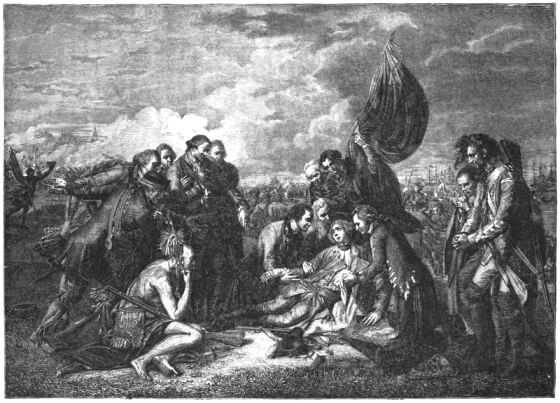
DEATH OF WOLFE. (After the Painting by Benjamin West, P.R.A.)
[See larger version]
Prince Ferdinand of Brunswick was more successful. He was at the head of an army of fifty-five thousand men, including ten or twelve thousand English, under Lord George Sackville. As the French had taken Frankfort-on-the-Main, he left the British and Hanoverian troops, amounting to twenty-eight thousand men, to watch the French, under Marshal de Contades, upon the Lippe, and set out to drive back the other divisions of the French, under De Broglie. He found these amounted to thirty-five thousand strong, but he did not hesitate to engage them at Bergen, on the Nidda, near Frankfort. After a hard-fought battle, he was defeated with a loss of two thousand men and five pieces of cannon. De Broglie pushed rapidly after him, formed a junction with Contades, and speedily reduced Cassel, Münster, and Minden. There appeared every prospect of the whole Electorate of Hanover being again overrun by them. The archives were once more sent off to Stade, ready for embarkation. But Ferdinand now displayed the superiority of his generalship. He left five thousand of his troops, with an air of carelessness, in the way of the French, who, unsuspicious of any stratagem, hastened forward to surprise them, when, to their astonishment, they found the whole of Ferdinand's army had been brought up in the night, and were drawn up behind a ridge near Minden.
To approach Ferdinand's forces, the French were obliged to pass a narrow ground between a river and a marsh, and were so cramped that they committed the very error which cost them the battle of Blenheim. They placed the cavalry in the centre, and made wings of their infantry. The cavalry made a succession of furious charges on Ferdinand's centre, but this stood compact and immovable, till the French horse, being discouraged, the Allies charged in their turn, and the centre of the army, the cavalry, being thus driven back, the whole line gave way. At this moment Ferdinand sent orders to Lord George Sackville to charge with the cavalry, which had been kept in reserve, and thus complete the destruction of the flying French. But Lord George, who had been constantly quarrelling with Ferdinand, as well as his own second in command, the Marquis of Granby, now did not appear to comprehend a succession of orders, and sat still. But Ferdinand, having lost patience, sent word to the Marquis of Granby to advance, and he promptly obeyed, but it was now too late; the French had got half an hour's start. Thus the English cavalry was deprived of all share in the victory; but the English foot had borne the chief brunt of the attack, being in the centre. Six British regiments, in fact, for a time maintained the whole shock of the French. Sackville was tried by court martial, and dismissed from all his military appointments. The battle of Minden was fought on the 1st of August, 1759.
The Parliament of England met on the 13th of October. Pitt, not without cause, assumed much merit from the successes of the year; and, in truth, so far as military matters went, rarely had this country reaped such fame. We had triumphed in every quarter of the world. In January came the news of the capture of Goree; in June, of Guadeloupe; in August, that of the victory of Minden; in September, of the victory off Lagos; in October, of the conquest of Quebec; in November, of Hawke's victory off Quiberon. Horace Walpole said, "victories came so thick, that every morning we were obliged to ask what victory there was, for fear of missing one." At the same time, the condition of our trade warranted the inscription afterwards placed on Chatham's monument in the Guildhall, that he caused commerce to flourish with war.
The earliest martial event of the year 1760 was the landing of Thurot, the French admiral, at Carrickfergus, on the 28th of February. He had been beating about between Scandinavia and Ireland till he had only three ships left, and but six hundred soldiers. But Carrickfergus being negligently garrisoned, Thurot made his way into the town and plundered it, but was soon obliged to abandon it. He was overtaken by Captain Elliot and three frigates before he had got out to sea, his ships were taken, he himself was killed, and his men were carried prisoners to Ramsey, in the Isle of Man.
In April the French made an attempt to recover Quebec. Brigadier-General Murray had been left in command of the troops, six thousand in number, and the fleet had returned to England. The Marquis de Vaudreuil, now the French governor at Montreal, formed a plan of dropping down the St. Lawrence the moment the ice broke up, and before the mouth of the river was clear for ships to ascend from England. He therefore held in readiness five thousand regular troops, and as many militia, and the moment the ice broke in April, though the ground was still covered with snow, he embarked them in ships and boats under the command of Chevalier de Levis, an officer of reputation. On the 28th of that month they were within sight of Quebec. They had landed higher up than where Wolfe did, and were now at the village of Sillery, not far from Wolfe's place of ascent. Murray, who had only about three thousand men available for such a purpose, the rest having been reduced by sickness, or being needed to man the fortifications, yet ventured to march out against them. He was emulous of the fame of Wolfe, and attacked this overwhelming force with great impetuosity, but was soon compelled to retire into Quebec with the loss of one thousand men killed and wounded. This was a serious matter with their scanty garrison, considering the numbers of the enemy, and the uncertainty of the arrival of succour.
Levis, who knew that his success depended on forestalling any English arrivals, lost no time in throwing up trenches and preparing batteries. Had the river continued closed, Quebec must soon have reverted to the French; but, on the 11th of May, the English were rejoiced to see a frigate approaching, and this, only four days after, was followed by another frigate and a ship of the line. These, commanded by Lord Colville, immediately attacked and destroyed or drove on shore the French flotilla, and at that sight Levis struck his tents and decamped as rapidly as he came, leaving behind him his baggage and artillery. Nor was the Marquis de Vaudreuil left long undisturbed at Montreal. The three expeditions, which had failed to meet the preceding summer, were now ordered to converge on Montreal—Amherst from Lake Ontario, Haviland from Crown Point, and Murray from Quebec. Amherst had been detained at Oswego by an outbreak of the Cherokees against us. This native tribe had been friendly to us, and we had built a fort in their country, and called it Fort Loudon, after Lord Loudon; but in the autumn of 1759 they had been bought over by the French, and made a terrible raid on our back settlements, murdering and scalping the defenceless inhabitants. Mr. Lyttelton, the Governor of South Carolina, marched against them with a thousand men, and compelled them to submission; but no sooner had he retired than they recommenced their hostilities, and Amherst sent against them Colonel Montgomery, with one thousand two hundred men, who made a merciless retaliation, plundering and burning their villages, so as to impress a sufficient terror upon them.
Amherst had now ten thousand men; and though he had to carry all his baggage and artillery over the Ontario in open boats, and to pass the rapids of the upper St. Lawrence, he made a most able and prosperous march, reducing the fort of Île Royale on the way, and reached the isle of Montreal on the very same day as Murray, and a day before Haviland. Vaudreuil saw that resistance was hopeless, and capitulated on the 8th of September. The French were, according to contract, sent home, under engagement not to come against us during the remainder of the war. Besides this, Lord Byron chased a squadron of three frigates, convoying twenty store-ships to Quebec, into the Bay of Chaleur, and there destroyed them. Thus all the French possessions in North America, excepting the recent and feeble settlement of New Orleans, remained in our hands.
The war in Germany grew more and more bloody. Russia and Austria came down upon Frederick this year with great forces. Daun entered Saxony; Laudohn and Soltikow, Silesia. Laudohn defeated Fouqué at Landshut, and took the fortress of Glatz, and compelled Frederick, though hard pressed by Daun, to march for Silesia. The month was July, the weather so hot that upwards of a hundred of his soldiers fell dead on the march. Daun followed him, watching his opportunity to fall upon him when engaged with other troops, but on the way Frederick heard of the defeat of Fouqué and the fall of Glatz, and suddenly turned back to reach Dresden before Daun, and take the city by storm; but as Daun was too expeditious for him, and Maguire, the governor, an Irishman, paid no heed to his demands for surrender, Frederick, who had lately been so beautifully philosophising on the inhumanities of men, commenced a most ferocious bombardment, not of the fortress but of the town. He burnt and laid waste the suburbs, fired red-hot balls into the city to burn it all down, demolished the finest churches and houses, and crushed the innocent inhabitants in their flaming and falling dwellings, till crowds rushed from the place in desperation, rather facing his ruthless soldiers than the horrors of his bombardment.
Prevented by the arrival of Daun from utterly destroying Dresden, though he had done enough to require thirty years of peace to restore it, Frederick marched for Silesia. Laudohn, who was besieging Breslau, quitted it at his approach; but the Prussian king, who found himself surrounded by three armies, cut his way, on the 15th of August, at Liegnitz, through Laudohn's division, which he denominated merely "a scratch." He was instantly, however, called away to defend his own capital from a combined army of Russians under Todleben, and of Austrians under Lacy, another Irishman; but before he could reach them they had forced an entrance, on the 9th of October. The Russians, departing from their usual custom of plunder, touched nothing, but levied a contribution of one million seven hundred thousand dollars on the city. At Frederick's approach they withdrew.
But there was no rest for Frederick. Daun was overrunning Saxony; had reduced Leipsic, Wittenberg, and Torgau. Frederick marched against him, retook Leipsic, and came up with Daun at Torgau on the 3rd of November. There a most sanguinary battle took place, which lasted all day and late into the night. Within half an hour five thousand of Frederick's grenadiers, the pride of his army, were killed by Daun's batteries of four hundred cannon. Frederick was himself disabled and carried into the rear, and altogether fourteen thousand Prussians were killed or wounded, and twenty thousand of the Austrians. This scene of savage slaughter closed the campaign. The Austrians evacuated Saxony, with the exception of Dresden; the Russians re-passed the Oder, and Frederick took up his winter quarters at Leipsic.
Prince Ferdinand this summer had to contend with numerous armies of the French. De Broglie marched from Frankfort into Hesse with a hundred thousand men. On the 10th of July they met the hereditary Prince of Brunswick at Corbach, and defeated him, though he gained a decided advantage over them a few days after at Emsdorf, taking the commander of the division and five battalions prisoners. This was followed by Ferdinand himself, who was at Warburg, where he took ten pieces of artillery, killed one thousand five hundred of the French, and drove them into the Dimel, where many were drowned. The British cavalry had the greatest share in this victory. In fact, the Marquis of Granby led them on all occasions with such spirit and bravery, that Ferdinand placed them continually in the post of danger, where of course they suffered more severely than the other troops.
Notwithstanding these checks at Emsdorf and Warburg, the French obtained possession of Göttingen and Cassel. Ferdinand attempted, but in vain, to dislodge them from Göttingen, and the hereditary Prince, attempting to surprise the Marquis de Castries at Wesel, was repulsed with a loss of one thousand two hundred men at Closter-Campen, near that town, and was compelled to retreat. This closed the campaign, and the French took up their winter quarters at Göttingen and Cassel.
Whilst these things were happening, and but two days before the mail arrived bringing the news of the defeat at Closter-Campen, George II. died. He had, till within the last two years, enjoyed robust health. He had then a severe attack of gout, and from that time his eyes and hearing had failed. On the morning of the 25th of October he rose at his usual hour of six, drank his chocolate, inquired how the wind was, being anxious for the arrival of the mails, and then suddenly fell, uttered a groan, and expired. He was seventy-seven years of age.
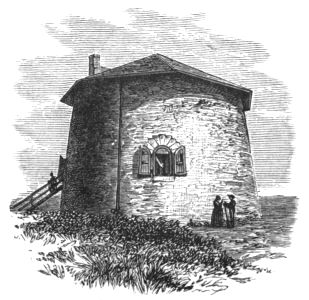
MARTELLO TOWER ON THE PLAINS OF ABRAHAM, QUEBEC.
[See larger version]
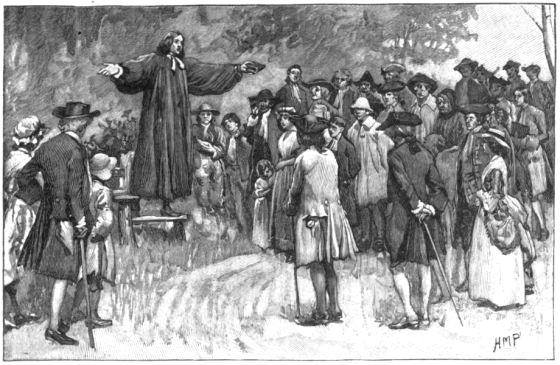
GEORGE WHITEFIELD PREACHING. (See p. 143.)
[See larger version]