Chapter X · (continued 2)
Reading edition
Within a few days of taking Philadelphia, Lord Howe raised three batteries on the side of the river. On the 3rd of October Washington issued from his camp on the Schuylkill, about fourteen miles from Germantown, having heard that two British detachments had been withdrawn thence to attack the forts on the Delaware. He had been reinforced by militia from Maryland and New Jersey, and determined to surprise the British camp at Germantown. Two columns of Continental troops, led by Greene and Sullivan, were to gain the front of the British, and attack it; whilst two other columns of militia were to attack the rear. This force marched all night, and entered Germantown about sunrise, and all seemed likely to favour their enterprise. A fog prevented the discovery of their approach. But, at the first surprise, Colonel Musgrove threw himself into a storehouse, and kept up such a fire from the windows as checked the assault of the Americans, and gave time for the rest of the British force to get under arms. The village of Germantown consisted of one long street. Across this street the British army had encamped, and stoutly resisted the advance of the Americans. Musgrove was summoned to surrender; but he continued his fire from the house without taking any notice, and, before artillery could be brought up to batter the house, General Greig and Brigadier Agnew came up to his assistance. The Continental troops in front, led on by Washington himself, made a brisk attack, but were repulsed at all points, and were badly co-operated with by the militia in the rear. Washington was compelled to fall back to his camp at Skippack Creek, leaving behind him about eight hundred killed and wounded, and four hundred prisoners. So far, however, was Sir William Howe from availing himself of this opportunity to follow up the attack on Washington, and disperse his army, that he, as usual, thought only of getting into snug winter quarters.
Thus was another glorious chance for the utter dispersion of the American army thrown away by this most incompetent commander; and, as Washington saw that he had nothing to fear during the winter, except from the elements, he determined to encamp himself, so as to keep the British in constant anxiety about him. He selected a strong piece of ground at a place called Valley Forge, covered with wood. He set his soldiers to fell trees and make log-huts, the interstices of which they stopped with moss, and daubed up with clay. As they had plenty of fuel, they could thus pass the winter in some degree of comfort. A great number of his men were on the verge of the expiration of their term, and were impatient to return home; but he persuaded many to remain, and he employed them in throwing up entrenchments on the right of his camp, which was open towards the plain. His left was defended by the Schuylkill, and his rear by a steep precipice descending to the Valley Creek. He began two redoubts, but he soon saw that there was no fear of Howe moving so long as the winter lasted, and he left them unfinished. And thus the winter went over, Howe lying snugly at Philadelphia, enjoying his wine and his cards, and apparently forgetful that there was any such place as Valley Forge within five-and-twenty miles of him.
Whilst these movements had been progressing, very different ones had been in development in the north. The British Government, with the fatality which distinguished nearly all its counsels in this war, had thought proper to take the command of the army destined to operate by way of Canada on the northern colonies, from Sir Guy Carleton, and to confer it on General Burgoyne. The campaign had been planned—not by experienced military men on the spot, capable of estimating the difficulties of the enterprise, but in the Cabinet at home, directed by defective maps, and still more defective information.
This scheme was to take Ticonderoga, and then to advance upon Albany. Whilst the army was marching to this point, the fleet, carrying another strong force, was to ascend the Hudson, and there meet Burgoyne, by which means the British could then command the Hudson through its whole extent; and New England, the head of the rebellion, would be entirely cut off from the middle and southern countries. The plan was excellent in itself, but demanded for its successful accomplishment not only commanders familiar with the country, but the most ardent spirit in them, and the most careful co-operation.
Being conveyed to St. John's, Burgoyne there disembarked, and on the 16th of June he commenced his march for Crown Point, the shipping following him by the lake. On the 1st of July he appeared before Ticonderoga. The place required ten thousand troops effectually to defend it; but St. Clair who commanded them had only three thousand, very indifferently armed and equipped. St. Clair saw at once that he must retire, as the Americans had already done, at Crown Point; but he sought to do it unobserved. Accordingly, in the night of the 5th of July the flight took place; but St. Clair's orders were immediately disobeyed; the soldiers fired the house which had been occupied by General de Fermoy, and the British were at once apprised of the retreat. The sailors soon broke up the obstructions at the mouth of the river, and a fleet of gunboats was in instant pursuit. They overtook the Americans near the falls of Skenesborough, and quickly mastered the protecting galleys, and destroyed the vessels. General Burgoyne followed with other gunboats containing troops, and at the same time dispatched Generals Fraser and Reisedel by land after St. Clair.
St. Clair had marched with such celerity that he reached, before the next night, Castleton, thirty miles from Ticonderoga. But the rear division under Colonel Warner halted at Hubberton, six miles short of Castleton. Early next morning, General Fraser found them on a hill. No sooner did they descry him, than one of the regiments turned and fled, leaving most of their officers to be taken prisoners. But the other two regiments, commanded by Warner and Francis, stood their ground stoutly. Fraser had with him only about eight hundred men, and the Americans were from one thousand two hundred to one thousand five hundred strong. But Fraser advanced up the hill and attacked them briskly. The Americans were protected by a sort of breastwork formed of logs and trees, and they gave Fraser a smart reception. But, calculating on the approach of Reisedel and the Germans, he fought on; and Reisedel soon after marching up with a full band of music, the Americans imagined that the whole body of the Germans was there, and fled on to Castleton as fast as they could.
General Schuyler was hastening to support Ticonderoga, when, on reaching Saratoga, he was met by the news of this succession of defeats. He had, when joined by St. Clair and Long, who had been left to defend St. John's in vain, about five thousand men, the whole now of the northern army; but many of these were militia hastily called together—many of them without arms—more, destitute of ammunition, and still more, of discipline. But Schuyler depended much more on the nature of the country which the British would have to traverse from this point than on his men. The whole region between Skenesborough and the Hudson was an almost unbroken wilderness. Wood Creek was navigable as far as Fort Anne; from Fort Anne to the Hudson, over an exceedingly rough country, covered with thick woods, and intersected by numerous streams and morasses, extended a single military road. Whilst Burgoyne halted a few days at Skenesborough to bring up the necessary supplies, Schuyler seized the opportunity to destroy the navigation of Wood Creek, by sinking impediments in its channel, and breaking up the bridges and causeways, of which there were fifty or more on the road from Fort Anne to Fort Edward. Had Burgoyne been well informed, he would have fallen back on Ticonderoga, have embarked on Lake George, and proceeded to Fort George, whence there was a waggon-road to Fort Edward, the place he was aiming at. Instead of this, he determined on separating himself from his baggage and artillery, sending these, under General Philips, to Fort George, and proceeding with the main portion of the army across the rugged country that lay between himself and Fort Edward. On this route they had not only to contend with swamps swarming with mosquitoes, deep gullies, ravines, and rivulets, but to make temporary bridges to supply the place of those destroyed by Schuyler, and remove the trees felled by him. The weather, to add to their stupendous labour, was intensely hot; yet, surmounting everything, on the 30th of July Burgoyne and his army hailed with enthusiasm the sight of the Hudson, which they had thus reached through a series of brilliant successes.
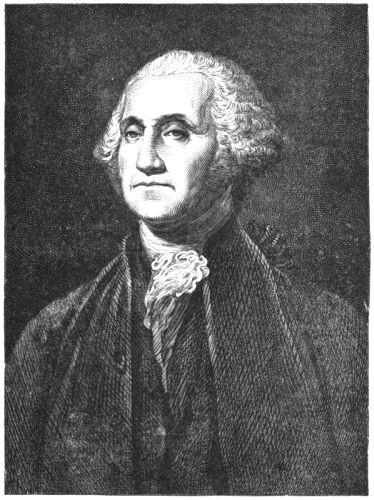
GEORGE WASHINGTON. (After the Portrait by Smart.)
[See larger version]
There only needed now one thing to render the expedition triumphant, and place the Hudson from Albany to New York in the absolute power of the British army—that General Howe should have been prepared to keep the appointment there with a proper fleet and armed force. But Howe was engaged in the campaign of Philadelphia, and seems to have been utterly incapable of conducting two such operations as watching Washington and supporting Burgoyne. As soon as Burgoyne discovered this fatal want of co-operation on the part of Howe, he ought to have retreated to the lakes, but he still determined to advance; and before doing so, he only awaited the coming up of the artillery and baggage under General Philips, and of Colonel St. Leger, who had been dispatched by the course of the Oswego, the Oneida Lake, and Wood Creek, and thence by the Mohawk river, which falls into the Hudson between Saratoga and Albany. St. Leger had two hundred regulars—Sir John Johnson's Royal Queen's and Canadian Rangers—with him, and a body of Indians under Brandt. St. Leger, on his way, had laid siege to Fort Schuyler, late Fort Stanwix, near the head of the Mohawk. General Herkimer raised the militia of Tryon county, and advanced to the relief of the place.
On hearing this, Burgoyne dispatched Colonel Baum with two pieces of artillery and eight hundred men—dismounted German dragoons and British marksmen. They were to surprise Bennington, a place about twenty miles to the east of the Hudson, where the Americans had collected their stores from New England, and, having secured these, to return and carry them to St. Leger. Baum, however, found himself surrounded by Generals Starke and Warner at St. Corick's Mill, on Walloon Creek, six miles from Bennington, before help came up. For two hours a fierce attack was kept up on Baum's entrenchments on all sides by the Americans with muskets and rifles. Baum made a most gallant defence, and three times drove them from some high ground which they occupied above his camp. At last he was picked off by a rifleman and fell mortally wounded. His German troops retreated into the woods, in the direction of Fort Edward, and were there met by Breyman, who was slowly advancing with reinforcements. He reorganised the fugitives, and commenced his retreat, hotly pursued by Starke and Warner; he made his way back to Burgoyne, but not until he had fired nearly his last cartridge.
During this time St. Leger had been investing Fort Schuyler. The whole of his miscellaneous force did not exceed six hundred, exclusive of Indians; and on the 5th of August he learned that General Herkimer was advancing to the relief. He instantly dispatched Sir John Johnson with a party of regulars and a number of Indians to waylay him. Herkimer fell into the ambush, and was himself mortally wounded. St. Leger, finding that his light artillery made no impression on the walls of Fort Schuyler, and hearing a false rumour that Burgoyne was defeated, raised the siege, leaving behind him his artillery, tents, and stores. His precipitation was occasioned by the more certain news of the approach of Arnold with ten pieces of artillery and two thousand men, who indeed, reached Fort Schuyler two days after his retreat.
Burgoyne was now in a condition which demanded all the talents of a great general. His forces were heavily reduced, those of the enemy much increased, and he was amongst bogs and wildernesses, which Barrington and Barré had from the first declared would be fatal to any army. He had sent express after express to Howe to urge a movement in co-operation, but no news of it arrived, and every day he was becoming more and more cut off from advance or retreat. Whilst these circumstances were operating against him, Burgoyne collected his artillery and provisions for about a month, and, forming a bridge of boats, passed his army, on the 13th and 14th of September, over the Hudson, and encamped on the heights and plains of Saratoga. Just at this juncture Schuyler had been superseded by his successor Gates, yet he himself remained to give his assistance in the campaign. The day after Gates assumed the command, Morgan had marched in with his rifle corps, five hundred strong, and Major Dearborn with two hundred and fifty other picked men. Arnold, too, had returned from pursuit of St. Leger, with two thousand men. The Americans numbered, with militia continually flocking in, nearly eight thousand, whilst Burgoyne's force did not exceed half that number. To approach the Americans it was necessary to cross the low ground, seamed with watercourses and rugged with scrub and stones, and to lay down bridges and causeways. This being completed, on the 19th the British army took position at Bemus's Heights in front of the American left. Gates, stimulated by the presence of Arnold, began the attack by sending out a detachment to turn Burgoyne's right flank, but they soon perceived the covering division of Fraser, and retreated. Gates then put Arnold at the head of a still stronger detachment to fall directly on Burgoyne's position, and a severe fight commenced about three o'clock in the afternoon, which lasted until sunset. Arnold made the most impetuous assaults on the British line to break it, but everywhere in vain, although the whole weight of the attack fell on three or four of our regiments, the rest being posted on some hills, and the Germans on the left at a greater distance. Whenever they advanced into the open field, the fire of the American marksmen from their concealment drove them back in disorder; but whenever the Americans ventured out, the British rushed forward and committed havoc amongst them; so the contest continued till night. The British remained in the field and claimed the victory; but it was a victory severely won, and far from decisive. The losses on both sides had been from five hundred to six hundred killed and wounded.
The English lay all night on their arms, and, as day dawned, began to entrench their position. If ever a general needed to push on his advantage it was now. Every day was consuming Burgoyne's stores; every day was augmenting the forces of the enemy. The country was closed to Burgoyne; it was open with all its resources to the Americans. Yet he lay there, as if paralysed, from the 20th of September to the 7th of October. The reason of this fatal delay is said to have been that Burgoyne had received a letter from General Sir Henry Clinton at New York, informing him that he must expect no co-operation from General Howe, but that he himself would take the responsibility of making a diversion in his favour by attacking the Forts Montgomery and Clinton, on the lower part of the Hudson. Burgoyne, on receiving this intelligence, sent Clinton word that he would remain where he was till the 12th of October—a fatal resolve, as a calculation of his stores should have shown him, which the acts of the Americans were certain to render calamitous. Elated at being able to stand their ground in some degree, this novel and almost sole success in the war had raised the spirits of the Colonials as by a miracle. They poured in on all sides, and Arnold, ever ready in resource, suggested to Gates an enterprise to be effected while Burgoyne was lying still and consuming his own victuals.
This was to send a part of Lincoln's militia, under Colonel Brown, to endeavour to surprise Fort Ticonderoga, Mount Independence, and Fort George, to capture or destroy all the stores there, to hold them in strong force, and thus completely to cut off Burgoyne's retreat by the lakes to Canada. Brown, being joined by another body of militia under Colonel Johnson, invested Ticonderoga. Being repulsed there, he sailed through Lake George in the vessels he had taken; made a fresh attempt upon Diamond Island, and, being also repulsed there, he set fire to the captured vessels, and returned to the American camp in the rear of Burgoyne. Partial as his success had been, he had, however, opened the route, and whilst he and the rest of the militia were watching Burgoyne, other bodies of Americans were mustering in his track, and the retreat of Burgoyne became an impossibility. He could stay where he was no longer. His provisions were exhausted; his horses were dying for lack of forage, and his situation was most deplorable.
In this situation the English General determined to attempt—what he should have attempted at first—to force the American lines. Accordingly, on the 7th of October, he drew out one thousand five hundred picked men, and formed them less than a mile from the American camp. No sooner were they descried, than they were attacked furiously by Poor's New Hampshire brigade. The attack extended rapidly to the right, where Morgan and his rifle corps stole round through some woods, and opened fire on the flank of the column. Other troops rushed out of the American entrenchments, and endeavoured to force their way between the British and their camp; but Major Ackland and his riflemen withstood them bravely; yet Burgoyne and his one thousand five hundred men were forced to fall back, leaving their cannon behind them. Morgan and his riflemen were now arriving, under cover of the woods, near the flank of the right wing; and Fraser, perceiving them, advanced to dislodge them. In this he succeeded, but was picked off by the American marksmen, as usual safe behind their trees, and fell mortally wounded. Meanwhile Colonel Brooks, at the head of Jackson's regiment of Massachusetts, was more successful. He turned the entrenchments of the German brigade, maintained his ground within the lines, and, to the wonderful relief of the Americans, seized the baggage of the Germans, and an ample supply of ammunition.
Retreat was now inevitable, and Burgoyne determined to attempt to reach Fort George, at the southern end of Lake George. He had but three days' provisions left, and his force was now reduced to three thousand five hundred men, and these had to make their way through a wilderness swarming with active and elate enemies. Gates, aware of the movement which Burgoyne was intending to make, sent troops up the river to occupy the banks of the Hudson, and to guard all passages of escape. The distance to Saratoga was only six miles, but the rain fell in torrents, the roads were almost impassable, the bridges over the Fishkill were all broken down by the Americans. Burgoyne sent forward detachments of soldiers to repair the bridges and re-open the roads; but they found the woods swarming with riflemen, and that it was impossible to execute the task assigned them. On the 10th, when he arrived at the fords of the Fishkill, he found them obstructed by strong forces of Americans. He soon dispersed them with cannon, but they only retired to the Hudson, where still stronger bodies of troops were posted to oppose his crossing. He might, perhaps, have dispersed these too, but other bodies were seen already in line on the left bank, and to cross there appeared hopeless.
Driven to desperation, Burgoyne now contemplated crossing the river in the very face of the enemy, and fighting his way through, and for this purpose he sent a party up the river to reconnoitre a suitable spot. Once over, he had little doubt of making his way to Fort Edward, and thence to the Canadian lakes. At this moment Gates was informed that Burgoyne had effected his passage, and that he had left only the rear-guard in the camp. He was in full march upon the camp, in the belief that he could seize it with ease, and part of his forces had actually crossed the fords of Fishkill, near which Burgoyne was strongly posted, when a spy or a deserter informed him of his mistake. Had it not been for this circumstance he must have suffered a surprise and a certain defeat, and the fortunes of Burgoyne would probably have been different. He was now on the alert to receive the Americans, and when, to his mortification, he saw them at a signal again retreating, he poured a murderous fire into them, and pursued them in confusion across the creek. This was his last chance. No news reached him from Clinton; but he ascertained that the Americans had already, in strong force, blocked up his way to Fort Edward. This was decisive. On the 13th he called together a council of war, at which every captain was invited to attend, and the unanimous result of the deliberations was that they must capitulate. Accordingly, an officer was sent with a note to the American headquarters that evening, to propose an interview between General Burgoyne and General Gates. The American General agreed to the meeting at ten o'clock the next morning. There Burgoyne stated that he was aware of the superiority of Gates's numbers, and, to spare the useless effusion of blood, he proposed a cessation of arms, to give time for a treaty to that effect.
Gates replied that he was well aware that General Burgoyne's army was reduced to the last extremity; that it had lost the greater part of its men by repeated defeats, sickness, etc., together with their artillery, horses, and ammunition; that their retreat was cut off, and, therefore, he could listen to nothing but an absolute surrender. Burgoyne said he would never admit that his retreat was cut off whilst he had arms in his hands; and Gates, who knew that Clinton was on his march, and might soon alter the whole face of things, was only too anxious to have Burgoyne's army out of the way. After some preliminaries, therefore, to save appearances, on the 16th it was agreed that the British should march out of their camp with all the honours of war; should deposit their cannon on the banks of the Hudson, and there pile their arms at the command of their own officers; that the troops, of whatever nation they might be composed, should retire in all security and honour to Boston, where they should be provided with all necessary comforts until they embarked for England, under condition of not serving against the United States again during that war; that the Canadians should be allowed to return in all honour to their own country; and that in no case should officers be separated from their own men. These were not such terms as are usually granted to conquered armies; and the reason was, that Clinton was every day drawing nearer. Scarcely were these terms agreed on, when this fact became known to Burgoyne. For a moment he hesitated whether he should sign the contract; but, on consultation with his officers, he felt himself bound in honour to ratify it, and accordingly, the next morning, the 17th of October, the deed was signed, and the troops, marching out, grounded their arms.
Whilst Burgoyne had been looking in vain for aid from New York, Sir Henry Clinton, at length daring the responsibility of a necessary deed, had set out with three thousand men, in vessels of different kinds, up the Hudson. On the 6th of October—eleven days before Burgoyne signed the capitulation—Clinton set out. Leaving one thousand men at Verplank's Point, he crossed to the other bank with his remaining two thousand, and landed them at Stony Point, only twelve miles from Fort Montgomery. He advanced with one-half of his force to storm Fort Clinton, and dispatched Lieutenant-Colonel Campbell to attack Fort Montgomery. Both forts were to be attacked, if possible, at the same instant, to prevent the one from aiding the other. The simultaneous assaults took place about sunset. Lieutenant-Colonel Campbell was killed leading his column against Fort Montgomery, but his brave troops entered and drove the garrison of eight hundred men from the place. Clinton found the approach to the fort of his own name much more arduous. But on went our brave fellows till they reached the foot of the works, where, having no ladders, they hoisted one another on their shoulders to the embrasures, through which they pushed past the cannon, and drove the Americans from their guns, and across the rampart, at the points of their bayonets. It was dark by the time the forts were taken, but the Americans soon threw light enough on the scene by setting fire to several vessels which were moored close under the guns of the forts. Had the English been disposed to risk the attempt to save them, they were prevented by several strong booms and chains thrown across the river. These they afterwards broke through, and, on the 13th of October, at the very moment that Burgoyne was making his first overtures for surrender, the English troops under General Vaughan ascended, in small frigates, as far as Esopus Creek, only thirty miles overland to Saratoga. But Burgoyne having now surrendered, and Gates being at liberty to send down strong reinforcements to co-operate with Putnam, the English vessels and troops were recalled, and returned to New York. Such was the campaign of 1777; equally remarkable for the valour of the British troops, and for their misfortunes; for the imbecility of their Government, and the incapacity or rashness of their commanders.
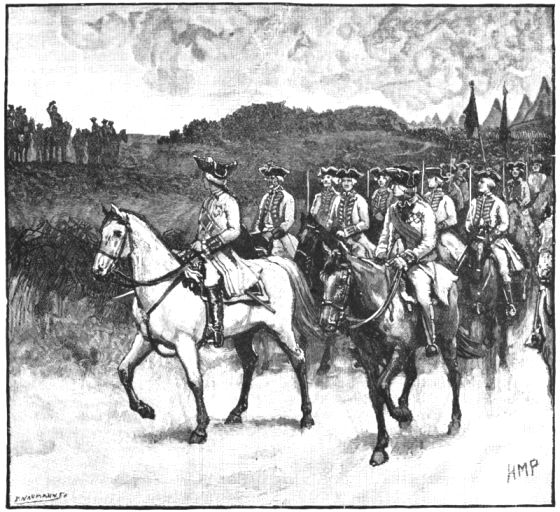
SURRENDER OF BURGOYNE AT SARATOGA. (See p. 244.)
[See larger version]