Chapter XVIII
Reading edition
REIGN OF GEORGE III. (continued).
Napoleon's Plans of Conquest—Sebastiani's Report—Napoleon's Complaints against the British Press—Espionage and Confiscation—He continues his Continental Aggressions—Napoleon's Interview with Lord Whitworth—Imminence of War—Negotiations for Pitt's Return to Office—War Declared—Napoleon Arrests British subjects in France—Seizure of Hanover—Emmett's Rebellion—Naval Attacks on the French Coast—The Mahratta War—Battle of Assaye—Successes of General Lake—Battle of Laswaree—Battle of Argaum—Conclusion of the War—Renewed Illness of George III.—Increasing Opposition of Pitt—He offers to undertake the Government—He forms a Tory Ministry—Wilberforce's Abolition Motion—The Additional Force Bill—Scheme for blowing up the French Fleet—War with Spain—The Georges Conspiracy—Murder of the Duke D'Enghien—Napoleon becomes Emperor—His Letter to the British King—The Condition of Europe—Lord Mulgrave's Reply to the Letter—Ministerial Changes—Weakness of the Ministry—Attack on Lord Melville—Whitbread's Motion—Melville's Defence—His Impeachment voted—Secession of Lord Sidmouth—The European Coalition—Hastened by Napoleon's Aggressions—Rashness of Austria—Invasion of Bavaria—Napoleon marches on the Rhine—Capitulation of the Austrian Army at Ulm—Occupation of Vienna—Battle of Austerlitz—Treaties of Schönbrunn and Pressburg—The Baltic Expedition—Expedition to Naples—Naval Affairs—Nelson's Pursuit of Villeneuve—Calder's Engagement—Battle of Trafalgar—Death of Nelson—Continuation of the Mahratta War—Lord Lake's Engagements with Holkar—Siege of Bhurtpore—Defeat of Meer Khan—The Rajah of Bhurtpore makes Peace—Treaties with Scindiah and Holkar—Death of Pitt—Payment of his Debts by the Nation.
The Peace of Amiens, instead of turning the attention of Buonaparte to internal improvements, seemed to give it opportunity to range, in imagination, over the whole world with schemes of conquest and of the suppression of British dominion. There was no spot, however remote, that he did not examine on the map with reference to plans of conquest. Louisiana and Guiana, obtained from Spain and Portugal, were viewed as ports whence conquest should advance to Nova Scotia, Canada, the Brazils, Mexico, and Peru. Every station in the West India Isles was calculated as a point for this purpose, and for seizing some day all the British islands there. The Cape of Good Hope, Madagascar, the isles of France and Bourbon, the Dutch spice isles, and their settlements in Java, Sumatra, etc., were regarded as a chain of ports which would enable Buonaparte to become master of India. He sent out expeditions, under different officers, to examine every island and region where the British had a settlement, or where he might plant one, to oppose them. One of these expeditions sailed in a couple of corvettes, commanded by Captain Baudin, who was accompanied by a staff of thirty-three naturalists, geologists, savants, etc., the ostensible object being science and discovery—the real one the ascertaining of the exact possessions of Britain, and of the best means of becoming master of them. The head of the scientific staff was M. Péron. On their return their report was published, and it is singular that in this report St. Helena, destined to be the prison of Napoleon, is described in rapturous terms as an earthly paradise.
Another expedition was that of Colonel Sebastiani, a Corsican, who was despatched to Egypt, Syria, and other countries of the Levant. Sebastiani reported to Buonaparte that the British were so detested in Egypt that six thousand men would suffice to re-take it; that Buonaparte's name was so venerated that it had procured him the utmost honour everywhere, and especially with Djezzar Pacha, Viceroy of Egypt. He asserted that General Stuart, the British envoy, had endeavoured to excite the Turks to assassinate him. He harangued the natives in the Ionian Isles, and assured them of the protection of Buonaparte, and besides many calumnies against the British officers, he told Napoleon that so hateful was the British rule that both Greeks and Venetians in those islands were ready to rise against them at the first word from France. On the appearance of this base report, our ambassador at Paris made a strong remonstrance; but Napoleon only replied by complaining of the late account of the campaign in Egypt by Sir Robert Wilson, in which he had detailed the butchery of the Turks and Arnauts at Jaffa, and Napoleon's command to poison his own wounded on the retreat from Acre. Through M. Otto, the French envoy in London, Napoleon demanded that statements injurious to his character made by the British press should be stopped by Government, that all French emigrants should be expelled from England, that Georges Cadoudal should be transported to Canada, and such princes of the House of Bourbon as remained there should be advised to repair to Warsaw, where the head of their house now resided. To these peremptory demands the British Government, through Lord Hawkesbury, replied that his Britannic Majesty did not possess the absolute power necessary for these acts, and that whilst the statements charging upon a British Ambassador instigations to murder were published in the Moniteur, the official organ of the French Government, the statements by the British press were protected by the freedom of that press guaranteed in Great Britain, which the king was not disposed to invade, but from which any man, British or foreign, might claim redress by an action at law. To show the First Consul how this might be done, the British Government commenced an action against M. Peltier, a French emigrant, for a libel on Napoleon in a newspaper published by him in London, called the Ambigu. Peltier was found guilty; but this by no means answered Buonaparte's object. He wanted the accounts of his darkest actions suppressed by a power above the law, not thus made more public by the action of the law. As Sir Walter Scott has observed, he wanted darkness, and the British Government gave him light.
The audacity of Buonaparte still further excited the indignation of the British Government. Under the name of consuls, he sent over to England and Ireland a number of military officers, whose real business was to act as privileged spies, to prepare plans of all the chief ports, with soundings, and an exact account of the winds with which vessels could go out or come in with most ease, and also at what draught of water the harbours might be entered by large vessels. These agents had been instructed to maintain the utmost secrecy as to their real objects, but they became known, and Ministers announced that any person coming in such a character to this country should be ordered instantly to quit it. Neither was the temper of the nation at all improved by the irritating proceedings of the French authorities on the coasts of France. A law had been passed by the Jacobins, in the most rabid time of the Revolution, condemning any vessel under a hundred tons burden found within four leagues of the French shores, having on board British merchandise. It was taken for granted that this decree was virtually annulled by the Peace of Amiens; but repeated seizures were now made of British merchant vessels driven by stress of weather on the French coasts, and the mere fact of having plates, knives, and forks for the crew, of British make, was used as a plea for confiscation of ships. It was in vain that remonstrances were made to the First Consul: they passed without notice. Such a peace it was evident could not last long. Napoleon was in a mood to brook no control from any quarter; he at this time showed how completely he would crush any creature who offended him when he had the power.
The Treaty of Amiens did not for a moment, even in appearance, interrupt the unlimited plans of aggression which Buonaparte had formed. Whether these plans tended to alarm Britain or not gave him no concern whatever. The encroachments on Italy never paused. Before the signing of the Peace of Amiens, Buonaparte had made himself President of the Cisalpine Republic; and though he had pledged himself to Alexander of Russia that he would not interfere further with Piedmont, because Alexander would not entertain the scheme of co-operating with France in the march to India, as his father had done, Buonaparte seized on all Piedmont in September of this year, annexed it to France, and divided it into six Departments. Charles Emmanuel, the King of Piedmont, retired to his island of Sardinia, and then abdicated in favour of his brother Victor Emmanuel. But Victor Emmanuel would not have been left long king, even of that small territory, had it not been for the protection of Britain. In October he annexed Parma and Placentia. He next made an agreement with the King of Naples for Elba, and took possession of it. Every movement of this restless being showed his intention to drive Britain out of the Mediterranean, and convert it into a French lake. But on the mainland he was equally active. There was no country on the Continent in which Buonaparte did not presume to dictate, as if he already were universal monarch. In the Diet of Germany his influence was prominently conspicuous, and he prevailed to have towns and districts transferred as he pleased. To have all the territory on the left bank of the Rhine secured to France, Prussia received valuable compensation at the expense of the German empire for the cession of the Duchy of Cleves and other provinces transferred to France. Bavaria and other minor States were benefited in the same way, because Napoleon already meant to use these States against Austria and Russia, as he afterwards did. Every endeavour was made, contrary to the articles of the Peace of Amiens, to shut out the trade of Britain, not only with France—as he had a right to do—but with Holland, Belgium, and Germany. It was in vain that Britain remonstrated. Buonaparte, through his official organ, the Moniteur, declared that "England should have the Treaty of Amiens, the whole Treaty of Amiens, and nothing but the Treaty of Amiens"; but he interpreted this treaty to give every advantage to France to the exclusion of Britain. Half Europe was closed to British trade. It was a condition of the Treaty of Lunéville that the independence of Switzerland should be respected, and this was guaranteed by the Batavian, Cisalpine, and Ligurian Republics, as well as by France and Austria. But Buonaparte had already absorbed all these republics into France, and Austria he set at defiance. He had never withdrawn the French troops from Switzerland, but whilst they remained French emissaries had continued to foment the feuds between the people and the nobles, between one canton and another. He now declared this state of things must end, and he assumed the office of umpire, to settle the affairs of the Swiss for them. He had no right to assume this office—if needed, it belonged to the other Powers of Europe as well as France; but he knew that he had the might—and he used it. At the end of September he sent General Rapp to issue a manifesto announcing that Napoleon was determined to put an end to all their differences. This manifesto was immediately followed by the appearance of General Ney at the head of forty thousand men, in addition to those already in the country. Thus Switzerland was invaded, and its constitution trodden out by an armed occupation. Buonaparte assumed the title of Mediator of the Helvetic League, and dictated his own terms to the deputies of the French party who were sent to Paris.
The king's speech at the opening of Parliament, and the martial tone of the speeches by the members of both Houses, exceedingly exasperated Napoleon; for though preparing for war he was scarcely ready, and meant to have carried on the farce of peace a little longer. Talleyrand demanded of Lord Whitworth the reason of this ebullition of the British Parliament and of the Press. Lord Whitworth replied, as he had done regarding the comments on the trial of Peltier, that it was the direct result of the insulting articles in the Moniteur, which was known to be the organ of the French Government; whereas, in Britain, the Government had no direct control, either over the speeches in Parliament or over the press. Talleyrand and Whitworth again discussed all the vexed questions of the retention of Malta, the conduct of Colonel Sebastiani in the East, the aggressions of Napoleon in Italy, Germany, and Switzerland, in violation of the Treaty of Amiens; and Lord Whitworth declared that all Britain wanted was, that the Treaty should be faithfully carried out on both sides; that we were ready to evacuate Malta, and recall our complaints, on that being done. But this was what Napoleon was resolved never to do, and he therefore resorted to the most extraordinary insults to the British Ambassador. He requested Lord Whitworth to call at the Tuileries at nine o'clock in the evening of the day on which he had had his conference with Talleyrand. Napoleon had, by an assumption of extreme hauteur and impetuosity, frightened the Austrian Ambassador at Campo Formio, and he probably thought of frightening the British one; but Britain had not been beaten like Austria, and such a proceeding could only enrage the British people. In this interview, Buonaparte ran over, in a rapid and excited harangue of two hours' length, scarcely permitting Lord Whitworth to interpose a word of reply, all the alleged causes of dissatisfaction with England; at one moment threatening to invade it, if it cost him his life; at another, proposing that France and England should unite to rule the Continent, and offering to share with it all the benefits of such an alliance. Lord Whitworth replied, as before, that the British Government desired nothing but the bonâ fide execution of the Treaty of Amiens, and could not for a moment entertain such schemes of aggression and domination as the First Consul proposed to her. He began to comment gravely on the aggressions in Switzerland and Italy, but Buonaparte cut him short angrily, saying those things were no business of his and that he had no right to talk of them. There was a fresh interview with Talleyrand, and fresh notes from him and Andreossi of the same character. A similar though more violent scene occurred at a levee on the 13th of March, in which Napoleon passionately accused Britain of driving France into war. A shrewd observer, Madame de Rémusat, was of opinion that his rage was simulated.
Everything in Parliament and in Ministerial movements now denoted the near approach of the renewal of war. On the 8th of March a message was received by both Houses of Parliament from his Majesty, stating that great military preparations were going on in Holland and France, and that his Majesty deemed it highly necessary to take measures for the security of his dominions. It added that negotiations were going on with France, the issue of which was uncertain, but it neither stated what these negotiations were, nor the measures called for. The message was taken for what it was—a note of war, and both in the Lords and Commons strong expressions of defiance were used to France. This seemed to have encouraged Ministers to a plainer expression of their intentions, for only two days later another message came down, calling for an increase of the navy. The next day, the 11th, the Commons formed themselves into a committee, and voted an addition of ten thousand seamen to the fifty thousand already voted. The militia were embodied. Sheridan was very zealous for war; Ministers, however, professed to desire the continuance of peace if possible.
There were rumours of negotiations going on for a return of Pitt to power; but as Mr. Addington showed no disposition to resign altogether in favour of Pitt, these came to nothing. Already in the previous November Canning and Lord Malmesbury, two of Pitt's most zealous supporters, had set on foot an address to Addington begging him to resign. But this plan was abruptly stopped by Pitt himself, who felt that he was to a certain extent the creator of the Ministry. Now Addington made overtures to Pitt through Dundas, become Lord Melville. But his propositions were absurd. He stipulated that Greville and Windham, who had opposed the Peace of Amiens, should be excluded from the arrangements. He also wished that Pitt's brother, Lord Chatham, should be the nominal Prime Minister, while he and Pitt should be equal secretaries. At this, Pitt put a stop to the envoy's conversation. "Upon my word," he said afterwards, "I had not the curiosity to ask what I was to be." So England engaged in war, with her greatest statesman excluded from office.
On the 6th of May Lord Pelham communicated to the Lords, and Mr. Addington to the Commons, another message from his Majesty, informing them that he had ordered Lord Whitworth, our Ambassador, to quit Paris immediately, unless he saw a prospect of closing the negotiations with the First Consul within a certain date; and that M. Andreossi, the French Ambassador, had applied for his passport, in order to quit London when Lord Whitworth should quit Paris. In consequence of the uncertainty of the result there was an adjournment, and then a second; but on the 16th of May all suspense was terminated by the announcement of Ministers that Lord Whitworth had quitted Paris, and M. Andreossi London. The papers which had passed between this Government and France, in the late negotiations, were ordered to be produced, and an Order in Council was issued, directing reprisals to be granted against the ships, goods, and subjects of the French Republic, and also for an embargo not only on all French ships in British ports, but on all Dutch vessels, and vessels of any Power under the military rule of France. Britain was once more at war. On the 17th of June the king announced, by message, that, in consequence of the Batavian Republic refusing to order the French troops to quit Holland—which, indeed, would have paid no attention to such orders—he had recalled his Ambassador from the Hague and had issued letters of marque and reprisals against that Republic. Thus, we were also at war with Holland. At the same time a demand was made for a grant of sixty thousand pounds, and a pension of sixteen thousand pounds per annum to the Prince of Orange, the ex-Stadtholder, on the plea that he was an exile and destitute; and the grant was voted. Parliament was now daily occupied in passing fresh measures for the defence of the country. It was voted, on the 20th of June, that a reserve army of fifty thousand should be raised by ballot, like the militia; and, indeed, it was no other than the extension of the militia: for during the war this division was to serve only in Great Britain, Ireland, and the Channel Islands. On the 18th of July it was proposed to pass a Bill enabling his Majesty to raise a levy en masse in case of invasion. Pitt strongly supported it, and proposed fresh fortifications on the coasts.
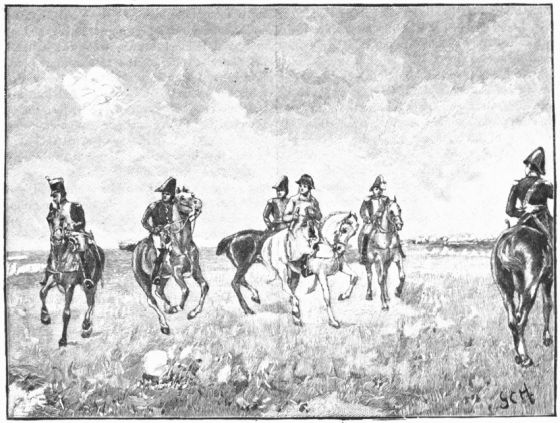
NAPOLEON AND HIS SUITE AT BOULOGNE. (See p. 490.)
[See larger version]
On the declaration of war, Buonaparte resorted to a proceeding that had never been practised before, and which excited the most violent indignation in England. He ordered the detention of British subjects then in France, as prisoners of war. Talleyrand previously assured some British travellers, who applied to him for information, that they had nothing to fear; that their persons would be safe under the protection of a Government which, unlike that of Britain, observed the laws of nations, and Buonaparte caused his well-known agent, Louis Goldsmith, the editor of a French paper, the Argus, published in London, to insert the same assurance in that journal. Thus thrown off their guard, all the British in France were seized by authority of a proclamation of the 22nd of May. Numbers of these were families and individuals not resident in France, but merely hurrying home from Italy, Switzerland, etc. They numbered some 12,000, and were kept confined till the close of the wars. The pretext was the capture of two ships before war was declared, but they were not captured until the Ambassadors had withdrawn, or until an embargo had been laid by Napoleon on British shipping.
There was another point, besides the seizure of unsuspecting British travellers, on which Buonaparte could deeply wound the honour of the British monarch, and at the same time furnish himself with considerable materials of war—the seizure of Hanover. George III. held this hereditary territory distinct from his Crown of Britain, as a State of the German federation. It was impossible to defend this against France with the forces kept there, and Napoleon ordered General Mortier to cross the Dutch frontier, and march into the Electorate with twenty thousand men. The Duke of Cambridge, who was Viceroy there, and General Walmoden, at first, put themselves in an attitude of resistance; they called on the chief Powers of Germany to protest against this invasion of the German Empire, and to come to their aid, if this remonstrance was disregarded. The Duke of Cambridge, seeing himself totally deserted by Germany, thought it best to surrender Hanover to France, by agreement that the troops should retire behind the Elbe, and not serve again till exchanged. This was done at the end of May; the different towns made their submission on the 3rd of June, and on the 5th Mortier entered Hanover; the Duke of Cambridge had quitted the country; and the British Cabinet refusing to ratify the Convention previously made with him, he called on the Hanoverian army to surrender as prisoners of war. Walmoden would have resisted with anything like equal forces, but as that was impossible, he made the best terms he could, which were that his army should give up their arms and disband themselves.
Napoleon also exerted himself to excite a rebellion in Ireland. He was the more bent on this, because he saw that it was hopeless to make a direct descent on England itself. He had collected a great fleet in the harbours of Boulogne, Dieppe, Havre, Dunkirk, Ostend, and other smaller ports, many of them capable only of receiving the gunboats in which he proposed to transport his soldiers. He had assembled a very fine army on the heights above Boulogne, called the Army of England, and there continually exercised it, under the inspection of Soult, Ney, Davoust, and Victor—men, the pride of his army; but he saw such powerful fleets crowding the Channel, blockading his very ports, cutting out, every now and then, some of his gunboats under the very batteries, and the war-ships of Britain even standing in and firing at him and his suite as they made observations from the cliffs, that, combined with the information that England was almost all one camp, he abandoned the project, for the present, in despair. But Ireland he deemed vulnerable, from the treason of her own children. He assembled all the Irish refugees in Paris, formed the Irish Brigade into the Irish Legion, and sent over active agents to arouse their countrymen in Ireland. Amongst these were Quigley and Robert Emmett, who had been engaged in the Rebellion of 1798. Quigley had been outlawed, and Emmett had been so deeply implicated in that Rebellion with his brother Thomas, who was banished, that he had found it necessary to quit the country. These emissaries soon collected around them, in Dublin, disaffected associates, amongst them being Dowdall, Redmond, and Russell. They formed a central committee, and corresponded with others in different towns, and especially with one Dwyer, who had also been in the former Rebellion, and had ever since maintained himself and a knot of desperate followers in the mountains of Wicklow. The Government received, from time to time, information of the proceedings of these foolish men—Emmett being a rash youth of only twenty-two or twenty-three years of age—but they took no precautions; and when, on the 23rd of July, the eve of the Festival of St. James, these desperadoes rushed, at evening, into the streets of Dublin, armed with pikes, old guns, and blunderbusses, the authorities were taken entirely by surprise. There were from two thousand to three thousand soldiers in the Castle, but neither police, soldier, nor officer appeared till the mob had murdered Colonel Brown, who was hastening to the Castle to arouse the troops, and Lord Kilwarden, the Chief Justice, whom they dragged from his carriage as it passed, and killed, along with his nephew, but, at the same time, they allowed the Chief Justice's daughter, who was with them, to depart. Soon after this—but not before the insurgents had severely wounded a Mr. Clarke, a manufacturer, who was riding to alarm the Castle—the soldiers appeared, and the mob fled at their very sight. The same day Russell had turned out at Belfast, and Quigley at Kildare, but with as little success. Emmett had escaped to the Wicklow mountains to join Dwyer; but having assumed the fatal disguise of French officers, the country people, who hated the French since their appearance under General Humbert, when they had ridiculed the Catholic religion, drove him and twelve of his companions back. In a short time, Emmett, Russell, Redmond, and others were all secured and executed. Dowdall escaped, with Allen and others, out of Ireland; Quigley and Stafford, one of his companions, were admitted as king's evidence, and thus escaped. The project of Napoleon had thus entirely failed, with the sacrifice of some of his leading agents.
During this year Great Britain held that position which properly belonged to her, and which showed how unassailable she was whilst employed in self-defence. Her fleets covering the Channel, and at the same time plying in the most distant regions for that money which for years had been wasted on helpless and ungrateful Continental nations, were calculated to make her invincible on the ocean. So far from permitting Buonaparte to set foot on her coasts, she continually insulted his. She entered the ports and roadsteads of Hâvre, St. Valery, and other places, and brought away ships and gunboats; she attacked Dieppe, and destroyed its batteries; she bombarded Granville, and demolished its pier, under the eyes of some of Napoleon's most distinguished officers. Her fleet amounted to nearly six hundred vessels of different kinds, and she began rapidly to recapture the colonies which she had so tamely, and without compensation, surrendered at the strange Peace of Amiens. St. Lucia was retaken by Commodore Hood and General Grinfield on the 22nd of June. In one day, the 30th of June, were retaken Tobago, in the West Indies, and St. Pierre and Miquelon, on the coast of Newfoundland. Demerara, Essequibo, and Berbice were soon after reconquered, and Guadeloupe was invested, and destined to fall into our hands ere long.
But our military achievements in the East Indies were on a scale to throw even these successes far into the shade. Lord Wellesley, the Governor-General, was entreated by the Peishwa of Poonah to assist him against the other Mahratta chiefs, Scindiah and Holkar. The Peishwa had been driven out of his territory by these chiefs, aided principally by the military talents of M. Perron, a Frenchman, who had for many years entered, with several other French officers, on the fall of the Mysore power, into the service of Scindiah. He had been extremely successful, and had been rewarded with a wide territory on the Jumna; and when, in 1793, Shah Allum, the Mogul, had been made prisoner, he had been consigned to the custody of M. Perron. The Frenchman had now given his aid to expel the Peishwa, and Lord Wellesley, in sending General Lake to restore the Peishwa, authorised him to attempt to win over M. Perron to the British interest by very brilliant offers of property and distinction, for Perron was deemed avaricious. The temptation, however, failed, both with Perron and his French officers. He took the field in support of Scindiah, with seventeen thousand infantry, from fifteen to twenty thousand Mahratta horse, and a numerous train of artillery.
The conjuncture was most critical, for the incompetent and short-sighted Addington had, by the Peace of Amiens, restored the French possessions which had cost us so much to make ourselves masters of in India; and had Buonaparte conceived the idea of supporting Perron there with strong reinforcements, the consequences might have been serious. Fortunately, he seemed too much engrossed with his plans nearer home, and as fortunately also for us, we had now rising into prominence in India a military chief, destined not only to dissipate the hostile combination of the Mahrattas, but also to destroy the dominion of Buonaparte himself. Major-General Wellesley, the younger brother of the Governor-General, and afterwards Duke of Wellington, by a rapid march upon Poonah surprised and drove out the Mahratta chief, Holkar, and saved the city from a conflagration which Scindiah's troops endeavoured to effect. Holkar fled to join Scindiah and the Rajah of Berar, and the Peishwa entered his own capital in the month of May. General Wellesley, being put into full command of all the troops serving under the Peishwa and the Nizam of the Deccan, and being also director of the civil affairs of the British in those provinces, made arrangements for their security, and then marched after Scindiah and the Rajah of Berar. After various marchings and counter-marchings, in consequence of their movements to avoid him, he came up with them near the village of Assaye, or Assye. General Stevenson, who had repulsed them from the territory of the Nizam, was also encamped only eight miles off. On coming in sight of them, Wellesley found them fifty thousand strong, with a splendid body of Mahratta cavalry, whilst he had only four regiments of cavalry, three of them being native, and seven battalions of infantry, five of them Sepoys. He determined, however, to attack them at once, and, sending word to Stevenson to come up, he crossed the river at a ford in face of the artillery of the enemy, and, after a sharp encounter, routed them before Stevenson could arrive. The Mahrattas had ninety pieces of artillery, with which they did terrible execution till the cavalry could come to close quarters with them, and the infantry reach them with their bayonets; then they fled headlong, leaving behind all their cannon (September 23rd, 1803). The Mahrattas rallied in the village of Assaye, and it required a desperate effort to expel them. It was dark before it was accomplished. General Stevenson had been prevented from crossing the river, and did not come up till the next day, when Wellesley sent him in pursuit of the enemy's infantry, which had been abandoned by the cavalry, and was thus exposed to attack.
In the meantime, General Lake had made a march on Delhi, continuing, as he went, his correspondence with M. Perron. As General Lake approached the fortress of Allyghur, the stronghold of Perron, the Frenchman came out with fifteen thousand men, but again retreated into the fortress. This was on the 29th of August. Perron made a strong resistance, and held out till the 4th of September, when the place was stormed by a party headed by Colonel Monson and Major Macleod. The success was somewhat clouded by the surprise and surrender of five companies of General Lake's sepoys, who had been left behind to guard an important position, but with only one gun. This accident, however, was far more than counterbalanced by the withdrawal of Perron from the service of the Mahrattas. He had found so much insubordination amongst his French officers, and saw so clearly that there was no chance of competing with the British, that he had at length closed with General Lake's offers, and, abandoning his command, had obtained a passport for himself, family, suite, and effects, and retired to Lucknow. This being accomplished, General Lake continued his march on Delhi, in order to release Shah Allum, the Mogul, and drew near it on the 11th of September. He there found that the army previously commanded by Perron, but now by Louis Bourquien, nineteen thousand strong, had crossed the Jumna and was posted between him and the city. Bourquien had posted his army on a rising ground, flanked on both sides by swamps, and defended in front by strong entrenchments and about seventy pieces of cannon. As Lake had only four thousand five hundred men, to attack them in that position appeared madness. The British were briskly assailed before they could pitch their tents, and General Lake, feigning a retreat, succeeded in drawing the enemy down from their commanding situation and out of their entrenchments; he then suddenly wheeled, fired a destructive volley into the incautious foe, and followed this rapidly by a charge with the bayonet. The enemy fled, and endeavoured to regain their guns and entrenchments; but Lake did not leave them time—another volley and another bayonet charge completely disorganised them, and they fled for the Jumna and the road by which they had come. The troops of Scindiah, which had held the Mogul prisoner, evacuated the city, and on the 16th General Lake made a visit of state to the aged Shah Allum, who expressed himself as delighted at being delivered from his oppressors and received under the protection of the British.

THE JUMMA MUSJID, DELHI. (From a Photograph by Frith & Co.)
[See larger version]
General Lake had no sooner seen Delhi clear of the enemy than he marched to Agra, which he reached on the 4th of October, and carried on the 17th. But Scindiah had availed himself of his absence, and made a sudden rush on Delhi, with seventeen well-disciplined battalions of infantry and between four thousand and five thousand cavalry. The Mahratta troops had been well trained by the French, who hoped, by their means, to crush the power of the British in India, and had shown throughout this war wonderfully increased efficiency, yet General Lake did not hesitate, with his small force, to go in quest of them. He started on the 27th of October, and after marching in heavy rains and through dreadful roads—the country having been purposely inundated by Scindiah's officers cutting down the banks of reservoirs—he came upon the Mahrattas on the 31st, near the village of Laswaree, their left flanked by that village, their right by a stream, and their front protected by seventy-two pieces of cannon. A furious battle took place, in the course of which Lake's troops were repeatedly repulsed, but returned to the attack undauntedly, and the successive charges by the bayonet, and the gallant conduct of the cavalry, at length, in the face of terrible discharges of grape-shot and canister, drove the Mahrattas from all their positions. The enemy had fought desperately, and step by step only had given way, but in the end the rout was complete—cannon, baggage, and almost everything, being left in the hands of the British (November 1st, 1803). This division of Scindiah's army was thus annihilated, and all the territory watered by the Jumna left in the hands of the British.
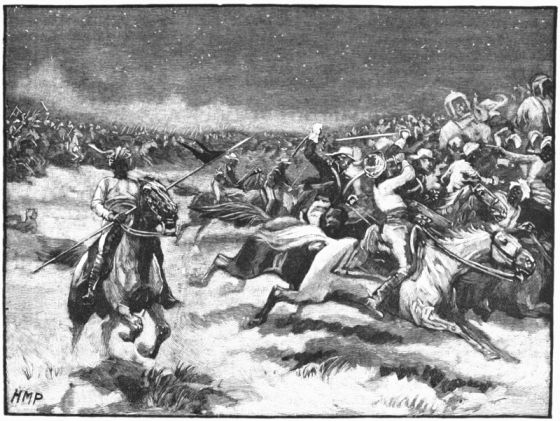
THE CHASE AT ARGAUM. (See p. 493.)
[See larger version]
This blow induced Scindiah to sue for peace from General Wellesley in November, and a truce was accordingly entered into with him; but as the Rajah of Berar still kept the field, Wellesley marched against him, and encountered him on the plains of Argaum, about one hundred and twenty miles north of the Purna river. He was surprised to find the treacherous Scindiah, notwithstanding the truce, also encamped with him. Wellesley attacked the allies on the 28th of November, though it was evening when he was ready for action, and there remained only twenty minutes of daylight. But it proved a brilliant moonlight night, and he routed the whole army, and his cavalry pursued the fugitives for several miles, taking many elephants, camels, and much baggage. He captured all their cannon, thirty-eight pieces, and all their ammunition. This done, he hastened to reduce the formidable fortress of Gawilgarh, situated on a lofty rock. On the 15th the outer walls were carried, and the 94th regiment, led on by Captain Campbell, scaled the inner one, opened the gate, and the whole place was soon in possession of the British. This closed the opposition of the Rajah of Berar. On the 17th of December he came to terms, and surrendered to Wellesley the important province of Cuttack and the district of Balasore. Immediately afterwards Scindiah was compelled to treat in earnest. He consented to surrender all the country between the Jumna and the Ganges, with numerous forts and other territories, and agreed to recognise the right of the Peishwa to the domains which the British had conferred upon him. Both he and the Rajah of Berar stipulated to send away all Frenchmen or other Europeans and Americans, and not to employ them again, nor even to employ British subjects, native or European, without the consent of the British Government.
Sir Arthur Wellesley, brilliantly seconded by General Lake, Stevenson, and others, had thus worked out the plans of the Governor-General, Lord Wellesley. With small forces, and those principally native ones, but admirably disciplined, they had beaten two hundred and fifty thousand men in four pitched battles and eight sieges. They had taken from them upwards of one thousand pieces of cannon, besides an enormous amount of ammunition, baggage, and other spoil. They had made themselves masters of all the Mahratta territory between the Jumna and the Ganges; of Delhi, Agra, Calpee, the greater part of the province of Bundelcund, the whole of Cuttack, and a territory in Gujerat, which secured us all the ports by which France could have entered, so that we enjoyed the whole navigation of the coast from the mouth of the Ganges to the mouth of the Indus. They had added most important acquisitions to the territories of our allies, the Peishwa and the Nizam of the Deccan, and to the Company itself a stronger frontier in the latter region; and all this had been achieved in the short space of four months. The French influence was completely annihilated, and every part of India placed in greater strength and security than it had ever known before.
The year 1804 opened by an announcement that his Majesty was suffering under a return of his old malady. On the 14th of February an official bulletin was issued at St. James's Palace, informing the public of the royal indisposition; and the repetition of it from day to day, without specifying the nature of the illness, left no doubt of its real character. Still, on the 29th, Addington assured the House that there was no necessary suspension of the royal functions, and the bulletins grew more favourable; but it was well known that he was not really in a condition to transact business till the following September, though at times, as on the 9th, 10th, and 11th of May, he drove about in public, in company with the queen and princesses. Probably his advisers thought that the hearty cheers with which he was received might have a bracing effect on his mind, which had been cruelly harassed by the separation of the Prince of Wales from his wife, the king's niece, amid grave public scandals. Such a circumstance was exactly calculated to throw the royal mind off the balance; but besides this, the unsatisfactory state of his Cabinet and of parties in Parliament was such as greatly to aggravate his anxiety.
The Ministry of Addington was felt to be utterly inadequate to the difficulties of the times. The country felt that Pitt or Fox must soon be called to the helm. Addington had shown a desire to strengthen his administration by bringing into it George Tierney, whom he had appointed Treasurer of the Navy and a Privy Councillor. Pitt, who had an intense dislike to Tierney—with whom he had, in 1798, fought a duel—showed increasing determination, from the introduction of Tierney to the Cabinet, to oppose the Ministry of Addington with all his vigour. An opportunity was given him on the 27th of February. The Hon. Sir Charles Yorke, the Secretary-at-War, had introduced a Bill for consolidating all the existing laws respecting the volunteers. In the debate on the second reading of this Bill on this day, a question was incidentally introduced by Sir Robert Lawley as to the exact state of the king's health, which, he said, concerned the safety of the country as much as the affairs of the volunteers. Fox followed up this idea, and demanded more perfect information on this subject from Ministers. He declared that the House had no information on this important subject, and he asked whether the Chancellor of the Exchequer really had any. He supported the motion for an adjournment which Sir Robert Lawley had made, in order that the House might be put in possession of the truth. Fox made it felt that he was looking forward to the fact of a regency. Addington, on this, declared that there was no necessity for any serious measures, that he was persuaded that the king's indisposition would be of short duration. Pitt made some strong observations on the conduct of Ministers in keeping Parliament in the dark on this head, though he opposed the adjournment.
On the 15th of March he took a more decided position of hostility to the Cabinet, by moving for an inquiry into the state of the navy. The Earl St. Vincent was now First Lord of the Admiralty, and he proved quite incompetent. Many gunboats had been broken up from motives of economy, and naval stores sold, for the most part, to the French. Pitt declared that only twenty-three gunboats had been built since January, 1803, and that the whole management of the navy was inert.
After accepting an offer from the Irish militia serving in England during the war, and agreeing that ten thousand should be the number, and that this number should be reinstated in Ireland by a new levy, the House adjourned on the 29th of March for the Easter recess. But during the recess Pitt was planning fresh measures of opposition, and in fact driving out Addington and taking his place. On the re-assembling of the House on the 23rd of April, Fox moved that it should resolve itself into a committee of inquiry regarding the measures of defence necessary for the country. Addington opposed the inquiry as unnecessary, but Pitt declared that it was never more necessary; that though there were a hundred and eighty-four thousand troops of the line, and four hundred thousand volunteers, the measures of Government were not of that vigorous character which the times demanded. Yorke, the Secretary-at-War, and Spencer Perceval defended Addington, who asserted that great exertions had been made to bring up members to vote for Mr. Pitt's views, and that he did not see how the present Ministry could remain in office if this measure was carried against them. It was not carried; but Addington's majority had sunk to only fifty-two, the numbers being for Fox's motion two hundred and four, against it two hundred and fifty-six. Wilberforce, who had much respect for Addington, as he had a great admiration for Pitt, exerted himself to reconcile the two and to get Pitt into the Cabinet with Addington. He consulted with Lord Chancellor Eldon on the plan for bringing in Pitt to join Addington.
But Pitt was already doing his own work and paving his own way. He wrote to the king on the 25th of April, informing him of the determined opposition he felt himself called upon to make to Addington's mode of administration, but assuring him that he would never attempt to force Fox upon him. This was saying, as plainly as he could speak to the king, that he was ready to resume the helm himself, and that, with the opposition that he could exert, the Government of Addington could not go on. Accordingly, Pitt received a notice that his Majesty would soon call for him to attend on him. On the 30th of April the Marquis of Stafford, in the House of Lords, gave notice of a motion identical with that of Fox in the Commons—namely, for inquiry into the national defences. Lord Hawkesbury immediately entreated the marquis to postpone his motion, for reasons which, he assured the House, it would deem fully satisfactory if he were at liberty to state them. It was at once understood that negotiations were on foot for a change of Administration. Lord Grenville, who was a relative of Pitt, but at the same time pledged to include Fox in any offers to himself of entering the Ministry, called upon Lord Hawkesbury to be more explicit; but he declined, and after some discussion the motion was postponed. Pitt, in fact, had received a message from the king, and on the 2nd of May, through Lord Chancellor Eldon, presented a letter sketching a plan of a new Cabinet, in which he included not only Lord Grenville but Fox also. On the 7th he had, for the first time, an interview with the king, which lasted three hours, and Pitt then more fully stated his views, and recommended a mixed Cabinet on the ground that there was every prospect of a long war, and that it was desirable that they should have a strong administration. Whether such a coalition would have been strong is more than doubtful, opposed as the views and tempers of Fox and Pitt were. But the king would not allow the name of Fox to be in the list. On the other hand, Lord Grenville refused to become part of an Administration from which Fox was excluded. He said he could not accept office in a Cabinet formed on the basis of exclusion, being convinced that an effective government could only be secured by uniting in it as large a proportion as possible of the weight, talents, and character to be found in public men of all descriptions. Pitt was thus forced to form a Government on a narrow Tory basis. On the 11th of May the Marquis of Stafford said, in the House of Lords, that he understood that a certain right honourable gentleman, who had turned his great abilities to the subject of the national defences, was about to take the management of public affairs, and that he therefore withdrew his motion. The next day the public announcement was made that Addington had resigned, and that Pitt had accepted the Chancellorship of the Exchequer. Of the Addington Ministry Pitt retained—Lord Chancellor Eldon; the Duke of Portland, President of the Council; the Earl of Westmoreland, Lord Privy Seal; his own brother, the Earl of Chatham, Master-General of the Ordnance; and Lord Castlereagh, President of the Board of Control. To these he added Dundas, now Lord Melville, as First Lord of the Admiralty; Lord Harrowby as Secretary of Foreign Affairs, in place of Lord Hawkesbury; and Lord Camden as Secretary of the Colonies, in place of Lord Hobart. Lord Mulgrave became Chancellor of the Duchy of Lancaster, in place of Lord Pelham. George Canning, now becoming a marked man, was made Treasurer of the Navy, in place of Tierney, but this gave him no seat in the Cabinet. Huskisson was Secretary to the Treasury, and Mr. Perceval remained Attorney-General.
The first measure of importance after the appearance of Pitt in the House of Commons as Prime Minister was the annual motion of Wilberforce for leave to bring in a Bill for the abolition of the Slave Trade. Pitt and Fox both supported it, and it was carried by seventy-five against forty-nine. The second reading was carried by a still larger majority—one hundred against forty-two—but on going into committee upon it, it was postponed to the next Session. War and preparations for war were the all-absorbing business of those times.
On the 5th of June, the day after the king's birthday, Pitt introduced his plan of military defence. It was to leave the militia what it was, but to increase the regular army by making it compulsory on parishes to furnish each a certain number of men to what was called the Army of Reserve—a body called out for five years, and only to be employed within the United Kingdom. He desired to break down the distinctions between this and the regular army by attaching the Reserve to the Regulars as second battalions, and encouraging volunteering thence into the Regulars. This was known as the Additional Force Bill, which was denounced by the Opposition as veiled conscription. In other ways, notably by the erection of his martello towers, Pitt set himself to rouse the spirit of the nation, in face of the very real danger of invasion.
In the autumn of this year the British Admiralty tested a plan to blow up and destroy the French invasion flotilla in the harbour of Boulogne. It consisted of a chest, pitched outside and made waterproof, containing forty barrels of gunpowder, which was to be ignited by a certain contrivance when it struck smartly against a solid body. This machine was called a catamaran. The experiment was tried by Lord Keith on the 2nd of October. There were one hundred and fifty French gunboats, praams, and floating batteries anchored outside the pier of Boulogne. Lord Keith anchored opposite to them with three line-of-battle ships and several frigates, covering a number of bomb-ships and fire-ships and the catamarans. Four fire-ships were towed into the neighbourhood of the French flotilla and exploded with a terrific noise, but did no injury whatever to the flotilla or the French, beyond wounding some half-dozen men. The catamarans exploded, for the most part, with the same failure of effect.
Though a declaration of war had been issued both against France and Holland, there had been none against Spain. But Ministers hearing that a strong Spanish armament was being equipped in the port of Ferrol, and that French soldiers were expected to join and sail in it, despatched Captain Graham Moore, the brother of Sir John Moore, with four frigates to intercept four Spanish treasure-ships. The proceeding was certainly high-handed, but Ministers were justified by their knowledge that Spain paid subsidies to France. The Spaniards were furious in their indignation; an order was speedily issued to make reprisals on British ships and property, and on the 12th of December war was formally proclaimed against us.
Reproduced by André & Sleigh, Ld., Bushey, Herts.
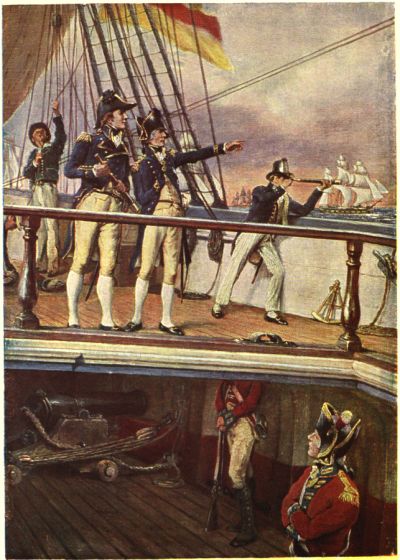
NELSON'S CHASE AFTER THE FRENCH FLEET, 1805.
BY THOMAS DAVIDSON.
[See larger version]
At this juncture Napoleon proceeded to set all Europe against him. A conspiracy had been set on foot against his Government by the Royalists, notably by one Lajolais, who had formerly fought under Pichegru, and in 1794 had assisted him in his intrigues with the Bourbon princes. On arriving in London he had interviews with Pichegru, Georges Cadoudal, the Chouan chief, the Polignacs, the Count d'Artois, the Duke of Berry, etc., and assured them that such was the feeling against Buonaparte in France, that it only needed the appearance of the Royalist leaders, and their forming a league with Moreau, the victor of Hohenlinden, whom he truly represented as greatly disgusted with Buonaparte, to produce a revolution and crush the aspiring First Consul. The statements of Lajolais were listened to, and a vessel, under the command of Captain John Wesley Wright, was despatched to the coast of Brittany, with General Georges Cadoudal, the Marquis de la Rivière, the brothers Armand and Jules Polignac, and some others, whom he put safely ashore in the autumn of 1803. Pichegru, Georges Cadoudal, the Polignacs, de la Rivière, and the rest of the Royalists, about thirty in number, had made their way to Paris, and were living there secretly, endeavouring to learn the real state of the public mind, and Pichegru and Cadoudal had been introduced to Moreau. Pichegru saw Moreau at least twice, and on one of these occasions he took with him Georges Cadoudal; but Moreau seemed taken by surprise by their communications with him, and was so horrified by the language and proposals of the daring Chouan, that he desired Pichegru not to bring that irrational savage again into his company. It appeared pretty clear that there was some mistake somewhere; and that Moreau, however much dissatisfied with Napoleon, was by no means disposed to enter into any Royalist conspiracy. Had the delegates found things ripe for such a revolution, they were to inform the Bourbon princes in London, and they were to make a strong descent on the coast of Brittany; but they all felt so satisfied that Lajolais had given them false information, that they were about to quit the capital, and to return to England, Captain Wright having been lingering with his frigate on the Breton coast for that purpose, when Fouchè the Minister of Police, pounced upon them. He had been keeping a strict watch on all their movements; he had now established their intercourse with Moreau, and trusted to be able to make sufficient use of that fact to destroy both them and him. It was asserted, although there is no proof whatever of the fact, that the plan included the murder of the First Consul. Further, in order to bring odium upon England, Buonaparte succeeded, by means of his agents, in entrapping Messrs. Drake and Spencer Smith, our Ministers at the courts of Bavaria and Würtemberg, into consenting to the conspiracy. They knew nothing of the real plot, but being informed that a Royalist conspiracy was on foot, gave it a certain amount of countenance. Napoleon thereupon accused them of being accomplices in a diabolical plot to assassinate him, forced the Courts to which they were accredited to expel them, and circulated throughout Europe a violent attack on the British Government. In an exceedingly able and dignified reply Lord Hawkesbury pointed out that Britain was at war with France, and had a right, which she intended to use, to take advantage of the political situation in that country. Napoleon gained little by his Machiavellian manœuvre.
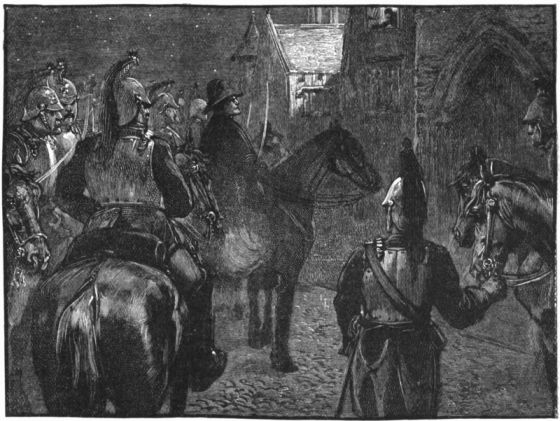
KIDNAPPING OF THE DUKE D'ENGHIEN. (See p. 498.)
[See larger version]
The Georges conspiracy, as it is commonly called, was followed by a still more startling act of violence. As the Bourbons still continued to watch for the overthrow of his power, Buonaparte determined to take a deep revenge on the persons of any of that family whom he could by any means get into his hands. Could he have inveigled the Count d'Artois and the Duke of Berry, as he attempted, to leave London and land in Brittany, he would have seized them and put them to death without ceremony or mercy. But there was another member of the family, though the farthest off from succession to the throne, who was living on the French frontiers, within a tempting reach of his soldiers in Alsace, and him he determined to kidnap and kill. This proposed victim of a most lawless and wicked vengeance was Antoine-Henri de Bourbon, Duke d'Enghien, the son of the Prince of Condé. The project was so odious, so certain to cover both Napoleon and France with inextinguishable infamy, that it startled the not very sensitive mind of Talleyrand, who, it is said, gave the duke secret warning of his danger, and advised him to remove farther from the Rhine. In consequence, the duke applied to Sir Charles Stuart to get him a passport from the Austrian Minister, to enable him to cross the Austrian territory to rejoin his grandfather, then at Warsaw with Louis XVIII. Sir Charles Stuart applied to M. de Cobenzl for this purpose, and had the Austrian Court been quicker in its movements, the duke would have been safe enough from the myrmidons of Buonaparte; but, whilst lingering at Ettenheim in Baden for the necessary passport, the duke had so little suspicion of the prompt and deadly nature of the usurper's design against him, that he took no means to conceal himself, or he might still have escaped. But in the middle of the night of the 14th of March he was aroused by the sound of horses' hoofs, and, looking out, saw that the château was surrounded by a troop of French cavalry. Buonaparte had despatched his aide-de-camp, Caulaincourt, to Strasburg to effect this capture, and he had sent on Colonel Ordenner to bring the duke away from the heart of a neutral territory. The duke was summarily tried by a military tribunal and shot (March 21, 1804) at Vincennes. The news of this most audacious crime soon transpired, and filled Europe with horror and execration against its perpetrators.
In the midst of these deeply-planned manœuvres Buonaparte proceeded to make his last move in his great game. He had intimidated the Royalists by the seizure and fusilading of the Duke d'Enghien; he had deprived the Republicans of their leader in Moreau, who was exiled; the nation was passive; all its branching lines of authority were in his hands; and there remained only to erect a throne and seat himself upon it. It must not be a regal throne, because that would too much remind the world of the claims of the Bourbons: it should, therefore, be an imperial one, and mark a totally new era in France. It was one which was especially calculated to flatter the French vanity. Accordingly, on the 30th of April, Curée—a man of no particular note, and perhaps selected on that account for the occasion, as his proposal might be the more easily disavowed, if it were resisted—rose in the tribunate, and proposed that Napoleon Buonaparte should be invested with the title of Emperor.
No sooner had the tribunate sent up its decision to the Senate, signed by all except Carnot, than the Senate hastened at once to adopt it, and to sign the answer to the message of the First Consul, which had been drawn up by Fouché for the Committee of Ten appointed by the Senate. In July Napoleon went to Boulogne to review the grand army of England, on the heights above the town, overlooking the English Channel, and from which the white cliffs of England were conspicuous. Everything had been elaborately got up for this occasion, on which the enthusiasm of the soldiers was to be raised to the highest pitch. The common people believed that he was going to lead the army at once across the Channel, and return loaded with the enormous wealth of London, and with the king, queen, royal family, William Pitt, and the leading members of the aristocracy as prisoners in his train. Buonaparte had no such wild idea; but since the Duke d'Enghien's murder the Powers of almost all Europe had manifested unequivocally their abhorrence of the act, and of the man who perpetrated it, and he now designed, by the display of enthusiasm in his army, at once to awe his own people and the sovereigns of other nations.
From Boulogne, Buonaparte proceeded to Brussels, Ostend, Antwerp, and so through Belgium, where Josephine met him, to the Rhine. Wherever he appeared, the authorities of the towns, both then and on his return through France, presented him with the most adulatory addresses. One would no longer believe it the same people who had, for ten years, committed such unexampled horrors to destroy the royalty they were now again adoring. The Mayor of Arras, Robespierre's own town, put the climax to all this civic incense by declaring, in his address, that "God made Napoleon, and then rested!"
Buonaparte now prepared for his coronation. Whilst at Mayence, on the Rhine—where the German princes flocked to pay abject homage to him as their protector, no nations, except Great Britain, Russia, and Sweden, keeping aloof—he despatched one of his aides-de-camp, General Caffarelli, an Italian, to invite the Pope to go to Paris to crown the new emperor and empress. Pius VII. had already been compelled to submit to the terms of the Concordat, which had made such inroads into the ancient power of the Church; and he knew very well that to refuse this request would bring down upon him fresh humiliations. Buonaparte, who affected to imitate Charlemagne as the founder of the French nation, passing over all the kings of France as unworthy of notice, determined to inaugurate the Second Empire by a still bolder stretch of authority than Charlemagne himself. That monarch had condescended to make the journey to Italy to receive the privilege of coronation from Pope Leo; but Buonaparte resolved that poor old Pope Pius VII. should come to him in France. His desire was carried out to the letter, and Pius arrived at Fontainebleau on the 25th of November. The 2nd of December having been fixed for the coronation, the Cathedral of Notre Dame was gorgeously decorated for the occasion, and the ceremony was performed amidst the utmost pomp and magnificence, Napoleon himself putting the crown on his head and then placing the Empress's diadem on the head of the kneeling Josephine. During the whole proceedings the Pope was made to play a secondary part. He simply "assisted" at the function. The ceremony was followed by a profuse creation of marshals and nobles.
The year 1805 was opened by Buonaparte addressing a second letter to George III. Its tenor may be gathered from the concluding paragraph. "Alas! what a melancholy prospect to cause two nations to fight, merely for the sake of fighting. The world is sufficiently large for our two nations to live in it, and reason is sufficiently powerful to discover means of reconciling everything, when the wish for reconciliation exists on both sides. I have, however, fulfilled a sacred duty, and one which is precious to my heart. I trust your Majesty will believe in the sincerity of my sentiments, and my wish to give you every proof of it.—Napoleon."
Nothing could be more just or more excellent than the sentiments and arguments of this letter; but, unfortunately, circumstances on both sides were such as really precluded any hope of making peace. Great Britain foresaw Italy under the foot of France; Holland and Belgium in the same condition; Bavaria, Baden, Würtemberg, and other smaller German States, allied with France against the other German States. It was impossible for her to conclude a peace without stipulating for the return of these States to the status quo; and was Buonaparte likely to accede to such terms? On the contrary, at this very moment, besides being in possession of Hanover, George III.'s patrimony, he had been exercising the grossest violence towards our Ambassadors in various German States, was contemplating making himself king of Italy, and was forcibly annexing Genoa, contrary to the Treaty of Lunéville, to the Cisalpine Republic—that is, to the French State in Italy. Whilst he was thus perpetuating want of confidence in him, on the other hand a league for resistance to his encroachments was already formed between Great Britain, Russia, Sweden, and Austria. Peace, therefore, on diplomatic principles was impossible, and Napoleon must have known it well. True, we had no longer any right to complain of the expulsion of the Bourbons from France, seeing that the nation had ostensibly chosen a new government and a new royal family, any more than France had a right to attack us because we had expelled the Stuarts and adopted the line of Brunswick. But the very nature of Napoleon was incompatible with rest; for, as Lord Byron says, "quiet to quick bosoms is hell." Buonaparte had repeatedly avowed that he must be warlike. "My power," he said, "depends upon my glory; my glory on my victories. My power would fall if I did not support it by fresh glory and new victories. Conquest has made me what I am, and conquest alone can maintain me. A newly-born government, like mine, must dazzle and astonish. When it ceases to do that, it falls." With such an avowal as that, in entire keeping with his character, there must be constant aggressions by him on the Continent which intimately concerned us. Accordingly, the British Government replied to Buonaparte by a polite evasion. As Britain had not recognised Napoleon's new title, the king could not answer his letter himself. It was answered by Lord Mulgrave, the Secretary for Foreign Affairs, addressed to M. Talleyrand, as the Foreign Secretary of France, and simply stated that Britain could not make any proposals regarding peace till she had consulted her Allies, and particularly the Emperor of Russia. The letter of Buonaparte and this curt reply were published in the Moniteur, accompanied with remarks tending to convince the French that the most heartfelt desires of peace by the Emperor were repelled by Great Britain, and that a storm was brewing in the North which would necessitate the Emperor's reappearance in the field.
Pitt had returned to office in anything but promising circumstances. Britain was at war with a great nation, and as yet the coalition which he was laboriously building up was far from being complete. Pitt's health was failing: his energies were prematurely worn out by the gigantic task that was forced upon him; his end was fast approaching, and his majority was shrunk and attenuated to an alarming degree. The Fox and Grenville opposition held together firmly, and Addington had carried a strong party along with him on retiring. Pitt felt his situation keenly and the king was sensibly alarmed at it. He attempted to conciliate Grenville, but, as Fox could not be accepted too, that failed. He then turned to Addington, and as the king was favourably disposed to his old minister, he warmly recommended this coalition. It was effected, and Addington was made a peer—Viscount Sidmouth, of Sidmouth. This was one of those rapid political promotions of George III.'s reign in which politics were made to ennoble men of no particular mark or abilities; and certainly the son of Pitt's father's doctor had never shown those splendid talents or rendered those brilliant services which justified such an elevation. But, as Pitt would take the lead in the Commons, it was, no doubt, felt more convenient that one who had lately been Prime Minister should not serve under the present Prime Minister, but should represent the Cabinet in the Upper House. There were some other changes at the same time. The Duke of Portland, who was growing old and infirm, retired from the post of President of the Council, which Sidmouth took up. Lord Harrowby, a warm friend of Pitt, retired, in consequence of continued illness, from the Foreign Department, and Lord Mulgrave took it, the Earl of Buckinghamshire succeeding to Lord Mulgrave's post as Chancellor of the Duchy of Lancaster.
But the Ministry of Pitt contained many elements of weakness and discord. Addington and Melville were violently opposed to each other. Wilberforce found this to his cost when he returned to his annual vote for the abolition of the Slave Trade. Addington and Melville, hostile to each other, were both hostile to him and to his project. Pitt warned him of this, and begged him to let his usual motion lie over this Session; but Wilberforce had been so fortunate in carrying it last Session through the Commons, that he was sanguine of succeeding now with both Commons and Lords. He introduced the Bill, obtained a first reading on the 10th of February, and had the second reading fixed for the 28th, but then it was thrown out by seventy-seven against seventy. The Scots members, who the preceding year were neutral, now, probably influenced by Melville, voted against him in a body; the Irish, who had been his warm supporters, now opposed him or held aloof, incensed by his having voted for the suspension of the Habeas Corpus Act in Ireland. It was a terrible blow to Wilberforce, but a worse blow was impending over one of his underminers—Melville.
A Commission had been appointed to inquire into the Department of Naval Affairs. The Commissioners, at whose head was Mr. Whitbread, had extended their researches so far back as to include the time when Lord Melville, as Mr. Dundas, had presided over that Department. They there discovered some very startling transactions. Large sums of money had been drawn out of the Bank of England on the plea of paying accounts due from the Naval Department; these sums had been paid into Coutts's Bank in the name of the Treasurer of the Navy, Mr. Trotter, who, for long periods together, used these sums for his own benefit. Other large sums had been drawn in the name of Dundas, and had been employed for his profit. Other sums had disappeared, and there was no account showing how they had vanished; but these were scored under the name of Secret Service Money, and Melville declared that the money paid into his account had gone in the same way. As much as forty-eight thousand pounds had been paid over to Pitt at once, and no account given of its expenditure. Indeed, as Pitt had nothing to do with that Department, the payment to him was altogether irregular. These discoveries created a great sensation. George Rose, who had begun life without a sixpence, but who, after attracting the attention of Pitt, had rapidly thriven and become extremely wealthy, had confessed to Wilberforce that some strange jobs had come under his notice as a member of that Department. There was a loud outcry for the impeachment of Melville. Melville appears to have been a jovial, hard-drinking Scotsman, of a somewhat infidel turn, according to Scottish philosophy of that period. Amongst Melville's faults, however, it does not appear that he was of an avaricious character, but rather of a loose morale, and ready to fall in with the licence practised by the officers of all departments of Government in the duties entrusted to them.
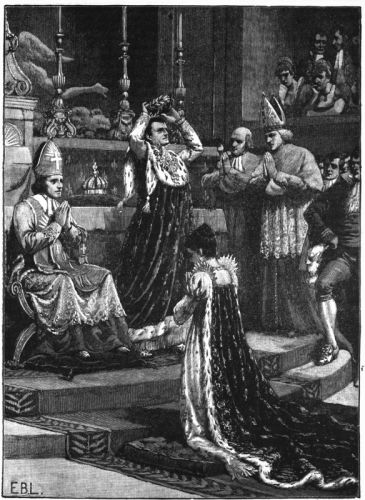
THE CORONATION OF NAPOLEON IN NOTRE DAME. (See p. 499.)
[See larger version]
On the 6th of April Whitbread brought forward these charges against Melville in the House of Commons, as detailed in the tenth report of the Naval Commissioners. In doing so, he paid a high compliment to the manner in which the naval affairs had been conducted since Lord St. Vincent became head of that Department; but he charged Lord Melville with having applied the public money to other uses than those of the Naval Department, in contempt of the Act of 1785—an Act which Melville himself, then Dundas, had supported: that he had connived at a system of peculation in the Treasurer of the Navy, Mr. Trotter, an individual for whom he was responsible. The salary of this Mr. Trotter had been fixed by the Act of 1785 at four thousand pounds a year, but he contended that Dundas had allowed Trotter to draw large sums from the Bank of England out of the navy deposit, pay them into Coutts's Bank, and use them for his own benefit; and that, moreover, he had participated in the profits of this system. This charge called forth a vehement contest of parties. Tierney, who had been Treasurer of the Navy under Addington, declared that he had found no inconvenience in complying with the Act of 1785, whilst holding that office. Fox, Grey, Ponsonby, Windham, Wilberforce, Lord Henry Petty, afterwards Lord Lansdowne, supported Whitbread's charges, and Pitt, Canning, and Lord Castlereagh defended Melville. On putting the resolutions moved by Whitbread, after a debate till quite late in the morning, they were carried by the casting vote of the Speaker. The scene, which is one of the most striking in our Parliamentary annals, has frequently been described, notably by Lord Fitzharris:—"I sat edged close to Pitt himself," he wrote, "the night when we were two hundred and sixteen, and the Speaker, Abbot, after looking as white as a sheet, and pausing for ten minutes, gave the casting vote against us. Pitt immediately put on the little cocked hat that he was in the habit of wearing when dressed for the evening, and jammed it down deeply over his forehead, and I distinctly saw the tears trickling down his cheeks. We heard one or two, such as Colonel Wardle, say they would see 'how Billy looked after it'! A few young ardent followers of Pitt, with myself, locked their arms together and formed a circle, in which he moved, I believe unconsciously, out of the House, and neither the colonel nor his friends could approach him." But the Opposition were not content with the vote of censure. Whitbread moved that an Address should be presented to his Majesty, praying him to remove Lord Melville for ever from his councils and presence, but the motion was withdrawn as soon as Melville's resignation was known. On the 6th of May Whitbread was about to move a resolution that his Majesty should be requested to erase the name of Lord Melville from the list of the Privy Council, but Pitt rose and said that the motion was unnecessary, as his Majesty had already done it.
Melville was now permitted by the House of Peers to go down to the House of Commons, notwithstanding their conclusion on the subject, to make his defence, and he made a very long speech, contending that he had not embezzled a farthing of the public money, and exalting his services to the country, especially in his India administration. But on the head of Secret Service Money he was as close as the grave. He declared that "if he had disclosed any of these transactions he should have felt himself guilty not only of a breach of public duty, but of a most unwarrantable breach of private honour." There were twenty thousand pounds which he never did, and never could, account for on this ground, and there were forty thousand pounds drawn at once by Pitt from the Navy Fund. He said he knew very well for what purposes these sums had been paid, but that nothing would compel him to disclose it. When it was asked him whether Mr. Trotter had not kept large sums belonging to the Navy Fund in Coutts's Bank, and speculated with them to his own great enrichment, he admitted that Trotter had had such sums for considerable times in Coutts's Bank, but that they were always forthcoming when wanted, and that no single payment had been delayed on that account; and that out of the one hundred and thirty-four millions which had passed through his hands, nothing had been lost. He praised Trotter in the highest manner, but was silent as to the private use that he had so long, and to such advantage to himself, made of the public money. He admitted that he had himself held considerable sums of this money at different times in his own hands, but had repaid the whole before quitting office, and this was all that the Act of 1785 required. He seemed to admit that he had paid money out of the Navy Fund for other than naval objects, and for these secret service purposes. Some of these were in Scotland, of which, also, he had the administration to a certain degree. And here the public called to mind that Watt, the spy and informer against the Scottish Reformers, had acknowledged to have been employed and paid by Dundas, so that it was clear whither some of the Navy Fund had gone. Melville entered into long explanations regarding a written release which had passed reciprocally between him and Trotter on winding up their affairs, in which they agreed to destroy all their vouchers for the sums paid away. This looked very black, but Melville contended that it was only a matter of course—a thing constantly done by officials in like circumstances, which, if true, made the matter all the worse for the country. But Melville contended that this clause in the release was merely a form; that it did not mean that they should literally destroy the vouchers, but only that they should be rendered invalid as evidence in any prosecution, which very little mended the matter. Melville declared that he had not, in consequence of the clause, destroyed a single paper.
On the withdrawal of Melville, Whitbread moved for his impeachment, and Mr. Bond for his prosecution in the ordinary courts of law, and this amendment was carried. But Melville preferred impeachment to a trial at common law. Mr. Bond was induced to withhold any further procedure in consequence of his motion, and Mr. Leycester, one of Melville's friends, made a fresh motion for impeachment, which was carried, and on the 26th of June Whitbread, accompanied by a great number of members, impeached him at the bar of the House of Lords. A Bill was also passed through both Houses regulating the course of his impeachment. The impeachment itself, owing to very important events, including the death of Pitt, was not proceeded with till April, 1806. On the 10th of July Lord Sidmouth and the Earl of Buckinghamshire resigned. It was supposed that difference of opinion regarding Lord Melville's case was the cause, and the surmise was correct, Addington taking strong exception to the appointment of Sir Charles Middleton, a very old man, to succeed Melville. Lord Camden succeeded Sidmouth, and Lord Harrowby Lord Buckinghamshire. Castlereagh obtained Camden's post of Secretary of Colonial Affairs. This secession weakened Pitt's Ministry considerably. On the 12th of July Parliament was prorogued, but a message was sent down to the House to enable his Majesty to carry out some arrangements in the north of Europe, which were necessary for the security and independence of Britain, and a sum, in addition to the large supplies already granted, was voted, which was not to exceed three millions and a half.
Great exertions had been made to draw Prussia into the confederation that was forming, and on the 25th of May, 1804, a defensive alliance had been concluded between Prussia and Russia. But the King of Prussia was, at the same time, listening to the offers of Buonaparte, who was encouraging him to expect the annexation of Hanover, and also further territory at the cost of Austria. In these circumstances, Prussia kept a dubious position, but continued to strengthen her armies for an emergency, holding herself ready to close with the best offer. Austria herself was afraid of another war with Buonaparte, and strongly urged that negotiations should be opened with him before proceeding to extremities. However, she too concluded a treaty with Russia in November. It was Pitt's object to draw these threads together. Fortunately the Czar sent his Minister, Nowosiltzoff, to England in 1805, and he readily fell in with Pitt's ideas. Accordingly, on the 11th of April the Treaty of St. Petersburg was signed on the basis of the maintenance of the Treaties of Lunéville and Amiens. The great coalition was thus practically complete, when news arrived that Buonaparte had annexed Genoa to France. This was a most gross violation of the Treaty of Lunéville. But the annexation of Genoa was but a small part of the aggressions of Buonaparte on Italy. On the very same journey he made himself King of Italy. On Sunday, the 26th of May, he was crowned in the cathedral of Milan. The Archbishop of Milan performed the ceremony, blessing the old iron crown of the ancient kings of Lombardy, and Buonaparte putting it himself on his head, as he had done that of France. Nor did Napoleon stop here. He wanted a little snug principality for his sister Eliza and her husband, the Corsican Bacciochi, and he turned the Republic of Lucca into such an one, and conferred it upon them.
But these assumptions of new territories and new honours had, as we have seen, alarmed the Northern Powers and Austria. They saw that they could have no peace with such a man, except it were a peace of continual encroachment, humiliation, and slavery, and Russia went so far as to recall her Ambassador, though without a declaration of war. There was the utmost necessity for union, caution, and the exertion of every ability. But the folly and incapacity of those nations appeared to rise in intensity in proportion to the actual need of wisdom, and to the genius of their enemy. Britain, could give them money, but she could not give them talent and sagacity. Before Russia could march down to unite with Austria, Austria, which had so long hung back, and thus delayed the operations of Alexander, now showed as fatal a temerity, and commenced the campaign alone. She rushed into Bavaria, whose Elector, Maximilian Joseph, had entered into league with Buonaparte, in common with Würtemberg and other German States. The Emperor Francis had despatched Schwarzenberg to Munich, to endeavour to prevail on him to unite with Austria against the common enemy of Germany. Maximilian Joseph pleaded that he was quite resolved on doing that, but that his son was travelling in France, and he prayed time to recall him, or Buonaparte would wreak his vengeance upon him. This should have induced Francis of Austria to delay at least a sufficient time for this purpose, especially as it gave another chance for the decision of Prussia in their favour, when it saw the Russians already on the march. Whether the Elector of Bavaria would eventually have kept his promise is doubtful, for Napoleon was, on the other hand, pressing him close, through his Ambassador, M. Otto, to proclaim openly the secret alliance concluded with France.
The troops of Austria were already in Bavaria on the 21st of August. They amounted to eighty thousand men, under the nominal command of the Archduke Ferdinand—a prince of high courage and great hopes—but really under that of General Mack, whose utter incapacity had not been sufficiently manifested to Austria by his miserable failures in the Neapolitan campaign, and who was still regarded in Germany as a great military genius. His army had been posted behind the Inn, in the country between the Tyrol and the Danube, into which the Inn falls at Passau. This was a strong frontier, and had the Austrians waited there till the arrival of the Russians, they might have made a powerful stand. But Mack had already advanced them to the Lech, where again he had a strong position covering Munich. Meanwhile, the Archduke Charles, Austria's best general, was posted in the north of Italy, with another eighty thousand men, and the Archduke John in the Tyrol with an inferior force. Such were the positions of the Austrian armies when Mack was invading Bavaria, and Buonaparte was preparing to crush him.
Buonaparte had watched all the motions of the Northern Powers and of Austria from the first, and was fully prepared to encounter and overthrow them. Even before his return from Italy his plans were laid. No sooner, indeed, was he in France again than he proceeded to his great camp at Boulogne, and dated several decrees thence, thus drawing attention to the fact. All France was once more persuaded that he was now going to lead his invincible Army of England across the strait, and add perfidious Albion to his conquests. He had increased that army greatly; it had been diligently disciplined, and contained soldiers who had carried him to victory in Italy and in Egypt. Such an army of a hundred and fifty thousand picked men was deemed capable of achieving anything, with the Emperor at their head. But Napoleon had no intention of making the desperate attempt to cross the Channel without an overwhelming fleet, and this, for reasons which we will mention by-and-bye, did not come. The maps of England had all been thrown aside, and those of Germany substituted. He was busy collecting material for artillery; he was sending everywhere to buy up draught-horses to drag his baggage and ammunition and guns; and suddenly, when people were looking for the ordering out of his flotilla, they were surprised by hearing that he was in full march for the Rhine. On the 23rd of September he sent a report to the Senate in these words:—"The wishes of the eternal enemies of the Continent are accomplished; hostilities have commenced in the midst of Germany; Austria and Russia have united with England; and our generation is again involved in all the calamities of war. But a very few days ago I cherished a hope that peace would not be disturbed. Threats and outrage only showed that they could make no impression upon me; but the Austrians have passed the Inn; Munich is invaded; the Elector of Bavaria is driven from his capital; all my hopes have therefore vanished. I tremble at the idea of the blood that must be spilled in Europe; but the French name will emerge with renovated and increased lustre." This was accompanied by two decrees: one for ordering eighty thousand conscripts, and the other for the organisation of a national guard. The next day he was on the way to Strasburg. He said to Savary, "If the enemy comes to meet me"—for Mack, like a madman, was rushing towards the Rhine, far away from his allies—"I will destroy him before he has re-passed the Danube; if he waits for me, I will take him between Augsburg and Ulm." The result showed how exactly he had calculated.
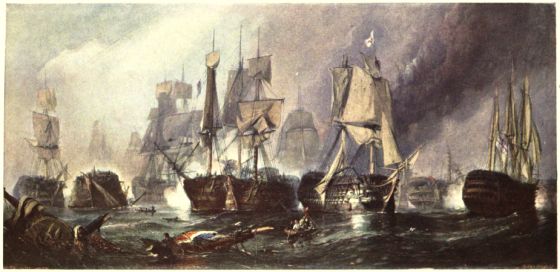
THE BATTLE OF TRAFALGAR AND THE VICTORY OF LORD NELSON OVER THE COMBINED FRENCH AND SPANISH FLEETS, OCTOBER 21ST, 1805.
From the Picture by CLARKSON STANFIELD, R. A., in the National Gallery.
[See larger version]
Mack, who was advancing rashly out of reach of any supporting bodies of troops, expected to encounter the French in front. He therefore took possession of Ulm and Memmingen, and threw his advanced posts out along the line of the Iller and the Upper Danube, looking for the French advancing by way of the Black Forest. But Buonaparte's plan was very different. He divided his army into six grand divisions. That commanded by Bernadotte issued from Hanover, and, crossing Hesse, appeared to be aiming at a junction with the main army, which had already reached the Rhine. But at once he diverged to the left, ascended the Main, and joined the Elector of Bavaria at Würzburg. Had Mack had a hundredth part of the strategic talent attributed to him, he would have concentrated his forces into one powerful body, and cut through the cordon which Buonaparte was drawing around him, and, under good generalship, such soldiers as the Hungarians would have done wonders; but he suffered his different detachments to be attacked and beaten in detail, never being ready with fresh troops to support those which were engaged, whilst the French were always prepared for this object. Accordingly, Soult managed to surround and take one entire Austrian division at Memmingen, under General Spangenberg, and Dupont and Ney defeated the Archduke Ferdinand at Günzburg, who had advanced from Ulm to defend the bridges there. Ferdinand lost many guns and nearly three thousand men. This induced Mack to concentrate his forces in Ulm, where, however, he had taken no measures for supplying his troops with provisions during a siege. He was completely surrounded, and compelled to capitulate on the 19th of October, 1805.
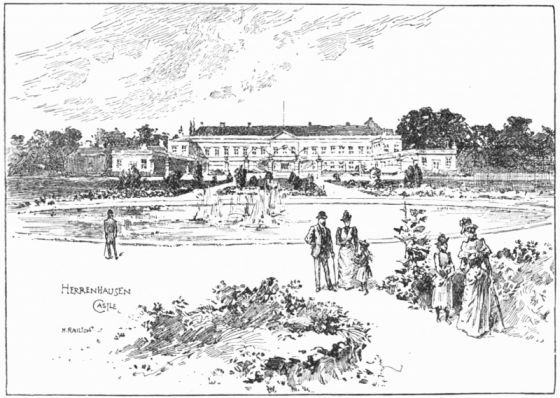
HERRENHAUSEN CASTLE, HANOVER.
[See larger version]
On the day after the surrender of Ulm, Buonaparte announced by proclamation to the army that he was going to annihilate the Russians, as he had done the Austrians; that Austria, in fact, had no generals with whom it was any glory to compete; and that Russia was only brought by the gold of England from the ends of the earth, for them to chastise them. At the end of October, accordingly, he commenced his march on Vienna.
The Emperor Francis did not attempt to defend his capital—that capital which had twice repelled all the efforts of the Turks—but fled into Moravia, to join his Russian ally, the Czar Alexander, who was there at the head of his army. On the 7th of November Francis took his departure, and on the 13th of November Napoleon entered Vienna without any opposition. Whilst Napoleon remained there he continued to receive the most cheering accounts of the success of his arms in Italy against the Austrians. There, Massena, on hearing of the capitulation of Ulm, made a general attack on the army of the Archduke Charles, near Caldiero. The French were victorious, and were soon joined by General St. Cyr, from Naples, with twenty-five thousand men. At the moment of this defeat, the Archduke received the news of the fall of Ulm, and the march of the French on Vienna. He determined, therefore, to leave Italy to its fate. He commenced his retreat in the night of November 1st, and resolved to make for Hungary.
Napoleon had so far executed his plans with wonderful success. He had rescued Bavaria, reduced the enemy's army and prestige at once by the capture of Ulm and Vienna, and had driven the Austrians simultaneously from Upper Italy and the Tyrol. But still his situation, for any general but himself, was very critical. The defeated army of the Emperor Francis had united itself to that of the young Emperor of Russia, in Moravia; the two archdukes were mustering great bodies of troops on the confines of Hungary, ready to rush forward and swell the Austro-Russian army; and the King of Prussia was watching the movements of the two parties, ready to strike, if France met with a reverse. Napoleon saw that his only security lay in a bold and decisive blow. He therefore crossed the Danube on the 23rd of November, and began a brisk march into the heart of Moravia, to attack the main body of the Allies under their two Emperors. He was soon before Brünn, its little capital, and the Allies retreated, at his approach, as far as Olmütz. This movement was, however, made to form a junction with the twenty-four thousand men under Benningsen. This being effected, they amounted to about eighty thousand men, but of these, many of the Austrians were troops already discouraged by defeat, and many more were raw recruits. The French were in number about equal, but consisting of veteran soldiers flushed with victory. On the 2nd of December Napoleon brought on the battle of Austerlitz, and before the close of the day the forces of the Coalition were completely beaten, losing upon the field some 27,000 killed and wounded, 20,000 prisoners, and 133 pieces of cannon.
Even now, had the Russians and Austrians possessed the spirit which the circumstances of the time demanded of them, they were far from being in a hopeless condition. Buonaparte was at an immense distance from his country. Besides the army still remaining with the two Emperors—at least sixty thousand in number—there were the strong forces of the Archdukes Charles and John in Hungary, and of Prince Ferdinand in Bohemia. By bold and skilful manœuvres they might have cut off his communications with France and Italy, and have harassed him, without committing themselves to a decided battle, till he must have found himself in a most perilous position. But Francis of Austria gave up the struggle in despair; he sent Prince John of Lichtenstein to propose a suspension of arms. Buonaparte insisted that they should first break with the Russians, and Lichtenstein said that Francis was quite willing, and to treat with Napoleon for a separate peace, but that he must claim for the Emperor Alexander the privilege of retreating into his own country without molestation. Buonaparte granted this as a favour, and added words so complimentary to Alexander, that they betrayed a wish to complete an agreement also with him. He returned to Vienna, and again occupied the palace of Schönbrunn. There he and Talleyrand concerted the demands which should be made; and an armistice was signed, on these terms, with Prince John of Lichtenstein, on the 6th of December. The final treaty was signed by the Emperor Francis, at Pressburg, on the 26th of December, a fortnight after Austerlitz. By this treaty Austria surrendered to Buonaparte all her territories in Italy, as well as her Venetian provinces of Dalmatia and on the coast of Albania. She surrendered her only seaport on the Adriatic, Trieste, and thus reduced herself to a mere inland power. She was compelled to cede to her rival, Bavaria, the Tyrol—a country most faithfully attached to the House of Hapsburg,—the bishopric of Passau, and other regions. Bavaria and Würtemberg, for their hostility to their own German race, were elevated into kingdoms, and Baden, for the same unpatriotic services, into a grand duchy. Thus France and her allies, or rather subjects, were now in possession of Switzerland, Italy, and the Tyrol on one side, and of Holland and Belgium on the other, so that she had everywhere an open high road into Germany, and nations of tributary princes, which were to aid in further enslaving it. Prussia had made up her mind on hearing of the victory of Austerlitz, and Haugwitz appeared at Schönbrunn, not to declare war on Buonaparte, but to compliment him on his victory. Buonaparte could not conceal his contempt for this despicable conduct. He said, "Ah! this compliment was intended for others, but fortune has transferred it to me;" but as he still intended to make use of Prussia, and could humiliate George III. by her means, he concluded a treaty with Haugwitz, by which he handed over Hanover to our late ally, and claimed Anspach in lieu of it. He then strengthened the Confederation of the Rhine, of which he was Protector, and so completely broke up the old federation of Germany, that Francis of Austria soon abandoned the title of Elective Emperor of Germany, and assumed that of Hereditary Emperor of Austria.
Pitt's expeditions were not particularly well arranged. Instead of sending an army of thirty or forty thousand to the Baltic, and calling on Russia to do the same, which she could have done, notwithstanding the army under the Emperor Alexander, he sent only about six thousand, and sent another eight thousand from Malta, to co-operate with twelve thousand Russians in a descent on the kingdom of Naples. This expedition might have been left till the success in the North was secured; in truth, it had better have been left altogether. When General Don and Lord Cathcart landed in Swedish Pomerania, and were joined by the king's German legion and some other German hired troops, our army amounted only to sixteen thousand men, the Swedes to twelve thousand, and the Russians to ten thousand—altogether, not forty thousand men. But what was worse than the paucity of numbers was the disunion amongst the commanders. Lord Harrowby was sent to Berlin, to endeavour to induce Prussia to join this coalition, but Prussia was well aware of the want of unity in the Allied Army, and, weighing probabilities, she could not be moved. The King of Sweden was so incensed at the cold, shuffling conduct of the King of Prussia, that he wrote him some very indignant and undiplomatic letters, which only furnished him with a further excuse for holding aloof. Gustavus, seeing no good likely to be done, resigned his command of the Allied Army, where, indeed, he had enjoyed no real command at all, and retired with his forces to Stralsund. This was a fatal exposition of want of unity, and it was not till three weeks were gone that the breach was healed. By this time it was the middle of November. Ulm had surrendered, Napoleon was master of Vienna, and Prussia was still watching what would be the fate of the coming battle between Napoleon and the Emperors of Austria and Russia. The union of the Allies came too late; the force was altogether too small to turn the scale of the campaign. Had Gustavus marched into Hanover a month earlier, with sixty thousand men, he might have rendered Austerlitz a nonentity; as it was, he had only time to invest Hameln, where Bernadotte had left a strong garrison, when the news of Austerlitz arrived, and caused the Allies to break up the campaign, and each to hurry off to his own country.