Chapter XV · (continued 2)
Reading edition
"I confess that the multiplied proofs which I have given at all times of my love for the people, and the manner in which I have always conducted myself, ought, in my opinion, to demonstrate that I was not afraid to expose myself in order to prevent bloodshed, and ought to clear me for ever from such an imputation."
On the 14th of January, 1793, the members of the Convention met, amid a mob surrounding the House, and demanding, "Death to the tyrant! Death to him or to us!" Other crowds crammed the galleries. The debate, which had begun immediately after the king's speech, was renewed, and furious menaces and recriminations between the Girondists and the Mountain were uttered. At length the Convention reduced all the questions to these three: 1st. Is Louis Capet guilty of conspiring against the liberty of the nation and the safety of the State? 2nd. Shall the judgment, whatever it be, be referred to the sanction of the people? 3rd. What punishment shall be inflicted on him?
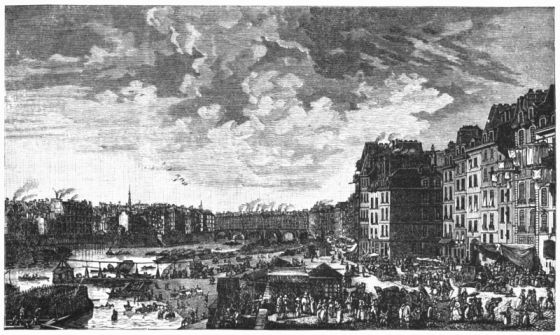
VIEW IN OLD PARIS: THE PORTE AU BLÉ, FROM THE END OF THE OLD CATTLE MARKET TO THE PONT NOTRE DAME. (From a Print by De l'Espinasse in 1782.)
[See larger version]
The debates and voting on these three questions occupied the Convention till late in the evening of the 17th. On the first question thirty-seven pronounced Louis guilty, but proposed only that he should be taken care of for the general safety; six hundred and eighty-three declared him guilty simply; and, as the Assembly consisted of seven hundred and forty-nine members altogether, there was a majority affirming his guilt of the whole, except twenty-nine members. He was therefore declared, by the President, guilty of conspiracy against the liberty and safety of of State. On the second question thirty-one members were absent: four refused to vote; eleven voted conditionally; two hundred and eighty—and these almost exclusively were members of the Girondist section—for the appeal to the people; and four hundred and twenty-three rejected it. The President, therefore, proclaimed that the appeal to the people was declined. The last fatal question of death to the monarch was put on the 16th. By this time the excitement was as intense all over Paris as within the walls of the Convention itself. It was found, that of the seven hundred and forty-nine members, three hundred and eighty-seven voted in favour of death unconditionally, while three hundred and thirty-four voted in favour of Louis' detention, or imprisonment, or death under defined conditions and in certain circumstances. Twenty-eight votes were not accounted for. Either they were lost amidst the excitement of the hour, or members to that number took no part in the decision. The king's death, therefore, was carried by a majority of only fifty-three votes. Then came the question of a reprieve.
On the 20th, at three o'clock in the morning, the voting on this point terminated, and the President declared that there was a majority of three hundred and eighty votes against three hundred and ten, and that there could be no reprieve; the execution must take place without delay. Louis met his death with dignity on the 21st of January, 1793.
For a short time quiet prevailed, as if the nation, and Europe, too, were stunned by the news of the execution of the king. In spite of the loud talk of the Jacobins and sansculottes throughout France, there was a startled sense of terror—a foreboding of calamity. In La Vendée there was intense horror and indignation. Abroad, every monarchy seemed thrown into a new attitude by the death of Louis. Spain and England, which had maintained a careful neutrality, assumed a threatening aspect. Germany, which had not yet federally allied itself with the movements of Austria and Prussia, became agitated with resentment; and Holland, by the fear of suffering the fate of Belgium. The axe which severed the head of Louis from his body seemed to sever every international sympathy with France. In England, the sensation on the news of the execution was profound. People in general had not believed that the French would proceed to such an extremity with a monarch of so inoffensive a character. The crime seemed to verify all the predictions and the denunciations of Burke. There was, except amongst a certain class of almost frantic Republicans, a universal feeling of abhorrence and execration. There was a gloomy sense of approaching war; a gloomy sense, as if the catastrophe was a national rather than a foreign one. Pitt had hitherto maintained a position of neutrality. He had contrived to avoid giving any support to the royal family of France, which must have produced immediately hostile consequences, but he had not failed, from time to time, to point out in Parliament the atrocious conduct of the French revolutionists, which justified all the prophecies of Burke, and threw shame on the laudatory language of Fox.
Whilst the fate of Louis XVI. was drawing to a crisis, the question of danger menaced by the French revolution had been warmly discussed in the British Parliament. The Government had already called out the militia when Parliament met on the 13th of December, 1792. The speech from the throne attributed this to the attempts of French incendiaries to create disturbance in the country, coupled with the doctrines of aggression promulgated by the French Convention, and their invasion of Germany and the Netherlands, which had already taken place. The latter country was overrun with French armies, and Holland, our ally, was threatened. The Address to the Speech, in the Commons, was moved by Mr. Wallace and seconded by Lord Fielding in the same tone. Fox, on the other hand, strongly opposed the warlike spirit of the speech. He declared that he believed every statement in the royal speech was unfounded, though the invasion of Germany and of the Netherlands was no myth. Fox had not yet, despite the horrors perpetrated by the French revolutionists, given up his professed persuasion of the good intentions of that people—a wonderful blindness—and he recommended that we should send a fresh ambassador to treat with the French executive. Grey and Sheridan argued on the same side; Windham and Dundas defended the measures of Government, declaring that not only had the French forced open the navigation of the Scheldt, the protection of which was guaranteed by Britain, but that they were preparing for the regular subjugation of Holland. Burke declared that the counsels of Fox would be the ruin of England, if they could possibly prevail. He remarked that nothing was so notorious as the fact that swarms of Jacobin propagandists were actively engaged in disseminating their levelling principles in Great Britain, and were in close co-operation with Republican factions. These factions had sent over deputations to Paris, who had been received by the Jacobin society and by the Convention. He read the addresses of Englishmen and Irishmen resident in Paris, and of Joel Barlow and John Frost, deputies of the Constitutional Society of London. Burke said the question was, if they permitted the fraternising of these parties with the French Jacobins, not whether they should address the throne, but whether they should long have a throne to address, for the French Government had declared war against all kings and all thrones. Erskine replied, ridiculing the fears of Burke, and denouncing the prosecution of Paine's "Rights of Man" by Government. The Address was carried by a large majority. Fox, however, on the 14th of December, moved an amendment on the Report; and in his speech he rejoiced in the triumph of the French arms over what he called the coalition of despots, Prussia and Austria. He declared the people of Flanders had received the French with open arms; that Ireland was too disaffected for us to think of going to war; and that it was useless to attempt to defend the Dutch, for the people there would go over to France too. He again pressed on the House the necessity of our acknowledging the present French Government, and entering into alliance with it. He said France had readily acknowledged the Revolution in England, and entered into treaty with Cromwell. Burke again replied to Fox, declaring that France had no real Government at all to enter into terms with. It was in a condition of anarchy, one party being in the ascendency one day, another the next; that such was not the condition of England under Cromwell. There was a decided and settled Republican Government, but a Government which did not menace or overthrow all monarchies around it, any more than Switzerland or the United States of America did now. Dundas reminded the House that we were bound by treaties to defend Holland if attacked, and that we must be prepared for it. Whigs, who had hitherto voted with Fox, now demanded to whom we were to send an ambassador—to the imprisoned king, to the Convention, or to the clubs who ruled the Convention? Fox's amendment was rejected without a division.
Undismayed, Fox renewed the contest on the following day, December 15th, by moving that an humble address should be presented to his Majesty, praying him to send an ambassador to France to treat with the persons constituting the existing executive Government. He said that he did not mean to vindicate what had taken place in that country, although, if we condemned the crimes committed in France, we must also condemn those of Morocco and Algiers, and yet we had accredited agents at the courts of those countries.
Grey followed, contending that we ought to avoid the calamities of war by all possible means. A long debate ensued, in the midst of which Mr. Jenkinson declared that on that very day, whilst they were discussing the propriety of sending an ambassador to France, the monarch himself was to be brought to trial, and probably by that hour was condemned to be murdered. All the topics regarding Holland and Belgium were again introduced. Fox was supported by Grey, Francis, Erskine, Whitbread, and Sheridan; but his motion was negatived without a division.
On Monday, the 17th, Fox renewed the discussion, supported by Mr. Grey, who complained that at a so-called loyal meeting held at Manchester, the people had been incited to attack the property of those of more liberal views; and that an association had been formed in London, at the "Crown and Anchor" Tavern, which had issued a paper called "A Pennyworth of Truth from Thomas Bull to his Brother John," containing most unfounded censures on the Dissenters, whom it charged as being the authors of the American war. He declared that this paper was far more inflammatory than Paine's "Rights of Man," and he desired that it might be read at the table. Fox severely criticised the conduct of the loyal associations, and the means taken by the subscription papers to mark out those who maintained Liberal opinions; all such marked persons, he said, were in danger, on any excitement, of having their persons or houses attacked. He mentioned one paper concluding with the words, "Destruction to Fox and all his Jacobin crew!" This was, he thought, pretty plainly marking him out for such treatment as Dr. Priestley and Mr. Walker had received. The motion was rejected.
Immediately after this, Fox encouraged the formation of a Society of Friends of the Liberty of the Press, of which Erskine and Horne Tooke were members. As several French emissaries were traversing the country disseminating their opinions, Lord Grenville, on the 19th of December, 1792, introduced a bill into the House of Lords, subjecting aliens to certain regulations not included in the ordinary Alien Bill. All foreigners were to announce themselves on their arrival, and surrender any arms brought with them; they were to take out passports, and to have them viséd on every fresh removal through the country, so that their movements might be known to the authorities; those who had arrived during the year 1792 to be particularly observed, and the motives for their coming ascertained; all such foreigners as received allowances from the British Government to be distributed into particular districts, under the eye of the authorities. With some opposition, this Bill was carried. The Marquis of Lansdowne forthwith moved that a negotiation should be immediately opened with the French Government, requiring it to receive back the numerous Frenchmen driven into exile, or to provide for their support, and at the same time to endeavour to save Louis XVI. from the terrible fate which threatened him. This was negatived on the declaration of other lords, who said that both propositions would be useless; the latter one would in all probability hasten, rather than avert, the fate of the French king. In the Commons, Fox and Sheridan strenuously resisted the new Alien Bill, and Burke as vehemently supported it. He declared that no measures of precaution could be too strict; that thousands of daggers had been manufactured in Birmingham for France, and intending to produce a startling effect he drew an actual dagger from his bosom, and flinging it on the floor of the House exclaimed, "That is what you are to obtain from an alliance with France. You must equally proscribe their tenets and their persons; you must keep their principles from your minds, and their daggers from your hearts!" In the French Convention such an action would have created a sensation, but in the matter-of-fact British Parliament it produced only surprise followed by laughter. Fox endeavoured as much as possible to weaken the sense of danger of French principles, though he expressed his abhorrence of the September massacres. The Bill was passed, and was succeeded by one prohibiting the circulation of French assignats, bonds, promissory notes, etc., and another, prohibiting the exportation of naval stores, saltpetre, arms, and ammunition.
On the 30th of January, 1793, Dundas announced to the House of Commons a message from the throne, communicating the news of the execution of the French king. This was accompanied by copies of a correspondence with M. Chauvelin, the late plenipotentiary of Louis, and of an order for his quitting the kingdom, in consequence of this sanguinary act. The message made a deep impression on the House, though the circumstances were already well known. It was agreed to take these matters into consideration on the 2nd of February, when Pitt detailed the correspondence which had for some time taken place between the British Cabinet and the French Government. He said that Britain, notwithstanding many provocations, had carefully maintained an attitude of neutrality, even when, in the preceding summer, France was at war with Austria and Prussia, and was menacing our Dutch allies. The French, on their part, had, he said, made similar professions. They had publicly renounced all aggression, and yet they had annexed Saxony, overrun Belgium, and now contemplated the invasion of Holland. They had done more: they had plainly menaced this country with invasion. So recently as the last day of the year, their Minister of Marine had addressed a letter to the seaports of France, in which this was the language regarding England:—"The King and his Parliament mean to make war against us. Will the English Republicans suffer it? Already these free men show their discontent, and the repugnance they have to bear arms against their brothers, the French. Well, we will fly to their succour; we will make a descent on the island; we will lodge there fifty thousand caps of liberty; we will plant there the sacred tree; we will stretch out our arms to our Republican brethren, and the tyranny of their Government shall soon be destroyed!" There was a strong war spirit manifest in the House. Fox and his diminished party combated it in vain. The same prevailing expression was exhibited in a similar debate in the House of Lords, in which Lord Loughborough—who, on the 20th of January, succeeded Thurlow as Lord Chancellor—supported the views of Ministers. But there was little time allowed for the two Houses to discuss the question of peace or war, for on the 11th of February Dundas brought down a royal message, informing the Commons that the French had declared war on the 1st of February, against both Britain and Holland. On the following day Pitt moved an Address to his Majesty, expressing a resolve to support him in the contest against France. In the debate, Burke declared the necessity of war against a nation which had, in fact, proclaimed war against every throne and nation. At the same time, he declared that it would be a war in defence of every principle of order or religion. It would not be the less a most desperate war. France was turning almost every subject in the realm into a soldier. It meant to maintain its armies on the plunder of invaded nations. Trade being ruined at home by the violence of mob rule, the male population was eager to turn soldiers, and to live on the spoils of the neighbouring countries. Lyons alone, he said, had thirty thousand artisans destitute of employment; and they would find a substitute for their legitimate labour in ravaging the fields of Holland and Germany. He deemed war a stern necessity. A similar Address was moved and carried in the Peers.
On the 18th of February, however, Fox moved a string of resolutions condemnatory of war with France. They declared that that country was only doing what every country had a right to do—reorganise its internal Constitution; that, as we had allowed Russia, Prussia, and Austria to dismember Poland, we had no right to check the aggressions of France on these countries; as we had remained quiescent in the one case, we were bound to do so in the other, and not to make ourselves confederates of the invasion of Poland; and his final resolution went to entreat his Majesty not to enter into any engagements with other Powers which should prevent us from making a separate peace with France. Burke did not lose the opportunity of rebuking Fox for his long advocacy of the Empress Catherine, whose unprincipled share in the partition of Poland he was now compelled to reprobate. The resolutions of Fox were negatived by two hundred and seventy votes against forty-four. Not daunted by this overwhelming majority, Fox again, on the 21st of February, brought forward his resolution in another form, declaring that there were no sufficient causes for war. The motion was negatived without a division.
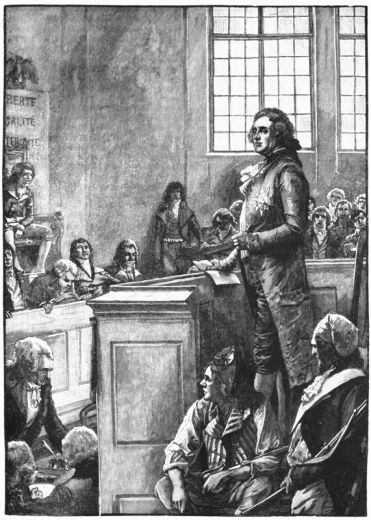
TRIAL OF LOUIS XVI. (See p. 409.)
[See larger version]
During these debates, Ministers detailed the proceedings which had for some time past taken place between the Governments of France and Britain, to show that the maintenance of peace was impossible. The chief of these transactions were briefly these:—From the date of the conferences at Pillnitz in 1791, when Prussia and Austria resolved to embrace the cause of the French king, and invited the other Powers to support them, Britain declared, both to those Powers and to France, her intention of remaining neutral. It was no easy matter to maintain such neutrality. To the Jacobin leaders, every country with an orderly Government, and still more a monarchy, was an offence. Against Britain they displayed a particular animus, which the most friendly offices did not remove. When, towards the end of 1791, the Declaration of the Rights of Man having reached St. Domingo, the negroes rose in insurrection to claim these rights, Lord Effingham, the Governor of Jamaica, aided the French Colonial Government with arms and ammunition, and the fugitive white people with provisions and protection. When this was notified to the National Assembly, with the King of Britain's approval of it, by Lord Gower, the ambassador at Paris, a vote of thanks was passed, but only to the British nation, and on condition that not even Lord Effingham's name should be mentioned in it. Other transactions on the part of the French still more offensive took place from time to time, but Britain still maintained her neutrality. When war was declared by France against Austria, in April, 1792, Chauvelin announced the fact to the British Government, and requested that British subjects should be prohibited from serving in any foreign army against France. Government at once issued an order to that effect. In June the French Government, through Chauvelin, requested the good offices of Britain in making pacific proposals to Prussia and Austria; but find that France expected more than friendly mediation—actual armed coalition with France—the British Government declined this, as contrary to existing alliances with those Powers. The proclamations of the French Government were already such as breathed war to Europe; all thrones were menaced with annihilation. At this time Mr. Miles, who exerted himself to maintain a friendly feeling between the nations, records, in his correspondence with the French Minister Lebrun and others, that Roland declared to one of his friends that peace was out of the question; that France had three hundred thousand men in arms, and that the Ministers must make them march as far as ever their legs could carry them, or they would return and cut all their throats.
This was the state of things when, on the 17th of August, 1792, the French deposed Louis, and prepared for his death. Lord Gower was thereupon recalled, on the plain ground that, being accredited alone to the king, and there being no longer a king, his office was at an end; he was, however, ordered to take a respectful leave, and to assure the Government that Britain still desired to maintain peaceful relations. Yet at this very time London was swarming with paid emissaries of the French Government, whose business was to draw over the people to French notions of republican liberty. Nay, more, Lebrun, the Foreign Minister, took no pains to conceal the assurance of the French that Ireland would revolt and that France would secure it. On the 18th of November a great dinner was given at White's Hotel in Paris, at which Lord Edward Fitzgerald and other Irish Republicans, Thomas Paine, Santerre, and a host of like characters, English, Irish, French, and others, toasted the approaching National Convention of Great Britain and Ireland, and amid wild acclamations drank the sentiment, "May revolutions never be made by halves!" The very next day, the 19th, the National Convention issued its decree, declaring war against all thrones and proclaiming the enfranchisement of all peoples. This was immediately followed by Jacobinised deputations of Englishmen, thanking the Convention for this proclamation; and the President, in reply, said, "Citizens of the world! Royalty in Europe is utterly destroyed, or on the point of perishing on the ruins of feudality; and the Rights of Man, placed by the side of thrones, are a devouring fire which will consume them all. Worthy Republicans! Congratulate yourselves on the festival which you have celebrated in honour of the French Revolution—the prelude to the festival of nations!"
Before the close of 1792 the French resolved to send an ambassador to the United States to demand a return of the aid given to the Americans in their revolution, by declaration of war against Great Britain. M. Genet was dispatched for this purpose at the beginning of 1793. Still neutrality was maintained, though our ambassador was withdrawn from Paris, and M. Chauvelin was no longer recognised in an official capacity by the British Court. This gentleman, however, continued in London, ignoring the loss of his official character, and officiously pressing himself on the attention of Ministers as still French plenipotentiary. Lord Grenville was repeatedly obliged to remind him that he had no power to correspond with him officially. He, however, informed him privately that, if the French Government wished to be duly recognised in Great Britain, they must give up their assumed right of aggression on neighbouring countries and of interference with established Governments. The French Girondist Ministers took advantage of this letter which Chauvelin transmitted to them to send a reply, in which, however, having now invaded Holland, they gave no intimation of any intention of retiring. They even declared that it was their intention to go to war with Britain; and if the British Government did not comply with their desires, and enter into regular communication with them, they would prepare for war. Lord Grenville returned this letter, informing Chauvelin again that he could receive no official correspondence from him in a private capacity. This was on the 7th of January, 1793; Chauvelin continued to press his communications on Lord Grenville, complaining of the Alien Bill, and on the 18th presented letters of credence. Lord Grenville informed him, in reply, that his Majesty in the present circumstances could not receive them. These circumstances were the trial and conviction of Louis XVI. On the 24th arrived the news of Louis's execution, and Chauvelin immediately received passports for himself and suite, and an order to quit the kingdom within eight days. This order created the utmost exultation in the French Convention, for the Jacobins were rabid for war with all the world, and on the 1st of February the Convention declared war against Britain, and the news reached London on the 4th. Such was the Ministerial explanation.
The declaration of war against Britain by the Convention was unanimous. The decree was drawn up by the Girondists, but it was enthusiastically supported by the Jacobins, including Robespierre and Danton. A vote creating assignats to the amount of eight hundred million livres was immediately passed, a levy of three hundred thousand men was ordered, and to aggravate the whole tone of the affair, an appeal to the people of Great Britain was issued, calling on them to act against and embarrass their own Government.
It must be confessed that it was impossible to keep peace with a nation determined to make war on the whole world. Perhaps on no occasion had the pride of the British people and their feelings of resentment been so daringly provoked. War was proclaimed against Britain, and it was necessary that she should put herself in a position to protect her own interests. The country was, moreover, bound to defend Holland if assaulted. But though bound by treaty to defend Holland, Great Britain was not bound to enter into the defence of all and every one of the Continental nations; and had she maintained this just line of action, her share in the universal war which ensued would have been comparatively insignificant. Prussia, Russia, and Austria had destroyed every moral claim of co-operation by their lawless seizure of Poland, and the peoples of the Continent were populous enough to defend their own territories, if they were worthy of independence. There could be no just claim on Britain, with her twenty millions of inhabitants, to defend countries which possessed a still greater number of inhabitants, especially as they had never been found ready to assist us, but on the contrary. But Britain, unfortunately, at that time, was too easily inflamed with a war spirit. The people as well as the Government were incensed at the disorganising and aggressive spirit of France, and were soon drawn in, with their Quixotism of fighting for everybody or anybody, to league with the Continental despots for the purpose not merely of repelling French invasions, but of forcing on the French a dynasty that they had rejected.
Fox and his party still maintained a vigorous and persevering endeavour to remain at peace; but he weakened his efforts by professing to believe that we might yet enter into substantial engagements with the French, who had at this moment no permanent settled Government at all, but a set of puppet Ministers, ruled by a Convention, and the Convention ruled by a mob flaming with the ideas of universal conquest and universal plunder. If Fox had advocated the wisdom of maintaining the defensive as much as possible, and confining ourselves to defending our Dutch allies, as we were bound, his words would have had more weight; but his assurance that we might maintain a full and friendly connection with a people that were butchering each other at home, and belying all their most solemn professions of equity and fraternity towards their dupes abroad, only enabled Pitt to ask him with whom he would negotiate—Was it with Robespierre, or the monster Marat, then in the ascendant? "But," added Pitt, "it is not merely to the character of Marat, with whom we would now have to treat, that I object; it is not to the horror of those crimes which have stained their legislators—crimes in every stage rising above one another in enormity,—but I object to the consequences of that character, and to the effect of those crimes. They are such as render a negotiation useless, and must entirely deprive of stability any peace which could be concluded in such circumstances. The moment that the mob of Paris comes under a new leader, mature deliberations are reversed, the most solemn engagements are retracted, or free will is altogether controlled by force. All the crimes which disgrace history have occurred in one country, in a space so short, and with circumstances so aggravated, as to outrun thought and exceed imagination." In fact, to have made an alliance with France at that moment, and for long afterwards, would have been to sanction her crimes, and to share the infamy of her violence and lawlessness abroad.
In the presence of this great exciting cause the remaining business of the Session of the British Parliament appeared tame. Mr. R. Smith introduced a petition for Parliamentary reform from Nottingham, and this was followed by a number of similar petitions from other places: but whilst French emissaries and English demagogues were preaching up revolution, nobody would listen to reform, and a motion of Mr. Grey, to refer these petitions to a committee, was rejected by two hundred and eighty-two votes to forty-one. On the 25th of February Dundas introduced an optimistic statement of the affairs of India, declaring that dependency as very flourishing, in spite of the continuance of the war with Tippoo; and this was preparatory to a renewal of the charter of the East India Company, which was carried on the 24th of May. Francis, Fox, and others, opposed the Bill, and made very different statements in vain. The real condition of India was not destined to force itself on the nation till it came in the shape of a bloody insurrection, and seventy million pounds of debt, more than sixty years afterwards.
On the 6th of March the first blessings of war began to develop themselves in the announcement, by Pitt, that his Majesty had engaged a body of his Hanoverian troops to assist the Dutch; and, on the 11th, by his calling on the House to form itself into a Committee of Ways and Means to consider the propriety of raising a loan of four millions and a half, and of issuing four millions of Exchequer Bills, in addition to the ordinary revenue, to meet the demands of the year. Resolutions for both these purposes were passed; and, on the 15th, a Bill was introduced, making it high treason for any one to sell to the French any muniments of war, bullion, or woollen cloth. Fox and his party opposed this Bill, but it was readily carried through both Houses.
The repulse of the French in their attack on Holland, and their repeated defeats in Belgium, which will be mentioned in the next chapter, induced the French Government to make overtures for peace with Britain, but in a secret and most singular way. Instead of an open proposal through some duly-accredited envoy, the proposals came through a Mr. John Salter, a public notary of Poplar. This notary delivered to Lord Grenville two letters from Lebrun the French Foreign Minister, dated the 2nd of April, stating that France was desirous to accommodate its differences with Britain, and, provided the idea was accepted, M. Marat should be sent over with full powers, on passports being duly forwarded. A Mr. John Matthews, of Biggin House, Surrey, attested that these notes were perfectly genuine, and had been signed in the presence of himself and Mr. John Salter. Lord Grenville, suspecting a correspondence coming through so extraordinary a medium, and believing that the design of the French was only to gain time, in order to recover their losses, took no notice of the letters. Moreover, as the Jacobins were then following up their attacks on the Girondists from day to day, he saw no prospect of any permanence of this party in power. In fact, they were expelled by the 2nd of June, and on the 22nd of that month Lebrun was in flight to avoid arrest. Marat arrived, but held no communications with Grenville, and very shortly returned to France. Soon afterwards came indirect overtures through Dumouriez to our ambassador, Lord Auckland, but they were too late. War had been declared.
Before the close of April a great commercial crisis had taken place in England, and Ministers were compelled to make a new issue, by consent of Parliament, of five millions of Exchequer Bills, to assist merchants and manufacturers, under proper security. The sudden expansion of industry which was met by an undue increase of the paper currency rather than bullion, combined with reckless banking, produced the crisis. It was calculated that out of the 350 provincial banks 100 failed. In the circumstances the issue of Exchange Bills was a most successful makeshift.
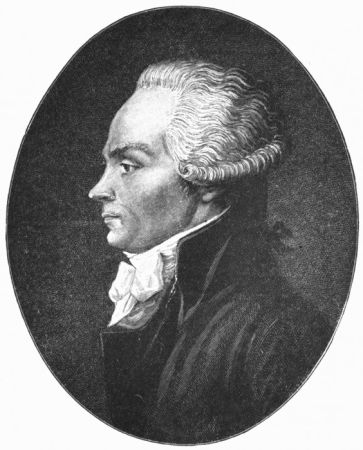
ROBESPIERRE.
[See larger version]
Fox did not suffer the Session to close without another powerful effort to avoid war with France. A petition had been handed to him for presentation to the Commons, drawn up by Mr. Gurney of Norwich, and signed by the Friends and other inhabitants of that city, praying that peace with France might be concluded. Fox not only agreed to present it and support its prayer, but he earnestly exhorted Mr. Gurney and his friends to promote the sending of petitions from other places for this object, as the only means of influencing the House, bent determinedly on war. On the 17th of June, only four days before the close of the Session, Fox moved an Address to the Crown, praying that, as the French had been driven out of Holland, peace should be made. In pursuance of his object—a great one, if attainable—he did not spare his former favourite, the Empress of Russia, and the other royal robbers of Poland. Burke replied that Fox knew very well that the defence of Holland was but a very partial motive for the war. The real obstacles to peace were the avowed principles of the French—those of universal conquest, of annexation of the kingdoms conquered, as already Alsace, Savoy, and Belgium; their attempts on the Constitution of Great Britain by insidious means; the murder of their own monarch held up as an example to all other nations. To make peace with France, he said truly, was to declare war against the rest of Europe, which was threatened by France; and he asked with whom in France should we negotiate for peace, if so disposed? Should it be with Lebrun, already in a dungeon, or with Clavière, who was hiding from those who were anxious to take his head? or with Egalité, who had been consigned to a dungeon at Marseilles? Burke declared that you might as well attempt to negotiate with a quicksand or a whirlwind as with the present ever-shifting and truculent factions which ruled in France.
The motion of Fox was negatived by a large majority, and on the 21st of June the king prorogued Parliament.