Chapter XIX · (continued 2)
Reading edition
But Sir John Duckworth was to play a leading part in a still more abortive enterprise. There was a rumour that Buonaparte had promised the Grand Turk to aid him in recovering the provinces which Russia had reft from Turkey on the Danube, in the Crimea, and around the Black Sea, on condition that Egypt was given up to him. To prevent this, an expedition was fitted out to seize on this country. Between four and five thousand men were sent from our army in Sicily, under Major-General Mackenzie Frazer. They embarked on the 5th of May, and anchored off Alexandria on the 16th. The following morning General Frazer summoned the town to surrender, but the governor of the Viceroy Mehemet Ali replied that he would defend the place to the last man. On that day and the following a thousand soldiers and about sixty sailors were landed, and, moving forward, carried the advanced works with trifling loss. Some of the transports which had parted company on the voyage now arrived, the rest of the troops were landed; and, having secured the castle of Aboukir, Frazer marched on Alexandria, taking the forts of Caffarelli and Cretin on the way. On the 22nd Sir John Duckworth arrived with his squadron; the British army expected to hear that he had taken Constantinople, and his ill news created a just gloom amongst both officers and men. The people of Alexandria appeared friendly; but the place was, or seemed to be, destitute of provisions; and the transports had been so badly supplied that the men were nearly starved before they got there. The Alexandrians assured General Frazer that, in order to obtain provisions, he must take possession of Rosetta and Rahmanieh. Frazer, therefore, with the concurrence of Sir John Duckworth, dispatched Major-General Wauchope and Brigadier-General Mead to Rosetta, with one thousand two hundred men. The troops were entangled in the streets and shot down. A subsequent effort was made to besiege Rosetta in form. The troops reached Rosetta on the 9th of April, and posted themselves on the heights above it. They summoned the town formally to surrender, and received an answer of defiance. Instead of proceeding to bombard the town at once, Major-General Stewart waited for the arrival of a body of Mamelukes. The Mamelukes had been in deadly civil strife with Mehemet Ali, and had promised to co-operate with the British; and this was one of the causes which led the British Government to imagine that they could make themselves masters of Egypt with so minute a force. But the Mamelukes did not appear. Whilst waiting for them, Colonel Macleod was sent to occupy the village of El Hammed, to keep open the way for the expected succour; but Mehemet Ali had mustered a great force at Cairo, which kept back the Mamelukes; and, at the same time, he was reinforcing both Rosetta, and Rahmanieh. Instead of the Mamelukes, therefore, on the morning of the 22nd of April a fleet of vessels was seen descending the Nile, carrying a strong Egyptian force. Orders were sent to recall Colonel Macleod from El Hammed; but too late; his detachment was surrounded and completely cut off. The besieging force—scattered over a wide area, instead of being in a compact body—were attacked by overwhelming numbers; and, having no entrenched camp, were compelled to fight their way back to Alexandria as well as they could. When Stewart arrived there he had lost one half of his men. Mehemet Ali, in proportion as he saw the British force diminished, augmented his own. He collected and posted a vast army between Cairo and Alexandria, and then the Alexandrians threw off the mask and joined their countrymen in cutting off the supplies of the British, and murdering them on every possible occasion at their outposts. Frazer held out, in the vain hope of aid from the Mamelukes or from home, till the 22nd of August, when, surrounded by the swarming hosts of Mehemet Ali, and his supplies all exhausted, he sent out a flag of truce, offering to retire on condition that all the British prisoners taken at Rosetta, at El Hammed, and elsewhere, should be delivered up to him. This was accepted, and on the 23rd of September the ill-fated remains of this army were re-embarked and returned to Sicily.
Thus was destroyed in Egypt all the prestige of the battles of Alexandria and Aboukir Bay. The consequence of these two badly-planned and worse-executed expeditions was the declaration of war against Britain by the Porte, the seizure of all British property in the Turkish dominions, and the formation of a close alliance between Turkey and France. But the triumph over the British had not relieved the Turks of the Russians. Admiral Siniavin still blockaded the Dardanelles, and another Russian squadron, issuing from the Black Sea, blockaded the mouth of the Bosphorus. The Turks came boldly out of the Dardanelles and attacked Siniavin on the 22nd of May and on the 22nd of June; but on both occasions they lost several ships, and were expecting heavier inflictions from the Russians, when they were suddenly relieved of their presence by the news of the Treaty of Tilsit, which had been contracted between Alexander of Russia and Buonaparte. Alexander, by this, ceased to be the ally, and became the enemy of Britain. It was necessary, therefore, for Siniavin to make all speed for the Baltic before war could be declared between the two nations, after which his return would be hopeless. The Russian admiral, however, before quitting the Mediterranean, had the pleasure of taking possession of Corfu, which Buonaparte had made over to Alexander.
One of the events of the early part of this year was the capture of the Dutch island of Curaçoa, by a squadron under Captain Brisbane; but by far the most prominent naval transaction of the year was the seizure of the Danish fleet off Copenhagen—a proceeding which occasioned severe censures on Britain by Buonaparte and the Continental nations under his domination. The Opposition at home were equally violent in the outcry against this act, as in open violation of the laws of nations, Denmark then being nominally at peace with us. But, though nominally at peace, Denmark was at heart greatly embittered against us by our bombardment of its capital in 1801, and it was quite disposed to fall in with and obey the views of Napoleon, who was now master of all Germany, at peace with Russia through the Treaty of Tilsit, and, therefore, able any day to overrun Denmark. Buonaparte was enforcing his system of the exclusion of Britain from all the ports of the Continent, and it was inevitable that he would compel Denmark to comply with this system. But there was another matter. Denmark had a considerable fleet and admirable seamen, and he might employ the fleet greatly to our damage, probably in endeavouring to realise his long-cherished scheme of the invasion of England; at the least, in interrupting her commerce and capturing her merchantmen. The British Ministers were privately informed that Buonaparte intended to make himself master of this fleet, and they knew that there were private articles in the Treaty of Tilsit between Russia and France, by which he contemplated great changes in the North, in which Denmark was believed to be involved. Upon these grounds alone the British Government was justified, by the clearest expressions of international law, in taking time by the forelock, and possessing themselves of the fleet to be turned against them; not to appropriate it, but to hold it in pledge till peace. Grotius is decisive on this point:—"I may, without considering whether it is manifest or not, take possession of that which belongs to another man, if I have reason to apprehend any evil to myself from his holding it. I cannot make myself master or proprietor of it, the property having nothing to do with the end which I propose; but I can keep possession of the thing seized till my safety be sufficiently provided for." This view would fully have justified the British Government, had nothing further ever become known. But subsequent research in the Foreign Office of France has placed these matters in their true light. The Treaty of Tilsit contains secret articles by which Alexander was permitted by Napoleon to appropriate Finland, and Napoleon was authorised by Alexander to enter Denmark, and take possession of the Danish fleet, to employ against us at sea. These secret articles were revealed to the British Government. No man at this time was so indignant as Alexander of Russia at our thus assailing a power not actually at war. He issued a manifesto against Britain, denouncing the transaction as one which, for infamy, had no parallel in history, he himself being in the act of doing the same thing on a far larger scale, and without that sufficient cause which Britain could show, and without any intention of making restitution. We only seized a fleet that was on the point of being used against us, and which was to be returned at the end of the war; the horrified Czar invaded Sweden, while at peace, and, without any declaration of war, usurped a whole country—Finland, larger than Great Britain. Russia, in fact, had brought Denmark into this destructive dilemma by its insidious policy; but, having seized Finland, in five years more it committed a still greater robbery on Denmark than it had done on Sweden, by contracting with Bernadotte to wrest Norway from Denmark, and give it to Sweden.
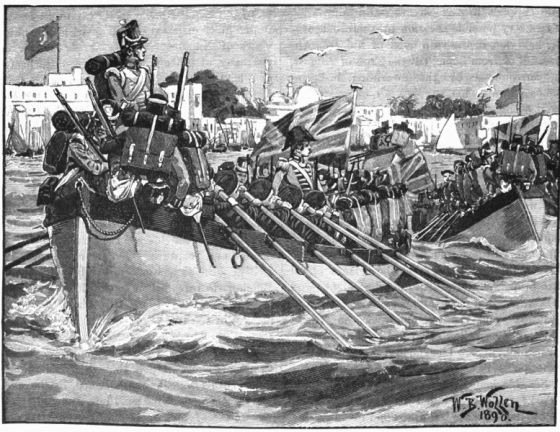
DEPARTURE OF THE BRITISH TROOPS FROM ALEXANDRIA. (See p. 539.)
[See larger version]
For the reasons here stated, early in the summer a powerful fleet was fitted out with the utmost dispatch and secrecy by the new Ministry, and sent to the Baltic. The fleet consisted of twenty-five sail of the line, more than forty frigates, sloops, bomb-vessels, and gun-brigs, with three hundred and seventy-seven transports to convey over twenty-seven thousand troops from Stralsund, a great part of which were Germans in British pay. Admiral Gambier commanded the fleet, and Lord Cathcart the army, having second in command Sir Arthur Wellesley. On the 1st of August the British fleet was off the entrance of Gothenburg, and Admiral Gambier sent Commodore Keats into the Great Belt to cut off any passage from Holstein for the defence of Copenhagen. Admiral Gambier himself entered the Sound, passed the castles without any attack from them, and anchored in Elsinore Roads. By the 9th of August the whole fleet and the transports were collected there, and Mr. Jackson, who had been many years British envoy in the north of Germany, and knew most of the Danish Ministers, was dispatched to Kiel, in Holstein, where the Crown Prince lay with an army of from twenty thousand to thirty thousand men, to endeavour to induce him to enter into an alliance with Great Britain, and to deliver the fleet to its keeping till the peace, stating the necessity that the British commanders would otherwise be under of taking possession of it by force. The Crown Prince, though the British had made it impossible to cross over and defend the fleet, received the overture with the utmost indignation. Mr. Jackson returned to Admiral Gambier, and the Crown Prince sent a messenger to order Copenhagen to be put into a state of defence. But there was scarcely a gun upon the walls, and the population only numbered, excluding the sailors, some thirteen thousand men, inclusive of five thousand five hundred volunteers and militia. On the 17th several Danish gunboats came out of the harbour, fired at some of our transports coming from Stralsund, burnt an English vessel, and attacked the pickets of Lord Cathcart's army. These vessels were driven back again by bombshells, and that evening Admiral Gambier took up a nearer station north-east of the Crown battery, the Trekroner. He then proceeded to surround the whole of the island of Zealand, on which Copenhagen stands, with our vessels. The division of the army landed at Wedbeck having now marched up, was joined by other divisions, and proceeded to entrench themselves in the suburbs of Copenhagen. They were attacked by the gunboats, but, on the 27th, they had covered themselves by a good battery, and they then turned their cannon on the gunboats, and soon compelled them to draw off. On the 29th Sir Arthur Wellesley marched to Kiöge, against a body of Danish troops that had strongly fortified themselves there in order to assail the besiegers, and he quickly routed them. The Danish troops then made several dashing sorties from Copenhagen, while their gunboats and floating batteries attacked our advanced vessels, and managed, by a ball from the Trekroner, to blow up one of our transports. The French had now arrived at Stralsund, and Keats was sent to blockade that port, to hinder them from crossing over into Zealand; nothing but the extreme rapidity of the movements of the British prevented a powerful army of French from being already in Copenhagen for its defence.
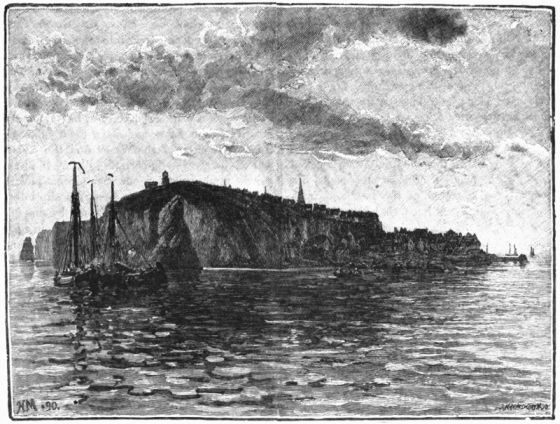
HELIGOLAND.
[See larger version]
On the 1st of September the British commander made a formal demand for the surrender of the fleet. The Danish General requested time to communicate this demand to the Crown Prince, but the vicinity of the French would not permit this, and the next day, the land batteries on one side, and our bomb-vessels on the other, began to fling shells into the town. The wooden buildings were soon in flames, but the Danes replied with their accustomed bravery to our fire, and the conflict became terrible. The bombardment of the British continued without cessation all day and all night till the morning of the 3rd. It was then stopped for an interval, to give an opportunity for a proposal of surrender; but, none coming, the bombardment was renewed with terrible fury. In all directions the city was in a blaze; the steeple of the chief church, which was of wood, was a column of fire, and in this condition was knocked to pieces by the tempest of shot and shells, its fragments being scattered, as the means of fresh ignition, far around. A huge timber-yard taking fire added greatly to the conflagration. The fire-engines, which the Danes had plied bravely, were all knocked to pieces, and, to prevent the utter destruction of the city, on the evening of the 5th the Danish governor issued a flag of truce, and requested an armistice of twenty-four hours. Lord Cathcart replied that, in the circumstances, no delay could be permitted, and that therefore no armistice could take place, except accompanied by the surrender of the fleet. This was then complied with, and Sir Arthur Wellesley, Sir Home Popham, and Lieutenant-Colonel George Murray went on shore to settle the terms of the capitulation. This was completed by the morning of the 7th, signed, and ratified. The British were to be put at once in possession of the citadel and all the ships and maritime stores, and, within six weeks, or as much earlier as possible, they were to remove these and evacuate the citadel and the isle of Zealand. All other property was to be respected, and everything done in order and harmony; prisoners were to be mutually exchanged, and Britons seized in consequence of the proclamation to be restored. The whole of these measures were completed within the time specified, and seventeen ships of the line, eleven frigates, and twenty-five gunboats became the prize of the British.
On the 21st of October the British fleet sailed from Copenhagen Roads; at Helsingfors the fleet was saluted by the King of Sweden, who invited the admirals to breakfast; and, by the end of the month, was anchored in Yarmouth Roads safely, with all its captives. Fresh offers of alliance with Denmark were made before leaving, accompanied with promises of restoration, but were indignantly refused by the Crown Prince; and no sooner were the British gone, than the Danes converted their trading-vessels into armed ones, and commenced a raid amongst the British merchants, now in the Baltic, for the protection of which some men-of-war ought to have been left. The Crown Prince, now thrown completely into the arms of the French, made a declaration of war against Britain, and the British Government issued an order for reprisals on the ships, colonies, and property of the Danes. They also seized on the island of Heligoland, a mere desolate rock, but, lying at the mouth of the Elbe, and only twenty-five miles from the mouths of the Weser and the Eider, it was of the greatest importance, during the war, as a safe rendezvous for our men-of-war, and as a depôt for our merchandise, ready to slip into any of the neighbouring rivers, and thus, by smugglers, to be circulated all over the Continent, in spite of Buonaparte's embargo. It served also to remind the people of those regions, that, though Buonaparte ruled paramount on land, there was a power on the sea that yet set him and all his endeavours at defiance.
The military transactions of the Continent this year had been of the most remarkable kind. Buonaparte, after his repulse at Pultusk, had retired to Warsaw, which he entered on the first day of the year 1807. He calculated on remaining there till the return of spring. But Benningsen, the Russian general, was determined to interrupt this pleasant sojourn. He had an army of eighty thousand or ninety thousand men, with a very bad commissariat, and equally badly defended from the severity of the winter. The King of Prussia was cooped up in Königsberg, with an army of a very few thousand men, and his situation was every day rendered more critical by the approach of the divisions of Ney and Bernadotte, whom the treacherous surrender of the Prussian fortresses by their commanders had set at liberty. But Benningsen hastened to relieve the King of Prussia at Königsberg; his Cossacks spread themselves over the country with great adroitness, surprising the French convoys of provisions. More Cossacks were streaming down to their support out of the wintry wilds of Russia, and the French were forced from their pleasant quarters in Warsaw, to preserve the means of their existence. Buonaparte, alarmed at these advances, determined to turn out and force the Russians eastward, towards the Vistula, as he had forced the Prussians at Jena with their rear turned to the Rhine. To take the Russians thus in the rear, he ordered Bernadotte to engage the attention of Benningsen on the right whilst he made this manœuvre on the left. But Benningsen, fortunately, learned their stratagem, by the seizure of the young French officer who was carrying Buonaparte's dispatches to Bernadotte. Benningsen was therefore enabled to defeat Buonaparte's object. He concentrated his troops on Preuss-Eylau, where he determined to risk a battle. But he was not allowed to occupy this position without several brisk encounters, in which the Russians lost upwards of three thousand men. The battle of Eylau took place on the 7th of February. It was such a check as Buonaparte had never yet experienced. He had been beaten at every point; Augereau's division was nearly destroyed; that of Davoust, nearly twenty thousand in number, had been repulsed by a much inferior body of Prussians. Fifty thousand men are said to have been killed and wounded, of whom thirty thousand were French. Twelve eagles had been captured, and remained trophies in the hands of the Russians.
Had Benningsen had a good commissariat, the doom of the French was certain. The army, famishing and in rags, was still eager to push their advantage the next day, and the French, if compelled to retreat, as there was every prospect, must have fallen into utter demoralisation, and the war would have been soon at an end. But Benningsen, sensible that there was an utter lack of provision for his army, and that his ammunition was nearly exhausted, hesitated to proceed to a second action with an army reduced twenty thousand in number, and thus to risk being cut off from Königsberg, endangering the person of the King of Prussia; and so the extreme caution, or rather, perhaps, the necessities of the Russian general, were the rescue of Buonaparte. Benningsen resolved to retreat upon Königsberg.
The Russians began their retreat, but some of them not till daylight, and then marched close past Eylau, in the very face of the French, who were, probably, as much astonished as pleased at the spectacle. Benningsen could scarcely have known the extent of the French losses, when he decided to retire. But Buonaparte, notwithstanding that he claimed the victory, was glad now to offer a suspension of hostilities to the King of Prussia, with a view to a separate peace, hinting that he might be induced to waive most of the advantages derived from the fields of Jena and Auerstädt, and restore the bulk of his dominions. Frederick William, however great the temptation, refused to treat independently of his ally, the Czar. On this, Buonaparte, so far from pursuing the Russians, as he would have done had he been in a capacity for it, remained eight days inactive at Eylau, and then retreated on the Vistula, followed and harassed all the way by swarms of Cossacks. On this Benningsen advanced, and occupied the country as fast as the French evacuated it. The Emperor Alexander could soon have raised another host of men, but he was destitute of money and arms. He therefore applied to Britain for a loan, which the Talents thought fit to decline. This, at such a crisis, was unwise. It is certain that it filled Alexander with disgust and resentment, and led to his negotiations with Buonaparte at Tilsit. Soon after this the Conservative or Portland Ministry came in, and supplies of muskets and five hundred thousand pounds were sent, but these were, in fact, thrown away, for they did not arrive till the Czar had made up his mind to treat with Napoleon.
On his return to the Vistula, Buonaparte displayed an unusual caution. He seemed to feel that his advance into Poland had been premature, whilst Prussia was in possession of Dantzic, whence, as soon as the thaw set in, he was open to dangerous operations in his rear, from the arrival of a British army. He therefore determined to have possession of that post before undertaking further designs. The place was invested by General Lefebvre, and capitulated at the end of May. Buonaparte all this time was marching up fresh troops to fill up the ravages made in his army. The Russians, after a drawn battle near Heilsberg on the 10th of June, then crossed the Aller, and placed that as a barrier between them and the French, in order that they might avoid the arrival of a reinforcement of thirty thousand men who were on the march.
Thus occupying the right bank of the Aller, and the French the left, or western side, the Russians advanced to Friedland, not many miles from Eylau. At Friedland was a long wooden bridge crossing the Aller, and there, on the 13th of June, Buonaparte, by a stratagem, succeeded in drawing part of the Russians over the bridge by showing only Oudinot's division, which had been severely handled at the battle of Heilsberg. The temptation was too great. Benningsen forgot his usual caution, and allowed a division of his army to cross and attack Oudinot. Oudinot retired fighting, and thus induced more of the Russians to follow, till, finding his troops hotly pressed, Benningsen marched his whole force over, and then Napoleon showed his entire army. Benningsen saw that he was entrapped, and must fight, under great disadvantages, with an enfeebled army, and in an open space, where they were surrounded by a dense host of French, who could cover themselves amid woods and hills, and pour in a tempest of cannon-balls on the exposed Russians. It was the anniversary of the battle of Marengo, and Buonaparte believed the day one of his fortunate ones. Benningsen was obliged to reduce his number by sending six thousand men to defend and keep open the bridge of Allerburg, some miles lower down the Aller, and which kept open his chance of union with L'Estocq and his Prussians. Notwithstanding all these disadvantages, Benningsen fought desperately. The battle continued from ten o'clock in the morning till four o'clock in the afternoon, when Buonaparte brought up his full force in person for one of those terrible and overwhelming shocks by which he generally terminated a doubtful contest. There was such a simultaneous roar of musketry and cavalry as seemed enough to sweep away the Russians like chaff. The batteries poured down upon them a rain of no less than three thousand ball and five hundred grape-shot charges; yet the Russians did not flinch till they had at least twelve thousand killed and wounded. It was then determined to retreat across the river, and, two fords having been found, the Czar's Imperial Guard charged the troops of Ney with the bayonet, and kept them at bay till the army was over. The transit was marvellous in its success. All their cannon, except seventeen, were saved, and all their baggage.
As at Eylau, so at Friedland, Napoleon made no attempt to follow the Russians. But the battle, nevertheless, produced important consequences. The King of Prussia did not think himself safe at Königsberg, and he evacuated it; and the unhappy queen prepared, with her children, to fly to Riga. The Russians retreated to Tilsit, and there Alexander made up his mind to negotiate with Napoleon. He was far from being in a condition to despair; Gustavus, the King of Sweden, was at the head of a considerable army at Stralsund; a British expedition was daily expected in the Baltic; the spirit of resistance was reawakening in Prussia; Schill, the gallant partisan leader, was again on horseback, with a numerous body of men, gathered in various quarters; and Hesse, Hanover, Brunswick, and other German provinces were prompt for revolt on the least occasion of encouragement. Buonaparte felt the peril of crossing the Niemen, and advancing into the vast deserts of Russia, with these dangerous elements in his rear. Besides, his presence was necessary in France. He had been absent from it nearly a year; he had drawn heavily on its resources, and a too long-continued strain without his personal influence might produce fatal consequences. To leave his army in the North was to leave it to certain defeat, and with the danger of having all Germany again in arms. These circumstances, well weighed by a man of genius and determination, would have induced him to make a resolute stand, and to draw his enemy into those wilds where he afterwards ruined himself, or to wear him out by delay. Alexander, however, had not the necessary qualities for such a policy of procrastination. He was now depressed by the sufferings of his army, and indignant against Britain.
Accordingly, Benningsen communicated Alexander's willingness for peace, on the 21st of June, and the armistice was ratified on the 23rd. Buonaparte determined then, as on most occasions, to settle the treaty, not by diplomatists, but personally, with the Czar. A raft was prepared and anchored in the middle of the Niemen, and on the morning of the 25th of June, 1807, the two Emperors met on that raft, and embraced, amid the shouts of the two armies arranged on each bank. The two Emperors retired to a seat placed for them on the raft, and remained in conversation two hours, during which time their attendants remained at a distance. The town of Tilsit was declared neutral ground, and became a scene of festivities, in which the Russian, French, and even Prussian officers, who had been so long drenching the northern snows with each other's blood, vied in courtesies towards each other. Amongst them the two Emperors appeared as sworn brothers, relaxing into gaiety and airs of gallantry, like two young fashionables. On the 28th the King of Prussia arrived, and was treated with a marked difference. He was bluntly informed, that whatever part of his territories were restored would be solely at the solicitation of the Emperor of Russia.
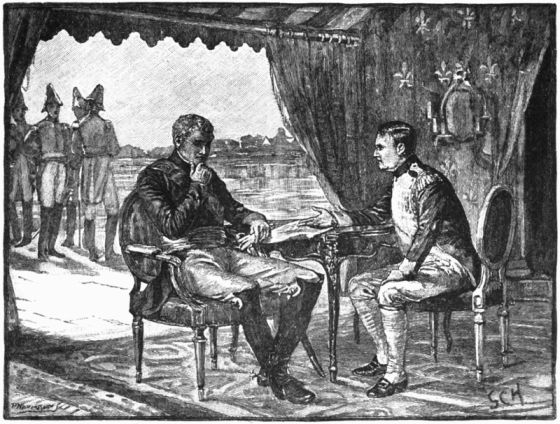
THE TREATY OF TILSIT. (See p. 544.)
[See larger version]
By the terms of the Treaty of Tilsit, Prussian Poland was taken away, but not to be incorporated with a restored Poland, as Buonaparte had delusively allowed the Poles to hope. No; a restored Poland was incompatible with a treaty of peace with Russia, or the continuance of it with Austria. It was handed over to the Duke of Saxony, now elevated to the title of the King of Saxony and Duke of the Grand Duchy of Warsaw—the name which Prussian Poland assumed. The duped Polish patriots cursed Buonaparte bitterly in secret. Alexander, with all his assumed sympathy for his fallen cousins of Prussia, came in for a slice of the spoil, nominally to cover the expenses of the war. Dantzic, with a certain surrounding district, was recognised as a free city, under the protection of Prussia and Saxony; but Buonaparte took care to stipulate for the retention of a garrison there till the conclusion of a general peace, so as to stop out any British armament or influence. To oblige the Emperor of Russia, he allowed the Dukes of Saxe-Coburg, Oldenburg, Mecklenburg-Schwerin, who were the Czar's relations, to retain possession of their territories; but he returned to Prussia only about one-half of the provinces which he had seized, reducing her very much to the limits in which Frederick the Great had found her before his usurpations. She surrendered her provinces between the Rhine and the Elbe, which, together with Hesse, Brunswick, and part of Hanover, were formed into the kingdom of Westphalia and given to Jerome Buonaparte. She was saddled by a crushing war indemnity, and had to leave Berlin and the chief fortresses in the hands of the French until the debt was paid. In the articles of the Treaty which were made public, Alexander paid a nominal courtesy to his ally, Great Britain, by offering to mediate between her and France, if the offer were accepted within a month; but amongst the secret articles of the Treaty was one binding the Czar to shut his ports against all British vessels, if this offer were rejected. This was a sacrifice demanded of Alexander, as Great Britain was Russia's best customer, taking nearly all her raw or exported produce. In return for this, and for Alexander's connivance at, or assistance in, Buonaparte's intention of seizing on Spain and Portugal, for the taking of Malta and Gibraltar, and the expulsion of the British from the Mediterranean, Alexander was to invade and annex Finland, the territory of Sweden, and, giving up his designs on Moldavia and Wallachia, for which he was now waging an unprovoked war, he was to be allowed to conquer the rest of Turkey, the ally of Napoleon, and establish himself in the long-coveted Constantinople. Thus these two august robbers shared kingdoms at their own sweet will and pleasure. Turkey and Finland they regarded as properly Russian provinces, and Spain, Portugal, Malta, Gibraltar, and, eventually, Britain, as provinces of France.