Chapter XX · (continued 2)
Reading edition
On the 23rd Moore was obliged to halt for the coming of his supplies; and whilst doing so, he received the intelligence that no fewer than seventy thousand men were in full march after him, or taking a route so as to cut off his rear at Benevento, and that Buonaparte himself headed this latter division. There was no further thought of advancing, but of retreat, before the army was completely surrounded. By the 26th the whole army was beyond Astorga, but the French were now close behind them. Buonaparte, indeed, hoped to have rushed on by the Guadarama, and to have cut off his retreat at Tordesillas, but he was twelve hours too late. On the last day of December, 1808, Buonaparte was pressing close on the British rear in the vicinity of Astorga, and thus closed the year on the fortunes of the Spaniards and their British Allies. The boastful Spanish armies, too proud to think at first that they needed assistance, too unskilful, when they did see the need of it, to co-operate with it, and who had afforded nothing but indifference and false intelligence to their benefactors, were dispersed like so many clouds, and their Allies were flying from an overwhelming foe.
But the year 1809 opened with one auspicious circumstance. There was no relief from the necessity of continuing the flight; but the proud Corsican, who hoped to annihilate the "English leopards," was suddenly arrested in his pursuit, and called away to contend with other foes. On the 1st of January he was in Astorga, and from the heights above it could see the straggling rear of the British army. Nothing but the most imperative urgency prevented him from following, and seeking a triumph over the hated British—but that urgency was upon him. Pressing dispatches from France informed him that the North was in ferment, and that Austria was taking the field. The intelligence was too serious to admit of a moment's delay; but he made sure that Soult could now conquer the British, and on the 2nd he turned his face northward, and travelled to Paris with a speed equal to that with which he had reached Spain.
Soult, indeed, had sixty thousand men and ninety-one guns to deal with the flying and now greatly disorganised army of the British. At first the retreat had been made with much discipline and order, but the miserable weather, the torrents of rain, and heavy falls of snow, the roads rough with rocks, or deep with mud, tried the patience of the men. So long as they were advancing towards the enemy they could bear all this with cheerfulness, but the British are never good-humoured or patient under retreat. Sullen and murmuring, they struggled along in the retreat, suffering not only from the weather, but from want of provisions, and the disgraceful indifference of the people to those who had come to fight their battles. Whenever a halt was made, and an order given to turn and charge the enemy, they instantly cheered up, forgot all their troubles, and were full of life and spirit. But their gloom returned with the retreat; and, not being voluntarily aided by the Spaniards, they broke the ranks, and helped themselves to food and wine wherever they could find them. Such was now the state of the weather and the roads, that many of the sick, and the women and children, who, in spite of orders, had been allowed to follow the army, perished. The French pressed more and more fiercely on the rear of the British, and several times Sir John was compelled to stop and repel them. On one of these occasions the French general, Colbert, was killed, and the six or eight squadrons of horse led by him were, for the most part, cut to pieces. At Lugo, on the 5th of January, Sir E. Paget beat back a very superior force. Again, on the 7th, Sir John Moore halted, and repulsed the advanced line of Soult, killing four or five hundred of the French. The next morning the armies met again in line of battle, but Soult did not attack; and as soon as it was dark Sir John quietly pursued his march, leaving his fires burning to deceive the enemy.
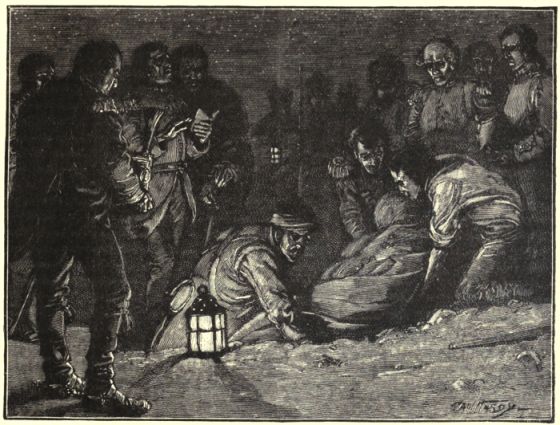
BURIAL OF SIR JOHN MOORE. (See p. 570.)
[See larger version]
On the 10th of January the army came in sight of Corunna and the sea, but no transports could be seen in the bay. They were detained by contrary winds at Vigo, and the last hope of safety seemed cut off. Sir John, however, quartered his troops in Corunna, and determined to defend it manfully till the transports could get up. But great was his chagrin at the proofs of the miserable management of the Commissariat Department. On a hill above the town were four thousand barrels of gunpowder, which had been sent from England, and had been lying there many months, and the town was a great magazine of arms. Sir John replaced the weather-worn muskets of his troops with new ones, supplied them with fresh, good powder, and, after removing as many barrels of powder into the town as the time would allow, he blew up the rest, producing a concussion that shook the place like an earthquake.
On the morning of the 14th the transports, to their great relief, hove in sight, and Sir John hastened to get on board the sick, the horses, and the dismounted cavalry, and to prepare for a fight, for Soult was now close upon the town; the hills were crowded with his troops, and they were already skirmishing with his outposts. In these skirmishes Colonel Mackenzie was killed in endeavouring to seize some of the French cannon, planted on the same spot where the powder had just been blown up. The morning of the 16th passed without any attack from Soult, and Sir John proceeded with his arrangements for embarkation; but about noon the battle began. Soult had erected a powerful battery on some rocks at the extremity of his left, and commanding the village of Elvina, occupied by our troops. Sir David Baird was posted on the British right, opposite to the battery, and at no great distance from the village. The French made a dash at the village, under cover of the battery, and drove our men from it. The fight then became general. Soult had twenty thousand men, Sir John about fourteen thousand five hundred; but Soult had far more and heavier cannon, for Sir John had shipped all his artillery except twelve light guns. It was soon seen that the French cannon did vastly more execution than ours; and as the whole line was engaged, Sir John sent Sir E. Paget, with the whole of his reserve, to turn the left of a column that was outflanking Baird on the right, and to silence the battery, if possible. Another division, under General Frazer, was sent to support Paget, and the battle now raged furiously on the right, and about the village of Elvina, which was lost and taken once or twice. In this conflict Sir David Baird had his arm shattered by a cannon-ball, and was taken off the field. Major Stanhope was killed, and Major, afterwards General Sir Charles, Napier was wounded. But Paget drew back on the British right, and Sir John, seeing the 42nd Highlanders engaged, rode up to them and shouted, "Highlanders! remember Egypt!" and they rushed forward, driving all before them, till they were stopped by a stone wall. The battle, however, still raging, and the French bringing up reserves, the furious contest was renewed around the village of Elvina. Sir John then dispatched Captain, afterwards Lord, Hardinge, to bring up the Guards to support the 42nd Highlanders. Whilst awaiting their arrival, a cannon-ball, which had struck the ground, glanced forward again, and wounded Sir John on the right shoulder and breast. He was dashed from his horse, and was supposed to be killed; but the force of the ball having been partly spent, before Captain Hardinge could reach him he had raised himself, and was gazing earnestly after the 42nd and the other troops engaged. When he had seen his soldiers driving the French before them, he consented to be borne to the rear. He was carried away by a Highland sergeant and three soldiers, in a blanket, his wound bleeding very much, and himself satisfied that his hurt was mortal. As he went, however, he repeatedly made the soldiers halt, that he might have another view of the battle. By night the French were beaten back in every direction; but the British general was dead, having lived only to receive the tidings of victory. During the night the troops were, most of them, got on board, and at midnight Sir John's remains were committed to the ground—as he had always wished them to be, should he be killed in battle—on the ramparts in the old citadel of Corunna. No coffin was to be procured, for coffins were not a Spanish fashion; but he was buried dressed as he was, and wrapt in his military cloak, literally as described in Wolfe's popular poem on his death. The chaplain read the burial service, and there his officers "left him alone with his glory," to make their own embarkation.
The prospects of the European war at this juncture, as observed from England, were gloomy in the extreme. The dispersion of the armies of Spain, the retreat and death of Sir John Moore, leaving the whole of the Spanish and Portuguese Peninsula under the feet of Buonaparte, disposed many to believe the power of the conqueror unassailable. The Whig Opposition made every use of this feeling to damage and, if possible, drive their rivals from office. That the Whigs, in power, would have refrained from Continental war any more than the Tories is not to be believed. They had always, when in office—except, in the case of Fox, for a short interval—been as ready to fight; but they had generally conducted their campaigns with much less ability. Now, their great organ, the Edinburgh Review, indulged in the most vehement censures on the Cabinet; charged all the adverse circumstances of the Spanish and Portuguese war to its bad management; and intimated that it was the most wicked and idiotic folly to hope to contend with Buonaparte at all. But if ever there was a time when the continuance of the war was excusable, and perhaps necessary, it was now. Great Britain had gone fully and freely into the conflict to assist the Continental nations. She had pledged herself solemnly to Spain and Portugal, and to have withdrawn at this crisis would have been equally treacherous to our allies and pusillanimous as regarded the enemy. It would have been, in fact, to proclaim to the world that we had been completely beaten out of the field, that we could not do what we had promised to our allies, and that Napoleon must be left the master of Europe, and the dictator to Britain. Such a confession would have destroyed for ever the prestige of Great Britain, and justly. Ministers felt this, and never were more resolved to persevere to the end. To show that they did not for a moment despair, they signed a treaty of peace and amity with Spain only five days after the arrival of the news of the retreat and death of Sir John Moore, binding themselves never to acknowledge the authority of Buonaparte over Spain, or of any family but of Ferdinand VII. and his lineal successors. That they were supported in their views by Parliament was soon made evident by the rejection, by a majority of two hundred and eight against one hundred and fifty-eight, of a motion of Lord Henry Petty censuring the Convention of Cintra, and, by a majority of two hundred and twenty against one hundred and twenty-seven, of a motion of Mr. Ponsonby for inquiry into the conduct of the late campaign in Spain. Ministers had at length satisfied themselves that they had in Sir Arthur Wellesley a man capable of contending against the haughty tyrant of Europe. The most liberal votes were made for the prosecution of the war. The total of supplies for the year amounted to fifty-three million eight hundred and sixty-two thousand pounds, including a loan of eleven million pounds. For the army twenty-seven million pounds was voted, and for the navy nineteen million pounds. Between twenty and thirty thousand men were drafted from the militia into the regulars, and thus the army was augmented to that amount by soldiers already well trained. The loan was freely taken at a lower interest than any hitherto borrowed—the Opposition asserted, because trade was deranged, and capitalists were at a loss how to invest their money; but the Ministers contended, on the other hand, that it was solely because the war was popular with the nation. Before, however, entering into its arduous and bloody details, we must narrate some disgraceful affairs at home.
On the 27th of January Colonel Wardle, a militia officer, rose in his place in the House of Commons and made some startling charges against the Duke of York, as Commander-in-Chief of the army. Wardle had been a zealous Conservative, but had now changed his politics, and was acting with the party of extreme Reformers headed by Sir Francis Burdett, Lord Folkestone, and others. His charge was that the Duke of York was keeping a mistress, named Mary Ann Clarke, a married woman, to the great scandal of the nation, and was allowing her to traffic in commissions and promotions in the army. Nor was this all; he asserted that, not in the army alone, but in the Church, this public adulteress was conferring promotions, through her influence with the Duke, and that she had quite a levee of clergy, who were soliciting and bribing her to procure livings and even bishoprics. These were sufficiently exciting statements, and the Colonel demanded a Committee of Inquiry to enable him to prove his assertions. Sir Francis Burdett seconded the motion; and the proposal was not met—as it should have been by Ministers or the Duke's friends—by a denial, but, in general, by a eulogium on the Duke's excellent discharge of his duties as Commander-in-Chief. The House determined that, wherever the infamy was to fall, it should have the full airing of a committee of the whole House, which was appointed to commence its inquiries on Wednesday, the 1st of February, the Duke intimating, through his friends, that he was, on his part, desirous of the fullest investigation of the matter. From the evidence of Mrs. Clarke it appeared very clear that the Duke had permitted her to traffic in the sale of commissions, and both Mrs. Clarke and Mary Ann Taylor, whose brother was married to Mrs. Clarke's sister, asserted that the Duke had received part of the money for some of these bargains. Sums of one thousand pounds, of five hundred pounds, and two hundred pounds had been paid to her for such services.
Unfortunately, however, for the continuance of the popularity of Mrs. Clarke, it appeared that she was now actually living in the keeping of this virtuous Colonel Wardle, who was thus chastising royal peccadilloes. The whole of the circumstances did not come out whilst the question was before the House of Commons, but enough to injure the credit irreparably of Colonel Wardle, and make Mrs. Clarke's evidence more than ever suspicious. The full information was brought out by a trial instituted by a Mr. Wright, an upholsterer, in Rathbone Place, for furnishing a new house for her in Westbourne Place. She had now quarrelled with Colonel Wardle, and he refused to pay the bill. Wardle, it appeared, had done his best to stop the coming on of the trial, but in vain; Mrs. Clarke appeared against him, and not only deposed that he had gone with her to order the goods, but told her it was in return for her aid in prosecuting the Duke of York's case. Wardle was cast on the trial, with costs, having about two thousand pounds to pay, and losing all the popularity that he had gained by the investigation. He had been publicly thanked by public meetings, both in the City and the country, and now came this rueful exposé. But it was too late now to save the Duke's reputation. The House of Commons had concluded its examination in March. It acquitted the Duke of any participation with his artful mistress in the vile profits on the sale of commissions, but that she had made such there was no question. The Duke did not await the decision of the Commons, but resigned his office. Lord Althorp, in moving that, as the Duke had resigned, the proceedings should go no further, said that the Duke had lost the confidence of the country for ever, and therefore there was no chance of his returning to that situation. This was the conclusion to which the House came on the 21st of March, and soon afterwards Sir David Dundas was appointed to succeed the Duke as Commander-in-chief, much to the chagrin of the army, and equally to its detriment. The Duke, though, like some of his brothers, very profligate, and, like them—according to a statement made during the debates on his case—capable, as a youth, of learning either Greek or arithmetic, but not the value of money, seems to have discharged his duty to the army extremely well, of which old General Dundas was wholly incapable.
The corruptions connected with the Duke of York and his mistress were but a small fragment of the wide and universal system which was existing. The exposures, however, made by this inquiry induced the Chancellor of the Exchequer to bring in a Bill to prevent such abuses. He referred to the sale of commissions which had been brought to light, and which had been carried on by means of improper influence over a man in high office. His Bill, therefore, went to make it penal to demand money for the appointment to office, or to issue advertisements to that effect. The Bill was passed.
But fresh light continued to break on the all-pervading corruption. The Commissioners of Naval Inquiry presented a fresh report, abounding with proofs of the villainies that had been going on in that department. The Military Commissioners had a like frightful exposure to make of frauds and peculations which had been going on wholesale, especially in the West Indies. The same result followed the investigations of the committee that inquired into the appointment of cadets to the East India Service. There was abundance of proofs of the sale of such places, and even Lord Castlereagh was implicated. It was found that as President of the Board of Control—the Minister, in fact, for Indian Affairs—he had presented a writership to his friend, Lord Clancarty, which Clancarty had bartered with a Mr. Reding for a seat in Parliament, and which Reding immediately sold for three thousand pounds. Lord Archibald Hamilton immediately moved that Lord Castlereagh had been guilty of an abuse of his authority as President of the Board of Control. Castlereagh replied that, when he presented his friend, Lord Clancarty, with the writership, he had no notion that Reding was a regular broker in parliamentary seats, though he did not deny that Reding had told him that he meant to make over the place to a Member of Parliament who had a nephew whom he wished to send to India, and that this Member of Parliament would vote accordingly. The virtuous Wilberforce seemed to hold this easy-going morality, for he voted for Lord Castlereagh, and, in spite of the denunciations of Sir Francis Burdett, Mr. W. Smith, and others, Lord Archibald Hamilton's motion was rejected by two hundred and sixteen against a hundred and sixty-seven—and Lord Castlereagh walked away scathless. There was immediately another charge brought against him, in company with the Honourable Henry Wellesley, the brother of General Wellesley, and late Secretary of the Treasury, for corrupt practices in the election of members of Parliament; but the ministerial majority outvoted Mr. Madox, the mover. About the same time Mr. Curwen brought in a Bill to prevent such practices, and to obtain purity of Parliament by extinguishing bribery, and this was suffered to pass when all vitality had been taken out of it. On the 15th of June Sir Francis Burdett also made a motion for extensive parliamentary Reform; but the greater part of the members of Parliament had already left town, and the motion was rejected by seventy-four against fifteen. On the 21st the Session was closed with a speech which took a hopeful view of the war in Spain, and also of that which Austria had again commenced. We may now return to the details of these great contests on the Continent.
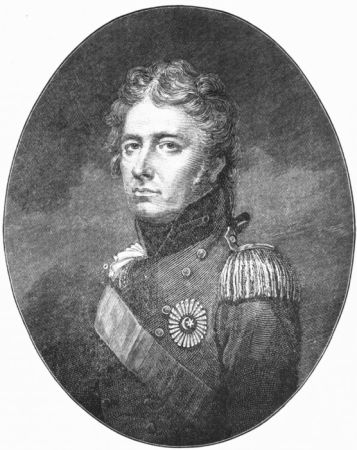
SIR DAVID BAIRD.
[See larger version]
We have stated that the spirit rising again in Germany called Buonaparte suddenly from Spain, even before Soult had pursued Sir John Moore to Corunna. At Valladolid he met the Abbé de Pradt, who had risen high in Buonaparte's favour. To De Pradt, he said he began to suspect that he had made his brother Joseph a grander present in Spain than he was aware of. "I did not know," he said, "what Spain was; it is a finer country than I imagined. But you will see that, by-and-by, the Spaniards will commit some folly which will place their country once more at my disposal. I will then take care to keep it to myself, and divide it into five great viceroyships." Such were the soaring notions of Napoleon at the very moment that the man was ready who was to drive the French from Spain for ever. In England, at last, almost every one had now awoke to the consciousness that Sir Arthur Wellesley was the only man to cope with the French in the Peninsula. There were a few individuals, like Lord Folkestone, who were blinded enough by party to oppose this general conviction; but before the close of March Sir Arthur was selected by the Government for this command. On the 15th of April he sailed from Portsmouth, and on the 22nd he arrived safely at Lisbon. Some regiments of both horse and foot soon followed him, and he assumed the command of the British army in Portugal, which had been some time in the hands of General Sir J. Cradock. The command of the Portuguese troops had been placed in the hands of General Beresford, who had been actively drilling them; and thus General Sir Arthur Wellesley found himself at the head of an effective army of British and Portuguese numbering twenty-five thousand men.
Soult, on the retreat of Sir John Moore, had taken possession of Ferrol, Bilbao, and the other principal towns in the north of Spain. He had then entered Portugal, and had marched to Oporto, which he took after a resistance of only two days; and Sir J. Cradock had retired to Lisbon. Soult was prevented from advancing farther by the rising of the Spaniards behind him in Galicia, who retook Vigo and other places; whilst Silviera, the Portuguese general, interposed between him and Galicia, and formed a junction with the Spaniards. Wellesley determined to expel Soult from Oporto, and did not hesitate to say that the French general could not long remain in Portugal. Leaving a division in Lisbon to guard the eastern frontiers of Portugal against the forces of Victor, who lay in Spanish Estremadura, Sir Arthur advanced towards Oporto with a celerity that astonished the French. He quitted Lisbon on the 28th of April, reached Coimbra, driving the French before him, and on the 9th of May he was advancing from that city on Oporto. By the 11th he was occupying the southern bank of the Douro, opposite to that city. Soult had broken down the bridges and sent away the boats, so that he might be able to retire at leisure into Galicia; but Sir Arthur managed to send across General Murray with a brigade, a few miles above Oporto, and a brigade of Guards also passed at the suburb of Villanova, and he discovered sufficient boats to carry over his main army just above the town. The French commenced a fierce attack on the British forces as they landed; but the first battalion, the Buffs, got possession of a large building called the Seminario, and held it till the other troops arrived. Major-General Hill soon brought up the 48th and 66th regiments; General Sherbrooke, who crossed the river below the town with the brigade of Guards and the 29th regiment, entered the town amid the acclamations of the people, and charged the French in the rear; and General Murray, about the same time, showed himself on the French left, above the town. Soult fled, leaving behind him his sick and wounded, and many prisoners, besides much artillery and ammunition. This taking of Oporto, in the face of a French force of ten thousand men, coupled with his having to cross the broad Douro, and that with very defective means of transit, was a most brilliant affair; and the most astonishing thing was, that Wellesley lost only twenty-three killed and ninety-eight wounded, whilst Soult's troops suffered severely.
Sir Arthur determined to give Soult as sharp a chase as he had given Sir John Moore. He wrote to General Beresford to hold Villa Real, if possible, whilst he pressed on the heels of Soult. On the 16th of May he came up with Soult's rear, near Salamonde, defeated the rear-guard, killed and wounded a great number of men, and Sir Arthur wrote that, had they had half an hour's more daylight, he should have taken the whole of his rear-guard. He added: "I shall follow him to-morrow. He has lost everything—cannon, ammunition, baggage, military chest—and his retreat is in every respect, even in weather, a pendant for the retreat to Corunna." In truth, had Sir John Moore sent a Nemesis to avenge himself, it could not have executed a more complete retribution. All the horrors of Sir John's retreat, and far worse, were repeated. The French had exasperated the population here, as everywhere, by their reckless cruelties and rapacity, and they surrounded the flying army, and killed every man that they could find straggling, or who was left exhausted on the road. On the other hand, the French tracked their retrograde path with equal fury. "Their route," says Sir Arthur, "could be traced by the smoke of the villages that they set on fire." Sir Arthur, in his dispatches, also says that, during their abode in Portugal, the French had murdered people merely because they did not like their seizure of their country; and that he saw men hanging on trees by the roadside, whom they had executed for no other reason. So the scene of Soult's retreat was now one long picture of Pandemonium—the whole way strewn with dead men, horses, and mules; a wasted country, and an infuriated peasantry seeking to wreak their vengeance. Sir Arthur stopped his pursuit near the frontiers of Spain. He could not overtake Soult, who fled flinging away every impediment, whilst he was compelled to carry his supplies and artillery along with him. Besides, the French, since the defeat of the Spaniards at Tudela, had entered Andalusia in great force, where there was no army to oppose them except the ill-equipped one of the proud and unmanageable General Cuesta; and Marshal Victor, who commanded in Estremadura, might readily have made a descent on Lisbon, had Wellesley gone far into Spain. He therefore resolved to return to Oporto, to make necessary inquiries as to the roads into Spain; to improve his commissariat; and then, forming a junction with Cuesta, to advance against Marshal Victor. Whilst at Oporto he had the satisfaction to learn that Frere was superseded by his own brother, Lord Wellesley, as ambassador for Spain, a circumstance of immense importance to the cause.
Towards the end of May Wellesley commenced his march over the Spanish frontiers; his force being about twenty thousand infantry and three thousand cavalry. He fell in with the old Spanish general, Cuesta, at Oropesa, on the 20th of July, who was at the head of thirty thousand men, but miserably equipped, discouraged by repeated defeats, and nearly famished. Sir Arthur was woefully disappointed by this first view of a Spanish army in the field, and here, indeed, all his difficulties began. The general was a regular Spanish hidalgo—proud, ignorant, and pig-headed. He received Wellesley with immense stiffness and ceremony, as if somebody immeasurably his inferior; and though he knew no English, nor Sir Arthur any Spanish, he would not condescend to speak French with him. His army collected supplies from all the country round; and though the British were come to fight for them, the Spaniards expected them to provide for themselves, and there was the greatest difficulty in inducing the people to sell the British anything except for fabulous prices. Still worse, Sir Arthur found it impossible to get Cuesta to co-operate in anything. He fancied that he knew a great deal more about military affairs than the "Sepoy general," as Wellesley was termed, and that he ought to direct in everything, though he had done nothing but get well beaten on every occasion. And yet, if we take a glance at the French forces now in Spain, against whom they had to make head, the utmost harmony and co-operation was necessary.
The French army in Spain numbered more than two hundred thousand men, and of these more than one hundred and thirty thousand lay in the provinces bordering on Portugal, or between it and Madrid. Victor had thirty-five thousand in Estremadura; and close behind him, in La Mancha, Sebastiani had twenty thousand more. Northward, in Old Castile, Leon, and Asturias, Kellermann and Bonnet had ten thousand. Soult, in Galicia, was joined by Ney and Mortier, making his army again upwards of fifty thousand, with whom he contemplated returning into Portugal. General Dessolles had fifteen thousand men at Madrid to protect the intrusive King Joseph; and Suchet and Augereau, in Aragon and Catalonia, commanded fifty thousand. Almost all the strong fortresses in the country were in their hands. The only circumstances favourable to the Allies were that the French generals were at variance amongst themselves; that none of them paid any deference to the commands of King Joseph, who was nominally generalissimo; and that the Spaniards were, everywhere where woods and mountains favoured them, harassing the French in a manner that made them very sick of the country, and that often reduced them to a state of severe privation.
Sir Arthur was anxious to engage and defeat Victor before he was joined by the forces of Joseph from Madrid, and of Sebastiani from La Mancha. He therefore dispatched Sir Robert Wilson, at the head of a considerable body of Spanish and Portuguese troops, on the way towards Madrid; and Sir Robert executed this duty with so much promptitude and address that he threw himself into the rear of Victor at Escalona, only eight leagues from the capital. On the 22nd of July the united armies of Britain and Portugal attacked Victor's outposts at Talavera, and drove them in. The stupid old Cuesta was nowhere to be seen; and the next day, the 23rd, when the British were again in position, ready to attack the French, the day was lost, because Cuesta said he would not fight on a Sunday. This tried Sir Arthur's patience past endurance, for every moment was precious, and he wrote on the occasion—"I find General Cuesta more and more impracticable every day. It is impossible to do business with him, and very uncertain that any operation will succeed in which he has any concern. He has quarrelled with some of his principal officers, and I understand they are all dissatisfied with him." The opportunity of beating Victor was thus lost. At midnight he quitted Talavera, and retreated to Santa Olalla, and thence towards Torrijos, to form a junction with Sebastiani. The next morning Wellesley took possession of Talavera, but he could not pursue the enemy, for he says, "he found it impossible to procure a single mule or a cart in Spain." Neither could he procure food for his army. He says his troops had actually been two days in want of provisions, though Cuesta's camp abounded with them. He declared that, under such treatment by those that he had come to save, he would return to Portugal before his army was ruined. On this, Cuesta became as wildly and madly active as he had been before stubbornly passive. He dashed forward after Victor alone, never stopping till he ran against the rear of the united army of Victor and Sebastiani, at Torrijos. Wellesley was quite sure what the result would be, and in a few days Cuesta came flying back with a confused mass of men, bullocks, flocks of sheep, baggage waggons, and artillery, beaten and pursued by the enemy.
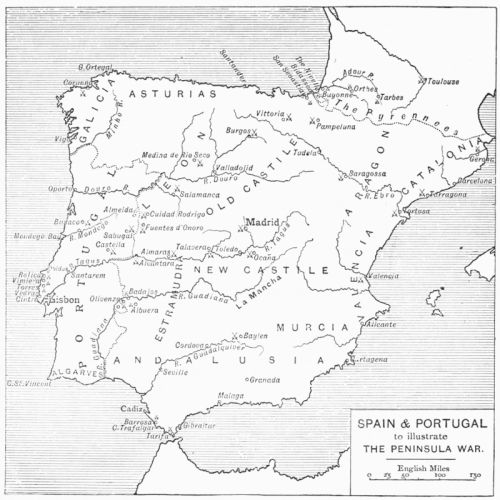
MAP OF SPAIN AND PORTUGAL TO ILLUSTRATE THE PENINSULAR WAR.
[See larger version]
Sir Arthur knew that at least one hundred thousand French were on the march to take him at once in flank and front; that Soult was advancing from Salamanca, Mortier from Valladolid; and, besides—which he did not know—Ney was en route from Astorga. He must, therefore, retreat at once or fight, and the enemy saved him the trouble of deciding. King Joseph, afraid of Sir Robert Wilson being joined by General Venegas, who had shown himself on the road towards Aranjuez, and of then falling on Madrid, ordered Victor to attack Wellesley at once, without waiting for any further reinforcements. Accordingly, Sir Arthur was attacked by Victor in front of Talavera. He had placed Cuesta and his Spaniards on his right, abutting on the Tagus, and protected by old enclosure walls and olive gardens; and his own troops on the left, on the open plain. The attack began on the evening of the 27th of July, on the outposts, which gradually fell back, and the battle was renewed the next day. The position of the Spaniards being found unapproachable, the whole fury of the French fell on the British, and the contest was kept up till it was pitch dark. About midnight there was a tremendous firing on the Spanish side, and Sir Arthur rode there to ascertain the cause. No cause was visible, but the Spaniards were flying in great haste, and it was with difficulty that he and Cuesta could stop the rout. Next day the British line was attacked on all points by the troops of both Victor and Sebastiani, but they were repelled, and driven down the hills at the point of the bayonet. At one time the British centre was driven in, but it was re-established by the 48th, while the 23rd Dragoons, by a reckless charge, paralysed a whole division of the French army. In the words of Sir Arthur, the British everywhere maintained their positions gloriously, and gave the French a terrible beating. Out of the fifty thousand pitched against the less than twenty thousand British—for the Spanish were scarcely engaged at all—they lost in killed and wounded seven thousand men. General Lapisse was killed, and many prisoners were taken, besides seventeen pieces of artillery, with tumbrils and ammunition complete. The British lost eight hundred and fifty-seven killed, and had three thousand nine hundred and thirteen wounded. Major-General Mackenzie and Brigadier-General Langworth were killed.
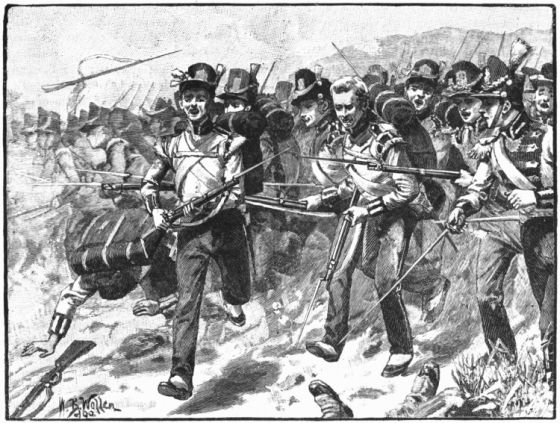
THE BAYONET CHARGE AT TALAVERA. (See p. 577.)
[See larger version]
The next morning, by daybreak, the French were in full retreat over the river Alberche, and Sir Arthur employed the two following days in getting his wounded into hospital in Talavera, and in procuring provisions for his victorious but starving army. Sir Arthur complains that, though he had thus repulsed the French for them, neither the Spanish authorities nor the Spanish people did anything to assist him in this respect. They were very willing that the British should fight their battles, but they must provide for themselves, or starve. The state of our own Commissariat aggravated this evil. It had long been a Department of the most corrupt kind, the duties of which were neglected, and little was thought of by its officers but the enriching of themselves at the expense of our Government and our soldiers. These swindlers, long after this, continued to pay the contractors and muleteers in notes payable at Lisbon, or at headquarters; these the receivers had often to get changed into coin at a monstrous discount, and Jews and jobbers flocked after the army for this purpose. To add to the mischief, some of these villains introduced loads of counterfeit dollars, merely copper-plated, so that, after losing enormously on the exchange of the paper, the receivers found themselves utterly defrauded of their payment. It was no wonder that the trading part of the Spanish population should feel shy of supplying us, more especially as Sir John Moore—from the money which should have been in his chest having been, by Mr. Frere, carelessly handed over to the Spanish Junta—had had to pay in paper which the British Government had not yet redeemed. The reform of such abuses as these was one of the great things which Wellesley did for the British army, but at present he was suffering the extremest difficulties from them. He wrote sternly to Mr. Frere, who had not yet been superseded by the arrival of Lord Wellesley, that he (Sir Arthur) was blamed by the Junta for not doing more, whilst they were allowing his army, which had beaten twice their own number in the service of Spain, to starve. "It is positively a fact," he wrote, "that during the last seven days the British army have not received one-third of their provisions; that, at this moment, there are nearly four thousand wounded soldiers dying in the hospitals in this town from want of common assistance and necessaries, which any other country in the world would have given even to its enemies; and that I can get no assistance of any description from this country. I cannot prevail on them to even bury the dead carcases in the neighbourhood, the stench of which will destroy themselves as well as us." All this while, he added, Don Martin de Garay was urging him to push on, and drive the French over the Pyrenees; "but," added Sir Arthur, "I positively will not move; nay, more, I will disperse my army till I am supplied with provisions and means of transport as I ought to be."
And, in fact, circumstances rendered it advisable to retreat. Joseph Buonaparte, with the reinforcements of Sebastiani, had joined Victor, and that general felt ready to advance. At the same time Wellesley learned that Soult had arrived in Palencia, in the British rear. He desired Cuesta to guard the pass of Puerto de Baños, but this he did so ineffectually that both Soult and Mortier marched through it. Ney also reached Palencia, and thus fifty-three thousand men were threatening to cut off Sir Arthur's route to Portugal. He determined to fall back on Oropesa, leaving Cuesta to defend Talavera, and protect the two thousand British wounded in the hospitals; but Cuesta speedily abandoned the place, leaving one thousand five hundred of the wounded behind, whom Victor, to his honour, treated in the most humane manner. With the road of the enemy thus left open in his rear in two directions, Sir Arthur, at the same time, learned that Soult's division had got between him and the bridge of Alvarez, in the direct line of his march into Portugal. His situation, thus hemmed in by overwhelming forces, was most critical, and he informed Cuesta that he must file off for Badajos. He reached Badajos safely on the 2nd of September, carrying the one thousand five hundred wounded with him. These he sent to the strongly fortified town of Elvas, in Portuguese territory, which now became the great hospital of the army. Sir Arthur, on the 7th of September, was informed of the arrival of Sir Robert Wilson at Castello Branco. He had conducted his little force almost to the gates of Madrid, and had made a powerful diversion in favour of the main army, by keeping King Joseph and the French General in constant fear of his joining Venegas and attacking the capital. On his return, by order of Wellesley, he had gallantly fought his way against vastly superior forces, always contriving to make the enemy believe that his strength was double what it was. His conduct of this expedition elicited the most cordial praises from the Commander-in-Chief. At this juncture Napoleon sent a dispatch, ordering the army in Spain to cease further offensive operations till the conclusion of the Austrian war enabled him to send fresh reinforcements into Spain. This was a proof that Buonaparte no longer hoped to beat the British army by any but the most preponderating masses. He had in Spain ten times the forces of the British, yet he could not hope for victory from this vast disproportion. Wellesley, at this very time, in one of his dispatches, had observed this great fact. "I conceive," he said, "that the French are dangerous only in large masses." The British army was therefore quartered on the line of the Guadarama, to protect Portugal from Soult, and remained undisturbed till the following May. Whilst the hostile forces were thus resting, the news reached Sir Arthur that he had been created Baron Douro of Wellesley, and Viscount Wellington of Talavera. This honour had been conferred upon him on the 4th of September, as soon as possible after the arrival of the news of his brilliant and memorable victory at Talavera.
If there wanted anything to prove the truth of Lord Wellington's warnings to the Spanish authorities of the undisciplined condition of their armies, and the incompetency of their generals, it came quickly. Whilst they continued to treat him more like an enemy than a friend, and had issued orders throughout the province where he lay, forbidding the sale of provisions and forage for his army, their own armies were again annihilated. The army of Venegas, which had retreated, on the advance of Sebastiani towards Madrid, into the Sierra Morena, had been taken from him, and given to a young, inexperienced man, General Areizaga. Cuesta, also, had been set aside for one still more incapable, a General Eguia, of whom Lord Wellington had already pronounced that he was a fool. Areizaga, instead of maintaining his strong post in the hills, being joined by the greater part of the army of Estremadura, now commanded by Eguia, imagined that he could beat the united forces of Mortier and Sebastiani, and drive them out of Madrid. With fifty thousand men and sixty pieces of artillery he descended from his hills into the open plains of Ocaña, where he was beaten on the 20th of November, with the loss of all his artillery but five guns, his baggage, military chest, provisions, and everything. There was immense slaughter of his soldiers, and the rest fled into the mountains. The Duke del Parque, who was placed for the protection of the line of the Tagus with another large army, was marching to support this intended conquest of Madrid, when, in the month of October, being strongly posted on the heights of Tamames, he encountered General Marchand, and defeated him. Elated by this success, he no longer trusted to hills and strong positions, but, like Areizaga, advanced boldly into the plains, and on the 28th of November he encountered Kellermann at Alba de Tormes, and received a most thorough defeat. His men, both cavalry and infantry, scarcely stayed to cross swords or bayonets with the French, but, flinging down their arms, and leaving all their baggage and artillery behind them, they fled in every direction. Kellerman pursued and cut them down without mercy—according to his own account, killing three thousand men and making three hundred prisoners.
Lord Wellington, notwithstanding that the destruction of these armies, on which the defence of Andalusia and the provinces of the south depended, completely proved the justice of his statements to the Junta, was deeply chagrined by the circumstance. "I lament," he said, in his despatches, "that a cause which promised so well a few weeks ago, should have been so completely lost by the ignorance, presumption, and mismanagement of those to whose direction it was entrusted. I declare that, if they had preserved their two armies, or even one of them, the cause was safe. The French could have sent no reinforcements which could have been of any use; time would have been gained; the state of affairs would have daily improved; all the chances were in our favour; and, in the first moment of weakness, occasioned by any diversion on the Continent, or by the growing discontent of the French themselves with the war, the French armies must have been driven out of Spain." Lord Wellington's position was, by the destruction of these armies, left totally open, and he had for some time resolved to retire wholly into Portugal, and had been planning that system of defence which afterwards proved so astonishing to the French. Though he was left with about twenty thousand men to maintain himself against the whole French host in Spain, he never for a moment contemplated quitting the Peninsula, nor despaired of the final result. The experienced eye of Lord Wellington, after the battle of Vimiera, had, at a glance, seen the admirable capability of the mountain ranges of Torres Vedras for the construction of impregnable lines of defence for Lisbon. So far from holding any notion of being driven to his ships, like Sir John Moore, he was satisfied that, by fortifying the defiles through these hills, and keeping our ships on the Tagus and on the coast, he could defy all the armies of France. He proceeded now to Lisbon, where he arrived on the 10th of October, reconnoitred the hills, and, having done so, left with Colonel Fletcher, of the Engineers, a clearly written statement of all that he desired to be done, so as to make the double line of defences complete: to erect batteries on each side of the defiles through which the necessary roads ran, to erect breastworks and entrenchments where required, and to break down the bridges in front of them. He ascertained the precise time it would require to accomplish all this, and, ordering all to be carried on with the utmost quickness, he returned to Badajos, and next proceeded to Seville, to join his brother in urging on the Spanish Government the necessary measures for the defence of the country. After visiting Cadiz with his brother, he returned to his headquarters, where he had scarcely arrived on the 17th of November, when he received the news of the total overthrow of the Spaniards at Ocaña. He then made a deliberate and orderly retreat from Spain, crossing the Tagus at Abrantes, where he left General Hill with his division, supported by General Fane's brigade of heavy horse, and marched to Almeida, and quartered his army there in a more healthy situation. His troops were now also well supplied with provisions. During the long interval of repose—that is, till the following May—Wellington actively employed himself in putting life and order into the commissariat, baggage, and conveyance departments; and General Beresford, to whom the important function of disciplining the Portuguese troops was assigned, laboured in that with such effect, that he produced at the next campaign troops which, led by British officers, and mixed with British regiments, fought admirably. The Portuguese were wise enough to allow the British commander full control, and by this means they avoided those defeats and calamities which fell long and heavily on the Spaniards.
Whilst these events had been taking place in Spain and Portugal, Great Britain had been sending money and troops to oppose Buonaparte in other quarters. Early in the spring Austria was in the field; in July a powerful fleet, carrying an army, sailed from the Downs, to create a diversion on the coast of the Netherlands, and other operations were commenced in the south of Italy. The army destined for the Netherlands amounted to forty thousand men, attended by a fleet of thirty-five sail of the line and twenty frigates, to assist where they might be needed. Buonaparte had contemplated making a great port of Antwerp, and had expended much money and labour in docks and fortifications there; but finding that the port of Antwerp was not deep enough for first-rate ships of war, he undertook to render Flushing capable of receiving and protecting a large fleet. He still contemplated, by the co-operation of Denmark and Russia, the sending forth a fleet, some day, which might cope with the British navy, or enable him to invade England. For this purpose he was building ships at Antwerp and Flushing; and it was, no doubt, these circumstances which determined the British to direct their attack on Flushing and Antwerp. Captain, afterwards Sir George Cockburn, was of opinion that these preparations of Napoleon could never affect England; that no possession of Zealand, or any part of it, could be kept by England, from its extreme unhealthiness to foreigners, and even to Dutchmen; and that it was much better for Britain to let Buonaparte build ships, and take them whenever they came out to sea, than to sacrifice the lives of our troops for no permanent benefit in this region of bogs, stagnant water, and malaria. Had these forty thousand troops been sent to support Wellington, and half the money that this fatal expedition cost, they would have enabled him to drive the French triumphantly out of Spain, and create the most magnificent diversion for Austria, as well as the most honourable to England.
But the surprise of Antwerp and the destruction of the docks of Flushing were determined upon; and Lord Chatham, rather for his name than for any military talent that he possessed, was appointed the commander of the forces. Lord Chatham was so notorious for his sluggish and procrastinating nature, that he had long been nicknamed the late Lord Chatham; the justice of this epithet had been too obvious in all the offices that he had hitherto held; and yet this expedition which demanded the utmost promptness and active skill, was entrusted to him. At the head of the fleet was placed Sir Richard Strachan, a man of no energy. The commander of the ships on such an occasion should have been Lord Cochrane, for Sir Sidney Smith was already engaged on the coast of Italy. The orders for each commander were extremely loose and indefinite thereby leaving every chance of disputes and consequent delays and mishaps; and, to complete the disgraceful management of the Government, no inquiries had been made as to the healthiness or unhealthiness of the district where the army would have to encamp. Though the island of Walcheren had been occupied by our troops under William III., no record was to be found, or, indeed, was sought for, as to the cost of life to our men on that occasion from the climate. The whole plan was laid in ignorance and carried out with carelessness, and it was no wonder, therefore, that it ended in misery and disgrace.
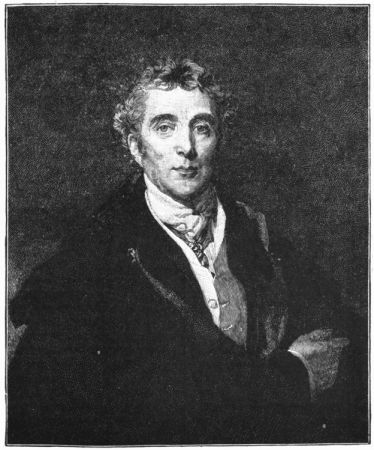
THE DUKE OF WELLINGTON. (After the Portrait by Sir Thomas Lawrence.)
[See larger version]
The fleet sailed from the Downs on the 28th of July, 1809, and on the 30th it touched at the islands of South Beveland and Walcheren. The orders of the Government were, "the capture or destruction of the enemy's ships, building or afloat at Antwerp and Flushing; the destruction of the arsenals at Antwerp, Terneuse, and Flushing; the reduction of the island of Walcheren, and, if possible, the rendering of the Scheldt no longer navigable for ships." Nelson, who had contemplated this enterprise, had calculated that it would require four or five thousand men, and could be accomplished in a week. But now Buonaparte had rendered the task more difficult, and there was no Nelson to do it. The most sagacious of the officers pointed out that the first rush should be for Antwerp, as the extreme point of the expedition, so as to destroy or capture the vessels there before the French could come to the rescue. The places nearer to the sea could be taken in returning. Had the troops landed at Blankenberg, they could have made a rapid march along a paved road through Bruges and Ghent, and captured Antwerp, only forty-five miles distant, whilst the fleet ascended the Scheldt to receive them on their return; but no such common-sense ideas found acceptance with the commanders. They determined to reduce Flushing first, and the other forts on the Scheldt, as Lillo and Liefkenshoek, in succession, by which time it was certain that the French would appear at Antwerp in numbers sufficient to protect it. Flushing was attacked on the 1st of August, and did not surrender till the 16th. Had this been the reduction of Antwerp, the rest of the objects of the expedition would have followed of course; but Lord Chatham and Rear-Admiral Strachan were in no hurry. They remained signing the capitulation, securing six thousand prisoners that they had taken, and reducing two small islands to the north of the eastern Scheldt, till the 21st (three whole weeks virtually wasted!), and on the 23rd they landed at Ter Goes, on the neighbouring island of South Beveland. Here, again, they delayed another precious fortnight, whilst the French were planting batteries at every turn of the river between them and Antwerp; had drawn a boom-chain across the channel between Lillo and Liefkenshoek; and had sunk vessels to obstruct the narrowest part of the channel beyond. They still talked of forcing their way to Antwerp; but according to a satiric rhyme of the time—
"The Earl of Chatham, with his sword drawn, Stood waiting for Sir Richard Strachan; Sir Richard, eager to be at 'em, Stood waiting too, for whom? Lord Chatham."
Meantime Cambacérès and Fouché had dispatched couriers to Louis Buonaparte, in Holland, to march down troops to the defence of Antwerp; and he had not only done that, but had opened the sluices on the borders of the Scheldt, and laid the country under water, to prevent the march of the British. He also had ordered the erection of numerous batteries, and Bernadotte arrived in about a fortnight, by orders of Napoleon, to resist the advance of the British. From forty to fifty thousand troops were assembled in and around Antwerp, and hosts of Dutch and Belgian militia swarmed over the country. This was certain to be the case if any time was allowed, and it was now agreed, in a council of war, that it was not possible to proceed further. In fact, they were no longer allowed to remain where they were. Their provisions were rapidly being exhausted, sickness was spreading amongst the troops, and the fire of the enemy's batteries from both sides of the river compelled them to fall down the stream. That was the end of the campaign; the rest was a foolish and murderous delay in the island of Walcheren, without any conceivable purpose. There was no use in retaining the island, for we could at any time blockade the mouths of the Scheldt, and our men on board the ships were comparatively healthy; but in this swamp of death the soldiers continued dying like rotten sheep. The island of Walcheren, to which they were now confined, is a spongy swamp, below the level of the sea at high water. The wet oozes through the banks, and stagnates in the dykes, and is only capable of being pumped out by windmills. The ground is covered often with mud and slime, and the inhabitants are sickly and sallow in aspect, and of loose and flaccid muscles. Yet, in this den of fever and death, the commanders seemed determined to retain the army till it perished entirely. The Earl of Chatham himself returned to London on the 14th of September, with as many of the sick as he could take. At this time he left eleven thousand, out of the seventeen thousand quartered on the island of Walcheren, on the sick-list, and rapidly dying; yet neither he nor Sir Eyre Coote, who succeeded him, seems to have felt the necessity of saving the army by retiring from the place. They attributed the unhealthiness to the dykes being cut, and the surrounding country being flooded in the hot season. No matter what was the cause, the army was perishing, and ought to have been removed; but, so far from this, the Ministers seemed determined to keep possession of this useless and pestilential swamp at any cost. As it was imagined that the drinking of the water was the cause of the fever, Thames water was carried over for the troops, five hundred tons per week being required. But it was not the drinking it only that caused disease and death, but the standing and working in it, as many of them did, up to the middle for many hours together, and the malaria arising from the oozy soil. As the roofs in Flushing were knocked to pieces by the storming of the town, British workmen, with bricks, mortar, tiles, and tools, were sent over to repair them, so as to protect the sick in the hospitals, though plenty of workmen and materials might have been had in the country.
As it was necessary that some doctors of note and experience should be sent over to examine the nature of the illness and the condition of the men, the Surgeon-General was ordered to proceed to the spot and make the necessary inquiries; but he replied that it was not in his department, but in that of the Physician-General, Sir Lucas Pepys. Sir Lucas excused himself on account of his age, and recommended some other physicians to be sent out. Both gentlemen were content to receive the country's money easily at home, but although a whole army was perishing, they would not risk their own precious lives. They were dismissed, and their conduct showed the necessity of a thorough reform of the medical establishment of the army. Sir Richard Strachan, though he saw the continuous destruction of the soldiers, strongly recommended Government to retain possession of Walcheren, as a very important naval station, and the Ministry were besotted enough to contemplate fortifying it on an extensive scale, and more men and materials were sent over for that purpose. But, fortunately for the remains of our army there, the Emperor of Austria had now made peace with Buonaparte, and our diversion in his favour here was useless, so, on the 13th of November, orders were sent to Lieutenant-General Don, who had succeeded Sir Eyre Coote, to destroy the docks and fortifications of Flushing, and come away. Thus ended this most fatal expedition, which cost Great Britain twenty millions of money, and many thousands of lives. Of those who survived, thousands had their constitutions broken for ever; and even such as appeared to get over the lingering and insidious Walcheren fever, on being sent to the war in the Peninsula, proved so liable to its return on exposure to wet or cold, that often one-third of these troops were not fit for service. So far from wishing to remove us from Walcheren, Buonaparte wrote to the Minister of War, saying: "We are rejoiced to see that the English have packed themselves in the morasses of Zealand. Let them be only kept in check, and the bad air and fevers peculiar to the country will soon destroy their army." The fatal results of this expedition introduced dissensions into the Cabinet, and soon after occasioned the resignation of Canning.
Our forces on the Italian coast were met by the active spirit of the new King of Naples, Joachim Murat. Sir John Stuart, who had won the splendid victory of Maida, embarked, on the 13th of June, fifteen thousand British troops in Sicily, and proceeded to menace Naples, and create alarm in various quarters, so as to draw the French from Upper Italy, and thus relieve the Austrians. With part of these forces siege was laid to Scylla; with the other Sir John anchored off Cape Miseno, close to Baiæ and Puzzuoli, and directly across the bay, about a dozen miles from Naples. The greatest alarm was excited, and nothing would have been easier for Sir John than to have battered the town about the ears of the intruder king; but this the interests of the old king did not permit, especially as Ferdinand's second son, Don Leopold, was present as nominal commander, but he was of no use really, being a most effeminate and incapable person. Sir John then sailed to the islands of Procida and Ischia, compelled the garrisons to capitulate, dismantled the fortifications, and then abandoned these islands. During all this time our warships were scouring the whole of the coasts of Southern Italy, capturing every vessel that ventured out, and keeping the French generals on shore in constant agitation. In the encounters with the enemy's vessels on these coasts many brilliant exploits were performed by our captains, and by none more than by Captain Staines, of the Cyane frigate, who, on the 27th of June, stood a stout but most unequal fight with a Neapolitan frigate and corvette, under the very batteries of Naples. The siege of Scylla was raised by a strong French force, and Sir John Stuart returned to Sicily. Scylla was, however, shortly after abandoned again by the French, and its guns and stores, which appeared to have been left in some panic, fell into the hands of the British.
Sir John Stuart did not long remain idle at Palermo. At the suggestion of Lord Collingwood, he sent out an expedition to seize on a number of the Ionian Isles, which had been taken possession of by the French, who were calculating on further conquests in that direction—namely, in continental Greece itself. The Warrior, commanded by Captain Spranger, attended by other vessels, carried over one thousand six hundred troops, under command of Brigadier-General Oswald. The troops were half of them British, and half Corsicans, Sicilians, Calabrians, and other foreigners in British pay. They carried with them Signor Foresti and an Ionian Greek as interpreters and agents with their countrymen, many of whom, they were aware, had an indignant hatred of the French domination. They arrived off Cephalonia on the 28th of September, and on the 1st of October, being joined by their transports and gunboats, they anchored in the bay of Zante, and the following morning commenced a landing, under the cover of a brisk fire from some of the ships and gunboats. The land-batteries were soon silenced, and before night the French commander had not only surrendered the castle, but the islands of Zante, Cephalonia, Ithaca, and Cerigo. Two of the seven islands remained for the time in the hands of the French—Santa Maura and Corfu. But Santa Maura, after a sharp contest, was carried, in the following April, by General Oswald, most brilliantly supported by Lieutenant-Colonel Hudson Lowe, Major Church, and other officers. General Camus, the French commandant, surrendered with his garrison of one thousand men. There remained only Corfu, but this, the most important island of the group, would have required a much stronger force to reduce it; and as it was completely useless to the French, being cut off from all communication with France by our ships, it remained under France till 1814, when, at the Congress of Paris, it was made over by Louis XVIII., and the whole seven islands were declared a republic, under the protection of Great Britain. Such was the origin of our connection with the Ionian Islands, where we maintained a Commissioner and a body of troops, much to the discontent of a party in the islands, who desired to join the kingdom of Greece.
At the opening of 1810 a peace was contracted with Turkey; but not with the Sultan Selim, with whom we had been at war, nor with his successor, Mahmoud. Whilst the throne of Turkey was occupied by a mere boy, and whilst his regular troops were dispersed, Alexander of Russia, famed for his piety, thought it a fine opportunity to seize on his neighbour's lands. His Ministers, at the commencement of 1809, at the Congress of Jassy, demanded, as a condition of peace, the cession of the Turkish provinces on the left bank of the Danube. The Turks, of course, refused to thus dismember their empire for the aggrandisement of Russia; and Alexander, who was resolved to have those provinces by hook or by crook, immediately declared war on Turkey, on the shameless plea that it had made peace with Britain. The Russians were supported by the Greeks, and other inhabitants of Moldavia and Wallachia; but on crossing the Danube and pushing forward into Bulgaria they were beaten on every occasion. On the 22nd of October, 1809, a desperate conflict took place between them under the walls of Silistria, which continued from morning till night, in which the Russians were driven back, and, in a second engagement, routed with such slaughter that they retired from Bulgaria, and went into winter-quarters in Moldavia and Wallachia. In this campaign it was found that the guns were served by French officers, though Buonaparte professed to be willing that Alexander should possess himself of Constantinople. By the peace with Turkey, the trading ports of that empire were again opened to us, and our manufactures, entering there, spread over all the Continent, and were sold and worn in Hamburg, Bremen, and other towns where they were strictly excluded by sea.
The naval transactions of 1810 were almost wholly confined to watching the French, Spanish, and Italian coasts, to thwart the French, who, on their part, were continually on the watch for any of our blockading ships being driven by the weather, or called to some other station, in order to run out and convey men and stores into Spain. The last action of Lord Collingwood took place in this service. Though his health was fast failing, and he had repeatedly entreated the Admiralty to allow him to give up the command and go home to his family—the only chance of his long survival—they always refused. His complaint was declared by the faculty to be owing to his long confinement on board ships, and he had now scarcely set foot on shore for three years. But notwithstanding all this, with a singular selfishness the Admiralty kept him on board, and he was too high-minded to resign his commission whilst he could be of service to his country. In this state of health he was lying off Toulon, blockading that port, when he was driven to Minorca by a gale of wind. He had regained the coast of Catalonia, when he heard that the French fleet had issued from Toulon, and were making for Barcelona. The whole British fleet were in exultation; but on sighting this supposed fleet it was found to consist only of three sail of the line, two frigates, and about twenty other vessels, carrying provisions to the French army at Barcelona. They no sooner caught view of the British fleet than they made off in all haste, and the British gave chase. Admiral Martin was the first to come up with them in the Gulf of Lyons, where two of the ships of the line ran ashore, and were set fire to by the French admiral, Baudin. Two others ran into the harbour of Cette; and eleven of the store-ships ran into the Bay of Rooas, and took refuge under the powerful batteries; but Lord Collingwood, in spite of the batteries, sent in the ships' boats, and in the face of the batteries, and of boarding nets, set fire to and destroyed them. Five other store-ships were captured. This was the last exploit of the brave and worthy Collingwood. His health gave way so fast, that, having in vain endeavoured again to induce the Admiralty to relieve him of his command, expressly assuring them that he was quite worn out, on the 3rd of March he surrendered his post to Rear-Admiral Martin, and set sail in the Ville de Paris for England. But it was too late; he died at sea on the 7th of March, 1810. Very few admirals have done more signal service, or have displayed a more sterling English character than Lord Collingwood; and perhaps none were ever more grudgingly rewarded or so unfeelingly treated by the Admiralty, who, in fact, killed him by a selfish retention of his services, when they could be continued only at the cost of his life.
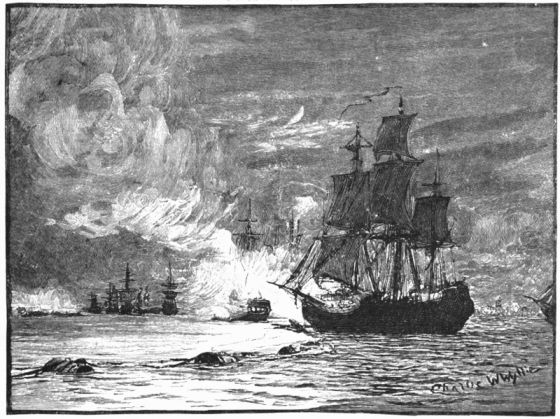
THE "MEDIATOR" BREAKING THE BOOM AT LA ROCHELLE. (See p. 585.)
[See larger version]
Another attempt was to burn a portion of the Brest fleet, which was found lying off La Rochelle, in the Basque Roads. Lord Gambier, on the 11th of March, wrote to the Admiralty proposing to send fire-ships amongst them and destroy them. The Admiralty seized on the idea; but instead of leaving Lord Gambier to work out his own plan, they appointed Lord Cochrane to that service, under Gambier. This was sure to create jealousies, not only in the mind of Gambier—to whom the Admiralty had written on the 19th, approving his design, and ordering him to execute it according to his own ideas—but also in the minds of other officers in Gambier's fleet. Lord Cochrane proceeded to the Basque Roads in a frigate, arriving there on the 3rd of April, and presenting Gambier with a letter informing him of the change of plan by the Admiralty. Mr. Congreve, with a supply of his rockets, was to accompany the fire-ships from England; and on the 11th, these having arrived, and being joined by several large transports which Lord Gambier had converted into fire-ships, the attack was made. The French squadron was lying between the isle of Aix and the town of La Rochelle, in a narrow passage, commanded by powerful batteries both on the land and on the island of Aix. Besides this, numbers of gunboats were placed so as to defend the approach to the vessels; but still more, a very strong boom was stretched across the passage, formed of enormous cables, secured by equally enormous anchors, and supported by buoys. None of the officers, not even Gambier or Cochrane, seem to have been aware of this boom till some of the foremost fire-ships ran against it; and several of the ships, whilst thus detained, exploded, being too far off to do any harm. But Captain Woolridge, in the Mediator, burst the boom asunder, and the fire-ships sailed up towards the French ships in the dark, and exploded, one after another, with a terrible uproar—one fire-ship alone containing fifteen hundred barrels of gunpowder, besides three or four hundred shells and three or four thousand hand-grenades. But the only mischief done was to cause the French to cut their cables, and run their ships ashore. There, the next morning, they were seen; and Lord Cochrane signalled to Lord Gambier to stand in and destroy them before the rising of the tide should float them, and enable them to run up the river Charente. No ships, however, arriving, Cochrane again more urgently signalled that all the fleet was aground, except two vessels, and might easily be destroyed. Lord Gambier paid no attention to these signals, and, as the tide rose, the vessels floated and escaped up the river, except four, which still stuck fast, and were destroyed by Cochrane. Those which escaped were all greatly damaged. Had Gambier stood in with his vessels promptly, no doubt the whole squadron would have been destroyed.
On his return Lord Cochrane received the honour of the red riband of the Bath; but he could not conceal his dissatisfaction at Lord Gambier's conduct, and declared that he would oppose any vote of thanks to him in Parliament. On this, Gambier demanded a court-martial, which was held, and acquitted him of all blame. Cochrane complained that the court was strongly biassed in favour of Gambier, and against himself, and the public was very much of his opinion.