Chapter XIII · (continued 2)
Reading edition
Coote landed at Madras at the beginning of November. A council was immediately called, Whitehill was removed from the government of the Presidency, and the member of Council next in seniority appointed. Coote had brought with him only five hundred British troops and six hundred Lascars. The whole force with which he could encounter Hyder amounted only to one thousand seven hundred Europeans and five thousand native troops. Coote, whose name as the conqueror of the French at Wandewash and Pondicherry struck terror into Hyder, soon resumed his triumphs on his old ground, driving the enemy from Wandewash. Hearing then of the arrival of the French armament off Pondicherry, he marched thither, and posted himself on the Red Hills. The French fleet, consisting of seven ships of the line and four frigates, was anchored off the place. But the French squadron having sailed away for the Isle of France, from apprehension of the approach of a British fleet, Hyder retreated, and, entering the territory of Tanjore, laid it waste, while his son, Tippoo, laid siege again to Wandewash. Hyder was again encouraged to advance, and on the 6th of July, 1781, Coote managed to bring him to action near Porto Novo, and completely routed him and his huge host, though he had himself only about eight thousand men. Hyder retired quite crestfallen to Arcot, and ordered Tippoo to raise the siege of Wandewash.
Notwithstanding that Hyder had established his camp soon after in a strong position near the village of Pollilore, he was attacked on the 27th of August by Eyre Coote. On this occasion Sir Hector Munro warned Coote of the disadvantages of ground under which he was going to engage, and the inevitable sacrifice of life. Coote replied angrily, "You talk to me, sir, when you should be doing your duty!" His warning, however, was just. Coote did not succeed in driving Hyder from his post without severe loss. But again, on the 27th of September, another battle was fought between them in the pass of Sholinghur, near Bellore, in which Coote defeated Hyder with terrible loss. This battle relieved the English garrison in Bellore, and the rainy season put an end to operations, but the Carnatic was saved.
On the 22nd of June, 1781, Lord Macartney arrived at Madras to take the place of Whitehill as Governor. He brought the news of the war having broken out between the British and the Dutch, and he determined to take advantage of it to seize the Dutch settlements on the coast of Coromandel and in Ceylon. But Sir Eyre Coote had lately had a stroke of palsy; his faculties were failing, and his temper had grown morose. Finding he could obtain no assistance from the Commander-in-chief, Macartney called out the militia of Madras, and at their head reduced the Dutch settlements of Sadras and Pulicat. Finding Sir Hector Munro waiting at Madras for a passage to England, in consequence of the insulting conduct of Sir Eyre Coote, he induced him to take the command of an expedition against Negapatam. Admiral Hughes landed the troops near Negapatam on the 21st of October; they then united with a force under Colonel Braithwaite, and on the 12th of November Negapatam was taken, with large quantities of arms and military stores. Leaving Braithwaite to make an expedition in Tanjore, where, in February of the coming year, he was surrounded by Tippoo and Lally, the French general, and taken prisoner, Admiral Hughes sailed across to Ceylon, a most desirable conquest, because of its secure harbour of Trincomalee, as well as the richness and beauty of the island, and also on account of its position, for it lay only two days' sail from Madras. On the 11th of January, 1782, Trincomalee was won.
But in February the long-expected armament from France arrived on the Coromandel coast. Suffren, the admiral, was one of the ablest sea-commanders of France. On his way he had secured the Cape of Good Hope against the English, and he now landed at Porto Novo two thousand French soldiers to join the army of Hyder Ali. Tippoo, flushed with the recent capture of Colonel Braithwaite, invited the French to join him in an attack on Cuddalore, an important town between Porto Novo and Pondicherry. This was done, and Cuddalore was wrested from the English in April. Whilst these events were taking place on land, repeated engagements occurred with the British fleets on the coasts. That of Admiral Hughes was reinforced by fresh ships from England, and between February, 1782, and June, 1783, the British and French fleets fought five pitched battles with varied success. In none of these was any man-of-war captured by either side, nor any great number of men lost; but, eventually, Suffren succeeded in retaking Trincomalee, in Ceylon, from the British.
From Cuddalore, Tippoo and Bussy, the French general, turned their forces against Wandewash; but they were met by Coote, though he was now sinking and failing fast. They retreated, and he attempted to make himself master of the strong fort of Arnee, where much of the booty of Hyder was deposited; but Hyder made show of fighting him whilst Tippoo carried off all the property. Tippoo was obliged to march thence towards Calicut, where the Hindoo chiefs, his tributaries, were joining the British under Colonel Mackenzie. Hyder at this moment was confounded by the news of the peace made by Hastings with the Mahrattas, and expected that those marauders would speedily fall on Mysore. His health was fast declining, and yet he dared not introduce his allies, the French, into his own territory, lest he should not so readily get them out again. Besides his suspicions of the French, he had constant fears of assassination. Hyder died in December, 1782.
At the time that Tippoo heard of the death of his father, he was, assisted by the French, eagerly pressing on the most inferior force of Colonel Mackenzie, not very far from Seringapatam. Mackenzie being obliged to retire, was suddenly set upon, before daylight, near Paniany, about thirty-five miles from Calicut, by the whole force; but he repulsed them with great slaughter. Tippoo then fell back and made the best of his way to his capital to secure his throne and the treasures of Hyder Ali. He found himself at the age of thirty master of the throne, of an army of nearly one hundred thousand men, and of immense wealth. With these advantages, and the alliance of the French, Tippoo did not doubt of being able to drive the British out of all the south of India. Yet, with his vast army, accompanied by nine hundred French, two thousand Sepoys, and nearly three hundred Kafirs, Tippoo retreated, or appeared to be retreating, before General Stuart, with a force of only fourteen thousand men, of whom three thousand alone were British. He was, in fact, however, hastening to defend the north-west districts of Mysore from another British force on the coast of Canara. This force was that of Colonel Mackenzie, joined by another from Bombay, under General Matthews, who took the chief command in that quarter.
News now arrived of peace concluded between Britain and France. The French, to whom their possessions were restored, at once ceased hostilities and went to occupy their reacquired settlements. But Tippoo continued the war, bent on taking Mangalore. Nothing could now have prevented the English from completely conquering but the stupidity of the Council of Madras. They sent commissioners to treat with Tippoo, who, once getting them into his camp, made them really prisoners, kept all information from them, and induced them to issue orders to the English officers to cease hostilities. By these orders a junction between Stuart and Colonel Fullarton, and the immediate investment and seizure of Seringapatam, Tippoo's capital, were prevented. Fullarton had overrun a great portion of the southern districts of Mysore, and had entered into close alliance with the Zamorin of Calicut, the Rajah of Travancore, and other rajahs, tributary to Tippoo, all the way from Cochin to Goa. With ample supplies of provisions and other aids from these chiefs, Fullarton was in full march to join Stuart, and laid siege to Seringapatam, when he received peremptory orders to give up the enterprise, as the British were about concluding terms with Tippoo. Exceedingly disconcerted by these commands, which thus frustrated the results of this wonderful campaign, Fullarton, however, had no alternative but to obey, and Tippoo thus held on till he had starved out Campbell, and gained the fort of Mangalore. Then he concluded peace on condition of mutual restitution of all conquests since the war. This peace was signed on the 11th of March, 1784.
Warren Hastings had saved Madras and the Carnatic, but only at the cost of extortion. To obtain the necessary money, he began a system of robbery and coercion on the different princes of Bengal and Oude. The first experiment was made on Cheyte Sing, the Rajah of Benares, who had been allowed to remain as a tributary prince when that province was made over to the British by the Nabob of Oude. The tribute had been paid with a regularity unexampled in the history of India; but when the war broke out with France, Hastings suddenly demanded an extraordinary addition of fifty thousand pounds a year, and as it was not immediately paid, the Rajah was heavily fined into the bargain. This was rendered still more stringent in 1780, when the difficulties in Madras began. Cheyte Sing sent a confidential agent to Calcutta, to assure Hastings that it was not in his power to pay so heavy a sum, and he sent him two lacs of rupees (twenty thousand pounds), as a private present to conciliate him. Hastings accepted the money, but no doubt feeling the absolute need of large sums for the public purse, he, after awhile, paid this into the treasury, and then said to Cheyte Sing that he must pay the contribution all the same. He compelled the Rajah to pay the annual sum of fifty thousand pounds, and ten thousand pounds more as a fine, and then demanded two thousand cavalry. After some bargaining and protesting, Cheyte Sing sent five hundred horsemen and five hundred foot. Hastings made no acknowledgment of these, but began to muster troops, threatening to take vengeance on the Rajah. In terror, Cheyte Sing then sent, in one round sum, twenty lacs of rupees (two hundred thousand pounds) for the service of the State; but the only answer he obtained for the munificent offering was, that he must send thirty lacs more, that is, altogether, half a million.
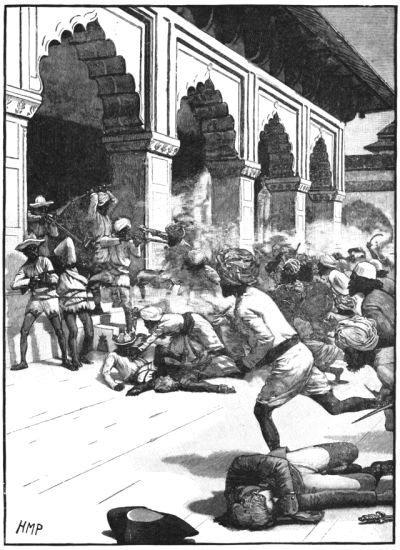
ARREST OF THE RAJAH OF BENARES. (See p. 334.)
[See larger version]
Following his words by acts, he set off himself, attended only by a few score sepoys, for Benares. Cheyte Sing came out as far as Buxar to meet the offended Governor, and paid him the utmost homage. He continued his journey with the Rajah in his train, and entered the Rajah's capital, the great Mecca of India, the famed city of Benares, on the 14th of August, 1781. He then made more enormous demands than before; and the compliance of the Rajah not being immediate, he ordered Mr. Markham, his own-appointed resident at Benares, to arrest the Rajah in his palace. Cheyte Sing was a timid man, yet the act of arresting him in the midst of his own subjects, and in a place so sacred, and crowded with pilgrims from every part of the East, was a most daring deed. The effect was instantaneous. The people rose in fury, and pouring headlong to the palace with arms in their hands, they cut to pieces Markham and his sepoys. Had Cheyte Sing had the spirit of his people in him, Hastings and his little party would have been butchered in half an hour. But Cheyte Sing only thought of his own safety. He got across the Ganges, and whole troops of his subjects flocked after him. Thence he sent protestations of his innocence of the émeute, and of his readiness to make any conditions. Hastings, though surrounded and besieged in his quarters by a furious mob, deigned no answer to the suppliant Rajah, but busied himself in collecting all the sepoys in the place. But the situation of Hastings was at every turn becoming more critical. The sepoys, sent to seize Cheyte Sing in the palace of Ramnuggur, were repulsed, and many of them, with their commander, killed. The multitude were now more excited than ever, and that night would probably have seen the last of Warren Hastings, had he not contrived to escape from Benares, and to reach the strong fortress of Chunar, situated on a rock several hundred feet above the Ganges, and about seventeen miles below Benares. Cheyte Sing, for a moment, encouraged by the flight of Hastings, put himself at the head of the enraged people, and, appealing to the neighbouring princes as to his treatment, declared he would drive the English out of the country. But troops and money were speedily sent to Hastings from Lucknow, others marched to Chunar from their cantonments, and he found himself safe amid a sufficient force commanded by the brave Major Popham, the conqueror of Gwalior, to defy the thirty thousand undisciplined followers of Cheyte Sing. From the 29th of August to the 20th of September there were different engagements between the British and the forces of Cheyte Sing; but on every occasion, though the Indians fought bravely they were worsted, and on the last-named day, utterly routed at Pateeta. Cheyte Sing did not wait for the arrival of the British troops; he fled into Bundelcund, and never returned again to Benares. Hastings restored order, and set up another puppet Rajah, a nephew of Cheyte Sing, but raised the annual tribute to forty lacs of rupees, or four hundred thousand pounds a year, and placed the mint and the entire jurisdiction of the province in the hands of his own officers.
Hastings next determined to experiment on the Nabob of Oude. This Nabob, Asaph-ul-Dowlah, was an infamously dissipated prince, spending his own money in licentious pleasures, and extorting what he could from the Begums, his mother and grandmother. The old ladies lived at the palace of Fyzabad, or the "Beautiful Residence," situated in a charming district, amid hills and streams, about eighty miles from Lucknow. The Nabob's father had left them large sums of money and extensive estates, so that they kept a handsome court, and yet had the reputation of having accumulated about three million pounds sterling. The Nabob had compelled them, by coercive means, to let him have, at different times, about six hundred thousand pounds, and he thirsted exceedingly for more. Hastings determined to anticipate him. He sent for the Nabob of Oude while he was still in the fortress of Chunar, and there reminding him of his debts to the British Government, which were considerable, coolly proposed to him the robbery of his mother and grandmother. The proposal was so barefaced that, when Hastings came to make it to the Nabob, he felt that he really required some pretended reason for thus arbitrarily laying hands on the property of these innocent women, and therefore unblushingly asserted that they had been concerned in stirring up the insurrection at Benares—a matter, besides that it was so notoriously the result of Hastings' own daring arrest of Cheyte Sing, the Begums had neither motive for meddling in nor time for doing it. Till now they had regarded the British as their only protectors. They were living quietly at Fyzabad, one hundred and fifteen miles from Benares, when the insurrection broke out from very obvious causes. This infamous bargain being concluded at Chunar, Hastings relying on his agent at Lucknow, Mr. Middleton, compelling the Nabob to carry it out, retreated to Benares, and thence to Calcutta. The Nabob returned to Lucknow to enforce the diabolical scheme; but he found his mother and grandmother determined to resist the iniquitous order, and so shameful was it that even the needy and debauched Nabob felt compunctions in proceeding with it. He left it to Middleton to execute it, but Middleton, in his turn, recoiled from the odious business. Not so Hastings; cold and resolute, he wrote to Middleton, that if he could not rely upon his firmness he would free him from his charge, and himself proceed to Lucknow and enforce his own orders. To induce Middleton to abandon his scruples of conscience and honour, the ever-ready friend of Hastings, the Chief Justice of Bengal, Sir Elijah Impey, it appears, wrote to Middleton, and inculcated the necessity of obedience. Middleton and the Nabob, therefore, seized on the estates of the Begums, and suddenly surrounded Fyzabad and the palace with troops, and made themselves masters of both. But the old ladies had not been so inattentive to the approaches of the storm as to neglect the hiding of their treasures; they could not be found. Thus cruelly disappointed of the expected hoard, and the Begums remaining firm in their refusal to produce any part of it, Middleton seized on their two chief ministers, the eunuchs, Jewar Ali Khan and Behar Ali Khan. They were now thrown into prison, put in irons, and orders were given to starve and torture them till they revealed the secret of the concealment of the treasure of their mistresses. At the same time, the two ladies were placed in rigorous confinement themselves. This system was continued till they had extorted upwards of a million sterling from the Begums, and found that they might kill both them and their aged ministers, but could get no more. When the Begums and the two old men were liberated, they were told by the Resident—not now Middleton, but Bristow—that they owed this favour to the Governor-General, who had determined to have them "restored to their dignity and honour." There was another name connected with these events, and with almost equal disadvantage, that of Sir Elijah Impey, the Chief Justice. Impey, who had no jurisdiction in Oude, was found up there in the midst of these transactions, volunteering his assistance in getting up charges against the Begums. These charges were supported by a host of venal witnesses, and affidavits of their evidence were made out, and sent down to Calcutta, to justify the dark doings of Hastings.
But the violent proceedings of Hastings and his Council, partly against each other, and still more against the natives, did not escape the authorities at home. Two committees were appointed in the House of Commons in 1781, to inquire into these matters. One of them was headed by General Richard Smith, and the other by Dundas, the Lord Advocate of Scotland. In both of these the conduct of Hastings, especially in the war against the Rohillas, was severely condemned, and the appointment of Impey to the new judicial office was greatly disapproved. In May, 1782, General Smith moved an address praying his Majesty to recall Sir Elijah Impey, which was carried unanimously, and he was recalled accordingly. Dundas also moved and carried a resolution declaring it to be the duty of the Court of Directors to recall Warren Hastings, on the charge of his "having, in sundry instances, acted in a manner repugnant to the honour and policy of the nation." The Court of Directors complied with this suggestion; but Lord Rockingham dying, his Ministry being dissolved, and Burke, the great opponent of Indian oppressions, being out of office, in October the Court of Directors, through the active exertions of the friends of Hastings, rescinded his recall. The succeeding changes of administration, and their weakness, first that of the Shelburne, and then that of the Coalition Ministry, enabled Hastings to keep his post in India, and finish the war in Madras. It was the India Bill of Pitt in 1784, which, by creating the Board of Control, and enabling the Government to take immediate cognisance of the proceedings of the Governors-General, and other chief officers in India, broke the power of Hastings, and led him to resign, without, however, enabling him to escape the just scrutiny which his administration needed.
Hastings embarked on the 8th of February, 1785, and arrived in England in June, 1786. He had sent home before him his wife, whose health had begun to suffer from the climate of India, and she had been most graciously received by King George and Queen Charlotte. He had been accompanied to his ship, on leaving Calcutta, by all the authorities, and by all people of distinction; he had received the most enthusiastic addresses of regret and of admiration as the saviour of India. In London, not only at Court, but in Leadenhall Street, he met with the same gratifying honour. He spent the autumn at Cheltenham with his wife, where he was courted and fêted in a manner to warrant his writing to a friend, "I find myself everywhere and universally treated with evidences, apparent even to my own observation, that I possess the good opinion of my country." He was busy trying to purchase Daylesford, the, old family estate, and anticipating a peerage.
But this was only the lull before the storm. Burke and Francis were living, and the thunder-bolts were already forged which were to shatter his pleasing dream of approval. His agreeable delusion was, indeed, soon ended. On the 24th of January, 1787, Parliament met, and Major Scott, an officious friend of Hastings, unfortunately for the ex-Governor-General, relying on the manifestation of approbation of Hastings by the Court and fashionable circles, got up and asked where now was that menace of impeachment which Mr. Burke had so long and often held out? Burke, thus challenged, on the 17th of February rose and made a call for papers and correspondence deposited in the India House, relative to the proceedings of Hastings in India. He also reminded Pitt and Dundas of the motion of the latter on the 29th of May, 1782, in censure of the conduct of Hastings on the occasions in question. This was nailing the ministers to their opinions; but Dundas, now at the head of the Board of Control, repeated that he still condemned the conduct of Hastings, but taken with the services which he had rendered to the country in India, he did not conceive that this conduct demanded more than censure, certainly not impeachment. Fox supported Burke, and Pitt defended Hastings, and attacked Fox without mercy. There was a feeling abroad that the king was determined to support Hastings, and the proceedings of Pitt confirmed this. Burke's demand for papers was refused, but this did not deter Burke. On the 4th of April he rose again and presented nine articles of impeachment against Hastings, and in the course of the week twelve more articles. To these a twenty-second article was afterwards added.
The affair was now becoming serious, and Hastings demanded to be heard at the bar, where he appeared on the 1st of May, and read a long and wearisome defence, which did not go to a denial of the charges, but a justification of them, from the need of money to save India, and from the approbation awarded to these actions both in India and at the India House. On the 1st of June Burke brought forward his first charge—the Rohilla war. The debate was not finished till seven o'clock on the morning of the 3rd. The motion was rejected by one hundred and nineteen against sixty-seven, and it was fondly hoped that the proceedings against Hastings were altogether crushed. Lord Thurlow advised the king to carry out his intention to make Hastings Baron Daylesford, and the talk in the clubs and West End assemblies was the triumph of Hastings. But the rejoicing was premature. On the 13th of June Fox took up the second charge—the treatment of Cheyte Sing and Francis, with all the bitterness of his character, and of his hatred of Hastings, supported it. So black were the facts now produced that Pitt was compelled to give way. He defended the Governor-General for calling on Cheyte Sing to contribute men and money for the war against Mysore; he lauded the firmness, decision and ability of Hastings, but he was forced to admit that he had been excessive in his demands, and must support the charge.
This was a thunderstroke to Hastings and his friends. Fifty of Pitt's followers immediately wheeled round with him; Dundas voted with Pitt, and the motion was carried by an exact inversion of the numbers which had negatived the former article on the Rohilla war, one hundred and nineteen against sixty-seven. The Session closed on the 11th of July with the rest of the charges hanging over the ex-Governor's head in ominous gloom.
In the interval, the character and conduct of the Prince of Wales came prominently before the public. The two great friends of the prince were Fox and Sheridan. If the intellectual qualities of these two remarkable men had been equalled by their moral ones, no fitter companions for a young prince could have been found. But, unfortunately, they were as distinguished for their drinking and dissipation, and Fox for his reckless gambling, as for their talents. Pitt and they were in violent opposition, and as Pitt, with his cold, unimpulsive nature, stood firmly by the king, Fox and Sheridan were, as matters of party, warmly the advocates of the prince. Hence the king and his son, sufficiently at strife on the ground of the prince's extravagance and debauchery, were rendered doubly so by the faction fire of their respective adherents. Pitt, who might have softened greatly the hostile feeling between the royal father and son, by recommending less parsimony on the part of the king, and kindly endeavouring to induce the prince to exhibit more respect for his father, never displayed the slightest disposition to act so generous and truly politic a part. Sheridan and some others of the Whig party mentioned the prince's debts, and urged the propriety of something being done to save the honour of the Heir Apparent; but Pitt turned a deaf ear, and the king informed the prince that he could not sanction the payment of his debts by Parliament, nor was he disposed to increase his allowance from the Civil List. On this the prince determined to break up his household, which had been appointed by the king, and cost the prince twenty thousand pounds, to sell his horses and carriages, and to live in a few rooms like a private gentleman. This he did; his fine horses were paraded through the streets on their way to Tattersall's to be sold, and he stopped the building of Carlton House. All this would have been admirable had it proceeded from a real desire to economise on the part of the prince, in order to satisfy his clamorous creditors, and to commence a real reform of his habits; but the whole was only a mode of mortifying the king and Court party by thus exhibiting the Heir Apparent as compelled, by the refusal of a proper allowance, to abandon the style befitting his rank, and sink himself into that of a mere lodger of scanty means. If this grand manœuvre did not accomplish its object at Court, it, however, told on his own party, who resolved in the next Session to make a grand effort for the liquidation of his debts.
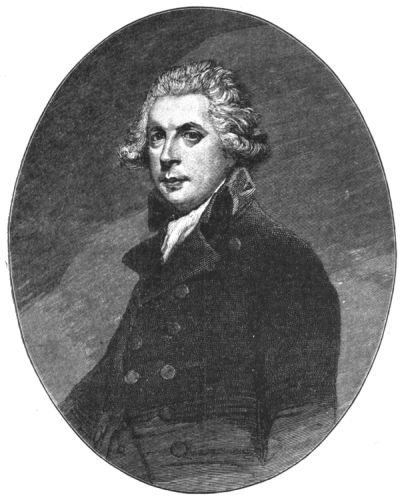
RICHARD BRINSLEY SHERIDAN. (After the Portrait by Sir Joshua Reynolds.)
[See larger version]
The great question of the Prince of Wales's debts was brought on by Alderman Newnham, who had been selected by the prince's set for that purpose, to give it more an air of independence. Newnham, on the 20th of April, asked the Chancellor of the Exchequer whether his Majesty's Ministers proposed to make any arrangement for this purpose. He praised the prince for his generous conduct in breaking up his establishment to facilitate the payment of his debts; but declared it disgraceful to the nation that he should remain in that condition. Not receiving any satisfactory answer, the alderman gave notice of a motion on the subject for the 4th of May. Pitt then endeavoured to deter the alderman from bringing in the motion, by saying that it was not his duty to do so except by command of the king. Newnham, however, persisted in his motion, and in the course of the debate Mr. Rolle, the member for Devonshire, pointedly alluded to the rumours that were afloat as to the marriage of the prince with Mrs. Fitzherbert, a Roman Catholic lady. As a matter of fact, these rumours were true: the prince had been secretly united to her by a Protestant clergyman on December 21st, 1785, in the presence of several witnesses. The marriage placed the prince in this dilemma: by the Act of Settlement, marriage with a Roman Catholic invalidated all claims to the throne; but by the Royal Marriage Act, any marriage contracted without the royal consent was null. He could therefore annul the action of the first Act by pleading the second, but by so doing he would obviously take away the character of his wife. The prince saw a better way out of the difficulty—namely, a denial that the marriage had taken place at all. Fox, completely duped by the mendacious assurances of his royal friend, was induced to get up and contradict the rumour, "by direct authority." The revulsion of feeling in the House was immediate. On the 23rd of May Pitt laid before the members a schedule of the prince's debts, amounting to one hundred and ninety-four thousand pounds. Of this sum a hundred and sixty-one thousand were voted, together with twenty thousand for the completion of Carlton House, and the king was induced to add ten thousand a year from the Civil List to the prince's income. He was thus placed for the time being in affluence, and only had to reckon with Mrs. Fitzherbert. This he did by disavowing Fox, whom he declared to have spoken without authority. But the lady appears to have urged some public explanation. The prince naturally avoided Fox, but sent for Grey, who, however, declined to have anything to do with the dirty business. "Then," said the prince, "Sheridan must say something." Accordingly, a few days later, Sheridan got up and paid a few vapid compliments to Mrs. Fitzherbert, which assuaged her wrath, without exposing the royal liar.
On the 1st of February the inquiry into the crimes of Warren Hastings was renewed. The third charge of the impeachment, the treatment of the Begums, was undertaken by Sheridan, as the first was by Burke, and the second by Fox. We have stated the facts of that great oppression, and they were brought out in a most powerful and dramatic light by Sheridan in a speech of nearly six hours. Sheridan had little knowledge of India; but he was well supplied with the facts from the records of the India House and the promptings of Francis, who was familiar with the country and the events. The effect of Sheridan's charge far exceeded all that had gone before it. When he sat down almost the whole House burst forth in a storm of clappings and hurrahs. Fox declared it the most astounding speech that he had ever heard, and Burke and Pitt gave similar evidence. The wit and pathos of it were equally amazing; but it was so badly reported as to be practically lost. The following remark, however, seems to be reported fairly accurately:—"He remembered to have heard an honourable and learned gentleman [Dundas] remark that there was something in the first frame and constitution of the Company which extended the sordid principles of their origin over all their successive operations, connecting with their civil policy, and even with their boldest achievements, the meanness of a pedlar and the profligacy of pirates. Alike in the political and the military line could be observed auctioneering ambassadors and trading generals; and thus we saw a revolution brought about by affidavits; an army employed in executing an arrest; a town besieged on a note of hand; a prince dethroned for the balance of an account. Thus it was they exhibited a government which united the mock majesty of a bloody sceptre and the little traffic of a merchant's counting-house—wielding a truncheon with one hand, and picking a pocket with the other." The debate was adjourned to the next day, for the House could not be brought to listen to any other person after this most intoxicating speech. The motion was carried by one hundred and seventy-five votes against sixty-eight.
The other charges having been voted, on the 25th of April Burke brought up the articles of impeachment. There was a long debate, in which Wilkes, who had completely changed his politics, and had cultivated a friendship with Warren Hastings and his wife, made a very effective speech in his defence. He tried to shift the blame from Hastings to the Company. Pitt again pointed out the fact that honourable members had not been showing the innocence of Hastings, but raising all manner of set-offs for his crimes—a course which he had before said he had hoped would have been abandoned; that for his part, without going to the length of all the charges brought forward, he saw sufficient grounds for an impeachment. He could conceive a State compelled by sudden invasion and an unprovided army, to lay violent hands on the property of its subjects, but then such a State must be infamous if it did not, on the first opportunity, make ample satisfaction. But was this the principle on which Mr. Hastings had acted? No; he neither avowed the necessity nor the exaction. He made criminal charges, and, under colour of them, levied immoderate penalties, which, if he had a right to take them at all, he would be highly criminal in taking in such a shape; but which, having no right to take, the mode of taking rendered much more heinous and culpable.
The report was agreed to, the impeachment was voted, and Burke, attended by the majority of the House, on the 10th of May, carried it up to the Lords. On the motion of Burke, Warren Hastings was then taken into custody, and delivered over to the Lords, who bound him to appear to take his trial, when called upon, in a bond of twenty thousand pounds himself, and Messrs. Sullivan and Sumner as his sureties in ten thousand pounds each.
In this Session the first step was taken in one of the greatest achievements of humanity which adorn the name of Britain. It was the grand preliminary towards annihilating the slave trade. The spirit of revolt against this odious trade had been gaining rapidly in the British mind. One of the earliest stabs given to it was by the pathetic story of Inkle and Yarico, in the "History of Barbadoes," by Lygon, which was taken up and amplified in the Spectator, and afterwards elaborated into an effective drama by Colman. Defoe, Dr. Johnson, Warburton in his "Divine Legation of Moses," and in his sermons so early as 1766, Voltaire, and other writers, had diffused a strong and sound feeling on the subject. It had been early attempted to establish the legal maxim, that a slave becomes a freed man in England; but in 1729 this had been positively pronounced against by Talbot and Yorke, then the highest legal authorities. But a more successful essay was made by Granville Sharp in 1772, in the case of James Somerset, and the principle was established, that the moment a slave set his foot on English ground he became free. In 1782 the Friends presented a petition to Parliament for the abolition of the slave trade. In 1785 Thomas Clarkson, then a student at the University of Cambridge, competed for and won the first prize for an essay on "The Slavery and Commerce in the Human Species," and this, which was undertaken as an academical exercise, led him to devote himself to the great work of the utter extinction of this evil. Mr. Ramsay, a clergyman of Kent, who had lived in St. Kitts, published a pamphlet on the same subject. The friends of Ramsay, Lady Middleton and Mrs. Bouverie, became zealous advocates of the cause, and finally Wilberforce resolved to make it the great object of his life. A society was now established in London, consisting only originally of twelve individuals, including the benevolent Mr. Thornton, and having Granville Sharp for its chairman. The members, however, were opulent merchants and bankers, and they set agents to work to collect information on the subject. The feeling rapidly spread; committees were formed in Manchester and other provincial towns for co-operation.
It was resolved to make the first attack only on the trade in slaves, not on the whole gigantic subject, with all its widely-ramified interests. Nay, it was deemed prudent by the committees, seeing well that the abolition of the monstrous practice of slave-holding must be a work of many years, in the first place to limit their exertions to the ameliorating of the sufferings of the negroes, in their passage from Africa to the scenes of their servitude. Numerous petitions had now reached the Houses of Parliament on the subject of the trade in and the sufferings of slaves, and a Committee of the Privy Council was procured to hear evidence on the subject. This commenced its sittings on the 11th of February, 1788. Before this committee were first heard the statements of the slave merchants of Liverpool. According to these gentlemen, all the horrors attributed to the slave trade were so many fables; so far from instigating African sovereigns to make war upon their neighbours and sell them for slaves, the oppressions of these despots were so horrible that it was a real blessing to bring away their unfortunate victims. But very different facts were advanced on the other side. On the part of the Liverpool merchants was the most palpable self-interest to colour their statements; on the other, was disinterested humanity. Amongst the gentlemen brought forward to unfold the real nature of the African traffic was Dr. Andrew Sparrman, Professor of Natural Philosophy at Stockholm, who had, with Mr. Wadström, been engaged in botanical researches in Africa. This information put to flight the pleasant myths of the Liverpool traders, and produced a profound impression.
It was resolved to bring the matter before Parliament. Wilberforce gave notice of motion on the subject, but falling ill at Bath, Clarkson applied to Pitt and Mr. Grenville, and was strongly supported by Granville Sharp and the London committee. Pitt had not considered the subject till it was forced on his attention by the evidence before the Privy Council; but he had come to the conclusion that the trade was not only inhuman, but really injurious to the interests of the nation. He consented to introduce the question, and, on the 9th of May, gave notice that early in the next Session Parliament would take into consideration the allegations against the slave trade, made in upwards of a hundred petitions presented to it. He recommended this short delay in order that the inquiries before the Privy Council might be fully matured. But both Fox and Burke—the latter of whom had been thinking for eight years of taking up the question—declared that the delay would be as cruel as it was useless; that it did not become the House to wait to receive instructions from the Privy Council, as if it were dependent upon it, but that it ought to originate such inquiries itself. Sir William Dolben supported this view of immediate action, contending that at least a Bill should be brought in to restrain the cruelties of the sea-passage, which would otherwise sacrifice ten thousand lives, as hundreds of thousands had been sacrificed before. This was acceded to. Pitt's resolution was carried by a considerable majority; and Sir William Dolben, on the 21st of May, moved to bring in a Bill to regulate the transport of slaves. Sir William stated that there was no law to restrain the avarice and cruelty of the dealers, and that the mortality from the crowding of the slaves on board was frightful.
The slave merchants of Liverpool and London demanded to be heard against even this degree of interference. On the 2nd of June counsel was heard on their behalf at the bar of the House of Commons. These gentlemen endeavoured to prove that the interest of the merchants was the best guarantee of the good treatment of the slaves; and they called witnesses to prove that nothing could be more delightful and salubrious than the condition of slaves on the voyage; and that the negroes passed their time most charmingly in dancing and singing on the deck. But, on cross-examination, these very witnesses were compelled to disclose one of the most revolting pictures of inhuman atrocity ever brought to the light of day. It was found that no slave, whatever his size, had more room during the whole voyage than five feet six inches in length, and sixteen inches in breadth; that the floor of every deck was thus densely packed with human beings; between the floor and the deck above were other platforms or broad shelves packed in the same manner! The height from the floor to the ceiling seldom exceeded five feet eight inches, and in some cases not four feet. The men were chained together two and two by their hands and feet, and were fastened by ringbolts to the deck or floor. In this position they were kept all the time they remained on the coast—often from six weeks to six months. Their allowance was a pint of water daily and two meals of yams and horse-beans. After eating they were ordered to jump in their irons to preserve their health, and were flogged if they refused. When the weather was wet they were often kept below for several days together. The horrors of what was called the "middle passage" were terrible and fatal beyond description. It was calculated that up to that time the Europeans had consumed ten millions of slaves, and that the British alone were then carrying over forty-two thousand Africans annually.
Besides the truths drawn by cross-examination from the witnesses for the slave-dealing merchants, who contended that even Sir William Dolben's Bill would nearly ruin Liverpool, Captain Parry, who had been sent by Pitt to Liverpool to examine some of the slave-ships, brought the directest proofs that the representations of these witnesses were false, and the accommodation for the slaves was most inhuman; Sir William Dolben himself had examined a slave-ship then fitting out in the Thames, and gave details which horrified the House. This Bill went to prohibit any ship carrying more than one slave to a ton of its register; the only matter in which the House gave way was that none should carry more than five slaves to every three tons, and a very few years proved that this restriction had been the greatest boon to the dealers as well as the slaves in the preservation of the living cargoes. The Bill met with some opposition in the Lords, and there Admiral Rodney and Lord Heathfield, both naturally humane men, were amongst its strongest opponents. The measure, however, passed, and received the Royal Assent on the 11th of July. Some well-meaning people thought that by legalising the freightage of slaves, England had acknowledged the lawfulness of the trade; but the advocates of the abolition made no secret of their determination to persevere, and this victory only quickened their exertions.
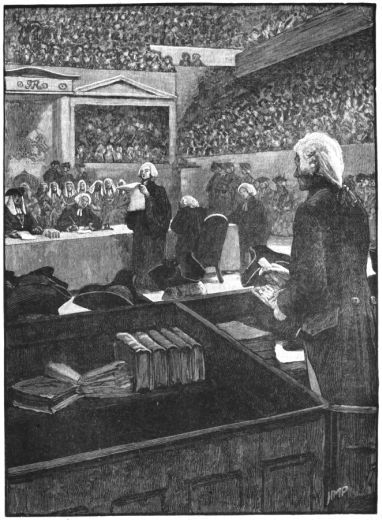
THE TRIAL OF WARREN HASTINGS. (See p. 342.)
[See larger version]
On the day appointed for the trial of Warren Hastings there was a wonderful crowding into the great hall at Westminster. The walls had been in preparation hung with scarlet, and galleries raised all round for the accommodation of spectators. The seats for the members of the House of Commons were covered with green cloth, those for the lords and all the others with red. Galleries were set apart for distinguished persons, and for the members of the foreign embassies. When the lords, nearly one hundred and seventy in number, entered in procession, the vast hall presented a striking scene, being crowded, with the exception of the space in the centre for the peers, with all who were noted in the land, from the throne downwards. The lords were all in their robes of gold and ermine, marshalled by the king-at-arms and the heralds. First entered Lord Heathfield, the brave old Elliot of Gibraltar, as the junior baron, and the splendid procession was closed by the Earl Marshal of England, the Duke of Norfolk, and by the brothers and sons of the king, the Prince of Wales last of all. The twelve judges attended to give their advice on difficult points of law, and the Managers were attended also by their counsel, Drs. Scott and Lawrence, and Mr. Mansfield, Mr. Pigot, Mr. Burke, and Mr. Douglas. The galleries blazed with the rich array of ladies and foreign costumes. There were seen the queen with her daughters, and the Princesses Elizabeth, Augusta, and Mary, the Duchess of Gloucester, Mrs. Fitzherbert, the beautiful Duchess of Devonshire, Sheridan's handsome wife, and the great actress, Mrs. Siddons. Gibbon the historian, Dr. Parr, Mr., afterwards Sir, James Mackintosh, and numbers of distinguished artists, amongst them Sir Joshua Reynolds and Gainsborough, were also present.
Warren Hastings was summoned to the bar, and there kneeling, the Lord Chancellor, Thurlow, intimated the charge against him, and assured him that, as a British subject, he would receive full justice from the highest British court. Hastings replied, in a clear and firm voice, that he had the highest confidence in the justice and integrity of that august court. The clerks of the court then commenced reading the charges against him, and the answers to them, and this reading occupied the whole of that day and the following one; and on the third, Burke rose to deliver his opening speech. This occupied the whole of four days, beginning on the 15th, and terminating on the 19th of February. The effect of that speech, notwithstanding its enormous length, was such as had scarcely ever been witnessed in a court of justice before. As he detailed the horrors practised by Hastings on the princes and people of India, both the orator and his audience were convulsed with terror and agitation. Ladies fainted away in the galleries; Mrs. Sheridan, amongst others, had to be carried out insensible: the faces of the strongest men, as well as of the more sensitive women, were flushed with emotion, or bathed in tears. In his peroration Burke far exceeded even himself. He appeared raised, enlarged into something ethereal by his subject, and his voice seemed to shake the very walls and roof of that ancient court. Finally, he exclaimed:—"I impeach Warren Hastings, Esquire, of high crimes and misdemeanours. I impeach him in the name of all the Commons of Great Britain in Parliament assembled, whose parliamentary trust he has betrayed. I impeach him in the name of the people of India, whose laws, rights, and liberties he has subverted, whose properties he has destroyed, whose country he has laid waste and desolate. I impeach him in the name, and by virtue of those eternal laws of justice which he has violated. I impeach him in the name of human nature itself, which he has cruelly outraged, injured, and oppressed, in both sexes, in every age, rank, situation, and condition of life. And I conjure this high and sacred court to let not these proceedings be heard in vain." Such was the effect of this wonderful torrent of eloquence that Hastings himself said, "For half an hour I looked up at the orator in a reverie of wonder; and during that space I actually felt myself the most culpable man on earth; but I recurred to my own bosom, and there found a consciousness that consoled me under all I heard and all I suffered."
When the intense agitation had in some degree subsided, Fox rose and proposed the mode in which the trial should be conducted, which was that the evidence on both sides should be gone through on each separate charge, and that charge immediately decided, whilst all the facts were fresh in the minds of the lords, who were the judges. But this was opposed by the counsel of Hastings, who knew well the advantage of leaving the decision till the vivid impression of the events was worn off. They succeeded in carrying their object, and when the trial terminated eight years afterwards, the result was quite according to their hopes. The Managers complained loudly, but there was no remedy. Fox, therefore, proceeded to open the Benares case, which occupied five hours. Grey took it up, and completed it the next day. Several succeeding days were employed in reading papers and hearing witnesses, and then Anstruther summed up and commented on the charge.
The court then adjourned to the 15th of April. The case of the Begums was opened by Mr. Adams, and concluded the next day by Mr. Pelham. Then sixteen days were occupied by the evidence, and at length, on the 3rd of June, Sheridan began to sum up the evidence, and, in a speech which lasted three days, he kept the court in the highest state of excitement. The place was crowded to suffocation during the whole time, and as much as fifty guineas is said to have been paid for a single seat. Greatly as this speech of Sheridan's was admired, it was felt to be too ornate and dramatic: there was not the deep and genuine feeling of Burke in it, and the effect was so evidently studied, that, on concluding, Sheridan fell back into the arms of Burke, as if overcome by his own sensations. The prorogation of Parliament was now at hand, and only two out of the twenty charges had been gone through: neither of them had yet been replied to, and yet other causes of engrossing interest arising, the trial was entirely suspended till the 20th of April of the following year! Then it was taken up languidly and at uncertain intervals, and rapidly became a mere exhibition of rhetoric. Further, Burke's unlawyer-like style and intemperance of language drew upon him the censure of the Lord Chancellor, and even of the House of Commons. A revulsion of public feeling took place, and was seen in the acquittal of Stockdale who was tried for libelling the promoters of the trial. Three years afterwards Burke himself renounced sixteen of his charges, and all popular interest in the trial gradually disappeared.
But the public attention was now freely withdrawn from Warren Hastings to much more exalted personages. On the 11th of July the king in person prorogued Parliament. He then appeared in his usual health, but soon afterwards it was whispered about that he was far from well, and had gone to Cheltenham by the advice of his physicians. When he returned in the autumn, the opinion of his derangement had gained ground, and, to remove this, a Drawing-room was held at St. James's on the 24th of October. Every means had been taken to secure the impression of his Majesty's saneness, but they failed, and the contrary impression was confirmed. Still, the king returned to Windsor, and the endeavours were strenuously maintained by the queen to conceal the melancholy fact from the public; but this was too positive to be long suppressed. On the 5th of November he met his son, the Duke of York, after he had been riding about Windsor Forest for five hours in a state of frenzy, and, bursting into tears, wished that he was dead, for that he felt he should go mad. No doubt he remembered his old sensations when he had a short but sharp fit of lunacy in 1764. The time was hurrying on which must reveal the whole truth; the prorogation of Parliament terminated on the 20th of November; the House would meet, and the king would not be able to attend and open the Session. Pitt was in a state of indescribable anxiety, having no precedents to guide him.
The 20th of November arrived; the two Houses met, and Lord Camden in the Peers, and Pitt in the Commons, were obliged to announce the incapacity of the king to open the Session, and to move for an adjournment till the 4th of December, in order that the necessary measures for transferring the royal authority, temporarily, might be taken. Fox, at this important crisis, was abroad, and had to hurry home with headlong speed, in order to join his party in their anxious deliberations preparatory to the great question of the regency. In the meantime, the king's physicians had been examined before the Privy Council, and had given their opinion that the royal malady would prove only temporary. This in particular was the opinion of Dr. Willis, a specialist who had the chief management of the case, and whose mild treatment, in contrast to the violent means previously employed, had already produced a marked improvement. From this moment Pitt appears to have taken his decision—namely, to carry matters with a high hand, and to admit the Prince of Wales as regent only under such restrictions as should prevent him from either exercising much power himself, or conferring much benefit on his adherents. When, therefore, Parliament met, after the adjournment, and that in great strength—for men of all parties had hurried up to town,—Lord Camden moved in the Lords, and Pitt in the Commons, that, in consequence of the king's malady, the minutes of the Privy Council containing the opinions of the royal physicians should be read, and that this being done, these opinions should be taken into consideration on the 8th of December.
This being done, Mr. Vyner suggested that the physicians should rather be examined by the House itself, a proposal supported by Fox. Pitt replied that this was a matter requiring much delicacy, and that the opinions of the physicians before the Council being on oath, he imagined that they had greater force than any given before Parliament, where they would not be on oath. But, during the four days' adjournment, he had ascertained, to his satisfaction, that the majority of the physicians were of opinion that the king would pretty soon recover, and that especially Dr. Willis was of this opinion, under whose more immediate care he was; and no sooner did the Commons meet, than Pitt most judiciously acquiesced in the suggestions of Vyner and Fox; and the physicians were examined by a committee of twenty-one members, of which he himself was chairman. On the 16th of December Pitt brought up the report of the committee, in which a majority of the physicians had expressed the opinion that the malady of the king would not be of long duration; and he then moved for another committee to search for precedents as to the power to be exercised by a regent. Fox declared that Pitt knew very well that there were no precedents to be found while there existed an Heir Apparent, at the time, of full age and capacity; that he was seeking only the means of delaying what ought to be done at once; that the failure of the mind of the sovereign was a case of natural demise, and that the Heir Apparent succeeded to the exercise of the royal authority from the period of that failure, as a matter of course; that the Parliament had, indeed, the authority to decide that such failure had actually taken place, and to sanction the assumption of the powers of regency, as the other two Estates of the realm, but nothing more. When Fox made this astounding assertion, Pitt slapped his thigh and exclaimed to a colleague sitting near him, "I'll unwhig the gentleman for the rest of his life."
He immediately made use of the opportunity with great skill. In his reply he urged that Fox was announcing a doctrine destructive of the Constitution; that he was denying the right by which Parliament had placed the present family on the throne, and he asserted that the Prince of Wales had no more natural right to assume the regency than any other individual. This led to the severest censures of the Premier by Burke, who declared that Pitt was making himself a dictator, and changing the succession to the regal power in England from hereditary to elective. The same doctrine was announced and combated in the Lords; but there, though Thurlow was silent, waiting to see how matters would go before he hazarded an opinion, Loughborough boldly supported Fox's doctrine, and declared that had the derangement of the king taken place during the non-existence of Parliament, the prince undoubtedly would have been warranted in issuing writs and summoning one. On the 15th of December the Duke of York and his uncle, the Duke of Gloucester, both spoke on the question, expressing their sense of the inexpediency of pressing the delicate question of right, and stating that Parliament could proceed to invest the Prince of Wales with the powers of the regency without waiting, as they certainly could not appoint any one else. Thurlow had by this time found that he had no chance with the Whigs, and he now, with unblushing assurance, took the part of Pitt, though every one knew why he had been hanging back till this moment. He declared that he could not see how Parliament could avoid coming to some conclusion on the question of right, seeing that it had been raised. At the same time, he made a most pretendedly pious defence of the rights of the king against the prince and the Whigs, exclaiming—"When I forget my king, may God forget me!" John Wilkes, who was standing in a knot of spectators near the throne, and within a few feet of Thurlow, expressed his disgust at this duplicity in his characteristically vigorous fashion.
Pitt, in a series of motions and violent debates on them—which did not terminate till the 23rd of January, 1789—not only carried his point, that Parliament should assert the whole right of appointing a regent, but he contrived to tie down the prince completely. On the 16th of December Pitt moved three resolutions—the third and most material of which was, that it was necessary that both Houses should, for the maintenance of the constitutional authority of the king, determine the means by which the royal assent might be given to an Act of Parliament for delegating the royal authority during the king's indisposition. After most determined opposition by the Whigs, he carried the whole of these resolutions, and it was then moved that the proper mode of doing this was to employ the Great Seal just as if the king were in the full exercise of his faculties. To prepare the way for this doctrine, the lawyers in Pitt's party had declared that there was a broad distinction between the political and the natural capacity of the king; that, as the king could do no wrong, so he could not go politically, though he might go naturally, mad; that therefore the king, in his political capacity, was now as fully in power and entity as ever, and therefore the Great Seal could be used for him as validly as at any other time. In vain did Burke exclaim that it was "a phantom," "a fiction of law," "a mere mummery, a piece of masquerade buffoonery, formed to burlesque every species of government." In the midst of the debate Mr. Rushworth, the young member for Newport, in Hampshire, standing on the floor of the House, exclaimed, in a loud and startling tone, "I desire that gentlemen of more age and experience than myself will refer to the glorious reign of George II. Let them recall to their memory the year 1745. Suppose that great and good king had lain under a similar affliction of madness at that period, where are the men, much less a Minister, that would have dared to come down to that House, and boldly, in the face of the world, say that the Prince of Wales had no more right to the regency than any other subject? The man or Minister who could have dared to utter such language must henceforward shelter in some other place than in the House of Commons, and in some other country than England!" The Prince of Wales, by letter, complained of the want of respect shown to him, but Pitt carried the resolution regarding the Great Seal, that it should be appended to a commission for opening Parliament, it now occupying the position of a convention, and that the commission should then affix the royal assent to the Bill for the regency. This done, he consented to the demand for the appearance of the physicians again before proceeding with the Bill, and the physicians having expressed hopes of the king's speedy recovery, on the 16th of January Pitt moved the following resolutions:—That the Prince of Wales should be invested with the royal authority, subject, however, to these restrictions, namely, that he should create no peers; that he should grant no place or pension for life, or in reversion, except such place as in its nature must be held for life, or during good behaviour; that the prince should have no power over the personal property of the king, nor over the king's person or household; that these two latter powers should be entrusted to the queen, a council being appointed to assist her in these duties by their advice, but subject to her dismissal, and without any power of alienation of any part of the property. The bad character of the prince, combined with the rumours of his indecent jests at the expense of his unhappy parents, rendered the restrictions universally popular.
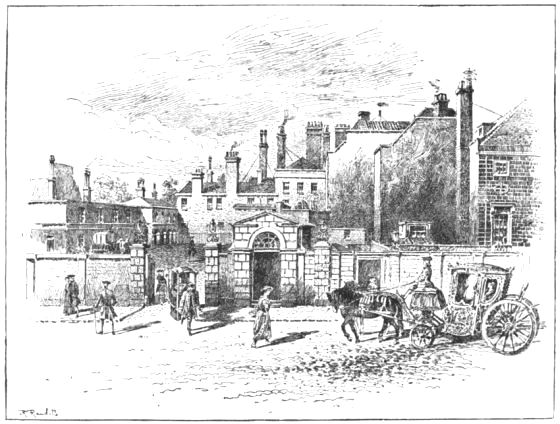
CARLTON HOUSE, LONDON (1780).
[See larger version]
These resolutions being carried, it then became a question whether the prince would accept this restricted regency. Burke had warned the House that perhaps, after all, the prince would not accept such a shadow of his own natural powers, and he warned them likewise that the British Parliament might find itself electing the prince as regent, whilst the Irish Parliament was nominating him as by right. But it would appear that the Whigs were so anxious to seize on office, even under such cramping restrictions, and to see Pitt dethroned, that they advised the prince to accept. A joint committee of Lords and Commons waited on him on the 30th of January, the anniversary of the execution of Charles I., and another joint-committee the same day waited on the queen, and the next day their answers, accepting their respective offices, were communicated to Parliament. The prince, indeed, qualified his acceptance by declaring that he did it only as a temporary arrangement, and in the hope, notwithstanding the peculiar and unprecedented circumstances, of preserving the interests of the king, the crown, and the people.
A commission was then moved for, under the Great Seal, by Lord Camden, and in this commission were included the names of the Prince of Wales, the Dukes of York, Gloucester, and Cumberland. These royal personages, however, declined to be named in it. With these remarkable omissions, Camden's motion was passed, and the result was communicated to the Commons, on which Pitt, on the 2nd of February, moved for the concurrence of that House. This again brought up the question of the prince's right. Lord North, who, though now blind, had mixed in these debates with his usual moderation, and with a great display of good sense, based on official experience, expressed his pleasure that the prince had condescended to accept the regency, notwithstanding its limitations. This prudence, he observed, had given the country an agreeable surprise, considering the temptations to stand upon his right, which must have produced inconceivable embarrassments. Pitt could not resist the impulse to arise and again deny the right, and observe that he believed those who had advocated that right were now really ashamed of it. This immediately called up Burke, for Fox was ill, and away at Bath, and he exclaimed, "I assert that the Prince of Wales's right is clear as the sun, and that it is the duty of the House to appoint him regent, with the full powers of sovereignty." He asserted with equal warmth, that Ministers were about to purloin the Great Seal, and commit an act of forgery. A stormy debate followed, in which Burke's violence was met with moderation and dignity.
On the 3rd of February the Commons attended to hear the commission read at the bar of the Lords, which was done by Earl Bathurst, in the absence of Thurlow. On returning to their House now as an authorised Parliament, the Commons read the Bill for the first time without a division, but on the second reading, on the 6th of February, Burke attacked it with unabated ferocity. He wanted to know how they were to determine when the king was sane again. Who was to inform them of it? Who was to certify it? He asserted the utter impossibility of adducing proof whether a person who had been insane were perfectly recovered or not. If this doctrine had been established, the regency must have become permanent. But this mode of reasoning was too metaphysical for the House of Commons; the debate passed on, and the Bill was committed. The clause providing against the non-residence of the prince, and against his marrying a papist, again brought up Mr. Rolle. He said that he had given his assent to the appointment of the prince regent on the assurance of his friends, that he was not married to a certain lady, either in law or in fact; but that he had since read a famous pamphlet, which affirmed that the facts were in opposition to those avowals. This was a brochure of Horne Tooke's, in the shape of a letter to a friend, in which he declared his positive knowledge of the prince's marriage with "the late Mrs. Fitzherbert," who, he contended, in spite of the Marriage Act, was his lawful wife. Rolle was answered by Lord North, who declared that the object of the pamphleteer was simply to make mischief by throwing out assertions that he never meant to prove, and Welbore Ellis called for the reading of the Royal Marriage Act, and showed that no royal marriage could be valid without the king's consent, and that, therefore, whatever was the case, all those objections were a mere waste of words. Rolle did not press the question to a division. The other clauses of the Bill raised much debate, but were all passed, and on the 10th of February the council was appointed to assist the queen in her charge, and Pitt named as members of it the four principal officers of the household, the Lord Chamberlain, the Lord Steward, the Master of the Horse, and the Groom of the Stole, with the addition of the Archbishop of Canterbury, Lord Chancellor Thurlow, the Archbishop of York, and Lord Kenyon. The names of the Prince of Wales, the Duke of York, several of the other princes, the Lord Mayor of London, and the Speaker of the House of Commons, were all strongly urged upon Parliament as persons who ought to be members of this council, but they were, to a man, rejected by a majority of about fifty.
Pitt had not forgotten the difficulty started by Burke, as to the recognition of the return to entire sanity of the king, and he now met it by proposing that when five out of the eight councillors appointed to assist the queen should declare the king's health restored, they should notify this to the political servants of the regent, and announce it in the London Gazette, as well as communicate it to the Lord Mayor; that the king should then summon nine of his Privy Council, who, sitting in council with him should be able to observe whether he were perfectly restored or not; and if six of the nine agreed that he was so, these six should sign a proclamation to that effect, on which the regency should cease and determine. Various amendments on this motion were made, but without effect, and it was carried. On the 12th of April the Regency Bill finally passed the Commons, and was carried up to the Lords, with the addition of a clause limiting the restriction on the making of peers to three years.
Reports that the king was rapidly recovering now began to fly about Court, daily gaining strength. The Whigs, impatient to seize on office, were in a state of strange excitement; but to go in with the prospect of being immediately dismissed by the king, did not accord with the dignity of the leaders. On the other hand, there were so many good things to be given away—one or two bishoprics, the office of Chief Justice in Eyre, sundry commissions of Major-General, besides expectations of promotions to the rank of Field-Marshal—that the dependents of the party grew impatient. Neither the Whigs nor Pitt knew well what to do. The Lords did not commit the Bill till the 17th, when they made two important additions to it, namely, to place all the palaces, parks, houses, and gardens of the king under the control of the queen, and to give her the care of all the royal children under the age of twenty-one. But, at that very crisis, the king was pronounced convalescent. On the 19th, Lord Thurlow announced this, on the certificate of the physicians; and it was declared by him that their lordships could not, in these circumstances, proceed with the Bill, but had better adjourn till Tuesday next. The Duke of York observed that he should most gladly have corroborated the statement of the Lord Chancellor, but could not, having called the day before at Kew, to desire that he might see his father, but had not been permitted. The House, however, adjourned, and on Tuesday, the 24th, Thurlow informed it that he had seen his Majesty, had found him perfectly recovered, and therefore he moved another adjournment to the Monday following, which was agreed to.
On the very next day took place what Burke had foreseen. A deputation from the two Irish Houses of Parliament arrived in London, with an address to His Royal Highness the Prince of Wales, requesting him to assume the regency as his right. Though the English Bill was now certain to be abandoned, this address was presented on the 26th of February, the day after the arrival, and was received by the prince in a manner likely to mark his sense of his treatment by Pitt and his party. The deputies were entertained at a splendid banquet; the walls of the dining-room at Carlton House were adorned with Irish harps, the shamrock, and other Irish emblems; the arms of Ireland, encircled by a glory, blazed in the centre of the table, and the richest wines flowed in torrents. But these banquetings had not been confined to this more auspicious day. Whilst the great contest had been going on in Parliament, dinners had been given on the Saturdays and Sundays of every week at Carlton House, to which about thirty of the members of both Houses had been invited, and at which the prince and the Duke of York had presided. Besides these, the attractions and persuasive powers of the great ladies on both sides had been enthusiastically called into play. The fascinating Duchess of Devonshire, who, in 1784, had so successfully canvassed for Charles James Fox in Westminster, had now thrown open her house, and employed all her amiabilities to win supporters to the prince's party. On the other hand, the more bold and vigorous Duchess of Gordon had feasted, entreated, and almost commanded adherence to Pitt, through whom it was said her husband had obtained the Great Seal of Scotland, and his brother, Lord William Gordon, the sinecure Rangerships of St. James's and Hyde Parks. The rivalries of these parties had been carried on in the most public manner, by caricatures, lampoons, ballads, and popular jests. Westminster was pre-eminently Whig; but London, which had formerly been so democratic, had become essentially loyal. The Coalition had given the first shock to the popularity of the Whigs in the City, and the sympathy for the calamity of the king, combined with disgust at the prince's levity and heartlessness, had produced a wonderful degree of loyalty there.
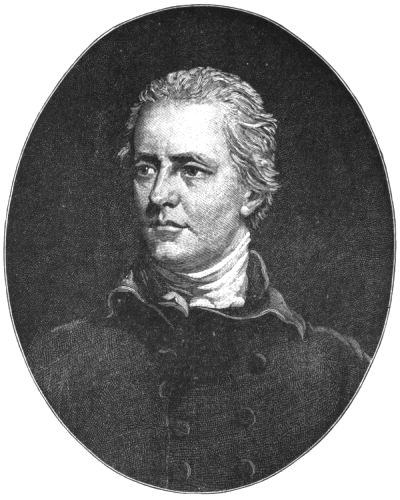
WILLIAM PITT. (After the Portrait by John Hoppner, R.A.)
[See larger version]
Both Houses adjourned, by successive motions, to the 10th of March; they then met, and were informed by the Lord Chancellor that, by the blessing of Providence, his Majesty being recovered from his severe indisposition, and able to attend to the public affairs of his kingdom, had issued a commission authorising the holding and continuing of Parliament; and the commission having been read, the Chancellor declared himself commanded to convey to them his Majesty's warmest acknowledgments for the additional proofs they had given of their attachment to his person. Addresses were then moved, as at the commencement of a Session, by both Houses, and also addresses of congratulation to her Majesty the queen; and the same evening the capital was illuminated, and the most sincere joy was evidenced in the happy event of the royal convalescence. On the 8th of April Pitt informed the House that the king had appointed Thursday, the 23rd of that month, as a day of public thanksgiving for his recovery, and that it was his Majesty's intention to go in procession to St. Paul's Cathedral on that day, to return thanks to Almighty God. The House voted thanks for his Majesty's having taken measures for their accommodation on the occasion, and passed a resolution to attend.
On the appointed day the two Houses of Parliament, the officers of State, the judges, all in their robes of state, the queen, and princes and princesses, attended the king on this solemn occasion. The streets were crowded with the inhabitants; the Lord Bishop of London, and the Dean and Canons of St. Paul's received him at the door. His entrance was announced by the sound of martial music from military bands on the outside, and the roar of the organs and the voices of five thousand children of the City charity schools inside, singing the Hundredth psalm. On walking across the area, under the great dome, the king was deeply affected, and observed to the Bishop of London and the Dean of St. Paul's, "I now feel that I have been ill." After the singing of the Te Deum, and the firing of the Tower and Park guns, the procession returned to St. James's as it had come. The popularity of the king was unbounded, and so was that of the great Minister who had stood by him in the hour of his adversity. Pitt was now at the zenith of his career.