THE STORY OF CANADA. (continued 6)
Reading edition
The immediate result of the rebellion in Lower Canada was the intervention of the imperial authorities by the suspension of the constitution of that province, and the formation of a special council for purposes of temporary government. Lord Durham, a nobleman of great ability, who had won distinction in imperial politics as a Reformer, was sent out to Canada as governor-general and high commissioner to inquire into and adjust provincial difficulties. This distinguished statesman remained at the head of affairs in the province from the last of May, 1838, until the 3rd of November in the same year, when he returned to England, where his ordinance of the 28th of June, sentencing certain British subjects in custody to transportation without a form of trial, and subjecting them and others not in prison to death in case of their return to the country, without permission of the authorities, had been most severely censured in England as quite unwarranted by law. By this ordinance Wolfred Nelson, Bouchette, Viger, and five others, then in prison, were banished to Bermuda, while Papineau, Cartier, O'Callaghan, Robert Nelson, and others beyond Canadian jurisdiction, were threatened with death if they returned to the province. Lord Durham's action was certainly in conflict with the principles of English law, but it was an error of judgment on the side of clemency. He was unwilling to resort to a court-martial—the only tribunal open to the authorities. A trial in the courts of justice was impracticable under existing conditions, as it was shown later. Lord Durham left Canada in deep indignation at the manner in which his acts had been criticised in England, largely through the influence of Lord Brougham, his personal enemy. The most important result of his mission was a report, the credit for the authorship of which was long denied to him through the misrepresentations of his enemies, though it is now clear that he and not his secretary was the author.
Soon after the departure of Lord Durham, who died a few months later, Sir John Colborne became governor-general. He was called upon to put down another rebellious movement led by Robert Nelson, brother of Wolfred Nelson, then in exile. At Caughnawaga, Montarville Mountain, Beauharnois, and Odelltown the insurgents made a stand from time to time, but were soon scattered. Bands of marauders inflicted some injury upon loyal inhabitants near the frontier, but in a few months these criminal attempts to disturb the peace of the province ceased entirely. The government now decided to make an example of men who had not appreciated the clemency previously shown their friends. Twelve men were executed, but it was not possible to obtain a verdict from a jury against the murderers of Weir and Chartrand—the latter a French Canadian volunteer murdered under circumstances of great brutality while a prisoner.
The rebellion opened the eyes of the imperial government to the gravity of the situation in Canada, and the result of Lord Durham's report was the passage of an imperial act reuniting the provinces into one, with a legislature of two houses. The constitutional act of 1791, which had separated French and English, as far as possible, into two sections, was clearly a failure. An effort was now to be made to amalgamate, if possible, the two races. The two provinces were given an equal representation in one legislature, and the French language was placed in a position of inferiority, compared with English in parliamentary and official proceedings and documents. At the same time the British Government recognised the necessity of giving a larger expansion of local self-government.
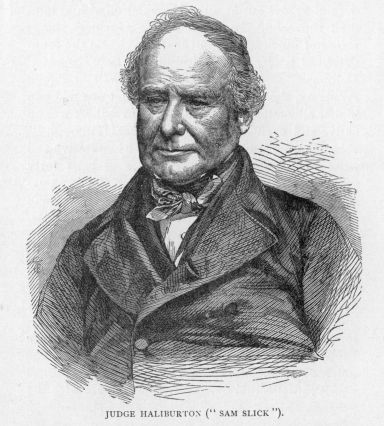
Judge Haliburton ("Sam Slick").
During the period of which I am writing Canada had given evidences of material, social, and intellectual progress. With the close of the War of 1812, and the downfall of Napoleon, large bodies of immigrants came into the province and settled some of the finest districts of Upper and Lower Canada. Scotch from the highlands and islands of Scotland continued until 1820 to flock into Nova Scotia and other maritime provinces. Although the immigration had been naturally stopped by the troubles of 1836 and 1838, the population of Canada had increased to over a million of souls, of whom at least four hundred and fifty thousand were French Canadians. The Rideau, Lachine, and Welland Canals date from this period, and were the commencement of that noble system of artificial waterways that have, in the course of time, enabled large steamers to come all the way from Lake Superior to tide-water.[1] In 1833 the Royal William, entirely propelled by steam, crossed the ocean—the pioneer in ocean steam navigation. A few years later Samuel Cunard, a native Nova Scotian, established the line that has become so famous in the world's maritime history. In Lower Canada the higher education was confined to the Quebec Seminary, and a few colleges and institutions, under the direction of the Roman Catholic clergy and communities. Among the habitants generally there were no schools, and the great majority could neither read nor write. In Upper Canada high schools for the education of the upper classes were established at a very early day, and the Cornwall Grammar School, under the superintendence of Dr. John Strahan, for some years was the resort of the provincial aristocracy. Upper Canada College dates from these early times. But in 1838 there were only twenty-four thousand children at school out of a total population of four hundred thousand. In the maritime provinces things were not much better, but in Nova Scotia the foundation of King's,—the oldest university in Canada—Dalhousie, and Acadia Colleges, as well as Pictou Academy, shows the deep interest that was taken in higher education. In all the provinces there was an active and even able newspaper press, although its columns were too much disfigured by invective and personalities. In 1836 there were at least forty papers printed in Upper Canada alone. The names of Cary, Neilson, Mackenzie, Parent, Howe, and Young are among the names of eminent journalists. It was only in the press, in the pulpit, at the bar, and in the legislature that we can look for evidences of intellectual development. The only original literary works of importance were those of Judge Haliburton, who had already given us the clever, humorous creation of "Sam Slick," and also written an excellent history of Nova Scotia. In the happy and more prosperous times that followed the union of 1840, and the establishment of political liberty, intellectual development kept pace with the progress of the country in wealth and population.
XXV.
RESPONSIBLE GOVERNMENT AND ITS RESULTS—FEDERAL UNION—RELATIONS BETWEEN CANADA AND THE UNITED STATES.
(1839-1867.)
The passage of the Union Act of 1840 was the commencement of a new era in the constitutional history of Canada as well as of the other provinces. The most valuable result was the admission of the all-important principle that the ministry advising the governor should possess the confidence of the representatives of the people assembled in parliament. Lord Durham, in his report, had pointed out most forcibly the injurious consequences of the very opposite system which had so long prevailed in the provinces. His views had such influence on the minds of the statesmen then at the head of imperial affairs, that Mr. Poulett Thomson, when appointed governor-general, received her Majesty's commands to administer the government of the united provinces "in accordance with the well-understood wishes and interests of the people," and to employ in the public service only "those persons who, by their position and character, have obtained the general confidence and esteem of the inhabitants of the province." During the first session of the Canadian legislature the assembly passed certain resolutions which authoritatively expressed the views of the supporters of responsible government.
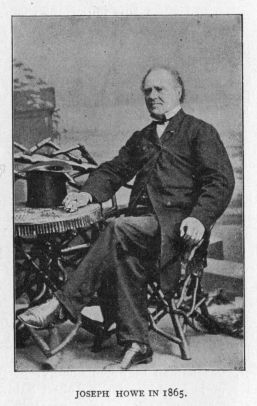
Joseph Howe in 1865
Nevertheless, during the six years that elapsed after the passage of this formal expression of the views of the large majority of the legislature, "Responsible Government" did not always obtain in the fullest sense of the phrase, and not a few misunderstandings arose between the governors and the supporters of the principle as to the manner in which it should be worked out. In Canada Lord Metcalfe, who succeeded Baron Sydenham—the title of Mr. Poulett Thomson—on his sudden death at Kingston in 1841, brought about a political crisis in consequence of his contention for the privilege—utterly inconsistent with the principles of responsible government—of making appointments to office without the advice of his council. In Nova Scotia Sir Colin Campbell, who was more suited to the military camp than to the political arena, endeavoured to throw obstacles in the way of the new system, but he was soon recalled. His successor, Lord Falkland, a vain nobleman, was an unhappy choice of the colonial office. He became the mere creature of the Tory party, led by James W. Johnston, a very able lawyer and eloquent speaker, and the open enemy of the liberals led by Joseph Howe, William Young, James Boyle Uniacke, and Herbert Huntington. The imperial government recognised their mistake, and replaced Lord Falkland by Sir John Harvey, the hero of Stoney Creek in 1813, who had done much to establish parliamentary government in New Brunswick. In 1847 Lord Elgin—the son-in-law of Lord Durham—was appointed governor-general, and received positive instructions "to act generally upon the advice of his executive council, and to receive as members of that body those persons who might be pointed out to him as entitled to do so by their possessing the confidence of the assembly." No act of parliament was necessary to effect this important change; the insertion and alteration of a few paragraphs in the Governor's instructions were sufficient. By 1848 the provinces of Canada, Nova Scotia, and New Brunswick, and by 1851 Prince Edward Island, were in the full enjoyment of a system of self-government, which had been so long advocated by their ablest public men; and the results have proved, on the whole, despite the excesses and mistakes of party, eminently favourable to political as well as material development.
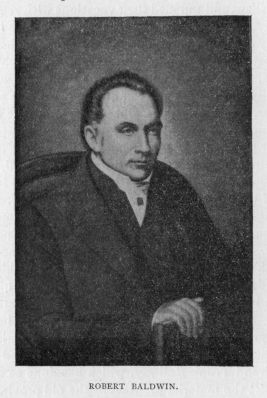
Robert Baldwin.
In the historic annals of the great contest that was fought for responsible government, some names stand out most prominently. Foremost is that of Joseph Howe, the eminent Liberal, whose eloquence charmed the people of Nova Scotia for many years. In his early life he was a printer and an editor, but he became a leader of his party soon after he entered the legislature, and died a lieutenant-governor of his native province. In New Brunswick, Lemuel A. Wilmot, afterwards a judge and lieutenant-governor, was a man of much energy, persuasive eloquence, and varied learning. Robert Baldwin, of Upper Canada, was a statesman of great discretion, who showed the people how their liberties could be best promoted by wise and constitutional agitation. Louis Hyppolite Lafontaine was one of the most distinguished and capable men that French Canada has ever given to the legislature and the bench. By his political alliance with Mr. Baldwin, the principles of responsible government were placed on a durable basis. In the parent state the names of Lord John Russell, Mr. Gladstone, and Earl Grey—colonial secretaries from 1839 to 1852—are especially associated with the concession of those great principles which have enlarged the sphere of self-government in the colonies of the English Crown.
During the quarter of a century that elapsed from 1842 to 1867—the crucial period of national development—an industrious population flowed steadily into the country, the original population became more self-reliant and pursued their vocations with renewed energy, and confidence increased on all sides in the ability of the provinces to hold their own against the competition of a wonderfully enterprising neighbour. Cities, towns, and villages were built up with a rapidity not exceeded even on the other side of the border. In those days Ontario became the noble province that she now is by virtue of the capacity of her people for self-government, the energy of her industrial classes, the fertility of her soil, and the superiority of her climate. The maritime industry of the lower provinces was developed most encouragingly, and Nova Scotia built up a commercial marine not equalled by that of any New England State. The total population of the provinces of British North America, now comprised within the confederation of 1867, had increased from a million and a half in 1840 to three millions and a quarter in 1861—the ratio of increase in those years having been greater than at any previous or later period of Canadian history. It was during this period that the Grand Trunk Railway, which has done so much to assist the material progress of the old province of Canada, was constructed. In 1850 there were only fifty miles of railway in operation throughout Canada, but by 1867 there were nearly three thousand miles, and that magnificent example of engineering skill, the Victoria Bridge, carried passengers across the St. Lawrence at Montreal, and connected Canada with the great railway system of the United States. With railway development must always be associated the name of Sir Francis Hincks, an able statesman of the Liberal party, who recognised the necessities of a new country.
So far from the act of 1840, which united the Canadas, acting unfavourably to the French Canadian people it gave them eventually a predominance in the councils of the country. French soon again became the official language by an amendment to the union act, and the claims providing for equality of representation proved a security when the upper province increased more largely in population than the French Canadian section. The particular measure which the French Canadians had pressed for so many years on the British Government, an elective legislative council, was conceded. When a few years had passed the Canadian legislature was given full control of taxation, supply, and expenditure, in accordance with English constitutional principles. The clergy reserves difficulty was settled and the land sold for public or municipal purposes, the interest of existing rectors and incumbents being guarded. The great land question of Canada, the seigniorial tenure of Lower Canada, was disposed of by buying off the claims of the seigniors, and the people of Lower Canada were freed from exactions which had become not so much onerous as vexatious. Municipal institutions of a liberal nature were established, and the people of the two Canadian provinces exercised that control of their local affairs in the counties, townships, cities, and parishes which is necessary to carry out public works indispensable to the comfort, health, and convenience of the community, and to supplement the efforts made by the legislature, from time to time, to provide for the general education of the country. With the magnificent system of public schools now possessed by Ontario must always be associated the name of Dr. Egerton Ryerson, a famous Methodist, the opponent of Mackenzie's seditious action, and for many years the superintendent of education. In Nova Scotia it was chiefly through the foresight of Sir Charles Tupper, when premier, that the foundations were laid of the present admirable system. During the same period the schools of New Brunswick and Prince Edward Island were also placed on an excellent basis. In the maritime provinces no express legal provision was made for separate or denominational schools, as in Upper and Lower Canada—schools now protected by the terms of the federal union of 1867. The civil service, which necessarily plays so important a part in the administration of government, was placed on a permanent basis.
The anxiety of the British Government to bury in oblivion the unfortunate events of 1837-38 was proved by an amnesty that was granted soon after the union of 1841, to the banished offenders against the public peace and the Crown. William Lyon Mackenzie, Louis Joseph Papineau, and Wolfred Nelson came back and were elected to Parliament, though the two first never exercised any influence in the future.
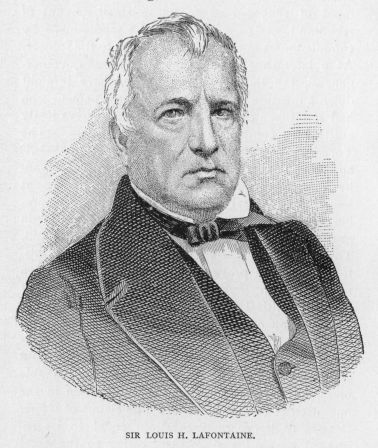
Sir Louis H. Lafontaine.
Then occurred an event which had its origin in the rebellion, and in the racial antagonism which was still slumbering in the bosom of the State. In the first session of the Union Parliament, compensation was granted to those loyalists of Upper Canada, whose property had been unnecessarily or wantonly destroyed during the outbreak. The claim was then raised on behalf of persons similarly situated in Lower Canada. The Conservative Draper government of 1845 agreed to pay a small amount of rebellion losses as a sequence of a report made by commissioners appointed to inquire into the subject. At a later time, when Lord Elgin was governor-general, the Baldwin-Lafontaine ministry brought down a measure to indemnify all those persons who had not taken part in the rebellion, but were justly entitled to compensation for actual losses. The Tory opposition raised the cry, "No pay to rebels," and some of them in their anger even issued a manifesto in favour of annexation. The parliament house at Montreal was burned down, a great number of books and records destroyed, and Lord Elgin grossly insulted for having assented to the bill. This very discreditable episode in the political history of Canada proved the extremes to which even men, professing extreme loyalty, can be carried at times of political passion and racial difficulty.
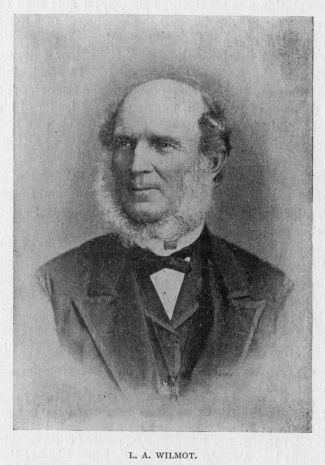
L. A. Wilmot.
The union of 1841 did its work, and the political conditions of Canada again demanded another radical change commensurate with the material and political development of the country, and capable of removing the difficulties that had arisen in the operation of the act of 1840. The claims of Upper Canada to larger representation, equal to its increased population since 1840, owing to the great immigration which had naturally sought a rich and fertile province, were steadily resisted by the French Canadians as an unwarrantable interference with the security guaranteed to them under the act. This resistance gave rise to great irritation in Upper Canada, where a powerful party made representation by population their platform, and government at last became practically impossible on account of the close political divisions for years in the assembly. At the head of the party demanding increased representation was Mr. George Brown, an able man of Scotch birth, who became the conductor of a most influential organ of public opinion, The Toronto Globe, and the leader of the "Grits," or extreme wing of the Reformers or Liberals. In opposition to him were allied Mr. George Etienne Cartier, once a follower of Papineau, but now a loyal leader of his race, and Mr. John Alexander Macdonald, who had occupied a prominent position for years as a Conservative leader.
The time had come for the accomplishment of a great change foreshadowed by Lord Durham, Chief-Justice Sewell, Mr. Howe, Sir Alexander Gait, and other public men of Canada: the union of the provinces of British North America. The leaders of the different governments in Canada, and the maritime provinces of Nova Scotia, New Brunswick, and Prince Edward Island combined with the leaders of the opposition with the object of carrying out this great measure. A convention of thirty-three representative men[1] was held in the autumn of 1864 in the historic city of Quebec, and after a deliberation of several weeks the result was the unanimous adoption of a set of seventy-two resolutions embodying the terms and conditions on which the provinces through their delegates agreed to a federal union. These resolutions had to be laid before the various legislatures and adopted in the shape of addresses to the Queen, whose sanction was necessary to embody the wishes of the provinces in an imperial statute.
The consent of the legislature was considered sufficient by the governments of all the provinces except one, though the question had never been discussed at the polls. In New Brunswick alone was the legislature dissolved on the issue, and it was only after a second general election that the legislature agreed to the union. In Nova Scotia, after much discussion and feeling, the legislature passed a resolution in favour of the measure, though a popular sentiment continued to exist against the union for several years. In the December of 1866 a second conference of delegates from the governments of Canada, Nova Scotia, and New Brunswick, was held at the Westminster Palace Hotel in London, and some modifications were made in the Quebec resolutions, chiefly with a view of meeting objections from the maritime provinces. In the early part of 1867 the imperial parliament, without a division, passed the statute known as the "British North America Act, 1867," which united in the first instance the province of Canada, now divided into Ontario and Quebec, with Nova Scotia and New Brunswick, and made provisions for the coming in of the other provinces of Prince Edward Island, Newfoundland, British Columbia, and the admission of Rupert's Land and the great Northwest.
From 1840 to 1867 the relations of Canada and the United States became much closer, and more than once assumed a dangerous phase. In 1840 the authorities of New York arrested one Macleod on the charge of having murdered a man employed in the Caroline, when she was seized by the loyalists during the outbreak of 1837. The matter gave rise to much correspondence between the governments of Great Britain and the United States, and to a great deal of irritation in Canada, but happily for the peace of the two countries the courts acquitted Macleod, as the evidence was clear he had nothing to do with the seizure of the vessel. In 1842 the question of the boundary between Maine and New Brunswick was settled by what is generally known in Canada as "the Ashburton Capitulation." As a result of the settlement made by Mr. Daniel Webster on the part of the United States, and of Mr. Alexander Baring, afterwards Lord Ashburton, on behalf of Great Britain, the State of Maine now presses like a huge wedge into the provinces of New Brunswick and Quebec, and a Canadian railway is obliged to pass over American territory, which many Canadians still believe ought to be a part of the Canadian Dominion. In 1846 Great Britain yielded to the persistency of American statesmen, and agreed to accept the line 49 degrees to the Pacific coast, and the whole of Vancouver Island, which, for a while, seemed on the point of following the fate of Oregon, and becoming exclusively American territory. But the question of boundary was not even then settled, as the Island of San Juan, which lies in the channel between Vancouver and the mainland, and is mainly valuable as a base of offensive and defensive operations in times of war, was, in later years, handed over to the Republic as a result of its successful diplomacy.
During this period the fishery question again assumed considerable importance. American vessels were shut out from the waters of certain colonial bays, in accordance with the convention of 1818, and a number of them captured from time to time for the infringement of the law. The United States Government attempted to raise issues which would limit Canadian rights, but all these questions were placed in abeyance for twelve years by the Reciprocity Treaty of 1854, which opened up the provincial fisheries to the people of the United States, on condition of free trade between the provinces and that country in certain natural products of the mines, fisheries, and farms of the two peoples. This measure was in itself an acknowledgment of the growing importance of the provinces, and of the larger measure of self-government now accorded them. The treaty only became law with the consent of the provincial legislatures; and, although the Canadian governments were not directly represented by any of their members, the governor-general, Lord Elgin, who personally conducted the negotiations on the part of England at Washington, in this, as in all other matters touching colonial interests, was assisted by the advice of his responsible ministers. The treaty lasted until 1866, when it was repealed by the action of the United States in accordance with the provision bringing it to a conclusion after one year's notice from one of the parties interested.
The commercial classes in the Eastern and Western States were, on the whole, favourable to an enlargement of the treaty, so as to bring in British Columbia and Vancouver Island, now colonies of the Crown, and to include certain other articles the produce of both countries, but the real cause of its repeal was the prejudice in the North against the provinces for their supposed sympathy for the Confederate States during the War of the Rebellion. A large body of men in the North had brought themselves foolishly to believe that the repeal of the treaty would, sooner or later, force the provinces into annexation. A raid made by a few rash Confederates who had found refuge in Canada, on the St. Albans Bank, in the State of Vermont, deeply incensed the people of the North, though at no time could it be proved that the Canadian authorities had the least suspicion of the proposed expedition. On the contrary, they brought the culprits to trial, placed companies of volunteers along the frontier, and even paid a large sum of money in acknowledgment of an alleged responsibility when some of the stolen money was returned to the robbers on their release by a Montreal magistrate. When we review the history of those times and consider the difficult position in which Canada was necessarily placed, it is remarkable how honourably her government discharged its duties of a neutral between the belligerents.
No doubt the position of Canada was made more difficult at that critical time by the fact that she was a colony of Great Britain, against whom both North and South entertained bitter feelings by the close of the war; the former mainly on account of the escape of Confederate cruisers from English ports, and the latter because she did not receive active support from England. The North had also been much excited by the promptness with which Lord Palmerston had sent troops to Canada when Mason and Slidell were seized on an English packet on the high seas, and the bold tone held by some Canadian papers when it was doubtful if the prisoners would be released.
Contemporaneously with the repeal of the Reciprocity Treaty came the raids of the Fenians—bands of men who did dishonour to the cause of Ireland, under the pretence of striking a blow at England through Canada, where their countrymen have always found happy homes, free government, and honourable positions. For months before the invasion American newspapers were full of accounts of the assembling and arming of these bands on the frontiers of Canada. They invaded the Dominion in 1866, property was destroyed, and a number of Canadian youth lost their lives near Ridgeway, in the Niagara district, but one O'Neil and his collection of disbanded soldiers and fugitives from justice were forced back by the Canadian forces to the country whose neutrality they had outraged. The United States authorities had calmly looked on while all the preparations for these raids were in progress. Proclamations were at last issued by the government when the damage had been done, and a few raiders were arrested; but the House of Representatives immediately sent a resolution to the President, requesting him "to cause the prosecutions, instituted in the United States courts against the Fenians, to be discontinued if compatible with the public interest"—a request which was complied with. In 1870 another raid[2] was attempted on the Lower Canadian frontier, but it was easily repulsed, and the authorities of the United States did their duty with promptitude. For all the losses, however, that Canada sustained through these invasions of her territory, she has never received any compensation whatever.
Out of the very circumstances which were apparently calculated to do much injury to Canada, her people learned lessons of wisdom and self-reliance, and were stimulated to go vigorously to work to carry out that scheme of national development which had its commencement in the Quebec conference of 1864, and was constitutionally inaugurated in 1867 when the provinces entered on the new era of federal union.
XXVI.
END OF THE RULE OF FUR-TRADERS—ACQUISITION OF THE NORTHWEST—FORMATION OF MANITOBA—RIEL'S REBELLIONS—THE INDIANS.
(1670-1885.)
In 1867 the Dominion of Canada comprised only the four provinces, formerly contained in the ancient historical divisions of Acadia and Canada, and it became the immediate duty of its public men to complete the union by the admission of Prince Edward Island and British Columbia, and by the acquisition of the vast region which had been so long under the rule of a company of fur-traders. In the language of the eloquent Irishman, Lord Dufferin, when governor-general, "the historical territories of the Canadas—the eastern sea-boards of New Brunswick, Nova Scotia, and Labrador—the Laurentian lakes and valleys, corn lands and pastures, though themselves more extensive than half a dozen European kingdoms, were but the vestibules and antechambers to that, till then, undreamt of dominion whose illimitable dimensions alike confound the arithmetic of the surveyor and the verification of the explorer."
The history of this northwest, whose rolling prairies now constitute so large a proportion of the wealth of Canada was, until 1867, entirely the history of the fur trade. Two centuries and a half ago a company of traders, known as the "honourable company of adventurers from England trading into Hudson's Bay," received from Charles II. a royal licence in what was long known as Rupert's Land, and first raised its forts on the inhospitable shores of the great bay, only accessible to European vessels during the summer months. Among the prominent members of this company was the cousin of the King, Prince Rupert, that gallant cavalier. The French in the valley of the St. Lawrence looked with jealousy on these efforts of the English to establish themselves at the north, and Le Moyne d'Iberville, that daring Canadian, had destroyed their trading-posts. Still the Hudson's Bay Company persevered in their enterprise, and rebuilt their forts where they carried on a very lucrative trade with the Indians who came from all parts of that northern region to barter their rich furs for the excellent goods which the company always supplied to the natives. In the meantime, while the English were established at the north, French adventurers, the Sieur de La Vérendrye, a native of Three Rivers, and his two sons, reached the interior of the northwest by the way of Lake Superior and that chain of lakes and rivers which extends from Thunder Bay to Lake Winnipeg. These adventurous Frenchmen raised rude posts by the lakes and rivers of this region, and Vérendrye's sons are said to have extended their explorations in January, 1743, to what was probably the Bighorn Range, an outlying buttress of the Rocky Mountains, running athwart the sources of the Yellowstone. The wars between France and England, however, stopped French trade in that northwestern region, and the Hudson's Bay Company's posts at the north were the only signs of European occupation when Wolfe and Montcalm fell on the Plains of Abraham, and the fleur-de-lis was struck on the old fort of the Canadian capital.
Towards the latter part of the eighteenth century, the merchants of Canada, who were individually dealing in furs, formed an association which, under the title of the Northwest Company, was long the rival of the Hudson's Bay adventurers. Both these companies were composed of Englishmen and Scotchmen, but they were nevertheless bitter enemies, engaged as they were in the same business in the wilderness. The employés of the Hudson's Bay Company were chiefly Scotch, while the Canadian Company found in the French Canadian population that class of men whom it believed to be most suitable to a forest life. The differences in the nationality and religion of the servants of the companies only tended to intensify the bitterness of the competition, and at last led to scenes of tumult and bloodshed. The Northwest Company found their way to the interior of Rupert's Land by the Ottawa River and the Great Lakes. Their posts were seen by the Assiniboine and Red rivers, even in the Saskatchewan and Athabascan districts, and in the valley of the Columbia among the mountains of the great province which bears the name of that noble stream. The Mackenzie River was discovered and followed to the Arctic Sea by one of the members of the Northwest Company, whose name it has always borne. At a later time a trader, Simon Fraser, first ventured on the river whose name now recalls his famous journey, and David Thompson, a surveyor of the Northwest Company, discovered the river of the same name. Previous, however, to these perilous voyages, the Hudson's Bay Company had been forced by the enterprise of its rival to reach the interior and compete for the fur traffic which was being so largely controlled by the Canadian Company. In 1771, Samuel Hearne, one of the Hudson's Bay Company's employés, discovered the Coppermine River, and three years later established a fort on the Saskatchewan, still known as Cumberland House. In later years, Sir John Franklin, George Back, and Thomas Simpson added largely to the geographical knowledge of the northern parts of the great region watered by the Coppermine, the Great Fish—also called the Back,—and other streams which fall into the Arctic Seas. As we glance at the map of this vast region, we still see the names of the numerous posts where the servants of the fur companies passed their solitary lives, only relieved by the periodical visits of Indian trappers, and the arrival of the "trains" of dogs with supplies from Hudson's Bay. Forts Enterprise, Providence, Good Hope, and Resolution are among the names of posts which tell in eloquent terms the story of the courage, endurance, and hope that first planted them throughout that solitary land.
It was on the banks of Red River, where it forms a junction with the Assiniboine, that civilisation made the first effort to establish itself in the illimitable domain of fur-traders, always jealous of settlement which might interfere with their lucrative gains. The first person to erect a post on the Red River was the elder Vérendrye, who built Fort Rouge about 1735 on the site of the present city of Winnipeg. The same adventurer also built Fort La Reine at Portage La Prairie. In 1811 an enterprising Scotch nobleman, the Earl of Selkirk, who had previously made a settlement in Prince Edward Island, became a large proprietor of Hudson's Bay stock, and purchased from the company over a hundred thousand square miles of territory, which he named Assiniboia. In 1812 he made on the banks of the Red River a settlement of Highland Scotch and a few Irishmen. The Northwest Company looked with suspicion on this movement of Lord Selkirk, especially as he had such large influence in the rival company. In 1816, the employés of the former, chiefly half-breeds, destroyed Fort Douglas and murdered Governor Semple, who was in charge of the new Scotch settlement. As soon as the news of this outrage reached Lord Selkirk, he hastened to the succour of his settlement, and by the aid of some disbanded soldiers, whom he hired in Canada, he restored order. Subsequently he succeeded in bringing to a trial at York several partners and persons in the service of the Northwest Company on the charges of "high treason, murder, robbery, and conspiracy," but in all cases the accused were acquitted. The Northwest Company had great influence at this time throughout Canada, and by their instigation actions were brought against Lord Selkirk for false imprisonment, and for conspiring to ruin the trade of the company, and he was mulcted in heavy damages. Two years later Lord Selkirk died in France, and then the two companies, which had received great injury through their rivalry, were amalgamated, and the old Hudson's Bay Company reigned supreme in this region until 1870. The Red River settlement became the headquarters of the company, who established in 1835 a system of local government—a president and council and a court of law—and built Fort Garry on the site of a fort also bearing the same name—that of a director of the company. The new fort was a stone structure, having walls from ten to twelve feet high, and flanked by bastions defended by cannon and musketry. In 1867 the houses of the settlers occupied the banks of the Red River at short intervals for twenty-four miles. Many evidences of prosperity and thrift were seen throughout the settlement; the churches and school-houses proved that religion and education were highly valued by the people. The most conspicuous structure was the Roman Catholic Church of St. Boniface, whose bells at matins and vespers were so often a welcome sound to the wanderers on the plains.
"Is it the clang of wild-geese, Is it the Indians' yell That lends to the voice of the North wind The tone of a far-off bell?
"The voyageur smiles as he listens To the sound that grows apace: Well he knows the vesper ringing Of the bells of Saint Boniface.
"The bells of the Roman mission That call from their turrets twain, To the boatmen on the river, To the hunters on the plain."
On all sides there were evidences of comfort in this little oasis of civilisation amid the prairies. The descendants of the two nationalities dwelt apart in French and British parishes, each of which had their separate schools and churches. The houses and plantations of the British settlers, and of a few French Canadians, indicated thrift, but the majority of the French half-breeds, or Métis, the descendants of French Canadian fathers and Indian mothers, continued to live almost entirely on the fur trade, as voyageurs, trappers, and hunters. They exhibited all the characteristics of those hardy and adventurous men who were the pioneers of the west. Skilful hunters but poor cultivators of the soil, fond of amusement, rash and passionate, spending their gains as soon as made, too often in dissipation, many of them were true representatives of the coureurs de bois of the days of Frontenac. This class was numerous in 1869 when the government of Canada first presented itself to claim the territory of the Northwest as a part of the Dominion. After years of negotiation the Hudson's Bay Company had recognised the necessity of allowing the army of civilisation to advance into the region which it had so long kept as a fur preserve. The British Government obtained favourable terms for the Dominion, and the whole country from line 49 degrees to the Arctic region, and from Lake Superior to the Rocky Mountains became a portion of the Canadian domain, with the exception of small tracts of land in the vicinity of the company's posts, which they still continue to maintain wherever the fur trade can be profitably carried on. In 1869 the Canadian ministry, of which Sir John Macdonald was premier, took measures to assume possession of the country, where they proposed to establish a provisional government. Mr. William McDougall, a prominent Canadian Liberal, one of the founders of confederation, always an earnest advocate of the acquisition of the Northwest, was appointed to act as lieutenant-governor as soon as the formal transfer was made. This transfer, however, was not completed until a few months later than it was at first expected, and the government of Canada appears to have acted with some precipitancy in sending surveyors into the country, and in allowing Mr. McDougall to proceed at once to the scene of his proposed government. It would have been wise had the Canadian authorities taken measures to ascertain the wishes of the small but independent population with respect to the future government of their own country. The British as well as French settlers resented the hasty action of the Canadian authorities. The halfbreeds, little acquainted with questions of government, saw in the appearance of surveying parties an insidious attempt to dispossess them eventually of their lands, to which many of them had not a sound title. The British settlers, the best educated and most intelligent portion of the population, believed that a popular form of government should have been immediately established in the old limits of Assiniboia, as soon as it became a part of Canada. Some of the Hudson's Bay Company's employés were not in their hearts pleased at the transfer, and the probable change in their position in a country where they had been so long masters. Although these men stood aloof from the insurrection, yet their influence was not exercised at the commencement of the troubles, in favour of peace and order, or in exposing the plans of the insurgents, of which some of them must have had an idea. The appearance of Mr. McDougall on the frontier of the settlement, was the signal for an outbreak which has been dignified by the name of rebellion. The insurgents seized Fort Garry, and established a provisional government with Mr. John Bruce, a Scotch settler, as nominal president, and Mr. Louis Riel, the actual leader, as secretary of state. The latter was a French half-breed, who had been superficially educated in French Canada. His temperament was that of a race not inclined to steady occupation, loving the life of the river and plain, ready to put law at defiance when their rights and privileges were in danger. This restless man and his half-breed associates soon found themselves at the head and front of the whole rebellious movement, as the British settlers, while disapproving of the action of the Canadian Government, were not prepared to support the seditious designs of the French Canadian Métis. Riel became president, and made prisoners of Dr. Schultz, in later times a lieutenant-governor of the new province, and of a number of other British settlers who were now anxious to restore order and come to terms with the Canadian Government, who were showing every disposition to arrange the difficulty. In the meantime Mr. McDougall issued a proclamation which was a mere brutum fulmen, and then went back to Ottawa, where he detailed his grievances and soon afterwards disappeared from public life. The Canadian authorities by this time recognised their mistake and entered into negotiations with Red River delegates, representing both the loyal and rebellious elements, and the result was most favourable for the immediate settlement of the difficulties. At this critical juncture the Canadian Government had the advantage of the sage counsels of Sir Donald Smith, then a prominent official of the Hudson's Bay Company, who at a later time became a prominent figure in Canadian public life. Chiefly through the instrumentality of Archbishop Taché, whose services to the land and race he loved can never be forgotten by its people, an amnesty was promised to those who had taken part in the insurrection, and the troubles would have come to an end had not Riel, in a moment of recklessness, characteristic of his real nature, tried one Thomas Scott by the veriest mockery of a court-martial on account of some severe words he had uttered against the rebels' government, and had him mercilessly shot outside the fort. As Scott was a native of Ontario, and an Orangeman, his murder aroused a widespread feeling of indignation throughout his native province. The amnesty which was promised to Archbishop Taché, it is now quite clear, never contemplated the pardon of a crime like this, which was committed subsequently. The Canadian Government were then fully alive to the sense of their responsibilities, and at once decided to act with resolution. In the spring of 1870 an expedition was organised, and sent to the North-west under the command of Colonel Garnet Wolseley, later a peer, and commander-in-chief of the British army. This expedition consisted of five hundred regulars and seven hundred Canadian volunteers, who reached Winnipeg after a most wearisome journey of nearly three months, by the old fur-traders' route from Thunder Bay, through an entirely unsettled and rough country, where the portages were very numerous and laborious. Towards the end of August the expedition reached their destination, but found that Riel had fled to the United States, and that they had won a bloodless victory. Law and order henceforth prevailed in the new territory, whose formal transfer to the Canadian Government had been completed some months before, and it was now formed into a new province, called Manitoba, with a complete system of local government, and including guaranties with respect to education, as in the case of the old provinces. The first lieutenant-governor was Mr. Adams Archibald, a Nova Scotian lawyer, who was one of the members of the Quebec conference, and a statesman of much discretion. Representation was also given immediately in the two houses of the Dominion parliament. Subsequently the vast territory outside of the new prairie province was divided into six districts for purposes of government: Alberta, Assiniboia, Athabasca, Keewatin, and Saskatchewan. Out of these districts in 1905 were erected the provinces of Alberta and Saskatchewan, which were then given responsible government. In 1908, when the boundaries of the provinces were again defined, Keewatin was incorporated in the Province of Manitoba. In 1896 four new provisional districts were, marked out in the great northern unsettled district under the names of Franklin, Mackenzie, Yukon, and Ungava.
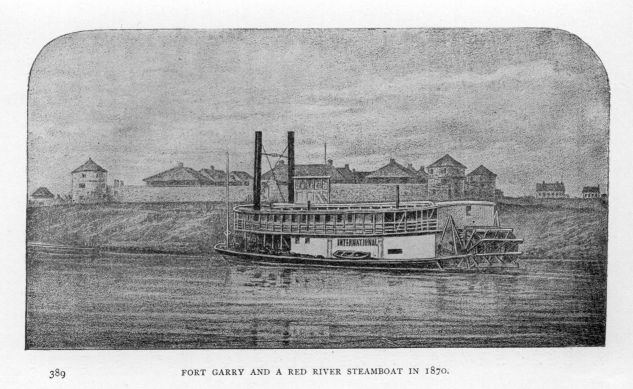
Fort Garry and a Red River steamboat in 1870.
In the course of a few years a handsome, well-built city arose on the site of old Fort Garry, and with the construction of the Canadian Pacific Railway—a national highway built with a rapidity remarkable even in these days of extraordinary commercial enterprise—and the connection of the Atlantic sea-board with the Pacific shores, villages and towns have extended at distant intervals across the continent, from Port Arthur to Vancouver, the latter place an instance of western phenomenal growth. Stone and brick buildings of fine architectural proportions, streets paved and lit by electricity, huge elevators, busy mills, are the characteristics of some towns where only yesterday brooded silence, and the great flowery stretches of prairie were only crushed by the feet of wandering Indians and voyageurs.
Fourteen years after the formation of the province of Manitoba, whilst the Canadian Pacific Railway was in the course of construction, the peace of the territories was again disturbed by risings of half-breeds in the South Saskatchewan district, chiefly at Duck Lake, St. Laurent, and Batoche. Many of these men had migrated from Manitoba to a country where they could follow their occupation of hunting and fishing, and till little patches of ground in that shiftless manner characteristic of the Métis. The total number of half-breeds in the Saskatchewan country were probably four thousand, of whom the majority lived in the settlements just named. These people had certain land grievances, the exact nature of which it is not easy even now to ascertain; but there is no doubt that they laboured under the delusion that, because there was much red-tapeism and some indifference at Ottawa in dealing with their respective claims, there was a desire or intention to treat them with injustice. Conscious that they might be crowded out by the greater energy and enterprise of white settlers—that they could no longer depend on their means of livelihood in the past, when the buffalo and other game were plentiful, these restless, impulsive, illiterate people were easily led to believe that their only chance of redressing their real or fancied wrongs was such a rising as had taken place on the Red River in 1869. It is believed that English settlers in the Prince Albert district secretly fomented the rising with the hope that it might also result in the establishment of a province on the banks of the Saskatchewan, despite its small population. The agitators among the half-breeds succeeded in bringing Riel into the country to lead the insurrection. He had been an exile ever since 1870, and was at the time teaching school in Montana. After the rebellion he had been induced to remain out of the Northwest by the receipt of a considerable sum of money from the secret service fund of the Dominion Government, then led by Sir John Macdonald. In 1874 he had been elected to the House of Commons by the new constituency of Provencher in Manitoba; but as he had been proclaimed an outlaw, when a true bill for murder was found against him in the Manitoba Court of Queen's Bench, and when he had failed to appear for trial, he was expelled from the house on the motion of Mr. Mackenzie Bowell, a prominent Orangeman, and, later, premier of the Canadian Government. Lepine, a member also of the so-called provisional government of Red River, had been tried and convicted for his share in the murder of Scott, but Lord Dufferin, when governor-general, exercised the prerogative of royal clemency, as an imperial officer, and commuted the punishment to two years' imprisonment. In this way the Mackenzie government was relieved—but only temporarily—of a serious responsibility which they were anxious to avoid, at a time when they were between the two fires: of the people of Ontario, anxious to punish the murderers with every severity, and of the French Canadians, the great majority of whom showed a lively sympathy for all those who had taken part in the rebellion of 1869. The influence of French Canada was also seen in the later action of the Mackenzie government in obtaining a full amnesty for all concerned in the rebellion except Riel, Lepine, and O'Donohue, who were banished for five years. The popularity enjoyed by Riel and his associates in French Canada, as well as the clemency shown to them, were doubtless facts considered by the leaders in the second rising on the Saskatchewan as showing that they had little to fear from the consequences of their acts. Riel and Dumont—the latter a half-breed trader near Batoche—were the leaders of the revolt which broke out at Duck Lake in the March of 1885 with a successful attack on the Mounted Police and the Prince Albert Volunteers, who were defeated with a small loss of life. This success had much effect on the Indian tribes in the Saskatchewan district, among whom Riel and his associates had been intriguing for some time, and Poundmaker, Big Bear, and other chiefs of the Cree communities living on the Indian reserves, went on the warpath. Subsequently Battleford, then the capital of the Territories, was threatened by Indians and Métis, and a force under Big Bear massacred at Frog Lake two Oblat missionaries, and some other persons, besides taking several prisoners, among whom were Mrs. Delaney and Mrs. Gowanlock, widows of two of the murdered men, who were released at the close of the rising. Fort Pitt, on the North Saskatchewan, thirty miles from Frog Lake, was abandoned by Inspector Dickens—a son of the novelist—and his detachment of the Mounted Police, on the approach of a large body of Indians under Big Bear. When the news of these outrages reached Ottawa, the government acted with great promptitude. A French Canadian, now Sir Adolphe Caron, was then minister of militia in Sir John Macdonald's ministry, and showed himself fully able to cope with this, happily, unusual, experience in Canadian Government. From all parts of the Dominion—from French as well as English Canada—the volunteers patriotically rallied to the call of duty, and Major-General Middleton, a regular officer in command of the Canadian militia, led a fine force of over four thousand men into the Northwest. The Canadian Pacific Railway was now built, with the exception of a few breaks of about seventy-two miles in all, as far as Qu'Appelle, which is sixteen hundred and twenty miles from Ottawa and about two hundred and thirty-five miles to the south of Batoche. The Canadian troops, including a fine body of men from Winnipeg, reached Fish Creek, fifteen miles from Batoche, on the 24th of April, or less than a month after the orders were given at Ottawa to march from the east. Here the insurgents, led by Dumont, were concealed in rifle-pits, ingeniously constructed and placed in a deep ravine. They checked Middleton, who does not appear to have taken sufficient precautions to ascertain the position of the enemy—thoroughly trained marksmen who were able to shoot down a considerable number of the volunteers. Later, at Batoche, the Canadian troops, led with great bravery by Colonels Straubenzie, Williams, Mackeand, and Grassett, scattered the insurgents, who never made an attempt to rally. The gallantry of Colonel Williams of the Midlanders—an Ontario battalion—was especially conspicuous, but he never returned from the Northwest to receive the plaudits of his countrymen, as he died of fever soon after the victory he did so much to win at Batoche. Colonel Otter, a distinguished officer of Toronto, had an encounter with Poundmaker at Cut Knife Creek on Battle River, one of the tributaries of the North Saskatchewan, and prevented him from making any hostile demonstrations against Battleford and other places. Riel's defeat at Batoche cowed these Indians, who gave up their arms and prisoners to Otter. Elsewhere in the Territories all trouble was prevented by the prompt transport of troops under Colonel Strange to Fort Edmonton, Calgary, and other points of importance. The Blackfeet, the most formidable body of natives in the Territories, never broke the peace, although they were more than once very restless. Their good behaviour was chiefly owing to the influence of Chief Crowfoot, always a friend of the Canadians.
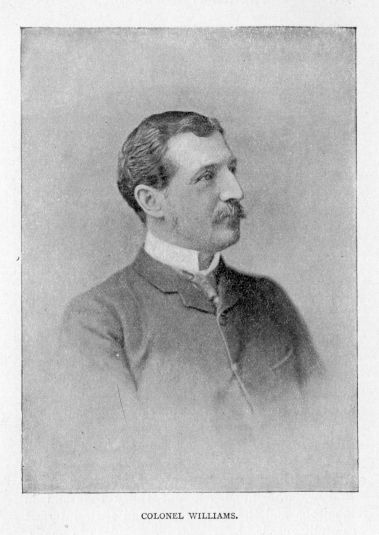
Colonel Williams.
When the insurrection was over, an example was made of the leaders. Dumont succeeded in making his escape, but Riel, who had been captured after the fight at Batoche, was executed at Regina after a most impartial trial, in which he had the assistance of very able counsel brought from French Canada. Insanity was pleaded even, in his defence, not only in the court but subsequently in the Commons at Ottawa, when it was attempted to censure the Canadian Government for their stern resolution to vindicate the cause of order in the Territories. Poundmaker and Big Bear were sent for three years to the penitentiary, and several other Indians suffered the extreme penalty of the law for the murders at Frog Lake. Sir John Macdonald was at the head of the Canadian Government, and every possible effort was made to force him to obtain the pardon of Riel, but he felt that he could not afford to weaken the authority of law in the west, and his French Canadian colleagues, Sir Hector Langevin, then minister of public works, Sir Adolphe Chapleau, then secretary of state,—now lieutenant-governor of Quebec—Sir Adolphe Caron, then minister of militia, exhibited commendable courage in resisting the passionate and even menacing appeals of their countrymen, who were carried away at this crisis by a false sentiment, rather than by a true sense of justice. Happily, in the course of no long time, the racial antagonisms raised by this unhappy episode in the early history of confederation disappeared under the influence of wiser counsels, and the peace of this immense region has never since been threatened by Indians or half-breeds, who have now few, if any, grievances on which to brood. The patriotism shown by the Canadian people in this memorable contest of 1885 illustrated the desire of all classes to consolidate the union, and make it secure from external and internal dangers, and had also an admirable influence in foreign countries which could now appreciate the growing national strength of the Dominion. In the cities of Ottawa, Toronto, and Winnipeg, monuments have been raised to recall the services of the volunteers who fought and died at Fish Creek and Batoche. On the banks of the Saskatchewan a high cairn and cross point to the burial place of the men who fell before the deadly shot of the half-breed sharpshooters at Fish Creek:
"Not in the quiet churchyard, near those who loved them best; But by the wild Saskatchewan, they laid them to their rest. A simple soldier's funeral in that lonely spot was theirs, Made consecrate and holy by a nation's tears and prayers. Their requiem—the music of the river's surging tide; Their funeral wreaths, the wild flowers that grow on every side; Their monument—undying praise from each Canadian heart, That hears how, for their country's sake, they nobly bore their part."
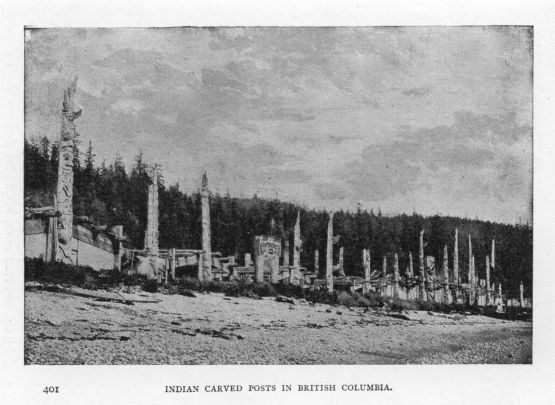
Indian carved posts in British Columbia.
One of the finest bodies of troops in the world, the Mounted Police of Canada, nearly one thousand strong, now maintains law and order throughout a district upwards of three hundred thousand square miles in area, and annually cover a million and a half miles in the discharge of their onerous duties. The half-breeds now form but a very small minority of the population, and are likely to disappear as a distinct class under the influence of civilisation. The Indians, who number about thirty thousand in Manitoba and the Northwest, find their interests carefully guarded by treaties and statutes of Canada, which recognise their rights as wards of the Canadian Government. They are placed on large reserves, where they can carry on farming and other industrial occupations for which the Canadian Government, with commendable liberality, provide means of instruction. Many of the Indians have shown an aptitude for agricultural pursuits which has surprised those who have supposed they could not be induced to make much progress in the arts of civilised life. The average attendance of Indian children at the industrial and other schools is remarkably large compared even with that of white children in the old provinces. The Indian population of Canada, even in the Northwest territory, appear to have reached the stationary stage, and hereafter a small increase is confidently expected by those who closely watch the improvement in their methods of life. The high standard which has been reached by the Iroquois population on the Grand River of Ontario, is an indication of what we may even expect in the course of many years on the banks of the many rivers of the Northwest. The majority of the tribes in Manitoba and the Northwest—the Crees and Blackfeet—belong to the Algonquin race, and the Assiniboines or Stonies, to the Dacotahs or Sioux, now only found on the other side of the frontier. The Tinneh or Athabaskan family occupy the Yukon and Mackenzie valleys, while in the Arctic region are the Eskimo or Innuits. In British Columbia[1] there are at least eight distinct stocks; in the interior, Tinneh, Salish or Shuswap; on the coast, Haida, Ishimsian, Kwakiool (including Hailtzuk), Bilhoola, Aht, or Nootka, and Kawitshin, the latter including several names, probably of Salish affinity, living around the Gulf of Georgia. The several races that inhabit Canada, the Algonquins, the Huron-Iroquois, the Dacotah, the Tinneh, and the several stocks of British Columbia, have for some time formed an interesting study for scholars, who find in their languages and customs much valuable archaeological and ethnological lore. The total number of Indians that now inhabit the whole Dominion is estimated at over one hundred thousand souls, of whom one-third live in the old provinces.
XXVII.
COMPLETION OF THE FEDERAL UNION—MAKERS OF THE DOMINION.
(1871-1891.)
Within three years after the formation of the new province of Manitoba in the Northwest, Prince Edward Island and British Columbia came into the confederation, and gave completeness to the federal structure. Cook and Vancouver were among the adventurous sailors who carried the British flag to the Pacific province, whose lofty, snow-clad mountains, deep bays, and many islands give beauty, grandeur, and variety to the most glorious scenery of the continent. Daring fur-traders passed down its swift and deep rivers and gave them the names they bear. The Hudson's Bay Company held sway for many years within the limits of an empire. The British Government, as late as 1849, formed a Crown colony out of Vancouver, and in 1858, out of the mainland, previously known as New Caledonia. In 1866 the two provinces were united with a simple form of government, consisting of a lieutenant-governor, and a legislative council, partly appointed by the Crown and partly elected by the people; but in 1871, when it entered into the Canadian union, a complete system of responsible government was established as in the other provinces. Prince Edward Island was represented at the Quebec conference, but it remained out of confederation until 1873, when it came in as a distinct province; one of the conditions of admission was the advance of funds by the Dominion government for the purchase of the claims of the persons who had held the lands of the island for a century. The land question was always the disturbing element in the politics of the island, whose history otherwise is singularly uninteresting to those who have not had the good fortune to be among its residents and to take a natural interest in local politics. The ablest advocate of confederation was Mr. Edward Whelan, a journalist and politician who took part in the Quebec conference, but did not live to see it carried out by Mr. J. C. Pope, Mr. Laird, and others.
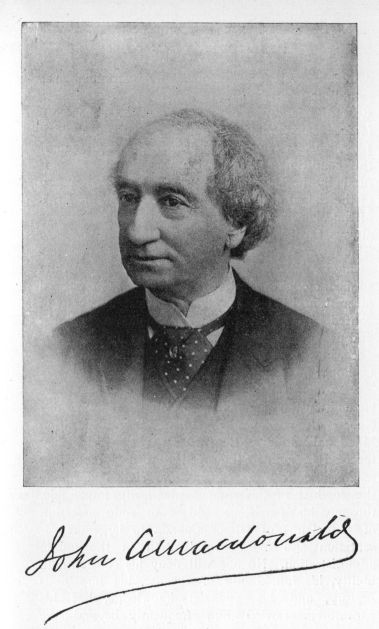
John A. Macdonald.
At Confederation the destinies of old Canada were virtually in the hands of three men—the Honourable George Brown, Sir George Cartier, and Sir John Macdonald, to give the two latter the titles they received at a later time. Mr. Brown was mainly responsible for the difficulties that had made the conduct of government practically impossible, through his persistent and even rude assertion of the claims of Upper Canada to larger representation and more consideration in the public administration. No one will deny his consummate ability, his inflexibility of purpose, his impetuous oratory, and his financial knowledge, but his earnestness carried him frequently beyond the limits of political prudence, and it was with reason that he was called "a governmental impossibility," as long as French and English Canada continued pitted against each other, previous to the union of 1867. The journal which he conducted with so much force, attacked French Canada and its institutions with great violence, and the result was the increase of racial antagonisms. Opposed to him was Sir George Etienne Cartier, who had found in the Liberal-Conservative party, and in the principles of responsible government, the means of strengthening the French Canadian race and making it a real power in the affairs of the country. Running throughout his character there was a current of sound sense and excellent judgment which came to the surface at national crises. A solution of difficulties, he learned, was to be found not in the violent assertion of national claims, but in the principles of compromise and conciliation. With him was associated Sir John Macdonald, the most successful statesman that Canada has yet produced, on account of his long tenure of office and of the importance of the measures that he was able to carry in his remarkable career. He was premier of the Dominion from 1867 until his death in 1891, with the exception of the four years of the administration of the Liberals (1873-1878), led by the late Mr. Alexander Mackenzie, who had raised himself from the humble position of stonemason to the highest place in the councils of the country, by dint of his Scotch shrewdness, his tenacity of purpose, his public honesty, and his thorough comprehension of Canadian questions, though he was wanting in breadth of statesmanship. Many generations must pass away before the personal and political merits of Sir John Macdonald can be advantageously and impartially reviewed. A lawyer by profession, but a politician by choice, not remarkable for originality of conception, but possessing an unusual capacity for estimating the exact conditions of public sentiment, and for moulding his policy so as to satisfy that opinion, having a perfect understanding of the ambitions and weaknesses of human nature, believing that party success was often as desirable as the triumph of any great principle, ready to forget his friends and purchase his opponents when political danger was imminent, possessing a fascinating manner, which he found very useful at times when he had to pacify his friends and disarm his opponents, fully comprehending the use of compromise in a country of diverse nationalities, having a firm conviction that in the principles of the British constitution there was the best guaranty for sound political progress, having a patriotic confidence in the ability of Canada to hold her own on this continent, and become, to use his own words, a "nation within a nation,"—that is to say, within the British Empire—Sir John Macdonald offers to the political student an example of a remarkable combination of strength and weakness, of qualities which make up a great statesman and a mere party politician, according to the governing circumstances. Happily for the best interests of Canada, in the case of confederation the statesman prevailed. But his ambition at this crisis would have been futile had not Mr. Brown consented to unite with him and Cartier. This triple alliance made a confederation possible on terms acceptable to both English and French Canadians. These three men were the representatives of the antagonistic elements that had to be reconciled and cemented. The readiness with which Sir Charles Tupper and Sir Leonard Tilley, the premiers of Nova Scotia and New Brunswick, co-operated with the statesmen of the upper provinces, was a most opportune feature of the movement, which ended in the successful formation of a confederation in 1867. Although the Liberal leaders in Nova Scotia, Mr., afterwards Sir, Adams Archibald, and Mr. Jonathan McCully, like Brown, Howland, Mowat, and McDougall in old Canada, supported the movement with great loyalty, the people of the province were aroused to a passionate opposition mainly through the vigorous action of the popular leader, Mr. Joseph Howe, who had been an eloquent advocate of colonial union before it assumed a practical shape, but now took the strong ground that the question should not be forced on the country by a legislature which had no mandate whatever to deal with it, that it should be determined only by the people at the polls, and that the terms arranged at Quebec were unfair to the maritime provinces. Mr. Howe subsequently obtained "better terms" for Nova Scotia by every available means of constitutional agitation—beyond which he was never willing to go, however great might be public grievances—and then he yielded to the inevitable logic of circumstances, and entered the Dominion government, where he remained until he became lieutenant-governor of his native province. The feelings, however, he aroused against confederation lasted with some intensity for years, although the cry for repeal died away, according as a new generation grew up in place of the one which remembered with bitterness the struggles of 1867.
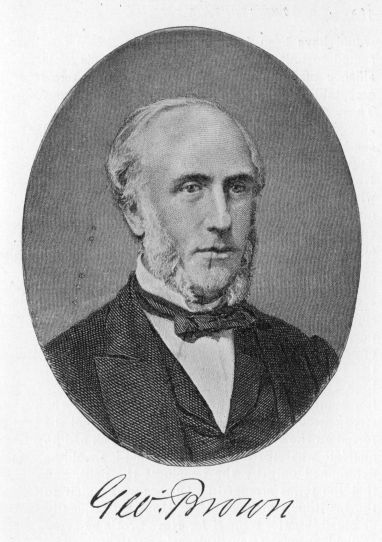
George Brown.
Mr. George Brown died from the wound he received at the hands of a reckless printer, who had been in his employ, and Canadians have erected to his memory a noble monument in the beautiful Queen's Park of the city where he laboured so long and earnestly as a statesman and a journalist. Sir George Cartier died in 1873, but Sir John Macdonald survived his firm friend for eighteen years, and both received State funerals. Statues of Sir John Macdonald have been erected in the cities of Montreal, Toronto, Hamilton, and Kingston. In Ottawa on one side of the Parliament building we see also a statue of the same distinguished statesman, and on the other that of his great colleague, Sir George Cartier. It was but fitting that the statues of these most famous representatives of the two distinct elements of the Canadian people should have been placed alongside of the national legislature. They are national sentinels to warn Canadian people of the dangers of racial or religious conflict, and to illustrate the advantages of those principles of compromise and justice on which both Cartier and Macdonald, as far as they could, raised the edifice of confederation.
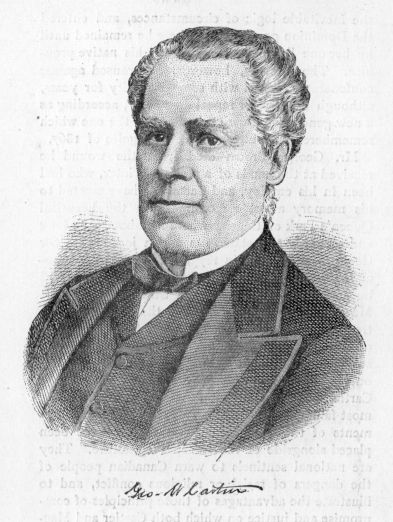
George Cartier.
XXVIII
CANADA AS A NATION: MATERIAL AND INTELLECTUAL DEVELOPMENT—POLITICAL RIGHTS.
Up to the dissolution of the 1904 Parliament in October, 1908, the Dominion had had ten Parliaments. During the first thirty years the Conservatives were almost continuously in office. They were defeated in the general election of 1874, owing to some grave scandals in connection with the building of the Canadian Pacific Railway; but were again returned to office in 1878. In the election of 1878 they were returned on a platform of protection for Canadian industry, and in 1879 Parliament enacted a National Policy Tariff, which was at once vehemently attacked by the Liberal Opposition. Seventeen years, however, elapsed before the Liberals had the opportunity of revising the tariff, and it was not until 1897 that there was any modification in the protective duties. In 1896, however, after several years of profound depression in trade in the Dominion, the Liberals succeeded in obtaining a large majority, and Sir Wilfrid Laurier succeeded to the premiership, which after the death of Sir John Macdonald had been held successively by Sir J. J. C. Abbott, Sir John Thompson, who died at Windsor, where he had gone to take the oath of office of privy councillor, Sir Mackenzie Bowell, and Sir Charles Tupper.
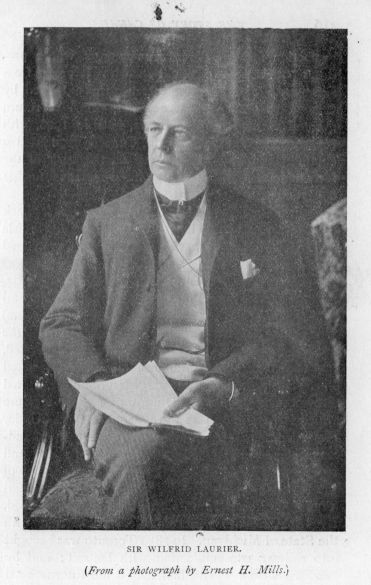
Sir Wilfrid Laurier (From a photograph by Ernest H. Mills.)
The following year (1897) the Liberal Government revised the tariff, retaining the protective features, and enlarging the system of bounties for the encouragement of industry which had been commenced in 1883. The tariff was modified, however, by the establishment of a preference for Great Britain, which, beginning at a reduction of one-eighth from the general tariff, was increased to one-fourth, and finally in 1900 to one-third. This reduction remained in force until 1906-7, when the tariff was again revised and arranged in three lists—general, intermediate, and British preference. The intermediate tariff was intended as a basis of negotiation whereby Canada might obtain concessions from foreign countries. After the concession of the British preference in 1897, Great Britain, at the request of Canada, denounced her commercial treaties with several foreign countries, under the terms of which concessions granted by the colonies to the mother country would have had to be extended to the treaty countries. Germany was one of these countries, and on the expiration of the treaty Germany showed her resentment by applying her maximum tariff to Canada. Canada retaliated by the imposition of a surtax on German goods, and a tariff war ensued, which resulted in a much higher degree of protection for Canadian manufacturers whose products came into competition with imports from Germany. The British preference was extended by Canada to other British colonies, which in return granted advantages to Canada, and in 1908, with the consent of Great Britain, Canada negotiated a commercial treaty with France on the basis of the intermediate tariff, though with numerous further concessions.
Railway building in Canada had begun as far back as 1836, when a short length of line from La Prairie to St. John's, in the Province of Quebec, was opened for traffic. The first link in what is now known as the Grand Trunk Railway was constructed in 1845, when Montreal was connected with the Atlantic and St. Lawrence Railway, now the Portland (Maine) Division of the Grand Trunk System. In 1851 the Grand Trunk Railway Company was incorporated, and took over about a hundred miles of constructed line. Soon afterwards the Legislature of the United Provinces of Quebec and Ontario passed the measure which is now known as the Guarantee Act. Under this enactment Government aid was given to railways of not less than seventy miles in length; and it was with this aid that the great development of the Grand Trunk system began. In 1854 the Grand Trunk line from Toronto to Montreal was opened. By 1856 Toronto was connected, viâ Sarnia, with the State of Michigan. In 1859 Toronto was brought into railway communication with Detroit; and by 1869 the Grand Trunk had leased the International Bridge across the Niagara River, and by this means its system was connected with the State of New York and the numerous centres of population in the Eastern States, which are reached viâ Buffalo.
Most of this development of the Grand Trunk system had preceded Confederation; but at Confederation the greatest need of the Dominion was easy means of communication between the provinces heretofore known as Upper and Lower Canada. One of the first undertakings of the new Dominion Government was the construction of the Intercolonial Railway, the object of which was to connect the maritime provinces with each other and with Quebec, and the building of which by the Government was one of the conditions on which the maritime provinces had consented to Confederation. It still remained to push out a railway to the far west, and in 1881 work was begun on the Canadian Pacific Railway. In four years this great highway across the continent was ready for use, and in 1887 the Canadian Pacific Railway established a line of steamships across the Pacific in connection with its Pacific terminals.
With the opening of the great North-west and the creation of the new provinces of Alberta and Saskatchewan in 1905,[1] the railway communication was found to be insufficient, and a new line to the Pacific was begun by the Grand Trunk Railway, which had been the pioneer in railway work in Ontario, and which before the beginning of the new line had already over 3,000 miles of road. The Grand Trunk Pacific Railway is divided into two sections. The eastern runs from Moncton to Winnipeg, a distance of 1,875 miles, and is being built by the Government. On its completion it is to be leased to the Grand Trunk Railway Company for fifty years. The western section runs from Winnipeg to Prince Rupert on the Pacific, a distance of 1,480 miles, and is being constructed and equipped by the Company, the Government granting a subsidy, and guaranteeing the Company's bonds up to 75 per cent. of the cost of construction. The first stretch of the new line to be completed was that from Winnipeg to Wainwright, a distance of 666 miles. It went into service in September, 1908, and was completed by the end of 1915.
At the same time, the Great Northern began to push out to the North-west, for the sake of the immense trade in grain which the opening up of the new provinces had created. A little later work was also begun on the Hudson's Bay Railway, which was intended to connect the more northern waters with Ontario and the Great Lakes. In 1908 the Dominion had twenty-two thousand miles of railway completed, in addition to the long stretches then under construction. In 1918 it was 38,879 miles.
Almost as important to Canada as her railways are her canals and her waterways. In 1897, on the accession of the Liberal Government to office, it was determined to deepen the St. Lawrence canals and enlarge the locks sufficiently to allow the passage from the great lakes to the sea of vessels drawing not more than fourteen feet of water. These canals afford a through water route, with a minimum depth of fourteen feet, from Montreal to Port Arthur on Lake Superior, a distance of 1,223 miles, 73 of which are by canal. The total expenditure of the Dominion on canals up to 1919 amounted to over $127,000,000.
Alongside the improvement in the means of communication—railways and canals—has gone a considerable growth of Canadian manufacturing industries. The iron and steel industry was scarcely in existence at Confederation. The Marmora plant at Long Point, Ontario, and a smaller plant at Three Rivers, Quebec, had been in existence since the forties; but the iron and steel industry, as it exists to-day in Canada, is largely the creation of the national policy of protective tariffs and bounties. The bounty system was instituted in 1883, chiefly for the benefit of a blast furnace of 100 tons capacity at Londonderry, Nova Scotia, which was then in difficulties. Besides this furnace, only two others—charcoal furnaces with an aggregate capacity of fifteen tons, at Drummondsville, Quebec—came on the bounty list in 1884. In 1897, when the Liberals came into office, furnaces had also been erected at New Glasgow, Radnor, and Hamilton, and the aggregate daily capacity of the furnaces of the Dominion was then 445 tons.
At the revision of the tariff in 1897 the bounty system was greatly extended, and under its aegis two great modern iron and steel plants—one at Sydney, N.S., and one at Sault Ste. Marie, O., came into existence. Modern furnaces have also been established at North Sydney, Hamilton, Welland, Midland, and Port Arthur, and in 1908 the output of pig-iron from all these plants was a little over 600,000 tons. A large proportion of this pig-iron is converted at the Sault Ste. Marie and the Sydney plants into steel rails, for which the constant extension of the railways furnishes a steady market.
Next to iron and steel the most important manufacturing industries are the textiles. Both woollens and cottons were manufactured in Canada in small quantities before Confederation. A small woollen mill was established at Coburg, Ontario, in 1846, and even earlier than this there were woollen mills in Nova Scotia which had made the province notable for their Halifax tweeds. In 1908, however, the woollen industry generally was not in a flourishing condition. Of the 157 mills in existence when the census of 1901 was taken, 28 had disappeared before 1908, and several of the 129 that remained were closed either permanently or temporarily. The value of the woollen goods produced in 1908 did not exceed seven million dollars.
The cotton industry, which is well organised and financially strong, has its largest centres at Montreal and Valleyfield, Quebec. The mills, of which there are about twenty-three, are large, modern, and well-equipped, and the value of their output is more than double that of the woollen mills of the Dominion.
The industry which ranks next in importance is probably the manufacture of farm implements and machinery, which is located at Brantford and Hamilton. Hamilton is also the centre of the manufacture of electrical equipment, stoves, wire, steel castings, hardware, and many other products of metal. At Montreal are the Angus shops, which rank with the finest on the North American Continent, at which locomotives are built for the Canadian Pacific Railway, and in 1908 the Grand Trunk Railway established similar shops on a correspondingly modern scale for locomotive building at Stratford, Ontario.
Shipbuilding was an important industry in the maritime provinces and Quebec in the old days of wooden sailing ships; but with the incoming of steamships of iron and steel the maritime provinces entirely lost their old pre-eminence and world-wide reputation for shipbuilding. It was July, 1908, before a steel ocean-going vessel was launched in the maritime provinces. This was a three-masted schooner of 900 tons burden, the James William, which was built in the Matheson Yard, at New Glasgow, N.S. Steel vessels had, however, been built for lake service at Toronto, Collingwood, and Bridgeburg from 1898 onward. At Collingwood and Bridgeburg the largest and finest types of lake freighters and passenger vessels are built. In 1908 a new steel shipbuilding yard was installed at Welland, and plans were completed for the establishment of a large yard at Dartmouth on Halifax Harbour.
Until the development of the prairie provinces, all manufacturing in the Dominion was carried on east of the great lakes. With the opening out of the great wheat-growing regions of Manitoba, Alberta, and Saskatchewan, however, Winnipeg is gradually becoming a great manufacturing city, and many miscellaneous industries on a factory scale have been established there. The most western iron plant—puddling furnaces and a rolling mill—is situated on the outskirts of the city.
According to the figures of the Canadian Manufacturers' Association, as given by Mr. E. J. Freysing, President of the Toronto Section, in July, 1908, there were in Canada at that time 2,465 firms which were either members of the Association or were eligible for membership. These firms employed either on salary or wages 392,330 men, women, and children. This number includes 80,000 engaged in the lumbering business—the largest number engaged in any one trade. Lumbering is carried on in Quebec, Ontario, British Columbia, Nova Scotia, and New Brunswick, and the annual value of the product is over one hundred million dollars—a value only exceeded by the food products of the Dominion.
More important than all other industries put together is farming. The extent of this industry may be judged from the fact that each year from 1900 to 1908 from 20,000 to 40,000 homesteads were taken up. The usual size of these homesteads is 160 acres, and the acreage thus newly under cultivation varied during the eight years from one to twelve million square miles a year. In 1907 alone the new farms represented an immigration of 105,420 persons. The total number of farms in the Dominion in 1908 was estimated at 600,000, representing a population directly dependent upon farming of over three millions. The principal crops in the prairie provinces are oats, wheat, and barley. The total crop of wheat in 1908 was about 130,000,000 bushels, of oats 270,000,000, and of barley 50,000,000.
In Ontario, Quebec, and the maritime provinces, dairying, fruit-growing, hog-raising—for bacon and ham—and mixed farming have taken the place of grain crops. In 1908 Canada had gained a strong position in the markets of Great Britain for cheese, butter, and canned goods, a position which was largely due to the work of the Dominion Agricultural Department in providing cold storage for farm products on the railways and steamers, and also to the educational work which the Department had been steadily pushing among the farmers.
The Dominion is rich in metals and minerals, and mining is an important industry in Nova Scotia, Ontario, and British Columbia. The largest coal-fields of Canada are in Cape Breton and in Pictou and Cumberland Counties, Nova Scotia, from which over five million tons of coal are mined each year. There are no coal measures between New Brunswick and Manitoba, and the lignite beds of Manitoba yield a much less valuable coal than that of Nova Scotia. The coal area of the Rocky Mountains, though not so large as that of the maritime provinces, yields the best coal so far found in the Dominion. The centre of this formation is at the Crow's Nest Pass. There is another coal area on the Pacific Coast in the neighbourhood of Nanaimo and in Queen Charlotte's Island. The total amount of coal mined in the Dominion in 1908 was 10,510,000. Besides coal, there are in Canada rich deposits of iron ore, lead, nickel, copper, silver, and gold, and the non-metallic minerals include petroleum, asbestos, and corundum. Diamonds have been found in Quebec in a formation not unlike the diamond fields of Kimberley. Gold is found chiefly in the Klondike country and in British Columbia; but some gold is also obtained from Nova Scotia, and a fair amount from Ontario and Quebec.
Ever since the settlement of the maritime provinces fishing has been an important industry on their shores, and many of the disputes with the United States have arisen out of the privileges granted to United States fishermen in the treaty of 1818. These disputes have, however, concerned Newfoundland more closely than the Dominion, and the final settlement of all questions between the sister colony and the great republic is hardly yet in sight. A modus vivendi pending settlement was again signed in August, 1908. The fishing industry is not confined to the maritime provinces. River and lake fishing are carried on in Ontario, Manitoba, and the new provinces; and British Columbia has fisheries and canneries of great importance on her coast and rivers. The total value of the yield of the fisheries for 1908 was about twenty-five million dollars.
The population of the Dominion in 1908 was estimated to be about six and a half millions, with a yearly immigration of between 150,000 and 200,000. The French Canadians numbered about 1,500,000, and of the rest the majority were English, Scotch, and Irish. The new immigration is introducing each year a large number of non-English-speaking people, and also some very desirable settlers in the American farmers from the Western States. Among the more important foreign settlements are those of the Doukhobors, who were received in Canada as refugees from persecution in Russia, and who have repeatedly given trouble to the authorities on account of their fanatical resistance to orderly government.
The revenue of Canada for 1907-8 was $96,054,505, and the expenditure was $76,641,451, leaving a surplus of nearly twenty million dollars. At the close of the fiscal year the debt of Canada amounted to $277,960,259. Canals, lighthouses, railways, Government buildings, and other public works are the assets which Canada has to set against this debt, which represents the expenditure necessary for the development of a new and widely extended country.
In education the Dominion ranks almost equal to the Northern States of America. Every province has a public school system, and the primary and grammar schools, especially of Ontario, are a pride and a credit to the people of the province. In 1908 there were seventeen universities in the Dominion. Among them may be mentioned McGill in Montreal, Laval in Quebec, Queen's in Kingston, Dalhousie in Halifax, University of Toronto in Toronto, and the University of Manitoba in Winnipeg. The University of Alberta was founded in 1906, that of Saskatchewan in 1907, and British Columbia in 1908.
Every city in Canada and every town of any size has its newspaper or newspapers—daily, bi-weekly, or weekly. Canadian journalism has a character quite of its own, leaning more to American ideals than to those of England. A great change in this respect has come over the Canadian Press since about 1885, up to which time the more important daily newspapers in Montreal, Toronto, Halifax, and St. John had been on the English rather than the American model.
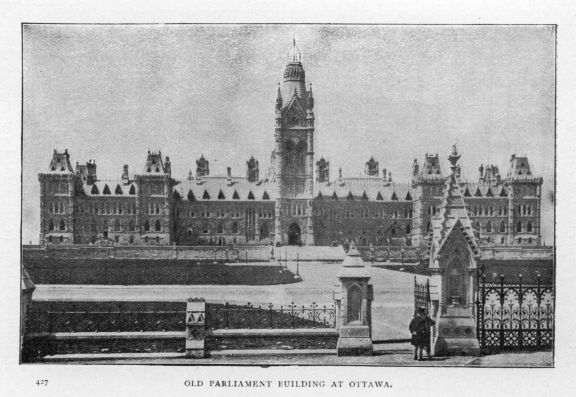
Old Parliament Building at Ottawa.
Self-government exists in the full sense of the term. At the base of the political structure lie those municipal institutions which, for completeness, are not excelled in any other country. It is in the enterprising province of Ontario that the system has attained its greatest development. The machinery of these municipalities is used in Ontario to raise the taxes necessary for the support of public schools, Free libraries can be provided in every municipality whenever the majority of the taxpayers choose. Then we go up higher to the provincial organisations governed by a lieutenant-governor, nominated and removable by the government of the Dominion, and advised by a council responsible to the people's representatives, with a legislature composed, in only two of the provinces, of two houses—a council appointed by the Crown, and an elective assembly; in all the other provinces, there is simply an assembly chosen by the people on a very liberal franchise, manhood suffrage in the majority of cases. The fundamental law, or the British North America Act of 1867, gives jurisdiction to the provincial governments over administration of justice (except in criminal matters), municipal, and all purely local affairs. The North-West Territories are under the Department of the Interior. Yukon Territory is governed by a Gold Commissioner, appointed by the Governor-General in Council, and a Council of three members elected by the people, The central or general government of the Dominion is administered by a governor-general, with the assistance of a ministry responsible to a Parliament, composed of a Senate appointed by the Crown, and a House of Commons elected under an electoral franchise, practically on the very threshold of universal suffrage. This government has jurisdiction over trade and commerce, post-office, militia and defence, navigation and shipping, fisheries, railways and public works of a Dominion character, and all other matters of a general or national import. Education is under the control of the provincial governments, but the rights and privileges of a religious minority with respect to separate or denominational schools are protected by the constitution. The common law of England prevails in all the provinces except in French Canada, where the civil law still exists. The criminal law of England obtains throughout the Dominion. The central government appoints all the judges, who are irremovable except for cause. Although the constitution places in the central government the residue of all powers, not expressly given to the provincial authorities, conflicts of jurisdiction are constantly arising between the general and local governments. Such questions, however, are being gradually settled by the decisions of the courts—the chief security of a written constitution—although at times the rivalry of parties and the antagonisms of distinct nationalities and creeds tend to give special importance to certain educational and other matters which arise in the operation of the constitution. All these are perils inseparable from a federal constitution governing two distinct races.
The relations of Canada with the United States have been increasingly close and cordial as years have gone on. Many old standing causes of friction have been removed; and in other cases, such as the fisheries dispute, and the extremely high duties levied on Canadian goods in the Dingley Tariff, there has been no recent aggravation of the irritation. In 1894 an end was made to the dispute over the right of America to exclude other nations from taking the seals of the Aleutian Islands outside the three-mile limit. Canadian vessels had been seized and confiscated by America, and a state of high tension existed, which was relieved by a reference of the dispute to arbitration. This time the award was in favour of Canada. The exclusive right of pelagic sealing was denied to the United States, and damages amounting to $464,000 were awarded to the Canadian fishermen.
The year 1896 is memorable, not only for the general election which brought Sir Wilfrid Laurier into power, and for the beginning of an uplift in trade which lasted until October, 1907, but also for the discovery of gold in the Yukon and in Alaska. The great rush of adventurers induced by these discoveries continued for the next two years, and Dawson city grew up with mushroom haste as the metropolis of this Arctic region. Gold discoveries in both Canadian and American territory brought to a crisis the long-pending dispute over the international boundary in the far North-west. In 1898 a joint High Commission was created, whose duties were to settle a number of questions which had long caused friction between Canada and the United States. The sessions of this Commission extended over eight months without accomplishing anything. No formal ending was made to the work of the Commission, but it never re-assembled after its adjournment in February, 1899.
It was not until 1903 that an agreement was reached between Great Britain and the United States concerning the Alaskan boundary line. In that year a treaty was concluded by which this long-disputed question was relegated to a Commission of six jurists, three British and three American, who by a majority vote were empowered to determine the boundary line. The British members of the Commission were Lord Alverstone, Chief Justice of England, who was made president, with a casting vote in case of a tie, and two Canadians, Sir Louis Jette and Mr. A. B. Aylesworth, both eminent jurists. The American members were Mr. Henry C. Lodge, Mr. Elihu Root, and Mr. George Turner. The report of the Commission, which was transmitted to the Governments of the United States and Great Britain in October, 1903, was somewhat disappointing to Canadians, as, on the whole, the Americans gained their contentions. Canada was shut out from water communication with the Yukon as far south as Portland Channel. The treaty in which this report was incorporated, and which was finally ratified in 1905, was, however, beneficial in removing a long-standing cause of irritation between the two nations, and Canada's need for a port was met in some degree by bonding concessions at the American ports on the Alaskan coast. An International Commission to mark out the boundary line was at work in Alaska in the summer of 1908.
Serious disturbance to a number of Canadian interests, especially those of the lumbermen, was caused by the passing of the Dingley Act, with its high duties on all Canadian exports except some raw materials. To the attack on Canadian lumber Ontario replied by prohibiting the export of saw logs cut on Crown timber limits, a step which led to the transfer of a considerable number of saw mills to the Canadian side of the border line. Another cause of complaint against the United States has been the strict and harsh enforcement of the contract labour laws on the American side of the boundary line.
It is the not unfounded boast of Canadians that as the nineteenth century was the century of growth and development of the United States, so the twentieth is to be the century of Canada; and the outstanding feature of Canadian development in the last decade of the nineteenth century and the early years of the twentieth is the awakening of her national consciousness. In all her relations with Great Britain this sense of nationality has been continuously manifest. In the Colonial Conferences which have been held at intervals in London since the first Jubilee of Queen Victoria in 1887, Canada has been acknowledgedly first among the self-governing colonies. In 1897, partly as a result of the enthusiasm created by enactment of the preference for Great Britain by the Dominion Parliament, Sir Wilfrid Laurier was the foremost figure among the colonial statesmen who were in London for the Diamond Jubilee. Another evidence of loyalty and of the close connection between Canada and Great Britain in the Jubilee year was the institution of two cent postage between Great Britain and Canada. Canada's domestic rate of letter postage from 1868 had been three cents, a rate which was extended to the United States by a postal convention, by which the domestic rate of Canada was made applicable to all letters and papers entering the United States, and that of the United States to all mail matter for Canada. This rate of three cents remained in force until January, 1899, when the two cent rate was made general for Canada, the United States, and Great Britain. In 1907, the rate for newspapers and periodicals between Great Britain and Canada was again lowered, and in August, 1908, a one cent rate for letters within the area of a town or city was adopted by the Canadian Post Office.
When the South African War broke out in 1899, Canada was the first of the colonies to come to the help of the mother country; and the Canadian contingents, the first of which left Canada for South Africa in October, 1899, rendered excellent service in the Boer War, especially in such work as scouting and the guerilla fighting in which the Boers were so adept.
The treaty-making power is still withheld from the Dominion; but since the Alaskan boundary treaty Great Britain has given more and more attention to the demands and needs of Canada when treaties have been in negotiation, and in 1907 Sir Wilfrid Laurier, Mr. W. S. Fielding, Minister of Finance, and the Hon. Mr. L. P. Brodeur went to Paris to negotiate directly a commercial treaty with the French Government. During the years from 1904 to 1907 the British Government gradually withdrew all the troops and warships which had been stationed in the Dominion. Canada assumed control of the fortifications of Halifax and Esquimalt in July, 1905, and the replacing of British by Canadian soldiers was complete by February, 1906. The naval dockyard at Halifax was handed over to the Canadian Government authorities in January, 1907; and from end to end of the Dominion Canada is now in complete and undivided control of her own territory.