THE STORY OF CANADA. (continued 4)
Reading edition
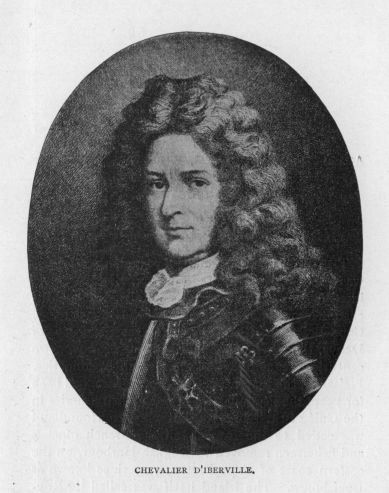
Chevalier D'Iberville.
Louis XIV. was humbled by Marlborough on the battlefields of Blenheim, Ramillies, and Oudenarde, and obliged to agree to the Treaty of Utrecht, which was a triumph for England, since it gave her possession of Acadia, Hudson's Bay, Newfoundland (subject to the rights of France in the fisheries), and made the important concession that France should never molest the Five Nations under the dominion of Great Britain. Such questions as the limits of Acadia, and the bounds of the territory of the Iroquois, were to be among the subjects of fruitful controversy for half a century.
XV.
ACADIA AND ÎLE ROYALE, FROM THE TREATY OF UTRECHT TO THE TREATY OF AIX-LA-CHAPELLE.
(1713-1748.)
The attention of Louis XIV. and his ministers was now naturally directed to Cape Breton, which, like the greater island of Newfoundland, guards the eastern approaches to the valley of the St. Lawrence. Cape Breton had been neglected since the days of Denys, though its harbours had been for over two centuries frequented by sailors of all nationalities. Plaisance, the Placentia of the Portuguese, had been for years the headquarters of the French fisheries in the Gulf of St. Lawrence, but when Newfoundland was ceded to the English, all the French officials and fishermen removed to English Harbour, on the eastern coast of Cape Breton, ever since known as Louisbourg. The island itself was called Île Royale, and its first governor was M. de Costabelle, who had held a similar position at Plaisance. It was not, however, until 1720, that France commenced the construction of the fortifications of Louisbourg, which eventually cost her over ten million dollars of modern money, and even then, they were never completed in accordance with the original design, on account of the enormous expense which far exceeded the original estimates. The fortifications were built on an oblong neck of land on the southern shore of the port, which lies only two leagues from that famous cape from which the island takes its name. The fortress occupied an area of over one hundred acres, and was planned on the best system of Vauban and other great masters of engineering skill, who intended it should be, as indeed it was, despite some faulty details of construction, the most complete example of a strongly fortified city in America. The harbour was also defended by batteries on an island at the entrance, and at other important points, while there were fortified works and small garrisons at Port Toulouse (St. Peter's) and Port Dauphin (St. Anne's). The government of the island was modelled on that of Canada, to which it was subordinate, and the governor was generally a military man. During the years the fortress was in possession of the French, there were probably, on an average, nearly two thousand people living in the town and vicinity, but this number was increased in the time of war by the inhabitants of the adjacent ports and bays.
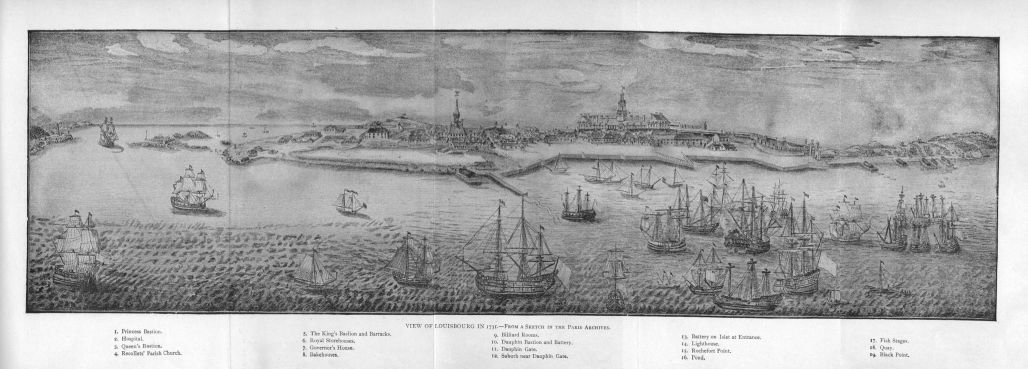
View of Louisbourg in 1731.—From a sketch in the Paris Archives.
During the thirty years that elapsed between the Treaty of Utrecht and the breaking out of war between France and Great Britain, the people of New England found that the merely nominal possession of Acadia by the English was of little security to them, while the French still held the island of Cape Breton and had the fealty of the Indians and Acadians, who were looking forward to the restoration of the country to its former owners. England systematically neglected Nova Scotia, where, until the foundation of Halifax, her only sign of sovereignty was the dilapidated fort at Annapolis, with an insignificant garrison, utterly unable to awe the Acadian French, and bring them completely under the authority of the British Crown. French emissaries, chiefly priests,—notably the treacherous Le Loutre—were constantly at work among the Acadians, Micmacs, and Abenakis, telling them that France would soon regain her dominion in Acadia. For years the Abenakis tomahawked the helpless English colonists that had made their homes in the present State of Maine, in the vicinity of the Kennebec and the Penobscot. The insidious policy of Vaudreuil and other governors of Canada, acting under instructions from France, was to keep alive the hostility of the Abenakis so as to prevent the settlement of that region known as Northern New England, one of whose rivers, the Kennebec, gave easy access to the St. Lawrence near Quebec. From Annapolis to Canseau the Micmacs destroyed life and property, and kept the English posts in constant fear.
New England took a signal revenge at last on the cruel and treacherous Abenakis, and inflicted on them a blow from which they never recovered. At Norridgewock perished the famous missionary, Sebastian Rale, beneath whose black robe beat the heart of a dauntless soldier, whose highest aspirations were to establish his creed and promote the ambitious designs of France in Acadia. A peace was made in 1726 between the colonists and the Abenakis, but New England felt she had no efficient security for its continuance while Acadian and Indian could see in the great fortress of Cape Breton powerful evidence that France was not yet willing to give up the contest for dominion in Acadia. Northern New England became now of relatively little importance in view of the obvious designs of France to regain Nova Scotia.
We have now come to an important period in the history of America as well as of Europe. In 1739 Walpole was forced to go to war with Spain, at the dictation of the commercial classes, who wished to obtain control of the Spanish Main. Then followed the War of the Austrian Succession, in which France broke her solemn pledge to Charles VI., Emperor of Germany, that she would support his daughter, Maria Theresa, in her rights to reign over his hereditary dominions. But when the Emperor was dead, France and other Powers proceeded to promote their own ambitious and selfish designs. France wished to possess the rich Netherlands, and Spain, Milan; Frederick of Prussia had no higher desire than to seize Silesia, and to drive Austria from Germany. Bavaria claimed the Austrian duchy of Bohemia. Maria Theresa was to have only Hungary and the duchy of Austria. The King of England was jealous of Prussia, and thought more of his Hanoverian throne than of his English crown. It became the interest of England to assist Austria and prevent the success of France, now the ally of Spain; forced to defend her colonial possessions in America. The complications in Europe at last compelled France and England to fight at Dettingen in 1743, and George II. won a doubtful victory, but war was not actually declared between these two nations until some months later. England had no reason to congratulate herself on the results, either in Europe or America. Her fleet met only with disaster, and her commerce was destroyed on the Spanish Main. Four years later she won a victory over the Spanish fleet in the Mediterranean, but hardly had her people ceased celebrating the event, than they heard that the combined forces of Hanover, Holland, and England, under the Duke of Cumberland, had been badly beaten by Marshal Saxe at Fontenoy.
It was at this time, when the prospects of England were so gloomy on the continent of Europe, that Englishmen heard, with surprise and gratification, that the strong fortress of Louisbourg in French America had surrendered to the audacious attack of four thousand colonists of New England.
A combination of events had aided the success of the brave enterprise. The news of the declaration of war reached Louisbourg at least two months before it was known in Boston, and the French Governor, M. Duquesnel, immediately sent out expeditions to capture the English posts in Nova Scotia. Canseau, at the entrance of the strait of that name, was easily taken, and the garrison carried to Louisbourg, but Annapolis Royal was successfully defended by Colonel Mascarene, then governor of Nova Scotia. All these events had their direct influence on the expedition which New England sent in the spring of 1745 against Louisbourg. The prisoners who had been captured at Canseau had remained until the autumn in Louisbourg, and the accounts they brought back of its condition gave Shirley and others reason to believe that if an expedition was, without loss of time, sent against it, there would be a fair chance of success. Not only did they learn that the garrison was small, but that it was discontented, and a mutiny had actually broken out on account of the soldiers not having received the usual additions to their regular pay for work on the fortifications. The ramparts were stated to be defective in more than one place, while gales and other causes had delayed the arrival of the ships which arrived every year with provisions and reinforcements. These facts gave additional confidence to Governor Shirley of Massachusetts, William Vaughan of New Hampshire, and many influential men who had already conceived the idea of striking a blow at the French which would give the English control of the whole coast from Cape Sable to the entrance of the St. Lawrence.
The expedition against Louisbourg consisted of over four thousand men, of whom Massachusetts, which then included the present State of Maine, contributed nearly one-third. Colonel Pepperrell of Kittery on the Piscataqua, who had command, with the title of lieutenant-general, was a man of wealth and influence, though without any military experience. His excellent judgment and undaunted courage, however, contributed largely to the success of this bold venture. Captain Edward Tyng, a capable colonial sailor, was the commodore of the little fleet of thirteen vessels, carrying in all about two hundred guns. The Puritan spirit of New England had much influence in organising an expedition, and whose flag had a motto suggested by the Methodist revivalist, Whitfield: "Nil desperandum Christo duce." The story of the success of the New England troops, in conjunction with the small English fleet, under the command of Commodore Warren, has been often told, and we need not dwell on its details. M. Duchambon was at the time governor of Louisbourg, and maintained the defence for nearly forty days. The capitulation of the fortress was hastened by the fact that the English fleet captured the French frigate Vigilante, on whose arrival the garrison had been depending for weeks. On the afternoon of June 17th, General Pepperrell marched at the head of his army through the West or Dauphin gate into the town, and received the keys from the commandant, who, with his garrison drawn up in line, received him in the King's bastion. One hundred and fifty years later a granite column was raised on the same historic ground in honour of this famous victory, which caused such rejoicings throughout England and America.
By the articles of capitulation, the garrison and residents of Louisbourg, probably two thousand persons in all, were transported to France. The settlement of Port Toulouse and Port Dauphin had been captured, the first before, and the other during the siege. The leader of the New England expedition was rewarded with a baronetcy, the first distinction of the kind ever given to a colonist, while Warren was promoted to the rank of rear-admiral of the blue.
If the English Government had fully understood the necessities of their American colonies, they would have immediately followed the advice of Governor Shirley, who was a man of statesmanlike views and bold conception, though he possessed no capacity as a leader of military operations, as his later career in America proved. He suggested that an expedition should attack Montreal by the usual route of Lake Champlain, while an English fleet ascended the St. Lawrence and besieged Quebec. All the colonies set to work with considerable energy to carry out this scheme, but it came to nought, in consequence of the failure of the Duke of Newcastle, the most incapable statesman ever at the head of imperial affairs, to redeem his promise. It was then proposed to attack Fort Frederick at Crown Point, on the western side of Lake Champlain, where it contracts to a narrow river, but its progress was arrested by the startling news that the French were sending out a fleet to take Cape Breton and Acadia, and attack Boston and other places on the Atlantic sea-board.
France had heard with dismay of the loss of Cape Breton, which she recognised as a key to the St. Lawrence, and made two efforts to recover it before the war closed in 1748. One of the noblest fleets that ever sailed from the shores of France left Rochelle in 1746 for Cape Breton, under the command of M. de la Rochefoucauld, the Duke d'Anville, an able, sensitive man, who, however, had had no naval experience. Storm and pestilence attacked the fleet, which found a refuge in the harbour of Chebouctou, afterwards Halifax, where the unfortunate Admiral died from an apoplectic seizure. His successor, M. d'Estournelle, committed suicide in a fit of despondency caused by the responsibility thrown upon him, when men were dying by hundreds every day on those lonely Acadian shores. The French lost between two and three thousand men by disease or casualties, and the remnant of the great fleet, which was to have restored the fortunes of France in America, returned home under the command of M. de la Jonquière without having even attempted to capture the half-ruined fort at Annapolis. Another fleet in 1747, under M. de St. George and the Marquis de la Jonquière, the latter of whom became subsequently Governor of Canada, never reached its destination, but was defeated off Cape Finisterre by a more powerful fleet under Admirals Anson and Warren.
The Canadian Government, of which the Marquis de Beauharnois was then the head, had confidently expected to regain Acadia, when they heard of the arrival of the Duke d'Anville's fleet, and immediately sent M. de Ramesay to excite the Acadians, now very numerous—probably ten thousand altogether—to rise in arms against the few Englishmen at Port Royal. He had with him a considerable force of Indians and Canadians, among the latter such distinguished men as Beaujeu, Saint-Ours, Boishébert, Lanaudière, but the news of the disasters that had crippled the fleet, forced him to give up his plan of attacking Annapolis, and to withdraw to the isthmus of Chignecto, where he built a small fort at Baie Verte. In the following year, 1747, he succeeded in surprising and capturing Colonel Arthur Noble and a considerable force of New England troops who had taken possession of the houses of the Acadian French at Grand Pré, one of the most fertile and beautiful districts of the province, afterwards still more famous in poetry and history. This exploit, however, did not materially change the aspect of things in Acadia, where the French Acadians had entirely disappointed the hopes of Ramesay and his government. Had they been as active or enterprising as their compatriots on the banks of the St. Lawrence, they might easily, at that time, have won back Acadia for France. As it was, however, Ramesay was not able to gain a firm foothold beyond the isthmus. Even the success he won was neutralised by the activity of Governor Shirley, who was ever alive to the importance of Nova Scotia, and immediately sent another force to occupy the meadows of Grand Pré.
In 1748 English diplomacy, careless of colonial interests, restored the island of Cape Breton to France by the Treaty of Aix-la-Chapelle, in return for the commercial post of Madras, which had been taken by the French in the East Indies where England and France were now rivals for the supremacy. It was the persistency of the French to regain possession of so valuable a bulwark to their great dominion of Canada, that forced the English cabinet to restore it at a time when the nation was threatened by a Catholic pretender, and disheartened at the results of the war on the continent. Weary of the struggle and anxious for a breathing space, England deserted Maria Theresa and made peace with France.
XVI.
THE STRUGGLE FOR DOMINION IN THE GREAT VALLEYS OF NORTH AMERICA—PRELUDE.
(1748-1756.)
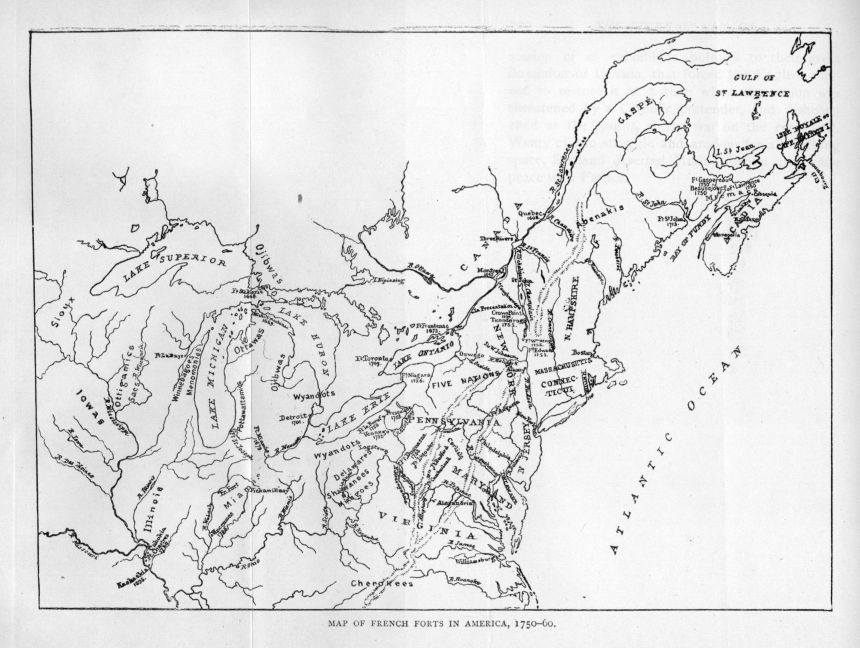
Map of French forts in America, 1750-60.
The map that is placed at the beginning of this chapter outlines the ambitious designs conceived by French statesmen soon after the Treaty of Aix-la-Chapelle. We see the names of many posts and forts intended to keep up communications between Canada and Louisiana, and overawe the English colonies then confined to a relatively narrow strip of territory on the Atlantic coast. Conscious of the mistake that they had made in giving up Acadia, the French now claimed that its "ancient limits" did not extend beyond the isthmus of Chignecto—in other words, included only Nova Scotia. Accordingly they proceeded to construct the forts of Gaspereau and Beauséjour on that neck of land, and also one on the St. John River, so that they might control the land and sea approaches to Cape Breton from the St. Lawrence where Quebec, enthroned on her picturesque heights, and Montreal at the confluence of the Ottawa and the St. Lawrence, held the keys to Canada. The approaches by the way of Lake Champlain and the Richelieu were defended by the fort of St. John near the northern extremity of the lake, and by the more formidable works known as Fort Frederick or Crown Point—to give the better known English name—on a peninsula at the narrows towards the south. The latter was the most advanced post of the French until they built Fort Ticonderoga or Carillon on a high, rocky promontory at the head of Lake Sacrement, afterwards called Lake George by General Johnson—a sheet of water always famed for its picturesque charms. At the foot of this lake, associated with so many memorable episodes in American history, General Johnson, a clever, ambitious Irishman, a nephew of Sir Peter Warren, in 1755, erected Fort William Henry, about fourteen miles from Fort Edward or Lyman, at the great carrying place on the upper waters of the Hudson. Returning to the St. Lawrence and the lakes, we find Fort Frontenac or Cataraqui at the eastern end of Lake Ontario, where the old city of Kingston now stands. Within the limits of the present city of Toronto, La Galissonnière built Fort Rouillé as an attempt to control the trade of the Indians of the North, who were finding their way to the English fort at Choueguen (Oswego), which had been commenced with the consent of the Iroquois by Governor Burnet of New York and was now a menace to the French dominion of Lake Ontario. At the other extremity of this lake was Fort Niagara, the key to the West.
At Detroit, Mackinac, and Sault Ste. Marie the French continued to hold possession of the Great Lakes and the country to the west and south. Their communications, then, between the West and Quebec were established, but between the great valleys of the St. Lawrence and the Mississippi, over which they claimed exclusive rights, there was another valley which became of importance in the execution of their scheme of continental dominion. In the years succeeding the treaty of Aix-la-Chapelle the English colonists awakened to the importance of the valley of the Ohio, and adventurous frontiersmen of Virginia and Pennsylvania were already forcing their way into its wilderness, when France's ambition barred the way to their further progress. That astute Canadian, Governor La Galissonnière, in 1749, recognised the importance of the Ohio in relation to the Illinois and Mississippi, and sent Céloron, a captain in the French service, to claim possession of the valley of the former river and its tributaries. This officer made a long and enterprising journey, in the course of which he affixed at different points the arms of France to trees, and buried leaden plates bearing the inscription, that they were memorials of the "renewal of the possession of the Ohio and all its affluents" originally established by arms and treaties, particularly those of Ryswick, Utrecht, and Aix-la-Chapelle. Under the instructions of Governor Duquesne, who possessed all the sagacity of La Galissonnière, forts were established at Presqu'ile (Erie) and on French Creek, a tributary of the Alleghany. Virginians saw with dismay the entrance of the French into a region on which they were now casting a longing eye. Their government had secured from the Iroquois a doubtful deed which gave them, as they urged, a title to the Great West, and a company was even formed to occupy the Ohio. In 1754 the English commenced the construction of a fort at the forks of the Ohio, but it was easily captured by Contrecoeur, who completed and renamed it in honour of the Governor of Canada, Duquesne. Washington, who now first appears in American history, was defeated by Chevalier de Villiers at Fort Necessity, a mere intrenchment at Great Meadows, and the French held entire possession of the Ohio valley, where no English trader or pioneer dared show himself. By 1755 the French dominion was complete from the Ohio to the Illinois, and from the Great Lakes to the Gulf of Mexico, so far as a slender line of communication by means of widely separated posts and settlements could make it so. On the St. Joseph, the Maumee, the Wabash, and the Illinois, there were small forts. Fort Chartres in the Illinois country was the only post of any thorough construction. At Cahokia, opposite the modern city of St. Louis, and at Kaskaskia, at the junction of the river of that name with the Mississippi, there were small and relatively prosperous French villages. In Louisiana the French had the towns of Mobile, Biloxi, New Orleans, and a few other settlements, where the African blacks far outnumbered the whites. That colony had had many difficulties to surmount before it could be considered established. Wars with the Natchez and Chickasaws had been constant. Crozat's experiment had been followed by the establishment of the Mississippi or Western Company, which was to develop gold mines, that never existed except in the imaginations of its reckless promoter, John Law, a Scotchman. When the Mississippi bubble burst, and so many thousands were ruined in France, Louisiana still continued under the control of the company, which was eventually obliged to give up its charter after heavy expenditures which had produced very small results, and the colony became a royal province. With its chequered future must be always associated the name of the Canadian Bienville, who was for some years its governor and justly earned the title of "Father of Louisiana." Insignificant as was its progress, France prized its possession, and had she been alive to her opportunities she might have colonised it with Huguenots and made it a power in the conflict between herself and England in America.
France, busy with her ambitious designs in Europe, gave but a meagre and too often half-hearted support to the men who had dreams of founding a mighty empire in America. When France and England met for the great struggle on that continent, the thirteen colonies had reached a population of nearly a million and a quarter of souls, exclusive of the negroes in the South, while the total number of the people in Canada and Louisiana did not exceed eighty thousand. In wealth and comfort there was the same disproportion between the French and English colonies. In fact at the time of the last war, Canadian commerce was entirely paralysed, farms neglected, and the towns barely able to live. In 1757 food was so scarce in Quebec and Montreal that the soldiers and people had to use horse flesh. The combined forces of Canadian militia and regular troops were always much inferior in number to the British and colonial armies when united for the invasion of Canada, with the support of a powerful fleet; but the great strength of the French colony lay in the natural barriers between the English colonies and the keys to New France, Quebec, and Montreal, and in the skill with which the approaches by way of Lake Champlain had been defended by forts at every important point. If the French force was insignificant in number, it was, as a rule, skilfully managed, and in the early part of the struggle the English had no commander to compare with Montcalm for military genius. In some respects the French Canadians were more manageable in war than the English colonists. No legislative bodies existed in Canada to interfere with and thwart the plans and orders of military commanders, but the whole Canadian people acted as a unit to be moved and directed at the will of the King's officers. The Indian tribes from Acadia to the Mississippi, the Ohio, and the Illinois, were, with the exception of the Five Nations, always friendly to the French since the days of Champlain—the warm allies of a people who fraternised naturally with them; and it would have been an unhappy day for the English colonists had eighty or a hundred thousand Canadians been able to arm and, under the skilful generalship of Montcalm, swoop down with their savage allies on the English colonial settlements. But the French of Canada were never able, as a rule, to do more than harass by sudden raids and skirmishes—by a system of petite guerre, or petty warfare—the English of America, and at no time in colonial history was the capture of Boston or of New York actually attempted by a land force from Canada, though it was suggested more than once. At the outbreak of the war the Mohawks were the only Indian tribe on whom the English could place much dependence, and that was largely owing to the energy and discretion of Sir William Johnson, who had long lived in their country and gained not only their confidence but even their affection. The tribes in the Ohio valley had been won by the success of the French in driving out the Virginians, while in the further west the Foxes and other communities who had been unfriendly to the French had been beaten into submission—the Foxes in fact almost destroyed—by the raids of the French and their Indian allies. The great current of active thought and enterprise which develops a nation was always with the English colonies, and though large schemes of ambition stimulated the energies of the bold and adventurous men to whom the destinies of France were entrusted from the days of La Salle to those of Montcalm, their ability to found a new empire in America under the lilies of France was ever hindered by the slow development of the French settlements, by the incapacity of the King and his ministers in France to grasp the importance of the situation on this continent, and by their refusal to carry out the projects of men like La Galissonnière, who at once recognised the consequences of such neglect and indifference, but found no one ready to favour his scheme of establishing large settlements of French peasantry in Canada and Louisiana. France, we see now, had her great opportunity in America, and lost it forever at Quebec in 1759.
Before we proceed to the record of the events which led to the conquest of Canada, it is necessary that we should briefly review the history of the period which elapsed between the Treaty of Aix-la-Chapelle and the commencement of the Seven Years' War. When English statesmen were informed of the mistake they had made in restoring Cape Breton to France with such reckless haste, they began to reflect on the best means of retrieving it as far as possible; and at the suggestion of Shirley and other colonists they set to work to bring an English population into Nova Scotia, and to make it a source of strength instead of weakness to the New England communities. In 1749, the year of the formal surrender of Louisbourg, the city of Halifax was founded on the west side of the admirable harbour, long known in Acadian history as Chebouctou. Here, under the direction of Governor Cornwallis, a man of great ability, a town slowly grew up at the foot and on the slopes of the hill which was in later times crowned by a noble citadel, above which has always floated the flag of Great Britain. Then followed the erection of a fort at Chignecto, known as Fort Lawrence in honour of the English officer who built it—afterwards governor of Nova Scotia—and intended to be a protection to the province, constantly threatened by the French and Indians, who were always numerous at the French posts and settlements on the isthmus. The French constructed on the northern bank of the Missiquash a fort of five bastions known as Beauséjour, and a smaller one at Bay Verte, with the object, as previously stated, of keeping up communication with Louisbourg, which they were strengthening in some measure. At Fort Beauséjour the treacherous priest Le Loutre continued to pursue his insidious designs of creating dissatisfaction among the French Acadians and pressing on them the necessity of driving the English from the former possessions of France.
Though war was not formally proclaimed between France and England until many months later, the year 1755 was distinguished in America by conflicts between the English and French—a prelude to the great struggle that was only to end in the fall of New France. The French frigates Alcide and Lys were captured on the coast of Newfoundland by vessels of a fleet under Admiral Boscawen, who had been sent by the English Government to intercept a French fleet which had left France under Admiral de la Mothe, having on board troops under Baron Dieskau and the Marquis de Vaudreuil, the successor of Duquesne in the government of Canada.
In Acadia, in the valley of the Ohio, and at Lake George, the opposing forces of England and France also met in conflict. In the spring an English force of regular and colonial troops, chiefly the latter, under the command of Colonel Monckton, who has given his name to a prosperous city on the isthmus of Chignecto, and of Colonels Winslow and Scott, captured the two French forts and took a good many prisoners, among whom were a considerable number of French Acadians, forced by the French to assist in the defence of Beauséjour. Le Loutre succeeded during the confusion on the surrender of the fort, in evading capture, but only to find himself eventually taken prisoner by an English ship while on his way to France, and sent to the island of Jersey, where he was kept in confinement until the end of the war, and from that time disappears from American history.
In the same year General Braddock, an arrogant though experienced soldier, was sent in command of a large force of regular and colonial troops into the valley of the Ohio to attack Fort Duquesne and drive the French from that region, but chiefly through his want of caution and his ignorance of Indian methods of warfare in the American wilderness, he was surprised on the Monongahela by a small force of Indians and French under the Canadian Beaujeu, who were concealed in ravines, from which they were able in perfect security to prevent the advance of the English, and literally riddle them with bullets until they fled in dismay and confusion, leaving behind them a great store of munitions and provisions besides a large sum of money in specie. Braddock died from the wounds he received, and the remnant of his beaten regiments retired precipitately beyond the Alleghanies. This unhappy disaster was followed by a succession of Indian raids along hundreds of miles of frontier, and the petite guerre of the Abenakis and French in Acadia and New England, with all its horrors, was repeated by the Indians of the West. The southern colonies were paralysed for the moment, and the authorities of Pennsylvania gave evidences of indifference, if not of cowardice, that are discreditable features of its early history.
General Johnson, of the Mohawk country, at the head of a large colonial force, defeated Baron Dieskau at the foot of Lake George, which then received its present name in honour of the King of England, and the French general himself was taken prisoner. It was for his services on this occasion that Johnson was made a baronet, though he had not succeeded in the original object of his expedition, the capture of Crown Point. General Shirley, however, was not so fortunate as Johnson, for he abandoned the project of attacking Fort Niagara when he heard that it had received reinforcements.
The most memorable event of this time, which has been the subject of warm controversy between French and English historians and the theme of a most affecting poem, was the expulsion of the Acadian French from Nova Scotia. When Halifax was founded it was decided, as a matter of necessity, to bring the Acadians more entirely under the control of the English authorities. They had probably increased since the Treaty of Utrecht to at least twelve thousand souls, living for the most part in the Annapolis valley, by the Gaspereaux and Avon rivers, at Grand Pré, at Mines, and at Chignecto. When they were asked to take the oath of allegiance by Governor Lawrence, they refused to do so unless it was qualified by the condition that they should not be obliged at any time to take up arms. Many years before a considerable number, if not the majority, of the same people had taken this qualified oath, although it is also claimed that no one had legal authority to make such a condition with them. Under the treaty of 1713 the Acadian French had a year to choose between leaving the country or giving their submission to the British Government and becoming its subjects. It was natural that they should have hesitated to leave the humble though comfortable homes which their own industry had made on the most fertile lands of Nova Scotia, but it is also quite certain that every obstacle was thrown in the way of their removal by the English governors. Had the British authorities adopted from the very commencement a firm and decided policy towards them, they might have given an unreserved allegiance to the British Crown and eventually become peaceable and contented inhabitants. As it was, the British Government systematically neglected the country, and left the little garrison at Annapolis for many years practically at the mercy of the Acadians, who could have often half starved them, and even captured the only English post of the least importance in the province, had they been led at any time by a man of courage and determination. It was only the watchfulness of the government of Massachusetts, who fully recognised the importance of Nova Scotia in relation to New England, that retained the province in English hands during the time when English statesmen like Newcastle were even ignorant of the existence or situation of Annapolis. If French emissaries were often able to make these credulous and ignorant people believe that France would soon regain her dominion in Acadia, it was largely owing to the fact that the English showed such weakness in all their relations with the Acadians, and made no earnest or sustained effort to assert their sovereignty. At last when England decided to settle and strengthen Nova Scotia, a feeling of uneasiness was naturally created by the presence of a large and increasing population who were naturally in sympathy with the French, and had assumed an attitude quite irreconcilable with the security of English interests on the Atlantic coast of eastern America. It must be admitted that the position of the Acadians was one deserving of sympathy, tossed about as they were for many years between French and English. They were considered by the French of Canada and Cape Breton as mere tools to carry out the designs of French ambition. England, however, had at some time or other to assert her sovereignty in Nova Scotia, and to assure its security, seemingly threatened by the presence of people who would not formally declare themselves British subjects. The position of Nova Scotia between Cape Breton and Canada gave reason for constant alarm, and when Halifax was founded some decisive step was felt to be necessary by Cornwallis and his successors. No doubt the feeling that had been created against the Acadians, by their refusal to take an unconditional oath of allegiance to Great Britain—the only oath that could be possibly offered to them by a self-respecting and strong government—was intensified by the notorious fact that a number of them had been actually captured at Fort Beauséjour with arms in their hands, though in this case they appear to have been really the mere tools of Le Loutre and French emissaries who grossly misled them. The people of New England were much prejudiced against them and asserted that they could never enjoy any security while the Acadians continued to maintain their attitude of neutrality. They had always supplied Louisbourg with provisions and helped to build the French forts on the isthmus, and it was difficult for Lawrence and his officers to obtain any assistance from them in the same way. When the Indians harassed the English settlers in Nova Scotia, the government of that province recalled the raids of the Abenakis and French Canadians, and believed with some reason there was to be the same condition of things in the peninsula. The war between the French and English had never really ceased in America, and it was well known that the hollow truce in Europe would be broken at any moment; and in the presence of the great danger that threatened the English colonies, they had some ground for fearing the presence of a large body of people who claimed to be neutrals in a country which was England's by conquest and treaty, and where they could and did enjoy an amount of political and religious liberty which no Protestant enjoyed in Catholic Europe. Then came the defeat of Braddock in the Ohio country, and the knowledge that France was preparing for a determined effort to strengthen and even increase her dominions in America.
It was under these circumstances that Governor Lawrence of Nova Scotia—a determined and harsh military man—no doubt at the instigation of Shirley and the authorities of New England, determined to secure the peace and safety of the province by the most cruel of all possible measures, the expulsion of the whole body of French Acadians. It must be admitted, however, that all the circumstances, when reviewed in these later times, do not seem sufficient to justify the stern action of the men who took the leading part in this sad tragedy. The responsibility must mainly rest on Governor Lawrence, and not on the imperial government, who never formally authorised the expatriation. Be that as it may, the Acadians were driven from their settlements, and the noble qualities of Lawrence, Monckton, and Winslow, who carried out the measures of expulsion, will be always obscured in the minds of that great majority of people who think only of the deed and its consequences, and are influenced by the dictates of the heart. It is a matter for deep regret that the men who represented England in those days had not run a risk on the side of humanity, rather than have driven thousands of men, women, and children from their pleasant homes by the sides of the beautiful bays and rivers of Nova Scotia, and scattered them far and wide among the English colonies, where their treatment was rarely generous. Even those who reached Quebec were coldly received and were grudgingly supplied with miserable food. Poetry and sentiment have not exaggerated the sorrow and misery of these hapless exiles, so ill-fitted to go out into the bitter world of hardship and destitution.
XVII.
THE STRUGGLE FOR DOMINION IN THE GREAT VALLEYS OF NORTH AMERICA: ENGLISH REVERSES AND FRENCH VICTORIES—FALL OF LOUISBOURG AND FORT DUQUESNE.
(1756-1758.)
In 1756 England was fully engaged in that famous war with France which was to end in driving her hereditary rival from the eastern and western hemispheres, and in the establishment of the German Empire by the military genius of Frederick the Great. For a while, however, the conflict in America was chiefly remarkable for the incapacity of English commanders on land and sea. Earl Loudoun, the sluggish commander-in-chief, of whom it was said, "he is like St. George on the signs; always on horseback, but never rides on," arranged a campaign against the French on Lake Champlain and against Louisbourg which ended only in disaster and humiliation for England. The forts at Oswego, always regarded as a menace by the French who occupied Fort Frontenac on the opposite side of Lake Ontario, were successfully attacked and destroyed by Montcalm,[1] who was sent to Canada in 1756 to make a supreme effort for France. The energetic French general then proceeded a year later to storm Fort William Henry, and largely owing to the incapacity or timidity of General Webb, who could have marched to the assistance of the besieged from Fort Edward, the brave Scotch officer, Lieutenant-Colonel Monro, then in command of this important defence of the northeastern frontier, was obliged to surrender. After the capitulation of this fort a large number of helpless men, women, and children were barbarously murdered by the body of Indians that accompanied the French—one of the saddest episodes in American history, which must always dim the lustre of Montcalm's victory, though it is now generally admitted that the French general himself was not responsible for the treachery of his Indian allies, but used his most earnest efforts—even at the risk of his own life—to save the English when the savages were mad with lust for the blood of their enemies.
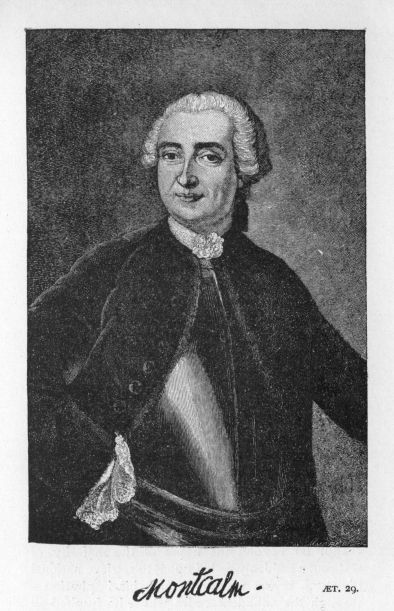
Montcalm
At sea the results were equally discouraging for the English. Fifteen ships-of-the-line and three frigates, under the orders of Admiral Holbourne, and twelve thousand troops under the command of Earl Loudoun himself, assembled in the harbour of Halifax in the July of 1757; but, owing to the absence of energy and celerity of movement from the very day the project was decided upon in England until after the arrival of the fleet in America, the French were able to get reinforcements of ships and men into Louisbourg, and the English admiral and general came to the resolve—so strange for Englishmen in time of war—to run no risk in attacking the fortress. Loudoun returned to New York, but too late to retrieve the injury he had done to the northern colonies by withdrawing so large a force from the frontier at a critical period, when Montcalm was marching on Fort William Henry with such unfortunate results for English interests. Holbourne sailed with his fleet for Louisbourg, and after a half-hearted attempt to draw the French fleet, then safely moored under the guns of the town, into an engagement, even the elements combined against him, and when he had lost a number of his vessels on the rocky Cape Breton coast, he returned to England to tell the story of his failure.
It was at this critical period, when England so sadly needed a bold and wise statesman at the head of her government in the place of weak and incompetent men like Newcastle, that the great Pitt, better known as Chatham at a later day, was called to office by the unanimous opinion of the English people outside, perhaps, of a small selfish clique of the aristocracy. It was his good fortune to be successful far beyond the hopes of the majority of statesmen suddenly called upon to retrieve national disaster. It was mainly through his inspiration—through the confidence with which he inspired all those who served the country at this momentous epoch—that England became the centre of a vast colonial empire such as the world never saw, even in the days when Rome was mistress.
When Pitt was recalled to office in July, 1757, it was too late to prevent the humiliation of England through the incompetency of Holbourne, Loudoun, and Webb, and the year 1757 closed with Montcalm triumphant in America. But while France neglected to give adequate support to her brave sons in Canada, England rallied to the support of Pitt, and the whole nation felt a confidence in the future which it had never had during the administration of his predecessors. On the continent of Europe, Pitt contented himself with giving the largest possible subsidies of money to his great ally Frederick, and by entrusting the command of the English and Hanoverian forces to the best of his generals, Ferdinand, Prince of Brunswick, in place of the incompetent Duke of Cumberland. The victories of Rossbach, Leuthen, and Minden were the answers that Frederick gave to the English minister for the confidence he reposed in his ability to cope with the four great Powers then combined with Saxony to destroy Prussia and bring England to the feet of France, by invading her territory and marching into her very capital. Hanover was saved by the memorable victory on the Weser, and England was spared the humiliation and perils of an invasion by the destruction of a French fleet by Admiral Hawke in Quiberon Bay.
While the military genius of Frederick and the inspiring statesmanship of Pitt were successfully thwarting the ambitious plans of France and her allies in Europe, the English minister had decided on a vigorous campaign in America. With that intuitive sagacity which he possessed above most men for recognising ability in others for the purpose in view, he chose General Amherst, Admiral Boscawen, and Brigadier-General Wolfe, not because of their aristocratic or political influence, but because of their military capacity, the want of which in Loudoun and Holbourne had brought disaster upon the English arms. Unhappily he was forced, for the time being, by strong influences around him to retain General Abercromby at the head of one of the expeditions in America, but he hoped that the co-operation of Lord Howe would keep up the courage of the army, and prevent any blunders on the part of the slow and obtuse soldier in command. The plan of the campaign which opened in 1758 was to send three expeditions simultaneously against the three all-important French positions held by the French in the Ohio valley, on Lake Champlain, and at the entrance of the Gulf of St. Lawrence. General Forbes, a resolute Scotch veteran, was to march on Fort Duquesne, General Abercromby was to lay siege to Crown Point and Ticonderoga, and General Amherst, with Admiral Boscawen, was to attack the fortress of Louisbourg, which was acknowledged as the key of the St. Lawrence.
The English fleet anchored in Gabarus Bay, to the southward of Louisbourg, on the 2nd of June, 1758. It was composed of over fifty ships, twenty-two of which were "liners," and carried eighteen hundred guns altogether. The army comprised between eleven and twelve thousand men, including a small force of provincial rangers. The fortress, which had been considerably strengthened since 1745, was defended by over three thousand regular troops, and a small number of Indians and inhabitants. A fleet of fourteen men-of-war, with a crew of nearly three thousand men, and five hundred and sixty-two guns, were in the harbour. Chevalier Drucour was governor of the island, and conducted the defences with skill and resolution, and had Admiral Desgouttes been as brave and capable as the former, Louisbourg would hardly have fallen so easily. On the morning of the 27th July, the English took possession of the West gate, and the cross of St. George was hoisted on the citadel of a fortress which was destined from that time to disappear from the pages of the world's history. In 1763 the fortress was levelled to the ground, and now a few mounds of turf alone represent the ambitions of France a century and a half ago. Nature has resumed dominion over the site of the once famous fortress, and the restless ocean, which stretches away beyond to the eastward without a break to Europe, brings no message of the fleets that came once, richly freighted, to this historic fort. Louisbourg is now only a place of memories—of associations which connect Cape Breton with most glorious episodes of England's history, with times when the genius of Pitt triumphed over France.
After the taking of Louisbourg, the English occupied the island of St. John, now Prince Edward, where there were several prosperous settlements at Port La Joye (Charlottetown), St. Pierre, and other places on the bays of the low-lying coast. The population was composed chiefly of Acadians, who had commenced to cross from Nova Scotia after the Treaty of Utrecht, and probably numbered in 1758 four thousand souls, engaged in fishing and farming. These people were able to supply Louisbourg with provisions, as no agricultural operations of importance were carried on in Cape Breton.
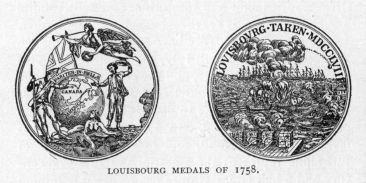
Louisbourg medals of 1758.
Wolfe destroyed the French settlements around the bays of Gaspé, Miramichi, and Chaleurs, while Colonel Monckton performed the same painful duty in the valley of the St. John River. Acadia, according to its "ancient limits," was at last completely in the possession of England.
The news of the capture of Louisbourg was received in America and Europe with many rejoicings, and the eleven stands of colours won at this gateway of Canada were deposited in St. Paul's Cathedral amid the roar of cannon. This victory came at an opportune moment, since Abercromby had suffered a humiliating repulse on the banks of Lake Champlain. With a splendid force of regular and provincial troops, from fourteen to fifteen thousand altogether, but entirely destitute of artillery,—an evidence of extraordinary incapacity, or of culpable negligence,—he had thrown himself upon most formidable entrenchments of fallen trees, with their sharp ends pointing outwards, that the French had ingeniously constructed in front of Carillon, which was still incomplete, and defended by less than three thousand men under Montcalm and Lévis. The most unhappy incident of this disaster was the death of Lord Howe, described by Wolfe, who knew him well, "as the noblest Englishman that has appeared in my time, and the best soldier in the British army." Abercromby hurriedly retired to the head of Lake George, and was soon afterwards superseded by the cautious Amherst. Montcalm was greatly encouraged by the spirit of his soldiers throughout the attack, and erected a cross on the battle ground with the following inscriptions of his own—the latter his paraphrase of the first:
Quid dux? Quid miles? Quid strata ingentia ligna? En signum! en victor! Deus hîc, Deus ipse triumphat.
"Chrétien! ce ne fut point Montcalm et la prudence, Ces arbres renversés, ces héros, ces exploits, Qui des Anglais confus ont brisé l'espérance, C'est le bras de ton Dieu, vainqueur sur cette croix." [2]
An important event of the year was the taking of Fort Frontenac by Colonel Bradstreet, who had assisted in the first siege of Louisbourg. The capture of this fort was regarded with every reason by the French as "of greater injury to the colony than the loss of a battle." Fort Duquesne, which was the key to the Ohio country, was abandoned by Ligneris on the approach of Brigadier Forbes, a very capable Scotch officer, but not until the French had beaten with considerable loss an advance of the main forces commanded by Major Grant. Ligneris withdrew his troops to Fort Machault (Venango), where he remained until the following year. Fort Duquesne was renamed in honour of Pitt, and a great manufacturing city has grown up on its site in the beautiful valley which, in 1758, passed away forever from the French who had only held possession of it for six short years.
XVIII.
THE STRUGGLE FOR DOMINION IN THE VALLEY OF THE ST. LAWRENCE—CANADA IS WON BY WOLFE ON THE PLAINS OF ABRAHAM.
(1759-1763.)
When the campaign opened in 1759 the French had probably under arms in Canada not far from twenty thousand men, regulars, militia, and Indians—one-fifth only being French regiments. At Detroit there was a very insignificant garrison, as it was of minor importance compared with Niagara, which was the key to the Lakes and West. Here Pouchot, an able officer, who has given us an interesting memoir of the war, was stationed, with authority to call to his assistance the French forces at Presqu'ile, Le Boeuf, and Venango—some three thousand men altogether, made up mostly of colonial forces and Indian auxiliaries. At Fort Rouillé (Toronto) there was no force worth mentioning, as it was a mere dependency of Niagara. Fort Frontenac had been destroyed by the English, and the French had no posts from that point as far as Montreal except at Point-au-Baril (near Ogdensburgh), and Île Galops, by the side of the well-known rapids of that name. The security of Montreal depended mainly on the French continuing to hold control of Lake Champlain, and Île-aux-Noix which they now set to work to fortify. Bourlamaque, an able officer, was in command at the French forts of the lake with a force of over two thousand men, of whom one-half were Canadian, and had orders to abandon Carillon and Crown Point, if necessary, and advance to Île-aux-Noix. At Quebec, probably fourteen thousand men, of whom four thousand were the pick of the French regiments in Canada, were under command of Montcalm, Lévis, and Vaudreuil, and were entrenched on a height of land stretching for nearly six miles from the St. Charles River, to the southeast of the fortress, as far as Montmorency River, where its current rushes wildly forward for its tremendous leap of over two hundred and fifty feet into a deep and rocky abyss, and forms that glistening sheet of billowy foam which, seen from a distance, resembles a snowdrift suspended in air. The fortifications of Quebec had been strengthened for some years back, and its defences were entrusted to Ramesay, who had led a force to Nova Scotia in the year of the Duke d'Anville's disastrous expedition. The city was ill-provided with provisions for any sustained siege, despite the opportune arrival of some relief from France in the spring. The whole country had been impoverished by the continuous drain on the agricultural and labouring population during the war, and the Canadians themselves began to lose courage, and assembled at the call of the authorities with less spirit than they had hitherto shown. Canada was literally on the brink of ruin, after so many years of war and privation. Corruption had eaten into the very body of Canadian life and government. The Intendant Bigot had been for years amassing riches at the expense of the country, and had, in imitation of his lord and master at Versailles, his fair Canadian Pompadour to bedeck with jewels and favours from the proceeds of his ill-gotten gains. The names of Péan, Varin, Cadet, Estèbe, and Clavery are the most conspicuous amongst those officials who became rich on Canadian misery and misfortune, and are dishonourably associated with the darkest hours of Canadian history. "What a country," said Montcalm, "where all the knaves grow rich, and honest men are ruined." Not the least discouraging feature of matters in Canada at this critical time, when unity and harmony were so necessary, was the jealousy that Governor de Vaudreuil, a weak, vain man, but honest and attached to his native province, entertained of Montcalm, who was himself imbued by the loftiest spirit that could animate a brave soldier and loyal Frenchman.
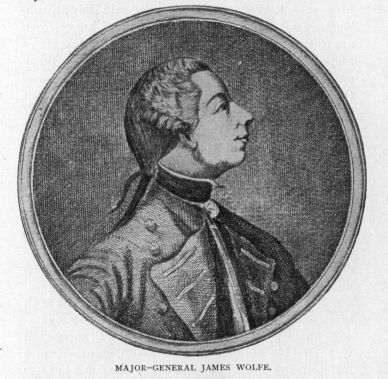
Major-General James Wolfe.
It was decided that the army under General Wolfe, less than nine thousand men, and the fleet under Admiral Saunders, should attack Quebec; that the Commander-in-Chief, Amherst, should advance against Montreal by way of Lake Champlain, and that Brigadier Prideaux and Sir William Johnson should lead a considerable force against Niagara. The English fleet arrived before Quebec on the 20th June, and no time was lost in commencing operations against the fortress. Wolfe was well supported by such able soldiers as Monckton, Murray, and Carleton, the latter of whom became famous in later Canadian history as Lord Dorchester. Brigadier Townsend, however capable, was irritable and egotistic. The soldiers admired Wolfe for his soldierly qualities, and loved him for his thoughtfulness for everyone above or below him. Admiral Saunders was well aided by Holmes and Durell, and gave a loyal and ready response to the plans of Wolfe. The regiments had seen service at Louisbourg, and were fully animated by the courage and spirit of their general. The siege lasted for eleven weeks, and was then only ended by an act of boldness on the part of Wolfe, which took the French entirely by surprise.
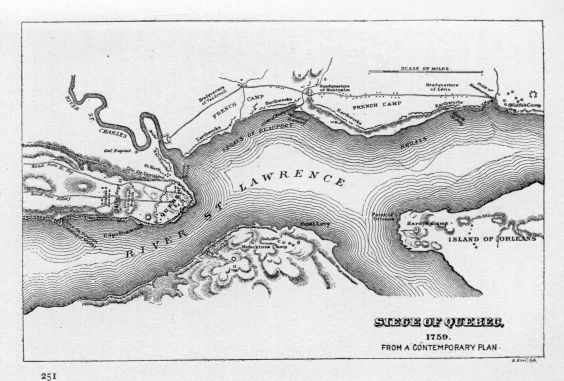
Siege of Quebec, 1759.
The principal events between the 26th June and the 12th September, when the last act in this great international drama was played, can be described in a few pages. One of the most important incidents was the occupation by the English of the heights of Lévis, whence the fortress was bombarded with an effectiveness that surprised the French, who, under the advice of Vaudreuil, and in opposition to that of Montcalm, had not taken adequate measures for the protection of so valuable a position. So destructive was the bombardment that, when the English took possession of Quebec, they found all the churches and buildings of importance in ruins, and the Ursuline Convent alone was saved from complete destruction.
The English sustained a severe repulse near the Montmorency end of the French lines. They had made an attack on an outwork at that point, and the grenadiers had been carried away by excitement and dashed up the slope of the heights, where from twelve to fourteen thousand French soldiers were strongly intrenched. A furious storm of bullets assailed the reckless and brave grenadiers, who could not even gain a firm footing on the slippery slope, while the rain came down in torrents, and their blood reddened the rivulets of water. This was, however, the only serious disaster that the English suffered throughout the siege. The fire ships of the French had been ill-managed, and failed to do any damage as they were sent down against the fleet. Montcalm, sure of his impregnable position, refused to be drawn from his intrenchments and to offer battle to Wolfe. He knew that delay was everything to him, for the autumn was drawing near. In a few weeks storm and frost would drive the Englishmen from the river. Wherever Montcalm looked, his position seemed unassailable. The high cliffs that stretched for miles above Quebec offered a guaranty of security in that direction, and to prevent any doubt, Bougainville, a capable officer—in later years famous as a navigator—was on the alert with a force of upwards of two thousand soldiers. He had double work to do, to guard these apparently impregnable cliffs, and to assure the arrival of provisions from the country by river and land. It was the expected arrival of a convoy of provisions that proved an important factor in the successful accomplishment of a plan that Wolfe had devised for the capture of the city.
While the siege was in progress, the news from the west and from Lake Champlain was discouraging for the French. Niagara had been surrendered by Pouchot to Sir William Johnson, who had taken command on the death of Prideaux—killed at the beginning of operations—and a large force that was brought up by Ligneris from the Ohio valley to succour the post had been severely defeated. Crown Point and Ticonderoga had been abandoned by Bourlamaque, and there was for a time some expectation of the advance of Amherst to the St. Lawrence; Montcalm was obliged to weaken his army by sending his ablest general, Lévis, with a force of fifteen hundred men, to look after the defences of Montreal, but the sluggish English general wasted his time on the banks of Lake Champlain.
It was quite clear to Wolfe and Saunders that Amherst was not to give them any assistance in the difficult work before them. It was on the night of the 12th of September that Wolfe carried out the project which had been for some time forming in his mind. He had managed to concentrate a force of four thousand men above the fortress without awakening the suspicions of the French, who were confident that Bougainville was fully able to prevent any force from attempting so impossible and foolhardy an exploit as the ascent of the high cliffs. The visitor to the historic places around Quebec will be deeply interested in a cove, just above Sillery, now known as Wolfe's Cove, but in old times as the Anse-au-Foulon. A zig-zag and difficult path led from this cove to the top of the height, and Wolfe conceived the hope that it was possible to gain access in this way to the table-land where he could best give battle to Montcalm. He saw that the cliff at this point was defended by only a small guard, under the command, as it afterwards appeared, of Vergor, who had been tried and acquitted for his questionable surrender of Beauséjour. When the English boats dropped down the river with the tide at midnight, on the 12th of September, there was no moon, and the stars alone gave a faint light. Montcalm had no conception of the importance of the movement of troops which, it had been reported to him, was going on for some days above Quebec, and his attention was diverted by the constant bombardment on the town from Lévis, and a fierce cannonading that was kept up against Beauport by Saunders. Wolfe's thoughts on that memorable night as his boat passed under the shadow of the dark cliff, we can imagine from an incident that is related by one who was present. Hardly a dip of an oar was heard from the flotilla as it was borne down the river, but from Beauport and Lévis came the constant roar of cannon. Every moment was carrying him to fame and death, and perhaps it was some foreboding of his fate that led him to repeat the words of Gray's Elegy, which from that hour has become more famous in English literature:
"The boast of heraldy, the pomp of power, And all that beauty, all that wealth e'er gave, Await alike th' inevitable hour; The paths of glory lead but to the grave."
As the boats came close to a point on the bank a sentinel challenged, "Qui vive?" "La France!" replied an officer of Fraser's Highlanders who spoke French well. "À quel regiment?" again challenged the suspicious soldier. "De la Reine," answered the same officer, who happily remembered that some companies of this regiment were with Bougainville. Fate that eventful night was on the side of the bold Englishman. The French were expecting a convoy of provisions, and the sentinel called out, "Passe!" Another sentry, more suspicious, ran down to the water's edge, and asked, "Pourquoi est-ce que vous ne parlez plus haut?" The captain replied with wonderful coolness, "Tais-toi, nous serons entendus!"—an answer which satisfied the guard. In this way the English boats were able to steal into the cove without being stopped. A few minutes later the heights were gained, the guard was overpowered, and the British regiments were climbing to the level land without hindrance. By six o'clock Wolfe was able to form his army of nearly four thousand men in line of battle on the Plains of Abraham.[1] "This is a serious business," exclaimed Montcalm, as he saw the red line of the English regiments on the table-land behind Quebec. He appears to have almost immediately come to the conclusion that it was necessary to fight the English before they received any accessions of strength, and not to wait for Bougainville, who would probably come up in time with his force of two thousand men. By ten o'clock the two armies—that of Montcalm outnumbering the English probably by fifteen hundred—were advancing on each other. The French as they drew near poured a volley into the ranks of the British regiments, but the latter reserved their fire until they were within forty yards of their enemy, when they discharged their guns with most deadly effect. The French fell in heaps, and as the bullets crashed amongst their faltering ranks, they broke and retreated. The battle was literally won in a few minutes. Wolfe, who had been wounded in the wrist at the beginning of the fight, was leading a charge of the grenadiers, who had shown such fateful precipitancy at Montmorency, when he was fatally wounded. He was removed to a redoubt in the rear and laid on the ground, where he remained for a few minutes in a swoon or stupour. "They run! See how they run!" exclaimed one of the men watching their wounded chief. "Who run?" he called, as he attempted to rise for an instant. "The enemy, sir; 'egad, they give place everywhere!" "Go, one of you, my lads," ordered the dying General, whose brain was still clear and active, "with all speed to Colonel Burton, and tell him to march Webb's regiment down to the St. Charles River, and cut off the fugitives to the bridge." He turned on his side and said: "God be praised, I now die in peace." Then, in a moment later, he passed into the great silent land. Montcalm also received his death blow while he was endeavouring to give some order to his beaten army. He was borne along by the crowd of retreating soldiers through the St. Louis gate into the town. A few hours later, on the 14th September, he breathed his last. His last words were in commendation of Chevalier de Lévis—a soldier in no way inferior to himself in military genius.
Monckton, who was next to Wolfe in rank, had been also severely wounded in the battle, and consequently by a strange irony of fate, Townshend, who had been unfriendly to Wolfe, and had doubted his military capacity, was called upon to take command. Lévis was absent at Montreal, unfortunately for French interests at this very critical juncture, and Vaudreuil's opinion prevailed for a retreat to Jacques Cartier. When Lévis arrived and Vaudreuil consented to march to the support of Quebec it was too late. Ramesay had decided to capitulate, in view of the ruined condition of the city and walls, the scarcity of rations, and the unwillingness of the Canadian troops and citizens to continue the defence, when they found that the English were about to resume the attack. When the French army was moving towards Quebec, the English were in possession, and the fleur-de-lis had given place to the red cross of England on the old fort of St. Louis. By the terms of capitulation the troops were to be allowed to march out with the honours of war, and to be landed in France; the inhabitants were not to be disturbed; the free exercise of the Roman Catholic religion was allowed, and safeguards granted to houses of clergy and communities. All conditions were provisional until a treaty was arranged between the Powers.
The body of Montcalm was buried beneath the floor of the Ursuline Convent, in a grave which had been already partly hollowed out by a bursting shell. Many years later an English governor-general, Lord Aylmer, placed in the chapel of the convent a plain marble slab, with the following graceful tribute to the memory of a great soldier of whom English and French Canadians are equally proud.
HONNEUR À MONTCALM LE DESTIN EN LUI DÉROBANT LA VICTOIRE L'A RÉCOMPENSÉ PAR UNE MORT GLORIEUSE!
Wolfe's remains were taken to England, where they were received with every demonstration of respect that a grateful nation could give. In Europe and America the news of this victory had made the people wild with joy. "With a handful of men," said Pitt, in the House of Commons, "he has added an empire to English rule." A monument in that Walhalla of great Englishmen, Westminster Abbey, records that he "was slain in a moment of victory." On the heights of Quebec, in the rear of its noble terrace, still stands the stately obelisk which was erected in 1828 under the inspiration of the Earl of Dalhousie in honour of Montcalm and Wolfe, and above all others attracts the interest of the historical student since it pays a just tribute to the virtue and valour of the two great commanders in the following simple but well conceived language:
MORTEM. VIRTUS. COMMUNEM. FAMAM. HISTORIA. MONUMENTUM. POSTERITAS. DEDIT.
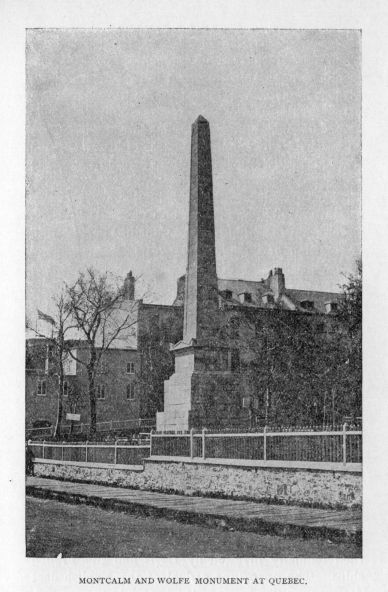
Montcalm and Wolfe monument at Quebec.
Wolfe was only in his thirty-third year when he died on the field of Abraham. Montcalm was still in the prime of life, having just passed forty-seven years. Both were equally animated by the purest dictates of honour and truth, by a love for the noble profession of arms, and by an ardent desire to add to the glory of their respective countries. Montcalm was a member of the French nobility, and a man of high culture. His love for his mother, wife, and children is shown in his published letters, written while in Canada, and he was ever looking forward to the time when he could rejoin them in his beloved château of Candiac, and resume the studies he liked so well. Some Canadian writers have endeavoured to belittle Montcalm, that they may more easily explain away the failings of Vaudreuil, a native Canadian, who thwarted constantly the plans of a greater man; but an impartial historian can never place these two men on the same high level. Wolfe's family was of respectable origin, and he inherited his military tastes from his father, who became a general in the English army. He had few advantages of education in his youth, though in later life he became studious, and had much love for mathematics. A soldier's life was his ambition, and fame was his dominating impulse. His indomitable spirit governed his physical weakness. The natural kindness of his nature rose superior to the irritability sometimes caused by his ill-health, and made him always sympathise with the joys, sorrows, and feelings of all classes among whom he lived. He had that magnetic power of inspiring his soldiers and companions with his own confidence and courage which must sooner or later give them victory. He was a good son and made a confidant of his mother. He was fond of female companionship, and was looking forward hopefully to a woman's love, and to a home of his own, when Fate ruthlessly struck him down before the walls of Quebec at the moment of victory.
It is impossible within the limited space of this story to dwell at any length on the events that followed from the taking of the Canadian capital until the cession of Canada three years later. General Murray, who was afterwards the first governor-general of Canada, had charge of the fortress during the winter of 1759-60, when the garrison and people suffered much from cold and disease—firewood being scarce, and the greater number of the buildings in ruins.
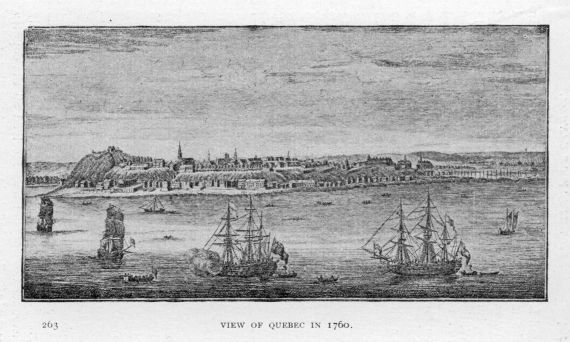
View of Quebec in 1760.
Lévis had decided to attack the town in the spring, as soon as the French ships were able to come down from near Sorel, where they had been laid up all the winter. Towards the last of April, Murray marched out of the fortress and gave battle at St. Foy to the French army, which largely outnumbered his force. His object was to attack the French before they were able to place themselves thoroughly in position before Quebec, but he suffered a considerable loss, and was obliged to retire hurriedly within the walls of the town, which was then regularly invested by Lévis and the French ships. The opportune arrival of the English fleet dashed the rising hopes of the French to the ground, and Lévis was obliged to retreat to Montreal. In the month of September of the same year General Amherst descended the St. Lawrence, after having captured the fort at Île Galops—afterwards Fort William Augustus. Brigadier Haviland left Lake Champlain, captured Île-aux-Noix, and then marched on Montreal; Brigadier Murray came up from Quebec. All these forces concentrated on the same day on the island of Montreal, and Vaudreuil had no alternative except to capitulate. By the terms of capitulation, which were drawn up, like those of Quebec, in French, Great Britain bound herself to allow the French Canadians the free exercise of their religion, and certain specified fraternities, and all communities of religieuses were guaranteed the possession of their goods, constitutions, and privileges, but a similar favour was denied to the Jesuits, the Franciscans, or Recollets, and the Sulpicians, until the King should be consulted on the subject. The same reservation was made with respect to the parochial clergy's tithes. On the 10th of February, 1763, by the Treaty of Paris, France ceded to Great Britain Canada, with all its dependencies, the island of Cape Breton, and the Laurentian Isles. By this treaty the King pledged himself "to give the most effectual orders, that his new Roman Catholic subjects may profess the worship of their religion, according to the rites of the Roman Catholic Church, as far as the laws of Great Britain permit." All the pretensions of France to Acadia were at last formally renounced. England also received all the country east of the River Mississippi, except the city of New Orleans and the neighbouring district, as well as Florida from Spain in return for Havana. Subsequently France gave up New Orleans to Spain, as well as the great region of Louisiana westward of the Mississippi. France was allowed to retain the barren islands of St. Pierre and Miquelon, and certain fishing rights on the coasts of Newfoundland, which she had previously given by the Treaty of Utrecht. George II. had died during 1760, and George III. was now King of England. Pitt was forced to resign, and the King's favourite, the incapable Bute, who became premier, made peace without delay. Pitt opposed the fishery concessions to France, but Bute attached relatively little importance to them, and they have ever since remained to torment the people of Newfoundland, and create complications in case that island consents to enter the Canadian Dominion. Still, despite these concessions, England gained great advantages from the peace, and became the greatest colonial and maritime power of the world.
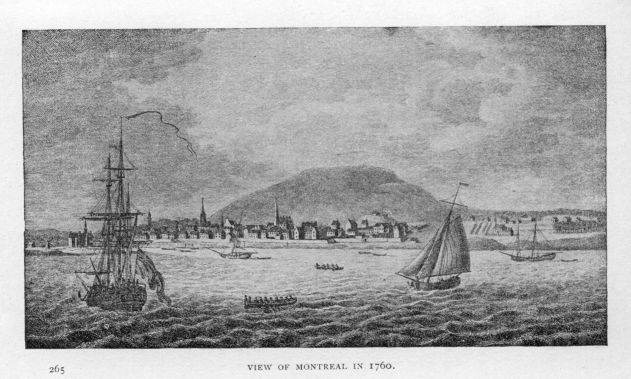
View of Montreal in 1760.
Freedom won on the Plains of Abraham, and a great Frenchman and a great Englishman consecrated by their deaths on the same battlefield the future political union of two races on the northern half of the continent, now known as the Dominion of Canada.
XIX.
A PERIOD OF TRANSITION—PONTIAC'S WAR—THE QUEBEC ACT.
(1760-1774.)
The Canadian people, long harassed and impoverished by war, had at last a period of rest. They were allowed the ministrations of their religion without hindrance, and all that was required of the parochial clergy was that they should not take part in civil affairs, but should attend exclusively to their clerical duties. The seigniors and priests, no doubt, did not give up for some time the hope that Canada would be restored to France, but they, too, soon bowed to the necessity of things, and saw that their material and spiritual interests were quite secure under the new government. None of the habitants ever left Canada after the war. A few members of the seigniorial nobility, the officials and some merchants—perhaps three hundred in all—may have gone back to France. Men like Bigot and Varin on their return were severely punished, and forced to give up as much as possible of their ill-gotten gains. Governor de Vaudreuil himself was cast into the Bastile, but it was ascertained after investigation that he had no connection with the crimes of the worthless parasites that had so long fattened on the necessities of the unhappy province. He died soon after his imprisonment; the iron of humiliation had probably eaten into the heart of a man who, whatever his faults, had many estimable qualities, and loved his native country.
For several years Canada was under what has been generally called the military régime; that is to say, the province was divided into the three districts of Quebec, Three Rivers, and Montreal, of which the government was administered by military chiefs; in the first place by General Murray, Colonel Burton, and General Gage respectively. These military authorities—notably General Murray—endeavoured to win the confidence of the people by an impartial and considerate conduct of affairs. Civil matters in the parishes were left practically under the control of the captains of militia, who had to receive new commissions from the British Crown. Appeal could be always made to the military chief at the headquarters of the district, but, as a matter of fact, the people generally managed their affairs among themselves, in accordance with their old usages and laws. Military councils tried criminal cases according to English law.
While the French Canadians were in the enjoyment of rest on the banks of the St. Lawrence and its tributary rivers, the Western Indians, who had been the allies of France during the war, suddenly arose and seized nearly all the forts and posts which had been formerly built by the French on the Great Lakes, in the valley of the Ohio, and in the Illinois country. After the taking of Montreal, Captain Robert Rogers, the famous commander of the Colonial Rangers, whose name occurs frequently in the records of the war, was sent by General Amherst to take possession of the forts at Presqu'ile, Detroit, Michillimackinac, Green Bay, and other places in the West. In the course of a few months there were in all these western posts small garrisons of English soldiers. In the neighbourhood of Detroit and Michillimackinac there were French Canadian villages, conspicuous for their white cottages with overhanging bark roofs and little gardens, orchards, and meadows. Forts Chartres and Vincennes were still in the possession of the French, and there was a population of nearly two thousand French Canadians or Louisiana French living in the Illinois country, chiefly at Cahokia and Kaskaskia on the Mississippi. The Indian tribes that took part in the rising of 1763 were the Ottawas, Pottawattomies, Ojibways (Chippeways), Wyandots (Hurons), and Kickapoos, who lived in the vicinity of the upper lakes; the Delawares (Loups or Lenapes) and the Shawanoes, who had their villages on the Ohio and its tributary rivers, especially on the Muskingkum and the Scioto; the Sauks or Saks, who encamped on the Wisconsin; the Senecas, who lived not far from the Niagara. All these Indians, except the Wyandots and Senecas, were members of the Algonquin family. The Senecas were the only tribe of the Six Nations that took part in the alliance against England; the other tribes were, happily for English interests, under the influence of Sir William Johnson.
French emissaries from the settlements on the Mississippi made the Indians believe that they would be soon driven by the English from their forest homes and hunting grounds, and that their only hope was in assisting France to restore her power in America. Many of these Indian tribes, as well as French settlers, believed until the proclamation of the treaty of Paris that Canada would be restored to the French. Indian sympathy for France was intensified by the contumely and neglect with which they were treated by the English traders and authorities. The French, who thoroughly understood the Indian character, had never failed to administer to their vanity and pride—to treat them as allies and friends and not as a conquered and subject race. By the judicious distribution of those gifts, on which the tribes had begun to depend and receive as a matter of right, the French cemented the attachment of the Indians. The English, on the other hand, soon ceased to make these presents, and neglected the Indians in other ways, which excited their indignation and wounded their pride.
Among the Western chiefs was Pontiac, whose name is as prominent in the history of the past as the names of the Onondaga Garangula, the Huron Kondiaronk (Rat), the Mohawk Thayendenagea (Brant), and the Shawanoese Tecumseh. He was the son of an Ottawa chief and an Ojibway mother, and had a high reputation and large influence among the tribes of the upper lakes. He showed in his career all the strength and weaknesses of the Indian character—great courage, treachery, vanity, and generosity, according to the impulses of the moment. The war in which he took so prominent a part is generally called by his name; his is the central figure in the striking drama which was enacted in the Western and Ohio country for two years and a half before peace generally reigned and Canada could be considered secure from Indian attacks.
At Detroit, where Major Gladwin was in command, Pontiac hoped to seize the fort by a stratagem. The Ottawas and other Indians under that chief were to meet the English officers in council within the fort at an appointed time. They had filed off the tops of the barrels of their muskets so as to conceal them easily under their garments. While in council Pontiac was to give a signal which would tell the assembled warriors that the time had come for falling on the garrison and taking possession of the fort.[1] Some writers give credence to the story that an Indian maiden, the mistress of Gladwin, warned him of the scheme of the Indian chief, who came to the council, in accordance with his intention, and found the garrison in arms and ready for any treacherous movement on his part. He left the fort in anger, and soon afterwards attacked it with all his force, though to no purpose, as Gladwin was able to hold it for many months, until aid reached him from the east. As one Indian woman's devotion saved Detroit, so the treachery of a Delaware girl gave Fort Miami and its little garrison to the Indians encamped on the Maumee. Holmes, the commandant, was her lover, and believed her when she told him that a squaw, who was seriously ill in one of the wigwams, wished to see him. He proceeded on his charitable mission, and was shot dead while about entering the place of his destination. At Michillimackinac Captain Etherington was surprised by a clever piece of strategy on the part of a body of Sacs and Ojibways, who invited him to witness a contest between them at their favourite sport of Lacrosse, which in these modern times has been made the national game of Canadians. While the game was going on, the gate was left open while the officers and soldiers stood in groups outside, close to the palisades, watching the Indians as they tossed the ball to and fro between the goals on the level ground opposite the fort. The squaws, wrapped in their blankets, passed in and out the fort, without attracting any attention from the interested spectators. Suddenly, when the game was most hotly contested, the ball was violently driven in the direction of the pickets of the fort. A crowd of the savage players tumultuously followed the ball, and in a moment were inside the fort where they snatched weapons from the squaws. One officer and several soldiers were instantly killed, but Etherington and the remainder of the garrison were taken prisoners. Etherington and a well-known trader of the West, Alexander Henry, eventually escaped, after having been on several occasions on the point of death. In six weeks' time from the first attack on Detroit, on the 9th of May, 1763, all the forts in the Western and Ohio country had been seized and destroyed by the Indians, except Fort Pitt at the forks of the Ohio, the one at Green Bay which was abandoned, and another at Ligonier. The garrisons were massacred or made prisoners, and in many cases tortured and even eaten. The frontiers of Virginia and Pennsylvania were laid waste by hordes of savages, who burned the homes of the settlers, murdered a large number, and carried off many prisoners, men, women, and children, to their savage fastnesses in the western wilderness. The war never ended until Virginia and Pennsylvania—where the Quaker element still prevailed—were aroused from their apathy and gave the requisite aid to an expedition under the command of an able officer, Colonel Bouquet, who had been one of Brigadier Forbes's officers during the campaign of 1759 in the Ohio valley. He rescued Fort Pitt, after administering to the Indians a severe defeat at Bushy Run. A year later he succeeded in taking a large force into the very heart of a country where the Indians thought themselves safe from any attack of their white enemy. His unexpected appearance on the banks of the Muskingkum awed the Delawares, Shawanoes, and Mingoes, who gladly agreed to terms of peace, especially as they knew that Colonel Bradstreet was in their rear on the banks of Lake Erie. The prisoners, whom the Indians had taken during their raids on the frontier settlements of Virginia and Pennsylvania, were restored to their friends and relatives who had, in the majority of cases, never hoped to see them again. The annals of those days tell us strange stories of the infatuation which some young women felt for the savage warriors whom they had wedded in Indian fashion. Some children had forgotten their mothers, and Parkman relates in his graphic narrative of those memorable times that one girl only recalled her childhood when she heard her distracted mother sing a song with which she had often lulled her daughter to sleep in happier days.
Peace again reigned in the West. Detroit, after repulsing Pontiac so successfully, was at last relieved, and the red cross of England floated above the forts of Chartres and Vincennes, which were given up by the French.
By the end of the autumn of 1765 France possessed only a few acres of rock, constantly enveloped in fog, on the southern coast of Newfoundland, of all the great dominion she once claimed in North America. Pontiac now disappears from history, and is believed to have been killed by an Indian warrior of the Illinois nation, after a drunken bout at the village of Cahokia—an ignominious ending to the career of a great chief whose name was for so many months a menace to English authority in that wilderness region, which was declared in later years by an imperial statute, the Quebec Act, to be a part of Canada's illimitable domain.
While this Indian war was going on, George III., in the autumn of 1763, issued a proclamation establishing four new governments in North America; Quebec, East Florida, West Florida, and Grenada. The governors were empowered to summon general assemblies, and to make laws and ordinances for good government with the consent of the councils. and the representatives of the people, and to establish courts of justice. Members elected to the proposed assemblies had to take the oaths of allegiance and supremacy, and the declaration against transubstantiation. No assembly, however, ever met, as the French Canadian population were unwilling to take the test oath, and the government of the province was carried on solely by the Governor-General—General Murray—with the assistance of an executive council, composed of certain officials and leading residents in the colony. From 1763 to 1774 the province remained in a very unsettled state, chiefly on account of the uncertainty that prevailed as to the laws actually in force. The "new subjects," or French Canadians, contended that justice, so far as they were concerned, should be administered in accordance with their ancient customs and usages. On the other hand, "the old," or English subjects, argued from the proclamation of 1763, that it was His Majesty's intention at once to abolish the old jurisprudence of the country, and to establish English law in its place.
Not the least important part of the proclamation of 1763 was that relating to the Indians, who were not to be disturbed in the possession of their hunting grounds. Lands could be alienated by the Indians only at some public meeting or assembly called for that special purpose by the Governor or commander-in-chief where such lands were situated. This was the commencement of that just and honest policy towards the Indians which has ever since been followed by the government of Canada. One hundred and ten years later, an interesting spectacle was witnessed in the great Northwest Territory of Canada. The lieutenant-governor of the new province of Manitoba, constituted in 1870 out of the prairie lands of that rich region, met in council the representatives of the Indian tribes, and solemnly entered into treaties with them for the transfer to Canada of immense tracts of prairie lands where we now see wide stretches of fields of nodding grain.
Governor Murray conducted his government on principles of justice and forbearance towards the French Canadians, and refused to listen to the unwise and arbitrary counsel of the four or five hundred "old subjects," who wished to rule the province. He succeeded in inspiring the old inhabitants of the province, or "new subjects," with confidence in his intentions. The majority of the "old subjects," who were desirous of ruling Canada, are described by the Governor in a letter to Lord Shelburne, as "men of mean education, traders, mechanics, publicans, followers of the army,"—a somewhat prejudiced statement. As a rule, however, the judges, magistrates, and officials at that time were men of little or no knowledge.
In 1774, Parliament intervened for the first time in Canadian affairs, and passed the Quebec Act, which greatly extended the boundaries of the province of Quebec, as defined by the proclamation of 1763. On one side, the province now extended to the frontiers of New England, Pennsylvania, New York province, the Ohio, and the left bank of the Mississippi; on the other, to the Hudson's Bay Territory. Labrador, Anticosti, and the Magdalen islands, annexed to Newfoundland by the proclamation of 1763, were made part of the province of Quebec.
The Quebec Act created much debate in the House of Commons. The Earl of Chatham, in the House of Lords, described it as "a most cruel, and odious measure." The opposition in the province was among the British inhabitants, who sent over a petition for its repeal or amendment. Their principal grievance was that it substituted the laws and usages of Canada for English law. The Act of 1774 was exceedingly unpopular in the English-speaking colonies, then at the commencement of the revolution on account of the extension of the limits of the province so as to include the country long known as the old Northwest in American history, and the consequent confinement of the Thirteen Colonies between the Atlantic coast and the Alleghany Mountains, beyond which the hardy and bold frontiersmen of Virginia and Pennsylvania were already passing into the great valley of the Ohio. Parliament, however, appears to have been influenced by a desire to adjust the government of the province so as to conciliate the majority of the Canadian people at this critical time.
The advice of Sir Guy Carleton, afterwards Lord Dorchester, who succeeded General Murray as Governor-General, had much to do with the liberality of the Quebec Act towards the French Canadians. After a careful study of the country he came to the conclusion that the French civil law ought to be retained, although he was met by the earnest advice to the contrary of two able lawyers, Chief-Justice Hay and Attorney-General Masères, who believed a code adopted from English and French principles was preferable. Masères, who was of Huguenot descent and much prejudiced against Roman Catholics, was also an advocate of a legislative assembly to be exclusively Protestant—in other words, of giving all power practically into the hands of a small British minority. When the subject of a new Canadian Constitution came to be discussed in England, Carleton crossed the Atlantic in 1769 and remained absent from Canada for four years. He returned to carry out the Quebec Act, which was the foundation of the large political and religious liberties which French Canada has ever since enjoyed.
The new constitution came into force in October, 1774. It provided that Roman Catholics should be no longer obliged to take the test oath, but only the oath of allegiance. The government of the province was entrusted to a governor and a legislative council, appointed by the Crown, inasmuch as it was "inexpedient to call an assembly." This council had the power, with the consent of the Governor, to make ordinances for the good government of the province. In all matters of controversy, relative to property and civil rights, recourse should be had to the French civil procedure, whilst the law of England should obtain in criminal cases. Roman Catholics were permitted to observe their religion with perfect freedom, and their clergy were to enjoy their "accustomed dues and rights," with respect to such persons as professed that creed.
Sir Guy Carleton nominated a legislative council of twenty-three members, of whom eight were Roman Catholics. This body sat, as a rule, with closed doors; both languages were employed in the debates, and the ordinances agreed to were drawn up in English and French. In 1776 the Governor-General called to his assistance an advisory privy council of five members.
When Canada came under the operation of the Quebec Act, the Thirteen Colonies were on the eve of that revolution which ended in the establishment of a federal republic, and had also most important influence on the fortunes of the country through which the St. Lawrence flows.
XX.
THE AMERICAN REVOLUTION—INVASION OF CANADA—DEATH OF MONTGOMERY—PEACE.
(1774-1783.)
The Canadian people had now entered on one of the most important periods of their history. Their country was invaded, and for a time seemed on the point of passing under the control of the congress of the old Thirteen Colonies, now in rebellion against England. The genius of an able English governor-general, however, saved the valley of the St. Lawrence for the English Crown, and the close of the war for American independence led to radical changes in the governments of British North America. A large population, imbued with the loftiest principles of patriotism and self-sacrifice, came in and founded new provinces, and laid the basis of the present Dominion of Canada.
During the revolution emphatic appeals were made to the Canadian French to join the English colonies in their rebellion against England. With a curious ignorance of the conditions of a people, who could not read and rarely saw a printed book, and never owned a printing-press[1] during the French régime, references were made by the congress that assembled at Philadelphia in September in 1774, to the writings of Beccaria and the spirit of the "immortal Montesquieu." The delegates attacked the Quebec Act as an exhibition of Roman Catholic tyranny at the very time they were asking the aid and sympathy of French Canadians in the struggle for independence. A few weeks later the same congress ignored the ill-advised address and appealed to the Canadians to join them on the broad grounds of continental freedom. The time, however, was too short to convince the clergy and leading men of the province that there was a change in the feeling of the majority in the congress with respect to the Roman Catholic religion. The mass of the French Canadians, especially in the rural districts, no doubt looked with great indifference on the progress of the conflict between the King of England and his former subjects, but in Quebec and Montreal, principally in the latter town, there were found English, as well as French-speaking persons quite ready to welcome and assist the forces of congress when they invaded Canada. On the other hand, the influences of the Quebec Act and of the judicious administrations of Murray and Carleton were obvious from the outset, and the bishop, Monseigneur Briand—who had been chosen with the silent acquiescence of the English Government—the clergy of the Roman Catholic Church, and the leading seigniors combined to maintain Canada under the dominion of a generous Power which had already given such undoubted guaranties for the preservation of the civil and religious rights of the "new subjects." In fact, the enemies of England were to be found chiefly among the "old subjects," who had attempted to obtain an assembly in which the French Canadians would be ignored, and had been, and were still bitterly antagonistic to the Quebec Act, with its concessions to the French Canadian majority. Many of these disaffected persons were mere adventurers who were carrying on a secret correspondence with the leaders of the American Revolution, and even went so far as to attempt to create discontent among the French Canadians by making them believe that their liberties were in jeopardy, and that they would have to submit to forced military service, and all those exactions which had so grievously burdened them in the days of the French dominion. The habitants, ignorant and credulous, however, remained generally inert during the events which threatened the security of Canada. It was left to a few enlightened men, chiefly priests and officers of the old French service, to understand the exact nature of the emergency, and to show their appreciation of what England had done for them since the cession.