THE STORY OF CANADA. (continued 5)
Reading edition
When the first Continental Congress met at Philadelphia, on September 5, 1774, the colonies were on the eve of independence as a result of the coercive measures forced on Parliament by the King's pliable ministers, led by Lord North. The "declaration," however, was not finally proclaimed until nearly two years later—on July 4, 1776,—when the Thirteen Colonies declared themselves "free and independent States," absolved of their allegiance to the British Crown. But many months before this great epoch-making event, war had actually commenced on Lake Champlain. On an April day, in the now memorable year, 1775, the "embattled farmers" had fired at Concord and Lexington, the shots "heard round the world," and a few weeks later the forts of Crown Point and Ticonderoga, then defended by very feeble garrisons, were in the possession of Colonial troops led by Ethan Allen and Seth Warner, two of the "Green Mountain Boys," who organised this expedition. Canada was at this time in a very defenceless condition. Only eight hundred regular troops altogether were in the colony, very many of the English residents of Montreal and Quebec were of doubtful loyalty, the majority of the French Canadians were indifferent, and could not be induced to rally in any numbers to the defence of the province. Happily for the best interests of Canada at this crisis there was at the head of the administration one of the ablest men who have ever been sent to Canada—a governor-general who may well be compared with Frontenac as a soldier and Lord Elgin as a statesman—and that was Sir Guy Carleton, the friend of Wolfe, with whom he had served at Quebec. His conciliatory attitude towards the French Canadian population, and his influence in moulding the Quebec Act, gave him great weight with the bishop and clergy of the Roman Catholic faith and leading men of the majority. The British Government, with culpable neglect of his warnings and appeals, left him unsupported until the very last moment, when the fate of Canada was literally trembling in the balance. In the autumn of 1775 General Montgomery, at the head of a considerable force of congress troops, captured the forts of Chambly and St. Johns on the Richelieu, and a few days later occupied Montreal, which had been hastily evacuated by Carleton, who at once recognised the impracticability of defending it with any chance of success, since he had an insufficient force, and could not even depend on the fealty of the inhabitants. Quebec, at this juncture, was the key to Canada, and there he determined to make his fight. He passed in the night-time the batteries which the congress troops had built at Sorel and the adjacent islands. The oars of his boat were muffled, and when in close proximity to the enemy the men used the palms of their hands. He reached Quebec safely, and at once inspired the garrison and loyal residents with his courageous spirit. He arrived not a moment too soon. General Benedict Arnold—a name discredited in history—had succeeded in reaching Quebec by the route of the Kennebec and Chaudière rivers—a route which in early times had been followed by the Abenakis, those firm allies of the Canadians. Arnold was not able to commence any active operations against Quebec until the arrival of Montgomery from Montreal, with a force of fifteen hundred men, of whom a very small number were French Canadians. At this time there were in Quebec only some eighteen hundred regular and militia troops, of whom over five hundred were French Canadians, under Colonel Voyer. No doubt the American commanders confidently expected to find in Quebec many active sympathisers who would sooner or later contrive to give the town into their hands, when these learned that all Canada except the capital was in the possession of the invading forces.
Many of their men were sick, and the artillery was insufficient for the siege of the fortress. It was decided then to attempt to seize the town by a piece of strategy, which was very simple though it had some chance of success. Arnold was well acquainted with the locality and entered heartily into the plan which was devised by Montgomery for a combined attack on Lower Town. Late at night on the 31st December, during a heavy snowstorm, Montgomery marched from Anse-au-Foulon along a rough and narrow road between the foot of Cape Diamond and the St. Lawrence, as far as Près-de-ville, or what is now Little Champlain Street. Arnold at the same time advanced from the direction of the St. Charles. It was arranged that the two parties should meet at the lower end of Mountain Street and force Prescott Gate, then only a rough structure of pickets. While the two bodies were carrying out this plan, attacks were made on the western side of the fortress to distract the attention of the defenders. Carleton, however, was not taken by surprise as he had had an intimation of what was likely to happen. Consequently the garrison was on the alert and Montgomery's force was swept by a sudden discharge of cannon and musketry as they came to Près-de-ville—a defile with a precipice towards the river on one side, and the scarped rock above him on the other—where all further approach to the lower town was intercepted by a battery. Montgomery, his two aides, and a considerable number of his soldiers were instantly killed. In the meantime Arnold had led his party from the St. Charles to the Sault-au-Matelot, where he captured the first barrier defended by two guns. Arnold was wounded in the knee, and his force was obliged to proceed without him under the command of Captain Morgan, to the attack of the second battery near the eastern end of the narrow street, known as Sault-au-Matelot from the most early times. They succeeded in obtaining possession of some houses in the street, but it was not long before they were surrounded by Carleton's men and forced to surrender to the number of several hundreds. Arnold remained, during the winter, in command of the congress troops, who suffered severely from small-pox, the cold, and even want of sufficient provisions. In the spring he was superseded by General Wooster who brought with him a reinforcement, but the arrival of English frigates with troops and supplies, forced him to raise the siege and retire hastily to Montreal. A few weeks later General Burgoyne, with seven regiments, including a large German contingent under General Frederick Riedesel, arrived at Quebec, and arrangements were made for an active campaign against the rebellious colonists. Arnold found it prudent immediately to leave Montreal which was again occupied by English troops. The forts on the Richelieu were regained by the English, Carleton destroyed the congress fleet under the command of Arnold on Lake Champlain, and Crown Point was partly destroyed and abandoned by the retreating Americans. Soon after these occurrences in 1775, Carleton found to his chagrin that the command of the forces was given to Burgoyne, a much inferior man, who had influence with Lord Germain, better known in English history as that Lord George Sackville who had disgraced himself on the battlefield of Minden, but had subsequently found favour with the King, who made him one of his ministers, and gave him virtually the direction of the campaign in America. Carleton, however, remained Governor-General until 1778, when he was replaced at his own request by General Haldimand, a very energetic and capable man, to whom Canadian historians have, as a rule, never rendered adequate justice. During these years Carleton had his difficulties arising out of the unsettled condition of things in the province, the prospects of invasion, and the antagonism of Chief-Justice Livius, who replaced a far better man, Hey, and was himself superseded by the Governor-General on account of his efforts to weaken the authority of the government at a time when faction and rivalry should have ceased among those who wished to strengthen British interests in America. Livius appealed to the home authorities, and through the influence of Lord George Germain was reinstated, though he did not find even in this quarter an approval in words of his own conduct, and never returned to fill his former position in Canada.
It is not necessary to dwell here on the events of a war whose history is so familiar to every one. Burgoyne was defeated at Saratoga, and his army, from which so much was expected, made prisoners of war. This great misfortune of the British cause was followed by the alliance of France with the States. French money, men, and ships eventually assured the independence of the republic whose fortunes were very low at times, despite the victory at Saratoga. England was not well served in this American war. She had no Washington to direct her campaign. Gage, Burgoyne, and Cornwallis were not equal to the responsibilities thrown upon them. Cornwallis's defeat at Yorktown on the 19th October, 1781, was the death-blow to the hopes of England in North America. This disaster led to the resignation of Lord North, whose heart was never in the war, and to the acknowledgment by England, a few months later, of the independence of her old colonies. Before this decisive victory in the south, the Ohio valley and the Illinois country were in the possession of the troops of congress. George Rogers Clark, the bold backwoodsman of Kentucky, captured Kaskaskia, Cahokia, and Vincennes, and gave the new States that valid claim to the west which was fully recognised in the treaty of peace.
The definitive treaty of peace, which was signed in 1783, acknowledged the independence of the old English colonies, and fixed the boundaries of the new republic and of Canada, and laid the foundation of fruitful controversies in later times.
The United States now controlled the territory extending in the east from Nova Scotia (which then included New Brunswick) to the head of the Lake of the Woods and to the Mississippi River in the west, and in the north from Canada to the Floridas in the south, the latter having again become Spanish possessions. The boundary between Nova Scotia and the Republic was so ill-defined that it took half a century to fix the St. Croix and the Highlands which were by the treaty to divide the two countries. In the far west the line of division was to be drawn through the Lake of the Woods "to the most northwestern point thereof, and from thence on a due west course to the River Mississippi"—a physical impossibility, since the head of the Mississippi, as was afterwards found, was a hundred miles or so to the south. In later times this geographical error was corrected, and the curious distortion of the boundary line that now appears on the maps was necessary at the Lake of the Woods in order to strike the forty-ninth parallel of north latitude, which was subsequently arranged as the boundary line as far as the Rocky Mountains. Of the difficulties that arose from the eastern boundary line I shall speak later.
From 1778 until 1783 the government of Canada was under the direction of General Haldimand, who possessed that decision of character absolutely essential at so critical a period of Canadian history. The Congress of the States had never despaired of obtaining the assistance of the French Canadians, and of bringing the country into the new republic. Haldimand had to arrest Du Calvet, Mesplet, and Jotard, as leaders in a seditious movement against England. Fleury Mesplet put up in Montreal the first printing-press, which gave him and his friends superior facilities for circulating dangerous appeals to the restless element of the population. Du Calvet was a French Protestant, in active sympathy with Congress, and had a violent controversy with Haldimand, who was, at last, forced to take severe measures against him. While on his way to England he was drowned, and the country spared more of his dangerous influence. Jotard, a French attorney, was a contributor to a paper owned by Mesplet, and a warm sympathiser with the efforts of Admiral D'Estaing and General Lafayette to win back the allegiance of the French Canadians. The appeals of these two distinguished men to the memories of the old subjects of France had no immediate effect except upon a very small class, although it might have been different had French troops made their appearance on the St. Lawrence. One Canadian priest, La Valinière, who was connected with the seminary of St. Sulpice in Montreal, was sent to England with the approval of the bishop, for his openly expressed sympathy with France. Happily Monseigneur Briand and the great majority of the clergy stood always firm on the side of England.
XXI.
COMING OF THE LOYALISTS.
(1783-1791.)
It was during Governor Haldimand's administration that one of the most important events in the history of Canada occurred as a result of the American war for independence. This event was the coming to the provinces of many thousand people, known as United Empire Loyalists, who, during the progress of the war, but chiefly at its close, left their old homes in the thirteen colonies. When the Treaty of 1783 was under consideration, the British representatives made an effort to obtain some practical consideration from the new nation for the claims of this unfortunate people who had been subject to so much loss and obloquy during the war. All that the English envoys could obtain was the insertion of a clause in the treaty to the effect that Congress would recommend to the legislatures of the several States measures of restitution—a provision which turned out, as Franklin intimated at the time, a perfect nullity. The English Government subsequently indemnified these people in a measure for their self-sacrifice, and among other things gave a large number of them valuable tracts of land in the provinces of British North America. Many of them settled in Nova Scotia, others founded New Brunswick and Upper Canada, now Ontario. Their influence on the political fortunes of Canada has been necessarily very considerable. For years they and their children were animated by a feeling of bitter animosity against the United States, the effects of which could be traced in later times when questions of difference arose between England and her former colonies. They have proved with the French Canadians a barrier to the growth of any annexation party, and as powerful an influence in national and social life as the Puritan element itself in the Eastern and Western States.
Among the sad stories of the past the one which tells of the exile of the Loyalists from their homes, of their trials and struggles in the valley of the St. Lawrence, then a wilderness, demands our deepest sympathy. In the history of this continent it can be only compared with the melancholy chapter which relates the removal of the French population from their beloved Acadia. During the Revolution they comprised a very large, intelligent, and important body of people, in all the old colonies, especially in New York and at the South, where they were in the majority until the peace. They were generally known as Tories, whilst their opponents, who supported independence, were called Whigs. Neighbour was arrayed against neighbour, families were divided, the greatest cruelties were inflicted as the war went on upon men and women who believed it was their duty to be faithful to king and country. As soon as the contest was ended, their property was confiscated in several States. Many persons were banished and prohibited from returning to their homes. An American writer, Sabine, tells us that previous to the evacuation of New York, in the month of September, 1783, "upwards of twelve thousand men, women, and children embarked at the city, at Long and Staten Islands, for Nova Scotia and the Bahamas." Very wrong impressions were held in those days of the climate and resources of the provinces to which these people fled. Time was to prove that the lot of many of the loyalists had actually fallen in pleasant places, in Nova Scotia, New Brunswick, and Upper Canada; that the country, where most of them settled, was superior in many respects to the New England States, and equal to the State of New York from which so many of them came.
It is estimated that between forty and fifty thousand people reached British North America by 1786. They commenced to leave their old homes soon after the breaking out of the war, but the great migration took place in 1783-84. Many sought the shores of Nova Scotia, and founded the town of Shelburne, which at one time held a population of ten or twelve thousand souls, the majority of whom were entirely unsuited to the conditions of the rough country around them, and soon sought homes elsewhere. Not a few settled in more favourable parts of Nova Scotia, and even in Cape Breton. Considerable numbers found rest in the beautiful valley of the St. John River, and founded the province of New Brunswick. As many more laid the beginnings of Upper Canada, in the present county of Glengarry, in the neighbourhood of Kingston and the Bay of Quinté, on the Niagara River, and near the French settlements on the Detroit. A few also settled in the country now known as the Eastern Townships of French Canada. A great proportion of the men were officers and soldiers of the regiments which were formed in several colonies out of the large loyal population. Among them were also men who had occupied positions of influence and responsibility in their respective communities, divines, judges, officials, and landed proprietors, whose names were among the best in the old colonies, as they are certainly in Canada. Many among them gave up valuable estates which had been acquired by the energy of their ancestors. Unlike the Puritans who founded New England, they did not take away with them their valuable property in the shape of money and securities, or household goods. A rude log hut by the side of a river or lake, where poverty and wretchedness were their lot for months, and even years in some cases, was the refuge of thousands, all of whom had enjoyed every comfort in well-built houses, and not a few even luxury in stately mansions, some of which have withstood the ravages of time and can still be pointed out in New England. Many of the loyalists were quite unfitted for the rude experiences of a pioneer life, and years passed before they and their children conquered the wilderness and made a livelihood. The British Government was extremely liberal in its grants of lands to this class of persons in all the provinces.
The government supplied these pioneers in the majority of cases with food, clothing, and necessary farming implements. For some years they suffered many privations; one was called "the year of famine," when hundreds in Upper Canada had to live on roots, and even the buds of trees, or anything that might sustain life. Fortunately some lived in favoured localities, where pigeons and other birds, and fish of all kinds, were plentiful. In the summer and fall there were quantities of wild fruit and nuts. Maple sugar was a great luxury, when the people once learned to make it from the noble tree, whose symmetrical leaf may well be made the Canadian national emblem. It took the people a long while to accustom themselves to the conditions of their primitive pioneer life, but now the results of the labours of these early settlers and their descendants can be seen far and wide in smiling fields, richly laden orchards, and gardens of old-fashioned flowers throughout the country which they first made to blossom like the rose. The rivers and lakes were the only means of communication in those early times, roads were unknown, and the wayfarer could find his way through the illimitable forests only by the help of the "blazed" trees and the course of streams. Social intercourse was infrequent except in autumn and winter, when the young managed to assemble as they always will. Love and courtship went on even in this wilderness, though marriage was uncertain, as the visits of clergymen were very rare in many places, and magistrates could alone tie the nuptial knot—a very unsatisfactory performance to the cooler lovers who loved their church, its ceremonies and traditions, as dearly as they loved their sovereign. The story of those days of trial has not yet been adequately written; perhaps it never will be, for few of those pioneers have left records behind them. As we wander among the old burying grounds of those founders of Western Canada and New Brunswick, and stand by the gray, moss-covered tablets, with names effaced by the ravages of years, the thought will come to us, what interesting stories could be told by those who are laid beneath the sod, of sorrows and struggles, of hearts sick with hope deferred, of expectations never realised, of memories of misfortune and disaster in another land where they bore so much for a stubborn and unwise king. Yet these grass-covered mounds are not simply memorials of suffering and privation; each could tell a story of fidelity to principle, of forgetfulness of self-interest, of devotion and self-sacrifice—the grandest story that human annals can tell—a story that should be ever held up to the admiration and emulation of the young men and women of the present times, who enjoy the fruits of the labours of those loyal pioneers.
Although no noble monument has yet been raised to the memory of these founders of new provinces—of English-speaking Canada; although the majority lie forgotten in old graveyards where the grass has grown rank, and common flowers alone nod over their resting-places, yet the names of all are written in imperishable letters in provincial annals. Those loyalists, including the children of both sexes, who joined the cause of Great Britain before the Treaty of Peace in 1783, were allowed the distinction of having after their name the letters U. E. to preserve the memory of their fidelity to a United Empire. A Canadian of these modern days, who traces his descent from such a source, is as proud of his lineage as if he were a Derby or a Talbot of Malahide, or inheritor of other noble names famous in the annals of the English peerage.
The records of all the provinces show the great influence exercised on their material, political, and intellectual development by this devoted body of immigrants. For more than a century they and their descendants have been distinguished for the useful and important part they have taken in every matter deeply associated with the best interests of the country. In New Brunswick we find among those who did good service in their day and generation the names of Wilmot, Allen, Robinson, Jarvis, Hazen, Burpee, Chandler, Tilley, Fisher, Bliss, Odell, Botsford; in Nova Scotia, Inglis (the first Anglican bishop in the colonies), Wentworth, Brenton, Blowers (Chief Justice), Cunard, Cutler, Howe, Creighton, Chipman, Marshall, Halliburton, Wilkins, Huntingdon, Jones; in Ontario, Cartwright, Robinson, Hagerman, Stuart (the first Anglican clergyman), Gamble, Van Alstine, Fisher, Grass, Butler, Macaulay, Wallbridge, Chrysler, Bethune, Merritt, McNab, Crawford, Kirby, Tisdale, and Ryerson. Among these names stand out prominently those of Wilmot, Howe, and Huntingdon, who were among the fathers of responsible government; those of Tilley, Tupper, Chandler, and Fisher, who were among the fathers of confederation; of Ryerson, who exercised a most important influence on the system of free education which Ontario now enjoys. Among the eminent living descendants of U. E. Loyalists are Sir Charles Tupper, long a prominent figure in politics; Christopher Robinson, a distinguished lawyer, who was counsel for Canada at the Bering Sea arbitration; Sir Richard Cartwright, a liberal leader remarkable for his keen, incisive style of debate, and his knowledge of financial questions; Honourable George E. Foster, a former finance minister of Canada. We might extend the list indefinitely did space permit. In all walks of life we see the descendants of the loyalists, exercising a decided influence over the fortunes of the Dominion.
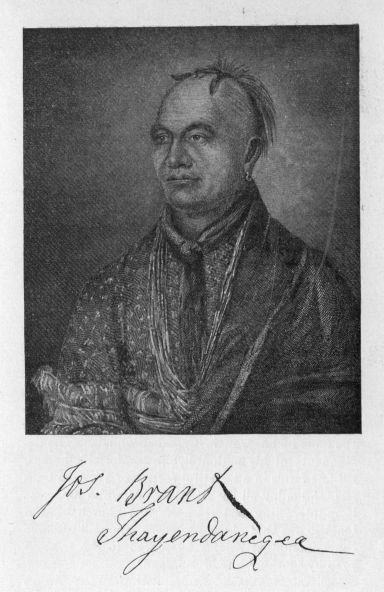
Joseph Brant (Thayendanegea)
Conspicuous among the people who remained faithful to England during the American revolution, we see the famous Iroquois chief, Joseph Brant, best known by his Mohawk name of Thayendanegea, who took part in the war, and was for many years wrongly accused of having participated in the massacre and destruction of Wyoming, that beauteous vale of the Susquehanna. It was he whom the poet Campbell would have consigned to eternal infamy in the verse:
"The mammoth comes—the foe, the monster, Brandt— With all his howling, desolating band; These eyes have seen their blade and burning pine Awake at once, and silence half your land. Red is the cup they drink, but not with wine— Awake and watch to-night, or see no morning shine."
Posterity has, however, recognised the fact that Joseph Brant was not present at this sad episode of the American war, and the poet in a note to a later edition admitted that the Indian chief in his poem was "a pure and declared character of fiction." He was a sincere friend of English interests, a man of large and statesmanlike views, who might have taken an important part in colonial affairs had he been educated in these later times. When the war was ended, he and his tribe moved into the valley of the St. Lawrence, and received from the government fine reserves of land on the Bay of Quinté, and on the Grand River in the western part of the province of Upper Canada, where the prosperous city and county of Brantford, and the township of Tyendinaga—a corruption of Thayendanegea—illustrate the fame he has won in Canadian annals. The descendants of his nation live in comfortable homes, till fine farms in a beautiful section of Western Canada, and enjoy all the franchises of white men. It is an interesting fact that the first church built in Ontario was that of the Mohawks, who still preserve the communion service presented to the tribe in 1710 by Queen Anne of England.
General Haldimand's administration will always be noted in Canadian history for the coming of the loyalists, and for the sympathetic interest he took in settling these people on the lands of Canada, and in alleviating their difficulties by all the means in the power of his government. In these and other matters of Canadian interest he proved conclusively that he was not the mere military martinet that some Canadian writers with inadequate information would make him. When he left Canada he was succeeded by Sir Guy Carleton, then elevated to the peerage as Lord Dorchester, who was called upon to take part in great changes in the constitution of Canada which must be left for review in the following chapter.
XXII.
FOUNDATION OF NEW PROVINCES—ESTABLISHMENT OF REPRESENTATIVE INSTITUTIONS.
(1792-1812.)
The history of the Dominion of Canada as a self-governing community commences with the concession of representative institutions to the old provinces now comprised within its limits. By 1792 there were provincial governments established in Upper and Lower Canada, Nova Scotia, New Brunswick, and Prince Edward Island. From 1713 to 1758 the government of Nova Scotia consisted of a governor, or lieutenant-governor, a council possessing legislative, executive, and even judicial powers. In October, 1758, an assembly met for the first time in the town of Halifax, which had been the capital since 1749. New Brunswick had been separated from Nova Scotia in 1784, but a representative assembly did not assemble until 1786, when its form of government was identical with that of the older province. Prince Edward Island was a part of Nova Scotia until 1769 when it was created a distinct province, with a lieutenant-governor, a combined executive and legislative council, and also an assembly in 1773. The island of Cape Breton had a lieutenant-governor and executive council, and remained apart from Nova Scotia until 1820 when it was included in its government. In 1791 the province of Upper Canada was formally separated from the province of Quebec by an act of the imperial parliament, and was called Upper Canada, while the French section received the name of Lower Canada. At that time the total population of British North America did not exceed a quarter of a million of souls, of whom at least a hundred and forty thousand lived on the banks of the St. Lawrence and its tributary streams, and almost entirely represented the language, institutions, and history of the French régime. In the French province there was also a small British population, consisting of officials, commercial men, and loyalists who settled for the most part in the Eastern Townships. The population of Upper Canada, about twenty-five thousand, was almost exclusively of loyalist stock—a considerable number having migrated thither from the maritime provinces. Beyond the Detroit River, the limit of English settlement, extended a vast region of wilderness which was trodden only by trappers and Indians.
The Constitutional Act of 1791, which created the two provinces of Upper and Lower Canada, caused much discussion in the British Parliament and in Canada, where the principal opposition came from the English inhabitants of the French province. These opponents of the act even sent Mr. Adam Lymburner, a Quebec merchant of high standing, to express their opinions at the bar of the English House of Commons. The advocates of the new scheme of government, however, believed that the division of Canada into two provinces would have the effect of creating harmony, since the French would be left in the majority in one section, and the British in the other. The Quebec Act, it was generally admitted, had not promoted the prosperity or happiness of the people at large. Great uncertainty still existed as to the laws actually in force under the act. In not a few cases the judges were confessedly ignorant—Chief Justice Livius, for instance—of French Canadian jurisprudence. The increase of the English population was a strong argument for a grant of representative institutions. Accordingly the constitutional act provided for an assembly, elected by the people on a limited franchise, in each province, and for a legislative council, appointed by the Crown. The sovereign might annex hereditary letters of honour to the right of summons to the legislative council, but no attempt was ever made to create a Canadian aristocracy, or distinct class, under the authority of this section of the act. The British Government reserved the right of imposing, levying, and collecting duties of customs, and of appointing or directing their payment, though it left the exclusive apportionment of all moneys levied in this way to legislature. The free exercise of the Roman Catholic religion was permanently guaranteed. A seventh part of all uncleared Crown lands was reserved for the use of the Protestant clergy—a provision that caused much trouble in the future. The civil law of French Canada was to regulate property and civil rights in that province. English criminal law was to prevail in both the Canadas. The Governor-General of Quebec and Lieutenant-Governor of Upper Canada were each assisted by an executive council chosen by those functionaries, and having a right to sit also in the legislative council. Lord Dorchester was the first governor-general, not only of Canada, but likewise of the other provinces by virtue of separate commissions to that effect. The heads of the executive in all the provinces except Quebec were called lieutenant-governors, but they became only directly subordinate to the governor-general when he was present in a province in his official capacity.
The city where the first assembly of Lower Canada met in 1792 was one of great historic interest. The very buildings in which the government transacted its business had echoed to the tread of statesmen, warriors, and priests of the old régime. The civil and military branches of the government then occupied apartments in the old Château St. Louis, elevated on the brink of an inaccessible precipice. On a rocky eminence, in the vicinity of a battery close to Prescott Gate, erected in 1797, was an old stone building, generally known as the Bishop's Palace. Like all the ancient structures of Quebec, this building had no claims to elegance of form, although much labour and expense had been bestowed on its construction. The chapel of this building, situated near the communication with the lower town, was converted into a chamber, in which were held the first meetings of the representatives of Lower Canada.
On the 17th of December, the two houses assembled in their respective chambers in the old palace, in obedience to the proclamation of Major-General Alured Clarke, who acted as lieutenant-governor in the absence of the governor-general, Lord Dorchester. Among the officers who surrounded the throne on that occasion, was probably his Royal Highness the Duke of Kent, who was in command of the 7th Royal Fusiliers, then stationed in the old capital. On so momentous an occasion, the assemblage was large, and comprised all the notabilities of English and French society. In the legislature were not a few men whose families had long been associated with the fortunes of the colony. Chaussegros de Léry, St. Ours, Longueuil, Lanaudière, Rouville, Boucherville, Salaberry, and Lotbinière, were among the names that told of the old régime, and gave a guaranty to the French Canadians that their race and institutions were at last protected in the legislative halls of their country. M. Panet, a distinguished French Canadian, was unanimously elected the speaker of the first assembly of French Canada.
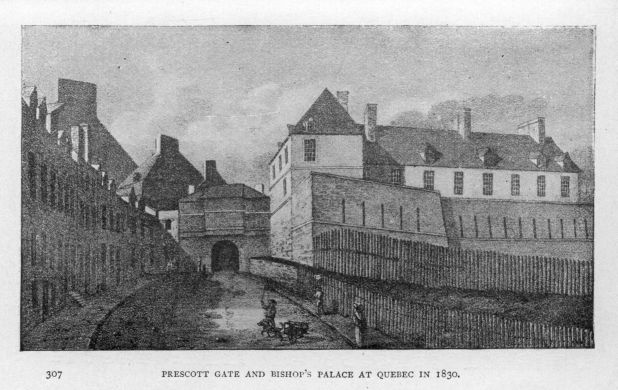
Prescott Gate and Bishop's palace at Quebec in 1830.
Now let us leave the Bishop's Palace, among the rocks of old Quebec, and visit the humble village of Newark, where Lieutenant-Governor Simcoe opened his first legislature under the new constitution in the autumn of 1792. Across the rapid river was the territory of the Republic, which was engaged in a grand experiment of government. The roar of the mighty cataract of Niagara could be heard in calm summer days. On the banks of this picturesque river was the residence of the lieutenant-governor, known as Navy Hall, where the legislators of Upper Canada probably met. This was but a mean parliament house, compared with the massive pile which was chosen for a similar purpose in Quebec; and yet each was appropriate in its way. The Bishop's Palace illustrated an old community, which had aimed at the conquest of the larger part of America, and had actually laid the foundations of an empire; the legislative cabin of Newark was a fit type of the ruggedness and newness of western colonial life. The axe was whirring amid the forests, and only here and there, through a vast wilderness, could be seen the humble clearings of the pioneers.
The session was opened with the usual speech, which was duly reported to the house of assembly by the speaker, Mr. McDonnell of Glengarry, and immediately taken into consideration by the representatives of the yeomanry of the western province. It is said that on more than one occasion, the representatives were forced to leave their confined chamber and finish their work under the trees before the door. If the attendance was small on this occasion, it must be remembered that there were many difficulties to overcome before the two Houses could assemble in obedience to the governor's proclamation. The seven legislative councillors and sixteen members who represented a population of only 25,000 souls, were scattered at very remote points, and could only find their way at times in canoes and slow sailing craft. Nor must it be forgotten that in those early days of colonisation men had the stern necessities of existence to consider before all things else. However urgent the call to public duty, the harvest must be gathered in before laws could be made.
Such were the circumstances under which the legislatures were opened in the two provinces, representing the two distinct races of the population. Humble as were the beginnings in the little parliament house of Newark, yet we can see from their proceedings that the men, then called to do the public business, were of practical habits and fully alive to the value of time in a new country, as they sat for only five weeks and passed the same number of bills that it took seven months at Quebec to pass.
The history of Canada, during the twenty years that elapsed between the inauguration of the constitution of 1792 and the war of 1812, does not require any extended space in this work. Lieutenant-Governor Simcoe, who had distinguished himself during the war for independence as a commander of the Queen's Rangers, was a skilful and able administrator, who did his best to develop the country. It was during his régime that Toronto, under the name of York, was chosen, by the influence of Lord Dorchester, as the capital in place of Newark, which was too close to the American frontier, although the Lieutenant-Governor would have preferred the site of the present city of London, on the River Thames, then known as La Tranche. Mainly through his efforts a considerable immigration was attracted from the United States. Many of the new settlers were loyal and favourable to British institutions, but in the course of time there came into the country not a few discontented, restless persons, having radical and republican tendencies. Among the important measures of his administration was an act preventing the future introduction of slaves, and providing for the freedom of children of slaves then in the province. Governor Simcoe devoted his energy not only to the peopling of the province, but to the opening up of arteries of communication, of which Yonge and Dundas Streets—still well-known names—were the most noted. The founder of an important settlement in the west, an eccentric Irishman of noble ancestry, Colonel Thomas Talbot, was a member of the Lieutenant-Governor's staff, and eventually made his home in the western part of the province, where he became a useful and influential pioneer. Among the most desirable immigrants were the Scotch Highlanders, who settled and named the county of Glengarry, and came to the country by the advice of the energetic and able priest, Macdonell, afterwards the first Roman Catholic bishop of Upper Canada. In Nova Scotia a number of Scotch settled in Pictou county as early as 1773, and were followed in later years by many others who found homes in the same district, in Antigonishe and Cape Breton, where their descendants are still greatly in the majority. In Prince Edward Island, Lord Selkirk, the founder of the Red River settlement, to whose history I shall refer in a later chapter, established a colony of thrifty Scotch in one of the deserted settlements of the French. Charlottetown was founded in those days on the bay first known as Port La Joye, and is now a pleasing example of the placid dignity and rural tranquillity that a capital may attain even in these restless modern times. In this island, the seeds of discontent were planted at a very early time by the transfer of nearly all its lands in one day by ballot to a few English landlords, whose absenteeism long retarded its advancement, and whose claims of proprietorship were not settled until after the confederation of the provinces.
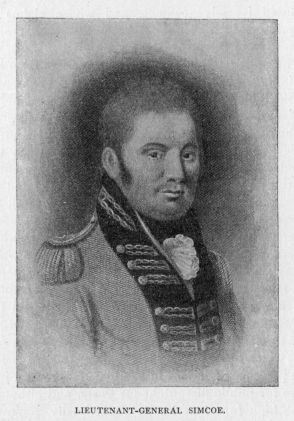
Lieutenant-General Simcoe.
The political condition of the provinces from the beginning of the nineteenth century began to assume considerable importance according as the assemblies became discontented with their relatively small share in the government of the country. In all the provinces there was a persistent contest between the popular assemblies and prerogative, as represented by the governors, and upper houses appointed by the same authority. Charles the First, with all his arrogance, never treated his parliament with greater superciliousness than did Sir James Craig, when governor-general, on more than one occasion when the assembly had crossed his wishes. In the absence of a ministry responsible to the assembly, a conflict was always going on between that body and the representative of the Crown. The assembly began now to claim full control over the taxes and revenues which belonged to the people of the provinces. The presence of judges in the legislature was a just cause for public discontent for years, and although these high functionaries were eventually removed from the assembly they continued to sit in the upper house until 1840. The constant interference of the Imperial Government in matters of purely local concern also led to many unfortunate misunderstandings.
In Lower Canada, where the population was the largest, and the racial distinctions strongly accentuated, the political conflict was, from the outset, more bitter than in other sections. The official class, a little oligarchy composed exclusively of persons brought from the British Isles, treated the French Canadians with a studied superciliousness, and arrogated to themselves all the important functions of government. This element dominated the executive and legislative councils, and practically the governors, who, generally speaking, had extreme views of their prerogative, and were cognisant of the fact that the colonial office in England had no desire to entrust the Canadian Government with much larger powers than those possessed by a municipal organisation. In the assembly the French Canadians were largely in the majority—the English element had frequently not more than one-fifth of the total representation of fifty members. The assembly too often exhibited a very domineering spirit, and attempted to punish all those who ventured to criticise, however moderately, their proceedings. The editor of the Quebec Mercury, an organ of the British minority, was arrested on this ground. Le Canadien was established as an organ of the French Canadian majority with the motto, Nos institutions, notre langue, et nos lois. By its constant attacks on the government and the English governing class it did much harm by creating and perpetuating racial antagonisms and by eventually precipitating civil strife. As a result of its attacks on the government, the paper was seized, and the printer, as well as M. Bedard and several other members of the assembly who were understood to be contributors to its pages, or to control its opinions, were summarily arrested by the orders of Sir James Craig. Though some of these persons obtained their release by an expression of regret for their conduct, M. Bedard would not yield, and was not released until the Governor-General himself gave up the fight and retired to England where he died soon afterwards, with the consciousness that his conduct with respect to Bedard, and other members of the assembly, had not met with the approval of the Imperial authorities, although he had placed the whole case before them by the able agency of Mr. Ryland, who had been secretary for years to successive governors-general, and represented the opinions of the ruling official class.
In Upper Canada there were no national or racial antipathies and rivalries to stimulate political differences. In the course of time, however, antagonisms grew up between the Tories, chiefly old U. E. Loyalists, the official class, and the restless, radical element, which had more recently come into the country, and now desired to exercise political influence. Lieutenant-governors, like Sir Francis Gore, sympathised with the official class, and often with reason, as the so-called radical leaders were not always deserving of the sympathy of reasonable men. One of these leaders was Joseph Willcocks, for some time sheriff of the Home district—one of the four judicial divisions of the province—and also the proprietor and editor of the Upper Canada Guardian, the second paper printed in Upper Canada—the first having been the Upper Canada Gazette, or the American Oracle, which appeared at Newark on the 18th April, 1793. He was a dangerous agitator, not worthy of public confidence, but he was able to evoke some sympathy, and pose as a political martyr, on account of the ill-advised conduct of the majority of the assembly ordering his arrest for expressing some unfavourable opinion of their proceedings in his paper.
In the maritime provinces the conflict between the executive and the assemblies was less aggravated than in the St. Lawrence country, although Sir John Wentworth, the Lieutenant-Governor of Nova Scotia, who had been a governor of New Hampshire before the revolution, had a very exalted idea of the prerogative, and succeeded in having an acrimonious controversy with Mr. Cottnam Tonge, the leader of the popular party, and the predecessor of a far greater man, Joseph Howe, the father of responsible government.
Such, briefly, was the political condition of the several provinces of British North America when events occurred to stifle discontent and develop a broader patriotism on all sides. The War of 1812 was to prove the fidelity of the Canadian people to the British Crown and stimulate a new spirit of self-reliance among French as well as English Canadians, who were to win victories which are among the most brilliant episodes of Canadian history.
XXIII.
THE WAR OF 1812-1815—PATRIOTISM OF THE CANADIANS.
At the outbreak of the unfortunate War of 1812 the United States embraced an immense territory extending from the St. Lawrence valley to Mexico, excepting Florida—which remained in the possession of Spain until 1819—and from the Atlantic indefinitely westward to the Spanish possessions on the Pacific coast, afterwards acquired by the United States. The total population of the Union was upwards of eight million souls, of whom a million and a half were negro slaves in the south. Large wastes of wild land lay between the Canadian settlements and the thickly populated sections of New England, New York, and Ohio. It was only with great difficulty and expense that men, munitions of war, and provisions could be brought to the frontier during the contest.
The principal causes of the war are quite intelligible to the historical student. Great Britain was engaged in a great conflict not only for her own national security but also for the integrity of Europe, then dominated by the insatiable ambition of Bonaparte. It was on the sea that her strength mainly lay. To ensure her maritime supremacy, she found it necessary, in the course of events, to seize and condemn neutral American vessels whenever there was conclusive evidence that their cargoes were not the produce of the United States, but had been actually bought in an enemy's colony and were on their way to the mother country. But such an interruption of a commerce, which had been carried on for years at a great profit by American merchants, was by no means so serious an affair as the stoppage of American vessels on the high seas, and the forcible abduction and impressment, by British naval officers, of sailors who were claimed as British subjects, even when they had been naturalised in the United States. To such an extent did Great Britain assert her pretensions, that one of her frigates, the Leopard, actually fired into the American cruiser Chesapeake, off the coast of the bay of the same name, and made prisoners of several men who were claimed as deserters from an English man-of-war—a national outrage for which Great Britain subsequently made an apology and gave a measure of reparation. Then came the British orders in council which forbade American trade with any country from which the British flag was excluded, allowed direct trade from the United States to Sweden only in American products, and permitted American trade with other parts of Europe only on condition of touching at English ports and paying duties. Napoleon retaliated with decrees which were practically futile while England was victorious on the ocean, but which nevertheless threw additional difficulties in the way of the commerce of a country like the United States, which possessed such exceptional facilities for its development from its position as a neutral nation, and its great maritime and mercantile enterprise. The British measures meant the ruin of an American commerce which had become very profitable, and the Washington government attempted to retaliate by declaring an embargo in their own ports, which had only the result of still further embarrassing American trade. In place of this injudicious measure a system of non-intercourse with both England and France was substituted as long as either should continue its restrictive measures against the United States. The Democratic governing party practically fell under the influence of France, and believed, or at least professed to believe, that Napoleon had abandoned his repressive system, when, as a matter of fact, as the English ministry declared, it still existed to all intents and purposes. The Democratic leaders, anxious to keep in power, fanned the flame against England, whose naval superiority enabled her to inflict an injury on American commercial interests, which France was entirely powerless to do. The Democrats looked to the South and West for their principal support in holding power. In these sections the interests were exclusively agricultural, while in New England, where the Federalists—the peace party—were in the majority—and the war was very unpopular—the commercial and maritime element largely prevailed. In the West there had been for years an intense feeling against England on account of the fact that after the definitive treaty of peace in 1783, the English Government continued to occupy the Western posts and dependent territory for thirteen years, nominally on the ground of the harsh treatment meted out to the loyalists in violation of its terms, and of the non-payment of debts due to English creditors, but probably also with the view of keeping control of the fur trade. The feeling prevailed among the western frontiersmen that the English secretly instigated Indian attacks on the new settlements, a belief proved by recent investigations to be groundless. Even after the victories of Mayne in 1794, and of Harrison in 1811, when the Indian power was effectively broken, this bitter sentiment still existed in the West against English and Canadians, and had much influence with the politicians who favoured the war.
The Southern leaders, Clay of Kentucky and Calhoun of South Carolina, were most inimical to England, and succeeded in forcing Madison to agree to a declaration of war, as a condition to his re-election to the presidency. The consequence of this successful bargain was the passage of a war measure by Congress as soon as Madison issued his message, and the formal declaration of hostilities on the 18th of June, 1812. On the previous day, England had actually repealed the obnoxious orders in council, but it was too late to induce the war party in the United States to recede and stop the progress of the forces, which were already near the western Canadian frontier when the governor-general of Canada, Sir George Prevost, a military man, heard the news of the actual declaration of hostilities.
With the causes of the War of 1812 the Canadian people had nothing whatever to do; it was quite sufficient for them to know that it was their duty to assist England with all their might and submit to any sacrifices which the fortunes of war might necessarily bring to a country which became the principal scene of conflict. Ontario, then Upper Canada, with a population of about eighty thousand souls, was the only province that really suffered from the war. From the beginning to the end its soil was the scene of the principal battles, and a great amount of valuable property destroyed by the invading forces. "On to Canada" had been the cry of the war party in the United States for years; and there was a general feeling that the upper province could be easily taken and held until the close of the struggle, when it could be used as a lever to bring England to satisfactory terms or else be united to the Federal Union. The result of the war showed, however, that the people of the United States had entirely mistaken the spirit of Canadians, and that the small population scattered over a large region—not more than four hundred thousand souls from Sydney to Sandwich—was animated by a stern determination to remain faithful to England.
No doubt the American Government had been led to believe from the utterances of Willcocks in the Guardian, as the representative of the discontented element in Upper Canada, that they would find not only sympathy but probably some active co-operation in the western country as soon as the armies of the Republic appeared on Canadian soil and won, as they confidently expected, an easy victory over the small force which could be brought to check invasion and defend the province. General Hull's proclamation, when he crossed the Detroit River at the commencement of hostilities, was so much evidence of the belief that was entertained in the United States with regard to the fealty of the Canadians. Willcocks proved himself a disloyal man, for he eventually joined the American forces and fell fighting against the country which he and a very small disaffected class would willingly have handed to a foreign invader. The forces at the disposal of the Canadian authorities certainly appeared to be inadequate for the defence of a country with so long and exposed a frontier. In the provinces of Canada there were, in 1812, only four thousand five hundred regular troops, and of these hardly one-third were stationed above Montreal. The Canadian militia, however, rallied with extraordinary readiness to the call of the authorities. The majority of the loyal population that had come into the country had been engaged in military services, and even the old settlers, who were exempted from active duty, voluntarily came forward, and exercised, as General Sheaffe, said, "a happy influence on the youth of the militia ranks." The legislative bodies of all the provinces responded liberally to the call of the executive and placed at the disposal of the government all their resources. Army bills were issued to a large amount, and found a most valuable currency throughout the war.
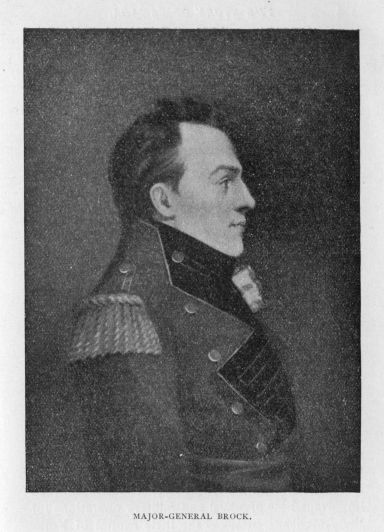
Major-General Brock.
During the first year of the war, there was a continuous record of success for Canada. The key to the upper lakes, Michillimackinac, was captured and held by a small force of English regulars and Canadian voyageurs. The immediate consequence of this victory was to win the confidence and alliance of the western Indians, then led by Tecumseh, the famous Shawanoese chief, who had been driven from Tippecanoe by General Harrison. Then followed the capitulation of General Hull and his army, who had invaded Canada and were afterwards forced to retreat to Detroit, where they surrendered to General Brock with a much inferior force. By this capitulation, which led to the disgrace and nearly to the execution of Hull on his return to his own country, the whole territory of Michigan, over two thousand five hundred troops, and a large quantity of munitions of war and provisions fell into the possession of the British. The next important event of this memorable year was the defeat of the attempt of Van Rensselaer to occupy Queenston Heights, with the object of establishing there a base of future operations against Upper Canada. The Americans were routed with great loss and many of the men threw themselves down the precipice and were drowned in the deep and rapid river. At the beginning of the battle, General Brock was unhappily slain while leading his men up the heights, and the same fate befell his chivalrous aide-de-camp, Colonel McDonell, the attorney-general of the province. It was left for General Sheaffe to complete the victory, which gave many prisoners to the English force, and drove the remainder of the beaten American army across the beautiful river. General Smyth, a most incompetent man, who succeeded to the command of the American army on the resignation of Van Rensselaer, subsequently attempted to storm and carry Fort Erie, but Colonel Bisshopp successfully held this important post, which controlled the outlet of Lake Erie into the Niagara River. When the campaign closed, in 1812, Canada was free from the invader, chiefly through the energy and sagacity with which the gallant General Brock had made his preparations to repel invasion.
In 1813 the campaign commenced with a signal victory by General Procter, who was in command at Detroit, over a considerable American force at Frenchtown, on the Raisin River, under the command of Brigadier Winchester. Then came a successful attack by Colonel McDonnell on Ogdensburgh (La Présentation of the French régime), in retaliation for raids on Gananoque and Elizabethtown, subsequently named Brockville—now a beautiful city near the Thousand Isles—in honour of the gallant soldier who perished on the heights of Queenston. Commodore Chauncey, in command of a small American fleet organised at Sackett's Harbour, an important base of naval and military operations for the Americans, attacked the little capital of York, now Toronto, which was evacuated by General Sheaffe, then administrator of the government, who retired to Kingston, the strongest position to the west of Montreal. The invaders burnt the legislative and other public buildings. The small library and public records were not even spared by the pillaging troops. No precautions had been taken by Sheaffe to improve defences which at the best were of little strength. During the summer, the American army was so much superior to the English forces that they were able to occupy the whole Niagara frontier from Fort Erie to Fort George, both of which were captured by General Dearborn. Major-General Vincent, the English commander, was compelled to retire to Burlington Heights, overlooking the present city of Hamilton. Sir George Prevost, who proved himself a most irresolute and incapable commander-in-chief, retreated ignominiously from Sackett's Harbour, although Commodore Chauncey and his fleet were absent and the post was defended by only a small garrison. This discreditable failure, which cannot be in any way excused, was soon forgotten when the news came of the success of Colonel Harvey, afterwards a lieutenant-governor of the maritime provinces, at Stoney Creek, quite close to Burlington Bay. With an insignificant detachment from Vincent's main body, Harvey succeeded in surprising at night a large American force, commanded by Brigadiers Chandler and Winder, both of whom, as well as one hundred officers and men, were taken prisoners. This serious disaster and the approach of Admiral Yeo's fleet from the eastward forced the invading army to retire to Fort George, where they concentrated their strength, after abandoning Fort Erie and other posts on the frontier. It was during the campaign of this year that Laura Secord, the courageous daughter of a sturdy loyalist stock which has given the name of Ingersoll to a Canadian town, afforded a memorable example of the devotion which animated Canadian women in these years of trial. General Dearborn had ordered Colonel Boerstler to surprise and attack the Canadian outposts at Twelve Mile Creek, now St. Catharine's, and at De Ceu's farm, close to the present town of Thorold. Lieutenant Fitzgibbon, with a picket of thirty men, was stationed at De Ceu's. A Canadian militiaman, James Secord, who lived at Queenston, heard of the proposed attack, but as he had been severely wounded in the attack on Queenston Heights in the previous October, he was unable to warn Fitzgibbon. His wife, a woman of nearly forty years, volunteered for the hazardous duty, and started at dawn for a journey of twenty miles, through dense woods, where the paths were few and had to be avoided for fear of meeting American marauders or suspicious Indians who might take her for a spy. It took her all day to reach her destination, where she first disturbed an encampment of Indians who received her with yells, which dismayed her for the moment. However, she was taken to the commanding officer, who made his arrangements immediately to surprise Boerstler, who soon made his appearance with five hundred men at least. The Americans were forced to surrender to what they believed was a vastly superior force, so cleverly had Fitzgibbon succeeded in deceiving them. In fact, he had only at first thirty soldiers, and two hundred and forty Indians, and when a captain and twenty troopers of the Chippewa cavalry came up Boerstler was quite ready to surrender.
All the successes in the west, however, were now rendered worthless by the unfortunate defeat at Put-in-Bay on Lake Erie of the English flotilla under Captain Barclay, by Commodore Perry, who had command of a large number of vessels, with a superior armament and equipment. The result of this victory was to give the control of Lake Erie and of the State of Michigan to the Americans. Procter retreated from Detroit, and was defeated near Moraviantown, an Indian village, about sixty miles from Sandwich, by General Harrison, who had defeated Tecumseh in the northwest, and now added to his growing fame by his victory over the English army, who were badly generalled on this occasion. Tecumseh, the faithful ally of the Canadians, fell in the battle, and his body was treated with every indignity, his skin, according to report, having been carried off to Kentucky as a trophy. Procter fell into disgrace, and was subsequently replaced by Colonel de Rottenburg. On his return to England, Procter was tried, by court-martial, suspended from his rank for six months, and censured by the commander-in-chief.
Passing by such relatively unimportant affairs as a successful attack on Black Rock, near Buffalo, by Colonel Bisshopp, and a second attack on York by Chauncey, who took some prisoners and a quantity of stores, we have now to state other facts in the history of the campaign of 1813 which compensated Canada for Procter's disasters in the west. The Americans had decided to make an attack on Montreal by two forces—one coming by the St. Lawrence and the other by Lake Champlain—which were to form a junction at Châteauguay on Lake St. Louis. General Wilkinson, with eight thousand men, descended the river from Sackett's Harbour, landed below Prescott, and then proceeded towards Cornwall. Some two thousand five hundred men, under Colonel Boyd, protected the rear of the main body, and was compelled to fight a much inferior force, under Colonel Morrison, on Chrystler's farm, near what is now known as Cook's Point on the north bank of the St. Lawrence. The Americans gave way in all directions, and sustained a heavy loss. Boyd rejoined Wilkinson at the foot of the Long Sault rapids, in the neighbourhood of the present town of Cornwall, and here the news arrived that General Hampton had received a serious repulse. Hampton, leading an army of probably seven thousand men, had been routed near the junction of the Châteauguay and Outarde rivers by an insignificant force of Canadian Fencibles and Voltigeurs under Colonel de Salaberry, a French Canadian in the English military service, with the aid of Colonel McDonnell, in command of seven companies of Lower Canadian militia. These combined forces did not exceed nine hundred men, all French Canadians, with the exception of Colonel McDonnell and several other officers. Three hundred French Canadian Voltigeurs and Fencibles formed the front of the line, and when the former gave way to the onslaught of the four thousand men who advanced against them Salaberry held his ground with a bugler, a mere lad, and made him sound lustily. Colonel McDonnell, with a remarkably keen understanding of the situation, immediately ordered his buglers to play, and to continue doing so while they scattered in the woods. As the woods echoed to the call of the bugles, to the shouts of the soldiers, and to the yells of the Indians, the American force halted as if they were paralysed. Then, believing from the noises that filled the forest in every direction that they were to be attacked in front and rear by an overwhelming force, they broke and fled tumultuously. Salaberry and the Canadians had won a victory that has only a few parallels in warlike annals. Hampton retreated as rapidly as possible to Plattsburg, while Wilkinson found his way to Salmon River. These two victories of Chrystler's farm and Châteauguay were won almost entirely by Canadian prowess and skill, and must be always mentioned among the glorious episodes of Canadian history.
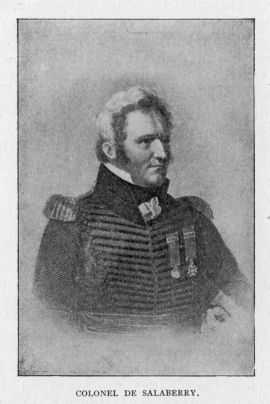
Colonel De Salaberry.
Before the end of the year, General McClure, in command of the American troops on the Niagara frontier, evacuated Fort George, when he heard of the advance of the English forces under General Murray. McClure committed the cowardly outrage of destroying the town of Newark. All the houses except one were burned, and no pity was shown even to the weak and helpless women, all of whom were driven from their comfortable houses and forced to stand on the snow-clad earth, while they saw the flames ascend from their homes and household treasures. As an act of retribution the British troops destroyed all the posts and settlements from Fort Niagara to Buffalo. When the campaign of 1813 closed, Lake Erie was still in the possession of the Americans, but the Niagara district on both sides of the river had been freed from the American forces, and not an inch of Canadian territory except Amherstburg was in possession of the enemy.
In the following year the campaign commenced by the advance of a large force of American troops under General Wilkinson into Lower Canada, but they did not get beyond Lacolle Mill, not far from Isle aux Noix on the Richelieu, where they met with a most determined resistance from the little garrison under Colonel Handcock. Wilkinson retreated to Plattsburg, and did not again venture upon Canadian territory. Sir Gordon Drummond took Oswego, and succeeded in destroying a large amount of public property, including the barracks. The greatest success of the year was won in the Niagara country, where the English troops under Drummond and Riall had been concentrated with the view of opposing the advance of an American army into Upper Canada. The Americans occupied Fort Erie, and Riall sustained a repulse at Street's Creek—now known as Usher's—near Chippewa, although General Brown, who was in command of a much superior force, did not attempt to follow up his advantage, but allowed the English to retreat to Fort George. Then followed, on the 25th of July, the famous battle of Lundy's Lane, where the English regulars and Canadian militia, led by General Drummond, fought from six in the evening until midnight, a formidable force of American troops, commanded by General Brown and Brigadiers Ripley, Porter, and Scott—the latter the future hero of the Mexican war. The darkness through this hotly contested engagement was intense, and the English more than once seemed on the point of yielding to sheer exhaustion as they contested every foot of ground against overpowering numbers of well handled troops. The undaunted courage and persistence of the British and Canadian soldiery won the battle, as the Americans retired from the field, though with a remarkable perversion of the facts this memorable event is even claimed by some American writers as a success on their side. This was the last great fight of the war, and will be always cited by Canadians as illustrating the mettle of their own militia in old times.
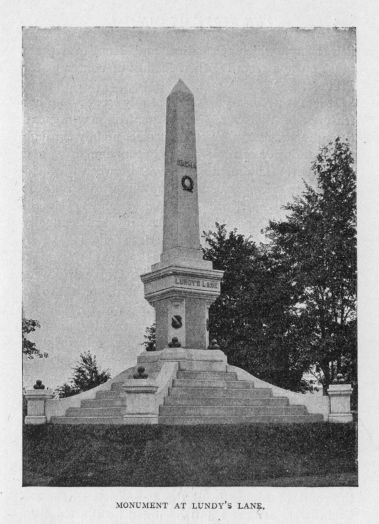
Monument at Lundy's Lane.
Drummond did not win other successes, and even failed to capture Fort Erie. The American army, however, did not make another advance into the country while he kept it so well guarded. Erie was eventually evacuated, while the Americans concentrated their strength at Buffalo. Prairie du Chien on the Mississippi was captured in this same summer by the English, and the Americans were repulsed in an attempt to seize the fort at Michillimackinac. In eastern Canada there was no such record of victory to show as Drummond and his officers had made in the west. Prevost again gave a signal proof of his incapacity. His fleet sustained a complete defeat on Lake Champlain, and so great was his dismay that he ordered the retreat to Montreal of a splendid force of over ten thousand troops, largely composed of peninsula veterans, though Plattsburg and its garrison must have fallen easily into his hands had he been possessed of the most ordinary resolution. This retreat was confessedly a disgrace to the English army, which Canadian and English writers must always record with a feeling of contempt for Prevost.
It is not necessary to dwell at any length on other features of this war. The American navy, small though it was, won several successes mainly through the superiority of their vessels in tonnage, crew, and armament. The memorable fight between the British frigate Shannon, under Captain Broke, and the United States frigate Chesapeake, under Captain Lawrence, off Massachusetts Bay, illustrates equally the courage of British and American sailors—of men belonging to the same great stock which has won so many victories on the sea. The two ships were equally matched, and after a sharp contest of a quarter of an hour the Chesapeake was beaten, but not until Captain Lawrence was fatally wounded and his victorious adversary also severely injured. During the war Nova Scotia and the other maritime provinces were somewhat harassed at times by American privateers, but the presence of a large fleet constantly on their coasts—Halifax being the rendezvous of the British navy in American waters—and the hostility of New England to the war saved these sections of British America from invasion. On the other hand, all the important positions on the coast of Maine from the Penobscot to the St. Croix, were attacked and occupied by the English. The whole American coast during the last year of the war was blockaded by the English fleet with the exception of New England ports, which were open to neutral vessels. The public buildings of Washington, the federal capital, were destroyed by an English army, in retaliation for the burning of York, Newark, and Moraviantown. The attempt to take Baltimore failed, and a bold man from Tennessee, Andrew Jackson—in later years President—drove Pakenham from New Orleans. The taking of Mobile by British ships was the closing incident of the war on the Atlantic coast. In fact peace was happily declared by the Treaty of Ghent on the 24th December, 1814, or a fortnight before the defeat of the English at New Orleans. The two nations gladly came to terms. It is questionable if the heart of either was ever deeply enlisted in this unhappy war which should never have been fought between peoples so closely connected by language and race. It was mainly a war of Western and Southern politicians, and when it ended New England, whose interests had been so seriously affected, was showing signs of serious restlessness which had broken out in the Hartford convention, and might have even threatened the integrity of the Union.
Although the war ended without any definite decision on the questions at issue between the United States and Great Britain, the privileges of neutrals were practically admitted, and the extreme pretensions of Great Britain as to the right of search can never again be asserted. One important result of the war, as respects the interests of Canada, was the re-opening of the question of the British American fisheries. Certain privileges extended by the Treaty of 1783 to American fishermen on the coasts of British North America were not again conceded, and the convention of 1818, which followed the peace of 1815, is the basis of the rights which Canadians have always maintained in disputes between themselves and the United States as to the fisheries on their coasts. Looking, however, to its general results, the war gave no special advantages to the Canadian people. When peace was proclaimed not an inch of Canadian territory, except the village of Amherstburg, was held by the American forces. On the other hand, Great Britain occupied the greater part of the sea-board of Maine, and her flag flew over Michillimackinac, the key to the Northwest. Had British statesmen seized this opportunity of settling finally the western boundary of New Brunswick, Canada would have obtained a territory most useful to the commercial development of the present Dominion. England, however, was very desirous of ending the war—perhaps the humiliating affair at Plattsburg had some effect on the peace—and it was fortunate for the provinces that they were allowed in the end to control their most valuable fisheries.
The people of Canada will always hold in grateful recollection the names of those men who did such good service for their country during these momentous years from 1812 to 1815. Brock, Tecumseh, Morrison, Salaberry, McDonnell, Fitzgibbon, and Drummond are among the most honourable names in Canadian history. Englishmen, Scotchmen, Irishmen, Canadians, Indians, were equally conspicuous in brilliant achievement. A stately monument overlooks the noble river of the Niagara, and recalls the services of the gallant soldiers, Brock and McDonell, whose remains rest beneath. A beautiful village, beyond which stretches historic Lundy's Lane, recalls the name and deeds of Drummond. As the steamers pass up and down the St. Lawrence they see on the northern bank the obelisk which the Canadian Government has raised on the site of the battlefield where Morrison defeated Boyd. On the meadows of Châteauguay, another monument has been erected by the same national spirit in honour of the victory won by a famous representative of the French Canadian race, who proved how courageously French Canadians could fight for the new régime under which they were then, as now, so happy and prosperous.
XXIV.
POLITICAL STRIFE AND REBELLION.
(1815-1840.)
The history of the twenty-five years between the peace of 1815 and the union of the Canadas in 1840, illustrates the folly and misery of faction, when intensified by racial antagonisms. In Lower Canada the difficulties arising from a constant contest for the supremacy between the executive and legislative authorities were aggravated by the fact that the French Canadian majority dominated the popular house, and the English-speaking minority controlled the government. "I found," wrote Lord Durham, in 1839, "two nations warring in the bosom of a single state; I found a struggle not of principles but of races." It is true that some Englishmen were found fighting for popular liberties on the side of the French Canadian majority. Mr. John Neilson, who was for years editor of the Quebec Gazette, was a friend of the French Canadians, and in close sympathy with the movement for the extension of public rights, but he was never prepared to go beyond the legitimate limits of constitutional agitation and threaten British connexion. On the other hand, Dr. Wolfred Nelson, descended from a loyalist stock, was one of the leaders of the majority that controlled the assembly of Lower Canada, and did not hesitate to join in the rebellion to which his rash and impetuous chief, Louis Joseph Papineau, led him at last. But while undoubtedly there were many persons among the British people, who were disgusted with the arrogance of some of the governing class, and discontented with the methods of government, they were gradually alienated by the demagogism of the French Canadian majority, who did not hesitate to profess their desire to make French Canada exclusively a French dominion. The tyranny of the majority was exhibited in the assembly by the attempt to impeach Chief Justices Sewell and Monk, on charges which had no justification in law or justice. Mr. Robert Christie, the member for Gaspé, who subsequently wrote a useful history of Lower Canada, was expelled several times because he was believed to have procured the dismissal from the magistracy of some members of the assembly who were inimical to the executive government. On the other hand, Lord Dalhousie, the governor-general, in 1827, refused to approve of the election of Mr. Papineau as speaker of the assembly, because he had reflected in strong terms in a manifesto on the public conduct of the former. Mr. Louis J. Papineau, the future leader of the rebellion in 1837, was a man of fine presence, gifted with remarkable powers of rhetoric and persuasion, but he was entirely wanting in discretion, and in the qualities which make a great statesman. When the assembly refused to reconsider its action and elect another speaker, Lord Dalhousie prorogued the legislature, which did not again meet until he was recalled and sent to India as commander-in-chief. Like other governors, Lord Dalhousie attempted to govern to the best of his ability, and what mistakes he committed arose from the contradictory and perplexing instructions he received from the officials in Downing Street, who were quite incapable at times of understanding the real condition of affairs in the province.
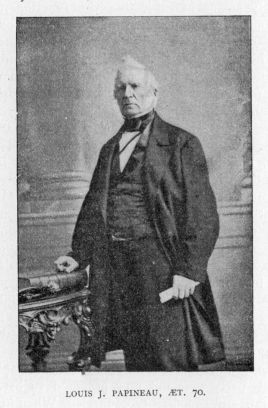
Louis J. Papineau, Aet. 70.
The disputes at last between the contending parties in Lower Canada prevented the working of the constitution. The assembly fought for years for the independence of Parliament and the exclusive control of the civil list and supply. When at last the assembly refused to vote a civil list and other necessary expenditures, the government were obliged to use the casual and territorial revenues—such as the proceeds of the sales and leases of Crown lands—and these funds were inadequate for the purpose. So carelessly were these funds managed that one receiver-general, engaged in business, became a heavy defaulter. The governors dissolved the legislatures with a frequency unparalleled in political history, and were personally drawn into the conflict. Public officials, including the judges, were harassed by impeachments. Bills were constantly rejected by the legislative council on various pretexts—some of them constitutionally correct—and the disputes between the two branches of the legislature eventually made it impossible to pass even absolutely necessary measures. Appeals to the home government were very common, and concessions were made time and again to the assembly. In fact, the contest as to the revenues and expenditures ought to have closed, in a great measure, with the abandonment, in 1832, by the government of every portion of the previously reserved revenue, but, as Lord Durham pointed out, the assembly, "even when it obtained entire control over the public revenues," refused the civil list because it was determined "not to give up its only means of subjecting the functionaries of government to any responsibility." The conflict was carried on to the bitter end. It does not appear, however, that the majority in the assembly at all understood the crucial difficulty. They devoted their whole strength to attacks on the legislative council, and to demands for an elective body. The famous ninety-two resolutions of 1834, in which Papineau's party set forth their real or fancied grievances, did not contain a single paragraph laying down the principles of parliamentary or responsible government as worked out in England, and ably supported by the moderate Upper Canadian Reformers like Robert Baldwin. The home government ought to have appreciated the gravity of the situation, but they were not yet prepared to introduce into these colonies the principles of parliamentary government. In 1835 they appointed a commission to inquire into the nature of the grievances and the best method of remedying them. The governor-general, Lord Gosford, was the head of this commission, but it failed because Papineau and his party were not now prepared to listen to moderate and conciliatory counsels. When in 1837 the assembly continued to refuse supply for the payment of public officials, and of the arrears, which up to that time amounted to nearly one hundred and fifty thousand pounds sterling, Lord John Russell carried in the English House of Commons a series of resolutions, rejecting the demand for an elective legislative council and other changes in the constitution, and empowering the executive government to defray the expenses of the public service out of the territorial and casual revenues. This action of the imperial government increased the public discontent, and gave an opportunity to Papineau and his followers to declare that no redress of grievances could be obtained except by a resort to arms. In this year the rebellion broke out, but before I refer to it, it is necessary to review briefly the condition of things in the other provinces.
In Nova Scotia and New Brunswick, the disputes between the executive and legislative authorities were characterised by much acrimony, but eventually the public revenues were conceded to the assemblies. In Prince Edward Island the political difficulties arose from the land monopoly, and the efforts of the lieutenant-governors to govern as much as possible without assemblies. In these provinces, as in Canada, we find—to cite Lord Durham—"representative government coupled with an irresponsible executive, the same abuse of the powers of the representative bodies, and the same constant interference of the imperial administration in matters which should be left wholly to the provincial governments." In the maritime provinces, however, no disturbance occurred, and the leaders of the popular party were among the first to assist the authorities in their efforts to preserve the public tranquillity, and to express themselves emphatically in favour of the British connection.
In Upper Canada an official class held within its control practically the government of the province. This class became known, in the parlance of those days, as the "family compact," not quite an accurate designation, since its members had hardly any family connection, but there was just enough ground for the term to tickle the taste of the people for an epigrammatic phrase. The bench, the pulpit, the banks, the public offices were all more or less under the influence of the "compact." The public lands were lavishly parcelled out among themselves and their followers. Successive governors, notably Sir Francis Gore, Sir Peregrine Maitland, and Sir Francis Bond Head, submitted first to its influence and allowed it to have the real direction of affairs. Among its most prominent members were John Beverly Robinson, for some years attorney-general, and eventually an able chief-justice, and the recipient of a baronetage; William Dummer Powell, a chief-justice; John Henry Boulton, once attorney-general; John Strachan, the first bishop of the Episcopal Church in Upper Canada; Jonas Jones, the Sherwoods, and other well-known names of residents of York, Niagara, Kingston, and Brockville.
It was not until 1820 that a strong opposition was organised in the assembly against the ruling bureaucracy. The cruel treatment of Robert Gourlay, an erratic Scotch land-agent, by the ruling class who feared his exposure of public abuses, had much to do with creating a reform party in the legislature. Gourlay was a mere adventurer, who found plenty of material in the political condition of the province for obtaining the notoriety that he coveted. In the course of some inquiries he made in connexion with a statistical work he published in later years, he touched on some points which exposed the land monopoly and other abuses. He was immediately declared by the "compact" to be a dangerous person, who must be curbed by some means or other. He was tried on two occasions for libelling the government, but acquitted. Then his enemies conspired to accuse him most unjustly of being a seditious and dangerous person, who came under the terms of an alien act passed in 1804. He was arrested and kept in prison for seven months. When he was at last tried at Niagara, the home of Toryism, he was a broken-down man, hardly in full possession of his senses. A severe judge and prejudiced jury had no pity, and he was forced to leave the province, to which he did not return until happier times. The injustice which was meted out to a man who had thrown some light on public corruption, stimulated the opponents of the "family compact" to united action against methods so dangerous to individual liberty and so antagonistic to the redress of public grievances.
The disputes between the reformers and the "family compact" were aggravated by the "clergy reserves" question, which was largely one between the Episcopalians and the dissenting bodies. This question grew out of the grant to the Protestant Church in Canada of large tracts of land by the imperial act of 1791, and created much bitterness of feeling for a quarter of a century and more. The reformers found in this question abundant material for exciting the jealousies of all the Protestant sects who wished to see the Church of England and the Church of Scotland deprived of the advantages which they alone derived from this valuable source of revenue. The British Government for years were on the side of the "family compact," whose leading adherents belonged to the Church of England, and who opposed every effort that was made to dispose of these lands for the support of education and other public purposes. The Methodists, who outnumbered the Church of England, had for years an additional grievance in the fact that their ministers were not allowed to solemnise marriages, and it was not until 1829 that this disability was removed by the legislature.
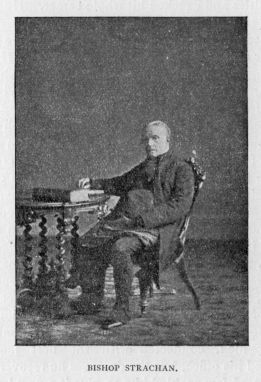
Bishop Strachan.
Among the minds that dominated the "family compact" was the eminent divine, John Strachan, who was originally a Presbyterian, and came to the country as a teacher at the request of the Honourable Richard Cartwright, a prominent U. E. Loyalist, but eventually joined the Episcopalian Church, and became its bishop. Like his countryman, John Knox, he had extraordinary tenacity of purpose and desire for rule. He considered the interests of the Church as paramount to all other considerations. He became both an executive and a legislative councillor, and largely moulded the opinions and acts of the governing classes. It was chiefly through his influence that Sir John Colborne established a number of rectories out of the clergy reserves, and thereby gave additional offence to those religious bodies who had no share in these lands. He hoped to create a state church, and the establishment of King's College, afterwards secularised, was a part of his ecclesiastical system. Eventually when King's College became a provincial institution, open to all denominations—the foundation of Toronto University—he devoted all his energies to the establishment of Trinity College, which is the noblest monument of the zealous prelate.
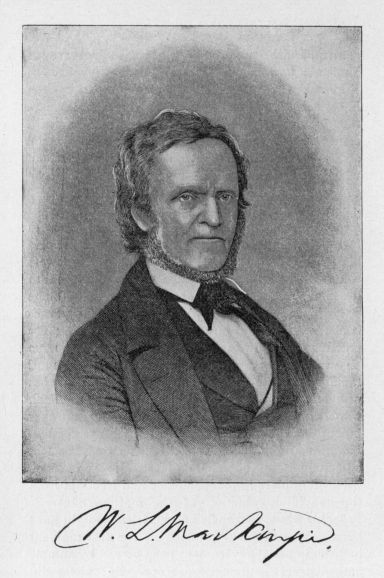
William Lyon Mackenzie.
Another Scotchman, who came to the country some years later than the bishop, was William Lyon Mackenzie, who was always remarkable for his impulsiveness and rashness, which led him at last into difficulties and wrecked his whole career. He had a deep sense of public wrongs, and placed himself immediately in the front rank of those who were fighting for a redress of undoubted grievances. He was thoroughly imbued with the ideas of English radicalism, and had an intense hatred of Toryism in every form. He possessed little of that strong common sense and power of acquisitiveness which make his countrymen, as a rule, so successful in every walk of life. When he felt he was being crushed by the intriguing and corrupting influences of the governing class, aided by the lieutenant-governor, he forgot all the dictates of reason and prudence, and was carried away by a current of passion which ended in rebellion. His journal, The Colonial Advocate, showed in its articles and its very make-up the erratic character of the man. He was a pungent writer, who attacked adversaries with great recklessness of epithet and accusation. So obnoxious did he become to the governing class that a number of young men, connected with the best families, wrecked his office, but the damages he recovered in a court of law enabled him to give it a new lease of existence. When the "family compact" had a majority in the assembly, elected in 1830, he was expelled five times for libellous reflections on the government and house, but he was re-elected by the people, who resented the wrongs to which he was subject, and became the first mayor of Toronto, as York was now called. He carried his grievances to England, where he received much sympathy, even in conservative circles. In a new legislature, where the "compact" were in a minority, he obtained a committee to consider the condition of provincial affairs. The result was a famous report on grievances which set forth in a conclusive and able manner the constitutional difficulties under which the country laboured, and laid down clearly the necessity for responsible government. It would have been fortunate both for Upper Canada and Mackenzie himself at this juncture, had he and his followers confined themselves to a constitutional agitation on the lines set forth in this report. By this time Robert Baldwin and Egerton Ryerson, discreet and prominent reformers, had much influence, and were quite unwilling to follow Mackenzie in the extreme course on which he had clearly entered. He lost ground rapidly from the time of his indiscreet publication of a letter from Joseph Hume, the English radical, who had expressed the opinion that the improper proceedings of the legislature, especially in expelling Mackenzie, "must hasten the crisis that was fast approaching in the affairs of Canada, and which would terminate in independence and freedom from the baneful domination of the mother-country." Probably even Mackenzie and his friends might have been conciliated and satisfied at the last moment had the imperial government been served by an able and discreet lieutenant-governor. But never did the imperial authorities make a greater mistake than when they sent out Sir Francis Bond Head, who had no political experience whatever.
From the beginning to the end of his administration he did nothing but blunder. He alienated even the confidence of the moderate element of the Reformers, and literally threw himself into the arms of the "family compact," and assisted them at the elections of the spring of 1836, which rejected all the leading men of the extreme wing of the Reform party. Mackenzie was deeply mortified at the result, and determined from that moment to rebel against the government which, in his opinion, had no intention of remedying public grievances. At the same time Papineau, with whom he was in communication, had made up his mind to establish a republic, une nation Canadienne, on the banks of the St. Lawrence.
The disloyal intentions of Papineau and his followers were made very clear by the various meetings which were held in the Montreal and Richelieu districts, by the riots which followed public assemblages in the city of Montreal, by the names of "Sons of Liberty" and "Patriots" they adopted in all their proceedings, by the planting of "trees," and raising of "caps" of liberty. Happily for the best interests of Canada the number of French Canadians ready to revolt were relatively insignificant, and the British population were almost exclusively on the side of the government. Bishop Lartigue and the clergy of the Roman Catholic Church now asserted themselves very determinedly against the dangerous and seditious utterances of the leaders of the "Patriots." Fortunately a resolute, able soldier, Sir John Colborne, was called from Upper Canada to command the troops in the critical situation of affairs, and crushed the rebellion in its very inception. A body of insurgents, led by Dr. Wolfred Nelson, showed some courage at St. Denis, but Papineau took the earliest opportunity to find refuge across the frontier. Thomas Storrow Brown, an American by birth, also made a stand at St. Charles, but both he and Nelson were easily beaten by the regulars. A most unfortunate episode was the murder of Lieutenant Weir, who had been captured by Nelson while carrying despatches from General Colborne, and was butchered by some insurgent habitants, in whose custody he had been placed. At St. Eustache the rebels were severely punished by Colborne himself, and a number burned to death in the steeple of a church where they had made a stand. Many prisoners were taken in the course of the rebellious outbreak. The village of St. Benoit and isolated houses elsewhere were destroyed by the angry loyalists, and much misery inflicted on all actual or supposed sympathisers with Papineau and Nelson. Lord Gosford now left the country, and Colborne was appointed administrator. Although the insurrection practically ended at St. Denis and St. Charles, bodies of rebels and American marauders harassed the frontier settlements for some time, until at last the authorities of the United States arrested some of the leaders and forced them to surrender their arms and munitions of war.
In Upper Canada the folly of Sir Francis Head would have led to serious consequences had Mackenzie and Rolph been capable of managing a rebellious movement. The Lieutenant-Governor allowed all the troops to go to Lower Canada, and the capital was entirely at the mercy of the rebels, had they acted with any spirit or energy. Dr. Rolph, a clever intriguer—who was to be the president of the new republic—was playing a fast and loose game, and temporised until the loyal forces from Hamilton were able to advance to the assistance of Head. Had the rebels, who were concentrating at Montgomery's tavern on Yonge Street, marched immediately on the capital, it could have been easily captured, in consequence of the neglect of Head to take the most ordinary precautions against surprise. Toronto was mainly saved by the men of the Gore district, led by Allan MacNab, an ardent loyalist, afterwards a baronet and premier of Canada. The insurgents, who at no time exceeded eight hundred in all, were routed at their headquarters. Rolph had previously thought it prudent to fly, and Mackenzie soon followed. Several lives were lost during this émeute, for it was hardly more, and a considerable number of prisoners taken. Among the latter were Samuel Lount, an ardent reformer, the first to arm for the rebellion, and Colonel Von Egmond, one of Napoleon's soldiers, the leader of the "patriot army." Marshall Spring Bidwell, an able and moderate leader of the Reformers, for some years speaker, does not appear to have taken any active part in the rebellious movement, but he availed himself of a warning given him by Head, who wished to get rid of him as quietly as possible, and hurried to the United States, where he remained for the remainder of his life. Mackenzie also fled to the Republic, and industriously set to work to violate the neutrality of the country by inciting bands of ruffians to invade Canada.
As in the case of the Fenian invasion many years later, the authorities of the United States were open to some censure for negligence in winking at these suspicious gatherings avowedly to attack a friendly country. The raiders seized an island just above Niagara Falls, on the Canadian side, as a base of operations, and a steamer, called the Caroline, was freely allowed to ply between the island and the mainland with supplies. It became necessary to stop this bold attempt to provide the freebooters on Navy Island with the munitions of war, and a Canadian expedition was accordingly sent, under the command of Colonel MacNab, to seize the Caroline. As it happened, however, she was found on the American side; but at such a time of excitement men were not likely to consider consequences from the point of view of international law. She was cut from her moorings on the American side, her crew taken prisoners, one man killed, and the vessel set on fire and sent over the Falls of Niagara.
Until the month of December, 1838, Upper Canada was disturbed from time to time by bands of marauders, instigated by Mackenzie and others, but they were easily beaten back by the bravery of loyal Canadian volunteers commanded by Colonels Prince, MacNab, Cameron, Fitzgibbon, and other patriotic defenders of the country. Whatever sympathy may have been felt for Mackenzie by some persons at the outset of the insurrection, was alienated from him by his conduct after he crossed the border. He suffered much misery himself while he remained in the United States, and was a prisoner for some months when the American Government awoke to the necessity of punishing a man who had so nearly embroiled them with England by his violation of the municipal law of a friendly territory, and of the obligations that rest upon political refugees. When Sir Francis Bond Head was very properly recalled from the province whose affairs he had so badly administered, he was succeeded by Sir George Arthur, who had been governor of Van Diemen's Land. Both Samuel Lount and Peter Matthews suffered death. Von Shoultz, and a number of Americans who had invaded the country in 1838, were also executed, and some persons in both provinces were transported to New Holland or sent to the penitentiary, but in the majority of cases the Crown showed clemency. The outbreak was an unfortunate episode in the history of Canada, but it caused the "family compact" to break up, and brought about a better system of government.