THE STORY OF CANADA. (continued 3)
Reading edition
The "black robe" was now to be seen in every Indian community of Canada; among the Hurons and Algonquins as far as Lake Huron, among the White Fish tribe at the head-waters of the Saguenay, and even among the Abenakis of the Kennebec. Father Gabriel Druillétes, who had served an apprenticeship among the Montagnais, was in charge of this Abenaki mission, and in the course of years visited Boston, Plymouth, and Salem, in the interests of the Canadian French, who wished to enter into commercial relations with New England, and also induce its governments to enter into an alliance against the Iroquois. The authorities of the New England confederacy eventually refused to evoke the hostility of the dangerous Five Nations. Father Druillétes, however, won for Canada the enduring friendship of the Abenakis, as Acadian history shows.
It is impossible within the limited space of this chapter to give any accurate idea of the spirit of patience, zeal, and self-sacrifice which the Jesuit Fathers exhibited in their missions among the hapless Hurons. For years they found these Indians very suspicious of their efforts to teach the lessons of their faith. It was only with difficulty the missionaries could baptise little children. They would give sugared water to a child, and, apparently by accident, drop some on its head, and at the same time pronounce the sacramental words. Some Indians believed for a long time that the books and strings of beads were the embodiment of witchcraft. But the persistency of the priests was at last rewarded by the conversion, or at all events the semblance of conversion, of large numbers of Hurons. It would seem, according as their fears of the Iroquois increased, the Hurons gave greater confidence to the French, and became more dependent on their counsel. In fact, in some respects, they lost their spirit of self-reliance. In some villages the converts at last exceeded the number of unbelievers. By 1647 there were eighteen priests engaged in the work of eleven missions, chiefly in the Huron country, but also among the Algonquin tribes on the east and northeast of Lake Huron or at the outlet of Lake Superior. Each mission had its little chapel, and a bell, generally hanging on a tree. One central mission house had been built at Ste. Marie close to a little river, now known as the Wye, which falls into Thunder Bay, an inlet of Matchedash Bay. This was a fortified station in the form of a parallelogram, constructed partly of masonry, and partly of wooden palisades, strengthened by two bastions containing magazines. The chapel and its pictures attracted the special admiration of the Indians, whose imagination was at last reached by the embellished ceremonies of the Jesuits' church. The priests, thoroughly understanding the superstitious character of the Indians, made a lavish use of pictorial representations of pain and sufferings and rewards, allotted to bad and good. Father Le Jeune tells us that "such holy pictures are most useful object-lessons for the Indians." On one occasion he made a special request for "three, four, or five devils, tormenting a soul with a variety of punishments—one using fire, another serpents, and another pincers." The mission house was also constantly full of Indians, not simply enjoying these pictures, but participating also in the generous hospitality of the Fathers.
It was in 1648 that the first blow descended on this unhappy people who were in three years' time to be blotted out as a warlike, united nation in America. In that year the Iroquois attacked the mission of St. Joseph (Teanaustayé), fifteen miles from Ste. Marie, where in 1638 a famous Iroquois, Ononkwaya, had been tortured. All the people had been massacred or taken prisoners in the absence of the warriors who were mostly in pursuit of a band of Iroquois. Father Daniel, arrayed in the vestments of his vocation, was among the first to fall a victim to the furious savages, who instantly cast his body into the flames of his burning chapel,—a fitting pyre for the brave soldier of the Cross. St. Ignace, St. Louis, and other missions were attacked early in the following year. Fathers Jean de Brebeuf and Gabriel Lalemant were tortured and murdered at St. Ignace. From village after village the shrieks of helpless women and men and children, tied to stakes in burning houses, ascended to a seemingly pitiless Heaven. Many persons were tortured on the spot, but as many or more reserved for the sport of the Iroquois villages. Father Brebeuf was bound to a stake, and around his neck was thrown a necklace of red-hot tomahawks. They cut off his lower lip, and thrust a heated iron rod down his throat. It was doubtless their delight to force a groan or complaint from this stalwart priest, whose towering and noble figure had always been the admiration of the Canadian Indians, but both he and Lalemant, a relatively feeble man, showed themselves as brave as the most courageous Indian warriors under similar conditions.
When a party from Ste. Marie came a few days later to the ruins of St. Ignace, they found the tortured bodies of the dead missionaries on the ground, and carried them to the mission house, where they were buried in sacred earth. The skull of the generous, whole-souled Brebeuf is still to be seen within a silver bust in the Hotel Dieu of Quebec. Father Gamier was killed at the mission of St. Jean (Etarita), in the raids which the Iroquois made at a later time on the Tobacco Nation, the kindred of the Hurons. Father Chabanel, who was on his way from St. Jean to Ste. Marie, was never heard of, and it is generally believed that he was treacherously killed and robbed by a Huron.
The Hurons were still numerous despite the losses they had suffered—counting even then more families than the Five Nations—but as they looked on the smoking ruins of their villages and thought of the undying hatred which had followed them for so many years they lost all courage and decided to scatter and seek new homes elsewhere. Father Ragueneau, the superior of the Jesuits, after consultation with the Fathers and Frenchmen at Ste. Marie, some fifty persons altogether, felt they could no longer safely remain in their isolated position when the Hurons had left the country. They removed all their goods to the Isle of St. Joseph, now one of the Christian Islands, near the entrance of Matchedash Bay, where they erected a fortified post for the protection of several thousand Hurons who had sought refuge here. Before many months passed, the Hurons believed that their position would be untenable when the Iroquois renewed their attacks, and determined to leave the island. Some ventured even among the Iroquois and were formally received into the Senecas and other tribes. A remnant remained a few months longer on the island, but they soon left for Quebec after killing some thirty of the bravest Iroquois warriors, who had attempted to obtain possession of the fort by a base act of treachery. A number belonging to the Tobacco Nation eventually reached the upper waters of the Mississippi where they met the Sioux, or Dacotahs, a fierce nation belonging to a family quite distinct from the Algonquins and Iroquois, and generally found wandering between the head-waters of Lake Superior and the Falls of St. Anthony. After various vicissitudes these Hurons scattered, but some found their rest by the side of the Detroit River, where they have been always known as Wyandots. Some three hundred Hurons, old and young, left St. Joseph for Quebec, where they were most kindly received and given homes on the western end of the Isle of Orleans, where the Jesuits built a fort for their security; but even here, as we shall see, the Iroquois followed them, and they were eventually forced to hide themselves under the guns of Quebec. War and disease soon thinned them out, while not a few cast in their lot with the Iroquois who were at last themselves seeking recruits. The Huron remnant finally found a resting-place at Lorette on the banks of the St. Charles, a few miles from the heights of the Capital.
The only memorials now in Canada of a once powerful people, that numbered at least twenty thousand souls before the time of their ruin and dispersion, are a remnant still retaining the language of their tribe on the banks of the Detroit; a larger settlement on the banks of the St. Charles, but without the distinguishing characteristics of their ancestors who came there from Isle St. Joseph; the foundations of the old mission house of Ste. Marie, and the remarkable graves and ossuaries which interest the student and antiquary as they wander in the summer-time through the picturesque country where the nation was once supreme.
X.
YEARS OF GLOOM—THE KING COMES TO THE RESCUE OF CANADA—THE IROQUOIS HUMBLED.
(1652-1667.)
It was noon on the 20th May, 1656, when the residents of Quebec were startled by the remarkable spectacle of a long line of bark canoes drawn up on the river immediately in front of the town. They could hear the shouts of the Mohawk warriors making boast of the murder and capture of unhappy Hurons, whom they had surprised on the Isle of Orleans close by. The voices of Huron girls—"the very flower of the tribe," says the Jesuit narrator—were raised in plaintive chants at the rude command of their savage captors, who even forced them to dance in sight of the French, on whose protection they had relied. The governor, M. de Lauzon, a weak, incapable man, only noted for his greed, was perfectly paralysed at a scene without example, even in those days of terror, when the Iroquois were virtually masters of the St. Lawrence valley from Huron to Gaspé.
At this very time a number of Frenchmen—probably fifty in all—were in the power of the Iroquois, and the governor had no nerve to make even an effort to save the Hurons from their fate. To understand the situation of affairs, it is necessary to go back for a few years. After the dispersion of the Hurons, the Iroquois, principally the Mohawks, became bolder than ever on the St. Lawrence. M. du Plessis-Bochat, the governor of Three Rivers, lost his life in a courageous but ill-advised attempt to chastise a band of warriors that were in ambush not far from the fort. Father Buteux was killed on his way to his mission of the Attikamegs or White Fish tribe, at the headwaters of the St. Maurice. In 1653, Father Poucet was carried off to a Mohawk village, where he was tortured in the usual fashion, and then sent back to Canada with offers of peace. The Senecas and Cayugas were then busily engaged in exterminating the Eries, who had burned one of their most famous chiefs, whose last words at the stake were prophetic: "Eries, you burn in me an entire nation!"
A peace, or rather a truce, was declared formally in the fall of 1653. Then, at the request of the Onondagas, Father Simon le Moyne, a missionary of great tact and courage, who was the first Frenchman to ascend the St. Lawrence as far as the Thousand Isles, ventured into the Iroquois country, where he soon became a favourite. As a result of the negotiations which followed this mission, Governor de Lauzon was persuaded to send a colony to the villages of the Onondagas. This colony was composed of Captain Dupuy, an officer of the garrison, ten soldiers, and between thirty and forty volunteers. Father Dablon, who had previously gone with Father Chaumonot among the Onondagas, and had brought back the request for a colony, accompanied the expedition, which left Quebec in the month of June, 1656. On the way up the river the Onondagas were attacked by a band of Mohawks, when the boats carrying the French had gone ahead and were not within sight. Some of the Onondagas were killed and wounded, and then the Mohawks found out that they had surprised and injured warriors belonging to a tribe of their own confederacy. They endeavoured to explain this very serious act of hostility against their own friends and allies by the excuse that they had mistaken them for Hurons, whom they were on the way to attack. There is little doubt that they well understood the character of the expedition, and attacked it through envy of the success of the Onondagas in obtaining the settlement of Frenchmen in their villages.
When the Mohawks had made their explanations, they allowed the angry Onondagas to proceed on their journey, while they themselves went on to Quebec where, as we have already seen, they showed their contempt of the French by assailing the Hurons under the very guns of the fort of St. Louis. As soon as the French colony arrived at the Onondaga villages, they took possession of the country in the name of Jesus. On an eminence overlooking the lake they erected the mission of St. Mary of Gannentaha, the correct Iroquois name for Onondaga, in the vicinity of the present city of Syracuse. The Onondagas generally appeared delighted at the presence of the French, though at this very time the Mohawks continued to paddle up and down the St. Lawrence to the consternation of the French and Canadian Indians alike. The Jesuit priest Garreau was killed in one of these excursions while accompanying a party of Ottawas to Lake Superior.
The colonists at Gannentaha at last found that their own lives were threatened by a conspiracy to destroy them, but they succeeded in deceiving the Indians and in escaping to Canada in the month of March, after living only two years among the Onondagas. Whilst the Indians were sleeping away the effects of one of those mystic feasts, at which they invariably stuffed themselves to repletion, the Frenchmen escaped at night and reached the Oswego River, which they successfully descended by the aid of flat-boats which they had secretly constructed after the discovery of the plot. The party reached the French settlement with the loss of three men, drowned in the descent of the rapids of the St. Lawrence, probably the Cedars. The enterprise was most hazardous at this season when the ice had to be broken on the rivers before the boats could be used. But this very fact had its advantage, since the bark canoes of the Indians would have been useless had they followed the party. This exploit is one of the most remarkable ever performed by the French in those early days, and shows of what excellent material those pioneers of French colonisation were made.
In the spring of 1660 it was discovered that an organised attack was to be made on all the settlements by a large force of over a thousand Iroquois, who were to assemble at the junction of the Ottawa and St. Lawrence rivers. It is stated on credible authority that Montreal—Canada in fact—was saved at this critical juncture by the heroism of a few devoted Frenchmen. Among the officers of the little garrison that then protected Montreal, was Adam Daulac or Dollard, Sieur des Ormeaux, who obtained leave from Maisonneuve, the governor, to lead a party of volunteers against the Iroquois, who were wintering in large numbers on the upper Ottawa. Sixteen brave fellows, whose names are all recorded in the early records of Montreal, took a solemn oath to accept and give no quarter, and after settling their private affairs and receiving the sacrament, they set out on their mission of inevitable death. Dollard and his band soon reached the impetuous rapids of the Long Sault of the Ottawa, destined to be their Thermopylae. There, among the woods, they found an old circular inclosure of logs, which had been built by some Indians for defensive purposes. This was only a wretched bulwark, but the Frenchmen were in a state of exalted enthusiasm, and proceeded to strengthen it. Only two or three days after their arrival, they heard that the Iroquois were descending the river. The first attacks of the Iroquois were repulsed, and then they sent out scouts to bring up a large force of five hundred warriors who were at the mouth of the Richelieu. In the meantime they continued harassing the inmates of the fort, who were suffering for food and water. A band of Hurons who had joined the French just before the arrival of the Iroquois, now deserted them, with the exception of their chief, who as well as four Algonquins, remained faithful to the end. The forests soon resounded with the yells of the Iroquois, when reinforced. Still Dollard and his brave companions never faltered, but day after day beat back the astonished assailants, who knew the weakness of the defenders, and had anticipated an easy victory. At last a general assault was made, and in the struggle Dollard was killed. Even then the survivors kept up the fight, and when the Iroquois stood within the inclosure there was no one to meet them. Four Frenchmen, still alive, were picked up from the pile of corpses. Three of these were instantly burned, while the fourth was reserved for continuous torture a day or so later. The faithless Hurons gained nothing by their desertion, for they were put to death, with the exception of five who eluded their captors, and took an account of this remarkable episode to the French at Montreal. The Iroquois were obviously amazed at the courage of a few Frenchmen, and decided to give up, for the present, their project of attacking settlements defended by men so dauntless.
Even the forces of nature seemed at this time to conspire against the unfortunate colony. A remarkable earthquake, the effects of which can still be seen on the St. Lawrence,—at picturesque Les Eboulements, which means "earth slips," for instance,—commenced in the month of February, 1663, and did not cease entirely until the following summer.
Fervent appeals for assistance were made to the King by Pierre Boucher, the governor of Three Rivers, by Monseigneur Laval, the first bishop, by the Jesuit Fathers, and by the governors of New France, especially by M. d'Avaugour, who recommended that three thousand soldiers be sent to the colony, and allowed to become settlers after a certain term of service. By 1663, the total population of Canada did not exceed two thousand souls, the large majority of whom were at Quebec, Montreal, and Three Rivers. It was at the risk of their lives that men ventured beyond the guns of Montreal. The fur-trade was in the hands of monopolists. The people could not raise enough food to feed themselves, but had to depend on the French ships to a large extent. The Company of the Hundred Associates had been found quite unequal to the work of settling and developing the country, or providing adequate means of defence. Under the advice of the great Colbert, the King, young Louis Quatorze, decided to assume the control of New France and make it a royal province. The immediate result of the new policy was the coming of the Marquis de Tracy, a veteran soldier, as lieutenant-general, with full powers to inquire into the state of Canada. He arrived at Quebec on the 30th June, 1665, attended by a brilliant retinue. The Carignan-Salières Regiment, which had distinguished itself against the Turks, was also sent as a proof of the intention of the King to defend his long-neglected colony. In a few weeks, more than two thousand persons, soldiers and settlers, had come to Canada. Among the number were M. de Courcelles, the first governor, and M. Talon, the first intendant, under the new régime. Both were fond of state and ceremony, and the French taste of the Canadians was now gratified by a plentiful display of gold lace, ribbons, wigs, ornamented swords, and slouched hats. Probably the most interesting feature of the immigration was the number of young women as wives for the bachelors—as the future mothers of a Canadian people.
The new authorities went energetically to work. The fortifications at Quebec, Three Rivers, and Montreal were strengthened, and four new forts erected from the mouth of the Richelieu to Isle La Mothe on Lake Champlain. The Iroquois saw the significance of this new condition of things. The Onondagas, led by Garacontié, a friend of the Jesuits, made overtures of peace, which were favourably heard by "Onontio," as the governor of Canada had been called ever since the days of Montmagny, whose name, "Great Mountain," the Iroquois so translated. The Mohawks, the most dangerous tribe, sent no envoys, and Courcelles, in the inclement month of January, went into their country with a large force of regular soldiers and fur hunters, but missed the trail to their villages, and found himself at the Dutch settlements, where he learned, to his dismay, that the English had become the possessors of the New Netherlands. On its return, the expedition suffered terribly from the severe cold, and lost a number of persons who were killed by the Indians, always hovering in the rear. The Mohawks then thought it prudent to send a deputation to treat for peace, but the Marquis de Tracy and Governor de Courcelles were suspicious of their good faith, and sent a Jesuit priest to their country to ascertain the real sentiment of the tribe. He was recalled, while on the way, on account of the news that several French officers—one of them a relative of the lieutenant-general—had been murdered by the Mohawks. The lieutenant-general and governor at once organised a powerful expedition of the regular forces and Canadian inhabitants—some thirteen hundred in all—who left Quebec, with those two distinguished officers in command, on the day of the Exaltation of the Cross, the 14th September, 1666, as every effort was made to give a religious aspect to an army, intended to avenge the death of martyred missionaries, as well as to afford Canada some guarantees of peace. It took the expedition nearly a month to reach the first village of the Mo hawks, but only to find it deserted. It was the same result in three other villages visited by the French. The Mohawks had made preparations for defence, but their courage failed them as they heard of the formidable character of the force that had come into the country. They deserted their homes and great stores of provisions. Villages and provisions were burned, and the Iroquois saw only ashes when they returned after the departure of the French. It was a great blow to these formidable foes of the French. Peace was soon made between the Five Nations and the French. The Marquis de Tracy then returned to France, and for twenty years Canada had a respite from the raids which had so seriously disturbed her tranquillity, and was enabled at last to organise her new government, extend her settlements, and develop her strength for days of future trial.
XI.
CANADA AS A ROYAL PROVINCE—CHURCH AND STATE.
(1663-1759.)
We have now come to that period of Canadian history when the political and social conditions of the people assumed those forms which they retained, with a few modifications from time to time, during the whole of the French régime. Four men now made a permanent impress on the struggling colony so long neglected by the French Government. First, was the King, Louis Quatorze, then full of the arrogance and confidence of a youthful prince, imbued with the most extravagant idea of his kingly attributes. By his side was the great successor of Mazarin, Jean Baptiste Colbert, whose knowledge of finance, earnest desire to foster the best resources of the kingdom, acknowledged rectitude, as well as admirable tact, gave him not only great influence in France, but enabled him to sway the mind of the autocratic king at most critical junctures. Happily for Colbert and Canada, Louis was a most industrious as well as pleasure-seeking sovereign, and studied the documents, which his various servants, from Colbert to the intendants in the colonies, sent him from time to time respecting their affairs.
In Canada itself the great minister had the aid of the ablest intendant ever sent by the King to Canada. This was Jean Baptiste Talon, who was not inferior to Colbert for his knowledge of commerce and finance, and clearness of intellect.
We see also in the picture of those times the piercing eyes and prominent nose of the ascetic face of the eminent divine who, even more than Colbert and Talon, has moulded the opinions of the Canadian people in certain important respects down to the present time. Monseigneur Laval was known in France as the Abbé de Montigny, and when the Jesuits induced him to come to Canada he was appointed grand vicar by the Pope, with the title of Bishop of Petrosa.
Before the Canadian bishops and their agents in France decided on the Abbé de Montigny as a bishop they had made an experiment with the Abbé Queylus, one of the four Sulpician priests who came to Montreal in 1657, to look after the spiritual, and subsequently its temporal, interests. The Abbé had been appointed vicar-general of Canada by the Archbishop of Rouen, who claimed a certain ecclesiastical jurisdiction in the country, and the Jesuits at Quebec were at first disposed to make him bishop had they found him sufficiently ductile. After some experience of his opinions and character, they came to the conclusion that he was not a friend of their order, and used all their influence thenceforth to drive him from Canada. Then they chose the Abbé de Montigny, between whom and the Abbé Queylus there ensued a conflict of authority, which ended eventually in the defeat of the latter, as well as of the Archbishop of Rouen. The Abbé, divested of his former dignity and pretensions, returned in later years to the island of Montreal, of which the Sulpicians had become the seigniorial proprietors, when the original company were too weak to carry out the objects of their formation. The same order remains in possession of their most valuable lands in the city and island, where their seminary for the education of priests and youth generally occupies a high position among the educational institutions of the province.
Bishop Laval was endowed with an inflexible will, and eminently fitted to assert those ultramontane principles which would make all temporal power subordinate to the Pope and his vicegerents on earth. His claim to take precedence even of the governor on certain public occasions indicates the extremes to which this resolute dignitary of the Church was prepared to go on behalf of its supremacy.
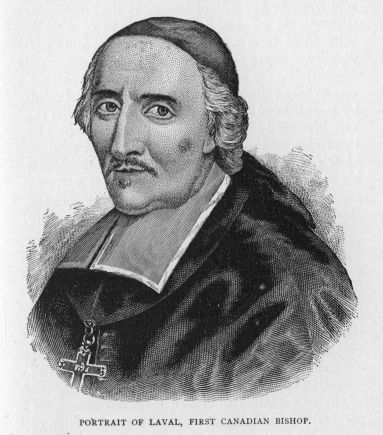
Portrait of Laval, first Canadian bishop.
No question can be raised as to Bishop Laval's charity and generosity. He accumulated no riches for himself—he spent nothing on the luxuries, hardly anything on the conveniences of life, but gave freely to the establishment of those famous seminaries at Quebec, which have been ever since identified with the religious and secular instruction of the French Canadians, and now form part of the noble university which bears his name.
With a man like Laval at the head of the Church in Canada at this early period, it necessarily exercised a powerful influence at the council board, and in the affairs of the country generally. If he was sometimes too arbitrary, too arrogant in the assertion of his ecclesiastical dignity, yet he was also animated by very conscientious motives with respect to temporal questions. In the quarrel he had with the governor, Baron Dubois d'Avaugour, an old soldier, as to the sale of brandy to the Indians, he showed that his zeal in the discharge of what he believed to be a Christian and patriotic duty predominated above all such mercenary and commercial considerations as animated the governor and officials, who believed that the trading interests of the country were injured by prohibition. Laval saw that the very life-blood of the Indians was being poisoned by this traffic, and succeeded in obtaining the removal of D'Avaugour. But all the efforts of himself and his successor, Saint-Vallier, could not practically restrain the sale of spirituous liquors, as long as the fur-trade so largely depended on their consumption.
At this time, and for a long time afterwards, Protestantism was unknown in Canada, for the King and Jesuits had decided to keep the colony entirely free from heresy. The French Protestants, after the revocation of the edict of Nantes, gave to England and the Netherlands the benefit of their great industry and manufacturing knowledge. Some of them even found their way to America, and stimulated the gathering strength of the southern colonies of Virginia and the Carolinas.
The new régime under Colbert was essentially parental. All emigration was under the direction of the French authorities. Wives were sent by shiploads for the settlers, newly-wedded couples received liberal presents suitable to their condition in a new country; early marriages and large families were encouraged by bounties. Every possible care was taken by the officials and religious communities who had charge of such matters, that the women were of good morals, and suitable for the struggles of a colonial existence.
While State and Church were providing a population for the country, Colbert and Talon were devoting themselves to the encouragement of manufactures and commerce. When the Company of the Hundred Associates, who appear to have been robbed by their agents in the colony, fell to pieces, they were replaced by a large organisation, known as the Company of the West, to which was given very important privileges throughout all the French colonies and dependencies. The company, however, never prospered, and came to an end in 1674, after ten years' existence, during which it inflicted much injury on the countries where it was given so many privileges. The government hereafter controlled all commerce and finance. Various manufactures, like shipbuilding, leather, hemp, and beer, were encouraged, but at no time did Canada show any manufacturing or commercial enterprise. Under the system of monopolies and bounties fostered by Colbert and his successors, a spirit of self-reliance was never stimulated. The whole system of government tended to peculation and jobbery—to the enrichment of worthless officials. The people were always extremely poor. Money was rarely seen in the shape of specie. The few coins that came to the colony soon found their way back to France. From 1685 down to 1759 the government issued a paper currency, known as "card money," because common playing cards were used. This currency bore the crown and fleur-de-lis and signatures of officials, and gradually became depreciated and worthless.
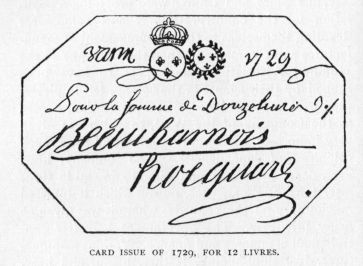
Card issue of 1729, for 12 livres.
While the townsfolk of Massachusetts were discussing affairs in town-meetings, the French inhabitants of Canada were never allowed to take part in public assemblies but were taught to depend in the most trivial matters on a paternal government. Canada was governed as far as possible like a province of France. In the early days of the colony, when it was under the rule of the Company of the Hundred Associates, the governors practically exercised arbitrary power, with the assistance of a nominal council chosen by themselves. When, however, the King took the government of the colony into his own hands, he appointed a governor, an intendant, and a supreme or—as it was subsequently called—a sovereign council, of which the bishop was a member, to administer under his own direction the affairs of the country. The governor, who was generally a soldier, was nominally at the head of affairs, and had the direction of the defences of the colony, but to all intents and purposes the intendant, who was a man of legal attainments, had the greater influence. He was the finance minister, and made special reports to the King on all Canadian matters. He had the power of issuing ordinances which had the effect of law, and showed the arbitrary nature of the government to which the people were subject. Every effort to assemble the people for public purposes was systematically crushed by the orders of the government. A public meeting of the parishioners to consider the cost of a new church could not be held without the special permission of the intendant. Count Frontenac, immediately after his arrival, in 1672, attempted to assemble the different orders of the colony, the clergy, the noblesse or seigneurs, the judiciary, and the third estate, in imitation of the old institutions of France. The French king promptly rebuked the haughty governor for this attempt to establish a semblance of popular government.

Fifteen sol piece.
From that moment we hear no more of the assembling of "Canadian Estates," and an effort to elect a mayor and aldermen for Quebec also failed through the opposition of the authorities. An attempt was then made to elect a syndic—a representative of popular rights in towns—but M. de Mésy, then governor, could not obtain the consent of the bishop, who knew that his views were those of the King. The result of the difficulties that followed was the dismissal of the governor, who died soon afterwards, but not until he had confessed his error, and made his peace with the haughty bishop whom he had dared to oppose.
The administration of local affairs throughout the province was exclusively under the control of the King's officers at Quebec. The ordinances of the intendant and of the council were the law. The country was eventually subdivided into the following divisions for purposes of government, settlement, and justice: 1. Districts. 2. Seigniories. 3. Parishes. The districts were simply established for judicial and legal purposes, and each of them bore the name of the principal town within its limits—viz., Quebec, also called the Prévoté de Quebec, Montreal, and Three Rivers. In each of these districts there was a judge, appointed by the king, to adjudicate on all civil and criminal matters. An appeal was allowed in the most trivial cases to the supreme or superior council, which also exercised original jurisdiction. The customary law of Paris, which is based on the civil law of Rome, was the fundamental law of Canada, and still governs the civil rights of the people.
The greater part of Canada was divided into large estates or seigniories, with the view of creating a colonial noblesse, and of stimulating settlement in a wilderness. It was not necessary to be of noble birth to be a Canadian seigneur. Any trader with a few louis d'or and influence could obtain a patent for a Canadian lordship. The seignior on his accession to his estate was required to pay homage to the King, or to his feudal superior in case the lands were granted by another than the King. The seignior received his land gratuitously from the crown, and granted them to his vassals, who were generally known as habitants, or cultivators of the soil, on condition of their making small annual payments in money or produce known as cens et rente. The habitant was obliged to grind his corn at the seignior's mill (moulin banal), bake his bread in the seignior's oven, give his lord a tithe of the fish caught in his waters, and comply with other conditions at no time onerous or strictly enforced in the days of the French régime. This system had some advantages in a new country like Canada, where the government managed everything, and colonisation was not left to chance. The seignior was obliged to cultivate his estate at a risk of forfeiture, consequently it was absolutely necessary that he should exert himself to bring settlers upon his lands. The obligation of the habitant to grind his corn in the seignior's mill was clearly an advantage for the settlers. In the early days of the colony, however, the seigniors were generally too poor to fulfil this condition, and the habitants had to grind corn between stones, or in rude hand mills. The seigniors had the right of dispensing justice in certain cases, though it was one he very rarely exercised. As respects civil affairs, however, both lord and vassal were to all intents and purposes on the same footing, for they were equally ignored in matters of government.
In the days of the French régime, the only towns for many years were Quebec, Montreal, and Three Rivers. In remote and exposed places—like those on the Richelieu, where officers and soldiers of the Carignan-Salières Regiment had been induced to settle—palisaded villages had been built. The principal settlements were, in course of time, established on the banks of the St. Lawrence, as affording in those days the easiest means of intercommunication. As the lots of a seigniorial grant were limited in area—four arpents in front by forty in depth—the farms in the course of time assumed the appearance of a continuous settlement on the river. These various settlements became known in local phraseology as Côtes, apparently from their natural situation on the banks of the river. This is the origin of Côte des Neiges, Côte St. Louis, Côte St. Paul, and of many picturesque villages in the neighbourhood of Montreal and Quebec. As the country became settled, parishes were established for ecclesiastical purposes and the administration of local affairs. Here the influential men were the curé, the seignior, and the captain of the militia. The seignior, from his social position, exercised a considerable weight in the community, but not to the degree that the representative of the Church enjoyed. The church in the parishes was kept up by tithes, regulated by ordinances, and first imposed by Bishop Laval for the support of the Quebec Seminary and the clergy. Next to the curé in importance was the captain of the militia. The whole province was formed into a militia district, so that, in times of war, the inhabitants might be obliged to perform military service under the French governor. In times of peace these militia officers in the parishes executed the orders of the governor and intendant in all matters affecting the King. In case it was considered necessary to build a church or presbytery, the intendant authorised the habitants to assemble for the purpose of choosing from among themselves four persons to make, with the curé, the seignior, and the captain of the militia, an estimate of the expense of the structure. It was the special care of the captain of the militia to look after the work, and see that each parishioner did his full share. It was only in church matters, in fact, that the people of a parish had a voice, and even in these, as we see, they did not take the initiative. The Quebec authorities must in all such cases first issue an ordinance.
Under these circumstances it is quite intelligible that the people of Canada were obliged to seek in the clearing of the forest, in the cultivation of the field, in the chase, and in adventure, the means of livelihood, and hardly ever busied themselves about public matters in which they were not allowed to take even a humble part.
XII.
THE PERIOD OF EXPLORATION AND DISCOVERY: PRIESTS, FUR-TRADERS, AND COUREURS DE BOIS IN THE WEST.
(1634-1687.)
We have now come to that interesting period in the history of Canada, when the enterprise and courage of French adventurers gave France a claim to an immense domain, stretching from the Gulf of St. Lawrence indefinitely beyond the Great Lakes, and from the basin of those island seas as far as the Gulf of Mexico. The eminent intendant, Talon, appears to have immediately understood the importance of the discovery which had been made by the interpreter and trader, Jean Nicolet, of Three Rivers, who, before the death of Champlain, probably in 1634, ventured into the region of the lakes, and heard of "a great water"—no doubt the Mississippi—while among the Mascoutins, a branch of the Algonquin stock, whose villages were generally found in the valley of the Fox River. He is considered to have been the first European who reached Sault Ste. Marie—the strait between Superior and Huron—though there is no evidence that he ventured beyond the rapids, and saw the great expanse of lake which had been, in all probability, visited some years before by Etienne Brulé, after his escape from the Iroquois. Nicolet also was the first Frenchman who passed through the straits of Mackinac or Michillimackinac, though he did not realise the importance of its situation in relation to the lakes of the western country. It is told of him that he made his appearance among the Winnebagos in a robe of brilliant China damask, decorated with flowers and birds of varied colours, and holding a pistol in each hand. This theatrical display in the western forest is adduced as evidence of his belief in the story that he had heard among the Nipissings, at the head-waters of the Ottawa, that there were tribes in the west, without hair and beards, like the Chinese. No doubt, he thought he was coming to a country where, at last, he would find that short route to the Chinese seas which had been the dream of many Frenchmen since the days of Cartier. We have no answer to give to the question that naturally suggests itself, whether Champlain ever saw Nicolet on his return, and heard from him the interesting story of his adventures. It was not until 1641, or five years after Champlain's death, that Father Vimont gave to the world an account of Nicolet's journey, which, no doubt, stimulated the interest that was felt in the mysterious region of the west. From year to year the Jesuit and the trader added something to the geographical knowledge of the western lakes, where the secret was soon to be unlocked by means of the rivers which fed those remarkable reservoirs of the continent. In 1641 Fathers Raymbault and Jogues preached their Faith to a large concourse of Indians at the Sault between Huron and Superior, where, for the first time, they heard of the Sioux or Dacotah, those vagrants of the northwest, and where the former died without realising the hope he had cherished, of reaching China across the western wilderness. Then came those years of terror, when trade and enterprise were paralysed by those raids of the Iroquois, which culminated in the dispersion of the Hurons. For years the Ottawa valley was almost deserted, and very few traders or coureurs de bois ventured into the country around the western lakes. An enterprising trader of Three Rivers, Médard Chouart, Sieur de Grosseilliers, is believed to have reached the shores of Lake Superior in 1658, and also to have visited La Pointe, now Ashland, at its western extremity, in the summer of 1659, in company with Pierre d'Esprit, Sieur Radisson, whose sister he had married. Some critical historians do not altogether discredit the assumption that these two venturesome traders ascended the Fox and Wisconsin rivers, and even reached the Mississippi, twelve years before Jolliet and Marquette.
With the peace that followed the destruction of the Mohawk villages by Tracy and Courcelles, and the influx of a considerable population into Canada, the conditions became more favourable for exploration and the fur trade. The tame and steady life of the farm had little charm for many restless spirits, who had fought for France in the Carignan Regiment. Not a few of them followed the roving Canadian youth into the forest, where they had learned to love the free life of the Indians. The priest, the gentilhomme, and the coureur de bois, each in his way, became explorers of the western wilderness.
From the moment the French landed on the shores of Canada, they seemed to enter into the spirit of forest life. Men of noble birth and courtly associations adapted themselves immediately to the customs of the Indians, and found that charm in the forest and river which seemed wanting in the tamer life of the towns and settlements. The English colonisers of New England were never able to win the affections of the Indian tribes, and adapt themselves so readily to the habits of forest life as the French Canadian adventurer.
A very remarkable instance of the infatuation which led away so many young men into the forest, is to be found in the life of Baron de Saint-Castin, a native of the romantic Bernese country, who came to Canada with the Carignan Regiment during 1665, and established himself for a time on the Richelieu. But he soon became tired of his inactive life, and leaving his Canadian home, settled on a peninsula of Penobscot Bay (then Pentagoët), which still bears his name. Here he fraternised with the Abenaquis, and led the life of a forest chief, whose name was long the terror of the New England settlers. He married the daughter of Madocawando, the implacable enemy of the English, and so influential did he become that, at his summons, all the tribes on the frontier between Acadia and New England would proceed on the warpath. He amassed a fortune of three hundred thousand crowns in "good dry gold," but we are told he only used the greater part of it to buy presents for his Indian followers, who paid him back in beaver skins. His life at Pentagoët, for years, was very active and adventurous, as the annals of New England show. In 1781 he returned to France, where he had an estate, and thenceforth disappeared from history. His son, by his Abenaqui Baroness, then took command of his fort and savage retainers, and after assisting in the defence of Port Royal, and making more than one onslaught on the English settlers of Massachusetts, he returned to Europe on the death of his father. The poet Longfellow has made use of this romantic episode in the early life of the Acadian settlements:
"The warm winds blow on the hills of Spain, The birds are building and the leaves are green, The Baron Castine, of St. Castine, Hath come at last to his own again."
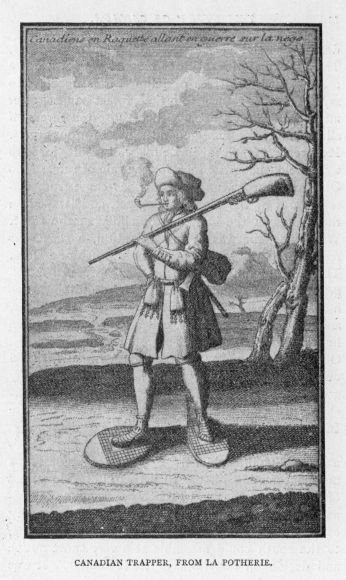
Canadian trapper, from La Potherie.
Year after year saw the settlements almost denuded of their young men, who had been lured away by the fascinations of the fur trade in the forest fastnesses of the west. The government found all their plans for increasing the population and colonising the country thwarted by the nomadic habits of a restless youth. The young man, whether son of the gentilhomme, or of the humble habitant, was carried away by his love for forest life, and no enactments, however severe—not even the penalty of death—had the effect of restraining his restlessness. That the majority of the coureurs de bois were a reckless, dare-devil set of fellows, it is needless to say. On their return from their forest haunts, after months of savage liberty, they too often threw off all restraint, and indulged in the most furious orgies. Montreal was their favourite place of resort, for here were held the great fairs for the sale of furs. The Ottawas, Hurons, and other tribes came from distant parts of the North and West, and camped on the shores in the immediate vicinity of the town. When the fair was in full operation, a scene was represented well worthy of the bold brush of a Doré. The royal mountain, then as now, formed a background of rare sylvan beauty. The old town was huddled together on the low lands near the river, and was for years a mere collection of low wooden houses and churches, all surrounded by palisades. On the fair ground were to be seen Indians tricked out in their savage finery; coureurs de bois in equally gorgeous apparel; black-robed priests and busy merchants from all the towns, intent on wheedling the Indians and bush rangers out of their choicest furs.
The principal rendezvous in the west was Mackinac or Michillimackinac. Few places possessed a more interesting history than this old headquarters of the Indian tribes and French voyageurs. Mackinac may be considered, in some respects, the key of the upper lakes. Here the tribes from the north to the south could assemble at a very short notice and decide on questions of trade or war. It was long the metropolis of a large portion of the Huron and Ottawa nations, and many a council, fraught with the peace of Canada, was held there in the olden times. It was on the north side of the straits that Father Marquette—whose name must ever live in the west—some time in 1671 founded the mission of St. Ignace, where gradually grew up the most important settlement which the French had to the northwest of Fort Frontenac or Cataraqui. The French built a chapel and fort, and the Hurons and Ottawas lived in palisaded villages in the neighbourhood. The coureurs de bois were always to be seen at a point where they could be sure to find Indians in large numbers. Contemporary writers state that the presence of so many unruly elements at this distant outpost frequently threw the whole settlement into a sad state of confusion and excitement, which the priests were at times entirely unable to restrain. Indians, soldiers, and traders became at last so demoralised, that one of the priests wrote, in his despair, that there seemed no course open except "deserting the missions and giving them up to the brandy-sellers as a domain of drunkenness and debauchery."
But it would be a mistake to judge all the coureurs de bois by the behaviour of a majority, who were made up necessarily from the ruder elements of the Canadian population. Even the most reckless of their class had their work to do in the opening up of this continent. Despising danger in every form, they wandered over rivers and lakes and through virgin forests, and "blazed" a track, as it were, for the future pioneer. They were the first to lift the veil of mystery that hung, until they came, on many a solitary river and forest. The posts they raised by the side of the western lakes and rivers, were so many videttes of that army of colonisers who have built up great commonwealths in that vast country, where the bushranger was the only European two centuries ago. The most famous amongst their leaders was the quick-witted Nicholas Perrot—the explorer of the interior of the continent. Another was Daniel Greysolon Duluth, who became a Canadian Robin Hood, and had his band of bushrangers like any forest chieftain. For years he wandered through the forests of the West, and founded various posts at important points, where the fur trade could be prosecuted to advantage. Posterity has been more generous to him than it has been to others equally famous as pioneers, for it has given his name to a city at the head of Lake Superior. Like many a forest which they first saw in its primeval vastness, these pioneers have disappeared into the shadowy domain of an almost forgotten past, and their memory is only recalled as we pass by some storm-beat cape, or land-locked bay, or silent river, to which may still cling the names they gave as they swept along in the days of the old régime.
XIII.
THE PERIOD OF EXPLORATION AND DISCOVERY: FRANCE IN THE VALLEY OF THE MISSISSIPPI.
(1672-1687.)
Sault St. Marie was the scene of a memorable episode in the history of New France during the summer of 1671. Simon François Daumont, Sieur St. Lusson, received a commission from the government of Quebec to proceed to Lake Superior to search for copper mines, and also to take formal possession of the basin of the lakes and its tributary rivers. With him were two men, who became more famous than himself—Nicholas Perrot and Louis Jolliet, the noted explorers and rangers of the West. On an elevation overlooking the rapids, around which modern enterprise has built two ship-canals, St. Lusson erected a cross and post of cedar, with the arms of France, in the presence of priests in their black robes, Indians bedecked with tawdry finery, and bushrangers in motley dress. In the name of the "most high, mighty, and redoubted monarch, Louis XIV. of that name, most Christian King of France and of Navarre," he declared France the owner of Sault Ste. Marie, Lakes Huron and Superior, and Isle of Mackinac, and "all of adjacent countries, rivers, and lakes, and contiguous streams." As far as boastful words and, priestly blessings could go, France was mistress of an empire in the great West.
Three names stand out in bold letters on the records of western discovery: Jolliet, the enterprising trader, Marquette, the faithful missionary, and La Salle, the bold explorer. The story of their adventures takes up many pages in the histories of this fascinating epoch. Talon may be fairly considered to have laid the foundations of western exploration, and it was left for Louis de Baude, Comte de Frontenac, who succeeded Courcelles as governor in 1672, to carry out the plans of the able intendant when he left the St. Lawrence.
Jolliet, a Canadian by birth, was wisely chosen by Talon—and Frontenac approved of the choice—to explore the West and find the "great water," of which vague stories were constantly brought back by traders and bushrangers. Jolliet was one of the best specimens of a trader and pioneer that Canadian history gives us. His roving inclinations were qualified by a cool, collected brain, which carried him safely through many a perilous adventure. He had for his companion Father Marquette, who was then stationed at the mission of St. Ignace, and had gathered from the Indians at his western missions—especially at La Pointe on Lake Superior—valuable information respecting the "great water" then called the "Missipi." Both had many sympathies in common. Jolliet had been educated by the Jesuits in Canada, but unlike La Salle, he was in full accord with their objects. Marquette possessed those qualities of self-sacrifice and religious devotion which entitle him to rank with Lalemant, Jogues, and Brebeuf. While Jolliet was inspired by purely ambitious and trading instincts, the missionary had no other hope or desire than to bring a great region and its savage communities under the benign influence of the divine being whose heavenly face seemed ever present, encouraging him to fresh efforts in her service. It was in the spring of 1673 that these two men started with five companions in two canoes on their journey through that wilderness, which stretched beyond Green Bay—an English corruption of Grande Baie. Like Nicolet, they ascended the Fox River to the country of the Mascoutins, Foxes, and Kickapoos, where they obtained guides to lead them across the portage to the Wisconsin. The adventurers had now reached the low "divide" between the valleys of the Lakes and the Mississippi. The Fox River and its affluents flowed tranquilly to the great reservoirs of the St. Lawrence, while the Wisconsin, on which they now launched their canoes, carried them to a mighty river, which ended they knew not where. A month after leaving St. Ignace they found themselves "with a great and inexpressible joy"—to quote Marquette's words—on the rapid current of a river which they recognised as the Missipi. As they proceeded they saw the low-lying natural meadows and prairies where herds of buffalo were grazing, marshes with a luxuriant growth of wild rice, the ruined castles which nature had in the course of many centuries formed out of the rocks of the western shores, and the hideous manitous which Indian ingenuity had pictured on the time-worn cliffs. They had pleasant interviews with the Indians that were hunting the roebuck and buffalo in this land of rich grasses. Their canoes struggled through the muddy current, which the Missouri gave as its tribute to the Missipi, passed the low marshy shores of the Ohio, and at last came near the mouth of the Arkansas, where they landed at an Indian village which the natives called Akamsea. Here they gathered sufficient information to enable them to form the conclusion that the great river before their eyes found its way, not to the Atlantic or Pacific oceans, but to the Gulf of Mexico. Then they decided not to pursue their expeditions further at that time, but to return home and relate the story of their discovery. When they came to the mouth of the Illinois River, they took that route in preference to the one by which they had come, followed the Des Plaines River,—where a hill still bears Jolliet's name—crossed the Chicago portage, and at last found themselves at the southern extremity of Lake Michigan. It was then the end of September, and Jolliet did not reach Canada until the following summer. When nearly at his journey's end, Fate dealt him a cruel blow, his canoe was capsized after running the Lachine Rapids just above Montreal, and he lost all the original notes of his journey. Frontenac, however, received from him a full account of his explorations, and sent it to France.
Two centuries later than this memorable voyage of Jolliet, a French Canadian poet-laureate described it in verse fully worthy of the subject, as the following passage and equally spirited translation[1] go to show:
LA DÉCOUVERTE DU THE DISCOVERY OF THE MISSISSIPPI. MISSISSIPPI. Jolliet . . . Jolliet . . . O, Jolliet, what splendid faery quel spectacle féérique dream Dut frapper ton regard, quand Met thy regard, when on that ta nef historique mighty stream, Bondit sur les flots d'or du Bursting upon its lonely grand fleuve inconnu unknown flow, Quel éclair triomphant, à cet Thy keel historic cleft its instant de fièvre, golden tide:-- Dut resplendir sur ton front Blossomed thy lip with what nu? . . . stern smile of pride? What conquering light shone on thy lofty brow? Le voyez-vous là-bas, debout Behold him there, a prophet, comme un prophète, lifted high, L'oeil tout illuminé d'audace Heart-satisfied, with bold, satisfaite, illumined eye, La main tendue au loin vers His hand outstretched toward l'Occident bronzé. the sunset furled, Prendre possession de ce Taking possession of this domain domaine immense, immense, Au nom du Dieu vivant, au nom In the name of the living God, roi de France. in the name of the King Et du monde civilisé? . . . of France, And the mighty modern world. Puis, bercé par la houle, et Rocked by the tides, wrapt in bercé par ses rêves, his glorious moods, L'oreille ouverte aux bruits Breathing perfumes of lofty harmonieux des grèves, odorous woods,
Humant l'acre parfum des Ears opened to the shores' grands bois odorants, harmonious tunes, Rasant les îlots verts et les Following in their dreams and dunes d'opale, voices mellow, De méandre en méandre, au fil To wander and wander in the l'onde pâle, thread of the pale billow, Suivre le cours des flots Past islands hushed and errants. . . . opalescent dunes. A son aspect, du sein des Lo, as he comes, from out the flottantes ramures, waving boughs, Montait comme un concert de A rising concert of murmurous chants et de murmures; song upflows, Des vols d'oiseaux marins Of winging sea-fowl lifting s'élevaient des roseaux, from the reeds; Et, pour montrer la route à la Pointing the route to his swift pirogue frèle. dripping blade, S'enfuyaient en avant, traînant Then skimming before, tracing leur ombre grèle their slender shade Dans le pli lumineux des eaux. In luminous foldings of the watery meads. Et, pendant qu'il allait voguant And as he journeys, drifting à la dérive, with its flow, On aurait dit qu'au loin, les The forests lifting their glad arbres de la rive, roofs aglow, En arceaux parfumés penchés sur In perfumed arches o'er his son chemin, keel's swift swell, Saluaient le héros dont Salute the hero, whose undaunted l'énergique audace soul Venait d'inscrire encor le nom Had graved anew "LA FRANCE" de notre race on that proud scroll Aux fastes de l'esprit humain. Of human genius, bright, imperishable.
Jolliet's companion, the Jesuit missionary, never realised his dream of many years of usefulness in new missions among the tribes of the immense region claimed by France. In the spring of 1675 he died by the side of a little stream which finds its outlet on the western shore of Lake Michigan, soon after his return from a painful journey he had taken, while in a feeble state of health, to the Indian communities of Kaskaskia between the Illinois and Wabash rivers. A few months later his remains were removed by some Ottawas, who knew and loved him well, and carried to St. Ignace, where they were buried beneath the little mission chapel. His memory has been perpetuated in the nomenclature of the western region, and his statue stands in the rotunda of that marble capitol which represents, not the power and greatness of that France which he loved only less than his Church, but the national development of those English colonies which, in his time, were only a narrow fringe on the Atlantic coast, separated from the great West by mountain ranges which none of the most venturesome of their people had yet dared to cross.
The work that was commenced by Jolliet and Marquette, of solving the mystery that had so long surrounded the Mississippi, was completed by Réné Robert Cavalier, Sieur de la Salle, a native of Rouen, who came to Canada when quite a young man, and obtained a grant of land from the Sulpician proprietors of Montreal at the head of the rapids, then known as St. Louis. Like so many Canadians of those days he was soon carried away by a spirit of adventure. He had heard of the "great water" in the west, which he believed, in common with others, might lead to the Gulf of California. In the summer of 1669 he accompanied two Sulpician priests, of Montreal, Dollier de Casson and Gallinée, on an expedition they made, under the authority of Governor Courcelles, to the extreme western end of Ontario, where he met Jolliet, apparently for the first time, and probably had many conversations with him respecting the west and south, and their unknown rivers. He decided to leave the party and attempt an exploration by a southerly route, while the priests went on to the upper lakes as far as the Sault. Of La Salle's movements for the next two years we are largely in the dark—in some respects entirely so. It has been claimed by some that he first discovered the Ohio, and even reached the Mississippi, but so careful an historian as Justin Winsor agrees with Shea's conclusion that La Salle "reached the Illinois or some other affluent of the Mississippi, but made no report and made no claim, having failed to reach the great river." It was on his return from these mysterious wanderings, that his seigniory is said to have received the name of La Chine as a derisive comment on his failure to find a road to China. In the course of years the name was very commonly given, not only to the lake but to the rapids of St. Louis.
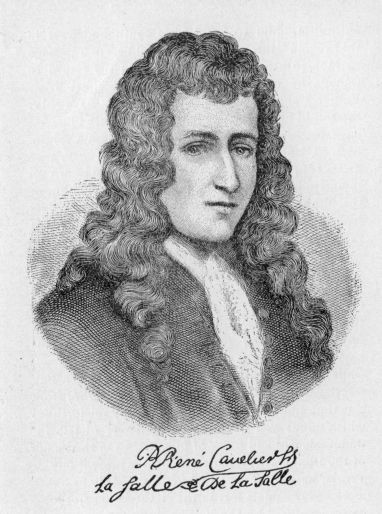
Réné Robert Cavalier, Sieur de la Salle
We now come to sure ground when we follow La Salle's later explorations, on which his fame entirely rests. Frontenac entered heartily into his plans of following the Mississippi to its mouth, and setting at rest the doubts that existed as to its course. He received from the King a grant of Fort Frontenac and its surrounding lands as a seigniory. This fort had been built by the governor in 1673 at Cataraqui, now Kingston, as an advanced trading and defensive post on Lake Ontario. La Salle considered it a most advantageous position for carrying on his ambitious projects of exploration. He visited France in 1677 and received from the King letters-patent authorising him to build forts south and west in that region "through which it would seem a passage to Mexico can be discovered." On his return to Canada he was accompanied by a Recollet friar, Father Louis Hennepin, and by Henry de Tonty, the son of an Italian resident of Paris, both of whom have associated their names with western exploration. Of all his friends and followers, Tonty, who had a copper hand in the place of the one blown off in an Italian war, was the most faithful and honest, through the varying fortunes of the explorer's career from this time forward. To Father Hennepin I refer in another place.
Both Hennepin and Tonty accompanied La Salle on his expedition of 1678 to the Niagara district, where, above the great falls, near the mouth of Cayuga Creek, he built the first vessel that ever ventured on the lakes, and which he named the "Griffin" in honour of Frontenac, whose coat-of-arms bore such a heraldic device. The loss of this vessel, while returning with a cargo of furs from Green Bay to Niagara, was a great blow to La Salle, who, from this time until his death, suffered many misfortunes which might well have discouraged one of less indomitable will and fixity of purpose. On the banks of the Illinois River, a little below the present city of Peoria, he built Fort Crèvecoeur, probably as a memorial of a famous fort in the Netherlands, not long before captured by the French. While on a visit to Canada, this post was destroyed by some of his own men in the absence of Tonty, who had been left in charge. These men were subsequently captured not far from Cataraqui, and severely punished.
In the meantime, three Frenchmen, Father Hennepin, Michel Accaut, and one Du Gay, in obedience to La Salle's orders, had ventured to the upper waters of the Mississippi, and were made prisoners by a wandering tribe of Sioux. Not far from the falls of St. Anthony Father Hennepin met with the famous forest ranger, Duluth, who was better acquainted with the Sioux country than any other living Frenchman, and was forming ambitious designs to explore the whole western region beyond Lake Superior. Father Hennepin, who had been adopted by an aged Sioux chief, was free to follow Duluth back to the French post at the Straits of Mackinac. This adventure of Father Hennepin is famous in history, not on account of any discoveries he actually made, but on account of the claim he attempted to establish some years after his journey, of having followed the Mississippi to the Gulf. In the first edition of his book, printed in 1683—Description de la Louisiane—no such claim was ever suggested, and it was only in 1697 that the same work appeared in an enlarged form,—La Nouvelle Découverte—crediting Hennepin with having descended the great river to its outlet. It is not necessary here to puncture a falsehood which was long ago exposed by historical writers. His history of having reached the Gulf of Mexico is as visionary as the traveller's tales of Norumbega. Indeed, he could not even claim a gift of fertile invention in this case, as the very account of his alleged discovery was obviously plagiarised from Father Membré's narrative of La Salle's voyage of 1682, which appears in Le Clercq's Premier Établissement de la Foy.
When La Salle was again able to venture into the west he found the villages of the Illinois only blackened heaps of ruins—sure evidence of the Iroquois having been on the warpath. During the winter of 1681 he remained at a post he had built on the banks of the St. Joseph in the Miami country, and heard no news of his faithful Tonty. It was not until the spring, whilst on his way to Canada for men and supplies, that he discovered his friend at Mackinac, after having passed through some critical experiences among the Iroquois, who, in conjunction with the Miamis, had destroyed the villages of the Illinois, and killed a number of those Indians with their customary ferocity. Tonty had finally found rest and security in a village of the Pottawattomies at the head of Green Bay.
On the 6th of February, 1682, La Salle passed down the swift current of the Mississippi on that memorable voyage which led him to the Gulf of Mexico. He was accompanied by Tonty, and Father Membré, one of the Recollet order, whom he always preferred to the Jesuits. The Indians of the expedition were Abenakis and Mohegans, who had left the far-off Atlantic coast and Acadian rivers, and wandered into the great west after the unsuccessful war in New England, which was waged by the Sachem Metacomet, better known as King Philip, and only ended with his death in 1676, and the destruction of many settlements in the colony of Plymouth.
They met with a kindly reception from the Indians encamped by the side of the river, and, for the first time, saw the villages of the Taënsas and Natchez, who were worshippers of the sun. At last on the 6th of April, La Salle, Tonty, and Dautray, went separately in canoes through the three channels of the Mississippi, and emerged on the bosom of the great Gulf. Not far from the mouth of the river where the ground was relatively high and dry, a column was raised with the inscription:
"Louis le Grand, roy de France et de Navarre, regne; le neuviesme Avril, 1682."
And La Salle took possession of the country with just such ceremonies as had distinguished a similar proceeding at Sault Ste. Marie eleven years before. It can be said that Frenchmen had at least fairly laid a basis for future empire from the Lakes to the Gulf. It was for France to show her appreciation of the enterprise of her sons and make good her claim to such a vast imperial domain. The future was to show that she was unequal to the task.
The few remaining years of La Salle's life were crowded with misfortunes. Duchesneau, the intendant, who had succeeded Talon, was an enemy of both Frontenac and the explorer. The distinguished governor was recalled by his royal master, who was tired of the constant complaints of his enemies against him, and misled by their accusations. La Barre, the incompetent governor who followed Frontenac, took possession of Fort St. Louis, which La Salle had succeeded, after his return from the Gulf of Mexico, in erecting at Starved Rock on the banks of the Illinois not far from the present city of Ottawa, where a large number of Indians had returned to their favourite home. In France, however, the importance of his discovery was fully recognised, and when he visited his native country in 1683-4 he met with a very cordial reception from the King, and Seignelay, who had succeeded his father, Colbert, when he resigned. The King ordered that La Salle's forts be restored to him, and gave him a commission to found colonies in Louisiana, as the new country through which the Mississippi flowed had been called since 1682. By a strange irony of Fate, the expedition of 1684 passed the mouth of the Mississippi, and La Salle made the first French settlement on the Gulf somewhere in the vicinity of Matagorda Bay, in the present State of Texas. Misery was the lot of the little colony from the very first moment it landed on that lonely shore. When his misfortunes were most grievous, La Salle decided to make an effort to reach the Illinois country, but he was assassinated by two of his own men—-Duhaut and Liotot—near a branch of the Trinity River. His nephew Moranget, Nika, a faithful Shawnee who had been by his side for years, and Sayet, his own servant, suffered the same fate. The leader of the murderers was killed soon afterwards by one of his accomplices, and the others found a refuge among the Indians; but of their subsequent fate we know nothing positively, except that they were never brought to justice, if any one of them returned to Canada or France. The few Frenchmen remaining in Texas were either killed or captured by unfriendly Indians, before the Spaniards could reach the place to expel these intruders on their domain. La Salle himself never found a burial place, for his body was left to wolves and birds of prey. His name has not been perpetuated in Louisiana, though it has been given to a county of Texas as well as to a city and county of Illinois, which was originally included in French Louisiana. The most noteworthy tribute to his memory has been paid by the historian Parkman, who has elevated him almost to the dignity of a hero. La Salle's indomitable energy, his remarkable courage in the face of disaster, his inflexibility of purpose under the most adverse circumstances, must be always fully recognised, but at the same time one may think that more tact and skill in managing men, more readiness to bend and conciliate, might have spared him much bitterness and trouble, and even saved his life at the end. That he did good service for France all will admit, though his achievement in reaching the Mississippi was rendered relatively easy after the preliminary expedition of Jolliet and Marquette.
XIV.
CANADA AND ACADIA: FROM FRONTENAC TO THE TREATY OF UTRECHT.
(1672-1713.)
In the previous chapter I have shown the important part that the Count de Frontenac took in stimulating the enterprise of La Salle and other explorers, and it now remains for me to review those other features of the administration of that great governor, which more or less influenced the fortunes of the province committed to his charge.
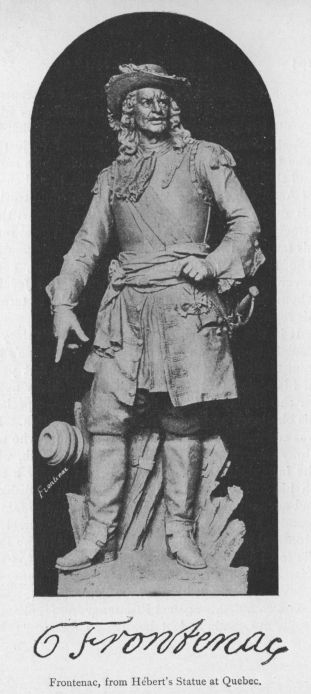
Frontenac, from Hébert's Statue at Quebec.
A brave and bold soldier, a man of infinite resources in times of difficulty, as bold to conceive as he was quick to carry out a design, dignified and fascinating in his manner when it pleased him, arrogant and obstinate when others thwarted him, having a keen appreciation of the Indian character, selfish where his personal gain was concerned, and yet never losing sight of the substantial interests of France in America, the Count de Frontenac was able, for nineteen years, to administer the affairs of New France with remarkable ability, despite his personal weaknesses, to stimulate and concentrate her energies and resources, and to make her when he died a power in America far beyond what her population or actual strength seemed to justify. The Iroquois learned at last to tremble at his name, and the Indian allies of Canada, from the Abenakis of Acadia to the Illinois of the West, could trust in his desire and ability to assist them against their ferocious enemy. As is the case with all great men, his faults and virtues have been equally exaggerated. The Recollets, whom he always favoured, could never speak too well of him, whilst the Jesuits, whom he distrusted, did all they could to tarnish his reputation.
It is not profitable or necessary in this story of Canada to dwell on the details of Frontenac's administration of public affairs during the first years of his régime (1672-1682), which were chiefly noted for the display of his faults of character—especially his obstinacy and impatience of all opposition. He was constantly at conflict with the bishop, who was always asserting the supremacy of his Church, with the intendant Duchesneau, who was simply a spy on his actions, with the Jesuits, whom he disliked and accused of even being interested in the sale of brandy, and with traders like Governor Perrot of Montreal who eventually found himself in the Bastile for a few days for having defied the edict of the King against the coureurs de bois who were under his influence and helped him in the fur trade.
The complaints against Frontenac from influential people in Canada at last became so numerous that he was recalled to France in 1682. His successor, La Barre, proved himself thoroughly incapable. The interests of the province were seriously threatened at that time by the intention of the Iroquois to destroy the Illinois and divert the western traffic to the Dutch and English, whose carriers they wished to become. La Barre was well aware how much depended on the protection of the Illinois and the fidelity of the Indians on the lakes. La Hontan, a talkative but not always veracious writer, who was in Canada at this time, gives us an insight into the weakness of the governor, whose efforts to awe the Iroquois ended in an abortive expedition which was attacked by disease and did not get beyond La Famine, now Salmon River, in the Iroquois country. The famous "La Grande Gueule," or Big Mouth,—so called on account of his eloquence,—made a mockery of the French efforts to deceive him by a pretence of strength, and openly declared the intention of the Iroquois to destroy the Illinois, while La Barre dared not utter a defiant word in behalf of his allies. This incapable governor was soon recalled and the Marquis de Denonville, an officer of dragoons, sent in his place. One of the most notable incidents of the new administration was the capture of the fortified trading-posts belonging to the English Company of Hudson's Bay, by the Chevalier de Troyes and a number of Canadians from Montreal, among whom were the three famous sons of Charles Le Moyne, Iberville, Sainte-Hélène, and Maricourt, the former of whom became ere long the most distinguished French Canadian of his time. The next event of importance was the invasion of the country of the Senecas, and the destruction of their villages and stores of provisions. This was a most doubtful triumph, since it left the Senecas themselves unhurt. How ineffectual it was even to awe the Iroquois, was evident from the massacre of La Chine, near Montreal, in the August of 1689, when a large band fell upon the village during a stormy night, burned the houses, butchered two hundred men, women and children, and probably carried off at least one hundred and twenty prisoners before they left the island of Montreal, where the authorities and people seemed paralysed for the moment. The whole history of Canada has no more mournful story to tell than this massacre of this unhappy settlement by the side of the beautiful lake of St. Louis. The Iroquois had never forgiven the treachery of the governor during the winter of 1687, at Fort Frontenac, where he had seized a large number of friendly Indians of the Five Nations who had settled in the neutral villages of Kenté (now Quinté) and Ganneious (now Gananoque), not many miles from the fort. Some of the men were distributed among the missions of Quebec, and others actually sent to labour in the royal galleys of France, where they remained until the survivors were brought back by Frontenac, when he and other Frenchmen recognised the enormity of the crime that had been committed by Denonville, who is immediately responsible for the massacre of La Chine. The Iroquois never forgot or forgave.
The French authorities soon recognised the fact that Denonville was entirely unequal to the critical condition of things in Canada, and decided in 1689 to send Frontenac back. During his second term, which lasted for nearly ten years, there was now and then some friction between himself and the intendant, on matters of internal government, and between himself and the bishop and the Jesuits with respect to amusements which the clergy always discountenanced; but he displayed on the whole more tact and judgment in his administration of public affairs. Undoubtedly the responsibilities now resting upon him tasked the energies of a man of seventy-two years of age to the utmost. In Acadia, whose interests were now immediately connected with those of Canada, he had to guard against the aggressive movements of New England. The English of New York and the adjacent colonies were intriguing with the Iroquois and the Foxes, always jealous of French encroachments in the northwest, and encouraging them to harass the French settlers. The efforts of the English to establish themselves in Hudson's Bay and Newfoundland, had to be met by vigorous action on the part of Canadians. In fact, we see on all sides the increasing difficulties of France in America, on account of the rapid growth of the English colonies.
When Frontenac arrived in Canada, war had been, declared between France and England. James II. had been deposed and William of Orange was on the English throne. Before the governor left France a plan had been devised at the suggestion of Callières, the governor of Montreal, for the conquest of New York. An expedition of regular troops and Canadian volunteers were to descend from Canada and assault New York by land, simultaneously with an attack by a French squadron from the sea. Unforeseen delays prevented the enterprise from being carried out, when success was possible. Had New York and Albany been captured, Callières was to have been the new governor. Catholics alone would be allowed to remain in the province, and all the other inhabitants would be exiled—an atrocious design which was to be successfully executed sixty years later, by the English authorities, in the Acadian settlements of Nova Scotia.
Count de Frontenac organised three expeditions in 1690 against the English colonies, with the view of raising the depressed spirits of the Canadians and showing their Indian allies how far Onontio's arm would reach. The first party, led by Mantet and Sainte-Hélène, and comprising among the volunteers Iberville, marched in the depth of winter on Corlaer (Schenectady), surprised the sleeping and negligent inhabitants, killed a considerable number, took many prisoners, and then burned nearly all the houses. The second party, under the command of François Hertel, destroyed the small settlement of Salmon Falls on the Piscataqua, and later formed a junction with the third party, led by Portneuf of Quebec, and with a number of Abenakis under Baron de Saint-Castin. The settlement at Casco Bay, defended by Fort Loyal (Portland) surrendered after a short struggle to these combined forces, and the garrison was treated with great inhumanity. The cruelties practised by the Indian allies invested these raids with additional terrors.
While Frontenac was congratulating himself on the success of this ruthless border warfare, and on the arrival at Montreal of a richly laden fleet of canoes from the west, the English colonies concerted measures of retaliation in a congress held at New York. The blow first fell on Acadia, which had been in the possession of France since the treaty of Breda. Port Royal was taken without difficulty in 1690 by Sir William Phipps, and the shore settlements at La Hève and Cape Sable ravaged by his orders.
Another expedition organised in New York and Connecticut to attack Montreal, was a failure, although a raid was made by Captain John Schuyler into the country, south of Montreal, and a number of persons killed at La Prairie. A more important expedition was now given to the command of Phipps, a sturdy figure in colonial annals, who had sprung from humble parentage in Maine, and won both money and distinction by the recovery of the riches of a Spanish galleon which had been wrecked on the Spanish Main half a century before. His fleet, consisting of thirty-two vessels—including several men-of-war, and carrying 2300 troops, exclusively provincials, fishermen, farmers, and sailors—appeared in the middle of October, 1690, off Quebec, whose defences had been strengthened by Frontenac, and where a large force had assembled from the French towns and settlements. As soon as the fleet came to an anchorage, just below the town, Phipps sent a messenger to present a letter to Frontenac, asking him to surrender the fort. This envoy was led blindfolded up the heights and brought into the presence of the governor, who was awaiting him in the fort, surrounded by a number of officers dressed in the brilliant uniform of the French army. As soon as he had recovered from the surprise which for the moment he felt, when the bandage was taken off his eyes, and he saw so brilliant an array of soldierly men, he read the letter, which, "by the orders of the King and Queen of England and of the government of the colony of New England," demanded "the surrender of the forts and castles undemolished, and of all munitions untouched, as also an immediate surrender of your persons and property at my discretion." The envoy, when the whole letter was read, took out his watch, and remarking that it was ten o'clock, asked that he be sent back by eleven. Count de Frontenac's answer was defiant. He refused to recognise William of Orange as the lawful sovereign of England, and declared him an "usurper." The haughty governor continued in the same strain for a few moments longer, and when he had closed, Phipps's messenger asked that the answer be given in writing. "No," he replied, "I have none to give but by the mouth of my cannon; and let your general learn that this is no way to send a summons to a man like me. Let him do the best on his side, as I am resolved to do on mine."
Phipps and his officers determined to attack Quebec in the rear by the way of Beauport, simultaneously with a fierce cannonading by the fleet. A considerable force, under the command of Major Walley, landed, and after some days of unhappy experiences, during which Phipps showed his incapacity to manage the siege, the former was obliged to find refuge in the ships, without having succeeded in crossing the St. Charles. By this time Frontenac had at least three thousand men, many of them veterans, in Quebec, and Phipps considered it his only prudent course to return to Boston, where he arrived with the loss of many vessels and men, chiefly from disasters at sea. The French had lost very few men by the cannonading and in the skirmishing on the St. Charles—probably not more than sixty killed and wounded—and celebrated their victory with great enthusiasm. Religious processions marched through the streets to the cathedral and churches, Te Deums were chanted, the colonial admiral's flag, which had been cut down by a lucky shot from the fort, was borne aloft in triumph, a new church was consecrated to Notre Dame de la Victoire, and a medal was struck in Paris in commemoration of the event. In Boston, the people received with dismay the news of the failure of an expedition which had ended so ignobly and involved them so heavily in debt.
The Iroquois, in league with the English of New York, where the able governor Dongan and his successor Andros, carefully watched over the interests of their colony, continued to be a constant menace to the French on the St. Lawrence, and to their allies in the West. In order to strengthen themselves with the Five Nations, the New York authorities sent Major Peter Schuyler, with a force of Mohawks, Dutch, and English, to harass the settlements near Montreal. An obstinate fight occurred at La Prairie between him and a considerable force of troops, Canadians, Hurons, and Iroquois of the Canadian mission under Varennes, an able officer, but Schuyler succeeded in breaking through the ranks of his enemies and reaching the Richelieu, whence he returned to Albany without further losses. In Acadia, however, the French gained an advantage by the recovery of Port Royal by Villebon.
At this time occurred an interesting episode. A young girl of only fourteen years, Magdeleine, daughter of the seigneur of Verchères, on the south side of the St. Lawrence, ten miles from Montreal successfully held her father's fort and block-house against a band of Iroquois, with the aid of only six persons, two of whom were boys, and one an old man. Day and night, for a week, she was on the watch against surprise by the Indians, who were entirely deceived by her actions, and supposed the fort was held by a garrison. At last a reinforcement came to the succour of the brave girl, and the Indians retreated. The courage displayed by this Canadian heroine is an evidence of the courage shown by the people of Canada generally, under the trying circumstances that so constantly surrounded them throughout the whole of the French régime.
In 1693 the Mohawks were punished by an expedition composed of regulars, militia, and bush-rangers, with a large Indian contingent, chiefly drawn from the Iroquois mission near Montreal, the modern settlement of Caughnawaga. This force was led by Mantet, Courtemanche, and La Noue, who succeeded in destroying the Mohawk villages after a fierce fight, in killing a large number, and in capturing several hundreds. The English, who had early information of the invasion, sent Major Peter Schuyler to pursue the retreating force, but it was too late. The immediate result of this success was a revival of trade. A large fleet of canoes came down from the upper lakes with a rich store of furs, that had been accumulating at Mackinac and other posts for nearly three years, on account of the Iroquois. Frontenac's triumph was complete, and he was called far and wide "the father of the people, the preserver of the country."
Returning for the moment to the Atlantic shores of Acadia, we find that the French arms triumphed in 1696 at Pemaquid, always an important point in those days of border warfare.
The fort, which was of some pretensions, was captured by the French under Iberville and the Abenakis under Saint-Castin, and after its destruction Iberville went on to Newfoundland, where the French ruined the English settlements at St. John and other places. Then the fleet proceeded to Hudson's Bay, where the French recaptured the trading posts which had been retaken a short time previously by the English.
In the meantime Frontenac had decided on an expedition against the Onondagas. Early in July, 1696, despite his age, he led the expedition to Fort Frontenac, which he had restored, and after a delay of a few days he went on to the Onondaga town, which he destroyed with all its stores of provisions, and its standing fields of maize. The Oneida village was also destroyed, and a number of men taken prisoners as hostages for their good behaviour. The Onondagas had fled, and the only one captured was an aged chief, who was wantonly tortured to death. It was now clear to the Iroquois that the English of New York could not defend them from the constant raids of the French, and they now made offers of peace, provided it did not include the western allies of France. Frontenac, however, was resolved to make no peace, except on terms which would ensure the security of the French for many years. He died in the November of 1698 amid the regrets of the people of all classes who admired his great qualities as a leader of men.
Callières, of Montreal, an able and brave soldier, who succeeded him, soon brought the Iroquois difficulty to an issue. The calumet was smoked and peace duly signed, in a great council held in the August of 1701, at Montreal, where assembled representatives of the Indian nations of the West, of the Abenakis, and of the Iroquois. From that time forward, Canada had no reason to fear the Iroquois, who saw that the French were their masters. The trade with the West was now free from the interruptions which had so long crippled it.
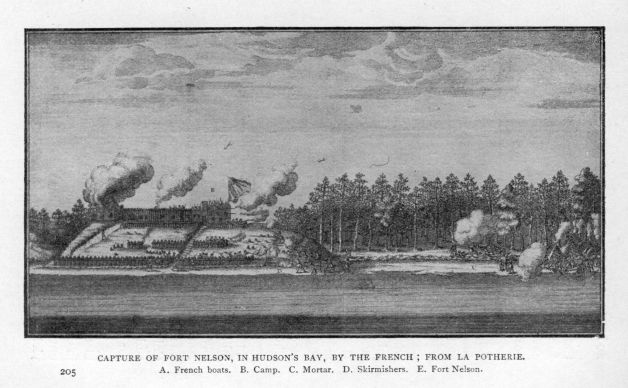
Capture of Fort Nelson, in Hudson's Bay, by the French; from La Potherie. A. French boats. B. Camp. C. Mortar. D. Skirmishers. E. Fort Nelson.
The Treaty of Ryswick, which was ratified in 1697, lasted for only five years. Then broke out the great conflict known in Europe as the War of the Spanish Succession. The reckless ambition of Louis XIV., then in the plenitude of his power, had coveted the throne of Spain for his own family, and brought him into conflict with England when he recognised the Pretender as the rightful heir to the English Crown. Queen Anne, the daughter of James II. and sister of Mary, queen of William III., had succeeded to the throne, and the war which was declared on the 15th May, 1702, was thereafter known in America by her name. The Abenakis, who had promised peace, broke their pledges, and joined the French Canadian bands in attacking Wells, Saco, and Haverhill, and the annals of New England tell many a sad story of burning homes, of murdered men and women. The people of New England retaliated on Acadia, and several ineffective attempts were made to take Port Royal by Colonels Church and Wainwright, who proved their incapacity. A movement was then made for the conquest of Canada by the English colonists, but it failed in consequence of an European emergency having diverted the British squadron intended for America to the shores of Portugal. An expedition was next organised in 1710, under the command of Colonel Nicholson, a man of much sagacity and audacity, though of little or no military experience, for the capture of Port Royal, which was surrendered by the governor, Subercase, and from that day this historic place has been known as Annapolis Royal, in honour of the reigning sovereign. It was not until the following year that the British Government yielded to the urgent representations of the colonies, and sent to America a powerful armament to attempt the conquest of Canada. The fleet was under the orders of Sir Hovenden Walker, whose incapacity was only equalled by that of the commander of the troops, Colonel Hill. After the loss of eight transports and nearly nine hundred men in a storm near the Isle aux Oeufs, at the entrance of the St. Lawrence, the incapable admiral decided to give up the project of besieging Quebec, and without even venturing to attack the little French post of Plaisance, he returned to England, where he was received with marks of disfavour on all sides, and forced soon afterwards to retire to South Carolina. While New England was sadly disappointed by this second failure to take Quebec, the French of Canada considered it a providential interposition in their behalf, and the church, which had been first named after the defeat of Phipps, was now dedicated to Notre Dame des Victoires.
All this while the French dominion was slowly and surely extending into the great valleys of the West and South. A fort had been built opposite to the Jesuit mission of St. Ignace, on the other side of the Strait of Michillimackinac, and it was now also proposed to make the French headquarters at Detroit, which had been founded by Antoine de la Mothe-Cadillac, despite the opposition of the Jesuits, who wished to have the mission field of the West in their own hands, and resented the intention to establish Recollets and other priests at the new post. As soon as the French established themselves permanently at this key to the Lakes and West, the English practically gave up for fifty years the hope of acquiring the Northwest, and controlling the Indian trade. French pioneers were pushing their way into the valleys of the Illinois and the Wabash. Perrot and Le Sueur had taken possession of the region watered by the upper Mississippi and its affluents. Iberville and Bienville had made small settlements at Biloxi, Mobile, and on the banks of the Mississippi, and with them was associated one of the most admirable figures of Canadian history, Henry de Tonty, who had left his fort on the Illinois. In 1711 Louisiana was made a separate government, with Mobile as the capital, and included the whole region from the Lakes to the Gulf, and from the Alleghanies to the Rocky Mountains. By the time of the Treaty of Utrecht the Indian tribes of the West were, for the most part, in the interest of the French, with the exception of the Sioux, Sauks, and Foxes, whose hostility was for a long time an impediment to their progress on the upper reaches of the Mississippi.