THE STORY OF CANADA. (continued 2)
Reading edition
During the summer of 1609 Champlain decided to join an expedition of the Algonquin and Huron Indians of Canada against the Iroquois, whose country lay between the Hudson and Genesee rivers and westward of a beautiful lake which he found could be reached by the river, then known as the River of the Iroquois—because it was their highway to the St. Lawrence—and now called the Richelieu.
Canada was to pay most dearly in later years, as these pages will show, for the alliance Champlain made with the inveterate enemies of the ablest and bravest Indians of North America. Nowhere in his own narrative of his doings in the colony does he give us an inkling of the motives that influenced him. We may, however, fairly believe that he underrated the strength and warlike qualities of the Iroquois, and believed that the allied nations of Canada would sooner or later, with his assistance, win the victory. If he had shown any hesitation to ally himself with the Indians of Canada, he might have hazarded the fortunes, and even ruined the fur-trade which was the sole basis of the little colony's existence for many years. The dominating purpose of his life in Canada, it is necessary to remember, was the exploration of the unknown region to which the rivers and lakes of Canada led, and that could never have been attempted, had he by any cold or unsympathetic conduct alienated the Indians who guarded the waterways over which he had to pass before he could unveil the mysteries of the western wilderness.
In the month of June Champlain and several Frenchmen commenced their ascent of the Richelieu in a large boat, in company with several bark canoes filled with sixty Canadian Indians. When they reached the rapids near the lovely basin of Chambly—named after a French officer and seignior in later times—the French boat could not be taken any further. It was sent back to Quebec while Champlain and two others, armed with the arquebus, a short gun with a matchlock, followed the Indians through the woods to avoid this dangerous part of the river. The party soon reached the safe waters of the Richelieu and embarked once more in their canoes. For the first time Champlain had abundant opportunities to note the customs of the Indians on a war-path, their appeals to evil spirits to help them against their enemies, their faith in dreams, and their methods of marching in a hostile country. The party passed into the beautiful lake which has ever since that day borne the great Frenchman's name; they saw its numerous islets, the Adirondacks in the west, and the Green Mountains in the east. Paddling cautiously for some nights along the western shore, they reached at last on the evening of the 29th of July a point of land, identified in later days as the site of Ticonderoga, so celebrated in the military annals of America. Here they found a party of Iroquois, who received them with shouts of defiance, but retreated to the woods for the night with the understanding on both sides that the fight would take place as soon as the sun rose next morning. The allies remained in their canoes, dancing, singing, and hurling insults at their foes, who did not fail to respond with similar demonstrations.
Next morning, two hundred stalwart Iroquois warriors, led by three chiefs with conspicuous plumes, marched from their barricade of logs and were met by the Canadian Indians. Champlain immediately fired on the chiefs with such success that two of them fell dead and the other was wounded and died later. "Our Indians," writes Champlain, "shouted triumphantly, and then the arrows began to fly furiously from both parties. The Iroquois were clearly amazed that two chiefs should have been so suddenly killed although they were protected from arrows by a sort of armour made of strong twigs and filled with cotton. While I was reloading, one of my men, who was not seen by the enemy, fired a shot from the woods and so frightened the Iroquois, no longer led by their chiefs, that they lost courage and fled precipitately into the forest, where we followed and succeeded in killing a number and taking ten or twelve prisoners. On our side only ten or fifteen were wounded, and they very soon recovered."
On their return to the St. Lawrence, the Indians gave Champlain an illustration of their cruelty towards their captives. When they had harangued the Iroquois and narrated some of the tortures that his nation had inflicted on the Canadians in previous times, he was told to sing, and when he did so, as Champlain naïvely says, "the song was sad to hear."
A fire was lit, and when it was very hot, the Indians seized a burning brand and applied it to the naked body of their victim, who was tied to a tree. Sometimes they poured water on his wounds, tore off his nails, and poured hot gum on his head from which they had cut the scalp. They opened his arm near the wrists, and pulled at his tendons and when they would not come off, they used their knives. The poor wretch was forced to cry out now and then in his agony, and it made Champlain heart-sick to see him so maltreated, but generally he exhibited so much courage and stoicism that he seemed as if he were not suffering at all. Champlain remonstrated with them, and was at last allowed to put a speedy end to the sufferings of the unhappy warrior. But even when he was dead, they cut the body into pieces and attempted to make the brother of the victim swallow his heart. Champlain might well say that it was better for an Indian to die on the battlefield or kill himself when wounded, than fall into the hands of such merciless enemies.
Soon after this memorable episode in the history of Canada, Champlain crossed the ocean to consult De Monts, who could not persuade the king and his minister to grant him a renewal of his charter. The merchants of the seaboard had combined to represent the injury the trade of the kingdom would sustain by continuing a monopoly of Canadian furs. De Monts, however, made the best arrangements he could under such unfavourable conditions, and Champlain returned to the St. Lawrence in the spring of 1610. During the summer he assisted the Canadian allies in a successful assault on a large body of the Iroquois who had raised a fortification at the mouth of the Richelieu, and all of whom were killed. It was on this occasion, when a large number of Canadian nations were assembled, that he commenced the useful experiment of sending Frenchmen into the Ottawa valley to learn the customs and language of the natives, and act as interpreters afterwards.
The French at Quebec heard of the assassination of Henry the Fourth who had been a friend of the colony. Champlain went to France in the autumn of 1610, and returned to Canada in the following spring. In the course of the summer he passed some days on the island of Mont Royal where he proposed establishing a post where the allied nations could meet for purposes of trade and consultation, as he told the Ottawa Indians at a later time when he was in their country. He made a clearing on a little point to which he gave the name of Place Royale, now known as Pointe-à-Callières, on a portion of which the hospital of the Grey Nuns was subsequently built. It was not, however, until thirty years later that the first permanent settlement was made on the island, and the foundations laid of the great city which was first named Ville-Marie.
During the next twenty-four years Champlain passed some months in France at different times, according to the exigencies of the colony. One of the most important changes he brought about was the formation of a new commercial association, for the purpose of reconciling rival mercantile interests. To give strength and dignity to the enterprise, the Count de Soissons, Charles of Bourbon, one of the royal sons of France, was placed at the head, but he died suddenly, and was replaced by Prince de Condé, Henry of Bourbon, also a royal prince, best known as the father of the victor of Rocroy, and the opponent of Marie de' Medici during her intrigues with Spain. It was in this same year that he entered into an engagement with a rich Calvinist, Nicholas Boulle, to marry his daughter Helen, then a child, when she had arrived at a suitable age, on the condition that the father would supply funds to help the French in their Canadian experiment. The marriage was not consummated until ten years later, and Champlain's wife, whose Christian name he gave to the pretty islet opposite Montreal harbour, spent four years in the settlement. The happiness of a domestic life was not possible in those early Canadian days, and a gentle French girl probably soon found herself a mere luxury amid the savagery of her surroundings. Helen Champlain has no place in this narrative, and we leave her with the remark that she was converted by her husband, and on his death retired to the seclusion of an Ursuline convent in France. No child was born to bear the name and possibly increase the fame of Champlain.
On his return to Canada, in the spring of 1613, Champlain decided to explore the western waters of Canada. L'Escarbot, who published his "New France," soon after his return from Acadia, tells us that "Champlain promised never to cease his efforts until he has found there [in Canada] a western or northern sea opening up the route to China which so many have so far sought in vain." While at Paris, during the winter of 1612, Champlain saw a map which gave him some idea of the great sea which Hudson had discovered. At the same time he heard from a Frenchman, Nicholas de Vignau, who had come to Paris direct from the Ottawa valley, that while among the Algonquin Indians he had gone with a party to the north where they had found a salt water sea, on whose shores were the remains of an English ship. The Indians had also, according to Vignau, brought back an English lad, whom they intended to present to Champlain when he made his promised visit to the Upper Ottawa.
Champlain probably thought he was at last to realise the dream of his life. Accompanied by Vignau, four other Frenchmen, and an Indian guide, he ascended the great river, with its numerous lakes, cataracts, and islets. He saw the beautiful fall to which ever since has been given the name of Rideau—a name also extended to the river, whose waters make the descent at this point—on account of its striking resemblance to a white curtain. Next he looked into the deep chasm of mist, foam, and raging waters, which the Indians called Asticou or Cauldron (Chaudière), on whose sides and adjacent islets, then thickly wooded, now stand great mills where the electric light flashes amid the long steel saws as they cut into the huge pine logs which the forests of the Ottawa yearly contribute to the commerce and wealth of Canada. At the Chaudière the Indians evoked the spirits of the waters, and offered them gifts of tobacco if they would ward off misfortune. The expedition then passed up the noble expansion of the river known as the Chats, and saw other lakes and cataracts that gave variety and grandeur to the scenery of the river of the Algonquins, as it was then called, and reached at last, after a difficult portage, the country around Allumette lake, where Nicholas de Vignau had passed the previous winter. Two hundred and fifty-four years later, on an August day, a farmer unearthed on this old portage route in the district of North Renfrew, an old brass astrolabe of Paris make, dated 1603; the instrument used in those distant days for taking astronomical observations and ascertaining the latitude. No doubt it had belonged to Champlain, who lost it on this very portage by way of Muskrat and Mud lakes, as from this place he ceases to give us the correct latitudes which he had previously been able to do.
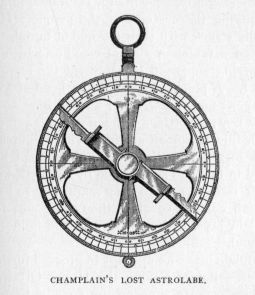
Champlain's lost astrolabe.
Among the Algonquin Indians of this district, who lived in rudely-built bark cabins or camps, and were hunters as well as cultivators of the soil, he soon found out that there was not a word of truth in the story which Nicholas de Vignau had told him of a journey to a northern sea, but that it was the invention of "the most impudent liar whom I have seen for a long time." Champlain did not punish him, though the Indians urged him to put him to death.
Champlain remained a few days among the Indians, making arrangements for future explorations, and studying the customs of the people. He was especially struck with their method of burial. Posts supported a tablet or slab of wood on which was a rude carving supposed to represent the features of the dead. A plume decorated the head of a chief; his weapons meant a warrior; a small bow and one arrow, a boy; a kettle, a wooden spoon, an iron pot, and a paddle, a woman or girl. These figures were painted in red or yellow. The dead slept below, wrapped in furs and surrounded by hatchets, knives, or other treasures which they might like to have in the far-off country to which they had gone; for, as Champlain says, "they believe in the immortality of the soul."
Champlain made no attempt to proceed further up the river. Before leaving the Upper Ottawa, he made a cedar cross, showing the arms of France—a custom of the French explorers, as Cartier's narrative tells us—and fixed it on an elevation by the side of the lake. He also promised Tessouat to return in the following year and assist him against the Iroquois.
The next event of moment in the history of the colony was the arrival in 1615 of Fathers Denis Jamay, Jean d'Olbeau, and Joseph Le Caron, and the lay brother Pacifique du Plessis, who belonged to the mendicant order of the Recollets, or reformed branch of the Franciscans, so named from their founder, St. Francis d'Assisi. They built near the French post at Quebec a little chapel which was placed in charge of Father Jamay and Brother Du Plessis, while Jean d'Olbeau went to live among the Montagnais and Joseph Le Caron among the Hurons of the West.
During the summer of 1615 Champlain fulfilled his pledge to accompany the allied tribes on an expedition into the country of the Iroquois. This was the most important undertaking of Champlain's life in Canada, not only on account of the length of the journey, and the knowledge he obtained of the lake region, but of the loss of prestige he must have sustained among both Iroquois and Canadian Indians who had previously thought the Frenchman invincible. The enemy were reached not by the usual route of the Richelieu and Lake Champlain, considered too dangerous from their neighbourhood to the Iroquois, but by a long detour by way of the Ottawa valley, Georgian Bay, Lake Simcoe, and the portages, rivers, and lakes that lead into the River Trent, which falls into the pretty bay of Quinté, at the eastern end of Lake Ontario, whence they could pass rapidly into the country of the Five Nations.
Accompanied by Stephen Brulé, a noted Indian interpreter, a servant, and eight Indians, Champlain left Montreal about the middle of July, ascended the Ottawa, and paddled down the Mattawa to the lake of the Nipissings, where he had interviews with the Indians who were dreaded by other tribes as sorcerers.
The canoes of the adventurous Frenchmen went down French River, and at last reached the waters of the great Fresh Water Sea, the Mer Douce of Champlain's maps, and now named Lake Huron in memory of the hapless race that once made their home in that wild region. Passing by the western shore of the picturesque district of Muskoka, the party landed at the foot of the bay and found themselves before long among the villages of the Hurons, whose country lay then between Nottawasaga Bay and Lake Simcoe. Here Champlain saw the triple palisades, long houses, containing several households, and other distinctive features of those Indian villages, one of which Cartier found at the foot of Mont Royal.
In the village of Carhagouaha, where the palisades were as high as thirty-five feet, Champlain met Father Le Caron, the pioneer of these intrepid missionaries who led the way to the head-waters and tributaries of the great lakes. For the first time in that western region the great Roman Catholic ceremony of the Mass was celebrated in the presence of Champlain and wondering Indian warriors. At the town of Cahiague, the Indian capital, comprising two hundred cabins, and situated within the modern township of Orillia, he was received with great rejoicings, and preparations immediately made for the expedition against the Iroquois. Stephen Brulé undertook the dangerous mission of communicating with the Andastes, a friendly nation near the headwaters of the Susquehanna, who had promised to bring five hundred warriors to the assistance of the Canadian allied forces.
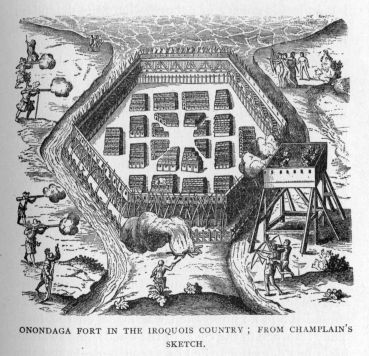
Onondaga fort in the Iroquois country; from Champlain's sketch.
The expedition reached the eastern end of Lake Ontario at the beginning of October by the circuitous route I have already mentioned, crossed to the other side somewhere near Sackett's harbour, and soon arrived in the neighbourhood of the Onondaga fort, which is placed by the best authorities a few miles to the south of Lake Oneida. It was on the afternoon of the 10th of October, when the woods wear their brightest foliage, that the allied Indians commenced the attack with all that impetuosity and imprudence peculiar to savages on such occasions. The fort was really a village protected by four concentric rows of palisades, made up of pieces of heavy timber, thirty feet in height, and supporting an inside gallery or parapet where the defenders were relatively safe from guns and arrows. The fort was by the side of a pond from which water was conducted to gutters under the control of the besieged for the purpose of protecting the outer walls from fire. Champlain had nine Frenchmen under his direction—eight of them having accompanied Father Le Caron to the Huron village. It was utterly impossible to give anything like method to the Indian assaults on the strong works of the enemy. Champlain had a high wooden platform built, and placed on it several of his gunners who could fire into the village, but the Iroquois kept well under cover and very little harm was done. The attempts to fire the palisades were fruitless on account of the want of method shown by the attacking parties. At last the allied Indians became disheartened when they saw Champlain himself was wounded and no impression was made on the fort. They returned to the cover of the woods, and awaited for a few days the arrival of Stephen Brulé and the expected reinforcements of Andastes. But when nearly a week had passed, and the scouts brought no news of Indians from the Susquehanna, the Canadians determined to return home without making another attack on the village. And here, I may mention, that Stephen Brulé was not seen at Quebec until three years later. It appeared then, from his account of his wanderings, that he succeeded after some vexatious delay in bringing the Andastes to Oneida Lake only to find that they had left the country of the Iroquois, who tortured him for a while, and then, pleased with his spirit, desisted, and eventually gave him his liberty. He is reported to have reached in his wanderings the neighbourhood of Lake Superior, where he found copper, but we have no satisfactory information on this point.[1]
On their return to Canada, the Indians carried Champlain and other wounded men in baskets made of withes. They reached the Huron villages on the 20th of December after a long and wearisome journey. Champlain remained in their country for four months, making himself acquainted with their customs and the nature of the region, of which he has given a graphic description. Towards the last of April, Champlain left the Huron villages, and arrived at Quebec near the end of June, to the great delight of his little colony, who were in doubt of his ever coming back.
Another important event in the history of those days was the coming into the country of several Jesuit missionaries in 1625, when the Duke of Ventadour, a staunch friend of the order, was made viceroy of the colony in place of the Duke of Montmorency, who had purchased the rights of the Prince of Condé when he was imprisoned in the Bastile for having taken up arms against the King. These Jesuit missionaries, Charles Lalemant, who was the first superior in Canada, Jean de Brebeuf, Ennemond Massé, the priest who had been in Acadia, François Charton, and Gilbert Buret, the two latter lay brothers, were received very coldly by the officials of Quebec, whose business interests were at that time managed by the Huguenots, William and Emeric Caen. They were, however, received by the Recollets, who had removed to a convent, Notre-Dame des Anges, which they had built by the St. Charles, of sufficient strength to resist an attack which, it is reported on sufficiently good authority, the Iroquois made in 1622. The first Jesuit establishment was built in 1625 on the point at the meeting of the Lairet and St. Charles, where Cartier had made his little fort ninety years before.
We come now to a critical point in the fortunes of the poor and struggling colony. The ruling spirit of France, Cardinal Richelieu, at last intervened in Canadian affairs, and formed the Company of New France, generally called the company of the Hundred Associates, who received a perpetual monopoly of the fur-trade, and a control of all other commerce for sixteen years, beside dominion over an immense territory extending from Florida to the Arctic Seas, and from the Gulf of St. Lawrence to the great Fresh Water Sea, the extent of which was not yet known. Richelieu placed himself at the head of the enterprise. No Huguenot thenceforth was to be allowed to enter the colony under any conditions. The company was bound to send out immediately a number of labourers and mechanics, with all their necessary tools, to the St. Lawrence, and four thousand other colonists in the course of fifteen years, and to support them for three years. Not only was the new association a great commercial corporation, but it was a feudal lord as well. Richelieu introduced in a modified form the old feudal tenure of France, with the object of creating a Canadian noblesse and encouraging men of good birth and means to emigrate and develop the resources of the country. This was the beginning of that seigniorial tenure which lasted for two centuries and a quarter.
Champlain was re-appointed lieutenant-governor and had every reason to believe that at last a new spirit would be infused into the affairs of the colony. Fate, however, was preparing for him a cruel blow. In the spring of 1628, the half-starved men of Quebec were anxiously looking for the provisions and men expected from France, when they were dismayed by the news that an English fleet was off the Saguenay. This disheartening report was immediately followed by a message to surrender the fort of Quebec to the English admiral, David Kirk. War had been declared between England and France, through the scheming chiefly of Buckingham, the rash favourite of Charles the First, and an intense hater of the French King for whose queen, Anne of Austria, he had developed an ardent and unrequited passion. English settlements were by this time established on Massachusetts Bay and England was ambitious of extending her dominion over North America, even in those countries where France had preceded her.
Admiral Kirk, who was the son of a gentleman in Derbyshire, and one of the pioneers of the colonisation of Newfoundland, did not attempt the taking of Quebec in 1628, as he was quite satisfied with the capture off the Saguenay, of a French expedition, consisting of four armed vessels and eighteen transports, under the command of Claude de Roquemont, who had been sent by the new company to relieve Quebec. Next year, however, in July, he brought his fleet again to the Saguenay, and sent three ships to Quebec under his brothers, Lewis and Thomas. Champlain immediately surrendered, as his little garrison were half-starved and incapable of making any resistance, and the English flag floated for the first time on the fort of St. Louis. Champlain and his companions, excepting thirteen who remained with the English, went on board the English ships, and Lewis Kirk was left in charge of Quebec. On the way down the river, the English ships met a French vessel off Malbaie, under the command of Emeric Caen, and after a hot fight she became also an English prize.
When the fleet arrived in the harbour of Plymouth, the English Admiral heard to his amazement that peace had been declared some time before, and that all conquests made by the fleets or armies of either France or England after 24th April, 1629, must be restored. The Kirks and Alexander used every possible exertion to prevent the restoration of Quebec and Port Royal, which was also in the possession of the English. Three years elapsed before Champlain obtained a restitution of his property, which had been illegally seized. The King of England, Charles I., had not only renewed a charter, which his father had given to a favourite, Sir William Alexander, of the present province of Nova Scotia, then a part of Acadia, but had also extended it to the "county and lordship of Canada." Under these circumstances Charles delayed the negotiations for peace by every possible subterfuge. At last the French King, whose sister was married to Charles, agreed to pay the large sum of money which was still owing to the latter as the balance of the dower of his queen. Charles had already commenced that fight with his Commons, which was not to end until his head fell on the block, and was most anxious to get money wherever and as soon as he could. The result was the treaty of St. Germain-en-Laye, signed on March 29, 1632. Quebec as well as Port Royal—to whose history I shall refer in the following chapter—were restored to France, and Champlain was again in his fort on Cape Diamond in the last week of May, 1633. A number of Jesuits, who were favoured by Richelieu, accompanied him and henceforth took the place of the Recollets in the mission work of the colony. In 1634, there were altogether eight Jesuit priests in the country. They appear to have even borrowed the name of the Recollet convent, Notre Dame des Anges, and given it to their own establishment and seigniory by the St. Charles.
During the last three years of Champlain's life in Canada no events of importance occurred. The Company of the Hundred Associates had been most seriously crippled by the capture of the expedition in 1628, and were not able to do very much for the colony. The indefatigable lieutenant-governor, true to his trust, succeeded in building a little fort in 1634 at the mouth of the St. Maurice, and founded the present city of Three Rivers, as a bulwark against the Iroquois. It had, however, been for years a trading place, where Brother Du Plessis spent some time in instructing the Indian children and people in the Catholic religion, and was instrumental in preventing a rising of the Montagnais Indians who had become discontented and proposed to destroy the French settlements.
On Christmas Day, 1635, Champlain died from a paralytic stroke in the fort, dominating the great river by whose banks he had toiled and struggled for so many years as a faithful servant of his king and country. Father Le Jeune pronounced the eulogy over his grave, the exact site of which is even now a matter of dispute.
What had the patient and courageous Frenchman of Brouage accomplished during the years—nearly three decades—since he landed at the foot of Cape Diamond? On the verge of the heights a little fort of logs and a château of masonry, a few clumsy and wretched buildings on the point below, a cottage and clearing of the first Canadian farmer Hébert, the ruins of the Recollet convent and the mission house of the Jesuits on the St. Charles, the chapel of Notre-Dame de Recouvrance, which he had built close to the fort to commemorate the restoration of Quebec to the French, the stone manor-house of the first seignior of Canada, Robert Giffard of Beauport, a post at Tadousac and another at Three Rivers, perhaps two hundred Frenchmen in the whole valley. These were the only visible signs of French dominion on the banks of the St. Lawrence, when the cold blasts of winter sighed Champlain's requiem on the heights whence his fancy had so often carried him to Cathay. The results look small when we think of the patience and energy shown by the great man whose aspirations took so ambitious and hopeful a range. It is evident by the last map he drew of the country, that he had some idea of the existence of a great lake beyond Lake Huron, and of the Niagara Falls, though he had seen neither. He died, however, ignorant of the magnitude, number, and position of the western lakes, and still deluded by visions, as others after him, of a road to Asia. No one, however, will deny that he was made of the heroic mould from which come founders of states, and the Jesuit historian Charlevoix has, with poetic justice, called him the "Father of New France."
VII.
GENTLEMEN-ADVENTURERS IN ACADIA.
(1614-1677.)
We must now leave the lonely Canadian colonists on the snow-clad heights of Quebec to mourn the death of their great leader, and return to the shores of Acadia to follow the fortunes of Biencourt and his companions whom we last saw near the smoking ruins of their homes on the banks of the Annapolis. We have now come to a strange chapter of Canadian history, which has its picturesque aspect as well as its episodes of meanness, cupidity, and inhumanity. As we look back to those early years of Acadian history, we see rival chiefs with their bands of retainers engaged in deadly feuds, and storming each other's fortified posts as though they were the castles of barons living in mediaeval times. We see savage Micmacs and Etchemins of Acadia, only too willing to aid in the quarrels and contests of the white men who hate each with a malignity that even the Indian cannot excel; closely shorn, ill-clad mendicant friars who see only good in those who help their missions; grave and cautious Puritans trying to find their advantage in the rivalry of their French neighbours; a Scotch nobleman and courtier who would be a king in Acadia as well as a poet in England; Frenchmen who claim to have noble blood in their veins, and wish to be lords of a wide American domain; a courageous wife who lays aside the gentleness of a woman's nature and fights as bravely as any knight for the protection of her home and what she believes to be her husband's rights. These are among the figures that we see passing through the shadowy vista which opens before us as we look into the depths of the Acadian wilderness two centuries and a half ago.
Among the French adventurers, whose names are intimately associated with the early history of Acadia, no one occupies a more prominent position than Charles de St. Etienne, the son of a Huguenot, Claude de la Tour, who claimed to be of noble birth. The La Tours had become so poor that they were forced, like so many other nobles of those times, to seek their fortune in the new world. Claude and his son, then probably fourteen years of age, came to Port Royal with Poutrincourt in 1610. In the various vicissitudes of the little settlement the father and his son participated, and after it had been destroyed by Argall, they remained with Biencourt and his companions. In the course of time, the elder La Tour established a trading post on the peninsula at the mouth of the Penobscot—in Acadian history a prominent place, as often in possession of the English as the French.
Biencourt and his companions appear to have had some accessions to their number during the years that followed the Virginian's visit. They built rude cabins on the banks of the Annapolis, and cultivated patches of ground after a fashion, beside raising a fort of logs and earth near Cape Sable, called indifferently Fort Louis or Lomeron. It has been generally believed that Biencourt died in Acadia about 1623, after making over all his rights to Charles La Tour, who was his personal friend and follower from his boyhood. Recently, however, the discovery of some old documents in Paris throws some doubt on the generally accepted statement of the place of his death.[1]
It is quite certain, however, whether Biencourt died in France or Acadia, young La Tour assumed after 1623 the control of Fort St. Louis and all other property previously held by the former. In 1626 the elder La Tour was driven from the Penobscot by English traders from Plymouth who took possession of the fort and held it for some years. He now recognised the urgent necessity of having his position in Acadia ratified and strengthened by the French king, and consequently went on a mission to France in 1627.
About this time the attention of prominent men in England was called to the fact that the French had settlements in Acadia. Sir William Alexander, afterwards the Earl of Stirling, a favourite of King James the Fourth of Scotland and First of England, and an author of several poetical tragedies, wished to follow the example of Sir Frederick Gorges, one of the promoters of the colonisation of New England. He had no difficulty in obtaining from James, as great a pedant as himself, a grant of Acadia, which he named Nova Scotia. When Charles the First became king, he renewed the patent, and also, at the persuasion of the ambitious poet, created an order of Nova Scotia baronets, who were obliged to assist in the settlement of the country, which was thereafter to be divided into "baronies." Sir William Alexander, however, did not succeed in making any settlement in Nova Scotia, and did not take any definite measures to drive the French from his princely, though savage, domain until about the time Claude de la Tour was engaged in advocating the claims of his son in Europe, where we must follow him.
The elder La Tour arrived at an opportune time in France. Cardinal Richelieu had just formed the Company of the Hundred Associates, and it was agreed that aid should at once be sent to Charles de la Tour, who was to be the King's lieutenant in Acadia. Men and supplies for the Acadian settlement were on board the squadron, commanded by Roquemont, who was captured by Kirk in the summer of 1628. On board one of the prizes was Claude de la Tour, who was carried to London as prisoner. Then to make the position for Charles de la Tour still more hazardous, Sir William Alexander's son arrived at Port Royal in the same year, and established on the Granville side a small Scotch colony as the commencement of a larger settlement in the future. Charles de la Tour does not appear to have remained in Port Royal, but to have retired to the protection of his own fort at Cape Sable, which the English did not attempt to attack at that time.
In the meantime the elder La Tour was in high favour at London. He won the affections of one of the Queen's maids of honour, and was easily persuaded by Alexander and others interested in American colonisation, to pledge his allegiance to the English king. He and his son were made baronets of Nova Scotia, and received large grants of land or "baronies" in the new province. As Alexander was sending an expedition in 1630 with additional colonists and supplies for his colony in Nova Scotia, Claude de la Tour agreed to go there for the purpose of persuading his son to accept the honours and advantages which the King of England had conferred upon him. The ambitious Scotch poet, it was clear, still hoped that his arguments in favour of retaining Acadia, despite the treaty of Susa, made on the 24th of April, 1629, would prevail with the King. It was urged that as Port Royal was on soil belonging to England by right of Cabot's discovery, and the French had not formally claimed the sovereignty of Acadia since the destruction of their settlement by Argall, it did not fall within the actual provisions of a treaty which referred only to conquests made after its ratification.
Charles de la Tour would not yield to the appeals of his father to give up the fort at Cape Sable, and obliged the English vessels belonging to Alexander to retire to the Scotch settlement by the Annapolis basin. The elder La Tour went on to the same place, where he remained until his son persuaded him to join the French at Fort St. Louis, where the news had come that the King of France was determined on the restoration of Port Royal as well as Quebec. It was now decided to build a new fort on the River St. John, which would answer the double purpose of strengthening the French in Acadia, and driving the British out of Port Royal. Whilst this work was in course of construction, another vessel arrived from France with the welcome news that the loyalty of Charles de la Tour was appreciated by the King, who had appointed him as his lieutenant-governor over Fort Louis, Port La Tour, and dependencies.
By the treaty of St. Germain-en-Laye the French regained Acadia and were inclined to pay more attention to the work of colonisation. Richelieu sent out an expedition to take formal possession of New France, and Isaac de Launoy de Razilly, a military man of distinction, a Knight of Malta, and a friend of the great minister, was appointed governor of all Acadia. He brought with him a select colony, composed of artisans, farmers, several Capuchin friars, and some gentlemen, among whom were two whose names occupy a prominent place in the annals of Acadia and Cape Breton. One of them was Nicholas Denys, who became in later years the first governor of Cape Breton, where he made settlements at Saint Anne's and Saint Peter's, and also wrote an historical and descriptive account of the French Atlantic possessions. The most prominent Frenchman after Razilly himself, was Charles de Menou, Chevalier d'Aunay and son of René de Menou, lord of Charnizay, who was of noble family, and became one of the members of the King's council of state at the time the disputes between his son and Charles de la Tour were at their height. Charles de Menou, or d'Aunay, as I shall generally name him, was made Razilly's deputy, and consequently at the outset of his career assumed a prominence in the country that must have deeply irritated young La Tour, who still remained one of the King's lieutenants and probably expected, until Razilly's arrival, to be the head of the colony.
Captain Forrester, in command of the Scotch colony at Port Royal, gave up the post to Razilly in accordance with the orders of the English king, who had acted with much duplicity throughout the negotiations. The fort was razed to the ground, and the majority of the Scotch, who had greatly suffered from disease and death, left Acadia, though several remained and married among the French colonists. This was the end of Alexander's experiment in colonising Acadia and founding a colonial noblesse.
Razilly made his settlement at La Hève, on the Atlantic shore of Nova Scotia, and Denys had a mill and trading establishment in the vicinity. Port Royal was improved and the post at Penobscot occupied. D'Aunay was given charge of the division west of the St. Croix, and during the summer of 1632 he came by sea to the Plymouth House on the Penobscot, and took forcible possession of the post with all its contents. A year later La Tour also seized the "trading wigwam" at Machias, in the present State of Maine, but not before two of the English occupants were killed. La Tour had by this time removed from Cape Sable to the mouth of the River St. John, where he had built a strong fort on, probably, Portland Point, on the east side of the harbour of the present city of St. John, and was engaged in a lucrative trade in furs until a quarrel broke out between him and D'Aunay.
Soon after Razilly's death in the autumn of 1635, D'Aunay asserted his right, as lieutenant-governor of Acadia and his late chief's deputy, to command in the colony. He obtained from Claude de Razilly, brother of the governor, all his rights in Acadia, and removed the seat of government from La Hève to Port Royal, where he built a fort on the site of the present town of Annapolis. It was not long before he and La Tour became bitter enemies.
La Tour considered, with much reason, that he had superior rights on account of his long services in the province that ought to have been acknowledged, and that D'Aunay was all the while working to injure him in France. D'Aunay had certainly a great advantage over his opponent, as he had powerful influence at the French Court, while La Tour was not personally known and was regarded with some suspicion on account of his father being a Huguenot, and friendly to England. As a matter of fact, the younger La Tour was no Protestant, but a luke-warm Catholic, who considered creed subservient to his personal interests. This fact explains why the Capuchin friars always had a good word to say for his rival who was a zealous Catholic and did much to promote their mission.
The French Government attempted at first to decide between the two claimants and settle the dispute, but all in vain. La Tour made an attempt in 1640 to surprise D'Aunay at Port Royal, but the result was that he as well as his bride, who had just come from France, were themselves taken prisoners. The Capuchin friars induced D'Aunay to set them all at liberty on condition that La Tour should keep the peace in future. The only result was an aggravation of the difficulty and the reference of the disputes to France, where D'Aunay won the day both in the courts and with the royal authorities. La Tour's commission was revoked and D'Aunay eventually received an order to seize the property and person of his rival, when he proved contumacious and refused to obey the royal command, on the ground that it had been obtained by false representations. He retired to his fort on the St. John, where, with his resolute wife and a number of faithful Frenchmen and Indians, he set D'Aunay at defiance. In this crisis La Tour resolved to appeal to the government of Massachusetts for assistance. In 1630, the town of Boston was commenced on the peninsula of Shawmut, and was already a place of considerable commercial importance. Harvard College was already open, schools were established, town meetings were frequent, and a system of representative government was in existence. Not only so, the colonies of Massachusetts, Connecticut, New Haven, and Plymouth had formed themselves into a confederacy "for preserving and propagating the truth and liberties of the Gospel, and for their own mutual safety and welfare."
Much sympathy was felt in Boston for La Tour, who was a man of very pleasing manners, and was believed to be a Huguenot at heart. He explained the affair at Machias and his relations with the French Government to the satisfaction of the Boston people, though apparently with little regard to truth. The desire to encourage a man, who promised to be a good customer of their own, finally prevailed over their caution, and the cunning Puritans considered they got out of their quandary by the decision that, though the colony could not directly contribute assistance, yet it was lawful for private citizens to charter their vessels, and offer their services as volunteers to help La Tour. The New Englanders had not forgotten D'Aunay's action at Penobscot some years before, and evidently thought he was a more dangerous man than his rival.
Some Massachusetts merchants, under these circumstances, provided La Tour with four staunch armed vessels and seventy men, while he on his part gave them a lien over all his property. When D'Aunay had tidings of the expedition in the Bay of Fundy, he raised a blockade of Fort La Tour and escaped to the westward. La Tour, assisted by some of the New England volunteers, destroyed his rival's fortified mill, after a few lives were lost on either side. A pinnace, having on board a large quantity of D'Aunay's furs, was captured, and the booty divided between the Massachusetts men and La Tour.
From his wife, then in France, where she had gone to plead his cause, La Tour received the unwelcome news that his enemy was on his return to Acadia with an overwhelming force. Thereupon he presented himself again in Boston, and appealed to the authorities for further assistance, but they would not do more than send a remonstrance to D'Aunay and ask explanations of his conduct.
At this critical moment, La Tour's wife appeared on the scene. Unable to do anything in France for her husband, she had found her way to London, where she took passage on a vessel bound for Boston; but the master, instead of carrying her directly to Fort La Tour, as he had agreed, spent some months trading in the Gulf of St. Lawrence and on the coast of Nova Scotia. D'Aunay was cruising off Cape Sable, in the hope of intercepting her, and searched the vessel, but Madame La Tour was safely concealed in the hold, and the vessel was allowed to go on to Boston. On her arrival there, Madame La Tour brought an action against the master and consignee for a breach of contract, and succeeded in obtaining a judgment in her favour for two thousand pounds. When she found it impossible to come to a settlement, she seized the goods in the ship, and on this security hired three vessels and sailed to rejoin her husband. In the meantime an envoy from D'Aunay, a Monsieur Marie, always supposed to be a Capuchin friar, presented himself to the Massachusetts authorities, and after making a strong remonstrance against the course heretofore pursued by the colony, proffered terms of amity in the future on the condition that no further aid was given to La Tour. After some consideration the colonial government, of which Governor Endicott was now the head, agreed to a treaty of friendship, which was not ratified by D'Aunay for some time afterwards, when La Tour was a fugitive. Then the terms were sanctioned by the commissioners of the confederated colonies.
Having succeeded in obtaining the neutrality of the English colonists through his agent Marie, D'Aunay then determined to attack La Tour's fort on the St. John, as he had now under his control a sufficient number of men and ships. In the spring of the same year, however, when La Tour was absent, D'Aunay mustered all his vessels and men, and laid siege to the fort, but he met with most determined resistance from the garrison, nerved and stimulated by the voice and example of the heroic wife. The besiegers were almost disheartened, when a traitor within the walls—a "mercenary Swiss," according to a contemporary writer—gave them information which determined them to renew the assault with still greater vigour. D'Aunay and his men again attempted to scale the walls, but were forced to retire with a considerable force. Then D'Aunay offered fair terms if the fort was immediately given up. Madame La Tour, anxious to spare the lives of her brave garrison, which was rapidly thinning, agreed to the proposal, and surrendered the fort; and then D'Aunay is said to have broken his solemn pledge, and hanged all the defenders except one, whose life was spared on the condition of his acting as executioner.
One would fain not believe what the contemporary historian adds, that D'Aunay forced Madame La Tour to remain with a rope round her own neck, and witness the execution of the brave men who had so nobly assisted her in defending the fort. The poor lady did not long survive this tragedy, as she died a prisoner a few weeks later. All the acts of her adventurous and tragic career prove her to have been a good woman and a courageous wife, and may well be an inspiring theme for poetry and romance.[2]
D'Aunay now reigned supreme in Acadia. He had burdened himself heavily with debt in his efforts to ruin his rival, but he had some compensation in the booty he found at St. John. By the capture of his fort La Tour lost jewels, plate, furniture, and goods valued at ten thousand pounds, and was for a time a bankrupt. His debts in Boston were very heavy, and Major Gibbons, who had sent vessels to Fort La Tour in 1643, was never able to recover the mortgage he had taken on his estate. Bereft of wife and possessions, La Tour left Acadia and sought aid from Sir David Kirk, who was then governor of Newfoundland, but to no purpose. Various stories are told of his career for two years or longer, and it is even reported that he robbed a Boston vessel in his necessities, "whereby it appeared, as the Scripture saith," mournfully exclaims Governor Winthrop, "that there is no confidence in any unfaithful or carnal man." Boston merchants and sailors had suffered a good deal from both D'Aunay and La Tour, and such a story would naturally obtain credence among men who found they had made a bad investment in Fort La Tour and its appendages. D'Aunay continued his work of improving Port Royal and surrounding country, and the colony he founded was the parent of those large settlements that in the course of time stretched as far as the isthmus of Chignecto. He was accidentally drowned in the Annapolis River some time in 1650. French Canadian writers call him cruel, vindictive, rapacious, and arbitrary, but he has never been the favourite of historians. His plans of settlement had a sound basis and might have led to a prosperous and populous Acadia, had he not wrecked them by the malignity with which he followed La Tour and his wife.
La Tour, in the year 1648, visited Quebec, where he was received with the most gratifying demonstrations of respect by his countrymen, who admired his conduct in the Acadian struggle. Then D'Aunay died and La Tour immediately went to France, where the government acknowledged the injustice with which it had treated him in the past, and appointed him governor of Acadia, with enlarged privileges and powers. In 1653 he married D'Aunay's widow, Jeanne de Motin, in the hope—to quote the contract—"to secure the peace and tranquillity of the country, and concord and union between the two families." Peace then reigned for some months in Acadia; many new settlers came into the country, the forts were strengthened, and the people were hoping for an era of prosperity. But there was to be no peace or rest for the French in Acadia.
One of D'Aunay's creditors in France, named Le Borgne, came to America in 1654 at the head of a large force, with the object of obtaining possession of D'Aunay's property, and possibly of his position in Acadia. He made a prisoner of Denys, who was at that time engaged in trade in Cape Breton, and treated him with great harshness. After a short imprisonment at Port Royal, which was occupied by Le Borgne, Denys was allowed to go to France, where he succeeded eventually in obtaining a redress of his grievances, and an appointment as governor of Cape Breton.
Whilst Le Borgne was preparing to attack La Tour, the English appeared on the scene of action. By this time the civil war had been fought in England, the King beheaded, and Cromwell proclaimed Lord Protector of the Commonwealth. In 1653 very strong representations were made to the latter by the colonists of New England with respect to the movements of the French in Acadia, and the necessity of reducing the country to the dominion of England. Peace then nominally prevailed between France and Great Britain, but we have seen, as the case of Argall proved, that matters in America were often arranged without much reference to international obligations. A fleet, which had been sent out by Cromwell to operate against the Dutch colony at Manhattan, arrived at Boston in June, 1654, and the news came a few days later that peace had been proclaimed between the English and Dutch. Thereupon an expedition was organised against the French under the command of Major Robert Sedgewick of Massachusetts. Le Borgne at Port Royal and La Tour on the St. John immediately surrendered to this force, and in a few days all Acadia was once more in the hands of the English. Denys was almost ruined by these events and obliged to retire for a time from the country. La Tour was now far advanced in years, and did not attempt to resist the evil destiny that seemed to follow all the efforts of France to establish herself in Nova Scotia. No doubt the injuries he had received from his own countrymen, together with the apathy which the French Government always displayed in the affairs of Acadia, were strong arguments, if any were needed, to induce him to place himself under the protection of the English. The representations he made to the Protector met with a favourable response, and obtained for him letters patent, dated August 9, 1656, granting to him, Sir Charles La Tour, in conjunction with Sir Thomas Temple and William Crowne, the whole territory of Acadia, the mines and minerals alone being reserved for the government. Sir Thomas Temple, a man of generous disposition and remarkably free from religious prejudices, subsequently purchased La Tour's rights, and carried on a large trade in Acadia with much energy. La Tour now disappears from the scene, and is understood to have died in the country he loved in the year 1666, at the ripe age of seventy-four. He left several descendants, none of whom played a prominent part in Acadian history, though there are persons still in the maritime provinces of Canada who claim a connection with his family. His name clings to the little harbour near Cape Sable, where he built his post of Lomeron, and antiquaries now alone fight over the site of the more famous fort at the mouth of the St. John, where a large and enterprising city has grown up since the English occupation. About the figure of this bold gentleman-adventurer the romance of history has cast a veil of interest and generous appreciation on account of the devotion of his wife and of the obstinate fight he waged under tremendous disadvantages against a wealthy rival, supported by the authority of France. He was made of the same material as those brave men of the west coast of England who fought and robbed the Spaniard in the Spanish Main, but as he plundered only Puritans by giving them worthier mortgages, and fought only in the Acadian wilds, history has given him a relatively small space in its pages.
Acadia remained in possession of England until the Treaty of Breda, which was concluded in July of 1667, between Charles II. and Louis XIV. Temple, who had invested his fortune in the country, was nearly ruined, and never received any compensation for his efforts to develop Acadia. In a later chapter, when we continue the chequered history of Acadia, we shall see that her fortunes from this time become more closely connected with those of the greater and more favoured colony of France in the valley of the St. Lawrence.
VIII.
THE CANADIAN INDIANS AND THE IROQUOIS: THEIR ORGANISATION, CHARACTER, AND CUSTOMS.
At the time of Champlain's death we see gathering in America the forces that were to influence the fortunes of French Canada—the English colonies growing up by the side of the Atlantic and the Iroquois, those dangerous foes, already irritated by the founder of Quebec. These Indians were able to buy firearms and ammunition from the Dutch traders at Fort Orange, now Albany, on the beautiful river which had been discovered by Hudson in 1609. From their warlike qualities and their strong natural position between the Hudson and Niagara rivers, they had now become most important factors in the early development of the French and English colonies, and it is consequently important to give some particulars of their character and organisation. In the first place, however, I shall refer to those Indian tribes who lived in Canada, and were closely identified with the interests of the French settlements. These Indians also became possessed of firearms, sold to them from time to time by greedy traders, despite the interdict of the French authorities in the early days of the colonies.
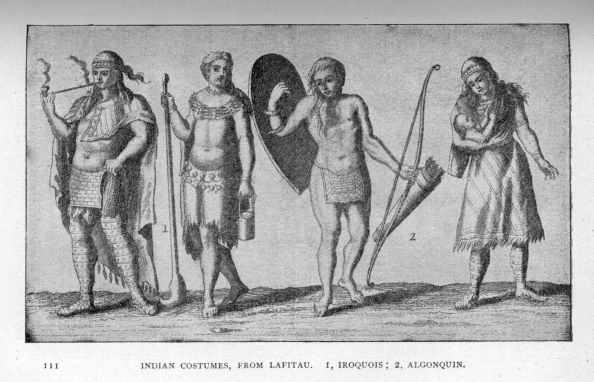
Indian costumes, from Lafitau. 1. Iroquois; 2. Algonquin.
Champlain found no traces of the Indians of Cartier's time at Stadacona and Hochelaga. The tribes which had frequented the St. Lawrence seventy years before had vanished, and in their place he saw bands of wandering Algonquins. It was only when he reached the shores of Georgian Bay that he came to Indian villages resembling that Hochelaga which had disappeared so mysteriously. The St. Lawrence in Cartier's day had been frequented by tribes speaking one or more of the dialects of the Huron-Iroquois family, one of the seven great families that then inhabited North America east of the Mississippi, from the Gulf of Mexico to the Hudson's Bay. The short and imperfect vocabulary of Indian words which Cartier left behind, his account of Hochelaga, the intimacy of the two Gaspé Indians with the inhabitants of Stadacona—these and other facts go to show that the barbarous tribes he met were of the Iroquois stock.
The Indians have never had any written records, in the European sense, to perpetuate the doings of their nations or tribes. From generation to generation, from century to century, however, tradition has told of the deeds of ancestors, and given us vague stories of the origin and history of the tribes. It is only in this folk-lore—proved often on patient investigation to be of historic value—that we can find some threads to guide us through the labyrinth of mystery to which we come in the prehistoric times of Canada. Popular tradition tells us that the Hurons and Iroquois, branches of the same family, speaking dialects of one common language, were living at one time in villages not far from each other—the Hurons probably at Hochelaga and the Senecas on the opposite side of the mountain. It was against the law of the two communities for their men and women to intermarry, but the potent influence of true love, so rare in an Indian's bosom, soon broke this command. A Huron girl entered the cabin of an Iroquois chief as his wife. It was an unhappy marriage, the husband killed the wife in an angry moment. This was a serious matter, requiring a council meeting of the two tribes. Murder must be avenged, or liberal compensation given to the friends of the dead. The council decided that the woman deserved death, but the verdict did not please all her relatives, one of whom went off secretly and killed an Iroquois warrior. Then both tribes took up the hatchet and went on the warpath against each other, with the result that the village of Hochelaga, with all the women and children, was destroyed, and the Hurons, who were probably beaten, left the St. Lawrence, and eventually found a new home on Lake Huron.[1]
Leaving this realm of tradition, which has probably a basis of fact, we come to historic times. In Champlain's interesting narrative, and in the Jesuit Relations, we find very few facts relating to Indian history, though we have very full information respecting their customs, superstitions, and methods of living. The reports of the missionaries, in fact, form the basis of all the knowledge we have of the Canadian tribes as well as of the Five Nations themselves.
It is only necessary that we should here take account of the Algonquins and Huron-Iroquois, two great families separated from one another by radical differences of language, and not by special racial or physical characteristics. The Eskimo, Dacotah, Mandan, Pawnee, and Muskoki groups have no immediate connection with this Canadian story, although we shall meet representatives of these natural divisions in later chapters when we find the French in the Northwest, and on the waters of the Missouri and Mississippi. The Algonquins and Huron-Iroquois occupied the country extending, roughly speaking, from Virginia to Hudson's Bay, and from the Mississippi to the Atlantic. The Algonquins were by far the most numerous and widely distributed. Dialects of their common language were heard on the Atlantic coast all the way from Cape Fear to the Arctic region where the Eskimo hunted the seal or the walrus in his skin kayak. On the banks of the Kennebec and Penobscot in Acadia we find the Abenakis, who were firm friends of the French. They were hunters in the great forests of Maine, where even yet roam the deer and moose. The Etchemins or Canoemen, inhabited the country west and east of the St. Croix River, which had been named by De Monts. In Nova Scotia, Cape Breton, and Prince Edward Island, we see the Micmacs or Souriquois, a fierce, cruel race in early times, whose chief, Membertou, was the first convert of the Acadian missionaries. They were hunters and fishermen, and did not till the soil even in the lazy fashion of their Algonquin kindred in New England. The climate of Nova Scotia was not so congenial to the production of maize as that of the more southern countries. It was the culture of this very prolific plant, so easily sown, gathered, and dried, that largely modified and improved the savage conditions of Indian life elsewhere on the continent. It is where the maize was most abundant, in the valley of the Ohio, that we find relics of Indian arts—such as we never find in Acadia or Canada.
On the St. Lawrence, between the Gulf and Quebec, there were wandering Algonquin tribes, generally known as Montagnais or Mountaineers, living in rude camps covered with bark or brush, eking a precarious existence from the rivers and woods, and at times on the verge of starvation, when they did not hesitate at cannibalism. Between Quebec and the Upper Ottawa there were no village communities of any importance; for the Petite Nation of the river of that name was only a small band of Algonquins, living some distance from the Ottawa. On the Upper Ottawa we meet with the nation of the Isle (Allumette) and the Nipissings, both Algonquin tribes, mentioned in a previous chapter. They were chiefly hunters and fishermen, although the former cultivated some patches of ground. On Georgian Bay we come to a nation speaking one of the dialects of a language quite distinct from that of the Algonquins. These were Hurons, numbering in all some twenty thousand souls, of whom ten thousand or more were adults, living in thirty-two villages, comprising seven hundred dwellings of the same style as Cartier saw at Hochelaga. These villages were protected by stockades or palisades, and by some natural features of their situation—a river, a lake, or a hill. Neither the long houses nor the fortifications were as strongly or as cleverly constructed as those of the Iroquois. Maize, pumpkins, and tobacco were the principal plants cultivated. Sunflowers were also raised, chiefly for the oil with which they greased their hair and bodies. Their very name meant "Shock-heads"—a nickname originating from the exclamation of some Frenchmen, when they first saw their grotesque way of wearing their hair, "Quelles hures!" (What a head of hair!) Champlain speaks of a tribe whom he met after leaving Lake Nipissing, in 1615, and called the Cheveux Relevés, or people with the stiff hair, but they were wandering Algonquins. Champlain called the Hurons, Attigouantans, though their true name was Ouendat, afterwards corrupted to Wyandot, which still clings to a remnant of the race in America.
They were brave and warlike, with perhaps more amiable qualities than the more ferocious, robust Iroquois. The nation appears to have been a confederacy of tribes, each of which was divided into clans or gentes on the Iroquois principle, which I shall shortly explain. Two chiefs, one for peace and one for war, assisted by a council of tribal chiefs, constituted the general government. Each tribe had a system of local or self-government—to use a phrase applicable to modern federal conditions—consisting of chiefs and council. The federal organisation was not, however, so carefully framed and adjusted as that of their kin, the Iroquois. At council meetings all the principal men attended and votes were taken with the aid of reeds or sticks, the majority prevailing in all cases. The whole organisation was essentially a democracy, as the chiefs, although an oligarchy in appearance, were controlled by the voices and results of the councils. In this as in other American savage nations, the rule governing the transmission of hereditary honours and possessions was through the female line.
Beyond the Huron villages, south of Nottawasaga Bay—so named probably from the Nottaways, a branch of the same family, driven by war to the south—we come to the Tionotates or Tobacco tribe, who were kin in language and customs to their neighbours and afterwards joined their confederacy. The Neutral Nation, or Attiwandaronks of Iroquois stock, had their homes on the north shore of Lake Erie, and reached even as far as the Niagara. They were extremely cruel, and kept for a long while their position of neutrality between the Hurons and Five Nations. To the south of Lake Erie rose the smoke of the fires of the Eries, generally translated "Cats," but, properly speaking, the "Raccoons." Like the Andastes, near the Susquehanna, mentioned in a previous chapter, they were famous warriors, and for years held their own against the Iroquois, but eventually both these nations yielded to the fury of the relentless confederacy.
We have now come to the western door of the "long house" (Ho-dé-no-sote) of the Iroquois, who called themselves "the people of the long house" (Ho-dé-no-sau-nee), because they dwelt in a line of villages of "long houses," reaching from the Genesee to the Mohawk, where the eastern door looked toward the Hudson and Lake Champlain. The name by which they have been best known is considered by Charlevoix and other writers to be originally French; derived from "Hiro" (I have spoken)—the conclusion of all their harangues—and Koué, an exclamation of sorrow when it was prolonged, and of joy when pronounced shortly. They comprised five nations, living by the lakes, that still bear their names in the State of New York, in the following order as we go east from Niagara:
IROQUOIS NATIONS. ENGLISH NAMES. FRENCH NAMES. Nundawäona ) Seneca Tsonnontouans Great hill people ) Guéugwehono ) Cayuga Goyogouin People of the marsh ) Onundägaono ) Onondaga Onnontague People of the hills ) Onayotékäono ) Oneida Onneyote Granite people ) Gäneägaono ) Mohawk Agnier Possessors of the flint )
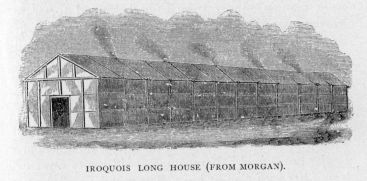
Iroquois long house (from Morgan).
Each tribe lived in a separate village of long houses, large enough to hold from five to twenty families. Each family was a clan or kin—resembling the gens of the Roman, the genos of the Greek—a group of males and females, whose kinship was reckoned only through females—the universal custom in archaic times in America. As among these people the marriage tie was easily sundered and chastity was the exception,—remarkably so among the Hurons, their kindred—it is not strange that all rank, titles, and property should be based on the rights of the woman alone. The child belonged consequently to the clan, not of the father, but of the mother. Each of these tenement houses, as they may well be called, was occupied by related families, the mothers and their children belonging to the same clan, while the husbands and the fathers of these children belonged to other clans; consequently, the clan or kin of the mother easily predominated in the household.[2] Every clan had a name derived from the animal world, as a rule, and a rude picture of the same was the "totem" or coat-of-arms of the kin or gens, found over the door of a long house or tattooed on the arms or bodies of its members. The Tortoise, Bear, and Wolf, were for a long time the most conspicuous totems of the Iroquois. These people were originally a nation of one stock of eight clans, and when they separated into five tribes or sections, each contained parts of the original clans. Consequently, "all the members of the same clan, whatever tribe they belonged to, were brothers or sisters to each other in virtue of their descent from the same common female ancestor, and they recognised each other as such with the fullest cordiality."
Whatever was taken in the hunt, or raised in cultivation, by any member of the household—and the Iroquois were good cultivators of maize, beans, and squash—was used as a common stock for that particular household. No woman could marry a member of her own clan or kin. The marriage might be severed at the will of either party. Yet, while the Iroquois women had so much importance in the household and in the regulation of inheritance, she was almost as much a drudge as the squaw of the savage Micmacs of Acadia and the Gulf.
The tribe was simply a community of Indians of a particular family or stock, speaking one of the dialects of its language. For instance, the Five Nations or Tribes spoke different dialects of the Iroquoian stock language, but each could understand the other sufficiently for all purposes of deliberation and discussion. Each tribe was governed by its own council of sachems and chiefs—the latter inferior in rank—elected by their respective clans, but invested with office by the whole tribe. For all purposes of tribal government the tribes had separate territories and jurisdiction. For common purposes they united in a confederation in which each tribe occupied a position of complete equality—the exception being the Tuscaroras—Dusgaóweh or "shirt-wearing people"—who came from the south at the beginning of the eighteenth century, and made up the "Six Nations." If a tribe made peace it would not bind the other tribes unless they had given their consent in formal council, or by the presence of their representatives. A general council of fifty sachems, equal in rank and authority, administered the affairs of the confederation. These sachems were created in perpetuity in certain clans of the several tribes and invested with office by the general council. They were also sachems in their respective tribes, and with other clan-chiefs formed the council which was supreme over all matters appertaining to the tribe exclusively. Women, too, had their clan and other councils, and could make their wishes known through the delegates they appointed to the council of the league. In the federal council the sachems voted by tribes, and unanimity was essential before action was taken or a conclusion arrived at. The general council was open to the whole community for the discussion of public questions, but the council alone decided. The council of each tribe had power to convene the general council, but the latter could not convene itself. With the object of preventing the concentration of too much power in one man's hands, the federal council appointed two war chiefs, equal in authority. The council fire or brand was always burning in the valley of the Onondagas, where the central council met as a rule in the autumn, or whenever a tribe might consider a special meeting necessary. The Onondagas had also the custody of the "Wampum," or mnemonic record of their structure of government, and the Tadodä'ho, or most noble sachem of the league, was among the same tribe. The origin of the confederacy is attributed in legendary lore to Hä-yo-went'-hä, the Hiawatha of Longfellow's poem.
These are the main features of that famous polity of the Iroquois which gave them so remarkable a power of concentration in war, and was one reason of their decided superiority over all the other nations of America. In council, where all common and tribal affairs were decided, the Iroquois showed great capacity for calm deliberation, and became quite eloquent at times. Their language was extremely figurative, though incapable of the expression of abstract thought, as is the case with Indian tongues generally. The Indian—essentially a materialist—could only find his similes, metaphors, and illustrations in the objects of nature, but these he used with great skill. The Iroquois had a very keen appreciation of their interests, and were well able to protect them in their bargains or contracts with the white men. In war they were a terrible foe, and a whisper of their neighbourhood brought consternation to Indian camps and cabins, from the Kennebec to the Delaware, from the Susquehanna to the Illinois. They have been well described as "the scourge of God upon the aborigines of the continent." In their political organisation, their village life, their culture of the soil, their power of eloquence, their skill as politicians as well as warriors, they were superior to all the tribes in America as far as New Mexico, although in the making of pottery and other arts they were inferior to the mound-builders of the Ohio and the Mississippi—probably the Allegewi who gave their names to the Alleghanies and are believed by some writers to have been either exterminated by a combination of Algonquin and Iroquois or driven southward where they were absorbed in other nations. At no time could the Iroquois muster more than 3000 warriors; and yet they were the scourge and dread of all the scattered tribes of Algonquins, numbering in the aggregate probably 90,000 souls, and eventually crushed the Hurons and those other tribes of their own nationality, who did not belong to their confederacy and had evoked their wrath.
The Algonquin and Huron-Iroquois nations had many institutions and customs in common. Every clan had some such totem as I have described in the case of the Iroquois. Every tribe had its chiefs as military leaders and its councils for deliberation and decision. Consequently the democratic principle dominated the whole organisation. Eloquence was always prized and cultivated as a necessity of the system of government. Some tribes had their special orators among the chiefs. Though a general war was dependent on the action of the council, yet any number of warriors might go on the warpath at any time against the enemies of the tribe. They had no written records, but their memories were aided in council or otherwise by reeds or sticks and rude pictures; strings of wampum—cleverly manufactured from shells—served as annals, which the skilled men of a tribe could decipher and explain. The wampum belts performed an important part in the declaration of war or peace, and the pipe was equally effective in the deliberations of council and in the profession of amity. Murder might be expiated by presents to the family or relatives of the dead, and crime was rarely followed by death except there was a question of other nations, who would not be content unless the blood of their kinsman was washed away by blood. Charity and hospitality were among the virtues of the Indian race, especially among the Iroquois, and while there was food in a village no one need starve. The purity of love was unknown to a savage nature, chiefly animated by animal passion. Prisoners were treated with great ferocity, but the Iroquois exceeded all nations in the ingenuity of torture. Stoicism and endurance, even heroic, were characteristics of Indians generally, when in the hands of their enemies, and the cruellest insult that a warrior could receive was to be called a woman. Sometimes prisoners were spared and adopted into the tribe, and among most nations the wife or mother or sister of a dead chief might demand that he be replaced by a prisoner to whom they may have taken a fancy. After torture parts of the bodies of the victim would be eaten as a sort of mystic ceremony, but this custom was peculiar to the Hurons and Iroquois only. In their warlike expeditions they had no special discipline, and might be successfully met on the open field or under the protection of fortified works. Their favourite system was a surprise or furious onslaught. A siege soon exhausted their patience and resources. They were as treacherous as they were brave. In the shades of the forest, whose intricacies and secrets they understood so well, they were most to be feared. Behind every tree might lurk a warrior, when once a party was known to be on the warpath. To steal stealthily at night through the mazes of the woods, tomahawk their sleeping foes, and take many scalps, was the height of an Indian's bliss. Curious to say, the Indians took little precautions to guard against such surprises, but thought they were protected by their manitous or guardian spirits.
A spirit of materialism prevailed in all their superstitions. They had no conception of one all-pervading, omniscient divine being, governing and watching over humanity, when the missionaries first came among them. It was only by making use of their belief in the existence of a supreme chief for every race of animals, that the priests could lead their converts to the idea of a Great Spirit who ruled all creation. In their original state of savagery or barbarism, any conception an Indian might have of a supernatural being superior to himself was frittered away by his imagining that the whole material world was under the influence of innumerable mysterious powers. In the stirring of the leaves, in the glint of the sunbeam amid the foliage, in the shadow on his path, in the flash of the lightning, in the crash of the thunder, in the roar of the cataract, in the colours of the rainbow, in the very beat of his pulse, in the leap of the fish, in the flight of the birds, he saw some supernatural power to be evoked. The Indian companions of Champlain, we remember, threw tobacco to the genius or Manitou of the great fall of the Ottawa. The Manitou of the Algonquins, and the Okies or Otkons of the Hurons and Iroquois were not always superior, mysterious beings endowed with supernatural powers, like the Algonquin Manabozho, the Great Hare, the king of all animals; or a deified hero, like Hiawatha, the founder of the Iroquois confederacy, and Glooscap, the favourite of Micmac legends. The Manitou or Oki might even be a stone, a fish-bone, a bird's feather, or a serpent's skin, or some other thing in the animate or inanimate world, revealed to a young man in his dreams as his fetich or guardian through life. Dreams were respected as revelations from the spirit world. As Champlain tells us, during his first expedition to Lake Champlain, the Indians always questioned him as to his dreams, and at last he was able to tell them that he had seen in a vision some Iroquois drowning in the lake, and wished to help them, but was not permitted to do so by the Indians of his own party. This dream, in their opinion, was a portent in their favour.
A fetich became at last even the object of an Indian's worship—to be thanked, flattered, expostulated with, according to the emergency. It can be easily seen that in this Indian land of mysterious agencies, of manitous and spirits, the medicine-man and conjuror exercised a great power among old and young, chiefs and women. He had to be consulted in illness, in peace, in war, at every moment of importance to individual or nation. Even in case of illness and disease he found more value in secret communications with the supernatural world, and in working on the credulity of his tribesmen, than in the use of medicines made from plants. The grossest superstition dominated every community. All sorts of mystic ceremonies, some most cruel and repugnant to every sense of decency, were usual on occasions when supernatural influences had to be called into action.
Every respect was paid to the dead, who were supposed to have gone on a journey to a spirit land. Every one had such a separate scaffold or grave, generally speaking, as Champlain saw among the Ottawas, but it was the strange custom of the Hurons to collect the bones of their dead every few years and immure them in great pits or ossuaries with weirdlike ceremonies very minutely described in the Relations. In a passage previously quoted Champlain gave credit to the Indians for believing in the immortality of the soul. The world to which the Indian's imagination accompanied the dead was not the Heaven or Hell of the Jew or Christian. Among some tribes there was an impression rather than a belief that a distinction was made in the land of the Ponemah or Hereafter between the great or useful, and the weak or useless; but generally it was thought that all alike passed to the Spirit Land, and carried on their vocations as in life. It was a Land of Shades where trees, flowers, animals, men, and all things were spirits.
"By midnight moons, o'er moistening dews In vestments for the-chase arrayed The hunter still the deer pursues, The hunter and the deer a shade."
IX.
CONVENTS AND HOSPITALS—VILLE-MARIE—MARTYRED MISSIONARIES—VICTORIOUS IROQUOIS—HAPLESS HURONS.
(1635-1652.)
A scene that was witnessed on the heights of Quebec on a fine June morning, two hundred and eighty-three years ago, illustrated the spirit that animated the founders of Canada. At the foot of a cross knelt the Governor, Charles Hault de Montmagny, Knight of Malta, who had come to take the place of his great predecessor, Samuel Champlain, whose remains were buried close by, if indeed this very cross did not indicate the spot. Jesuits in their black robes, soldiers in their gay uniforms, officials and inhabitants from the little town below, all followed the example of Montmagny, whose first words were, according to Father Le Jeune, the historian of those days: "Behold the first cross that I have seen in this country, let us worship the crucified Saviour in his image." Then, this act of devotion accomplished, the procession entered the little church dedicated by Champlain to Notre Dame de la Recouvrance, where the priests solemnly chanted the Te Deum and offered up prayers for the King of France.
The Church was first, the State second. After the service the new governor entered the fort of St. Louis, only a few steps from the sacred building, received the keys amid salutes of cannon and musketry, and was officially installed as head of the civil and military government of Canada, at this time controlled by the Company of the Hundred Associates. Then he was called upon to act as god-father for a dying Indian who desired baptism. In the smoky cabin packed with Indians Montmagny stood by the earnest Jesuit and named the Algonquin Joseph. "I leave you to think," says Father Le Jeune, "how greatly astonished were these people to see so much crimson, so many handsomely dressed persons beneath their bark roofs."
Marie Guyard (Mère Marie de l'Incarnation).
During the period of which I am now writing we see the beginnings of the most famous educational and religious institutions of the country. The Hotel Dieu was founded in 1639, by the Soeurs Hospitalières from the convent of St. Augustine, in Dieppe, through the benefactions of the Duchess d'Aiguillon, the niece of Cardinal Richelieu. Rich, fascinating, and beautiful women contributed not only their fortunes but their lives to the service of the Church. Marie Madeleine de Chauvigny, who belonged to a noble family in Normandy, married at a very early age a M. de la Peltrie, who left her a young widow of twenty-two years of age, without any children. Deeply attached to her religion from her youth, she decided to devote her life and her wealth to the establishment of an institution for the instruction of girls in Canada. Her father and friends threw all possible obstacles in the way of what they believed was utter folly for a gentle cultured woman, but she succeeded by female wiles and strategy in carrying out her plans. On the first of August, 1639, she arrived at Quebec, in company with Marie Guyard, the daughter of a silk manufacturer of Tours, best known to Canadians as Mère de l'Incarnation, the mother superior of the Ursulines, whose spacious convent and grounds now cover seven acres of land on Garden Street in the ancient capital. She had a vision of a companion who was to accompany her to a land of mists and mountains, to which the Virgin beckoned as the country of her future life-work. Canada was the land and Madame de la Peltrie the companion foreshadowed in that dream which gave Marie Guyard a vocation which she filled for thirty years with remarkable fidelity and ability.
Madame de la Peltrie and Marie Guyard were accompanied by Mdlle. de Savonnière de la Troche, who belonged to a distinguished family of Anjou, and was afterwards known in Canada as Mère de St. Joseph, and also by another nun, called Mère Cécile de Sainte-Croix. A Jesuit, Father Vimont, afterwards superior, and author of one of the Rélations, and the three Hospital sisters, arrived in the same ship.
The company landed and "threw themselves on their knees, blessed the God of Heaven, and kissed the earth of their near country, as they now called it." A Te Deum followed in the Jesuits' church which was now completed on the heights near their college, commenced as early as 1635—one year before the building of Harvard College—through the generosity of Réné Rohault, eldest son of the Marquis de Gamache. The first visit of the nuns was to Sillery, four miles to the west of Quebec, on the north bank of the river, where an institution had been established for the instruction of the Algonquin and other Indians, through the liberality of Noël Brulart de Sillery, a Knight of Malta, and a member of an influential French family, who had taken a deep interest in the settlement of Canada and proved it by his bounty. Madame de la Peltrie and her companions, the Jesuit historian tells us naïvely, embraced the little Indian girls "without taking heed whether they were clean or not."
It was during Montmagny's term of office that the city of Montreal was founded by a number of religious enthusiasts. Jérôme le Royer de la Dauversière, receiver of taxes at La Flêche in Anjou, a noble and devotee, consulted with Jean Jacques Olier, then a priest of St. Sulpice in Paris, as to the best means of establishing a mission in Canada. Both declared they had visions which pointed to the island of Mont Royal as the future scene of their labours. They formed a company with large powers as seigniors as soon as they had obtained from M. de Lauzon, one of the members of the Company of Hundred Associates, a title to the island. They interested in the project Paul de Chomedey, Sieur de Maisonneuve, a devout and brave soldier, an honest and chivalric gentleman, who was appointed the first governor by the new company. Mdlle. Jeanne Mance, daughter of the attorney-general of Nogent-le-Roi, among the vine-clad hills of Champagne, who had bound herself to perpetual chastity from a remarkably early age, gladly joined in this religious undertaking. The company had in view the establishment of communities of secular priests, and of nuns to nurse the sick, and teach the children—the French as well as the savages. Madame de Bullion, the rich widow of a superintendent of finance, contributed largely towards the enterprise, and may be justly considered the founder of Hotel Dieu of Montreal.
Maisonneuve and Mdlle. Mance, accompanied by forty men and four women, arrived at Quebec in August, 1641, when it was far too late to attempt an establishment on the island. Governor de Montmagny and others at Quebec disapproved of the undertaking which had certainly elements of danger. The governor might well think it wisest to strengthen the colony by an establishment on the island of Orleans or in the immediate vicinity of Quebec, instead of laying the foundations of a new town in the most exposed part of Canada. However, all these objections availed nothing against the enthusiasm of devotees. In the spring of 1642, Maisonneuve and his company left Quebec. He was accompanied by Governor de Montmagny, Father Vimont, superior of the Jesuits, and Madame de la Peltrie, who left the Ursulines very abruptly and inconsiderately under the conviction that she had a mission to fill at Mont Royal.
Portrait of Maisonneuve.
On the 17th May, Maisonneuve and his companions landed on the little triangle of land, the Place Royale of Champlain, formed by the junction of a stream with the St. Lawrence. They fell immediately on their knees and gave their thanks to the Most High. After singing some hymns, they raised an altar which was decorated by Madame de la Peltrie and Mdlle. Mance, and celebrated the first great mass on the island. Father Vimont, as he performed this holy rite of his Church, addressed the new colonists with words which foreshadowed the success of the Roman Catholic Church in the greatest Canadian city, which was first named Ville-Marie.
A picket enclosure, mounted with cannon, protected the humble buildings erected for the use of the first settlers on what is now the Custom-house Square. The little stream—not much more than a rivulet except in spring—which for many years rippled between green, mossy banks, now struggles beneath the paved street.
An obelisk of gray Canadian granite now stands on this historic ground. Madame de la Peltrie did not remain more than two years in Ville-Marie, but returned to the convent at Quebec which she had left in a moment of caprice. Mdlle. Mance, who was Madame de Bullion's friend, remained at the head of the Hotel Dieu. The Sulpicians eventually obtained control of the spiritual welfare, and in fact of the whole island, though from necessity and policy the Jesuits were at first in charge. It was not until 1653 that one of the most admirable figures in the religious and educational history of Canada, Margaret Bourgeoys, a maiden of Troyes, came to Ville-Marie, and established the parent house in Canada of the Congregation de Notre-Dame, whose schools have extended in the progress of centuries from Sydney, on the island of Cape Breton, to the Pacific coast.
Yet during these years, while convents and hospitals were founded, while brave gentlemen and cultured women gave up their lives to their country and their faith, while the bells were ever calling their congregations to mass and vespers, the country was defended by a mere handful of inhabitants, huddled together at Quebec, at Three Rivers, and at the little settlement of Ville-Marie. The canoes of the Iroquois were constantly passing on the lakes and rivers of Canada, from Georgian Bay to the Richelieu, and bands of those terrible foes of the French and their Indian allies were ever lurking in the woods that came so dangerously close to the white settlements and the Indian villages.
In 1642, Father Isaac Jogues was returning from the missions on Lake Huron, with Couture, an interpreter, and Goupil, a young medical attendant—both donnés or lay followers of the Jesuits. They were in the company of a number of Hurons who were bringing furs to the traders on the St. Lawrence, when the Iroquois surprised them at the western end of Lake St. Peter's. The prisoners were taken by the Richelieu to the Mohawk country and Father Jogues was the first Frenchman to pass through Lake George[1]—with its picturesque hills and islets—which in a subsequent journey he named Lac du Saint-Sacrament, because he reached it on the eve of Corpus Christi. The Frenchmen were carried from village to village of the Iroquois, and tortured with all the cruel ingenuity usual in such cases. Goupil's thumb was cut off with a clam shell, as one way of prolonging pain. At night the prisoners were stretched on their backs with their ankles and wrists bound to stakes. Couture was adopted into the tribe, and was found useful in later years as an intermediary between the French and Mohawks. Goupil was murdered and his body tossed into a stream rushing down a steep ravine. Despite his sufferings Father Jogues never desisted from his efforts to baptise children and administer the rites of his Church to the tortured prisoners. On one occasion he performed the sacred office for a dying Huron with some rain or dewdrops which were still clinging to an ear of green corn which had been thrown to him for food. After indescribable misery, he was taken to Fort Orange, where the Dutch helped him to escape to France, but he returned to Canada in the following year.
Bands of Iroquois continued to wage war with relentless fury on all the Algonquin tribes from the Chaudière Falls of the Ottawa to the upper waters of the Saguenay. Bressani, a highly cultured Italian priest, was taken prisoner on the St. Lawrence, while on his way to the Huron missions, and carried to the Mohawk villages, where he went through the customary ordeal of torture. He was eventually given to an old woman who had lost a member of her family, but when she saw his maimed hands—one split between the little finger and the ring-finger—she sent him to the Dutch, who ransomed and sent him to France, whence he came back like Jogues, a year later.
In 1645 the Mohawks made peace with the French, but the other members of the Five Nations refused to be bound by the treaty. Father Isaac Jogues ventured into their country in 1646, and after a successful negotiation returned to consult the governor at Quebec; but unhappily for him he left behind a small box, filled with some necessaries of his simple life, with which he did not wish to encumber himself on this flying visit. The medicine-men or sorcerers, who always hated the missionaries as the enemies of their vile superstitious practices, made the Indians believe that this box contained an evil spirit which was the origin of disease, misfortune, and death. When Father Jogues came back, he found the village divided into two parties—one wishing his death, the other inclined to show him mercy, and after infinite wrangling between the factions, he was suddenly killed by a blow from a tomahawk as he was entering a long-house, to attend a feast to which he had been invited. His body was treated with contumely, and his head affixed to a post of the palisades of the village. He was the first martyr who suffered death at the hands of the Iroquois.