CLASSIFICATION.
Reading edition
One great advantage of the study of birds is that the amount of facts to be learnt in anatomy is far less than with some other groups. They are wonderfully uniform in structure. There is less difference in structure between an ostrich and a humming-bird than between, say, a lizard and a crocodile. Though this may be gratifying to the student of birds who is content with a broad knowledge of anatomical fact, it has its disadvantages—very distinct disadvantages—to those who want to arrange and classify the species. As there are computed to be over eleven thousand different kinds of birds, it is clear that an arrangement of some kind is wanted; we must have an artificial brain in which to store the characters of each bird in their proper place. But before we can consider this it is necessary to consider first what place birds as a whole occupy in Nature. It used to be thought that warm-blooded birds ought to be put near to the warm-blooded mammals. But it is now the general opinion that, as we have before pointed out in relation to certain details of structure, their proper place is in the neighbourhood of the reptiles. In fact they are regarded as a separate division of an order of vertebrated animals which has received the name of Sauropsida, which signifies ‘lizard-like’ animals.
Now, as to these eleven thousand, how are they to be divided? To this simple question innumerable answers have been given—it is hardly an exaggeration to say as many answers as there are ornithologists. Every part of the body has had its turn in affording a base for a classificatory scheme. At first, and with the older generation, it was bill and claw; then came a period of bones; later the muscles were held to be all-important; at present the fashion is in favour of taking all characters into consideration, which is clearly a more reasonable way of looking at the matter. The reason for the divergences of opinion—which implies great difficulty in the subject—is that birds are so modern a race. They are now at their heyday of development. By-and-by, when gaps appear in the now serried ranks, classification will be an easier matter; for classification, after all, is an artificial, unnatural sort of thing, if we believe in a gradual modification of species out of pre-existing species. It is not too much to say that, the more perfect our scheme of classification, the greater our ignorance of the group classified. If the only birds known to science were a Hornbill, a Duck, and a Crow, together with a few of the immediate allies of each, we could easily sort them. But there are so many intermediate forms which absolutely decline to fit accurately into any system. Then the would-be systematist has to distinguish between those characters which imply a deep-seated relationship and those which are only due to similar needs. The aim of classification is, of course, to indicate real relationship, not merely to pigeon-hole in a convenient way. Real relationship is often masked by superficial differences. For instance, the common blindworm of our hedgerows is not, as might be thought, a snake, but a lizard; it appears to be unlike the lizard in having no legs, and to be so far a snake. Indeed, the terror inspired by this peaceful reptile must stand it in good stead with any except human foes. But its whole anatomy is built upon the lizard, and not upon the snake, plan. We disregard, therefore, in a scheme of classification the likeness to a snake, remembering that in Nature, as in morals, appearances are apt to be deceptive. The owls, among birds, are believed by many to offer an instance of the same kind of deception. By all the older systematists, and by many of the more modern, they are placed with the hawks in one group. No doubt the owls bear a certain likeness to the hawks. They have formidable claws and a hooked and powerful beak; they kill their prey; and only differ superficially in that they love the darkness, while the hawks hunt by day. Now, in certain details of anatomy, particularly in the windpipe and the muscles, the owls are much more like that division of birds which includes the goatsuckers. The mention of this latter family brings us face to face with another difficulty. If the superficial likeness of the owls to the hawks is to be distrusted, as merely due to a similar mode of life, and therefore to the development of certain structures which are in direct relation to that mode of life, how about the superficial likeness of the owls to the goatsuckers, which is almost as well marked as to the hawks? In Australia and other parts of the East there are two genera of goatsuckers which have received the names of Podargus and Batrachostomus. These birds are wonderfully like owls. They have the same brown-and-grey and soft plumage; their flight is equally noiseless—and, altogether, anyone who saw the living Cuvier’s Podargus recently on view at the Zoological Gardens might well be pardoned for thinking it an owl. The fact is that we must be careful not to be prejudiced in any direction. Superficial similarities may or may not go with real likeness. Speaking generally, one should be disposed to lay greatest stress upon characters which have no obvious relation to mode of life as likely to be of the most use in indicating blood relationship. It is easier, however, to lay down general principles of this kind than to apply them to birds. As has been already mentioned, birds are so uniform in anatomy that in such characters as brain, lungs, and other internal organs which are not so directly under the immediate influence of their surroundings, there is but little difference. Such characters afford no help to the systematist. We are obliged, therefore, to rely upon other and really less important points.
In most books upon ornithology—in this one, for instance—the scheme of classification is set forth in the shape of a list beginning with one particular group and ending with another. This is merely due to the physical properties of sheets of paper. A linear scheme is really an impossibility; to represent classification properly we want a solid diagram, showing how from a root-stock branches arose and pushed their way in every direction. Another defect of the linear scheme is that we must begin somewhere and end somewhere. In this book we begin with the Passeres and end with the Parrots; others start with the Accipitres, in spite of the protest of Michelet against placing the cowardly, flat-headed, stupid hawks at the summit of bird creation. It doesn’t matter where we begin or where we end as long as we carefully bear in mind that a linear classification is only a convenient way of briefly stating certain facts, and that it does not pretend to be a copy of Nature. An alternative method of expressing the facts of structure in space of two dimensions is the Stammbaum, originally made in Germany; but this inevitable tree of life is open to the serious objection of undue dogmatism; and besides, it must be inaccurate, as it is not in three dimensions. A given naturalist may have strong reasons for believing, let us say, that the Struthious birds represent the lowest bird stock, from which arose in a regular series of branches, independently, and alternately from one side or the other, the various groups into which we divide the class in the present book; if so, then the Stammbaum is easily constructed. But the general consensus of opinion is that the inter-relationships of the different groups cannot be expressed with so much simplicity. It is clear that, in any case, the most modified offshoots must occupy the highest branches of the tree, and that we may in a linear scheme conveniently begin or end with them. But it is impossible to arbitrate as to which group is the most specialised. It is, on the whole, agreed that the Ostrich tribe have retained more primitive characters than other birds; but is the elaborate voice-mechanism of the Nightingale, or the almost human intelligence of the Raven or Parrot, to rank first as evidence of high position, i.e. specialisation, remoteness from the original stock? This is a matter about which everybody can legitimately have an opinion; and we cannot at present formulate a creed—for those, that is to say, who are acquainted with the facts.
The scheme that I adopt here is the same as that which Mr. Hudson uses in the pages which follow; it is the plan followed in the B.O.U. list, and approved by most ornithologists in this country as a convenient working outline. I have added to it the fossil groups, and those groups which do not occur in Great Britain. The main scheme is that of Dr. Gadow, used in his valuable account of the anatomy of birds in Bronn’s ‘Klassen und Ordnungen des Thierreichs.’ There is no deep-seated and mysterious reason for my placing Parrots at the end of the Aves Carinatæ: it is simply sheer inability to place them anywhere in particular.
CLASS. AVES.
Sub-class I. Archæornithes (contains genus Archæopteryx only).
Sub-class II. Neornithes.
Division i. Neornithes Ratitæ.
Order i. Ratitæ (contains Struthio, Rhea, Dinornis, &c.).
Order ii. Stereornithes (contains a few fossil genera, Gastornis, Dasornis, &c.).
Division ii. Neornithes Odontolcæ.
Order i. Hesperornithes (the extinct Hesperornis and Enaliornis).
Division iii. Neornithes Carinatæ.
Order i. Ichthyornithes (fossil Ichthyornis only).
Order ii. Passeres (thrushes, swallows, flycatchers, tits, &c.).
Order iii. Picariæ (rollers, cuckoos, hornbills, woodpeckers, swifts, colies, trogons, goatsuckers, kingfishers).
Order iv. Striges (owls).
Order v. Accipitres (hawks, eagles, American vultures, &c.).
Order vi. Steganopodes (cormorants, pelicans, solan geese, frigate bird).
Order vii. Herodiones (herons, storks, ibis, spoonbills).
Order viii. Odontoglossi (flamingoes).
Order ix. Anseres (screamers, ducks, geese).
Order x. Columbæ (doves).
Order xi. Pterocletes (sand-grouse).
Order xii. Gallinæ (curassows, megapodes, pheasants, grouse, Opisthocomus, &c.).
Order xiii. Tinamidæ (tinamous).
Order xiv. Fulicariæ (rails, coots).
Order xv. Alectorides (cranes, bustards, Cariama, &c.).
Order xvi. Limicolæ (plovers, snipe, knots, &c.).
Order xvii. Gaviæ (gulls, skuas).
Order xviii. Pygopodes (auks, divers, grebes).
Order xix. Sphenisciformes (penguins).
Order xx. Tubinares (petrels, albatross).
Order xxi. Psittaci (parrots).
It will be noticed that, out of these twenty-one groups into which we may divide the Neornithes Carinatæ of Gadow, only three are not represented in Great Britain, viz. the Sphenisciformes, Psittaci, and Tinamiformes. So that the student of bird anatomy in this country has plenty of chance of making himself acquainted with the main outlines of structure of the entire class of living birds. Out of the thirty-two minor divisions of these birds, no fewer than twenty-one are to be met with in these islands; and of those that are not, some are quite easy to get hold of—a parrot, for instance.
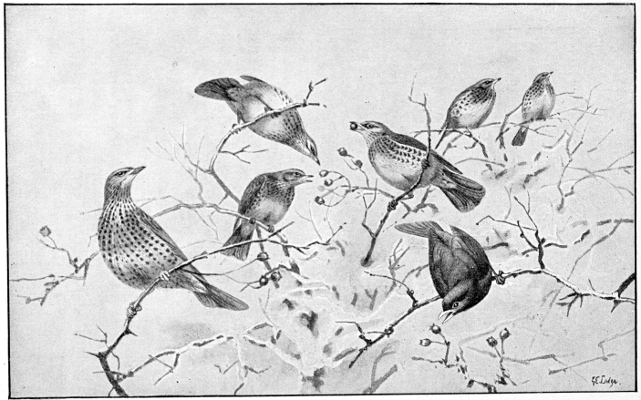
Fieldfares. Missel-Thrush. Blackbird.
Missel-Thrush, or Stormcock. Turdus viscivorus.
Upper parts ash-brown; under parts white, faintly tinged with yellow, marked with numerous black spots; under wing-coverts white; three lateral tail feathers tipped with greyish white. Length, eleven inches.
There are six British thrushes. Of these the missel-thrush and blackbird are residents throughout the year; the song-thrush is also found with us at all seasons, and is a winter songster, but many birds migrate; the ring-ouzel is a summer visitor; the redwing and fieldfare are winter visitors.
The missel or mistletoe thrush, or stormcock, is the largest, exceeding the fieldfare, which comes next in size, by at least an inch in length and two inches in spread of wings. This species possesses in a marked degree all the characters that everywhere distinguish the true thrushes, which are world-wide in their range. Theirs is a modest colouring:—olive-brown above, paler and spotted below; a loud and varied song, and harsh cry; a statuesque figure; rapid, startled movements on the ground, with motionless intervals, when the bird stands with head and beak much raised, in an attitude denoting intense attention; and, finally, a free, strong, undulating flight.
The missel-thrush inhabits almost the whole of the British Islands, and is most abundant in Ireland. Throughout England and Wales he is fairly common, less common in Scotland, and becoming rarer the farther north we go. He is found in all woods and plantations, but is most partial to wooded parks, orchards, and gardens, which afford him food and shelter throughout the year. He is the hardiest of our vocalists, and is better known as a winter than a summer songster. His song may be heard in the autumn, but from midwinter until spring his music is most noteworthy. Its loudness and wild character give it a wonderful impressiveness at that season of the year. He is not of the winter singers that wait for a gleam of spring-like sunshine to inspirit them, but is loudest in wet and rough weather; and it is this habit and something in the wild and defiant character of the song, heard above the tumult of nature, which have won for him the proud name of stormcock.
This thrush is an early breeder, and pairs about the beginning of February. The birds, after mating, are exceedingly pugnacious, and attack all others, large or small, that approach the chosen nesting-site. The nest is not often made in evergreens, to which blackbirds and song-thrushes are so partial; as a rule, a deciduous tree—oak, elm, or beech—is made choice of, and the nest may be at any height, from a few feet above the ground to the highest part of a tall tree; and as it is built so early in the year, when trees are leafless, it forms a most conspicuous object. Furthermore, the missel-thrush, a shy and wary bird at other times, becomes strangely trustful, and even careless, when nesting, and often builds in the neighbourhood of a house, or in an isolated tree at the roadside. When building and breeding the birds are silent, except when the nest is threatened with an attack, when they become clamorous and bold beyond most species in defence of their eggs or nestlings.
The nest is large and well made, outwardly of dry grass, moss, and other materials, woven together; it is plastered with mud inside, and thickly lined with fine dry grass. The four eggs vary in ground-colour from bluish white to pale reddish brown, and are spotted, blotched, and clouded, with various shades of purple, brown, and greyish under-markings. Two or three broods are reared in the season.
At the end of June the missel-thrushes begin to unite in small parties numbering a dozen to twenty birds, and to range over the open country, seeking their food in the pastures and turnip-fields, and on moors and commons. Where the birds are abundant much larger congregations are seen. In Ireland I have seen them in August in flocks of about a hundred birds. They do not keep close together, as is the manner of starlings and finches, but fly widely scattered, and alight at a distance apart, a flock of fifty to a hundred birds sometimes occupying half an acre or more ground. They then look very large and conspicuous, scattered over the green grass, standing erect and motionless, or hopping about in their wild, startled manner. These flocks diminish in number as the season progresses, and finally break up about midwinter.
In autumn the missel-thrushes devour the yew-berries, and the fruit of the rowan and service trees; later in the year they feed on the glutinous berries of the mistletoe, on haws and ivy-berries, and other wild fruits; but their food for the most part consists of earthworms, snails, grubs, and insects of all kinds.
Throstle, or Song-Thrush. Turdus musicus.
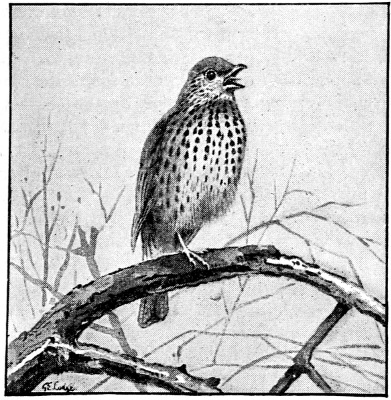
Fig. 18.—Song-Thrush. ¼ natural size.
Upper parts olive-brown, throat white in the middle; sides of neck and under parts ochreous yellow spotted with dark brown; under wing-coverts pale orange-yellow. Length, nine inches.
The protest and recommendation implied by the use of the first name at the head of this article may be futile; but it is impossible not to feel and to express regret that so good and distinctive and old a name for this familiar bird should have been replaced by a name which is none of these things. Song-thrush is an unsuitable name, for the very good reason that we have several thrushes, all of them songsters. By most persons the bird is simply called ‘thrush,’ which is neither better nor worse than ‘song-thrush.’
The throstle is one of the smaller members of the genus, being about a third less in size than the noble stormcock. In form, colouring, motions, language, and habits, he is a very thrush. It cannot be said that his music is the best—that, for instance, it is finer than that of the blackbird. The two songs differ in character; both are good of their kind, neither perfect. The throstle is, nevertheless, in the very first rank of British melodists, and it is often said of him that he comes next to the nightingale. The same thing has been said of other species, tastes differing in this as in other matters. It is worth remarking that most persons would agree in regarding the nightingale, song-thrush, blackbird, blackcap, and skylark, as our five finest songsters, and that these all differ so widely from each other in the character of their strains that no comparison between them is possible, and there is no rivalry.
The only species which may be called the rival of the song-thrush is the missel-thrush, as their music has a strong resemblance. That of the stormcock has a wonderful charm in the early days of the year, when it is a jubilant cry, a herald’s song and prophecy, sounding amidst wintry gloom and tempest. Heard in calm and genial weather in spring, the throstle is by far the finer songster. His chief merit is his infinite variety. His loudest notes may be heard half a mile away on a still morning; his lowest sounds are scarcely audible at a distance of twenty yards. His purest sounds, which are very pure and bright, are contrasted with various squealing and squeaking noises that seem not to come from the same bird. Listening to him, you never know what to expect, for his notes are delivered in no settled order, as in some species. He has many notes and phrases, but has never made of them one completed melody. They are snatches and portions of a melody, and he sings in a scrappy way—a note or two, a phrase or two, then a pause, as if the singer paused to try and think of something to follow; but when it comes it has no connection with what has gone before. His treasures are many, but they exist jumbled together, and he takes them as they come. As a rule, when he has produced a beautiful note, he will repeat it twice or thrice; on this account Browning has called him a ‘wise bird,’ because he can
recapture The first fine careless rapture.
There is not in this song the faintest trace of plaintiveness, and of that heart-touching quality of tenderness which gives so great a charm to some of the warblers. It is pre-eminently cheerful; a song of summer and love and happiness of so contagious a spirit that to listen to it critically, as one would listen to the polished phrases of the nightingale, would be impossible.
The throstle is a very persistent singer: in spring and summer his loud carols may be heard from a tree-top at four o’clock or half-past three in the morning; throughout the day he sings at intervals, and again, more continuously, in the evening, when he keeps up an intermittent flow of melody until dark. His evening music always seems his best, but the effect is probably due to the comparative silence and the witching aspect of nature at that hour, when the sky is still luminous, and the earth beneath the dusky green foliage lies in deepest shadow.
So far only the music of the throstle has been considered; but in the case of this bird the music is nearly everything. When we think of the throstle, we have the small sober-coloured figure that skulks in the evergreens, and its life-habits, less in our minds than the overmastering musical sounds with which he fills the green places of the earth from early spring until the great silence of July and August falls on nature.
The song-thrush is a common species in suitable localities throughout the British Islands, being rarest in the north of Scotland. He is found in this country all the year round, but it was discovered many years ago, by Professor Newton, that a very limited number of birds remain to winter with us. Probably they migrate by night, as the fieldfare and redwing are known to do, and, being much less gregarious than those birds, come and go without exciting attention. The fact remains that, where they are abundant in summer, a time comes in autumn when they mysteriously vanish. One or two individuals may remain where twenty or thirty existed previously; and if they only shifted their quarters, as the missel-thrushes do in some parts of the country, they would be found in considerable numbers during the winter in some districts. But the disappearance is general. I am inclined to think that this thrush migration is not so general as Professor Newton believes, and that the birds that leave our shores are mainly those that breed in the northern parts of the country. During the exceptionally severe winter of 1894–5 the thrushes that remained with us suffered more than most species, and in the following spring I found that the song-thrush had become rare throughout the southern half of England.
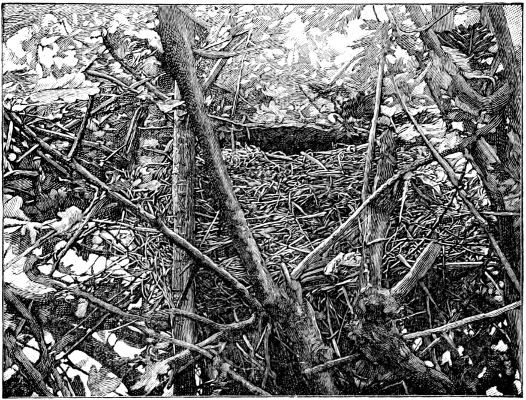
Fig. 19.—Throstle’s Nest.
Nesting begins in March, the site selected being the centre of a hedge, or a thick holly or other evergreen bush, or a mass of ivy against a wall or tree. The nest is built of dry grass, small twigs, and moss, and plastered inside with mud, or clay, or cow-dung, and lined with rotten wood. This is a strange material for a nest to be lined with, and is not used by any other bird; the fragments of rotten wood are wetted when used, and, being pressed smoothly down, form a cork-like lining, very hard when dry. Four or five eggs are laid, pale greenish blue in ground-colour, thickly marked with small deep brown spots, almost black. Two, and sometimes three, broods are reared in the season.
During the day, when not singing, the thrush is a silent bird; in the evening he becomes noisy, and chirps and chatters and screams excitedly before settling to roost.
Insects of all kinds, earthworms, and slugs and snails, are eaten by the song-thrush. The snail-shells are broken by being struck vigorously against a stone; and as the same stone is often used for the purpose, quantities of newly broken shells are sometimes found scattered round it. He is a great hunter after earthworms, and it would appear from his actions that the sense of hearing rather than that of sight is relied on to discover the worm. For the worm, however near the surface, is still under it, and usually a close bed of grass covers the ground; yet you will see a thrush hopping about a lawn stand motionless for two or three seconds, then hop rapidly to a spot half a yard away, and instantly plunge his beak into the earth and draw out a worm. The supposition is that he has heard it moving in the earth. He is also a fruit and berry eater, both wild and cultivated.
Redwing. Turdus iliacus.
Upper parts olive-brown; a broad white streak above the eye; under parts white, with numerous oblong, dusky spots; under wing-coverts and flanks orange-red. Length, eight and a half inches.
In size and general appearance the redwing resembles the song-thrush. Like the fieldfare, he is a winter visitor from northern Europe, arriving a little earlier on the east coast, and differing from his fellow-migrants in being less hardy. He is more of an insect-eater, and is incapable of thriving on berries and seeds; hence in very severe seasons he is the greater sufferer, and sometimes perishes in considerable numbers when, in the same localities, the fieldfare is not sensibly affected. Nor is he of so vagrant a habit as the larger thrush: year after year he returns to the same place to spend the winter months, feeding in the same meadows, and roosting in the same plantations, until the return of spring calls him to the north. He is partial to cultivated districts where there are woods and grass-lands, and passes the daylight hours in meadows and moist grounds near water, returning regularly in the evening to the roosting-trees.
At all seasons the redwing is gregarious, and in its summer haunts many birds are found nesting in close proximity. A good deal of interest attaches to the subject of its song, which Linnæus thought ‘delightful,’ and comparable to that of the nightingale—an opinion ridiculed by Professor Newton in his edition of Yarrell. Richard Jefferies, who found the redwing breeding and heard its summer song in England, describes its strain as ‘sweet and loud—far louder than the old, familiar notes of the thrush. The note rang out clear and high, and somehow sounded strangely unfamiliar among English meadows and English oaks.’[1]
Fieldfare. Turdus pilaris.
Head, nape, and lower part of the back dark ash-grey; upper part of the back and wing-coverts chestnut-brown; a white line above the eye; chin and throat yellow streaked with black; breast reddish brown spotted with black; belly, flanks, and lower tail-coverts white, the last two spotted with greyish brown; under wing-coverts white. Length, ten inches.
In size and colouring, more especially in the spotted under parts, the fieldfare comes near enough to the missel-thrush to be sometimes confounded with it. Thus, flocks of missel-thrushes seen in autumn are sometimes mistaken for fieldfares that have come at an exceptionally early date to warn the inhabitants of these islands that the winter will be a severe one. The fieldfare is slightly less in size than the missel-thrush, and has a more variegated plumage, and when seen close at hand is a handsome bird.
He is one of the latest winter visitors to arrive, seldom appearing before the end of October. The return migration takes place at the end of April, or later; flocks of fieldfares have been known to remain in this country to the end of May, and even to the first week in June. Like the redwing, he is gregarious all the year round; in his summer home in the Norwegian forests he exists in communities, and the nests are built near each other. The migration is usually performed by night, and the harsh cries of the travellers may be heard in the dark sky, on the east coasts of England and Scotland, at the end of October, and in November. From the time of their arrival until they leave us they are seen in flocks of twenty or thirty to several hundreds of individuals. They do not, like the redwings, attach themselves to certain localities, but wander incessantly from place to place, ranging over the entire area of Great Britain and Ireland. Owing to this vagrancy, the fieldfare is an extremely familiar bird to the countryman, and invariably its first appearance, and harsh yet joyous clamour, as of jays screaming and magpies chattering in concert, call up a sudden image of winter—cold, brief days and a snow-whitened earth, and memories of that early period in life when the great seasonal changes impress the mind so deeply.
In open weather the fieldfares seek their food in meadows and pastures, also in the fields. Unlike the missel-thrushes, that move about in all directions over the ground, the fieldfares when feeding all move in the same direction. In like manner, when the flock repairs to a tree, the birds on their perches are all seen facing one way—a very pretty spectacle. When their feeding-grounds are frozen, or covered with snow, they go to the hedges and devour the hips and haws, and any other wild fruit that remains ungathered; if severe weather continues, they take their departure to more southern lands. Their flight is strong, easy, and slightly undulating, and before settling to feed the flock often wheels gracefully about over the field for some time.
The song of the fieldfare, described by Seebohm as a ‘wild desultory warble,’ uttered on the wing, is not known to us in this country—it is a song of summer and of love; but in genial weather, when the birds are faring well, they often burst out into a concert of agreeable sounds just after alighting in a tree.
In the evening when settling to roost they are extremely noisy like most thrushes, and their cries may be heard until dark.
Blackbird. Turdus merula.
Black; bill and orbits of the eyes orange-yellow. Female: sooty brown. Length, ten inches.
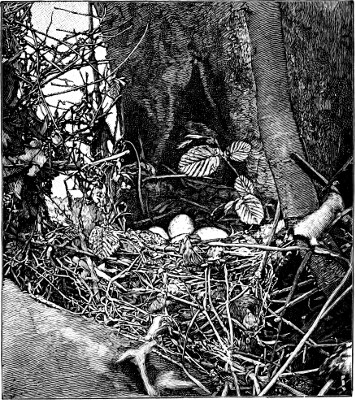
Fig. 20.—Blackbird’s Nest.
Among the feathered inhabitants of these islands there is scarcely a more familiar figure than that of the blackbird. Not only is he very generally diffused, and abundant in all suitable localities, but he is attached to human habitations—a bird of the garden, lawn, and shrubberies. His music is much to us, his beautiful mellow voice being unique in character in this country. But, more than his voice, his love of gardens and their produce, and whatever else serves to make him better known than most birds, is his blackness. Excepting the crows, he is the only British bird in the passerine order with a wholly black plumage; and his bright yellow bill increases the effect of the blackness, and, like a golden crown, gives him a strange beauty. Like his companion of the garden and shrubbery, the throstle, he is a skulker, and on the least alarm takes shelter under the thickest evergreen within reach. When disturbed from his hiding-place he rushes out impetuously with a great noise, making the place resound with his loud, clear, ringing and musical chuckle. But he is not so inveterate a skulker and in love with the shade as the other. You will sometimes find him on hillsides and open moors, or nesting in the scanty tufts of sea-campion on rocky islands where he has for only neighbour the rock-pipit. But above all situations he prefers the garden and well-planted ground, and in such places is most abundant. His food is the same as that of the throstle, and is taken in much the same way: he listens for the earthworms working near the surface of the ground, and hammers the snails against a stone to break the shells. In the fruit season he is very troublesome to the gardener, and greedily devours strawberries, cherries, currants, gooseberries and mulberries.
The song of the male begins early in spring, and is mostly heard during the early and late hours of the day. Its charm consists in the peculiar soft, rich, melodious quality of the sound, and the placid, leisurely manner in which it is delivered. But the manner varies greatly. ‘He sings in a quiet, leisurely way, as a great master should,’ says Richard Jefferies; unfortunately, the great master too often ends his performance unworthily with an unmusical note, or he collapses ignominiously at the close. John Burroughs, the American writer on birds, thus describes it: ‘It was the most leisurely strain I heard. Amid the loud, vivacious, work-a-day chorus it had an easeful dolce far niente effect.... It constantly seemed to me as if the bird was a learner, and had not yet mastered his art. The tone is fine, but the execution is laboured; the musician does not handle his instrument with deftness and confidence.’ Perhaps it may be said that, of all the most famed bird-songs, that of the blackbird is the least perfect and the most delightful.
The blackbird places his nest in the centre of a hedge or in an evergreen; it is formed of herbs, roots, and coarse grass, plastered inside with mud, and lined with fine dry grass. Four to six eggs are laid, light greenish blue in ground-colour, mottled with pale brown. Two or three, and sometimes as many as four, broods are reared in the season.
In the northern and more exposed parts of the country the blackbird has a partial migration, or shifts his quarters to more sheltered localities in the winter.
Ring-Ouzel. Turdus torquatus.
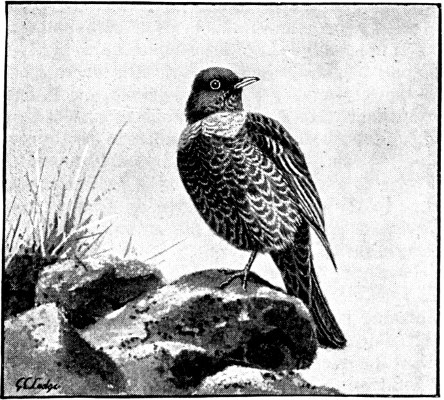
Fig. 21.—Ring-Ouzel. ⅕ natural size.
Black, the feathers edged with greyish white; a large crescent-shaped, pure white spot on the throat. Length, eleven inches. Female: plumage greyer; the white mark narrower and less pure.
The ring-ouzel is sometimes called the ‘mountain blackbird,’ on account of his likeness to the common species. He is more a ground bird and less skulking in habit than the garden blackbird, but in appearance and motions strongly resembles him. On alighting he throws up and fans his tail in the same way, and is very clamorous when going to roost in the evening. His manner of feeding is much the same: hopping along the ground, frequently pausing to look up, and anon plunging his beak into the soil to draw out a grub or earthworm. He breaks the snail-shells in the same way, and is equally fond of fruits and berries, both wild and cultivated.
The ring-ouzel is a summer visitor to this country, arriving about the beginning of April, and spends the summer months and breeds in the higher, least-frequented parts of Dartmoor, in Devonshire, and the hilly part of Derbyshire, and many localities in the north of England. He is also found in various localities in Wales, Scotland, and Ireland. On their arrival the birds are seen for a short period in flocks, sometimes of considerable size, frequenting wet and marshy grounds. As soon as pairing takes place the flocks break up, and the birds distribute themselves over the mountains and high uplands. The song of the male is heard after the birds have paired and made choice of a breeding-site. It is a powerful song, delightful to listen to, partly for its own wild, glad character, but more on account of the savage beauty and solitariness of the nature amidst which it is usually heard. The nest is placed upon or close to the ground, beneath or in a tuft of heather; and occasionally is built in a low bush or tree. Outwardly it is made of coarse grass or twigs of heather, plastered inside with mud or clay, and lined with fine dry grass. The four or five eggs are bluish green, blotched with reddish brown.
Seebohm has the following spirited description of the ring-ouzel’s action in the presence of danger to its nest: ‘Approach their treasure, and, although you have no knowledge of its whereabouts, you speedily know that you are on sacred ground.... Something sweeps suddenly round your head, probably brushing your face. You look round, and there the ring-ouzel, perched close at hand, is eyeing you wrathfully, and ready to do battle, despite the odds, for the protection of her abode. Move, and the attack is resumed, this time with loud and dissonant cries that wake the solitudes of the barren moor around. Undauntedly the birds fly around you, pause for a moment on some mass of rock, or reel and tumble on the ground to decoy you away. As you approach still closer the anxiety of the female, if possible, increases; her cries, with those of her mate, disturb the birds around; the red grouse, startled, skims over the shoulder of the hill to find solitude; the moor-pipit chirps anxiously by; and the gay little stonechat flits uneasily from bush to bush. So long as you tarry near their treasure the birds will accompany you, and, by using every artifice, endeavour to allure or draw you away from its vicinity.’
Besides the six species described, there are three thrushes to be found in works on British birds: the black-throated thrush (Turdus atrigularis), a straggler from Central Siberia; White’s thrush (T. varius), from North-east Siberia; and the rock-thrush (Monticola saxatilis), from South Europe, a member of a group that connects the true thrushes (Turdus) with the wheatears (Saxicola).
Wheatear. Saxicola œnanthe.
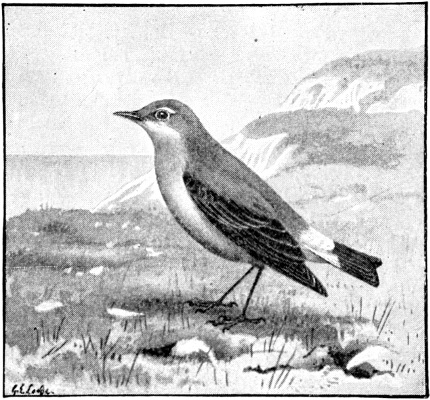
Fig. 22.—Wheatear. ⅓ natural size.
Upper parts bluish grey; wings and wing-coverts, centre and extremity of the tail, feet, bill, and area comprising the nostrils, eyes, and ears, black; base and lower portion of the side of the tail pure white; chin, forehead, stripe over the eye, and under parts, white. In autumn, upper parts reddish brown and tail feathers tipped with white. Female: upper parts ash-brown tinged with yellow; stripe over the eye dingy. Length, six and a half inches.
To those who are attracted to solitary, desert places, who find in wildness a charm superior to all others, the wheatear, conspicuous in black and white and bluish grey plumage, is a familiar figure—a pretty little wild friend; for he, too, prefers the uncultivated wastes, the vast downs, the mountain slopes, and the stony barren uplands. He is one of the earliest, if not the first, of the summer migrants to arrive on our shores. They appear early in March, sometimes at the end of February, on the south and east coasts, after crossing the Channel by night or during the early hours of the morning. They come in ‘rushes,’ at intervals of two or three days. In the morning they are seen in thousands; but after a few hours’ rest these travellers hurry on to their distant breeding-grounds, and perhaps for a day or two scarcely a bird will be visible; then another multitude appears, and so on, until the entire vast army has distributed itself far and wide over the British area, from the Sussex and Dorset coasts to the extreme North of Scotland and the Hebrides, the Orkneys, and Shetlands. The return migration begins early in August, and lasts until the middle of September. During this period the downs on the Sussex coast form a great camping-ground of the wheatears, and they are then taken in snares by the shepherds for the markets. Most of the birds taken are young; they are excessively fat, and are esteemed a great delicacy. The wheatear harvest has, however, now dwindled down to something very small compared with former times; it astonishes us to read in Pennant that a century and a quarter ago eighteen hundred dozens of these birds were annually taken in the neighbourhood of Eastbourne alone. The great decrease in the number of wheatears is no doubt due to the reclamation of waste lands, where this bird finds the conditions suited to it. To a variety of climates it is able to adapt itself: the vast area it inhabits includes almost the whole continent of Europe, from the hot south to the furthermost north; and westwards its range extends to Iceland, Greenland, and Labrador. But cultivation it cannot tolerate: when the plough comes the wheatear vanishes. Fortunately, there must always be waste and desert places—the scattered areas on mountain-sides, barren moors and downs, and rocky coasts, that cannot be made productive. In such spots the wheatear is an unfailing summer companion, and at once attracts attention by his appearance and motions. He is fond of perching on a rock, stone wall, or other elevation, but seldom alights on bushes and trees. He runs rapidly and freely on the ground, and, pausing at intervals and standing erect, moves his tail deliberately up and down. He flies readily, his rump and tail flashing white as he rises; and after going but a short distance, flying close to the ground, he alights again, and jerks and fans his tail two or three times. He feeds on grubs, small beetles, and other insects picked up from the ground, but also pursues and catches flying insects. He has a short, sharp call-note that sounds like two pieces of stone struck smartly together; hence the name of ‘stone-clatter,’ by which he is known in some localities. His short and simple song would attract little attention in groves and gardens; it is charming on account of the barren, silent situations it is heard in. It gives life to the solitude, and is a love-song, accompanied by pretty gestures and motions, and is frequently uttered as the bird hovers in the air.
The wheatear breeds in a cavity under a stone, or in a hole or crevice in a stone wall; also in cairns and in the cavities in peat-stacks, and occasionally in a disused rabbit-burrow or under a clod of earth. The nest is made of dry grass, loosely put together and slightly lined with some soft material—moss and rootlets, rabbits’ fur, horsehair, or wool, or feathers. From four to seven eggs are laid, pale greenish blue in colour, in some cases faintly marked with purplish specks at the large end.
The wheatear, owing to its wide distribution in this country, is known by a variety of local names in different districts; of these may be mentioned fallowchat, whitetail, stone-cracker, chack-bird, and clod-hopper.
Two other species of the genus Saxicola have been included in the list of British birds. These are the black-throated wheatear (Saxicola strapazina), of which a single specimen has been obtained, and the desert wheatear (Saxicola deserti), of which two or three specimens have been shot.
Whinchat. Pratincola rubetra.
Upper parts dusky brown edged with reddish yellow; broad white stripe over the eye; throat and sides of neck white; neck and breast bright yellowish red; a large white spot on the wings and base of the tail; tip of the tail and the two middle feathers dusky brown; belly and flanks yellowish white. Female: colours duller; white spot on the wing smaller. Length, five inches and a quarter.
Of the three British species forming this group of two genera (Saxicola and Pratincola)—the fallowchat, stonechat, and whinchat—the last-named is the least striking, whether in appearance or habits. His modest plumage has neither brightness nor strongly contrasted colours; and although he is a frequenter of furze-grown commons, and named on this account furzechat, or whinchat, he is not, like the stonechat, restricted to them. He inhabits both wild and cultivated grounds, rough commons and waste lands, mountain-sides, and meadows and grass fields divided by hedgerows. He roosts, breeds, and obtains most of his food on the ground; but he loves to perch on bushes and low trees, and in most open situations where these grow the whinchat may be met with. On his arrival in April he feeds very much on the fallows, but later, in May, forsakes them for the neighbouring grass fields, where he makes his nest. He is commonly seen perched on the summit of a bush, low tree, or hedgerow, and, like the stonechat, he makes frequent short excursions in pursuit of flying insects. When approached he grows restless on his perch, fans his tail at intervals, and frequently utters his low call or alarm note; then flies away, to perch again at a short distance from the intruder, and flies and perches again, and finally doubles back and returns to the first spot. Besides the insects he catches flying, he feeds on small beetles, grubs, worms, &c., found about the roots of the grass. He is frequently seen fluttering close to the surface of the tall grass, picking small insects from the leaves, and is most active in seeking his food during the evening twilight.
The whinchat’s low warbling song, which has some resemblance to that of the redstart, is mostly heard in the love season, and is uttered both from its perch on the summit of a bush or tree, and when hovering in the air.
The nest is placed on the ground, usually in a cavity under the grass in a field, not far from a hedgerow, or under a thick furze-bush on commons, or at the roots of the heather on moors. It is formed of dry grass and moss, and lined with horsehair and rootlets. Four to six eggs are laid, greenish blue in colour, faintly marked with a zone of brown spots at the larger end.
Stonechat. Pratincola rubicola.
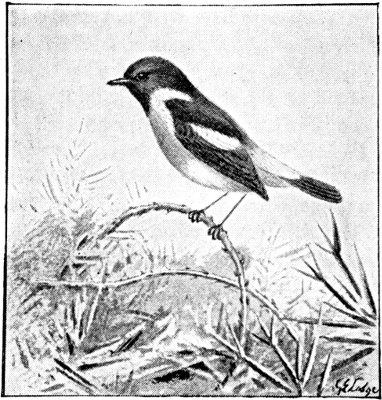
Fig. 23.—Stonechat. ¼ natural size.
Head, throat, bill, and legs black; sides of neck near the wing, tertial wing-coverts, and rump white; breast bright chestnut-red, paling to white on the belly; feathers of the back, wings, and tail black with reddish brown edges. Female: head and upper parts dusky brown, the feathers edged with yellowish red; throat black with small whitish and reddish spots; less white in the wings and tail; the red of the breast dull. Length, five and a quarter inches.
In his colouring and appearance, and to some extent in habits, the small stonechat is unlike any other bird. His strongly contrasted tints—black and white, and brown and chestnut-red—make him as conspicuous to the eye as the goldfinch or yellowhammer, and thus produce much the same effect as brilliancy of colour. The effect is increased by the custom the bird has of always perching on the topmost spray of a furze-bush on the open commons which it inhabits. Perched thus conspicuously on the summit, he sits erect and motionless, a small feathered harlequin, or like a painted image of a bird. But his disposition is a restless one; in a few moments he drops to the ground to pick up some small insect he has spied, or else dashes into the air after a passing fly or gnat, and then returns to his stand, or flits to another bush some yards away, where he reappears on its top, sitting erect and motionless as before. He is always anxious in the presence of a human being, flying restlessly from bush to bush, incessantly uttering his low, complaining note, which has a sound like that produced by striking two pebbles together; hence his name of stonechat. But it is a somewhat misleading name. He is not, like the wheatear, an inhabitant of barren stony places, but is seen chiefly on commons abounding in furze-bushes and thorns and brambles. He is seen in pairs, but is nowhere a numerous species, although found in most suitable localities throughout the three kingdoms. He is also to be met with throughout the year, but is much rarer in winter than in summer; and probably a great many individuals leave the country in autumn, while others seek more sheltered situations to winter in, or have a partial migration.
The stonechat has a slight, but sweet and very pleasing, song, uttered both when perched and when hovering in the air. Towards the end of March the nest is made, and is placed on or close to the ground, under a thick furze-bush; it is large, and carelessly made of dry grass, moss, heath and fibrous roots, lined with fine grass, horsehair, feathers, and sometimes with wool. Five or six eggs are laid, pale green or greenish blue in colour, and speckled at the large end with dull reddish brown. When the nest is approached the birds display the keenest distress.
Redstart. Ruticilla phœnicurus.
Forehead white; head and upper part of back bluish grey; throat black; breast, tail-coverts, and tail, except the two middle feathers, which are brown, bright bay. Female: upper parts grey deeply tinged with red; throat and belly whitish; breast, flanks, and under tail-coverts pale red. Length, five and a quarter inches.
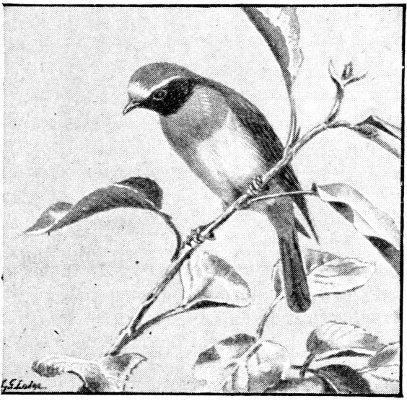
Fig. 24.—Redstart. ⅓ natural size.
The redstart is found from April to the end of August throughout England and Wales, but is nowhere common; in Scotland and Ireland he is rare. He is, nevertheless, a better-known bird to people in the country districts than some of the migratory songsters which are more abundant. Not, however, on account of his song, which is inferior to most, but partly because he ‘affects neighbourhoods,’ as Gilbert White says, and partly on account of his pure and prettily contrasted colours—the white forehead, slaty grey upper parts, and chestnut rump and tail. The bright-coloured tail, which he flirts often as he flits before you, quickly attracts the eye. ‘Firetail’ is a common name for this bird. Redstart is Saxon for redtail. When seen perched upright and motionless he resembles the robin in figure, but does not seek his food so much on the ground, and in his restless disposition and quick, lively motions, he is like the warblers. A peculiarity of the redstart is his fondness for old walls; he is attracted by them to orchards and gardens, where he is most often seen, although always a shy bird in the presence of man.
Seebohm says: ‘As the wheatear is the tenant of the cairns, the rocks, and the ruins of the wilds, in like manner the redstart may be designated a bird of the ruins and the rocks in the lower, warmer, and more cultivated districts. You will find it in orchards and gardens, about old walls, and in the more open woods and shrubberies. Another favourite haunt of the redstart is old crumbling ruins, abbeys, and castles, on whose battlements and still massive walls, ivy-covered and moss-grown, it delights to sit and chant its short and monotonous song.’
The song consists of one short phrase, dropping to a low twitter at the end, which varies in different singers; but the opening note is always a beautiful expressive sound.
The redstart feeds on small beetles, caterpillars, spiders, and grubs, which it picks up in walls, trees, and bushes; and on gnats, flies, and butterflies, captured on the wing after the manner of the flycatcher.
The nest is almost always made in a hole, usually in an old stone wall, but occasionally in a hole in a tree, and sometimes in the cleft formed by two branches. It is loosely built with dry grass and moss, and lined with hair and feathers. The eggs are four to six in number; sometimes as many as eight, or even ten, are laid. They resemble the hedge-sparrow’s eggs, being of a uniform greenish blue colour.
The black redstart (Ruticilla titys) is a winter visitor in small numbers to the south-west of England, and has been known to breed on two or three occasions in this country. It is common throughout Central and Southern Europe, wintering in North Africa, and in its nesting and other habits and language resembles the redstart.
Between the redstarts (Ruticilla) and the redbreast (Erithacus), next to be described, the bluethroats (Cyanecula) are placed, of which two species have been recorded as casual visitors to this country—the white-spotted bluethroat (C. Wolfi), from Western Europe; and the red-spotted bluethroat (C. Suecica), a breeder in the arctic regions.
Redbreast. Erithacus rubecula.
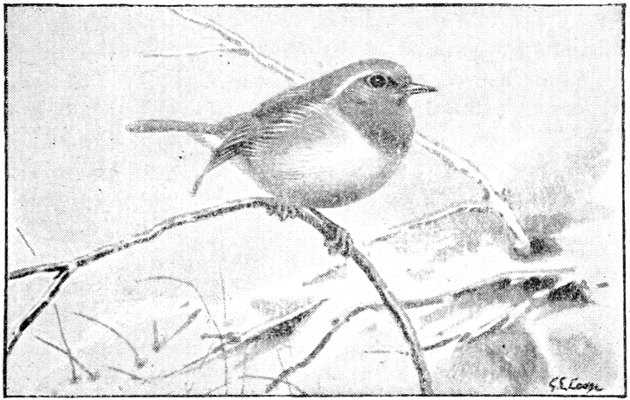
Fig. 25.—Redbreast. ¼ natural size.
Upper parts olive-brown; forehead and breast red, the red edged with grey; belly white. Female: a trifle smaller than the male, and less bright in colour. Length, five inches and three-quarters.
Of man’s feathered favourites—the species he has thought proper to distinguish by a kindly protective sentiment—the redbreast probably ranks first, both on account of the degree of the feeling and its universality. The trustfulness of the familiar robin, especially in seasons of snow and frost, in coming about and entering our houses in quest of crumbs, is the principal cause of such a sentiment; but the highly attractive qualities of the bird have doubtless added strength to it. The bright red of his breast, intensified by contrast with the dark olive of the upper parts, gives him a rare beauty and distinction among our small songsters, which are mostly sober-coloured. Even more than beauty in colouring and form is a sweet voice; and here, where good singers are not few, the robin is among the best. Not only is he a fine singer, but in the almost voiceless autumn season, and in winter, when the other melodists that have not left our shores are silent, the robin still warbles his gushing, careless strain, varying his notes at every repetition, fresh and glad and brilliant as in the springtime. His song, indeed, never seems so sweet and impressive as in the silent and dreary season. For one thing, the absence of other bird-voices causes the robin’s to be more attentively listened to and better appreciated than at other times, just as we appreciate the nightingale best when he ‘sings darkling’—when there are no other strains to distract the attention. There is also the power of contrast—the bright, ringing lyric, a fountain of life and gladness, in the midst of a nature that suggests mournful analogies—autumnal decay and wintry death. There cannot be a doubt that the robin gives us all more pleasure with his music than any other singing-bird; we hear him all the year round and all our lives long, and his voice never palls on us. But those who have always heard it, for whom this sound has many endearing associations, might have some doubts about its intrinsic merits as a song—they might think that they esteem it chiefly because of the associations it has for them. In such a case one is glad to have an independent opinion—that, for instance, of an ‘intelligent foreigner,’ who has never heard this bird in his own country. Such an opinion we may find in John Burroughs, the American writer on birds; and it may well reassure those who love the robin’s song, but fear to put their favourite bird in the same category with the nightingale, blackcap, and garden-warbler. He writes: ‘The English robin is a better songster than I expected to find him. The poets and writers have not done him justice. He is of the royal line of the nightingale, and inherits some of the qualities of that famous bird. His favourite hour for singing is the gloaming, and I used to hear him the last of all. His song is peculiar, jerky, and spasmodic, but abounds in the purest and most piercing tones to be heard—piercing from their smoothness, intensity, and fulness of articulation; rapid and crowded at one moment, as if some barrier had suddenly given way, then as suddenly pausing, and scintillating at intervals bright, tapering shafts of sound. It stops and hesitates, and blurts out its notes like a stammerer; but when they do come, they are marvellously clear and pure. I have heard green hickory-branches thrown into a fierce blaze jet out the same fine, intense, musical sounds on the escape of the imprisoned vapours in the hard wood as characterise the robin’s song.’
The robin is an early breeder, and makes its nest beneath a hedge, or in a bank, or in a close bush not far above the ground; it is formed of dry grass, leaves, and moss, and lined with feathers. Six or seven eggs are laid, reddish white in ground-colour, clouded or blotched, and freckled with pale red. When the nest is approached the old birds express their anxiety by a very curious sound—a prolonged note so acute that, like the shrill note of some insects and the bat’s cry, it is inaudible to some persons. Two, and even three, broods are raised in the season.
At the end of summer the old birds disappear from their usual haunts to moult; and during this perhaps painful, and certainly dangerous, period, they remain secluded and unseen in the thickest foliage. When they reappear in new and brighter dress, restored to health and vigour, a fresh trial awaits them. The young they have hatched and fed and protected have now attained to maturity, and are in possession of their home. For it is the case that every pair of robins has a pretty well-defined area of ground which they regard as their own, jealously excluding from it other individuals of their own species. The young are forthwith driven out, often not without much fighting, which may last for many days, and in which the old bird is sometimes the loser. But in most cases the old robin reconquers his territory, and the young male, or males, if not killed, go otherwhere. And here we come upon an obscure point in the history of this familiar species; for what becomes of the young dispossessed birds is not yet known. It has been conjectured that they migrate, and that not many return from their wanderings beyond the sea. And it is not impossible to believe that the migratory instinct may exist in the young of a species, although obsolete at a later period of life.
Nightingale. Daulias luscinia.
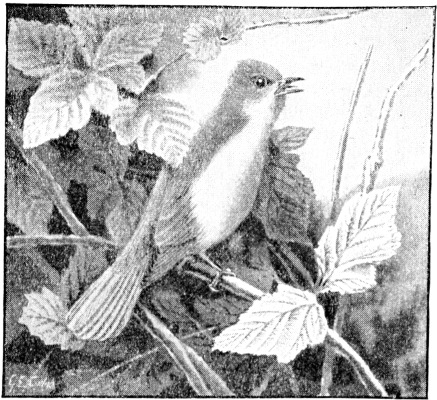
Fig. 26.—Nightingale. ⅓ natural size.
Upper plumage uniform brown tinged with chestnut; tail rufous; under parts greyish white; flanks pale ash. Length, six inches and a quarter.
The nightingale is the only songster that has been too much lauded, with the inevitable result that its melody, when first heard, causes disappointment, and even incredulity. More than once it has been my lot to call the attention of someone who had not previously heard it to its song, at the same time pointing out the bird; and after a few moments of listening, he or she has exclaimed, ‘That the nightingale! Why, it is only a common-looking little bird, and its song, that so much fuss is made about, is after all no better than that of any other little bird.’ And then it is perhaps added: ‘I don’t think the nightingale—if the bird you have shown me is the nightingale—sings so well as the thrush, or the blackbird, or the lark.’ The song is, nevertheless, exceedingly beautiful; its phrasing is more perfect than that of any other British melodist; and the voice has a combined strength, purity, and brilliance probably without a parallel. On account of these qualities, and of the fact that the song is frequently heard in the night-time, when other voices are silent, the nightingale was anciently selected as the highest example of a perfect singer; and, on the principle that to him that hath shall be given, it was credited with all the best qualities of all the other singers. It was the maker of ravishing music, and a type, just as the pelican was a type of parental affection and self-sacrifice, and the turtle-dove of conjugal fidelity. Only, when he actually hears it for the first time, the hearer makes the sad discovery that the bird he has for long years been listening to in fancy—the nightingale heard by the poet with an aching heart, and the wish that he, too, could fade with it into the forest dim—was a nightingale of the brain, a mythical bird, like the footless bird of paradise and the swan with a dying melody. Beautiful, nay, perfect, the song may be, but he misses from it that something of human feeling which makes the imperfect songs so enchanting—the overflowing gladness of the lark; the spirit of wildness of the blackcap; the airy, delicate tenderness of the willow-wren; and the serene happiness of the blackbird.
The nightingale arrives in this country about the middle of April, returning to the same localities year after year, apparently in the same numbers. It is scarcely to be doubted that the young birds that survive the perils of migration come back to the spot where they were hatched, since the species does not extend its range nor establish new colonies. It is most common in the southern counties of England, above all in Surrey, but rare in the western and northern counties, and in Scotland and Ireland it is unknown.
The nightingale so nearly resembles the robin in size, form, and manner that he might be taken for that bird but for his clear, brown colour. Like the robin, he feeds on the ground, seeking grubs and insects under the dead leaves, hopping rapidly by fits and starts, standing erect and motionless at intervals as if to listen, and occasionally throwing up his tail and lowering his head and wings, just as the robin does. He inhabits woods, coppices, rough bramble-grown commons, and unkept hedges, and loves best of all a thicket growing by the side of running water.
Two or three days after arriving he begins to sing, and continues in song until the middle, or a little past the middle, of June, when the young are hatched. In fine weather he sings at intervals throughout the day, but his music is more continuous and has a more beautiful effect in the evening. For an hour or two after sunset it is perhaps most perfect. In the dark he is silent, but if the moon shines he will continue singing for hours. That is to say, some birds will continue singing; as a rule, not half so many as may be heard during daylight.
The nest is nearly always placed on the ground beneath a hedge or close thicket; it is rather large, and composed of dry grass and dead leaves loosely put together, the inside lined with fine dead grass, rootlets, and vegetable down. The eggs are four or five in number, and of a uniform olive-brown colour.
During incubation and after the young are hatched the parent birds display the most intense solicitude when the nest is approached, and flit from bough to bough close to the intruder’s head, incessantly repeating two strangely different notes—one low, clear, and sorrowful, the other a harsh, grinding sound.
The return migration is in August and September.
Whitethroat. Sylvia cinerea.
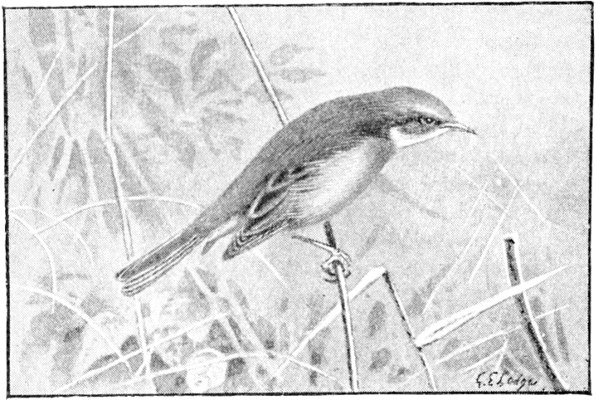
Fig. 27.—Whitethroat. ⅓ natural size.
Head ash-grey tinged with brown; rest of upper parts reddish brown; wings dusky, the coverts edged with red; lower parts white faintly tinged with rose colour; tail dark brown, the outer feathers white on the tips and the outer web, the next only tipped with white. Female without the rosy tint on the breast. Length, five and a half inches.
The whitethroat, or greater whitethroat, as the name is sometimes written, is one of the commonest and best known of the soft-billed songsters that spend the summer and breed in our country. It inhabits all parts of the British Islands, excepting the most barren. Even to those who pay little attention to the small birds that come in their way the whitethroat is tolerably familiar, less on account of its song, which is in no way remarkable, than for the excited notes and actions of the bird, sometimes highly eccentric, which challenge attention. The whitethroat is, moreover, readily distinguishable from its colour—the reddish brown hue of its upper plumage and the unmistakable white throat, which give it a conspicuous individuality among the warblers. It inhabits the wood-side, the thickets, the rough common, but of all places prefers the thick hedge for a home. Shortly after the bird’s arrival, about the middle or near the end of April, he quickly makes his presence known to any person who walks along a hedgeside. The intruder is received with a startled, grating note, a sound expressive of surprise and displeasure, and, repeating this sound from time to time, the bird flits on before him, concealed from sight by the dense tangle he moves amidst. Presently, if not too much alarmed, he mounts to a twig on the summit of the hedge to pour out his song—a torrent of notes, uttered apparently in great excitement, with crest raised, the throat puffed out, and many odd gestures and motions. Sometimes he springs from his perch as if lifted by sheer rapture into the air, and ascends, singing, in a spiral, then drops swiftly back to his perch again. It is a peculiar song on account of its vehement style and the antics of the singer, more so when he flies on before a person walking, now singing, now moving farther ahead in a succession of wild jerks, then suddenly ducking down into the hedge. It is also a pleasing song in itself, although for pure melody the whitethroat does not rank very high among the greatly gifted birds of its family, or sub-family. If we include the nightingale and robin, it should be placed about the sixth on the list, the other singers that come before it being the willow-wren, blackcap, and garden warbler.
The nest of the whitethroat is a round, flimsy structure, formed of slender stalks of grass and herbs, and lined with horsehair, and is placed two or three feet above the ground, in the brambles and briers of the hedge, or in a large furze-bush. The five eggs are of a greenish white, speckled with olive, and sometimes blotched and marked with grey and light brown. One brood only is reared. Nettle-creeper is a common name for this bird, on account of its love of weeds, especially of nettles, no doubt because the small caterpillars it feeds on are most abundant on them. It is also fond of fruit, wild and cultivated, and visits the gardens near its haunts to feed on currants and raspberries.
Lesser Whitethroat. Sylvia curruca.
Head, neck, and back smoke-grey; ear coverts almost black; wings brown edged with grey; tail dusky, outer feather as in the last species, the two next tipped with white; lower parts nearly pure white; feet lead colour. Length, five and a quarter inches.
The difference in size between this warbler and the one last described is very slight; still, there is a difference; and the descriptive epithet of lesser would also be a suitable one if applied in another sense. He is a less important bird. To begin with, he is much rarer, being only of local distribution in England and Scotland, and unknown in Ireland; in colouring he is more obscure; his trivial song has nothing in it to attract attention; he is shyer in habits, passes much of the time among the higher foliage of the trees he frequents, and is, consequently, not often seen.
He arrives in this country about or shortly after the middle of April, and is found in thickets and copses, and hedges in the neighbourhood of trees. Like most of the warblers, he is exceedingly restless, and moves incessantly among the leaves, picking up the aphides and minute caterpillars, and from time to time darts into the air to capture some small passing insect. Like the common whitethroat, he is also fond of ripe fruit, especially currants and raspberries. He is often on the wing, passing directly from place to place with an undulating flight and rapidly-beating wings. When singing he swells his throat out, and delivers his strain with considerable vigour; but his song is of the shortest, and is composed of one or two notes, hurriedly repeated two or three times without variation, and with scarcely any musical quality in it. No sooner is it finished than the bird is off again on his flitting rambles among the leaves and twigs; it is less like a song than an exclamation of pleasure—a cheerful call that bursts out from time to time.
The lesser whitethroat nests in orchards, coppices, thick hedgerows, bramble and furze bushes on commons, and among tangled vegetation overhanging streams, but in all cases the nest is placed in the midst of a dense mass of foliage. This is a somewhat loosely made and shallow structure, composed of dry grass-stems and small twigs, bound together with cobwebs and cocoons, and lined with fine rootlets and horsehair. Four or five eggs are laid, in ground-colour white or dull buff, blotched and speckled with greenish brown, with underlying markings of purplish grey.
Blackcap. Sylvia atricapilla.
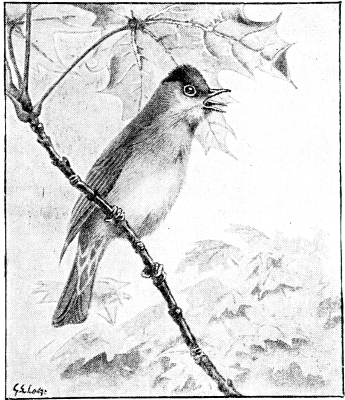
Fig. 28.—Blackcap. ⅓ natural size.
Head above the eyes jet-black, in the female chocolate-brown; upper parts, wings, and tail ash-grey slightly tinged with olive; throat and breast ash-grey; belly and under wing-coverts white. Length, five and a half inches.
This brilliant songster arrives in this country about the middle of April, in some years considerably earlier. It is found throughout England and Wales, and extends its range to Scotland and Ireland, only in lesser numbers. Though widely distributed it is rare, except in some districts in the southern and western counties of England. A person familiar with the ornithological literature of this country, but having little personal knowledge of the birds, who should go out to make acquaintance with the blackcap, would be surprised at its rarity. After much seeking, he would probably come to the conclusion that, speaking of warblers only, there are at least half a hundred willow-wrens, and perhaps twenty whitethroats, to one blackcap. Another curious point about the blackcap is that it appears to be almost unknown to the country people. It is a rare thing to find a rustic, man or boy, who knows it by that or any other name, though he may be quite familiar with the redstart and whitethroat. On these last two points I find that my experience coincides with that of John Burroughs, the American writer on bird life, in the accounts of his observations on British song-birds. There is a third point on which I also agree with him; this, however, is not a question of fact, but of opinion or of individual taste, and refers to the merit of the blackcap as a singer. His is a song which has always been very highly esteemed, and it has often been described as scarcely inferior to that of the nightingale. Gilbert White of Selborne described it as ‘a full, deep, sweet, loud, wild pipe; yet that strain is of short continuance, and his motions are desultory; but when that bird sits calmly and engages in song in earnest, he pours forth very sweet, but inward, melody, and expresses great variety of soft and gentle modulations, superior, perhaps, to those of any of our warblers, the nightingale excepted.’ After reading such a description it is a disappointment to hear the song. Nevertheless, it is very beautiful, and given out with immense energy, as the bird sits on a spray with throat puffed out, and moves its head, sometimes its whole body, vigorously from side to side. The song is a clear warble composed of about a dozen notes, rapidly enunciated, loud, free, of that sweet, pure quality characteristic of the melody of our best warblers. The strain is short, and repeated from time to time, the intervals often being filled by lower notes, sweet and varied—the ‘inward melody’ which White describes. Burroughs’s description of the song is as follows: ‘While sitting here I saw, and for the first time heard, the black-capped warbler. I recognised the note at once by its brightness and strength, and a faint suggestion in it of the nightingale’s; but it was disappointing: I had expected in it a nearer approach to its great rival.... It is a ringing, animated strain, but as a whole seemed to me crude, not smoothly and finely modulated. I could name several of our own birds that surpass it in pure music. Like its congeners, the garden warbler and the whitethroat, it sings with great emphasis and strength, but its song is silvern, not golden.’ This account of the blackcap’s song is interesting as coming from a foreigner who has paid great attention to the bird music of his own country, and it is on the whole a very good description; but I should not say that the blackcap’s strain is crude, however wild and irregular it may be; nor that there is in it even a faint suggestion of the nightingale’s.
In its active, restless habits this warbler resembles the other members of its group; but it exceeds them all in shyness. When approached it becomes silent, and conceals itself in the interior of the thicket. It frequents woods and orchards; also hedges and commons where large masses of furze and bramble are found, especially in the vicinity of trees. The nest is made of dry grass, lined with hair or fibrous roots, and is placed in the forked branches of a thick bush, three or four feet above the ground. The eggs, of which five or six are laid, are of a light reddish colour, mottled and blotched with darker red and reddish brown. They vary greatly, both in the depth of colour of the mottlings and in the pale ground-tints.
The blackcap lives on insects, which it often captures on the wing, and on fruits, and is fond of raspberries and currants. Its autumn migration is in September.
Garden Warbler. Sylvia hortensis.
Upper plumage greyish brown tinged with olive; below the ear a patch of ash-grey; throat dull white; breast and flanks grey tinged with rust colour; rest of under parts dull white. Length, five and a quarter inches.
This warbler was first described as a British species by Willughby, more than two centuries ago, under the name of ‘prettichaps’; and Professor Newton, in a note to Yarrell’s account of it, says: ‘This name (prettichaps) seems never to have been in general use in England, or it would be readily adopted here.’ The old name of prettichaps, it may be mentioned, does not appear to be quite obsolete yet: I have heard it in Berkshire, where it was applied indiscriminately to the garden warbler and blackcap.
The garden warbler is not common anywhere. In Ireland it is scarcely known; in Scotland, Wales, and a large part of England it is very rare. It is most frequently to be met with in the southern counties, especially in Hampshire. Very curiously, Gilbert White did not know this warbler, which may now be heard singing any day in spring in the neighbourhood of Selborne village.
The garden warbler is often said to rank next to the blackcap as a melodist. The songs of these two species have a great resemblance; it is, indeed, rare to find two songsters, however closely allied, so much alike in their language. The garden warbler’s song is like an imitation of the blackcap’s, but is not so powerful and brilliant: some of its notes possess the same bright, pure, musical quality, but they are hurriedly delivered, shorter, more broken up, as it were. On the other hand, to compensate for its inferior character, there is more of it; the bird, sitting concealed among the clustering leaves, will sing by the hour, his rapid, warbled strain sometimes lasting for several minutes without a break.
The garden warbler is a late bird, seldom arriving in this country before the end of April. It builds a rather slight nest, in a bush near the ground, of dry grass and moss, lined with hair and fibrous roots. The eggs are five in number, and are dull white, sometimes greenish white, blotched and speckled with dull brown and grey.
The food of this warbler consists of small insects; and it is also fond of fruit and berries.
Six species of the genus Sylvia are included in books on British birds: the four already described, the orphean warbler (Sylvia orphea), an accidental visitor from Central and Southern Europe, and the barred warbler (Sylvia nisoria), from Central, South, and East Europe.
Furze-Wren, or Dartford Warbler. Melizophilus undatus.
Upper parts greyish black; wing-coverts and feathers blackish brown; outer tail feathers broadly, and the rest narrowly, tipped with light brownish grey; under parts chestnut-brown; belly white. Tail long; wings very short. Length, five inches.
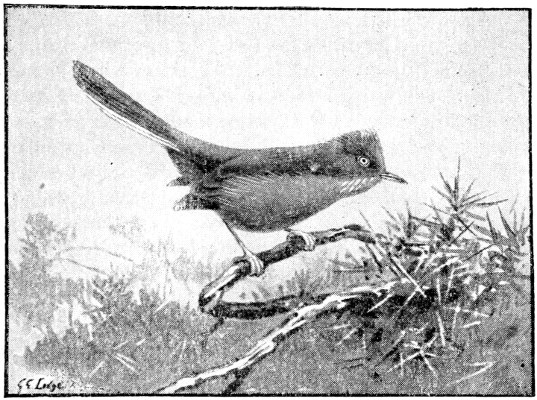
Fig. 29.—Dartford Warbler. ⅓ natural size.
The furze-wren, never a common species in this country, is now become so scarce, and is, moreover, so elusive, that it is hard to find, and harder still to observe narrowly. Its somewhat singular appearance among the warblers—its small size, short, rounded wings, great length of tail, and very dark colour—its peculiar song, and excessively lively and restless habits, and the fact that it was first discovered in this country (1773), where, though so small and delicate a creature, it exists on open, exposed commons throughout the year, have all contributed to make it a fascinating subject to British ornithologists. In England it inhabits Surrey and the counties bordering on the Channel; but it has also been found in suitable localities in various other parts of the country, and ranges as far north as the borders of Yorkshire. I have sought for it in many places, but found it only in Dorset. Forty or fifty years ago it was most abundant in the southern parts of Surrey; it was there observed by the late Edward Newman, who gave the following lively and amusing account of its appearance and habits in his ‘Letters of Rusticus on the Natural History of Godalming’ (1849): ‘We have a bird common here which, I fancy, is almost unknown in other districts, for I have scarcely ever seen it in collections.... I mean the furze-wren, or, as authors are pleased to call it, the Dartford warbler. We hear that the epithet of Dartford is derived from the little Kentish town of that name, and that it was given to the furze-wren because he was first noticed in that neighbourhood. ... If you have ever watched a common wren (a kitty-wren we call her), you must have observed that she cocked her tail bolt upright, strained her little beak at right angles, and her throat in the same fashion, to make the most of her fizgig of a song, and kept on jumping and jerking and frisking about, for all the world as though she was worked by steam; well, that’s more the character of the Dartford warbler, or, as we call her, the furze-wren. When the leaves are off the trees and the chill winter winds have driven the birds to the olive-gardens of Spain, or across the Straits, the furze-wren is in the height of his enjoyment. I have seen them by dozens skipping about the furze, lighting for a moment on the very point of the sprigs, and instantly diving out of sight again, singing out their angry, impatient ditty, for ever the same. Perched on the back of a good tall nag, and riding quietly along the outside, while the foxhounds have been drawing the furze-fields, I have often seen these birds come to the top of the furze.... They prefer those places where the furze is very thick, and difficult to get in.... And although it is so numerous in winter, and so active and noisy when disturbed by dogs and guns, still, in the breeding season it is a shy, skulking bird, hiding itself in thick places, much in the manner of the grasshopper lark, and seldom allowing one to hear the sound of its voice.’
Spring is, however, the season of the furze-wren’s greatest activity: its lively gestures, antics, and dancing motions on the topmost sprays of the bushes are then almost incessant, as it pursues the small moths and other winged insects on which it feeds; and its curious and impetuous little song is then delivered with the greatest vigour. It has also a harsh, scolding note, uttered several times in rapid succession, and a loud musical call-note.
The nest is placed among the dense masses of the lower, dead portion of a thick furze-bush. It is a flimsy structure, composed of dead furze-leaves, small twigs, and grass-stems, lined with finer stems, and sometimes with horsehair. Four or five eggs are laid, white in ground-colour, sometimes tinged with buff or with greenish, thickly spotted and freckled with pale brown over paler brown and grey markings. Two broods are reared in the season.
Golden-crested Wren, or Goldcrest. Regulus cristatus.
Upper parts olive tinged with yellow; cheeks ash-colour; wing greyish brown, with two transverse white bands; crest bright yellow in front, orange behind, bounded by two black lines; under parts yellowish grey. Female: colours not so bright; crest lemon-colour. Length, three and a half inches.
The golden-crested wren has the distinction of being the smallest British bird; it is also one of the most widely distributed, being found throughout the United Kingdom. Furthermore, it is a resident throughout the year, is nowhere scarce, and in many places is very abundant. Yet it is well known only to those who are close observers of bird life. The goldcrest is not a familiar figure, owing to its smallness and restlessness, which exceed that of all the other members of this restless family of birds, and make it difficult for the observer to see it well. Again, it is nearly always concealed from sight by the foliage, and in winter it keeps mostly among the evergreens, and at all times haunts by preference pine, fir, and yew trees. In the pale light of a winter day, more especially in cloudy weather, it is hard to see the greenish, restless little creature in his deep green bush or tree. Standing under, or close to, a wide-spreading old yew, half a dozen goldcrests flitting incessantly about among the foliage in the gloomy interior of the tree look less like what they are than the small flitting shadows of birds.
In March, and even as early as the latter part of February, the male is frequently heard uttering his song; but he is not of the songsters that perch to sing, and pour out their music deliberately and with all their might. The goldcrest’s song comes in as a sort of trivial distraction or relief—a slight interlude between the more important acts of passing from one twig or spray to another, and snatching up some infinitesimal insect so quickly and deftly that to see the action one must watch the bird very closely indeed. And the music, of which the musician makes so little, is of very little account to the listener. It is the smallest of small songs—two notes, almost identical in tone, repeated rapidly, without variation, two or three times, ending with a slight quaver, scarcely audible, on the last note. The sound is sharp and fine, as of young mice squealing, but not quite so sharp, and more musical; it is a sound that does not travel: to hear it well one must stand not farther than a dozen or fifteen yards from the singer.
Yarrell has the following passage on the song of the goldcrest: ‘Pennant says he has observed this bird suspended in the air for a considerable time over a bush in flower, while it sang very melodiously; but this peculiarity does not appear to have been noticed by other naturalists.’ I have observed the male, in the love season, hovering just above the bush, in the topmost foliage of which its mate was perched, and partially hidden from view. It is when engaged in this pretty, aërial performance, or love-dance, that the golden-crested wren is at his best. The restless, minute, sober-coloured creature, so difficult to see properly at other times, then becomes a conspicuous and exceedingly beautiful object; it hovers on rapidly-vibrating wings, the body in almost a vertical position, but the head bent sharply down, the eyes being fixed on the bird beneath, while the wide-open crest shines in the sun like a crown or shield of fiery yellow. When thus hovering it does not sing, but emits a series of sharp, excited, chirping sounds.
The goldcrest builds a pendent nest, made fast to the small twigs under a branch of yew or fir, and uses a variety of materials—fine dry grass, leaves, moss, and webs—closely woven together, lining the cavity with feathers. It is a very ingenious and pretty structure. The eggs laid are from six to ten, of a pale yellowish white, spotted and blotched, chiefly at the large end, with reddish brown.
In the autumn, in the months of October and November, a great migratory movement takes place among the goldcrests in the north of Europe; and in some seasons incredible numbers of these small travellers arrive, often in an exhausted condition, in Northumberland and on the east coast of Scotland. After resting close to the sea for a day or two, they resume their journey, and distribute themselves over the country.
The firecrest (Regulus ignicapillus), which closely resembles the species just described, is an accidental visitor from the continent of Europe.
Chiffchaff. Phylloscopus rufus.
Upper plumage olive-green tinged with yellow; above the eye a faint yellowish white streak; under parts yellowish white; feathers of the leg greyish white. Length, four inches and three-quarters.
The chiffchaff, although his song is so simple—the simplest song of all—and after a time is apt to become wearisome from incessant repetition, is, nevertheless, one of the most welcome visitors of the early spring; for this small bird, in spite of its smallness and frailty, is the first of the migratory warblers to make its appearance on our coasts. Shortly after the middle of March, and even earlier in some years, the well-remembered, familiar sound, full of promise of the beautiful budding season, begins to be heard here and there in the more sheltered and sunny spots in woods and copses, and by the first week in April it is one of the most familiar sounds in the country. It is not, however, so general as the strain of the willow-wren, this species being more local in its distribution.
It is this early appearance of the chiffchaff, coming ‘before the swallow dares,’ that endears it to the lover of Nature and of bird life. Mr. Warde Fowler, in his ‘Year with the Birds,’ has well expressed the feeling which so many have for this small warbler. ‘No one,’ he says, ‘who hails the approach of spring as the real beginning of a new life for men and plants and animals, can fail to be grateful to this little brown bird for putting on it the stamp and sanction of his clear, resonant voice. We grow tired of his two notes—he never gets beyond two—for he sings almost the whole summer through; ... but not even the first twitter of the swallow, or the earliest song of the nightingale, has the same hopeful story to tell me as this delicate traveller who dares the east wind and the frost.’
The two notes, which vary as slightly in tone as two taps of a hammer on an anvil delivered with equal force on the same spot, are emitted with great vigour and spirit, as if the little creature’s whole heart was in the performance, and repeated several times without a pause. This is the whole song, and, when not engaged in uttering it, the singer is incessantly moving about in pursuit of small insects and their larvæ, now searching for them in the small twigs and buds, after the manner of the titmice, and at times capturing them on the wing. Meanwhile the song is repeated at frequent intervals from morning until dark. It is not suspended, as in the case of most of the warblers, after the young have been hatched, but continues throughout the summer and autumn, when it degenerates somewhat in character, the sound losing the little musical quality it originally possessed.
The nest is made in the ground, a hedgebank being the situation preferred, and is round and domed, with an opening at the side. Dry grass, leaves, and moss are the materials used in its construction, the cavity being plentifully lined with feathers. The eggs are six, pure white, spotted and speckled with brown and brownish purple.
Willow-Wren. Phylloscopus trochilus.
Upper plumage bright olive-green; a narrow streak of yellow over the eye; under parts yellowish white, palest in the middle; feathers of the legs yellow. Length, nearly five inches.
The willow-wren, or willow-warbler, is one of the earliest of our summer songsters to arrive, usually following the chiffchaff—which it resembles in size and general appearance—by a few days. During the last week of March, if the weather be not too cold, its delicate strain may be heard in sheltered situations in the southern parts of England, and by the second week in April it is one of the most frequently heard songs throughout the length and breadth of the land. Not only is this species very much more generally diffused than its two nearest relations—the chiffchaff and wood-wren—but it is met with in a much greater variety of situations—on commons, in hedgerows, gardens, woods, and plantations. Yet, in spite of its abundance and wide distribution, it is nowhere a familiar bird to the country people; the small, delicate voice does not compel attention and is well-nigh lost in the summer concert that has so many loud, jubilant strains in it.
The willow-wren is a pretty little bird, although without any bright colour in its plumage, which at a short distance looks of a soft greenish yellow tint. He is best seen when the trees are opening their buds, before the thickening foliage hides his tiny, restless, flitting form from sight. He is the least shy of the warblers, his trustfulness being in strong contrast to the suspicious manner and love of concealment of the blackcap and whitethroat. He will unconcernedly continue his hunt for minute insects, and utter his melody at intervals, within a few feet of a person, sitting or standing, quietly observing him. The song, although a small one, both as to duration and power, has a singular charm: not merely the charm of association experienced in a voice long absent and heard once more—a voice of the spring, that comes before the loud call of the cuckoo and the familiar, joyous twitter of the swallow; it is in itself a beautiful sound, one of the sweetest bird-songs heard in our country. ‘A song which is unique among British birds,’ says Mr. Warde Fowler, whose description of it is, perhaps, the most perfect which we have. ‘Beginning with a high and tolerably full note, he drops it both in force and pitch in a cadence short and sweet, as though he were getting exhausted with the effort.... This cadence is often perfect; by which I mean that it descends gradually, not, of course, on the notes of our musical scale, ... but through fractions of one, or perhaps two, of our tones, and without returning upward at the end; but still more often, and especially, as I fancy, after they have been here a few weeks, they take to finishing with a note nearly as high in pitch as that with which they began.’
After this it is interesting to read Mr. J. Burroughs’s impressions of the willow-wren’s song. He writes: ‘The most melodious strain I heard, and the only one that exhibited to the full the best qualities of the American songsters, proceeded from a bird quite unknown to fame—in the British Islands, at least. I refer to the willow-warbler.... White says it has a “sweet, plaintive note,” which is but half the truth. It has a long, tender, delicious warble, not wanting in strength and volume, but eminently pure and sweet—the song of the chaffinch refined and idealised.... The song is, perhaps, in the minor key, feminine and not masculine, but it touches the heart.
‘That strain again; it had a dying fall.’
‘The song of the willow-warbler has a dying fall; no other bird-song is so touching in this respect. It mounts up round and full, then runs down the scale, and expires upon the air in a gentle murmur.’
The willow-wren breeds early, making a circular domed nest on the ground, among the long grass and weeds, under a hedge or beneath a bramble bush on a bank, and occasionally at a distance from sheltering bushes in the grass of a field. It is made of dry grass, and lined with rootlets and horsehair, and, lastly, with feathers. The eggs are six or seven in number, pure white, the yolk showing through the frail shell, and giving it a faint yellow tinge; they are blotched and spotted with reddish brown. When the nest is approached the parent birds display the greatest anxiety, hopping and flitting about close to the intruder, and uttering low, plaintive notes.
The willow-wren stays longer with us than any migratory warbler except the chiffchaff, and its song is, without exception, the most persistent. From the time of its arrival in March, or early in April, it sings without ceasing until July; then for a few weeks its song is heard only in the early morning, and it ceases at the end of August, during the moult, but is renewed a little later, and is then continued until the bird’s departure at the end of September.
Wood-Wren. Phylloscopus sibilatrix.
Upper plumage olive-green tinged with sulphur-yellow; a broad streak of sulphur-yellow over the eye; sides of head, throat, and insertion of the wings and throat bright yellow; rest of under plumage pure white. Length, nearly six inches.
This warbler arrives in England at the end of April, being later by many days than its two nearest relations, the chiffchaff and willow-wren. As its name implies, it is a bird of the woods, with a preference for such as are composed wholly or in part of oak and beech trees. It is not easily discerned, on account of its restless disposition; also because it chiefly frequents the uppermost parts of the trees it inhabits. Its instinct appears to be to live and hunt for the small insects it preys on among the green leaves at the greatest possible height from the earth; this may account for its love of the beech, which is the tallest of our forest trees. But if difficult to see as it flits lightly from place to place among the higher foliage, it is easy to hear, and its frequently uttered song sounds very loud in the woodland silence, and is strangely unlike that of any other songster. It may be said to possess two distinct songs: of these, the most frequently uttered and unmistakable begins with notes clear, sweet, and distinct, but following more and more rapidly until they run together in a resonant trill, and finally end in a long, tremulous note, somewhat thin and reedy in sound. At longer intervals it utters its other song, or call, a loud, clear note, slightly modulated, and somewhat plaintive, repeated without variation three or four times.
The wood-wren, although so great a lover of the tall tree-tops, breeds on the ground, like the two species described before it, and, like them, builds an oval-shaped domed nest. It is placed among the herbage, and is composed of moss, dry leaves, and grasses, lined with fine grass and horsehair. Feathers are never used in the nest-lining, and in this the wood-wren differs from the two preceding species. Six eggs are laid, transparent white, spotted and speckled with dark brown, purple and grey.
The wood-wren differs from most of the warblers in being exclusively an insect-eater.
A fourth member of this genus, the yellow-browed warbler (Phylloscopus superciliosus), which breeds in Northern Siberia, has been met with as a rare straggler in this country.
Two more warblers, belonging to different genera, must be mentioned here as stragglers to England: the icterine warbler (Hypolaïs icterina) and the rufous warbler (Aëdon galectodes).
Reed-Warbler. Acrocephalus streperus.
Upper plumage uniform reddish brown, without spots; a white streak or spot between the eye and bill; throat white; under plumage very pale buff. Length, five and a half inches.
The reed-warbler closely resembles the sedge-warbler, next to be described, in size, colouring, and general appearance, also in language and habits; but is a much less common species, more local in its distribution, and is, consequently, not nearly so well known. He arrives in this country about the middle of April, and inhabits dense reed-beds in dykes, marshes, and the borders of rivers, where he skulks, for the most part out of sight; but his loquacity betrays his presence, for he is a persistent singer, especially in the early part of the day, and again in the evening. His song resembles that of the sedge-warbler in its curious mingling of musical and harsh notes, its hurried and somewhat angry scolding character, but is less powerful, the harsh notes less harsh and vigorous—a sweeter but not so interesting a performance. Like the nearly allied species, he bursts into singing when excited by fear or solicitude for the safety of his nest. He is an exceedingly restless little creature, incessantly hopping from stem to stem, now mounting to the surface of the reeds, and almost instantly dropping into concealment again. Even where the birds are many, it is only by patient waiting and watching that an occasional glimpse of one can be got. His food consists of small insects, caught on the wing and on the leaves and stems of the reeds and aquatic herbage. The nest is a deep, beautiful structure, suspended on two or three, or more, slender reed-stems, or on the twigs of a willow, osier, or other plant growing near the water. It is made of long dry grass-leaves woven together, with finer grass-leaves and horsehair for a lining. The eggs are four or five in number, greenish white in colour, clouded, blotched, and freckled with dark olive and ash-grey.