CLASSIFICATION. (continued 5)
Reading edition
Osprey. Pandion haliaëtus.
Feathers of the head and neck white with dark centres; on each side of the neck a streak of blackish brown, extending downwards; upper plumage generally deep brown; under parts white, tinged here and there with yellow, and on the breast marked with arrow-shaped spots; tail-feathers barred with dusky; cere and beak dark grey; iris yellow. Length, two feet.
The osprey, like the sea-eagle, hen harrier, and kite, is one of the species that linger with us on the verge of extinction; and it may linger for many years, as in the case of the avocet, the black-tailed godwit, and the ruff, after these species had been reduced to a few breeding pairs; and, on the other hand, it may be gone to-morrow. That it will remain permanently as a member of the British avifauna is scarcely to be hoped.
The osprey, like the peregrine falcon and the short-eared owl, has an immense range, and inhabits Europe, Africa, the greater part of Asia, Japan, Formosa, the Australian region, New Guinea, and America. With us it appears in autumn as a migrant in small numbers; but the birds of the British race are now reduced to one or two pairs that breed annually in the Highlands of Scotland, and are strictly protected in their summer haunts.
The osprey feeds exclusively on fish, which it drops upon like a tern or gannet; but, falcon-like, it strikes with its feet, and, with its slippery prey gripped firmly in its sharp, crooked talons, it flies back to land.
The nest is usually placed in a tree, and is very large, formed of sticks, and lined with moss. Two or three eggs are laid, white or buff in ground-colour, blotched with rich chestnut-red, and purple-grey underlying marks.
Besides the twelve species of the order Accipitres described, all of which breed in the British Islands, there are fourteen others, which, although described as British in the standard ornithological works, are only occasional or accidental visitors or stragglers to our shores. There are two vultures to be mentioned: the griffon vulture (Gyps fulvus), an inhabitant of Southern Europe, Africa, and Asia, once obtained in Ireland; and the Egyptian vulture (Neophron percnopterus), an inhabitant of Southern Europe and Africa, twice obtained. The next species is the marsh-harrier (Circus æruginosus), once abundant throughout Great Britain and Ireland, now, unhappily, extinct as a British species. This harrier, which was also called the moor-buzzard, is a graceful, handsome bird: the head creamy white; upper parts brown; beneath, buff, streaked with brown and chestnut; part of the wing and the tail silvery grey. In its buoyant flight and preying and nesting habits it resembles the hen harrier, but frequents fens and marshes instead of moors and uplands.
The rough-legged buzzard (Archibuteo lagopus) is an irregular visitor, chiefly in autumn and winter, from the northern parts of Europe. It differs from the common buzzard in having its legs feathered to the toes—hence the specific name, lagopus—rough-footed like a hare. This species is of more frequent occurrence in the British Islands than any other occasional visitor among the diurnal raptors, and in some years it appears in considerable numbers.
The spotted eagle (Aquila clanga), known to us as a rare occasional visitor, breeds in the forests of central and south-eastern Europe. More interesting to us is the goshawk (Astur palumbarius), since this fine bird of prey, although now a very rare straggler to Great Britain, is believed to have been formerly an indigenous species, and to have bred in Scotland down to the beginning of the present century. In form, colouring, and manner of preying it resembles the sparrow-hawk, but is nearly double the size of that bird, and flies at very much larger game.
The American goshawk has been included in the list of British birds on ‘somewhat slight evidence,’ as the author of the ‘Manual of British Birds’ says. The black kite (Milvus nigrans) is an African species, a summer visitant to Europe south of the Baltic, and has once been obtained in Great Britain. The swallow-tailed kite (Elanoïdes furcatus), an American species, which I once had the pleasure of seeing (not in a glass case, but sitting on a tree, and soaring in the air), has also been found as a straggler in this country. The honey-buzzard (Pernis apivorus) is a third species of hawk in this list which has disappeared from this country. Like the hobby and the osprey, it is (or was) a summer visitant, and has been known to breed in most English and Scottish counties from Hampshire to Aberdeenshire. Up to within four or five years ago a few pairs continued to return to us each summer, but these, too, have now vanished. This fine large hawk, in size the equal of the common buzzard, lived almost entirely on insect food, wasps and wild bees especially—hence its name of honey-buzzard.
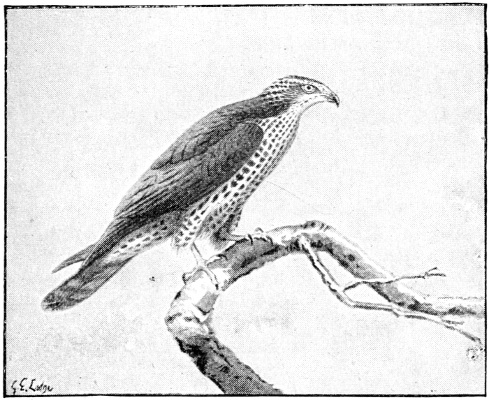
Fig. 73.—Honey-Buzzard. ¹⁄₁₂ natural size.
The remaining species to be noticed are all true falcons: the gyrfalcon (Hierofalco gyrfalco), an inhabitant of arctic Scandinavia, only once obtained in this country; the Greenland falcon (Hierofalco candicans), a wanderer to this country from north-west America and Greenland; the Iceland falcon (Hierofalco islandicus), a wanderer from Iceland; the red-footed falcon (Tinnunculus vespertinus), an occasional visitor from the warm countries of Europe; and the lesser kestrel (Tinnunculus cenchris), a visitor from southern Europe, where it breeds.
Cormorant. Phalacrocorax carbo.
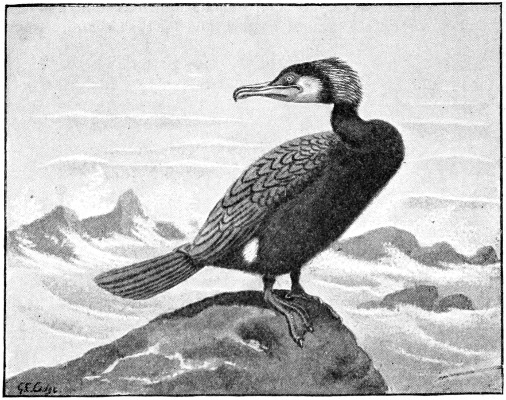
Fig. 74.—Cormorant. ¹⁄₁₁ natural size.
Upper head and neck black, striated with hair-like white feathers, those on the occiput being elongated, and forming a crest in spring; throat white; gular pouch yellow; mantle black and bronze-brown; all the other parts black, except a white patch on the thigh, assumed early in spring and lost in summer; iris emerald-green. Female: larger than the male, brighter in colour, and with longer crest. Length, three feet.
To those who know it slightly the cormorant is a big, sombre, ugly bird, heavy and awkward in his motions out of the water, and, when breeding, disgusting in his habits. He improves on a closer acquaintance. He may be easily tamed, and makes an intelligent, and sometimes very amusing, pet, and is capable of being trained to catch fish for his keeper. He is most frequently met with on the sea and seashore, but is an inhabitant of inland waters as well, and sometimes breeds beside them, making his nest on the ground or in a tree. He feeds exclusively on fishes and eels, which he captures by diving and pursuing them under water, sometimes for considerable distances. The bird is proverbial for its voracity. Its ‘swallow’ is probably the largest of any bird of its size—a fish fourteen inches long has been taken from its gullet. When swimming he presents a curious appearance: his body, as if too heavy for the element it floats in, sinks like a waterlogged boat, until the flat back is on a level with the surface. When alarmed, he sinks his body deeper and deeper at will, until the head and long neck alone appear, looking like the head and neck of a serpent swimming with body submerged. When resting on a rock after feeding, cormorants stand very erect and motionless, their long, hooked beaks much raised, and at such tunes they present a heavy, ungainly appearance. They are fond of opening their wings out to their greatest extent to dry their feathers, and remain for a long time in this attitude, looking like birds with spread wings carved out of black stone. The cormorant watches the water at times from a rock, and dives after its prey; but it more often swims, when fishing, with head and neck submerged. When taking wing it rises heavily and with great labour, but when once fairly launched the flight is powerful. Cormorants are gregarious and social birds at all seasons, and, like gulls and herons, they breed in communities. Very early in spring, or shortly after the winter solstice, the bird’s nuptial ornaments—a crest on the head and a white patch on the thigh—begin to appear; both crest and white mark disappear at the end of the breeding season. The same nesting-place is resorted to year after year, as in the case of most species that breed in communities. The summit of a crag not easily accessible, or a ledge of rock on a cliff fronting the sea, or a rocky island, are favourite sites. Here the birds, sometimes in hundreds, live together in the greatest harmony, building their nests close together, in some cases almost touching. The nest is pyramidal in form, built up from the rock to a height of from six or seven inches to a couple of feet, and is composed of sticks, coarse grass, and seaweed. Three to five eggs are laid, very small for the bird’s size, narrow and long in shape, of a pale greenish blue colour, overlaid with a thick coat of a chalky substance. This substance is quite soft when the egg is first laid; it is then white, but soon hardens, and becomes stained, in the always wet and filthy nest, to a dirty yellowish colour. The young birds are hatched blind, and have a naked, bluish black skin, but they soon grow a thick, sooty black down. They are at all stages strange and repulsive-looking creatures, and when handled or approached by a person they become sick with fear or anger, and roll and sprawl about on their nests, screaming harshly, and vomiting their half-digested food.
The young are fed with fish that has already been partially digested in the maw of the parent. It is not disgorged; the young bird thrusts his head and neck deep down into his parent’s gullet, and feeds as a horse does from his nose-bag.
The young are said not to assume the adult or breeding plumage until the third year.
Shag, or Green Cormorant. Phalacrocorax graculus.
Bill black; base of the under mandible yellow, the black skin about the gape thickly studded with small yellow spots; iris emerald-green; crown, neck, upper and under parts dark green with purple and bronze reflections; wing and tail-feathers, legs and feet, black; a crest, curling forwards, grows on the forehead in early spring, and is lost by the end of May. Length, twenty-seven inches.
The shag may be easily mistaken for the cormorant, which it closely resembles, but when near at hand is seen to differ in its smaller size and its prevailing green colour, which appears black at a distance; and, in the breeding season, by the absence of the white patch on the flank. In its habits it is more strictly marine than the cormorant, but resembles that bird in its manner of swimming and flight. It prefers bays and inlets to the open sea, and deep water near rocks to the shallow sea, where there is a low beach. In diving after fish it springs upwards almost out of the water, and goes down head first. Beneath the water it propels itself wholly by its feet; the auks, and some other diving birds, use their wings as fins to assist progression. After capturing a fish the shag brings it to the surface to swallow it, then swims on for a space, and dives again, and so on, and finally returns to the rock, where it proceeds to disgorge its prey, to devour it at leisure. The shag breeds on sea-cliffs, sometimes building on the ledges or in crevices, but caves, where they exist, are preferred. The eggs are three in number, in shape and colour like those of the cormorant, and the nests, which are placed close together, are also like those of that bird.
The shag is found in certain localities all round the coasts of Great Britain and Ireland, but is less numerous and more local than the cormorant.
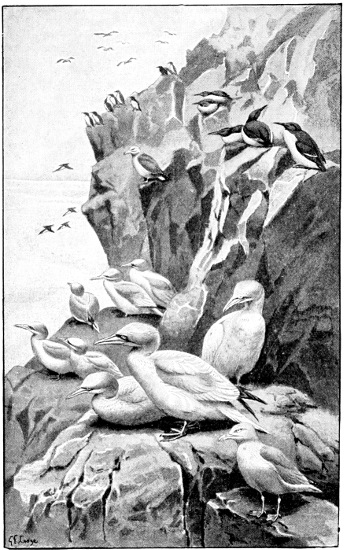
Gannets. Guillemots. Herring-Gulls.
Gannet. Sula bassana.
Adult: head and neck buff-colour; all the rest of the plumage white, except the primaries, which are black. Young of the first year: upper parts blackish brown necked with white; under parts mottled with dusky ash and buff. The dark markings diminish until the sixth year, when the adult colouring is assumed. Length, thirty-four inches.
One of the most notable seafowls inhabiting the British coasts is the gannet, or solan goose, a species which forms a connecting-link between the cormorants and the pelicans. The origin of its two common names is not precisely known, although it seems probable that gannet is derived from gans, the ancient British name for goose. The young birds from the Bass Rock, which are largely used as food in the neighbouring counties, are called, I do not know why, ‘Parliamentary geese.’ The world will have it that the bird is a goose, although as little like a goose, except in size, as a guillemot is like a sheldrake. The scientific name, bassana (of the Bass Rock), had its origin in the belief that the rock at the entrance to the Firth of Forth was the gannet’s only breeding-place. There are several other colonies: one, now greatly diminished, on Lundy Island; another, also small, on the coast of Pembrokeshire; on the West Coast of Scotland there are four stations, and others exist on the Irish coast. None of these, however, can compare in importance with the Bass Rock, where it has been calculated that as many as ten thousand pairs congregate each year to breed.
The gannet is an exclusively marine bird, and an inhabitant throughout the year of the seas round the British Islands. Its flight is easy and powerful, and its appearance on the wing more pelican- than cormorant-like. It feeds entirely on fish, and follows the shoals of such species as swim near the surface—mackerel, herrings, pilchards, and sprats. When fishing it sails at a considerable height, and on catching sight of its prey rises to a greater height, and then, with wings nearly closed, drops straight down, with great force, into the water. Its appearance when falling has been likened by one observer to ‘a brilliant piece of white marble.’
The gannets begin to assemble at the breeding-rock in March. Their nesting habits are similar to those of the cormorant, but only one egg is laid, which is, like the cormorant’s egg, pale blue in colour and thickly coated with a white, chalky material. Mr. Charles Dixon, in ‘Our Rarer Birds,’ thus describes a visit to the great gannet settlement on the east coast: ‘By far the best locality for studying the nesting economy of the gannet is the Bass, that wide-famed mass of basaltic rocks standing like a sentinel in the Firth of Forth.... Upon reaching the Bass a few gannets may be seen sailing dreamily about, but you have no idea of the immense numbers until you have climbed the rugged hill.... But when the summit of the cliff is reached the scene that bursts upon our gaze is one that well-nigh baffles all description. Thousands upon thousands of gannets fill the air, just like heavy snowflakes, and on every side their loud, harsh cries of “carra-carra-carra” echo and re-echo among the rocks. The gannets take very little notice of our approach, many birds allowing themselves to be actually pushed from their nests. Others utter harsh notes, and with flapping wings offer some show of resistance, only taking wing when absolutely compelled to do so, and disgorging one or two half-digested fish as they fall lightly over the cliffs into the air. On all sides facing the sea gannets may be seen. Some are standing on the short grass on the edge of the cliffs, fast asleep, with their heads buried under their dorsal plumage; others are preening their feathers; whilst many are quarrelling and fighting over standing-room on the rocks.’
Describing another great breeding-place of the gannet on the island of Borreay, about four miles from St. Kilda, he says: ‘The flat, sloping top of one of these stupendous ocean rocks, called by the natives “Stack-a-lie,” looks white as the driven snow, so thickly do the gannets cluster there, and the sides are just as densely populated wherever the cliff is rugged and broken. So vast is this colony of birds that it may be seen distinctly forty miles away, looking like some huge vessel under full sail heading to windward.’
Heron Ardea cinerea.
Crest bluish black; upper parts slate-grey; forehead, cheeks, and neck white, the latter streaked with bluish grey and terminating in long white feathers; under parts greyish white; bill yellow. Length, thirty-six inches.
The heron is sometimes spoken of as our largest wild bird. It is not meant that he is really larger than the golden eagle, or wild swan, or grey lag goose, but only that he is the biggest of the comparatively common birds. The heron has two very different aspects—when in repose, or standing, and when on the wing. On the ground, or, as we more often see him, standing knee-deep in the water, watching the surface, he presents a sorry appearance—a bird lean and ungraceful in figure, white and ghostly grey in colour, awkward in his motions when he moves. No sooner does he open his wings than this mean aspect vanishes, and he is transfigured. At first the flight appears heavy on account of the slow, measured beats of the broad, rounded vans; but as he rises higher, and soars away to a distance, it strikes the beholder as wonderfully free and powerful. The appearance of the bird is then majestic, and its flight more beautiful than that of any other large wading bird with which I am acquainted—ibis, wood-ibis, stork, flamingo, or spoonbill. When pursued by a falcon the heron is capable of rising vertically to a vast height, while the hawk rushes after in a zigzag course, striving to rise above his quarry so as to strike. This aërial contest of hawk and heron forms a very fascinating spectacle, and formerly, when falcons were trained for this sport, the heron was as much esteemed as the pheasant—which has been called the ‘sacred bird’—is at the present day. With the decline of falconry the heron ceased to be protected by law, and diminished greatly in numbers; but he is an historical bird, and there is a feeling, or sentiment, that has served to prevent his extermination. It is still considered a fine thing to have a heronry on a large estate; and so long as this feeling endures the bird will receive sufficient protection, although the existing heronries, when we come to count them, are not many.
The heron breeds in communities, and when the heronry is well-placed and safeguarded the birds return to it year after year. As a rule the nests are built on the tops of large trees in a sheltered part of the wood. The nest is a bulky, rudely built platform structure of sticks and weeds, lined with rushes, wool, and other soft materials. Three or four eggs are laid, very pale dull green in colour. The young are fed in the nest five or six weeks before they fly. Two broods are reared in the season.
The heronry is a most interesting place to visit when the young birds are nearly old enough to fly, and are most hungry and vociferous, and stand erect on the nests or neighbouring branches, looking very strange and tall and conspicuous on the tree-tops. The nests are of various sizes, and have a very disordered appearance, some of them looking like huge bundles of sticks and weed-stalks flung anyhow into the trees. At this period the parent birds are extremely active, and if the colony be a large one, they are seen arriving singly, or in twos and threes, at intervals of a few minutes throughout the day. Each time a great blue bird with well-filled gullet is seen sweeping downwards the young birds in all the nests are thrown into a great state of excitement, and greet the food-bearer with a storm of extraordinary sounds. The cries are powerful and harsh, but vary greatly, and resemble grunts and squeals and prolonged screams, mingled with chatterings and strange quacking or barking notes. When the parent bird has settled on its own nest, and fed its young, the sounds die away; but when several birds arrive in quick succession the vocal tempest rages continuously among the trees, for every young bird appears to regard any old bird on arrival as its own parent bringing food to satisfy its raging hunger.
The cry of the adult is powerful and harsh, and not unlike the harsh alarm-cry of the peacock.
Common Bittern. Botaurus stellaris.
Crown and nape black; general colour buff, irregularly barred above and streaked below with black; feathers of the neck long, and forming a ruff; bill greenish yellow; legs and feet green. Length, thirty inches.
The bittern, formerly a common bird, is hardly entitled to a place in this book, since it has long been extirpated as a breeding species. It is, however, a noteworthy fact that, whereas other species that have been driven out, such as the great bustard, spoonbill, avocet, black tern, and several more, appear now as only rare occasional visitors in our country, the bittern comes back to us annually, as if ever seeking to recover its lost footing in our island. And that he would recover it, and breed again in suitable places as in former times, is not to be doubted, if only the human inhabitants would allow it; but, unhappily, this bird, like the ruff, hoopoe, and kingfisher, when stuffed and in a glass case, is looked upon as an attractive ornament by persons of a low order of intelligence and vulgar tastes.
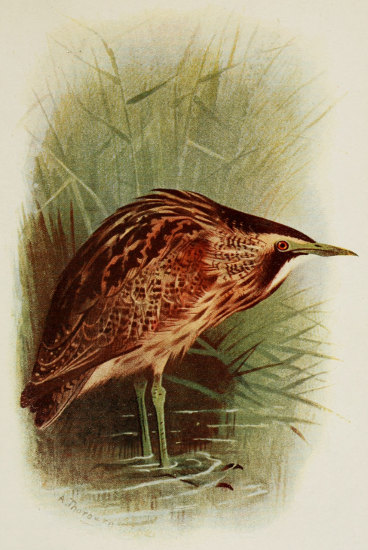
PLATE IX. BITTERN. ⅕ NAT. SIZE.
The bittern is a bird of singular appearance. On the wing he resembles the heron, but it is a rare thing to see him abroad in the daytime. He is strictly nocturnal in habits, and passes the daylight hours concealed in thick reed-beds in extensive marshes. His buff and yellow and chestnut colour, mottled and barred and pencilled with black and brown, gives him a strange tigrine or cat-like appearance; it is a colouring well suited to his surroundings, where yellow and brown dead vegetation is mixed with the green, and the stems and loose leaves of the reeds throw numberless spots and bars of shade beneath. Secure in its imitative colouring, the bittern remains motionless in its place until almost trodden upon. Its active life begins in the evening, when it leaves its hiding-place to prey on fishes, eels, frogs, voles, small birds, and insects, and every living thing it finds and is able to conquer with a blow of its sharp, powerful bill.
When flying he utters a harsh, powerful scream, and he has, besides, a strange vocal performance, called ‘booming’—a sound that resembles the bellowing of a bull. Formerly, when the bittern was a common bird in England, this extraordinary evening performance was the subject of some superstitious notions, and it was commonly believed that, to produce so great a volume of sound, the bird, when screaming, thrust its beak and head into the water. Thus, in Thomson’s ‘Seasons’ we read:—
The bittern knows his time, with, bill submerged, To shake the sounding marsh.
In March or April the nest is made on the ground, among the thick reeds, and is formed of weeds, sticks, and rushes. The eggs are four in number, of an olive-brown colour, sometimes with a greenish shade.
Besides the two species described there are no fewer than eight herons in our list of British birds, most of these being very rare stragglers to our shores:—
Purple heron (Ardea purpurea) is a straggler from the continent of Europe; it breeds in Holland.
Great white heron (Ardea alba).—Eight examples of this species, a straggler from South-eastern Europe, have been obtained in this country.
Little egret (Ardea gazetta).—A waif from Southern Europe; it also inhabits Africa, Asia, and Australia.
Buff-backed heron (Ardea bubulcus).—Inhabits Southern Europe; three examples have been obtained.
Squacco heron (Ardea ralloïdes).—From Southern Europe; occasionally seen on migration in England.
Little bittern (Ardetta minuta).—This bittern almost deserves to rank as a British species, as it is of somewhat frequent occurrence, and has been known to breed in the Broads of Norfolk, and in other localities in Great Britain. It is a summer visitor to most countries in Europe.
Night heron (Nycticorax griseus).—This heron has a range almost as extensive as that of the barn-owl, and breeds in many localities throughout the continent of Europe. The question as to whether or not it has ever bred in England has not been settled; but it is now an almost annual spring and autumn visitor to our country, and it is hardly to be doubted that it would breed with us if unmolested, or, in other words, allowed to live.
American bittern (Botaurus lentiginosus).—A few examples of this North American bittern have been obtained in this country.
Two other families in the present order (Herodiones) are represented by occasional visitors in the list of British birds—two storks (Ciconiidæ), and a spoonbill, and an ibis (Platalaidæ):—
White stork (Ciconia alba).—Common in Holland, and an occasional visitor to the east coast of England.
Black stork (Ciconia nigra).—A rare straggler from continental Europe.
Spoonbill (Platalea leucorodia).—Now an occasional straggler to Great Britain; formerly a regular breeder in heronries in several localities in England.
Glossy ibis (Plegadis falcinellus).—A very rare straggler from Southern Europe.
Grey Lag Goose. Anser cinereus.
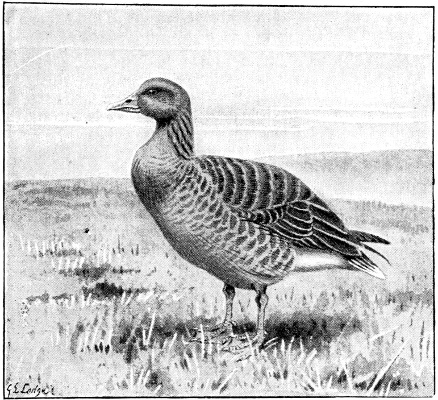
Fig. 75.—Grey Lag Goose. ¹⁄₁₄ natural size.
Head, neck, and upper parts greyish brown; lower breast and abdomen dull white with a few black spots; bluish grey rump and wing-coverts; bill flesh-coloured, with a white nail at the tip; legs and feet flesh-coloured. Length, thirty-five inches.
Eight species of geese are counted among British birds; two of these—the snow-goose (Chen albatus) and the red-breasted goose (Bernicla ruficollis)—may be dismissed at once as rare stragglers to the British Islands. The other six are all winter visitors to our coasts, and are divisible into two natural groups—the grey geese (counting four species), all large birds, brownish grey in colour, and feeders on land; and the black, or dark-coloured geese (two species), very dark in colour, very much smaller in size, and feeders on the tidal flats.
The grey lag is the largest species in the first group, and the only goose that breeds within the limits of the United Kingdom. It was formerly a common summer resident, and bred in the eastern counties of England; it is now confined as a breeding species to a few localities in Scotland and the Hebrides, and in all these last refuges it is said to be rapidly diminishing. That it will diminish still further, until the vanishing-point is reached, hardly admits of a doubt. As a winter migrant from northern Europe it will long continue to visit our coasts, and as a domestic bird we shall have it always with us; for the grey lag is supposed to be the species from which our familiar bird has descended.
The grey lag goose pairs for life, and is gregarious, but is said not to associate with geese of other species. It feeds on grass and young shoots, and in the autumn on grain, and spends nearly the whole day in feeding, and resorts at dark to some open level space to roost, where it is almost impossible to approach within gunshot of the flock, owing to its watchfulness. The grey lag makes a large nest of reeds and grass, lined with moss, and lays six eggs, sometimes a larger number. During incubation the gander keeps guard over his mate, and afterwards assists her in rearing the young. These are led back to the nest every evening by the goose, and sleep under her wing. The male begins to moult a month earlier than the female, and when the time comes he leaves her in sole charge of the young, and withdraws to some hiding-place, or spends the daylight hours on the water, coming to the land in the evening to feed. The goose begins her moult after the young are able to take care of themselves.
The grey lag goose does not range so far north as the allied species; it is only in Norway, where the summer is longest, owing to the influence of the Gulf Stream, that it is found nesting north of the arctic circle.
Bean-Goose. Anser segetum.
The bean-goose differs from the preceding species in its more slender shape and longer bill, which is orange-colour in the middle, black at the base and on the nail; and in its darker colour and the absence of black marks on the breast, and the bluish grey colour on the shoulder of the wing; legs and feet orange-yellow. Length, thirty-four inches.
This species is more arctic in its range than the grey lag, and has not been known to breed in this country, except in a domestic state. It visits Scotland, Ireland, and the north and east coasts of England, in winter. It is less in size than the grey lag, but its habits are similar: by day it feeds on the wolds and stubbles, and its love of grain has won for it the common name of bean-goose, as well as its scientific name, segetum. Its flight is somewhat laboured, with measured wing-beats, but powerful and rapid, and the birds travel in skeins, or in a phalanx formation. It breeds in extensive marshes and lakes, making its nest on the ground among the rushes on small islands. The nest is a slight hollow lined with dead grass and moss, and down from the parent bird: three or four eggs are laid, creamy white in colour, with a rough granular surface. Before the young are able to fly the moulting season begins, when the birds lose the power of flight, as is the case with all the geese; and according to Seebohm’s interesting account, even in the remote and desolate districts in Siberia, to which this bird resorts to breed, the moulting season is one of great danger to it. He says: ‘The Samoyades in the valley of the Petchora gave us glowing accounts of the grand battues which they used to have at these times, surrounding the geese, killing them with sticks, and collecting sacks full of down and feathers.’
Pink-footed Goose. Anser brachyrhynchus.
Colour of plumage as in the bean-goose, but with the bluish grey on the shoulder of the wing as in the grey lag goose; upper mandible pink in the centre; base, edges, and nail black; legs and feet pink. Length, twenty-eight inches.
This goose very closely resembles the bean-goose in habits, colour, and general appearance; the only difference of any importance between the two species consists in the smaller beak of the pink-foot, from which it takes its name of brachyrhynchus (short-billed), and in its legs being pink instead of yellow. It was first described as a distinct species about fifty years ago, but is still regarded by some authorities as only an ‘island form’ of the bean-goose. The pink colour of the bill and feet is found not to be constant, and Seebohm says, ‘It looks very much as if the pink-footed geese had been long enough in the arctic climate of Spitzbergen to change the colour of their feet, but not long enough to make the new colour permanent, and that when bred in the warmer climate of this country they had a tendency to hark back to their ancestors.’
White-fronted Goose. Anser albifrons.
White on the forehead and at the base of the lower mandible; upper parts brownish ash; breast and belly brownish white broadly barred with black; bill orange-yellow, with a white nail at the tip; legs and feet orange. Length, twenty-seven inches.
The white-fronted goose is the fourth and last on our list of grey geese—four forms of one species, as some hold—and, like the others, it comes to us from the north in winter, but is more common in Ireland than in Great Britain. It is like the bean-goose in size, but differs from it in its white front, and from the grey lag goose in having the under parts more speckled with black feathers. Its voice is most like that of the grey lag, but is more trumpet-like in sound, and the rapidly repeated notes give its cry a laughter-like character; laughing goose is one of its common names. It breeds farther north than the bean-goose, and its nest is described as a hollow in the ground lined with dead grass. It lays five to seven creamy white eggs.
Brent Goose. Bernicla brenta.
Bill, head, throat, and neck black, except a small white patch on each side of the latter; mantle brownish black with rufous-brown edges; wing-feathers, rump, and tail black; coverts white; upper breast black; lower breast and belly slate-grey; legs black. Length, twenty-three inches.
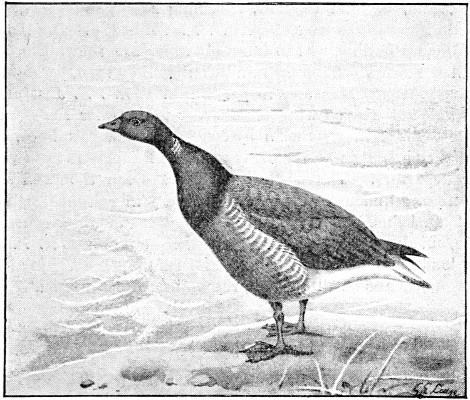
Fig. 76.—Brent Goose. ¹⁄₁₀ natural size.
The brent goose arrives in our islands in the autumn, and remains through the winter in suitable localities in various parts of the coast, from the Orkneys and Shetlands in the north to the Channel Islands; it is, however, most abundant on the north-east coast of England. In most years old and young birds arrive together in flocks; in other years only adults appear, and it is supposed that in such seasons exceptionally cold weather has prevented the eggs from hatching. The brent differs from its nearest ally, the barnacle goose, in its slightly smaller size, darker plumage, which is nearly black, and its more marine habits. With us it spends most of the time out at sea, visiting the tidal flats early and late in the day, and at night, to feed on the wrack grass (Zostera marina). Mr. Abel Chapman has graphically described this goose in his ‘Bird Life on the Border.’ It is, he says, the last of our winter visitors to arrive, seldom coming in force until the new year. Their affections are so hyperborean that they will come no farther south than they are actually compelled by food requirements, being driven reluctantly southwards, point by point, before the advancing line of the winter’s ice. He writes: ‘On alighting at the feeding-grounds the geese at once commence greedily to pull up and devour the blades of the sea-grass, the whole flock advancing in the closest order over the green oozy mud, all heads down except the sentries, of which an ample number are always discernible.... After finishing their morning meal, about noon, the geese are disposed to rest, and spend the middle of the day floating about on the water, preening themselves, and, in mild weather, splashing about, and chasing each other in sheer exuberance of spirit.... Towards evening the geese recommence feeding, and so intensely eager are they about sunset to utilise the few remaining minutes that they then, perhaps, offer the most favourable chance to get within shot.... Just at dark the whole host rise on wing together, and make for the open sea. In the morning they come in by companies and battalions, but at night they go out in a solid army; and a fine sight it is to witness their departure. The whole host, perhaps ten thousand strong, here massed in dense phalanxes, elsewhere in columns, tailing off into long skeins, V’s, or rectilinear formations of every conceivable shape, but always with a certain formation—out they go; ... while their loud clanging honk honk, and its running accompaniment of lower croaks and shrill bi-tones, resound for miles around.’
Barnacle Goose. Bernicla leucopsis.
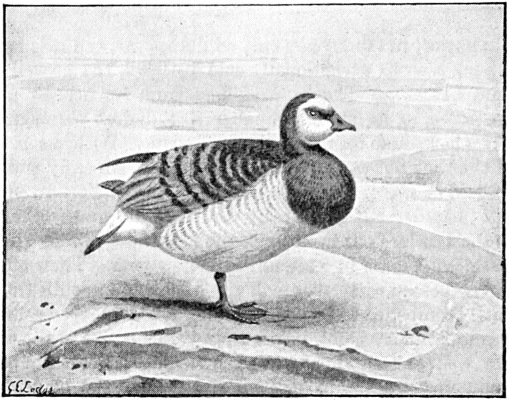
Fig. 77.—Barnacle Goose. ¹⁄₁₀ natural size.
Head, neck, and throat black; forehead, cheeks, and chin white; a black stripe between the eye and bill; mantle lavender-grey barred with bluish black and white; wing and tail feathers blackish; breast and belly greyish; vent and tail-coverts pure white; flanks barred with grey; bill, legs, and feet black. Length, twenty-five inches.
The present species is not nearly so abundant as the brent, and not so exclusively marine in its habits. It sometimes visits inland districts, and although it feeds on the mud-flats like the brent, it leaves them as soon as the tide rises, and repairs to some grassy bank of a river or lake, where it feeds. The breeding habits of this species are not known; it is believed to have its nesting-grounds in Spitzbergen and Nova Zembla.
Mute Swan. Cygnus olor.
Bill reddish orange; the nail, nostrils, lores, and basal tubercle black; plumage pure white; legs and feet black. Length, sixty inches; weight, about thirty pounds.
The mute, or tame swan, is as well known to most people as the turkey, goose, and pheasant, and, like the pheasant, is supposed to be a foreign species, said to have been first brought from Cyprus to this country, by Richard I., about the end of the twelfth century. As a semi-domestic species it exists throughout the British Islands, but whether wild birds of its species visit us or not is not known, since wild and semi-wild birds are indistinguishable. The wild mute swan breeds in Denmark and South Sweden, in South Russia and the valley of the Danube, and many other localities, and in winter visits the Mediterranean. The breeding habits of the wild and tame bird are the same, but, according to Naumann, the wild bird in the pairing season has a loud, trumpet-like note, resembling the cry of a crane or whooper swan.
The cygnet is sooty grey in colour, but in the so-called ‘Polish swan’ (Cygnus immutabilis) of Yarrell, which is now regarded by most ornithologists as a variety of the mute swan the cygnets are white.
Whooper Swan. Cygnus musicus.
Beak: anterior part depressed and black, basal part quadrangular and lemon-colour; plumage white; legs and feet black. Length, sixty inches; weight, about twenty-four pounds.
The whooper, also called the wild swan and the whistling swan, is a not uncommon visitor to our coasts in winter, and a little over a century ago had a breeding-station in the Orkneys. It is very closely related to the mute swan, but it ranges very much farther north in summer, its breeding-grounds being north of the arctic circle. The nest is bulky, composed of sedge and coarse herbage, and the eggs are four or five in number, and white. Seebohm, who observed its habits in its breeding-grounds, says: ‘The whooper is a ten times handsomer bird than a tame swan in the eyes of an ornithologist, but is not really so graceful—its neck is shorter, and its scapulars are not so plume-like. Instead of sailing about with its long neck curved in the shape of the letter S, bent back almost to the fluffed-up scapulars, the whooper seemed intent on feeding with his head and neck under water.’ He compares the notes of the whooper to a bass trombone; but the notes are short—three or four trumpet-blasts, keeping time with the upward and downward beat of the wings. He adds: ‘The extermination of the whooper in so many of its breeding-places has arisen from the unfortunate habit, which it evidently acquired years ago, before men came upon the scene—a habit which it shares with the goose. Most birds moult their quills slowly, in pairs, so that they are only slightly inconvenienced by the operation, and never without quills enough to enable them to fly. Swans and geese, on the other hand, drop nearly all their flight-feathers at once, and for a week or two, before the new feathers have grown, are quite unable to fly. In some localities the whoopers have had the misfortune to breed where the natives have been clever enough to surround them at the critical period of their lives, and stupid enough to avail themselves of the opportunity thus afforded of killing the geese that laid the golden eggs.’
Bewick’s swan (Cygnus Bewickii), named by Yarrell after Thomas Bewick, author of a well-known ‘History of British Birds,’ is of frequent occurrence in the British Islands in severe winters, but is not a regular visitant. It is a third smaller than the whooper, which it resembles in figure and habits.
Common Sheldrake. Tadorna cornuta.
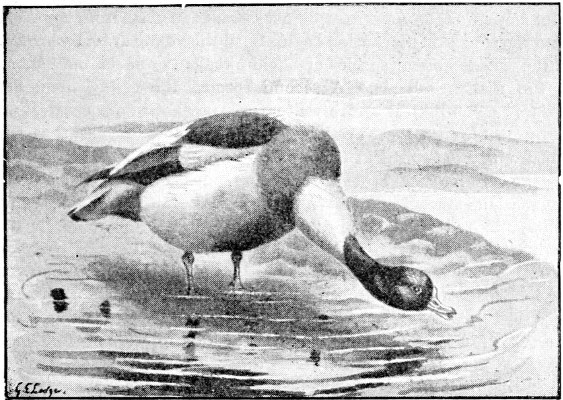
Fig. 78.—Sheldrake. ¹⁄₁₀ natural size.
Beak and basal knob bright red; head and upper neck dark glossy green, followed by a white collar, below which is a chestnut band; wing-coverts white; speculum green; scapulars, part of the secondaries, and the primaries black; rump, upper tail-coverts, and tail-feathers white, the latter tipped with black; lower, central line of the breast and belly dark brown, the rest of the under parts white; legs and feet pink. Length, twenty-six inches. The female is without the knob at the base of the bill, and her colours are not so bright.
The sheldrakes, or sheld-ducks, are curious and interesting birds, and form a connecting-link between the geese and ducks; but they are more like the former than the latter, and sheld-gander, or sheldgoose, would perhaps be a more suitable name. The common sheldrake is, perhaps, the most duck-like in appearance of all the birds of this genus, and the common name, sheld, which means parti-coloured, really applies to this species only. As in the geese, the male and female sheld-ducks are nearly alike in plumage, and the male does not change colour; and, like the gander, he assists his mate in rearing the young. In the true ducks the drake changes his plumage in summer, becoming like the female in colour, and in most cases (for there are exceptions) he remains apart from the duck from the time that incubation begins until the young are fully grown. Of the seven known species of sheldrake, only one is indigenous to the British Islands. A second species, the ruddy sheldrake (Tadorna casarca), is a rare visitor, or straggler, to our coasts, and it is probable that most of the sheldrakes of this species that are shot from time to time in England are escaped birds.
The common sheldrake is a bird that, once seen, cannot be easily forgotten, its strange guinea-pig arrangement of three colours—black, white, and red—making it one of the most strikingly conspicuous fowls in this country. On account of its handsome and singular colouring it is much persecuted, and as a breeding species is becoming increasingly rare with us. It inhabits sandy sea-coasts, and is only seen as a rare straggler on inland waters. It feeds close to the shore where the sea is shallow, and is partial to coasts where wide stretches of sand, mixed with rocks, are uncovered at low water. It feeds, both in the water and on the flats, on marine insects and molluscs, and breeds in the sandhills along the coast. The nesting-hole is in most cases a deserted rabbit-burrow, but it also burrows for itself, and is known as the ‘burrow-duck’ on many parts of the coast. The hole is six to twelve feet in length, ending in a chamber lined with dry grass and moss. Seven to twelve creamy white eggs are laid, sometimes a larger number. The eggs are enveloped in a quantity of down, which the bird plucks from her own body. It is said that the male takes no part in incubation, but remains near the burrow on guard, and gives timely warning of danger, and when the young are hatched and taken to the sea, assists in rearing and protecting them.
The sheldrake has a harsh cry, but in the breeding season the drake utters a soft, tremulous, whistling note.
Wigeon. Mareca penelope.
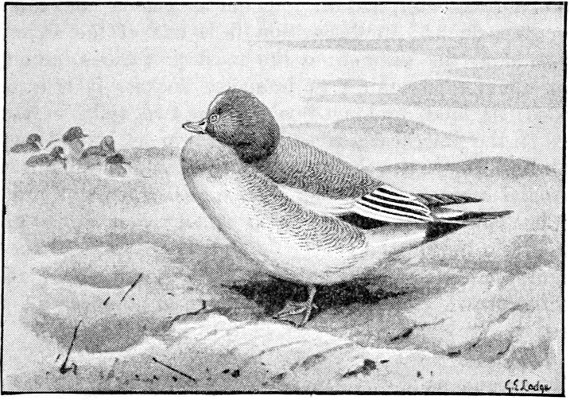
Fig. 79.—Wigeon. ⅐ natural size.
Bill dull blue; forehead and crown cream-white; chin, neck, and throat chestnut; the cheeks and hind neck minutely spotted with deep green; breast white; under parts grey, the flanks pencilled with dark grey; mantle vermiculated grey; shoulder white, with a terminal bar of black, followed by a green speculum tipped with black below; wing- and tail-feathers dark brown; legs and feet dark brown. Length, eighteen inches. Female: above, mottled greyish brown; shoulder whitish; speculum greyish green; under parts mottled buffish white. The drake assumes female plumage in July.
Next to the mallard, the wigeon is the most familiar freshwater duck in the British Islands. Its abundance, handsome plumage, peculiar voice, and interesting habits, to say nothing of its excellence as an article of food, contribute to make it well known. It is a visitor in winter in very large numbers to our coasts, and seeks its food both on the tidal flats and on inland waters throughout the country, but is always most abundant in the vicinity of the sea. In April and May it migrates to higher latitudes: in Scotland it is partly a resident species, and breeds in many localities; and, in less numbers, it also remains to breed in Ireland. The wigeon differs a good deal from other ducks in its feeding habits: it feeds both by day and night, in the water and on land. On land it is, like the goose, a grass-eater, and in Lapland is known from this habit as the ‘grass-duck.’ In disposition it is one of the shyest and wariest; and at the same time the most gregarious, among the waterfowl, and often unites in immense flocks. It is also very loquacious: its loud, prolonged whistle in two syllables, strongly accented on the first, is described by Seebohm as being ‘very wild and weird, as it startles the ear on the margin of a mountain tarn or moorland lake—a solitary cry, very high in key, not unmusical in tone, but loud and piercing.’ It is called ‘whew duck’ in some localities, from its whistling cry.
The nest is placed amidst coarse grass or heather, and is deeply lined with down. The eggs are seven to ten in number, and cream-coloured.
A few specimens of the American wigeon (Mareca americana) have been obtained in various parts of Great Britain.
Pintail. Dafila acuta.
Head and neck bronze-brown, black on the nape; a white stripe down the neck on each side, extending to the white breast and under parts; back and flanks mottled grey; greater wing-coverts buff; speculum green margined with black and white; tail black, the two middle feathers greatly prolonged; under tail-coverts black; bill, legs, and feet slaty grey. Length, twenty-eight inches. Female: mottled brown above and greyish white below; speculum green. In July the male assumes the female dress, and retains it until October.
The pintail, although not so handsomely coloured as the shoveler, mallard, wigeon, and teal, is the most elegant of the freshwater ducks, being slim and graceful in form, with the two slender middle feathers of the tail greatly elongated. Sea-pheasant is one of its local names, but the same name is sometimes given to the long-tailed duck (Harelda glacialis) on the north-east coast. The pintail is a winter visitor only to the British Islands, appearing in October, and is most common on the south coast. It is found in small flocks, and prefers shallow waters with muddy bottoms, and feeds on aquatic weeds, insects, and crustaceans. It is always most abundant near the shore, but is also met with on inland waters. It has a rapid flight, and is a comparatively silent bird by day; its cry by night is a low quack, and in spring, during courtship, the drake utters soft and inward notes, which he accompanies with some curious gestures and antics. The pintail breeds freely in a semi-domestic state, and lays seven to ten eggs, pale buffish green in colour.
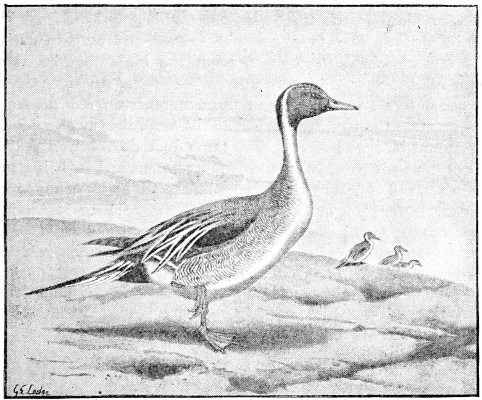
Fig. 80.—Pintail. ¹⁄₁₀ natural size.
Mallard, or Wild Duck. Anas boscas.
Bill yellowish; head and neck glossy green, followed by a white ring; hind neck and breast deep chestnut; across the secondaries a greenish purple speculum, bordered above and below with white: rump, upper tail-coverts, and the four middle curled tail-feathers black; the rest of the tail-feathers grey; flanks and belly greyish white; under tail-coverts velvet-black; legs and feet orange-red. Length, two feet. Female: smaller; bill greenish; crown dark brown; general plumage mottled brown and buff; speculum green.
The mallard is the most common and best-known freshwater duck in Britain, and is a resident species, breeding in suitable localities throughout the country; but the birds that breed and remain all the year are few in number compared to the migrants that come to us in winter from more northern regions. In the domestic state the mallard is, next to the fowl, the most abundant and familiar bird we possess. The tame duck differs from the mallard only in its heavier body and shorter wings, and in being polygamous instead of monogamous in its habits. The tendency to vary in colour is a result of domestication in all species. It was from observing the annual change in the plumage of the domestic drake that the discovery was made that ducks differ from other birds in the manner of their moult. The period of the moult does not coincide in the drake and duck; and this discrepancy in the sexes has caused ducks to differ in their breeding habits from all other birds. Thus, in most birds, male and female share the labours of incubation, and of rearing and protecting the young; and the moult, which is always a period of danger, during which the bird is obliged to go into hiding, takes place some time after the young are able to shift for themselves—in other words, the family tie is broken after it has ceased to be necessary; and the female of the mallard, and of other ducks, moult in this way. Not so the male. He is smitten by the change after the eggs are all laid and incubation begun; with the result that the marriage tie is dissolved just at the period when his help is most needed. This is one of the strangest things in bird history; for up to the time when the physical change begins the drake is not less loving and solicitous than any other male bird, and if by chance the moulting period is delayed, he continues to guard the nest and share the labours of incubation; so that we may say, without straining a metaphor, that the drake is forcibly torn away from his marital duties, just as the late-breeding swift or swallow is sometimes forced by an overpowering migratory instinct to abandon its helpless young in the nest. The action of the swift in leaving its helpless young to perish of starvation in the nest is painful to contemplate, since we are accustomed to look on the parental affection as the most powerful of all; and in this case there is a conflict between this emotion and another—the desire for another climate; and the last conquers, and the young are forsaken. In the drake it is not a case of a conflict between two emotions or two instincts, but of a physical change, which kills or makes nugatory the instinct and emotion; for it is certain that the moulting period in all species that, like the duck, change their whole plumage in a short time, is not only a period of danger, but of suffering. When the change comes the bird acts like the ‘stricken deer,’ and like animals afflicted with some fatal disease: he goes apart, and remains in hiding until his new plumage has grown, and with renewed health his social instincts are restored. It is only in the case of the male duck that this change from health and strength to sickness and impotence falls in the midst of the breeding season.
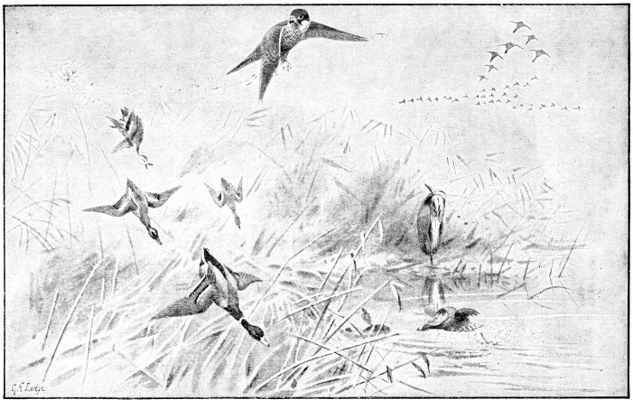
Mallards. Peregrine Falcon. Heron. Coot.
Another extraordinary fact about the moulting of the drake is that, in moulting, he puts on the dress of the female. The moult is complete, but only after the whole of the small feathers have been changed are the wing- and tail-feathers shed, and as these are all shed at once, the bird is for some time incapable of flight. But while in this incapable condition he is no longer a drake in appearance—a bird of rich and conspicuous colouring—but has a dull mottled brown like the duck. This annual ‘eclipse,’ as Waterton called it, lasts for three or four months; and then there is a second, autumnal moult, of the body-feathers only, in which the rich colours of the male sex are recovered.
The duck, in the meantime, moults only once in the year.
A slight difference has been noted between the resident mallard that breeds in the British Islands and the mallard from the north that visits us in winter, the native bird being heavier.
Gadwell. Chaulelasmus streperus.
Beak lead-colour; head and upper neck light brown with darker mottlings; back marked with crescents of light grey on a dark ground; median wing-coverts chestnut; greater coverts blackish; primaries brown; secondaries brown and black, the outer webs forming a white speculum; rump and upper tail-coverts bluish black; tail-feathers dark brown with pale edges; lower neck dark grey, each feather with a pale grey margin; breast and belly white; flanks and vent grey; under tail-coverts bluish black; legs and feet orange. Length, twenty-one inches. Female: head and upper neck light brown mottled with dark; lower hind neck and upper parts brown; speculum and under parts white.
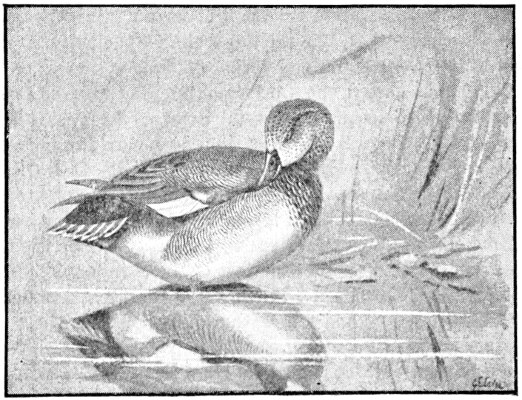
Fig. 81.—Gadwell. ¹⁄₁₀ Natural Size.
The gadwell most nearly resembles the mallard, but is not so richly coloured, and is smaller in size. It is a widely distributed species, ranging over a greater portion of the northern hemisphere. In the British Islands it is a winter visitor in small numbers, very few pairs remaining to breed, except in one locality in Norfolk, where it has been strictly protected for the last forty years, with the result that it breeds regularly, and is abundant. Elsewhere it is the rarest of the British freshwater ducks. The wings are long and sharply pointed, and the flight exceedingly rapid. When flying it frequently utters its cry, which resembles that of the mallard, but is shriller in tone. Like the mallard, it is a night feeder; during the daylight hours it usually remains concealed in the closest cover. Its nest, lined with dry grass and a quantity of down, is placed on the ground at some distance from the waterside. Eight to twelve buffish white eggs are laid.
Garganey. Querquedula circia.
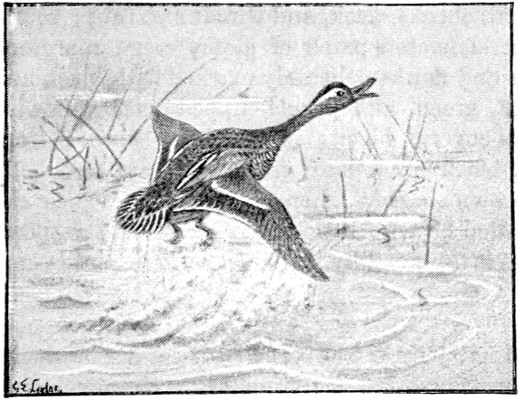
Fig. 82.—Garganey. ¹⁄₁₁ natural size.
Bill black; forehead, crown, nape, and back dark brown; from the eye a white stripe extending to the back of the neck; cheeks and neck light brown with short hair-like lines of white; scapulars black, with central white stripe; wing-coverts bluish grey; speculum green between two bars of white; primaries and tail dull brown; chin black; breast pale brown with dark crescentic bands; belly white; flanks with transverse black lines; under tail-coverts black and white; legs and feet greyish brown. Length, sixteen inches. Female: mottled brown; stripe over the eye yellowish white; speculum dull metallic green between two white bars.
The garganey, or summer teal, or cricket teal, as it is sometimes called, on account of the low, jarring note of the male in the pairing season, differs considerably from its nearest relation, the common teal, both in its larger size and its colouring, which a little resembles that of the shoveler. It is an early spring visitor to the British Islands, rare in England, and still rarer in Scotland and Ireland. It remains to breed in suitable localities in this country, and is perhaps most common in the district of the Broads in Norfolk. It flies swiftly, and utters on the wing a sharp, quacking cry, sometimes repeated twice. Its feeding habits are similar to those of the teal, but it is not esteemed a good bird for the table. The nest is made among the coarse grass and herbage in swampy ground; eight or nine creamy white eggs are laid sometimes a larger number.
Teal. Querquedula crecca.
Bill blackish; crown, cheeks, neck, and throat chestnut; round and behind the eye an elongated patch of glossy green margined with buff; upper parts and flanks delicately marked with black and white; speculum black, green, and purple, tipped with yellowish white; rump and tail-coverts black; tail-feathers brown; front of neck spotted with black on a buff ground; breast and belly white; legs and feet brownish grey. Length, fourteen inches and a half. Female: mottled brown; little or no purple on the speculum. The female dress is assumed by the drake in July, and is kept until October.
The handsome and natty little teal is the smallest of our ducks, its weight being only one third that of the mallard. In appearance it is a small wigeon, but whereas the wigeon is the wildest of our wild ducks in disposition, the teal is the tamest. It is chiefly a winter visitor to this country, and from September until spring is found throughout the British Islands. A considerable number of pairs remain to breed in suitable localities throughout England, and more numerously in Scotland and Ireland. The nest is placed on the ground on the borders of a marsh or bog, and sometimes at a distance from water, among heather or herbage; it is made of dry grass and leaves, and, later on, down from the bird is added. The eggs are creamy-white or pale buff in colour, with a tinge of green, and eight or ten in number, sometimes as many as fifteen. The teal feeds chiefly by night, on aquatic plants, insects, slugs, and small crustaceans. Its call-note is a short, sharp quack, and in the pairing-time the drake emits a low, jarring note. The drake does not moult so early as most ducks, and remains longer with the female during the breeding season, leaving her only when the young are partly grown.
Two American species of teal—the blue-winged teal (Querquedula discors) and the green-winged teal (Q. carolinensis)—have been obtained in Great Britain, one specimen of each.
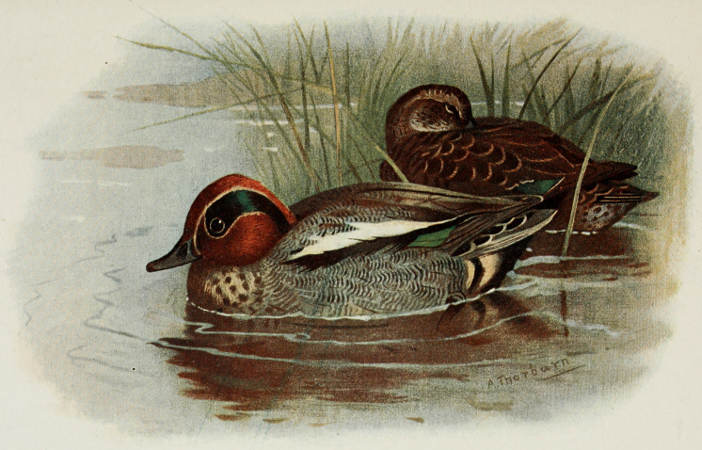
PLATE X. TEAL (MALE AND FEMALE). ⅓ NAT. SIZE.
Shoveler. Spatula clypeata.
Bill lead-colour, very broad at the tip; head and upper neck green; lower neck and scapulars white; middle of the back dark brown; shoulders pale blue; greater wing-coverts white; secondaries dark brown with a green speculum; primaries, rump, upper and under tail-coverts, and tail-feathers, blackish; breast and belly rich chestnut; flanks freckled with dark brown on a paler ground; vent white; legs and feet reddish orange. Length, twenty inches. Female: brown with dark and light mottlings. In summer, the male in moulting assumes the colours of the female.
The shoveler is the handsomest of the British freshwater ducks, and the most singular in appearance, on account of the great breadth of its spoon-like bill. Its plumage also, although beautiful, strikes one as somewhat singular; for it is rare to find pale and delicate hues, like those on the wings and upper parts of this duck, together with a deep, rich colouring, as on the head, upper neck, and under parts. The pale blue and pure white contrast beautifully with the deep green and chestnut-brown. Another most interesting point in the shoveler’s history is its distribution. There is but one shoveler duck in the northern hemisphere, over which it has an immense range, including Europe, North Africa, Asia, and North America from Alaska to Panama. But in the southern hemisphere there are four other species, occupying respectively the four following widely separated regions—South America, South Africa, Australia, and New Zealand.
The shoveler is a winter visitor to the British Islands; it also breeds sparingly in some localities in the Midlands, in East Anglia, and the northern counties; also in the Hebrides, and in one or two spots in Ireland. It is a very early breeder, placing its nest, lined with dry grass and down, on the ground, usually near the water, and it lays eight to fourteen eggs, pale greenish buff in colour.
In the breeding season it utters a low quack, but at other times is a silent bird.
Tufted Duck. Fuligula cristata.
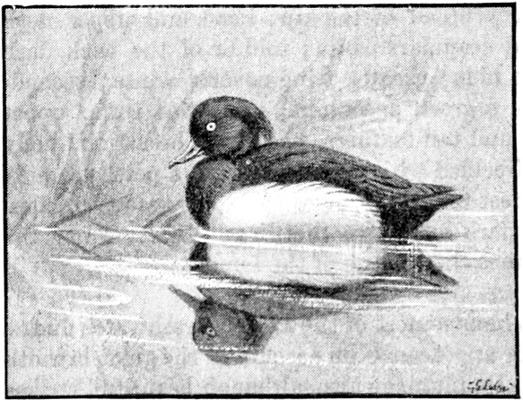
Fig. 83.—Tufted Duck. ¹⁄₁₁ natural size.
Black, the head and neck with purplish gloss; speculum, flanks, and belly white; bill pale blue; irides brilliant yellow; legs and feet dark blue. Length, seventeen inches. Female: dark brown; under parts brownish grey. Male changes colour in May.
Of sea or diving ducks (including the mergansers) no fewer than twenty species, referable to nine genera, have been described as ‘British.’ Of this number nine species are irregular visitants or stragglers, and may be dismissed with a mention of their names: Red-crested pochard (Fuligula rufina), white-eyed duck (Nyroca ferruginea), Barrow’s goldeneye (Clangula islandica), buffel-headed duck (C. albeola), harlequin duck (Cosmonetta histrionica), Steller’s duck (Heniconetta Stelleri); king eider (Somateria spectabilis); surf-scoter (Œdemia perspicillata), and hooded merganser (Mergus cucullatus).
Of the eleven species, referable to six genera, that breed in, or regularly visit, these islands, and may properly be described as British birds, three are mergansers, the least duck-like of the ducks in their curiously modified beaks and grebe-like habits. Of the other eight species, four only are, strictly speaking, sea-ducks, being (on our coasts) exclusively marine in their habits. These are the eider, the long-tailed duck, the common scoter, and the velvet scoter. The tufted duck, pochard, and goldeneye, are marine and freshwater ducks. The scaup is more of a sea-duck than these three, and may be said to be intermediate in its habits between the two groups.
These eight diving ducks are all interesting, and some of them very handsome birds in their richly coloured and conspicuous plumage. They have stout, heavy-looking figures, and are clumsy walkers on land; but in the water they are as much at home as grebes and guillemots, and are also strong on the wing. But they are not so familiar to us as the mallard, wigeon, and teal, as comparatively few persons have the opportunity of observing them. Mr. Abel Chapman, in his valuable work, ‘Bird Life on the Border,’ says that these ducks are only well known to those ‘who are enthusiastic enough to follow the regular sport of wildfowling afloat, and who alone enjoy the opportunity of becoming acquainted with these wild creatures in their bleak and desolate haunts.’
The tufted duck is a winter visitor to our coasts, also a resident throughout the year, and a regular breeder in various localities in England, Scotland, and Ireland. In winter it is both a sea- and freshwater duck; in the breeding season it is exclusively an inhabitant of inland waters, with a preference for small ponds with weedy bottoms. It pairs in March, and male and female thereafter keep company until incubation begins, when the marriage tie is dissolved, as is the case with most ducks. It feeds chiefly by night, and is inactive by day, floating lazily on the water, dozing, or preening its feathers. At sunset it leaves the pool where it has passed the day, to seek its feeding-grounds. Its food consists of weeds growing at the bottom, for which it dives, and, tearing them up, brings them to the surface, to be eaten at leisure.
The nest is placed among the rushes at the waterside, or in the centre of a tuft of aquatic grass, and is composed of dry sedges and grass, to which down is added as incubation progresses. Eight or ten eggs are laid, sometimes more, greenish buff in colour.
When rising from the water it utters a grating cry. In winter it is gregarious, and is often seen associating with the scaup, pochard, and goldeneye.
Scaup. Fuligula marila.
Head, neck, upper breast, and back glossy black; mantle finely vermiculated with greyish brown and white; speculum white, terminated with greenish black; rump, wing- and tail-feathers brown; belly white; bill pale blue; irides straw-yellow; legs and feet dull blue. Length, eighteen inches. Female: brown; a broad white band round the base of the bill; upper breast and mantle vermiculated with grey; belly dull white.
The scaup is common with us in winter, and found on most parts of the coast, but never remains to breed. It does not come inland, like the tufted duck and goldeneye, but is met with in estuaries and the mouths of tidal rivers. In its breeding-haunts in the extreme north of Europe it penetrates to lakes and rivers at a considerable distance from the sea. It feeds on shellfish, crustaceans, aquatic insects, also on vegetable food, which it obtains by diving. It is gregarious at all times, and in the breeding season is seen in small flocks, feeding or floating idly on the water. It rises heavily, and flies rapidly, with violently-beating wings. Seebohm, who observed it in its summer haunts, says of its language: ‘Of all the cries of ducks that have come under my notice, I think that of the scaup is the most discordant. None of them are very musical, perhaps; but if you imagine a man with an exceptionally harsh, hoarse voice, screaming out the word scaup at the top of his voice, some idea of the note of this duck may be formed.’
The scaup makes its nest near the water, and lays from six to nine eggs, of a pale greenish grey colour.
Pochard. Fuligula ferina.
Head and neck chestnut-red; breast and upper back black; mantle finely freckled with black and white; speculum inconspicuous and grey; under parts greyish white; tail-coverts black: bill black with a blue band across the middle; irides red; legs and feet bluish grey. Length, nineteen and a half inches. Female: dull brown; chin white.
The pochard is a common winter duck when it comes to us from northern Europe; it is a resident throughout the year in small numbers, and breeds regularly in many localities in Great Britain and Ireland. As a breeding species it has, however, greatly diminished in numbers, owing to the extensive draining of marshes and meres in recent times. The pochard is more a freshwater than a sea-duck, and comes nearest to the tufted duck in its habits, obtaining its food by diving, and tearing up the grass and weeds from the lake-bottom. It feeds chiefly on vegetable matter, and is considered a better bird for the table than any other diving duck. In its flight it resembles the tufted duck, and also has a harsh, quick cry, like that species, when alarmed. At other times it has a low, whistling call-note. The nest is a hollow among the herbage near the water, or in a tussock of sedge, and is lined with dry grass, and with down from the sitting-bird. Seven to ten or twelve eggs are laid, in colour like those of the scaup.
Goldeneye. Clangula glaucion.
Head and neck glossy green, the crown-feathers slightly elongated; a white patch at the base of the bill; back black; lower neck, scapulars, speculum, and under parts white; thighs dark brown; bill bluish black; irides golden-yellow; legs and toes yellow, with blackish webs. Length, nineteen inches. Female: dark brown above, without the white face-spot; below, white. The female colour is assumed by the male in summer.
The goldeneye is a regular winter visitant to the British Islands, remaining from the middle of October to the middle of April. In language and flight it resembles the scaup and tufted duck, but its flight is more violent, the rapidly-beating wings producing a loud, whistling sound. It passes most of the time on the water, and dives for its food, which consists of small fishes, frogs, shellfish, and insects; also seeds and tender shoots of water-plants. During the winter it inhabits the sea and inland waters indifferently; but in its summer haunts it seeks an inland lake, marsh, or river, where it has the peculiar habit of nesting in the trunk of a hollow tree. The eggs are deposited on the rotten wood at the bottom of the cavity, and a thick bed of down from the sitting-bird is made. As many as nineteen eggs are sometimes laid, but a dozen or thirteen is the more usual number. They are smooth and glossy, and greyish green in colour. The natives in the summer home of the goldeneye place suitable nesting-boxes, with small entrance-holes, in the trees; the ducks readily occupy the boxes, and return to them year after year, although always robbed of their eggs. When the young have hatched the parent bird takes them in her beak, and carries them one by one to the water.
Long-tailed Duck. Harelda glacialis.
Head and neck, white with brownish grey cheeks, and below, on each side of the neck, an oval patch of dark brown; back, rump, and tail-feathers blackish; long scapulars, inner secondaries, short outside tail-feathers, belly, and flanks white; breast, wing-coverts, and primaries brownish black; bill, rose-colour in the middle, base and tip black; irides yellow or red; legs and feet pale lead-colour. Length, twenty-six inches. Female: brown; stripe above the eye and lower parts white.
The long-tailed duck has the most elegant figure of the sea and diving ducks, if we except the mergansers, and although not so richly coloured as some species, is a beautiful bird in its white and brown plumage, bright red irides, and rose-coloured bill. During its winter sojourn on our coasts it is exclusively marine in its habits. To the south and east coasts its visits are irregular; on the west coast of Scotland and in the Hebrides it is common; in Ireland it is restricted to the north coast. It is more arctic in its distribution than any other duck, and in summer is only to be met with north of the limit of forest growth. In its summer haunts it goes inland to breed, and Seebohm says: ‘Probably the explanation of its almost exclusive attachment to salt water in winter is to be found in the fact that it rarely winters in a climate where all the fresh water is not frozen up.’ A charming account is given by the same author of the habits of the long-tailed duck in its summer home in the Siberian tundra—a vast level region of swamps and lakes, gay with bright-tinted moss and lichen, and brilliantly-coloured arctic flowers. The ducks were abundant and very tame, in strange contrast to their excessively shy and wary disposition on our coasts. The smaller lakes were inhabited by single pairs, the larger sheets of water by several pairs. Each pair appeared to be very jealous of any invasion of its breeding-grounds, and severe battles were frequent between the males. The call of the drake was very peculiar, and often heard, and was a loud, clear cry of three syllables, the middle one prolonged and strongly accented. In its summer haunts it feeds on water-plants. The drake does not leave his mate after the eggs have all been laid, but assists in incubation and in protecting the young. The nest is a slight hollow in the ground with down for lining; the eggs are pale buffish green in colour.
Mr. Abel Chapman says that, like other sea-ducks, this species gets its food by diving, but is not a bottom-feeder like the eider and scaup, which cannot feed in water more than two or three fathoms deep. The long-tail feeds on small marine animals floating in the water, and is hence able to feed in deep as well as shallow seas at a distance from land.
Eider Duck. Somateria mollisima.
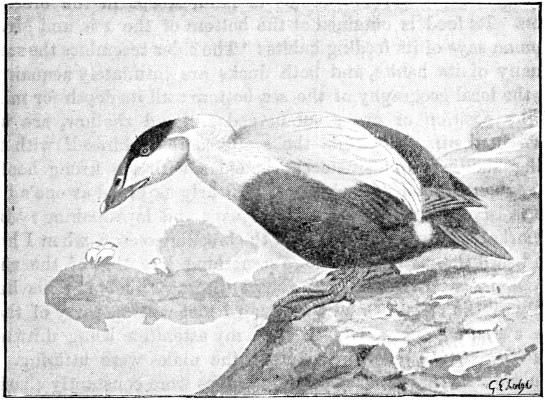
Fig. 84.—Eider Duck. ¹⁄₁₀ natural size.
Bill greenish; down its centre, halfway to the nostrils, is a wedge of feathers which are black, like those of the forehead and crown; the latter bisected by a white line running to the pale green nape, and divided by another white line from a green patch on each side of the neck; cheeks, back, and wing-coverts white; long sickle-shaped secondaries yellowish white; wing-feathers, rump, and tail nearly black, with a white patch on each side of the latter; breast rosy buff; abdomen black; legs and feet dull green. Length, twenty-five inches. Female: rufous-brown barred with blackish.
The male eider is a large and strikingly handsome duck in its conspicuous and strongly contrasted colours—velvet-black and snowy white, variegated with buff and delicate pale sea-green. But it is exclusively a sea-duck, living most of the time away from land, and most people know it only by name, as the bird that yields the exceedingly light and elastic down with which bed-quilts are stuffed. It inhabits the northern coasts of Great Britain, its most southern breeding-station being on the Farne Islands, off the coast of Northumberland. It is gregarious at all seasons, and is usually seen in small flocks on the sea. It sits lightly on the water, swims and dives well, and flies rapidly near the surface. It feeds much near the shore, but seldom comes to land, except in the breeding season. Its food is obtained at the bottom of the sea, and Mr. A. Chapman says of its feeding habits: ‘The eider resembles the scaup in many of its habits, and both ducks are intimately acquainted with the local geography of the sea-bottom: all its depth for miles, and the position of every submerged reef and shallow, are well known to them. But while the scaup contents himself with the smaller shellfish and crustacea, the eider, with his strong hooked beak, can crush and devour dog-crabs nearly as broad as one’s fist.’ Charles Dixon thus describes its language and love-making: ‘It is a remarkably silent bird, except in the breeding season, when I have often heard the male utter a note something like that of the ringdove, as he swam round and round his mate, bobbing his head rapidly all the time. On one occasion I met with a party of these birds evidently engaged in pairing, my attention being drawn to them by a chorus of grunting notes the males were uttering. It was a most animated sight, and the drakes were constantly chasing each other with angry cries, or swimming excitedly round the ducks, with trembling wings and heads swaying up and down. The noise made by this party of eiders could be distinctly heard a mile across the water.’
The nest, as a rule, is placed near the sea, sometimes on the tops of lofty cliffs, and is usually concealed among the coarse grass, heath, and herbage that grow in such situations. It is a hollow lined with fine grass and seaweed, and a quantity of down plucked from the under parts of the sitting-bird. The eggs are five to seven in number, and are smooth, oval in shape, and of a pale dull green colour. The female continues to pluck down from her body during incubation, until the eggs are enveloped in a large mass of it; and on leaving the nest to feed she covers the eggs with the down. At this time the drake is not wholly forgetful of her, and on her appearance, when she leaves her eggs to feed, he usually keeps company with her, and after she has left the water rejoins his male companions.
The drake is at all times a shy and wary bird; but in the breeding season the ducks, if not molested, are very tame, and at the Farne Islands the sitting-bird will sometimes allow her back to be stroked, without leaving her eggs.
Common Scoter. Œdemia nigra.
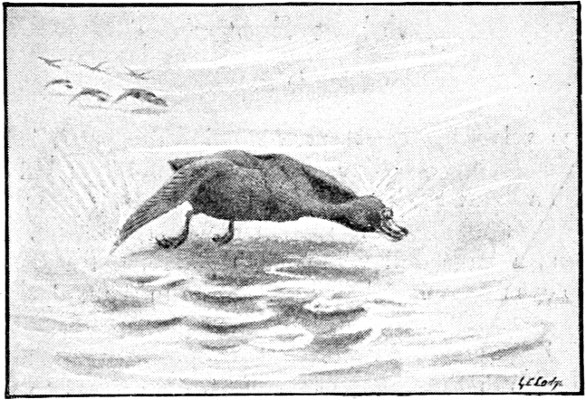
Fig. 85.—Common Scoter. ¹⁄₁₂ natural size.
Black, the upper parts glossy; central ridge of the upper mandible orange. Length, twenty inches. Female: blackish brown above, dark brown below.
The common, or black scoter, is a large, handsome bird, whose handsomeness is due to its uniform blackness, reminding one of those two familiar beauties and favourites, the blackbird and the domestic black cat; and as with these two—one with splendid yellow eyes, the other with a golden dagger for a beak—so is the scoter’s blackness relieved, and its handsomeness brought out, by a touch of bright orange on the upper mandible. It is the most marine of the diving ducks, and a deep-sea feeder like the long-tailed duck. Its breeding-grounds are in northern Europe, West Siberia, and Iceland, but a few pairs breed annually in the north of Scotland. The nest is a hollow in the ground near the sea, lined with dead leaves and grass, and with down from the sitting-bird. The eggs are eight or nine in number, and of a pale greyish buff. In winter the black scoter visits our coasts in thousands, and is the most common sea-duck. It does not appear to breed until its second year, as large numbers in immature plumage remain on our coasts throughout the summer. The scoter has a harsh cry like that of the tufted duck, and in spring the drake has a love-call, said to be not unmusical.
Velvet Scoter. Œdemia fusca.
Plumage velvet-black, except a small white patch behind the eye and a conspicuous white bar across the wing; bill apricot-yellow, with a black tubercle at the base; irides white; legs and toes orange-red; webs black. Length, twenty-two inches. Female: sooty brown; a large dull white patch before, and a smaller one behind, the eye; speculum less defined than in the male.
Mr. Abel Chapman, comparing this species with the last described, has given the best picture of it. He says: ‘The velvet scoter is a larger and handsomer species, the jet-black plumage of the old drakes being peculiarly rich and glossy, and is easily distinguished at any distance by the broad white speculum on the wings, closely resembling an old black cock, if one could imagine such a bird far out at sea.’ It is not known whether the velvet scoter breeds in Scotland or not. In summer it is found on inland lakes in Scandinavia and Northern Russia, and it visits our coasts in winter, but not in such large numbers as the common scoter. It is not so exclusively marine in its habits as that species.
Goosander. Mergus merganser.
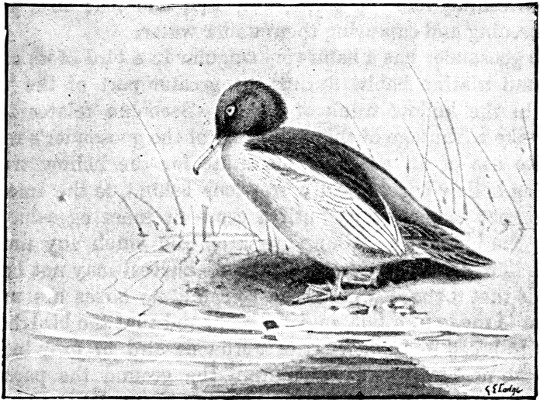
Fig. 86.—Goosander. ¹⁄₁₂ natural size.
Bill and irides blood-red; head and upper neck glossy dark green; lower neck and under parts white tinged with salmon-pink; upper back and scapulars black; wing-coverts white; primaries and some of the secondaries ash-brown; lower back and tail ash-grey; legs and feet orange-red. Length, twenty-six inches. The female is less conspicuously coloured, and has a reddish brown head and neck.
The mergansers are sea-ducks of slimmer and more elegant forms than the species already described, and differ from scaups, eiders, and scoters as terns differ from gulls. They have grebe-like necks and long, slender, serrated bills, and a variegated plumage with strongly contrasted colours.
The goosander is the largest of the three British species, and is not uncommon in winter on some parts of the coast, and is abundant in the west districts of Scotland. Its visits to the coasts of England and Ireland occur chiefly in severe seasons. It is also a breeder in the Highlands of Scotland. In its summer haunts in Scandinavia and north of the arctic circle the goosander affects rivers and inland lakes, but is also found on the sea-coast. But whether on sea or lake, the water is its element; and being somewhat grebe-like in form, with the legs placed very far back, it sits erect, and moves with difficulty on land. On the water it submerges its body when swimming like the cormorant, and, like that bird, preys on fish, pursuing and capturing them under water.
The goosander has a habit very singular in a bird of its conformation and marine habits during the greater part of the year: it breeds in the hollow trunk of a tree. Seebohm relates that the Finns take advantage of this habit, and of the goosander’s readiness to make use of an artificial substitute for the hollow trunk, by fastening hollow boxes, with a trapdoor behind, to the, trees. The peasant robs the nest daily until a score or more eggs have been taken; the bird is then allowed to keep and hatch any more that may be laid, so that the following year’s harvest may not be spoilt. He adds that if there is no hollow tree, and no boxes are provided, the nest is made in a hole under a rock, and that the bird has been known to breed in an old nest of a crow or bird of prey in a tree. When the nest is at a distance from the ground the parent bird removes her young in her beak, carrying them down one by one, then leading them to the water. The nest is made of weeds and moss, and a quantity of down from the bird is added. Eight to twelve eggs are laid, smooth-shelled, and creamy white in colour.
The call of the goosander is a low whistling cry.
Red-breasted Merganser. Mergus serrator.
Bill and irides red; head, including crest and upper neck, dark glossy green; below, a white collar, divided on the nape by a narrow black line running to the back, which is also black; the long falcated inner scapulars black, the outer ones white; speculum white barred with black; rump, flanks, and tail-coverts vermiculated with grey; lower neck pale chestnut streaked with black, on each side a conspicuous tuft of white feathers edged with black; under parts white; legs and feet reddish orange. Length, twenty-four inches. The female has the head and neck reddish brown, and is less richly coloured than the male, and much smaller.
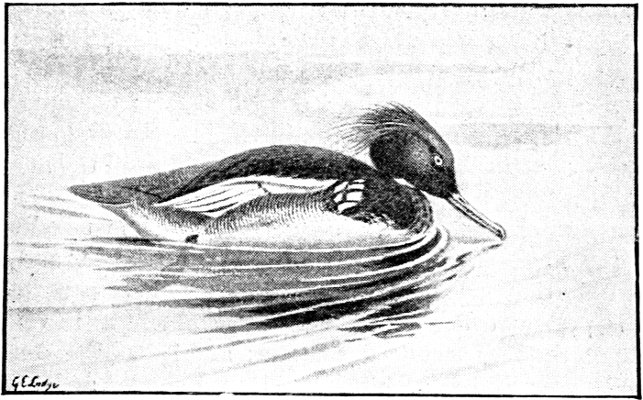
Fig. 87.—Red-Breasted Merganser. ¹⁄₁₁ natural size.
The present species exceeds the goosander in elegance of form and in handsomeness of colouring and ornament. It is a winter visitor, and also a resident throughout the year on the coast of Scotland north of the Clyde, and of the Orkneys, Shetlands, Hebrides, and St. Kilda. In Scotland and Ireland it inhabits inland lakes and rivers, as well as the sea-coasts. During the cold season it is gregarious, and usually goes in small flocks. In March these companies break up, and male and female are thereafter seen always in close companionship. They are excessively shy and wary birds, diving or taking to flight on the least alarm. They feed on small fishes and marine molluscs, which they take by diving; near the shore, where the water is shallow, they are often seen with head and neck almost continuously immersed as they explore among the seaweed at the bottom for food. They swim like the cormorant, having the faculty of sinking the body beneath the surface; and also dive like that bird, springing up and plunging down almost vertically. The favourite nesting-place is on an island, under the shelter of a rock, sometimes in a hole in the ground. The nest is formed of leaves and grass placed in a slight hollow, down being added later by the incubating bird. Six to nine eggs are laid, sometimes as many as twelve. The eggs are glossy, and pale olive-grey in colour. The drake does not assist in incubation or in protecting the young.
Smew. Mergus albellus.
Forehead, crown, with crest, throat, neck, and under parts satin-white; a black patch before and below the eye, and a greenish black triangular patch on the crest; back black, with a crescentic mottled band of the same colour stretching over each side of the shoulders, and another in front of each wing; scapulars white margined with black; lesser wing-coverts white; greater coverts black, with two narrow white bars; wing- and tail-feathers blackish brown; flanks vermiculated with grey; bill, legs, and feet lead-colour. Length, seventeen inches. Female: head reddish brown; collar ash-grey; rest of the plumage much as in the male. In June the male assumes the female plumage, which is retained until the autumn.
The smew, or nun, as it is sometimes called, is usually placed among the irregular visitors to the British Islands, and hardly comes within the scope of this book; but there is reason to believe that it is present every winter, although sometimes in very small numbers, in the seas around our coasts; and it has, therefore, some claim to be described as a British species. Females and immature birds, called red-headed smews by fishermen, are frequently met with on the east coasts of England and Scotland; males in the beautiful mature plumage are very rare, it is supposed because they do not approach the shore, except in very severe weather.
In its breeding habits the smew resembles the goosander, laying its eggs in the trunk of a hollow tree. Finnish Lapland is said to be the western limits of its breeding range.
Wood-Pigeon, or Ringdove. Columba palumbus.
Head bluish grey; sides and back of neck glossed with violet and green, bounded on each side by a patch of white; upper parts grey, the wing-coverts broadly edged with white, forming a conspicuous bar; tail-feathers dark slate-grey; under parts reddish purple, pale on the belly; bill orange, powdered with white at the base; legs and feet bright red. Length, seventeen inches.
Of the four species of British doves, the wood-pigeon is the most interesting, as well as the best known, on account of its large size, its abundance, and general diffusion throughout the country, and its plaintive music, so familiar to everyone; not in the rural districts only, but even in London town, where this bird exists in a semi-domestic state, and is seen to be actually tamer than the domestic pigeons it frequently associates with. Like most widely diffused and well-known species, it is called by various names: quest and cushat in the north, and, in England, ringdove and wood-pigeon. The last name, which it once shared with the stock-dove, is now becoming the most general.
For many years past the wood-pigeon has been increasing in numbers, and, in Scotland, extending its range; this is no doubt due to the spread of cultivation and the planting of trees, and to the extirpation of its natural enemies, the rapacious birds, by gamekeepers. But, in spite of all this, it is really surprising that the wood-pigeon should continue to increase, considering that it is one of the most persecuted of wild birds, and is perpetually being shot at by everyone in possession of a gun, from various motives. It affords good sport, and is a good bird for the table, and is heartily disliked by the farmers. It is an exceedingly voracious feeder, and as it is partial to grain of all kinds, to young turnip buds and leaves, also to the roots in which rooks or other birds have first pecked a hole, the amount of damage it does is very considerable. It also devours gooseberries, green corn, young clover, acorns, beech-mast, and wild fruit of most kinds. But the pigeon is not purely a pest to the farmer; after the harvest, when it resorts to the stubbles, it consumes an immense quantity of seeds of charlock and other noxious weeds.
In autumn and winter the number of wood-pigeons is greatly increased by the arrival of large flocks from the Continent; and at this season, and until March, it is not uncommon to see them congregated in thousands.
The wood-pigeon is the handsomest, as well as the largest, of the British doves, its dove-grey tints being singularly delicate, soft, and harmonious, and their effect heightened by the white marks and touch of iridescent colour on the neck. On the ground its motions are deliberate, and have a graceful dignity which contrasts strongly with the hurried, eager manner of the rock-pigeon and stock-dove. When startled from its perch it rushes out with great violence and loud clapping of the wings. Its flight is easy and powerful; and before alighting, when it sweeps swiftly and silently on its long, sharp-pointed wings through the glades of a wood, it sometimes has a singularly hawk-like appearance. Even the wild birds in the wood may be deceived by it, and thrown for a few moments into a violent commotion.
The wood-pigeon’s familiar song may be heard in favourable weather throughout the year, but its voice gains greatly in beauty in the breeding season. In May and June the love-note of this pigeon is one of the woodland sounds that never fail to delight the ear. It commonly happens that birds improve in voice in the season of courtship; and not only do they acquire greater richness and purity in their strains, but there is at this season an increased beauty and grace in their gestures and motions, and in most species the male indulges in pretty or fantastic antics—a kind of love-dance, in which he exhibits his charms to the female he is desirous of winning. All doves have performances of this kind, and that of the wood-pigeon is not the least graceful. On the ground, or on a branch, he makes his curious display before the female, approaching her with lowered head, and with throat and neck puffed out, in a succession of little hops, spreading his tail fanwise, and flirting his wings so as to display their white bars. All at once he quits his stand, and rising in the air to a height of thirty or forty yards, turns, and glides downwards in a smooth and graceful curve. This mounting aloft and circling descent is very beautiful to see, and produces the idea that the bird has been suddenly carried away by an access of glad emotion.
Breeding begins in April, and, in very favourable seasons, even as early as the first week in March. The nest is a slight platform of slender sticks laid across each other on the smaller branches or twigs of a tree, usually at a good height from the ground, and the eggs are two, with pure white, glossy shells. Two, and sometimes three, broods are reared in the season.
The young are fed on a substance called ‘pigeon’s milk,’ a thick white, curd-like fluid, consisting of the partially digested food the parent bird has swallowed, and which is regurgitated from its crop. In feeding, the young bird thrusts its beak deep down into the mouth of its parent and literally drinks. The pigeons alone among birds feed their young in this way; and they also differ from other birds in drinking like mammals, taking a continuous draught instead of a series of sips.
Stock-Dove. Columba œnas.
Head, throat, wings, and lower parts bluish grey; the lower parts of the neck with metallic reflections; breast wine-red; a black spot on the last two secondaries and some of the wing-coverts; primaries grey at the base, passing into dusky; tail grey, barred with black at the extremity, the outer feather with a white spot on the outer web, near the base; iris reddish brown; bill yellow, red at the base; feet red. Length, thirteen and a half inches.
The stock-dove is a third smaller than the wood-pigeon, and in size, colouring, and appearance when flying, so closely resembles the common pigeon, or rock-dove, as to be often mistaken for it. But it differs from the better-known bird in the uniform blue colour of the back: the rock-dove has a white patch on the rump. It is not so abundant nor so widely diffused as the species last described, being most common in the southern and eastern counties of England; but it is found in suitable localities throughout England and Wales, and is extending its range in Scotland; also, in a less degree, in Ireland. In some localities in the south it is so abundant that its low, monotonous, crooning or ‘grunting’ voice may be heard all day long in summer like a continuous murmur in the woods. It prefers ancient woods, and breeds in holes in trees and pollard tops, and from this habit it is said to derive its name of stock-dove. It is also an inhabitant of seaside cliffs, like the rock-dove; and at Flamborough Head, on the Yorkshire coast, both species may be found breeding in the same caverns, and sometimes associating in flocks together. In districts with a sandy soil it nests on the ground in a rabbit-burrow, or under a thick furze-bush. A very slight nest is made of twigs and sticks, and in many cases no nest at all. The eggs are two in number, and of a light cream-colour.
Rock-Dove. Columba livia.
Bluish ash, lighter on the wings; rump white; neck and breast lustrous, with green and purple reflections; two transverse black bands on the wing; primaries and tail tipped with black; outer tail-feathers white on the outer web; iris pale orange; bill black; feet red. Length, twelve and a half inches.
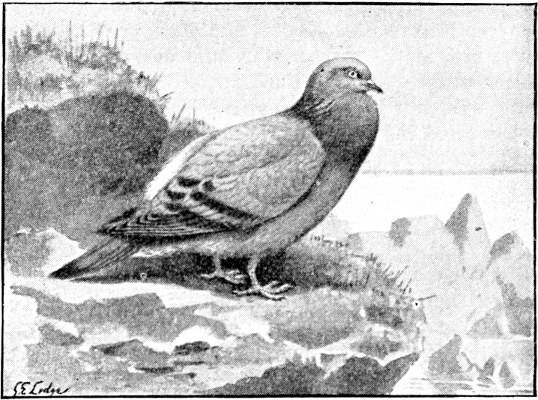
Fig. 88.—Rock-Dove. ⅐ natural size.
The rock-dove, or blue rock, the wild form of the domestic pigeon, is very rarely found breeding in any inland locality in the British Islands; in Spain and Italy, and other parts of continental Europe, it is an inhabitant of the mountainous districts. With us it inhabits the rock-bound coasts of Scotland and its islands, and of Ireland, and, very sparsely, the south and east coasts of England, and breeds in caverns, making its nests on the ledges of the rock. In its language, flight, and habits it is indistinguishable from the bird familiar to everyone in a domestic state.
Turtle-Dove. Turtur communis.
Head and nape ash tinged with wine-red; a space on the sides of the neck composed of black feathers tipped with white; neck and breast pale wine-red; back ash-brown; primaries dusky; secondaries bluish ash; scapulars and wing-coverts rust-red, with a black spot in the centre of each feather; belly and under tail-coverts white; tail dusky, all but the two middle feathers tipped with white, the outer feather edged with white externally; iris yellowish red; feet red; bill brown. Length, eleven and a half inches.
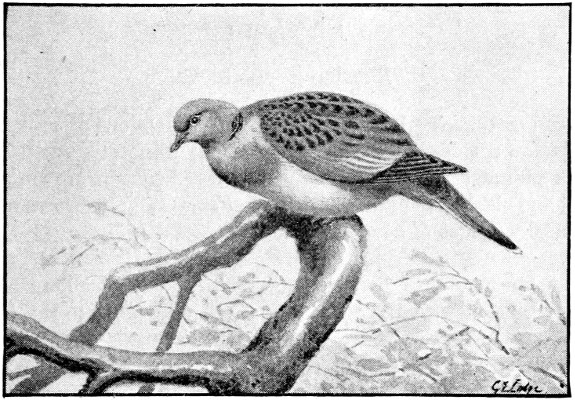
Fig. 89.—Turtle-Dove. ⅙ natural size.
The turtle-dove differs from other British doves in its much smaller size and in being a summer visitor to England. It arrives in the southern counties at the end of April, and ranges as far north as Westmorland and Cumberland; in the west of England, and in Wales and Ireland, it is a somewhat scarce bird. Like the wood-pigeon and the stock-dove, it is believed to be increasing its numbers. It inhabits woods and plantations, and being of a shy disposition, is not often noticed. In the autumn it may be seen in small companies, usually composed of a pair of old birds and their young; at other times it goes alone or with its mate. Its spring song is a cooing note, very soft and agreeable, and somewhat plaintive in sound. The nest is made at no great height, a large bush or a hedge being as often selected for a site as a tree. It is a slight structure of slender sticks and twigs laid crosswise, and the two eggs are creamy-white. Two broods are reared in the season.
In September the turtle-doves take their departure to their winter haunts in Africa.
A few specimens of the handsome and elegant passenger-pigeon (Ectopistes migratorius), a North American species, once excessively abundant in that continent, but now nearly extinct, have been obtained in this country.
Pallas’s sand-grouse (Syrrhaptes paradoxus), a curious and handsome bird, related structurally to the pigeons, is also included in works on British birds. Its home is the steppes of Central Asia, but from time to time visitations of this species, sometimes in very large numbers, have occurred in Europe, extending to the British Islands. The last and largest visitation of this kind occurred in 1888.
Pheasant. Phasianus colchicus.
Head and neck glossed with metallic reflections of green, blue, and yellow; sides of head bare, scarlet, minutely spotted with black; plumage spotted and banded with red, purple, brown, yellow, green, and black. Length, three feet. Female: light brown marked with dusky; sides of head feathered.
The pheasant has had a remarkable and a very long history, extending back into the period of myth and fable to the famous expedition of the Argonauts, who brought back this bird, with some other curious and beautiful objects, including the golden fleece, from the banks of the river Phasis, in Colchis. That, at all events, is the tradition which science has preserved in both names of the species. It is not incredible that the pheasant was introduced into Europe twelve and a half centuries before Christ; for we know that our familiar homing pigeon was employed as a letter-carrier by the Egyptians at an even earlier date. When and by whom it was first introduced into England is not known. There is evidence that the bird existed and was held in great esteem in this country before the Norman Conquest; and the belief is that it was brought hither by the Romans, who were accustomed to introduce ‘strange animals’ into the countries they conquered, and who gave the fallow-deer to Britain. That the first pheasants brought to Europe were obtained on the banks of the Phasis—now the Riou—is highly probable, since the marshy woods in the neighbourhood of that stream are still the headquarters of the aboriginal wild bird. Its habits appear curiously persistent: it must have wood, dense cover, and water in abundance to thrive. In Britain, where it has been permitted to run free in the woods for the last sixteen or seventeen centuries, it is still scarcely able to maintain its existence without the strictest protection and a great deal of attention on the part of man. It is known that when the birds are left to shift for themselves they soon decrease in numbers, and eventually die out, except in a few rare cases where the conditions are extremely favourable. How heavy the cost is of keeping pheasants in numbers sufficient for the purposes of sport is well known to all those who have preserves.