CLASSIFICATION. (continued 6)
Reading edition
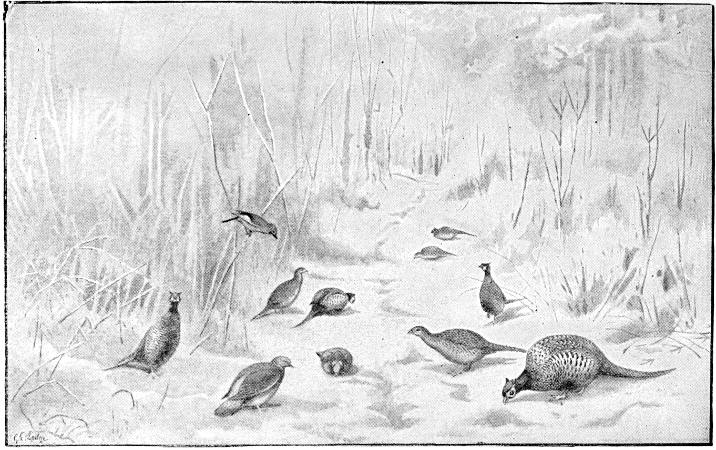
Jay. Wood-Pigeons. Pheasants.
An interesting fact about the pheasant is, that the various species forming the group to which our bird belongs freely interbreed when they come together, and produce hybrids which are fertile. A Chinese species, the ring-necked pheasant, which is a little smaller than the British bird, was introduced into this country at the end of the last century, and everywhere the two species have interbred so freely that it is now scarcely possible to find a bird which does not show traces of hybridism.
An account of the habits of the pheasant would be superfluous here, as this bird, in the nearly semi-domestic state in which it exists throughout the country, is as familiar to most persons as the fowl.
Red-legged Partridge. Caccabis rufa.
Throat and cheeks white, surrounded by a black band, which spreads itself out over the breast and sides of the neck in the form of numerous spots and lines, with which are intermixed a few white spots; upper parts reddish ash; on the flanks a number of crescent-shaped spots; the convexity towards the tail rust-red; the centre black bordered by white; beak, orbits, and feet bright red. Length, thirteen and a half inches.
The red-legged partridge, or French partridge, as it is often called, is, like the pheasant, a naturalised species, introduced by man; but its history as a British bird is comparatively a short one and devoid of romance. A first attempt to naturalise it was made in the reign of Charles II., but was not successful; on its reintroduction about a hundred and twenty years ago, it proved well able to maintain existence in its new surroundings. Owing to its swiftness of foot and excessive wildness it was difficult for the sportsman to get within shooting distance of it, when partridges were shot over dogs. On this account it was disliked; so much so in some cases that attempts were made to extirpate it. But in spite of persecution it continued to increase, and is now found distributed over a large part of England, from the southern counties to Westmorland.
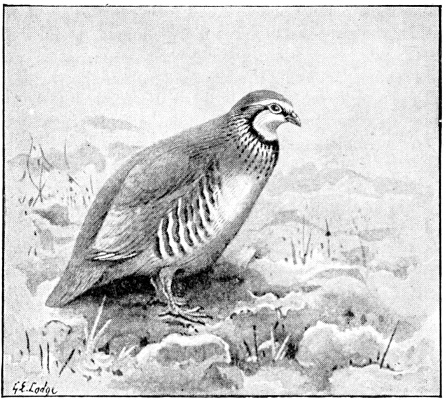
Fig. 90.—Red-legged Partridge. ⅐ natural size.
It differs from the common partridge in language and habits, as well as in its more conspicuously marked plumage and bright red legs. It is not a bird of the homestead, being partial to dry, sandy soils, to commons, and uncultivated lands. Its call-note is a musical, piping cry. It breeds early, and makes a slight nest on the ground. The eggs are fifteen to eighteen in number, yellowish white in ground-colour, and blotched with brown.
An allied species, the Barbary partridge (Caccabis petrosa), has been included, as a rare straggler to England, among British birds.
Partridge. Perdix cinerea.
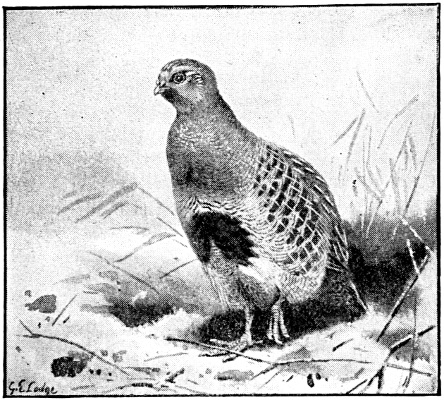
Fig. 91.—Partridge. ⅙ natural size.
Plumage grey and reddish brown, the male with a chestnut horseshoe patch on the lower breast. Length, twelve and a half inches.
The partridge is a favourite of the ornithologist, and of all lovers of our wild bird life. A handsome and interesting bird, he is the only indigenous gallinaceous species in Britain that is not adversely affected by the reclamation of waste lands and the spread of cultivation. On the contrary, the changes that prove fatal to other game-birds are advantageous to him, since he flourishes most on rich soils, and where agriculture is most advanced. As a bird of the homestead he is made dear by association to those who have passed their early years in rural England; to the sportsman he is more, in the long run, than any other game-bird we possess, on account of his greater abundance and more general distribution.
Except during the breeding season, the partridge is gregarious, keeping in coveys of half a dozen to twenty or more birds. Their feeding-times are early in the morning and in the afternoon. Towards noon they repair to some secluded spot to take their ease and dust themselves; and, if the weather be genial, to lie basking in the sunshine. At dusk they resort to some open place, usually the central part of a field of grass, to roost, or ‘jug,’ as it is called; and it may then be seen that the covey is not a mere chance assemblage, but a community, under the leadership of one individual, presumably the oldest and most sagacious cock bird among them. At the approach of sunset, and until dark, the call of the leader may be heard from the chosen roosting-ground. It is a familiar sound to everyone in the rural districts—a harsh and powerful cry; but, like the clamour of blackbirds and redwings on going to rest, and the cawing of rooks at eventide, it has a great charm for the lover of nature. In character it resembles the call of the guinea-fowl, but is somewhat more metallic, and is more powerful and far-reaching. When the birds are assembled, they settle down for the night a little distance apart from each other, disposed in a circle, all with faces turned outwards. Disposed in this form, it must be difficult for any prowling animal to come upon them without being detected by some one bird in the covey.
In spring, usually in March, pairing takes place, and the coveys break up; but if snow or frost supervenes the birds pack again, and wait in company for the return of milder weather. In the pairing season the males are jealous and pugnacious, and two cocks are often seen engaged in fierce fight, making the fields resound, meanwhile, with their angry cries.
The nest is placed on the ground, among the growing corn, or under the shelter of an untrimmed hedge, and is a mere hollow scratched in the earth, with a slight lining of dead grass and leaves. The eggs vary in number from six or seven to eighteen, and are of a uniform olive-brown colour. When the young have been hatched by the female the male assists in rearing and protecting them, and both birds display intense anxiety and great boldness in the presence of danger, and will drag themselves over the ground, with flapping and trailing wings, within a few yards of a man or dog, to entice him away from their chicks. The young feed principally on insect food, small caterpillars, and larvæ of ants, of which they are extremely fond. The old birds include green leaves, buds, grain, and seeds of weeds, in their dietary.
Quail. Coturnix communis.
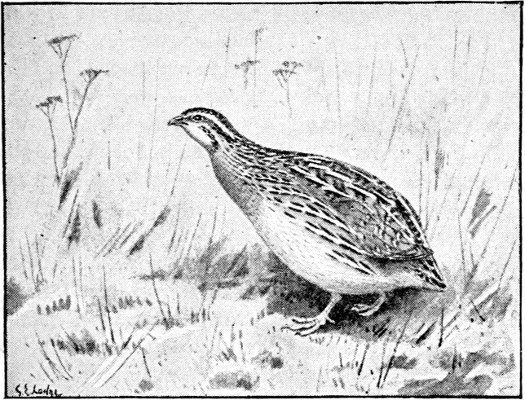
Fig. 92.—Quail. ⅕ natural size.
Head mottled with black and reddish brown, with three parallel, longitudinal, yellowish streaks; upper parts ash-brown variegated with black and straw-colour; neck reddish yellow, with a double crescent of dusky brown; breast pale reddish brown streaked with white; bill and feet yellowish brown. Length, eight inches. Female: paler, and wanting the double crescent on the neck.
The quail is a summer visitor to this country, arriving in May. It is nowhere a common bird, although widely distributed, and it has been found breeding in most parts of the British Islands. Occasionally it is met with in winter, most often in Ireland. Immediately after its arrival the call of the male is heard morning and evening, a shrill, piping note of three syllables, supposed to resemble the words wet my lips, or wet my feet, according to the hearer’s fancy. This call is repeated again and again, with some slight variation in the sound. The nest is a slight hollow scratched in a cornfield, among grass or clover, and the eggs number seven or eight to twelve, and even a larger number is sometimes found. They are speckled and blotched with umber-brown on a yellowish white ground. Two broods are reared in the season. The quail prefers open, rough grass country to cultivated land. Its food consists of seeds, grain, and insects.
The quail is in appearance a very small partridge, being little more than half the size of that bird. It is singular that in the very limited number of gallinaceous birds that exist wild in this country there should be included the capercaillie, the largest of the order, with, perhaps, the exception of one American species, and the diminutive quail—a giant and a pigmy.
Historically, the small species is the more important of the two. He is a Bible bird, and was as familiar as the eagle and the crane to the civilised nations of antiquity in Asia and Africa, where letters and arts had their origin, when the great wood-grouse was known only to the barbarians of Europe.
When we consider how bound to earth (like our unfortunate selves) the gallinaceous birds are, seldom using their wings, unless to escape from some sudden, pressing danger into the nearest cover, it strikes us as very wonderful that the plump little quail should be as great a migrant as the most aërial kinds—the swallows and the warblers. When with us in the summer he is a dweller on the ground, an earth-lover, like his stay-at-home relation, the partridge; yet in his wide wanderings he crosses seas, vast deserts, and the loftiest mountain chains; and by means of this migratory instinct he has diffused himself over the three great continents of Europe, Asia, and Africa.
Ptarmigan. Lagopus mutus.
Winter: pure white; a black line from the angle of the beak through the eye; outer tail-feathers black; above the eye a scarlet fringed membrane; beak black; tarsi and toes thickly clothed with woolly feathers. Female: without the black line through the eyes. Summer: wings, under tail-coverts, two middle tail-feathers, and legs white; outer tail-feathers black, some of them tipped with white; all the rest of the plumage ash-brown marked with black lines and dusky spots. Length, fifteen inches.
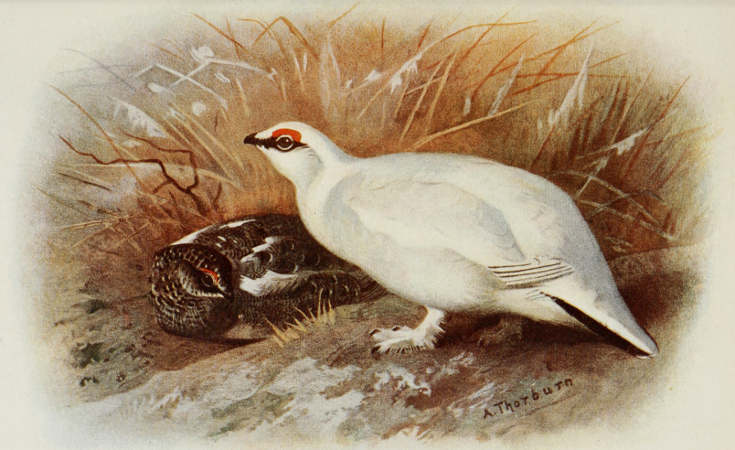
PLATE XIII. PTARMIGAN (WINTER AND AUTUMN PLUMAGE). ²⁄₇ NAT. SIZE.
In the British Islands the ptarmigan is at present confined to the Highlands of Scotland, the ‘region of stones,’ and to some of its islands, where, however, it is decreasing in numbers.
A peculiar interest attaches to this bird on account of its change of plumage from brown in summer to snow-white in winter, and of the fact that it inhabits only the summits and slopes of high mountains. These two things—the white winter plumage and the mountain habit—have a close connection. The periodical change to white is a common phenomenon in arctic animals, both birds and mammals, and all the species of grouse of the genus to which the ptarmigan belongs assume the white dress in winter, with one exception—the red grouse of the British Islands. Thus, in Britain we have two grouse of this group (Lagopus), one of which turns white like the continental grouse, while the other keeps its brown dress throughout the year. To explain this difference it must be assumed that both species inhabited Britain at a period when its climate was an intensely cold one, and that both species changed their colour to protective white in the season of snow. When the British climate changed, and became so mild that the snow no longer remained unmelted for months at a time on the lower levels, all such creatures as had the arctic habit of becoming white in winter would be in danger of extermination, since their intense whiteness on the brown or green earth would make them fatally conspicuous to their enemies. A white grouse on a brown moor would be visible for miles to high-soaring birds of prey. The red grouse escaped destruction by losing its white winter dress: the change in it from two distinct liveries to one colour for all seasons was doubtless gradual, extending over a period of very many centuries, keeping pace with the slowly improving climate. He ended by becoming a bird that was wholly brown in winter, while the willow-grouse of northern Europe and Asia—the continental form, and, it may be added, the parent, form of our bird of the moors—continued to change to white periodically. Meanwhile no such change took place in the ptarmigan’s plumage: he alone continued to assume the pure white winter dress, as if to keep alive the tradition of an ancient arctic Britain; and yet he survived. He escaped destruction because he was a hardier bird, and preferred the higher grounds, where the snows never melted in winter. At the northern limit of its range, north of the arctic circle, the ptarmigan inhabits the fells and level country; in Europe it is everywhere confined to the higher slopes of lofty mountains; in other words, wherever found—and it ranges as far south as the mountains of Spain—it still has an arctic climate. The bird exists ‘islanded’ on high mountains, separated from the rest of its kind by wide spaces of low-lying country as impassable to it as the sea.
The ptarmigan breeds in May. Its nest is well concealed, and is merely a slight hollow in the ground, lined with a little dry grass. Eight to ten eggs are laid, of a yellowish white blotched with dark brown. In autumn or early in winter the birds pack, and sometimes as many as fifty are seen in one flock. Macgillivray has the following interesting account of the bird in its mountain haunts: ‘These beautiful birds, while feeding, run and walk among the weather-beaten and lichen-crested fragments of rock, from which it is very difficult to distinguish them when they remain motionless, as they invariably do should a person be in sight. Indeed, unless you are directed to a particular spot by their strange low, croaking cry, you may pass through a flock of ptarmigans without observing a single individual, although some of them may not be ten yards distant. When squatted, however, they utter no sound, their object being to conceal themselves; and if you discover the one from which the cry has proceeded, you generally find him on the top of a stone, ready to spring off the moment you show an indication of hostility. If you throw a stone at him, he rises, utters his call, and is immediately joined by all the individuals around, which, to your surprise, if it be your first rencontre, you see spring up one by one from the bare ground.’
Red Grouse. Lagopus scoticus.
Plumage reddish brown on the head and neck, and chestnut brown, barred and speckled with black, on the upper parts; the feathers of the breast almost black, with white tips. In summer the general colour is lighter; in winter the under parts are frequently mottled with white. Length, sixteen inches. Female: more reddish yellow in colour.
One sunny morning a few months ago, as I stood on a mountain slope among bracken, ling, and furze, and scattered masses of grey rock, watching a small party of grouse near me, it struck me that I had never looked on a more beautiful creature than this bird:—so finely shaped and richly coloured, and proud and free in carriage, and in such perfect harmony with the rough vegetation and that wild and solitary nature amid which it exists. It is not strange that this species should have a fascination above all others for the sportsman that he is willing to go farther and spend more in its pursuit; for it is not the bird only that draws him: the fascination is of that unadulterated nature of which the bird is a part, and the sense of liberty and savage life that returns to man in the midst of mountain and moorland scenery.
To the ornithologist the grouse has another great distinction: it is the only species of bird exclusively British. It is generally distributed in Scotland and its islands, the Shetlands excepted. It also inhabits the moors in the northern counties of England, and of Wales as far south as Glamorgan; and of Ireland, where, unhappily, it is decreasing in numbers.
The grouse feeds principally on the tender shoots of the heather; and also eats leaves and buds of other plants, and such wild fruits as grow on or near the moors. In autumn and winter it is gregarious, and in some localities the males and females pack separately. Pairing takes place very early in the spring, and the male, as is usual in the grouse family, courts the female with curious sounds and a fantastic dancing performance. The wooing takes place very early in the morning, before there is light enough to feed. Flying up to a height of fifteen or twenty feet into the air, he drops down uttering a succession of powerful ringing notes, which end as the bird reaches the ground. This is repeated again and again until daylight and feeding-time suspend the performance. The red grouse is strictly monogamous, and each pair retires to its own chosen nesting-place, where a slight hollow is scratched under a tuft of ling, and five or six to twelve eggs are laid. They are pale olive in ground-colour, blotched with dark red. The female alone incubates, but the male assists in rearing and protecting the young. The chicks when small feed chiefly on small caterpillars.
Black Grouse. Tetrao tetrix.
Black with violet reflections; a broad white band on the wings; secondaries tipped with white; lower tail-coverts white; eyebrows naked, vermilion; a white spot beneath the eye. Length, twenty-three inches. Female: head and neck rust-red barred with black; rump and tail-feathers black barred with red; belly dusky brown with red and whitish bars.
The black grouse is most abundant and generally distributed in Scotland and the northern counties of England, but is everywhere decreasing in numbers. In England its decline has been most marked, and in the southern counties, where it was formerly common, it ceased to exist, except in the New Forest, where a few birds survive. It has been reintroduced in some localities, but so far has not thriven well. In Ireland it is not indigenous.
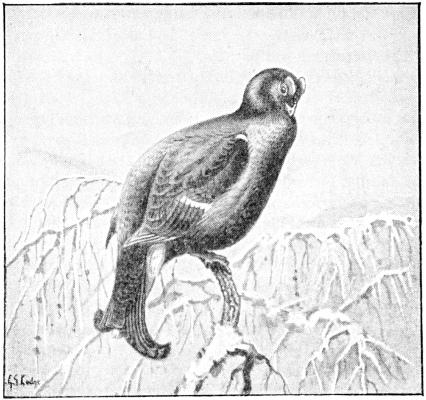
Fig. 93.—Blackcock. ¹⁄₁₀ natural size.
Its large size, rich blue-black plumage, white wing-bar, scarlet wattles, and strange lyre-shaped ornament, formed by the outward-curving feathers of the tail, give the black cock an exceedingly fine appearance, and he is, perhaps, the handsomest of our game-birds. He inhabits both woods and moors, but is most partial to grounds of a mixed character, such as are found on the fringe of a moor, where woods and thickets are broken and varied with patches of heath.
The black cock is polygamous; and at the end of winter many birds meet together at an early hour of the morning, when the males utter their powerful call-notes, and strut to and fro, with tail expanded and trailing wings, in the presence of the hens. These ‘matrimonial markets’ are scenes of desperate combats between rival cocks. In the end each male retires with the females he has secured for his harem. The hen makes a slight nest under the shelter of a bush, and lays six to ten eggs, yellowish white, with orange-brown spots. The young feed principally on larvæ of ants and other insects. Grain, seeds, berries and buds, and shoots of many kinds, are eaten by the old birds.
Capercaillie. Tetrao urogallus.
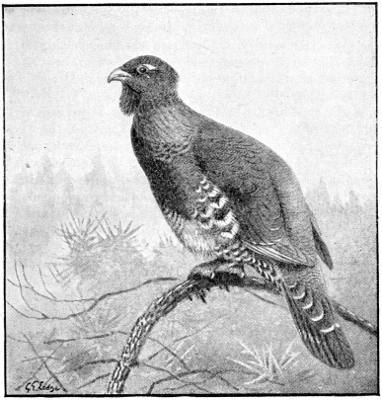
Fig. 94.—Capercaillie. ¹⁄₁₂ natural size.
Feathers of the throat elongated, black; head and neck dusky; eyes with a bare red skin above and a white spot below; wings brown speckled with black; breast lustrous green; belly black with white spots; rump and flanks marked with undulating lines of black and ash colour; tail black with white spots; beak horn-white. Length, two feet ten inches. Female: a third smaller, barred and spotted with tawny red, black, and white; throat tawny red; breast deep red; tail dark red with black bars, white at the tip.
North Britain, with its islands, although poor in species comparatively, has one glory which her larger, richer neighbour is without: her wilder districts still afford breeding-places to several of the larger species which have long ceased to exist in England. Of these are the osprey, sea-eagle, golden eagle, ptarmigan, and capercaillie, the last the finest game-bird of Europe, with the sole exception of the great bustard. The story of the capercaillie in Great Britain is singularly interesting. It became extinct about the middle of the last century, and was recovered some eighty or ninety years later, when it was reintroduced from Sweden in 1837–8, and has since spread over a large portion of Scotland, and continues to extend its range.
The difference in size between the cock and hen capercaillie is greater than in any other game-bird. In Scotland, the weight of the male is from ten to eleven pounds, that of the female about four pounds and a half. In northern Europe the cock weighs as much as seventeen pounds. It is curious to find that in a large number of gallinaceous birds, the pheasants and grouse more especially, the females have a near resemblance in size, form, and colouring. The divergence is mostly in the males, and is greatest in the polygamous species. Thus, it would be difficult to find two birds in the same order more utterly unlike in appearance than the cock pheasant and capercaillie; yet the females of the two species preserve a strong family likeness.
The capercaillie feeds on the tender shoots of the Scotch fir, and on buds and shoots of other trees and plants, and berries of various kinds. He is an early breeder, and in spring the cock is heard uttering his powerful double cry, several times repeated in succession, from a lofty perch in a pine-tree. While calling he puffs out his plumage and expands his tail like an angry turkey-cock. The call, which is uttered early in the morning, is a summons to the hens, who are not slow to obey it, and is also a challenge to other males. The same spot is used morning after morning for meetings, displays, and combats, until each male has secured his tale of hens, whereupon breeding begins. The nest is a slight hollow scratched in the ground under a bush, and the eggs are six to twelve in number. They are pale reddish yellow in ground-colour, spotted and blotched with brown.
The male does not assume the mature plumage until the third year.
Water-Rail. Rallus aquaticus.
Bill red; crown, hind neck, and upper parts olive-brown, a black streak in the centre of each feather; cheeks, neck, and breast grey; flanks blackish, barred with white; legs and feet brownish flesh-colour. Length, eleven inches and a half. Female: duller in colour, the wing-coverts sometimes barred with white.
The water-rail inhabits fens, marshes, and watercourses, moving rapidly in the rank vegetation, swimming and diving with ease, flying only when compelled, and rising heavily, with fluttering wings and dangling legs, and after a short flight dropping again into cover. Its shy, skulking habits make it appear a very rare bird, but it is found, although in small numbers, in most suitable localities in Great Britain and Ireland. Although it is met with throughout the year in this country, it is believed to be migratory, the birds that breed with us moving southwards in winter, when their places are taken by migrants arriving from more northern regions.
The nest is made of reed-leaves, and is placed among coarse herbage or in a tussock of sedge. Seven to eleven eggs are laid, in colour pale creamy white, thinly flecked with reddish brown and grey. The nestlings are covered with black down. During the pairing and breeding time the rails are loquacious, frequently uttering their loud peculiar cry.
Three other rails (genus Porzana) occur in the British Islands, one a regular visitant. They inhabit marshes, but in form are more like the corncrake than the water-rail.
Spotted crake (Porzana maruetta).—A summer visitor, breeding sparingly in different parts of Great Britain. On account of its skulking habits and small size it is rarely seen. It lays eight to ten eggs, olive-buff in ground-colour, spotted with dark reddish brown. In size it is about a fourth less than the water-rail; the upper parts are olive-brown spotted with white; crown dark brown; face and neck dull grey; breast brown spotted with white.
Baillon’s crake (Porzana bailloni).—A somewhat rare visitor to Great Britain, but known to have bred in Norfolk. General colour warm brown flecked with black and white. Length, seven inches.
Little crake (Porzana parva).—A rare visitor to the British Islands, chiefly to the east coast. Upper parts olive-brown; under parts slate-grey. Length, eight inches.
Corncrake. Crex pratensis.
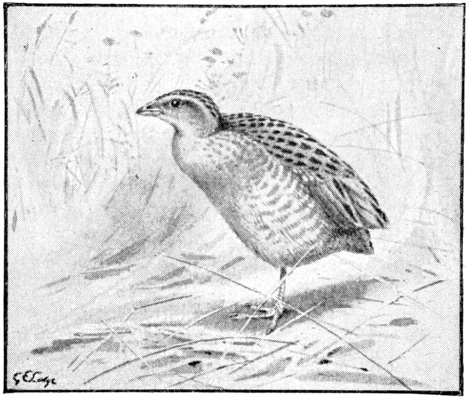
Fig. 95.—Landrail. ⅐ natural size.
Ash-grey patches above the eyes and on the cheeks; feathers of the upper parts yellowish brown with dark centres; wing-coverts and quills chestnut; throat white; breast greyish buff; belly white in the centre, and flanks broadly barred with brown and buff; bill and feet pale brown. Length, eleven inches.
The corncrake is one of the commonest British birds. It is as large as a partridge and more brightly coloured; it lives on the ground, and, like the partridge, is to some extent a bird of the homestead. Yet it is rarely seen, for, of all skulking creatures, it is the shyest, swiftest of foot, and most elusive. Its narrow, wedge-like shape fits it to pass through the close, upright stems of the grass with perfect ease, and, with head and neck extended as if flying, it runs in the grass as rapidly as a plover or partridge over the smoothest ground. But though not seen it is heard, its low creaking cry sounding incessantly from morning till night in spring from the meadows and fields. This curious sound may be imitated by rapidly passing the thumb-nail along the teeth of a fine comb. The note is said to be uttered by the male, and is not often heard after breeding begins. The nest is made at the end of May, or in June, and is placed among growing corn or meadow grass, and is formed of dry grass and leaves. Seven to ten eggs are laid, reddish white in ground-colour, spotted with bright brown and grey.
The corncrake, or landrail, is found throughout the British Islands, and is most abundant in rich pastures; in southern England and in Ireland it appears to be most numerous. At the beginning of October it migrates, but birds are not unfrequently met with in winter, particularly in Ireland.
Moorhen. Gallinula chloropus.
Fore part of the bill yellow; base and frontal plate red; irides red; upper parts dark olive-brown; head, neck, and under parts slate-grey, with some white streaks on the flanks; under tail-coverts pure white; legs greenish yellow, red above the tarsal joint. Length, thirteen inches. In this species the female is larger and more brightly coloured than the male.
The moorhen is one of our most familiar wild birds; for not only is it common and generally distributed in the British Islands, but where it is not molested, and the stream, or pond, or ditch it inhabits is close to the homestead, it becomes almost domestic in its habits, and will freely mix with the poultry and share their food. Furthermore, it attracts a good deal of attention, and is something of a favourite with most people, on account of its pretty appearance and quaint, graceful carriage, as it moves over the turf with measured steps, nodding its head and jerking its tail in order to display the conspicuous snow-white under-coverts.
The name of moorhen, which some writers dislike, is old English for marsh-hen, from moorish, which had the same meaning as marshy. Water-hen, another time-honoured name for this bird, is still in common use; but mot-hen, or moat-hen, from the bird’s habit of frequenting moats when moated houses were common in England, is now obsolete.
The moorhen swims and dives with ease, and feeds a good deal in the water, usually keeping near the fringe of weeds, in which it takes refuge on the slightest alarm. When hunted it dives, and is able to remain submerged for an indefinite time by grasping the weeds at the bottom with its claws and keeping its nostrils above the surface.
The nest is generally placed on the ground among the reeds or rushes, but many other sites are used; and sometimes it is built in a tree several feet above the ground. Seven or eight eggs are laid, reddish white in ground-colour, thinly speckled and spotted with orange-brown. The young when hatched are covered with a black hairy down. Two or three broods are reared in the season, and it has been observed that the young of the first brood sometimes assist the parents in making a new nest and in rearing the young of the second brood.
The moorhen feeds on worms, slugs, insects of all kinds, and vegetable substances.
Coot. Fulica atra.
Beak pale flesh-colour; bald patch on the forehead white; irides crimson; under parts sooty black; above, slate-grey with a narrow white bar across the wing; legs and feet dark green. Length, eighteen inches.
In its appearance the coot is a large plain-coloured moorhen. It is more aquatic in its habits than that bird, keeping almost as constantly on the water as a diving duck. Like its smaller relation, it prefers stagnant meres or ponds, or sluggish streams with marshy borders and a deep fringe of reeds for cover; and it is to be met with in all suitable localities throughout the British Islands. It is resident all the year, but in the north, when the watercourses are frozen over in winter, it migrates to the tidal estuaries and the sea-coast, where it feeds on the mud-flats. The nest is a large structure, placed among the reeds or rushes, and built up to a height of several inches above the water. Seven to ten eggs are laid, of a light stone-colour, speckled with dark brown. The coot was formerly much more abundant than it is now in England, and was, perhaps, most numerous in the district of the Broads in Norfolk. Sir Thomas Browne, writing of the birds of Norfolk two centuries and a half ago, gives the following account of a singular habit of this bird: ‘Coots are in very great flocks on the broad waters. Upon the appearance of a kite or buzzard I have seen them unite from all parts of the shore in strange numbers; when, if the kite stoop near them, they will fling up and spread such a flash of water with their wings that they will endanger the kite, and so keep him off again and again in open opposition.’ This story, which reads like a fable, was found to be plain truth by Lord Lilford, who observed the coots on the lakes of Epirus, a district where birds of prey are abundant. He writes: ‘I have several times observed the singular manner in which a flock of these birds defend themselves against the white-tailed eagle. On the appearance over them of one of these birds they collect in a dense body, and when the eagle stoops at them they throw up a sheet of water with their feet, and completely baffle their enemy; in one instance ... they so drenched the eagle that it was with difficulty that he reached a tree on the shore not more than a hundred yards from the spot where he attacked them.’
The order Alectorides, which follows, includes two noble forms once common, but now extinct in this country. One is the crane (Grus communis), which was abundant in the fen country down to the latter end of the seventeenth century. The other, finest of British birds, is the great bustard (Otis tarda), which lived in all suitable localities in England, from the southern counties to Yorkshire, and was wantonly extirpated during the first half of the present century.
The little bustard (Otis tetrax) occurs as a rare straggler in the eastern half of England.
A single example of Macqueen’s bustard (Otis macqueeni), an Asiatic species, was obtained in England half a century ago.
Stone-Curlew. Œdicnemus scolopax.
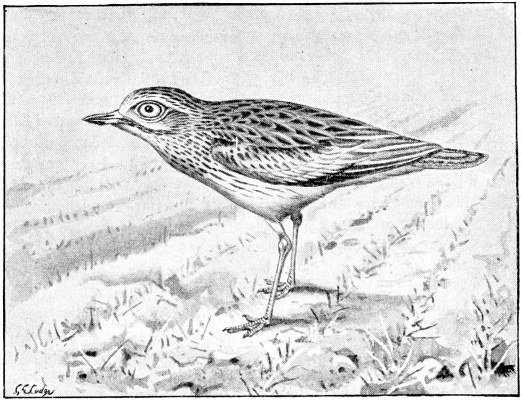
Fig. 96.—Stone-Curlew. ⅐ natural size.
Beak black, yellowish at the base; irides, orbits, legs, and feet yellow; upper parts mottled pale brown; wing-coverts with white tips, forming two narrow bars; quill black; throat and stripe beneath the eye white; neck and breast buff streaked with dark brown. Length, seventeen inches. Sexes alike.
The stone-curlew owes its name to a superficial resemblance in its size and pale brown, mottled plumage to the common curlew, and to its preference for a sandy or stony soil. It is also called the thick-knee, from the curious conformation of its knees, which are very massive, and have a somewhat bulbous appearance. Its other common names are big plover and Norfolk plover, Norfolk and Suffolk being now the headquarters of this species in England, although it is still found in small and, sad to say, diminishing numbers in suitable localities from Hampshire and Dorsetshire in the south to the wolds of Lincolnshire and the East Riding of Yorkshire in the north. It does not occur in Ireland. It is a bird of a somewhat singular appearance, and is the sole representative of its family in Europe. It is a summer visitor to England, a few birds remaining to winter in the southern counties, and inhabits extensive heaths where there are patches of stony or pebbly ground; and it also frequents fallows and downs. In its habits it is semi-nocturnal, feeding principally by night; it is by night that its wild, clear, ringing cry is usually heard. Its breeding-time is about the middle of April, when it deposits its two eggs in a slight hollow in the ground, among the flint pebbles and scanty vegetation. The eggs are buff-coloured, spotted and streaked with grey and brown, and are very hard to discover, so well do they harmonise in hue and markings with the sandy and pebbly ground on which they are placed.
Mr. Trevor-Battye thus describes the nesting habits of the stone-curlew in his ‘Pictures in Prose’:—‘This bird, quite apart from its own very quaint appearance and habits, must always have a great interest for British ornithologists, as it is the nearest surviving link we have with the great bustard, now, alas! extinct in this country. It is nocturnal in its habits, and is extremely wary and shy. Although on its arrival in spring it keeps well away in the open, it generally lays its eggs not far from a belt or covert of trees. The pair of which I speak had chosen the middle of a gravelly space among the pines. By creeping upon hands and knees under cover of a bank one could gain a position, just fifteen paces away from the nest, without being observed, so close that with my glass I could see the light shine through the crystal prominence of the sitting-bird’s great yellow eyes. At intervals one bird would relieve the other on the nest. When disturbed the birds ran away for shelter to a bank beneath the pines. And here the bird that was not sitting always stood sentry. When its turn came to relieve its mate it would walk pretty deliberately across the first part of the open, where it was more or less screened by a fringe of trees; and then, having reached a point that was commanded from a long way off, it would suddenly lower its head, and run as fast as a red-leg to the nest. When it was about a yard away the sitting-bird would slip off, and, staying for no greetings, run past, and away to the pine-bank.... It was interesting to notice that the bird always rose backwards from the nest, so that its long legs should not disturb the eggs; and that the new-comer did not turn the eggs immediately, but squatted perfectly still for perhaps a minute, as if to make sure it was not disturbed. And after the eggs were satisfactorily disposed, and all the coast seemed clear, the bird would close its eyes in the hot sunshine, and appear to go to sleep. But even then I could scarcely so much as move a finger above the ground but instantly it was off its nest and away.’
It is very delightful to be thus let into the domestic secrets of so shy and wary a bird by so close and sympathetic an observer as Mr. Trevor-Battye.
When anxious to avoid being seen the stone-curlew practises the device of squatting close on the ground with its neck extended. The South American rheas have a similar habit, and it is, perhaps, possessed by other large birds that have a more or less protective colouring and inhabit the open country.
The stone-curlew feeds on slugs, worms, and insects, and also devours mice and small reptiles.
The family Glareolidæ is represented in works on British birds by one species, the collared pratincole (Glareola pratincola), a rare straggler to Great Britain from Southern Europe. This bird comes between the stone-curlew and the true plovers (family Charadriidæ), which follow.
The cream-coloured courser (Cursorius gallicus) is another rare straggler to England from Western Asia and North Africa.
Golden Plover. Charadrius pluvialis.
Upper parts greyish black spotted with gamboge-yellow; above the eye a white line, which continues down the neck to the flanks; under parts black. After the autumnal moult the under parts are white, and the upper parts more yellow than in spring. The female, in summer, has less black on the breast. Length, eleven inches.
The golden plover has for several centuries been in great esteem for the table, its fame in this respect being equal to that of the dotterel, woodcock, ruff, and black-tailed godwit. The two last named have now ceased to exist in this country as breeding species. The golden plover, although incessantly persecuted by fowlers and sportsmen, is still not uncommon; probably because the great majority of the birds that visit the British islands on migration in autumn and winter have their breeding-grounds in remote regions north of the arctic circle, where there are no human beings to molest them. The birds that breed with us are also migratory, and escape destruction by going south in autumn.
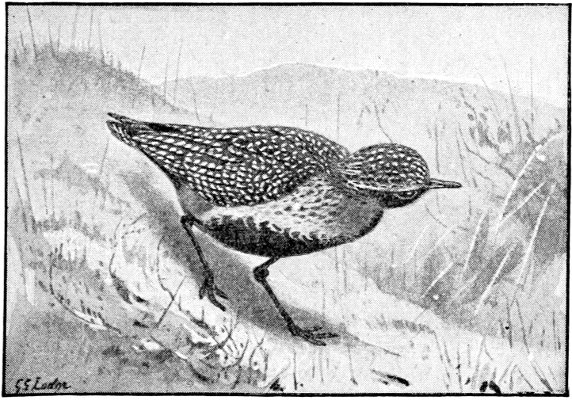
Fig. 97.—Golden Plover (summer plumage). ⅙ natural size.
The golden plover gets its common name from the rich yellow spots that decorate its upper parts. All the species of the genus to which it belongs undergo a very remarkable change of plumage every year: in winter the whole under parts are pure white; in spring the white changes to intense black, and this nuptial, or summer dress, lasts until the autumn moult, when the winter white is resumed. With us this species breeds in suitable localities throughout the British Islands, but very sparingly in the southern half of England. The nest is a slight hollow among heather or short grass, sometimes on the bare ground, and is scantily lined with dry grass. The eggs, of a yellowish stone-colour, spotted and blotched with blackish brown, are four in number, and are handsome, and large for the bird. The young when hatched are pretty little creatures, orange-yellow and brown in colour.
The call-note of the golden plover, clear and wild and far-reaching, is one of the bird-sounds that have a great charm. In the pairing season the male emits a different sound, by way of love-song, as he rises and flutters in the air above his mate, and reiterates a double note so rapidly that it runs into a trill.
After the breeding season the birds unite in flocks, and leave the moors for the lowlands and seashore.
The Eastern, or lesser golden plover (Charadrius fulvus), a form of the British golden plover differing only in its slightly smaller size, has been obtained on two or three occasions in this country.
Grey Plover. Squatarola helvetica.
Fore-crown white, and upper parts mottled blackish brown and white; lores, cheeks, throat and neck, and under parts, black. Length, twelve inches. After the autumn moult the upper parts are more greyish, and all the rest white.
This species so closely resembles the golden plover in size and appearance, both in summer and winter, changing, like it, from black to white, and from white to black, that it seems strange to find it classed in a separate genus. But there is a slight anatomical difference in the two birds: the grey plover is provided with a rudimentary hind toe, while the golden plover has only three toes on its foot. The present species does not breed in the British Islands. Its summer home is in arctic Siberia. From August, when it begins to arrive, until the following spring it is found on our coasts every year in small flocks. It is much less common than the golden plover, and while with us is almost exclusively a bird of the seashore.
The grey plover is considered a poor bird for the table; but in Yarrell’s work it is stated that Englishmen have not always been of that opinion, that it was formerly esteemed above most birds, and that the saying, ‘a grey plover cannot please him,’ was used of a person with an excessively fastidious palate. The bird proverbial for its delicacy was probably our golden plover, which to this day is called grey plover in Ireland.
Kentish Plover. Ægialitis cantiana.
Forehead, stripe above the eye, chin, cheeks, and under parts white; upper part of forehead, a band from the base of the bill extending through the eye, and a large spot on each side of the breast, black; head and nape light brownish red; upper plumage ash-brown; two outer tail-feathers white. Length, six inches and three-quarters. The female is without the black on the fore-crown, her neck patches are brown instead of black, and her colours duller than in the male.
This species, in appearance a small and pale-coloured ringed plover, is a summer visitor to the south-east and east coasts of England from Sussex to Yorkshire, and received its name of Kentish plover when first described, nearly a century ago, by Latham, from specimens obtained at Sandwich. Its sojourn in this country is a short one, excepting on the Sussex and Kentish coasts, where a few pairs remain to breed; but as a breeding species the bird has now been almost extirpated by the egg-collector—the soulless Philistine who is without any feeling for wild nature, and whose vulgar ambition it is to fill a cabinet with the faded shells of eggs which he can label ‘British-taken.’
The Kentish plover has a very extensive distribution in Europe, Africa, and Asia. In its habits it resembles the ringed plover, and lays its three, and sometimes four, eggs in a slight depression among the fine shingle or broken shells. The eggs are of a yellowish stone-colour, spotted and scratched with black.
Ringed Plover. Ægialitis hiaticula.
Forehead, lores, and gorget reaching round the neck black; a band across the forehead, a stripe over each eye, broad collar, and lower parts, white; nape and upper parts hair brown; outer tail-feathers white; bill, orbits, and feet orange. Length, seven inches and three-quarters. In the female the black collar is less well defined.
The small ringed plover is a sprightly, prettily marked bird, with conspicuous white and black collar, and a melodious voice. His modulated alarm-note, somewhat plaintive in character, is familiar to most persons who walk by the seashore, for he is a common species on our coasts, and has the habit of betraying his presence by sounding an alarm when approached; and if the intruder moves quietly, and occasionally pauses in his walk, the little plover will not take to flight, but continue running on before him, all the while playing on his wild and sorrowful little pipe. In spring the male has a fuller, sweeter note, by way of love-call or song, uttered occasionally on the wing. He is an extremely active and lively bird, running rapidly on the sands, and, when the tide is going out, often keeping close to the water to pick up the small marine insects and crustaceans on which he feeds. He is not, however, exclusively a bird of the seashore, but is also found on the margins of rivers and lakes, and sometimes breeds at a distance from the sea. As a rule the nest is placed on the sandy beach, or fine shingle, above high-water mark. The nest is merely a slight depression in the sand, in which four pear-shaped eggs are laid, of a pale stone or cream colour, marked with small round, blackish brown and grey spots. The breeding season begins in May, and as eggs continue to be found to the end of July, it is probable that two broods are reared in the season. When the young are hatched the parent birds manifest the utmost anxiety, and will attempt to lead a man or dog from the spot by fluttering as if wounded along the ground.
The ringed plovers are social in disposition, and even during the breeding season it is common to find them in small parties. In the autumn they unite in flocks.
This species is to be met with in this country throughout the year; but in spring our coasts are visited on migration by a ringed plover of a different race, smaller in size. It is with this smaller bird that the lesser ringed plover (Ægialitis curonica), a rare straggler to England from continental Europe, is sometimes confounded.
Another member of this genus, the North American killdeer plover (Ægialitis vocifera), has been once or twice obtained in this country.
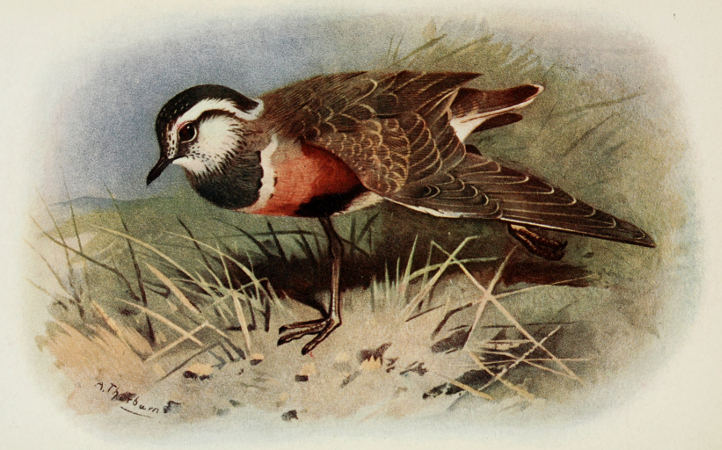
PLATE II. DOTTEREL. ½ NAT. SIZE.
Dotterel. Endromias morinellus.
Crown dusky black, bordered by a white band extending backwards from the eye round the nape; upper parts ash-brown, the inner secondaries margined with rufous; tail-feathers broadly tipped with white, except the middle pair; throat dull white; upper breast ash-brown; white gorget or band lower breast, and flanks bright chestnut; belly black; tail-coverts white. The female is larger and brighter than the male. Length, nine inches.
This is a richly coloured, handsome little plover; it was familiar to our forbears, and is often mentioned by old British and Continental writers as a very delicate bird to eat—a ‘very daintie dish,’ as Drayton wrote. Much was also said, both in verse and prose, about its supposed foolishness, which was proverbial, so that dull and weakminded persons were compared to the dotterel. It was believed that when the fowler, on approaching the bird, stretched forth an arm, the dotterel responded by stretching out a wing; that when a leg was put forth, the action was immediately copied; and that the bird, being intent on watching and imitating the motions of the man, neglected its own safety, and was taken in the net. The origin of this notion, which was credited by everyone, ornithologists included, for the space of two or three centuries, is no doubt to be found in the fact that the dotterel is less shy and active than most plovers, and, like very many other birds, when approached and disturbed during repose has the habit of stretching out a wing and leg before moving away.
The dotterels arrive in this country in small flocks, called ‘trips,’ about the beginning of May. From the south-east coast, where they first appear, they travel from place to place on their way north. Arrived at their breeding-haunts in Westmorland and Scotland, they are seen at first frequenting heaths, dry pasture-lands, and fallows, but soon retire to the mountains to breed. The nest is a slight depression in the short, dense grass on or a little below the mountain summit, and several pairs are usually found breeding near each other. The eggs are three in number, in colour yellowish olive, spotted and blotched with brownish black.
In August or early in September the dotterels take their departure for the south. It is known that this bird, which was once common in this country, has been diminishing in numbers for many years, and that very few pairs, if any, survive in the Lake District.
Lapwing. Vanellus vulgaris.
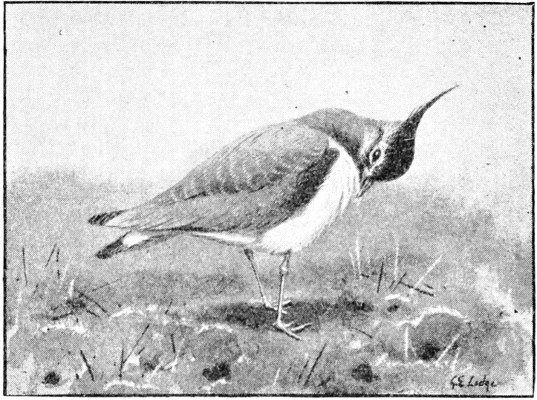
Fig. 98.—Lapwing. ⅙ natural size.
Crown and crest greenish black; sides of neck whitish; upper parts metallic green with purple reflections; quills black; tail-feathers white with a broad black band; face, throat, and upper breast bluish black; belly and axillaries white; tail-coverts fawn-colour. Length, twelve inches.
The lapwing, pewit, or green plover, as he is variously named from his manner of flight, note, and colour, is a familiar bird to most persons, and undoubtedly the best and most generally known member of the order which includes plover, snipe, and their allies. He is widely distributed in the British Islands, and fairly abundant, and, furthermore, is a bird it is impossible to overlook, on account of his conspicuous colouring, his singular manner of flight and appearance on the wing, and his unique voice. A first meeting with the lapwing invariably excites surprise in the beholder. Seen on the ground he is a handsome bird; in plumage and long, curling crest unlike any other British species, elegant in form, and graceful and somewhat stately in his movements. The moment he takes flight, displaying his curiously shaped, rounded wings, that have a heavy, flopping, heron-like motion, he appears like a different creature: he looks awkward and strange, like an owl or a goatsucker driven out of its hiding-place in the daylight. But no sooner does he begin to practise his favourite evolutions in the air than a fresh surprise is experienced. Rising to a height of forty or fifty yards, he suddenly dashes in a zigzag, downward flight, with a violence and rapidity unsurpassed by even the most aërial species in their maddest moments, and, turning like lightning when almost touching the surface, he rises, to repeat the action again and again. The heavy appearance and slow, flopping movement, and the marvellous wing-feats, are in strange contrast.
He is a vociferous bird, and when his breeding-ground is invaded he circles high above the intruder, dashing down at intervals, as if to intimidate him, and uttering all the while a wailing cry, somewhat cat-like in character. His call, heard both by day and night, most frequently in the breeding season, is a hollow, bubbling sound, followed by a prolonged and modulated clear note of a peculiar quality, not readily describable, except by the epithet ‘eerie,’ which is somewhat vague. It is a quality heard chiefly in the voices of nocturnal species—owls and others.
The lapwings begin to nest at the end of March on heaths and waste lands, and in meadows, pastures, and fallows. As a rule, more than one pair, and often several pairs, have their nests near each other; and so gregarious are the birds at all times, that even during incubation, and when the young are out, they are to be seen associating together when feeding, and when indulging in their sportive exercises in the air. A slight depression in the soil, with a few dried grass-stems for lining, serves for nest, and the eggs are four in number, olive-green, thickly mottled with black and blackish brown spots. False nests are often found near the nest containing eggs, and these are said to be formed by the male in turning round and round when showing off to his mate.
The lapwing is common throughout the year, but in autumn, when they congregate, often in flocks of many hundreds, and even thousands, there is a very general movement; and no doubt at this season a large proportion of the birds that breed with us leave the country, their places being taken by others from more northern regions. Throughout the British Islands it is a fairly common species, but it is believed that for many years past the lapwing has been decreasing in numbers, chiefly on account of the demand for plovers’ eggs, and of unrestricted egging.
Turnstone. Strepsilus interpres.
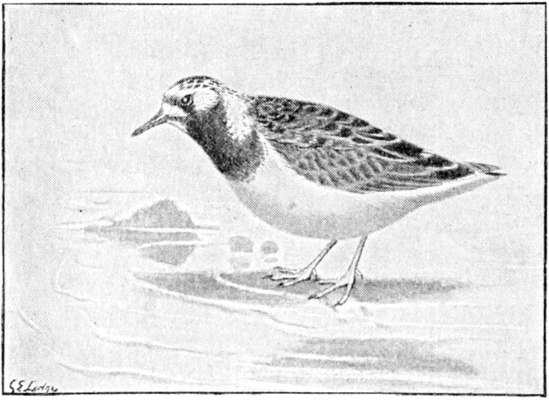
Fig. 99.—Turnstone. ⅕ natural size.
Head, neck, breast, and shoulders variegated with black and white; upper surface black and chestnut-red; rump white; tail-feathers and a patch on the coverts dark brown; under parts white; legs and feet orange. Female: not so bright. Length, nine inches.
The turnstone is very nearly of a size with the song-thrush, although its conspicuous black-and-white and curiously marked plumage causes it to appear much bigger to the eye. The plumage is very handsome, the upper parts being mottled with black and red—a tortoiseshell colouring which is rare in birds. It is a visitor to our coasts after the breeding season, the young birds arriving towards the end of July, the adults following in August, after the moult. From the east coast of England most of the birds depart in autumn; on the south and west coasts many remain all winter. The return migration to the breeding-grounds in the arctic regions takes place about the middle of May; but it is believed that a few pairs breed annually within the limits of the British Islands, as birds have been observed in summer in full nuptial dress. There are few birds with so wide a distribution as the turnstone, its range extending along the coasts of Europe, Asia, Africa, North and South America, Australia, and the Atlantic and Pacific islands.
The turnstone is a bird of the seashore exclusively, with a partiality for rocky coasts, and feeds on marine insects and small crustaceans, which it picks from the stranded seaweed, and on this account it is called ‘tangle-picker’ on the Norfolk coast. It also turns over the small stones and shells on the sand, to search for insects concealed beneath them; and when the stone is too large to be moved by the bill, the breast is used in pushing. Two or three birds have been observed to unite in pushing over an object too large to be moved by one.
Oyster-catcher. Hæmatopus ostralegus.
Plumage intense black and pure white; bill orange-yellow: irides crimson; legs and feet purplish pink. Length, sixteen inches.
The oyster-catcher, or sea-magpie, is regarded by many persons as the most beautiful of our shore-birds. When seen running on the sands with a rapid, trotting gait, or standing motionless—a pied bird with thick, orange-red bill and pink legs, the large head drawn in—his appearance strikes one as singular rather than beautiful. No sooner does he take to flight, exhibiting the sharp-pointed, wonderfully conspicuous, black and white wings, than the beauty is revealed. The flight is rapid, and as he wheels round the intruder in a wide circle he utters a succession of cries, somewhat like those of the golden plover and curlew in character, but shriller and more vehement. The oyster-catcher is a resident species, to be met with throughout the year in all suitable localities on the coasts of Great Britain and Ireland. He is most partial to rocky coasts with patches of sand and shingle, his food consisting chiefly of small shellfish left exposed on and among the rocks at low water. With his strong, wedge-shaped bill he strikes the limpets from the rocks and scoops out their contents; and he opens the mussel-shells by driving his beak between the closed valves and prising them apart. He also devours sea-worms, shrimps, and other crustaceans.
The nest is placed on the rocks or on rough shingle, a little above high-water mark. It is very simple, being nothing more than a slight depression in the shingle, with small pebbles and fragments of shells for lining. Several false nests are sometimes made by the birds near the one containing the eggs.
Three, or very rarely four, eggs are laid, of a pale stone-colour with a yellowish tinge, spotted and streaked with black, blackish brown, and dark grey. During incubation the male keeps watch, and gives warning of danger to his mate, who quietly leaves the nest; when the spot is approached both birds fly round the intruder, frequently alighting on the ground within a few yards of him, uttering their shrill, distressed cries the whole time. At all other times the oyster-catcher is an excessively shy and wary bird, owing to much persecution.
In autumn and winter oyster-catchers gather in small flocks, and the birds that breed on the northern coasts go south to winter, their place being taken by migrants from the Continent.
Red-necked Phalarope. Phalaropus hyperboreus.
Female: head, hind neck, and shoulders ash-grey; upper parts dark grey mixed with rufous; a white bar on the wing; neck chestnut; upper breast ash-grey; under parts white; bill black; legs and feet greenish. Length, seven inches and three-quarters. Male: smaller, and less brightly coloured.
The phalaropes are small, handsome birds that, like the plovers they are related to, perform long annual migrations, breed in very high latitudes north of the arctic circle, and have a distinctly different summer and winter plumage. But in the form of their curiously lobed feet they are like coots, while in their habits they are, perhaps, nearest to the moorhen. There are two British species, both irregular visitors on migration to this country; but of the red-necked phalarope a few pairs remain to breed annually in the Hebrides and Shetlands, consequently this species may be regarded as indigenous. Unfortunately, the British race of this bird is now nearly extinct, victims to the ‘cupidity of the cabinet,’ specimens of the bird and its eggs being in great request among collectors.
The red-necked phalarope is equally at home on land or water, and picks up its food on the sandy or muddy margins of the marshy pools it frequents in summer, and from the surface of the water, as it swims rapidly about, sitting high, and with head set back like a gull.
The nest is placed on the ground, among heather or herbage and grass, at some distance from the water. The four eggs are pale brown in ground-colour, spotted with blackish brown and grey.
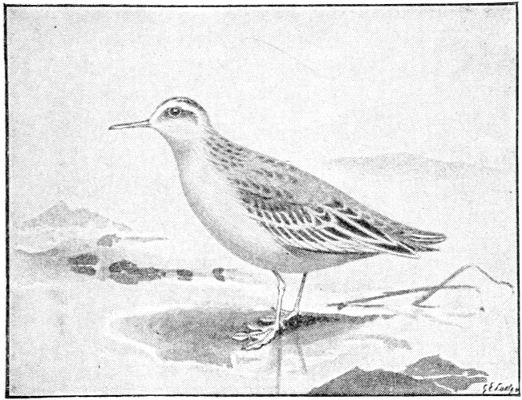
Fig. 100.—Grey Phalarope. ¼ natural size.
The grey phalarope (Phalaropus fulicarius), irregular in its visits like the last species, appears in larger numbers when it does come. Its visits to the south and south-east coasts of England occur in autumn and winter. Its range in summer is circumpolar, and it has been found breeding as far north as latitude 82° 30′. The breeding plumage is reddish chestnut, the female being brightest in colour. In winter, when it arrives in this country, its under parts are pure white, and the whole upper parts a delicate pale grey.
Woodcock. Scolopax rusticula.
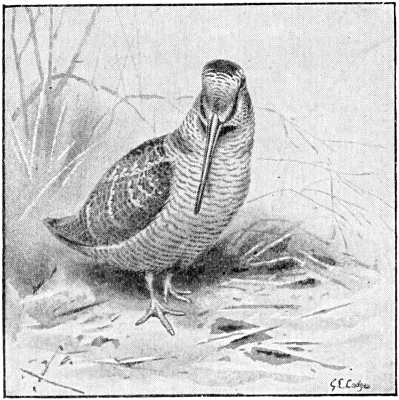
Fig. 101.—Woodcock. ⅙ natural size.
Upper plumage reddish brown barred and vermiculated with black; under parts wood-brown with darker brown bars. Length, fourteen inches. Sexes alike.
The woodcock is a large species compared with other snipes, and a very handsome bird in its russet-red plumage, prettily pencilled and barred with various shades of black and brown and grey; furthermore, it is in great esteem for the table, and it is therefore not strange that, like the red grouse, it should be a favourite alike with the ornithologist, the sportsman, and the lover of delicate fare.
Nocturnal in its habits, the woodcock spends the daylight hours in close concealment in woods and brakes, often under the shelter of a thick evergreen bush, and, it is said, sometimes partially covering itself with dead leaves. Its red and mottled plumage, which so closely assimilates in colour to the fallen leaves among which it sits, is its best protection—a similar case to that of the nightjar crouching on the dry, open common. Visible it may be, but not distinguishable as a bird amid such surroundings unless the large, lustrous black eyes are caught sight of. When flushed during daylight its flight is owl-like, and its appearance somewhat singular. In the dusk of evening, when seeking its feeding-ground, it flies in a curious manner, darting rapidly this way and that through the glades and open spaces. It obtains its food by probing deep in the soft, damp soil, or in bogs, with its long bill, but how it finds the earthworms and grubs on which it feeds would be hard to say. There is no doubt that the end of the beak is an exquisitely delicate organ of touch, but it is hard to believe that it is thrust deep into the soil merely on the chance of finding something edible.
The woodcock breeds in suitable localities throughout Great Britain and Ireland, but in limited numbers, and not very regularly; but whether the birds that breed with us remain all the year, or migrate to more southern latitudes in autumn, is not known. Most, if not all, of the birds that winter in our islands are visitors from northern Europe. They begin to arrive, chiefly on the east and south-east coasts, about the middle of October, travelling by night, usually in calm, hazy, or foggy weather, and sometimes arriving in immense numbers. As a rule the females arrive first, the later flights being composed of males. It is only when migrating that woodcock are seen in any number together, and at such times their gatherings are probably accidental. On their arrival they quickly scatter over the country, and for the rest of the time are solitary in their habits. The migrants from the north take their departure in March. In this country nesting begins at the end of that month, and in the pairing season the male woos his mate with a curious and pretty performance, not at all like the wild celestial love-antics of his relation, the common snipe. For a time he abandons his shy, skulking habits—a hermit in love, he comes out morning and evening, and for the space of half an hour continues flying to and fro, with a singularly slow flight, and with plumage puffed out, so that he looks twice his ordinary size. Flying, he emits two peculiar notes, one deep and hollow, the other sharp and whistling. This performance of the woodcock is called ‘roding’ in East Anglia. The nest is a slight hollow, placed among dead ferns and fallen leaves in a sheltered situation in a wood. The eggs are four, pale yellowish white, the larger end spotted and blotched with ash-grey and brown of a reddish yellow tint.
A little over a century ago it was discovered that the female woodcock had the habit of removing its young, one at a time, when in danger by flying away with them. But it was said that the young bird was carried in the bill of its parent, and ornithologists declined to believe it, because, as Gilbert White remarked, the long, unwieldy beak of the woodcock was unfitted for such a task. The matter remained in doubt until about twenty years ago; and it is now known that the bird carries her young with her feet, either grasping them in her claws or holding them pressed between her thighs. According to some observers, the bird uses her bill to keep her young one pressed firmly against her thighs when flying with it.
Great Snipe. Gallinago major.
Crown black, divided lengthways by a yellowish white band; a streak of the same colour over the eye; upper parts mottled with black and chestnut-brown; greater wing-coverts tipped with white; under parts whitish, spotted and barred with black. Length, twelve inches.
The great, or solitary snipe, sometimes called the double snipe, resembles the common snipe in form and colouring, and in size is intermediate between that species and the woodcock. This species, described in the B.O.U. official list as a ‘straggler,’ hardly comes within the scope of the present work. But although a straggler, it comes regularly, appearing in the eastern and southern counties from the middle of August to the middle of October. These visitors are young birds, and few in number, and as they do not revisit us in spring, it may be assumed that they perish in their winter wanderings—the usual fate of stragglers from the migrating route of the species, or race. The fact that young birds in very many cases migrate in advance of the adults, that they keep to the same lines, and often journey vast distances, clearly shows that migration is performed instinctively. We may call the principle of action in this case crystallised experience, or inherited or historical knowledge, or lapsed intelligence, or by any other pretty name; but it is not ordinary intelligence—the guiding faculty that observes, considers, and profits by experience. And it is possible to believe that the young of the great snipe, when visiting Great Britain in the autumn, are going back to an ancient route abandoned by the species, perhaps thousands of years ago, on account of physical changes in the earth’s surface, or of a change in the system of the bird itself.
Common Snipe. Gallinago cælestis.
Upper plumage mottled black and chestnut-brown; flanks barred with white and dusky; under parts white. Length, ten inches and a half.
The common snipe, like the woodcock, breeds in limited numbers throughout the British Islands. But the woodcock nests in woods, and, owing to the increase of plantations, the bird as a breeding species has increased with us. Just the contrary has happened with the snipe. He is a breeder in marshes, fens, and low, wet grounds, and as drainage and cultivation deprive him of suitable localities to nest in, he diminishes in numbers. Most of the birds that winter in our islands are migrants from Scandinavia; they come in October and November, and remain until March. During the winter months they are often compelled by changes in the weather to shift their feeding-grounds, and intense cold is very fatal to them. Their soft, sensitive bills must have a soft soil to probe in, and frost cuts off their food-supply. When approached, the snipe seeks to avoid observation by crouching close to the earth, where its mottled upper plumage fits in well with the colour of the boggy or wet ground; on taking wing it rushes upwards with a violent zigzag flight, uttering at the same time a sharp, scraping cry, two or three times repeated. Late in March or early in April the snipes pair, and it is then that the males begin to practise their curious aërial exercises, familiar to anyone who observes wild bird life, and about which so much has been said by ornithologists. The performance takes place at all hours of the day, but chiefly towards evening, the bird rising to an immense height in the air, and precipitating himself downwards with astonishing violence, producing in his descent the peculiar sound variously described as drumming, bleating, scythe-whetting, and neighing. From this sound the snipe has been named in some districts ‘moor-lamb’ and ‘heather-bleater.’ As to how the sound is produced opinions differ still, although the question has been discussed for over a century. Probably it is in part vocal and partly produced by the wing-feathers.
The snipe makes a very slight nest of a few dried grass leaves and stalks, placed among rushes or by the side of a tussock of coarse grass. Four eggs are laid, yellowish or greenish white, the larger end spotted with various shades of brown. The female hatches the eggs without assistance from her mate, who continues his play in the air at intervals every day until the young are out. Two broods are sometimes reared in the season.
Jack-Snipe. Limnocryptes gallinula.
Upper parts mottled with buff, reddish brown, and black, the latter exhibiting green and purple reflections; neck and breast spotted; belly white. Length, eight inches.
The small jack-snipe is exclusively a winter visitor to this country, never remaining to breed. It comes at the end of September and in October, and is found generally distributed in Great Britain and Ireland, but in less numbers than the common snipe. In its habits it is more solitary than that species, and sits closer, often refusing to rise until almost trodden upon; and when it flies it utters no alarm-note. In April it leaves us, after assuming its summer plumage, glossed with beautiful colours. In its breeding-haunts in northern Europe and beyond the arctic circle the male has an aërial performance similar to that of the common snipe, but the sound produced by the bird in descending is different, and has been compared by Wolley to ‘the cantering of a horse over a hard, hollow road; it comes in fours, with a similar cadence and a like clear yet hollow sound.’ It makes its slight nest on the low ground, and lays four eggs, very large for the bird, of a yellowish olive colour, spotted and streaked with brown.
Dunlin. Tringa alpina.
Crown rufous streaked with black; mantle chestnut variegated with black; rest of upper parts grey; throat and upper breast greyish white and striped; lower breast black; belly white. The female is the largest, and measures eight inches. The winter plumage is chiefly grey on the upper parts; the under parts white with a greyish band on the lower breast.
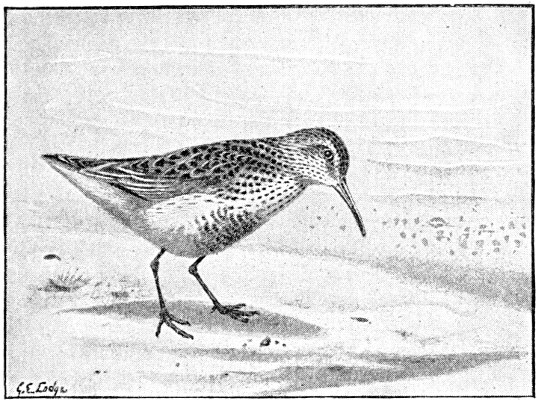
Fig. 102.—Dunlin (summer plumage). ¼ natural size.
The dunlin is by far the most abundant sandpiper on our coasts during the autumnal and vernal migrations; a considerable number of birds remain throughout the winter, and non-breeders or immature birds are to be met with in summer on the sandbanks and mud flats. The dunlin also breeds in this country, on moors and fells, in the wilder portions of England, Wales, and Scotland, and, in smaller numbers, in Ireland. In autumn they often congregate in such large numbers that a cloud of dunlins is on many parts of the coast as familiar a sight as is a cloud of starlings in more inland districts. The well-known and esteemed writer known as ‘A Son of the Marshes’ thus vividly describes the variable appearance of a vast flock of these birds on the wing: ‘In the distance something is coming up ... that looks like the smoke from the funnel of a steamer; it waves and streams as smoke will do in a rush of wind. Now the smoke has vanished. Again it shows thick, as at first, and then it breaks up in patches. Presently the dark cloud becomes a light one—a great flash of silver. It consists of dunlins coming up the wind at full speed. We can hear the rush of the thousands of wings, and their soft chatter, some time before they reach us. Now they are here; with a humming roar they pass below us up the creek; shoot up, showing black and white as they turn; dive down into the creek again; pass us, and take a sweep over the snow, where they are invisible, for their white under plumage, caused by the turn, is in the light. Another turn, and the dark cloud is passing over the snow and into the creek. One turn more, and we see the cloud of dunlins drop below us on the slub—a vast host of living silver dots moving rapidly over the dark brown mud and grey ooze. As they throw their wings up, as they flirt up from one spot to another, all busy chattering, and dibbling, now here, now there—for we can see all their actions, so close are they to us—I thought that it was one of the most interesting sights I had been privileged to witness.’
At the end of April the great body of dunlins forsake our coasts, going north to breed; those that remain to breed in the British Islands withdraw to the loneliest moors and fells, the summer haunts of the curlew and golden plover. On this account the dunlins are called ‘plovers’ pages’ in some districts.
The language of the dunlin differs from that of most of the sandpipers, being hoarse and somewhat grating; but in spring, on the moors, the male has an agreeable trilling love-call, uttered in the air, or as the bird descends to earth with set, motionless wings and expanded tail.
A slight nest is made on the ground among the heather, and four eggs are laid, greenish white, spotted and blotched with reddish brown.
The great difference in the summer and winter plumage of the dunlin caused it to be regarded formerly, by most persons, as two distinct species: in the chestnut-and-black plumage it was the dunlin; in white-and-grey, the purre. Other local names for this species are stint, ox-bird, and sea-snipe.
Little Stint. Tringa minuta.
Upper parts variegated with rufous and black; throat and upper breast tinged with rufous and speckled with dark brown; under parts white; bill and feet black. Length, six inches. In winter the upper parts are ashy brown, and there is no rufous on the throat.
This diminutive sandpiper, no larger than a house-sparrow, and in appearance a miniature dunlin, is the least of its order in the British Islands. It comes to us only during the autumn and spring migrations, but in small numbers, as the British coasts lie a little outside of its main lines of travel. It makes its appearance in August, chiefly on the east side of Great Britain, and is gone by October; in May it reappears, to stay till June, when it resumes its journey northwards. Its known breeding-places are in Northern Norway and Siberia, north of the arctic circle. The eggs are four in number, of the same length as those of the song-thrush, in colour and markings like dunlins’ eggs. The note of this species is described in Yarrell as a ‘whispering, warbling trill, very different from the louder call of the dunlin; ... and the call of a flock is something like the confused chirping of grasshoppers or crickets.’
Temminck’s stint (Tringa temmincki) is a visitor on migration to the coasts of Great Britain, but is less regular, and appears in smaller numbers than the little stint, which it resembles in size and colour.
Curlew-Sandpiper. Tringa subarquata.
Head, neck, and mantle chestnut, streaked and barred with black and grey; upper tail-coverts white tinged with buff and barred with black; quills and tail-feathers ash-grey; under parts chestnut-red, slightly barred with brown and grey on the belly and flanks. Length, eight inches. In winter the upper parts are ash-brown, mottled with darker and paler brown; breast paler; under parts and upper tail-coverts white.
This species derives its name from the form of the bill, which is curved downwards, as in the curlew; pigmy curlew is one of its common names. It is an annual visitor on migration to this country, on the east side chiefly, and occasionally penetrates to inland waters. It associates with dunlins on the sand and mud flats, and resembles that species in its feeding habits, but when flying may be easily distinguished by its conspicuous white tail-coverts. On its return from its breeding-grounds it remains on our coasts from August to October. From its winter haunts in the south it begins to arrive at the end of March, the migration continuing until June. At this season the birds are in their full summer dress, which resembles that of the knot. The bird is, Seebohm writes, ‘a miniature knot with a long, decurved bill.’ Its breeding-grounds have not yet been discovered.
Purple Sandpiper. Tringa striata.
Head and neck dusky brown tinged with grey; upper parts nearly black, with purple reflections; the feathers edged with ash; throat, neck, and breast greyish; below, white; legs and feet ochre-yellow. Length, eight and a quarter inches. In winter the upper parts are sooty and the breast dark ash-brown, with faint lines and mottlings.
The purple sandpiper is an inhabitant of the British coasts in autumn and winter, and is occasionally seen associating with dunlins on the sand and mud flats, and may readily be distinguished by its darker colour and its lumpier figure, caused by the thickness of its winter plumage. But its favourite haunts are rocky shores, where it feeds among the stranded seaweed on marine insects, small shrimps, and other crustaceans. It is, in fact, a sandpiper with the feeding habits of the turnstone. It is known to breed on the Faröes, where it nests on the fells and mountains and lays four eggs, pale green or olive, blotched with reddish brown, with purplish under-markings. Its eggs have never been found within the British Islands, but it is probable that a few pairs breed annually on some of the islands and on the mainland of Scotland. In its summer haunts in the arctic regions it is said to be the most abundant sandpiper. With us it is not a common species, and is seen in small flocks of half a dozen to a dozen birds.
Knot. Tringa canutus.
Crown and neck reddish brown with darker streaks; mantle blackish; the feathers spotted with chestnut and margined with white; tail-coverts white barred with black; cheeks, throat, and breast chestnut. Length, ten inches. In winter the upper parts are ash-grey and the under parts white flecked with grey.
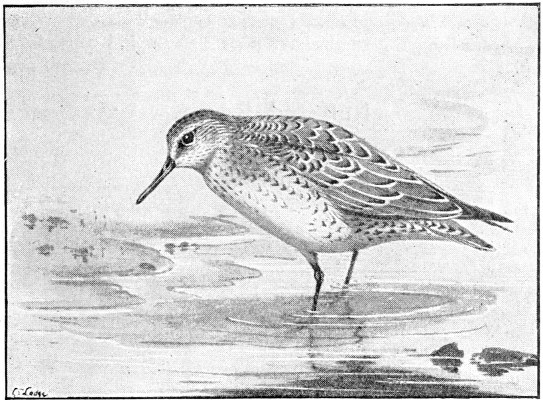
Fig. 103.—Knot. ¼ natural size.
This richly coloured and pretty sandpiper with a strange name is one of two species in this order of birds of which the eggs are not known to ornithologists, or do not exist in collections. It is a regular visitor to the British coasts on migration in August, but many birds remain in this country until the following May. In some seasons they are very abundant, especially on the north-east coast of England; and in former times they were esteemed a great delicacy, and were netted in large numbers, to be fattened, like dotterels and ruffs and reeves, on bread-and-milk for the table. According to Camden (‘Britannia,’ 1607), the bird was named after King Canute on account of his excessive fondness for its flesh. Drayton, adopting this explanation of the name, wrote in his ‘Polyolbion’:
The Knot that called was Canutus Bird of old, Of that great King of Danes, his name that still doth hold, His apetite to please, that farre and neare was sought, For him (as some have sayd) from Denmark, hither brought.
It is possible that the Danish king introduced the taste for the knot, which lasted down to the end of the seventeenth century.
As long ago as 1820 the knot was found breeding in the Melville Islands (lat. 80°), and later, at various times, in other arctic localities, but in no case were the eggs preserved. During the pairing-time the birds toy with each other in the air, the male uttering a sweet, fluting whistle. On our coasts they are very gregarious, feeding on the extensive mud-flats in large flocks. It has been observed that the young birds that come in advance of the adults in August are strangely tame in disposition. In May, when the return migration to their arctic breeding-grounds takes place, the birds that arrive on our shores from the south have their rich nuptial colours fully developed.
Ruff and Reeve. Machetes pugnax.
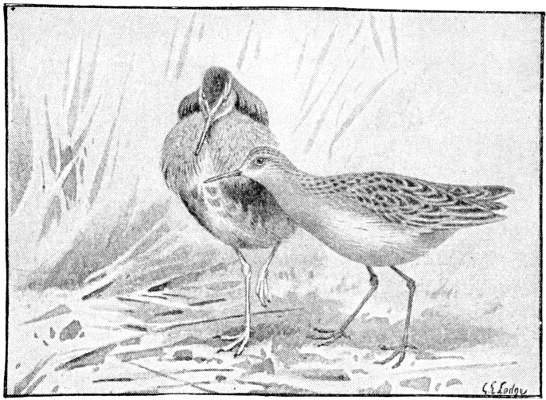
Fig. 104.—Ruff and Reeve. ⅐ natural size.
The male in spring dress has the face covered with yellowish caruncles; a tuft of long feathers on each side of the head; throat furnished with a shield-like ruff of feathers; general plumage mottled with ash, black, brown, yellowish, and white, the ornamental feathers being differently coloured in almost every individual. In his winter plumage the male has the face feathered, and is without the ruff and ear-like tufts; under parts pale buff. Length, twelve inches. The female, or reeve, is a third smaller than the male, and in colour resembles the male in his winter dress.
If by chance the reader has seen in some museum or collection a group of ruffs in full breeding-plumage, displaying their immense, shield-like ruffs of many colours, their beauty, singularity, and wonderful variety must have astonished him. The curious feather ornament is similar in form in all the birds, but the colour varies infinitely, and it is hard to find two birds exactly alike. In some individuals it is entirely white, in others intense purple-black, and between these two extremes numberless varieties are found—buffs, reds, chestnuts, browns of many shades, and mottled black or brown and white, often beautifully streaked, or barred, or spotted, or delicately vermiculated. But, alas! these dead, stuffed birds, standing immovable by means of wire frames—a burlesque on the wonderful living creatures—are the only ruffs he is ever likely to see, since this bird, as a breeding species, has now been extirpated in England. On migration in autumn and spring it still visits our coasts, but in small numbers, and probably not very regularly. These visitors, or stragglers, are without the wonderful feather ornaments, which are nuptial, and assumed about the middle of May, to be worn only for about six weeks.
The ruff is polygamous; and in spring the birds have the habit of meeting on some small dry spot, or hillock, in a marsh to show off and fight for the possession of the females, or reeves. When engaging in combat the birds stand face to face, like fighting-cocks, their great feather shields erected, and thrust at each other with their long beaks. These combats usually take place early in the morning; and formerly, when the birds were abundant, the marshmen made it their business to find the hillocks used by the birds, and set horsehair nooses on them. The birds taken were fattened for the market, and it was owing to this system of persecution during the breeding season that the ruffs were reduced to a mere remnant; and the remnant has since been destroyed by collectors. In Lincolnshire the ruffs and reeves finally ceased to breed in 1882; in Norfolk the last few pairs of the once numerous British race lingered on until within the last three or four years.
Sanderling. Calidris arenaria.
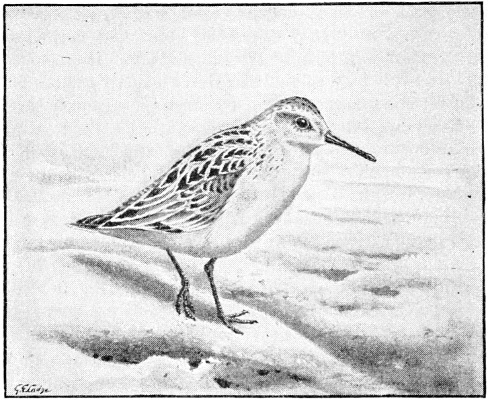
Fig. 105.—Sanderling (winter plumage). ¼ natural size.
Feathers of the upper parts with dark brown centres, edged or spotted with rufous and tipped with grey; base of inner primaries and edge of greater wing-coverts white, and outer feathers of tail-coverts also white; face, neck, and upper breast pale chestnut spotted with dark brown; under parts white; bill black; legs and feet dark olive. Length, eight inches. In winter the upper plumage is ash-grey and the whole under parts white.
The sanderling is the sole member of its genus, and differs from other sandpipers in having no hind toe. It arrives on our coasts in August, young and old birds coming together. During the autumn months it is found in small flocks, associating with dunlins and other species on the seashore, and it is also a visitor to the margins of inland waters. A few birds remain through the winter. In April the migrants reappear, and remain until May or June before going north to their breeding-grounds. The sanderling is circumpolar in its distribution, and breeds farther north than most of the arctic species. The eggs are greenish buff in ground-colour, spotted with various shades of brown, and have been described as ‘miniature curlews’ eggs of a pale colour.’ After the young have been reared the birds travel south along the shores of Europe, Asia, Africa, and America. On the Pacific coast of America their migration extends from the arctic regions to Patagonia, a journey of nearly eight thousand miles.
Common Sandpiper. Tringoïdes hypoleucus.
Upper parts ash-brown glossed with olive; chin white; sides of the neck and breast pale ash with dusky streaks; under parts and tips of outer tail-feathers white. Length, eight inches.
The common sandpiper, known also as the summer snipe, is a summer visitor, to be met with from April until the end of September in suitable places throughout the British Islands. He is an exceeding lively and restless little bird, running nimbly or flitting along the margin of the water; when standing, perpetually bobbing his head and jerking his tail, on which account he is named ‘fidler’ in some districts; solitary in habit, or living with his mate only, choosing for a home the most secluded spots by streams and meres. In the southern half of England, where the localities that best suit him are fewest, he is very thinly diffused; in Scotland, on the other hand, he is most abundant. Seebohm writes of this sandpiper: ‘It is found in the same localities as those frequented by the dipper. High up among the mountains its melodious cry may be heard from the shingly margin of the stream, or the bird may not unfrequently be seen perched on a rock surrounded by water. Even here the sandpiper shows a partiality for certain haunts. The dipper loves their wildest mood, and the more they roll and toss over the rocky boulders, the more he seems at home; but the sandpiper prefers their slow-running reaches and sandy, driftwood-covered islets, where the shingly and oozy rush-grown banks afford it the haunt it needs.’
The slight nest of moss and dried leaves is placed among coarse grass or rushes, or in a hole or sheltered hollow in a bank near a stream. Four pear-shaped eggs are laid, very large for the bird, reddish white in ground-colour, spotted and speckled with dusky brown.
The sandpiper utters on the wing a clear musical note, thrice repeated; and in the pairing season the male has a trilling note, or song, emitted while hovering in the air. Both old and young birds are able to swim with ease, and, to escape danger, dive as readily as a moorhen or water-rail.
Green Sandpiper. Helodromus ochropus.
Upper parts olive-brown glossed with green and spotted with white and dusky; under parts white; tail white, the central feathers barred with black. Length, nine and a quarter inches.
The green sandpiper, like many other members of its family, is a visitor to the British Islands after the breeding season. This species differs from others in coming earlier and departing later. Half a century ago it was observed in Norfolk that the green sandpiper was to be met with during nearly every month in the year. The discovery was made later that it differs from other sandpipers in breeding in trees, in old nests of other birds, in squirrels’ dreys, and on mossy trunks and branches. On account of this singular habit its nest is rarely found; but that it has bred, and does breed, in this country scarcely admits of a doubt.
In continental Europe it is known to breed in Scandinavia, North and Central Russia, and North Germany. The eggs are four in number, pale greyish green in ground-colour, with small purple-brown spots and markings.
The green sandpiper frequents inland watercourses and swamps in wooded districts, and is excessively shy and wary in its habits; it flies rapidly, and utters when on the wing its shrill, piping note, thrice repeated.
Redshank. Totanus calidris.
Summer plumage: upper parts pale brown closely streaked and barred with umber; secondaries nearly white; rump white, with a few dusky flecks; tail-feathers white barred with blackish; under parts white, streaked on the neck and breast with umber; legs and feet orange-red. Winter plumage: upper parts ash-colour; rump and under parts white, sparsely streaked and spotted with grey on the neck and breast. The female is slightly larger than the male. Length, eleven inches.
The redshank, although not so numerous as formerly, is still a fairly common bird of the tidal flats and saltings on the east coast of England, and, in smaller numbers, in all suitable localities in Great Britain and Ireland. It is resident throughout the year, but is most plentiful in autumn and winter, at which time its numbers are increased by the arrival of migrants from northern Europe. Its food consists of marine worms, insects, and small crustaceans, and when its feeding-grounds are covered at flood-tide, it may be seen in close flocks on the small, dry areas, waiting for the water to subside. When thus congregated the birds are very loquacious, keeping up a perpetual confused sound of many voices, which has been compared to the chirruping concert of a flock of house-sparrows before settling down to roost of an evening. When the tide goes out the flocks break up, and the birds scatter in all directions to feed. The redshank begins to breed about the end of May, in fens and inland marshes, and on the saltings, out of reach of the tide.
The nest is a slight depression in the ground, with a few dried bents and grass-blades for lining, or with no lining at all, and is in some cases quite exposed; but it is more often placed among coarse grass, or in the centre of a tussock, which conceals it from view. Four eggs are laid, of a yellowish grey ground-colour, blotched and spotted with purplish brown. When its breeding-haunts are approached the bird displays the greatest excitement, and flies circling about high above the intruder’s head; and at such times a peculiar manner of flight, common to all the species of the genus Totanus, becomes very marked. The flight is slow and somewhat wavering, with an occasional downward stroke of the wings, which are much depressed, as of a duck about to drop on to the water. While flying in this way it clamours loudly, making the marsh ring with its shrill, piercing pipe, and at times dashes down close to the intruder’s head, as if to intimidate him; and if there should be young, or eggs about to hatch, it drops on to the ground, and flutters along the surface like a wounded bird, in order to draw the danger away. Most birds in the order which includes the sandpipers, snipes, and plovers, make use of this device when their young are in danger.
At all times the redshank is a vigilant and clamorous bird, and as the meaning of its ringing alarm-note is understood by all waders and waterfowl, it is heartily detested by the gunners on the sea-coast.
Greenshank. Totanus canescens.
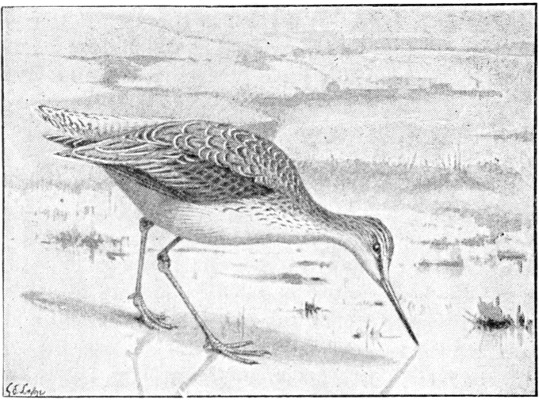
Fig. 106.—Greenshank. ⅙ natural size.
Head and neck greyish white streaked with blackish brown; mantle and secondaries nearly black; rump and tail-feathers white, the latter mottled and barred with dusky brown; under parts white, streaked and spotted with ash-brown; legs and feet olive-green. Length, fourteen inches. In the winter plumage the upper parts are greyer and the under parts pure white.
The greenshank is an annual visitor during the spring and autumn migrations to the coasts and inland waters of Great Britain and Ireland; but it comes in small numbers. It has long been known that a number of pairs remain annually to breed in Scotland, and, according to Mr. Harvie-Brown, its breeding-range is extending in that country. Macgillivray wrote of this species: ‘Its habits are very similar to those of the redshank, with which it associates in autumn. It is extremely shy and vigilant.... Many individuals remain during the summer, when they are to be found by the lakes in the interior.... At that season it is easily discovered, for when you are, perhaps, more than a quarter of a mile distant, it rises into the air with clamorous cries, alarming all the birds in its neighbourhood, flies round the place of its nest, now wheeling off to a distance, again advancing towards you, and at intervals alighting by the edge of the lake, where it continues its cries, vibrating its body all the while.’
The nest is often placed at some distance from the water. The four eggs are of a warm stone-colour, spotted with brown and blotched with purplish grey.
Whimbrel. Numenius phæopus.
Crown dark brown, with broad pale streak down the middle; upper parts like the curlew, but darker; axillaries white barred with brown. Length of female, eighteen inches.
If it were our belief that the happiness of birds consisted in the degree of interest they, as species, excite in us, it could be said that the whimbrel suffers from his resemblance to the curlew. He is in form and colouring a lesser curlew with a less strongly marked individuality; ‘half-curlew’ and ‘jack-curlew,’ his two vernacular names, really imply that he is only half as attractive as the bigger bird. With us he is best known as an autumn and spring visitor, breeding only in the Orkney and Shetland Islands. The migration eastwards begins at the end of July, and the birds continue to pass until September, flying rapidly and at a great height. Of the flocks that alight to rest and feed on our coasts, a few birds remain through the winter. The return migration begins in April, but the greatest number of the migrants appear on our coasts about the beginning of May. On account of their punctuality, the whimbrel is known in some districts as the ‘May bird.’ In language and habits they resemble curlews, but have shriller voices, a more rapid flight, are not so excessively shy, and do not confine themselves so exclusively to the sand-flats when feeding. Grass-grown saltings, low meadows, and pasture-lands in the neighbourhood of the sea are visited by them. The nest is placed on moors and heaths not far removed from the shore. A slight hollow among the heather or coarse grass is lined with dead stems and leaves, and four eggs are laid, in colour like those of the curlew, but differing in size. During the breeding season the whimbrels are extremely pugnacious, and attack the skuas, lesser black-backed gulls, and other egg-stealing species, and chase them from their nesting-ground with shrill, angry cries.
Common Curlew. Numenius arquata.
General plumage reddish ash mottled with dusky spots; belly nearly white, with dusky streaks; rump and tail-coverts white; tail-feathers barred with dark brown. Length of the female, which is the larger, twenty-one to twenty-six inches.
The curlew is the largest of its order in the British Islands; even the large woodcock looks small besides him, and among diminutive stints and sandpipers he is a veritable giant. An imperfect ibis in figure, in a pale sandy brown dress with dusky mottlings, he is, perhaps, the least handsome of the Limicolæ; in character he is one of the most interesting. What marvellously keen senses, what unfailing wariness and alertness must this large, inland-breeding species possess to keep its hold on existence in so many localities in this populous country in spite of incessant persecution! Most vigilant of birds, he is not vigilant on his own account only. He is the unsleeping sentinel of all the wild creatures that are pursued by man, warning them of danger with piercing cries that none fail to understand. The redshank, greenshank, and many other species, in this and other orders, are equally vociferous in the presence of danger, and their warnings are as promptly obeyed by all wild creatures that live with or near them; but a curious feature about the curlew is that he appears to take an intelligent interest in the welfare of beings not of his own species, and that he is distressed if they fail to act on his signal. In Yarrell’s ‘British Birds’ (4th edit. vol. iii.) Howard Saunders gives a striking instance of this characteristic. He describes seeing one of these birds, ‘after shrieking wildly over the head of a sleeping seal, swoop down, and apparently flick with its wings the unsuspecting animal, upon which the stalker was just raising his rifle.’ This, to my mind, is a far more wonderful instance of the help-giving instinct in the lower animals than that related by Edwards of Banff, in which a number of terns swooped down upon one of their number which he had wounded and was pursuing, and, taking its wings in their beaks, raised it, and bore it away out to sea beyond his reach. The case of the curlew reminds us rather of the action of the rhinoceros-bird in waking the rhinoceros on the appearance of an enemy; but between curlew and seal there is no such thing as commensalism, and no tie, excepting the common knowledge that they are living creatures, and must fly for life at the approach of man, their deadliest enemy, on account of his superior cunning and his power to slay them at long distances.
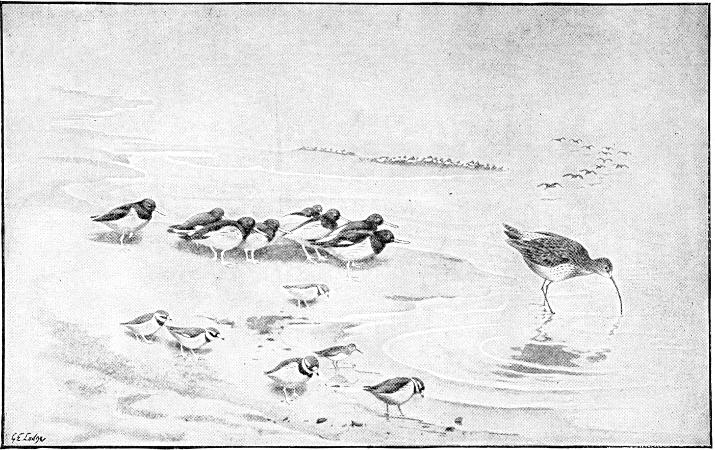
Oyster-catchers. Ringed Plover. Little Stint. Curlew.
During a greater part of the year the curlew is a shore-bird, seeking its food on the sand-flats which become covered at high water. When the tide overflows the flats the birds go inland, often to a distance of several miles from the sea, and wait there until the tide turns. They appear to know just when this occurs, however far from the shore they may be, and, rising and calling to each other, set out on their return, to arrive at the exact time when feeding may begin. It is during these journeys to and fro between the sea and the moors that the curlew looks at his best when, seen at a moderate distance, he passes in small flocks, disposed in the form of a wedge, or letter V, his sharp-pointed wings and long, ibis-like beak clearly outlined against the blue sky. To most lovers of nature and wild bird life the voice of the curlew is his principal attraction. He is very loquacious, and his ordinary cry of two notes, from which he takes his name, is singularly clear, far-reaching, and wild in character. His night cries have given rise to some curious and gloomy superstitions in Scotland, where the curlew is called ‘whaup.’ According to Yarrell, the bird is a ‘long-nebbit thing,’ from which the Highlander prays to be delivered, classing it with ‘witches and warlocks.’ In the same work we read: ‘Saxby says that the Shetlanders regard with horror the very idea of using so uncanny a bird as food; in fact, a visitor who did so was afterwards alluded to, almost in a whisper, as “the man that ate the whaup.”’ Long may the ‘long-nebbit things’ continue to exist, to delight and invigorate us with their wild voices!