CLASSIFICATION. (continued 2)
Reading edition
Sedge-Warbler. Acrocephalus phragmitis.
Upper plumage greyish brown; above the eye a broad, distinct, yellowish white streak; under plumage pale buff; throat white. Length, four inches and three-quarters.
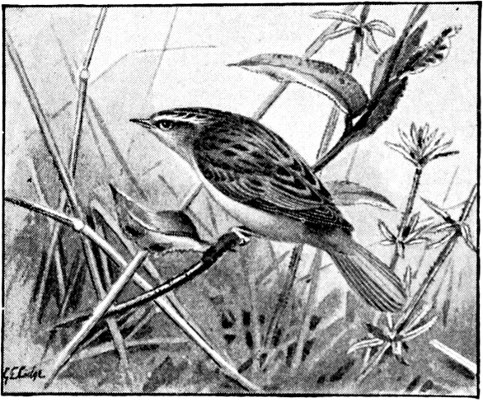
Fig. 30.—Sedge-Warbler. ⅓ natural size.
The sedge-warbler, usually called sedge-bird, and in some localities river-chat, is a common species in most waterside places where there are reed-beds and willows; it also frequents rough hedges and bramble and furze bushes in the neighbourhood of a watercourse. Sometimes, but not often, it is found breeding at a considerable distance from a stream. It comes to us in April, and is a most active and lively little creature. Although not shy of man, it is less easy to observe than any other species in this group, except, perhaps, the grasshopper warbler, on account of its excessive restlessness, the rapidity of its movements, and its habit of keeping near the surface in the close reeds and bushes it lives in. The grasshopper warbler, and, indeed, most small birds that inhabit bushes, love to come to the surface to sing; the sedge-warbler sings much as he hurries about in search of his food, which consists of small caterpillars and slugs, and aquatic insects. Occasionally the restless little yellowish brown figure appears for a moment or two near the top of a bush, and then vanishes again.
The song is curious, and delivered in a curious manner, with hurry and vehemence; and this, as well as the character of the sounds emitted, gives the idea that the bird is excited to anger—that he is scolding at, rather than singing to, the listener. The opening note, hurriedly repeated several times, and recurring at short intervals as long as the song lasts (its keynote and refrain), resembles the chiding note of the whitethroat when its nest is approached, but is louder and more strident. It is the loudest sound the sedge-warbler emits, and when the song is heard at a distance of fifty or sixty yards it seems all composed of chiding notes. But on a nearer approach—and the bird will allow the listener to get quite close to it—the performance is found to be a very varied one. Listening to it, one finds it hard not to believe that this warbler possesses the faculty it has often been credited with, of mocking other species. But if he indeed has such a talent, he reproduces not so much the songs of other birds as the notes and chirps and small cries of anxiety and alarm—the various sounds emitted by singing-birds in the presence of danger to their young or incubated eggs. Thus, in the medley of hurried and strongly contrasted sounds that come in a continuous stream from the sedge-warbler one seems to recognise the low girding of the nightingale, and the different notes of solicitude of the sparrow, reed-bunting, and chaffinch, of the wren and the willow-wren, the meadow-pipit and pied wagtail. But whether these various sounds are really borrowed or not one can never feel sure.
The sedge-warbler is a very persistent singer. Some birds are too chary of their strains; but of this waterside music any person may have as much as he likes in May and June. Singing is apparently as little tiring to this bird as rushing through the air is to the swift. At the season of his greatest vigour he appears to pour out his rapid notes almost automatically; and when silent, a stone or stick flung into his haunts will provoke a fresh outburst of melody. He also sings a great deal at night in the love season.
The sedge-warbler makes its nest among the tangled vegetation at the waterside; as a rule it is placed near the ground, and is composed outwardly of moss, leaves, and aquatic grasses, and lined with fine grass and hair. The eggs are five, of a dirty white or pale brownish ground-colour, with yellowish brown spots, sometimes with hair-like marks among the spots.
Besides the two described, three more species of this group of warblers have been numbered as British birds, having been found as stragglers in this country. These are the marsh-warbler (Acrocephalus palustris), the great reed-warbler (Acrocephalus turdoïdes), and the aquatic warbler (Acrocephalus aquaticus).
Grasshopper Warbler. Locustella nævia.
Upper parts light greenish brown; the middle of each feather, being darker, gives a mottled appearance; under parts very pale brown, spotted with darker brown on neck and breast; feet light brown. Length, five and a half inches. Female without the brown spots on the breast.
This warbler arrives in our country about the middle of April, sometimes a week, or even a fortnight, earlier. In the melodious family to which it belongs it is distinguished by the singularity of its voice, which has no musical, or song-like, or even bird-like quality in it, but is like the sound produced by some stridulating insects. It is to be found in suitable situations throughout England and Wales, and in many parts of Scotland and Ireland. It frequents both dry and marshy ground where dense masses of vegetation afford it the close cover which would seem necessary to its frail existence; thus it is found in reed-beds growing in the water, and in hedges and thorny thickets, and among the furze-bushes on open commons. Although thus widely distributed in the British Islands, it is, like the nightingale, very local, and reappears faithfully each spring at the same spot. How strong the attachment to place, or home, is in this species will be seen in the following fact: Having found a small colony of about half a dozen grasshopper warblers inhabiting a circumscribed spot in the middle of an extensive common, I went back to the place in three consecutive summers, and each time found the birds in the same bushes. Yet the dozen or twenty furze and bramble bushes which they inhabited were in no way, that one could see, better suited to their requirements than hundreds of other bushes of the same description scattered over the surrounding land. Nor were any other individuals of the species to be found in the neighbourhood, except one pair, which were always to be met with in some brambles about a quarter of a mile from the spot inhabited by the other birds. Such a fact appears to show that, not only do the old birds return year after year to the same breeding-place, but that the young also come back to the spot where they were hatched; also, it appears to show that in this frail and far-travelling species the annual increase is only sufficient to make good the losses from all natural causes.
Immediately after their arrival in April the males begin their curious vocal performance, at first with a feeble and broken strain; but in a little while the voice gains in strength and shrillness, and the utterance becomes more sustained, lasting sometimes without a break for thirty or forty seconds, and even longer. This is renewed again and again at short intervals throughout the day, and continued far into the night. Indeed, the song may be heard all night long in fine summer weather. The sound is recognised by few of those who hear it as coming from a bird. It is usually attributed to an insect, and if the hearer grows curious, and tries to find the exact spot from which it issues, he finds this a somewhat difficult task. The sound seems now on this side, now on that, now far away, and anon close at hand; it is here, there, and everywhere. A good plan is to put the open hands behind the ear, then to turn slowly round until the exact spot is discovered. When the bush from which it proceeds has been found, the listener should advance cautiously to within a few yards of it, and sit down and wait until the hidden bird, recovering from his alarm, comes up to the summit and resumes his singing. It is then most interesting to observe him. The bird sits motionless, turning its head from side to side, and so long as the strain continues the yellow mouth is wide open, like the gaping mouth of a fledgeling waiting to receive food, the slender body trembling with the sound, as if an electric current were passing through it. The sound produced has been compared by different writers to the song of a grasshopper, only more sustained; to the cicada; to the whirring of a wool-spinner’s reel, and to that of a well-oiled fisherman’s reel made to run at a very rapid rate; and, finally, to the sharp, vibrating sound of the rattlesnake, and to an electric bell; but it is not so sharp as these last two.
The grasshopper warbler builds on the ground, and so well concealed is the nest that it is only possible to find it by watching the birds when carrying nesting materials into the bush. The nest is formed of dry grass and moss, and lined with fine fibres. Five to seven eggs are laid, white or pale pink, spotted with reddish brown over the entire egg; and sometimes fine hair-like lines are mixed with the spots.
A small warbler, closely resembling the grasshopper warbler in its language and habits, and once an indigenous British species, is Locustella luscinioïdes, locally known as the reelbird, red night-reeler, and red craking night-wren, and in books as Savi’s warbler, after its discoverer. It bred regularly in the Norfolk Broads and the fen districts in Lincolnshire down to about 1849, when it became extinct.
Hedge-Sparrow. Accentor modularis.
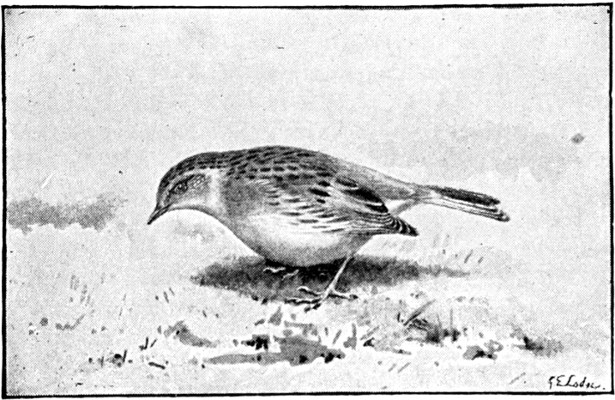
Fig. 31.—Hedge-Sparrow. ⅓ natural size.
Crown ash-colour with brown streaks; side of neck, throat, and breast bluish grey; back and wings reddish brown streaked with dark brown; breast and belly buffy white. Length, five and a half inches.
Most people know that a sparrow is a hard-billed bird of the finch family, and that the subject of this notice is not a sparrow, except in name. It is, in fact, a soft-billed bird belonging to that large and musical family which includes the nightingale, the redbreast, and the warblers. ‘How absurd, then, to go on calling it a sparrow!’ certain ornithologists have said from time to time, and have re-named it the hedge-accentor. But, as Professor Newton has said in his addition to Yarrell’s account of the bird, a name which has been part and parcel of our language for centuries, and which Shakespeare used, ‘is hardly to be dropped, even at the bidding of the wisest, so long as the English tongue lasts.’ Now, as the English tongue promises to last a long time, it seems safest to retain the old and, in one sense, incorrect name. Dunnock is another common name for this species; it is also called shufflewing, from the habit the bird has, when perched, of frequently shaking its wings.
Among our small birds, the hedge-sparrow is regarded with some slight degree of that kindly feeling, or favouritism, which is extended to the robin redbreast, the swallow, and the martin. It is one of the few delicate little birds that brave the rigours of an English winter, and occasionally enliven that dead season with their melody. With the wren and missel-thrush, it is a prophet, in February, of the return of brighter sunshine and lengthening days; and in hard weather it comes much about the house, for the sake of the small morsels of food to be picked up; and, while retaining its sprightliness at such times, it learns to be trustful. It is possible that the feeling or sentiment which no person, not even the most matter-of-fact scientific ornithologist, is quite proof against, is the cause of this species having been a little overpraised in many books about birds. The hedge-sparrow is often spoken of as a very charming little creature, while its song has been described as pleasing, as sweet, and as delightful. All birds are in a sense attractive, and even charming in appearance, but in different degrees, and the plain-coloured dunnock strikes one as being the least attractive among our birds. In the same way, the song may be said to be pleasant because it is a natural sound, and is heard in the open air when the sun shines, when leaves and blossoms are out, and it expresses the gladness which is common to all sentient things. But it has none of the rare qualities which are requisite to make a pleasant sound anything more than a merely pleasant sound.
The hedge-sparrow is a common bird throughout the British Islands—so common as to be familiar to most people, in spite of its shyness and love of concealment. It is pre-eminently a hedge-bird, and in that respect has been well named; even in the most populous districts, and in the suburbs of large towns, where a hedge remains, there the smoke-grey and brown little bird will have its home and make its nest, although it may seldom be able to rear its young. It is a very early breeder, a first brood being often reared in March. As a rule, the nest is placed in the centre of a hedge or thorny bush, three or four feet from the ground; it is made of dry grass and fine roots, and lined with hair; the eggs are five or six in number, bright greenish blue in colour, without spots. Two or three broods are reared in the season.
The alpine accentor (Accentor collaris), a larger species than our hedge-sparrow, which it resembles in colour, is known as a straggler to England from the mountainous districts of Central and Southern Europe.
Dipper. Cinclus aquaticus.
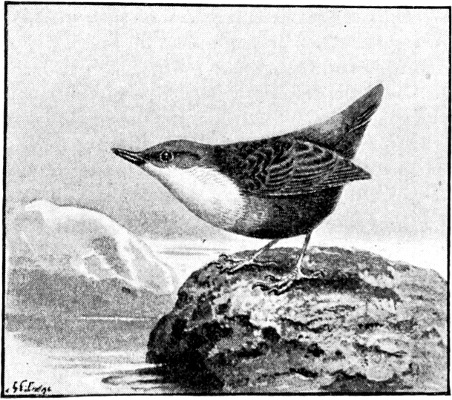
Fig. 32.—Dipper. ⅕ natural size.
Upper plumage brownish black tinged with grey; throat and breast pure white; belly chestnut-brown; bill black; feet horn-colour. Female: colours dingy. Length, six inches and a half.
The dipper, or water-ouzel, differs considerably in appearance, and still more in habits, from all other British birds; as is the case with such species as the wryneck, cuckoo, kingfisher, bearded tit, tree-creeper, starling, and nuthatch, there is no other like him. In figure he is wren-like, stout and compact in body, with short, rounded wings and short, square tail, which, as with the wren, is often carried upright and jerked. He is a little less than the song-thrush in size, and is conspicuously coloured, the greater part of the plumage being black, or blackish brown; and, in strong contrast, the throat and upper part of the breast shining white—a big black wren with a silvery white bib.
Some species always live and move within such narrow limits, or, in other words, are so dependent on certain conditions, that we invariably think of them in association with their surroundings:—the snipe with the boggy soil; the rock-pipit with the rock-bound seashore; the tree-creeper with the tree he climbs upon; the lark with the cultivated fields; and the swift with the void blue sky, through which he is perpetually rushing. In like manner we invariably think of the dipper in connection with the swift, brawling mountain-torrent he inhabits. He is never, or very seldom, found removed from it, and is probably more restricted to certain conditions, and consequently more bound to his home, than any one of the species just named. The stream he attaches himself to must have quiet and comparatively deep pools, and the water must be clear to enable him to detect the larvæ of water-beetles, dragon-flies, and other aquatic insects he preys on, all of which have a protective colouring. He does not range up and down a stream, like the kingfisher, to visit the various feeding-places; he limits himself to a portion of it, in many cases not more than a hundred yards in length, and explores the bottoms of the same pools from day to day, until they must be as familiar to him—all their inequalities, their stony ridges and half-buried boulders, and sandy or pebbled places, and all the holes and secret corners where sediment collects—as the rooms we live in are to us, and about which we are able to move freely in the dimmest light. In ascending a mountain stream such as these birds love, abounding in deep, quiet pools, with noisy cascades and shallow rapids, its bottom strewn with great fallen boulders partly submerged, the rocky banks overgrown with sheltering bushes and vines, when you disturb a dipper he flies up stream a short distance, perhaps twenty yards, and alights on a boulder, or in the shadow of an overhanging rock, and there waits, silent and motionless, until, disturbed again, he takes a second short flight up stream, and so on to the limit of his range, whereupon, rising up and doubling back, he flies to the spot he started from. And as often as you disturb him he will act in the same way, going just so far, and no farther. If you leave him behind and go on, you will find another pair of dippers, whose portion of the stream begins just where that of the first pair ends. They, too, will act in the same way, and fly on until the end of their range is reached, and will not venture beyond where a third pair are in possession. Where they are not disturbed a mountain stream may be found parcelled out in this way among a dozen or twenty couples. Probably the dipper, like the robin, jealously resents the intrusion of another bird of his kind into his chosen ground. Concerning this habit of the dipper, and its strange way of feeding under the water, something still remains to be known. It is, indeed, strange that this little perching song-bird should have the habit of diving for its food like a grebe or a guillemot, and other species that have structures specially adapted to such a way of life. For there is absolutely nothing in the dipper’s structure to lead anyone unacquainted with its habits to believe that it ever approaches the water, unless to drink and bathe, and perhaps to pick up an insect floating on the surface. That it is able to sink into and move freely about beneath the water close to the bottom of a stream, in spite of gravity, seems very astonishing, and would be incredible if the fact were not so familiar. Some ornithologists believe that it is related to the wren, others to the thrush;—that is a question capable of solution; but how by a short-cut it became a diver must remain a mystery.
Formerly it was believed that the dipper was able to walk freely about on the bottom of the stream, but that was an error. It is difficult to watch the bird moving about under water; but a few good observers have succeeded in doing so, and from their accounts it would appear that the dipper propels itself by powerful wing-beats, moving by a series of rushes or jerks, keeping close to the bottom of the stream. It appears to swallow its food under water, but comes up at intervals to breathe, then sinks again beneath the surface.
On land the dipper is somewhat inactive, and will stand on a boulder or under an overhanging rock without moving for a long time. One would imagine that their eyes, fitted so well to see in the dim light beneath the surface, must be very sensitive to the glare above.
The dipper’s song is short but brilliant, and very much like that of the wren in character; it is heard most frequently in the love season, and occasionally in autumn and in winter, when the sun shines, even during very cold weather.
The nest is made among the rocks, usually in a crevice, and is very large for the size of the bird, being sometimes a foot across, and is globular in form, with a small opening near the top. It is composed principally of moss, loosely felted, the inside lined with dry grass, fine rootlets, and dead leaves. Four to six eggs are laid, pure white, and unspotted.
The dipper is most common in mountainous districts in Scotland, Ireland, and Wales, and is found in suitable localities in England.
The black-billed dipper (Cinclus melanogaster), the Scandinavian and North Russian form of Cinclus aquaticus, has been met with on two or three occasions as a straggler to the east coast of England.
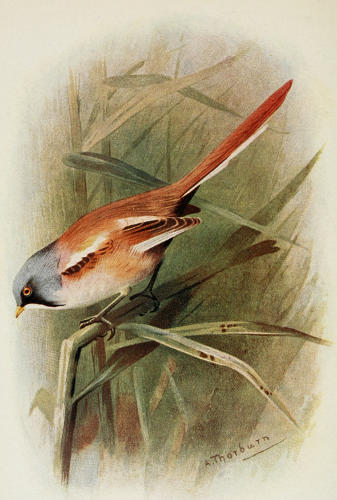
PLATE IV. BEARDED TITMOUSE. 3/4 NAT. SIZE.
Bearded Titmouse. Panurus biamicus.
Head bluish grey; between the bill and eye a tuft of pendent black feathers, prolonged into a pointed moustache; throat and neck greyish white; breast and belly white tinged with yellow and pink; upper parts light orange-brown; wings variegated with black, white and red; tail very long, orange-brown, the outer feathers variegated with black and white. Female: the moustache the same colour as the cheek; the grey on the head absent. Length, six inches and a half.
This bird, although by name a tit, and placed next to the titmice by many naturalists in their systems, differs widely from those birds in some points. The question of its true position among passerine birds has, indeed, been a subject of controversy for a long time past, and is not yet settled. Some writers would have it that it comes nearest to the shrikes; others, that it is most closely related to the buntings; and still others place it next to the waxwing. Leaving aside anatomical subjects, it may be said that the bearded tit is unlike all these different birds and the titmice in habits, language, colouring, and in its curious feather-ornaments—the erectile, pointed, black feathers that grow between the beak and eyes, and form the curious long moustache which gives the bird its name.
The bearded tit, although at all times an extremely local species, on account of its being exclusively an inhabitant of reed-beds, was once fairly common in many parts of England; but owing to the draining of marshes and to the persecution of collectors, it has now become one of the rarest of British birds. At present it is confined to the district of the Broads in Norfolk, where it is, unhappily, becoming increasingly rare, and is threatened with extinction at no distant date.
It is a very pretty bird in its buff and fawn coloured dress; very elegant in form, its singular black moustache and long, graduated tail enhancing the beauty of its appearance; and exceedingly graceful in its motions. It lives in the beds of reeds growing in the water; and the slim, graceful, clinging bird, and the tall, slender stems, with their pale, pointed leaves and feathery flowers, seem adapted each to the other. In seeking its food it clings to the reeds, much as the blue tit does to the pendent twigs of the birch. Its food consists of small insects and their larvæ, small molluscs, and the seeds of the reeds. In autumn and winter it is gregarious, three or four, or more, families uniting in a flock, and roaming from reed-bed to reed-bed and from broad to broad. When disturbed, or alarmed at the appearance of a hawk, they drop down into concealment among the reeds, but in a short time rise to the surface again, climbing parrot-like up the slender stems. There are few birds without a brilliant colouring that have so attractive an appearance as the bearded tit, especially when seen flying just above the top of the reeds, or when perched on a slender stem near its top, and swayed to and fro by the wind. Their alarm-note is harsh, but they have a variety of calling and singing notes, which are somewhat metallic in sound and very musical. A writer in Loudon’s ‘Magazine of Natural History’ describes the bearded tits in flight as ‘uttering in full chorus their sweetly musical notes; it may be compared to the music of very small cymbals, is clear and ringing, though soft, and corresponds well with the delicacy and beauty of the form and colour of the bird.’
The nest is made at the end of March or early in April, and is placed on the ground, under a bush, or among the grass and herbage near the water. It is composed of leaves of reeds, bents, and grass-blades, and lined with the fine fibres of the reed-tops. The eggs are four to six in number, and sometimes eight; they are white, with a few minute specks, blotches, and lines of dark reddish brown.
Long-tailed Titmouse. Acredula rosea.
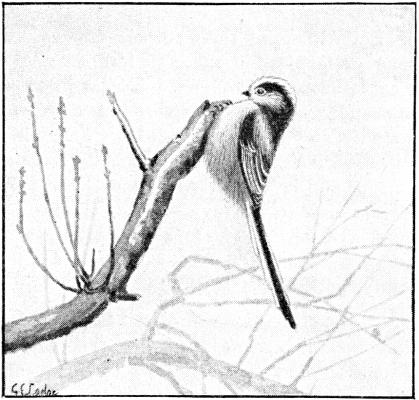
Fig. 33.—Long-tailed Tit. ¼ natural size.
Head, neck, throat, breast, and a portion of the outer tail-feathers white; back, wings, and six middle feathers of the tail black; a black streak above the eye; sides of the back and scapulars tinged with rosy red; under parts reddish white. Tail very long; beak very short. Length, five inches and three-quarters.
The long-tailed tit is the least of the titmice, and is only saved from being described as the smallest British bird on account of its loose plumage and long tail, which make it look a trifle more bulky than the golden-crested wren. In many of its habits, and to some extent in its appearance, it resembles the typical tits, the five species of the genus Parus which remain to be described, and is often seen associating with them in winter. In its colouring, language, and nesting habits it differs from them. It is a somewhat singular-looking little bird, with grey and rose-coloured plumage, short wings, a very long tail, and a short, conical beak, which gives the round head something of a parrot-like appearance.
This species is found throughout Great Britain and Ireland, but is less common in Scotland than in England. It inhabits woods and plantations, and, like the other tits, is social, active, and restless in its habits. After the breeding season the old and young birds remain united, and spend the autumn and winter months in perpetually wandering through the woods; but their travels do not take them far from home. They are seen in a scattered party, each member of which appears wholly occupied with his own search for minute insects and their eggs and larvæ, but is ready at a given signal to abandon his food-getting and join the others in their hurried flight to the next tree. And as they pass from tree to tree their short wings and long tails give them, as Knapp said, the appearance of a flight of arrows. Leaving the woods, they roam over the surrounding country, making their way by short stages from tree to tree and from bush to bush, along lanes and hedges, and visiting the clumps of trees in parks and pasture-lands. They also come about houses, not for the crumbs that fall from the table, but to continue in gardens and shrubberies their endless search for minute insects. Very restless and anxious little hearts are theirs, one would imagine, from their incessant hurried flittings from place to place, and the small, querulous sounds in which they converse together.
At night they roost huddled together in a cluster composed, in some cases, of half a dozen or eight birds in a row, with three or four others perched on their backs, and one or two more resting on these.
Early in spring these curious little companies break up, and the song or love-call of the male bird, so unlike that of the other tits, may be heard—a prolonged trill, low and aërial, and very delicate in sound. The nest is placed on a tree or bush, and is long in building, and a marvel of bird architecture. It is domed, oval in shape, with a small aperture near the top, and is composed of moss, lichens, and hair closely felted, and the interior thickly lined with feathers. Macgillivray says that the feathers taken from one nest numbered 2,379. Six to eleven eggs are laid, sometimes a larger number. They are pure white or pearly grey in ground-colour, thinly spotted with light red and a few faint purple marks.
The continental form of the long-tailed tit, Acredula caudata, differs from A. rosea in wanting the dark stripe on the head; specimens without the stripe are sometimes met with in this country, but whether or no they are visitors from the Continent is not known.
Great Titmouse. Parus major.
Head, throat, and a band passing down the centre of the breast black; back olive-green; cheeks and a spot on the nape white; breast and belly yellow. Length, six inches.
The great tit, or oxeye, is a resident species throughout the British Islands, and inhabits woods and plantations, and is also seen in orchards, gardens, and shrubberies. He is nowhere abundant, yet very well known, being one of those species it would be difficult for even the least observant person to overlook. He has a comparatively gay plumage, and the various colours are disposed and contrasted in a striking way. The intense glossy black of the head, throat, and broad band which divides the bright greenish yellow of the under parts lengthways, make him a conspicuous object.
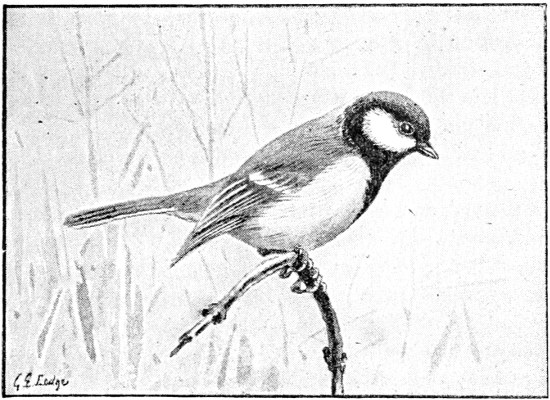
Fig. 34.—Great Tit. ⅓ natural size.
His voice, for so small a bird, is a powerful and far-reaching one; and his frequently uttered spring call, or song, composed of two notes repeated two or three times in succession, strikes so sharply on the sense that it compels attention, like ringing blows on an anvil or on the rivets of iron rails and girders, or the sound of sharpening a saw. Saw-sharpener is one of its local names. Another thing—the oxeye is the largest of the tits, consequently the principal member of a group of small birds exhibiting very strongly marked characters. They differ from most small birds, to some extent, in form, colouring, and general appearance, and, in a greater degree, in language and habits. They are extremely active and restless, and spend most of their time in trees, from the bark of the trunk and large branches to the smallest terminal twigs and leaves. In winter, when the elms and other deciduous trees have shed their foliage, and their fine upper boughs appear like a sombre fretwork against the pale sky, the tits are seen at their best; they are then gathered into small flocks or family parties, and may be observed, as they scatter about the tree, clinging to the twigs in every conceivable position, and looking like a company of small sober-coloured paroquets of this cold northern world. They subsist principally on small insects and their eggs, larvæ, and chrysalids, but are almost omnivorous in their diet, feeding on buds, seed, and fruits, and on animal food when it can be had. A meaty bone or a piece of bacon, cooked or raw, or a lump of suet, will quickly attract them, as is well known. The oxeye, pretty little bird as it is, will eat carrion like any crow, and even kill and devour other small birds as big as himself. His rapacious habits have, however, not been very well established. In a captive condition he will occasionally attack a small bird in the same cage, killing it by vigorous blows on the head, and picking out its brains; but in a state of nature the great tit would probably be able to kill only a young or sick bird. For so small a bird he is, undoubtedly, very resolute and strong; the rapid blows of his short, strong bill on the bark sound like those of a nuthatch. Like that bird, he splits open the hard shells of seeds to get at the kernels.
The great tit is less social and gregarious than the other species of this group; still, he does unite in small parties, and joins the bands of mixed titmice and other small birds that form so familiar and interesting a feature of woods and copses in autumn and winter.
The nest is placed in a variety of situations, but a covered site is usually preferred to an open one, and nests may be found in holes and cavities in decayed timber, holes in walls, and in old nests of magpies, crows, and rooks. In a well-covered site the nest is loosely built; if in an open one, such as a crow’s nest, the structure is much more elaborate, dry grass, moss, hair, and wool, being closely woven together, and the inside thickly lined with feathers.
The eggs vary from five to eleven in number; usually they are seven or eight. They are pure white or faintly tinged with yellow, blotched and spotted with reddish brown. Two broods are reared in the season. The parent birds are very bold in defence of their eggs and young, and vigorously attack any bird that approaches the nest, without regard to its size. The sitting-bird sometimes refuses to leave her eggs, and when taken in the hand will bite and hiss like the wryneck.
In autumn and winter the number of great tits is considerably increased by a migration from the Continent.
Coal-Titmouse. Parus ater; Parus britannicus.
Crown, throat, and front of the neck black; cheeks and nape pure white; upper parts grey; wings bluish grey, with two white bands; under parts white tinged with grey. Length, four and a quarter inches.
The coal-tit of our country (P. britannicus) differs slightly from the continental form (P. ater), the British bird having the slate-grey of the upper parts suffused with brown or olive, while in the continental form the brown tinge is confined to the rump. The European coal-tit visits our islands on migration, and doubtless interbreeds with our bird, as intermediate varieties are found.
The coal-tit, or coalmouse, like the oxeye and the blue tit, is generally diffused throughout the British Islands, and is not uncommon, although nowhere abundant. In Scotland it is more local in its distribution, being found chiefly in districts abounding in pine and fir woods. It is believed to be increasing in numbers and extending its range in this country. In its social habits, its flight, and its manner of seeking its food—during which it clings to the smaller boughs and twigs in a variety of positions—it closely resembles the other members of its genus. It also resembles them in its language, although a shriller note may be detected in its voice, both in its call-note and song. It differs from other tits in its greater activity, in preferring conifers to other trees, in going more often to the ground to feed, and in being a greater wanderer out of the breeding season.
The nest, as a rule, is placed near the ground, in a hole in a rotten tree-stump, or in a wall, or any other suitable place. It is composed of moss, hair, and feathers, felted together, and lined with more feathers. Six to eight eggs are laid, like those of the great tit in colour. Like the oxeye, it is omnivorous, but in summer it feeds principally on insects.
After the breeding season the old and young birds keep together, and several families may unite and form a flock. One of the most interesting winter sights in a wood composed of pine and fir growing together with beech and other deciduous trees is afforded by a wandering flock of coal-tits. As they move from tree to tree they attract other species of similar habits—the oxeye and blue and marsh tits, and goldcrests, and siskins, and perhaps a couple of tree-creepers. Occasionally a party of long-tailed tits will join, and keep with the flock for some time; but the long-tails are the most restless and vagrant of all, and eventually hurry on by themselves, leaving the more patient plodders behind. It is wonderful and very beautiful to see so many species thus drawn into companionship by a common social instinct, and by a similar manner of seeking their food; a mental likeness serves to keep them together for hours at a time, or for a whole day, in spite of so great a diversity in form and colour and language.
Marsh-Titmouse. Parus palustris.
Forehead, crown, head, and nape black; upper parts grey; wings dark grey, lighter at the edges; cheeks, throat, and breast dull white. Length, four inches and a half.
It is curious that, of the seven species of birds inhabiting this country called titmice in the vernacular, six have been named from some character that strikes the eye: greater size in one, a peculiar feather-ornament in two, and in the remaining species a distinctive shape or colour; and the names in all cases are suitable—bearded, long-tailed, great, blue, coal, and crested. In the one case where this rule has been neglected the name is unsuitable and misleading. The marsh-tit may be more partial to low or wet ground than the blue tit, and oxeye, and coal-tit, but the bird is found everywhere—in woods, groves, hedgerows, orchards, and gardens—and in autumn and winter is seen associating with the other species in their wandering bands. But it would have been difficult to name this species from its colouring, which is more uniform and sober than in any of the others. He is the plainest of them all, but in his lively, social habits, and in his various pretty motions and attitudes, he is one of the family; and so strong in him is the family likeness, that some find it not easy to distinguish marsh-tit from coal-tit, except when seen closely. In its language, also, it is unmistakably a titmouse; but it is not so vociferous as the oxeye and blue tit, and its tinkering voice is not so sharp and loud.
The nest is placed in a rotten stump or trunk of a tree, an old pollarded willow being a favourite site; and sometimes the bird excavates a hole for itself in the decayed wood. The nest is made of moss and hair, felted together, and lined with willow down. The eggs are five or six in number, and are similar to those of the great tit in colouring.
The marsh-tit is common in England, rarer in Scotland, and does not extend to Ireland.
Blue Titmouse. Parus cæruleus.
Crown blue encircled with white; cheeks white bordered with dark blue; back olive-green; wings and tail bluish; greater coverts and secondaries tipped with white; breast and belly yellow, traversed by a dark blue line. Length, four and a half inches.
The blue tit is a commoner species than the oxeye, and is even more widely diffused in this country, its range extending from the Channel Islands to the northernmost parts of Scotland, and it has been found as a straggler in the Orkneys and the Shetlands. All the qualities that distinguish the tits and make them such engaging birds are found in a marked degree in the present species—sociability; extreme vivacity, especially in the cold season; and the power to assume an endless variety of graceful positions when clinging to the slender branches and twigs, upright or pendulous, of the leafless trees in winter. And as the blue tit is more abundant, and more familiar with man, than the others, besides having a gayer colouring, he is the favourite member of his genus. He promises, indeed, to become in time our first feathered favourite; for though he is without melody, and does not come to us with a glad message, like the swallow, and has no ancient sentiment and nursery literature, like the robin, to help him to the front, he possesses one unfailing attraction—he is an amusing creature. Perhaps our progenitors were less susceptible in that way than we are, and took no notice of the tomtit and his vagaries. In winter he may be easily won with a little food; and when he joins the mixed company of sparrows, dunnocks, blackbirds, and starlings that come to the door for crumbs and scraps, he is by contrast among them a ‘winged jewel’—a small wanderer from the tropics. In works of ornithology you will find the blue tit described as a little acrobat and harlequin, droll and grotesque and fantastic in his ways; and if this Puck among our feathered fairies can win expressions such as these from the gravest scientific writers, it is not strange that ordinary folk should find him so fascinating.
The language of the blue tit resembles that of the oxeye. Its voice is not so powerful, but the various sounds, the call and love notes, or song, composed of one note repeated several times without variation, have similar sharp, incisive, and somewhat metallic qualities.
In spring the wandering little companies break up, and about the end of April breeding begins. The nest is placed in a hole in a tree or wall, or wherever a suitable cavity is found. It is loosely formed of dry grass or moss, lined with wool, hair, and a quantity of feathers. Five to eight eggs are usually laid, in some cases as many as twelve and fourteen; in colour they are like those of the great tit, and, as in the case of that species, the incubating bird sits closely on her eggs and hisses like a snake when interfered with.
The blue tit is omnivorous in its diet. In summer it feeds principally on caterpillars, aphides, and insects of all kinds, sometimes catching them on the wing. At other seasons it eats fruit and seeds of various kinds, buds, flesh, and, in fact, almost anything it can get.
Crested Titmouse. Parus cristatus.
Feathers of the crown elongated, and forming when erected a pointed crest, black, edged with white; cheeks and sides of the neck white; throat, collar, and a streak across the temples black; all the other parts reddish brown; lower parts white, faintly tinged with red. Length, four inches and three-quarters.
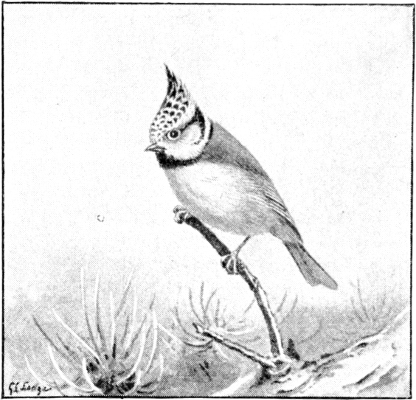
Fig. 35.—Crested Tit. ⅓ natural size.
The crested tit is one of the rarest and most local of British birds, being restricted to a few extensive pine-forests in the north of Scotland; indeed, there are few who know it from personal observation in this country. Although modest in colour, it is a pretty little bird, and its high, pointed crest gives it a somewhat distinguished appearance. In its language and habits it resembles the other members of the genus, and associates in the same way with birds of different species. Like the coal-tit, it makes its nest in a hole in a rotten tree-stump, and it will also breed in a crow’s or magpie’s old nest, or a squirrel’s drey. The nest is made of dry grass, moss, wool, hair, fur, and feathers, thinly felted together; and five or six eggs are laid, white in ground-colour, spotted and speckled with brownish red.
Nuthatch. Sitta cæsia.
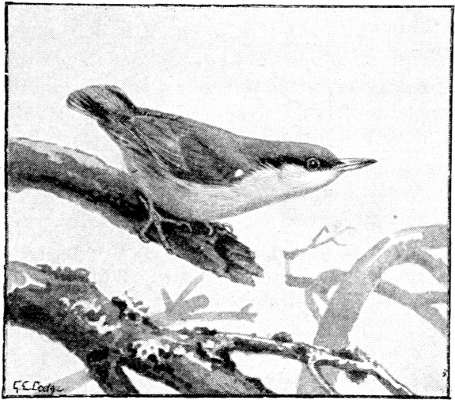
Fig. 36.—Nuthatch. ¼ natural size.
Upper parts bluish grey; a black streak across the eye; cheeks and throat white; breast and belly buff; flank and lower tail-coverts chestnut-red; outer tail feathers black, with a white spot near the end tipped with grey, the two central ones grey; beak bluish black, the lower mandible white at the base; feet light brown. Length, five inches and a half.
The nuthatch, although a small bird, not brightly coloured, and scarcely deserving the name of songster, exercises a singular attraction; and if it were possible to canvass all those who love birds, and have not fewer than half a dozen favourites, it is probable that in a great majority of cases the nuthatch would be found among them. When I see him sitting quite still for a few moments on a branch of a tree in his most characteristic nuthatch attitude, on or under the branch, perched horizontally or vertically, with head or tail uppermost, but always with the body placed beetle-wise against the bark, head raised, and the straight, sharp bill pointing like an arm lifted to denote attention—at such times he looks less like a living than a sculptured bird, a bird cut out of a beautifully variegated marble—blue-grey, buff, and chestnut—and placed against the tree to deceive the eye. The figure is so smooth and compact, the tints so soft and stone-like; and when he is still, he is so wonderfully still, and his attitude so statuesque! But he is never long still, and when he resumes his lively, eccentric, up-and-down and sideway motions he is interesting in another way. One is not soon tired of watching his perpetual mouse-like, independent-of-the-earth’s-gravity perambulations over the surface of the trunk and branches. He is like a small woodpecker who has broken loose from the woodpecker’s somewhat narrow laws of progression, preferring to be a law unto himself.
Without a touch of brilliant colour, the nuthatch is a beautiful bird on account of the pleasing softness and harmonious disposition of his tints; and, in like manner, without being a songster in the strict sense of the word, his voice is so clear and far-reaching, and of so pleasant a quality, that it often gives more life and spirit to the woods and orchards and avenues he frequents than that of many true melodists. This is more especially the case in the month of March, before the migratory songsters have arrived, and when he is most loquacious. A high-pitched, clear, ringing note, repeated without variation several times, is his most often-heard call or song. He will sometimes sit motionless on his perch, repeating this call at short intervals, for half an hour at a time. Another bird at a distance will be doing the same, and the two appear to be answering one another. He also has another call, not so loud and piercing, but more melodious: a double note, repeated two or three times, with something liquid and gurgling in the sound, suggesting the musical sound of lapping water. These various notes and calls are heard incessantly until the young are hatched, when the birds all at once become silent.
A hole in the trunk or branch of a large tree is used as a nesting-place, the entrance, if too large, being walled up with clay, only a small opening to admit the bird being left. At the extremity of the hole a bed of dry leaves is made. The eggs are five to seven in number, white, and spotted with brownish red, sometimes with purple. When the sitting-bird is interfered with she defends her treasures with great courage, hissing like the wryneck, and vigorously striking at the aggressor with her sharp bill.
The food of the nuthatch during a greater portion of the year consists of small insects and their larvæ, found in the crevices of the bark; hence the bird is most often seen frequenting old rough-barked trees, the oak being a special favourite, more especially if it happens to be well covered with lichen. At times, when seeking its prey, its rapid and vigorous blows on the bark or portion of rotten wood can be heard at a considerable distance, and are frequently mistaken for those of the woodpecker. In autumn the nuthatch feeds largely on nuts and fruit-stones, and to get at the kernel he carries the nut to a tree, and wedges it firmly in a crevice or in the angle made by a forked branch, then hammers at the end with his sharp beak until the shell is split open and the kernel disclosed. Its love of nuts makes it easy to attract the bird to a tree or wall close to the house by fixing nuts in the crevices. If supplied regularly with this kind of food it soon grows trustful, and may even be taught to come to call, and even to catch morsels of food thrown to it in the air. Canon Atkinson, in his lively and interesting ‘Sketches in Natural History,’ has described the amusing manners of a pair of nuthatches which he thus made tame by feeding. Since his book was published, about twenty-five years ago, many persons have adopted the same plan with success.
Wren. Troglodytes parvulus.
Upper parts reddish brown with transverse dusky bars; quills barred alternately with black and reddish brown; tail dusky, barred with black; over the eye a pale narrow streak; under parts pale reddish brown; flanks and thighs marked with dark streaks. Length, three inches and a half.
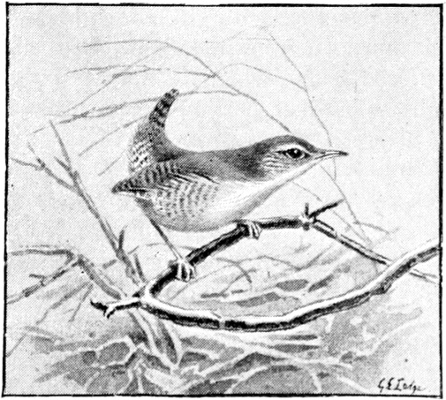
Fig. 37.—Wren. ¼ natural size.
The little nut-brown wren—nut-like, too, in his smallness and round, compact figure—with cocked-up tail and jerky motions and gesticulations, and flight as of a fairy partridge with rapidly-beating, short wings, that produce a whirring noise if you are close enough to hear it, is a familiar creature to almost every person throughout the three kingdoms, and is even more generally diffused than the house-sparrow. Something of the feeling which we have for the swallow, the house-martin, and the robin redbreast, falls to the share of the small wren. He is one of the few general favourites, although, perhaps, not so great a favourite as the others just named. The reason of this is, doubtless, because he is less domestic, never so familiar with man or tolerant of close observation. The wren is never tame nor unsuspicious; he is less dependent on us than other small birds that attach themselves to human habitations, never a ‘pensioner’ in the same degree as the blue tit, dunnock, blackbird, and sparrow. The minute spiders, chrysalids, earwigs, and wood-lice with other creeping things to be found in obscure holes and corners in wood-piles, ivy-covered walls, and outhouses, are more to his taste than the ‘sweepings of the threshold.’ His small size, modest colouring, and secrecy; his activity, and habit of seeking his food in holes and dark places which are not explored by other insectivorous species, enable him to exist in a great variety of conditions—gardens, orchards, deep woods, open commons, hedgerows, rocky shores, swamps, mountains, and moors; there are, indeed, few places where the small, busy wren is not to be met with. This ability of the wren to find everywhere in nature a neglected corner to occupy would appear to give it a great advantage over other small birds; moreover, it is very prolific, and excepting, perhaps, two species of tits, is more successful than any other small bird in rearing large broods of young. Nevertheless, the wrens do not seem to increase. At the end of summer they are very abundant, and you will, perhaps, be able to count a dozen birds where only one pair appeared in spring; but when spring comes again you will generally find that the population has fallen back to its old numbers. The larger increase in summer indicates a greater mortality during the rest of the year than is suffered by other species. The wren is said to eat fruit occasionally, and even seeds; but it is almost exclusively insectivorous, and probably perishes in large numbers during periods of frost, when larks, pipits, and titmice become seed-eaters. Yet the wren is a hardy little bird, a resident all the year round in the coldest parts of our country, and one of the few songsters which may be heard in all seasons. Even during a frost, if the sun shines, the wren will sing as gaily as in summer. His song is his greatest charm. It is unlike that of any other British melodist—a loud, bright lyric, the fine, clear, high-pitched notes and trills issuing in a continuous rapid stream from beginning to end. Although rapid, and ending somewhat abruptly, it is a beautiful and finished performance, in which every note is distinctly enunciated and has its value. When near it sounds very loud: one is surprised to hear so loud a song from so small a creature. But it does not carry far: the notes of the song-thrush, blackbird, and nightingale can be heard at nearly three times the distance.
The wren begins his nest-building at the end of April, and in selecting a site exercises a greater freedom than most small birds. The nests may be found in trees, bushes, masses of ivy or other dense vegetation, hedgerows, holes in banks and walls, crevices in rocks, in furze-bushes, and close to the ground among the bramble-bushes. There is also a great variety in the materials used in building different nests. As a rule, one kind of material is used for the outer part of the structure, which is domed, and very large for the bird. It may be moss or dead leaves, or moss and leaves woven together, or dry grass leaves and stems, or dead fern-fronds. The nest is not only well concealed, but in most cases the outside is made to assimilate in colour to the vegetation surrounding it. The opening is near the top of the nest; inside, the cavity is lined with moss, hair, and feathers. Four or five eggs are laid, often a larger number, and it is not unusual to find as many as eight or nine eggs in a nest. Not long ago, in a wood in Berkshire, I saw eight young wrens sitting in a row on a branch near the ground, and watched them being fed by the old birds. The eggs are pure white, thinly spotted with pinkish red. Two broods are reared in the season. Imperfect or false nests are often found near the nest containing the eggs, and are called ‘cocks’ nests,’ the belief being that they are made by the male bird.
Pied Wagtail. Motacilla lugubris.
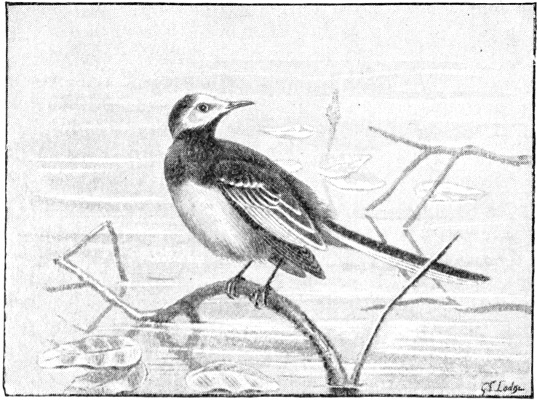
Fig. 38.—Pied Wagtail. ¼ natural size.
Summer plumage variegated with white and black; back and scapulars, chin, throat, and neck black; a small portion of the side of the neck white. Winter plumage: back and scapulars ash-grey; chin and throat white, with a black, but not entirely isolated, gorget. Length, seven and a half inches.
The pied wagtail is probably not more abundant in this country than the yellow wagtail, but is far better known, being a more generally diffused species, often seen in the neighbourhood of houses where the yellow wagtail never comes. And if there be a pied wagtail anywhere within range of sight, it is sure to be seen and recognised, for in its black-and-white plumage it is the most conspicuous small bird in this country, not excepting the kingfisher, snow-bunting and blackbird. When tripping about a smooth lawn he looks double his real size, and reminds one of a magpie in a field or an oyster-catcher on a wide stretch of level sand.
The pied wagtail is found in this country all the year round, but many birds (probably the large majority) migrate annually. Knox, in his ‘Ornithological Rambles in Sussex,’ says that they arrive on the Sussex coast about the middle of March, the old males first, the females and the males of the previous year a few days later. They are sometimes seen in large numbers near the coast, resting after their voyage before proceeding inland. The return migration takes place at the end of August or early in September.
Meadows and pasture-lands in the neighbourhood of a running stream are favourite resorts of the wagtail, and it is fond of attending cattle for the sake of the numbers of insects driven from their shelter in the grass by the grazing animals.
The pied wagtail is not so lively, quick, and graceful as the yellow and the grey species; but if you watch him for any length of time he, too, gives you the idea of a creature that never continues in the same mind for a minute at a time, but acts according to the impulse of the moment, and is as unstable as a ball of thistle-down. He runs, then stands, and shakes his tail; for two or three moments he searches for food; then chases an insect, and is still again, waiting for a new impulse to move him:—suddenly he flies away, not straight, as if with an object in view, but with a curving, dipping, erratic flight, governed seemingly by no will; and just as suddenly alighting again, when he is once more seen standing still and shaking his tail. The call-note, a sharp chirp of two syllables, is emitted once or twice during flight. The song is a loud, hurried warble, uttered on the wing as the bird hovers at a moderate height from the ground. But the pied wagtail has another way of singing, especially in early spring: this is a warble so low that at the distance of fifteen yards it is just audible, and is sometimes uttered continuously for two or three minutes at a stretch.
The nest is made, as a rule, in a hollow or cavity in the ground, or in a crevice or hole in a bank or rock, or under a stone, or at the roots of a furze-bush. It is built of fine dry grass, moss, and various other materials, and lined with hair and feathers. The eggs are four or five, pale bluish in tint, and spotted with greyish brown.
Grey Wagtail. Motacilla melanope.
Summer plumage: head and back bluish grey; a pale streak over the eye; throat black; under parts bright yellow. Winter plumage: chin and throat whitish, passing into yellow. Length, seven inches and a half.
The grey wagtail is the prettiest and the least common of the three species of Motacilla inhabiting the British Islands. Like the dipper, it frequents mountain streams, but is not restricted to them. In England it is a somewhat rare species, but is more common in Scotland and Ireland. It remains with us throughout the year, but although a permanent resident in most parts of the country, it is certain that it disappears in autumn from many of its breeding-haunts in Scotland and the north of England, and that a large number of these northern birds winter in the southern and western counties.
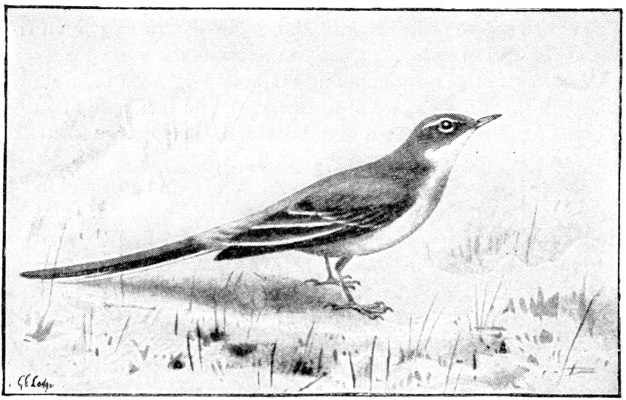
Fig. 39.—Grey Wagtail. ⅓ natural size.
The grey wagtail is frequently spoken of as a bird of brilliant plumage. It is not exactly that, but the various colours are so soft and delicate, they harmonise so admirably, and show in the velvet-black of the gorget and pure canary-yellow of the breast so fine a contrast, that the effect is most beautiful, and pleases, perhaps, more than the colouring of any other British bird. And this is not all. The charm which the grey wagtail has for those who know it intimately consists in the union of delicate colouring with a delicate form and exquisitely graceful motion. Ornithologists have called it a ‘fairy-like bird,’ and the terms in which they have sometimes recorded their impressions of it might lead one to imagine that they are speaking, not of a bird, but of some elusive nymph of the mountain rivulets, of whom they had caught a glimpse in their rambles. To its other charms may be added that of melody. Its spring song is sweet and lively, a little like that of the swallow in character, and is uttered as the bird hovers in the air. The alarm-note is like that of the pied wagtail, a sharp double note, emitted as the bird passes away in undulating flight.
The grey wagtail is more exclusively a bird of the waterside than either of the other two species, seldom being met with away from the margins of its beloved mountain streams; in its flight, motions on the ground, and manner of taking its insect prey, it closely resembles the pied and yellow wagtails, the only difference being that it is even more volatile, and that it is the most graceful of these three feathered Graces.
The nest is made on the ground, concealed by grass and herbage, or under a bush, and often under the shelter of an overhanging rock. It is formed of fibrous roots, dry grass, and moss, and lined with hair, wool, and feathers. The eggs are five or six in number, French white or grey in ground-colour, mottled and spotted with pale brown and olive.
Yellow Wagtail. Motacilla rayii.
Top of head, lore, nape, back, and scapulars greenish olive; a bright yellow streak over the eye; lower parts sulphur-yellow. Length, six inches.
The yellow wagtail is a summer visitor, arriving at the end of March or early in April in this country, and is found very nearly in all parts of England, and is also common in the southern counties of Scotland; farther north it is rare, and in Ireland it is only known to breed in one locality. On its arrival it frequents open downs and sheepwalks, pastures, commons, and arable lands, more especially fields where spring sowing is in progress. On this account it has been named in some districts the barley-bird and oat-seed-bird, and in Scotland seed-bird and seed-lady—the last a suitable appellation for so sweet and dainty a creature. Seebohm says of it: ‘Its active, sylph-like movements, and its delicate form and lovely plumage, make it a general favourite.’ In its motions on the ground, its tail shaking and fanning gestures, and in its fitful curving and dipping flight, accompanied with a sharp double call-note, it closely resembles the species already described. From the pied wagtail it differs in never coming about houses or breeding in their vicinity; and from the grey wagtail in not being restricted to the waterside. In the fields it follows the plough, and in the pastures it is often seen with the cattle, chasing the small twilight moths and other insects driven from the grass.
As the season advances it forsakes the cultivated lands and open downs, and is more restricted to borders of streams, and to meadows and pastures not far from water. The nest is placed on the ground under the grass and herbage, and is formed of dry bents and fibrous roots, and lined with hair. Four to six eggs are laid, mottled with pale brown and olive on a French-white ground.
Besides the three species described we have the white wagtail (Motacilla alba) as a rare visitor to the south of England and Ireland, and the blue-headed yellow wagtail (Motacilla flava), an accidental straggler to the southern, south-western, and eastern counties of England. These two species breed throughout Europe, the first being the continental form of our pied wagtail, which it closely resembles; and the second, of the yellow wagtail.
Meadow-Pipit. Anthus pratensis.
ind claw longer than the toe, slightly curved. Upper parts ash tinged with olive, the centre of each feather dark brown; under parts dull buffy white, with numerous elongated spots of dull brown. Length, five inches and three-quarters.
To the uninformed the pipits are lesser larks; they are lark-like in figure, in their sober, mottled colouring, in habits, language, and, to some extent, in the action which accompanies their song. But, in spite of these outward resemblances, modern authorities have removed them from the position they once occupied next to the larks in classification, to place them by the side of the wagtails, which are now supposed to be their nearest relations. And when wagtails and pipits are seen running and flying about together, it strikes us that there is among them a certain family resemblance; but we see, too, that the wagtails have diverged greatly, and are much more graceful in figure, have longer tails, and a gayer plumage; they are also more aërial in habit, and warble a more varied strain. From the fact that the numerous species of pipits are so much alike, not only in appearance, but also in habits, language, and flight, and that they are so widely distributed on the globe, being found both on continents and oceanic islands, it may be inferred that the modest earth-loving pipit represents the original form from which the wagtails have sprung.
Of our three species, the meadow-pipit is by far the most numerous, being found in all open situations, moist or dry, meadow and waste-land, moor and mountain-side, and close by the sea, where one can listen to meadow-pipit and rock-pipit singing together, or alternately, like birds of one species, and compare the two songs, that are so much alike. This species is, moreover, to be met with in all parts of our country, from the warm Hampshire and Dorset coasts to the western islands of Scotland; but while in the main a resident all the year round in the southern parts of the country, in the bleak and barren districts of the farther north he is migratory, and moves southward in winter in considerable flocks.
The meadow-pipit seeks his food on the ground, and moves nimbly about in search of minute beetles, caterpillars, and seeds, pausing at intervals to stand motionless for a few seconds, with head raised and tail slowly moving up and down. When approached he displays a curious mixture of timidity and tameness, and eyes the intruder with suspicion, but flies with reluctance. The flight is a succession of jerky movements, the bird rising and falling in a somewhat wild, erratic manner.
In the love season the male pipit occasionally takes his stand on a weed or low bush; but on moors, hills, and stony waste-lands he prefers a stone or mound of earth for a perch. From such an elevation he is able to keep watch on the movements of his mate, and, when the singing spirit takes him, to launch himself easily on the air. To sing he soars up to a height of forty feet or more, then glides gracefully down, with tail spread and wings half-closed and motionless, presenting the figure of a barbed arrow-head. In his descent he emits a series of notes with little or no variation in them, slightly metallic in sound, and very pleasing. These notes are occasionally repeated as the bird sits motionless on the ground.
In describing bird-melody it is sometimes borne in on us that all that has, or can be, said about the song of any species is not only inadequate, but in a sense even false, inasmuch as a single song of an individual is described as compared with that of some other, usually nearly related, species. Thus, the meadow-pipit’s song is said to be less rich and varied, and in every way inferior to that of the tree-pipit. This is true enough, so far as it goes, but it does not take into account the different scenes in the midst of which the two distinct sounds are heard. The song of a single meadow-pipit, heard close at hand, is a slight performance—an attenuated and not very dulcet sound. The effect is wholly different and most delightful when a dozen or twenty birds are within hearing, singing at intervals at a distance, on a perfectly calm day on the moors or downs. As the little widely-scattered, unseen melodists rise and fall, the sounds they emit are refined to something bell-like and delicate: the effect is unique and indescribably charming and fairy-like.
The nest is a neat structure, usually placed in a small cavity in the ground, under a bunch of grass or heather, and is made of dry bents, and lined with fine grass, fibrous roots, and hair. Four to six eggs are laid; these vary greatly in colour and markings, but the most common form is white, thickly mottled over with greyish brown. When the nest is approached the parent birds display great solicitude, flying from place to place, and incessantly uttering a sharp but plaintive chirp of alarm.
Tree-Pipit Anthus trivialis.
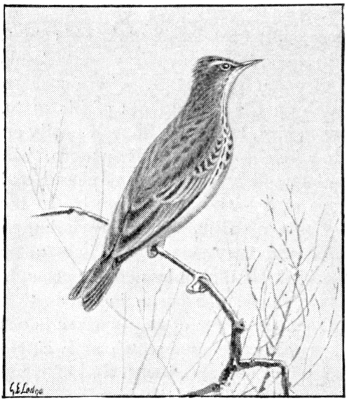
Fig 40.—Tree-pipit. ¼ natural size.
Upper parts ash tinged with olive, the centre of each feather dark brown; a double band across the wing, formed by the yellowish white tips of the lesser and middle wing-coverts; the outer pair of tail feathers white; throat and region of the eye dull white; breast buff, with elongated spots of dark brown; belly and lower tail-coverts dull white. Length, six inches.
Of the three species of Anthus inhabiting the British Islands, and which are appropriately named of the tree, rock, and meadow, according to their respective habits, the tree-pipit alone is migratory, appearing in this country about the third week in April, to remain until the end of September, and sometimes longer. In size, colour, and general appearance it so closely resembles the meadow-pipit that the two species are hardly distinguishable, except by examination in the hand. They also resemble each other in their feeding habits, running about in the grass in a mouse-like manner in search of the small insects and seeds on which they subsist, and, when flushed, starting up suddenly, with a sharp chirp of alarm, and going away with a wild, jerky flight. The tree-pipit is distributed widely over the country, and is found at most wood sides, and where trees grow singly or in isolated groups about the pasture-lands. Where the conditions are favourable he is a common bird, but never abundant. In spring and summer the tree-pipit is solitary, and it is possible that the males, as with the redbreast and nightingale, are not tolerant of other singers of their own species near them, as they are always found occupying trees far apart—seldom, in fact, within hearing distance of one another. On the arrival of the birds in April each male chooses a home, a feeding-ground, with a tree or trees to sing on, and this spot he will occupy until the end of the breeding season, after which the birds resort to the fallows and stubbles, and sometimes before departure they are seen gathered in small flocks.
It has been said of the tree-pipit’s song that it is like that of the canary, and that it ‘is perhaps more attractive from the manner in which it is given than from its actual quality.’ Both statements are true in a measure: that is to say, they will be found true in many instances, but not always. For there are few birds in which the song varies so much in different individuals. The reiterated, clear thin notes and trills that so closely resemble those of the caged canary are heard in some songs, and not in others. As a rule, the bird perches on a favourite tree, very often using the same branch, and at intervals, rising into the air, ascends with rapidly-beating wings, and when it attains to the highest point—usually as high again as the tree, but sometimes considerably higher—the song begins with a succession of notes resembling the throat-notes of the skylark, but very much softer. With the song the descent begins, the open wings fixed motionless, and so raised as to give the bird a parachute-like appearance, falling slowly in a beautiful curve or spiral; on the perch the song continues, but with notes of a different quality—clear, sweet and expressive—repeated many times. Having ended its song, it remains perched for a few moments silent, or else uttering notes as at the beginning, until once more it quits its perch, either to repeat the flight and song, or to drop to the ground, from which it shortly ascends to sing again. The manner in which the song is given is thus always beautiful, and in some individuals there is a wonderful sweetness in the quality of the voice.
The nest is built near the male bird’s favourite tree, and is placed in a hollow in the ground, and so well concealed by the grass and herbage that it is almost impossible to find it, unless by flushing the incubating bird from it. It is formed of fine dry grass and fibrous roots, and lined with horsehair. Four to six eggs are laid, of a dull white ground-colour, spotted with dull brown, grey, and purple, sometimes with blotches and hair-like marks among the spots. The eggs of this species vary a great deal.
Rock-Pipit. Anthus obscurus.
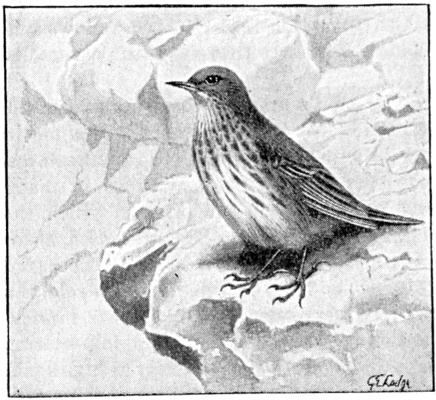
Fig. 41.—Rock-pipit. ⅓ natural size.
Hind claw equal to the toe in length, much curved. Upper parts greenish brown, the centre of each feather darker brown; a whitish streak over the eye; under parts dull white, spotted and streaked with dark brown. Length, six and a quarter inches.
The rock-pipit is the only songster that inhabits the seashore, and this is the one distinction of this small dull-coloured bird. It is true that the starling sometimes nests, like the jackdaw, in cliffs, and that sparrows, wagtails, and a few other species, are occasionally to be seen on the sands and among the rocks; but they are only casual visitors in such places—they are inland birds, that live and breed in meadows, hedgerows, woods, and commons. The rock-pipit is of the seashore exclusively, and everywhere inhabits the coasts of Great Britain and Ireland where there are rocks and cliffs, and all the rocky islands and islets in the neighbouring seas; his nest is not found nor his song heard out of sound of the ocean. In summer he keeps very close to the sea, and his food then consists principally of minute crustaceans and marine insects and worms; in the autumn and winter months he unites in small flocks, and visits the salt-marshes and low grounds near the shore, and he then feeds mostly on small seeds. His song, if heard at a distance from the sea, would not be distinguished from that of the meadow-pipit; the action which accompanies the song is also the same in both species. Occasionally he delivers his notes while sitting on a rock; but as a rule he soars up to a moderate height, either silent or else repeating the first note of the song at regular intervals, then descends with a slow, sliding flight to the earth, and descending emits his best notes, short and simple, but with a melodious tinkling sound which is very pleasant to listen to, especially when several individuals are heard at once. When intruded on in his rocky haunts, or anxious for the safety of his young, his alarm-note, sharp yet plaintive, closely resembles that of the meadow-pipit. The nest, built in May, is carefully concealed among the rocks, beneath a tuft of grass, or in a well-sheltered hole or crevice in the rock, and is composed of small scraps of seaweed, dry grass, and moss, and lined with fine dry grass or hair. Four or five eggs are laid, white or pale bluish in ground-colour, thickly mottled with dull greyish brown or reddish brown spots.
Besides those described, three other species of Anthus have been included among British birds. These are the tawny pipit (Anthus campestris), Richard’s pipit (Anthus richardi), and the water-pipit (Anthus spipoletta). The first two are occasional visitors to the south of England; of the water-pipit, a very few specimens have been obtained in different parts of the country.
Two beautiful British birds, unfortunately not indigenous nor regular in their visits to our country, may be mentioned in this place. They represent two families: Oriolidæ, which follows Motacillidæ (wagtails and pipits); and Ampelidæ, which comes after Laniidæ (shrikes). One is the golden oriole (Oriolus galbulus), a rare straggler to England on migration from Central and Southern Europe. It has been known to breed in the southern counties, and, if protected, would probably become an annual visitant. The other species is the waxwing (Ampelis garrulus), an irregular visitor in winter, sometimes in considerable numbers, from the arctic circle.
Red-backed Shrike. Lanius collurio.
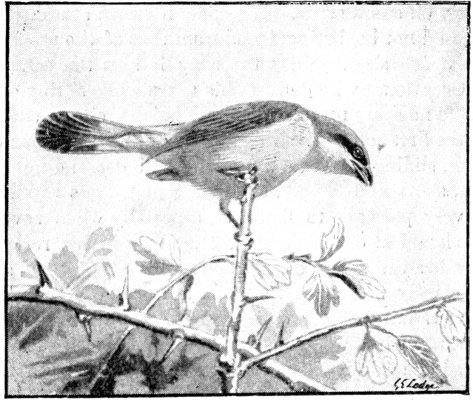
Fig. 42.—Red-backed Shrike. ¼ natural size.
Frontal band, lores, and ear-coverts black; crown and nape grey; mantle chestnut-brown; quills dark brown edged with rufous; tail-coverts grey; tail-feathers white at their bases, the other portion and the whole of the two central ones black; under parts rose-buff; bill and feet black. Length, seven inches.
The shrike is distinguished among perching birds by its sharply hooked, toothed, rapacious beak, and its hawk-like habit of preying on small birds, mice, shrews, frogs, and lizards. The extraordinary custom it has of impaling its victims on thorns has won for it the unpleasant name of butcher-bird, by which it is best known to country-people. Some naturalists have expressed the opinion that the shrike does not often attack small birds; and this would seem a reasonable view to take when we consider that the bird is no bigger than a skylark. But it is impossible to follow with the eye all the wanderings and the actions of all kinds that go to make the day of any wild bird; we really see only a very small part of the killing that goes on. The little feathered butcher is small in size, but his spirit is bold, and his taste for flesh not to be doubted. In a question of this kind I believe our slight intermittent observation is less to be depended on than the reputation—if such a word may be used in this connection—which the shrike bears among his feathered fellow-creatures. He is by them reputed dangerous, a bird of prey to be avoided, or at least regarded with extreme suspicion. We are accustomed to say that we do not know a man until we come to live with him; and the small birds live with the shrike, and therefore know him best.
The red-backed shrike is a summer visitor, arriving in this country early in April, and is not an uncommon species in England and Wales, being most numerous in the southern counties; but its range does not extend to Ireland, and in North Britain it is only known as a straggler. It inhabits the open borders of woods, rough commons, and high hedges, and has the habit of sitting conspicuously perched, often for an hour at a stretch, on the summit of an isolated bush or low tree, or on a fence or any other elevated stand, where it has a pretty appearance. From its perch it watches for its prey, but is by no means a motionless and depressed-looking watcher, like the flycatcher: its movements on its stand, as it turns its head from side to side and jerks and fans its tail, frequently uttering its low, percussive, chat-like chirp or call-note, give the impression of a creature keenly alive to everything passing around it. The shrike is, in fact, attentively watching air, earth, and the surrounding herbage and bushes for a victim, which he captures by a sudden dart, taking it by surprise. Besides small vertebrates, he preys on various large insects—beetles, grasshoppers, wasps, bees, &c.—seizing them in the air as they fly past, or dropping upon them on the ground. He often devours the insects captured on the spot, then returns to his stand; but he also has a favourite thorn-bush or tree to which he is accustomed to convey many of the creatures he takes, to impale them on thorns or fix them on forked twigs. He has the habit of plucking birds before devouring them; and it is doubtless easier for him to pluck a small bird and pull anything he catches to pieces when fixed on a thorn, for, being without crooked claws, he is incapable of grasping his victim and holding it steady while operating on it. This is one of those instincts which simulate reason very closely. The number of remains of victims sometimes found suspended to a butcher-bird’s tree shows that he is occasionally very destructive to small birds. In a case recorded in the ‘Zoologist’ (1875, p. 4723), bodies of the great tit, blue tit, long-tailed tit, robin, hedge-sparrow, and young of blackbirds and thrushes, were found. The indigestible portions swallowed—bones, fur, and wing-cases of large beetles—are cast up in pellets.
In the pairing season the shrike utters at times a chirruping song, not unlike the attempted singing of a sparrow in sound. The nest is large, and placed in a thick bush or hedge, and is composed outwardly of stalks, and inside of fibrous roots and moss, lined with fine bents and a little horsehair. Four to six eggs are laid; these vary a good deal, the ground being pale green, pale buff, cream or pale salmon-colour, spotted and blotched, principally at the large end, with reddish brown and purplish grey.
After leaving the nest the young keep company with their parents until their departure in September and October.
There are four more species of Lanius in the list of British birds, all stragglers—the great grey shrike (Lanius excubitor), a breeder in Central Europe; Pallas’s great grey shrike (Lanius major), from North Scandinavia and Siberia; the lesser grey shrike (Lanius minor), from Central and Southern Europe; the woodchat (Lanius pomeranus), also from Central and Southern Europe.
Spotted Flycatcher. Muscicapa grisola.
Upper parts ash-brown; feathers of the head marked with central dark line; under parts white, the sides marked with longitudinal brown streaks; flanks tinged with red. Length, five and a half inches.
The spotted flycatcher is one of our commonest summer migrants, and at the same time one of the least remarked. He is a late comer, arriving about the middle of May; but he does not come after the leaves are out, to conceal himself among them, after the manner of the wood-wren and of other small insect-eaters. From the day of his arrival he is exposed to sight in the places he frequents—parks, skirts of woods, orchards, gardens, and the borders of fields and meadows. The area inhabited by each bird, or pair, is very circumscribed, and contains a few favourite perching-places, which are regularly occupied at different hours of the day. The perching-place is on a projecting branch, or, better still, a dead branch of a bush or tree, a wire fence, or a paling or gatepost. He comes near houses, and he may have a stand within twenty or thirty yards of the door, from which those who come and go may have him full in sight for several hours each day. But little or no notice is taken of him. And it is not strange, for of all our birds he is the least attractive, in his pale, obscure plumage, as he sits silent and motionless, listless and depressed in appearance, showing neither alarm nor curiosity when regarded. Seen thus he is like a silent grey ghost of a little dead bird returned to haunt the sunlight. Despite this listless appearance he is keenly alive to outward things. As the motionless heron watches the water, with the creatures that move like vague shadows in it, the flycatcher watches the air and the living things, minute and swift-winged, that inhabit it. At intervals he quits his perch and makes a dash at some passing insect, which he captures, his mandibles closing on it with an audible snap; then returns to his stand and his watching once more.
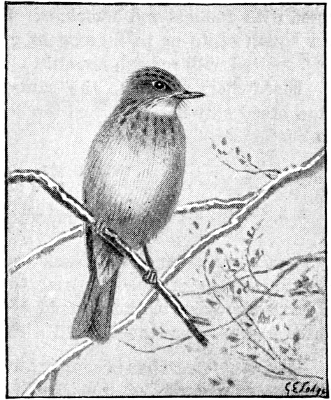
Fig. 43.—Spotted Flycatcher. ¼ natural size.
His call-note is a feeble chirp, two or three times repeated; and he is said to have a song, which few have heard, composed of a few rambling notes in a low tone.
The flycatcher begins to build soon after its arrival, and a favourite site for the nest is in the ivy growing against a wall; nests are also made in holes in walls and in the trunks of trees, on horizontal branches, and in a variety of situations. The nest is composed of dry grass and moss, mixed with a few feathers, and lined with rootlets and horsehair. Five or six eggs are laid; they are bluish white or pale green in ground-colour, clouded, blotched and spotted with reddish brown.
Flycatchers return to the same nesting-place year after year. One brood only is reared, and the birds leave us by the third week in September.
Pied Flycatcher. Muscicapa atricapilla.
Upper parts and tail black; wings black, with the central coverts white; scapulars edged with white; under parts white. Female: greyish brown instead of black; the white dingy; the three lateral tail-feathers edged with white. Length, five inches.
The pied flycatcher is comparatively a rare bird, and is unknown to a great majority of the inhabitants of this country, being restricted to a few localities in the north of England and the south of Scotland, and to some parts of North Wales, and the English counties bordering on Wales. In its nesting and feeding habits, and its partiality for orchards and gardens, it is like the spotted flycatcher; but it arrives earlier than that species, usually during the last week in April or the first week in May. Its black-and-white plumage gives it a very different and a much more attractive appearance. The only other point in which the two species differ greatly is in the number and colour of the eggs. Those of the pied flycatcher number from five to eight, and are very beautiful, being of a uniform delicate pale blue, and unspotted.
A third species, the red-breasted flycatcher (Musicapa parva), has been included in the list of stragglers from Central and Eastern Europe to this country.
Swallow. Hirundo rustica.
Forehead and throat chestnut-brown; upper parts, sides of neck, and a bar across the breast black, with violet reflections; lower parts dull reddish white. Tail long and forked. Female: less red on the forehead and less black on the breast; under parts white; outer tail-feathers shorter. Length, seven and a half inches.
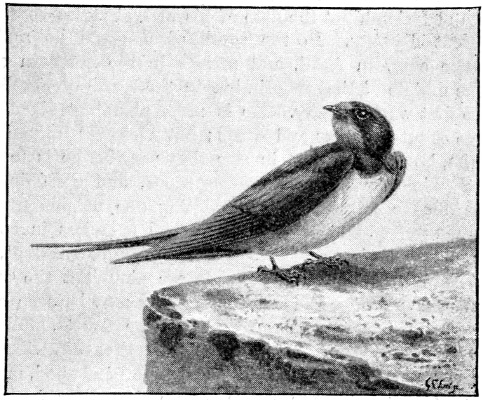
Fig. 44.—Swallow. ¼ natural size.
The swallow, as we usually see him, gliding and doubling in the air with a freedom surpassing that of other birds, has considerable beauty, being richly coloured and of an elegant figure, with sharply forked tail and long, pointed wings. But this is not the reason of the charm he has for us, since there are other more beautiful birds that inspire no such feeling. He is loved above most species on account of his domestic habits and familiarity with man. There would be few swallows in a dispeopled and savage England, with all its buildings crumbled to earth, for he would then be compelled to return to the original habits of the wild swallow, and build his mud cradle in rocky cliffs and caverns. As things are he is not dependent on cliffs, for he has taken kindly to human habitations, and increases with the increase of house-building, until he has become one of the commonest and most generally diffused species. And being a house-bird, and accustomed to the human form, when our summer migrants return to us with the return of the sun, and the others seek their customary homes in woods and groves by the sides of streams and marshes, and on downs and waste lands, the swallow alone comes direct to us to deliver the glad message, so that even the sick and aged and infirm, who can no longer leave their beds or rooms, are able to hear it. What wonder that we cherish a greater affection for, and are more intimate with, the swallow than with our other feathered fellow-creatures!
The swallow is very evenly distributed over the whole of Great Britain and Ireland, but the date of his arrival varies considerably in different districts. In the south of England he makes his appearance early in April, and arrives in the northern counties about the middle of that month, but in the north of Scotland not until the first week in May. He is most abundant about villages and large country-houses and farms; but wherever human habitations exist, however modest in size they may be, he is to be met with. Swallows are eminently gregarious, and even during the breeding season all the birds inhabiting one neighbourhood are accustomed to feed and practise their aërial exercises in company. At this season their gatherings are, however, intermittent, and in part accidental. Where flying insects are abundant the swallows quickly gather. At one time of the day they may be seen coursing up and down the lanes and roads and village streets, gliding close to the ground with great speed; in rough weather they will assemble in scores or hundreds on the sheltered side of a wood, or lane, or a row of elms; but on a warm, damp day, they frequent the meadows and low grounds near the water, where insects are most abundant.
The swallow has a variety of sharp little chirps and twittering notes, and a loud, startled, double alarm-note, uttered at the appearance of a hawk speeding through the air, or at sight of a prowling cat. The appearance of a hawk excites as much anger as fear, and he generally goes in pursuit of it; but the note is understood by other small birds, and has the effect of sending them quickly into hiding. The song, uttered sometimes on the wing, but more frequently when perched, is very charming, and seems more free and spontaneous than that of any bird possessing a set song, the notes leaping out with a heartfelt joyousness which is quite irresistible. The sound differs in quality from that of other birds; it is, perhaps, more human: a swallow-like note may be heard in some of the most beautiful contralto voices. The dozen or more notes composing the song end with a little jarring trill, so low as to be hardly audible.
A favourite site for the swallow’s nest is the top of a joist supporting the rafters of a barn or other outhouse to which there is free access. It is a saucer-shaped rim of mud or clay, placed on the wood. The inside is lined with dry grass and feathers. It is quite open at the top, but usually close to the roof. The eggs are four to six in number, and vary much in shape and disposition of markings. They are pure white, spotted with rich coffee-brown, light reddish brown, and purplish grey. During incubation the sitting-bird is fed at intervals by her mate.
Two broods are reared in the season, and the young are fed for some days after quitting the nest. The early broods are believed to leave this country in advance of the adults and the young of the later broods. The final and principal migration takes place at the end of September or early in October, the birds congregating some days before departure in large flocks, sometimes numbering many thousands.
Martin. Chelidon urbica.
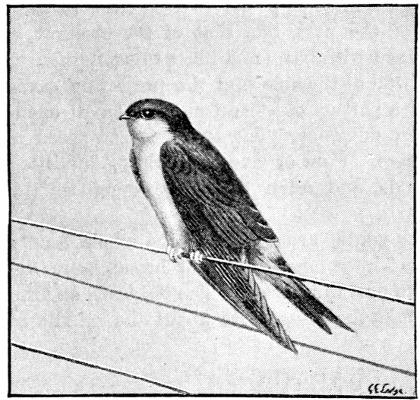
Fig. 45.—Martin. ⅓ natural size.
Head, nape, and upper part of the back black, with violet reflections; lower parts of the back and under parts pure white. Feet and toes covered with downy feathers; tail forked. Length, five and a half inches.
The martin, or house-martin, is as common and widely diffused in the British Islands as the swallow, and as it lives with man in the same way, making use of houses to build its nest on, it shares the affection with which that bird is generally regarded. Most people, in fact, regard them as one and the same species; for both are of one type, and are domestic in habit, and associate together, and unless looked at with attention they are not seen distinctly, and consequently not distinguished. The martin differs from the swallow in its slightly smaller size; in having its feet feathered and the rump and entire under parts pure white; and in its less sharply forked tail and shorter wings. On the wing it is not so perfectly free as the swallow: it cannot double so quickly, nor fly with such speed and grace.
The martin cannot be called a songster. His most common expression is a somewhat harsh note, often uttered as he sports with his fellows in the air; in the pairing and nesting time he occasionally attempts to sing, usually when clinging to a wall and to the rim of his nest, and emits a slight warbling sound, somewhat guttural, and so low that it can only be heard at a distance of a few yards.
He arrives in this country a little after the swallow, and immediately sets about making a new nest or repairing an old one. This is formed outwardly of mud or clay, and is placed under the eaves of a house, against the wall. He is able to build against a smooth brick or stucco wall, but prefers stone, which has a rougher surface. It is usual to find several nests near together, and the reason is, probably, that the surface of the wall is suitable to build on, and not, as is often stated, because the martins prefer to nest close to each other. The outer shell of the nest, like that of the swallow, is formed of mud or clay, mixed with hairs and fibres to strengthen it, and is placed against the wall at the side and the projecting eaves above, and forms a half or a portion of a hemisphere, a small opening being left at the top for entrance. The lining is composed of feathers and a little dry grass. Four or five pure white, unspotted eggs are laid. Two broods, and often three, are reared in the season.
For some days after the young are able to fly the whole family roost at night in the nest. The young of the first brood, as in the case of the swallow, are the first to migrate. The old birds and the young of the later broods take their departure about the middle of October.
Sand-Martin. Cotile riparia.
Upper parts, cheeks, and a broad bar on the breast mouse-colour; throat, fore part of the neck, belly, and under tail-coverts white. Legs and feet naked, with the exception of a few small feathers near the insertion of the hind toe; tail forked, rather short. Length, five inches.
The sand-martin, although common enough in some localities, and found throughout the British Islands, including the Outer Hebrides and the Orkneys, is not a very well-known bird; for, however populous the country may be, and though other hirundines become increasingly domestic and breed under eaves, in porches, barns, and chimneys, he always preserves his original wild character. He is a swallow that is a stranger to man, and breeds in holes and crevices in precipitous cliffs on the sea-coast. But he prefers to excavate a breeding-hole in a perpendicular bank of clay not too stiff for his weak mining implements. Earth-cliffs on the banks of rivers and lakes and on the sea, are resorted to for this purpose, and he also takes advantage of the steep sides of railway-cuttings and sand and gravel pits. A suitable bank or cliff will often attract a large number of sand-martins, and the surface will appear riddled with their holes. It has always caused surprise in those who have observed this bird that it should be able with its small, weak bill to form such deep tunnels in the hard earth. The hole once made is, however, often used by the same birds for several years. They do not work by digging into the earth with their bills as a man digs with a knife or other implement. They perch against the surface and pick out small particles, and by means of this slow, laborious process accomplish their great work. The hole slants upwards, and is from three to four feet in length and two or three inches in diameter. At its extremity the gallery is widened to form a chamber about six inches in diameter, where the bed is made of dry grass, with a few feathers for lining. Male and female take turns in boring, working only in the morning, the rest of the daylight hours being spent in feeding and play. It sometimes happens that in boring their hole a sunken boulder or vein of impenetrable earth is met with; the hole is then abandoned and a new one begun in another place. By the end of May the eggs are laid. These are four to six in number, and are pure white.
When hovering before their holes, and passing to and fro with wavering flight along the face of the bank, the sand-martins have a curious moth-like appearance. While flying about in company they constantly utter a low monotonous note; and this sound is prolonged to a scream when the birds are excited by the presence of some enemy. The male has, besides, a twittering song, uttered on the wing while hovering before the nesting-hole.