CLASSIFICATION. (continued 3)
Reading edition
Two broods are reared, and as soon as breeding is over the birds forsake the bank and scatter about the country, and may then be seen associating with house-martins and swallows.
The sand-martin is the earliest of the swallows to arrive in this country, and the first to depart; it is rare to meet with them after the middle of September.
Tree-Creeper. Certhia familiaris.
Upper parts mottled with yellowish brown, dark brown, and white; a pale streak over the eye; throat and breast buff-white, becoming dusky on the belly; wings brown, tipped with white, and barred with white, brown, and dull yellow; tail-feathers reddish brown, stiff, and pointed. Length, five inches.
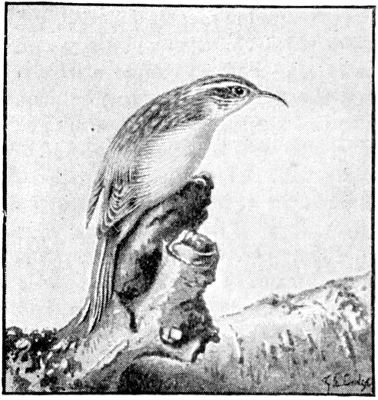
Fig. 46.—Tree-creeper. ⅓ natural size.
The little creeper appears to move more in a groove than almost any other passerine bird, and is the most monotonous in its life; yet it never fails to interest, doubtless because in its appearance and actions it differs so much from other species. A small bird—one of the very smallest—with striped and mottled brown upper, and silvery white under, plumage; long and slim in figure, with a slender curved bill and stiff, pointed tail-feathers, it spends its life on the boles and branches of trees, exploring the rough bark with microscopic sight for the minute insects and their eggs and larvæ it subsists on, moving invariably upwards in a spiral from the roots to the branches by a series of rapid jerks; its appearance as it travels over the surface, against which it presses so closely, is that of a mammal rather than a bird—a small mottled brown mouse with an elongated body. It is more of a parasite on the trees that furnish it with food than any other bird of similar habits. Nuthatches and woodpeckers are not so dependent on their trade; their habits and diet vary to some extent with the seasons and the conditions they exist in. The creeper is a creeper on trees all the year round, and extracts all his sustenance from the bark. His procedure is always the same: no sooner has he got to the higher and smoother part of the hole up which he has travelled than he detaches himself from it, and drops slantingly through the air to the roots of another tree, to begin as before. The action is always accompanied with a little querulous note, which falls like an exclamation, and seems to express disgust at the miserable harvest he has gathered, or else satisfaction that yet another tree in the long weary tale of trees has been examined and left behind. The fanciful idea is formed that the creeper has not found happiness in his way of life: it is so laborious a way; he must live so close to the dull-hued and always shaded bark, and examine it so narrowly! The contrast of such a method with that of other small birds—warblers and wagtails, and swallows and finches—is very great. Feeding-time with them is song-time and play-time; their blithe voices and lively antics and motions show how happy they are in their lives. The creeper is a rather silent bird, but he utters in the pairing season a shrill, high-pitched call-note, and the same sound is emitted when the nest is in danger. The song, which is occasionally heard in spring, is composed of three or four shrill notes resembling the call-notes in sound.
The nest is a neat and pretty structure, and is often placed against the trunk of a tree, behind a piece of bark that has become partly detached. A hole in the trunk, or in a large branch, or in a cavity where a portion of the wood has rotted away, is often selected as a site. When the nest is made behind a piece of loose bark, the cavity is filled up with a quantity of fine twigs. Inside, the nest is formed of roots, moss, and sometimes feathers, and lined with fine strips of inside bark. Six to nine eggs are laid, pure white, with red spots. Two broods are reared in a season.
Goldfinch. Carduelis elegans.
Back of the head, nape, and feathers round the base of the bill black; forehead and throat blood-red; cheeks, fore part of the neck, and under parts white; back and scapulars dark brown; wings variegated with black, white and yellow; tail black, tipped with white. Length, five inches.
We are rich in finches. No fewer than eighteen members of that family, including the snow-bunting, may be truly described as British. Among our passerine birds they excel in beauty of plumage, and by most persons the goldfinch, in his pretty coat of many colours—crimson, black, and white, and brown, and brilliant yellow—is regarded as the most beautiful of all. Certainly he is the most elegant in shape, the most graceful and engaging in his motions. It is charming to watch a small flock of these finches in the late summer, busy feeding on the roadside, or on some patch of waste land where the seeds, they best love are abundant, when they are seen clinging in various attitudes to the stalks, deftly picking off the thistle seed, and scattering the silvery down on the air. They are then pretty birds prettily occupied; and as they pass with easy, undulating flight from weed to weed, with musical call-notes and lively twitterings, bird following bird, they appear as gay and volatile as they are pretty.
They are found in suitable localities throughout England, and also inhabit Scotland and Ireland, but their distribution in the last two countries is much more local. During late summer and autumn they lead a gipsy life, incessantly wandering about the open country in search of their favourite seeds. They are also seen in winter, but few remain with us throughout the year, the majority passing over the Channel, to winter in a warmer climate. On their return in spring they come to the neighbourhood of houses, and build by preference in an apple or cherry tree in an orchard. The nest is well made, and composed of a great variety of materials—fine twigs, roots, grass, leaves, moss, and wool—and lined with hairs, feathers, and vegetable down. The four or five eggs are white, thinly spotted with reddish brown and pale purple.
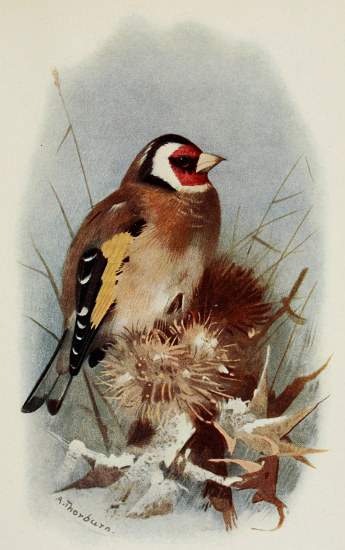
PLATE V. GOLDFINCH. ⅔ NAT. SIZE.
As a vocalist the goldfinch does not rank high; but his lively, twittering song, uttered both on the perch and when passing through the air, and his musical call-notes, have a very pleasing effect, especially when the birds are seen in the open country in bright, sunny weather. Unhappily, it is not now very easy to see them, except in a few favoured localities, owing to their increasing rarity. For the goldfinch is a favourite cage-bird, and so long as bird-catching is permitted to flourish without restriction, this charming species will continue to decrease, as it has been decreasing for the last fifty years and upwards.
Siskin. Chrysometris spinus.
Crown black; a broad yellow streak behind the eye; the plumage variegated with grey, dusky, and various shades of green; wings dusky, with a transverse greenish yellow bar, and a black one above, and a second black bar across the middle of the tertiaries; tail dusky, the base and edge of the inner web greenish yellow. Female: colours less bright, and no black on the head. Length, four and a half inches.
The siskin, or aberdevine, as it is also called, is known to us as a winter visitant, but it is better known as a cage than a free bird. In the British Islands it breeds in various places in Scotland, in pine and fir woods; it has also been found breeding in various localities in England and Wales. In Ireland it is not so common as in England. The siskin is a pretty, active, musical little bird, somewhat tit-like in its manner of seeking its food, its sociability, and the various positions it assumes in its search for small insects and seeds in the higher branches of a tree, or when clinging to the terminal twigs. As a caged bird his song is a small musical twittering; but in a wild state, in the pairing season, the male has a more charming performance, for he then soars about the tree, and, with fluttering wings and outspread tail, floats down singing to his perch.
The nest is built in a pine or fir tree at a considerable height from the ground, and so hidden as to make it very hard to find. There is a legend in some districts on the continent of Europe that the siskin places a small stone among its eggs, which renders the nest invisible. This legend reminds me of a belief of the peasants of southern South America, that the rail-like, spotted tinamou—a bird that easily eludes one’s sight among the grey and yellow herbage—has the faculty of making itself invisible. The primitive mind is much given to explanations of this kind.
The nest, placed as a rule in the fork of a horizontal branch, is composed of rootlets and moss, on a foundation of bents and twigs of heather, and is lined with fine dry grass and a little vegetable down, sometimes with a few feathers. Five or six eggs are laid, pale bluish green in ground-colour, and spotted with dark reddish brown and pinkish grey under-markings.
In autumn siskins unite in small flocks and migrate southward; and during winter they are found widely distributed over the country, but are most numerous in the northern counties of England. At this season they may be seen associating on trees and bushes with goldcrests, redpolls, and titmice of different species.
Closely allied to the siskin and goldfinch, and in its colouring intermediate between them, but differing in having the crown, nape, and chin black, is the serin (Serinus hortulanus). It breeds in North and Central Europe, and is only known in this country as a rare straggler.
Greenfinch. Ligurinus chloris.
Yellowish green variegated with yellow and ash-grey. Length, six inches.
It has been a subject of mild wonder to me that the greenfinch is not more a favourite than I find him; for he is almost more with us than any other finch, and, in most cases, to know a bird well is to like it. Few of our eighteen finches can be seen and heard close to our houses. The brambling, siskin, redpoll, crossbill, and twite are scattered about the country in the cold and songless season; in summer we see little or nothing of them. The linnet is fairly abundant, but must be looked for on waste lands and commons; while the goldfinch, bullfinch, hawfinch, and tree-sparrow are either so shy or so rare that, to most persons, they might be non-existent. Three of our five buntings are common enough; but these, too, are birds of the open, that come little about houses, and are without the qualities that go to make a favourite. Of finches of the homestead that possess beauty and melody there are only two—the chaffinch and the greenfinch; and it is the fact that most people have a great esteem for the first, and pay but very slight attention to the second. The greenfinch is not formed on the graceful lines of the goldfinch and some other members of the family; he is made more after the pattern of the hawfinch, and is somewhat heavy in appearance. Regarding his colouring only, he is a prettier bird than his neighbour, the chaffinch, his plumage showing two colours that contrast beautifully—olive-green and brilliant yellow. It is not often that we can see him in the proper light and position. He is strangely fond of concealing himself in the green foliage, which makes him in his green dress invisible. Seen in the shade or against a bright light, his colour appears dull and indeterminate; but against a background of green leaves, with the sunlight on him, he is certainly beautiful.
The greenfinches are very sociable in disposition, and all the summer long, even when they are engaged in breeding, they may be seen in parties of three, or four, or half a dozen; two or three nests are often found on the same branch, or in close proximity. The passions of jealousy and anger, so common among birds in the pairing season, seem not to exist in this species. As a songster he cannot compare with the linnet, the chaffinch, and the goldfinch, but he probably produces more pleasant sound than any other finch, unless we include the chirruping of the sparrow. He is attached to gardens and shrubberies, to groves and hedges, and hedgerow trees, especially elms, and among the clustering leaves in which he loves to hide he is constantly uttering his various notes, the commonest of which is a low and long-drawn trill. Occasionally he gives out another long, single note, with a very different sound, a kind of soft-toned, inflected scream, used sometimes as a call-note and sometimes to express alarm; and this he will often repeat again and again at short intervals. When uttering his trill, which is his favourite expression, among the leaves, bird answering bird with trills that vary in tone, he gives out from time to time another sound, a series of warbled notes, soft and melodious in character. Occasionally, in the pairing season, the male bird flies up out of the cloud of foliage and emits these warbling notes as he circles round, and descends into the midst of the leaves again. The charm of this perpetual summer music of the greenfinches is its airy, subdued character, as of wind-touched leaves that flutter musically.
The nest is placed among the close branches of a bush or low tree, and is somewhat loosely put together, straw, roots, and moss, mixed with wool, being used, with a lining of fibres, horsehair, and feathers. The eggs are four to six in number, and are white, faintly spotted and speckled with purplish red at the large end. The young are fed on seeds of various weeds and small caterpillars; and two, and sometimes three, broods are reared in the season. At the end of summer the greenfinches repair to the fields, and are seen in flocks of two or three score to a hundred or more individuals, and are also found associating with sparrows, chaffinches, and other species.
The greenfinch is a common bird throughout the British Islands.
Hawfinch. Coccothraustes vulgaris.
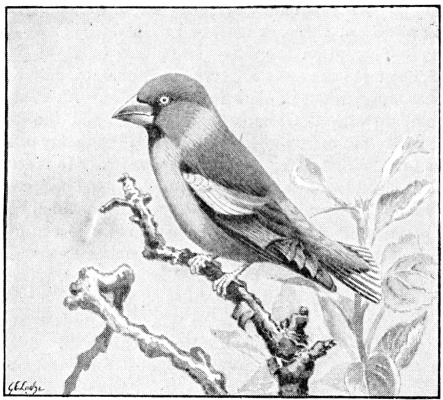
Fig. 47.—Hawfinch. ⅓ natural size.
Lore, throat, and plumage at the base of the bill black; crown and cheeks reddish brown; nape ash-grey; back dark reddish brown; wings black; great coverts white; under parts light purplish red. Length, seven inches.
The hawfinch has a somewhat curious history in this country. It was always believed to be an accidental autumn and winter visitor until, a little over half a century ago, the naturalist Doubleday, of Epping, discovered that it was a resident all the year round, and not a very rare species in that locality. Later it was found breeding in other places, and it is now known to inhabit all the Home Counties and various other parts of England. At present the belief is general that the bird is increasing in numbers and extending its range. This would seem the most natural explanation of the fact that the bird is often seen now in places where it was not seen formerly; but it must be taken into consideration that nobody looked to find the hawfinch when it was not known to be a British species, and that now many sharp eyes watch for it. As it is, we are seldom rewarded by a sight of it, even in localities where it is known to exist, in spite of its conspicuous colouring and the somewhat singular appearance given to it by its large head and massive, conical beak. Its excessive wariness prevents it from being seen even when it is not rare. No other small bird is so shy with us, so vigilant, and quick to make its escape at the slightest appearance of danger. When not feeding it passes the time in woods, plantations, and copses, at a spot where the trees grow thickest and the foliage is most dense. Its love of concealing itself in the deepest shade is like that of a nocturnal species. When away from its obscure place of refuge it is extremely alert, perching in the tops of trees to survey the surrounding scene, and from which to drop silently into any garden or orchard which may be safely visited. Naturally, it has been assumed that this shy and watchful habit has been brought about by persecution, gardeners and fruit-growers being deadly enemies to hawfinches on account of their depredations; but in the forests of North Africa, Mr. Charles Dixon found the bird just as vigilant and quick to take alarm as in England.
Hawfinches are rather silent birds: when flying from tree to tree in small flocks they utter a call-note with a clicking sound, and in spring the male sometimes emits a few low notes by way of song.
The nest is placed in a tree, or bush, or hedge, a thorn being the tree most frequently chosen for a site. The nest is rather large and well made, outwardly of twigs, dead stalks, and lichen, inside of dry grass, and lined with rootlets and a little hair. The eggs are four to six in number, pale olive or bluish green in ground-colour, spotted with black, and irregularly streaked with dark olive. In some eggs the ground-colour is buff. The young are fed on caterpillars, and only one brood is reared. After leaving the nest the young birds live with the parents, and sometimes several families unite into a flock; as many as a hundred birds, or more, may be seen together.
In autumn and winter the hawfinches feed on seeds of various kinds—hornbeam, beech, yew, and hawthorn. The kernels only of the haws are eaten; and, in like manner, cherries and other fruits are robbed for the sake of the kernel, the hard stones being split open with the powerful beak.
House-Sparrow. Passer domesticus.
Lores black; a narrow white streak over each eye; crown, nape, and lower back ash-grey; region of the ear-coverts chestnut; back chestnut-brown streaked with black; wings brown, with white bar on the middle coverts; tail dull brown; throat and breast black; cheeks and sides of neck white; belly dull white. Length, six inches. Female: without the black on the throat, and upper parts striated dusky brown.
More, far more, has been written about the sparrow than about any other bird, but as it is not advisable here to enter into the controversy on the subject of the injury he inflicts, or is believed by many to inflict, on the farmer and gardener, a very brief account of its habits will suffice. They are almost better known to most persons than the habits of the domestic fowl, owing to the universality of this little bird, to its excessive abundance in towns as well as in rural districts, and to its attachment to human habitations. For his excessive predominance there are several causes. He is exceedingly hardy, and more adaptive than other species; his adaptiveness makes it possible for him to exist and thrive in great smoky towns like London. He is sagacious beyond most species, and although living so constantly with or near to man, he never loses his suspicious habit, and of all birds is the most difficult to be trapped. He is very prolific: as soon as the weather becomes mild, at the end of February or in March, he begins to breed, and brood after brood is reared until September, or even till November if the weather proves favourable. He also possesses an advantage in his habit of breeding in holes in houses, where his eggs and young are much safer than in trees and hedges. There is a curious diversity in his nesting habits: he generally prefers a hole in a wall, or some safe, convenient cavity, and will make vigorous war on and eject other species, like the house-martin, from their nests and nesting-holes; but when such receptacles are not sufficiently numerous, or it appears safe to do so, he builds in trees, making a large, conspicuous, oval, domed nest of straw, mixed with strings, rags, and other materials, and thickly lined inside with feathers. Five to six eggs are laid, of a pale bluish white ground-colour, spotted, blotched, or suffused with grey and dusky brown. The young are fed on caterpillars; and the adults also are partly insectivorous during the summer months, but in the autumn and winter grain, seeds, and buds are chiefly eaten.
Tree-Sparrow. Passer montanus.
Crown and back of head chestnut-brown; lore, ear-coverts, and throat black; neck almost surrounded by a white collar; upper parts as in the last; wing with two transverse white bars. Length, five and a half inches.
By a careless observer the tree-sparrow would, in most cases, be taken for the house-sparrow, and not looked directly at. When we know that there is a tree-sparrow, and meet with it, we notice the chief points in which it differs from the common species—the chestnut-coloured head, with black and white patches at the side, and the double bar on the wing.
The tree-sparrow is locally distributed throughout England and Scotland, but is nowhere abundant; in Wales and Ireland it is rare. With us it is a shy bird, being found, as a rule, at a distance from houses, in fields, on the borders of woods, in thickets growing beside streams, and in fir plantations. In some districts on the Continent it is far less shy of man, and lives in villages and towns, where it associates with the common sparrow, and is said to be just as tame. In many parts of Asia it is still more domestic. Edward Blyth wrote of it: ‘In the great rice-exporting station of Akyab we have seen this species so familiarly hopping about in the public streets that it would only just move out of the way of the passers-by; and we have also known it breeding so numerously in dwellinghouses as to be quite a nuisance from its shrill, incessant chirping.’ This bird is the common house-sparrow of China and Japan, the Philippines, Burma, and more or less over the whole Malayan region.
In its habits it is more active and lively than its more domestic relation, and is more at home on trees, and may be seen moving about among the lesser branches and twigs with much freedom, sometimes seeking its food there, after the manner of the siskin and redpoll; but it feeds principally on the ground. It can scarcely be called a song-bird, its most song-like sounds being composed of a few chirruping notes uttered in the pairing season. Its voice, both in its attempted singing and in its ordinary chirp and call-notes, is much shriller than that of the common sparrow.
Like that species, it breeds both in holes and on trees. A hole in the rotten wood of a pollard willow by the waterside is a favourite site, and it also nests in holes under the eaves or thatch of a barn or other outhouse, and in holes in ruins, old walls, and rocks. The nest is made of dry grass, loosely put together, and lined with some soft material—wool, or feathers, or hair. Four to six eggs are laid, bluish white in ground-colour, the whole egg thickly mottled with brown of different shades. Two, and even three, broods are reared in the season.
In winter the tree-sparrows gather in small flocks, and are often found associating with the common sparrow, chaffinch, brambling, and other species. At this season they subsist principally on seeds of weeds and grass, but in summer they are partly insectivorous.
Chaffinch. Fringilla cœlebs.
Forehead black; crown and nape greyish blue; back and scapulars chestnut tinged with green; rump green; breast chestnut-red, fading into white on the belly; wings black, with two white bands; coverts of the secondaries tipped with yellow; tail black, the two middle feathers ash-grey, the two outer, on each side, black, with a broad, oblique white band. Female: head, back, and scapulars ash-brown tinged with olive; lower parts greyish white; the transverse bands less distinct. Length, six inches.
The chaffinch is one of the most popular song-birds in Britain; it is very much with us, being universal in its distribution in this country, and a bird that attaches itself to the neighbourhood of houses, an inhabitant of gardens and orchards, and a resident throughout the year. He is a pretty bird, and, if not a brilliant songster, is at all events a very vigorous one; his lively, ringing lyric, being short and composed of notes invariably repeated in the same order, is capable of being remembered longer and more vividly reproduced in the mind than any other song. Sitting by the fireside in January, you can mentally hear the song of the chaffinch; but the brain is incapable of registering the more copious and varied bird-music in the same perfect way—the music, for instance, of the skylark and thrush and garden-warbler. It is not strange that, when Browning wished to be back in England in April, he thought of the spring song of the chaffinch, before that of any other species.
O to be in England Now that April’s there; And whoever wakes in England Sees, some morning, unaware, That the lowest boughs of the brushwood sheaf Round the elm-tree bole are in tiny leaf, While the chaffinch sings on the orchard bough In England now!
The chaffinch makes the most of his song. He appears, indeed, very much in earnest in whatever he does, his character in this respect offering a strong contrast to that of the goldfinch, siskin, and various other melodists. They sing at all times, anywhere and anyhow. With the chaffinch, singing is a business just as important as any other—feeding, fighting, pairing, and building. He flies to a tree, and deliberately takes his stand, often on the most commanding twig, and there delivers his few notes with the utmost energy, and so rapidly that they almost run into each other, ending with a fine flourish. At regular intervals of a few seconds the performance is repeated, the bird standing erect and motionless all the time; until, having given the fullest and most complete expression to his feelings, he flies away, to engage elsewhere in some task of another kind.
It is a loud song and a joyous sound—‘gay as a chaffinch’ is a proverbial saying of the French; but there is also a note of defiance in the song, as in the crow of a cock. Chaffinches sing, as cocks crow, against each other, and the music often ends in a combat. It is not, as some imagine, that there is a spirit of emulation in birds with regard to their singing—that they are rival musicians, like the shepherds in the old pastorals, that contended in song for mastery: it is simply that the cock chaffinch, like the robin and some other species, is a bird of a jealous and pugnacious disposition, and can brook no other male chaffinch near him. Another’s singing tells him that another male is present, and his jealousy is at once excited. If the sound is at a distance, he will content himself by answering song with song; if near, he will quickly seek out the singer, and drive him from his chosen ground. It is this jealous temper of the chaffinch that gives it value to the bird-fanciers of a base kind.
The chaffinch is first heard before the end of February. He pairs early in March, and in April begins to build. The nest is placed in a shrub or tree, in a cleft, or on a horizontal branch. An apple, pear, or cherry tree in an orchard is a favourite site; but any tree, from an evergreen in a garden to the largest oak or elm, may be selected, and the nest may be at any height from the ground from half a dozen to fifty feet. It is a very beautiful structure, formed outwardly of lichen, moss, and dry grass, compactly woven together, and mixed with cobwebs; the cup-shaped inside is lined with hair, vegetable down, and feathers. In most cases the outer portion of the nest is composed of materials that give it a close resemblance to the tree it is built on. Thus, on an oak or apple tree overgrown with grey lichen, or on a silver birch, the framework is chiefly composed of lichen; but in deep green bushes evergreen moss is used. The nest is built by the female, but the male assists in collecting and bringing materials. A fortnight, or longer, is taken to complete this elaborate nest; but from the beginning, and even before the nest is begun, the birds exhibit the greatest excitement and distress if the chosen tree is approached, flying round and flitting from branch to branch, incessantly uttering their well-known alarm-notes, usually spelt pink-pink or spink-spink, a clear, penetrating sound, slightly metallic in character; also another sound, a lower and somewhat harsh note of anxiety.
The eggs are four or five in number, of a pale bluish green, spotted and blotched with dull purplish brown. The young are fed on caterpillars and small insects. The adults, too, subsist chiefly on insects in summer, seeking for them on the ground, and sometimes capturing them in the air, like the flycatcher.
In autumn the chaffinches congregate in flocks, and at this season the separation of the sexes, about which so much has been said since the days of Linnæus, takes place. Something remains to be known on this subject. It is beyond dispute that large flocks composed entirely of birds of one sex are often met with in autumn and winter, both in this country and on the Continent. The question about which ornithologists differ is as to whether or not a separation of the sexes takes place among chaffinches of British race. Seebohm says: ‘It is probable that this peculiar habit is confined to the birds that come to our shores in autumn’; and we have it on good authority that no separation of males from females takes place in the south and west of England. In the month of September, at one place in Scotland, I observed the male chaffinches gathered in small parties of three or four to a dozen individuals; these were the birds belonging to the district; but the females had vanished. Selby observed the same thing many years ago in Scotland and the north of England. One can only suppose that the migratory impulse is a little stronger or earlier in the female of this species, and that the divergence between the sexes, in this respect, becomes greater as we go towards the northern limit of its range.
Brambling. Fringilla montifringilla.
Head, cheeks, nape, and upper part of back black, the feathers (in winter) tipped with light brown or ash-grey; neck and scapulars pale orange-brown; wings black variegated with orange-brown and white; rump and lower parts white; the flanks reddish, with a few dark spots. Female: crown reddish brown, the feathers tipped with grey; a black streak over the eye; cheeks and neck ash-grey; all the rest as in the male, but less bright. Length, six and a quarter inches.
The brambling, or mountain-finch, comes nearest in relationship to the chaffinch, but differs very much in its glossy black, white, and bright buff colouring, and is a much prettier bird. We do not see it in its bright nuptial plumage in this country; for it is an arctic species, breeding in very high latitudes, in birch woods near the limit of forest growth. Its nest and eggs resemble those of the chaffinch, the nest being a compact and beautifully shaped fabric that assimilates in colour to the white and grey bark of the silver birch. The bramblings arrive in this country during September and October, and are found in winter throughout Great Britain and Ireland. They are, however, very irregular in their movements, and do not, like the redwings, return year after year to the same localities; but, as a rule, where a flock appears in autumn, there it will remain until the end of winter. Beech-woods form a great attraction to them, beech-mast being their favourite food, and where it is abundant they will sometimes congregate in immense numbers. As a songster the brambling ranks low among the finches, but the lively chirping and twittering concert of a large flock on a tree-top, and in the evening, before the birds settle to roost, has a very pleasing effect.
Linnet. Linota cannabina.
Forehead and centre of the crown crimson; the rest of the head, nape, and sides of the neck, mottled brownish grey; mantle chestnut-brown; wing-feathers blackish, with outer edges white, forming a conspicuous bar; upper tail-coverts dark brown with whitish margins; tail-feathers black, narrowly edged with white on the outer and broadly on the inner webs; chin and throat dull white, striped with greyish brown; breast crimson; belly dull white; flanks fawn-brown. Length, five inches and three-quarters. In winter the crimson feathers are concealed by wide greyish margins. Female: duller in colour and without any crimson.
Next to the goldfinch, the linnet is the most sought after in this country as a cage-bird, and the demand for linnets is no doubt causing a great diminution in their numbers. But they are still fairly abundant, and to be met with in most waste and uncultivated places, especially where furze-bushes abound.
The linnet is one of the most social of the finches, being found gathered in small flocks and parties of three, or four, or half a dozen, even in the middle of the breeding season. When perched or flying they incessantly call to each other in sharp little chirps and twittering notes. They are more aërial in habit than most finches, and take to flight very readily, and fly high, with great velocity; and when at a great elevation they are often seen to check their rapid course very suddenly, and dart away in some other direction, or else to drop plumb down like falling hailstones to the earth. Being so free of the air, they are great rovers, and, except when engaged in breeding, are constantly travelling about in the open country at all times of the year.
In the colour of its plumage the linnet is one of the most variable of birds: it is common to meet with bird-catchers and bird-fanciers who hear with surprise, and even with incredulity, that all these birds of different tints are of one species. The cock linnet never, or very rarely, puts on his most beautiful colours in captivity, and even in a state of nature the individuals composing a flock are seen to differ greatly. Among a dozen birds, perhaps only one will exhibit the perfect male plumage—the blood-red forehead, grey head, rich chestnut-brown upper parts, and lovely carmine breast. There is one variety, known as the lemon linnet, in which the breast is lemon-yellow instead of carmine-red; and there are other varieties. In song, too, the linnet greatly varies. When the singer is a good one, and listened to at a distance not exceeding twenty or thirty yards, the strain is sprightly, varied, and very agreeable; but the sweetest part is a phrase of two or three notes which usually comes as a prelude to the song; the sound has a quality that reminds one of the swallow’s voice, but it is purer, and suggests a very delicate wind instrument. During the love season the male sometimes sings on the wing; rising to a height of several yards, it drops slowly and gracefully down, uttering a series of beautiful notes and trills.
A furze-bush is the site most often selected for the nest; this is formed of fine dry grass and fibres, and lined with wool and vegetable down, sometimes with hair. Four to six eggs are laid, chalky white, and faintly tinged with blue in ground-colour, and spotted with light reddish brown and purplish red.
After the breeding season the linnets unite in large flocks, and at this time there is a southward movement, and large numbers undoubtedly leave this country to winter elsewhere. But even in the cold season they are common enough, and their fitful winter-evening concerts, when they congregate on a tree-top before settling down for the night, are as pleasant to listen to as the love-song of the male heard in spring among the blossoming furze and broom.
Lesser Redpoll. Linota rufescens.
Forehead, lore, and throat black; crown deep crimson; upper parts reddish brown with dusky streaks; wings and tail dusky, edged with pale reddish brown; breast glossy rose-red, passing into light chestnut-brown on the sides; belly and lower tail-coverts dull white. Female: less bright. Length, five and a quarter inches.
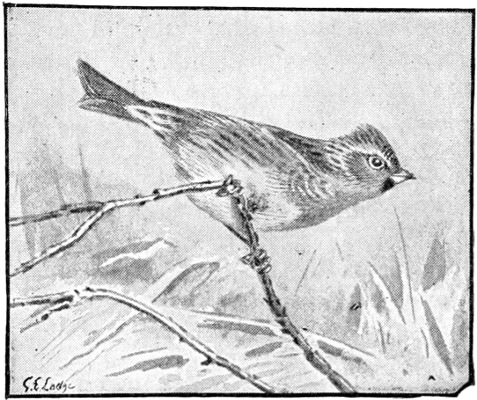
Fig. 48.—Lesser Redpoll. ⅓ natural size.
The redpoll, or redpole, as it is often written, is a pretty and interesting little bird of the northern parts of Great Britain. It has been described by Seebohm as an immature linnet in appearance, but resembling a siskin in its habits. It is usually called the lesser redpoll, because it is slightly less in size than the continental redpoll, which sometimes visits this country in winter. This last subspecies is the mealy redpoll (Linota linaria). A third form of this wide-ranging little bird, the Greenland redpoll (Linota hornemanni), has been included in the list of British birds on account of a single specimen having been obtained in this country.
In its lively disposition, its flight, and to some extent in its language, the redpoll resembles the linnet; but its feeding habits vary according to the season of the year and the conditions it finds itself in. In summer it keeps much to the higher branches of the trees, where it moves deftly about like a siskin or a crested tit in its search after minute insects and their larvæ; but in winter it feeds principally on seeds which it finds on the ground. It is fond of the seeds of the birch-tree. The appearance of a flock of redpolls feeding among the birches is thus described by Warde Fowler: ‘It is one of the prettiest sights that our whole calendar of bird life affords to watch these tiny linnets at work in the delicate birch-boughs. They fear no human being, and can be approached within a very few yards. They almost outdo the titmice in the amazing variety of their postures. They prefer in a general way to be upside down, and decidedly object to the commonplace attitudes of more solidly built birds.’
The song of the redpoll is described by Seebohm as a short, monotonous trill, clear, shrill, and not unmusical; and he adds that ‘it might be said to resemble the rattling of loose cog-wheels.’ It breeds in suitable localities, chiefly in birch-woods in Scotland, and in England north of Norfolk and Leicester. It also breeds occasionally in more southern localities. The nest is made of dry grass and moss on a foundation of slender twigs, and is well lined with vegetable down, or with wool and feathers. It is a very neat, cup-shaped nest, and contains four to six eggs, greenish blue in ground-colour, with spots and specks of purplish brown.
After the breeding season the redpolls begin to scatter about the country in small flocks; as autumn approaches these flocks increase in size, and a southward movement begins, large numbers crossing the Channel. Many, however, remain to winter at home, and these may be met with in woods and plantations, leading a vagrant life in small flocks, and often associating on the trees with titmice, goldcrests, and siskins.
Twite. Linota flavirostris.
Upper parts dark brown, the feathers edged with light brown; rump (of the male) tinged with red; throat tawny brown; breast and belly dull white, streaked on the flanks with dark brown; beak yellow; feet dark brown. Length, five and a quarter inches.
The twite, or mountain-linnet, is a bird of the mountain and moorland, and of the north, being most abundant in the Hebrides; but it also breeds in hilly districts throughout Scotland, and in suitable localities in the northern and midland counties. In the south it is a winter visitor, and is then found associating with the linnet, which it very closely resembles in flight, habits, and appearance; when near it may be distinguished by its shriller voice, and by its longer tail, which makes it look slimmer. In its song, too, the twite resembles the linnet, and, like that bird, occasionally sings on the wing; but its music is wanting in the finer sounds—just as its plumage is without the lovely carmine tint—of the other species.
The nest is placed in a bunch of heather, or beneath it, on the ground, and sometimes in a furze-bush. It is made of dry grass, moss, and wool, lined with hair and fur. The eggs are five or six in number, and are like the linnet’s in colour.
In autumn the twites unite in large flocks, and visit the stubbles and ploughed lands.
Bullfinch. Pyrrhula europæa
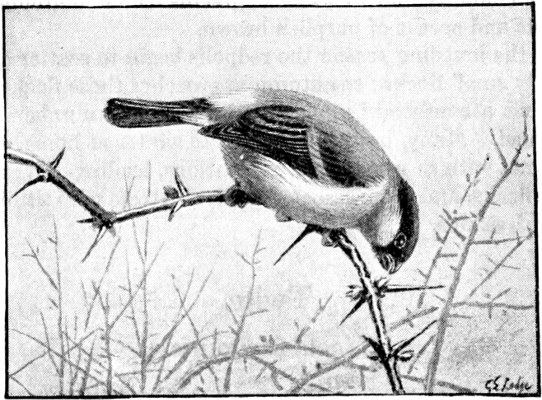
Fig. 49.—Bullfinch. ⅓ natural size.
Crown, throat, region round the beak, wings, and tail lustrous purple-black; upper part of the back bluish ash; ear-coverts, sides of the neck, breast, and belly red; lower tail-coverts dull white; a broad buff and grey band across the wing. Length, six and a quarter inches.
The bullfinch stands out among British finches with a strange distinctness. He is gaily coloured, and the arrangement of colours is a striking one—glossy black, blue-grey, and pure white above, and a fine red beneath. This is described in the books as ‘brickred’; and there is no doubt that, among the thousand and more shades of the less vivid red seen in bricks taken fresh from the kiln, the exact tint of the bullfinch might be matched. In the same way you could match the most delicate floral red—that which we see in the spikes of the red horse-chestnut, and the almond blossom, and the briar rose. The earthy, uniform red of weathered bricks is not the colour of our bird. The beauty of such a tint as that of the bullfinch can be best appreciated where, indeed, it is most commonly seen, amidst the verdure of clustering leaves; for greens and reds, pleasing in themselves, ever make the most agreeable contrasts among colours.
In its figure, too, this bird is very singular among the finches: his curiously arched beak gives him the look of a diminutive hawk in a gay plumage.
The bullfinch is greatly persecuted by gardeners on account of the mischief he is supposed to do, for he has the habit of feeding on the flower-buds of fruit-trees in winter and spring. On the other hand, he is greatly esteemed as a cage-bird, and the bird-catchers are ever on the watch for it. But the effect in both cases is pretty much the same, since the hatred that slays and the love that makes captive are equally disastrous to the species. There is no doubt that it is diminishing in this country, and that it is now a rare bird in most districts. Fortunately, it has a wide distribution in Great Britain: in Ireland, where it is said to be rare, I have found it not uncommon, and tamer than in England. It may be increasing there, which would not be strange in a country where even the magpie is permitted to exist, and birds generally are regarded with kindlier feelings than in this country.
The bullfinch does not often go to the ground to feed; he gets most of his food on trees and bushes—insects, buds, fruit, and seeds of various kinds. He inhabits woods, plantations, and thickets, and is often seen in thick hedges and in the tangled vegetation growing by the side of streams. Where he is not persecuted he is a tame and rather sedentary bird, and will allow a person to approach within a dozen yards before leaving his perch. His call and alarm note is a low, piping, musical sound, very pleasant to hear. The male sings in the spring, and so, it is said, does the female; but his strain is short, and so feeble that it can be heard only at a distance of a few yards.
The nest is built during the last half of April in a holly or yew, or other dense, dark bush or tree, or in a thick hedge. It is unlike the nest of any other finch, being outwardly a platform-shaped structure made of interwoven twigs, with a cup-shaped nest in the centre, formed of fine rootlets, the rim of the cup projecting above the platform it is built on. The eggs are four to six, greenish blue in ground-colour, spotted and sometimes streaked with dark purplish brown, and blotched with pinkish brown.
Bullfinches pair for life, and at all seasons of the year male and female are seen together; if any young are reared, they usually remain in company with the parent birds during the autumn and winter months.
Nearly allied to the common bullfinch are two beautiful birds which have a place in our list of species. One of these is the rosy bullfinch (Carpodacus erythrinus), of which two or three stragglers have been found in England; it breeds in Finland, and is found throughout the Russian Empire. The other is the pine grossbeak (Pinicola (enucleator), also a rare straggler to Britain from the north of Europe.
Crossbill. Loxia curvirostra.
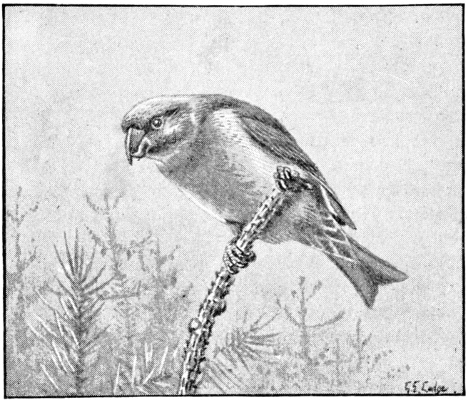
Fig. 50.—Crossbill. ¼ natural size.
Wing and tail feathers brown; all other parts green, yellow, orange, and tile-red, according to age and sex. Red is the colour of the adult male in a state of nature, and yellow in captivity. Length, six inches and a half.
The crossbills differ from all other birds in the extraordinary form of the parrot-like bill. In other birds, whatever the shape of the bill may be, straight or curved, or broad and flat, or conical, or hooked, the two mandibles correspond, and fit when closed like box and lid. In this bird both mandibles have prolonged curved points, and cross each other, much as the two forefingers of our hands cross when the fingers are loosely linked together. A full description of this form of beak and its use as a seed-extractor, together with an admirably written history of the common crossbill, is contained in the second volume of Yarrell’s great work (fourth edition).
The crossbill is also remarkable on account of the changes of colour it undergoes and of the brightness of its colours. These are birds of the sombre pine-woods, inhabiting high latitudes; but in their various greens and reds and yellows they are like tanagers and other tropical families, and form an exception to the rule that birds of brilliant plumage are restricted to regions of brilliant sunlight.
No fewer than four species of this genus (Loxia) figure in the list of British birds; three of these may be dismissed in a few words:—
Parrot crossbill (Loxia pittyopsittacus) breeds in the pine-forests of Scandinavia and northern Russia, and is known in England as a rare straggler. It is scarcely distinct, specifically, from the common crossbill.
White-winged crossbill (Loxia leucoptera), a North American species, once obtained in England.
Two-barred crossbill (Loxia bifasciata) a Siberian species; a rare straggler to England and Ireland.
The fourth species (the common crossbill) has a better title to figure as a British species, and its winter visits to this country are much more frequent, although irregular; and it also breeds with us in some localities in Scotland, probably every year, and has also bred intermittingly in many districts in England, even so far south as Bournemouth. The reason of its irregularity in visiting our shores is that the crossbill is one of those species that do not go farther from home than they are compelled by severe cold and scarcity of food. Driven from home they become ‘gipsy migrants,’ and may be very abundant with us one year, and not one appear the following season, or for several seasons. At all times of the year the crossbill is gregarious in its habits. Throughout the summer it is seen in small parties; when the breeding season is over these begin to move about, accompanied by the young birds, and join with other parties, and as the season progresses the flock grows by process of accretion until it may number many hundreds. At this season they are remarkably tame, and will allow a person to approach within a few yards and admire their colours and various motions as they cling to and climb, parrot-like, about the twigs in search of seed and fruit. When flying they call to each other with a loud shrill note, and in late winter and spring both male and female utter a low warbling song.
The nest is placed in a pine-tree, at a distance from the ground of from five to forty feet; it is formed outwardly of twigs, roots, and dry grass; the inner part, of wool, hair, and feathers. Four or five eggs are laid, white or greenish white in ground-colour, spotted with reddish brown, with under-markings of pale brown.
Corn-Bunting. Emberiza miliaria.
Upper parts yellowish brown with dusky spots; under parts yellowish white spotted and streaked with dusky. Length, seven and a half inches.
The present species is the largest of our five buntings, and is the most generally diffused throughout the British Islands. It is often called the common bunting, but is scarcely deserving of the name, as in most places it is less common than the yellow bunting. It is certainly more local than that bird, although in some localities, both in the south and north of England, it is more numerous than any other bird of its genus. Nor is its other name of corn-bunting more strictly accurate, for though it is a frequenter of corn-fields in spring and summer, it is equally partial to hay-meadows, commons, and other open places. Like the skylark, it loves an open sky and a wide horizon; but, not being able to soar, it seeks an elevation of some kind to perch on—a hedge-top, or the summit of a bush, or a tall weed in the middle of a field of corn, will serve it; but, best of all, it loves a telegraph-wire, where it sits on high above the world, in sunshine and wind, and without the slightest exertion is able to experience agreeable sensations like those of the kestrel, lark, or tern, when suspended motionless in mid-air. On a telegraph-wire it will sit contentedly by the hour, delivering its song at regular intervals.
The buntings—all those included in the genus Emberiza—differ from other finches in their more sedentary habits and heavier motions. The present species is the heaviest and most sedentary of all, and on this account, and also on account of its dull plumage, and because its voice is not melodious, it has been usually described in somewhat depreciatory terms. Yarrell speaks of its droning, harsh, unmusical song; and Warde Fowler thus describes it in his delightful book, ‘A Year with the Birds’: ‘Look at the common corn-bunting, as he sits on the wires or the hedge-top: he is lumpy, loose-feathered, spiritless, and flies off with his legs hanging down, and without a trace of agility or vivacity; he is a dull bird, and seems to know it. Even his voice is half-hearted, and reminds me often of an old man in our village who used to tell us that he had a wheezing in his pipes.’ This is a pretty description; but it makes the homely bunting a little too homely, and the critical remarks on its singing are not quite satisfactory: the song is not droning, and not half-hearted. Heard at intervals in the open, sunny fields and pasture-lands, it somehow has a pleasant effect. It is a peculiar sound, not easily describable. The song begins with two or three vigorous and musical chirps, then all at once the bird seems to lose himself as a musician, and throws out all that remains of his song in a burst of confused sound. In character it is somewhat like the sharp note of alarm, or excitement of some kind, often uttered in spring by the skylark as he flies low above the field, but is sharper and more prolonged. Robert Gray wrote: ‘It puts you in mind of the jingling of a chain or the sound of breaking glass.’ It is certainly like breaking glass. You can imitate it by tightly pressing a handful of polished pebbles together, which produce, as they slide over each other, a variety of sharp and scraping sounds. It is a peculiarity of the song that it is like several sounds emitted simultaneously, as of a note broken up into splinters, or issuing from a bundle of minute windpipes instead of out of one of larger size.
Of all the birds that remain with us throughout the year, the bunting is the latest to breed, the nest being usually built in May. It is placed among grass and herbage close to the ground, and formed of dry grass and fibrous roots, lined with horsehair and fine fibres. Four to six eggs are laid, dull purplish white or pale yellowish in ground-colour, blotched and streaked with dark brown, with some patches of a dull lavender hue.
The bunting feeds on seeds and grain and insects. In autumn it becomes gregarious, and visits the stubbles and rickyards, where it is seen associating with sparrows, greenfinches, and chaffinches.
Yellowhammer. Emberiza citrinella.
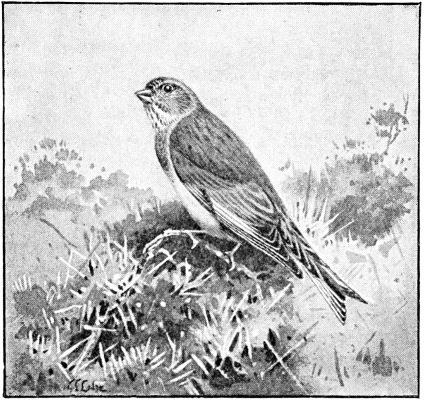
Fig. 51.—YELLOWHAMMER. ⅓ natural size.
Head, neck, breast, and under parts bright yellow, more or less streaked with dusky; flanks streaked with brownish red; upper parts reddish brown spotted with dusky. Female: the yellow parts less bright, and spotted with dull reddish brown. Length, six and a quarter inches.
The yellowhammer, or yellow bunting, is one of the most generally diffused species in the British Islands, and, on account of its habit of always perching on the summit of a bush or other elevation, and of its bright yellow head and neck, which make it conspicuous at a distance, it is a familiar object to every person in the rural districts. It differs from the corn-bunting both in a brighter colouring and in a slimmer and more graceful figure. But it is a heavy bird nevertheless, of a sedentary disposition, and during the warm season spends a great portion of its time in sitting upright and motionless on its perch, uttering its song at regular intervals.
This species affects rough commons and waste lands in preference to fields, and where he is found you may hear his song at all times of the day, even during the sultriest hours; for although the yellowhammer remains with us throughout the year, and is able to resist the colds of winter, he is a great lover of heat. The song is very different from that of the species last described: it is composed of half a dozen or more short, reedy notes, all exactly alike, and shaken out, as it were, in a hurry, followed by a long, thin note, or by two notes, slightly melodious in character. It may be described as a trivial and monotonous song, but it is a summer sound which most people hear with pleasure, and the yellowhammer, or ‘little-bit-of-bread-and-no-c-h-e-e-s-e,’ as it is called in imitation of its note, is something of a favourite with country-people. The rustics have a story about the origin of the bread-and-no-cheese name, which they think very laughable; and one is certainly very much amused at the manner in which it is usually told. This is ponderous and slow, and strikes one as highly incongruous, the subject being only a childish legend about a little bird.
According to Yarrell, the Scotch peasants have some curious superstitions about the yellow yoldring, as they call it. To them its song sounds like the words ‘Deil, deil, deil tak ye,’ and the bird itself is supposed to be on very familiar terms with the evil being whose name it invokes so freely, and who supplies it on a May morning with a drop of his own blood with which to paint its curiously marked eggs.
About the middle of April the yellowhammer builds its nest, on or above the ground, among furze and bramble bushes, or at the roots of a hedge, or in a bank among grass and nettles. The nest is large but neatly made, outwardly of dry grass, stalks, roots, and moss, the inside being lined with fibres and horsehair. The eggs are four or five in number, purplish white in ground-colour, streaked and veined with deep reddish purple, with violet-grey under-markings.
The young males acquire the bright yellow head of the adult bird at the autumn moult.
Although this bird remains with us throughout the year, it has a partial migration. In autumn and winter it is seen in small flocks, often feeding in company with the common bunting and other finches. In winter its food consists principally of seeds; in summer it subsists largely, and feeds its young exclusively, on insects.
Cirl Bunting. Emberiza cirlus.
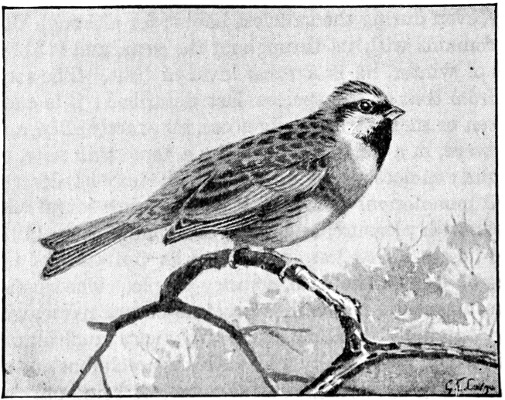
Fig. 52.—Cirl Bunting. ⅓ natural size.
Crown olive streaked with black; throat, neck, and band across the eye black; gorget and band above and below the eye bright yellow; breast olive-grey, bounded at the sides by chestnut; belly dull yellow; back brownish red with dusky spots. Female: the distinct patches of black and yellow wanting; the dusky spots on the back larger. Length, six and a half inches.
This bird, in its dress of many colours—chestnut-brown, olive, black and white, and lemon-yellow—is the handsomest of the British buntings. It is an uncommon species, being restricted to the southern and western counties of England, and exceedingly local in its distribution. It is, moreover, of a shy disposition, and hides from sight in tall trees; consequently it is seldom seen, and is known to few persons. It is resident all the year. Its winter movements, if it has any, are not known. The curious fact about this bunting is that its breeding-places, which form small isolated areas, chiefly on or near the south-western coast, remain year after year unchanged. The birds do not nest outside of the old limits, nor do they form fresh colonies in other suitable places.
Hedgerow-elms, and other large trees growing near fields, are favourite resorts of the cirl bunting, and the male takes his stand to sing on a tree-top, just as the yellowhammer does on a furze-bush or hedge-top. His song comes nearest in character to that of the species just named, being composed of several rapidly uttered, short notes, only brighter and more vigorous; but the song is without the long, thin note with which the more common species ends his slight strain. In its nesting habits and in the colour of its eggs it is like the yellowhammer, but its young are fed almost wholly on young grasshoppers.
In summer the cirl bunting lives chiefly on insects, but in autumn and winter it is, like other finches, a seed-eater, and at this season unites in small flocks, and occasionally associates with birds of other species
Reed-Bunting. Emberiza schœniclus.
Head, throat, and gorget black (in winter speckled with light brown); nape, sides of the neck, and a line extending to the base of the beak white; upper parts variegated with reddish brown and dusky; under parts white streaked with dusky on the flanks. Female: head reddish brown with dusky spots; the white on the neck less distinct; under parts reddish white, with dusky spots. Length, six inches.
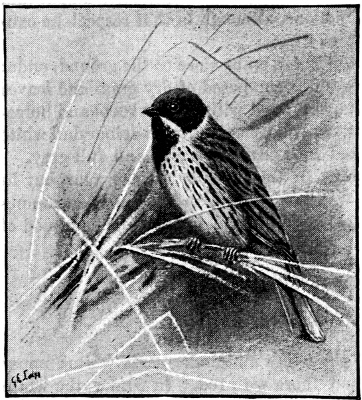
Fig. 53.—Reed-Bunting. ¼ natural size.
The reed-bunting, although by no means an uncommon bird, is not nearly so common as either the corn-bunting or yellowhammer. It is a bird of the waterside, and its spring and summer life is passed among the reeds and aquatic herbage and willows and alders growing on the margins of streams and marshes. It is widely distributed, and, where suitable localities exist, may be looked for with some confidence. In most districts it is known as the reed-sparrow, and in its colouring and general appearance it is undoubtedly more sparrow-like than the other buntings. From its black head, which is very conspicuous by contrast with the white collar, it is often called the black-headed bunting, a name which more properly belongs to a continental species to be noticed later on as an accidental visitor to this country. The male is a persistent singer in the spring months, and, perched near the top of a reed, or on the topmost branch of an alder tree, he will repeat at intervals his slight reedy song of four or five notes, the last somewhat prolonged. If disturbed, he will fly a little distance ahead and perch again; and this action he will repeat two or three times if followed up; then, doubling back, he will return to the first spot. He is a sprightlier bird than the other buntings. The slender reed-stems he perches on, which bend and sway beneath the slightest weight, have taught him easier and more graceful motions, although in that respect he cannot compare with the bearded tit.
The nest is made near the water, on or close to the ground, under a bush or bunch of rushes, and is composed of dry grass and leaves and stems of aquatic plants, and lined with fibrous roots and horsehair. The eggs are four or five in number, in ground-colour dull white or grey, spotted and streaked with purplish brown and dull grey.
The reed-bunting remains in this country all the year, but in severe weather leaves the wet, low ground, and is then seen among the flocks of mixed finches in fields and in the neighbourhood of farmhouses.
Snow-Bunting. Plectrophanes nivalis.
Head, neck, portion of the wings and under parts white; upper parts black, tinged here and there with red. In winter the white of the head and the black on the back mixed with reddish brown. Female: the white on the head and upper parts mottled with dusky, and her colours not so pure. Length, six inches and three-quarters.
The snow-bunting, or snowflake, as it is also called, breeds regularly in some localities in the Highlands of Scotland, and may therefore be regarded as an indigenous species; but the birds breeding within British limits are only a few pairs, and the snow-bunting is best known as a winter visitor from more northern regions. They appear on our coasts in the month of October, sometimes in immense flocks, to pass the winter, for the most part in the neighbourhood of the sea, seeking their food in fields and on waste lands. Occasionally these flocks penetrate to the more inland districts. Being very pretty and lively little birds, they are great favourites in the places they visit; and their appearance is all the more welcome on account of the desolate aspect of nature in the districts where they are most abundant. Many ornithologists have written lovingly about the snow-bunting. Thus, Saxby says: ‘Seen against a dark hillside or a lowering sky, a flock of these birds presents an exceedingly beautiful appearance, and it may then be seen how aptly the term “snowflake” has been applied to the species. I am acquainted with no more pleasing combination of sight and sound than that afforded when a cloud of these birds, backed by a dark grey sky, descends, as it were, in a shower to the ground, to the music of their own sweet, tinkling notes.’
The fullest, and by far the most interesting, account ever given of the snow-bunting is by Seebohm. He says that in its habits it is the most arctic of the small birds, breeding as far north as latitude 82° 33´. Its appearance is thus described: ‘In sledging over the snow across the steppes of South-western Siberia from Ekaterranburg to Tomsk, a distance of about a thousand miles, the snow-bunting was the only bird we saw, except a few sparrows, jackdaws, and hooded crows near the villages. The snow-buntings were in small flocks, and many of them had almost lost their winter dress. It was a charming sight to watch them flitting before the sledge, as we disturbed them at their meals. Sometimes, in the sunshine, their white bodies were invisible against the white snow, and we could almost fancy that a flock of black butterflies was dancing before us. The flight of the snow-bunting is peculiar, and is somewhat like that of a butterfly, as if the bird altered its mind every few seconds as to which direction it wished to take.’
Of its song he says: ‘Whilst the female is busy with the duties of incubation the male sings freely, sometimes as he sits upon the top of a rock, but often flinging himself into the air like a shuttlecock, and then descending in a spiral curve, with wings and tail expanded, singing all the time. The song is a low and melodious warbling, not unlike that of the shore-lark.’
The nest is placed in crevices of rocks, and is made of dry grass, roots, and moss, lined with root-fibres, hair, wool, and feathers. Five or six, sometimes seven, eggs are laid, in ground-colour greyish white or pale blue, spotted and blotched with reddish brown, with under-markings of pale brown and pale grey.
The young are fed on the larvæ of gnats. In winter the snow-buntings feed on seeds of grass and weeds.
Besides the five buntings described, five more species figure in the list of British birds, and these may now be briefly noticed:—
Black-headed bunting (Emberiza melanocephala), inhabiting South-eastern Europe; a single specimen has been obtained in this country.
Ortolan bunting (Emberiza hortulana).—A summer visitor to Europe. Several specimens have been obtained in the British Islands, mostly in the south and east of England.
Rustic bunting (Emberiza rustica).—Breeds in North-eastern Europe and Northern Siberia. A rare straggler to Britain.
Little bunting (Emberiza pusilla), from North-eastern Europe and Siberia. Has been taken once in England.
Lapland bunting (Calcarius lapponica).—A circumpolar species breeding in the arctic regions. Occasionally straggles to this country.
Starling. Sturnus vulgaris.
Black with purple and green reflections, the upper feathers tipped with pale buff; under tail-coverts edged with white; beak yellow; feet flesh-colour tinged with brown. Female: spotted below as well as above. Young: uniform ash-brown, unspotted. Length, eight and a half inches.
A compactly built bird with a short, square tail, strong legs and feet, and a long, sharp beak, the starling does not excel in beauty of figure or grace of carriage; his lines are rather indicative of strength; he looks what he is—a plodding digger in the meadows and pastures, a hardy bird of rook-like habits, able to stand all weathers. But he has a beautiful coat. As in the case of the large corvine species he so frequently associates with when feeding, his richly coloured plumage has a gloss which causes it to shine at times like polished metal in the sunlight. The starling has an added distinction in the spangling of white and buff on the upper parts.
During the greater portion of the year his food consists almost entirely of insects in their different stages. Like the rook, he searches at the roots of the grass for worms and grubs; and there is no doubt that he deserves his reputation of one of the farmer’s feathered helpers. He attends the sheep and cattle in the meadows, and is often seen perching on their backs; the animals take it quietly, and perhaps know that he is on the look-out for ticks, which are a source of irritation to them.
Although a digger and plodder, the starling is very different from his companion, the rook, in manner. The rooks are seen soberly marching about, quartering the ground, each one intent on finding something for himself. The starlings are not nearly so methodical; they run about a great deal on the feeding-ground, and watch and interfere with each other. When one by chance finds a rich treasure, the others are eager to share it, and there are occasional scolding matches, and sometimes downright quarrelling, among them.
The starling is also a fruit-eater, particularly of cherries; and in winter, when insect food is scarce, he will eat berries, seeds, and grain, and, like the blackbird and blue tit, may be easily attracted to the house with scraps of animal food.
The nesting habits of the starling contribute to make it one of our most familiar birds. He breeds in holes, and a hole in a tree or rock, in a cliff or quarry, suits him very well; but he more often finds a suitable place under the eaves of a house, or in a barn, or church-tower, or other building; and, unless disturbed, he will continue to use the same site year after year. As early as January the starlings begin to pay occasional visits to the breeding-site, but they do not build until April. The nest is composed of a large quantity of dry grass, small twigs, moss, and other materials, and is sometimes lined with wool or feathers. Four to seven eggs are laid—five being the usual number—of a delicate pale greenish blue colour, and unspotted.
The starling sings more or less all the year, but his song is at its best in the spring months. He has no such melodious notes as distinguish the warblers; his merit lies less in the quality of the sounds he utters than in their endless variety. In a leisurely way he will sometimes ramble on for an hour, whistling and warbling very agreeably, mingling his finer notes with chatterings and cluckings and squealings, and sounds as of snapping the fingers and of kissing, with many others quite indescribable. On account of this variety of language he has always been reputed a mimic; but he does not mock as the mocking-bird does: he never reproduces the song of any other songster. Notes and phrases, and calls and alarm-notes, he has apparently picked up, and, listening, you recognise this or that species; but the imitations are seldom perfect, and in the end you are almost inclined to believe that he is called a mimic only because his variety is so great.
After the breeding season the young and old birds feed together in the pastures, where they unite with other families; and the flocks thus formed, as they increase in size, extend their wanderings over the surrounding country. Like rooks, they have favourite roosting-places, to which they return annually; these are reed and osier beds, thickets of holly and other evergreens, and fir-plantations. But they are not so constant in their attachment to one locality as the rook. They are more vagrant in their habits, and shift their ground, and migrate, and their numbers may vary greatly from year to year in the same district. In a district where they are abundant, they are seen at the end of each day gathering from all directions to the roosting-place; and it is then that the ‘cloud of starlings’ may be seen at its best, and it is certainly one of the finest sights that bird life presents in England. At intervals, after the birds have been steadily pouring in their flocks for a couple of hours, the whole vast concourse rises, and, seen from a distance, the flock, composed of tens and hundreds of thousands, may then be easily mistaken for a long black cloud suspended above the wood. In a few moments it is seen to grow thin, as the flock scatters, until it almost fades away. Suddenly it darkens again; and so on, alternately, the form, too, changing continually, now extending to an immense length across the sky, like a long bar of vapour, and now gathered into a huge oval or oblong black mass; and by-and-by the cloud again empties itself into the trees, and the sky is clear once more. These evolutions are repeated many times, until, as the evening draws on, the birds finally settle down in their places, but not to sleep; for an hour longer the wood is filled with an indescribable noise—a tangle of ten thousand penetrative voices, all together whistling, chattering, scolding, and singing.
We have but one starling; an allied species, the beautiful rose-coloured pastor (Pastor roseus), which breeds in Western Asia, is an irregular visitor to all parts of England.
Chough. Pyrrhocorax graculus.
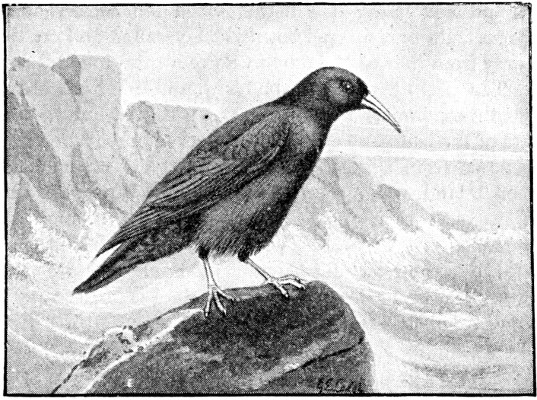
Fig. 54.—Chough. ⅛ natural size.
Black with purple and green reflections; beak and feet coral-red. Length, sixteen inches.
It is melancholy to think that this interesting and extremely handsome bird has been diminishing in numbers for a long period, and is now become so rare that, unless strong measures to secure its protection be at once taken, its eventual extinction in this country must be regarded as merely a question of time. Formerly it bred in many inland localities in England, Wales, Scotland and Ireland; but from all its ancient nesting-cliffs in the interior of these countries it has long vanished, and, like the raven, which has also fallen on evil days, is now only found in a few spots on the rock-bound coasts where high, precipitous cliffs afford it some chance of hatching its eggs and continuing the species for a few years longer.
A few pairs are still found breeding each year on the coast of Cornwall, where it was formerly abundant, and on this account was called the Cornish chough. It also breeds in limited numbers in a few other situations:—at Lundy Island, the rocks of the Calf of Man, on the coast of Wales, and at Islay and a few other situations on the coast of Scotland.
In size, flight, language, habits, and general appearance, the chough comes nearest to the jackdaw, but is a much handsomer bird, its uniform intense black plumage and long, curved, coral bill, and red legs and feet, giving it a distinguished and somewhat singular appearance. Its cry, uttered both when perched and on the wing, differs only from that of the daw in its more ringing and melodious sound. The flight is easy and buoyant, and the birds are fond of aërial pastimes, similar to those of the jackdaw, during which the members of the company pursue one another in play, and frequently tumble down from a great height through the air as if disabled. They feed inland, often going long distances from the cliffs they inhabit to seek their food, like rooks, in the meadows and pasture-lands. They also follow the plough to pick up the worms and grubs, like the rook and black-headed gull, and are said to eat carrion, berries, and grain. On the sands and rocks they feed on the animal refuse left by the tides.
The chough, like the daw, lives always in communities; the two species may often be found breeding near each other and associating in flocks. The nest is placed in a hole or crevice in the rocks in the least accessible part of the cliff. It is built of sticks and twigs, and lined with grass, fur, wool, and other soft substances. Four to six eggs are laid, in ground-colour white, faintly tinged with blue or yellowish, and spotted and blotched with various shades of grey and pale brown.
Jay. Garrulus glandarius.
Crest greyish white streaked with black; a black moustache from the corners of the beak; general plumage reddish grey, darker above; primaries dingy black; secondaries velvet-black and pure white; inner tertials rich chestnut; winglet and greater coverts barred with black, white, and bright blue; upper and under-tail-coverts pure white; iris bright blue; beak black; feet dark brown. Length, thirteen and a half inches.
The jay is nearly equal to the daw in size, and has a variegated and beautiful plumage, and when seen flying across an open sunlit space is nearly as conspicuous as a magpie. But among the dense foliage of the woods and thickets he inhabits it is as difficult to see a jay as a wood-wren; and it is doubtless owing to this fact, and to his extreme wariness and cunning, that he still survives in many parts of England where the magpie has now been extirpated, although both species are pursued by gamekeepers with the same stupid and deadly animosity. In Scotland he is said to be decreasing more rapidly than in England, probably because the Scotch are more thorough than the Southrons, especially in the process of stamping out: in Ireland it is found only in the southern half of the island, where it is somewhat scarce.
The most striking characteristic of the jay is its tireless energy, and a liveliness of disposition and alertness almost without a parallel among British birds; even the restless, prying, chattering magpie seems a quiet creature beside it; and as to the other corvine birds, they are by comparison a sedate family. Like the magpie, he is an excitable and vociferous bird, and has a curious and varied language. When disturbed in his woodland haunts he utters a scream that startles the hearer, so loud and harsh and piercing is it. Richard Jefferies well describes it as being like the sound made in tearing a piece of calico. He also has a lower, monotonous, rasping note, which he will continue uttering for half an hour at a time when his curiosity or suspicion has been excited. In the love season he utters a variety of sounds by way of song, and as they resemble the notes of the starling, sparrow, and other birds, he is supposed to be a mocker. In captivity he can be taught to speak a few words; but it is possible that the various sounds composing his vocal performance in the woods are his own.
In spring he becomes somewhat social, and unites in noisy parties; at other times he is solitary, or lives with his mate.
Owing to an excessively wary and suspicious habit, engendered by much persecution, it is difficult to observe him narrowly for any length of time. In the woods and plantations, few and far between, where jays are not persecuted, and do not associate the human figure with a sudden shower of murderous pellets, he will allow a nearer approach, and it is then a rare pleasure to study him on his perch. He does not, as a rule, rest long in one place, and when perched is of so active and excitable a temper that he cannot keep still for three seconds at a stretch. The wings and tail are raised, and depressed, and flirted, the crest alternately lowered and elevated, the head turned from side to side, as the wild, bright eyes glance in this or that direction. If he should by chance place himself where a stray sunbeam falls through the foliage on him, lighting up his fine reddish brown plumage, variegated with black and white and beautiful blue, he shows as one of the handsomest birds that inhabit the woodlands.
The jay makes his nest in a bush or sapling at no great height from the ground; the lower branch of a large tree is sometimes made choice of, where the nest is well concealed by the close foliage; a thick holly or other evergreen is also a favourite site. The nest is built of sticks and twigs, sometimes mixed with mud, and the cup-shaped cavity is lined with fine roots. Four to seven eggs are laid, pale greyish green in ground-colour, thickly freckled, and spotted all over with pale olive-brown. The young birds follow their parents for some weeks after leaving the nest.
The jay is omnivorous, but in summer feeds mainly on slugs, worms, grubs, and insects of all kinds; in this season he devours berries and fruit—plums, cherries, also peas and currants; and in autumn, nuts, beech-mast, and acorns. He also plunders the smaller birds of their eggs and young, and is said to carry off pheasant and partridge chicks. He is a keen mouser, and after killing a mouse with two or three sharp blows on the head, strips the skin off before devouring it. Like the nuthatch and some other species, he has the habit of concealing the food he does not want to eat at once.
Magpie. Pica rustica.
Head, throat, neck, and back velvet-black; scapulars and under plumage white; tail much graduated, and, as well as the wings, black, with lustrous blue and green reflections; beak and feet black. Length, eighteen inches.
In spite of his evil reputation, the magpie is regarded by most persons who are not breeders of pheasants with exceptional interest, and even affection. He has some very attractive qualities, and is one of that trio of corvine birds—pie, chough, and jay—from which it is difficult to single out the most beautiful. The most conspicuous he undoubtedly is, in his black and white plumage; and his figure, with its long, graduated tail, is also the most elegant. In his habits there is abundant variety, and in sagacity he is probably unsurpassed by any member of the corvine family, which counts so many wily brains. His excessive cunning and rapid rate of increase have probably served to save him from the fate that has overtaken the hen harrier and marsh-harrier, and many another beautiful member of the British avifauna. As it is, he has been almost extirpated throughout a large part of England and Scotland. In Ireland, however, he is still a common species, but, oddly enough, he is not indigenous to that country. It is believed that he first appeared there about, or a little more than, two centuries and a half ago. How he got there is not known. According to Yarrell, there is a widespread belief in Ireland that the magpie was imported into that island by the English out of spite.
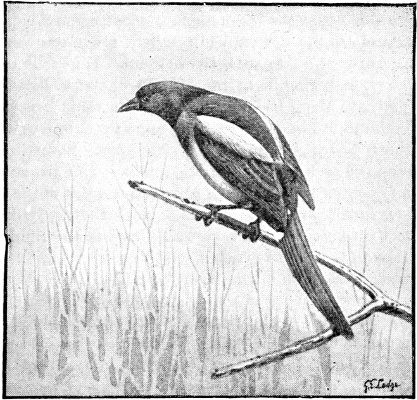
Fig. 55.—Magpie. ⅑ natural size.
The magpie is as singular in his motions, gestures, and flight as he is beautiful in colour and elegant in form. On the wing he appears most conspicuous when the white webs of the quills are displayed. The wings are very short, and the flight is slow and somewhat wavering, and at every three or four yards there is an interval of violent wing-beats, during which the black and white of the quills mix and become nearly grey. High in the air he has a most curious appearance; as a rule he flies low, passing from tree to tree, or along the side of a hedge. He seeks his food on the ground, and his movements are then utterly unlike those of any other ground-feeder. His manner of running and hopping about, flinging up his tail; his antics and little, excited dashes, now to this side, now to that, give the idea that he is amusing himself with some solitary game rather than seeking food. Richard Jefferies has given so accurate and vivid a picture of the bird in his ‘Wild Life in a Southern County’ that I cannot refrain from quoting it in this place. ‘To this hedge the hill-magpie comes; some magpies seem to keep entirely to the downs, while others range the vale, though there is no apparent difference between them. His peculiar uneven, and, so to say, flickering flight marks him out at a distance, as he jauntily journeys along beside the slope. He visits every fir-copse and beech-clump in his way, spending some time, too, in and about the hawthorn hedge, which is a favourite spot. Sometimes in the spring, when the corn is yet short and green, if you glance carefully through an opening in the bushes, or round the side of the gateway, you may see him busy on the ground. His rather excitable nature betrays itself in every motion: he walks, now to the right a couple of yards, now to the left in quick zigzag, so working across the field towards you; then, with a long rush, he makes a lengthy traverse at the top of his speed; turns, and darts away again at right angles; and presently up goes his tail, and he throws his head down with a jerk of the whole body, as if he would thrust his beak deep into the earth. This habit of searching the field, apparently for some favourite grub, is evidence in his favour that he is not so entirely guilty as he has been represented of innocent blood. No bird could be approached in that way. All is done in a jerky, nervous manner. As he turns sideways, the white feathers show with a flash above the green corn; another moment, and he looks all black.’
In disposition the magpie is restless, inquisitive, excitable, and loquacious. Where he is greatly persecuted by gamekeepers—as, indeed, is the case almost everywhere in England—he grows so wary that, in spite of his conspicuous colouring, it would be almost impossible to get a glimpse of him, were it not for his outbursts of irrepressible excitement and garrulity. The sight of a stoat, fox, or prowling cat will instantly cause him to forget the more dangerous keeper and his gun, and to fill the coppice with cries of alarm. The feathered inhabitants of the wood hurry from all sides to ascertain the cause of the outcry, and assist in driving out the intruder. But the keeper, too, hears; this is the opportunity he has been long watching and waiting for; and if he approaches the scene of excitement with due caution, poor beautiful Mag, dead, and shattered with shot, will soon be added to his festering trophies.
The usual sound emitted by the magpie is an excited chatter—a note with a hard, percussive sound, rapidly repeated half a dozen times. It may be compared to the sound of a wooden rattle, or to the bleating of a goat; but there is always a certain resemblance to the human voice in it, especially when the birds are unalarmed, and converse with one another in subdued tones. But it is more like the guttural voice of the negro than the white man’s voice. Their subdued chatter has sometimes produced in me the idea that I was listening to the low talking and laughing of a couple of negroes lying on their backs somewhere near. It is well known that this bird can be taught to articulate a few words.
The magpie is a notable architect, and as a rule builds his nest in a tall tree in or on the borders of a wood; sometimes in a low, isolated tree or large bush, or in the centre of a thick hedge. It is large, and formed of sticks and mud, with a hollow in the centre, plastered with mud and lined with fibrous roots; over this solid platform and nest a large dome of loosely interwoven thorny sticks is built, with a hole in the side just large enough to admit the bird.
Magpies pair for life, and the nest may serve the birds for several years, a little repairing work being bestowed on it each spring. The eggs are usually six in number, but in some cases as many as nine are laid. In colour they are pale bluish green, very thickly spotted and freckled with olive-brown, and faintly blotched with ash-colour.
The magpie may be easily tamed; even the wild birds, when not persecuted, become strongly familiar with man, and come about the house like fowls. In a state of nature he subsists on grubs, worms, snails, slugs, and various insects, and will eat any kind of animal food that offers, not excepting carrion; he also devours young birds and eggs, and is fond of ripe fruit. He is supposed to be a deadly enemy of the poultry-yard, and a stealer of pheasant and partridge chicks; but it is certain that his depredations have been greatly exaggerated.
Jackdaw. Corvus monedula.
Crown and upper parts black with violet reflections; back of the head and nape grey; iris white; under parts dull black. Length, fourteen inches.
It is hard to pronounce which of our indigenous corvine species is the most interesting. They are all wonderful birds; and to those who have made pets of, and studied them, and know them intimately as most of us know our dogs, they appear to excel other feathered creatures in the quality of mind, just as thrushes, larks, and warblers do in that of melody, and as terns and others of the more aërial kinds excel in graceful motions. If the jackdaw is not the first of his family in intelligence, he is certainly not behind any of them. In beauty he does not compete with the three species already described—chough, jay, and pie—and at a distance is only a lesser rook or carrion crow in appearance; but there is a peculiar look about this bird when seen closely that engages and holds the attention more than mere beauty or grace. When he is sitting in repose, his head drawn in and beak inclining downwards, and turns his face to you, it does not look quite like a bird’s face: the feathers puffed out all round make the head appear preternaturally large, and the two small, bright, whitish grey eyes set close together in the middle have an expression of craft that is somewhat human and a little uncanny.
The jackdaw is one of the birds that the gamekeeper wars against without ruth, shooting and trapping them in the breeding season, especially when they are occupied in feeding their young, and can be seen and easily shot in their frequent journeys to and from the nesting-tree. But the jackdaw is not so easy to extirpate as some of its congeners. He is probably just as common as he ever was, while the chough is rapidly dying out, and crow and jay and pie are yearly diminishing in numbers, and the raven, driven from its inland haunts, clings to existence in the wildest and most inaccessible parts of the coast. The reason of this is that the jackdaw is more adaptive than the other species. He has been compared in this respect to the house-sparrow, for he can exist in town as well as country, and readily adapts himself to new surroundings. The variety of sites he uses for breeding purposes shows how plastic are his habits. He breeds apart from his fellows, like the carrion crow; or in communities, like the rook and chough. He builds in hollow trees in parks and woods, in rabbit-burrows, in ruins, church-towers, and buildings of all kinds; and in holes and crevices in cliffs, whether inland or facing the sea, where he lives in company with the rock-pigeon and the puffin. ‘At Flamborough,’ Seebohm says, ‘the jackdaws are very abundant. A republican might call them the aristocracy of the cliffs. Like the modern noble, or the monks of the Middle Ages, they contrive to eat the fat of the land without any ostensible means of living. They apparently claim an hereditary right in the cliffs; for they catch no fish, and do no work, but levy blackmail on the silly guillemots, stealing the fish which the male has brought to the ledges for the female, upsetting the egg of some unfortunate bird who has left it for a short time, and devouring as much of its contents as they can get hold of, when the egg is broken, on some ledge of rock or in the sea.’
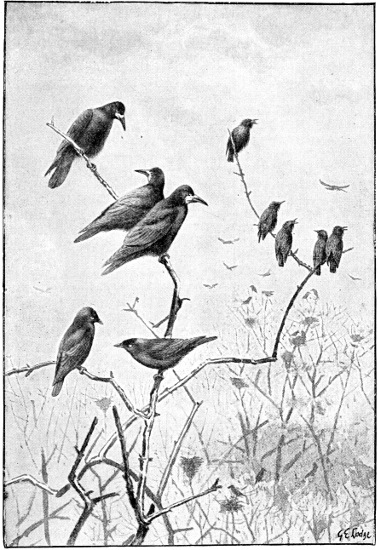
Rooks. Jackdaws. Starlings.
The social disposition of the jackdaw, and its friendliness towards other species of its family, is no doubt favourable in the long run to it; for by mixing with the rooks, both when feeding and roosting, he comes in for a share of the protection extended to that bird in most districts. There is also a sentiment favourable to the jackdaw on account of its partiality for churches and castles: the ‘ecclesiastical’ daws are safe and fearless of man while soaring and playing round the sacred buildings in villages and towns; when they go abroad to forage, and are not with the rooks, there is danger for them, and they are, accordingly, wary and shy of man.
At all seasons the jackdaw loves to consort with his fellows, and to spend a portion of each day in aërial games and exercises: the birds circle about in the air, pursuing and playfully buffeting one another, and tumbling downwards, often from a great height, only to mount aloft again, to renew the mock chase and battle and downward fall. They are loquacious birds, and frequently call loudly to one another, both when perched and when flying; the usual call-note has a clear, sharp, querulous sound, something like the yelping bark of a small dog.
The nest is a rude structure made with sticks, dry grass, leaves, wool, and other materials heaped together, and is large or small according to the situation; when in a church-tower or hollow tree an enormous quantity of material is sometimes used to fill up the cavity. The eggs are four to six in number, and vary much in size, shape, and markings. They are very pale blue, varying to greenish blue, in ground-colour, and are spotted and blotched with blackish brown and olive-brown, with pinkish grey under-markings.
The jackdaw is omnivorous, but subsists principally on worms, grubs, and insects, which it picks up in the pastures where it feeds in company with rooks and starlings. In spring it will eat the newly sown grain, in autumn devours acorns and beech-mast, and in winter will stoop to carrion.
In captivity the jackdaw makes a clever and amusing pet, and may be taught to repeat a few words.
Carrion Crow. Corvus corone.
Black with green and violet reflections; iris dark hazel; lower part of the beak covered with bristly feathers. Length, nineteen inches.
The common, black, or carrion crow so closely resembles the rook in form, size, and colouring as to be indistinguishable from it when seen at a distance. Viewed nearer it is seen to have the base of the beak clothed with feathers, instead of naked and grey, as is the case in the more common bird. The young rook may, however, be mistaken for a crow even when very near, as its face is feathered like the crow’s. In voice the two birds differ, that of the crow being louder and very much harsher—more like the raven’s croak than the familiar hoarse, but not disagreeable, caw of the rook. In summer he may be identified by his solitary habits. He has a very much worse reputation than the species he so nearly resembles: both game-preserver and farmer regard him as a pest, and he is said to be the most persecuted bird in this country. But somehow, in spite of all that is done to extirpate him utterly, he manages to keep a pretty strong hold on life, although he is not common. He inhabits all of the British Islands, chiefly England and Wales; in the central and northern parts of Scotland, and in Ireland, he is rarely met with, his place in those countries being taken by the hooded crow. When not engaged in breeding the crow is to some extent gregarious, and is also social, associating both in the fields and at roosting-time with rooks and jackdaws. And it is probable that this habit has been of great advantage to him, and may even have saved the species from extermination, for while among the rooks he easily passes for a rook. That he is exceptionally sagacious, and very careful to keep out of reach of his deadly human enemies, goes without saying; he is a member of a family ranking high in intelligence; and being so large and conspicuous a bird, his life is one of incessant danger. In selecting a site for his nest his intelligence is sometimes at fault. Not only is the nest a large structure, but, with a strange fatuity, the bird will at times build in a conspicuous place near a house. On the coast he is, like the raven and jackdaw, a nester in cliffs; inland he usually builds in or on a large tree, and if the nest is allowed to remain he will use it for several years. The nest is a large platform, made of sticks, weeds, pieces of turf, and other materials, with a hollow in the centre neatly lined with fine grass, wool, hairs, and feathers. The eggs are four to six in number, in ground-colour pale bluish green, spotted and blotched with various shades of olive-brown, with purplish grey underlying blotches.