CLASSIFICATION. (continued 7)
Reading edition
In spring—early in April as a rule—the curlews begin to forsake their feeding-grounds on the sandbanks and go inland to breed; but some unpaired or non-breeding birds remain through the summer by the sea. Wild extensive moors are its favourite summer haunts. ‘Its breeding-range,’ Seebohm says, ‘is similar to that of the red grouse and ring-ouzel.’ Its nesting-place, as a rule, is on the flat and boggy parts of the moor, and the nest is not unfrequently placed among reeds or rushes. The three or four eggs are olive-green, blotched and spotted with dark brown and dusky green. The young birds when hatched have short, straight, plover-like bills.
The family Scolopacidæ, which comprises the phalaropes, avocet, snipes, sandpipers, godwits, the curlew, and whimbrel, numbers thirty-four (so-called) British species. Eighteen have been fully described, including the ruff, now extinct as a breeder, and fallen to the position of a mere straggler in this country. The ruff is one of three interesting and handsome species in this family of birds which have been extirpated in England during the present century. Another is the avocet (Recurvirostra avocetta), a singular wader, conspicuous and beautiful in black and white plumage, with a long bill, curved upwards. It bred in large numbers in fens and marshes in the eastern countries; but since about 1825, when it finally ceased to visit its old haunts in summer, it has been known only as a rare straggler. The third extirpated species is the fine black-tailed godwit (Limosa melanura), which bred annually in Norfolk and the neighbouring county until about 1835. It is now a visitor on migration, in very small numbers, to the east coast. The bar-tailed godwit, which has never bred in the British Islands, also appears occasionally in small numbers during migration. It breeds in northern Europe. The black-winged stilt, which resembles the avocet in its black and white dress, but has longer legs and a straight bill, is a rare straggler from southern Europe. Of several species of sandpipers that appear as stragglers on our coasts during migration, there are two that have some claim to be regarded as British species. One is the wood-sandpiper (Totanus glareola), which comes nearest to the green sandpiper in size, colour, and general appearance. It appears on the east and south coasts in autumn, in small flocks composed of young birds. The wood-sandpiper is known to have bred on one occasion in this country—at Prestwich Car, in Northumberland, in 1853. The second species is the spotted redshank, a rare and irregular visitor during migration, chiefly to the eastern counties. Its winter plumage is ash-grey above and white beneath; in summer it differs from all other sandpipers in its dark hue, the general colour being sooty black, the upper parts studded with triangular spots of pure white. It breeds in northern Europe in wooded situations, and is partial to burnt grounds, where its dark plumage assimilates in colour to the charred wood and blackened earth. Like the redshank, it is, when breeding, exceedingly vigilant and noisy when approached.
Eight species, all rare stragglers, remain to be mentioned: the broad-billed sandpiper, pectoral sandpiper, Bonaparte’s sandpiper, American stint, buff-breasted sandpiper, Bartram’s sandpiper, red-breasted snipe, and Esquimaux curlew. With the exception of the first, which breeds in northern Europe and winters in Africa, these are all American species, breeding in or near the arctic regions, and migrating in autumn to South America, in some cases as far south as Patagonia.
Roughly speaking, we may say that, of the thirty-four species of the snipe family described in most ornithological works as ‘British,’ seventeen or eighteen are breeders in or annual visitants to this country; six are occasional visitors—two or three of these are perhaps, annual visitors, but in very small numbers; and the remaining ten are all rare stragglers.
Arctic Tern. Sterna macrura.
Bill blood-red; legs and feet coral-red; head and nape black; mantle pearl-grey; rump and tail white; under parts paler pearl-grey. Length, fourteen and a half inches.
The tern has been called a sea-swallow, and he is certainly swallow-like in his slender figure, sharply forked tail, and aërial habits; but he is built on more graceful lines, with proportionately longer wings, and in his white and pearl-grey plumage is the more beautiful bird. The blood-red hue of the beak in the arctic tern gives that touch of bright colour which adds so much to the beauty of a species otherwise wholly black or white; it intensifies a black plumage, as we see in the blackbird and chough, and makes the white plumage seem more immaculate in its whiteness. The flight of the tern is unlike that of any other bird, whether of the sea or land: it is more airy, and suited to the pale, slender, aërial figure; buoyant and slightly wavering, it reminds one a little of the high, apparently uncertain, flight of some large-winged butterfly; and it is in perfect harmony, not only with the slimmer form, but with the idea of a being whose life is passed amid wind and mist and fluctuating wave. It is a rare pleasure to watch a number of these terns feeding in an inlet or bay, where the spectator can sit or lie on a cliff or jutting rock near to and on a level with the birds. They are not concerned at his presence, but, intent on their prey, pass and re-pass before him so near that their round, brilliant eyes may be distinctly seen. The blood-red, dagger-like beak is pointed downwards almost constantly as the bird gazes on the water thirty or forty yards below. All at once the buoyant flight is arrested, the bird hangs motionless in mid-air, the snow-white, forked tail expanded and depressed, the slow-moving, wavering wings rapidly vibrated. In such an attitude he reminds you less of a windhover than of the humming-bird, when that little feathered fairy is seen hovering motionless above the flowers on which its eyes are fixed. Suddenly the wings partly close, and the white figure drops plumb down, with such force as to send up a shower of foam and spray as it strikes on and disappears into the water, to emerge in a moment or two with a small fish in its bill.
The terns, of which there are five breeding-species in the British Islands, are all migrants, and come to us in spring. The arctic tern ranges farthest north: it is the most common species on the coasts of Scotland and its islands; its most southern breeding-station is at the Farnes, off the coast of Northumberland. It breeds in communities sometimes numbering thousands of birds. The nests are placed very near each other, often within half a yard, among scanty grass and herbage, or on the shingle and sand of the beach, and sometimes on the bare rock. Two or three eggs are laid, greatly varying in their ground-colour, olive, buff, greyish brown, stone, and other tints being found; and the spots and blotches of blackish brown and grey may be few or many. The young birds are at first covered with a yellowish down with dark brown spots, and are very active. When the nesting-ground is entered the birds rise up, and hover in a dense cloud above the intruder’s head, their united powerful screams producing an extraordinary noise, like that of the sea on a shingled beach when the withdrawing wave drags back the pebbles with shrill and grating sounds.
In September and October the arctic tern migrates to warmer regions.
Common Tern. Sterna fluviatilis.
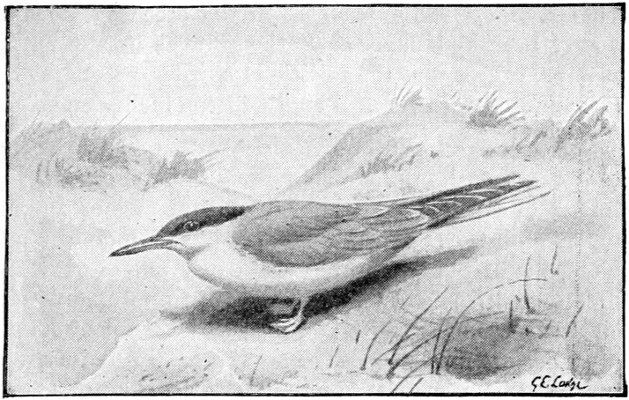
Fig. 107.—Common Tern. ⅐ natural size.
Bill, legs, and feet orange-red; entire plumage as in the arctic tern, except the lower parts, which are more nearly pure white. Length, fourteen and a quarter inches.
So nearly alike are the arctic and common terns that it is hard, well-nigh impossible, in fact, to distinguish them when they are observed flying about in company. In size, manner of flight, language, and general appearance, they are identical. On a close examination the common tern is found to be slightly less slender in build, its under parts dull white instead of pale grey, its beak tipped with black and coral-red, instead of blood-red. It is doubtless owing to their similarity that the two species associate freely together at all times, and are often to be found breeding side by side. But while the arctic tern is most common in the north, from the Shetlands, Orkneys, and Hebrides, to the coast of Northumberland on the one side of the country, and of Lancashire on the other, the common tern is common only on the coasts south of these two points. The nest is a slight depression, sometimes with a little dry grass for lining, placed on the shingle of the beach; the three eggs are yellowish stone, grey, or olive colour, spotted and blotched with dark brown and grey.
Roseate Tern. Sterna dougalli.
Bill black, orange-red at the base in the breeding season; legs and feet red; head and upper parts the same as in the arctic and common terns, except that the mantle is a paler pearl-grey; lower parts white suffused with rose. Length, fifteen inches and a quarter.
This species differs from the two already described in its slimmer body and greater length of tail, and in its shorter and narrower wings. It also differs in the delicate rose-colour suffusing or tinging the white under-plumage; but this faint exquisite hue is seen only when the bird is in the hand. On the wing, unless very near, it appears white and pale grey like the common tern, and only an accustomed eye can distinguish it among the others by its slightly different shape. It may be more easily recognised by its short, constantly repeated note, which is more musical than that of the other species. Besides this short, excited note, it has the long, somewhat guttural, and gull-like cry common to all the terns. It breeds only on islands, and Howard Saunders, our best authority on the birds of this order, says that it is more ‘intolerant of interference’ than other terns: hence many of its old breeding-stations on the British coasts have been successively abandoned during the last half-century owing to egg-collecting, and the bird is now becoming so rare that its extinction as a British species at no distant date is feared by ornithologists. In the north of England, and at various places on the coasts of Scotland, a few pairs still breed in company with the common and arctic terns. The nest is a slight depression in the sand and gravel, and two or three eggs are laid, creamy white or buff-colour, blotched and clouded with bluish grey and rich brown. As soon as the young have been reared the breeding-ground is abandoned, and the migration southwards begins.
Little Tern. Sterna minuta.
Bill orange-yellow tipped with black; legs and feet orange; crown and nape black; forehead and stripe over the eye white; mantle pearl-grey; tail and under parts white. Length, eight inches.
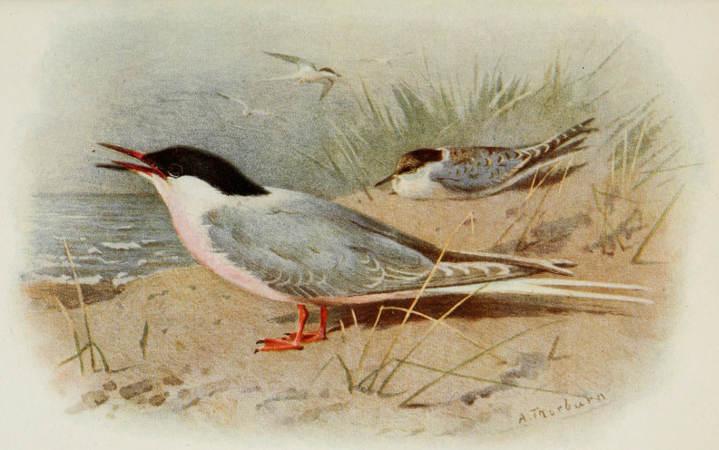
PLATE XIV. ROSEATE TERN (ADULT AND IMMATURE). ⅖ NAT. SIZE.
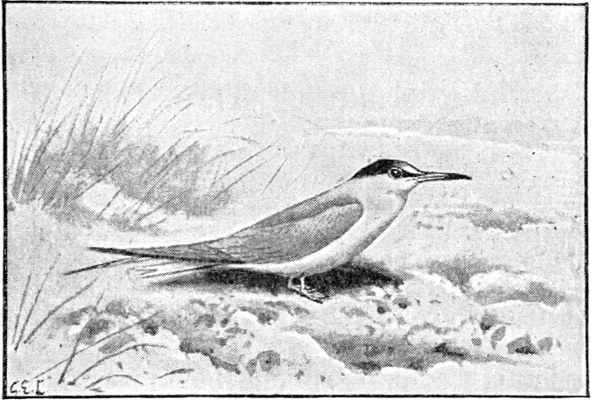
Fig. 108.—Lesser Tern. ¼ natural size.
The little, or lesser tern, is a third less than the common species in size, measuring only eight inches in length. The colour is nearly the same in both birds, except that the under parts in the little tern are pure white, and the bill orange—instead of coral-red. The voice differs somewhat, being thinner and shriller in tone; otherwise the language is the same. The flight is more wavering. This species is much less numerous than the arctic and common terns; in its habits it closely resembles them, breeding in communities, sometimes in company with the other kinds. When breeding alongside of the common tern its nests, as a rule, are placed a little apart and nearer to the water. The nest is a slight depression in the loose sand and gravel, sometimes with a few bents and fragments of dry seaweed for lining; the eggs are two or three in number, of a light stone-colour, spotted with grey and brown. In size and colour they closely resemble the eggs of the ringed plover. This tern, like the others, hovers screaming overhead when its breeding-ground is intruded on; but recovers from its anxiety only too quickly, for no sooner has the intruder got a little distance away than the bird drops down directly on to its nest. When the female is incubating the male brings food for her, and Mr. Trevor-Battye has described in his ‘Pictures in Prose’ the pretty way in which the birds play with each other before the fish is delivered. ‘Returned from his quest, the bird with a fish in his bill circles round and round, and lower and lower, over his mate, and presently drops down beside her. Then he begins a series of extraordinary evolutions. With head thrown back, wings drooping, and tail cocked straight up, he struts—no other word expresses it—he struts about in front of his mate.... He jumps at his mate, as if daring her to take the fish. Then he will fly round for a bit, only to settle again and repeat the play. I have seen on several occasions a female “chit,” before she had settled down on her eggs, get up, fly off, settle on the shingle off and on for a considerable time, followed persistently by her fish-bearing partner, but always avoiding him, as if coquetting or really annoyed. Sooner or later the fish is always relinquished, or, as I suspect, taken by the female bird.’
In Norfolk the little terns are called chits, or chit-perles.
Sandwich Tern. Sterna cantiaca.
Bill and feet black; upper part of the head black; mantle pearl-grey; rump, tail, throat, and under parts white; the breast suffused with rose. Length, sixteen inches.
This is the largest of the British terns, being as much superior as the little tern is inferior in size to the arctic and common species. In its manner of flight and language it differs somewhat from the others. At a distance the under parts appear to be of a snowy whiteness; in the captive or dead bird the white plumage is seen to be suffused with an evanescent delicate pink colour. On the wing the Sandwich tern does not look so graceful and beautiful as the smaller species: the flight is heavier, straighter, unwavering, the wings beating more rapidly. Its scream is shorter, less inflected, and has a harsh and even grating sound.
This tern suffers much from the persecutions of the egg-collector, as well as of that base kind of sportsman who is allowed to amuse himself in August and September by slaughtering terns. On the Farne Islands, which are protected during the breeding season, there now exists a considerable colony of Sandwich terns, numbering about one thousand pairs, and a few smaller colonies are found on the coasts of Scotland and Ireland, and on some of the lakes of those countries. On the Farnes the birds breed on one of the islands on a flat surface overgrown with sea-campion, and here their nests are placed so close together that it is difficult at times to walk over the ground without treading on the nests containing eggs or young birds. The eggs are two or three in number, and are stone-colour with a yellow tinge, thickly spotted with grey or brown.
Besides the five species described, there are eight terns set down in the books as British. Of these, the Caspian tern, gull-billed tern, and black tern, are described as ‘irregular visitors,’ and come in small numbers; the whiskered tern, white-winged black tern, sooty tern, Scopoli’s sooty tern, and noddy, are all rare stragglers, the last three from the tropics. The black tern (Hydrochelidon nigra) was in reality a British bird in former times, a summer visitor, breeding in immense numbers in the fens and marshes in some of the eastern counties. It bred ‘in myriads’ in Norfolk as late as 1818, and, in diminishing numbers, down to 1835. ‘Drainage and persecution’ caused the destruction of this graceful species.
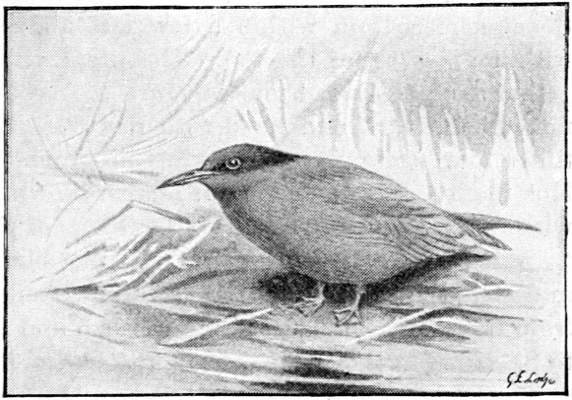
Fig. 109.—Black Tern. ⅐ natural size.
Kittiwake. Rissa tridactyla.
Bill greenish yellow; legs and feet black; mantle deep grey; head, neck, tail, and under parts white. Length, fifteen and a half inches.
The kittiwake takes its pretty name from its usual cry, composed of three notes, two quick and short, and one long. It is the smallest of the British gulls, excluding the stragglers, and is also one of the handsomest and most interesting in its habits. It is more of a sea-bird than most gulls, feeding principally on small fish, which it captures after the manner of a tern, hovering motionless for a few moments, then dashing down on to the water with great force. It is common round the British Islands throughout the year, but probably most of the birds that breed on our coasts migrate to more southern regions in winter, their places, meanwhile, being taken by visitors from the north. Its breeding-sites, often shared with the guillemot and razorbill, are precipitous rocky cliffs fronting the sea, the nest being placed on the ledges and wherever a projecting rock affords standing-room for a bird of its size. When the colony is a numerous one the birds may be seen whitening the face of the precipice from within a few feet above high-water mark to within a few feet of the top. The nests, often placed so near together as to be almost touching, are rather bulky, built of seaweed mixed with turf, and lined with dry grass. Two or three, sometimes four, eggs are laid, varying in ground-colour from greenish blue to olive-brown, or buff, or buffish brown, spotted and blotched with reddish brown, and under-markings of pale brown and grey.
Where suitable sites exist, and the birds are not too much molested, the kittiwakes have breeding colonies on the British coasts from the Scilly Islands and the Cornish and Devon cliffs right away to St. Kilda in the north. The kittiwakes breed later than most gulls, unfortunately for them. It has been pointed out again and again that the young birds are often hardly able to feed themselves, and in many cases are not yet out of their nests, at the end of July, which is also the end of the close time for sea-birds. It then becomes lawful for the scoundrels who practise this form of sport to slaughter the kittiwakes—both the helpless young and the parent birds that are engaged in feeding and protecting them.
Herring-Gull. Larus argentatus.
Bill yellow; legs and feet flesh-colour; mantle grey; head, tail, and lower parts white; outer primaries black. Length, twenty-four inches.
The herring-gull, which derives its name from its habit of following the shoals of herrings, is common on our coasts throughout the year. Like most gulls, it searches the shore at ebb-tide for stranded marine animals, dead and alive, and garbage of all kinds. It quarrels with ravens and crows over the carcass of a dead sheep, and, like the raven, is a plunderer of eggs and young birds from the cliffs. It is often seen at a distance from the sea, roaming over the moors in search of prey or carrion; and it also feeds on insects and, like the black-headed gull, sometimes follows the plough to pick up worms and grubs. It nests on precipitous, rocky shores, usually making choice of the summit or upper ledges. It also breeds on flat islands, sometimes in company with the lesser black-backed gull, which it resembles in size and general appearance. It usually breeds in communities, but is not so strictly gregarious as most gulls at this season. The nest, which is usually somewhat bulky, is composed of seaweed and herbage, and lined with dry grass. Three eggs are laid, stone-colour or light olive-brown, spotted and blotched with dark umber.
Lesser Black-backed Gull. Larus fuscus.
Bill, legs, and feet yellow; summer plumage of the adult white, except on the mantle, which varies from slate-grey to black. Length, twenty-three inches.
From its abundance, its large size—which is nearly the same as that of the herring-gull—and its extremely conspicuous black-and-white plumage at maturity, the lesser black-back is one of the most familiar birds on our coasts. The young differ greatly from the adults, having a slate-grey beak, flesh-coloured legs, and a general brown plumage. The mature breeding colours, including yellow on legs and bill, with a vermilion patch on the lower mandible, are not perfect until the fourth year. Judging solely from this fact of its slow growth to maturity, we may take it that the lesser black-back lives long—that its natural term, as in some accipitrine species, probably exceeds a century. It is certainly the case that this gull is able, not only to keep itself alive, but to keep up its numbers, notwithstanding its large size and the dislike with which it is regarded on account of its predacious habits. The unfeathered biped is ever anxious to keep all the killing and plundering in his own hands. The voice of this gull is very powerful and far-reaching, and, when soaring with its fellows, occasionally all the birds unite their voices in a chorus of short and long cries, laughter-like in character, yet with something solemn, and even desolate, in the sound, as of the sea. It is gregarious and social at all seasons, and breeds in gulleries, where the nests are placed close together on the level ground. The three eggs are of a light stone colour, spotted and blotched with blackish brown and grey. The largest and best-known colony on the British coasts is at the Farne Islands, and of that colony Seebohm writes: ‘It is a wonderful sight on approaching an island to see the green mass sprinkled all over with large white-looking birds, every one standing head to wind, like an innumerable army of white weathercocks.’ It is also fine to see and hear them, when a person walks about among the nests, stooping occasionally to examine eggs or handle the yellow, black-spotted chicks: the birds hover in a dense cloud over his head, their deep, powerful cries mingling in one mighty uproar, and, at short intervals, one or two birds dash down out of the bird-cloud as if to strike his head, and, missing it by an inch or two, reascend to repeat the action.
Common Gull. Larus canus.
Bill greenish at the base, yellow at the tip; legs and feet greenish yellow; mantle ash-grey; first two primaries black, with a white patch near the extremity; the rest black near the end; head, neck, tail, and under parts white. Length, eighteen and a half inches.
The name of this species is somewhat misleading, as it is less numerous on most of our coasts, and in estuaries and rivers, than the black-headed species, which indeed is often called the common gull. When flying about in company, the two species are indistinguishable in the winter plumage. The common gull has no breeding-place south of the Border. In Scotland and its islands there are several colonies, and in Ireland a few. In its habits it is intermediate between the marine and inland species, and its gulleries are placed both on islands near the sea-coast and in lochs at a distance from the shore. Like the herring-gull and black-headed gull, it follows the plough to pick up worms and grubs, and roams over moors, marshes, and pasture-lands in search of insects, small vertebrates, and carrion. The nest is bulky, and composed of seaweed, herbage, and dry grass. Three eggs are laid, olive-brown, spotted and streaked with blackish.
Great Black-backed Gull. Larus marinus.
Bill yellow; legs and feet flesh-colour; plumage as in the lesser black-backed gull. Length, thirty inches.
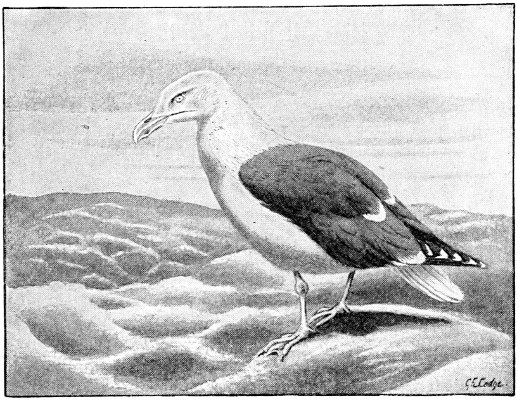
Fig. 110.—Great Black-backed Gull. ¹⁄₁₁ natural size.
Turner, who wrote on British birds three centuries ago, in describing the great black-backed gull, says that it was called ‘cob’ on the Kentish and Essex coast. It is curious to find that it is still known by this name in the same localities, where it is now very rare. In colour and appearance it closely resembles the lesser black-back, but exceeds it in size, and is nearly twice as heavy—it is, in fact, the largest of the gulls. It is also the rarest species in the British Islands; for although its breeding-sites are not few in Scotland, while others exist on the coasts of England, Wales, and Ireland, its colonies are very small compared with those of other species, and in many cases the breeding-place is occupied by a single pair. Its habits are similar to those of the herring and lesser black-backed gulls; but being so much larger and more powerful, it is more injurious to other sea-birds, whose nests it plunders of their eggs or young. It is also more oceanic, straying to a great distance from land in its search for dead animal matter floating on the waves—a veritable ‘vulture of the sea.’ Its nest is placed, as a rule, on the summit of an inaccessible rock on the coast, or on a small rocky island, and is carelessly formed of seaweed and grass. Two or three eggs are laid, greyish brown, sometimes tinged with olive, with dark brown spots distributed sparingly over the whole surface.
Black-headed Gull. Larus ridibundus.
Bill and feet red; head and upper part of the neck blackish brown; mantle grey; all the rest, white; the under parts tinged with pink. The black on the head is lost in winter. Length, sixteen inches.
The black-headed gull, if not the most abundant of its genus, is without doubt the most generally known, on account of its wide diffusion in the country, and of its habit of breeding in inland marshes. It remains throughout the year, most of the time frequenting the flat parts of the sea-coast, estuaries, and tidal rivers, where it is seen perpetually roaming up and down in search of the small fishes and crustaceans on which it feeds, and any dead animal matter cast up by the tide. In its winter dress it is almost impossible to tell this species from the common gull and kittiwake when they are seen together, as in size they are nearly alike, and the buoyant, leisurely flight and circling motions in the air are the same in all. But very early in spring the distinguishing mark and nuptial ornament of a black hood is assumed, after which there can be no mistake. And here I may remark that I differ from Howard Saunders when he says that, as the hood is not black, the bird should be called the brown-headed gull. Vernacular names of this kind are descriptive of the creatures as they appear to us when seen living in a state of nature; and at a distance of twenty or thirty yards, which is as close as a flying gull will come to a man, the hood certainly appears to be black.
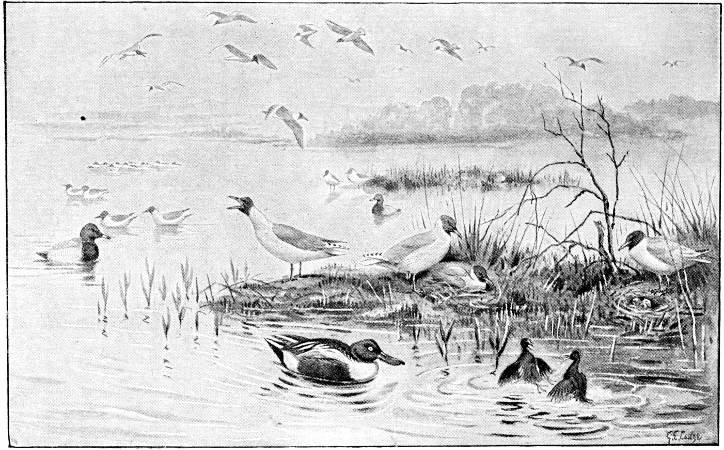
Black-headed Gulls. Pochards. Shoveler. Water-Hens.
In March the gulls withdraw to marshes and meres to breed. The breeding-place is usually in the neighbourhood of the sea, sometimes in an inland district. Year after year the same spot is resorted to, and it is known that some of the gulleries in this country have existed for centuries. One of the largest and best known in England is at Scoulton Mere, in Norfolk. Half a century ago 20,000 birds annually bred at this spot, but the colony has now diminished to less than half that number. A favourite site for the gullery is an island in a mere or swamp, and the nests are placed both on the ground and on clumps of rushes or tussocks of grass. Three or four eggs are laid, varying in ground-colour from olive-brown to pale green, blue, or salmon, blotched with black and dark brown. During the breeding season the birds seek their food over the surrounding country in marshes, meadow-lands, and fields that are being ploughed. Seebohm says: ‘So easily do they adapt themselves to changed circumstances, that they have already become used to the steam-plough. It is a very pretty sight to watch a party of these little gulls, looking snow-white in the distance against the rich brown of the newly turned-up soil, paddling amongst the clumsy clods with dainty, red-webbed feet, and continually lifting their white wings to balance themselves on the rough ground, reminding one of a group of angels by Gustave Doré.’ One suspects that Doré, being, like other artists, incapable of imagining the unimaginable, made use of gulls and such like as models for his angels.
This gull, like most of the Laridæ, is a vociferous bird, and his notes—short and rapid, like excited exclamations, or drawn out, guttural in tone, and inflected in various ways—often sound like laughter; hence the name of laughing gull, sometimes given to this species, and the specific name of ridibundus. To my ear it is like the guttural and extravagant laughter of the negro, rather than that of the white man.
Besides the six species described, there are six others, belonging to the sub-family Larinæ (true gulls), which figure in the books as British species. One of these (the second on the list) is perhaps a regular visitor.
Ivory gull (Pagophila eburnea).—A circumpolar species; occasionally straggles to the British coasts.
Glaucous gull (Larus glaucus).—Circumpolar in its range; a winter visitor to the northern parts of the United Kingdom.
Iceland gull (L. leucopterus).—A rare winter visitor (to the north) from the arctic regions.
Great black-headed gull (L. ichthyaëtus).—A single specimen of this southern species was obtained many years ago in this country.
Little gull (L. minutus).—An irregular visitor from continental Europe.
Sabine’s gull (Xema sabinii).—A rare straggler from North America.
Common or Great Skua. Stercorarius catarrhactes.
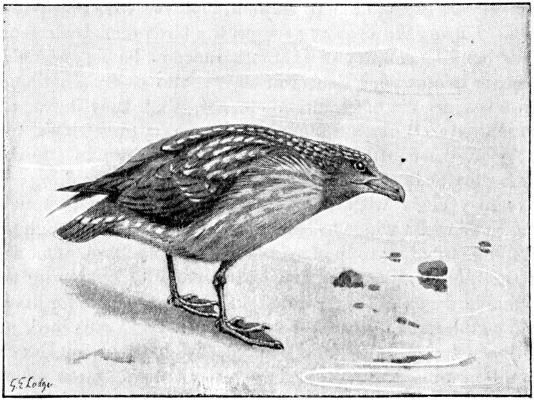
Fig. 111.—Great Skua. ¹⁄₁₂ natural size.
Upper parts mottled brown; shafts of the quills and tail-feathers white; under parts rufous-brown; bill, legs, and feet black. Length, twenty-five inches.
Of skuas there are but six species, two of which inhabit the southern hemisphere, and breed on the confines of the antarctic regions. The others belong to the northern half of the globe, and range in summer to the arctic regions. These four are all claimed as members of the British avifauna, but only two species need be fully described in this work. The skuas are gull-like birds, very strong on the wing, and swift flyers; and, like the gulls, they have a variety of feeding-habits, and are both the vultures and hawks of the sea. In the skuas there is more of the hawk and not so much of the vulture. Their predatory habits, extreme violence in attack, and readiness to take and destroy their feathered fellow-creatures and toilers of the deep when the occasion offers, have won them a reputation among birds similar to that of a pirate among men—the lawless rover of the sea, who is without compunction, and whose hand is against every man. In shape and general appearance the skuas are gull-like; they differ chiefly from the gulls in the form of the beak, which is straight for two-thirds of its length, and for the rest curved into a hook, as in the raptorial birds; and in the form of the tail, which is cuneiform, with the two centre feathers projecting beyond the others. In the gulls the tail-feathers are of equal length; while the terns, at the other end of this order of birds, have sharply forked tails like the swallow.
The great skua, or bonxie, as it is called by the Shetlanders, is the largest of the family. Except during the breeding season it is a solitary bird, oceanic in its habits, roaming far and wide over the waters in quest of food, its visits to land being restricted to rocky island coasts. Like the marine gulls, it feeds on dead fish found stranded or floating on the water, and on dead animal matter of all kinds, and also catches fish by pouncing on them as they swim near the surface. But it prefers to watch the movements of the other fishing-birds, which it follows and associates with to rob them of their prey. The herring-gull and lesser black-back may be frequently seen pursuing a tern or kittiwake to take from it the fish it has just captured; but these would-be robbers are not very successful—the chased tern, or small gull, in most cases proves too quick for them. These are like the merest mock chases and playful interludes in the day’s work compared with the sudden, furious onslaught of the bonxie. The swiftest gull or tern cannot escape from him; he can turn as quickly as a swallow, and keep close to his victim in all his doublings, until the chased bird in his terror disgorges the fish he has just swallowed. The skua stays his flight to pick up the falling morsel, and the chase is over. Besides robbing the birds of their prey, he is also a bird-killer, making his deadly attacks on the sickly or wounded, and on the young in the breeding season.
The great skua breeds in the Shetlands, but the birds have now been reduced to a few pairs, chiefly owing to the persecution of collectors. Every effort has been made to protect the birds in their two small colonies on Unst and Foula, but it is scarcely to be hoped that this insignificant remnant will continue to exist many years, when we consider that the childish and contemptible craze of eggshell-collecting is very common, and that many collectors do not hesitate to steal, or to bribe others to steal for them, the eggs they desire to have in their cabinets.
About April the surviving birds return to their ancestral breeding-grounds and make their simple nests, composed of a few twigs or a little dry grass, in a slight hollow in the ground. The two eggs laid vary in ground-colour from pale to dark buffish brown, and are spotted with dark brown, with greyish brown underlying spots. They resemble the eggs of the herring-gull and lesser black-back.
In the breeding season the skua is a terror to all birds in the vicinity of its nest, as it is even more savage and impetuous in the defence of its eggs than when seeking its prey. Ravens, sea-eagles, dogs, and foxes, are violently attacked and driven off by it. It is also very bold towards a human intruder, gliding to and fro close to the surface within a few feet of him, and hovering overhead, screaming, and occasionally dashing down violently at his head, and all but striking it. They do strike sometimes, it is said, and it is related by the Shetlanders that birds have impaled themselves on a knife held up to ward off an attack, and have met their death in other curious ways, when trying to defend their nests. These stories are doubtless true, although the birds are less bold now than formerly, a long and sad experience having taught them that there is one enemy they cannot frighten away. I have often been struck by birds engaged in defending their nests—hawks, waders, and perching birds—and in some cases the striker has stunned himself; but this happened at a distance from Britain, in a region where birds have not been persecuted so long, and fear man less.
It is from its exceedingly violent down-rushing method of attack that the great skua derives its specific name of catarrhactes. It rushes down like a cataract. This is an ancient name for a bird of prey, and, in this case, a singularly fit one. But what shall we say of Brisson’s hideous and ridiculous invention of Stercorarius as the generic name for all the skuas?
Richardson’s Skua. Stercorarius crepidatus.
Crown dusky; cheek, neck, and under parts white tinged with yellow and brown; rest of the plumage dusky. Length, twenty inches.
This species breeds in the Outer Hebrides, the Orkneys, and the Shetlands; it is also said to be a regular breeder in Sutherlandshire. It is a much more numerous species than the great skua, being a regular visitor to the coasts of Scotland in the autumn and spring migrations. In its preying habit it resembles the bonxie, but, unlike that species, is gregarious. It breeds on moors, often at a considerable distance from the sea, and its nests are widely scattered on the breeding-ground. A slight hollow in the ground, with a little dry grass for lining, serves as a receptacle for the eggs. Two eggs are laid, and in some cases only one. These vary greatly in shape, some being nearly round, others long and pointed. In ground-colour they vary from russet-brown to pale olive, and are evenly and sparingly spotted with dark brown.
A curious fact about this species is that there are two forms, one light in colour, the other dark, and that these habitually interbreed; but the young, instead of being intermediate, are, according to Seebohm, light or dark, like one of the parents.
The pomatorhine skua (S. pomatorhinus) is an autumn and spring visitor on migration to the seas in the vicinity of the British coasts. In some seasons it occurs in large numbers, but is not very regular in its appearance. Buffon’s skua (S. parasiticus) is a rare and irregular visitor on migration to the British coasts. It breeds in the arctic regions, and is circumpolar.
Stormy Petrel. Procellaria pelagica.
Upper parts black, except the tail-coverts, which are white at their bases; edges of the wing-coverts slightly edged with white; under parts sooty black; bill and feet black. Length, six inches.
The names of stormy petrel and Mother Carey’s chicken are as familiar to everyone as that of rook, or partridge, or hedge-sparrow; but the little bird they belong to is known by sight to comparatively few persons. It is pre-eminently an oceanic species, that comes to land only to breed; its breeding-places are on remote and lonely islands not easy of access; and, when breeding, the bird is nocturnal in habits, and it would be possible for anyone to spend many days in the very midst of a colony of petrels and not see them, or suspect that they were there.
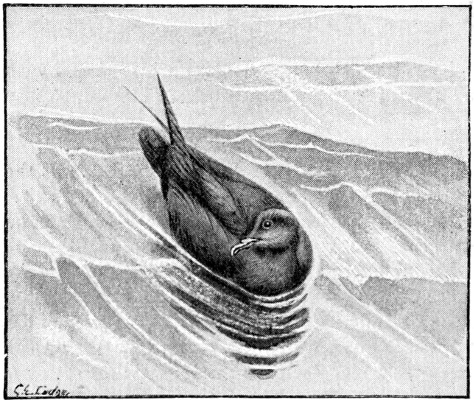
Fig. 112.—Stormy Petrel. ⅓ natural size.
The name of stormy petrel has been altered in several modern ornithological works to that of storm petrel; and on this subject Seebohm makes a delightfully characteristic observation. ‘The words stormy petrel,’ he writes, ‘are doubtless a very ungrammatical combination, as many other familiar English words are; but that is no reason why they should be altered, although they may have offended the ears of Yarrell and his academical friends.’ The rebuke is the more deserved when we remember that these same ‘academical friends’ have been quick to ridicule the attempts of certain ornithologists to substitute the name of hedge-accentor for that of hedge-sparrow—the absurdest name of all, but ‘consecrated,’ as they say, by long use, and Shakespeare. The name of ‘petrel’ comes about in a very curious way. It is the diminutive of Peter, given to the bird on account of a habit it has, when gliding along just above the surface, of dropping its feet and paddling, producing the idea that it is walking on the water. I am not quite sure that this is a correct derivation; Peter (the apostle), it will be remembered, was not wholly successful in his attempt to walk on the waves. Sailors call the petrels ‘Mother Carey’s chickens’; but not, as might be imagined from such a name, on account of any tender regard or feeling of affection for the birds. Mother Carey is supposed to be a kind of ocean witch, a supernatural Mother Shipton, who rides the blast, and who has for attendants and harbingers the little dark-winged petrels, just as the more amiable Mother Venus had her doves.
The stormy petrel is known to be the smallest bird with webbed feet, consequently his smallness is to the ornithologist his chief distinction. He is no bigger than a sparrow, and when seen flying in the wake of a ship, gliding to and fro close to the surface, his small size, sharp-pointed, swallow-like wings, dark plumage, and snow-white rump, give him the appearance of the house-martin. Like other pelagic birds, the petrel when on the wing is perpetually seeking its food, and is seen to drop often on to the surface to pick up some floating particle from the water; and yet to this day ornithologists do not accurately know what it feeds on. The bird is generally excessively fat, and when taken in the hand it ejects a small quantity of amber-coloured oil from its mouth. When dissected, its stomach is found to contain an oily fluid, and the young are fed with the same substance, injected by the parent bird into their mouths. Where this oil springs from, and how it comes to be floating on the water, is one of the secrets of the sea which this bird shares with other members of the petrel family; but they have no tongue to tell it.
The petrels do not arrive at their breeding-grounds until about the middle of June. They have colonies on the Scilly Islands, and at various other points on the west coast to St. Kilda, and the Orkneys and Shetlands. A few small colonies are also found on some of the islands on the Irish coast. The birds breed in holes in stone walls and piles of loose stones, and, in some localities, in old rabbit-burrows and holes in banks. A single egg is laid, on a slight bed of grass; it is very large for the bird’s size, rough in texture, pure white, and in most cases thinly sprinkled with minute reddish brown specks.
The young birds are fed at night, and may then be heard faintly clamouring for food after dark.
The fork-tailed, or Leach’s petrel (Procellaria leucorrhoa), is a larger bird than the last, being about the same size as the swift. It is a much rarer species than the stormy petrel, and has only two known breeding-places in the United Kingdom, one at St. Kilda, the other on the island of North Rona, off the west coast of Scotland. On all other parts of the British coast it is known only as a storm-driven straggler. The birds breed in June, in holes which they make in the soft peaty soil to a depth of two or three feet, or deeper. A slight nest of dry grass is made, and a single egg deposited, pure white in colour, with a zone of small reddish spots at the large end. During the daytime the birds remain silent in their holes; in the evening they become active and garrulous.
Wilson’s petrel (Oceanites oceanicus), a bird about the size of a swift, with a black plumage and white rump, appears occasionally as a straggler in the British Islands. Its only known breeding-grounds are in the southern hemisphere.
Manx Shearwater. Puffinus anglorum.
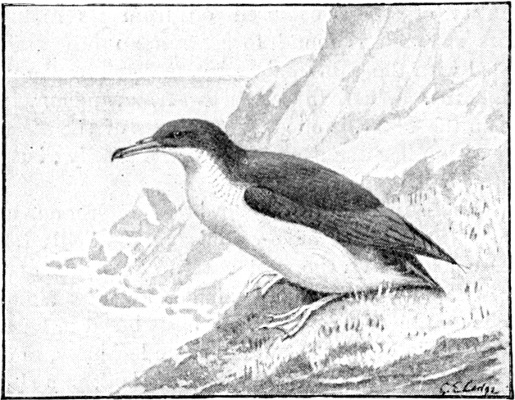
Fig. 113.—Manx Shearwater. ⅛ natural size.
Bill blackish; legs and feet yellowish flesh-colour; crown, nape, and upper parts sooty black; under parts white; sides of neck mottled with greyish brown. Length, fifteen inches.
The Manx shearwater is the most abundant and best known of the four petrels that frequent the British seas. It has several breeding-stations in the Channel and along the west coast of Great Britain, and a few on islands off the coast of Ireland; but its principal colonies are on St. Kilda, the sea-bird’s paradise. Like the stormy petrel, the shearwater is nocturnal in its habits during the summer, feeding by night, and remaining concealed in its burrows during the day. In winter it seeks its food at all hours. It has the same habits as the stormy petrel of dropping its feet and paddling in the water, while sustained by its motionless, outspread wings. Its name of shearwater is derived from its custom of gliding along very close to the surface. Seebohm likens it to ‘a gigantic swift’ in appearance as it careers to and fro over the waves when the gale is at its height. Except when breeding its whole time is spent on the open sea: it is as truly at home on the stormy Atlantic, a thousand miles from the nearest land, as is the blackbird in its favourite shrubbery or the sedentary owl in its hollow beech-tree. But it remains longer at its breeding-grounds than the other species. At St. Kilda it begins to arrive as early as February, and remains until the end of the summer. It forms a burrow, often of great depth, in the peaty soil, and lays a single egg, pure white, and smooth in texture. According to Dixon, the birds are very garrulous at night, uttering their peculiar notes both when flying and in their nesting-holes; the syllables ‘Kitty-coo-roo’ are given by this author in imitation of the notes.
The sooty shearwater (Puffinus griseus) and the greater shearwater (P. major) are occasionally met with in autumn and winter on the British coasts. A third species, the dusky shearwater (P. obscurus), has a place in the list of British birds, two specimens having been obtained in the United Kingdom.
Fulmar. Fulmarus glacialis.
Bill yellow; legs and feet grey; mantle and tail grey; quills dusky; head, neck, and under parts white. Length, nineteen inches.
The fulmar is the largest of the petrels; it exceeds the black-headed gull and common gull in size, and is a giant by comparison with its diminutive relation, the stormy petrel. It is a circumpolar species, and in winter inhabits the Atlantic and Pacific oceans in the northern hemisphere. On the British coasts it is a rare straggler in winter, and its only breeding-station in the United Kingdom is at St. Kilda. It is said that formerly there were several colonies on the west coast of Scotland, but these no longer exist. In its manner of flight and general appearance the fulmar is gull-like, and may easily be mistaken for a gull. Like other petrels, it lives, when not engaged in breeding, on the open sea, and it often follows the deep-sea fishing-boats and whalers, to feed on the offal thrown out and portions of blubber floating on the water. Seebohm says that ‘if a piece of meat be thrown to them, they often seize it before it sinks, but instead of diving after it, as a duck or guillemot would do, they alight on the surface feet first, and in the most comical way let themselves sink down in the water with uplifted wings.’
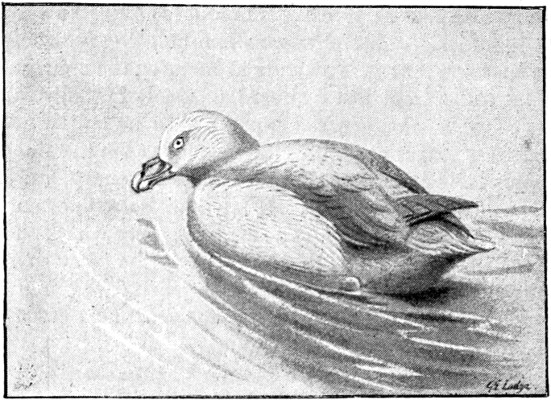
Fig. 114.—Fulmar. ⅑ natural size.
The fulmar lays a single white egg in a shallow hole dug in the peaty soil. Dixon has the following graphic account of the breeding-haunts and habits of the fulmar: ‘In many places, although the cliff is very precipitous, it is covered with grass, sorrel, and other plants, and a loose, rich soil. It is in such spots that the fulmar breeds in the greatest numbers. I shall never forget the imposing effect of this noble bird-nursery.... When I reached the summit the scene was grand: tens of thousands of fulmars were flying silently about in all directions, but never by any chance soaring over the land; they passed backwards and forwards along the face of the cliff, and for some considerable distance out to sea, whilst the waves, a thousand feet below, were dotted thickly with floating birds. The silence of such an animated scene impressed me: not a single fulmar uttered a cry.... No bird flies more gracefully than the fulmar: it seems to float in the air without any exertion, often passing to and fro for minutes together with no perceptible movement of its wings.... It is a remarkably tame bird, fluttering along within a few feet of you, its black eye glistening sharply against its snow-white dress.... In some parts of the cliffs, where the soil is loose and turf-grown, the ground is almost white with sitting fulmars. Every available spot is a fulmar’s nest; and as you explore the cliffs, large numbers of birds fly out from all directions where they had not previously been noticed.... It very rarely burrows deep enough in the ground to conceal itself whilst incubating, and in the majority of cases only makes a hole large enough to half-conceal itself, whilst in a great many instances it is content to lay its eggs under some projecting tuft, or even on the bare and exposed ledge of a cliff, in a similar place to that so often selected by the guillemot.... The nests are very slight, and in a great number of instances are dispensed with altogether.’
Of the number of fulmars, the same observer says: ‘The myriads of birds were past all belief: the air was darkened with their numbers; still the cliffs were white with birds, and I calculated that not more than one in ten had risen. The fulmars filled the air like large snowflakes, and the hordes of puffins looked like a huge swarm of bees, darkening the air as far as we could see. Myriads of birds swept round the vessel or filled the air above; the face of the cliffs seemed crumbling away as the living masses swept seaward; yet, singularly enough, little noise was made beyond the humming of countless wings. The mighty peaks of these solitary ocean rocks were indistinctly seen through the surging cloud of birds, that seemed almost as if it would descend and overwhelm us.’[2]
Two petrels remain to be noticed: the capped petrel (Œstrelata hæsitata) and Bulwer’s petrel (Bulweria columbina), one straggler having been obtained of the first species, and two of the second, on the east coast of England.
Great Northern Diver. Colymbus glacialis.
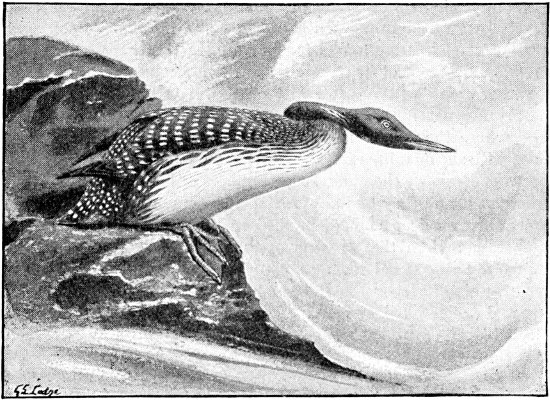
Fig. 115.—Great Northern Diver. ⅑ natural size.
Bill black; irides red; head and neck black, glossed with purple on the upper throat, and with green on the lower neck; two throat-bands black barred with white; mantle black spotted with white; under parts white. Length, thirty-three inches.
The great northern diver, or loon, is called great because he exceeds the other divers in size; in this sense he is also great in relation to birds generally, since he is as big as a goose, and therefore the equal of the few species that are greatest. In form he differs widely from the geese. An oceanic bird that escapes from its enemies by diving, and is never seen on the wing except when migrating, and never on land except when breeding, his form has been modified so as to make swimming and diving as easy to him as careering through the air is to the swift, and climbing on trees to the woodpecker. The beak is straight, conical, and sharp-pointed; the head, neck, and body, grebe-like in form; and the legs set so far back that the bird is almost incapable of progression on land. It is very wonderful that a creature that spends so great a part of its time on and in the water, without leaving it, should yet retain wing-power sufficient to perform long bi-annual migrations. Probably it does not take very extended flights; when found on inland waters during migration, it often appears incapable of flight, and if in a small stream is easily taken. In its flying powers it appears, with the grebes and auks, to occupy a position midway between the ever-soaring, aërial gannet and the penguins, that are incapable of flight. In their dark rich, variegated upper, and white under, plumage, the divers again resemble the grebes. The glossy black back, thickly strewn with symmetrical white spots, gives the present species a beautiful and somewhat singular appearance. Out at sea it is a silent bird—silent and shy and solitary—with the cormorant-like habit of making itself invisible by sinking its body beneath the water. In the breeding season it utters cries of a very strange character, powerful and uncanny in their effect on the mind, and compared by different listeners to screams uttered by tortured children, and to shrieks of insane laughter. It is a winter visitor to the British Islands, chiefly to the west coasts of Scotland and England: but as it has occasionally been met with in summer in full nuptial plumage, it is thought by some ornithologists that a few pairs may remain to breed in some of the secluded lakes in the west of Scotland, the Outer Hebrides, the Orkneys, and Shetlands. It has not yet been found breeding anywhere in continental Europe; its known breeding-grounds are in Iceland, and in America, from Greenland to Alaska. It breeds in secluded lakes and tarns, at no great distance from the sea, and prefers an island to nest on; but where no island exists the nest is placed on the shore close to the water. Two eggs are laid, varying in ground-colour from olive-brown to russet-brown, spotted somewhat thinly with black.
The family of divers (Colymbidæ) consists of four species, all contained in one genus; and of the four, three are British. In habits, as well as in structure, they are so closely related that a very brief description of the other two is all that will be necessary. The black-throated diver (Colymbus arcticus) is much smaller than the great northern diver, its length being twenty-six inches. Bill black; irides red; crown and hind head ash-grey; upper parts blackish, spotted and barred with white; throat purplish black, with a half-collar of short white streaks; sides of neck striped with black and white; under parts white.
This diver breeds in small numbers on the west coast of Scotland and in the Outer Hebrides. To other parts of the country it is an accidental visitor. It is less oceanic in its habits than the last species described, and goes to a greater distance from the sea to breed. Two eggs are laid, similar in colour to those of the great northern diver.
The red-throated diver (Colymbus septentrionalis) is the smallest of the three species, its length being twenty-three inches. It has the head, throat, and sides of the neck mouse-colour; crown spotted with black; neck marked with black and white lines; on the front of the neck a large orange-coloured patch; back dusky brown; under parts white.
This species breeds in the west and north of Scotland, and in the Hebrides, Orkneys, and Shetlands.
Great Crested Grebe. Podiceps cristatus.
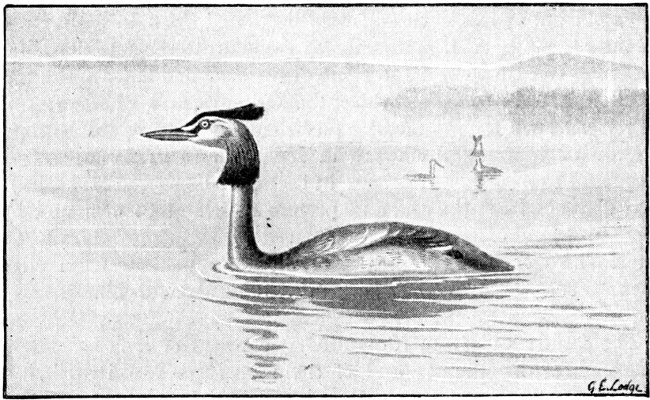
Fig. 116.—Great Crested Grebe. ¹⁄₁₀ natural size.
Crown and crest and ruff dark brown and chestnut; cheeks white; upper parts dark brown; secondaries white; under parts silky white. Length, twenty-two inches.
The great crested grebe still survives as a British species, although it is a large and handsome bird, and, like all those to which such a description applies, it has been much persecuted. Among our large water-birds there are few more strikingly handsome and stately in appearance than this grebe in its full breeding-plumage, when viewed as it floats, unalarmed, on the secluded reed-fringed water it loves. The swan, in its immaculate white dress, with proudly arched neck and plume-like scapulars, when seen ‘floating double,’ is to many minds the most perfect type of a beautiful waterfowl; certainly it is the most familiar. The great grebe has a very different appearance, with its straight neck, long, boat-shaped body, dark upper and silvery under plumage, and its broad ruff and double, ear-like crest; but in some aspects he is not less attractive than the white, larger bird, especially when sailing peacefully in close proximity to tall, slender reeds, their beauty, and that of the bird, enhanced by the ‘magic of reflection,’ when both seem part of the glassy pool, and made for one another.
Although in sadly diminished numbers, the great crested grebe still breeds regularly in many localities in England, especially in the eastern counties, and in a few situations in Wales and Ireland. In the northern counties of England it is very rare, and does not breed in Scotland: it is there a winter migrant from the north of Europe.
The habits of the grebe when on the water are similar to those of the diver. It is adapted to a swimming and diving existence; feeds on fish, frogs, water-beetles, and other small aquatic creatures; when alarmed it sinks its body deeper and deeper into the water, and when pursued, or in danger, seeks to escape by diving. It makes little use of its wings, except when migrating. At most times it is a silent bird, but in the breeding season utters a harsh, grating cry.
The grebe makes a large platform nest of aquatic plants, placed on the water among the reeds. Four eggs are laid, the shell pale blue in colour, but covered with a soft, white, chalky substance. Invariably, when leaving the nest the bird covers the eggs with moss and weeds, and the usual inference is that this is done to hide them from rapacious egg-eating birds; but Seebohm is of the opinion that the eggs are covered to be kept warm, and he says that they are covered only after the full complement is laid and incubation begun.
Little Grebe, or Dabchick. Tachybaptes fluviatilis.
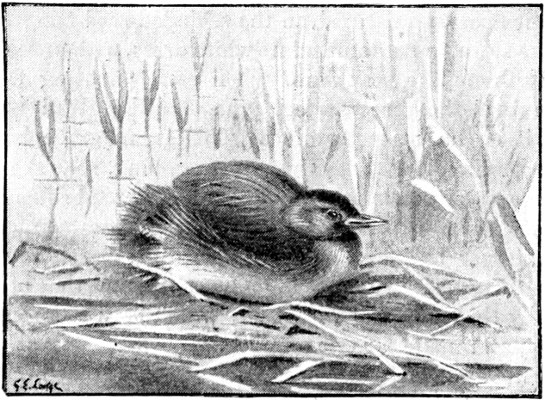
Fig. 117.—Little Grebe. ⅙ natural size.
Head, neck, and upper parts dark brown; a little white on the secondaries; chin black; cheeks, throat, and sides of the neck reddish chestnut; under parts greyish white; flanks dusky brown; bill horn-colour; legs and feet dull green. Length, nine inches and a half.
The little grebe, or dabchick, is less than the teal in size, and differs from the great crested grebe in about the same degree as the partridge does from the pheasant. It is the one common and well-known species of grebe in this country, being resident in suitable localities in all parts of the United Kingdom. In summer it is generally diffused, and is to be met with even on small pools and streams; in winter it shifts its ground, resorting to the rivers and larger bodies of water, and in very severe weather to the sea-coast.
It begins to breed at the end of April or early in May, and forms a floating nest of aquatic weeds and grasses close to the bank or among the reeds, but in most cases little care is taken to conceal the nest. The eggs are three or four to six in number, and are white, and rough in texture. Before quitting the nest the incubating bird invariably covers the eggs with wet leaves and grass, drawn in from the edge of the nest. It is hard to believe, with Seebohm, that the object of this action is to keep the eggs warm. The nest is, in very many cases, conspicuous to the eye, but on the slightest alarm the sitting-bird quickly and deftly draws the dead, wet materials like a blanket over the eggs, and, slipping off, dives silently, to come up at a considerable distance, usually where it cannot be seen. The nest then presents the appearance of a mere bunch of dead and water-soaked weeds or grass floating on the surface. I have examined a good many nests, and am convinced that the eggs are covered to hide them from the sight of egg-robbing animals, and that only the egg-robber that is neither furred nor feathered, and is well acquainted with the habits of the bird, is capable of seeing through this pretty deception.
The dabchick has the curious habit of holding its young under its wings and diving from the nest, to take them out of danger. Like its neighbour, the moorhen, the little grebe sometimes begins to breed a second time, before the young of the first brood are able to take proper care of themselves; and it has been observed in such cases that while one of the parents incubated the eggs in the new nest, the other has remained in charge of the partly grown young. The nest is used by the young birds after they are able to swim and dive, and while resting on it their parents bring them food.
The three remaining species of the grebe family (Podicipidæ) included in the avifauna of the United Kingdom are the red-necked grebe (Podiceps griseigena), a rare winter visitor to the British coasts; the Sclavonian grebe (P. auritus), a not uncommon winter visitor to Scotland, Ireland, and the north and east coasts of England; and the eared grebe (P. nigrocollis), an irregular visitor, usually in spring, to the southern and eastern districts of England.
Razorbill. Alca torda.
Upper parts greenish black; deep brown on the throat; under parts white. Length, seventeen inches.
The black and white razorbill, with curiously shaped massive beak, viewed sitting on a rock, its body inclined a little forward, may give us some idea of the great auk’s appearance. It is less than half the size of the vanished bird, but is its nearest living representative. Throughout the year the razorbill is not an uncommon species in the seas that surround the British Islands, but is very much less abundant than the common guillemot, which it most nearly resembles in its habits. That it will become still less common than it is at present is greatly to be feared. For some time past it has been decreasing in numbers on all our coasts, from what cause is not accurately known. On this subject Howard Saunders writes: ‘This may partly be owing to severe visitations of mortality which have from time to time affected many sea-birds, but especially the present species.’ Whether killed by an epidemic to which they are liable, or starved to death, as some naturalists think, it is certain that they perish in large numbers. On the south coast I have seen their dead bodies, washed up by the waves during a severe gale, lying in hundreds on the beach; and the same distressing spectacle has been witnessed by others at various points on the coast.
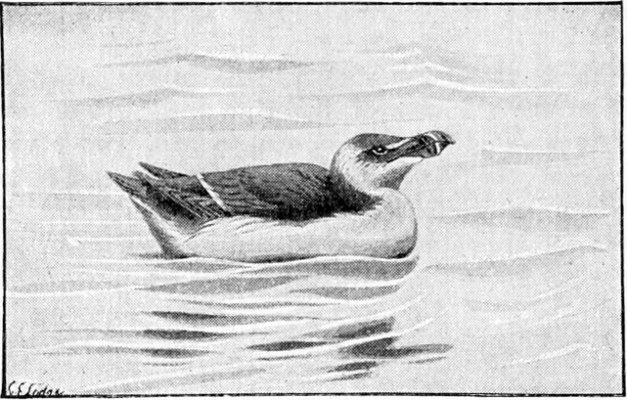
Fig. 118.—Razorbill (winter plumage). ¹⁄₁₁ natural size.
The razorbill is a handsome species, with shiny white under-plumage, the black upper parts relieved by a stripe of pure white on the head and a narrow white bar across the wing. The black, axe-like beak is also crossed in its deepest part with a white mark in the form of a crescent. Its life is mostly passed in the water, where it sits high and floats buoyantly like a duck. It feeds chiefly on small fishes, for which it dives, and when pursuing them uses the wings as well as feet in propulsion. On the sea the razorbills are usually seen in small flocks; they fly like diving ducks, with rapidly-beating wings, in a line, one bird behind the other, and so close as to be almost touching. In March they resort to the bold headlands and precipitous rocky cliffs which are their breeding-places. They are then seen associating with guillemots and puffins; for, albeit these three auks differ in appearance and breeding-habits, they seem to be aware of their relationship, and mix together in a friendly way. It may, however, be noticed that on a ledge where many guillemots and a few razorbills are assembled, as a rule the latter form a little group by themselves. This species is somewhat silent, although they occasionally utter long cries, somewhat gull-like in character, but lower and more guttural. When disturbed they emit a different sound, peculiar and human-like in tone, resembling the low moans of a person in pain.
A single egg is laid by the razorbill, and is placed in a cranny, sometimes in a hole several feet deep; occasionally the egg is deposited in a hollow on a rocky ledge, and in such situations razorbills and guillemots are found breeding side by side. The egg is large and handsome, the ground-colour white, spotted and blotched with different shades of blackish and deep reddish brown, and sometimes chocolate-colour. Both birds take part in incubating. An observer who has studied the habits of this bird says that in most cases the young fly down to the sea, usually early in the morning, and being once there, do not return to the rocks, as their wings are not then strong enough to enable them to mount upwards. ‘Sometimes,’ he writes, ‘when the young one is obstinate, the mother will take it by the back of the neck, and fly down to the sea.’ (Zoologist, 1871, p. 2427.) He adds that the parent teaches the young bird to dive by taking it by the neck and diving with it.
The breeding season over, the birds do not return to the rocks until the next spring.
Common Guillemot. Lomvia troile.
Head, neck, and upper parts blackish brown; under parts white. Length, eighteen inches.
The common guillemot is the most abundant of the four species of auks which inhabit the British Islands. Less handsome and striking in appearance than the razorbill, in its habits it is just as interesting. It is found in the breeding season on all parts of our coasts where extensive rocky cliffs and headlands exist, and it has not been driven away by persecution. At some points on the coast, as at Bempton Cliffs and Flamborough Head, and at the Farne Islands, and other localities farther north, the guillemots are still exceedingly numerous; south of Yorkshire they have greatly diminished in numbers, and several of the old breeding-stations have been abandoned.
On the sea their habits are similar to those of the razorbill: they swim, dive, and fly in strings in the same manner. In appearance the two species differ considerably. The guillemot has a dusky brown or mouse-coloured upper plumage, and a straight, sharp beak, very different to the massive weapon of the razorbill.
Early in spring the guillemots begin to gather from the neighbouring seas at their old breeding-stations on the summits and sides of cliffs that face the ocean. Of all birds that breed in communities, they are the most social, or, at all events, crowd closest together. Where they breed on the side of the cliff, as at Flamborough, they may be seen standing in close rows and groups on every ledge or jutting rock large enough to afford them a footing. A strange and fascinating spectacle is presented when the cliff is looked at from below, and the guillemots are seen in thousands, row above row, lessening in size by distance until, near the summit of the vast precipice, they appear no bigger than dippers; all standing erect, their backs to the dark stone wall, and their shiny, white breasts to the sea. It is also strange to see them gathered on the flat, table-like tops of the ‘Pinnacles,’ a group of isolated, precipitous rocks at the Farnes; for here the space they have is not sufficient to properly accommodate the vast number of birds that resort to it. Their appearance forcibly reminds the spectator of a human crowd on some fête day in a populous city; but the bird-crowd does not move or sway: each guillemot keeps its place, for it is standing over its own egg, which must be kept warm at any cost. In spite of this fixity they are all very alert and lively, turning their beaks about this way and that, and, when alarmed, all bobbing and bowing their heads as if to salute the intruder. Although silent birds when on the sea, the guillemots become loquacious at their breeding-grounds. They are very excitable, and when two or three neighbours quarrel, as they frequently do, or a bird returned from the sea drops on to a ledge where others are standing, or when male and female meet again after a separation of a few hours, there is a great deal of noise. They utter a hoarse, long-drawn cry, like the beginning of a dog’s howl before he has cleared his voice; also a succession of laughter-like notes, and other sounds resembling the cries, guttural and clear, of the black-headed gull; and, sometimes, short, barking notes like those of geese and sheldrakes.
Like most short-winged, heavy-bodied birds, they fly straight to their point, rushing violently through the air with rapidly-beating wings. It is amusing to watch a bird flying in from the sea, and attempting to alight on a ledge of rock already crowded; one or two birds at the spot the new-comer attempts to drop on threaten to strike with their beaks. This demonstration prevents him from coming down among them; and, being incapable of gliding off to one side to drop on to some other spot, or of suspending himself in the air for a few moments, he is compelled to drop down without touching the ledge, sweep round, and go straight out to sea again, and after flying a distance of three or four hundred yards, or farther, to circle round and come back to the ledge a second time. The frustrated bird is often seen to fly right away out of sight.
The single egg of the guillemot is deposited on the naked rock, without any nest, often dangerously near the edge. The sitting-birds are very careful when leaving the rock to push the eggs from under them; but when suddenly startled, as by the report of a gun fired from a ship or boat for the amusement of cockney excursionists, the eggs may be thrown off the ledge, and in some instances have been seen to fall in a shower down the cliff-side. The guillemot lays a handsome pear-shaped egg, very large for the bird. No other bird lays eggs so various in colour; so greatly do they vary that two eggs cannot be found quite alike, even among hundreds. The ground-colour in different specimens is white, cream, stone-colour, pale blue, reddish, and many shades of green, from a strong, bright green to olive-green. The egg is spotted and blotched with brown, black, and deep red, and grey. The guillemot when incubating does not lie on its egg like most birds, but stands with the egg between its legs, which are placed very far back, as in all auks, divers, and grebes. It is a pretty and amusing sight to watch the guillemot, when returning to her egg after a short absence, walk on to it, and adjust and readjust it a score of times, using her beak and chin for the purpose, before she is satisfied that it is effectually covered. Incubation lasts a month, and only one young bird is reared in the season; if the first egg is taken she will lay a second, and sometimes a third.
In strange contrast to the guttural croaking and barking cries of the adults is the language of the young bird. Its hunger-note is a far-reaching, sandpiper-like cry, clear, tremulous, and musical. In imitation of this sound the young bird is called a willock; and it is supposed that the name of guillemot, which is of French origin, is also derived from the young bird’s cry.
Black Guillemot. Uria grylle.
Plumage sooty black, except a patch on the wing-coverts, which is white with a black bar; bill black; legs vermilion-red. Length, fourteen inches.
The black guillemot is much less abundant than the last species. On the south and east coasts it is extremely rare; its principal breeding-stations are on the west coast of Scotland; and it also breeds on the north and west coasts of Ireland. It differs greatly from the common guillemot in size, being scarcely more than half as large as that species; also in colouring, the whole plumage, except a broad white patch on the wing, being glossy black, the legs and feet bright red. It breeds in the same situations as the common guillemot, but is not so gregarious; and in its nesting-habits it resembles the razorbill, laying its eggs in a hole or cranny in the rocks, or beneath a rock on the soil. Two eggs are laid, in ground-colour white, or pale stone, or pale green, spotted and blotched with brown and grey. The young are covered with a greyish black down, and their first plumage is mottled black and white.
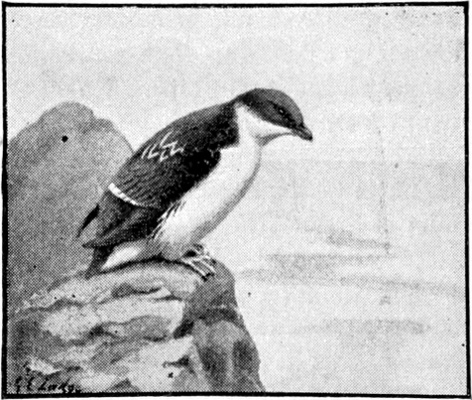
Fig. 119.—Little Auk. ⅛ natural size.
The black guillemot frequents the seas in the vicinity of its breeding-station throughout the year.
Brünnich’s guillemot (Lomvia bruennichi) is a very rare straggler from the arctic regions to the northern islands and coasts of Scotland.
The little auk (Margulus alle) is an irregular visitor, sometimes in considerable numbers, to the British coasts, especially in the north. It is a circumpolar species, and straggles southwards in winter, but seldom approaches the British Islands, except in very severe weather.
Puffin. Fratercula arctica.
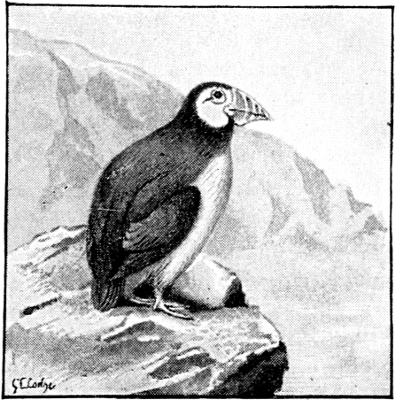
Fig. 120.—Puffin. ⅑ natural size.
Crown, collar, and upper parts black, all the rest white; bill, bluish at the base, yellow in the middle, bright red at the tip; legs and feet orange-red. Length, twelve inches.
Among British birds, whether sea or land, the puffin is the most singular in appearance—a small auk, compact in build, conspicuous in black and white plumage, broad collar, white, owlish face, and great beak, short and adze-shaped, but massive as a toucan’s. The brilliant colours of this beak, too—red with orange bars—give it a curious resemblance to the enormous organ of the tropical bird. One may look at the puffin almost daily, as he stands on the rocks, always with something of surprise at his strikingly handsome yet grotesque appearance. The fanciful idea suggests itself that the bird is a masquerader; that the visible, brilliantly coloured beak has been artificially made, and put on over the natural beak, just as in the case of a human masquerader a large, gaily coloured, artificial nose is sometimes placed over the natural organ. And the puffin’s beak is, in fact, something of a mask, or superimposed ornament; and after the breeding season its surface peels off in horny plates, and is shed like the deciduous bark of certain trees. The bird’s beak in winter is moderate in size and dull-coloured.
The puffin is a spring visitor to our coasts, and after rearing their young the birds scatter over the sea and journey southwards. The puffins found on the east coasts of England and Scotland during the winter months are probably migrants from more northern latitudes. Puffins are found in summer in most localities on our coasts where razorbills and guillemots collect; on the south coast they are rare, but increase as we go north, until at St. Kilda they are found gathered in incalculable numbers. As a cliff-breeder the puffin deposits its egg in a hole or cranny in the rocks like the razorbill, but never on an exposed ledge, as the guillemot always, and the razorbill sometimes, does. Sometimes they take forcible possession of rabbit-burrows among sandhills, driving the owners out; but they prefer making their own burrows in a soft peaty soil, such as they find at St. Kilda and in many other localities. In March or April they return from their wanderings on the sea and begin the great business of the year. Where they are in large numbers and make their burrows near each other the soft soil is so undermined by them that it is difficult to walk over the ground without breaking through the turf and sinking almost knee-deep in their holes at every few steps. When engaged in digging the birds are so intent on their work that they may be approached very closely, and sometimes even taken with the hand. The burrow is three or four feet in length, sometimes more, and at the extremity a single egg is laid, oval in form, large for the bird’s size, and white, faintly spotted and streaked with grey. The young bird is covered with black down, and has a comparatively small beak, of a dark colour. He is a squat, lumpish creature, owlish in appearance. When fishing to supply its young the parent puffin has the curious habit and faculty of keeping the small fishes it catches in its beak, where they may be seen as the bird swims on the sea, their tails and a portion of their bodies protruding at the sides of the beak and mouth. How it manages to hold several little fishes in this way and go on diving and catching others is a puzzle. On arriving at the burrow the fishes are placed on the floor inside, or at the entrance, where the young bird sits waiting for its parent, and are then picked up one by one and put into the open, hungry mouth.