Front matter
Reading edition
BIOLOGY AND ITS MAKERS
With Portraits and Other Illustrations
BY
WILLIAM A. LOCY, Ph.D., Sc.D.
Professor in Northwestern University
NEW YORK
HENRY HOLT AND COMPANY
1908
Copyright, 1908,
BY
HENRY HOLT AND COMPANY
Published June, 1908
To MY GRADUATE STUDENTS Who have worked by my side in the Laboratory Inspired by the belief that those who seek shall find This account of the findings of some of The great men of biological science Is dedicated by The Author
PREFACE
The writer is annually in receipt of letters from students, teachers, ministers, medical men, and others, asking for information on topics in general biology, and for references to the best reading on that subject. The increasing frequency of such inquiries, and the wide range of topics covered, have created the impression that an untechnical account of the rise and progress of biology would be of interest to a considerable audience. As might be surmised, the references most commonly asked for are those relating to different phases of the Evolution Theory; but the fact is usually overlooked by the inquirers that some knowledge of other features of biological research is essential even to an intelligent comprehension of that theory.
In this sketch I have attempted to bring under one view the broad features of biological progress, and to increase the human interest by writing the story around the lives of the great Leaders. The practical execution of the task resolved itself largely into the question of what to omit. The number of detailed researches upon which progress in biology rests made rigid selection necessary, and the difficulties of separating the essential from the less important, and of distinguishing between men of temporary notoriety and those of enduring fame, have given rise to no small perplexities.
The aim has been kept in mind to give a picture sufficiently diagrammatic not to confuse the general reader, and it is hoped that the omissions which have seemed necessary will, in a measure, be compensated for by the clearness of the picture. References to selected books and articles have been given at the close of the volume, that will enable readers who wish fuller information to go to the best sources.
The book is divided into two sections. In the first are considered the sources of the ideas—except those of organic evolution—that dominate biology, and the steps by which they have been molded into a unified science. The Doctrine of Organic Evolution, on account of its importance, is reserved for special consideration in the second section. This is, of course, merely a division of convenience, since after its acceptance the doctrine of evolution has entered into all phases of biological progress.
The portraits with which the text is illustrated embrace those of nearly all the founders of biology. Some of the rarer ones are unfamiliar even to biologists, and have been discovered only after long search in the libraries of Europe and America.
An orderly account of the rise of biology can hardly fail to be of service to the class of inquirers mentioned in the opening paragraph. It is hoped that this sketch will also meet some of the needs of the increasing body of students who are doing practical work in biological laboratories. It is important that such students, in addition to the usual classroom instruction, should get a perspective view of the way in which biological science has come into its present form.
The chief purpose of the book will have been met if I have succeeded in indicating the sources of biological ideas and the main currents along which they have advanced, and if I have succeeded, furthermore, in making readers acquainted with those men of noble purpose whose work has created the epochs of biological history, and in showing that there has been continuity of development in biological thought.
Of biologists who may examine this work with a critical purpose, I beg that they will think of it merely as an outline sketch which does not pretend to give a complete history of biological thought. The story has been developed almost entirely from the side of animal life; not that the botanical side has been underestimated, but that the story can be told from either side, and my first-hand acquaintance with botanical investigation is not sufficient to justify an attempt to estimate its particular achievements.
The writer is keenly aware of the many imperfections in the book. It is inevitable that biologists with interests in special fields will miss familiar names and the mention of special pieces of notable work, but I am drawn to think that such omissions will be viewed leniently, by the consideration that those best able to judge the shortcomings of this sketch will also best understand the difficulties involved.
The author wishes to acknowledge his indebtedness to several publishing houses and to individuals for permission to copy cuts and for assistance in obtaining portraits. He takes this opportunity to express his best thanks for these courtesies. The parties referred to are the director of the American Museum of Natural History; D. Appleton & Co.; P. Blakiston's Sons & Co.; The Macmillan Company; The Open Court Publishing Company; the editor of the Popular Science Monthly; Charles Scribner's Sons; Professors Bateson, of Cambridge, England; Conklin, of Philadelphia; Joubin, of Rennes, France; Nierstrasz, of Utrecht, Holland; Newcombe, of Ann Arbor, Michigan; Wheeler and E.B. Wilson, of New York City. The editor of the Popular Science Monthly has also given permission to reprint the substance of Chapters IV and X, which originally appeared in that publication.
W.A.L.
Northwestern University, Evanston, Ill., April, 1908.
CONTENTS
PART I
The Sources of Biological Ideas Except Those of Organic Evolution
CHAPTER I
An Outline of the Rise of Biology and of the Epochs in its History, 3
Notable advances in natural science during the nineteenth century, 3. Biology the central subject in the history of opinion regarding life, 4. It is of commanding importance in the world of science, 5. Difficulties in making its progress clear, 5. Notwithstanding its numerous details, there has been a relatively simple and orderly progress in biology, 6. Many books about the facts of biology, many excellent laboratory manuals, but scarcely any attempt to trace the growth of biological ideas, 6. The growth of knowledge regarding organic nature a long story full of human interest, 7. The men of science, 7. The story of their aspirations and struggles an inspiring history, 8. The conditions under which science developed, 8. The ancient Greeks studied nature by observation and experiment, but this method underwent eclipse, 9. Aristotle the founder of natural history, 9. Science before his day, 9, 10. Aristotle's position in the development of science, 11. His extensive knowledge of animals, 12. His scientific writings, 13. Personal appearance, 13. His influence, 15. Pliny: his writings mark a decline in scientific method, 16. The arrest of inquiry and its effects, 17. A complete change in the mental interests of mankind, 17. Men cease to observe and indulge in metaphysical speculation, 18. Authority declared the source of knowledge, 18. The revolt of the intellect against these conditions, 19. The renewal of observation, 19. The beneficent results of this movement, 20. Enumeration of the chief epochs in biological history: renewal of observation, 20; the overthrow of authority in science, 20. Harvey and experimental investigation, 20; introduction of microscopes, 20; Linnæus, 20; Cuvier, 20; Bichat, 21; Von Baer, 21; the rise of physiology, 21; the beginnings of evolutionary thought, 21; the cell-theory, 21; the discovery of protoplasm, 21.
CHAPTER II
Vesalius and the Overthrow of Authority in Science, 22
Vesalius, in a broad sense, one of the founders of biology, 22. A picture of the condition of anatomy before he took it up, 23. Galen: his great influence as a scientific writer, 24. Anatomy in the Middle Ages, 24. Predecessors of Vesalius: Mundinus, Berangarius, Sylvius, 26. Vesalius gifted and forceful, 27. His impetuous nature, 27. His reform in the teaching of anatomy, 28. His physiognomy, 30. His great book (1543), 30. A description of its illustrations, 30, 32. Curious conceits of the artist, 32. Opposition to Vesalius: curved thigh bones due to wearing tight trousers, the resurrection bone, 34, 35. The court physician, 35. Close of his life, 36. Some of his successors: Eustachius and Fallopius, 36. The especial service of Vesalius: he overthrew dependence on authority and reëstablished the scientific method of ascertaining truth, 37, 38.
CHAPTER III
William Harvey and Experimental Observation, 39
Harvey's work complemental to that of Vesalius, 39. Their combined labors laid the foundations of the modern method of investigating nature, 39. Harvey introduces experiments on living organisms, 40. Harvey's education, 40. At Padua, comes under the influence of Fabricius, 41. Return to England, 42. His personal qualities, 42-45. Harvey's writings, 45. His great classic on movement of the heart and blood (1628), 46. His demonstration of circulation of the blood based on cogent reasoning; he did not have ocular proof of its passage through capillaries, 47. Views of his predecessors on the movement of the blood, 48. Servetus, 50. Realdus Columbus, 50. Cæsalpinus, 51. The originality of Harvey's views, 51. Harvey's argument, 51. Harvey's influence, 52. A versatile student; work in other directions, 52. His discovery of the circulation created modern physiology, 52. His method of inquiry became a permanent part of biological science, 53.
CHAPTER IV
The Introduction of the Microscope and the Progress of Independent Observation, 54
The pioneer microscopists: Hooke and Grew in England; Malpighi in Italy and Swammerdam and Leeuwenhoek in Holland, 54. Robert Hooke, 55. His microscope and the micrographia (1665), 56. Grew one of the founders of vegetable histology, 56. Malpighi, 1628-1694, 58. Personal qualities, 58. Education, 60. University positions, 60, 61. Honors at home and abroad, 61. Activity in research, 62. His principal writings: Monograph on the silkworm, 63; anatomy of plants, 66; work in embryology, 66. Jan Swammerdam, 1637-1680, 67. His temperament, 67. Early interest in natural history, 68. Studies medicine, 68. Important observations, 68. Devotes himself to minute anatomy, 70. Method of working, 71. Great intensity, 70. High quality of his work, 72. The Biblia Naturæ, 73. Its publication delayed until fifty-seven years after his death, 73. Illustrations of his anatomical work, 75-76. Antony van Leeuwenhoek, 1632-1723, 77. A composed and better-balanced man, 77. Self-taught in science, the effect of this showing in the desultory character of his observations, 77, 87. Physiognomy, 78. New biographical facts, 78. His love of microscopic observation, 80. His microscopes, 81. His scientific letters, 83. Observes the capillary circulation in 1686, 84. His other discoveries, 86. Comparison of the three men: the two university-trained men left coherent pieces of work, that of Leeuwenhoek was discursive, 87. The combined force of their labors marks an epoch, 88. The new intellectual movement now well under way, 88.
CHAPTER V
The Progress of Minute Anatomy, 89
Progress in minute anatomy a feature of the eighteenth century. Attractiveness of insect anatomy. Enthusiasm awakened by the delicacy and perfection of minute structure, 89. Lyonet, 1707-1789, 90. Description of his remarkable monograph on the anatomy of the willow caterpillar, 91. Selected illustrations, 92-94. Great detail—4,041 muscles, 91. Extraordinary character of his drawings, 90. A model of detailed dissection, but lacking in comparison and insight, 92. The work of Réaumur, Roesel, and De Geer on a higher plane as regards knowledge of insect life, 95. Straus-Dürckheim's monograph on insect anatomy, 96. Rivals that of Lyonet in detail and in the execution of the plates, 99. His general considerations now antiquated, 99. He attempted to make insect anatomy comparative, 100. Dufour endeavors to found a broad science of insect anatomy, 100. Newport, a very skilful dissector, with philosophical cast of mind, who recognizes the value of embryology in anatomical work, 100. Leydig starts a new kind of insect anatomy embracing microscopic structure (histology), 102. This the beginning of modern work, 102. Structural studies on other small animals, 103. The discovery of the simplest animals, 104. Observations on the microscopic animalcula, 105. The protozoa discovered in 1675 by Leeuwenhoek, 105. Work of O.F. Müller, 1786, 106. Of Ehrenberg 1838, 107. Recent observations on protozoa, 109.
CHAPTER VI
Linnæus and Scientific Natural History, 110
Natural history had a parallel development with comparative anatomy, 110. The Physiologus, or sacred natural history of the Middle Ages, 110, 111. The lowest level reached by zoölogy, 111. The return to the science of Aristotle a real advance over the Physiologus, 112. The advance due to Wotton in 1552, 112. Gesner, 1516-1565. High quality of his Historia Animalium, 112-114. The scientific writings of Jonson and Aldrovandi, 114. John Ray the forerunner of Linnæus, 115. His writings, 117. Ray's idea of species, 117. Linnæus or Linné, 118. A unique service to natural history. Brings the binomial nomenclature into general use, 118. Personal history, 119. Quality of his mind, 120. His early struggles with poverty, 120. Gets his degree in Holland, 121. Publication of the Systema Naturæ in 1735, 121. Return to Sweden, 123. Success as a university professor in Upsala, 123. Personal appearance, 125. His influence on natural history, 125. His especial service, 126. His idea of species, 128. Summary, 129. Reform of the Linnæan system, 130-138. The necessity of reform, 130. The scale of being, 131. Lamarck the first to use a genealogical tree, 132. Cuvier's four branches, 132. Alterations by Von Siebold and Leuckart, 134-137. Tabular view of classifications, 138. General biological progress from Linnæus to Darwin. Although details were multiplied, progress was by a series of steps, 138. Analysis of animals proceeded from the organism to organs, from organs to tissues, from tissues to cells, the elementary parts, and finally to protoplasm, 139-140. The physiological side had a parallel development, 140.
CHAPTER VII
Cuvier and the Rise of Comparative Anatomy, 141
The study of internal structure of living beings, at first merely descriptive, becomes comparative, 141. Belon, 141. Severinus writes the first book devoted to comparative anatomy in 1645, 143. The anatomical studies of Camper, 143. John Hunter, 144. Personal characteristics, 145. His contribution to progress, 146. Vicq d'Azyr the greatest comparative anatomist before Cuvier, 146-148. Cuvier makes a comprehensive study of the structure of animals, 148. His birth and early education, 149. Life at the sea shore, 150. Six years of quiet study and contemplation lays the foundation of his scientific career, 150. Goes to Paris, 151. His physiognomy, 152. Comprehensiveness of his mind, 154. Founder of comparative anatomy, 155. His domestic life, 155. Some shortcomings, 156. His break with early friends, 156. Estimate of George Bancroft, 156. Cuvier's successors: Milne-Edwards, 157; Lacaze-Duthiers, 157; Richard Owen, 158; Oken, 160; J. Fr. Meckel, 162; Rathke, 163; J. Müller, 163; Karl Gegenbaur, 164; E.D. Cope, 165. Comparative anatomy a rich subject, 165. It is now becoming experimental, 165.
CHAPTER VIII
Bichat and the Birth of Histology, 166
Bichat one of the foremost men in biological history. He carried the analysis of animal organization to a deeper level than Cuvier, 166. Buckle's estimate, 166. Bichat goes to Paris, 167. Attracts attention in Desault's classes, 167. Goes to live with Desault, 168. His fidelity and phenomenal industry, 168. Personal appearance, 168. Begins to publish researches on tissues at the age of thirty, 170. His untimely death at thirty-one, 170. Influence of his writings, 170. His more notable successors: Schwann, 171; Koelliker, a striking figure in the development of biology, 171; Max Schultze, 172; Rudolph Virchow, 174; Leydig, 175; Ramon y Cajal, 176. Modern text-books on histology, 177.
CHAPTER IX
The Rise of Physiology—Harvey. Haller. Johannes Müller, 179
Physiology had a parallel development with anatomy, 179. Physiology of the ancients, 179. Galen, 180. Period of Harvey, 180. His demonstration of circulation of the blood, 180. His method of experimental investigation, 181. Period of Haller, 181. Physiology developed as an independent science, 183. Haller's personal characteristics, 181. His idea of vital force, 182. His book on the Elements of Physiology a valuable work, 183. Discovery of oxygen by Priestley in 1774, 183. Charles Bell's great discovery on the nervous system, 183. Period of Johannes Müller, 184. A man of unusual gifts and personal attractiveness, 185. His personal appearance, 185. His great influence over students, 185. His especial service was to make physiology broadly comparative, 186. His monumental Handbook of Physiology, 186. Unexampled accuracy in observation, 186. Introduces the principles of psychology into physiology, 186. Physiology after Müller, 188-195. Ludwig, 188. Du Bois-Reymond, 189. Claude Bernard, 190. Two directions of growth in physiology—the chemical and the physical, 192. Influence upon biology, 193. Other great names in physiology, 194.
CHAPTER X
Von Baer and the Rise of Embryology, 195
Romantic nature of embryology, 195. Its importance, 195. Rudimentary organs and their meaning, 195. The domain of embryology, 196. Five historical periods, 196. The period of Harvey and Malpighi, 197-205. The embryological work of these two men insufficiently recognized, 197. Harvey's pioneer attempt critically to analyze the process of development, 198. His teaching regarding the nature of development, 199. His treatise on Generation, 199. The frontispiece of the edition of 1651, 202, 202. Malpighi's papers on the formation of the chick within the egg, 202. Quality of his pictures, 202. His belief in pre-formation, 207. Malpighi's rank as embryologist, 205. The period of Wolff, 205-214. Rise of the theory of pre-delineation, 206. Sources of the idea that the embryo is pre-formed within the egg, 207. Malpighi's observations quoted, 207. Swammerdam's view, 208. Leeuwenhoek and the discovery of the sperm, 208. Bonnet's views on emboîtement, 208. Wolff opposes the doctrine of pre-formation, 210. His famous Theory of Generation (1759), 210. Sketches from this treatise, 210. His views on the directing force in development, 211. His highest grade of work, 211. Opposition of Haller and Bonnet, 211. Restoration of Wolff's views by Meckel, 212. Personal characteristics of Wolff, 213. The period of Von Baer, 214-222. The greatest personality in embryology, 215. His monumental work on the Development of Animals a choice combination of observation and reflection, 215. Von Baer's especial service, 217. Establishes the germ-layer theory, 218. Consequences, 219. His influence on embryology, 220. The period from Von Baer to Balfour, 222-226. The process of development brought into a new light by the cell-theory, 222. Rathke, Remak, Koelliker, Huxley, Kowalevsky, 223, 224. Beginnings of the idea of germinal continuity, 225. Influence of the doctrine of organic evolution, 226. The period of Balfour, with an indication of present tendencies, 226-236. The great influence of Balfour's Comparative Embryology, 226. Personality of Balfour, 228. His tragic fate, 228. Interpretation of the embryological record, 229. The recapitulation theory, 230. Oskar Hertwig, 232. Wilhelm His, 232. Recent tendencies; Experimental embryology, 232; Cell-lineage, 234; Theoretical discussions, 235.
CHAPTER XI
The Cell-Theory—Schleiden. Schwann. Schultze, 237
Unifying power of the cell-theory, 237. Vague foreshadowings, 237. The first pictures of cells from Robert Hooke's Micrographia, 238. Cells as depicted by Malpighi, Grew, and Leeuwenhoek, 239, 240. Wolff on cellular structure, 240, 241. Oken, 241. The announcement of the cell-theory in 1838-39, 242. Schleiden and Schwann co-founders, 243. Schleiden's work, 243. His acquaintance with Schwann, 243. Schwann's personal appearance, 244. Influenced by Johannes Müller, 245. The cell-theory his most important work, 246. Schleiden, his temperament and disposition, 247. Schleiden's contribution to the cell-theory, 247. Errors in his observations and conclusions, 248. Schwann's treatise, 248. Purpose of his researches, 249. Quotations from his microscopical researches, 249. Schwann's part in establishing the cell-theory more important than that of Schleiden, 250. Modification of the cell-theory, 250. Necessity of modifications, 250. The discovery of protoplasm, and its effect on the cell-theory, 250. The cell-theory becomes harmonized with the protoplasm doctrine of Max Schultze, 251. Further modifications of the cell-theory, 252. Origin of cells in tissues, 252. Structure of the nucleus, 253. Chromosomes, 254. Centrosome, 256. The principles of heredity as related to cellular studies, 257. Verworn's definition, 258. Vast importance of the cell-theory in advancing biology, 258.
CHAPTER XII
Protoplasm the Physical Basis of Life, 259
Great influence of the protoplasm doctrine on biological progress, 259. Protoplasm, 259. Its properties as discovered by examination of the amœba, 260. Microscopic examination of a transparent leaf, 261. Unceasing activity of its protoplasm, 261. The wonderful energies of protoplasm, 261. Quotation from Huxley, 262. The discovery of protoplasm and the essential steps in recognizing the part it plays in living beings, 262-275. Dujardin, 262. His personality, 263. Education, 263. His contributions to science, 264. His discovery of "sarcode" in the simplest animals, in 1835, 266. Purkinje, in 1840, uses the term protoplasma, 267. Von Mohl, in 1846, brings the designation protoplasm into general use, 268. Cohn, in 1850, maintains the identity of sarcode and protoplasm, 270. Work of De Bary and Virchow, 272. Max Schultze, in 1861, shows that there is a broad likeness between the protoplasm of animals and plants, and establishes the protoplasm doctrine. The university life of Schultze. His love of music and science. Founds a famous biological periodical, 272-274. The period from 1840 to 1860 an important one for biology, 274.
CHAPTER XIII
The Work of Pasteur, Koch, and Others, 276
The bacteria discovered by Leeuwenhoek in 1687, 276. The development of the science of bacteriology of great importance to the human race, 276. Some general topics connected with the study of bacteria, 277. The spontaneous origin of life, 277-293. Biogenesis or abiogenesis, 277. Historical development of the question, 277. I. From Aristotle, 325 B.C., to Redi, 1668, 278. The spontaneous origin of living forms universally believed in, 278. Illustrations, 278. II. From Redi to Schwann, 278-284. Redi, in 1668, puts the question to experimental test and overthrows the belief in the spontaneous origin of forms visible to the unaided eye, 279. The problem narrowed to the origin of microscopic animalcula, 281. Needham and Buffon test the question by the use of tightly corked vials containing boiled organic solutions, 281. Microscopic life appears in their infusions, 282. Spallanzani, in 1775, uses hermetically sealed glass flasks and gets opposite results, 282. The discovery of oxygen raises another question: Does prolonged heat change its vitalizing properties? 284. Experiments of Schwann and Schulze, 1836-37, 284. The question of the spontaneous origin of microscopic life regarded as disproved, 286. III. Pouchet reopens the question in 1858, maintaining that he finds microscopic life produced in sterilized and hermetically sealed solutions, 286. The question put to rest by the brilliant researches of Pasteur and of Tyndall, 288, 289. Description of Tyndall's apparatus and his use of optically pure air, 294. Weismann's theoretical speculations regarding the origin of biophors,292. The germ-theory of disease, 293-304. The idea of contagium vivum revived in 1840, 293. Work of Bassi, 293. Demonstration, in 1877, of the actual connection between anthrax and splenic fever, 294. Veneration of Pasteur, 294. His personal qualities, 296. Filial devotion, 297. Steps in his intellectual development, 298. His investigation of diseases of wine (1868), 298. Of the silkworm plague (1865-68), 298. His studies on the cause and prevention of disease constitute his chief service to humanity, 298. Establishment of the Pasteur Institute in Paris, 298. Recent developments, 300. Robert Koch; his services in discovering many bacteria of disease, 300. Sir Joseph Lister and antiseptic surgery, 302. Bacteria in their relation to agriculture, soil inoculation, etc., 303. Knowledge of bacteria as related to the growth of general biology, 304.
CHAPTER XIV
Heredity and Germinal Continuity—Mendel. Galton. Weismann, 305
The hereditary substance and the bearers of heredity, 305. The nature of inheritance, 305. Darwin's theory of pangenesis, 306. The theory of pangens replaced by that of germinal continuity, 307. Exposition of the theory of germinal continuity, 308. The law of cell-succession, 309. Omnis cellula e cellula, 309. The continuity of hereditary substance, 309. Early writers, 312. Weismann, 310. Germ-cells and body cells, 310. The hereditary substance is the germ-plasm, 311. It embodies all the past history of protoplasm, 311. The more precise investigation of the material basis of inheritance, 311. The nucleus of cells, 311. The chromosomes, 312. The fertilized ovum, the starting-point of new organisms, 313. Behavior of the nucleus during division, 313. The mixture of parental qualities in the chromosomes, 313. Prelocalized areas in the protoplasm of the egg, 314. The inheritance of acquired characteristics, 314. The application of statistical methods and experiments to the study of heredity, 314. Mendel's important discovery of alternative inheritance, 316. Francis Galton, 317. Carl Pearson, 318. Experiments on inheritance, 318.
CHAPTER XV
The Science of Fossil Life, 320
Extinct forms of life, 320. Strange views regarding fossils, 320. Freaks of nature, 321. Mystical explanations, 321. Large bones supposed to be those of giants, 322. Determination of the nature of fossils by Steno, 322. Fossil deposits ascribed to the Flood, 323. Mosaic deluge regarded as of universal extent, 324. The comparison of fossil and living animals of great importance, 325. Cuvier the founder of vertebrate palæontology, 325. Lamarck founds invertebrate palæontology, 326. Lamarck's conception of the meaning of fossils more scientific than Cuvier's, 327. The arrangement of fossils in strata, 328. William Smith, 328. Summary of the growth of the science of fossil life, 329. Fossil remains as an index to the past history of the earth, 332. Epoch-making work of Charles Lyell, 330. Effect of the doctrine of organic evolution on palæontology, 332. Richard Owen's studies on fossil animals, 332. Agassiz and the parallelism between fossil forms of life and stages in the development of animals, 334. Huxley's geological work, 335. Leidy, 337. Cope, 337. Marsh, 338. Carl Zittel's writings and influence, 338. Henry F. Osborn, 339. Method of collecting fossils, 340. Fossil remains of man, 340. Discoveries in the Fayûm district of Africa, 341.
PART II
The Doctrine of Organic Evolution
CHAPTER XVI
What Evolution Is: The Evidence upon which it Rests, etc., 345
Great vagueness regarding the meaning of evolution, 346. Causes for this, 346. The confusion of Darwinism with organic evolution, 347. The idea that the doctrine is losing ground, 347. Scientific controversies on evolution relate to the factors, not to the fact, of evolution, 347. Nature of the question: not metaphysical, not theological, but historical, 348. The historical method applied to the study of animal life, 349. The diversity of living forms, 349. Are species fixed in nature? 350. Wide variation among animals, 350. Evolutionary series: The shells of Slavonia and Steinheim, 351-353. Evolution of the horse, 354. The collection of fossil horses at the American Museum of Natural History, New York, 355. The genealogy of the horse traced for more than two million years, 354. Connecting forms: the archæopteryx and pterodactyls, 358. The embryological record and its connection with evolution, 358. Clues to the past history of animals, 358. Rudimentary organs, 361-363. Hereditary survivals in the human body, 363. Remains of the scaffolding for its building, 364. Antiquity of man, 364. Pre-human types, 365. Virtually three links: the Java man; the Neanderthal skull; the early neolithic man of Engis, 364-366. Evidences of man's evolution based on palæontology, embryology, and archæology, 366. Mental evolution, 366. Sweep of the doctrine of organic evolution, 366-367.
CHAPTER XVII
Theories of Evolution—Lamarck. Darwin, 368
The attempt to indicate the active factors of evolution is the source of the different theories, 368. The theories of Lamarck, Darwin, and Weismann have attracted the widest attention, 369. Lamarck, the man, 368-374. His education, 370. Leaves priestly studies for the army, 370. Great bravery, 371. Physical injury makes it necessary for him to give up military life, 371. Portrait, 373. Important work in botany, 371. Pathetic poverty and neglect, 372. Changes from botany to zoölogy at the age of fifty years, 372. Profound influence of this change in shaping his ideas, 374. His theory of evolution, 374-380. First public announcement in 1800, 375. His Philosophie Zoologique published in 1809, 375. His two laws of evolution, 376. The first law embodies the principle of use and disuse of organs, the second that of heredity, 376. A simple exposition of his theory, 377. His employment of the word besoin, 377. Lamarck's view of heredity, 377. His belief in the inheritance of acquired characters, 377. His attempt to account for variation, 377. Time and favorable conditions the two principal means employed by nature, 378. Salient points in Lamarck's theory, 378. His definition of species, 379. Neo-Lamarckism, 380. Darwin. His theory rests on three sets of facts. The central feature of his theory is natural selection. Variation, 380. Inheritance, 382. Those variations will be inherited that are of advantage to the race, 383. Illustrations of the meaning of natural selection, 383-389. The struggle for existence and its consequences, 384. Various aspects of natural selection, 384. It does not always operate toward increasing the efficiency of an organ—short-winged beetles, 385. Color of animals, 386. Mimicry, 387. Sexual selection, 388. Inadequacy of natural selection, 389. Darwin the first to call attention to the inadequacy of this principle, 389. Confusion between the theories of Lamarck and Darwin, 390. Illustrations, 391. The Origin of Species published in 1859, 391. Other writings of Darwin, 391.
CHAPTER XVIII
Theories Continued—Weismann. De Vries, 392
Weismann's views have passed through various stages of remodeling, 392. The Evolution Theory published in 1904 is the best exposition of his views, 392. His theory the field for much controversy. Primarily a theory of heredity, 393. Weismann's theory summarized, 393. Continuity of the germ-plasm the central idea in Weismann's theory, 394. Complexity of the germ-plasm. Illustrations, 395. The origin of variations, 396. The union of two complex germ-plasms gives rise to variations, 396. His extension of the principle of natural selection—germinal selection, 397. The inheritance of acquired characters, 398. Weismann's analysis of the subject the best, 398. Illustrations, 399. The question still open to experimental observation, 399. Weismann's personality, 400. Quotation from his autobiography, 401. The mutation theory of De Vries, 402. An important contribution. His application of experiments commendable, 403. The mutation theory not a substitute for that of natural selection, 404. Tendency toward a reconciliation of apparently conflicting views, 404. Summary of the salient features of the theories of Lamarck, of Darwin, of Weismann, and De Vries, 405. Causes for bewilderment in the popular mind regarding the different forms of the evolution theory, 406.
CHAPTER XIX
The Rise of Evolutionary Thought, 407
Opinion before Lamarck, 407. Views of certain Fathers of the Church, 408. St. Augustine, 409. St. Thomas Aquinas, 409. The rise of the doctrine of special creation, 410. Suarez, 410. Effect of John Milton's writings, 411. Forerunners of Lamarck: Buffon, Erasmus Darwin, Goethe, 411. Statement of Buffon's views on evolution, 412. Erasmus Darwin the greatest of Lamarck's predecessors, 413. His writings, 414. Paley's Natural Theology directed against them, 414. Goethe's connection with evolutionary thought, 414. Causes for the neglect of Lamarck's theoretical writings, 415. The temporary disappearance of the doctrine of organic evolution, 415. Cuvier's opposition, 415. The debate between Cuvier and St. Hilaire, 415. Its effect, 417. Influence of Lyell's Principles of Geology, 418. Herbert Spencer's analysis in 1852, 419. Darwin and Wallace, 420. Circumstances under which their work was laid before the Linnæan Society of London, 420. The letter of transmission signed by Lyell and Hooker, 420-422. The personality of Darwin, 422. Appearance, 423. His charm of manner, 423. Affectionate consideration at home, 424. Unexampled industry and conscientiousness in the face of ill health, 424, 426. His early life and education, 425. Voyage of the Beagle, 425. The results of his five years' voyage, 426. Life at Downs, 426. Parallelism in the thought of Darwin and Wallace, 427. Darwin's account of how he arrived at the conception of natural selection, 427. Wallace's narrative, 428. The Darwin-Wallace theory launched in 1858, 429. Darwin's book on The Origin of Species regarded by him as merely an outline, 429. The spread of the doctrine of organic evolution, 429. Huxley one of its great popular exponents, 431. Haeckel, 431. After Darwin, the problem was to explain phenomena, 431.
CHAPTER XX
Retrospect and Prospect. Present Tendencies in Biology, 434
Biological thought shows continuity of development, 434. Character of the progress—a crusade against superstition, 434. The first triumph of the scientific method was the overthrow of authority, 435. The three stages of progress—descriptive, comparative, experimental, 435. The notable books of biology and their authors, 435-437. Recent tendencies in biology: higher standards, 437; improvement in the tools of science, 438; advance in methods, 439; experimental work, 439; the growing interest in the study of processes, 440; experiments applied to heredity and evolution, to fertilization of the egg, and to animal behavior, 440, 441. Some tendencies in anatomical studies, 442. Cell-lineage, 442. New work on the nervous system, 443. The application of biological facts to the benefit of mankind, 443. Technical biology, 443. Soil inoculation, 444. Relation of insects to the transmission of diseases, 444. The food of fishes, 444. The establishment and maintenance of biological laboratories, 444. The station at Naples, 444. Other stations, 446. The establishment and maintenance of technical periodicals, 446. Explorations of fossil records, 447. The reconstructive influence of biological progress, 448.
READING LIST, 449
I. General References, 449-451. II. Special References, 451-460.
Index, 461
ILLUSTRATIONS
1. Aristotle, 384-322 B.C., 2. Pliny, 23-79 A.D., 3. Galen, 131-200, 4. Vesalius, 1514-1565, 5. Anatomical Sketch from Vesalius' Fabrica (1543), 6. The Skeleton from Vesalius' Fabrica, 7. Initial Letters from the Fabrica, 8. Fallopius, 1523-1563, 9. Fabricius, Harvey's Teacher, 1537-1619, 10. William Harvey, 1578-1657, 11. Scheme of the Portal Circulation according to Vesalius (1543), 12. Hooke's Microscope (1665), 13. Malpighi, 1628-1694, 14. From Malpighi's Anatomy of the Silkworm (1669), 15. Swammerdam, 1637-1680, 16. From Swammerdam's Biblia Naturæ, 17. Anatomy of an Insect Dissected and Drawn by Swammerdam, 18. Leeuwenhoek, 1632-1723, 19. Leeuwenhoek's Microscope, 20a. Leeuwenhoek's Mechanism for Examining the Circulation of the Blood, 20b. The Capillary Circulation, after Leeuwenhoek, 21. Plant Cells from Leeuwenhoek's Arcana Naturæ, 22. Lyonet, 1707-1789, 23. Larva of the Willow Moth, from Lyonet's Monograph (1750), 24. Muscles of the Larva of the Willow Moth, from Lyonet's Monograph, 25. Central Nervous System and Nerves of the Same Animal, 26. Dissection of the Head of the Larva of the Willow Moth, 27. The Brain and Head Nerves of the Same Animal, 28. Roesel von Rosenhof, 1705-1759, 29. Réaumur, 1683-1757, 30. Nervous System of the Cockchafer, from Straus-Dürckheim's Monograph (1828), 31. Ehrenberg, 1795-1876,8 32. Gesner, 1516-1565, 33. John Ray, 1628-1705, 34. Linnæus at Sixty (1707-1778), 35. Karl Th. von Siebold, 36. Rudolph Leuckart, 37. Severinus, 1580-1656, 38. Camper, 1722-1789, 39. John Hunter, 1728-1793, 40. Vicq d'Azyr, 1748-1794, 41. Cuvier as a Young Man, 1769-1829, 42. Cuvier at the Zenith of His Power, 43. H. Milne-Edwards, 1800-1885, 44. Lacaze-Duthiers, 1821-1901, 45. Lorenzo Oken, 1779-1851, 46. Richard Owen, 1804-1892, 47. J. Fr. Meckel, 1781-1833, 48. Karl Gegenbaur, 1826-1903, 49. Bichat, 1771-1801, 169 50. Von Koelliker, 1817-1905, 51. Rudolph Virchow, 1821-1903, 52. Franz Leydig, 1821-1908 (April), 53. S. Ramon y Cajal, 54. Albrecht Haller, 1708-1777, 55. Charles Bell, 1774-1842, 56. Johannes Müller, 1801-1858, 57. Ludwig, 1816-1895, 58. Du Bois-Reymond, 1818-1896, 59. Claude Bernard, 1813-1878, 60. Frontispiece of Harvey's Generatione Animalium (1651), 61. Selected Sketches from Malpighi's Works, 62. Marcello Malpighi, 1628-1694, 63. Plate from Wolff's Theoria Generationis (1759), 64. Charles Bonnet, 1720-1793, 65. Karl Ernst von Baer, 1792-1876, 66. Von Baer at about Seventy Years of Age, 67. Sketches from Von Baer's Embryological Treatise (1828), 68. A. Kowalevsky, 1840-1901, 69. Francis M. Balfour, 1851-1882, 70. Oskar Hertwig in 1890, 71. Wilhelm His, 1831-1904, 72. The Earliest Known Picture of Cells, from Hooke's Micrographia (1665), 73. Sketch from Malpighi's Treatise on the Anatomy of Plants (1670), 74. Theodor Schwann, 1810-1882, 75. M. Schleiden, 1804-1881, 76. The Egg and Early Stages in Its Development (after Gegenbaur), 77. An Early Stage in the Development of the Egg of a Rock Limpet (after Conklin), 78. Highly Magnified Tissue-Cells from the Skin of a Salamander (after Wilson), 79. Diagram of the Chief Steps in Cell-Division (after Parker), 80. Diagram of a Cell (modified after Wilson), 81. (A) Rotation of Protoplasm in Cells of Nitella. (B) Highly Magnified Cells of a Tradescantia Plant, Showing Circulation of Protoplasm (after Sedgwick and Wilson), 82. Félix Dujardin, 1801-1860, 83. Purkinje, 1787-1869, 84. Carl Nägeli, 1817-1891, 85. Hugo von Mohl, 1805-1872, 86. Ferdinand Cohn, 1828-1898, 87. Heinrich Anton De Bary, 1831-1888, 88. Max Schultze, 1825-1874, 89. Francesco Redi, 1626-1697, 90. Lazzaro Spallanzani, 1729-1799, 91. Apparatus of Tyndall for Experimenting on Spontaneous Generation, 92. Louis Pasteur (1822-1895) and His Granddaughter, 93. Robert Koch, born 1843, 94. Sir Joseph Lister, born 1827, 95. Gregor Mendel, 1822-1884, 96. Francis Galton, born 1822, 97. Charles Lyell, 1797-1875, 98. Professor Owen and the Extinct Fossil Bird of New Zealand, 99. Louis Agassiz, 1807-1873, 100. E.D. Cope, 1840-1897, 101. O.C. Marsh, 1831-1899, 102. Karl von Zittel, 1839-1904, 103. Transmutations of Paludina (after Neumayer), 104. Planorbis Shells from Steinheim (after Hyatt), 105. Bones of the Foreleg of a Horse, 106. Bones of Fossil Ancestors of the Horse, 107. Representation of the Ancestor of the Horse Drawn by Charles R. Knight under the Direction of Professor Osborn. 108. Fossil Remains of a Primitive Bird (Archæopteryx), 109. Gill-clefts of a Shark Compared with those of the Embryonic Chick and Rabbit, 110. Jaws of an Embryonic Whale, showing Rudimentary Teeth, 111. Profile Reconstructions of the Skulls of Living and of Fossil Men, 112. Lamarck, 1744-1829, 113. Charles Darwin, 1809-1882, 114. August Weismann, born 1834, 115. Hugo de Vries, 116. Buffon, 1707-1788, 117. Erasmus Darwin, 1731-1802, 118. Geoffroy Saint Hilaire, 1772-1844, 416 119. Charles Darwin, 1809-1882, 120. Alfred Russel Wallace, born 1823, 121. Thomas Henry Huxley, 1825-1895, 122. Ernst Haeckel, born 1834, 123. The Biological Station at Naples,
PART I
THE SOURCES OF BIOLOGICAL IDEAS EXCEPT THOSE OF ORGANIC EVOLUTION
CHAPTER I
AN OUTLINE OF THE RISE OF BIOLOGY AND OF THE EPOCHS IN ITS HISTORY
"Truth is the Daughter of Time."
The nineteenth century will be for all time memorable for the great extension of the knowledge of organic nature. It was then that the results of the earlier efforts of mankind to interpret the mysteries of nature began to be fruitful; observers of organic nature began to see more deeply into the province of life, and, above all, began to see how to direct their future studies. It was in that century that the use of the microscope made known the similarity in cellular construction of all organized beings; that the substance, protoplasm, began to be recognized as the physical basis of life and the seat of all vital activities; then, most contagious diseases were traced to microscopic organisms, and as a consequence, medicine and surgery were reformed; then the belief in the spontaneous origin of life under present conditions was given up; and it was in that century that the doctrine of organic evolution gained general acceptance. These and other advances less generally known created an atmosphere in which biology—the great life-science—grew rapidly.
In the same period also the remains of ancient life, long since extinct, and for countless ages embedded in the rocks, were brought to light, and their investigation assisted materially in understanding the living forms and in tracing their genealogy.
As a result of these advances, animal organization began to have a different meaning to the more discerning naturalists, those whose discoveries began to influence the trend of thought, and finally, the idea which had been so often previously expressed became a settled conviction, that all the higher forms of life are derived from simpler ones by a gradual process of modification.
Besides great progress in biology, the nineteenth century was remarkable for similar advances in physics and chemistry. Although these subjects purport to deal with inorganic or lifeless nature, they touch biology in an intimate way. The vital processes which take place in all animals and plants have been shown to be physico-chemical, and, as a consequence, one must go to both physics and chemistry in order to understand them. The study of organic chemistry in late years has greatly influenced biology; not only have living products been analyzed, but some of them have already been constructed in the chemical laboratory. The formation of living matter through chemical means is still far from the thought of most chemists, but very complex organic compounds, which were formerly known only as the result of the action of life, have been produced, and the possibilities of further advances in that direction are very alluring. It thus appears that the discoveries in various fields have worked together for a better comprehension of nature.
The Domain of Biology.—The history of the transformation of opinion in reference to living organisms is an interesting part of the story of intellectual development. The central subject that embraces it all is biology. This is one of the fundamental sciences, since it embraces all questions relating to life in its different phases and manifestations. Everything pertaining to the structure, the development, and the evolution of living organisms, as well as to their physiology, belongs to biology. It is now of commanding importance in the world of science, and it is coming more and more to be recognized that it occupies a field of compelling interest not only for medical men and scholars, but for all intelligent people. The discoveries and conquests of biology have wrought such a revolution in thought that they should be known to all persons of liberal culture. In addition to making acquaintance with the discoveries, one ought to learn something about the history of biology; for it is essential to know how it took its rise, in order to understand its present position and the nature of its influence upon expanding ideas regarding the world in which we live.
In its modern sense, biology did not arise until about 1860, when the nature of protoplasm was first clearly pointed out by Max Schultze, but the currents that united to form it had long been flowing, and we can never understand the subject without going back to its iatric condition, when what is now biology was in the germ and united with medicine. Its separation from medicine, and its rise as an independent subject, was owing to the steady growth of that zest for exploration into unknown fields which began with the new birth of science in the sixteenth century, and has continued in fuller measure to the present. It was the outcome of applying observation and experiment to the winning of new truths.
Difficulties.—But biology is so comprehensive a field, and involves so many details, that it is fair to inquire: can its progress be made clear to the reader who is unacquainted with it as a laboratory study? The matter will be simplified by two general observations—first, that the growth of biology is owing to concurrent progress in three fields of research, concerned, respectively, with the structure or architecture of living beings, their development, and their physiology. We recognize also a parallel advance in the systematic classification of animals and plants, and we note, furthermore, that the idea of evolution permeates the whole. It will be necessary to consider the advances in these fields separately, and to indicate the union of the results into the main channel of progress. Secondly, in attempting to trace the growth of ideas in this department of learning one sees that there has been a continuity of development. The growth of these notions has not been that of a chaotic assemblage of ideas, but a well-connected story in which the new is built upon the old in orderly succession. The old ideas have not been completely superseded by the new, but they have been molded into new forms to keep pace with the advance of investigation. In its early phases, the growth of biology was slow and discursive, but from the time of Linnæus to Darwin, although the details were greatly multiplied, there has been a relatively simple and orderly progress.
Facts and Ideas.—There are many books about biology, with directions for laboratory observation and experiment, and also many of the leading facts of the science have been given to the public, but an account of the growth of the ideas, which are interpretations of the facts, has been rarely attempted. From the books referred to, it is almost impossible to get an idea of biology as a unit; this even the students in our universities acquire only through a coherent presentation of the subject in the classroom, on the basis of their work in the laboratory. The critical training in the laboratory is most important, but, after all, it is only a part, although an essential part, of a knowledge of biology. In general, too little attention is paid to interpretations and the drill is confined to a few facts. Now, the facts are related to the ideas of the science as statistics to history—meaningless without interpretation. In the rise of biology the facts have accumulated constantly, through observation and experiment, but the general truths have emerged slowly and periodically, whenever there has been granted to some mind an insight into the meaning of the facts. The detached facts are sometimes tedious, the interpretations always interesting.
The growth of the knowledge of organic nature is a long story, full of human interest. Nature has been always the same, but the capacity of man as its interpreter has varied. He has had to pass through other forms of intellectual activity, and gradually to conquer other phases of natural phenomena, before entering upon that most difficult task of investigating the manifestations of life. It will be readily understood, therefore, that biology was delayed in its development until after considerable progress had been made in other sciences.
It is an old saying that "Truth is the daughter of Time," and no better illustration of it can be given than the long upward struggle to establish even the elemental truths of nature. It took centuries to arrive at the conception of the uniformity of nature, and to reach any of those generalizations which are vaguely spoken of as the laws of nature.
The Men of Science.—In the progress of science there is an army of observers and experimenters each contributing his share, but the rank and file supply mainly isolated facts, while the ideas take birth in the minds of a few gifted leaders, either endowed with unusual insight, or so favored by circumstances that they reach general conclusions of importance. These advance-guards of intellectual conquest we designate as founders. What were they like in appearance? Under what conditions did they work, and what was their chief aim? These are interesting questions which will receive attention as our narrative proceeds.
A study of the lives of the founders shows that the scientific mood is pre-eminently one of sincerity. The men who have added to the growth of science were animated by an unselfish devotion to truth, and their lasting influence has been in large measure a reflection of their individual characters. Only those have produced permanent results who have interrogated nature in the spirit of devotion to truth and waited patiently for her replies. The work founded on selfish motives and vanity has sooner or later fallen by the wayside. We can recognize now that the work of scientific investigation, subjected to so much hostile criticism as it appeared from time to time, was undertaken in a reverent spirit, and was not iconoclastic, but remodelling in its influence. Some of the glories of our race are exhibited in the lives of the pioneers in scientific progress, in their struggles to establish some great truth and to maintain intellectual integrity.
The names of some of the men of biology, such as Harvey, Linnæus, Cuvier, Darwin, Huxley, and Pasteur, are widely known because their work came before the people, but others equally deserving of fame on account of their contributions to scientific progress will require an introduction to most of our readers.
In recounting the story of the rise of biology, we shall have occasion to make the acquaintance of this goodly company. Before beginning the narrative in detail, however, we shall look summarily at some general features of scientific progress and at the epochs of biology.
The Conditions under which Science Developed
In a brief sketch of biology there is relatively little in the ancient world that requires notice except the work of Aristotle and Galen; but with the advent of Vesalius, in 1543, our interest begins to freshen, and, thereafter, through lean times and fat times there is always something to command our attention.
The early conditions must be dealt with in order to appreciate what followed. We are to recollect that in the ancient world there was no science of biology as such; nevertheless, the germ of it was contained in the medicine and the natural history of those times.
There is one matter upon which we should be clear: in the time of Aristotle nature was studied by observation and experiment. This is the foundation of all scientific advancement. Had conditions remained unchanged, there is reason to believe that science would have developed steadily on the basis of the Greek foundation, but circumstances, to be spoken of later, arose which led not only to the complete arrest of inquiry, but also, the mind of man being turned away from nature, to the decay of science.
Aristotle the Founder of Natural History.—The Greeks represented the fullest measure of culture in the ancient world, and, naturally, we find among them the best-developed science. All the knowledge of natural phenomena centered in Aristotle (384-322 B.C.), and for twenty centuries he represented the highest level which that kind of knowledge had attained.
It is uncertain how long it took the ancient observers to lift science to the level which it had at the beginning of Aristotle's period, but it is obvious that he must have had a long line of predecessors, who had accumulated facts of observation and had molded them into a system before he perfected and developed that system. We are reminded that all things are relative when we find Aristotle referring to the ancients; and well he might, for we have indubitable evidence that much of the scientific work of antiquity has been lost. One of the most striking discoveries pointing in that direction is the now famous papyrus which was found by Georg Ebers in Egypt about 1860. The recent translation of this ancient document shows that it was a treatise on medicine, dating from the fifteenth century B.C. At this time the science of medicine had attained an astonishingly high grade of development among that people. And since it is safe to assume that the formulation of a system of medicine in the early days of mankind required centuries of observation and practice, it becomes apparent that the manuscript in question was no vague, first attempt at reducing medicine to a system. It is built upon much scientific knowledge, and must have been preceded by writings both on medicine and on its allied sciences.
It is not necessary that we should attempt to picture the crude beginnings of the observation of animated nature and the dawning of ideas relative to animals and plants; it is suitable to our purpose to commence with Aristotle, and to designate him, in a relative sense, as the founder of natural history.
That he was altogether dissatisfied with the state of knowledge in his time and that he had high ideals of the dignity of science is evidenced in his writings. Although he refers to the views of the ancients, he regarded himself in a sense as a pioneer. "I found no basis prepared," he says, "no models to copy.... Mine is the first step, and therefore a small one, though worked out with much thought and hard labor. It must be looked at as a first step and judged with indulgence." (From Osborn's From the Greeks to Darwin.)
There is general agreement that Aristotle was a man of vast intellect and that he was one of the greatest philosophers of the ancient world. He has had his detractors as well as his partisan adherents. Perhaps the just estimate of his attainments and his position in the history of science is between the enthusiastic appreciation of Cuvier and the critical estimate of Lewes.
This great man was born in Stagira in the year 384 B.C., and lived until 322 B.C. He is to be remembered as the most distinguished pupil of Plato, and as the instructor of Alexander the Great. Like other scholars of his time, he covered a wide range of subjects; we have mention, indeed, of about three hundred works of his composition, many of which are lost. He wrote on philosophy, metaphysics, psychology, politics, rhetoric, etc., but it was in the domain of natural history that he attained absolute pre-eminence.
His Position in the Development of Science.—It is manifestly unjust to measure Aristotle by present standards; we must keep always in mind that he was a pioneer, and that he lived in an early day of science, when errors and crudities were to be expected. His greatest claim to eminence in the history of science is that he conceived the things of importance and that he adopted the right method in trying to advance the knowledge of the natural universe. In his program of studies he says: "First we must understand the phenomena of animals; then assign their causes; and, finally, speak of their generation." His position in natural history is frequently misunderstood. One of the most recent writers on the history of science, Henry Smith Williams, pictures him entirely as a great classifier, and as the founder of systematic zoölogy. While it is true that he was the founder of systematic zoölogy, as such he did not do his greatest service to natural history, nor does the disposition to classify represent his dominant activity. In all his work classification is made incidental and subservient to more important considerations. His observations upon structure and development, and his anticipation of the idea of organic evolution, are the ones upon which his great fame rests. He is not to be remembered as a man of the type of Linnæus; rather is he the forerunner of those men who looked deeper than Linnæus into the structure and development of animal life—the morphologists.
Particular mention of his classification of animals will be found in the chapter on Linnæus, while in what follows in this chapter attention will be confined to his observation of their structure and development and to the general influence of his work.
His great strength was in a philosophical treatment of the structure and development of animals. Professor Osborn in his interesting book, From the Greeks to Darwin, shows that Aristotle had thought out the essential features of evolution as a process in nature. He believed in a complete gradation from the lowest organisms to the highest, and that man is the highest point of one long and continuous ascent.
His Extensive Knowledge of Animals.—He made extensive studies of life histories. He knew that drone bees develop without previous fertilization of the eggs (by parthenogenesis); that in the squid the yolk sac of the embryo is carried in front of the mouth; that some sharks develop within the egg-tube of the mother, and in some species have a rudimentary blood-connection resembling the placenta of mammals. He had followed day by day the changes in the chick within the hen's egg, and observed the development of many other animals. In embryology also, he anticipated Harvey in appreciating the true nature of development as a process of gradual building, and not as the mere expansion of a previously formed germ. This doctrine, which is known under the name of epigenesis, was, as we shall see later, hotly contested in the eighteenth century, and has a modified application at the present time.
In reference to the structure of animals he had described the tissues, and in a rude way analyzed the organs into their component parts. It is known, furthermore, that he prepared plates of anatomical figures, but, unfortunately, these have been lost.
In estimating the contributions of ancient writers to science, it must be remembered that we have but fragments of their works to examine. It is, moreover, doubtful whether the scientific writings ascribed to Aristotle were all from his hand. The work is so uneven that Huxley has suggested that, since the ancient philosophers taught viva voce, what we have of his zoölogical writings may possibly be the notes of some of his students. While this is not known to be the case, that hypothesis enables us to understand the intimate mixture of profound observation with trivial matter and obvious errors that occur in the writings ascribed to him.
Hertwig says: "It is a matter for great regret that there have been preserved only parts of his three most important zoölogical works, 'Historia animalium,' 'De partibus,' and 'De generatione,' works in which zoölogy is founded as a universal science, since anatomy and embryology, physiology and classification, find equal consideration."
Some Errors.—Dissections were little practised in his day, and it must be admitted that his observations embrace many errors. He supposed the brain to be bloodless, the arteries to carry air, etc., but he has been cleared by Huxley of the mistake so often attributed to him of supposing the heart of mammals to have only three chambers. It is altogether probable that he is credited with a larger number of errors than is justified by the facts.
He must have had unusual gifts in the exposition of these technical subjects; indeed, he made his researches appear so important to his royal patron, Alexander, that he was aided in the preparation of his great Natural History by a grant of 800 talents (equivalent to $200,000) and by numerous assistants and collectors. Thus in ancient times was anticipated the question that is being agitated to-day—that of the support and the endowment of research.
Personal Appearance.—Some idea of his looks may be gained from Fig. 1. This is a copy of a bas-relief found in the collection of Fulvius Ursinus (d. 1600), and was originally published by J. Faber. Its authenticity as a portrait is attested (1811) by Visconti, who says that it has a perfect resemblance to the head of a small bust upon the base of which the name of Aristotle is engraved. Portrait busts and statues of Aristotle were common in ancient times. The picture of him most familiar to general readers is the copy of the head and shoulders of an ancient statue representing him with a draping over the left shoulder. This is an attractive portrait, showing a face of strong intellectuality. Its authenticity, however, is not as well established as that of the picture shown here. Other pictures, believed to be those of Aristotle, represent him later in life with receding hair, and one exists in which his baldness is very extensive. He was described as short in stature, with spindling legs and small, penetrating eyes, and to have been, in his younger days, vain and showy in his dress.
He was early left an orphan with a considerable fortune; and there are stories of early excesses after coming into his property. These charges, however, lack trustworthy support, and are usually regarded as due mainly to that undermining gossip which follows one holding prominent place and enviable recognition. His habits seem to have been those of a diligent student with a zest in his work; he was an omnivorous reader, and Plato called him the mind of his school. His large private library and his manner of living bespeak the conserving of his property, rather than its waste in selfish indulgences.
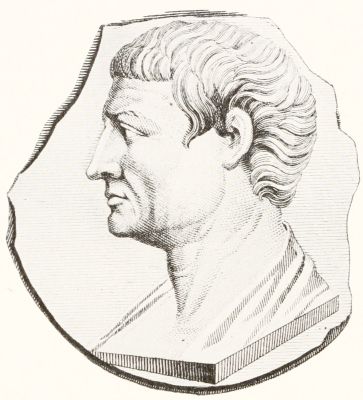
Fig. 1.—Aristotle, 384-322 B.C.
His Influence.—The influence of Aristotle was in the right direction. He made a direct appeal to nature for his facts, and founded his Natural History only on observation of the structure, physiology, and development of animals. Unfortunately, the same cannot be said of his successors.
Galen, who is mentioned above in connection with Aristotle, was a medical writer and the greatest anatomist of antiquity. On account of the relation of his work to the growth of anatomy, however, the consideration of it is reserved for the chapter on Vesalius.
Soon after the period of Aristotle the center of scientific investigation was transferred to Alexandria, where Ptolemy had erected a great museum and founded a large public library. Here mathematics and geography flourished, but natural history was little cultivated.
In order to find the next famous naturalist of antiquity, it is necessary to look to Rome. Rome, although great in political power, never became a true culture center, characterized by originality. All that remains of their thought shows us that the Roman people were not creative. In the capital of the empire, the center of its life, there arose no great scientific investigator.
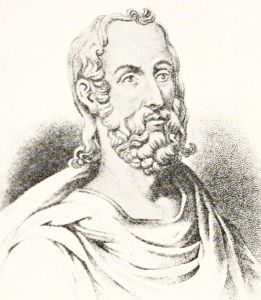
Fig. 2.—Pliny, 23-79 A.D.
Pliny.—The situation is represented by Pliny the Elder (23-79 A.D.), Roman general and littérateur (Fig. 2). His works on natural history, filling thirty-seven volumes, have been preserved with greater completeness than those of other ancient writers. Their overwhelming bulk seems to have produced an impression upon those who, in the nineteenth century, heralded him as the greatest naturalist of antiquity. But an examination of his writings shows that he did nothing to deepen or broaden the knowledge of nature, and his Natural History marks a distinct retrograde movement. He was, at best, merely a compiler—"a collector of anecdotes"—who, forsaking observation, indiscriminately mixed fable, fact, and fancy taken from the writings of others. He emphasized the feature of classification which Aristotle had held in proper subordination, and he replaced the classification of Aristotle, founded on plan of organization, by a highly artificial one, founded on the incidental circumstance of the abodes of animals—either in air, water, or on the earth.
The Arrest of Inquiry and its Effects.—Thus, natural history, transferred from a Greek to a Roman center, was already on the decline in the time of Pliny; but it was destined to sink still lower. It is an old, oft-repeated story how, with the overthrow of ancient civilization, the torch of learning was nearly extinguished. Not only was there a complete political revolution; there was also a complete change in the mental interests of mankind. The situation is so complex that it is difficult to state it with clearness. So far as science is concerned, its extinction was due to a turning away from the external world, and a complete arrest of inquiry into the phenomena of nature. This was an important part of that somber change which came over all mental life.
One of the causes that played a considerable part in the cessation of scientific investigation was the rise of the Christian church and the dominance of the priesthood in all intellectual as well as in spiritual life. The world-shunning spirit, so scrupulously cultivated by the early Christians, prompted a spirit which was hostile to observation. The behest to shun the world was acted upon too literally. The eyes were closed to nature and the mind was directed toward spiritual matters, which truly seemed of higher importance. Presently, the observation of nature came to be looked upon as proceeding from a prying and impious curiosity.
Books were now scarcer than during the classical period; the schools of philosophy were reduced, and the dissemination of learning ceased. The priests who had access to the books assumed direction of intellectual life. But they were largely employed with the analysis of the supernatural, without the wholesome check of observation and experiment; mystical explanations were invented for natural phenomena, while metaphysical speculation became the dominant form of mental activity.
Authority Declared the Source of Knowledge.—In this atmosphere controversies over trivial points were engendered, and the ancient writings were quoted as sustaining one side or the other. All this led to the referring of questions as to their truth or error to authority as the source of knowledge, and resulted in a complete eclipse of reason. Amusing illustrations of the situation are abundant; as when, in the Middle Ages, the question of the number of teeth in the horse was debated with great heat in many contentious writings. Apparently none of the contestants thought of the simple expedient of counting them, but tried only to sustain their position by reference to authority. Again, one who noticed spots on the sun became convinced of the error of his eyes because Aristotle had somewhere written "The face of the sun is immaculate."
This was a barren period not only for science, but also for ecclesiastical advance. Notwithstanding the fact that for more than a thousand years the only new works were written by professional theologians, there was no substantial advance in their field, and we cannot escape the reflection that the reciprocal action of free inquiry is essential to the growth of theology as of other departments of learning.
In the period from the downfall of Rome to the revival of learning, one eminent theologian, St. Augustine, stands in relief for the openness of his mind to new truth and for his expressions upon the relation of revelation in the Scriptures to the observation of nature. His position will be more clearly indicated in the chapter dealing with the rise of evolutionary thought.
Perhaps it has been the disposition of historians to paint the Middle Ages in too dark colors in order to provide a background on which fitly to portray the subsequent awakening. It was a remolding period through which it was necessary to pass after the overthrow of ancient civilization and the mixture of the less advanced people of the North with those of the South. The opportunities for advance were greatly circumscribed; the scarcity of books and the lack of facilities for travel prevented any general dissemination of learning, while the irresponsible method of the time, of appealing to authority on all questions, threw a barrier across the stream of progress. Intellectuality was not, however, entirely crushed during the prevalence of these conditions. The medieval philosophers were masters of the metaphysical method of argument, and their mentality was by no means dull. While some branches of learning might make a little advance, the study of nature suffered the most, for the knowledge of natural phenomena necessitates a mind turned outward in direct observation of the phenomena of the natural and physical universe.
Renewal of Observation.—It was an epoch of great importance, therefore, when men began again to observe, and to attempt, even in an unskilful way, hampered by intellectual inheritance and habit, to unravel the mysteries of nature and to trace the relation between causes and effects in the universe. This new movement was a revolt of the intellect against existing conditions. In it were locked up all the benefits that have accrued from the development of modern science. Just as the decline had been due to many causes, so also the general revival was complex. The invention of printing, the voyages of mariners, the rise of universities, and the circulation of ideas consequent upon the Crusades, all helped to disseminate the intellectual ferment. These generic influences aided in molding the environment, but, just as the pause in science had been due to the turning away from nature and to new mental interests, so the revival was a return to nature and to the method of science. The pioneers had to be men of determined independence; they labored against self-interest as well as opposition from the church and the priesthood, and they withstood the terrors of the Inquisition and the loss of recognition and support.
In this uncongenial atmosphere men like Galileo, Descartes, and Vesalius established the new movement and overthrew the reign of authority. With the coming of Vesalius the new era of biological progress was opened, but its growth was a slow one; a growth of which we are now to be concerned in tracing the main features.
The Epochs in Biological History
It will be helpful to outline the great epochs of biological progress before taking them up for fuller consideration. The foundation of progress was the renewal of observation in which, as already stated, all modern science was locked up.
It was an epoch in biological history when Vesalius overthrew the authority of Galen, and studied at first hand the organization of the human body.
It was an epoch when William Harvey, by adding experiment to observation, demonstrated the circulation of the blood and created a new physiology. The two coördinate branches of biology were thus early outlined.
The introduction of the microscope, mainly through the labors of Grew, Hooke, Malpighi, and Leeuwenhoek, opened a new world to the investigator, and the work of these men marks an epoch in the progress of independent inquiry.
Linnæus, by introducing short descriptions and uniform names for animals and plants, greatly advanced the subject of natural history.
Cuvier, by founding the school of comparative anatomy, so furthered the knowledge of the organization of animals that he created an epoch.
Bichat, his great contemporary, created another by laying the foundation of our knowledge of the structure of animal tissues.
Von Baer, by his studies of the development of animal life, supplied what was lacking in the work of Cuvier and Bichat and originated modern embryology.
Haller, in the eighteenth, and Johannes Müller in the nineteenth century, so added to the ground work of Harvey that physiology was made an independent subject and was established on modern lines.
With Buffon, Erasmus Darwin,, and Lamarck began an epoch in evolutionary thought which had its culminating point in the work of Charles Darwin.
After Cuvier and Bichat came the establishing of the cell-theory, which created an epoch and influenced all further progress.
Finally, through the discovery of protoplasm and the recognition that it is the seat of all vital activity, arrived the epoch which brought us to the threshold of the biology of the present day.
Step by step naturalists have been led from the obvious and superficial facts about living organisms to the deep-lying basis of all vital manifestations.
CHAPTER II
VESALIUS AND THE OVERTHROW OF AUTHORITY IN SCIENCE
Vesalius, although an anatomist, is to be recognized in a broad sense as one of the founders of biology. When one is attempting to investigate animal and plant life, not only must he become acquainted with the external appearance of living organisms, but also must acquire early a knowledge of their structure, without which other facts relating to their lives can not be disclosed. Anatomy, which is the science of the structure of organized beings, is therefore so fundamental that we find ourselves involved in tracing the history of its rise as one part of the story of biology. But it is not enough to know how animals and plants are constructed; we must also know something about the purpose of the structures and of the life that courses through them, and, accordingly, after considering the rise of anatomy, we must take a similar view of its counterpart, physiology.
The great importance of Vesalius in the history of science lies in the fact that he overthrew adherence to authority as the method of ascertaining truth, and substituted therefor observation and reason. Several of his forerunners had tried to accomplish the same end, but they had failed. He was indebted to them as every man is indebted to his forebears, but at the same time we can not fail to see that Vesalius was worthy of the victory. He was more resolute and forceful than any of his predecessors. He was one of those rare spirits who see new truth with clearness, and have the bravery to force their thoughts on an unsympathetic public.
The Beginning of Anatomy.—In order to appreciate his service it is necessary to give a brief account of his predecessors, and of the condition of anatomy in his time. Remembering that anatomy embraces a knowledge of the architecture of all animals and plants, we can, nevertheless, see why in early times its should have had more narrow boundaries. The medical men were the first to take an interest in the structure of the human body, because a knowledge of it is necessary for medicine and surgery. It thus happens that the earliest observations in anatomy were directed toward making known the structure of the human body and that of animals somewhat closely related to man in point of structure. Anatomical studies, therefore, began with the more complex animals instead of the simpler ones, and, later, when comparative anatomy began to be studied, this led to many misunderstandings; since the structure of man became the type to which all others were referred, while, on account of his derivation, his structure presents the greatest modification of the vertebrate type.
It was so difficult in the early days to get an opportunity to study the human body that the pioneer anatomists were obliged to gain their knowledge by dissections of animals, as the dog, and occasionally the monkey. In this way Aristotle and his forerunners learned much about anatomy. About 300 B.C., the dissection of the human body was legalized in the Alexandrian school, the bodies of condemned criminals being devoted to that purpose. But this did not become general even for medical practitioners, and anatomy continued to be studied mainly from brute animals.
Galen.—The anatomist of antiquity who outshines all others was Galen (Claudius Galenus, 130-200 A.D.), who lived some time in Pergamos, and for five years in Rome, during the second century of the Christian era. He was a man of much talent, both as an observer and as a writer. His descriptions were clear and forceful, and for twelve centuries his works exerted the greatest influence of those of all scientific writers. In his writings was gathered all the anatomical knowledge of his predecessors, to which he had added observations of his own. He was a man of originality, but not having the human body for dissection, he erred in expounding its structure "on the faith of observations made on lower animals." He used the right method in arriving at his facts. Huxley says: "No one can read Galen's works without being impressed with the marvelous extent and diversity of his knowledge, and by his clear grasp of those experimental methods by which alone physiology can be advanced."
Anatomy in the Middle Ages.—But now we shall see how the arrest of inquiry already spoken of operated in the field of anatomy. The condition of anatomy in the Middle Ages was the condition of all science in the same period. From its practical importance anatomy had to be taught to medical men, while physics and chemistry, biology and comparative anatomy remained in an undeveloped state. The way in which this science was taught is a feature which characterizes the intellectual life of the Middle Ages. Instead of having anatomy taught by observations, the writings of Galen were expounded from the desk, frequently without demonstrations of any kind. Thus his work came to be set up as the one unfailing authority on anatomical knowledge. This was in accord with the dominant ecclesiastical influence of the time. Reference to authority was the method of the theologians, and by analogy it became the method of all learning. As the Scriptures were accepted as the unfailing guide to spiritual truth, so Galen and other ancient writers were made the guides to scientific truth and thought. The baneful effects of this in stifling inquiry and in reducing knowledge to parrot-like repetition of ancient formulas are so obvious that they need not be especially dwelt upon.
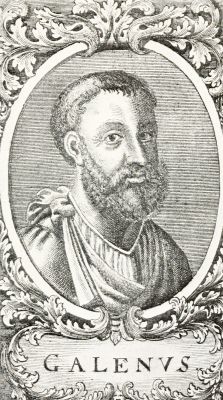
Fig. 3.—Galen, 131-200. From Acta Medicorum Berolinensium, 1715.
Predecessors of Vesalius.—Italy gave birth to the first anatomists who led a revolt against this slavery to authority in scientific matters. Of the eminent anatomists who preceded Vesalius it will be necessary to mention only three. Mundinus, or Mondino, professor at the University of Bologna, who, in the early part of the fourteenth century, dissected three bodies, published in 1315 a work founded upon human dissection. He was a man of originality whose work created a sensation in the medical world, but did not supersede Galen's. His influence, although exerted in the right direction, was not successful in establishing observation as the method of teaching anatomy. His book, however, was sometimes used as an introduction to Galen's writings or in conjunction with them.
The next man who requires notice is Berengarius of Carpi, who was a professor in the University of Bologna in the early part of the sixteenth century. He is said to have dissected not less than one hundred human bodies; and although his opportunities for practical study were greater than those of Mondino, his attempts to place the science of anatomy upon a higher level were also unsuccessful.
We pass now from Italy to France, where Sylvius (1478-1555), one of the teachers of Vesalius, made his mark. His name is preserved to-day in the fissure of Sylvius in the brain, but he was not an original investigator, and he succeeded only in "making a reputation to which his researches do not entitle him." He was a selfish, avaricious man whose adoption of anatomy was not due to scientific interest, but to a love of gain. At the age of fifty he forsook the teaching of the classics for the money to be made by teaching anatomy. He was a blind admirer of Galen, and read his works to medical students without dissections, except that from time to time dogs were brought into the amphitheater and their structure exposed by unskilled barbers.
Vesalius.—Vesalius now came upon the scene; and through his efforts, before he was thirty years of age, the idol of authority had been shattered, and, mainly through his persistence, the method of so great moment to future ages had been established. He was well fitted to do battle against tradition—strong in body, in mind, and in purpose, gifted and forceful; and, furthermore, his work was marked by concentration and by the high moral quality of fidelity to truth.
Vesalius was born in Brussels on the last day of the year 1514, of an ancestry of physicians and learned men, from whom he inherited his leaning toward scientific pursuits. Early in life he exhibited a passion for anatomy; he dissected birds, rabbits, dogs, and other animals. Although having a strong bent in this direction, he was not a man of single talent. He was schooled in all the learning of his time, and his earliest publication was a translation from the Greek of the ninth book of Rhazes. After his early training at Brussels and at the University of Louvain, in 1533, at the age of 18, he went to Paris to study medicine, where, in anatomy, he came under Sylvius and Günther.
His Force and Independence.—His impetuous nature was shown in the amphitheatre of Sylvius, where, at the third lecture, he pushed aside the clumsy surgeon barbers, and himself exposed the parts as they should be. He could not be satisfied with the exposition of the printed page; he must see with his own eyes, must grasp through his own experience the facts of anatomical structure. This demand of his nature shows not only how impatient he was with sham, but also how much more he was in touch with reality than were the men of his time.
After three years at the French capital, owing to wars in Belgium, he went back to Louvain without obtaining his medical degree. After a short experience as surgeon on the field of battle, he went to Padua, whither he was attracted by reports of the opportunities for practical dissection that he so much desired to undertake. There his talents were recognized, and just after receiving his degree of Doctor of Medicine in 1537, he was given a post in surgery, with the care of anatomy, in the university.
His Reform of the Teaching of Anatomy.—The sympathetic and graphic description of this period of his career by Sir Michael Foster is so good that I can not refrain from quoting it: "He at once began to teach anatomy in his own new way. Not to unskilled, ignorant barbers would he entrust the task of laying bare before the students the secrets of the human frame; his own hand, and his own hand alone, was cunning enough to track out the pattern of the structures which day by day were becoming more clear to him. Following venerated customs, he began his academic labors by 'reading' Galen, as others had done before him, using his dissections to illustrate what Galen had said. But, time after time, the body on the table said something different from that which Galen had written.
"He tried to do what others had done before him—he tried to believe Galen rather than his own eyes, but his eyes were too strong for him; and in the end he cast Galen and his writings to the winds, and taught only what he himself had seen and what he could make his students see, too. Thus he brought into anatomy the new spirit of the time, and the men of the time, the young men of the time, answered the new voice. Students flocked to his lectures; his hearers amounted, it is said, to some five hundred, and an enlightened senate recognized his worth by repeatedly raising his emoluments.
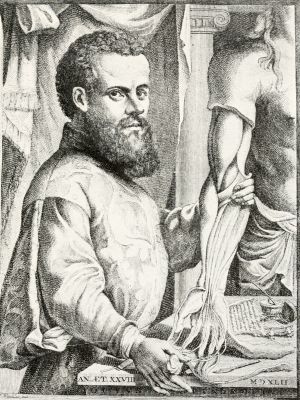
Fig. 4.—Vesalius, 1514-1564.
"Five years he thus spent in untiring labors at Padua. Five years he wrought, not weaving a web of fancied thought, but patiently disentangling the pattern of the texture of the human body, trusting to the words of no master, admitting nothing but that which he himself had seen; and at the end of the five years, in 1542, while he was as yet not twenty-eight years of age, he was able to write the dedication to Charles V of a folio work entitled the 'Structure of the Human Body,' adorned with many plates and woodcuts which appeared at Basel in the following year, 1543."
His Physiognomy.—This classic with the Latin title, De Humani Corporis Fabrica, requires some special notice; but first let us have a portrait of Vesalius, the master. Fig. 4 shows a reproduction of the portrait with which his work is provided. He is represented in academic costume, probably that which he wore at lectures, in the act of demonstrating the muscles of the arm. The picture is reduced, and in the reduction loses something of the force of the original. We see a strong, independent, self-willed countenance; what his features lack in refinement they make up in force; not an artistic or poetic face, but the face of the man of action with scholarly training.
His Great Book.—The book of Vesalius laid the foundation of modern biological science. It is more than a landmark in the progress of science—it created an epoch. It is not only interesting historically, but on account of the highly artistic plates with which it is illustrated it is interesting to examine by one not an anatomist. For executing the plates Vesalius secured the service of a fellow-countryman, John Stephen de Calcar, who was one of the most gifted pupils of Titian. The drawings are of such high artistic quality that for a long time they were ascribed to Titian. The artist has attempted to soften the necessarily prosaic nature of anatomical illustrations by introducing an artistic background of landscape of varied features, with bridges, roads, streams, buildings, etc. The employment of a background even in portrait-painting was not uncommon in the same century, as in Leonardo da Vinci's well-known Mona Lisa, with its suggestive perspective of water, rocks, etc.
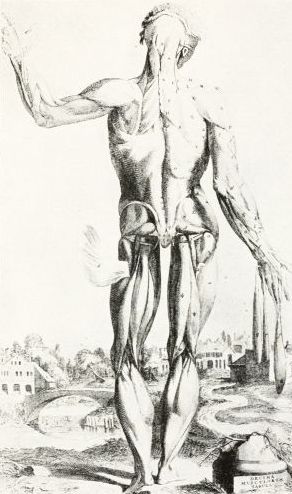
Fig. 5.—Anatomical Sketch from Vesalius's Fabrica. (Photographed and reduced from the facsimile edition of 1728.)
Fig. 5 will give an idea on a small scale of one of the plates illustrating the work of Vesalius. The plates in the original are of folio size, and represent a colossal figure in the foreground, with a background showing between the limbs and at the sides of the figure. There is considerable variety as regards the background, no two plates being alike.
Also, in delineating the skeleton, the artist has given to it an artistic pose, as is shown in Fig. 6, but nevertheless the bones are well drawn. No plates of equal merit had appeared before these; in fact, they are the earliest generally known drawings in anatomy, although woodcuts representing anatomical figures were published as early as 1491 by John Ketham. Ketham's figures showed only externals and preparations for opening the body, but rude woodcuts representing internal anatomy and the human skeleton had been published notably by Magnus Hundt, 1501; Phrysen, 1518; and Berengarius, 1521 and 1523. Leonardo da Vinci and other artists had also executed anatomical drawings before the time of Vesalius.
Previous to the publication of the complete work, Vesalius, in 1538, had published six tables of anatomy, and, in 1555, he brought out a new edition of the Fabrica, with slight additions, especially in reference to physiology, which will be adverted to in the chapter on Harvey.
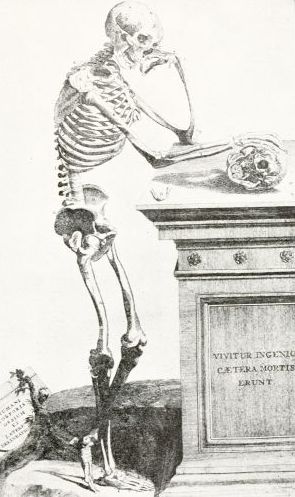
Fig. 6.—The Skeleton, from Vesalius's Fabrica.
In the original edition of 1543 the illustrations are not collected in the form of plates, but are distributed through the text, the larger ones making full-page (folio) illustrations. In this edition also the chapters are introduced with an initial letter showing curious anatomical figures in miniature, some of which are shown in Fig. 7.
Fig. 7.—Initial letters from Vesalius's Fabrica of 1543.
The Fabrica of Vesalius was a piece of careful, honest work, the moral influence of which must not be overlooked. At any moment in the world's history, work marked by sincerity exercises a wholesome influence, but at this particular stage of intellectual development such work was an innovation, and its significance for progress was wider and deeper than it might have been under different circumstances.
Opposition to Vesalius.—The beneficent results of his efforts were to unfold afterward, since, at the time, his utterances were vigorously opposed from all sides. Not only did the ecclesiastics contend that he was disseminating false and harmful doctrine, but the medical men from whom he might have expected sympathy and support violently opposed his teachings.
Many amusing arguments were brought forward to discredit Vesalius, and to uphold the authority of Galen. Vesalius showed that in the human body the lower jaw is a single bone—that it is not divided as it is in the dog and other lower mammals, and, as Galen had taught, also in the human subjects. He showed that the sternum, or breast bone, has three parts instead of eight; he showed that the thigh bones are straight and not curved, as they are in the dog. Sylvius, his old teacher, was one of his bitterest opponents; he declared that the human body had undergone changes in structure since the time of Galen, and, with the object of defending the ancient anatomist, "he asserted that the straight thigh bones, which, as every one saw, were not curved in accordance with the teaching of Galen, were the result of the narrow trousers of his contemporaries, and that they must have been curved in their natural condition, when uninterfered with by art!"
The theologians also found other points for contention. It was a widely accepted dogma that man should have one less rib on one side, because from the Scriptural account Eve was formed from one of Adam's ribs. This, of course, Vesalius did not find to be the case. It was also generally believed at this time that there was in the body an indestructible resurrection-bone which formed the nucleus of the resurrection-body. Vesalius said that he would leave the question of the existence of such a bone to be decided by the theologians, as it did not appear to him to be an anatomical question.
The Court Physician.—The hand of the church was heavy upon him, and the hatred shown in attacks from various quarters threw Vesalius into a state of despondency and anger. In this frame of mind he destroyed manuscripts upon which he had expended much labor. His disappointment in the reception of his work probably had much to do in deciding him to relinquish his professorship and accept the post of court physician to Charles V of the United Kingdoms of Spain and Belgium. After the death of Charles, he remained with Philip II, who succeeded to the throne. Here he waxed rich and famous, but he was always under suspicion by the clerical powers, who from time to time found means of discrediting him. The circumstances of his leaving Spain are not definitely known. One account has it that he made a post-mortem examination of a body which showed signs of life during the operation, and that he was required to undertake a pilgrimage to the Holy Land to clear his soul of sacrilege. Whether or not this was the reason is uncertain, but after nineteen years at the Spanish Court he left, in 1563, and journeyed to Jerusalem. On his return from Palestine he suffered shipwreck and died from the effects of exposure on Zanti, one of the Ionian Islands. It is also said that while on this pilgrimage he had been offered the position of professor of anatomy as successor to Fallopius, who had died in 1563, and that, had he lived, he would have come back honorably to his old post.
Eustachius and Fallopius.—The work of two of his contemporaries, Eustachius and Fallopius, requires notice. Cuvier says in his Histoire des Sciences Naturelles that those three men were the founders of modern anatomy. Vesalius was a greater man than either of the other two, and his influence was more far-reaching. He reformed the entire field of anatomy, while the names of Eustachius and Fallopius are connected especially with a smaller part of the field. Eustachius described the Eustachian tube of the ear and gave especial attention to sense organs; Fallopius made special investigations upon the viscera, and described the Fallopian tube.
Fallopius was a suave, polite man, who became professor of anatomy at Padua; he opposed Vesalius, but his attacks were couched in respectful terms.
Eustachius, the professor of anatomy at Rome, was of a different type, a harsh, violent man, who assailed Vesalius with virulence. He corrected some mistakes of Vesalius, and prepared new plates on anatomy, which, however, were not published until 1754, and therefore did not exert the influence upon anatomical studies that those of Vesalius did.
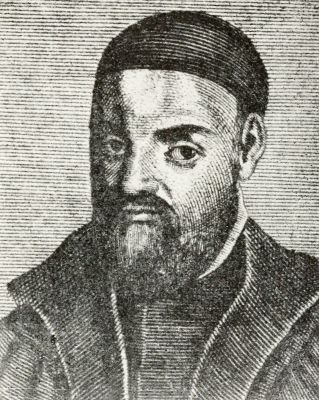
Fig. 8.—Fallopius, 1523-1563.
The Especial Service of Vesalius.—It should be remembered that both these men had the advantage of the sketches made under the direction of Vesalius. Pioneers and path-breakers are under special limitations of being in a new territory, and make more errors than they would in following another's survey of the same territory; it takes much less creative force to correct the errors of a first survey than to make the original discoveries. Everything considered, Vesalius is deserving of the position assigned to him. He was great in a larger sense, and it was his researches in particular which re-established scientific method and made further progress possible. His errors were corrected, not by an appeal to authority, but by the method which he founded. His great claim to renown is, not that his work outshone all other work (that of Galen in particular) in accuracy and brilliancy, but that he overthrew dependence on authority and re-established the scientific method of ascertaining truth. It was the method of Aristotle and Galen given anew to the world.
The spirit of progress was now released from bondage, but we have still a long way to go under its guidance to reach the gateway of modern biology.
CHAPTER III
WILLIAM HARVEY AND EXPERIMENTAL OBSERVATION
After the splendid observations of Vesalius, revealing in a new light the construction of the human body, Harvey took the next general step by introducing experiment to determine the use or purpose of the structures that Vesalius had so clearly exposed. Thus the work of Harvey was complemental to that of Vesalius, and we may safely say that, taken together, the work of these two men laid the foundations of the modern method of investigating nature. The results they obtained, and the influence of their method, are of especial interest to us in the present connection, inasmuch as they stand at the beginning of biological science after the Renaissance. Although the observations of both were applied mainly to the human body, they served to open the entire field of structural studies and of experimental observations on living organisms.
Many of the experiments of Harvey, notably those relating to the movements of the heart, were, of course, conducted upon the lower animals, as the frog, the dog, etc. His experiments on the living human body consisted mainly in applying ligatures to the arms and the legs. Nevertheless, the results of all his experiments related to the phenomena of the circulation in the human body, and were primarily for the use of medical men.
In what sense the observations of the two men were complemental will be better understood when we remember that there are two aspects in which living organisms should always be considered in biological studies; first, the structure, and, then, the use that the structures subserve. One view is essential to the other, and no investigation of animals and plants is complete in which the two ideas are not involved. Just as a knowledge of the construction of a machine is necessary to understand its action, so the anatomical analysis of an organ must precede a knowledge of its office. The term "physiological anatomy of an organ," so commonly used in text-books on physiology, illustrates the point. We can not appreciate the work of such an organ as the liver without a knowledge of the arrangement of its working units. The work of the anatomist concerns the statics of the body, that of the physiologist the dynamics; properly combined, they give a complete picture of the living organism.
It is to be remembered that the observations of Vesalius were not confined exclusively to structure; he made some experiments and some comments on the use of parts of the body, but his work was mainly structural, while that which distinguishes Harvey's research is inductions founded on experimental observation of the action of living tissues.
The service of Vesalius and Harvey in opening the path to biological advance is very conspicuous, but they were not the only pioneers; their work was a part of the general revival of science in which Galileo, Descartes, and others had their part. While the birth of the experimental method was not due to the exertions of Harvey alone, nevertheless it should stand to his credit that he established that method in biological lines. Aristotle and Galen both had employed experiments in their researches, and Harvey's step was in the nature of a revival of the method of the old Greeks.
Harvey's Education.—Harvey was fitted both by native talent and by his training for the part which he played in the intellectual awakening. He was born at Folkestone, on the south coast of England, in 1578, the son of a prosperous yeoman. The Harvey family was well esteemed, and the father of William was at one time the mayor of Folkestone. Young Harvey, after five years in the King's school at Canterbury, went to Cambridge, and in 1593, at the age of sixteen, entered Caius College. He had already shown a fondness for observations upon the organization of animals, but it is unlikely that he was able to cultivate this at the university. There his studies consisted mainly of Latin and Greek, with some training in debate and elementary instruction in the science of physics.
At Padua.—In 1597, at the age of nineteen, he was graduated with the Arts degree, and the following year he turned his steps toward Italy in search of the best medical instruction that could be found at that time in all the world. He selected the great university of Padua as his place of sojourn, being attracted thither by the fame of some of its medical teachers. He was particularly fortunate in receiving his instruction in anatomy and physiology from Fabricius, one of the most learned and highly honored teachers in Italy. The fame of this master of medicine, who, from his birthplace, is usually given the full name of Fabricius ab Aquapendente, had spread to the intellectual centers of the world, where his work as anatomist and surgeon was especially recognized. A fast friendship sprang up between the young medical student and this ripe anatomist, the influence of which must have been very great in shaping the future work of Harvey.