48. Study of a Picture Story
Reading edition
I
Oral Exercise. 1. What is happening in the first picture on the next page? Does the dog want to go along? Why do the boys not take him?
2. Make believe that you are the boy on the back seat in the boat. Look at the dog as that boy looks at him. Hold up your finger as the boy does. What does that mean? Now, as your boat slowly moves from shore, talk to the dog. Are you sorry that he must stay? How do you show that? Do you sternly warn him not to leave his post?
Group Exercise. 1. Some of your classmates will now play that they are talking to the dog. Each tries to show how it really happened.
2. The class will tell what it likes in each pupil's talking and playing, and what it does not like. The following questions will help the class:
1. Did the pupil talk as he really would talk to his dog if the class were not there to hear him?
2. What was the best thing he said?
3. What might he have said that he left out?
AN UNFINISHED STORY
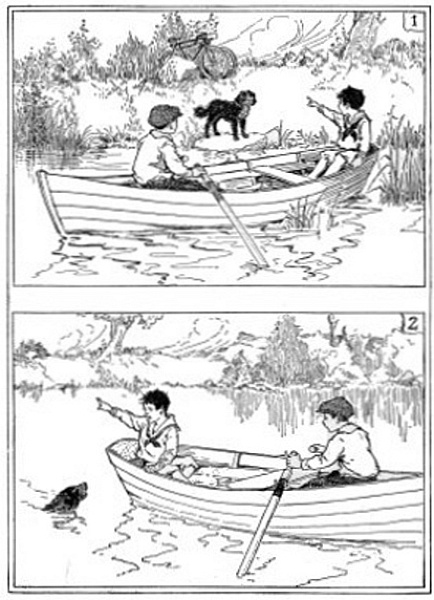
Oral Exercise. 1. You and a classmate may now play that you are the two boys in the first picture. Make believe that you are just arriving at the lake on your bicycles. Jump off and lean them against trees.[56] Talk about the lake and the beautiful day. Look the boat over and talk about your plan to go rowing. Talk about where to leave the bicycles. Decide to have the dog watch them. Explain this to the dog. Tell him you are sorry that he cannot go along. Then untie the boat, jump in, and push off. One of you is rowing. The other is sitting on the back seat and talking to the dog.
2. Two other pupils, and two others, may now play the same happenings.[57] They should try to talk exactly as they would if they were really the boys in the picture. Those two boys probably talked all the time.
Group Exercise. The class will tell what it likes in each playing of the picture, and what it thinks could be done better. The following questions will be useful in these talks:
1. Did the boys jump off their make-believe bicycles as if these were real? Did they lean them carefully against trees?
2. Did they talk together as if they were really on a day's picnic?
3. Did they get into the boat carefully? Did one of them row the make-believe boat as if it were a real boat? Did he look back now and then to see where he was going?
4. Which two boys played the picture best? Which two talked the best?
II
In the second picture the boys are seen on the water, well out from shore. They have just made an unpleasant discovery.
Oral Exercise. 1. Play that you are one of the boys in the boat and have suddenly discovered your dog in the water near by. Look as you think this boy looked. Say what you think he said to the dog. Say what he said to the boy rowing the boat.
2. Now, with a classmate, play this part of the story. Begin where you stopped in the first picture. You have left the dog on shore and are rowing out into the middle of the lake. What can you see out there? What do you say to each other? Think of the things that two boys out in a boat would talk about,—birds flying by, fish, the sky, the depth of the water, whether they could swim ashore. Say these things. Then, right in the middle of your good time, the dog! After you have scolded him, you and your classmate talk together about what to do. What does each say, and what do you decide?
Group Exercise. Other pupils will now play this part of the story in their own way. Each two will try to show the others the best way. After each playing, the class will talk about it. These questions will help the class to see whether the playing was good or not:
1. Did the players talk enough? What more could each one have said?
2. Did they act and move as if they were sitting in a boat out on a lake or as if they were standing on dry land?
3. Did they lean over the edge of the boat and look for fish? Did they speak about how the shore looked from the middle of the lake? Did they see other boats on the water?
Oral Exercise. How did the story end? Did the boys row on and let the dog swim after them until he got tired and returned to shore? Or did they take the wet animal into the boat and leave the bicycles to take care of themselves? What happened then? Were the bicycles still there when the boys returned from their boat ride? Tell your classmates how you think the story ended. If the ending is a good one, the teacher may ask you and other pupils to play it.
Group Exercise. The teacher will write some of the story endings on the board. Perhaps one or two pupils who have told good endings may write these on the board. Then the class will try to make each one better.[58] The following questions will help in this class work:
1. Does every sentence begin with a capital letter?
2. Does every sentence end with the right kind of mark?
3. Are there mistakes in any sentence?
4. Where can better words be used than those of the writer?
5. Where can a sentence or two be added to make the story better?
Written Exercise. Of all the story endings that have been corrected and rewritten on the board, the best one should now be copied. As you copy, notice the spelling of the hard words, the capitals, and the punctuation marks. Then, together with two or three classmates, correct your work and theirs.