35. Telling Interesting Things
Reading edition
Far north of us lies a part of the world where it is very cold both in summer and in winter. It is so cold there that trees cannot live. No cities are to be seen there, and no farms. The people who make their homes in this world of ice and snow live by hunting and fishing. They are called Eskimos. Their clothes are warm suits made of the fur of the polar bear, the seal, and the reindeer. Let us learn about the Eskimos.
HOW THE ESKIMO BUILDS HIS HOUSE
The house in which an Eskimo family lives is made of ice and snow. First the builder makes a ring on the snow-covered ground. This he makes as large as he wishes the house to be. On this ring he places blocks of snow. Then he lays more blocks on top of these. Each row or ring of blocks is a little smaller than the row or ring below it. As more and more rows of blocks are laid, these rows at last close the top like a roof. Then snow is shoveled over it, until not a crack remains in the solid wall.
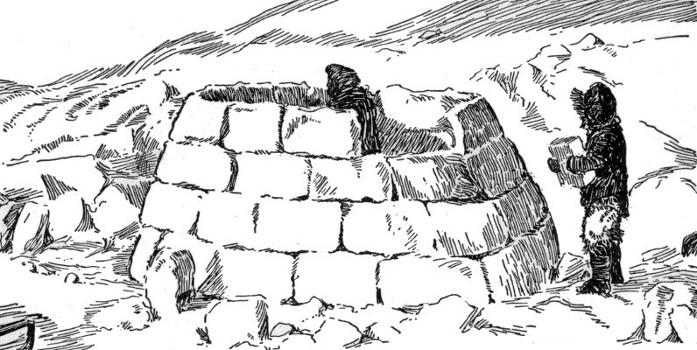
Now a narrow hallway is made. This is the only way into the house. It is long, and the opening is hung with skins. The Eskimos creep through it on their hands and knees.
There is only one window in the Eskimo's house. It is a small hole in the wall, over the low hallway. There is no glass in it, but it is covered with a thin skin that keeps out the wind and cold.[45]
Oral Exercise. 1. Can you think of a good reason why the Eskimos have no such houses as ours? Why have they no fine large coal or wood stoves in that cold country? What would happen if an Eskimo placed our kind of stove in his house and started a roaring fire in it?
2. The Eskimo has only three things with which to build. What are they? If you had only snow and the skins and bones of animals to work with, what kind of house should you make? Can you think of any way in which you could make the Eskimo house warmer or safer?
3. Does the Eskimo way of building a house give you an idea of a good way of building a snow fort? Tell your classmates what you think would be the best way of building one. Shall you put a roof over it?
4. Play that you are an Eskimo. Make believe that you are in the frozen North and are just beginning to build yourself a new house. You have already drawn a ring on the snow-covered ground. Draw a ring on the floor of the schoolroom with a piece of chalk. Other pupils will play that they have come to the Far North in a ship. They will pretend that they know nothing about the way Eskimos live or build their houses. They stand around while you work at your new house. They ask you many questions about it. Stop in your work and explain it to them. Remember that they know nothing at all about it. Perhaps some of their questions will seem very stupid to you. But patiently explain to these strangers everything they want to know.
Group Exercise. The class will tell you and the other pupils how the meeting between the Eskimo and the strangers might have been played better. But first they will point out what they liked in the play. Several other groups of pupils will each try to show the class how the meeting should be played.
Oral Exercise. Find out from a book or from your parents or your teacher some interesting fact about the Eskimos and the country where they live. Let it be something that you think the class does not know. The other pupils will do the same. Then each one will stand before the class and tell what he has learned.
Some might tell about how cold it is in this North-Pole part of the world.
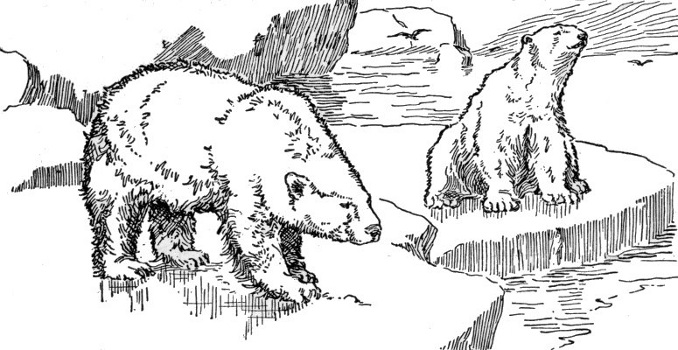
Some might tell about polar bears, seals, reindeer, or walruses.
Some might tell the class what Eskimos eat and how they cook their food.
Some might tell about the inside of the Eskimo house.
Other pupils might tell the class about some of the men from our country who traveled in this cold part of the world. Some of these men wished to reach the North Pole.
Group Exercise. When each pupil has spoken, some of those who spoke best will tell again what they said. The teacher will write on the board what they say. Now the class will try to make this better. The following questions will help the class improve what has been written on the board:[46]
1. What is the best part of the account on the board?
2. Is anything important left out?
3. Could anything be left out because it is not needed?
4. Are too many and's used?
5. What could be added to make the account better?
Written Exercise. When all the accounts on the board have been rewritten, study the one the teacher selects. Notice the spelling of the hard words. Notice the capital letter at the beginning of each sentence and the punctuation mark at the end of each sentence. This study will make it easier for you to write the account from dictation without making any mistakes. Write it from dictation.