16. More Telling about Indians
Reading edition
One way of starting fire was for several of the boys to sit in a circle and, one after another, to rub two pieces of dry, spongy wood together until the wood caught fire.—Charles A. Eastman (Ohiyesa), "Indian Child Life"
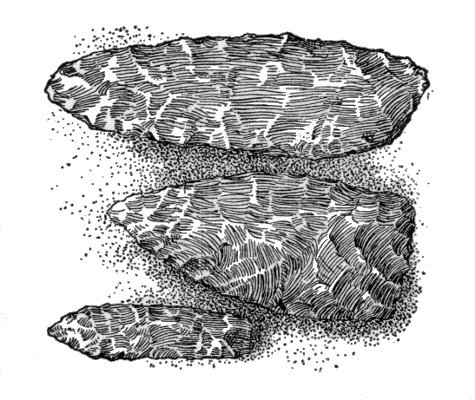
FLINT KNIVES
Oral Exercise. 1. Do you know in what kind of houses the Indians lived? Explain to the class how large you think an Indian house was, how it was made, and what kind of door it had. If you can, draw on the board a picture of the tepee about which you are talking.
2. In which of the following questions are you interested most? You probably know something about it already. Learn as much more as you can. Ask your teacher and your father and mother, and try to find something about it in books. Then tell your classmates what you know. If you can draw on the board[26] a picture of the thing about which you are talking, it may help your classmates to understand you better. Or you may make a drawing on paper with colored crayons.
1. What sort of boat did Indians use and how did they make it?
2. What did the Indians wear?
3. How were the Indian babies taken care of?
4. What did the Indians use for money?
5. How are the Indians of to-day different from the Indians whom the first white men saw?
Group Exercise. 1. After each pupil's talk the class should explain to the speaker, first, what they liked in the talk, and, second, how the talk might have been better.
2. One of these talks the teacher will write on the board.[16] Then the whole class should study it together, improving it as much as possible. The following questions may help in this work:
1. Is anything important left out?
2. What could be added to make the talk more interesting?
Written Exercise. 1. When the talk that you have just been studying has been rewritten on the board in its improved form, copy it. Before doing so, read the exercise that follows. It will show you why it is very important that you try to copy the talk without making a single mistake. Look out for the spelling of words, for the capital letters, and for the punctuation marks. In this way you will be preparing for the battle in the next exercise.
2. The entire class may now be divided into two Indian tribes. The tribes are to have a battle in the schoolroom. The battle will be a writing battle. It will show which tribe can write from dictation[18] with the fewer mistakes. What you have just copied from the board is to be used for this dictation. Before the exercise begins, each tribe may give its war whoop.
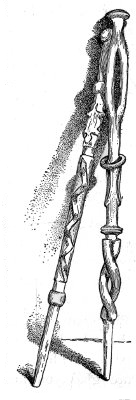
WALKING STICKS USED BY THE OLD MEN OF A TRIBE
3. Compare what you have written with what is on the board.[12] How many mistakes in spelling have you made? How many times have you written small letters where there should be capitals? How many punctuation marks have you forgotten? How many mistakes have all the Indians in your tribe made? Did your tribe make fewer mistakes than the other tribe? Then your tribe may give its war whoop as a sign of victory. The losing tribe must remain silent.