47. Telling Interesting Things
Reading edition
Oral Exercise. 1. What kind of dog should you like to have for your pet? Stand in front of the class and tell your classmates why you like that kind of dog and what you would do with him.
2. Dogs can do many useful things. Tell the class of a remarkable thing you have seen a dog do. If you cannot do that, tell of some intelligent and brave deed which you have heard that a dog did. Perhaps the following list will help you:
1. Some dogs are faithful watchdogs. They may be trusted to guard a house, a small child, an automobile, or a flock of sheep.
2. Some dogs are used in hunting.
3. Some dogs are good rat catchers.
4. Some dogs are taught tricks. Such dogs are sometimes seen at the circus.
5. In some countries dogs are used to haul carts; in others they draw sleds.
6. The St. Bernard dog and the Newfoundland dog are famous as life-savers.
7. Dogs make good playmates for boys and girls.
3. Think of a dog you like. Without telling what kind of dog he is, make your classmates see exactly how he looks. There is no need of saying that the dog has four legs, two ears, two eyes, and a tail. Every dog has these. But tell what the class must know in order to see the dog as you see him in your mind. Perhaps you will make the class see a picture something like one of the following:
I
My dog has long hair but he himself is short. He looks like a white muff. His bark and bite are sharp, but no one is afraid of him. He might just as well be a rabbit.
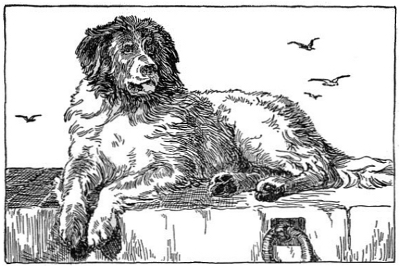
After a painting by Landseer
II
The dog I am thinking about is nearly as tall as I am. He is so heavy that I cannot lift him off the ground. He is so strong that he can carry me. His beautiful brown and white hair is long and curly. He is a good dog, and I should feel safe with him anywhere on the darkest night.
Group Exercise.[54] 1. The class will try to guess the kind of dog each pupil tells about. Then it will tell each speaker (1) what was good in his talk, and (2) where the talk might have been better.
2. Some of the talks should be given a second time. This time the teacher will write them on the board.[16] How can each of them be made better?
3. You and your classmates might make an interesting dog picture book. After writing about each dog, you could draw his picture or cut it out of a magazine and paste it beside what you have written.[55]