19. The Names of the Months
Reading edition
Here are two lists of names. The second gives the Indian names for the months. As you see, the Indians use the word moon instead of the word month.
January Snow Moon
FebruaryHunger Moon
MarchCrow Moon
AprilWild-Goose Moon
MayPlanting Moon
JuneStrawberry Moon
JulyThunder Moon
AugustGreen-Corn Moon
SeptemberHunting Moon
OctoberFalling-Leaf Moon
NovemberIce-Forming Moon
DecemberLong-Night Moon
Oral Exercise. 1. As you read the two lists above, do you see the reason for each Indian name? Do you like the Indian names as well as the names we use? Which Indian name do you like best of all? Which do you think could be improved? Can you make up other names for the twelve months?[29]
2. Can you name the twelve months in order? Remember to pronounce all the r's in February.
3. Let twelve pupils be the twelve months. Let the pupil who is January speak first. He should tell who he is and what he brings. He might speak as follows:
I am January. The Indians call me Snow Moon. I bring cold weather, ice, and snow. Healthy boys and girls like me. When I am here, they can go coasting and skating. When I bring too much cold, they stay indoors by the fire and read books about Indians.
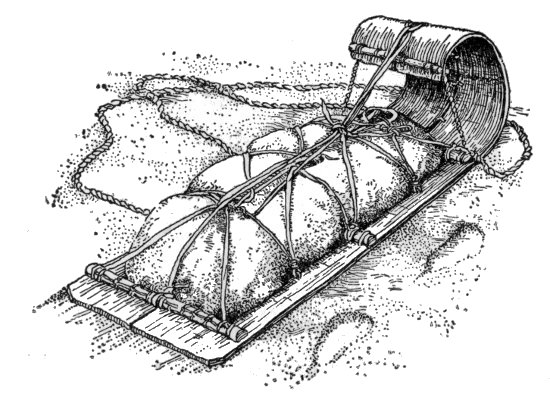
INDIAN SLED, OR TOBOGGAN
In this way each of the twelve pupils may tell the class what kind of month he is.
Group Exercise. After each month has spoken, the class should tell him, first, what was specially good in his talk, and then, what might have been better. These questions will help the class to see how good each talk was:
1. What was the best thing in the talk?
2. Did the speaker leave out anything interesting?
3. Did he use too many and's?[30]
Written Exercise. You and eleven classmates may go to the board. The teacher will name a month for each pupil. Each is to write a sentence that tells what he likes to do in one of the months. If you are to write what you like to do in November, you might write a sentence like the following:
In November I like to read books and play games by the warm fire.
While the twelve pupils are writing on the board, the pupils in their seats will write on paper.
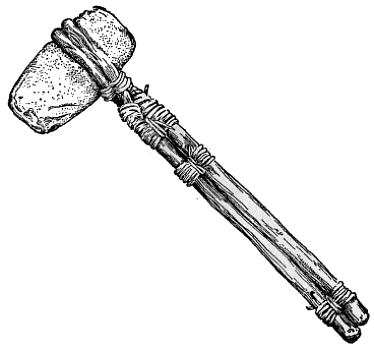
STONE AX
Do not forget that the name of every month begins with a capital letter. Do not forget that the word I is always written as a capital letter.
Group Exercise. 1. The class may now point out any mistakes there are in each of the twelve sentences on the board. These questions will help pupils to find mistakes:
1. Is the name of the month spelled correctly? Does it begin with a capital letter?
2. Does the sentence begin with a capital letter?
3. Does the sentence end with a period?
4. If the word I is used, is it written as a capital letter?
2. Now the sentences that pupils wrote at their desks may be read. Those that are very good may be written on the board under the ones about the same months. Then the class will point out mistakes in them, if there are any.