14. Telling about Indians[26]
Reading edition
14. Telling about Indians[26]
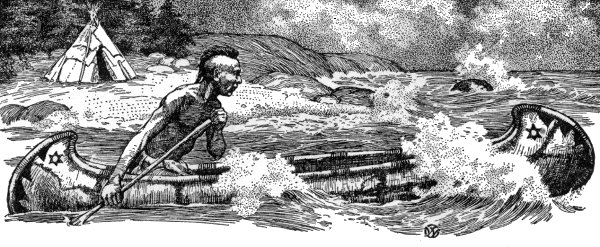
Long ago there were no cities and no railroads in our country. The white men had not yet come. Only Indians lived here. As you probably know, their houses were tents made of skins. They had no guns, but hunted with bows and arrows. Their clothes were very different from those we wear.
Oral Exercise. 1. You have probably read or heard interesting things about the Indians. What can you tell your classmates about them?
2. Of course you know that Indian children were not sent to school as you are. They did not learn to read books. Do you know what they did learn? Tell the class what you know about it.
3. Read what an Indian says in the following true story. When this Indian boy grew to be a young man, he learned English. He has written a number of books about his boyhood. As you read what follows, notice how many things you are told which you never heard of before. Perhaps you had thought that little Indian boys were never afraid of the dark. This story tells how they get over it. What else does it tell that is interesting to you?
AN INDIAN BOY'S TRAINING [B]
My uncle was my teacher until I reached the age of fifteen years. He was strict and good. When I left the tepee in the morning, he would say: "Boy, look closely at everything you see." At evening, on my return, he used to question me for an hour or so.
He asked me to name all the new birds that I had seen during the day. I would name them according to the color, or the shape of the bill, or their song, or their nest, or anything about the bird that I had noticed. Then he would tell me the correct name.
One day he told me what to do if a bear or a wild-cat should attack me. "You must make the animal fully understand that you have seen him and know what he is planning to do. If you are not ready for a battle, that is, if you are not armed, the only way to make him turn away from you is to take a long, sharp-pointed pole for a spear and rush toward him. No wild beast will face this unless he is cornered and already wounded."
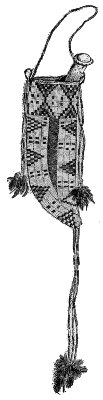
KNIFE IN ITS BEADED CASE
When I was still a very small boy, my stern teacher began to give sudden war whoops over my head in the morning while I was sound asleep. He expected me to leap up without fear, grasp my bow and arrows or my knife, and give a shrill whoop in reply. If I was sleepy or startled and hardly knew what I was about, he would laugh at me and say that I would never become a warrior. Often he would shoot off his gun just outside the tepee while I was yet asleep, at the same time giving bloodcurdling yells. After a time I became used to this.
My uncle used to send me off after water when we camped after dark in a strange place. Perhaps the country was full of wild beasts. There might be scouts from warlike bands of Indians hiding in that very neighborhood.
Yet I never objected, for that would have shown cowardice. I picked my way through the woods, dipped my pail in the water, and hurried back. I was always careful to make as little noise as a cat. Being only a boy, I could feel my heart leap at every crackling of a dry twig or distant hooting of an owl. At last I reached the tepee. Then my uncle would perhaps say, "Ah, my boy, you are a thorough warrior." Then he would empty the pail, and order me to go a second time.
Imagine how I felt! But I wished to be a brave man as much as a white boy desires to be a great lawyer or even President of the United States. Silently I would take the pail and again make the dangerous journey through the dark.—Charles A. Eastman (Ohiyesa), "Indian Child Life" (Adapted)
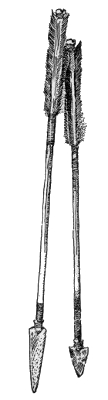
INDIAN ARROWS
Oral Exercise. 1. Play that you are an Indian boy or girl. Make believe that you are walking through the dark woods. Remember, there may be wild beasts in the woods, or the scouts of warlike Indian bands. Show the class how you would walk and how you would look about you as you picked your way to a spring to fetch water for the camp. Tell the class what you might see and hear on this dangerous trip.
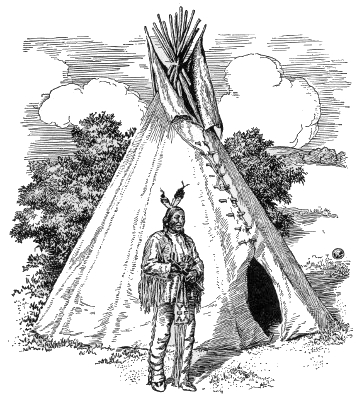
A TEPEE
2. Now let three or four of your classmates be white boys and girls. They are passing carefully through the same woods. Let these white children show the class exactly how they would make their way through the woods. What might they be whispering to each other?
3. Play that suddenly you and the white hunters meet in these dangerous woods. At first you see them a little distance away. What do you try to do? But they have also seen you. What do they try to do? At length you find that they are friendly, and they see that they need not fear you. When you meet them, what might you say to them? What questions might you ask them? What might they ask you?
4. Make believe that the white boys and girls know very little about Indian boys, and that they wonder why you are not in school studying your lessons. What will you tell them? When they ask you whether you never learn anything, tell them what you have learned in the woods.
5. Now tell them that you know nothing about the schools to which white children go. Ask them to tell you why they go to school and what they do there. Ask them more questions until they have told you all about their school.