17. Still More Telling about Indians
Reading edition
What boy would not be an Indian for a while when he thinks of the freest life in the world? This life was mine. Every day there was a real hunt.—Charles A. Eastman (Ohiyesa), "Indian Child Life"
Oral Exercise. 1. What did Indian boys and girls enjoy that you do not have? What pleasant things do you enjoy that the Indian children had never heard of before the white men came to this country?
2. Make believe that you are an Indian boy or girl. Play that you have been asked by the teacher to visit the school. The teacher asks you to tell about your pleasant life in a tepee in the woods, and why you are glad you are an Indian. The teacher will meet you at the door, lead you before the class, and say something like this:
Boys and girls, I want to introduce you to our visitor. As you see, he is an Indian boy, who has come to us from his home in the woods. He will tell us why he likes the Indian life and why he would not exchange places with us.
What will you say to the class?
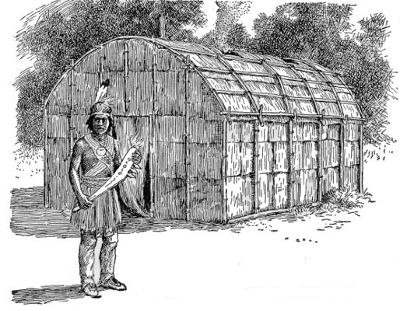
BARK WIGWAM WITH CURVED ROOF
3. Now play that the class is a tribe of Indians. You have been captured by them as you were wandering through the woods.[27] They want you to live with them and to grow up with the Indian boys and girls. Stand before this Indian tribe. Tell them bravely why you would rather stay with the white men. Ask them to let you return to your home. Give good reasons why they should do so. Which of the following ideas will you use in your talk?
1. You would rather spend your life in the city than in the woods.
2. You like the white men's houses and ways of living better than those of the Indians.
3. You want to learn to read better so that you may enjoy many storybooks of which you have heard.