Chapter VII · GORELOVKA AND QUEEN LUKERIA
Reading edition
Discussing the projects of our future travel, I was reminded by Colonel Tarasoff that we must not fail to make a stay in one of the villages of Russian peasants which were situated upon the route of our journey south. The Governor had so often sung the praises of these villagers that we were all anxious to comply with his advice. If only this fertile country could be inhabited by such a peasantry; what crops it would bear, what riches it would produce! He added: “Be sure to visit Gorelovka; there you will see what Russian colonists can bring to pass.”
Russian colonists! But, of course, Russia is not yet in a position to colonise, however much these distant provinces of her Asiatic empire may be in need of new methods, of new blood. Indeed, the rulers of Russia early recognised the expediency of introducing into their lawless possessions beyond Caucasus a leaven of orderly and strenuous elements from the West; and in the dearth at home of such material, which might be available for the purpose, they invited or encouraged settlements from abroad. It is possible that they were shown the way by the finger of Providence; it is at least certain that, when once the favourable opportunity arose, they did not suffer it to pass them by. In the earlier years of the present century the kingdom of Würtemberg was the scene of a struggle among the Protestant community, of which the origin was no less curious than the results were strange. It had been solemnly announced by several popular pastors that the second coming of Christ was near at hand. Such was the confidence of the reverend teachers in their prophetical powers, that they had already fixed the date when the sun and moon should be darkened, the celestial bodies should reel, the ocean roar, and men expire from fright before the crowning event had been accomplished—the Son of Man appearing with glory in the clouds. These signs and stupendous portents should be revealed to a distracted world in 1836.
The fate or fortune of these German settlements was recalled to me at Akhalkalaki not only by the mention of the Russian colonial experiment, but also through our intercourse with a forlorn individual, whose history linked him with the early history of that courageous company. What use to conceal his name, since I cannot hide his identity, since I am only dealing with the current facts of provincial life? It was the mission of Sembat Baghdasareantz to sow abroad the seeds of the Gospel, carrying his liberty and even his life in his hand. An Armenian by birth, he had pursued his studies in Europe, where he had resided among the Methodists of Frankfurt, although not a member of that persuasion himself. A Protestant, he disclaimed allegiance to any particular denomination; he belonged to the society of Evangelical preachers which had been founded some seventy years ago in Shusha, the capital of the province of Karabagh, by missionaries from Basle. Zaremba is the name of the teacher whom his successors most closely associate with the origin and early struggles of their brotherhood; his memory is joined with that of his colleague Dittrich, who shared his labours from the first. These missionaries represented a Society whose devout zeal had been directed to the Mohammedans of distant Persia; prudence dictated the choice of a base within the territory of Russia; yet the Russian Church was a formidable enemy on Russian soil. She claimed the right of baptizing and holding within her own communion all converts to the Christian faith. But an exception had been made in favour of those communities of heterodox Christians which were tolerated by the Russian State; it was permissible for a Mohammedan to become converted to their tenets and to be enrolled as a member of their sect. The Society of Basle were therefore encouraged to attempt the expedient of a protected colony, which should receive a special charter from the Russian Government and be invested with the character of a tolerated sect. An example of such a colony was already before them; their Scotch brethren were engaged in preaching to the mountaineers of Caucasus from an adopted home at Karass. In the pursuit of this purpose, Zaremba and Dittrich were sent to St. Petersburg in 1821. They were received by the same Alexander who had favoured the Germans, and in a spirit which partook of their own zeal. Liberal provisions were attached to the charter of their prospective colony, among which the right of baptizing converts was included. They were further authorised to establish a printing press, to found elementary schools, and to organise a seminary in which the higher learning should be dispensed. In the meanwhile they were invited to travel in Transcaucasia with the view of selecting a locality for their future home.
When the missionaries arrived in Georgia in the spring of 1823, their interest was aroused by the condition of the German colonists—their co-religionists, almost their countrymen, settled in this remote country without spiritual direction, without the elements of ecclesiastical order. Could there exist a prior claim upon their own activities than was furnished by the spectacle of this flock without shepherds, severed from the homestead and wandering where it might? Their first summer was devoted to the charge of these brethren, among whom the slow blight of purely worldly preoccupations had already sapped the vigour of early zeal. The success of their efforts appears to have awakened the Lutheran Consistory of St. Petersburg, to whom the spiritual interests of their co-religionists in Russia are entrusted by Russian law. The Consistory sent a pastor, duly commissioned; and the colonists were resigned into his hands. But the hardy Germans had not quarrelled with ecclesiastical authority in their native country in order to subject themselves to similar tyranny in their new seats; they disclaimed any connection with the Consistory, and refused to accept its nominee. The dispute was referred to Alexander, and was by him decided with his usual good sense. He consented that the Society of Basle should supply them with pastors, and he went so far as to endow their churches himself.
In the eyes of a philosopher the Dukhobortsy may appear to practise pure religion, and to observe the spirit of the teaching of Christ. Yet in the view of the majority of Christians their doctrines would be deemed heretical and their religious usages would be condemned. Such an attitude is the fruitful parent of misrepresentation and calumny; and the account of them which we received from our itinerant preacher was not untinctured by these defects. In justice to him one must remember that his own services would be repudiated by these fellow-offenders with him against the majesty of the Orthodox Church; that neither a Zaremba nor an Eli Smith would be welcomed by these simple peasants and solicited to direct and elevate their spiritual life. The imagination of the Oriental may have been coloured by the prejudice of the Christian teacher; yet I cannot doubt that the tales which he told us about them were widely current in the gossip of the countryside. According to Sembat, considerable mystery surrounded the religion of these peasants, which he himself had not sufficient knowledge to dispel. Pagan practices were freely imputed to them; and they were said to worship images of birds and beasts. Whether they worshipped them, or only regarded them as symbols, it was at least certain that they were in the habit of making such images, and we could judge for ourselves what purpose they served. And then he related to us a portion of the story of Lukeria—half-goddess and half-queen.
September 5.—In the East mankind is usually a monotonous animal, which you would scarcely notice, such is the majesty of his natural surroundings, were it not for the needs which you share in common with him, and which he most indifferently supplies. It was therefore with expectations of no ordinary character that we set out from Akhalkalaki to visit the Russian colonies on the southern margin of the great plain. The direct distance between the town and Gorelovka, the principal settlement, is seventeen miles. The road, although it constitutes the avenue of communication with Alexandropol, is little better than a track. In places the carriage is jolted in a merciless manner by protruding boulders, embedded in the soil. We started at half-past two, on a course a little east of south; the vastness of the expanse and the billowing surface of the naked soil suggested the appearance of the sea. But the horizon was outlined by the forms of lofty ranges, encircling the floor of the plain. Banks of white and grey cloud were suspended about their summits, while the zenith was blue and the air crisp, yet full of sun.
At three o’clock we gained the margin of the Toporovan river, a flash of water slowly flowing over the surface of the plain. On the further bank a small Armenian village; a little Tartar settlement on this shore. We paused awhile, that we might realise the features of the landscape, the same we had commanded from the summit of Abul. On our left hand we were skirting some stony hummocks, which flank the mass of Abul. That broad-based mountain rose beyond them, closing the landscape in the east. On our point of course, some eight miles distant, a range of gentle vaulting stretched from east by south to west by north. It may be identified with the outer framework of the mountains which encircle Lake Chaldir. In the south-west we discerned a break in the ranges, the distant passage of the Kur. On our right the level plain; and beyond it, at a long interval, the lofty ridges which border the Kur on the left bank. Behind us, from a second cleft or opening in the mountains, a long serrated ridge, which belongs to the northern border ranges, and which formed a striking feature in the prospect from Abul. This chain and that in the west appeared to be the highest, except for the nearer outline of Abul.
Bogdanovka is not a favourable specimen of its species. I did not notice any appreciable contrast between the Russian and the Armenian village; it is indeed possible that they may have mutually affected one another, not to the advantage of the Russian settlement—in both cases rambling, stone-built tenements, and flat roofs, topped with turf. Dirty little lanes, of uneven surface, debouch upon the principal street. But the gait, the physiognomy of the two races—what a remarkable contrast in this respect! Large, lustrous, coal-black eyes: little, colourless pupils; shapely features, animate with expression: formless protuberances from a massive, heavy skull. The ugliness of the women especially appalled us, and we were impressed with the deliberate slouch of the men’s walk.
We had come a distance of 18 versts (12 miles). After changing horses, we gained some rising ground on the further side. From here we could see Lake Chonchal, with a village at the foot of the rising ground on its opposite shore. In half an hour we were at the tiny lake and village of Orlovka—a ragged-looking place, of which a striking feature was the stacks of tezek or dried manure. This was the second Russian village; we were disappointed. Gorelovka, the goal of our journey, was to come next.
The range on our left still continued; but on our right the hills had receded, and were replaced by gently rising ground. Patches of arable land mounted the slopes about us, suggesting that the rising tide of reclamation was flowing into these remote solitudes. We noticed that the soil had become more turf-like and fibrous in character; we thought it well adapted to potato culture, but not a field of potatoes could we see. These uplands provide good pasture during summer and sweet hay for the long winter months. It was a landscape of open downs at a great elevation; we had reached a height of some 7000 feet. Such are the bleak surroundings of Gorelovka. We were chilled to the bones when we arrived at half-past six.
The impression which we had received at the two smaller villages was quickly dispelled by our new surroundings. Great was our pleasure when we recognised that the high opinion of Colonel Tarasoff was amply justified by those to whom it applied. It is true that these sectaries are the flower of the peasantry in Russia; but that peasantry is none the less honoured by what they have achieved.
A Dukhobortsy village is not built into the earth, like the burrows of the Armenians and the Kurds. The Russians cheat the climate by the additional thickness which they put into their solid stone walls. Their dwellings are low, one-storeyed houses; the masonry is covered over with plaster, which receives several coats of whitewash. A long street traverses the village—straight, broad and well maintained; the houses are aligned upon it at intervals. The roofs are almost flat, and consist of stout beams, supporting a superstructure of earth and sods of turf. The chimneys are mere apertures in the roof, protected by little wooden hoods. We found the interiors clean and comfortable; the wooden ceilings are neatly mitred, and the walls are distempered white. The deep embrasures of the windows testify to the thickness of the walls. In some of the Russian settlements, through which we passed later, the people had adorned their homes with gay shutters and combings of fretwork design; in Gorelovka no work of fancy adorns the dwellings of the peasants, and they have lavished all their skill in wood-carving upon the residence of their queen.
The inhabitants are tall and powerfully built, and, although they are bronzed in complexion almost beyond recognition, the fair hair bears witness to their northern origin. Their limbs are loosely put together, so that, apart from the difference of their dress and demeanour, they present a strong contrast to the neatly-made natives of the country, by reason of their lofty stature and the unbuckled slouch of their walk. The features are irregular, the eyes small, and the countenance is wanting in animation, in the case of both women and men. The dress of the men consists of dark blue trousers and jacket and a peaked military cap; this costume gives them the appearance of old soldiers, and all seem to shave the beard. The women wear very clean cotton dresses of showy patterns and bright hues.
Next morning, according to arrangement, we were to visit, in company with our host, Alexei Zupkoff, the venerable starshina, or head of the village, the residence and garden of the queen. The brother of the queen joined our party—Michael Vasilievich Ghubanoff, the same of whom Count Tolstoy speaks. We passed down the long, straight street of the village, the spacious intervals between the white houses opening to the breezy downs. Entering an enclosure, we found ourselves in a delightful flower-garden, among trees and thick rose-bushes, allowed to spread in freedom, and only saved from rankness and riot by the loving hand of man. How strange, after our wanderings among peoples whose material standards hover on the extreme margin where life is just possible and no more, appeared to us the sight of these garden flowers and the scent of the double rose. A low one-storeyed building faces the garden on two sides; the one wing contains the chapel and reception room, the other the private apartments in which the queen used to live. Passing within the doorway, we stood in a little hall from which rooms opened, one on either side. Both apartments are spacious, and their size was enhanced by the complete absence of furniture. Large stone stoves are built into the rooms, and form the most prominent feature in them; these stoves are usual in all the houses, but in this house they are decorated with a scroll of stone carving, which is not the case elsewhere. The ceilings are low, and the walls are so thick that the windows have the appearance of fortress embrasures, with their deep cavernous sills. The two large rooms on either side of the hall were formerly devoted, the one to prayer meetings and the other to social gatherings; but it was evident that they were not in use at the time of my visit, and I was told that assemblies in this house had been interdicted by Government, on account of the fresh outbreak of fanaticism which was apprehended should the people come together beneath the roof of their former queen.
The general arrangement and appearance of the chapel or apartment in which they used to meet for prayer is this—the low ceiling is composed of narrow pine planks, the surface being relieved by delicate wood beadings along the seams where plank meets plank. The large pier of the stove projects boldly into it from the side of the door. The walls of such rooms are in general covered with a neat paper of common Russian pattern, and the floors are either painted a reddish colour, or the boards are left natural, and stopped, and scrubbed daily, like the deck of a yacht. Round this particular apartment there runs a low bench; this is the only sitting-place. Large pots of flowers, carefully pruned and tended, bloomed in the deep embrasures of the windows, and broke the light, diffused about the sober apartment in a warm and regular glow. In that part of the building where the queen used to live, the rooms, although smaller, presented a similar appearance; they were maintained in the same state of scrupulous cleanliness as though she inhabited them still. The furniture had all been removed from them; but, in addition to the pots of beautiful flowers, there was in each a dish of Easter eggs.
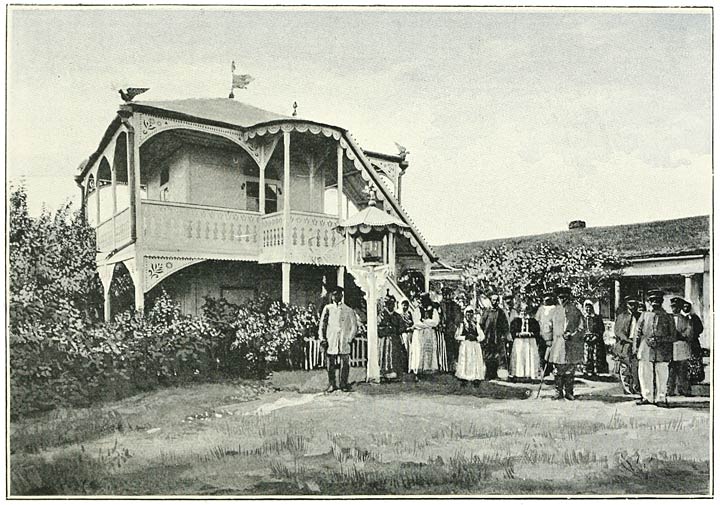
Fig. 21. Summer Pavilion at Gorelovka.
In the centre of the garden among the rose-bushes stands the summer pavilion of the queen (Fig. 21). The kernel of the structure may be described as consisting of two square boxes, placed one above the other, and serving as living rooms. Each side of the upper room is broken by a large window; so that the view from within embraces the whole settlement and all the landscape around. The lower room contains a bed and a row of pegs, on which, behind a light covering, hang the dresses of the queen; that above is bare of all furniture, and was always used as a sitting-room. A broad wooden balcony with staircase runs round this inner kernel, supported on pillars of wood. They have lavished all their skill upon the decoration of this balcony, enriching it with delicate fretwork traceries and with figures placed at the angles of the roof. At each corner sits a dove with wings outspread, while on the summit of the roof a dove is just alighting, the wings just closing, the legs outstretched. In front of the pavilion, on the side of the house, there is a large standard lantern, a work of curious design and fancy, surmounted by an image of St. George and the dragon, carved with much life and vigour in wood.
By my side stood the man who had made these images, and I asked him whether they had any religious meaning, peculiar to their creed. I was loath to put the question, so obvious was their purpose, so universal the symbolism they implied. He answered good-humouredly that they were pure ornaments, and that he was flattered by my appreciation of his skill.
In a room, removed from the part of the village in which the queen lived, they showed us her furniture and effects, her personal ornaments, and every detail of her attire. Everything that belonged to her had been carefully kept and cherished, like the relics of a saint. Her possessions had been those of a simple peasant woman, verging on the middle class—a velvet chair or two, some statuettes in plaster, a few chromo-lithographs. Many trays of coloured Easter eggs were here collected—the offerings, I suppose, of many happy Easters, when she had led their congregations of prayer.
The moral ideas of the Dukhobortsy are such as might be expected from a people who hold this lofty view of the nature of man. Man, being the receptacle of the divinity, must not injure, must not kill his fellow-man. Hence they do not see the necessity of judicial tribunals; for they do not wish to wrong any man. Nor do they consider that one man should exercise authority over another; each one must do his duty, because it is his duty, and no compulsion can be necessary from outside.
That from such peaceful surroundings there should issue fierce dissensions, that a people trained to mutual love and forbearance should be inflamed by the worst passions of an opposite nature, and turn the hand which they had been unwilling to lift against their fellow-men upon the brothers of their own creed, is a melancholy example of the failure of purely emotional methods to elevate permanently the nature of man. It seems there are no short cuts to virtue; the standards attained under the impulse of religious enthusiasm have but an ephemeral life. With the death of Lukeria was removed the personality and visible example for which simple natures crave; and the exaggeration of sentiment, of which she had been the object, brought with it its own revenge. Although cut off at the early age of forty-three years, the queen was already a widow when she died. Her marriage had been childless, and, even had she possessed a natural successor, the place which she occupied in the imagination of her people would perhaps have been impossible to fill. Yet scarcely a year had elapsed from the time of her death when a pretended successor arose—a boy, who, I believe, claimed relationship with her, and who presumed to be worthy to wear the mantle which had hitherto descended on none. The inhabitants of Gorelovka, whose version of the story I am giving, were emphatic in their statement that this youth was an impostor. “He told lies,” was the expression which they used. His authority had never been acknowledged by them, and he had stirred up their own brethren against them. I gathered that they had not stopped short of actual violence in the ardour of religious and partisan zeal. Gorelovka, it appears, had been solid against the usurper; but opinions had been divided in the neighbouring villages and throughout the community settled in Transcaucasia of the Dukhobortsy sect. The Russian Government, as was natural, surveyed the situation from the standpoint of hard-headed prudence; they were not anxious to see installed a successor to Lukeria and a revival of the old religious flame. The weight of their authority was thrown in the scale against the pretender; he was suppressed without delay and banished from the country to a remote exile in the north.
At the time of our visit the feud was slumbering; Count Tolstoy informs us how it broke out anew. It would appear that the pretender—his name was Peter Veriguin—was supported by the large majority of the Dukhobortsy, who were incensed at the action of the authorities in making over to the brother of Lukeria, our friend Ghubanoff, the succession to the communal funds. From his place of exile Veriguin corresponded with his disaffected brethren; Government, apprised of the fact, removed him to Siberia during the winter of 1894–5. While he was in Moscow on his way to the land of forgetfulness, he was visited by his relations and by some of his spiritual allies. Them he charged to convey a proposal to the brethren: that they should abstain from participation in the violent acts of Government, should refuse to serve in the capacity of soldiers, and should destroy all their arms. This proposal was accepted by the whole of the larger party; and they prepared to translate it into action without delay.
In the Government of Elizabetpol, on the first day of the festival of Easter, eleven Dukhobortsy, who were performing military service with a reserve battalion, refused to parade, and formally signified that they intended to serve no more. At their head was an individual who, in spite of his legal disability as a sectarian, had been promoted to the rank of a non-commissioned officer for his high qualities and the exceptional nature of his deserts. Their example was followed in other provinces, in Akhalkalaki, in Kars. No pains were spared by the authorities to save them from their rashness; when persuasion failed, fear was tried. Five recalcitrants in Akhalkalaki were taken into the prison yard and placed in line. A firing party of Cossacks was called in and ordered to load with ball; the prisoners asked and received permission to pray. The command “make ready” was next issued, and a few minutes passed. The former soldiers quietly awaited the word to fire. It was not given; the muzzles were lowered, and they were conducted to their cells. In other places Cossacks charged the prisoners and made pretence to cut them down. When the sectarians still persisted in their decision, they were beaten with the lash. Asked how they justified their action, they answered that they were Christians, endeavouring to observe the precepts of Christ. Nor was their refusal to serve in the army the only issue with Government into which they were carried by their aversion to violence in human affairs. It so happened that a certain prisoner, in course of transportation, was brought to one of their villages. It was the duty of the elder of the village to provide for his further escort and to hand him over to a sure man. This charge had fallen by turn upon the brother of the sergeant who had renounced service on the first day of Easter. The man informed the elder that he could not escort the prisoner because he would be unable to use force. He asked him to report his refusal to the authorities; but the elder answered that he was not prepared to turn traitor; he should bring the prisoner to the house of his temporary warder, who would act as he thought best. The man returned to his house; the elder brought the prisoner, and went away. The warder treated his charge as though he were a pilgrim, warmed him, gave him to eat and drink, gave him a bed. Next morning, observing that the prisoner was a poor man, he supplied him with money and offered to direct him on his way. When they had arrived outside the village, he showed him two roads, of which he gave him the choice. He told him that the one led to his destination as prisoner and the other to liberty. The prisoner preferred the first road, and came to the place of his destination. In this case no evil consequences ensued.
In 1895 the prison of Elizabetpol contained no less than 120 members of the Dukhobortsy sect. All had been sentenced for offences of the nature already described; but the crown of the people’s offence was not yet come. In a country where the holding of arms is regarded in the light of a civil duty, they determined to burn every weapon in their possession of which the purpose was to kill men. The night of the 28th of June, the eve of the feast of Peter and Paul, was chosen for the simultaneous execution of this resolve. In Kars and in Elizabetpol the event passed off without serious trouble; but the case was different in the province of Akhalkalaki. About three versts from the village of Orlovka there is an excavation in the rock, which the people call “The Cave.” In this spot it was their habit to hold their large prayer meetings; it was now chosen as the tryst for the burning of arms. On the appointed night about 2000 people were there collected; a pile was made, fuel and petroleum added, and the whole ignited in due course. In the morning, when the flames were exhausted, the assembly offered up prayer, and each man returned to his home. The day passed quietly; they returned in the evening, and collected together the metal parts which had escaped the fire. These they melted into a mass, in the presence of a still larger concourse, among whom were many women and young children.
Reflecting upon this story after reading these accounts, the mind travels back to the dawn of Christianity and to the annals of the early Church. The famous letter of Pliny appears fresh and modern, while the grave language of the London Times in the leading article which it publishes mingles naturally with the spirit of a pre-Christian age: “The first principles of their creed lead straight to social anarchy, tempered only by the whims of the ‘sons of God.’ They are doubtless sincere fanatics, and as such must be looked upon with a measure of pity and respect.” It is interesting to place by the side of this paragraph in a modern newspaper the words of the great historian of the Roman world: “The Christians were not less averse to the business than to the pleasures of this world. The defence of our persons and property they knew not how to reconcile with the patient doctrine which enjoined an unlimited forgiveness of past injuries and commanded them to invite the repetition of fresh insults. Their simplicity was offended by the use of oaths, by the pomp of magistracy, and by the active contention of public life; nor could their humane ignorance be convinced that it was lawful on any occasion to shed the blood of our fellow-creatures, either by the sword of justice or by that of war, even though their criminal or hostile attempts should threaten the peace and safety of the whole community;... while they inculcated the maxims of passive obedience, they refused to take any active part in the civil administration or the military defence of the empire.... This indolent, or even criminal disregard to the public welfare exposed them to the contempt and reproaches of the pagans, who very frequently asked, What must be the fate of the empire, attacked on every side by the barbarians, if all mankind should adopt the pusillanimous sentiments of the new sect?”
Have the Christians of the present day become pagans, or did the pagans only change their name?